88 percent of audiences value brand authenticity, but the majority of marketers are ignoring the one strategy that will meet this demand.
As marketers, it’s natural to focus our efforts on what we can immediately control rather than put energy into big-picture changes that may require a larger (and far longer) organizational shift to achieve. We look for opportunities presented as low-hanging fruit to deliver quick, controllable wins that move the needle and validate our assumptions. It can be misconstrued as a foundational marketing strategy rather than what it truly is: putting a Band-Aid on something that requires a different set of tools to make it better.
Less than half of marketers surveyed believe that their brand messaging, authenticity, positioning, and overarching strategy have made a significant impact on growth. This might be why it’s easier to focus energies elsewhere. But in a world where 88 percent of customers value brand authenticity, these factors should be key drivers of growth for the majority of marketers, rather than a minority. And these days, if your brand messaging and positioning are not driving significant growth for your organization, no number of bandages will stop the bleeding.
Despite this, marketers are ignoring this golden messaging opportunity.
Only about one in every three marketers consider reworking their brand messaging and positioning when planning their overall marketing strategy. Stranger still, it’s only this small group of marketers that invest in market research to gather a better understanding of how their brand is perceived by customers.
Today’s marketplace is rife with volatility. Between the pandemic, the economy, and politics we’ve seen rapid shifts in consumer behaviour and customer sentiment. Despite this, most marketers see brand positioning as a one-time investment. Their past brand work has driven results, so why re-evaluate, right? But today’s customers expect brands to consistently evolve their messaging to meet the moment. After all, can a brand be truly authentic if it doesn’t adjust with the times?
Brand awareness and engagement rely on a unique value proposition.
Almost half of all marketers surveyed noted that improving brand awareness and increasing brand engagement are high priorities in 2022 and beyond. But this can be hard to achieve without a deep understanding of their target customers. In fact, over 60 percent of marketers lack confidence in their team’s abilities to engage consumers with their current brand positioning.
Marketers who invest in real-time consumer research to better understand their customers have the upper hand. A clear picture of the market’s perception of their brand helps them differentiate from the rest. Think about it: By understanding what makes your brand valuable to your customers, you can respond far faster and adjust accordingly as the world changes. Your value proposition, after all, answers three key questions: what you do, why you do it, and who you do it for. If that value proposition hasn’t shifted in response to the events of the past few years, then it’s already outdated.
Brands must stay relevant as the market shifts. But simply changing your messaging to respond to new trends or major societal events without care for customer perception may be seen as disingenuous. Leading with authenticity requires first understanding how your brand delivers value to your audience and adjusting that value proposition to meet the moment.
Authentic brands are mission-driven, not mission adjacent.
With the understanding that 82 percent of customers prefer to buy from mission-driven brands, more and more companies are jumping on the trend. But only 40 percent of marketers are confident that their organizations are truly mission-driven. Instead, many organizations are choosing to support a cause in a public way but without consistency.
Brands today must show that they value something beyond just profits. Social consciousness should be the norm, rather than the exception. Following the recent repeal of Roe v. Wade, for example, dozens of businesses announced new health travel benefits that would help women travel to a state where they could seek care. The brands that continually respond to sweeping social change by showing their support for those in need have stood out for their authenticity. Companies that are simply jumping on the bandwagon to grow brand recognition, however, stick out like a sore thumb.
Challenge your brand position and messaging today, tomorrow, and always.
Marketers should regularly reconsider their brand position and messaging to ensure it meets the current moment. As the times change, so too will your brand perception in the marketplace. By taking the time to adjust your value proposition and messaging to align with today’s expectations, your organization will display a commitment to evolving with the needs of your audience consistently and authentically.
Protect your business from the looming recession with these business marketing strategies! Help ensure your business has long-term growth.
In 2022, the United States is fortunate enough not to be in a recession. However, the odds of a recession in 2023 are on the rise. Experts predict there’s currently a 30% chance of recession, and that number has doubled over three months.
As a large or small business, it’s essential to have a plan if a recession hits. Luckily, there are several recession-proof business marketing strategies that you can use. These marketing ideas will help your business continue to find success, even during a recession. Continue reading, and find out how you can fuel your business growth:
Strategy 1: Focus on customer experience
Today’s market values authenticity and excellent customer service. Around 65% of Millennials are willing to pay more for customer experience.
The best businesses know that happy customers give great reviews and spread the word quickly. It’s much easier to market your business when customers have already mentioned your company as one of their favourites. In fact, word-of-mouth marketing is a critical factor in 74% of purchase decisions. It drives six trillion dollars of spending every year.
By focusing on customer experience, you’re saying that you want to be the best in the market. There are a few ways you can improve the customer experience:
Provide quality products: In the event of a recession, customers will be even more careful about what they spend money on. Make sure your products and services are of high quality and that customers will be happy with them. This puts you in the good graces of your target market, because you’re providing a quality product or service.
For example, if you’re selling shoes, you need to make sure that the shoes are made of high-quality materials that will last for a long time.
If you’re providing a service, you need to ensure that your services are always completed promptly.
Provide high-quality customer service: Customer service is dying in America. Everyone talks about making customers happy; however, many companies fail to deliver the expected level of customer service.
You’ll never be able to make everyone happy. However, you need to make sure you’re delivering excellent customer service. Make sure that when customers walk in the door, you do everything within your power to show them you’re honest, reliable, quick, efficient and friendly.
Sometimes the best customer service you can provide is just listening. Take the time to really listen to your customers and build a partnership with them.
Always look for ways to improve: As a business, you should constantly find ways to improve while still providing high-quality services. What can you do to make your products or services better? Can you reduce the price? Can you reduce the wait time? Can you provide a guarantee on your products or services? This is the time to go above and beyond to impress your target market. Let them know that you’re different from your competitors.
Strategy 2: Improve your conversion rates with automatic emails
All businesses can improve their conversion rates. The most important thing is to ensure that you’re sending out automatic emails to your customers.
By promoting your content through email marketing, you can ensure that you’re reaching each one of your customers and getting them excited about your products.
Strategy 3: Analyse your competitors
Analysing your competitors is one of the smartest strategies you can use. By analysing your competitors’ content and their backend search engine optimization (SEO), you can capitalize on what they fail to do.
Strategy 4: Use social media to engage with customers
Social media is a fantastic way to get your business in front of the eyes of larger audiences. By having a robust social presence and a solid social media strategy, you can drive interested consumers to your online store.
By ensuring that you’re interacting with customers on social media and establishing yourself as the authority in the niche, you can guarantee that you’re getting the best possible sales and reviews that your business can get.
It’s also important to build a strong social media presence through exclusive content. It’s not enough to simply post your content online. You need to ensure that it’s only available to your customers on your social media sites. This will encourage a strong relationship between your customers and your brand, which will drive up your conversion rates by encouraging customers to share your content with their friends and family.
Strategy 5: Use content marketing to attract customers
Content marketing is a strategy that allows you to attract potential customers by providing them with informative and valuable content. With content marketing, you can reach a larger audience of interested consumers and drive sales and traffic to your online store. Here are some tips:
Create a blog and keep it updated: Creating a blog and keeping it updated is an excellent content marketing strategy you can use to attract interested consumers. A blog is a fantastic way to share knowledge and information with your customers, and by blogging and keeping your blog updated, you can guarantee that you’re always being current and up-to-date with the market. Blogs are also a fantastic way to build backlinks to your site, which helps influence your search engine ranking.
Publish content that inspires customer interaction: Publishing content that inspires customer interaction is one of the most effective ways to improve your conversion rates. You can build a next-generation marketing strategy by creating content that encourages customers to share their own experiences with your products.
Strategy 6: Don’t forget to track your progress
With this final strategy, you can see if your marketing strategies are working. By using a backend analytics tool, you can confirm that you’re actually seeing growth. This will allow you to tell if the marketing strategies that you’re using are really working.
There are many business marketing strategies out there. However, by using the right strategies, you can ensure that your marketing strategy is recession-proof.
Business Strategies, Entrepreneurial Advice & Inspiring Stories are all in one place. Explore the new Entrepreneur Bookstore
Artificial intelligence (AI) can use a person’s brainwaves to see around corners and create images of objects the human eye can not directly see.
Researchers at the University of Glasgow have shown that the computational imaging technique, known as “ghost imaging”, can be combined with human vision to reconstruct the image of objects hidden from view by analyzing how the brain processes barely visible reflections on a wall.
Ghost imaging has been used before to reveal objects hidden around corners and normally involves beaming laser light onto a surface, around a corner and back to a camera sensor, then using algorithms to decode the scattered returned light to identify the object. For the new study, researchers swapped out the camera for human eyes.
Although the researchers previously used human vision in a passive manner to perform ghost imaging, the new work uses the human visual system in an active role by having a person view the light patterns instead of a camera. The brain’s visual response is recorded and used as feedback for an algorithm that determines how to reshape the projected light patterns and reconstructs the final image.
Experimental set-up for non-line-of-sight ghost imaging with EEG neurofeedback | Daniele Faccio, University of Glasgow
The experiment was set up so that the hidden object was made up of light patterns from a projector cast onto a cardboard cut-out, reports New Atlas. From around the corner, the human participant could only see diffused light on a white wall, which alone wouldn’t be clear enough to make out the original object. This is where the AI component comes in.
The human subjects wore an EEG helmet, which was able to read signals in their visual cortex. These signals were fed into a laptop running AI algorithms which could then decode the scattered light and identify the object. The researchers showed that their technique could successfully reconstruct 16×16 pixel images of simple objects that could not be seen by the observer. They also demonstrated that the carving out process helped reduce the observation time needed for image reconstruction to about one minute.
“This is one of the first times that computational imaging has been performed by using the human visual system in a neurofeedback loop that adjusts the imaging process in real time,” says lead researcher, Daniele Faccio, in a press release for Optica’s Imaging and Applied Optics Congress where the new findings will be presented later this month.
“Although we could have used a standard detector in place of the human brain to detect the diffuse signals from the wall, we wanted to explore methods that might one day be used to augment human capabilities,” adds Faccio.
The new work represents a step toward combining human intelligence with AI. The researchers say that future work will investigate imaging objects in three dimensions, and combining data from multiple viewers at the same time.
Learn nine sustainable business terms, their meaning, and when companies can use them.
As more companies begin incorporating sustainability into their business strategy, they start using more environmental terms in their marketing. Let’s look at nine sustainable business terms and what they mean.
1. B corp
A B corp is a for-profit company whose business model is designed to create a positive social or environmental impact. B corps must publish public reports on their social and environmental impact.
A B corp creates greater trust with its customers and the public and can attract employees and investors aligned with its mission. To become certified, you must undergo a risk assessment and verify your status every three years. However, the process varies slightly depending on your company size.
2. Biodegradable
If something is biodegradable, it can be naturally broken down into smaller components, such as sugars and gases. However, this can get confusing because the term doesn’t reference any particular time frame.
For instance, some materials are easily biodegradable, while some could take hundreds of years to decompose. For a company to claim a product is biodegradable, it must “break down completely and return to nature” within one year.
3. Corporate social responsibility (CSR)
Corporate social responsibility (CSR) is a strategy companies use to ensure their operations benefit society. It’s a broad concept that is implemented in a number of different ways.
Businesses that engage in CSR initiatives usually focus on the following four categories:
Environmental responsibility.
Human rights responsibility.
Philanthropic responsibility.
Economic responsibility.
4. Eco-friendly
If a product is eco-friendly, it’s either friendly to the environment or, at the very least, isn’t harmful. The term usually refers to products that help conserve resources or prevent pollution.
Here are some examples of eco-friendly products:
It contains sustainably raised ingredients.
It was produced in a way that doesn’t harm the ecosystem.
It contains organic ingredients.
It was produced using recycled ingredients.
It is biodegradable.
For a company to claim a product is biodegradable, it must “break down completely and return to nature” within one year.
5. Green
A green product is durable, non-toxic, minimally packaged, and has less environmental impact than comparable products. However, there’s still a lot of controversy around what makes a product “green,” and the boundaries are poorly defined. This has led to an increase in deceptive marketing practices like greenwashing.
6. Greenwashing
Greenwashing is when a company provides misleading information about how environmentally friendly its products are. Businesses often make exaggerated claims about the environmental impact and fail to back up those assertions with data. Greenwashing is harmful because it tricks consumers and can hurt a brand’s reputation.
7. Non-toxic
Personal care and cleaning products are often labelled as “non-toxic,” but what does that mean? According to the Consumer Product Safety Commission (CPSC), something is toxic if it “can produce personal injury or illness to humans when it is inhaled, swallowed, or absorbed through the skin.”
A product is considered toxic if it causes death in more than 50% of its animal subjects within 14 days. Beyond that, the term “non-toxic” is pretty unregulated, and it’s up to consumers to inform themselves about the ingredients contained in products.
8. Organic
In the U.S., the USDA National Organic Program is responsible for regulating organic products. USDA-certified organic foods are grown and processed according to federal guidelines.
There are specific guidelines that must be followed concerning the soil quality, weed and pest control used, and use of additives. And labelling guidelines are set based on the percentage of organic content — products labelled “organic” must have at least 95% organically produced ingredients, aside from water and salt.
9. Sustainability
Sustainability refers to a system’s ability to be maintained at a certain level. For instance, a sustainable business can maintain its operations without having a negative impact on the environment or society. A sustainable business is profitable while still attempting to solve social and environmental problems.
CO— aims to bring you inspiration from leading respected experts. However, before making any business decision, you should consult a professional who can advise you based on your individual situation.
Do you want to increase blog traffic for more leads, sales, affiliate, or ad revenue?
Well, look no further.
Because in this post, I’m diving into 33 ways to get more traffic to your blog.
When you apply these tips, you’ll benefit from:
Consistent traffic that improves over time
Growing your audience
More leads and sales
And more
So, if you’re ready, let’s dive right in.
Whatever your niche, there are millions of potential customers out there wanting to do business with you.
And you know that getting more traffic to your blog is your best chance of success.
Here are 33 incredibly smart ways to increase blog traffic and grow your business.
1. Know your audience
You know a blog has huge potential for the growth and success of your business.
But, do you know your audience?
If you spend your precious time publishing valuable content on your blog, but it doesn’t gel with the reader, then it’s time wasted.
You need to define a specific problem your niche market struggles with and address it directly.
It’s too much for any business owner to help everyone on the planet, so focus on an individual person.
Because what is personal to an individual is usually most general.
Getting inside the heads of your audience will help you understand them.
Join communities, forums, and groups and start a conversation with people to understand what they truly need.
It will make all the difference when your traffic pours in.
2. Optimize for SEO
If you want consistent traffic growth for your blog, aim to increase organic traffic.
This is traffic you receive from organic search results in search engines.
If you’re going to publish blog posts anyway, you may as well optimize them for a better chance of ranking.
It only requires a few steps to optimize your articles for SEO.
Here’s how to do it.
Step 1: Do keyword research
Find keywords that people are already searching for and focus your articles on these terms.
Include the keyword in the title, subheading, and body of the content.
Step 2: Create epic content
Look at the top 10 results in Google for your chosen keyword and aim to improve your article by providing more value.
More on this later.
Step 3: Format your articles for readability
Keep people on the page longer and help search engines understand your content with proper formatting.
Use subheadings, bold text, images, quotes, and videos where possible. No one likes to read huge blocks of text.
Step 4: Interlink between your articles
Build relevancy by linking to other articles on your blog.
Each article should answer the readers’ query, but expand on it by linking to other related content you publish.
3. Run Ads on Social Media
Do you have a budget to run ads?
That’s great!
Because running ads can be the fastest way to increase blog traffic, grow your email list, and make more money.
Simply choose a social media site where you can buy ads, such as Facebook.
You’ll need a Facebook page for your blog and a business account to run ads.
Then you can create ads that drive traffic to your articles.
My article on the best Udemy courses mentions a course that might help with this.
It’s a Facebook ads course that teaches you everything you need to know to run Facebook ads effectively.
4. Optimize Your Site for Conversions
Increasing blog traffic has its benefits, but it’s the right traffic that’s makes the difference.
You could have thousands of visitors, but if you’re targeting the wrong people with your content, they will never convert.
That’s why it’s wise to optimize for conversions, not just traffic.
Here are a few pointers to get you started:
Use effective copywriting for blogs: Using sales copy in your blog posts provides structure to your articles. It also influences readers to do what you want them to do.
Offer a great UX (User Experience): From the design of your blog to the way you serve your audience, your user experience speaks a thousand words.
Always leave a CTA (Call to Action): Don’t leave your readers in the dark. If they don’t know what you offer, they won’t look. Use a clear CTA to improve conversions.
Track everything: Add Google Analytics or other tracking so that you know how well your blog is performing.
5. Retarget Visitors on Other Platforms
Stop losing out on visitors leaving your blog and never returning. Instead, set up retargeting ads to increase your rate of return visitors.
There are many benefits of retargeting your blog traffic.
It develops brand awareness
Reminds previous visitors to continue where they left off
Adds opportunity to capture leads
Maintains a steady flow of traffic that would otherwise be lost
To retarget your blog traffic on Facebook, go to your ad manager account and create a new custom audience.
You can then target people who visited specific pages, i.e. your blog posts.
Then, with your ad, bring people back to the specific blog posts they viewed or a landing page to capture their email address.
6. Grow a Twitter following
Twitter.com is the 9th most visited website globally and the world’s 7th favorite social networking site, according to Hootsuite.
It has also seen a surge of growth since 2020 and is expected to reach 335 million active users by 2024.
Growing a following on any social network has its benefits, but each offers different methods of interacting with its users.
What makes Twitter unique is the real-time communication and the users’ interest in learning.
Unlike some social media sites, Twitter’s user base is growth-oriented and connects well with accounts that educate and offer valuable information.
They have recently introduced a new feature, currently being tested with select accounts. It’s the ability to publish long form posts, called Notes.
This creates an entirely new dynamic of interacting with your audience, growing an account, and generating blog traffic.
7. Only Create High-Quality Content
Gone are the days where you could post 500-word articles about your personal life and grow organically.
Because of the sheer amount of high-quality blog posts being published every day, your content must be world-class to stand out.
In addition, the evolution of technology has changed the way people consume information, which adds distractibility and the need for instant gratification.
Therefore, the articles you publish need to be engaging, informative, and of high value. Subpar won’t cut it.
Just remember that perfection isn’t the goal. Done is better than perfect. The luxury with blog content is that you can always make improvements in the future.
8. Use IFTTT to Automate Social Media Sharing
I love automation, and technology has made it incredibly easy for us to reap its benefits.
For example, IFTTT is a free automation tool that lets you connect to almost any website or social network together.
It stands for If This Then That, which means you can make something happen on one website when another thing happens on a different website.
Specifically, when you publish a new blog post, you can broadcast it to your social media accounts automatically.
Here’s how.
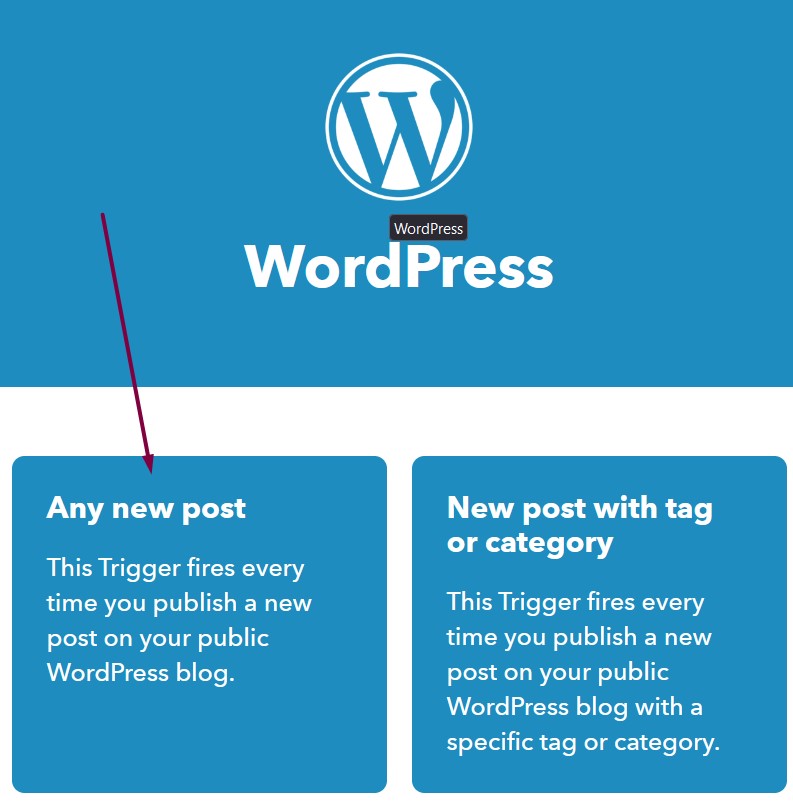
Create an IFTTT account and launch a new automation with the WordPress applet.
Select Any new post and connect your WordPress blog:
Click on Create Trigger and you’ll be directed to select “Then That” step:
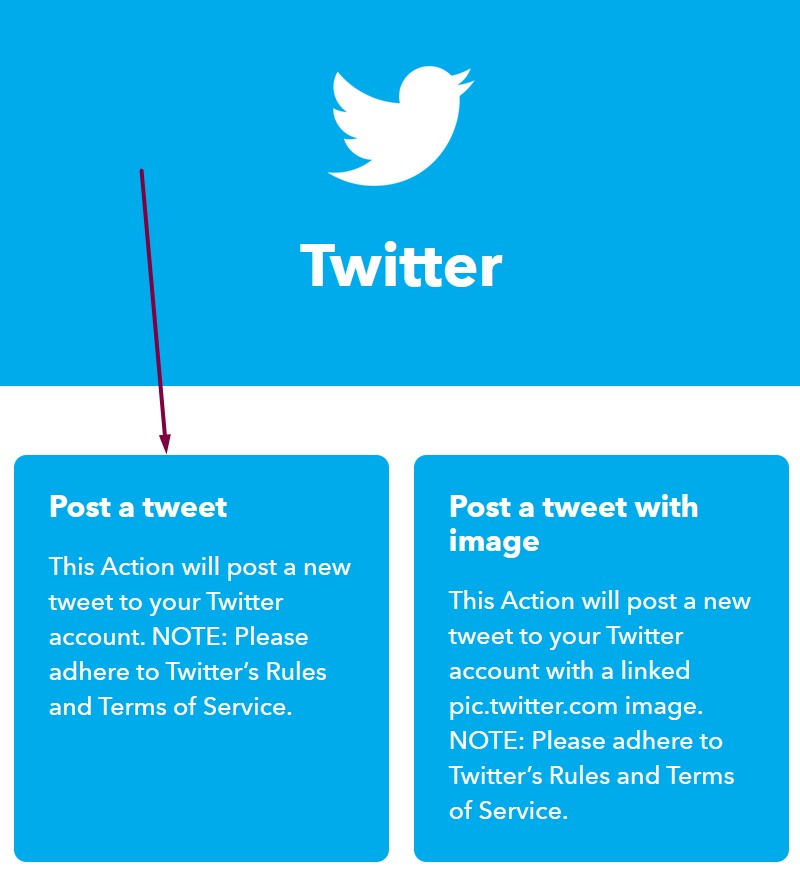
Then search for Twitter and choose “Post a tweet”:
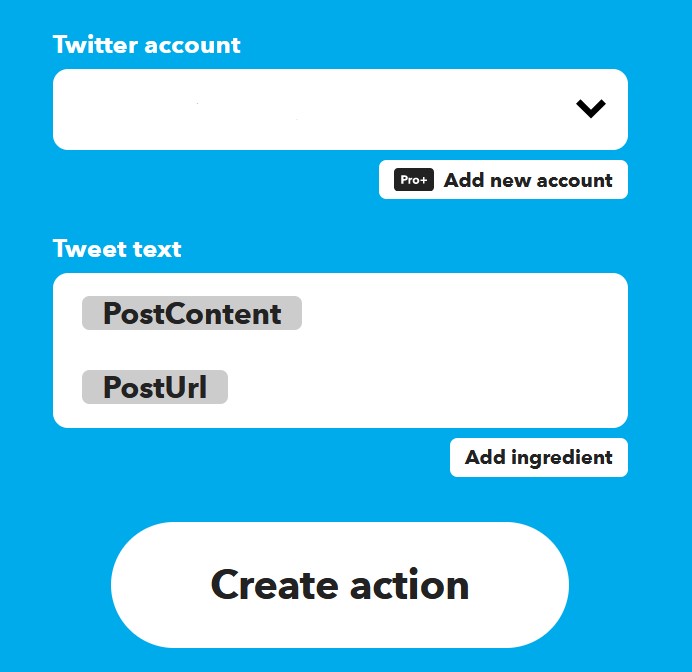
Connect your Twitter account and click create action:
Now, whenever you publish a new blog post, it’ll automatically post a tweet to your Twitter followers.
9. Write Scientifically Shareable Content
It turns out there are psychological and scientific reasons content goes viral.
And you can up your chances of viral traffic when you understand why.
First, neuroscience tells us that people share content that is entertaining, inspiring, and useful, not just for ourselves, but for other people.
Evidence shows that a specific region in the brain lights up, suggesting we’re on the lookout for information interesting enough to share.
Second, psychology suggests we share content that expresses who we are.
If an article portrays the version of ourselves we want to become, we are more likely to share it.
And another reason people share content is to nurture our relationships and feel connected.
This is apparent in a study undertaken by The New York Times Customer Insight Group. The results show that 78% of respondents said “it let them stay connected to people they may not otherwise stay in touch with.”
And a further 73% of them said they shared information because it allowed them to connect with others who shared their interests.
So try to add blog content proven to get shares and you’ll more likely increase blog traffic.
10. Develop a Pinterest Strategy
Pinterest has over 433 million active users and is considered the 4th most popular social networking site.
It’s also not just a social network, but a search engine.
That means it works in a similar way to Google and YouTube when displaying search results.
The Pinterest algorithm analyses accounts and their content based on four sets of criteria:
Domain quality
Pin quality
Pinner quality
Topic relevance
If you develop a strategy that adheres to the algorithm and post consistently, you can explode your traffic with Pinterest.
11. Add social sharing buttons
Want people to share your blog posts on their social media accounts?
Then add social share buttons.
When you give readers the opportunity to share your content, it can do a few things:
Build credibility by displaying the share count
Send positive signals for your brand
Grow your social media following
And give you a bump in blog traffic
It’s super easy to set up. Here’s how:
In WordPress, head over to your plugins library and search for “social buttons”.
You’ll see a ton of plugins to choose from. Choose one you like and install it.
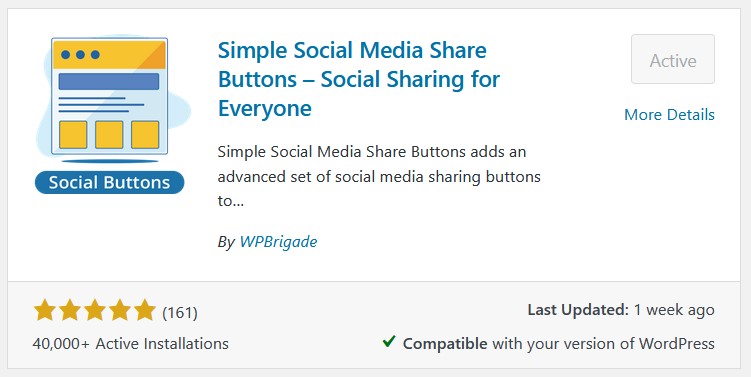
I’m using Simple Social Media Share Buttons by WPBrigade.
Once you’ve experimented with the settings, you’ll see the buttons appear on your articles.
12. Track Keyword Rankings
Want to get the most from your SEO efforts?
To know your top-performing articles, you’ll need to know where they rank. Monitoring traffic isn’t enough.
That’s because you’ll only see traffic from search engines when your articles show up on page one.
Using a rank tracking tool gives you insights into how well your on-page optimization is taking shape.
The screenshot above is the rank tracker SerpRobot, which offers some valuable insights.
It’s also a very affordable way to see a complete overview of all your search ranking positions.
Here’s how it works:
Create an account here. You get a free 14-day trial.
Sign into your account and add a project. Fill out the details of your website and add the keywords you are trying to rank for:
The SerpRobot bots will get to work, searching Google to see where your blog posts or pages show up.
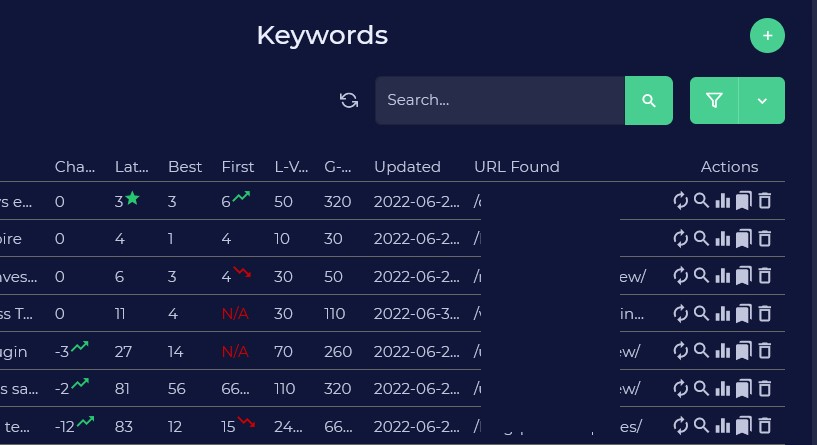
Once it’s done, you can view your ranking positions in this table view:
The table shows the keyword, ranking position, keyword volume, and the URL.
When you know which articles are performing best on your blog, you can focus more of your attention on this type of content.
Medium is a publishing platform who calls themselves “the YouTube for writers,” and receives around 143 million monthly visits.
That’s a lot of traffic. And we can take a slice of this to increase blog traffic.
To be successful on Medium, you’ll need to commit to the long game.
Like other platforms, such as Twitter, Pinterest, YouTube, or Facebook, posting a few pieces of content and abandoning ship won’t be enough.
You must be consistent.
That being said, there are several actionable tips you can follow to improve your chances.
Here are just a few:
Publishing on a Saturday morning can increase your chances of standing out
Include images to make your stories more engaging
Add tags to your articles
400 words and up are usually the most popular
Don’t forget to link to the articles you publish on your own blog to get a steady steam of traffic.
14. Create a YouTube Channel
Want to take advantage of YouTube’s 14.3 billion visits per month?
Then why not create a YouTube channel?
All you need to do is turn your blog posts into videos and upload them to the platform.
You can get a decent amount of blog traffic and potentially grow an additional income stream.
That’s right. If you grow your channel to 1000+ subscribers and 4000 watch hours, you can monetize your channel with ads.
To make the most of your video creation skills, follow these simple guidelines to grow your channel fast:
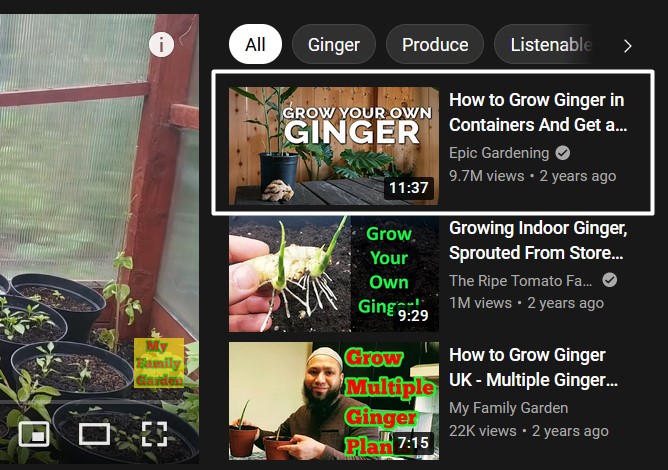
Replicate what already works
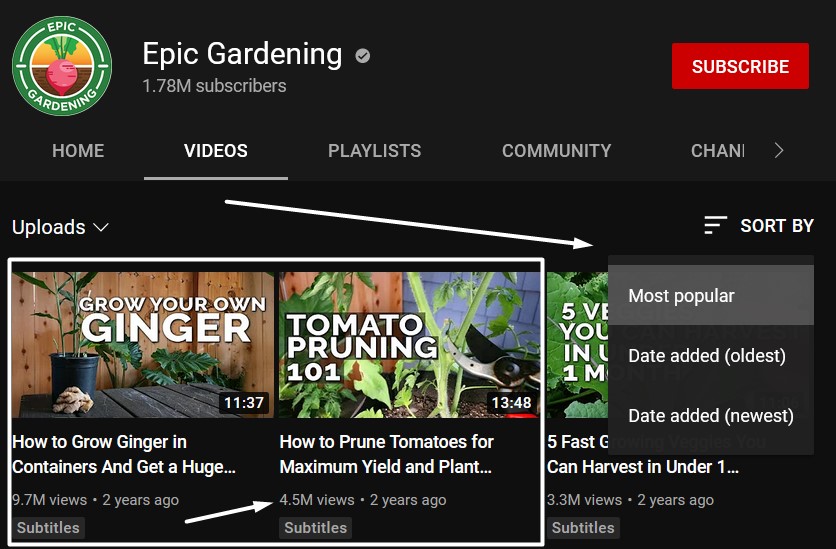
Find channels in the same niche as you and view their top videos:
Recreate these videos in your own unique way and you’ll show up in the suggested videos section:
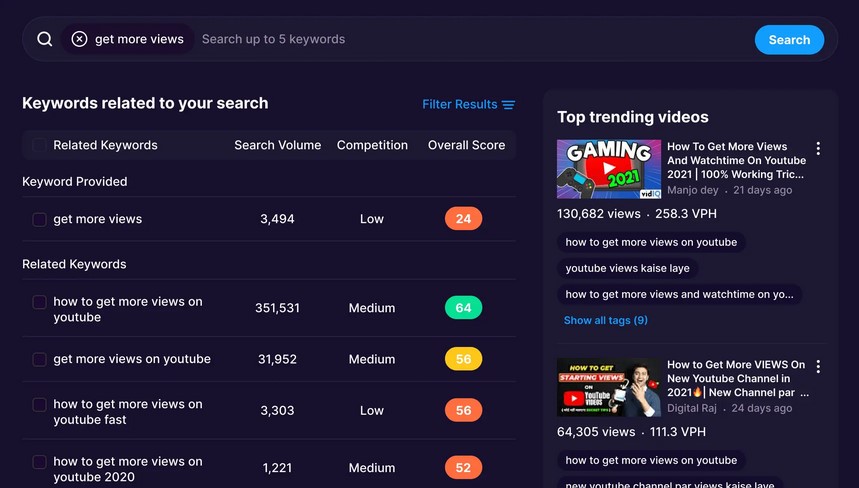
Use keywords that people search for
Use a tool like vidIQ to see which keywords people are searching for:
Then target these keywords in your video title, description, and tags.
Add links to your blog
When you publish new videos, you can add links in several places.
Mainly in the description and the comments. And you can pin the comment so it stays at the top.
And, don’t forget to add a link to your profile header:
Ask people to subscribe
Asking people to subscribe is like adding a call to action button on a landing page.
Sometime, if you don’t ask, you don’t get.
Mention other videos to keep people watching
When recording a video, mention previous videos you’ve already published and add a card for people to click on.
It will make people want to subscribe to your channel because of your valuable content.
15. Start a Podcast
The more places you publish content, the more opportunities you’ll have for driving blog traffic.
And a podcast is one of those opportunities.
Podcast experts tell us that starting a podcast is one of the easiest and most affordable ways to grow an online business.
All you need is a laptop or mobile device and a mic, which you might already have. And unlike writing and publishing articles, podcast episodes can be faster to produce.
You just have to find some topics to talk about by looking at the top-performing podcast episodes in your niche.
Then share your unique perspective on the topic.
Here’s an excellent video by Pat Flynn with a detailed tutorial:
16. Get Interviewed on Other Podcasts
Starting your own podcast might be a smart way to drive more traffic to your site, but being a guest on other podcasts takes it to another level.
When you’re invited for an interview on others’ podcasts, you are potentially being exposed to a wider audience.
That’s because many podcasters have already built up a following. And you’ll almost always gain a backlink from their website.
That not only gives you a traffic boost but also a domain authority boost, which will improve your SEO positions.
To get interviewed on podcasts, follow these simple steps:
Find relevant podcasts by browsing iTunes or doing a Google search with the keywords, “best [your niche] podcasts.”
Choose the podcasts to reach out to. Make sure they regularly have guests and a big audience. You can gauge this by their number of reviews.
Find the podcast owners’ contact details using Hunter.io and send them a pitch.
Make your pitch high-quality and respect the podcasters’ time.
The more they resonate with your story (make it brief), and think you’re right for their audience, you’ll get a higher response rate and more invites.
17. Repurpose Your Content
Creating content and only posting it in one place is a huge waste of potential.
Instead, repurpose your content on multiple channels in a variety of ways. This will give you the biggest return on the time and effort it takes to create content.
Here’s a bulletproof strategy to follow:
Write a Medium article that covers a broad range of topics you write about on your blog. Then link to multiple articles on your blog from the Medium post.
Then turn those articles you published on your blog into YouTube videos.
And you could even take the audio from the YouTube videos and publish them as a podcast.
Next, take some ideas you shared in the articles and add them to a Tweet Deck for automatic publishing to your Twitter account.
Last, take the YouTube videos and turn them into a free Udemy course.
More on getting traffic with a Udemy course later.
18. Automate Internal Links Between Your Articles
Internal linking might be the least-used marketing strategy available, yet yield significant results.
That’s because content marketing is so effective at building trust, improving conversions, and generating more traffic to your blog.
But when you have tons of published blog posts that don’t link to each other, you’re preventing search engines from recognizing their value.
What you need to do is insert 2-5 links from each of your articles to your other articles. But, it can take some time if you have a lot of articles.
To speed up this process, use a plugin such as Link Whisper to do the heavy lifting for you.
Once installed, it searches through your articles and makes internal linking suggestions.
Instead of sifting through articles to find a relevant keyword to interlink to the right blog post, it automates the whole process for you.
In summary, you create a GA4 account, add a Google analytics plugin, and you’re good to go.
When you implement a strategy, you’ll know whether to keep at it or try something different.
24. Start a Newsletter
It’s a well-known fact that more than 70% of your traffic will never return to your website.
But capture their email with a free lead magnet or irresistible newsletter and you’re onto a winner.
That’s because you can keep on engaging with your email list, a bit like you would on your social media channels.
The difference?
Email marketing almost always outperforms social media marketing by a longshot.
According to a Derek Halpern, after performing a test between Twitter, Google+ and his email list, the results were staggering.
In the space of one hour, he received 50 clicks from Twitter, 75 clicks from Google Plus, and 1200 clicks from his email list.
The bottom line is that email is a powerful and effective way of sending targeted traffic to your blog.
25. Answer Questions on Quora
Did you know Quora has over 300 million active users?
You know what that means?
Millions of people are actively using the platform:
To get their questions answered
To learn something new
Or for entertainment
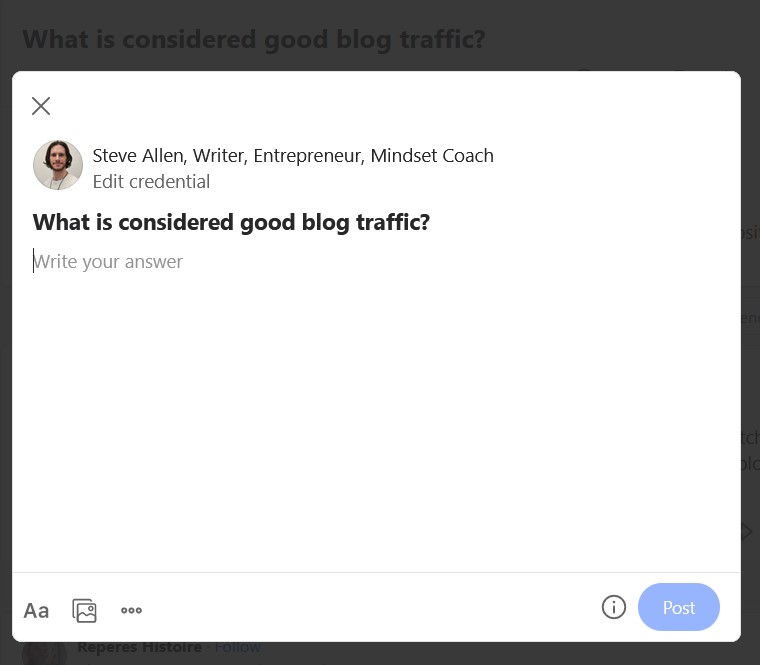
And you could be one of those experts who answers their questions and provides them with what they’re looking for.
Here’s how it works.
Search for a topic you specialize in and choose a question to answer:
Click on the Answer button and start writing:
The key with Quora, like any form of marketing, is to provide value. And for best results, answer questions every day.
You also want to format your answers like you would with a blog post, using bullets points, images, bold text, and quotes.
And, don’t forget to add links to your blog. You’ll start gaining traction after a few weeks of consistent publishing.
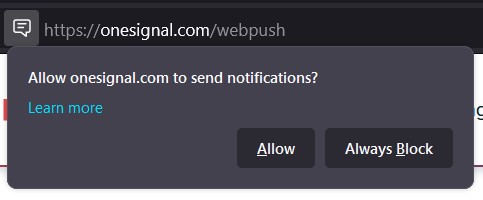
26. Add Push Notifications to Your Site
Push notifications are those popups you see on some websites, asking if you want to be notified of new posts.
If you already get a sizable number of visitors, this could be an opportunity to bring some of them back when you post new content.
All you need to do is add a WordPress plugin. The most popular one is called OneSignal.
Once it’s installed, you’ll need to create a free account. Then, it’ll connect your API key to the plugin and you can switch on the popup for your readers.
Now, when people show up on your blog, they will be able to opt-in to Push notifications in their browser every time you publish an article.
27. Share Old Content on Social Media
Make the most out of your old blog posts by sharing them with your social accounts.
The best about this tip is that the content is already written.
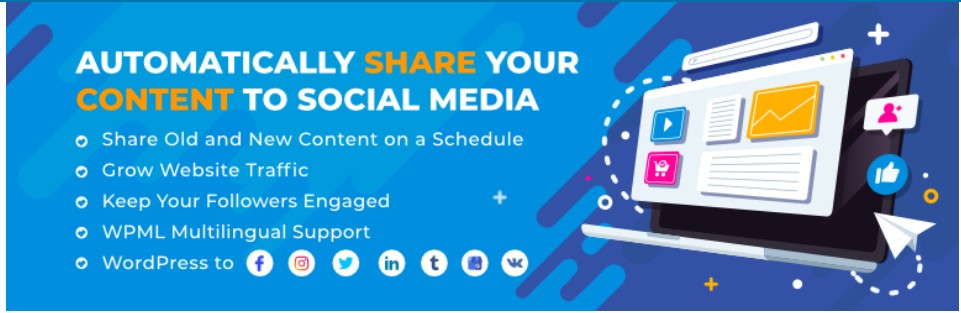
And you can even automate the process with a clever plugin.
Revive Old Posts is a free and premium WordPress plugin that does exactly what the name suggests; revives old post.
Doing so can give you a boost in blog traffic, without you lifting a finger.
And if you give your readers an incentive to go to your blog, this will certainly increase your traffic.
You can offer anything from another book to a discount on your products or services.
31. Use Paid Search
The most popular way to advertise with paid search traffic is through Google Ads.
As long as you understand how to run paid search ads, there’s no faster way of driving traffic.
The only downfall is that it costs money, but it doesn’t need to be hundreds or thousands.
The trick is to find low competition keywords that have a high amount of searches.
Set yourself a daily budget and see your traffic pouring in.
33. Launch a Free Course on Udemy
Udemy is one of the largest online course platforms on the internet.
The platform has over 40 million active users and 70,000 instructors (learnopoly.com) teaching anything from web development and marketing to personal development and yoga.
Apart from using Udemy as an additional revenue source, you can launch a free course to build brand awareness and drive traffic back to your website.
If you market your course well on other platforms and provide substantial value, it will also help you gain trust and credibility for your brand.
To get traffic to your blog from Udemy, you can create an instructor’s profile and add a to link to your website.
Following their guidelines, you may promote other links in your last course lecture, which need to include the word “bonus”.
This link can be anything you link. You blog, a landing page to capture leads, or to promote a paid course you offer.
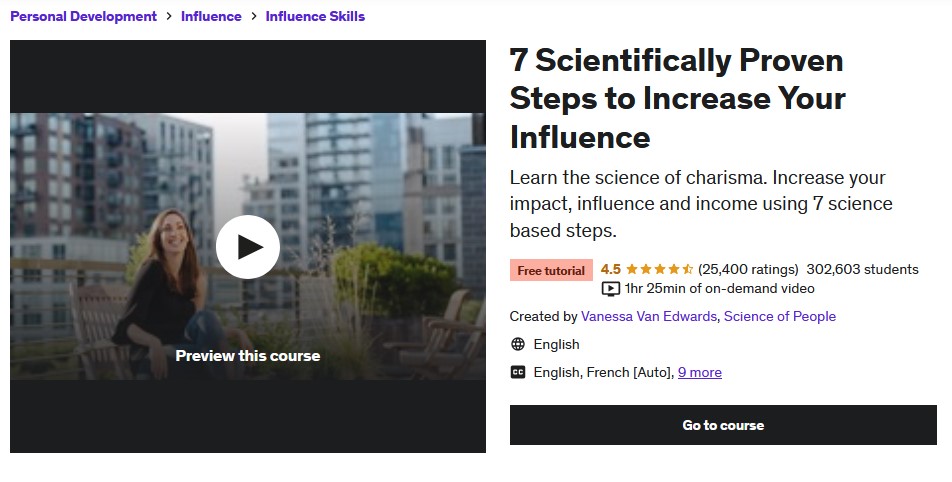
Here’s a great example by instructor Vanessa Van Edwards who offers this free course called, “7 Scientifically Proven Steps to Increase Your Influence”.
It has over 300,000 enrolled students and 25,000+ reviews. If only 1% of her students were to visit her blog or website, that would be more than 3,000 visitors.
Conclusion: How to
Phew! That’s a lot of ways to increase blog traffic. Of course, you may not need to try all of them, because 2-3 decent traffic sources could be enough.
Which ones will you try?
Don’t forget, traffic isn’t everything. Conversions are also important, as is your ability to play the long game by developing a strategy and sticking to it.
The bottom line; try one thing at a time, go all in for a few months and monitor your results. Then rinse and repeat until you find what works best for you.
Omnichannel marketing is the key to meeting customers where they’re at and ensuring cohesive experiences across channels and devices.
It’s midnight in Arizona, and Martin can’t sleep. He opens his iPad and begins scrolling through a collection of flat screen TVs on the Walmart website. Within ten minutes, one catches his eye, and he drops it in his cart and finalizes the purchase.
Across the country in Florida, it’s 3 a.m., and Emily is on her smartphone eyeing a set of golf clubs a local pro shop advertised in an email. With a flick and click, they’re hers.
Once relegated to after-work hours or weekends, shoppers now make purchases around the clock — while at work, lunch, during their commute, on vacation and when they can’t sleep at 3 a.m.
And they often switch between multiple devices throughout the day. There’s the work computer, a personal laptop, home desktop, smart phone and iPad. And that doesn’t account for brick-and-mortar shoppers that want an in-store experience.
Brands can meet these customers where they are by offering products and services across various online and offline channels — on a website, app or social media account, via email or text, at retail locations and public events. Companies can capture it all through omnichannel marketing.
What Is Omnichannel Marketing?
Customers desire a positive, seamless experience — no matter the path they take or device they use. Omnichannel marketing seeks to enable that desire by creating a cohesive, unified journey for each customer across all brand channels.
Cohesiveness across channels is a critical component. As opposed to multichannel marketing, which includes multiple channels that remain separate, omnichannel allows all online and offline channels to work in unison across touchpoints, devices and departments. With it, customers can bounce from smartphone to laptop to retail store and have a smooth experience.
Major Retailers Embrace It
Many large retailers have already incorporated omnichannel strategies, making the customer journey easier and more convenient.
Starbucks provides an app for use both online and in-store, incorporating a rewards program that allows customers to avoid lines and order ahead, gain free refills, use birthday bonuses and earn points for free products.
Amazon aligns its experience across a retail website, streaming service, mobile apps and connected Alexa devices and smartwatches.
Walgreens unifies its brand between in-store and online purchases through a customer loyalty program app that provides rewards, discounts and information about in-store events and sales.
Home Depot offers an app to help customers find products online and in-store, also including live chat and image search.
Disney app and loyalty cards allow visitors to check ride times and book tickets without standing in a long line.
Social Media Sells
With an active, integrated presence on social media accounts, brands have the opportunity to create a community.
A report from Statista predicted that by 2026, worldwide sales through social media platforms will reach $2.9 trillion — with the most influential content for buyers coming from posts made by acquaintances and connections.
McKinsey & Company reported that, with 60% to 70% of consumers researching and making purchases online and in-store, omnichannel is here to stay and will continue to grow. Their research also revealed that social media channels influence all age groups — particularly younger customers.
Outstanding Omnichannel
If the message a brand sends is unified and consistent across all channels, it better be a good one. Knowing what’s important to consumers today can help organizations create the best communications and serve to reflect their commitment to providing a positive customer experience.
Salesforce’s 2022 analysis of consumer and business buyer data revealed several factors worthy of consideration when creating an omnichannel platform, including:
Favourite Channels
Phone
In-person
Online chat
Channel Surfing
Customers turn to an average of nine different channels to communicate with companies.
57% of customers prefer to engage through digital channels, but 43% prefer non-digital channels — meaning satisfying customers generally requires great experiences both online and offline.
Loyalty
83% of customers say they’re more loyal to companies that provide consistency across departments.
71% of consumers switched brands at least once in the past year. The top three reasons were better deals, better product quality and better customer service.
Experience
88% of customers say the experience a company provides is as important as its products or services.
94% say a positive customer service experience makes them more likely to purchase again.
Emotion
62% of customers feel an emotional connection to the brands they buy from most.
A recent Forrester report indicated that while customer experience rankings decreased for 19% of brands in 2022, the highest rankings were achieved by brands that provided customers with “high emotional quality” across their experiences.
And happy customers are a forgiving bunch — with data revealing that 54% of customers who feel happy, valued and appreciated are more willing to forgive brand mistakes.
Omnichannel in Action
Karla Medrano, a registered nurse and founder and operator of SGM Medical Marketing, said omnichannel marketing isn’t just about using every available channel for marketing, although that’s important too. It’s also about breaking down an organization’s various customer-facing channel-based silos.
“Being omnichannel is about taking a consumer-centric view of marketing tactics,” Medrano said. “In other words, the consumer’s experience comes first and your organization needs to be seamless in its branding, messaging and online and offline presence.”
When tasked with assisting AmbitCare in developing a stronger digital presence, Medrano employed an omnichannel strategy.
AmbitCare, a provider of free resources to physicians, caregivers and patients affected by rare diseases, had an inadequate social media presence. Medrano’s agency began to define content pillars and cohesive messaging across all channels to help potential patients learn about services. They also created content for the Spanish-speaking population.
After 60 days, said Medrano, the total net audience increased 81.3%.
Recently, her team implemented an omnichannel marketing strategy for a health/wellness start-up app specializing in post-partum. It’s still in the testing phase, but so far, Medrano said the results have been promising.
The app creators came to the agency with the issue of poor adherence rates; they wanted to find a way to help participants finish the program. Medrano created video content, personalized email templates and a system to respond to questions and concerns in a timely manner.
As a result of this strategy, Medrano said adherence rates improved by 40%.
“My omnichannel approach via texts, emails, video content and therapeutic communication to help moms through the program made them feel heard and supported,” she explained.
Omnichannel Oversights
According to a McKinsey & Company report, while the right omnichannel approach can potentially increase brand value, a disjointed or disorganized strategy can destroy it.
Medrano said that a few common errors in the omnichannel strategy include automating everything and thinking that being on Instagram, Facebook, LinkedIn, etc., is enough.
“Sometimes people need to know that there is a human on the other side so they can feel supported,” Medrano said. “A brand can have 10 channels and have rotten customer service vs. a brand that can have three channels and have quality customer service that includes a chat box, timely email responses, personalized attention, courtesy calls, flexible pay options, SMS and more.”
She said another mistake is not asking for customer feedback and not providing staff with proper training to ensure a cohesive conversation, tone and branding.
“Leadership doesn’t interact directly with customers, so they don’t always know what works and what doesn’t,” Medrano explained. “Every single interaction customers have with your brand…should help them feel heard and supported. Otherwise, you can potentially lose customers, receive bad reviews and lose revenue.”
Branding Blunders
With over 15 years of experience guiding large consumer brands to develop customer experiences that deliver shared value, Freelance CX Strategist Jenny Neilsen offered her list of the recurring mistakes brands make in their omnichannel marketing strategy:
Brands trying to scale their high-level brand messaging across channels without considering the devices or experience. Each marketing asset should be helping to move the prospect through the funnel, not just shouting the same tag line at them.
Saying they do omnichannel, but there is little coordination between in-house teams and agencies executing or designing the assets. All that equates to is running a lot of advertising simultaneously with little cohesion.
Not using what they know about their audiences to execute a smart campaign.
“Brands need to understand and use online and offline data points to deploy personalized experiences across channels and physical locations,” Neilsen said. “Every brand has hurdles when it comes to the shape and location of their data, so they either need to roll up their sleeves and make the data work for them manually or invest in technology to help them do it faster.”
It’s Not for Everyone
As founder of Jennis Consulting Group and co-founder of Founders Compass, a mentoring consultancy for new start-ups, Steve Jennis places omnichannel marketing at the bottom of the priority list for start-ups.
He believes omnichannel marketing is good for customer retention because customers return to places where they have a good buying experience. But for a new business, he classifies it as a “back-end operational process that comes after marketing and sales have been successful.” A good product coupled with solid marketing and sales should come first.
“Without good marketing and sales, omnichannel is useless as customers don’t have a good reason to buy anyway,” Jennis said. “As such, it’s pretty low down as a priority for a start-up unless it gives you a real competitive advantage. But better products, marketing and sales will be more effective at that than channel choices.”
The global CEO of AB InBev’s in-house agency draftLine believes the media industry will continue to make a “directional shift” towards attention as a primary trading metric.
AB InBev is “increasingly” moving away from buying media purely on traditional cost-per-thousand impressions (CPM) and towards buying “attentive reach”, according to the global CEO of the alcoholic drinks giant’s in-house agency, draftLine.
Media performance metrics have come under growing scrutiny over recent years, particularly those measuring effectiveness of digital media. With the value of metrics such as shares, opportunity to see and viewability being questioned, some brands are experimenting with ways to measure the level of actual attention consumers pay to their ads across different channels.
In June 2020, AB InBev joined the likes of Mars, Diageo, British Gas and Reckitt on the then-recently launched Attention Council, a confederation of brands, agencies and publishers working to understand how attention can be used as a trading currency for media.
Meanwhile, the price of media has been rising rapidly post-pandemic. Forecasts from the World Federation of Advertisers (WFA) and Ebiquity for 2022 suggest the cost of digital media will inflate by 6.4%, while total offline media will inflate 5.5%. TV is expected to have the highest cost inflation at 9%, while outdoor media’s cost inflation will be 5.7% and radio’s 4.9%.
It’s about getting the reach you need and making sure you’re capturing the right amount of attention.
Tracy Stallard, AB InBev
“The media industry has historically sold itself on CPM and on the idea that an impression is an impression and a reach point is a reach point,” explains draftLine’s Tracy Stallard, speaking to Marketing Week at this year’s Cannes Lions Festival of Creativity.
“Increasingly we’re thinking about attentive reach. How much attention are we really capturing in this moment? Is the individual in a moment when they can actually be open to a new message or a new way of thinking about a brand?”
When looking at the media marketplace from the perspective of attention, there remains some “pricing discrepancy” compared to a pure CPM perspective, she adds.
Passion points
Stallard is also global vice-president of consumer experiences at the company, leading a team which takes a particular focus on how AB InBev’s brands – which include Stella Artois, Corona and Budweiser – use passion points such as sports, hobbies or interests.
“We know that consumers are much more attune to receiving new messages when they’re in something that they’re actively leaning into and that tends to be their passion points. So we’re really looking at using attention as the way we want to transact and buy rather than just a CPM approach,” she says.
While media channels including cinema, magazines, TV and news brands have been particularly vocal in their support of attention as a metric for trading and measuring performance, Stallard says AB InBev hasn’t yet found itself prioritising one channel over another.
“We’re not channel focused, we’re people focused. At the end of the day, we’re trying to make sure we’re reaching people in the right place and the right way,” she says.
“It’s about getting the reach you need and making sure you’re capturing the right amount of attention.”
Stallard adds she is closely watching developments in the attention measurement space, predicting this segment of the industry will continue to grow.
“I do think that will be a directional shift the media industry will be making,” she says.
By improving efficiency and eliminating human error, automation might be the best move for businesses today.
You may think that automation is something that requires an intense technical infrastructure backed by a big budget to boot. But the truth is, even small businesses can use simple automation tools to improve customer success.
Business owners are always looking for ways to streamline processes and make operations more efficient. One way to do this is by using automation tools to manage customer interactions.
What is customer success automation?
Customer success automation is the process of using technology to automate tasks and procedures to accomplish goals related to customer success. This can include everything from customer onboarding and engagement to retention and support.
Automation can help you improve efficiency and accuracy, freeing up time for your team to focus on more strategic tasks. It can also help you improve the customer experience, making it easier and faster to get the help they need. Not to mention you take the element of human error completely off the board.
Every business wants loyal customers, and what better way to get them than to keep them happy and satisfied with fast and efficient service?
Is automation for customer success expensive?
The answer to this question is no–there are many ways to use customer success automation without breaking the bank. In fact, some of the most effective techniques are pretty simple and easy to implement.
You don’t need a software developer to automate some of the processes in your business. With the right tools, you can automate tasks related to customer success easily and inexpensively.
Automate emails and follow-ups.
Instead of spending hours creating and sending emails to individual customers, you can use automated tools that can send emails whenever the time is ripe.
There are a lot of email marketing tools like ActiveCampaign or Mailshake that can send those for you. Just remember that when using email automation, it’s crucial to avoid getting flagged as spam.
Fortunately, most modern email marketing tools let you specify conditions and triggers before firing off automated messages.
Automate outreach from sentiment in your existing online conversations.
A 2022 survey by CompleteCSM revealed that 79 percent of businesses struggled to manage the rising expectations of customers, with response time and “bedside manner” being two of the many challenges affecting the customer experience.
One solution is to set up automated and templated responses to an overall downturn in customer sentiment over a series of conversations. The ability to locate and respond to a situation before it escalates by looking at customer sentiment from your existing systems can give days’ or weeks’ advance warning of a waning customer.
Automate customer re-engagement.
All businesses have cold leads that haven’t responded to interactions–stubbornly refusing to move down the sales funnel.
As a business owner, you’d want to reach out to them. But it would be inefficient to implement a manual approach in doing so.
Having an automated re-engagement strategy for such situations can help you reactivate cold leads and reduce churn rate. A typical strategy is to send an automated re-engagement email after a specific number of days have passed since their previous interaction. Again, this can be easily accomplished with the right email marketing tool.
Create self-onboarding experiences.
The simplest automation strategy for customer success is to automate the onboarding experience.
Greet new users with links to important resources and free downloadables. For SaaS companies, engineer a self-paced learning process via in-app tours or tutorial videos.
Remember, customer success is your success. By improving efficiency and eliminating human error, automation might be the best move for businesses in today’s age.
Feature Image Credit: Getty Images
By Kelly Richardson
Co-founder of Infobrandz. She likes to help people build businesses through visual communication and her influential blogs.
Are you happy with the number of leads your marketing campaigns are generating? Or, do you wish they were a bit more effective?
If you’re serious about growing your business—whether it’s a B2B company, an e-commerce store, or a startup—increasing the number of leads should be a top priority. Setting up online campaigns is a good start, but it’s not enough. You need to optimize those marketing campaigns to squeeze every last lead from your funnel.
Are you ready to get to work? Here are seven strategies to generate leads like never before.
Why Are Leads so Crucial to Business Growth?
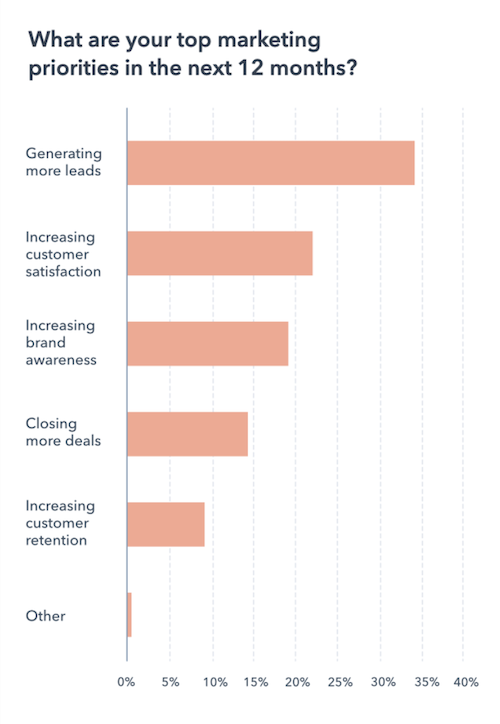
Two of marketers’ top priorities are generating leads and converting those leads to customers. Only increasing customer satisfaction comes close to the importance of getting new leads.
A bar graph of the top marketing priorities in the next 12 months.
It’s no surprise that lead generation is a top priority. Without a continuous flow of new leads, sales dry up. Without sales, there’s no revenue. And without revenue, your business folds.
What’s more, most people who land on your site won’t purchase right away. You need to constantly collect leads so you can nurture them and convert them into buyers in the future.
Not just any leads will do, however. Referrals, conferences, and cold calling are all great lead generation strategies, but they aren’t enough. You also need to learn how to generate more leads from your online campaigns.
Why are advertising leads better? Using targeting you can gather better leads faster and even automate parts of the process. How do you make sure your ads are driving quality leads?
How to Generate Leads Online: 7 Strategies to Drive More Leads
If you aren’t sure how to create a lead generation campaign, I have previous articles to walk you through the process. What I’m going to do is show you how to generate leads online by improving your existing ad campaigns.
Optimize Your Landing Page
Your landing page (or squeeze page) is one of the most important elements of your online lead generation campaign. The goal is to leave the visitor with no choice but to hand over information in exchange for something valuable.
Landing pages convert better than most other ads or offers. The average conversion rate is 2.35 percent, but some have conversion rates in excess of 10 percent. If your landing page’s conversion rate isn’t pushing double digits, you should look to optimize one or more elements ASAP.
I recommend looking at your page’s copy, including its headline, first. Make sure your copy is short, sharp, and engaging. Users need to understand exactly what your product is and how it helps them within a few seconds of landing on your site. Make sure you focus on the benefits of your product to the user, not its features.
Spend more time tweaking and testing your headline than anything else. This will be the first thing a user reads and one of the biggest deciding factors in whether they continue browsing the rest of the page.
You can speed up a user’s understanding of your product by including a video on your landing page. A good chunk of your audience would rather watch a video than read your copy, which is why 76 percent of sales teams say video is key to securing more deals.
Finally, remove all distractions from your page. The layout should be as simple as possible and there’s no need for a navigation bar or links to any other pages on your site. This leaves the user with two options: close their browser window or sign up.
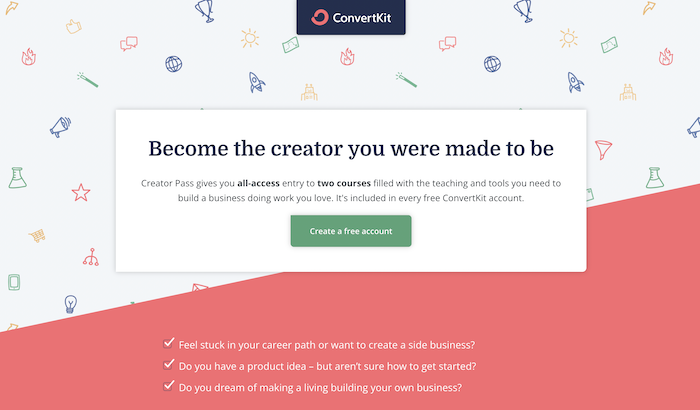
ConvertKit’s Creator Pass is a fantastic example of how to create a great landing page. There’s no headline navigation, the headline copy offers a clear benefit, and there’s an enticing call to action right in front of you.
Generate more leads by optimizing your landing page.
Offer Real Value
Arguably the most important part of your landing page isn’t the copy, image, or CTA. It’s the piece of content, tool, or resource you offer in return for each lead’s email address.
For most brands, gated content takes the form of a PDF download, something like an ebook or a whitepaper. But it doesn’t have to be. Case studies, surveys, webinars and video series are all excellent types of gated content.
Whatever form your gated content takes, it must deliver tremendous value. Otherwise leads will leave your funnel as quickly as they entered. How do you deliver value? By solving a problem your leads have. What are their pain points? Where do they get stuck? What expertise can you leverage to make their lives a little bit easier?
Delivering value also means presenting gated content in the best way possible. Make it visually appealing, with images, videos, and other forms of multimedia content. The nicer it is for your leads to consume, the more they’ll engage with it.
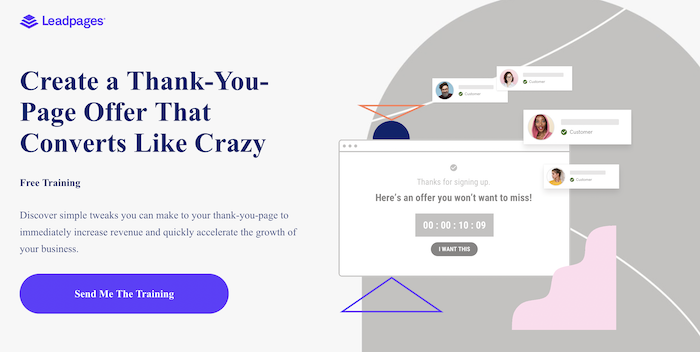
Here’s an example of a non-ebook lead magnet from Leadpages:
Generate more leads by offering real value to the consumer.
They know their leads often struggle to create high converting pages, so they created a training course to solve that issue.
Use Automation to Nurture Leads
Collecting leads is just the first step of the process; you also need to nurture them. Only two percent of sales are made at first contact, yet most salespeople give up after the first attempt. If you automate the follow-up process, you don’t have to worry about a thing.
I recommend using email to nurture when possible. It is a great way to drip feed messages to your leads, it also generates massive ROI. According to research by the Direct Marketing Association, the ROI of email marketing is £42 for every £1 spent.
If you don’t have an email automation platform yet, check out my review of the best solutions. Then integrate your landing page’s form so every email is automatically added to your mailing list.
Next, create an automated series of emails that is sent out at regular intervals. Your goal is to take leads through each stage of the buying process—and that means providing them with the right educational content at the right time. Start by educating them about your wider industry and their general problems. A couple of emails later, you can start to focus on your product and service and how you can help.
The more emails you send, the more you can make your product the hero of the email, and the more direct you can be with the lead.
Use Chatbots to Turn Conversations Into High-Quality Leads
Your salespeople aren’t the only ones who can nurture leads. Chatbots can automate almost every part of the lead generation process. They’re incredibly effective at it, too. Over half of businesses that use AI-powered chatbots generate better quality leads.
Start by replacing forms on your landing page with a chat bot. Forms can be long-winded and rarely offer a great user experience. Chatbots make it easier for prospects to fill out their details. In some cases, users may not even be aware they’re filling out a lead form.
You can also use chatbots to respond to leads at lightning speed. Response time matters in lead generation. A study by Harvard Business Review shows businesses that respond to leads in under five minutes are 100 times more likely to convert them. With chatbots, you can automate the response process and send a message as soon as a lead fills out a form.
Finally, use chatbots to nurture and qualify leads. Chatbots can ask the same qualifying question as your salespeople to separate the wheat from the chaff. The best can be sent directly to sales, while everyone else is added to a nurturing sequence.
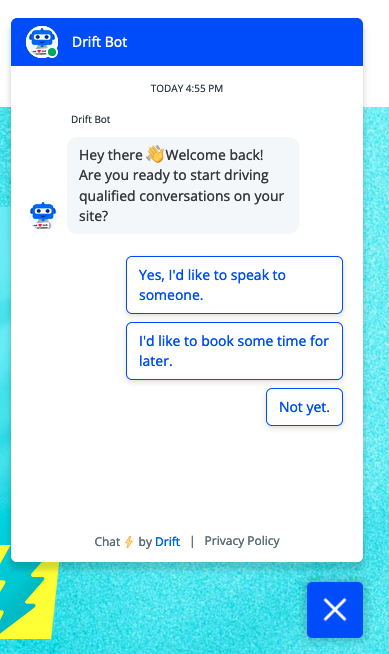
Drift’s chatbot is an excellent example of this. It asks a qualifying question as soon as someone lands on the site, putting them straight through to a sales rep if they’re ready.
Generate more leads by utilizing chat bots.
Use Multi-Platform Campaigns
How many platforms are you using to advertise your landing page and gated content? You probably aren’t using enough.
Today’s customer journey is long. Most don’t convert to customers the first time they land on your site. The majority probably won’t sign up on your landing page, either. A recent Google study found it takes between 20 and 500 touchpoints to become a customer.
The solution is a multi-touch campaign, where your message is delivered in multiple formats across multiple channels.
Advertising on a range of channels maximizes the chances that potential customers will see and click your ad. It’s a numbers game at the end of the day. The more shots you take, the more chances you have to score.
Leverage Personalization
If you want an easy way to increase conversion rates at every stage of your online lead generation campaign, try personalization. In a survey of B2B sales and marketing professionals, over three-quarters (77 percent) said personalization made for better customer relationships, and over half (55 percent) said personalization led to higher sales conversions.
How can you add personalization into your funnels to generate leads?
Start by personalizing your ads. While Apple may have made creating hyper-personalized ads a lot harder, Google still makes it relatively easy to personalize paid search ads with dynamic ads.
Next, personalize your landing page, particularly the call to action. Research shows personalized CTAs achieve 202 percent better conversions. Marketing tools like HubSpot and Unbounce can help you create dynamic CTAs that change depending on who views them. But you could also go old school and create several different versions of your page for each ad group and personalize the copy accordingly.
Finally, build personalization into your email automation tool. Every major email marketing tool makes it easy to automatically insert the recipient’s name into the subject line and body copy, so there’s absolutely no excuse not to personalize your nurturing emails.
Target Your Ads Carefully
There’s no point wasting resources nurturing leads who will never buy your product. That’s why you need to target your lead generation ads carefully.
I will say it’s important not to be too hasty when judging the performance of your landing page ads. When pruning and optimizing ad campaigns, don’t just judge performance based on how many people they send to your landing page that sign up. That’s a good measure, but it’s not as important as how many people actually convert into customers.
Think about it. One ad campaign could have a ridiculously high signup conversion rate of 20 percent. But if only a tiny fraction of those people make a purchase, it’s not a particularly effective ad. An ad campaign with a much lower signup conversion rate could be far more effective at generating high-quality leads.
Of course, this means you’re going to have to wait longer to collect relevant data. But the end result should be a much more targeted and effective ad campaign.
The best way to target ads effectively? Target keywords with higher buyer intent. These are search terms that indicate the user is closer to conversion.
Frequently Asked Questions About Generating More Leads
How do you build a lead generation campaign?
Start by having an objective and defining your target audience. Create a valuable piece of gated content and drive traffic to it using paid ads. Collect emails and then use email to nurture those leads.
What is an example of a lead generation marketing campaign?
A gated whitepaper is an example of a lead generation marketing campaign. Webinars can also be used as a lead generation marketing campaign to acquire leads and nurture them using video
How do I optimize my lead generation campaign?
There are several strategies to optimize lead generation campaigns. Improve your landing page copy, put your emails on autopilot, use chatbots to speed up response time, and personalize messaging.
Where should I advertise for my lead gen campaign?
Social media platforms are one of the most cost-effective places to advertise your lead generation campaign. But the important thing is to advertise wherever your target audience hangs out online.
Conclusion: Generate More Leads to Improve Marketing ROI
Improving your online marketing campaigns and optimizing how you generate leads are the keys to growing your business. But you don’t have to use all of the strategies I’ve listed all at once.
Optimizing your campaigns should be an ongoing endeavour, so pick one or two of these strategies to implement at a time. Pretty soon you’ll send your ROI skyrocketing.
Brands have been experimenting with branded entertainment for decades, but few have managed to cut through and become long-running international hits. That’s until Lego Masters came along and rewrote the rule book. Lucas Green, global head of content operations at international distributor Banijay, tells brands how they can replicate its success.
Lego Masters is the holy grail of branded entertainment. The show, which is jointly owned by production outfit Tuesday’s Child, and The Lego Group, represented by Banijay, was first released in 2017 on Channel 4. It has gone on to spawn 18 international adaptations and is in its third season in a primetime slot on Fox hosted by the actor Will Arnett.
“[Lego Masters] has spread all over the world and taken on a new life of its own – in quite a short space of time it’s become a global hit,” Green says.
The format originated with UK producers Tuesday’s Child, which pitched it to the toymakers. Green says Lego is inundated with requests, but the format convinced it that it would be executed in the right way and in line with its brand values.
“If you are going to do a show about competitive brick-making there is only one market leader in that space – it’s Lego, there is no question about which brand you want to be associated with,” Green says.
A tricky aspect of executing brand-related content is negotiating the various territory-specific sponsorship regulations that prohibit the number of direct brand references or logos. In the case of Lego Masters, the producers couldn’t show any Lego sets that were on sale. To overcome this, Green says any show should be a “reaffirmation of your brand values.”
“All the creative beats of the show, the tone of the show and the sense of humour and playfulness,” it’s all Lego, he says. “It’s about driving home those core principles of Lego, even if it’s not just a matter of how many seconds you can get a Lego on the screen.”
Green reminds brands and agencies executing branded content not to forget the storytelling. “That is what helps create that long-form programming beyond an advertising campaign.” In the case of Lego that’s creating epic builds, jeopardy and human stories, he says.
“Don’t underestimate the decades of experience TV format producers have learned about building a story – it’s about the narrative, how you sustain an audience, how you get them to binge-watch your show and how to integrate your brand,” Green advises.
In terms of the editorial process, Green says it involves the producers of the show in collaboration with Lego. “Without Lego’s involvement it wouldn’t be possible,” he says. “It’s a perfect example of how producers and brands can work together.”