Author

editor

Browsing

Or how I learned to stop worrying and love the algorithm.

You know how your Instagram feed starts sending you ads for khakis the minute you think about how you need a new pair of pants? Well, spirits giant Diageo is further immersing itself in the world of tech that knows what you want before you know what you want with the acquisition of flavour matching company Vivanda.

While not quite as nefarious sounding as the real life blocking or memory recall of a Black Mirror episode, this is indeed a look at what the future may hold for whisky consumers. Diageo has actually been using Vivanda’s technology since 2019 in several markets, including the “Journey of Flavour” experience at Johnnie Walker Princes Street in Edinburgh, as well as stores, ecommerce channels and the website Malts.com. It’s also the foundation of the “What’s Your Whisky” website, which works like this: Vivanda’s “FlavorPrint” system is powered by artificial intelligence, and by asking you a series of questions it’s able to map out your individual flavour preferences and suggest which whisky you should try based on your specific “Flavour Print.” Once you get your results, you are able to click to purchase a bottle of Talisker or Lagavulin or Oban, depending on your results.

Diageo plans to expand the use of Vivanda’s technology to other categories within its sizable portfolio, as well as using it to support “the continued development of our advanced analytics and digital marketing capabilities” to provide better understanding of just exactly what it is you like to drink, according to a press release. “We know consumers are looking for more personalized, interactive experiences and that they are increasingly engaging with our brands digitally as well as in person,” said Diageo chief marketing officer Cristina Diezhandino in a prepared statement. “We’re delighted to welcome Vivanda to Diageo and we are looking forward to working together to connect with consumers in more innovative ways that help shape the future of how we socialize in person and virtually.” So far the whisky has not become sentient and experienced its first sensation of love, but we are still in early days.

Feature Image Credit: Charl Folscher/Unsplash

Sourced from Robb Report

By

Apple intros “extreme” optional protection against the scourge of mercenary spyware.

Mercenary spyware is one of the hardest threats to combat. It targets an infinitesimally small percentage of the world, making it statistically unlikely for most of us to ever see. And yet, because the sophisticated malware only selects the most influential individuals (think diplomats, political dissidents, and lawyers), it has a devastating effect that’s far out of proportion to the small number of people infected.

This puts device and software makers in a bind. How do you build something to protect what’s likely well below 1 percent of your user base against malware built by companies like NSO Group, maker of clickless exploits that instantly convert fully updated iOS and Android devices into sophisticated bugging devices.

No security snake oil here

On Wednesday, Apple previewed an ingenious option it plans to add to its flagship OSes in the coming months to counter the mercenary spyware menace. The company is upfront—almost in your face—that Lockdown mode is an option that will degrade the user experience and is intended for only a small number of users.

“Lockdown Mode offers an extreme, optional level of security for the very few users who, because of who they are or what they do, may be personally targeted by some of the most sophisticated digital threats, such as those from NSO Group and other private companies developing state-sponsored mercenary spyware,” the company said. “Turning on Lockdown Mode in iOS 16, iPadOS 16, and macOS Ventura further hardens device defences and strictly limits certain functionalities, sharply reducing the attack surface that potentially could be exploited by highly targeted mercenary spyware.”

As Apple says, Lockdown mode disables all kinds of protocols and services that run normally. Just-in-time JavaScript—an innovation that speeds performance by compiling code on the device during runtime—won’t run at all. That’s likely a defence against the use of JiT-spraying, a common technique used in malware exploitation. While in Lockdown mode devices also can’t enrol in what’s known as mobile device management used for installing special organization-specific software.

The full list of restrictions are:

  • Messages: Most message attachment types other than images are blocked. Some features, like link previews, are disabled.
  • Web browsing: Certain complex web technologies, like just-in-time (JIT) JavaScript compilation, are disabled unless the user excludes a trusted site from Lockdown Mode.
  • Apple services: Incoming invitations and service requests, including FaceTime calls, are blocked if the user has not previously sent the initiator a call or request.
  • Wired connections with a computer or accessory are blocked when iPhone is locked.
  • Configuration profiles cannot be installed, and the device cannot enrol into mobile device management (MDM), while Lockdown Mode is turned on.

It’s useful that Apple is upfront about the extra friction Lockdown adds to the user experience because it underscores what every security professional or hobbyist knows: Security always results in a trade-off with usability. It’s also encouraging to hear Apple plans to allow users to allow-list the sites that are allowed to serve JIT JavaScript while in Lockdown mode. Fingers crossed Apple might enable similar allow-listing of trusted contacts.

Lockdown mode is a big deal for lots of reasons, not the least of which is that it comes from Apple, a company that’s hyper-sensitive about customer perception. Officially acknowledging that its customers are vulnerable to the scourge of mercenary spyware is a big step.

But the move is big because of its simplicity and concreteness. No security snake oil here. If you want better security, learn to do without the services that pose the biggest threat. John Scott-Railton, a Citizen Lab researcher who knows a thing or two about counselling victims of NSO spyware, said Lockdown mode provides one of the first effective courses for vulnerable individuals to follow short of turning off their devices altogether.

“When you notify users that they’ve been targeted with sophisticated threats, they inevitably ask ‘How can I make my phone safer?” he wrote.’ “We haven’t had many great, honest answers that really make an impact. Hardening a consumer handset is really out of reach.”

Now that Apple has opened the door, it’s inevitable that Google will follow suit with its Android OS and it wouldn’t be surprising for other companies to also fall in line. It may also begin a useful discussion in the industry about broadening the approach. If Apple will allow users to disable unsolicited messages from unknown people, why can’t it provide an option to disable built-in microphone, camera, GPS, or cellular capabilities?

One thing everyone should know about Lockdown mode, at least as described on Wednesday by Apple, is that it doesn’t stop your device from connecting to cellular networks and broadcasting unique identifiers like IMEI and ICCID. That’s not a criticism, just a natural limitation. And trade-offs are a core part of security.

So if you’re like most people, you’re never going to need Lockdown mode. But it’s great that Apple will be offering it because it’s going to make all of us safer.

By

Dan is the Security Editor at Ars Technica, which he joined in 2012 after working for The Register, the Associated Press, Bloomberg News, and other publications.
Email [email protected] // Twitter @dangoodin001

Sourced from arsTECHNICA

By

Use these three ways to help your business leverage audio-based communication events for better buyer engagement.

Technology enables brands to connect with consumers like never before, and changing strategies to best utilize tech is a necessity. Bynder’s 2021 State of Branding Report found more than one-quarter of those surveyed were most concerned with how to successfully reach their audiences in increasingly crowded digital channels.

This worry drives innovation, but just because a marketing strategy is new doesn’t mean it’s effective. Think of Google+ accounts. Keyword-stuffed blog posts. The marketing department junk drawer is filled to the brim with marketing trends that never stuck. Now, it’s time to add static, one-way content to the mix.

What’s the problem with this content? For one, it’s more of the same. How can marketers expect to rise above the noise if they’re only adding more of the same airwaves? There’s no pizzazz. Everything’s controlled. Consumers want magic and excitement, not a carefully planned brand marketing strategy parading as something more off-the-cuff — 80% of viewers prefer to engage with live content rather than pre-recorded pieces, after all.

Certainly, forums such as Instagram and Facebook Live are more interactive. Socialinsider analysed almost 4 million Facebook videos and found that audiences engaged much more readily with live videos: One successful broadcast can crush the engagement metrics of a social media video post. Yet the method is underutilized, as 88% of videos on the platform are pre-recorded. Marketers are already behind the curve on audience engagement, and consumers are moving on to a different kind of interaction: audio events.

Audio events to the rescue

Audio-based mediums such as Clubhouse have been having a heyday over the past few years. According to Influencer Marketing Hub research, about 700,000 Clubhouse rooms pop up every day and become part of the organically developing community. And this is Clubhouse on a bad day — at its height, the platform had almost 10 million monthly downloads.

While Clubhouse’s popularity has waned, other tech giants have risen up with their own iterations of audio spaces, such as Twitter’s Spaces. Launched in late 2020, Spaces claims to enhance the concept of tweeting via the inclusion of live voices. By mid-2021, Spotify had followed suit when its Greenroom hit center stage. Even LinkedIn is testing the waters of the audio scene.

This method is successful because audio streams still carry the weight of “presence” found at a live, in-person event. Users can jump into conversations or just take a backseat and listen in for the scoop. Usually structured freeform rather than with a set agenda, these audio events take on a serendipitous tone.

This isn’t just a trend. With the global health crisis, people have increasingly turned to audio to pass the time. A survey by Sortlist found more than three-quarters of people have increased their consumption of audio content over the past couple of years.

Audio is a new brand marketing strategy that can build thriving communities with everyone from hesitant prospects to raving fans, and companies would be amiss to let this opportunity pass them by.

Below are three ways for businesses to leverage audio-based communication events and get on the bandwagon before it gets anywhere near its zenith.

1. Host exclusive audio rooms

Everyone likes to be the first to know. Depending on what platform you use, audio rooms can limit admittance to select participants. Therefore, they can serve as invite-only experiences to nourish brand loyalty. Even without a video component, participants can get a sense that they’ve been given special access to information not yet available to others.

Community-driven exclusivity has seen huge success with some big brands. Nike brings engagement up by rewarding members using its SNKRS app with drops outside of scheduled releases. Even when using the app, exclusive access isn’t guaranteed, which adds to the thrill of getting a pop-up notification that there is a pair of Jordans with your name on it.

Translate this magic to the audio space with live launch announcements and chatroom giveaways, and you’ve got a formula for marketing success.

2. Promote user-generated audio events

Customers treat reviews from other customers as more valid than company-constructed content. Knowing this, you may want to encourage existing happy customers to moderate or co-organize audio discussions. Don’t assume that this will happen without your input. Tint’s 2022 State of User-Generated Content report found that 6 in 10 people willing to pull together user-generated content want brands to be specific in terms of type and related parameters.

User-generated events have multiple benefits for branding. For one, bringing others into the content creation process allows for greater output and scalability. Furthermore, it can make audiences feel a part of the process. Allowing more people to engage in the brand, especially in creative ways, gives them a sense of belonging. This practice of social brand engagement will increase your number of brand ambassadors — from influencers and hired content partners down through their fanbase (who will eventually become a fan of your brand as well).

3. Conduct Q&A research in audio chatrooms

A final way to get on this marketing trend is by using audio apps as a gathering ground for first-party information and research. Pop-up audio events can be effective environments for conducting focus groups. Customers don’t just want personalization; they expect it. Talking directly to your audience can be quicker and more effective than guessing why a certain tactic hasn’t met the expected ROI. Bringing target audience members into audio events can be a source of innovation.

HubSpot recommends targeting existing audiences for focus groups, as those are often the people already invested in the brand. They may be the first to test new products and initiatives, so why not capitalize on that? Including them in the conversation grows their emotional bond with a brand and allows marketers easy access to a valuable trove of feedback. Going the route of audio rooms can help speakers feel more comfortable. After all, no one knows you’re lounging in your favourite pair of sweatpants in an audio-only call.

But there’s a bigger benefit to audio-only focus groups than not worrying about fixing your hair: Recent research found that groups with only-audio cues communicate and problem-solve more effectively than those streaming video as well. Eliminating the distraction will lead to fewer interruptions and better insights for your brand.

No doubt about it: Audio-based events are having a moment. Just make sure you don’t come late to this party that’s showing so much promise.

By

Sourced from Entrepreneur

By Lis Anderson

Public relations is changing. The media landscape looks very different than it did just two years ago, and savvy PR leaders should be adapting to the modern world.

PR professionals know how to generate interest in a brand and develop trust. Part of this is achieved through writing excellent content that resonates with an audience and placing it on relevant websites.

Search engine optimization (SEO) professionals understand how good content helps a website shoot up the SERPs (search engine results pages) by using carefully planned keywords. Good research means good content that can secure quality backlinks from external outlets.

Combining PR and SEO achieves great and, most importantly, measurable results. Even Google’s John Mueller backs the power of digital PR.

We’ve seen the results for ourselves. We boosted our PR with SEO and have seen the change in the quality of sales leads coming through. So, how did we do it? Here are some of our lessons learned:

First, look at your website. While this is your shop window, it’s also so much more than that. It’s how you attract people to find out more about you, how to establish yourself as a thought leader and how to create trust.

It’s also what Google analyses and decides to place you in search results for keywords. This is where combining PR and SEO can really work. Content is one of the main links between PR and SEO. It is an essential part of SEO to ensure you are found on Google. The higher up the search results you are, the more likely you are to get in front of your target audience.

Well-written content is highly valued by Google. And so are backlinks to your website.

Deliver what your audience wants.

Find out what works for your target audiences by tracking their behavior. Then, create more of the content that is doing well. Some of our metrics include:

• Number of visits to a blog post or service page.

• Bounce rate.

• Time on page.

• Next page that visitors go.

Use Google Analytics to understand how your content is performing as well as the behaviors of your audiences. This is where your SEO team can help. The PR team can take the information and rework the content on-site to ensure it appeals to the audience.

Create copy that resonates.

Boosting the amount of content on-site will help bring in traffic. Google wants to see plenty of fresh content and defined fresh content as:

• Recent events or hot topics.

• Regularly recurring events.

• Frequent updates.

New blog posts are helpful but so are updates to previous blog posts. SEO professionals can review blog posts, analyze backlinks and make suggestions for updating keywords. Savvy PR writers can ensure blog posts are high-quality written content.

This can be done for clients’ websites and also with media outlets. Identify the keywords that drive traffic, review articles to see their traction, and then work with your PR team to create even stronger content.

Turn your website into an important source.

This is another area where the SEO and PR combination can make a real difference. Backlinks are a crucial part of improving the domain authority of a website and, therefore, increasing visibility in search results.

Backlinks come in two forms: dofollow and nofollow. SEO values dofollow links, as these tell Google that the website is happy to share its domain authority with the origin of the link. Nofollow links tell Google that the websites aren’t sharing domain authority. It doesn’t mean that websites with nofollow links should be ignored, however, as they often come from high DA media outlets. Use them to build brand awareness and trust in the brand and website.

Together, they are powerful. Your PR team can be strategic in securing backlinks in the right places for the right audiences.

Research effective content.

PR professionals have close relationships with journalists and editors and know what their contacts are looking for. Many outlets have their own engagement and reach/view targets to hit. PR professionals work with them to produce content that resonates with their audiences.

SEO teams can help research keywords and topics that have value to target audiences. The crossover between the two is the sweet spot and can enhance relationships with media outlets. Your content will bring them the hits and reach they need.

Get techy with your content.

PR can support SEO work on the wider website as well. Meta descriptions are such an important part of SEO. These are the descriptions under the URLs that appear on search engine results pages. They’re important because they can sway someone to click on your link over another one.

Getting the tone of voice right and choosing the right language to communicate key messages is where your PR professionals will excel.

Choosing the right image to illustrate the blog post is also something that PR professionals can help with. PR people are well versed in sourcing images, arranging photoshoots and more. Journalists and editors often expect images, videos, links, etc. from PR professionals as part of a pitch.

Choose a powerful combination that gets you results.

A combined PR and SEO strategy is a long-term strategy that can increase brand awareness and improve the number and quality of leads as a result. They complement each other perfectly and help boost the quality and success of each other’s work. While there is crossover in skills—used in different ways for different ends— they can absolutely support each other.

Feature Image Credit: getty

By Lis Anderson

Lis Anderson is founder and director at PR consultancy AMBITIOUS and an agency MD with over 20 years in the communications industry. Read Lis Anderson’s full executive profile here.

Sourced from Forbes

Brands and creators want customers to be active, engaged fans — and to spend more money.

I can’t pinpoint when I first realized that “community” was morphing into a marketing buzzword. The phrase “building community,” it seemed, was being deployed more frequently by startup founders and their respective brands, rather than by actual members of one. For example, I am currently a member of four Discord “communities,” as they’re called, through paid subscriptions via Patreon and Substack. I contribute absolutely nothing to any of these groups, aside from lurking. I am still considered a member, though, simply because I paid the access fee.

Within such virtual spaces, “community” is a shorthand for interaction — not necessarily belonging. From a business standpoint, community is a means to harness customer loyalty. From fitness companies like Peloton to beauty and fashion brands like Glossier and Victoria’s Secret PINK, brand communities have become essential marketing mechanisms, especially in the direct-to-consumer world where companies rely on social media buzz or personal recommendations to reach new customers. Communities naturally drum up hype for a brand and its products; in some instances, members might even provide feedback for product development and are the first to test new samples.

Being a “Glossier girl,” as its brand ambassadors (and anyone who uses the hashtag) are called, connotes a sense of cool, low-maintenance beauty that can be achieved via a handful of cult products. Into the Gloss, Glossier’s beauty blog, used to function as a sort of community forum, where the team solicited opinions about customers’ ideal facial cleanser and general product feedback.

For a fitness membership service like Peloton, members become informal spokespeople for its lifestyle and slogan (“Motivation that moves you”). In addition to formal Peloton-run member pages and forums, there are hundreds of fan-run Facebook groups, Instagram pages, TikTok accounts, and even Etsy stores devoted to Peloton merch. Many members develop parasocial ties with their favourite instructors and cultivate relationships with members they frequently ride with.

Historically, the relationship between consumers and companies was more transactional and direct. You would seek out an item you needed in a store. You might be put on a mailing list and sent promotional catalogues or coupons every few months, but communication remained relatively sparse. Today, the age of passive consumerism seems to be over. The expectation is to keep patrons active, enthusiastic, and engaged beyond the parameters of the product that they’re offering. Brands want consumers to be fans and follow them on social media, tag them in posts, contribute to private chat channels, and attend in-person events.

In a saturated market where new direct-to-consumer start ups are popping up left and right, customers “want to feel that they’re getting something superior,” said Krystal Melissa Wu, who has worked as a community manager for various tech companies. “Community is not something you can replicate or cultivate overnight.” Digital ad prices are also on the rise, which might incentivize businesses to double down on their existing community of buyers, rather than seek out new ones.

Consumers, too, have become more aware of the mechanics of brand-building. As a result, companies are under pressure to simulate authenticity by leaning into more personalized forms of communication. Fast fashion retailers casually refer to me, a customer, as “babe.” A kitchenware brand texts me when its bestsellers are back in stock. At-home fitness services want me to attend in-person classes and other Manhattan-based community events.

The community model is currently being touted as “the golden child of marketing,” according to Wu. Thanks to social media, “community” has become a definable business metric. Before, marketers were still doing this work, Wu said, through less-publicized in-person events, forums, and chat groups. “It’s always been a way for businesses to reach new and old audiences,” she said. “If we took the spotlight away, communities would still exist. It’s just one of those things that seem more apparent now because of social media.”

We seem especially primed for it now. Once Covid-era restrictions began to be loosened and people started hosting gatherings again, many were restless after extended periods of isolation. Many wanted to socialize, meet new people, and be in community with others. The fervor toward branded community has yet to subside and is only ramping up, especially in spaces like Web3. The Walt Disney Company wants to take it one step further by building residential communities for superfans to reside in.

Still, it’s unrealistic for every brand or online influencer to expect community from customers. People have a limited amount of attention and time. The promise of community begins to feel disingenuous when what’s described is little more than a euphemism for a targeted demographic of interested consumers. Is there any other reason to facilitate community if not for a business to sell more products and accrue more members? Is it possible to find real community beyond the parameters of one’s consumerist interests?

Community, according to the clinical and community psychologist David McMillan, can be defined by four conditions: membership, influence, integration and fulfilment of needs, and shared emotional connection. In Vox reporter Allie Volpe’s piece on finding community, she writes that community members should “feel a sense of belonging (membership), feel like you make a difference to the group and that the group makes a difference to you (influence), feel like your needs will be met by other group members (integration and fulfilment of needs), and feel that you share history, similar experiences, time, and space together (shared emotional connection).”

This list of criteria isn’t always fulfilled in most branded communities, where members might not be invested in the needs of others or share any significant history or life experiences. So why do consumers still gravitate toward and participate in them?

Hugo Amsellem, vice president of community at Jellysmack, a company that works with video creators, believes that this is due to a pervasive lack of community in modern society. “We’re confused about what community should look like,” Amsellem told me. “The only places we find community are at work or at home.”

Over the past few decades, traditional institutions, like organized religion, neighbourhood associations, unions, or service organizations, have diminished in social relevance. Americans are working too much to devote time to community causes and activities beyond the realm of family and work. As a result, people are seeking out products and influencers to fill in this dwindling social gap. Brands, of course, welcome this interest, and many have positioned themselves as a sort of privatized third space to facilitate a sense of community.

Amsellem argues that virtual interactions are only a Band-Aid solution to our community-deficient lives. “Consumers are stuck on this fast loop of content consumption and creation, but they ultimately never find that sense of belonging,” he said. “I do believe that some people find comfort in online communities, but usually, those who are really online are those who feel the loneliest offline. It’s a self-selecting demographic. Being online does not necessarily solve their loneliness or make them feel like part of a group.”

On the internet, users are often driven to form micro-identities based on content or products they consume. As a result, a vague sense of camaraderie can be grown out of online fandoms, even though there’s often no formalized structure to ensure that members’ needs are being met.

“People want to attach themselves to something,” Wu said. “But there has to be an intention for community, rather than it just be a space for people to communicate.” Most fandoms don’t always develop into a community, according to Wu, although having an engaged fan base is a good foundation for brands or influencers. The grocery store Trader Joe’s, for example, has a large online fan base, but the company doesn’t seem interested in leveraging customer interest into a corporate-led community. “With fandoms, it’s more of a self-led space that might be more grassroots where anyone who’s expressed interest can join,” she added. “For community, there needs to be more of a purpose behind interactions or events.”

Wu’s philosophy is in line with the notion of “building community” that many founders and marketing experts emphasize. Still, intentionality doesn’t disguise the transactional nature of belonging that’s central to the existence of many branded communities. This is, in some ways, antithetical to the experience of community; there must be an element of reciprocity among members and an investment in their collective well-being. In some cases, consumers might have enough of an affinity for the brand that they’re unbothered by the economic basis of their belonging. The transaction — or the experience of owning, say, a Glossier product or a Peloton bike — leads them to feel like part of a specialized in-group. However, the conditions of membership remain contingent on the individual’s relationship with the brand, rather than other members.

When Anna Gát founded InterIntellect, a platform that hosts virtual salon-style conversations, she was determined to not focus on community just for the sake of accumulating more members.

“We started hosting events and salons first before we saw a community of interested members grow around these gatherings,” she told me. “I think it’s really important for every community, even if it’s led by a brand or platform, to have a telos or raison d’être. InterIntellect is a community because the people there want to share in cultural abundance, learning, pleasure with others without it being super expensive, inaccessible, or bound to geography.”

Most InterIntellect events (both in-person and virtual) are open to the public for a small fee; attendees don’t have to stay in touch or participate in the community any further than the event. For those who remain interested or keep showing up to events, they have the opportunity to pay a monthly or annual membership fee to join the InterIntellect Discord and receive discounted or free access to salons.

The fee, Gát said, ensures a base level of engagement among community members: “I believe in thoughtful monetization, so that people can check themselves and their commitments before signing up for something.” The money also goes toward staffing and future events, she added, so it feels less like a patronage model where money goes toward “talent” and more like a pooling of resources to benefit the collective.

Communities can naturally form in all sorts of social circumstances, but they often need a formalized structure to expand and sustain. This is where the guidance of community managers might come in, according to Wu. Ten Little, for example, is a kids shoe retailer that also operates a private community forum where parents can connect with childcare experts and other parents. The forum provides added value to Ten Little and has become the basis for its community, with a mission of providing a “safe, judgment-free space for all things parenting.”

Meanwhile, Victoria’s Secret PINK recruits college-aged students to serve as campus reps, encouraging them to build an empowering campus community while promoting the brand’s apparel. Most of these students likely would not have been in community with one another, if not for their affinity for the brand. Still, the presence of campus reps, aided by PINK, allows them to establish a community-like structure through branded events, giveaways, and occasional community service.

More businesses have now recognized the benefits of community. It’s a worthwhile investment that can help maintain customer loyalty and interest. However, most people have limited bandwidth; many likely aren’t a part of more than one community while attending to work and family life. Amsellem, who oversees community at Jellysmack, warns of the potential for “community fatigue” with the proliferation of branded micro-groups, which aren’t always invested in members’ well-being.

“This is not just happening online,” he said. “If you think of the workplace as a community, the employment churn is a form of community fatigue. If you look at the rate of Americans moving to different cities or neighborhoods, that’s also community fatigue.”

Branded groups and fandoms might fulfill the social function of community, but they satisfy a fleeting need. Investment and time are required to establish a foundation for lasting community; members need to feel as if they have a shared emotional connection, not just an affinity toward a product or brand, but with each other. It’s rare to come across this collective third space that blends together the public and private, Gát said.

“You can’t think of community as a zero-sum game, even if people are paying for it,” she said. “I see a world where online and offline communities can coexist in a person’s life. We should encourage people to negotiate their time with the things they love, while also giving them space to explore in a healthy way.”

Feature Image Credit: Getty Images

Sourced from Vox

By

Here’s how to design a billboard.

Before the age of social media, the likes of billboards and posters dominated the advertising world. And while they’re not as popular as they once were, some clever print designs still pack an impactful punch, and the designs in this roundup are some of the best we’ve ever seen.

We’ve assembled the four most surprising billboard designs that’d be sure to make you stop and stare in the street. And if you can’t get enough of these designs, you’ll love our more extensive roundup of the best billboard advertising, and might also enjoy the spooky upside-down Stranger Things billboard.

01. Wee Billboard

Elvie billboard showing weightlifting woman appearing to pee

(Image credit: Elvie)

Yep, you read that correctly, this billboard actually urinates (well, not actually, it just secretes water). It’s safe to say we haven’t ever seen a billboard that wees before, so it should come as no surprise that we’ve added it to our list. This provocative design is promoting Elvie, the women’s health brand, which is trying to raise awareness for mild and minor incontinence.

02. Adidas underwater billboard

Adidas

Does this remind anyone else of a Damien Hirst? (Image credit: Adidas)

Now, this might look like an underwater-themed billboard, but surprisingly enough, that’s actual water. Adidas set up the swimming pool-cum-billboard on a beach in Dubai to encourage women to get in and have a swim, as a way to help combat body confidence issues.

The billboard box is full of over 11,500 gallons of water and I don’t know about you, but the design kind of reminds me of a Damien Hirst design.

03. Specsavers billboard

The Specsavers billboard

These billboard were one big genius mistake (Image credit: The Agency/Specsavers)

You may think that this Specsavers billboard just looks like one big mistake – and you’d be correct. These genius designs may look like a big fat mishap, but of course, they’re part of Specsavers’ famous ‘Should’ve gone to Specsavers’ campaign.

Some of the billboards in this collection look as though they’ve been printed the wrong way up, while others look as though they’ve accidentally plastered ladders into the design. If I’d seen these designs on the streets of London and Leeds, then I may have thought that street artist Banksy was responsible for them.

04. Bee Billboard

The McHive

Of course McDonald’s named its bee billboards, the ‘McHive’ (Image credit: NORD DDB / McDonald’s)

Now McDonald’s is renowned for some of its brilliant advertising campaigns, and this might just be my favourite. The fast food chain in Sweden released a number of billboards that weren’t just promoting Big Macs and Fries, but actually doubling up as a home for bees.

The billboards, aptly named the ‘McHives‘, were fully functioning beehives. The ads were made of big wooden panels with holes drilled into them, and were created to help support the Swedish wild bees that were under threat because of the lack of rest areas nearby – how cute.

By

Sourced from CREATIVE BLOQ

By Erik Emanuelli

Are you looking for ways to increase your website traffic? If so, you’re in the right place!

In this post, we will discuss tips that will help drive more visitors to your site.

Traffic is essential for any business – without it, your website won’t be able to generate sales or leads.

1. Have a Business Blog

A business blog is one of the best ways to generate traffic to your website.

By creating quality content relevant to your target audience, you will be able to attract readers interested in what you have to say.

Not only will this help you increase traffic, but it will also help you build relationships with potential customers.

Here are a few tips for creating a successful business blog:

  • Write quality content that is interesting and informative
  • Use keyword-rich titles that will help your posts rank in search engines
  • Promote your blog articles through social media and email marketing
  • Engage with your readers by responding to comments and questions

2. Create Engaging Visuals

People are visual creatures and are more likely to remember something if an image accompanies it.

When you create blog posts, include images, infographics, or videos to help your readers understand and remember your content.

In addition to using visuals in your blog posts, you can also use them in your email marketing and social media campaigns.

By creating engaging visuals, you will be able to increase traffic to your website as well as improve your conversion rate.

Here are a few tips for creating engaging visuals:

  • Use high-quality images that are relevant to your content
  • Make sure your visuals are attention-grabbing and easy to understand
  • Include a call-to-action with each visual
  • Test different visuals to see what works best for your audience
  • Use a mixture of visuals in your marketing campaigns

3. Leverage the Power of Video

Video is one of the most powerful tools you can use to generate traffic to your website.

People love watching videos and are likelier to watch a video than read a blog post or article.

In addition, videos are more likely to be shared on social media than other types of content.

If you want to increase traffic to your website, start creating videos that are relevant to your target audience.

Here are a few tips for creating successful videos:

  • Create videos that are informative and entertaining
  • Keep your videos short and to the point
  • Optimize your videos for search engines
  • Promote your videos through social media and email marketing
  • Post them on platforms like YouTube and Vimeo
  • Engage with your viewers by responding to comments and questions

4. Target Long-Tail Keywords

If you want to generate traffic from search engines, you need to target the right keywords.

Most businesses make the mistake of targeting short-tail keywords that are highly competitive.

While there is nothing wrong with targeting these keywords, you will have a much easier time ranking for long-tail keywords.

Long-tail keywords are longer and more specific, making them less competitive.

For example, if you sell shoes, a short-tail keyword would be “shoes.”

A long-tail keyword would be “women’s size 11 black dress shoes.”

Here are a few tips for targeting long-tail keywords:

  • Use keyword research tools like Google AdWords Keyword Planner and Moz Keyword Explorer
  • Identify what your target audience is searching for
  • Create content that is relevant to your target keywords
  • Include your target keywords in your title, meta tags, and header
  • Use keyword-rich titles that will help your posts rank in search engines

5. Build Backlinks

Backlinks are links from other websites to your website.

They are an essential ranking factor in search engines and can also help you generate traffic.

The more backlinks you have, the higher your website will rank in search results.

In addition, backlinks can help you build relationships with other webmasters and influencers.

Start building backlinks if you want to generate traffic and improve your search engine ranking.

Here are a few tips for building backlinks:

  • Identify websites that are relevant to your niche
  • Reach out to webmasters and ask for links
  • Create informative and engaging content that other webmasters will want to link to
  • Submit your website to directories and web listings
  • Participate in forums and discussion groups

6. Use Influencer Marketing

Influencer marketing is a type of marketing that focuses on using influencers to promote your brand.

An influencer is someone with a large following on social media or another online platform.

They can help you generate traffic, leads, and sales.

To use influencer marketing, start by identifying relevant influencers in your industry.

Then reach out to them and ask if they would be interested in promoting your brand.

Here are a few tips for using influencer marketing:

  • Identify relevant influencers in your industry
  • Reach out to them and ask if they would be interested in promoting your brand
  • Create content that is shareable and relevant to their audience
  • Offer them something in return for promoting your brand
  • Monitor your results and adjust your strategy as needed

7. Build an Email List

Email marketing is a great way to generate traffic and leads.

Email marketing lets you stay in touch with your target audience and promote your brand.

In addition, email marketing can help you build relationships with your customers and prospects.

If you want to use email marketing to generate traffic, start by building an email list.

To build an email list, you must collect your target audience’s email addresses.

There are a few ways to do this:

  • Use sign-up forms on your website and blog
  • Include a call-to-action in your emails
  • Offer something of value in exchange for email addresses
  • Be sure to include a call-to-action in your emails so that your recipients know what you want them to do.
  • Make sure your emails are informative and engaging.

8. Use Guest Blogging

Guest blogging is great for generating website traffic, building relationships, and improving your search engine ranking.

When you guest blog, you write an article for another website in your industry.

This gives you exposure to their audience and can help you build relationships with other webmasters.

In addition, guest blogging can help you generate traffic and improve your search engine ranking.

Here are a few tips for using guest blogging:

  • Identify websites that accept guest blogs
  • Reach out to them and pitch your ideas
  • Write informative and engaging articles
  • Include a call-to-action in your bio

9. Use Social Media

Social media is great for generating traffic, building relationships, and improving your search engine ranking.

When you use social media, you can connect with your target audience and promote your brand.

In addition, social media can help you build relationships with other webmasters and influencers.

Here are a few tips for using social media:

  • Identify the social media platforms that are relevant to your niche
  • Create informative and engaging content
  • Engage with other users on the platform
  • Include links to your website in your profile
  • Monitor your results and adjust your strategy as needed
  • Use hashtags to reach a wider audience
  • Participate in groups and forums
  • Use social media ads

10. Track, Analyse, and Repeat

The most essential part of any traffic-building strategy is to track your results.

You need to know what is working and what is not.

Without tracking, you will not be able to improve your results.

There are a few things you should track:

  • website traffic
  • leads
  • sales
  • conversions

To track your results, you need to use web analytics tools.

Many web analytics tools are available, but Google Analytics is the most popular.

Once you have set up tracking, you need to analyse your results.

Look at your web traffic and see where it is coming from.

Then look at your leads and sales.

Finally, look at your conversion rate.

Once you have analysed your results, you need to adjust your strategy.

Make changes to your website, content, and marketing campaigns.

Then track your results again and repeat the process.

Final Words

Website traffic is essential if you want to succeed online.

There are many ways to get more visitors, but not all of them are effective.

To build traffic that converts, you need to focus on creating shareable content, building relationships, and tracking your results.

Following these tips can generate the traffic you need to succeed.

What are your favourite traffic-building strategies? Let us know in the comments below.

By Erik Emanuelli

Erik Emanuelli is an online marketer who has been blogging since 2010. Be sure to check his website for free SEO resources.

Sourced from readwrite

Sourced from Syfter

After helping thousands of hiring managers fill thousands of roles, I know first hand how difficult it can be to hire. When it’s time to make your next critical hire, in this crazy market, you don’t want to leave any stone unturned or possibly lose your budget.

Sometimes, it’s the simplest things that can have the biggest impact. Social media platforms are constantly changing, and no one is there to take the time to walk you through them. (Until now…lol) I’m going to provide you a step-by-step guide on how to hire by simply using your LinkedIn profile…

1. Post your job on your personal LinkedIn profile.

Did you know that posting a job from your company’s page costs money, but posting it from your own profile is totally free? Let me show you how.

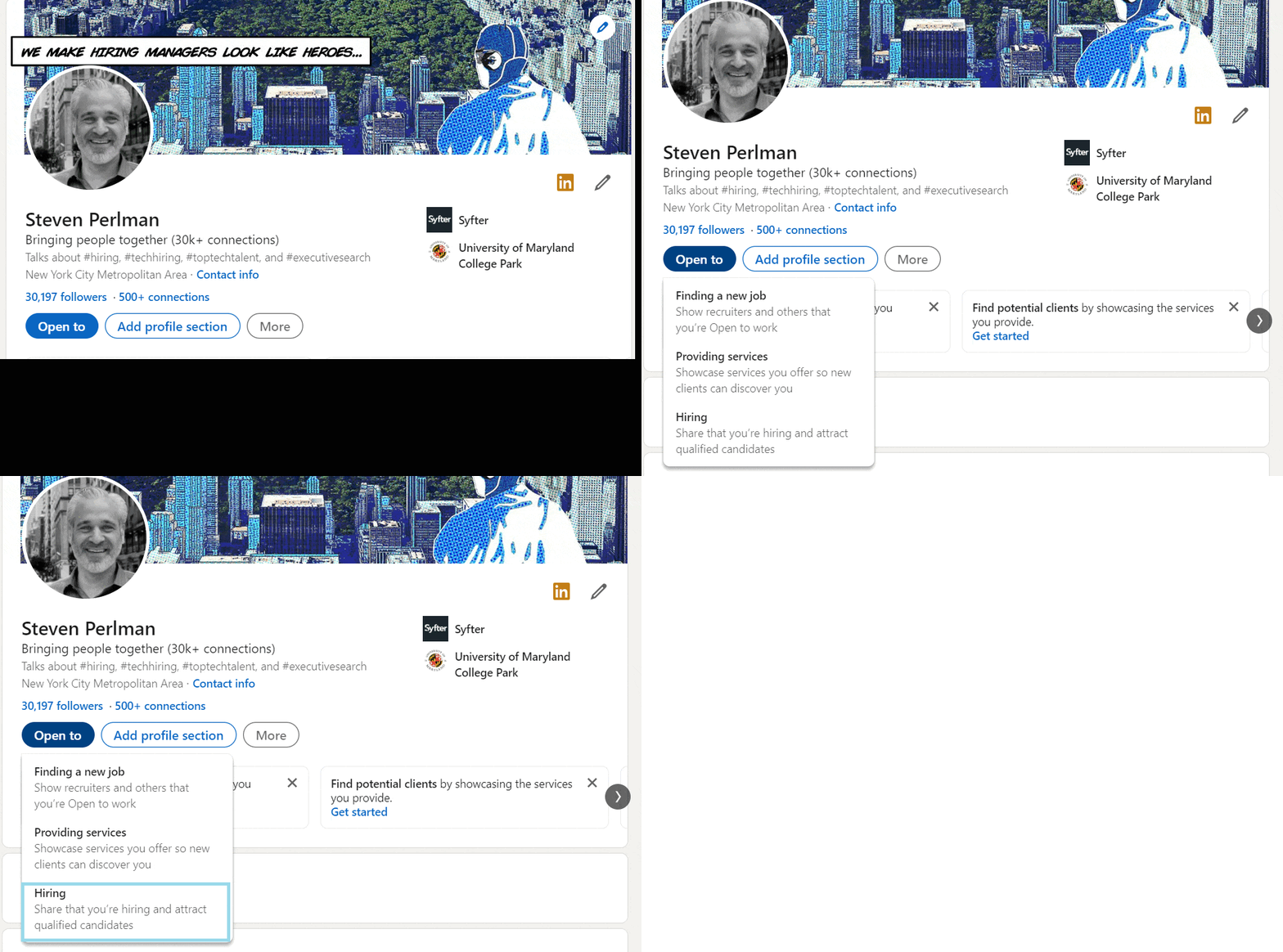
The first thing you need to do is go to your LinkedIn profile. Under your photo, you’ll see a blue button that says “Open To.” Click that blue button, and select the third option – “Hiring.

 
Once you select “Hiring,” you can click the button that will appear: “Create a new job.”
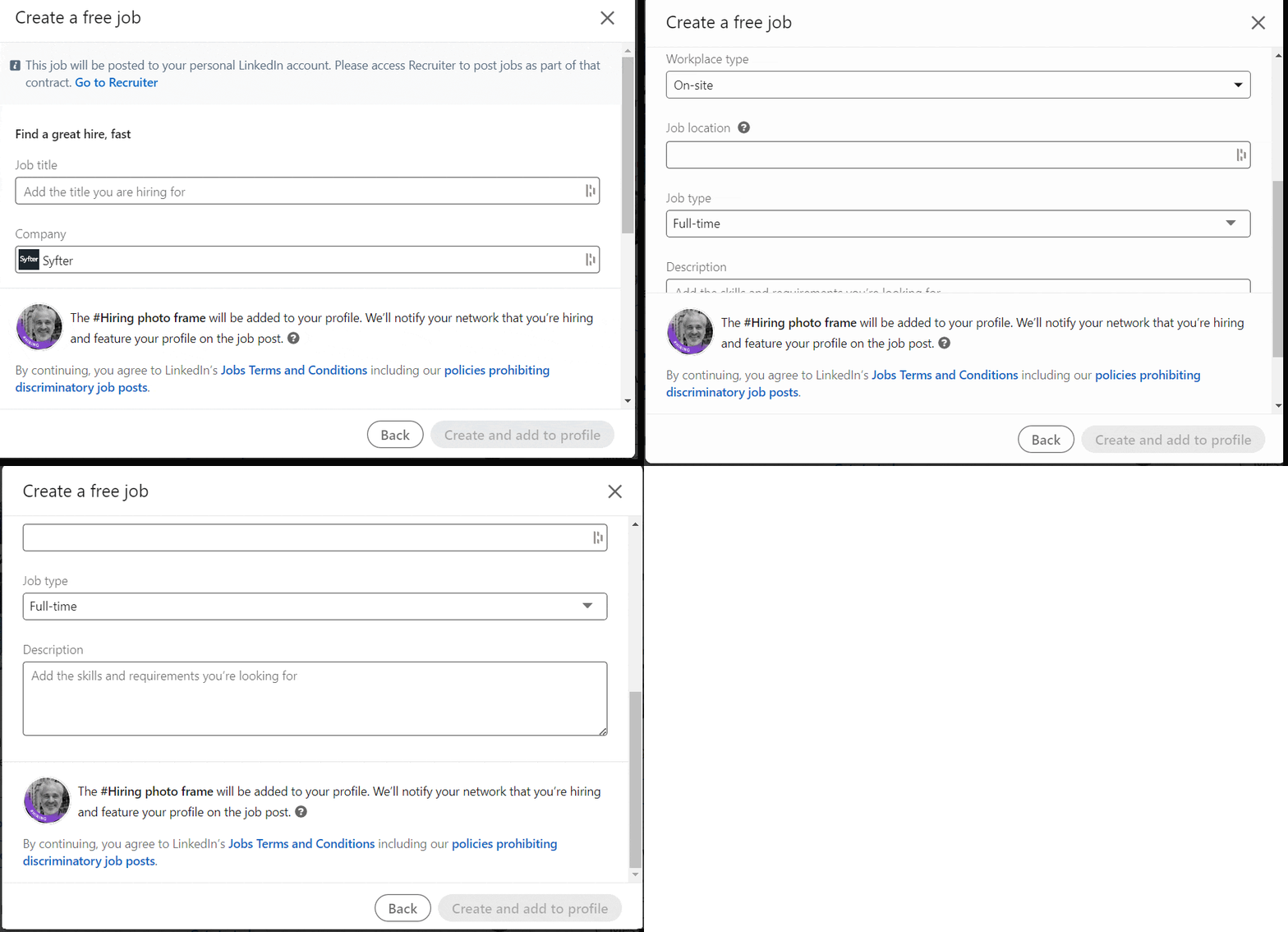
Then, you’ll be taken to fill out the details of your job posting. You’ll need the job title; whether your job is onsite, remote, or hybrid; the job location; if it’s full-time, part-time, freelance, etc.; and the job description you want to post.

You’ll notice at the bottom here that once you post your job, you’ll automatically get that purple #Hiring frame for your profile picture

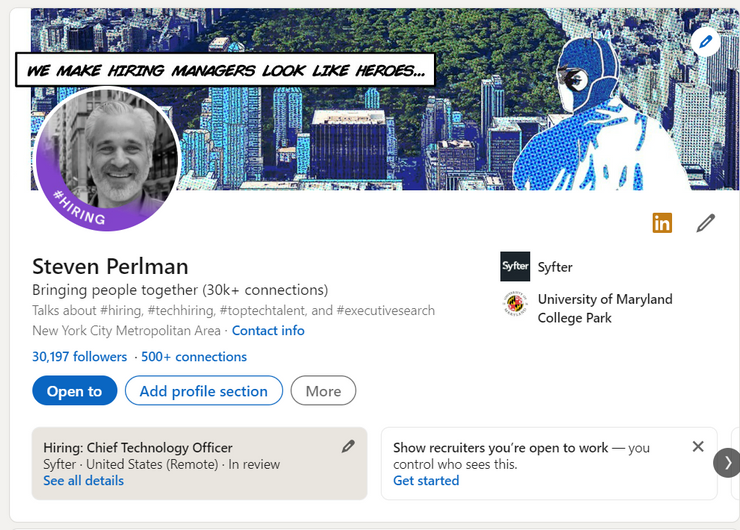
Once you’ve hit “Create and add to profile,” anyone who clicks on your profile will see this:
Once you create the job posting, you can share the post just like you would share any other post on Linkedin. Once you’ve done that, encourage your colleagues to share and like the post. In addition, go into your LinkedIn groups and spend more time posting and networking on topics relevant to the job that you posted. That way, anyone that is intrigued by your content can see the Hiring frame on your profile picture, and they’ll be able to click on your profile and apply directly to your job.

I hope this was helpful for you in trying to be innovative in making your next hire. If you want to take it a step further, here is some in-depth guidance on how to perfect your LinkedIn profile.

Sourced from Syfter

Once a year, spend some time taking back your algorithms

For the last few years, I’ve chosen one weekend day a year to undertake what I’ve come to call a Feeds Reboot. I try to systematically go through every subscription, every follow, every algorithmically or chronologically generated thing I see on social platforms, streaming services, and news apps, and reset or at least review the way it works. I can’t recommend this enough.

Every time I do a Feeds Reboot, I notice a huge uptick in how interesting and relevant I suddenly find the internet. Does it then spend the next 364 days slowly degrading back into a morass from which I will try and extricate myself next year? Yep! But I’m still making progress.

The point of a Feeds Reboot is to be more intentional about the internet. It’s not the same as a privacy audit, which is also a good thing to do every year; rather, it’s a way to change what you see online. Odds are, some of what’s in your feeds — the creators on YouTube, the out-there old friends on Facebook, the inescapable dance crazes on your TikTok For You page — is the result of something you commented on, liked, or just happened to watch many months or years ago. The reboot gives you a chance to start fresh, to declare to the internet that you are no longer the person you once were, and to take more control over the algorithms that run so much of your life.

My process has gotten more complicated over time and now includes three steps: the Following Audit, the Mass Archive, and a more complicated step I’ve come to call the Feeds Reboot Pro Max.

The Following Audit is tedious but really simple: just assess everything you follow everywhere. Go through your following list on Twitter, TikTok, and Instagram, look at all the sources you follow on RSS, check all your Discord memberships, look at all the newsletters you get, scroll through your podcast subscriptions, and check all the bands you follow on Spotify to make sure you still care. Don’t worry about adding better stuff since that tends to happen naturally over time. Just delete everything you don’t want, and make sure you’re only signed up for stuff you actually care about.

The next step is the Mass Archive, which is exactly what it sounds like. Do you have a million emails in your inbox? Do you have a read-it-later app chock-full of stuff you haven’t gotten to yet? How many unviewed Snaps do you have in your list? There’s only one way forward: get rid of all of it. You can delete it all if you’re feeling chaotic or just make a folder called “Archive” and dump everything in. That way it’ll all still be there if you need it… but you won’t. That’s the point.

If you just do those two things, you’ll notice almost immediately that your online life feels more relevant and less overloaded. It always takes the longest the first time since you have a lifetime of feed choices to look at; every year after that is much quicker.

The Feeds Reboot Pro Max is the next step in taking control of your algorithms. It involves looking into how various social algorithms already understand what you like and care about and tweaking them whenever possible.

Not every app lets you do this — TikTok, for instance, won’t give you any control at all over what you see. But some apps do offer more fine-grained control over the algorithm. I’ve included the steps for their mobile apps, though you can sometimes get to the same information in a browser. (And, with YouTube and Facebook in particular, it’s much easier to do some bulk actions on a laptop.) Here they are, in no particular order:

YouTube

  • Go to your Library tab, then select View All above your watch history. Scroll back through everything you’ve watched, hit the three-dot button on the right side, and select Remove from watch history to also take it out of your recommendation pool.
  • Or go nuclear: go to Settings, then History & privacy, and just click Clear watch history to wipe the whole thing and start over.
  • You can also click on Manage all activity and tell YouTube (and other Google services) to purge all your activity after a certain period of time. I have mine set to 18 months, but you can also choose three months or three years of data for Google to keep around.
You can control the data YouTube stores about you or delete it after the fact.
Image: YouTube/David Pierce

Instagram

  • Go to Settings, then Ads, and then Ad Topics to see a list of all the categories advertisers can use to reach you. If you see one you don’t want, tap on it and select See Less.
  • Go to your profile, tap on Following in the top right, and tap on the Least Interacted With category. Unfollow everything in there you don’t want anymore.

Facebook

  • Go to Settings & privacy > Settings and select Your Time on Facebook. Hit See Settings under Get More From Your Time, then tap News Feed Preferences, and either add or remove people from your Favourites and Unfollow lists to control how often they appear in your feed. (Unfollowing people without unfriending them remains an underrated tactic on Facebook.)
  • Go to Settings & privacy > Settings, look for Permissions, and select Ad preferences. Select Ad Topics at the top of the page, and you can see and edit all the topics Facebook tells advertisers you’re into. (This list mirrors the one on Instagram, by the way, so you should only need to tweak it in one place.)
Facebook offers more content control than most — and some of it applies to Instagram, too.
Image: Facebook/David Pierce

Twitter

  • Go to Settings > Privacy and safety, select Content you see, and review both the Topics and the Interests Twitter has for you. Unfollow the ones you no longer want, and opt in to the suggested topics that sound most interesting.

LinkedIn

  • Go to Settings & Privacy > Advertising data, then select Interest categories. You’ll be presented with everything LinkedIn thinks you care about and can turn off any you don’t.

Streaming services

  • Most streaming services have a feature — usually under some phrase like “Watch history” or in the menu where you manage your Continue Watching section — that lets you control what the service uses to inform your recommendations. I would do this on all your services more often than once a year.
  • In Netflix, for instance, it only works on the web: under your profile picture, go to your Account, look for your profile picture in Profile & Parental Controls, then select Viewing activity. Click on the Hide icon next to anything you’d rather not show up in your viewing history or inform your recommendations going forward.

Some folks I’ve talked to over the years recommend a more scorched-earth version of a Feeds Reboot. They say you should just periodically unfollow everyone everywhere and rebuild all your feeds naturally going forward. That feels like overkill to me, but the purpose is the same. Modern life is run by feeds and algorithms, and if you don’t tend to your inputs, you’ll eventually grow to hate the outputs.

The real onus here should be on the platforms themselves to make this process simpler and more transparent — to tell you more about what they know and let you change it. Facebook is probably the model here: a lot of its information is buried deep in settings menus, but you can see and edit everything from your search history to a detailed list of everything the platform thinks you care about.

Until then, there’s the Feeds Reboot. It’s an excellent weekend project for a long weekend like this one.

Feature Image Credit: Photo by Amelia Holowaty Krales / The Verge

Sourced from The Verge

By Connor Cohen

The conversation around content creation and strategizing is trending, with many companies debating whether they need a content marketing strategy or whether it’s a waste of time, money, and resources. However, it is a relatively new concept, and older professionals in the marketing industry are still not convinced that it is just as vital as the other traditional forms of marketing.

If you don’t have a digital content marketing strategy in this day and age, you might be left behind. Whether your company is just starting or is already firmly established in the market, it needs a quality, consistent and relevant digital presence.

Why? Because now more than ever, people are using their phones and other devices as a tool to find information, solutions, and service providers. According to a February 2021 research study, nearly half of the respondents said they spent five to six hours per day on their phone, not including work-related cell phone use. Another 22% of respondents said they spent three to four hours per day on their phones on average.

The marketing transition

In the past, when people needed work done, they relied on referrals and yellow pages. However, today’s service bidders rely on referrals and word of mouth less frequently than recent years. In fact, referrals fell by over 16% in the last five years. It appears that, the holy grail of corporate development for aeons, is losing its clout as the business world unfolds.

Now that we know how critical your digital presence is, let us look at what a digital content strategy is and what it means for businesses.

What is a digital content strategy?

A content strategy is a framework that assists businesses in curating, managing, distributing, and promoting valuable digital content. It’s a way to ensure that the organization’s digital content is consistent with its overall goals and strategy.

People’s perception of an online presence usually starts and ends with a company website, but it is much more than that. Your digital presence includes a company website, social media platforms, eBooks, video interviews, podcasts, case studies and success stories, infographics, blog posts, webinars, emails, presentations, and whitepapers.

The digital content creation mistake

Some companies shy away from creating a digital content strategy because they don’t know where to begin or what it entails. That’s why they make the mistake of only sharing content when it’s available, for example, when they have a new product, service or upgrade available. The truth is, you are not harnessing your company’s true potential.

With competition increasing, you have to ensure that you stay on the radar of your potential buyers. How? By providing information and solutions outside of the services and products you provide. Your goal is to be the first brand that comes to mind when a business or consumer needs a service or product.

Before you sit down to create a strategy, you need to consider the following questions to grasp a rough idea of the direction you want your digital content to take.

  1. Why am I designing this content strategy?

What are you trying to achieve by putting together a digital content strategy? You don’t need to have one hundred reasons before starting – two to five will do. For example, are you trying to increase brand awareness and generate leads or sales?

  1. Who is my target audience?

It would help if you had a clear idea of whom you are curating this content for. Understanding who your target audience is can help with decision making and allows you to narrow down your choices. For example, knowing your target audience or buyer persona will determine the type of content you put out, the tone of your content, and what channels you use to distribute content.

  1. What kind of content are they interested in?

As we mentioned earlier, there are different types of content available that you can use in your digital strategies, like blog posts, podcasts, videos, among others. Find out which type of content is most popular with your target audience and focus on that through market research. Keep in mind that you need more than one type. Even if you have one or two sure choices, try to have a mix.

If, for instance, you are a clothing brand targeting 16–25-year-olds, short videos and pictures are a great way to grab their audience. You can also write short blog posts about quick ways to style their outfits or color block.

  1. Where do they usually search for this kind of content?

You might develop unique and valuable content, but if it’s on platforms your customers do not frequent, it is as good as useless. Carry out surveys and polls and let your customers fill out questionnaires ranking their most addictive and popular apps and platforms so you know where you should publish your content.

  1. How often should I publish this content?

It is essential to strike a balance between being persuasive and not being irritating. You want your potential customers to always have your brand in mind, but you do not want them to find you annoying and too persistent.

For example, if you choose to connect to your clients through email marketing, do not send them emails every single day. Even if your content is valuable, they may unsubscribe from it as it could become a bit of a nuisance. So instead, let your clients consume your information in doses.

  1. Who will be curating this content?

This is a critical decision because it will determine the type of content you put out. Just because you know everything there is to know about starting an eCommerce store, it does not automatically mean you have the skill to write blog posts or eBooks about it. But, if you do, that’s perfect.

If you do not know how to use this knowledge to produce insightful and valuable content, you can outsource it to different content creators like writers, influencers, and videographers. In addition, you can hand over this task if you have an in-house content creation team.

Why is good content important?

  1. It asserts your company as a thought leader

If you googled ‘how to lose ten pounds in a month’ and found a simple program that worked, and then ‘how to grow your glutes’ a few weeks later, and it also worked, chances are, you will start to rely on that source for your fitness needs.

By putting out informative and valuable content, you show your target audience that you know what you are talking about. Good content makes it easy for you to stand out from the hundreds of companies providing the same product or service.

  1. It is an SEO tool

If you are in the digital content creation business, you know a thing or two about SEO. Search engine optimization is a tool that boosts a website or web pages chances of showing up at the top of search engine results.

The more you publish your content and strategically place keywords that your audience usually searches for, the higher the chances that your brand will be noticed, hence creating new leads.

One way to do this is through publishing evergreen content, both written and video. Why? Because it’s timeless and is relevant all-year round.

Evergreen content examples

  • How To…
  • Tips & Tricks
  • Product reviews
  • Guides / Recipes
  • Top ten…
  • FAQ’s
  1. It attracts new leads

Good content is a promotional tactic on its own. If you consistently put out quality content, you attract serious clients interested in your services or solutions. Your content will walk into recruitment meetings before you even go in for a pitch.

  1. It increases brand awareness

Unless you build rockets or are Lewis Hamilton, chances are there are hundreds or thousands of people who can provide the services or products you do. So, if your goal is to be a class apart from the competition, you must publish well-thought-out content. The more you create helpful content and publish it across multiple platforms, the higher your chances are of growing a more prominent and broader following.

  1. High-quality content has the potential to influence purchasing behavior

If you believe that advertisements influence buyers more than article content on the internet, you are mistaken.

In fact, 7 out of 10 buyers prefer to learn about a business or brand through articles rather than advertisements. This fact demonstrates that article-type content delivered via a company blog or other content marketing mediums is the preferred approach for customers to learn about products and services. Why? It allows you to have more of a voice, style or flair, and story than typical ‘professional’ web pages.

Why is good content distribution essential?

Content distribution is a tactical approach to delivering content to your target audience through various channels. It entails publishing, sharing, and promoting high-quality content in strategic locations where people can actively and successfully engage with it. There are three main distribution channels: owned, earned and paid.

  • Owned

These are the networks your business owns and has total control over, like your website, blog, email or newsletter, and social media accounts.

  • Earned

Earned channels encompass third parties who share or promote your content at no cost—for instance, social media mentions, reposts, shares, guest blogs, and product reviews.

  • Paid

Some channels are not freely accessible. You have to pay to distribute your content to a highly targeted and specific audience. For example, pay-per-click ads, sponsored content and paid influencer content or ads on Facebook, Twitter, LinkedIn, Google, and Instagram.

In marketing, content is king and distribution is queen – they are part and parcel of any digital content creation strategy and need to be handled tactically. We’ve seen a rapid influx of content met with shrinking demand in recent years. We can only consume so much information with almost 4.5 million blog posts published every day. As a result of this content shock, your distribution plan should be strategic and well-thought-out if it’s to be effective.

The beauty of a digital content and distribution strategy is flexibility. You can adjust it as you go depending on the metrics and results. If you try one channel and it fails, try another one or a mix until it is just right.

Companies that tweak their distribution strategy until it’s perfect enjoy perks like increased brand awareness, recognition, lead generation, increased sales, and revenue. The starting point is to get people to talk about your brand, trust it and rely on it as an authority figure. Then, you can start leveraging these benefits to boost revenue and sales.

Social media content strategy

Social media is the perfect marketing tool right now. With new and popular apps popping up every other day, brands have an excellent opportunity to capitalize on the frenzy to grow their businesses and brand awareness. For example, Instagram and TikTok have emerged as two of the most addictive content creation and sharing apps, with YouTube retaining its power and influence.

Video content should form at least part of your content distribution strategy because it is one of the best ways to truly show potential customers your core values, purpose, goals and objectives. In addition, videos are an excellent way to tell your story and inspire an emotional and psychological connection with your customers.

Furthermore, you can combine your YouTube content strategy with a case study to accurately depict your business solutions and services.

YouTube is the most profitable video sharing and viewing platform, with 2.3 billion people accessing it each month. If you can invest in a good videographer and content development team, you can leverage your social media platforms to boost the subscription and viewership for your YouTube channel.

Other social media content examples

  • Written posts, blogs and articles
  • Images
  • Videos and video stories
  • Infographics
  • Links to external content
  • Testimonials and reviews
  • Lives

This article cannot entirely cover everything there is to know about developing a digital content marketing strategy, but it is a good start.

If you found this piece helpful and would like to learn more about creating a digital content strategy that works, visit our content marketing hub, where you can find more news and information about content marketing.

By Connor Cohen

Sourced from The Drum