Author

editor

Browsing

Data science is a new interdisciplinary field of research that focuses on extracting value from data, integrating knowledge and methods from computer science, mathematics and statistics, and an application domain. Machine learning is the field created at the intersection of computer science and statistics, and it has many applications in data science when the application domain is taken into consideration.

From a historical perspective, machine learning was considered, for the past 50 years or so, as part of artificial intelligence. It was taught mainly in computer science departments to scientists and engineers and the focus was placed, accordingly, on the mathematical and algorithmic aspects of machine learning, regardless of the application domain. Thus, although machine learning deals also with statistics, which focuses on data and does consider the application domain, up until recently, most machine learning activities took place in the context of computer science, where it began, and which focuses traditionally on algorithms.

Two processes, however, have taken place in parallel to the accelerated growth of data science in the last decade. First, machine learning, as a sub-field of data science, flourished and its implementation and use in a variety of disciplines began. As a result, researchers realized that the application domain cannot be neglected and that it should be considered in any data science problem-solving situation. For example, it is essential to know the meaning of the data in the context of the application domain to prepare the data for the training phase and to evaluate the algorithm’s performance based on the meaning of the results in the real world. Second, a variety of population began taking machine learning courses, people for whom, as experts in their disciplines, it is inherent and essential to consider the application domain in data science problem-solving processes.

Teaching machine learning to such a vast population, while neglecting the application domain as it is taught traditionally in computer science departments, is misleading. Such a teaching approach guides learners to ignore the application domain even when it is relevant for the modelling phase of data science, in which machine learning is largely used. In other words, when students learn machine learning without considering the application domain, they may get the impression that machine learning should be applied this way and become accustomed to ignoring the application domain. This habit of mind may, in turn, influence their future professional decision-making processes.

For example, consider a researcher in the discipline of social work who took a machine learning course but was not educated to consider the application domain in the interpretation of the data analysis. The researcher is now asked to recommend an intervention program. Since the researcher was not educated to consider the application domain, he or she may ignore crucial factors in this examination and rely only on the recommendation of the machine learning algorithm.

Other examples are education and transportation, fields that everyone feels they understand. As a result of a machine learning education that does not consider the application domain, non-experts in these fields may assume that they have enough knowledge in these fields, and may not understand the crucial role that professional knowledge in these fields plays in decision-making processes that are based on the examination of the output of machine learning algorithms. This phenomenon is further highlighted when medical doctors or food engineers, for example, are not trained or educated in machine learning courses to criticize the results of machine learning algorithms based on their professionalism in medicine and food engineering, respectively.

We therefore propose to stop teaching machine learning courses to populations whose core discipline is neither computer science nor mathematics and statistics. Instead, these populations should learn machine learning only in the context of data science, which repeatedly highlights the relevance of the application domain in each stage of the data science lifecycle and, specifically, in the modelling phase in which machine learning plays an important role.

If our suggestion, to offer machine learning courses in a variety of disciplines only in the context of data science, is accepted, not only will the interdisciplinarity of data science be highlighted, but the realization that the application domain cannot be neglected in data science problem-solving processes will also be further illuminated.

Don’t teach machine learning! Teach data science!

Orit Hazzan is a professor in the Technion’s Department of Education in Science and Technology; her research focuses on computer science, software engineering, and data science education. Koby Mike is a Ph.D. student at the Technion’s Department of Education in Science and Technology; his research focuses on data science education.

Sourced from Communications of the ACM

By Ben Hall, University of Essex

The most boring person in the world has been discovered by University of Essex research – and it is a religious data entry worker, who likes watching TV, and lives in a town.

The peer-reviewed study into the science of boredom has uncovered the jobs, characteristics, and hobbies that are considered a stereotypical snooze.

After examining more than 500 people across five experiments researchers found the blandest jobs are seen as data analysis, accounting, cleaning and banking.

The paper – published in the Personality and Social Psychology Bulletin – also discovered that religion, watching TV, bird watching, and smoking were amongst the dullest hobbies.

Boring people were also perceived to shun large settlements to live in small cities and towns

Led by the Department of Psychology’s Dr Wijnand Van Tilburg the research revealed that stereotypically boring people are generally disliked and avoided due to preconceptions.

And people may expect to be paid a minimum of £35-a-day to spend time with them as recompense.

He launched the study to explore the stigma of perceived boredom and how it can impact perceptions.

He said: “The irony is studying boredom is actually very interesting and has many real-life impacts.

“These paper shows how persuasive perceptions of boredom are and what an impact this can have on people.

“Perceptions can change but people may not take time to speak to those with ‘boring’ jobs and hobbies, instead choosing to avoid them.

“They don’t get a chance to prove people wrong and break these negative stereotypes.

“The very fact that people choose to avoid them can lead to social ostracization and increase loneliness leading to a really negative impact on their lives.”

The study also showed that being perceived as boring likely conveys low competence and low interpersonal warmth.

Those perceived as boring may thus be at greater risk of harm, addiction and mental health issues.

And despite the negative perception society needs people to perform roles such as accounting and banking.

“It was interesting to me to see the study showed that boring people were not seen as competent,” said Dr Van Tilburg.

“I would have thought that accountants would be seen as boring, but effective and the perfect person to do a good job on your tax return.

“The truth of the matter is people like bankers and accountants are highly capable and have power in society – perhaps we should try not to upset them and stereotype them as boring!”

Lists:

The top five most boring jobs:

1.) Data Analysis

2.) Accounting

3.) Tax/insurance

4.) Cleaning

5.) Banking

The top five most exciting jobs

1.) Performing arts

2.) Science

3.) Journalism

4.) Health professional

5.) Teaching

The top five most boring hobbies

1.) Sleeping

2.) Religion

3.) Watching TV

4.) Observing animals

5.) Mathematics

Feature Image Credit: The peer-reviewed study into the science of boredom has uncovered the jobs, characteristics, and hobbies that are considered a stereotypical snooze. (CREDIT: Creative Commons)

By Ben Hall, University of Essex

Sourced from Brighter Side of News

By Todd Spangler

A new study estimates that upwards of 10% of Twitter active accounts post spam content — double the company’s own claims.

The report from U.K.-based data analytics and consulting firm GlobalData comes as Elon Musk, the billionaire Twitter power-user, has threatened to nix his $44 billion deal for the social network over the question of the prevalence of spam and fake accounts on Twitter. On Monday, Musk’s lawyers sent a letter to Twitter alleging the company was in “clear material breach” of the acquisition agreement because Twitter has refused to furnish information backing up its claim that fake/spam accounts represent less than 5% of daily active users.

A Twitter rep declined to comment.

According to GlobalData, its 10% spam estimate is conservative but the firm acknowledged that “there is no conclusive way of knowing if a certain account is a bot or spam.” According to Sidharth Kumar, GlobalData senior data scientist, the discrepancy between Twitter’s internal sub-5% estimate and the GlobalData model’s 10% estimate is likely due to a difference in criteria as to what counts as “spam.”

“The precise proportion of spam accounts is difficult to compute, as it is almost impossible to confirm the identity of the entity behind a tweet handle,” Kumar said, adding that “the definition of a spam account may differ for everyone. Incessant tweeting of non-original content can be considered spam, but some may choose to see it as a very active user sharing articles/opinions.”

For the study, GlobalData analysed about 4 million recent tweets from a sample of 20,976 Twitter accounts to discern patterns — and concluded that 10.9% of those represented spam accounts. The firm’s model used multiple factors to determine whether a specific account was “spam,” including whether its tweets originated from third-party applications; whether it is Twitter Verified; number of tweets per day; proportion of retweets; the median time between any two tweets; the length of an account’s bio description; and proportion of links shared.

Wall Street has viewed Musk’s sudden interest in conducting due diligence about the spam/bot metric as an attempt to either back out of the acquisition or to drive the deal price down. Twitter has disclosed its estimate that spam and fake accounts represent less than 5% of its active users for years, dating back to its IPO filing in 2013.

Last month, Musk tweeted that Twitter’s active user base could represent “20% fake/spam accounts” and asserted, without citing any evidence, that it “could be *much* higher.” To be sure, the question of how many of Twitter’s 229 million daily active users (as of Q1) are actual monetizable users is an important factor in valuing the company, but analysts have wondered why Musk only zeroed in on the issue weeks after clinching the original buyout agreement.

In a series of tweets, Twitter CEO Parag Agrawal responded to Musk’s questions about fake/spambot accounts, tweeting in part that “Unfortunately, we don’t believe that this specific estimation can be performed externally, given the critical need to use both public and private information (which we can’t share).”

By Todd Spangler

Sourced from Variety

B

Did you know that around 7 million blog posts and 500 million tweets are sent out every single day?

That equates to almost 5000 blogs per minute and 6000 tweets per second. In addition, you also have over 300 hours of video uploaded to YouTube every minute.

That’s a dizzying amount of content to compete with, and if you’re a content marketer, you’re at some point going to ask yourself the exasperating question, how am I going to cut through the noise and reach my target audience?

One thing to remember while creating content for your audience is that, in the end, they are human beings. To cut through the noise you can tap into human psychology. Here are 5 actionable strategies that can help you do just that.

1. Social Proof Theory

Social proof is a psychological phenomenon that consciously and unconsciously persuades you to adopt a belief or mimic the actions of a group of people you happen to like or trust.

According to Robert Cialdini’s Influence: The Psychology of Persuasion, he states “we view a behaviour as more correct in a given situation to the degree that we see others performing it.”

How to apply it in content marketing?

Social proof can be incorporated in several ways to boost your content marketing, you can either add social plugins or provide sharing buttons to your blog that displays the number of shares your content has generated. If your readers can see that some people have shared your post already, it’s quite likely that they will follow suit. Another quick way to apply social proof to your content marketing strategy is to highlight milestones on social media.

User-generated content like testimonials, reviews, and social media mentions each offers amazing avenues for leveraging social proof. Why? because they all highlight positive experiences and effectively signal to others that your content is trustworthy. Therefore, if you are lucky enough to boast these or any other forms of social proof, you should not shy away from it!

2. Information Gap Theory

Characterized as a disparity between what is known, and what needs to be known to make a comprehensive and reliable decision. This strategy can be used tactfully, to impact your content marketing.

Human psyche is such that when an individual identifies a gap in his/her knowledge or on a topic they care about, they will take the necessary course of action to find out what they need to know. This sort of behaviour is fuelled by natural human curiosity, which when tapped into strategically works wonders for content marketing.

How to apply it in content marketing?

You can leverage this theory by making your target audience more interested in your business. To help create an information gap, make sure to use gripping headlines and select engaging topics that pique your target audience’s interest. All your headlines must be ultra-specific, unique, and useful, they need to be able to fuel a sense of need and curiosity, take a cue from Neil Patel’s content.

NeilPatel

Therefore, when you fashion a headline, try and test out a variety of options until you find a blend that encompasses all the attributes mentioned above. Then, the main too should do justice to the headline and provide the reader with valuable insights they desire.  You can also utilize this psychological strategy to determine the answers your prospects are looking for and create content that addresses those topics.

3. Theory of Reciprocity

Within social psychology, reciprocity is described as the tendency of human nature to want to offer something when something is received. Essentially, when your content can offer individuals copious amounts of value, they might be fuelled by gratitude and might choose to return the favour. The key to this strategy lies in using the principle tactfully to trigger customers to behave in the way you desire.

How to apply it in content marketing?

When you think about it, with every blog post that you create, you give away valuable insights to your readers for free, but why just stop at that! You can go a step further to take advantage of reciprocity, you can create a few free podcasts, webinars, e-books, etc too. These insightful freebies, when used for performance support can get you a mention or a shout out on their social media or a link back to other blogs. They also act as amazing lead magnets that lure readers and potential customers to share their contact details. In short, if you can ingrain a sense of gratitude in your content, reciprocity will help you secure loyalty.

Digital-Marketing

4. The Nudge Theory

Developed by Richard H. Thaler and Cass R. Sunstein, this theory suggests that indirect suggestions and positive reinforcements play a pivotal role in influencing people’s decisions and actions. The success of this strategy relies on clever placement and timing to reinforce the prospect’s momentum. This approach guides prospects towards your content by launching them from other related services or products.

How to apply it in content marketing?

You could tactfully place call-to-action buttons or suggested articles on relevant content and advertising platforms with related products or services. A nudge can provide suggestions of what other converted users did or clicked next to streamline the customer journey. If a nudge towards an action happens to pop up at a natural point during the user experience, they are more likely to take the cue. Embedded nudges are useful for getting people to sign up or subscribe to your content.

Ogilvy

5. The Frequency Illusion

The frequency illusion, or for many the Baader-Meinhof phenomenon, is a sense of analytical bias wherein after you notice something for the first time, there is a tendency that it starts cropping up everywhere. The trick about this illusion is that your selective attention goes into overdrive. When it comes to content marketing, you can use it strategically to retarget your consumer.

How to apply it in content marketing?

To trigger the illusion, you need to make potential customers aware of your content through integrated campaigns. Distinctive headlines and short sharp hooks within the content supported by attention-grabbing visuals are crucial. You should create multiple pieces of content across several platforms that can reinforce the marketing message conveyed in each, which in turn creates the feeling of frequency.

Parting thoughts

At its core, marketing is in fact psychological manipulation, from colour palettes to hook phrases to streamlining the user experience, psychology helps marketers anticipate and even influence behaviour.

The reason behind using these psychological tactics is that it helps create a competitive advantage by providing audiences with valuable content­ that speaks to their wants, needs, and challenges.

You too could utilize these strategies to unravel the minds of your target audience and better grasp the universal motives that fuel human behaviour and desire.

B

Aditya Kathotia is the CEO of Nico Digital and the founder of Digital Polo. A polyglot of the digital marketing business, he has powered 500+ brands through transformative digital marketing strategies. His work has been featured on Entrepreneur, Hubspot, Business.com, Clutch, and many more. You can find him on Twitter or connect with him on LinkedIn

Sourced from Jeff Bullas


By

  • Some of McDonald’s former Russian franchisees are still using its branding.
  • “Of course we’re not happy about this,” Oleg Paroev, the CEO of Vkusno & tochka, told Reuters.
  • Vkusno & tochka has replaced most of the McDonald’s restaurant, and has a different logo and menu.

Some former franchisees of McDonald’s Russian restaurants are still using its branding – and the CEO of the chain that took over most of the sites isn’t happy about it.

Russian businessman Alexander Govor bought the majority of Russia’s McDonald’s restaurants after the burger giant quit the country following its invasion of Ukraine. The restaurants began reopening on June 12 with a new menu, logo, and name – Vkusno & tochka, which translates as “tasty and that’s it.”

“We don’t have the right to use some colours, we don’t have the right to use the golden arches, we don’t have the right to use any mention of McDonald’s,” new owner Govor told Reuters.

Though Vkusno & tochka still uses the same ingredients and equipment to make dishes, there are some major changes.

The Big Mac has been taken off the menu, branded packaging has been scrapped largely in favour of plain boxes and bigs, and the logo, while still resembling an “M,” has changed dramatically.

McDonald's Russia food on a tray with an arrow pointing to the sauce packet
Former McDonald’s stores in Russia rebranded so quickly that some resorted to scribbling McDonald’s logo off sauce packets.

Kirill Kudryavtsev/AFP via Getty Images

But the same isn’t true of all the former McDonald’s franchise restaurants. Though the vast majority of McDonald’s restaurants in Russia were owned by the company, around 100 were owned by franchisees. Some of these locations are continuing to sell Big Mac burgers under a different name and are using packaging and electronic screens with McDonald’s branding, Reuters reported.

“Of course we’re not happy about this,” Oleg Paroev, the CEO of Vkusno & tochka, told Reuters. But even though continuing to use McDonald’s brand violates Russian law, Vkusno & tochka has no rights to the brand so can’t take legal action, he said.

Paroev said that around 100 of McDonald’s former Russian restaurants hadn’t been bought by Govor. He said that Vkusno & tochka had suggested that the former franchisees join the new brand, and that one had already agreed.

Unlike Vkusno & tochka, the ex-franchisees no longer have access to McDonald’s old suppliers, Paroev said.

“It’s a mystery to me what products are sold there,” he told Reuters, speaking about restaurants in train stations and airports. “But I can say with certainty that it is absolutely not the same products or ingredients that were previously sold at McDonald’s.”

Paroev told Reuters that Vkusno & tochka sold a record 120,000 burgers on its opening day and that the chain planned to open 1,000 restaurants within the next five years.

Feature Image Credit: Getty Images

By

Sourced from Insider

By Andrew Romero

We’ve all been there. Emails are stacking up, and none of them seem important in the least. Fortunately, there’s a feature in Gmail that allows you to unsubscribe from emails with a couple of taps or clicks. This guide will take you through it.

An easier way to unsubscribe

Normally, we tend to answer useless emails by opening them up, scrolling straight to the bottom, and hitting “Unsubscribe.” While this is the tried and true method of unsubscribing from emails, it can sometimes be a little counterintuitive. A major job of a marketing company is to retain prospective clients. The problem they face is if you go to unsubscribe, the company loses out on potential business. This is the reason why a lot of times the unsubscribe page looks jumbled and has material presented in a way to keep you on board.

Google has implemented a way to unsubscribe from certain emails for a few years now. The company has gone through several iterations of this dedicated button – among its many other Gmail experiments – and finally landed on a prompt you can access from specific emails. This button takes away all of the marketing noise you have to crawl through when unsubscribing from some companies and makes it easy to leave the email list with a couple of quick taps. When you hit the unsubscribe button in Gmail, you’ll no longer see emails from that company and you can keep cleaning out your inbox.

How to unsubscribe from emails in Gmail

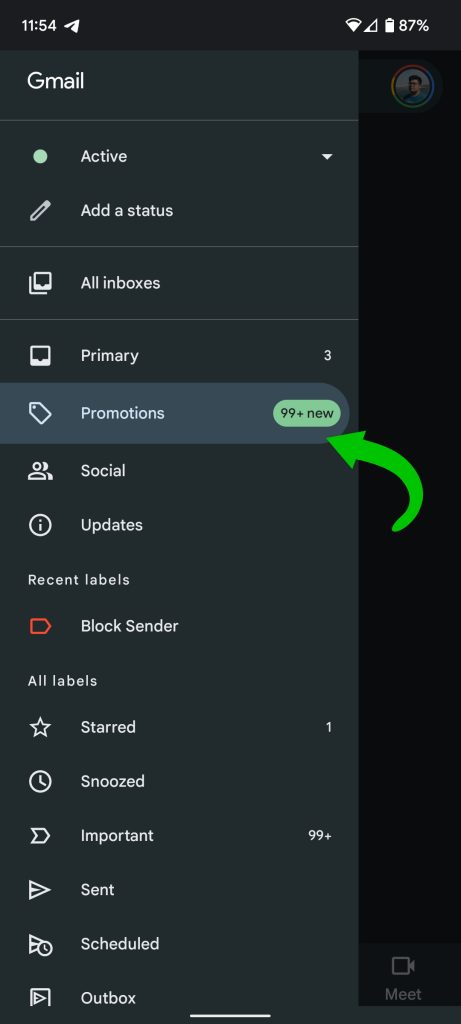
If you want to make use of this helpful feature, you’ll need to have access to Gmail on a mobile device. Gmail for desktop doesn’t quite utilize the button at this point. On your phone, however, unsubscribing from marketing emails in Gmail is pretty easy. Here’s how to do it:

  1. On your mobile device, head to the Gmail app.
  2. Look through your emails and find marketing or promotional emails you want to unsubscribe from.
  3. Open the email.
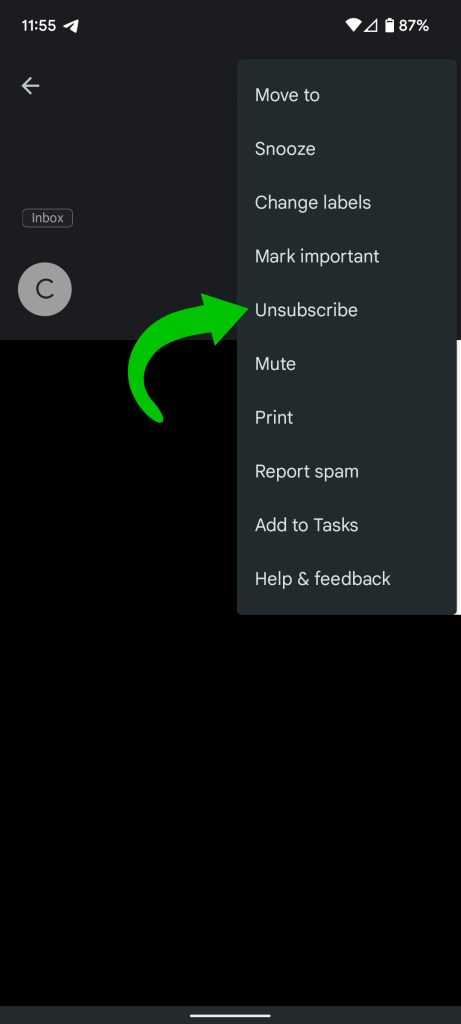
  4. Find the three-dot menu in the top-right corner of the email and tap it.
  5. A menu will appear. Tap Unsubscribe.
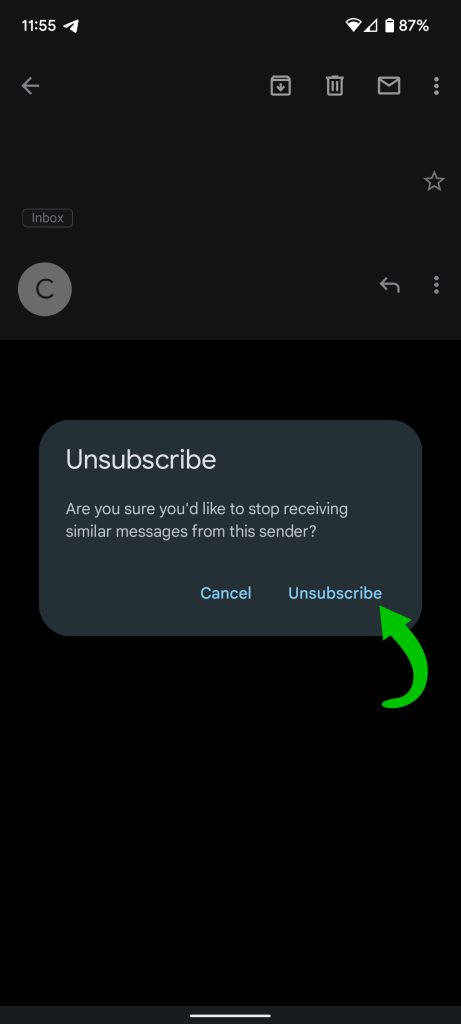
  6. Confirm you want to unsubscribe.

Once you do that, you’re given an option to report the message as spam. Generally, you don’t have to and the emails will halt. This is a great way to easily stop receiving emails from companies and organizations that you didn’t want in the first place.

More on Gmail:

By Andrew Romero

Sourced from 9to5Google

By Amber Atherton

Increasingly, building a successful start-up involves not only building a product that people can’t get enough of, but also building an engaged, loyal community around that product. Today, most founders are acutely aware of the value of community. In CMX’s 2021 Community Industry Report, 86% of respondents (community managers from 508 different companies) said community was critical to their company’s mission, and more than two-thirds said their company planned to increase their investment in community in the next year.

But while many founders are eager to invest in community, they often don’t know what they’ll need to understand to build one the right way. Between starting and running Zyper, a platform that connected brands with super-fans, and now leading community growth strategy at Discord, I’ve built hundreds of healthy communities for businesses, brands, and creators. Before diving in and hiring a dedicated community team, I’ve learned, founders need to have a strong grasp of two essential concepts: 1) the community quadrant (to understand how community differs from other groups of people who interact with a product), and 2) the community funnel (to understand what makes a community compelling to prospective members).

To that end, I’ve put together a guide that breaks down both concepts. It doesn’t cover everything you need to know to build a successful community. Instead, it’s intended to teach early-stage founders just enough to begin allocating resources.

What a community is (and isn’t)

One common misconception, I’ve noticed, is the idea that “community” and “customers” are synonymous terms. They aren’t. Understanding how they differ is critical, so let’s start there.

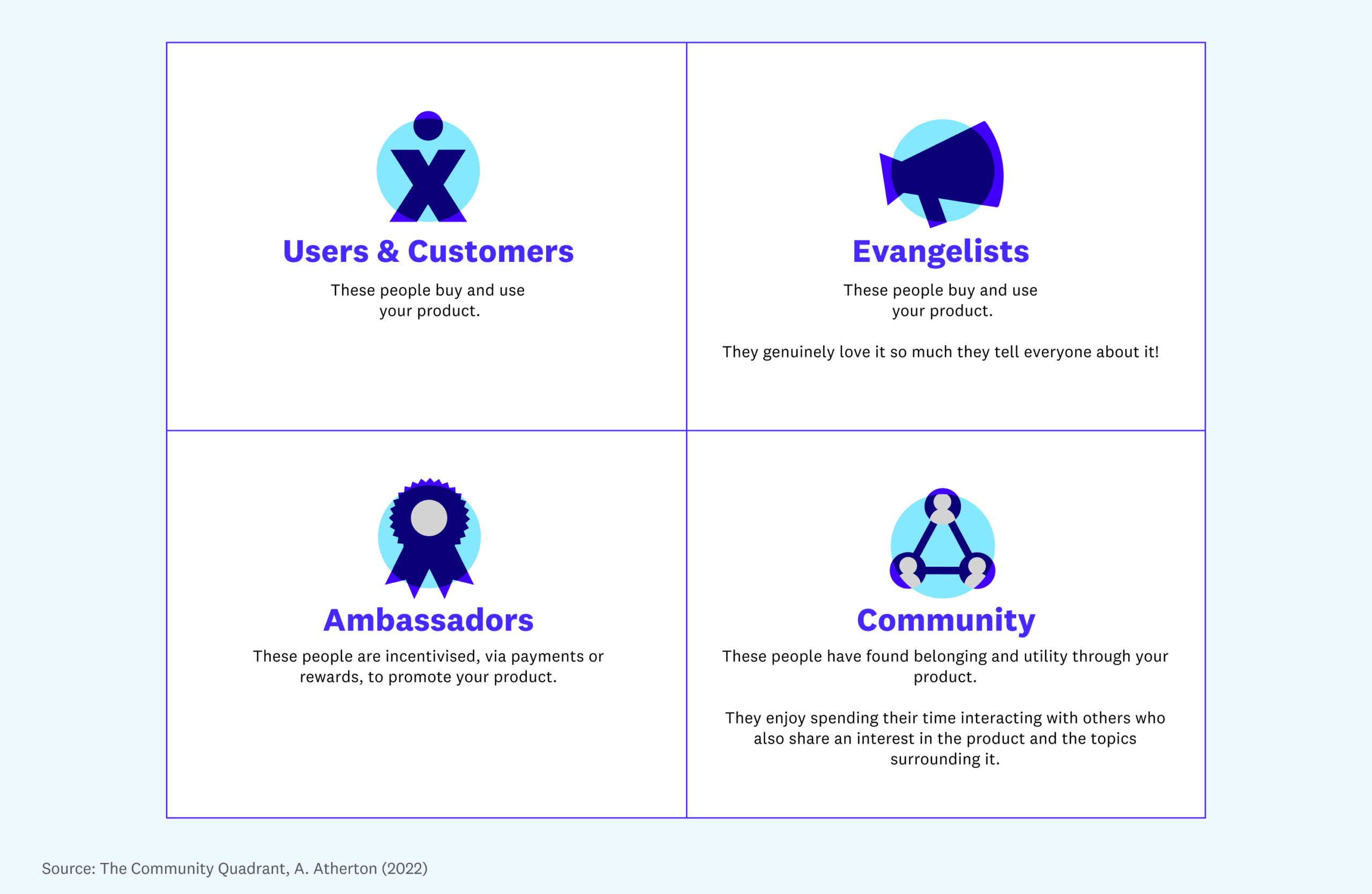
The people who interact with your product generally fall into one of four buckets:

  • Customers/users buy and/or use your product.
  • Evangelists tell everyone they know to buy or use your product because they genuinely love it.
  • Community is the group of people who’ve found belonging and utility through your product.
  • Ambassadors are incentivized, through payments or rewards, to promote your product.

What distinguishes community members from those in other groups is the congregation element: Beyond using, liking, or writing glowing reviews of your product, they spend time forming connections with other people based on a shared affinity for it.

The quadrant, sequenced

Three of these groups reliably emerge in a fixed order: Users/customers come first, followed by evangelists, and then community.

Ambassadors don’t fit neatly into this sequence, so you’ll need to make a decision about their relationship to the other three groups. Even though ambassador endorsements aren’t organic, they still help spread awareness of your product to new segments and markets. Ambassadors range from nano-influencers and affiliates to well-known celebrities, and they can collectively become a community in their own right, with gamified rankings and events. Generally speaking, my advice is to build an ambassador program that functions separately from the other three groups. This article covers the basics.

The ideal time to launch a community varies, but you should wait until you have confirmed evangelists. People who love your product are your proof point. If self-professed evangelists haven’t announced themselves yet, email a group of your earliest customers (50 is enough) to find out if they love your product. Those who respond enthusiastically are your first evangelists; invite them to join your community. Evangelists don’t automatically become community members, but they’re the most obvious cohort to start with because you know that they like your product and want to talk about it.

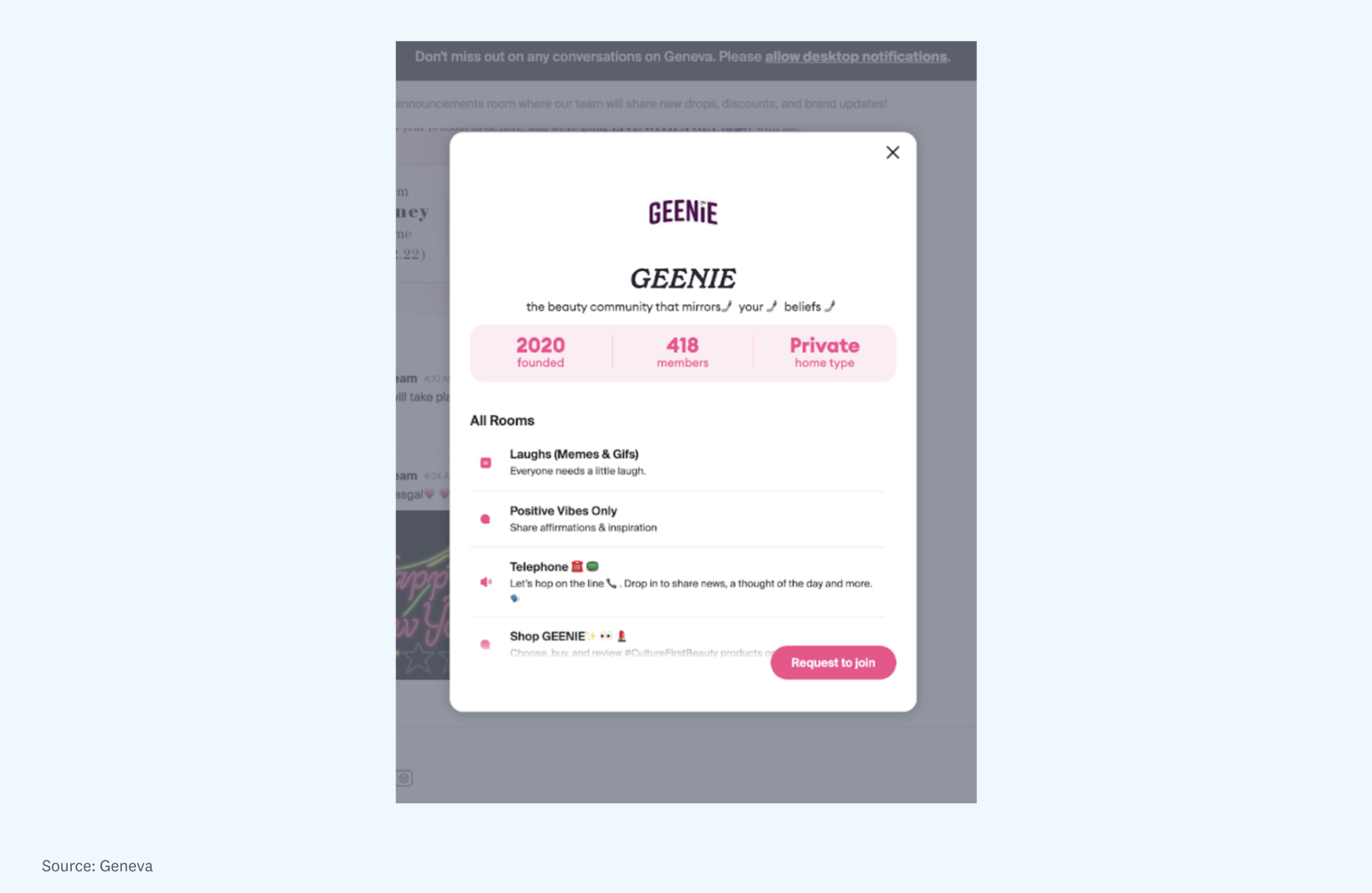
Next, start a conversation with this founding group in a private space designed for that purpose, such as a Discord server, a Slack channel, a Telegram chat, or even a group DM on Instagram. Some community platforms are designed to be versatile while others are geared toward specific populations. Geneva, for example, is a private group-chat app gaining traction among businesses with female customer bases.

One thing you shouldn’t do is waste engineering resources on building out your own community infrastructure. At this stage, third-party community platforms will meet all your technical needs. Plus, your target community members might already use them. Meeting people where they are never hurts.

The early days of community-building should feel like user research. You’re not trying to build an audience or sustain engagement. Instead, you’re experimenting with different offerings to figure out what your evangelists want. Audio? AMAs? IRL meet-ups? Ask them directly. Not only will you learn what they find valuable, you’ll also give them a sense of belonging.

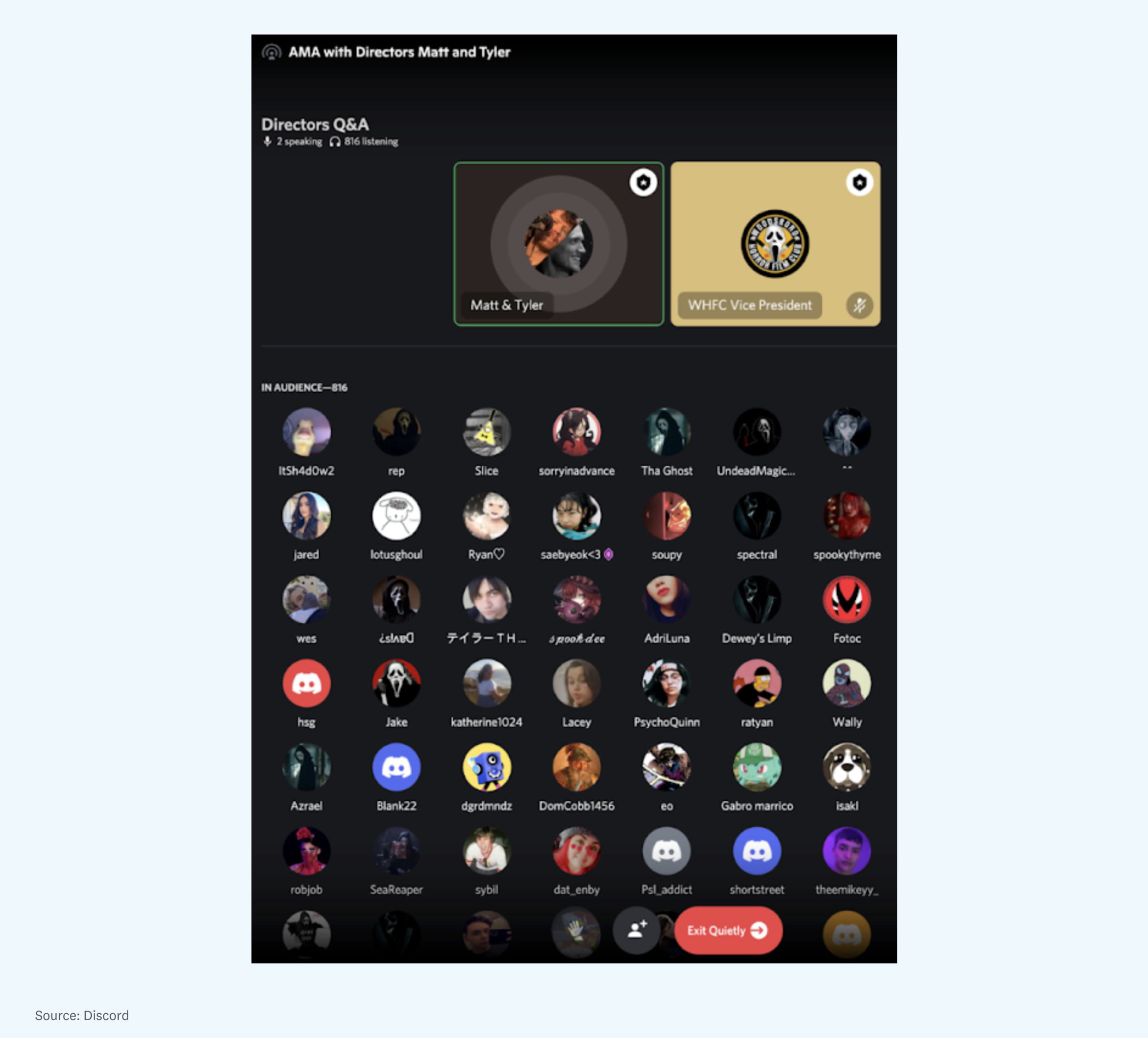
The specific offerings that appeal to evangelists vary by community. For example, members of Scream Movies on Discord — a community for super-fans of the franchise — get exclusive access to events like director AMAs. That’s a big deal if you’re a Ghostface diehard.

But AMAs might not be such an effective way to generate interest in every community. Take the SBUX Hub on Discord, an unofficial Starbucks community for baristas and fans alike. Perks of membership include behind-the-counter secrets and access to off-menu recipes. Here, learning about seasonal Frappuccino flavors months before they’re announced might drum up more excitement than, say, joining an AMA with Howard Schultz.

Once you have a handle on the quadrant, the second concept to master is the community funnel.

The community funnel: invited —> invested

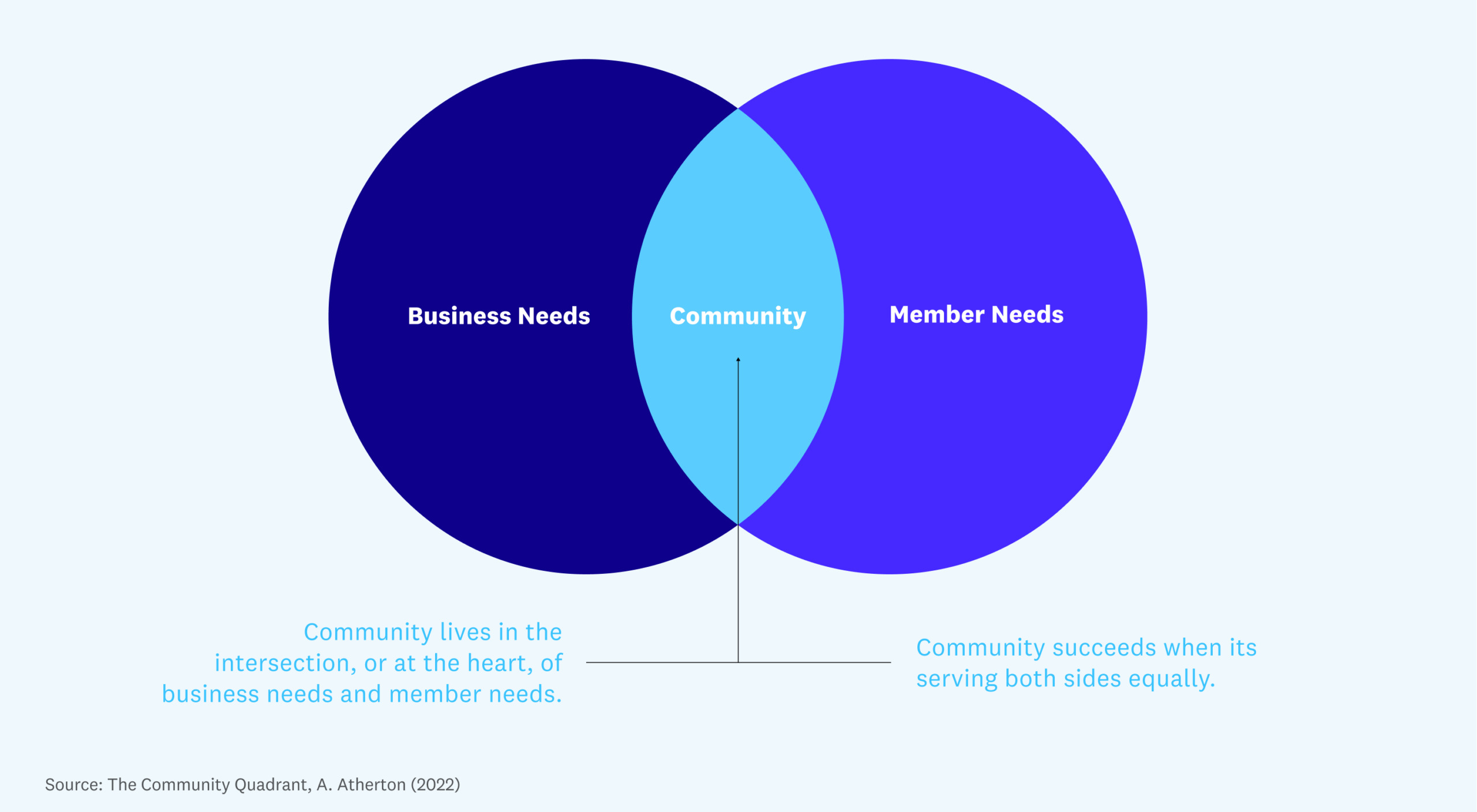
Communities are primarily valuable to businesses for two reasons:

  • They create a built-in source of real-time user feedback, which is critical for building a product people really want.
  • They foster friendships rooted in an affinity for your product, which drives lifetime value and new customer referrals.

When it comes to community-building, it’s your job to spark the fire. But you can’t keep it burning alone. The key to a thriving community is members who care enough to take initiative — they pose thoughtful questions to the group, introduce new topics to explore, and sometimes even plan events, online or off, to help people bond. And they’re invested enough in the community to assume some of the responsibility of steering it forward. Early on, think about identifying folks you’d like to see take on more responsibility.

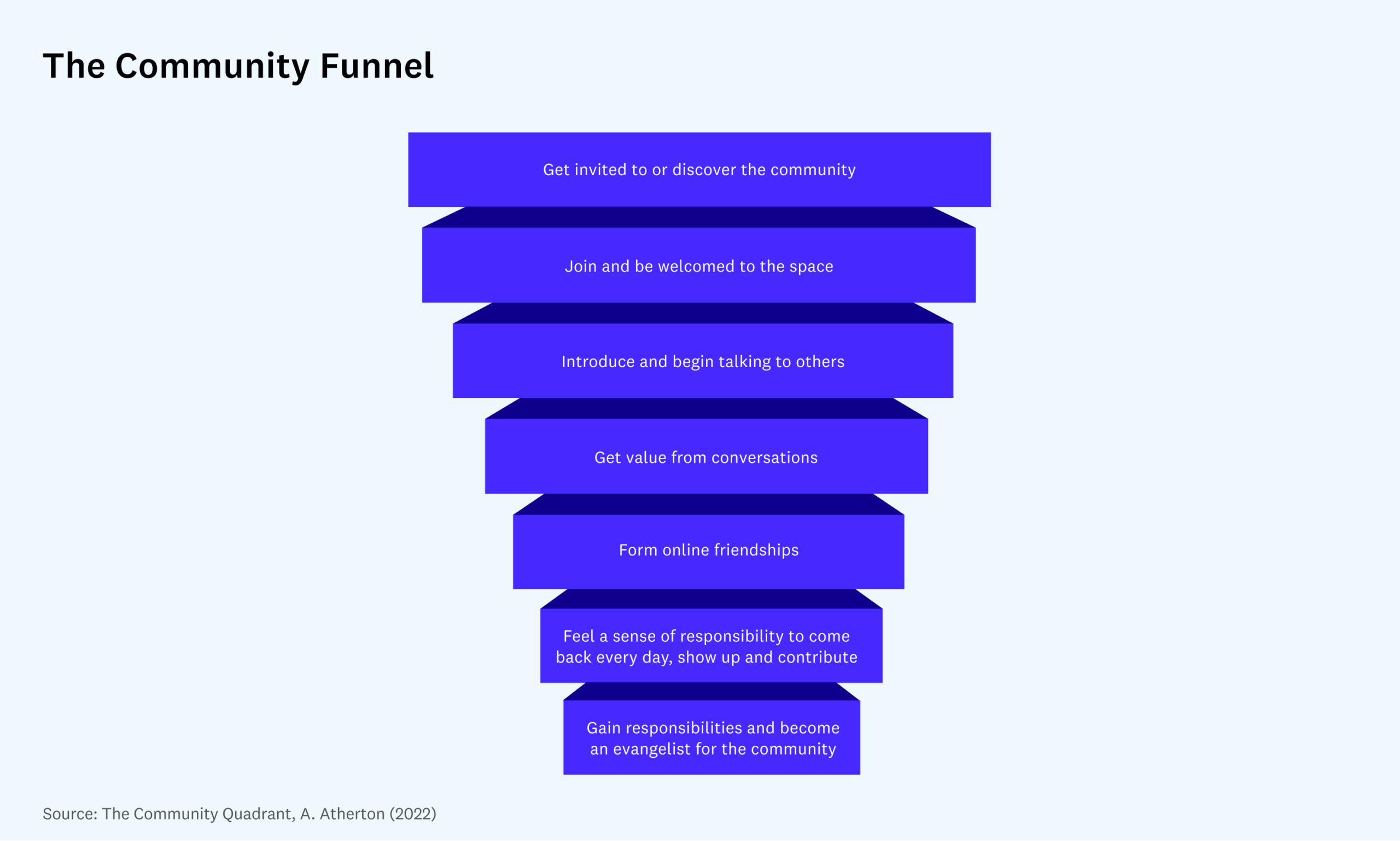
But new community members don’t magically turn into devotees. You need to set the stage for that to happen — both by letting early members play a role in shaping and growing the community, and also by creating an environment compelling enough to reel in anyone who enters. The community funnel charts a prospective member’s path from receiving an invitation to becoming an invested, active member. It’s important to think about your role in moving members through the funnel.

One priority should be optimizing introductions: A member’s first few interactions with the community can have an outsized influence on whether or not they stick around. Consider those early experiences through the eyes of a new member:

Is the initial invitation compelling? Does it spark excitement or curiosity, or make prospective members feel special? On Geneva, invites are often hard to find, which makes them fun to discover. This also gives new members something to bond over right away.

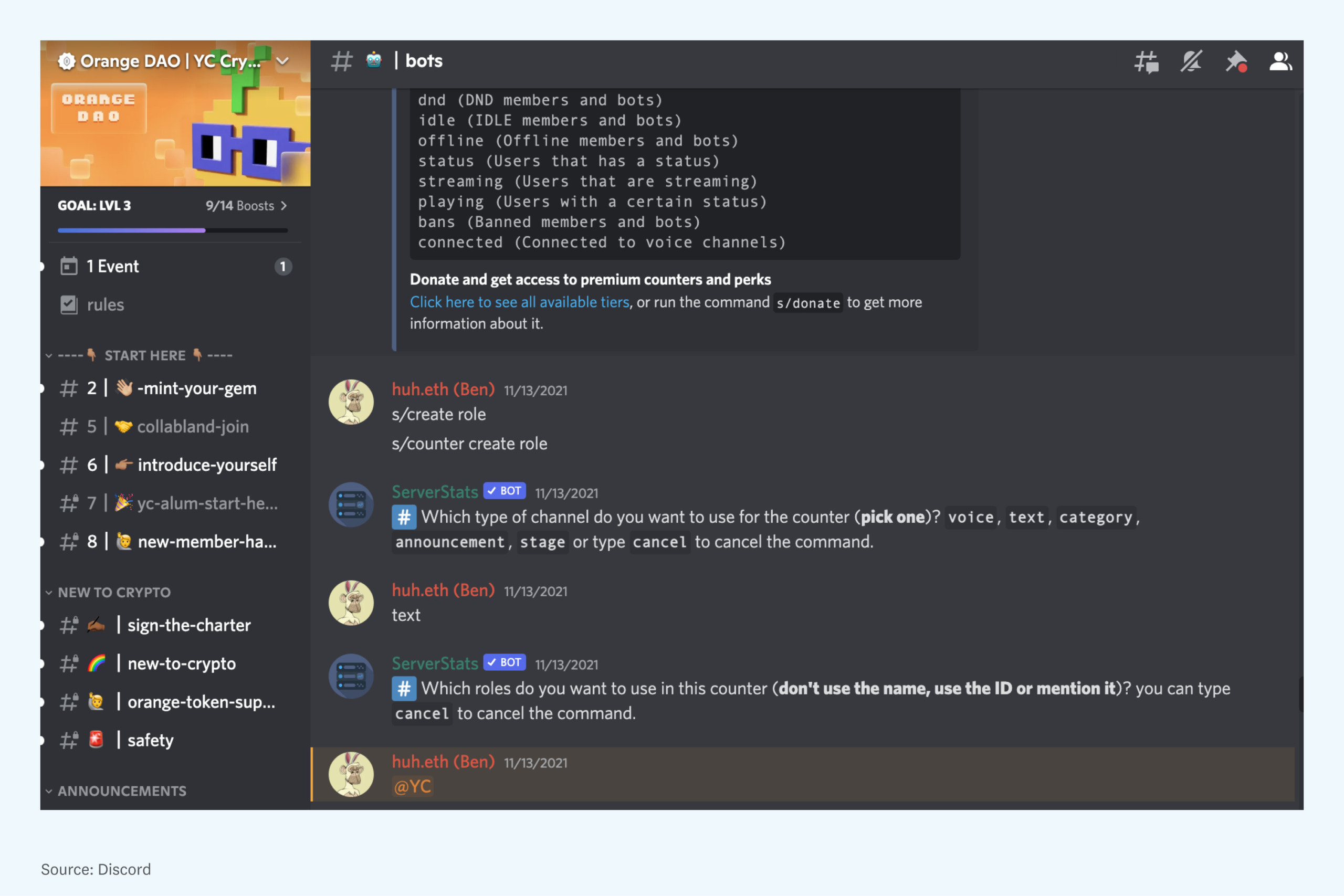
Do members land in space that’s easy to understand and navigate, and also fun to spend time in? Simply numbering channels and visually laying out the first steps a new member should take is a low-lift way to guide people through the on-boarding experience. Extra points if the space is beautifully designed. User-friendly design makes the Discord server for crypto collective Orange DAO inviting to first-timers:

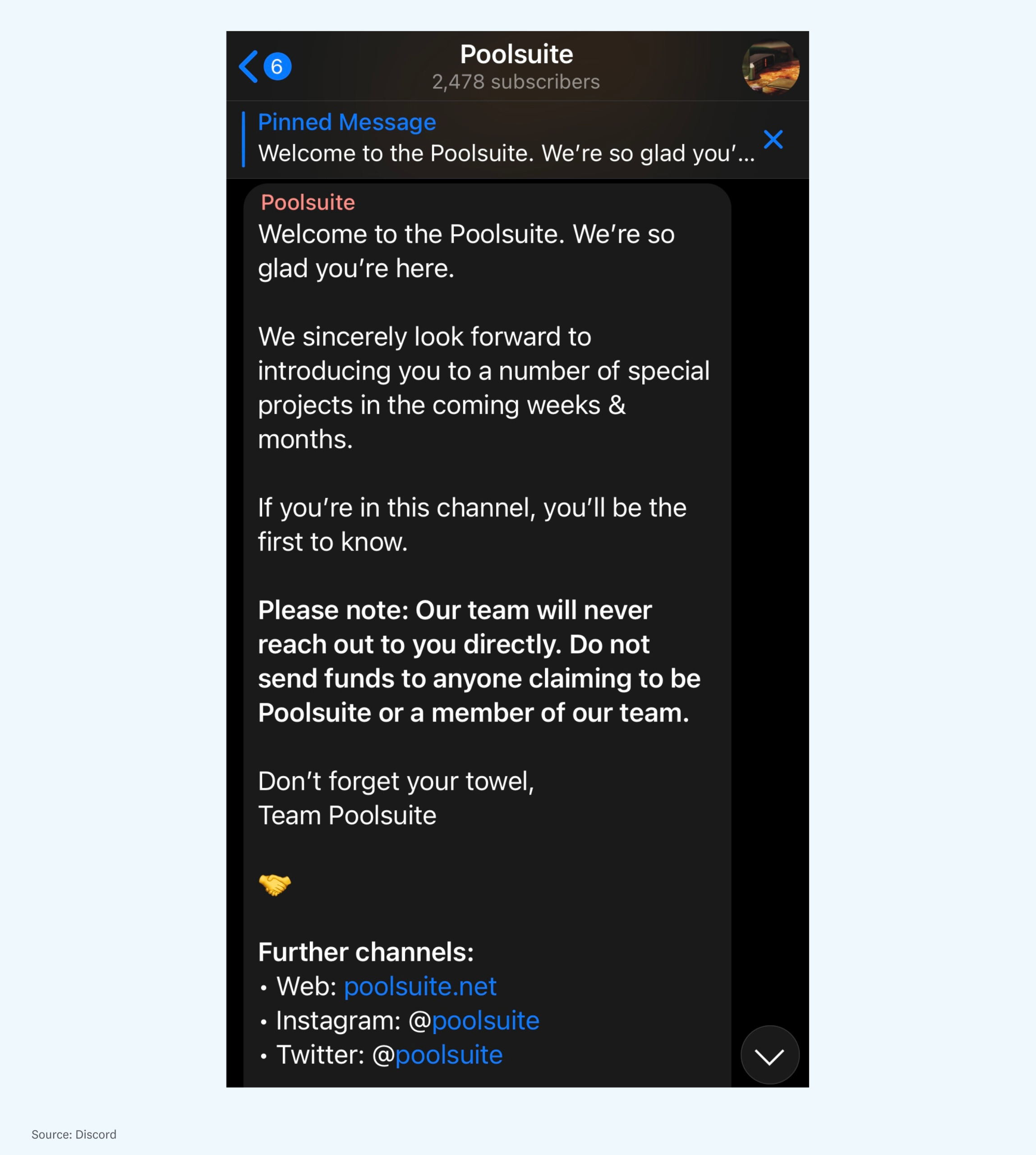
The ultra-simple layout of Telegram channels, which only have one central chat, makes the platform a low-friction way to get a community going. Here’s what new members see upon joining Poolsuite’s chat:

Are members individually welcomed into the space by a human (rather than a bot) and introduced into the conversation? Stripe’s developer community on Discord exemplifies digital hospitality with an active developer relations team welcoming new members:

Once introduced, do community members feel compelled to participate in the conversation? Participation primes members to become friends, which makes them feel more deeply tied to the community and motivated to contribute to it regularly. Most people who join your community will be evangelists for your product. By the time they reach the end of the funnel, they’ll (also) be evangelists for your community.

Now that you understand these two foundational community-building concepts, it’s time to begin architecting your community strategy. Start by clearly articulating why you’re building the community and what the value exchange will be. In other words, what will community members gain from joining and participating, and how does it help your business (now and down the road) to devote resources to community that could go elsewhere?

The value of community isn’t always easy to quantify financially, but there are benefits beyond the bottom line. If you get the basics down and approach community-building thoughtfully, your company will become a catalyst for strong relationships that grow alongside it.

By Amber Atherton

Amber Atherton is a British entrepreneur and angel investor based in Silicon Valley. A community building expert and life-long founder, Amber is currently the head of strategic communities at Discord. Follow Twitter Website

Sourced from Future

By Lane Ellis

Looking for inspiration and new insight to forge new B2B marketing successes as we drive ahead to 2023?

We’re taking a look at five forthcoming or recently-published books that offer an array of fascinating tactics, tips, case studies, and other insight from some of the industry’s top business marketers and subject matter experts.

A good marketing book will not only help you stay current with the latest B2B marketing industry trends, but  also gain inspiration in the process — and we’ve compiled a list of books that fit the bill on both counts.

Let’s turn the page and jump right in with our list of five new marketing books every B2B marketer can learn from.

1 — Everybody Writes: Your New and Improved Go-To Guide to Creating Ridiculously Good Content (2nd Edition)

Ann Handley
MarketingProfs logo
Chief Content Officer, MarketingProfs

Everybody Writes 2nd Edition

The much-anticipated second edition of Ann’s popular “Everybody Writes,” which is used in college classrooms and by writers the world over, will be released on October 18, 2022, when B2B marketers will be able to read the completely revised and expanded update to this marketing and writing classic.

Everybody Writes: Your New and Improved Go-To Guide to Creating Ridiculously Good Content” is slated to include all-new examples, an even-more-detailed writing framework, and new material reflecting the latest changes in content marketing since the original version was published.

2 — Change Masters: How to Actually Make The Changes You Already Know You Need to Make

Barry J. Moltz
Speakers & Author, Shafran Moltz Group, LLC

Change Masters

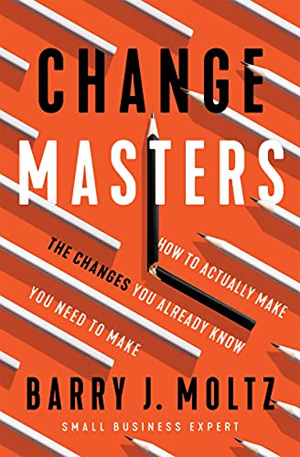
In “ChangeMasters: How To Actually Make the Changes You Already Know You Need To Make,” Barry shares his small business subject matter expertise, including an examination of just why change is so difficult, and how to focus on and complete the critical changes that will make a difference.

From the brain science behind the mechanisms of change to how various areas of business can create change and more, Barry’s book offers helpful take-aways B2B marketers can apply in multiple areas of their professional and personal lives.

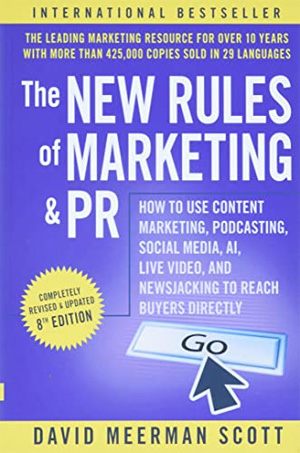
3 — The New Rules of Marketing and PR: How to Use Content Marketing, Podcasting, Social Media, AI, Live Video, and Newsjacking to Reach Buyers Directly

David Meerman Scott
Limited Partner and Strategic Advisor, Stage 2 Capital, also Entrepreneur, Advisor, Keynote Speaker and WSJ Bestselling Author, Freshspot Marketing

The New Rules Of Marketing & PR Cover

A new eighth edition of David’s book “The New Rules of Marketing and PR: How to Use Content Marketing, Podcasting, Social Media, AI, Live Video, and Newsjacking to Reach Buyers Directly” has recently been released, updated with new techniques and information that will be of interest to B2B marketers.

From details blueprints and strategies for getting your ideas implemented to generating buyer attention, the latest edition of David’s book offers a helpful look at both fundamentals and the current state of marketing.

David has also published the well-received “Fanocracy” book, which our CEO Lee Odden covered in “How to Tap the Most Powerful Marketing Force in the World – Fanocracy.”

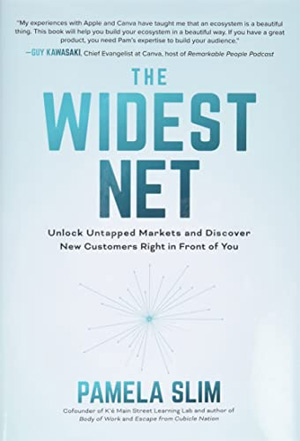
4 — The Widest Net: Unlock Untapped Markets and Discover New Customers Right in Front of You

Pamela Slim
Author, Speaker and Small Business Strategist

The Widest Net Cover

Pamela’s “The Widest Net: Unlock Untapped Markets and Discover New Customers Right in Front of You” explores an array of dynamic ideas for creating marketing and business customer connections that may be outside your usual field of view.

The Widest Net utilizes case studies and examples to take a deep dive into creating newfound business and marketing success.

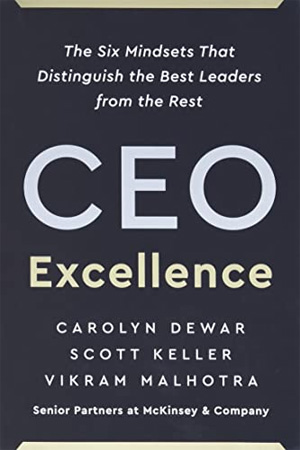
5 — CEO Excellence: The Six Mindsets That Distinguish the Best Leaders from the Rest

Carolyn Dewar
Global Practice Leader – CEO and Board Excellence, McKinsey & Company
Scott Keller
Global Practice C0-Leader – CEO Excellent, McKinsey & Company
Vikram Malhotra
Senior Partner, McKinsey & Company

CEO Excellence Cover

New York Times and Wall Street Journal bestseller “CEO Excellence: The Six Mindsets That Distinguish the Best Leaders from the Rest” looks at successful chief executives from global major organizations including Netflix, JPMorgan Chase, General Motors, and Sony,  and explores the unique qualities that we can all learn from them.

Carolyn, Scott, and Vikram’s book provides B2B marketers a helpful look at what we can learn from the way that CEOs shape culture, and how they in turn are changed by it.

Learn From B2B Marketing Page-Turners

via GIPHY

We hope that you’ve enjoyed our exploration of five books by these leading marketing and business authors, and that they’ll help inspire you in your own marketing work throughout the years ahead.

Looking for more books to enhance your B2B marketing and related skills? Check out these other articles we’ve published:

Building award-winning digital experiences featuring elements such as those explored in the books we’ve featured here takes significant time, resources, and effort, which is why many of the world’s top B2B brands choose to partner with a leading B2B marketing agency. Contact us today and learn why for more than 20 years brands from LinkedIn and 3M to Dell and Adobe have chosen to work with TopRank Marketing.

By Lane Ellis

Lane R. Ellis (@lanerellis), TopRank Marketing Social Media and Content Marketing Manager, has over 38 years’ experience working with and writing about the Internet. Lane spent more than a decade as Lead Editor for prestigious conference firm Pubcon. When he’s not writing, Lane enjoys distance running (11 marathons including two ultras so far), genealogical research, cross-country skate skiing, vegetarian cooking, and spending time with his wonderful wife Julie Ahasay and their cat Kukla in beautiful Duluth, Minnesota.

Sourced from TopRanking Marketing