Short videos can lead to big outcomes, just ask TikTok.
When eMarketer compared average time spent on the top social platforms by U.S. adults, TikTok surpassed YouTube. Users spent an average of 45.8 minutes on the Bytedance-owned social video platform versus 45.6 minutes on YouTube.
This milestone follows a series of changes on the TikTok platform that were seen as threats to YouTube’s video dominance. In February, TikTok extended the video length limit from 3 minutes to 10 minutes. The platform also announced a new revenue sharing program that is very similar to YouTube’s.
YouTube has likely caught onto the success of TikTok and is looking to stop its roll: Earlier this year, YouTube Chief Product Officer Neal Mohan announced a series of product announcements that would be coming to the platform, centered around YouTube’s answer to TikTok, Shorts.
LONDON, UNITED KINGDOM – JUNE 4: Detail of the YouTube logo outside the YouTube Space studios in … [+]
Future via Getty Images
TikTok is also delivering these results on videos shorter than 10 minutes. The data does account for company’s virtual MVPD service YouTube TV. YouTube also offers videos longer than 10 minutes, which likely increase the overall time spent on the platform. The survey was conducted in April 2022 and accounted for all viewing engagement with a platform, be active or multi-tasked.
Despite efforts to emulate the features found on TikTok, Instagram accounted for an average of 30.1 minutes per day. Its parent platform also had an average of 30.1 minutes.
TikTok and YouTube were followed by Twitter, with 34.8 minutes spent on average, Snapchat with 30.4 minutes, Facebook with 30.1 minutes, followed by the aforementioned Instagram. Users spent an average of 23.8 minutes per day on Reddit.
However, it is worth noting that TikTok has a smaller user count, 1 billion monthly active users, while YouTube is believed to have north of 2.6 billion.
I’m a contributing writer for Forbes covering Google and Alphabet. I’m also a writer and curator for Inside.com, where I have covered a variety ot topics, ranging from automotive to Google. Send tips, pitches or notes via email ([email protected]) or on Twitter (@dudejohan).
Instagram is my waiting room app. I don’t use it every day, but when I have a couple of spare minutes, I like to casually check out what the people I’m following are up to.
The problem, lately, is getting to the stuff I actually want to see requires battling through a mountain of sponsored content and suggested posts. When it comes to ads on platforms, there’s a point at which a user inevitably will throw their hands up in the air and say: enough. This level is different for everyone, but for me, Instagram has not only reached it — it’s running circles around it.
Dude, where’s my content?
Let’s test this. I’ve just opened the Instagram app on my iPhone and counted 14 (fourteen) instances of ads, suggested posts, and sponsored content, in the first 16 posts on the top of my feed. I had to scroll past six ads before I got to a post by someone I actually follow. I’m not sure when Instagram became this aggressive when it comes to ads, but I don’t remember it being this bad earlier this year. A month-old Reddit post showcases the same issue, with a seemingly infinite array of ads lined up one after another.
Worse, there’s something deeply insulting by the content of the ads and suggested posts I’m seeing. Yes, I follow a couple of fitness-oriented pages, as well as wrestling pages, on Instagram. So its algorithms have decided that I must be into boxing and bodybuilding (I’m not). I’m constantly being served ads for boxing lessons, which I don’t particularly care about, and I keep seeing muscular men posing on a stage, which, again, is not my cup of tea. Instagram is relentless about this type of content; there’s little variety to it. I’m a human in 2022, which means I have the luxury of having specific, nuanced interests — I’m alright with bodyweight workouts, but not interested in bodybuilding. I can watch Brazilian jiu-jitsu videos all day, but not boxing. Maybe it’s the way I’m engaging with this content that throws Instagram’s algorithms off, but it just seems incapable of accurately predicting what I really want to see.
It’s not just me. Another Reddit thread, also from about a month ago, titled “Okay, we get it. Your feed is entirely ads,” has dozens of users complaining about how bad Instagram’s feed has become.
“60 percent of the posts on my newsfeed are from accounts I do not follow — yet there are accounts I do follow who post regularly and I don’t ever see their posts,” writes user HireLaneKiffin. “It’s gone from all my follows to every other follow and ad to as of today a three to two ratio of ads and promoted follows from the worst people and things,” writes user ilivedownyourroad. I don’t have a scientific method to determine how many ads are too many for the majority of users, but my guesstimate is that Instagram is well past it.
This behavior is spilling over to Meta’s other property, Facebook. On this platform’s feed, you’ll see at least some content from the pages and people you follow on top, but there will be a ton of ads in between, and every now and then you’ll see a suggested post from a page you don’t particularly care about — I’m looking at you, Nick’s Strength and Power. In fact, this particular page which serves bodybuilding-related content, probably has little to do with it; Facebook has decided that I must be into bodybuilding, and bodybuilding videos I will watch, so help me the almighty algorithm.
But I don’t wanna watch what Simon did next. Credit: Instagram/upromototraining
The sponsored overload is not as bad on Facebook as it is on Instagram, but Instagram may be an early warning here. A few months down the road, you might have to jump through the hoops of switching to chronological post order every time you open the app (to do that, tap “Menu,” then “See more,” then “Most recent” on the iPhone).
Can you help it? Yes, but not quite.
There are ways to alleviate this influx of ads, but Instagram is quite cunning about it. Once you’ve opened the app, there’s a little white arrow that appears next to the Instagram logo on top, letting you see content only from the accounts you’ve set as favourites. But the little white arrow only appears once you’ve scrolled past the first post — a way to force you, I reckon, to see at least one ad before getting to the content you want. Furthermore, you have to do it every time you start the app, and you also have to ardently add all the content you want to follow to your favourites, which is an additional hassle.
You can also get an Android-only unofficial app for Instagram that lets you get rid of ads altogether, but unofficial apps, besides probably being against Instagram’s terms of service, can be a way to get malware on your device.
The bottom line is that, for the majority of users, the Instagram experience is severely tarnished when you’re force fed stuff you don’t want. There’s a point at which even advertisers will start to complain, as they inevitably see engagement numbers fall from their tired and resigned audience. I’ve asked Instagram whether they think they’ve gone too far with sponsored content, and will update this article when I hear back.
UPDATE: Jun. 9, 2022, 12:21 p.m. EDT An Instagram spokesperson got back to me, saying that my feed having so many ads and suggested posts is “not the intended experience.” The company will look into it and get back to me with more information.
I know the mantra: If you’re not paying for it, you’re not the user, you’re the product being sold. But for me to consent to being sold, I need to get something back from the app or else I’ll just give up. Right now, Instagram is working very hard to make me give up.
In January 2020, when the coronavirus started making headlines around the world, Jane McGonigal’s inbox was flooded with emails from Silicon Valley execs, government officials, and nonprofit leaders. They all had the same question: “Jane, didn’t you run a simulation of a respiratory pandemic?”
Yes, she had. All the way back in 2010.
Jane is a game designer. She builds simulations that help players imagine the unimaginable. And in 2010, she invited nearly 20,000 people to immerse themselves in a future world besieged by a global pandemic. “How would you change your habits?” she asked. “What social interactions would you avoid? Can you work from home?”
A decade later, when COVID went from nascent threat to full-blown crisis, Jane started hearing from folks who had participated in the simulation. “I’m not freaking out,” one of them said with relief. “I already worked through the panic and anxiety when we imagined it ten years ago.”
According to the latest research in psychology and neuroscience, we can all learn to make the shift from panic to poise by training our brains to think about the unthinkable. But what does that training look like? In her new book, Imaginable—and on today’s episode of the Next Big Idea podcast—Jane shares evidence-based techniques you can use to see the future coming. Listen to the full episode below, or read a few key highlights. And follow host Rufus Griscom on LinkedIn for behind-the-scenes looks into the show.
How Jane went from game designer to future forecaster.
Rufus: Your path from studying and designing video games to working as a futurist—some would see that as counterintuitive. I think you see this as a logical progression. Why does that sequencing make sense?
Jane: What first really fascinated me about the gaming community was this trend that I was observing in gamers: they were developing real skills, real abilities, collective intelligence, and collective imagination that they wanted to apply in a bigger context—maybe help solve some real-world challenges.
This was back in 2001 when I was starting my Ph.D. work. And I thought, “This is amazing! It would be really good for humanity if we could channel these new skills that are coming out of online gaming into real-world problem-solving.” But at that time, there were not a lot of games to play that actually connected this community with real-world challenges.
After studying it for six years, writing my dissertation on this topic, I rolled right into, “I’m going to be the one to make games that help gamers apply those strengths to real-world contexts.” And the context that I wound up working in was trying to anticipate hard-to-predict futures, or apply that collective imagination to seeing future scenarios from massively many points of view—the same way that we see a game world—so that we might discover the outlier risks or unexpected opportunities. And that’s what I’ve been doing for 15 years now.
Predicting COVID … back in 2010.
Rufus: This mission to take our interest in gaming and collective imagining exercises and use them to help us better understand possible future outcomes—you and your team have been engaged in this for a while, and you have an astoundingly impressive track record at anticipating possible future outcomes. Can you share some of the details of what you all have done?
Jane: 2020 was a really strange year to be a future forecaster, in that I had an experience of living through a very difficult future that we had been forecasting for a decade or more. My work at the Institute for the Future involved creating these social simulations way back in 2008, 2010, where we were inviting thousands of people to spend weeks in a private social network. It would look like Twitter, Facebook, or Discord, but everything being posted and shared was about a hypothetical future.
“There was this incredible proliferation of news stories and headlines using the word ‘unimaginable’ to describe the pandemic and its consequences. But it wasn’t unimaginable. We just didn’t have a critical mass of people imagining it.”
Futurists love to look 10 years ahead because that gives us enough mental distance to think creatively. And if we’re imagining problems that might not happen for 10 years, it gives us enough time to prepare for them or prevent them. So we were looking at the years 2019 and 2020, and back then our simulation centered around, how would we survive and adapt to a respiratory pandemic that started in China that was also complicated by cascading crises? One of the things that I specialize in is figuring out how different crises and disruptions intersect. So we’re not just looking at it from a public health perspective or an epidemiology perspective. We were also thinking about how we would survive and adapt when we have the supply-chain disruptions, when there is misinformation and conspiracy theories about the pandemic being spread on social media, when there are historic wildfires and extreme heat waves due to climate change. And that’s just what we lived through in 2020.
What made me sort of crazy for a little while, and made me want to write the book Imaginable, is that there was this incredible proliferation of news stories and headlines using the word “unimaginable” to describe the pandemic and its consequences. But it wasn’t unimaginable. We just didn’t have a critical mass of people imagining it. We had 20,000 people in one of our simulations, and 8,000 in another. My goal is to have 20 million—I think that would really help us prepare for the future.
Why you should think 10 years into the future.
Jane: When we give ourselves these long, luxurious deadlines, we feel time rich. And when we feel time rich, we think, “I have all this time! I can do what I want. I can do what matters to me.”
When we have urgent deadlines or too many tasks on our to-do list for today, we feel time poor, time deprived—and then we just don’t use our time, because even though we still have the same amount of time, it feels scarce.
Another thing that researchers have found is that when we imagine 10 years out, we tend to think about things that are more relevant to our most important values—the kinds of goals that would help us live a life that we would consider really authentic, really true to our dreams or what we find meaningful and purposeful.
I give people this challenge. It’s not, “where would you like to be in 10 years?” or “what would you like to be different?” The challenge is to try to vividly imagine waking up on a specific day. So, pick a day of the week; is it a Monday? Is it a Saturday? A Sunday? You imagine yourself waking up, and you try to picture every detail. Where are you? Are you in the same room that you woke up in today, or is it a different room? Where is it? Is there somebody with you? Is it a person? Is it a pet? Is it a different person or pet than you might wake up with today? And then imagine what mood you are in. What mood would you like to wake up in? What would put you in that mood? What might be on your calendar for that day that would put you in that mood?
“Because we’ve given ourselves 10 years, it allows us to dream bigger, and also enjoy that sense of time spaciousness to really make some changes or explore possibilities that we would dismiss as impossible today.”
And then I tell people, “Go put it on your calendar.” If you’ve just imagined yourself doing this amazing thing that makes you feel a certain way, go ahead and open up your Google or Apple calendar—they do go 10, 20, 30, 40 years in the future—and put it on your calendar. Even better, invite somebody. Invite a loved one.
It can spark some really interesting conversations about our real hopes and dreams. What is it going to take to get there? Because we’ve given ourselves 10 years, it allows us to dream bigger, and also enjoy that sense of time spaciousness to really make some changes or explore possibilities that we would dismiss as impossible today.
The future scenarios everyone should consider.
Rufus: Are there any other future scenarios that you think our listeners should consider?
Jane: Things to pay attention to: government-mandated internet shutdowns is a huge future force that is spreading globally. If you’re not aware of this phenomenon and not potentially prepared to live through weeks or months of the government turning off the internet, that’s something to think about.
Another one is climate migration. We’ve got to be willing to think about the risks where we live. Are we in a climate-secure, climate-resilient place that will probably be welcoming others who are migrating out of climate-unsafe regions? If so, we should be prepared to see a higher density of living, to be welcoming to people who have been forcibly displaced. Are we emotionally ready for that? Are we economically ready for that? Also think about our pathways to move if we need to. That is something that every serious futurist that I know is thinking about—pathways of human movement within countries, and across borders. How can we support people economically, socially, mentally, psychologically? How can we make a home? That’s a problem space that warrants so much imagination and innovation and creativity. If I could get all of the smartest minds on the planet to work on something, it would be thinking about movement. That is the biggest future scenario that would benefit from our imagination, and also our innovation.
Seemingly innocuous habits and tendencies common among entrepreneurs can be signals of a serious problem.
In the startup and wider business world alike, we celebrate the extreme lengths people go to–including long hours, missed events and milestones, and even the slow deterioration of connections–to achieve the impossible. But as the ability to work brutal schedules is put on a pedestal, what you really are oftentimes is simply on a road to burnout.
Success depends upon your ability to sustain, and so as much as you may want to push through in order to forge ahead, ignoring the signs of burnout may be what causes you to crash and burn. The problem is, while you’re probably familiar with the dangers of burnout, you may not know how the signs present themselves. Often they’re not as simple as the key indicators such as poor sleep, low energy, or lack of focus.
So here are five signs of impending burnout that you may not have heard before–because burnout will burn you if you’re not careful.
1. Living In a Constant State of Stress–and Enjoying It
Some say the word “neurotic” like it’s a bad thing, but for many entrepreneurs it’s this tendency to flourish in chaos that enables them to create. In fact, how one views stress is a key indicator of one’s ability to succeed. So while others feel the daunting pressures at work and the weight of life and all of its stresses on their shoulders, entrepreneurs on the verge of burnout shoulder it so well they might actually come to enjoy it.
In many ways, the constant high-stress, high-anxiety lifestyle feels like playing a game or running a race. It presents a challenge to overcome and something to be achieved. It’s exciting and it can be enjoyable even. And when you’re living this way day in and day out, doing what others can’t, you feel as though you’re on the right track–even if it might be a fast-track to burnout.
2. Feeling Obsessive (Often Towards One’s Health)
Burnout comes with a myriad of side effects, many of which display long before burnout is recognized. One of them is being obsessive. However, it’s not simply having a one-track mind, where you’re consumed by your goals and what you’ve set out to achieve. It can be an obsession with other aspects of your life, including your health. While it seems like a positive sign to take an interest in well-being and longevity, it is in fact a sign of impending burnout.
As burnout nears, health wears. After all, we have too much time sitting in front of screens during the day and not enough time sleeping at night. For an overly driven entrepreneur, health is another thing to conquer or achieve. As a pastime, it feels productive and thus it feels good for someone who feels compelled to keep moving forward–a common trait amongst the most burnt out.
3. Taking an All-or-Nothing Approach to Life
When every choice comes at the expense of another, people on the verge of burnout often eventually begin seeing every decision through the lens of not just one option or another but all or nothing. It’s a rhythm we can fall into, but it’s often not widely recognized because it can be hidden in menial day-to-day events and activities.
For example, it can be as simple as not giving a gift one holiday, then being overly generous the next. It can be the friend or colleague who is either mentally absent or highly tuned in. It’s a stop-go pattern that often yields overcorrection and yo-yoing.
4. Being Discontent at Rest
No matter how vital rest and relaxation is for the mind and body, for those on the slippery slope to burnout, being at rest becomes synonymous with being stagnant. For many, the idea of resting raises concerns of missing out, getting behind, or missing opportunities. After all, even if you don’t have Elon Musk’s secret to working 120 hours per week, you may think working just 60 to 80 is reasonable.
Every minute is a chance to get ahead, leading many to feel riddled with guilt when taking a break or saying no to plans. The result is that many burn the candle at both ends. And though it can work for short periods of time, staying up late and waking up early is not sustainable–nor is trying to be the person who can do everything. Instead, learn how to feel the joy of missing out.
5. Being Wired–Even With Little Sleep
Naturally, we associate poor sleep with low energy. And sure, the two go hand-in-hand, but there’s a funny thing about a lack of sleep: Exhaustion can also show up as high energy.
Much like a child on the brink of a tantrum who is haphazardly bouncing off the walls, adults who are sleep-deprived may also experience bursts of energy or a general feeling of being wired. The assumption is that if we have energy-even with little sleep-what we’re doing is fine. But this borderline explosive energy does blow up, and it dissipates as quickly as it arrives. It’s not sustainable, but it is a sneaky sign of burnout.
While Twitter said in its SEC filing that less than 5 per cent of its monetizable daily active users (mDAUs) are fake, Musk believes the number of bots is four times higher
Tesla CEO Elon Musk on Sunday once again raised the presence of fake/spam accounts or ‘bots’ on Twitter, saying the micro-blogging platform has ‘very bot-friendly’ rules.
Musk has put the $44 billion Twitter buyout on hold till its CEO Parag Agrawal tells him the exact percentage of bots on the platform. Twitter currently says less that 5 per cent of accounts on its platforms can be fake.
A follower tagged Musk, posting “current technical Twitter Limits”: “None of these @Twitter limits are aligned with the goal of human-to-human interactions @elonmusk.”
“Like 1 tweet every 36 seconds during 24 hours is not human behaviour. Neither is changing your account’s email address 4 times per hour,” the follower asked Musk.
The Tesla CEO replied: “Totally, these are very bot-friendly rules!”
The Twitter technical limits say that for Direct Messages (DMs), the limit is 1,000 messages sent per day, while for tweets, it is 2,400 per day.
The “change to account email” is 4 per hour and the technical “follow limit” is 400 per day.
Musk has asked the US Securities and Exchange Commission (SEC) to probe whether Twitter’s claim on the number of its user base is true.
While Twitter said in its SEC filing that less than 5 per cent of its monetizable daily active users (mDAUs) are fake, Musk believes the number of bots is four times higher.
Musk mentioned that the Twitter CEO publicly refused to show proof of less than 5 per cent bots.
“20 per cent fake/spam accounts, while 4 times what Twitter claims, could be much higher. My offer was based on Twitter’s SEC filings being accurate,” Musk wrote.
“Yesterday, Twitter’s CEO publicly refused to show proof of less than 5 per cent. This deal cannot move forward until he does,” he had added.
Musk, at a conference in Miami this month, said that Twitter could have at least four times more fake accounts than what has been revealed in its filing.
You can push back without driving customers out the door as long as you take a partnership mindset.
Very few areas of life have been untouched by Covid-19, especially in the world of business. Early on in the crisis, for instance, we saw customers abandon brand loyalties as items flew off the shelves and shoppers migrated to online channels. This is a pretty common cycle: When circumstances change, people explore other options because that process helps them determine whether their current option is actually a good fit.
Unfortunately, this experimentation has real-world consequences for businesses. One survey of small business owners found that 82% lost their most profitable client after Covid-19 swept the nation. And despite Paycheck Protection Program loans injecting hundreds of thousands of small businesses with cash to maintain their payrolls, many still couldn’t manage to keep their doors open. By July 2020, just five months after initial lockdowns, one analysis estimated that more than $1 billion in PPP loans had gone to now-defunct businesses.
These kinds of stats aren’t exactly comforting to small business owners and entrepreneurs, and as a result, many have resolved to bend over backward for their customers in the hopes of keeping them around long term. But while I understand the sentiment, becoming a yes-man won’t have the effect you desire.
The art of saying ‘no’
When increasing customer retention by just 5% can increase profits anywhere from 25% to a whopping 95%, it’s natural to want to meet every request with a confident “coming right up!” But customer demands can’t always be fulfilled precisely as expected, and it’s dangerous to try to fit a square peg in a round hole.
As the leader of a software company, I’ve seen time and again that customers generally know what kind of outcomes they desire, but sometimes, their requests and desired outcomes aren’t the same. In those cases, we need to be good partners and push back. Business leaders trying to improve their retention should adopt a similar mindset — focusing their effects on being a good partner, not a sycophant.
Still, saying “no” can be tricky, so here are a few strategies you can adopt to push back without driving customers out the door.
1. Set the stage
In my own business, I’ve found that the best way to ensure client projects don’t go off the rails is to set clear expectations upfront. At the beginning of each project, we dedicate time to ask probing questions that get to the heart of what the client is trying to accomplish. Typically, that will prevent us from going down the path of doing something just because the client asked us to, even if it doesn’t necessarily make sense for the project’s goals. That openness around why we can or can’t do something sets the tone for the entire relationship.
Discuss any what-ifs, too: What if the project fails? What if you go over budget? And what will happen if things go sideways? As you progress through the project’s stages, make sure to check in with your client or customer regularly. Sometimes, the scope and expectations of a project will change, and that’s okay, but you need to make sure you’re updating the contract alongside those changes to protect your business.
2. Get radical
You’re an expert in your industry, but it’s a mistake to act like you know everything. So when a client makes a pipe-dream request, resist the urge to be brutally honest about how bad their idea really is. That kind of obnoxious aggression will just make you look arrogant and rude. Instead, work to establish mutual trust by developing a relationship grounded in radical candour, a communication style popularized by author Kim Scott back in 2017.
In short, practitioners of radical candour are able to simultaneously challenge people while still showing that they care. Traditionally, this communication style has been applied to supervisor-employee relationships, but it’s just as relevant for clients and customers. A client request might be next to impossible to deliver on, and you need to communicate that in a way that demonstrates to themthat you have their best interests at heart. It’s about pointing out how a particular route could potentially sabotage their long-term success, and because you’re framing that “no” in a way that shows you care about their future, the point is more likely to land.
3. Offer alternatives
Apple is probably one of the best examples of a company that understands how to develop a seamless customer experience, even in the tricky world of tech. Its Genius Bar employees, who service customers experiencing tech issues, use the three F’s — feel, felt and found — to empathize with frustrated customers. Then, they employ the mnemonic APPLE (which stands for approach, probe, present, listen and end) to guide customers to a conclusion that they believe is their own.
When you have to turn a client idea or request down in your own business, you should always have an alternate solution waiting in the wings. Being a true partner, after all, means acting as a resource. And when it comes to offering choices, research from the University of Minnesota shows that three is the magic number.
Companies are scrambling to drive better customer retention because happy customers are their biggest sellers and their biggest advocates. But saying “yes” to every request and idea won’t get you there. Instead, learn how to gently push back on your customers or clients using the tips above and watch transactional relationships transform into lifelong partnerships.
A machine learning engineer is a programmer proficient in building and designing software to automate predictive models. They have a deeper focus on computer science, compared to data scientists.
Machine Learning Engineering has grown in great popularity and is surpassing Data Science. The job title is high in demand with many people from Data Science careers transitioning to become Machine Learning Engineers. It is currently #6 in the top 50 Best Jobs in America, according to glassdoor.
A Machine Learning (ML) Engineer is a programmer proficient in building and designing software to automate predictive models. They have a deeper focus on computer science, in comparison to Data Scientists.
The majority of ML Engineers come from one of two backgrounds. The first is those with a Ph.D. in Data Science, Software Engineering, Computer Science, and/or Artificial Intelligence. The other is people who have prior experience as either a Data Scientist or Software Engineer who has transitioned into the role.
What Does an ML Engineer Do?
A Data Scientist and ML Engineer both work with dynamic data sets, carry out complex modelling, and have exceptional data management skills.
The main role of an ML engineer is to design software to automate predictive models which help carry out future predictions. This is how the ‘machine’ ‘learns’ from ‘engineering’.
The sub-tasks included in doing this include:
Researching ML algorithms and tools and how they can be implemented.
Selecting the appropriate data sets
Selecting data representation methods
Verifying the quality of the data
Identifying the distribution in the data and how it affects model performance.
Iterating training on ML systems and models
Perform statistical analysis
Fine-tuning the model
Improving existing ML frameworks and libraries
What Skills Do You Need To Be A Successful ML Engineer?
There are a variety of skills required to become an ML Engineer.
Programming Skills
You need to have knowledge in multiple programming languages such as C++, Python, and Java with other programming languages such as R and Prolog which have become important elements in Machine Learning. The more programming languages you know, the better; however that can require a lot of studying.
Statistics
Machine Learning has a heavier focus on computer science, using probability and other statistical tools to help build and validate models. Machine learning algorithms are an extension of statistical modelling procedures therefore having a good understanding of the foundations of statistics and maths is important.
Problem Solvers
There are going to be times when models fail and it can become very complicated, therefore ML Engineers need to be good problem solvers. Instead of giving up, solving the problem efficiently by understanding the issue at hand and developing these approaches to help you save time and reach your goal faster.
Understand Data
ML Engineers quickly gander through large data sets being able to identify patterns to help them understand what next steps to take to produce meaningful outcomes. Using tools such as Excel, Tableau, and Plotly can also be used to provide greater insight into the data.
Desirable degrees for ML engineers include Mathematics, Data Science, Computer Science, Statistics, and Physics. These degrees provide ML Engineers with the foundations, aswell as skills in programming, statistical tools, and analysis.
If you would like to get a better insight on the type of content you will learn at University, have a read of this article: Free University Data Science Resources.
Once you have completed a degree, you will need to build your skills and experience in fields such as Software Engineering, Data Scientist, etc. ML Engineers require a few years of experience with a high level of proficiency in programming to be successful.
You can further increase your knowledge by getting a Master’s degree in Data Science, Software Engineering, and/or a Ph.D. in Machine Learning.
Modern tech route: e-Learning
With the demand for tech experts in this day and age, another possibility is independent and/or e-learning. This can be done through BootCamps, online courses, Youtube, and more.
If you are looking to learn through YouTube, there are a variety of YouTube channels that can help you get there. There are YouTubers such as John Starmer, Krish Naik, and more. If you would like to know more, have a read of this article: Top YouTube Channels for Learning Data Science.
There are also a variety of online courses, some of which are provided by Universities. This shows the demand for tech experts as Universities have taken the time to create courses to help meet this demand. With the new remote lifestyle, online courses are becoming more and more popular to help accelerate people’s careers.
ML Engineers have to know a lot of knowledge surrounding Machine Learning, and the different types of algorithms. If you would like to know more about the type of algorithms you will learn in Machine Learning, have a read of this article: Popular Machine Learning Algorithms.
Books
Although many things have moved online, fewer and fewer people read books. Books are a great way to learn, however, it can be difficult to know which book to choose. I would highly recommend the book Machine Learning for Absolute Beginners by Oliver Theobald.
If you would like more Machine Learning book recommendations for different levels of learning; beginners, intermediate, and experts, have a read of this article: Machine Learning Books You Need To Read In 2022
It’s Not An Easy Route, But It’s Worth It
Becoming an ML Engineer won’t happen overnight, but once you have obtained the correct qualifications, skills, and experience, you will be in a field that provides you with a solid future. It requires a lot of hard work and determination, all you need to do is put in the work.
Nisha Arya is a Data Scientist and Freelance Technical Writer. She is particularly interested in providing Data Science career advice or tutorials and theory based knowledge around Data Science. She also wishes to explore the different ways Artificial Intelligence is/can benefit the longevity of human life. A keen learner, seeking to broaden her tech knowledge and writing skills, whilst helping guide others.
The tool will guarantee brands that their ads appear in the most relevant content in twelve different categories.
TikTok’s reach is undeniable. The Chinese social network has revolutionized the world and its growth figures are impressive. Content creators have found a way to build communities on the platform and will soon be able to use it to generate revenue through TikTok Pulse , an ad sales program that will help brands reach the audiences they want while benefiting financially. to powerful tiktokers.
Through a statement , the social network explained what it is about: “To help brands stay on top of entertainment and culture on TikTok, we are pleased to introduce TikTok Pulse, a new contextual advertising solution that allows advertisers to place your brand next to the main content in the ‘For You Feed’. TikTok Pulse is designed to give brands the tools and controls to be a part of these everyday moments and trends that engage the community.”
The program will launch in the United States in June of this year and in other territories in the fall. It is reserved for creators who have more than 100,000 followers and advertising will only appear on 4% of the content on the platform; the one with the greatest range. Among the content categories that TikTok Pulse will use are: beauty, fashion, cars, video games and cooking.
The social network has explained that the contents will be reviewed before displaying ads next to them to guarantee safe environments for brands . Additionally, TikTok Pulse will include metric measurement tools so brands know exactly how their ads performed.
The arrival of TikTok Pulse represents an important evolution for the platform that until now had not explored advertising revenue schemes shared with content creators. During the launch stage, content creators will receive 50% of the income from advertising related to their posts.
Increasingly, building a successful startup involves not only building a product that people can’t get enough of, but also building an engaged, loyal community around that product. Today, most founders are acutely aware of the value of community. In CMX’s 2021 Community Industry Report, 86% of respondents (community managers from 508 different companies) said community was critical to their company’s mission, and more than two-thirds said their company planned to increase their investment in community in the next year.
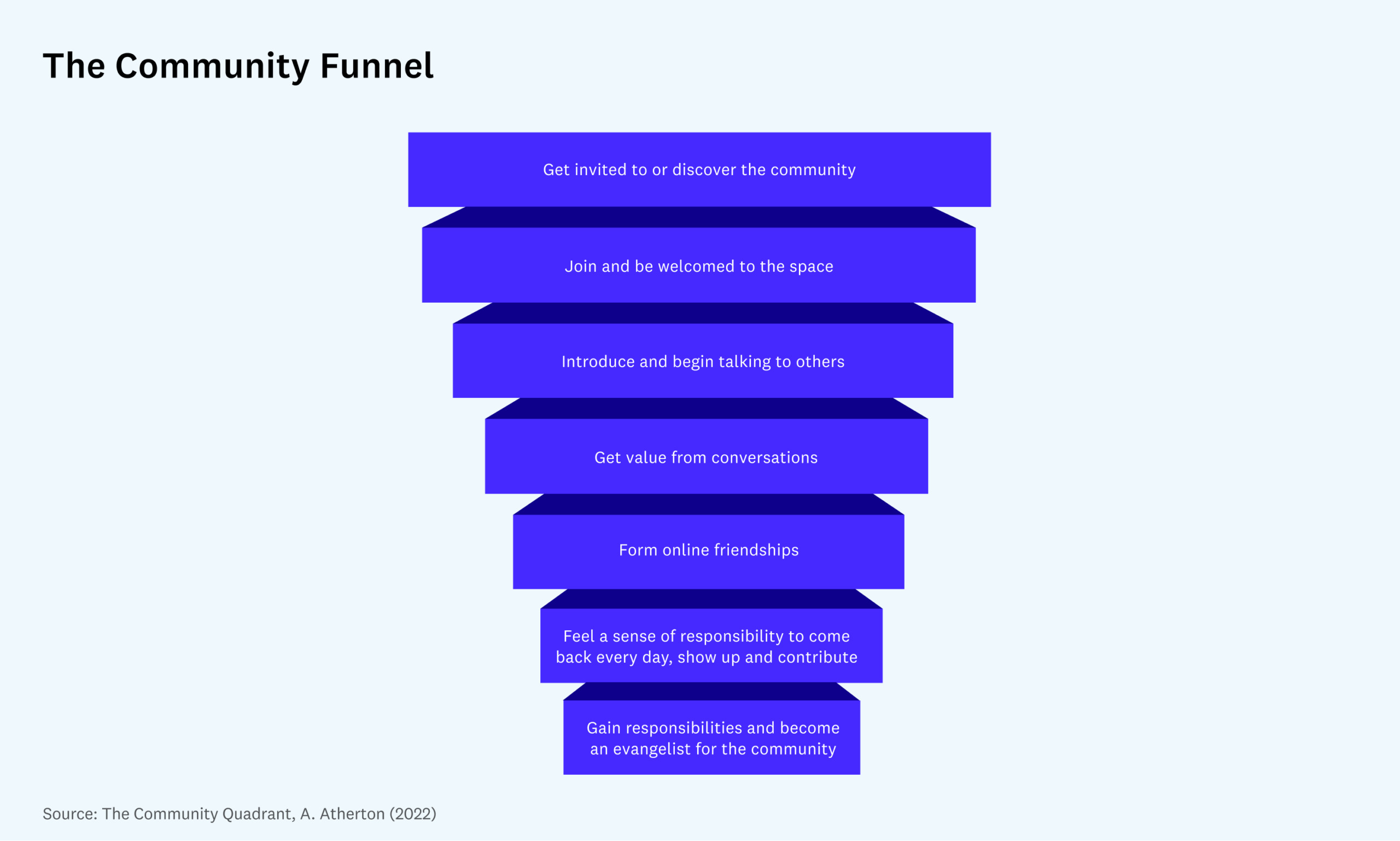
But while many founders are eager to invest in community, they often don’t know what they’ll need to understand to build one the right way. Between starting and running Zyper, a platform that connected brands with super-fans, and now leading community growth strategy at Discord, I’ve built hundreds of healthy communities for businesses, brands, and creators. Before diving in and hiring a dedicated community team, I’ve learned, founders need to have a strong grasp of two essential concepts: 1) the community quadrant (to understand how community differs from other groups of people who interact with a product), and 2) the community funnel (to understand what makes a community compelling to prospective members).
To that end, I’ve put together a guide that breaks down both concepts. It doesn’t cover everythingyou need to know to build a successful community. Instead, it’s intended to teach early-stage founders just enough to begin allocating resources.
What a community is (and isn’t)
One common misconception, I’ve noticed, is the idea that “community” and “customers” are synonymous terms. They aren’t. Understanding how they differ is critical, so let’s start there.
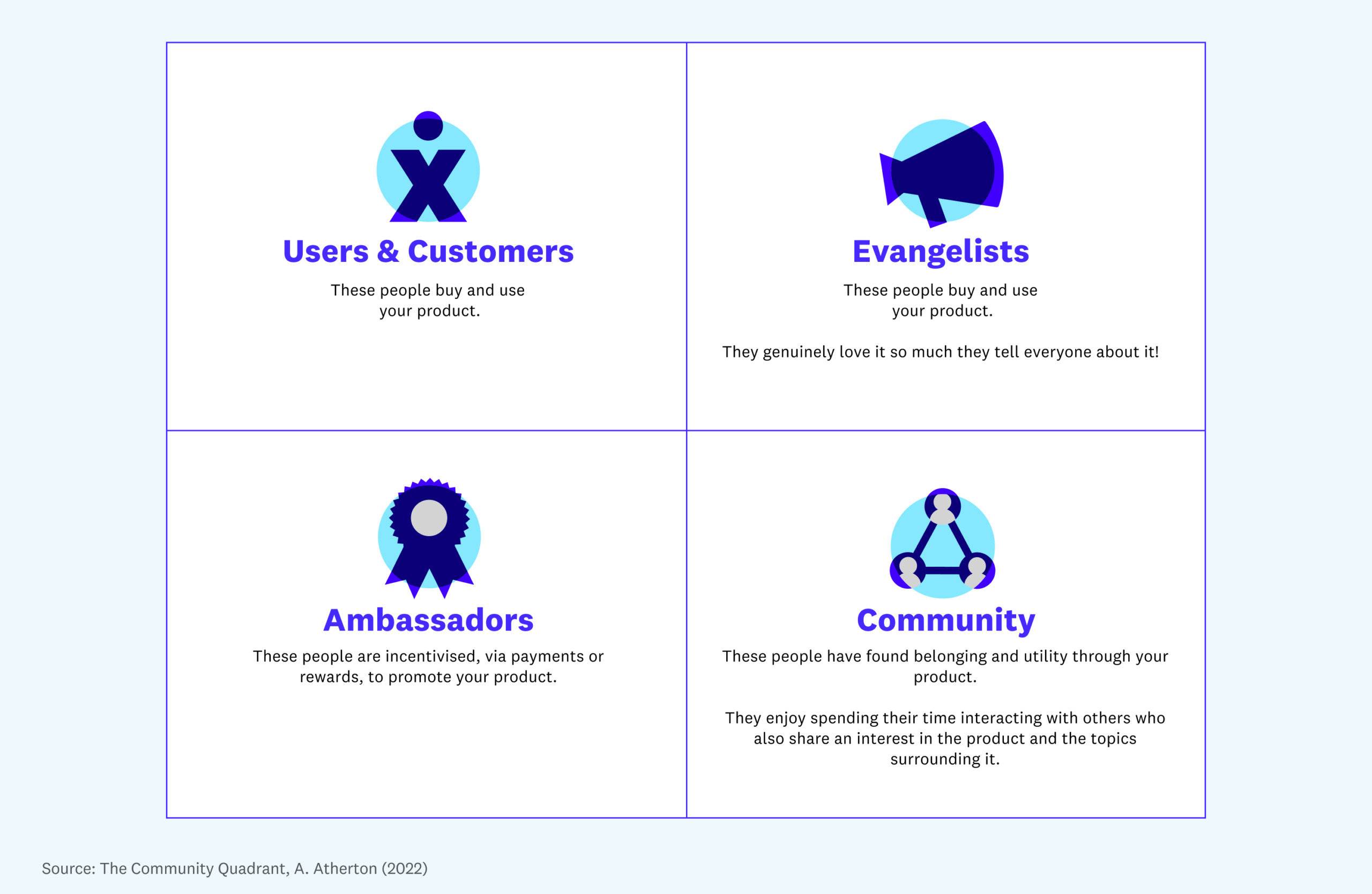
The people who interact with your product generally fall into one of four buckets:
Customers/users buy and/or use your product.
Evangelists tell everyone they know to buy or use your product because they genuinely love it.
Community is the group of people who’ve found belonging and utility through your product.
Ambassadors are incentivized, through payments or rewards, to promote your product.
What distinguishes community members from those in other groups is the congregation element: Beyond using, liking, or writing glowing reviews of your product, they spend time forming connections with other people based on a shared affinity for it.
The quadrant, sequenced
Three of these groups reliably emerge in a fixed order: Users/customers come first, followed by evangelists, and then community.
Ambassadors don’t fit neatly into this sequence, so you’ll need to make a decision about their relationship to the other three groups. Even though ambassador endorsements aren’t organic, they still help spread awareness of your product to new segments and markets. Ambassadors range from nano-influencers and affiliates to well-known celebrities, and they can collectively become a community in their own right, with gamified rankings and events. Generally speaking, my advice is to build an ambassador program that functions separately from the other three groups. This article covers the basics.
The ideal time to launch a community varies, but you should wait until you have confirmed evangelists. People who love your product are your proof point. If self-professed evangelists haven’t announced themselves yet, email a group of your earliest customers (50 is enough) to find out if they love your product. Those who respond enthusiastically are your first evangelists; invite them to join your community. Evangelists don’t automatically become community members, but they’re the most obvious cohort to start with because you know that they like your product and want to talk about it.
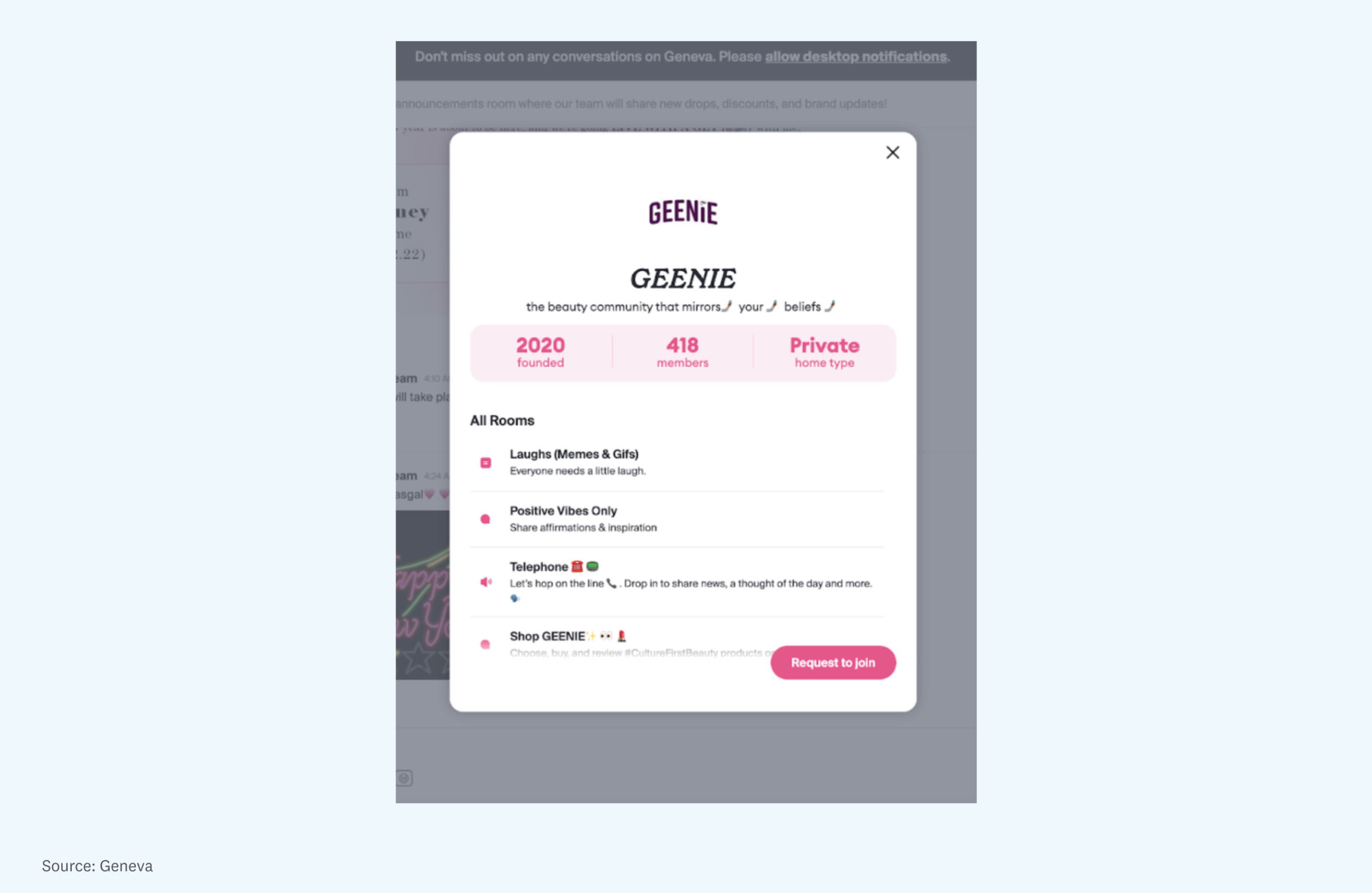
Next, start a conversation with this founding group in a private space designed for that purpose, such as a Discord server, a Slack channel, a Telegram chat, or even a group DM on Instagram. Some community platforms are designed to be versatile while others are geared toward specific populations. Geneva, for example, is a private group-chat app gaining traction among businesses with female customer bases.
One thing you shouldn’t do is waste engineering resources on building out your own community infrastructure. At this stage, third-party community platforms will meet all your technical needs. Plus, your target community members might already use them. Meeting people where they are never hurts.
The early days of community-building should feel like user research. You’re not trying to build an audience or sustain engagement. Instead, you’re experimenting with different offerings to figure out what your evangelists want. Audio? AMAs? IRL meet-ups? Ask them directly. Not only will you learn what they find valuable, you’ll also give them a sense of belonging.
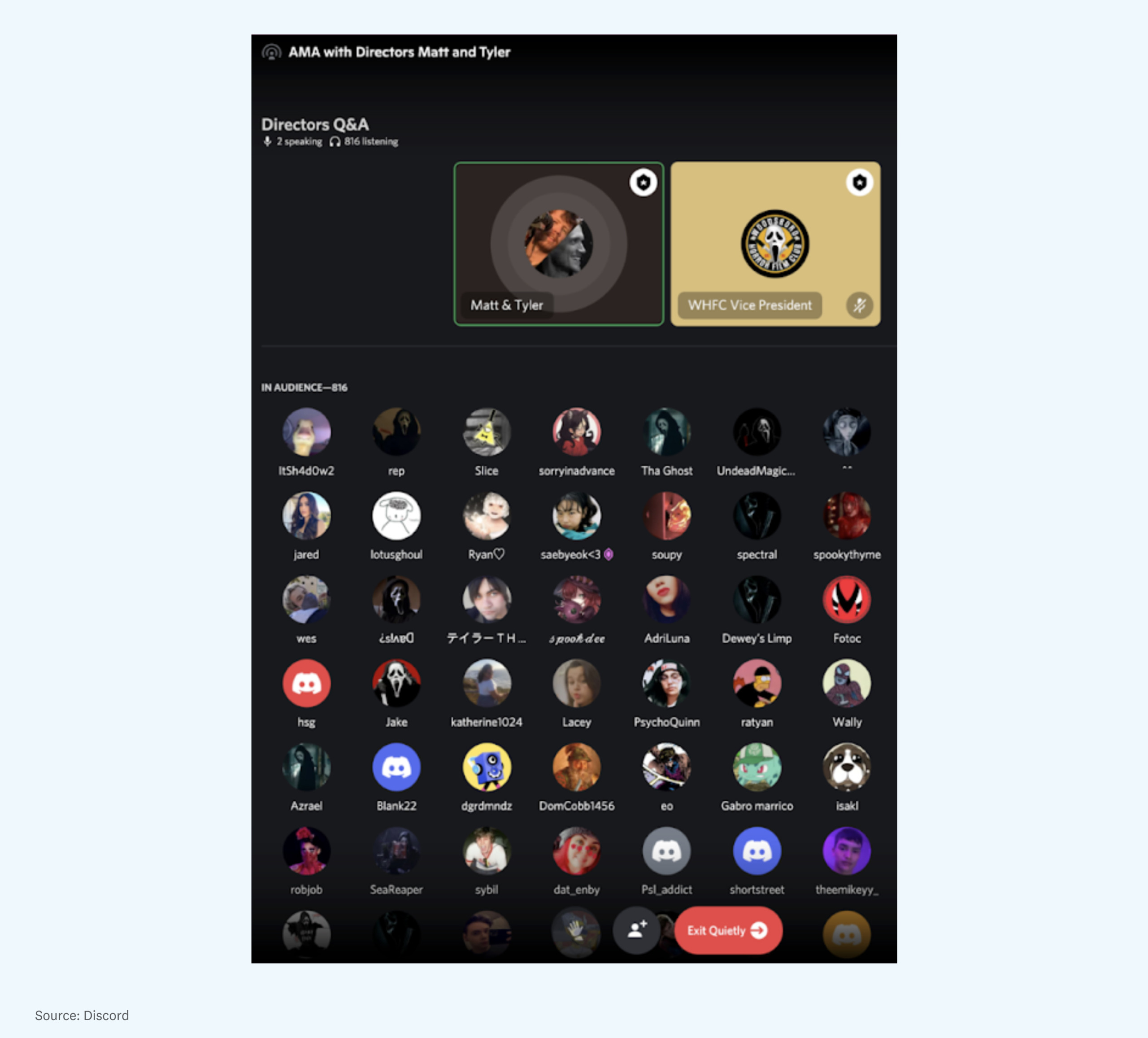
The specific offerings that appeal to evangelists vary by community. For example, members of Scream Movies on Discord — a community for super-fans of the franchise — get exclusive access to events like director AMAs. That’s a big deal if you’re a Ghostface diehard.
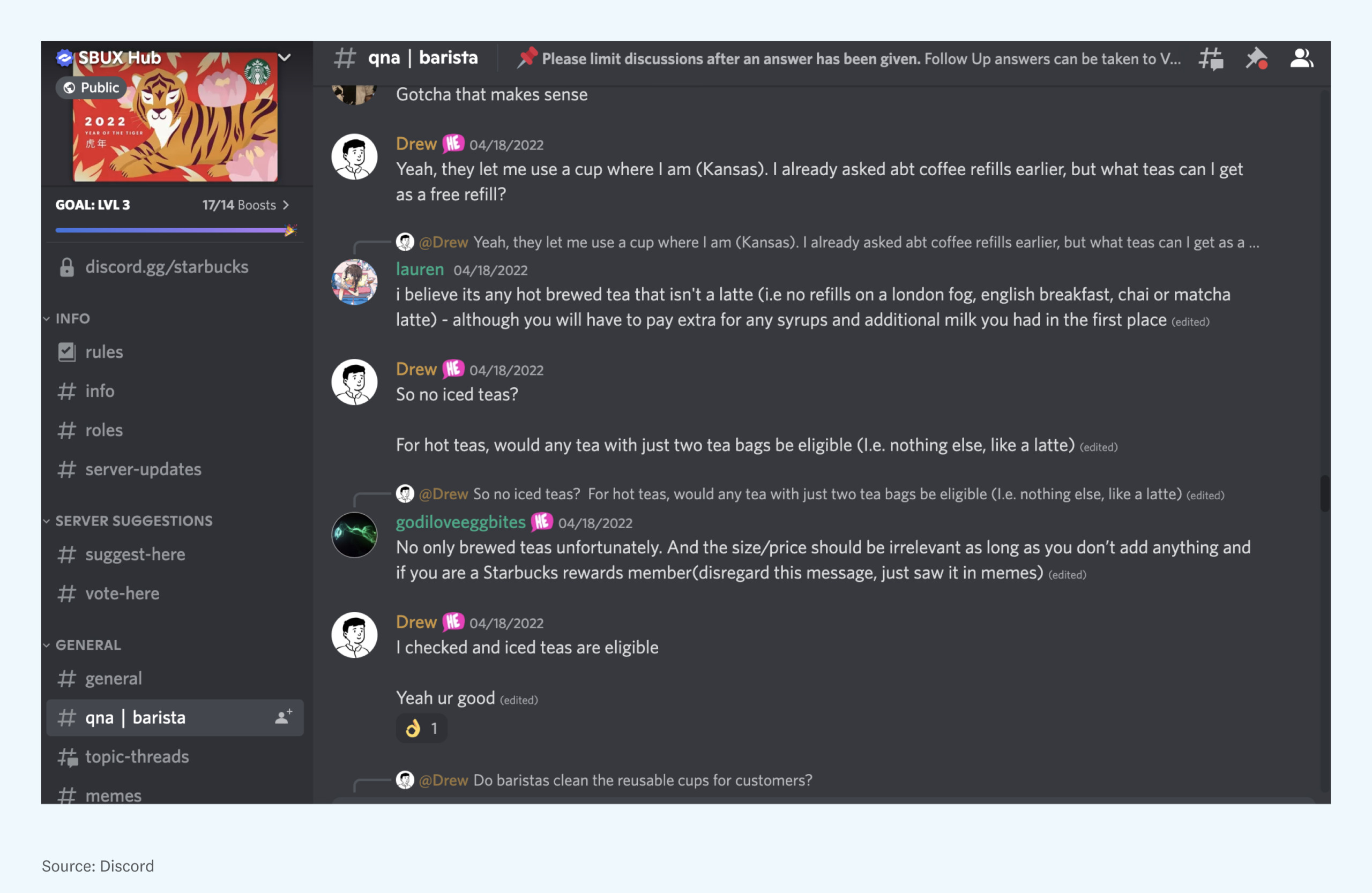
But AMAs might not be such an effective way to generate interest in every community. Take the SBUX Hub on Discord, an unofficial Starbucks community for baristas and fans alike. Perks of membership include behind-the-counter secrets and access to off-menu recipes. Here, learning about seasonal Frappuccino flavors months before they’re announced might drum up more excitement than, say, joining an AMA with Howard Schultz.
Once you have a handle on the quadrant, the second concept to master is the community funnel.
The community funnel: invited —> invested
Communities are primarily valuable to businesses for two reasons:
They create a built-in source of real-time user feedback, which is critical for building a product people really want.
They foster friendships rooted in an affinity for your product, which drives lifetime value and new customer referrals.
When it comes to community-building, it’s your job to spark the fire. But you can’t keep it burning alone. The key to a thriving community is members who care enough to take initiative — they pose thoughtful questions to the group, introduce new topics to explore, and sometimes even plan events, online or off, to help people bond. And they’re invested enough in the community to assume some of the responsibility of steering it forward. Early on, think about identifying folks you’d like to see take on more responsibility.
But new community members don’t magically turn into devotees. You need to set the stage for that to happen — both by letting early members play a role in shaping and growing the community, and also by creating an environment compelling enough to reel in anyone who enters. The community funnel charts a prospective member’s path from receiving an invitation to becoming an invested, active member. It’s important to think about your role in moving members through the funnel.
One priority should be optimizing introductions: A member’s first few interactions with the community can have an outsized influence on whether or not they stick around. Consider those early experiences through the eyes of a new member:
Is the initial invitation compelling? Does it spark excitement or curiosity, or make prospective members feel special? On Geneva, invites are often hard to find, which makes them fun to discover. This also gives new members something to bond over right away.
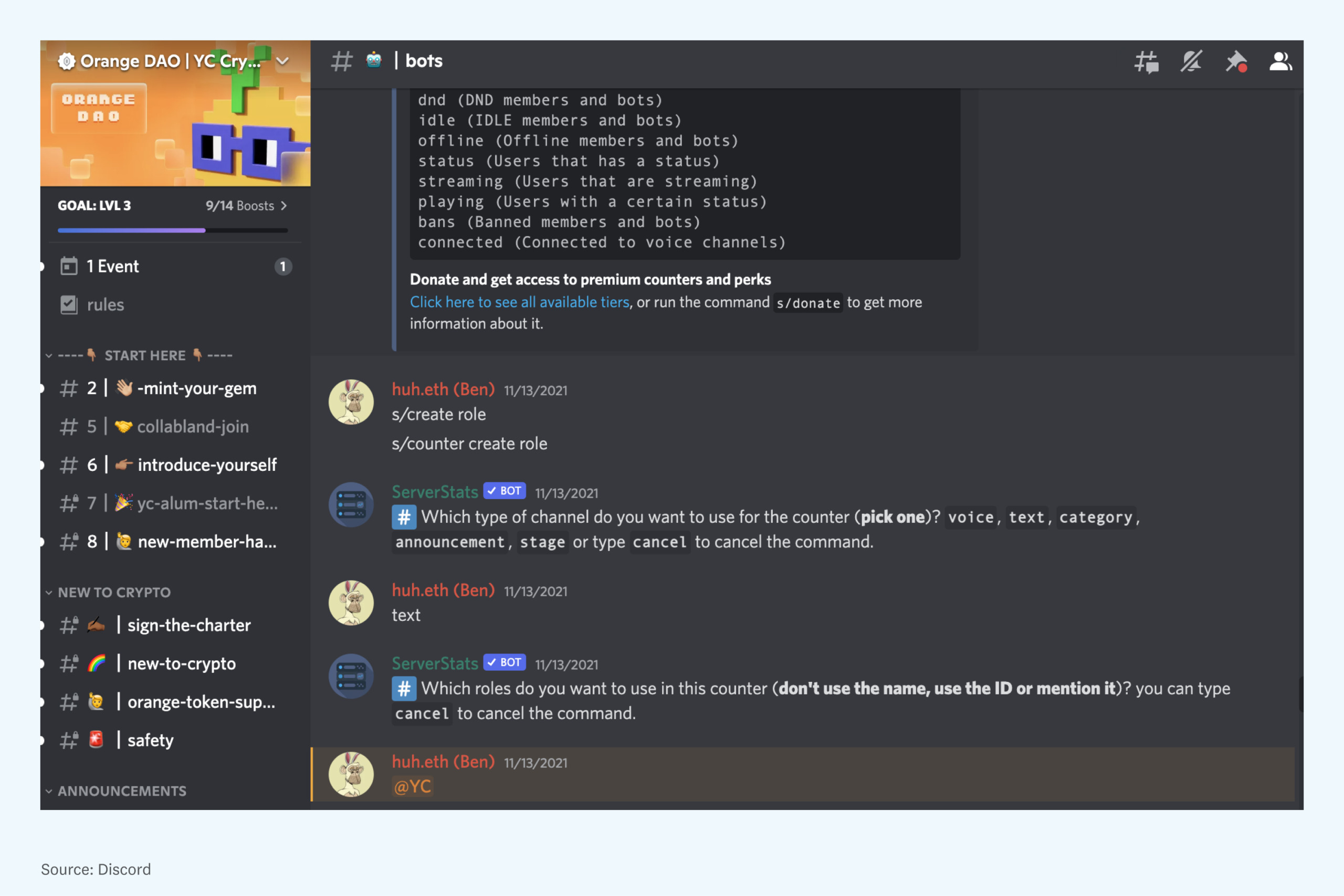
Do members land in space that’s easy to understand and navigate, and also fun to spend time in? Simply numbering channels and visually laying out the first steps a new member should take is a low-lift way to guide people through the on-boarding experience. Extra points if the space is beautifully designed. User-friendly design makes the Discord server for crypto collective Orange DAO inviting to first-timers:
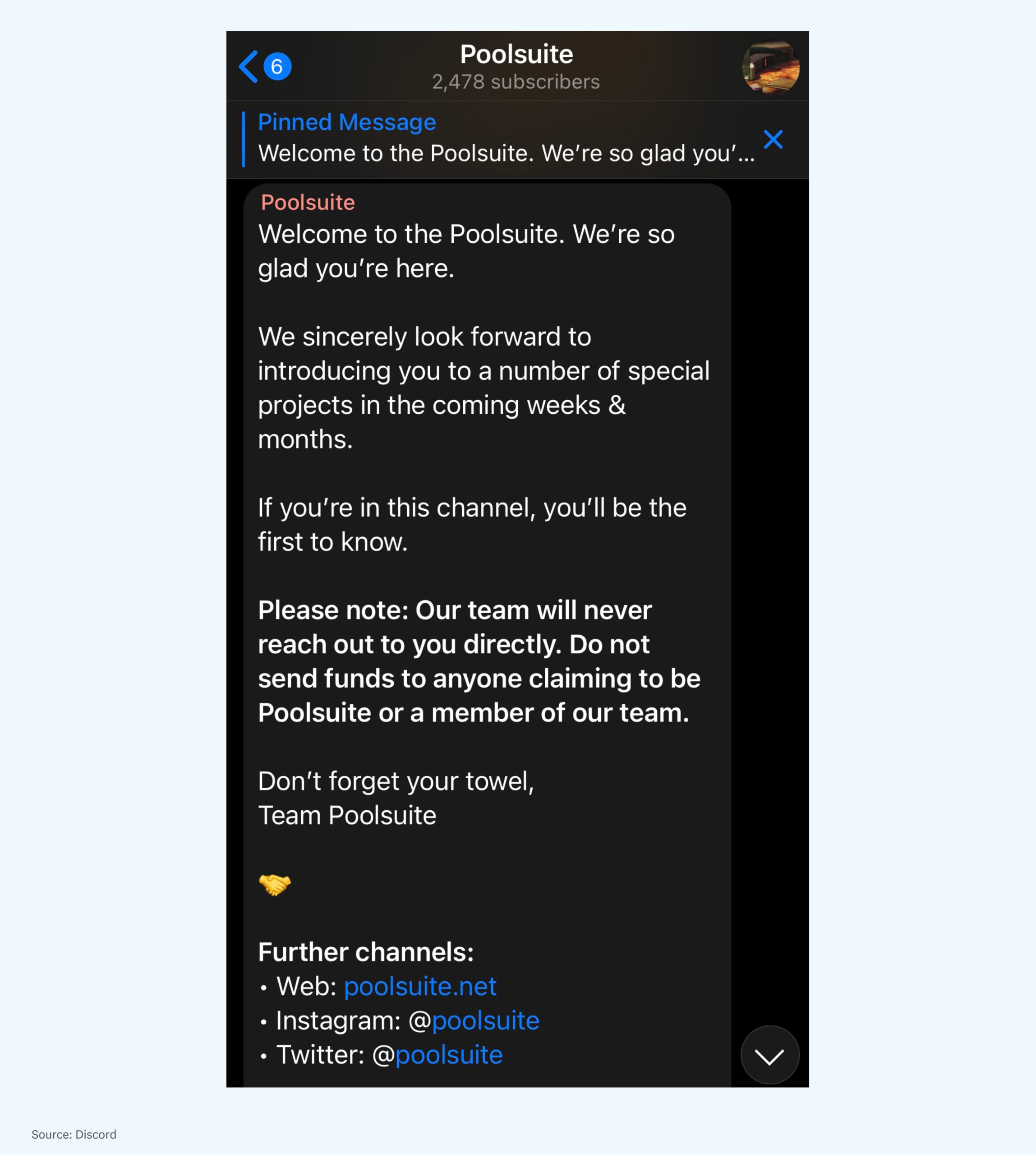
The ultra-simple layout of Telegram channels, which only have one central chat, makes the platform a low-friction way to get a community going. Here’s what new members see upon joining Poolsuite’s chat:
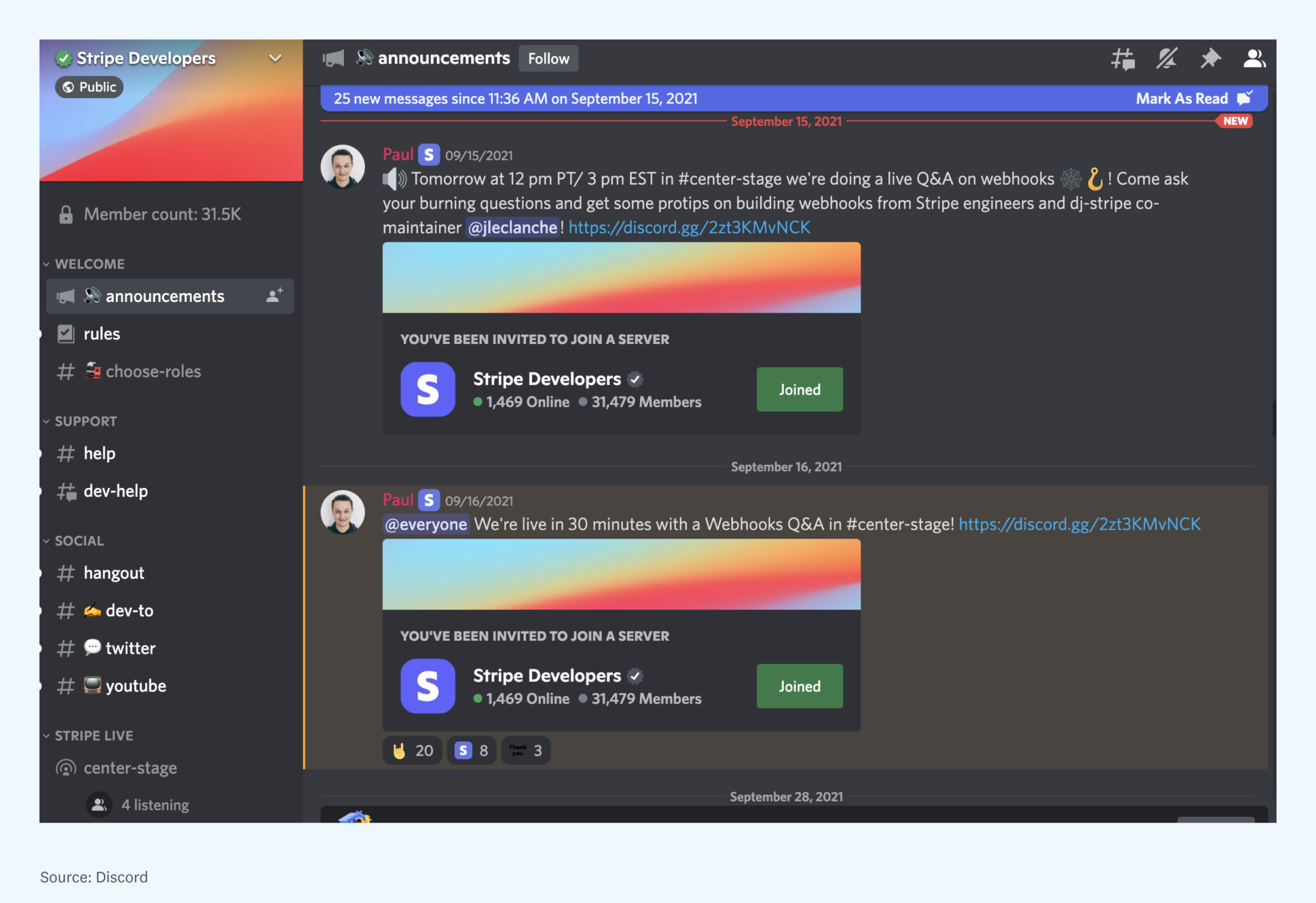
Are members individually welcomed into the space by a human (rather than a bot) and introduced into the conversation?Stripe’s developer community on Discord exemplifies digital hospitality with an active developer relations team welcoming new members:
Once introduced, do community members feel compelled to participate in the conversation? Participation primes members to become friends, which makes them feel more deeply tied to the community and motivated to contribute to it regularly. Most people who join your community will be evangelists for your product. By the time they reach the end of the funnel, they’ll (also) be evangelists for your community.
Now that you understand these two foundational community-building concepts, it’s time to begin architecting your community strategy. Start by clearly articulating why you’re building the community and what the value exchange will be. In other words, what will community members gain from joining and participating, and how does it help your business (now and down the road) to devote resources to community that could go elsewhere?
The value of community isn’t always easy to quantify financially, but there are benefits beyond the bottom line. If you get the basics down and approach community-building thoughtfully, your company will become a catalyst for strong relationships that grow alongside it.
A British entrepreneur and angel investor based in Silicon Valley. A community building expert and life-long founder, Amber is currently the head of strategic communities at Discord. FollowTwitterWebsite
Nearly every business today, large or small, utilizes social channels to promote their brand, build customer relationships and enhance the customer experience. Savvy businesses have long used social channels to listen to what their customers are saying about their brand, measure how they are reacting to new product updates and stay on top of current industry trends.
Early awareness of these trends can inform strategic changes that lead to first-mover advantages, improved customer loyalty and increased revenue for businesses.
Businesses Need Better Social-Channel Customer Care
For example, at the beginning of the COVID-19 pandemic, companies that were engaged and analyzing their social media data were able to more quickly identify services that customers wanted and needed to stay safe, including curb side pickup, contactless delivery, improved return policies on online purchases and mask requirements for in-person shopping.
But while many businesses have successfully tapped social data to discover new potential sales opportunities and grow their business, there are many more examples of brands blundering when attempting to provide customer care over their social channels.
This is an area businesses need to make improvements, and they need to make them quickly. Consumers have grown to enjoy the convenience of shopping and receiving support on their mobile devices.
For most people today, providing digital customer service is no longer a nice-to-have option — it’s preferred. And consumers’ expectations for support are high. Studies show that customers will wait for a response up to just one hour on social media, just one day after leaving a review and less than a minute when messaging with a brand using their digital channels. In fact, most consumers will only spend 10 minutes or less searching for a solution to their problem on self-help channels (online FAQs, chatbots, IVR) before abandoning a purchase.
While digital customer support (DCS) became a priority for many businesses during the COVID-19 pandemic, there are many organizations without a dedicated DCS team or plan. Below are three reasons why businesses should invest in DCS in 2022:
Digital Customer Support Saves Money, Improves CX
The truth is, contact centre managers are often heavily focused on cost reduction. However, rather than increase costs, DCS channels like Twitter, Facebook, WhatsApp, Instagram and SMS can help reduce expensive call-centre volumes, and they provide opportunities for businesses to create custom workflows to handle simple chat conversations, concerns or commonly asked questions.
When implemented correctly — digital customer service interactions see higher CSAT, NPS and drive greater customer loyalty, as well as fewer repeat contacts and more case resolutions in the same amount of time that a call would take. With the right technology, agents can multi-task by taking on multiple conversations at the same time, whereas that is impossible for traditional phone calls. Thus, deploying DCS can enable contact centre staff to handle more customer concerns in less time, using fewer agents, leading to savings.
Digital Customer Service Unlocks the True Value of Social Listening
A holistic approach to social analytics is necessary for businesses to understand their consumers and competitors. Research has shown that social media trends are leading indicators of consumer concerns, behaviours and preferences. By aggregating social data with things like reviews, messaging and other digital customer outreach data, an organization can gain an on-the-ground understanding of what trends affect consumers and how those are manifesting in their outreach directly to their organization.
Altogether, this offers businesses more granular information on brand awareness and reputation, allowing brands to be proactive in their approach to customer care.
Unstructured Customer Data Becomes a Goldmine of Insights
Advances in natural language understanding (NLU) technology enable businesses to gather more in-depth insights into competitors and deeper brand awareness by analyzing the open-text, unstructured data from digital customer service interactions. When NLU models are tuned on DCS data, a new picture of the customer’s interactions with their support channels becomes available.
Brands can use this technology to measure things like emotional intensity, how empathetic the agent was, and how much effort it took to complete a support task. All of this data can be added to a business CRM or customer data platform. The ultimate goal is to make this information readily available to agents and managers, so managers can better develop their agents and so agents have a view into an individual’s entire history of transactions, experiences and preferences with a brand. With this comprehensive view, the entire support team can scale personalized experiences.
Final Thoughts: Path to Customer Loyalty
Customers today expect fast, convenient customer service from any channel. The companies that continue to invest in digital service technologies realize increased sales, establish stronger customer loyalty through personalized service and save money by increasing efficiency.
Fabrice is the head of product for Qualtrics XM discover and customer care, and is responsible for the vision, roadmap and go-to-market strategy for Qualtrics XM discover and customer care and frontline solutions. Prior to Qualtrics, he was the Chief Product Officer at Clarabridge.