Author

editor

Browsing

By Chance Miller

As we’ve covered a number of times already, expectations for the iPhone 14 line-up are pretty clear. Apple is likely to unveil four different iPhone 14 models across two screen sizes at 6.1-inches and 6.7-inches.

While Apple (usually) does a great job at keeping marketing names under wraps until a product is announced, it’s fun to speculate ahead of time. Something I’ve been pondering recently is whether the iPhone 14 line-up could mark the return of the “Plus” branding…

The iPhone 14 line-up is likely to consist of two 6.1-inch iPhone models, one of which will be branded as a “Pro” model and the other one being the “entry-level” model. This is unsurprising and is the exact strategy Apple used with the iPhone 12 and iPhone 13.

But where things are expected to differ is with the 6.7-inch iPhone models. At the high-end of the line-up will be the iPhone 14 Pro Max, again repeating the strategy used with the iPhone 12 and iPhone 13. For the first time, however, Apple is also expected to introduce an iPhone with a 6.7-inch display that is not branded as a “Pro” model.

What this means is that the iPhone 14 will be available in two different screen sizes across four different price points. Analyst Ming-Chi Kuo has suggested that the non-Pro version of the 6.7-inch iPhone 14 could be priced at around $900, making it the most affordable 6.7-inch iPhone ever released by Apple.

Loosely looking at current iPhone prices, that means the iPhone 14 line-up could look like this:

  • $799 iPhone 14
  • $899 iPhone 14 Max
  • $999 iPhone 14 Pro
  • $1099 iPhone 14 Pro Max

iPhone 14 Plus?

But my proposal and idea for Apple’s crack marketing team is this. Instead of using the “iPhone 14 Max” name, let’s bring back the “Plus” and call it the iPhone 14 Plus. How about this:

  • iPhone 14
  • iPhone 14 Plus
  • iPhone 14 Pro
  • iPhone 14 Pro Max

Having two versions of the iPhone 14 with “Max” tacked on the end could prove to be confusing for consumers. The “Plus” branding has also been very, very successful for Apple in the past. The iPhone 6 Plus, for instance, is one of the best selling iPhones of all-time.

The iPhone 14 line-up is actually looking like an extension of Apple’s iPhone 6 strategy of attempting to bring a large screen to as low of a price point as possible. If the iPhone 6 Plus success serves as any indication, the iPhone 14 Plus could be one of the most popular iPhone models in recent years.

Again, this is all just conjecture at this point and Apple does a great job at keeping iPhone branding under wraps until officially announcing the new devices. It’s also notoriously hard to predict Apple marketing names, and it could be that Apple does something unexpected this year. Drop the numbers all together? Go with the “iPhone 13S” instead? It’s anyone’s guess.

What are your thoughts on marketing names for this year’s iPhone 14 line-up? Give us your best guesses down in the comments.

Read more 9to5Mac coverage of the iPhone 14: 

By Chance Miller

Sourced from 9 TO 5 Mac

By Shane Barker

Augmented reality (AR) is already making waves online. From Rihanna’s sparkly diamond headpiece to Kylie Jenner’s bold lipstick shades, AR filters are all over Instagram. That’s indicative of the trend that AR is gaining popularity.

In fact, a study estimates that there will be approximately 1.7 billion mobile AR users worldwide by 2024. That’s huge, right? With more internet users embracing AR, you can expect users to change the way they browse the internet.

There are big changes coming in the next few years, all of which are likely to impact search engine optimization (SEO). In this post, let’s look at some of the ways the evolving AR landscape is likely to change search engine optimization.

1. Local SEO will become more important.

Local SEO is already a focus area for anyone who wants to get ranked on Google. With AR, you can scan a code via a mobile device and get all the information you need about a business. You can check reviews and ratings and get images.

With apps like Wikitude or Yelp, you can give out location-specific AR experiences. For instance, you can give a special offer to someone who is close to your business’s location.

As a business owner, you’ll have to ensure that all of your business information is updated in local listings to make the most out of the popularity of AR.

2. Immersive digital experiences will become more mainstream.

AR will change the way you design your website. It opens up the possibility of giving users a truly immersive and engaging experience. Such experiences could have a mix of physical as well as virtual elements, and they have varied applications.

IKEA is one of the big brands that has already jumped on the bandwagon. They let customers preview their furniture items within their homes or any other living space. Through their special app, IKEA Place, users can check 3-D renderings of more than 2,000 IKEA products from different angles.

If you are buying a new sofa for your living room but aren’t sure whether it will fit in a corner, you can place it on the app and check. Similarly, fashion brands can offer virtual dressing rooms where customers can try out different outfits. Real estate companies can offer virtual tours for properties they want to sell.

This example is for an app, but there is a chance of such experiences being replicated on websites in the future. With a better user and immersive experience, you can expect to have a positive impact on your SEO. That’s because such elements can increase the overall time spent on a website and reduce the bounce rate.

3. Visual search and interactive content will become widely used.

In their quest to provide a better user experience, Google has included image and voice search features. To further elevate the experience, they are also investing in AR projects like Tango and virtual reality (VR) projects like Daydream. Overall, its vision is to maintain its lead as the most widely used search engine worldwide.

As AR-based content becomes more popular, you can expect it to gain more space in the search engine results pages (SERPs). For forward-thinking businesses, AR should become a part of the overall content marketing strategy.

With multimedia elements like 3-D objects and videos added as a part of the mix, you can expect visual searches to become more mainstream. Eventually, interactive content is also likely to become an integral part of the virtual world. As a content marketer or an entrepreneur, you’ll have to make sure you deliver such immersive experiences and match up to the changing search trends.

4. Social media will impact SEO more.

Everyone already knows that your social media presence has an impact on your SEO. So, it shouldn’t come as a surprise that AR will likely increase this effect. That’s because AR allows social media companies to provide engaging and immersive experiences that can boost engagement and conversion rates.

For instance, Facebook’s 360-degree videos allowed users to fully immerse themselves in whatever they were watching on their screen. Because of this, you could take a tour of the Louvre in Paris while sitting in your bedroom.

When it comes to AR, this is just the beginning. If you’ve used Snapchat or Instagram, you know how popular their 3-D effects are. You can see social media users get creative and experiment with them to create unique Stories.

Brands have already been using them to market their products and increase their brand awareness. With the increasing popularity of AR, you can expect more social media channels to come up with AR-centric features. That means the impact of AR on your SEO strategy is likely to increase. In a nutshell, AR should be a part of your social media strategy to make sure your SEO strategy works well.

For inspiration, consider the creative AR social media campaign created by Browns Fashion. The luxury retail brand came out with a sparkling AR filter to boost brand awareness. It gained more than 2 million try-ons. Even celebrities like Vanessa Hudgens and Heidi Klum used it on their Instagram profiles.

Augmented reality has the potential to change the way people interact with products and make purchase decisions. It is a technology that can also enable businesses to better understand their audiences and provide better user experiences. If you are looking to level up your SEO strategy, think AR. It’s still a new and fairly unexplored territory, so you can get the early mover advantage, too!

Feature Image Credit: getty

By Shane Barker

Shane Barker is a digital marketing consultant who specializes in sales funnels, targeted traffic and website conversions. Read Shane Barker’s full executive profile here.

Sourced from Forbes

By

New tools make it easier to manage ads and messaging as well as generate leads.

To commemorate National Small Business Week, Meta has announced a number of new tools to help businesses manage conversations and ads as well as generate leads.

According to a new press release from the company, businesses have had a lot of success getting discovered by new customers and having conversations using Facebook and Instagram ads that open to a WhatsApp chat. In order to make it easier to create these kinds of ads, Meta will soon make it possible to create full ads directly from the WhatsApp Business app.

As businesses using the company’s Inbox are already managing customer messages across Facebook Messenger and Instagram Direct all in one place. Now though, Meta plans to bring WhatsApp to Inbox as well so that multiple people at an organization can manage messages in Inbox from the same WhatsApp number on multiple devices to help save time and boost productivity.

Meta is also testing a new capability in Meta Business Suite that will allow businesses to send promotional message campaigns using Messenger to customers who opt in.

Improved lead generation and customer acquisition

By using lead generation tools, SMBs can grow their customer base by finding new customers and initiating relationships with them which is why Meta is expanding end-to-end management of lead generation on its platform with several new features.

First off, the free product Quote request on Instagram will allow businesses to put a “Get Quote” button on their Instagram profile as well as use “Get Quote” stickers in Stories. With either option, businesses can set up custom questionnaires for customers to fill out before starting a conversation about a quote.

Businesses will also soon be able to pursue promising leads using lead filtering in Lead Ads Instant Forms. Customer responses to a multiple-choice question can then be used to filter leads that may not be a good fit for an organization.

Meta is also in the process of testing a more flexible and personalized Instant Form that allows businesses to add visuals and content in the form so that they can share more visual information about their company and nurture the interest of potential customers.

Finally, Meta Business Suite users can now download lead information directly to their own CRM to follow up with potential customers more quickly.

Feature Image Credit: Meta

By

After getting his start at ITProPortal while living in South Korea, Anthony now writes about cybersecurity, web hosting, cloud services, VPNs and software for TechRadar Pro. In addition to writing the news, he also edits and uploads reviews and features and tests numerous VPNs from his home in Houston, Texas. Recently, Anthony has taken a closer look at standing desks, office chairs and all sorts of other work from home essentials. When not working, you can find him tinkering with PCs and game consoles, managing cables and upgrading his smart home. 

Sourced from techradar.pro

Sourced from KHTS HometownStation

Though there are many possible ways to boost your business page’s success, in the beginning, it is especially important to know exactly why people follow brand accounts and use this knowledge to reach a dedicated follower base that is likely to convert into leads and promote loyalty to and awareness of your brand in the long run.

To help you create and maintain the most efficient profile possible, here are 9 essential steps to draw followers to your Instagram business page and get them to stay, from launching the account to everyday operations.

Business

Research Your Market

First, it’s good to know the basics about Instagram as a platform.

Instagram is visited by 1.22 billion people every month, according to the most recent reports. It’s extremely popular with users between the ages of 18 and 34 and is used by slightly more men than women, though the difference there is minor. It’s most popular in India, with a fast-growing market there that increased 16% between quarters last year.

If you’re planning to use Instagram to promote your business, it helps to know who you’ll be advertising to. Spend time researching your specific industry market by exploring popular tags and accounts in the same niche. This will also give you a good idea of who your average viewer is going to be, and which formats – feed posts, stories, Reels, or Lives – they’re going to engage with most.

Develop a Strategy

Once you’ve looked into your market, you’ll want to develop a strategy for your advertising campaigns. According to advice from Instagram’s parent company Meta, your marketing strategy should involve three basic steps:

1. Establishing a clear SMART goal. 

  • Specific. You’re trying to build a following.
  • Measurable. How many followers you do want to garner?
  • Achievable. What can you do realistically right now to garner that number of followers?
  • Relevant. What research do you have that shows the potential to garner followers?
  • Time-bound. How long will it take to build a stable following?

2. Establishing a brand aesthetic. 

  • Establishing a brand aesthetic includes having a consistent color palette, post style, and brand voice across all of your content.

3. Creating a posting schedule.

  • We’ll talk more about this below, but for now, it’s enough to say that research suggests consistent posting on a reliable schedule, even if it’s not daily, offers a marked improvement in overall profile growth on Instagram.

Optimize Your Profile

Your Instagram profile itself is the best place to start when it comes to curating a following for your brand. Without a solid, well-optimized, and complete profile, no amount of advertising is going to make viewers convert to followers.

Here are some ways you can optimize your profile for both viewers and algorithms:

  • Have a clear, simple Instagram handle. This is the name that users can look up in the search bar and tag when they want to mention your products in their posts. It should be associated with your brand and easy to remember. Ideally, it’ll be your brand name written as simply as possible.
  • Choose a high-quality profile picture. For multi-product brands, this should be a high-resolution image of your company logo. For individuals running a business account, it should be a professional or semi-professional headshot that clearly shows your face. As an aside, try to keep the same profile picture or style of profile picture for as long as you can; this will help users quickly recognize at a glance when a post is yours.
  • Include important keywords and hashtags in your bio. Your Instagram bio is the 150-character space in which you need to summarize your business for newcomers and the Instagram algorithm alike. Including important keywords and tags – vegan, fitness, fashion, business, social, etc. – will help the Instagram algorithm recommend your profile to users most likely to enjoy it.
  • Include a profile link. You may choose to link to your brand’s website, your latest product landing page, or use an aggregation link like Linktree. This gives viewers another way to verify the authenticity of your brand.
  • Take full advantage of Instagram’s Business features. Fill out your brand’s category, add the appropriate contact information, and choose an Action Button to appear on your page. This way, users don’t have to go searching for your information on other sites and can instead access your brand with one click.

You should also aim to be verified by Instagram. Instagram requires that an account be Authentic (represented and run by a real person or business), Unique (the only profile of this person or business as a business entity), Complete (with a public bio, profile picture, and active feed), and Notable (representing a brand well-known on and offline).

Though the exact requirements for notability are vague, it’s worth attempting to be verified, as this will prevent scam accounts from phishing followers from your brand and makes it easier to interact with other brands and influencers.

Create a Variety of Content

Instagram offers four main types of content, with the two major options being feed posts and Instagram Stories.

Since different niche users appreciate different content, it can be worthwhile to create a variety of different formats to test which appeals the most to your audience, and which gains the most traction. You may find that you want to use only one or two formats, or you may choose to use all four.

Feed Posts

Feed posts are the square photographs that appear on your follower feed and your main profile page. These posts can either be single images or a group of up to ten (called a carousel post).

These posts include a caption that can be up to 2,200 characters and options to add a location tag, product tags, and tags for other users. Instagram has also introduced a collaboration feature that allows your posts to be seen on both your feed and the feed of your collaborator, but we’ll talk more about this below.

Instagram also includes a wide variety of editing options for their feed posts including filters, light and colour adjustment, and focus adjustment, among others. Take full advantage of these features to create high-quality images that suit your theme.

Curating an attractive feed using this kind of post is the best way to attract new followers, as Instagram is a primarily visual social media experience. Many content creators choose to have a set theme or aesthetic for their posts; this can be especially helpful for brands who wish to be instantly recognizable. This is where your brand aesthetic comes into play.

Stories

Instagram Stories are short images or video clips that stay on screen for a few seconds at a time before automatically moving to the next piece. Much like content on Snapchat, Stories disappear after 24 hours and make great vehicles for quick snippets like one-off jokes, new post announcements, behind-the-scenes content, and time-sensitive content.

Stories are some of the most versatile pieces of content you can create on Instagram, given the wide variety of features you can add in the editing phase. You may choose to:

  • Create a Boomerang, a looping video that plays backward and forward, for a unique aesthetic approach
  • Use Stickers such as hashtags, mentions, polls, questions, and meters to interact more directly with your audience
  • Share user-created posts to your Stories and comment on them to engage your community
  • Create an Instagram Filter that others can use in their own Stories

The possibilities are endless. One tip here is to have some level of consistency across your Stories. While creating a variety of content is fun and engaging, if you want to keep your brand recognizable, you’ll want to incorporate your aesthetic – a colour palette, set font, or logo set – into each Story.

Instagram

Reels

Reels are longer-form videos on Instagram, about 15-30 seconds per post, that are reminiscent of the TikTok format and follow many of the same creation rules as that platform. This longer space allows you to share more information more effectively than you can in Stories or feed posts.

As with its other content types, Instagram offers a variety of editing tools for Reels including clipping and adding special effects in post-production. Though you can shoot Reels directly in the app, you can also import short videos from third-party apps with more editing options or through the Meta Business Suite for more control over when your video is posted.

Shopping

Instagram Shopping is the app’s latest addition, allowing creators to manage storefronts within the app itself. Shopping entries are fairly standard product options; you can include an image (or multiple images), a description, the price of the product, and a link to purchase.

Recently, Instagram has introduced the option to buy products directly in-app, though this feature is as of yet only available in the United States. For all other countries, you can include a link to your external store page to purchase.

5. Use Your Captions Effectively

Though images are the main draw for your content, having a compelling caption can make or break your user engagement. As mentioned, the caption limit on Instagram is 2,200 characters, so it’s a good idea to experiment with both longer and shorter captions to see which appeals to your audience more.

You must put the most important information in your caption in the first line if possible. This is because Instagram automatically cuts off captions after the first few lines, meaning that you need to grab your followers’ attention immediately to encourage them to click “more.”

Beyond that, you’ll want to make sure your content is tagged appropriately. The standard etiquette for Instagram is to put all of your relevant tags at the bottom of your caption unless they can be worked in naturally to the caption text. Tagging your post will cause it to appear on that tag’s Explore page, which leads to more exposure for you and your brand. Try to choose a few relevant keywords, and avoid spam tagging (filling the entire caption with every imaginable tag), as this can come across as insincere at best and bot-like at worst.

You may also choose to include a question or prompt in your caption that invites users to comment on the post and contribute their feedback. This drives up engagement naturally, which looks good for your page and can, again, increase your wider exposure on Instagram.

Create a Schedule

According to social media marketers, the best strategy for the fastest possible growth is to post at least once per day, every day, but even posting a few times per week is going to boost your follower count steadily over time. To keep up with this amount of content, it’s a good idea to create a consistent content calendar and a backlog of prescheduled posts. This will give you time to plan your content, produce batches of it at a time that will be more consistent, and focus on interaction rather than daily posting logistics.

There are many third-party apps you can use to create and schedule your Instagram content, though you can also do so directly from the Meta Business Suite, which features an in-built posting calendar complete with suggestions for important days to post on and data about the optimal time to post based on your followers’ previous engagement.

Engage with Your Audience

Posting alone will not get your page noticed on Instagram the vast majority of the time. The site is, at its core, a social site; it’s designed for two-way interaction and community building. This is why bot accounts don’t do as well as actively managed accounts – active accounts interact with people, which causes them to find more followers, more quickly.

Here are a few ways you can engage with your audience to create a sense of community.

  • Follow accounts that are similar to your brand and your brand values. This will not only give you insight into your market and the type of content they can expect but also opportunities to collaborate with others in your niche.
  • Like and comment on these other accounts’ posts. Actively engage with other accounts and your brand will be seen as more personal, with real interests, rather than a faceless corporate account. It will also help the followers of these accounts to be exposed to your name, allowing the opportunity for more brand exposure.
  • Speaking of being personal, interact with your followers on your posts! Respond to comments and pin your favourites to the top of the post. Answer questions when they come up and direct people to your target landing page when you can. Interacting with your followers not only drives engagement on a post but encourages engagement on future posts and builds trust in your brand.
  • Run polls and Q&As from your Instagram Stories. This allows you to not only boost engagement but also receive direct feedback from your audience and tailor your social media plan to their expectations and preferences, making it all the more effective. You might even gather insight on interest in future products.
  • Run contests and giveaways in your feed posts. Common entry requirements for contests and giveaways on Instagram are comments, tagging friends, liking, and sharing a certain post to your own Stories. This increases the exposure exponentially and gives you a chance to make an impression with new followers using follow-up posts. Be warned that many followers gained from this tactic are likely to unfollow as soon as the contest ends unless impressed by your follow-up content.
  • Work with influencers in your niche. Offer an affiliate or ambassador program and collaborate with other creators to be featured on both their feed and yours. This also helps build brand loyalty; people are more likely to trust a brand they’ve heard of through someone they already admire and trust.

Advertise Your Page

Of course, the most traditional way to gain followers on Instagram is to advertise on the platform. Luckily, Instagram advertising is relatively easy and inexpensive; the ads can be easily created from existing posts and monitored from their Ad Centre in the Business Suite (or Ad Tools on the mobile app) for the best possible results.

To build an effective Instagram ad, start with what you already know about your followers by examining your Insights tab. Use this information to choose a high-engagement post and target a specific audience (by age, gender, location, and/or interests). From there, set a specific goal (in this case, “More Profile Visits” is probably the most appropriate option), set a daily or overall budget (you can choose to run ads for as little as one dollar per day), and allow the ad to run.

You might choose to test an ad structure with a low budget and, if it produces the results you want, repeat the campaign with a higher budget to win better placement. You may also choose to run multiple ads simultaneously to examine which structure works best. As with any other kind of content on the site, remember to tag your ads appropriately for the best exposure.

Hearts

Review Your Results

When you’ve tried everything you want to gain followers, examine the results of your efforts. You can do this by keeping track of how many followers you’ve gained over time through your Insights page, from which you can also glean more information about what kinds of followers you’ve been getting. Find out which strategies have been most effective and continue with them or tweak your approach to better cater to your findings.

You should be reviewing your results regularly, about once per month at least, to keep an eye on the patterns and trends that emerge. This will help you plan your next month of content and engagement and may help you decide which influencers and brands to partner with again in the future and which promotions are most effective not only in terms of followers but in terms of producing leads.

Conclusion

Instagram is a fantastic place to create and maintain an active brand image. The platform is most helpful for visually-based brands, of course, but it doesn’t hurt to maintain a profile there even if your brand is more abstract in its offerings.

By following these essential steps, you can draw high-quality converting followers to your Instagram business profile and grow your business in a cost-effective and modern manner, perfect for the digital marketing era.

Sourced from KHTS HometownStation

By Umber Bhatti

A blog can also be a low-cost way to elevate your small business’s reach and also build credibility with your followers, making it a win-win situation. Here’s how to start a blog for your small business.

You’ve probably never envisioned yourself as a blogger. After all, you’re a small business owner, and probably not a trained writer. But you don’t have to be the perfect wordsmith to write compelling and engaging posts. Creating a successful blog really just requires being passionate about a certain topic — a characteristic you already possess as an ambitious entrepreneur! A blog can also be a low-cost way to elevate your small business’s reach and also build credibility with your followers, making it a win-win situation.

Another benefit of blogging is your posts are “owned content,” meaning you have complete freedom to create your blog as you please without relying on third parties. All the material on the site will be within your control, ensuring the tone and style of your blog are consistent with your brand values. Building a blog from scratch takes some work, but this article will help you get set up with the basics, while also providing insight into the various ways other businesses blog.

Why start a blog for your small business?

When thinking about the content you want to include on your blog, the 80/20 social media rule is useful to reference. This popular social media tenet dictates that while it’s acceptable for businesses to devote up to 20 percent of their marketing strategy explicitly promoting their products, the remaining 80 percent of posts should be entertaining and helpful for your audience.

The idea is that instead of bombarding customers with promotional ads, you should enrich their experience through interesting, edifying, or educational content. You probably want to add value to your customers’ lives in some way, and a blog is a perfect channel to do just that! Sharing this content will not only attract more customers, but it can also open a dialogue with your existing followers, creating a stronger online community. Blog posts can also be repurposed on social media — generating more content for your business.

Here are some reasons blogging is a good investment:

Highlight your knowledge

Customers want to know that the brands they’re buying from are dependable and trustworthy, and blogging can be a great way to relay your expertise in your field. Through blogging, CEOs, founders, and other employees can also dive deep into thought leadership by expressing their learnings from their own career journeys.

Expand on your brand’s values and goals

Oftentimes, Twitter threads or Instagram Stories may not feel like the right platform for when you want to write a deep dive into your company’s mission. Blog posts, however, are the perfect medium for an in-depth look into your company’s principles as you can expand about your goals and aspirations as an entrepreneur.

Document and share transparently

Running a business is no easy feat, and recording the ups and downs of the journey can be a beneficial experience for both business owners and customers alike. Sharing some useful content to include would be a timeline of company milestones, quarterly reviews, and a post honestly depicting the obstacles in running your business and how you overcame them. Individuals who are building in public have seen many positive returns, like finding community and gaining brand exposure. Readers will also appreciate this candidness and it may even help them see the humanity behind your brand instead of just viewing it as another company.

Include keywords in your post

By writing blog posts that contain keywords relating to your products and services, you can start driving more traffic to your site. This is an efficient way to build up the organic search for your brand. Just know that it will take some time for your posts to rank high for SEO. Still, if you consistently generate solid content that is crafted with search engines in mind, your articles can eventually start ranking higher on Google and similar sites. If you are interested in learning more, here are some SEO tools that can help.

How to start blogging

Setting up a blog is fairly simple, but there are some logistics to figure out before you begin writing.

Choose a Content Management System

There are a ton of content management systems you can pick from for your blog. Here are just a few options:

  • WordPress —  WordPress is used in 41 percent of websites, and for good reason. The platform is simple to use while also offering more advanced features for those who need it. The basic version of WordPress is free, but most brands and businesses will probably require a plaid plan.
  • TumblrWhile Tumblr may be known as a social media platform, the user-friendly interface is perfect for writing blog posts. It’s also a great choice if you want to infuse your posts with trending memes and a more casual tone. Best of all, Tumblr is free.
  • BloggerA free Google product, Blogger has been around since 1999 and has been credited as being a game-changer in the online publishing space. Blogger provides simplicity, easy-to-use templates, and can be linked with all of your Google accounts. A plus? Google Adsense can also be integrated into your site.
  • Ghost At Buffer, we use Ghost for our blog and appreciate its intuitive dashboard, built-in SEO features, and the platform’s commitment to centering content at the forefront. Ghost Open-Source is a free version of the site, while the more advanced Ghost Pro starts at $9 per month.

Make editing easier

A blog post that is filled with typos and grammatical errors can be jarring for readers, which is why it’s important to ensure your content has been reviewed. Grammarly is a great editing tool to use, especially if you’re an ambitious team of one. While there is a premium version, a free Grammarly account should take care of most major grammar and spelling errors.

Implement a content calendar

Similar to how one would set up a social media calendar, you can also make use of a content calendar for your blog. The calendar would include pitches and blog post ideas, the timeline for completing each post factoring in the outlining, drafting, and editing process, and the publish dates for each piece. This will give you an organized look into your blog and ensure you’re staying up to date with your posts.

Generate Ideas

You may have a few top-of-mind ideas for your blog, but are wondering how to churn out content on a regular basis. Feeling unsure of what to post is common, but there are several ways to develop new topics to write about. Getting your followers’ input on the content they’d like to see is always a good option as they can bring up important customer pain points they’d like addressed. Asking the rest of your team for pitches – even if their role isn’t directly tied to marketing or communications – can also provide an insider’s perspective on the blog. And finally, creating a mind map of relevant topics and doing other brainstorming exercises can allow you to think outside of the box.

Running a blog can feel like juggling multiple tasks at once, but eventually, you’ll settle into a good rhythm of creating content. Getting started is the most important part, and remember, you can always adjust your blogging strategy along the way.

How other small businesses approach their blogs

The great part about writing a blog is that you can be flexible in the type of content you share. If you want more ideas for getting started, these examples from other small businesses can give you a jumping start.

Documenting their journey

Blogs offer the perfect medium for customers to catch up with important news and updates from brands.

Scotch Porter

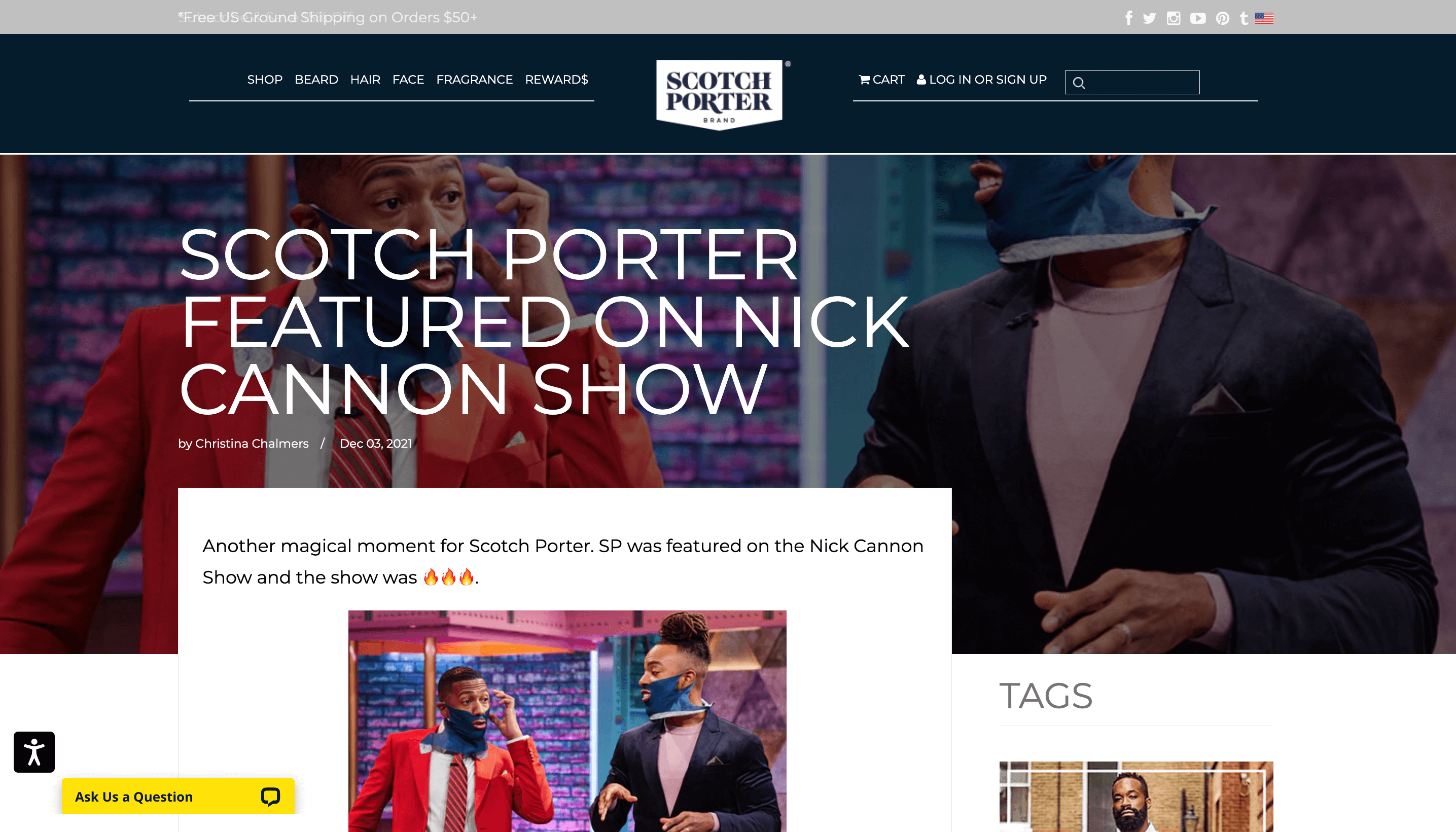
Scotch Porter —  a black-owned business that makes hair care products for men — has a variety of posts on their blog aka The Scotch Porter Journal. But their core focus seems to be sharing company milestones like announcing their launches in both Target and CVS. And when they were featured on Nick Cannon’s talk show in late 2021, they dropped the exciting news via their journal.

A blog post from Scotch Porter
Scotch Porter updates fans about exciting company milestones on their journal

Buffer

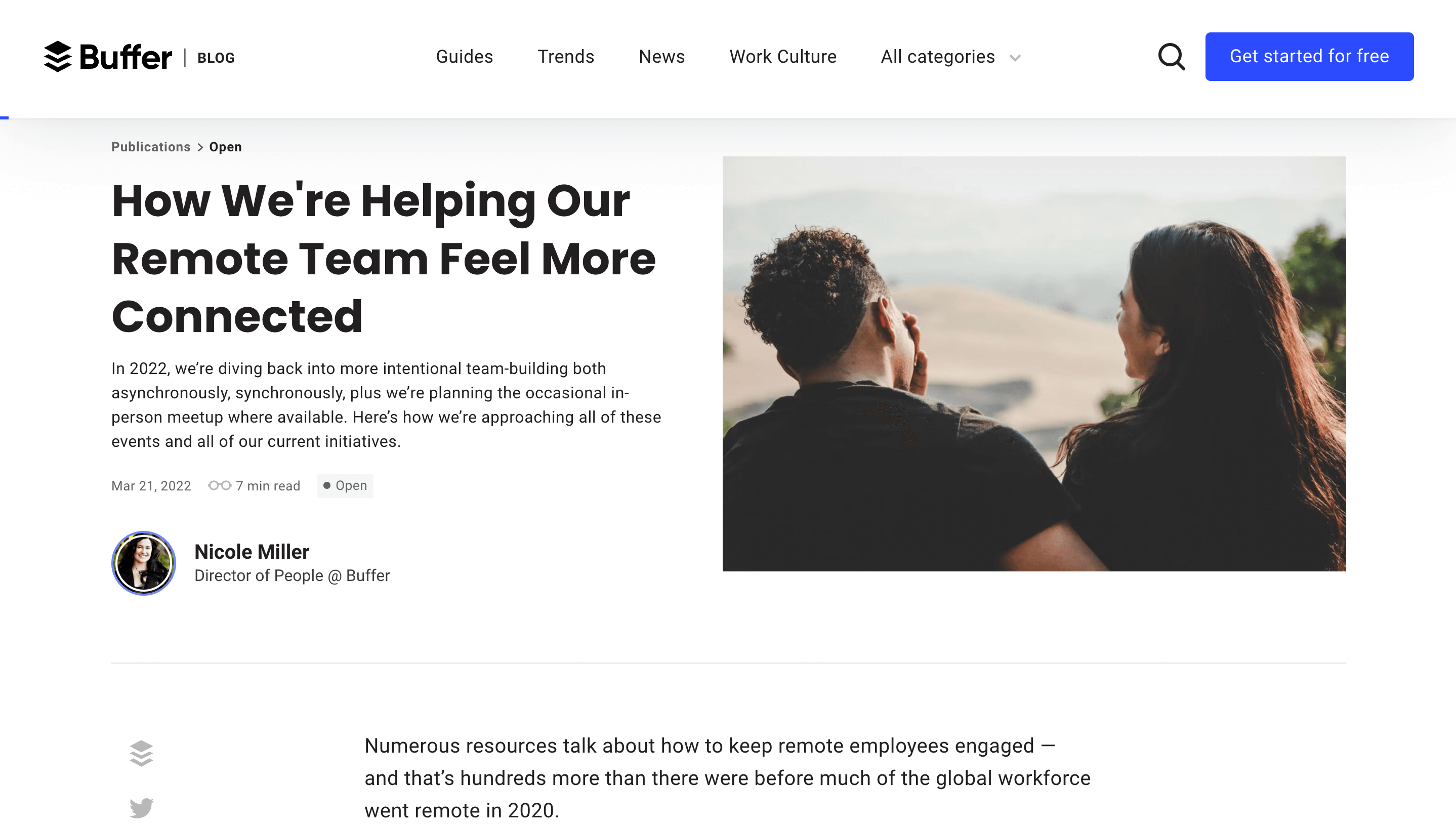
While it’s always nice to highlight your accomplishments, it can be just as rewarding to open up about the challenges and obstacles your business has faced. At Buffer, one of our core values is defaulting to transparency, which is why we document important learnings on our Open blog. In these posts, we don’t shy away from difficult topics but instead, get candid about areas we need to improve on and the steps we’re taking to do just that.

We’ve written about cultivating a better sense of community within our remote team, the challenges our engineering team has faced, and security breaches at Buffer. Our hope is that by sharing things transparently, we can inspire and help others on their small business journeys.

A blog post from Buffer
Sharing transparently is a top priority for us at Buffer

Highlighting products

While you may be used to advertising your products mostly through social media, a blog is a creative way to promote your products.

Glamnetic

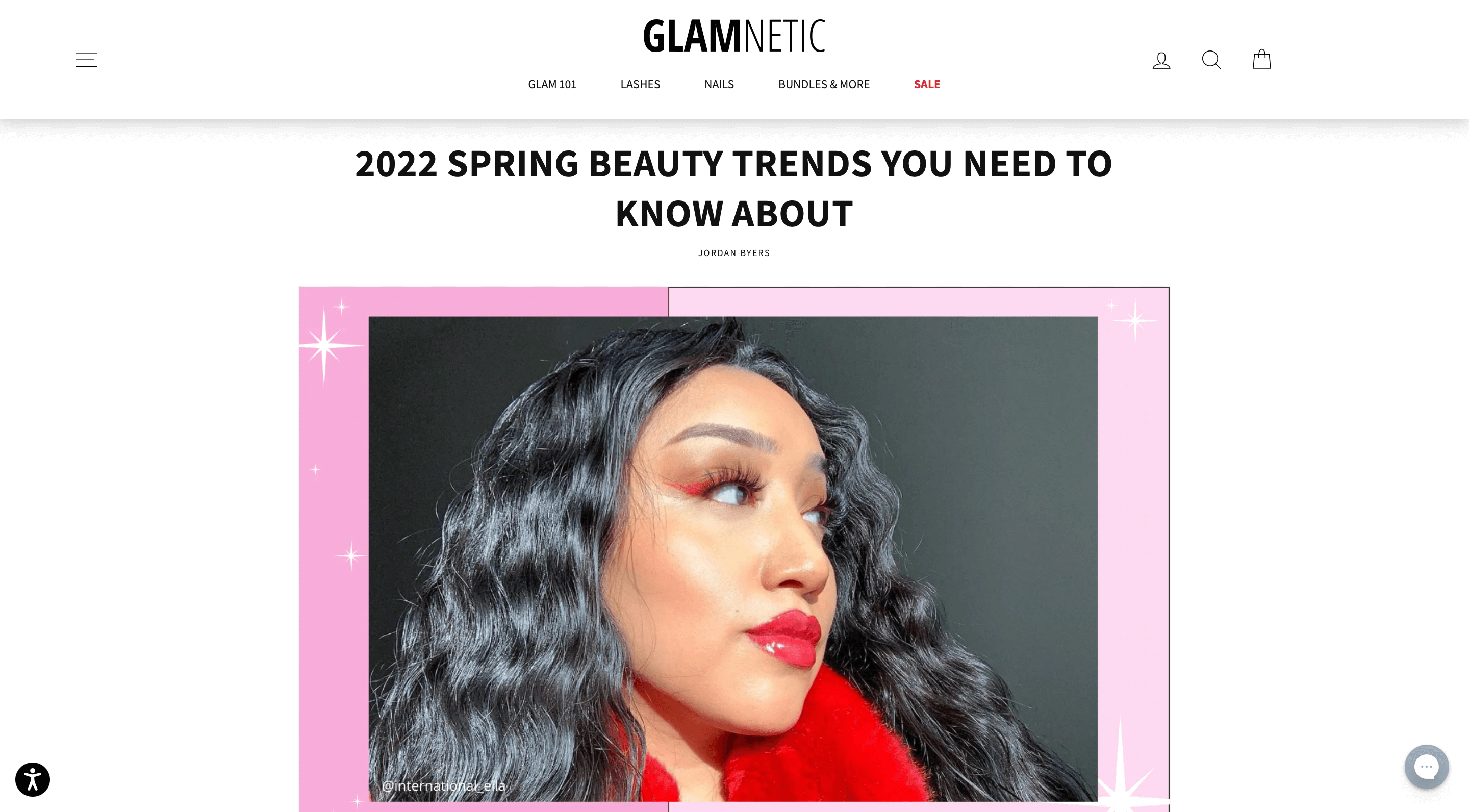
Glamnetic, a beauty brand that sells press on nails and magnetic lashes, spotlights their products often on their blog but keeps it fun by connecting back to other trending topics including TikTok, celebrity culture, and popular beauty trends. Some of their articles include Want nails like Kylie Jenner?, How to remove press on nails — TikTok viral hack, and 2022 spring beauty trends you need to know about.

A blog post from Glamnetic
Glamnetic’s blog contains trending beauty news along with product highlights

Passion Planner

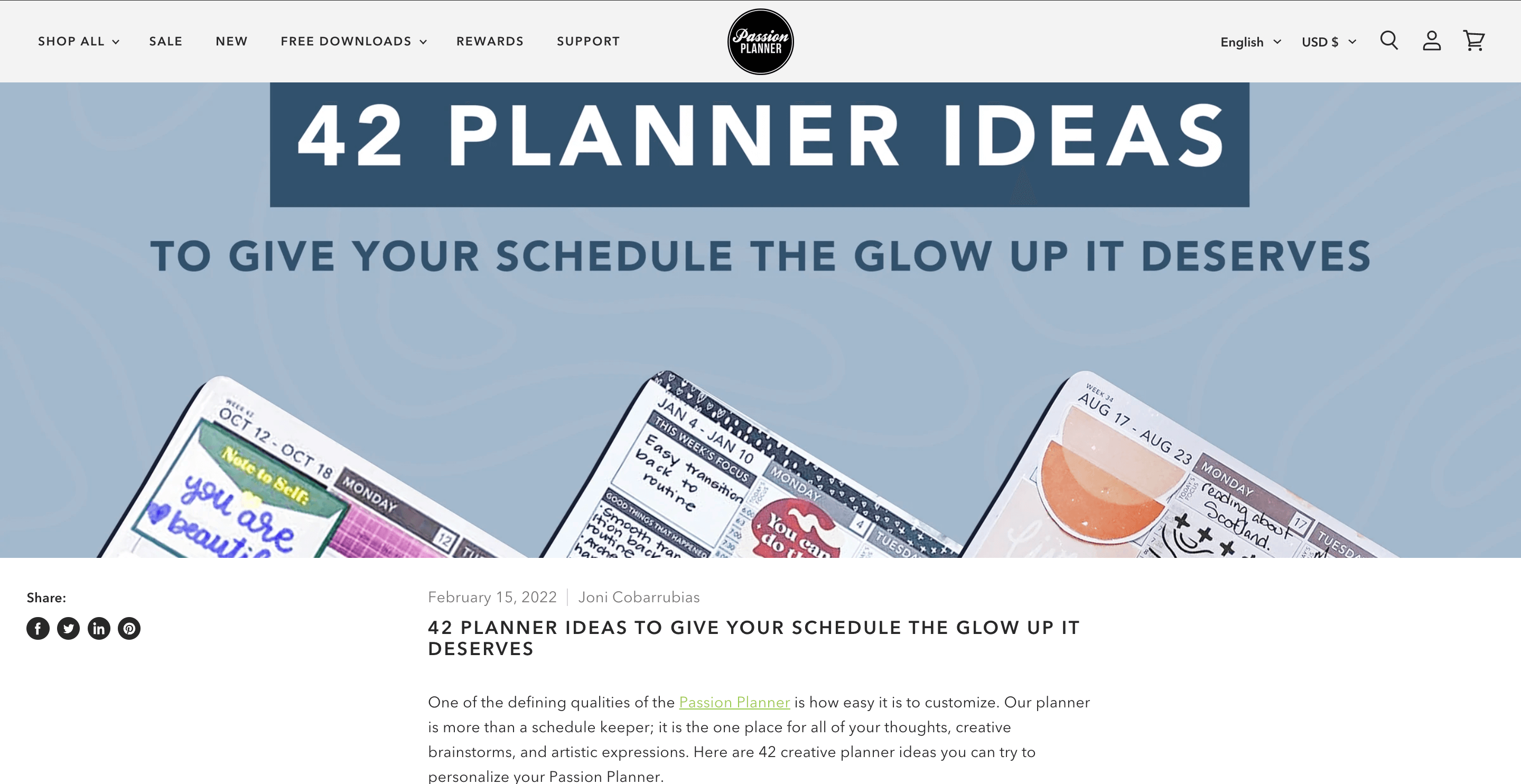
Passion Planner similarly writes blog posts that tie back to their main products: journals. Their blog includes tons of ideas for customers who’re interested in journaling, like 42 planner ideas to give your schedule the glow up it deserves and The 7-day self-love challenge. Instead of focusing specifically on their passion planners, however, the tips in the blog posts could work for any journal or agenda. This makes Passion Planner’s blog feel less like another marketing ploy but instead a solid resource for readers.

A blog post from Passion Planner
Passion Planner’s blog includes helpful tips for journaling 

Flow Club

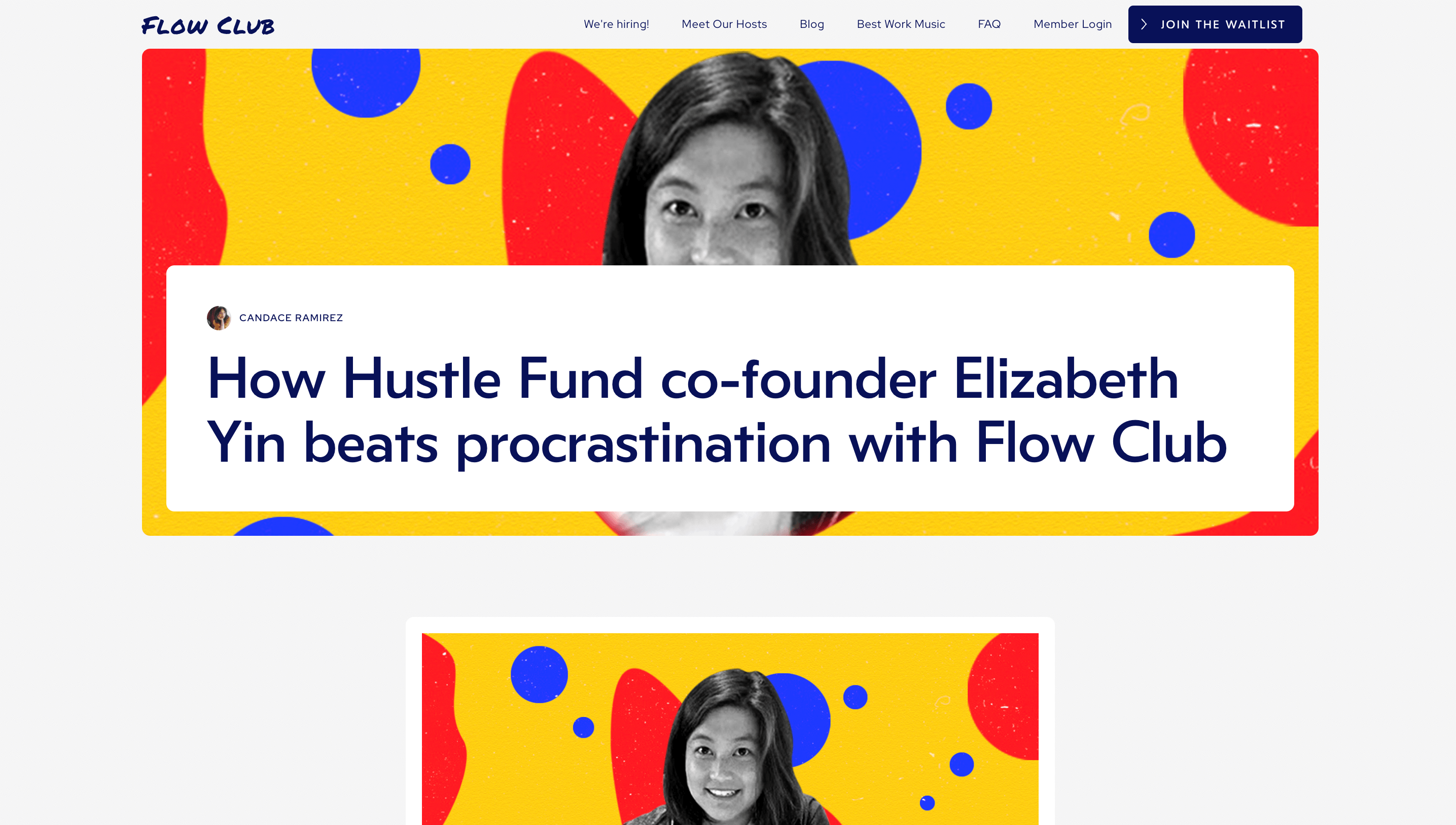
Flow Club, a virtual coworking space, highlights their product a little differently by including user testimonials on their blog. In this article entitled, “How Hustle Fund co-founder Elizabeth Yin beats procrastination with Flow Club,” they hone in on one customer’s experience with their product, providing direct quotes and personalizing the service a bit more for readers.

A blog post from Flow Club
Flow Club uses their blog to highlight customer experience

Demonstrating expertise

You know your stuff, and blogging about your experiences and knowledge is a perfect way to educate your readers about interesting topics related to your business!

Birthdate Co.

Birthdate Co. crafts their products with astrology, numerology, and tarot in mind, creating a unique candle for every birthdate. Naturally, their blog includes tons of resources about horoscopes and astrology, like: Gemini Guide: What Are the Traits of a Gemini?, Taurus Season Horoscopes, and What Are the Best Astrology Books To Learn Everything About Your Sign?

A Blog post from Birthdate Co.
Birthdate Co. shares astrology related posts

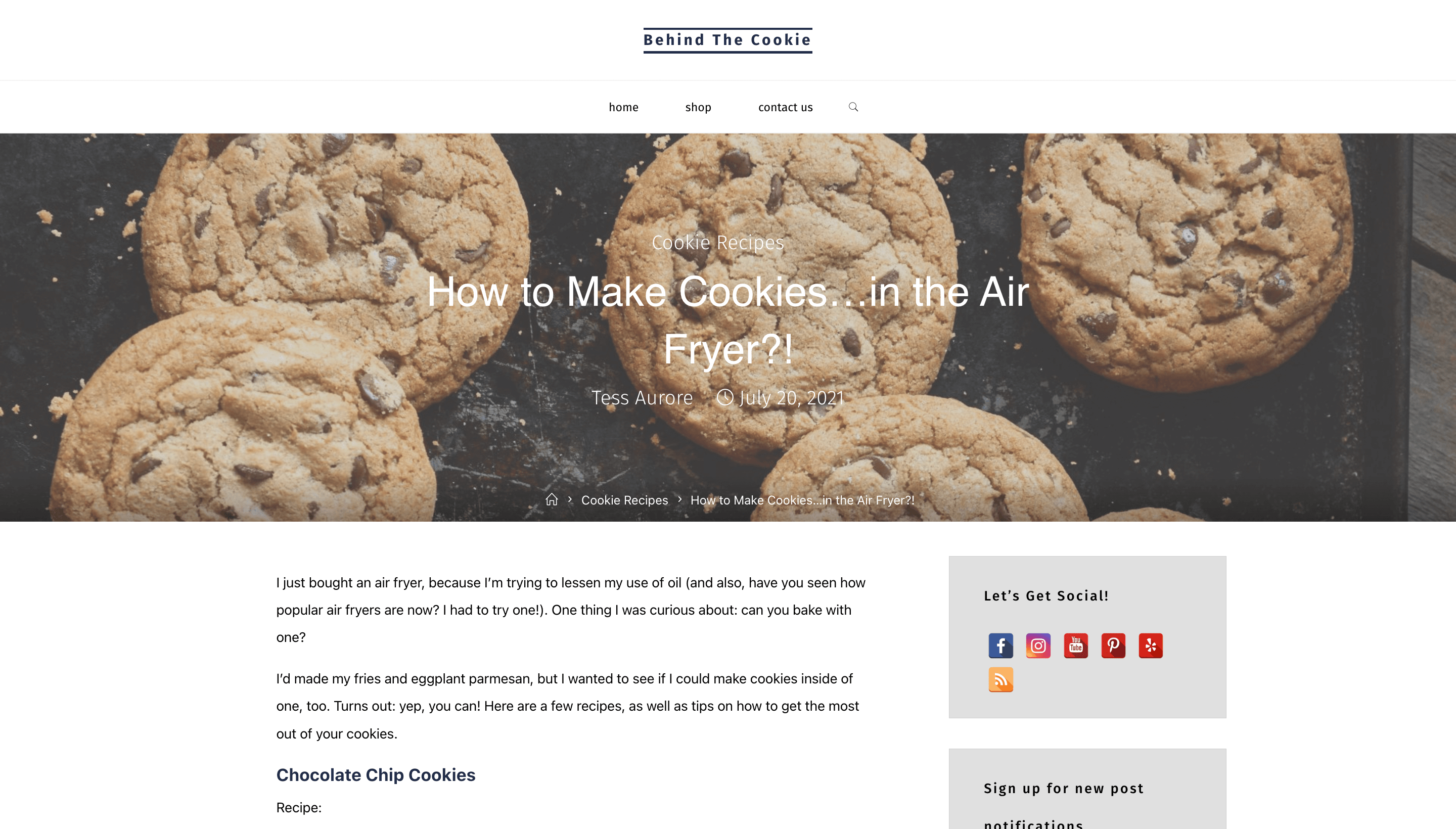
A family-owned business, Pacific Cookie Company keeps it simple by centering their blog around all things cookies. Their articles include posts about the best cookie and coffee pairings, recipes for air-fryer cookies, and other baking topics like making cookies without butter.

A Blog Post from Pacific Cookie Company
Pacific Cookie Company includes baking tips and other cookie related posts on their blog

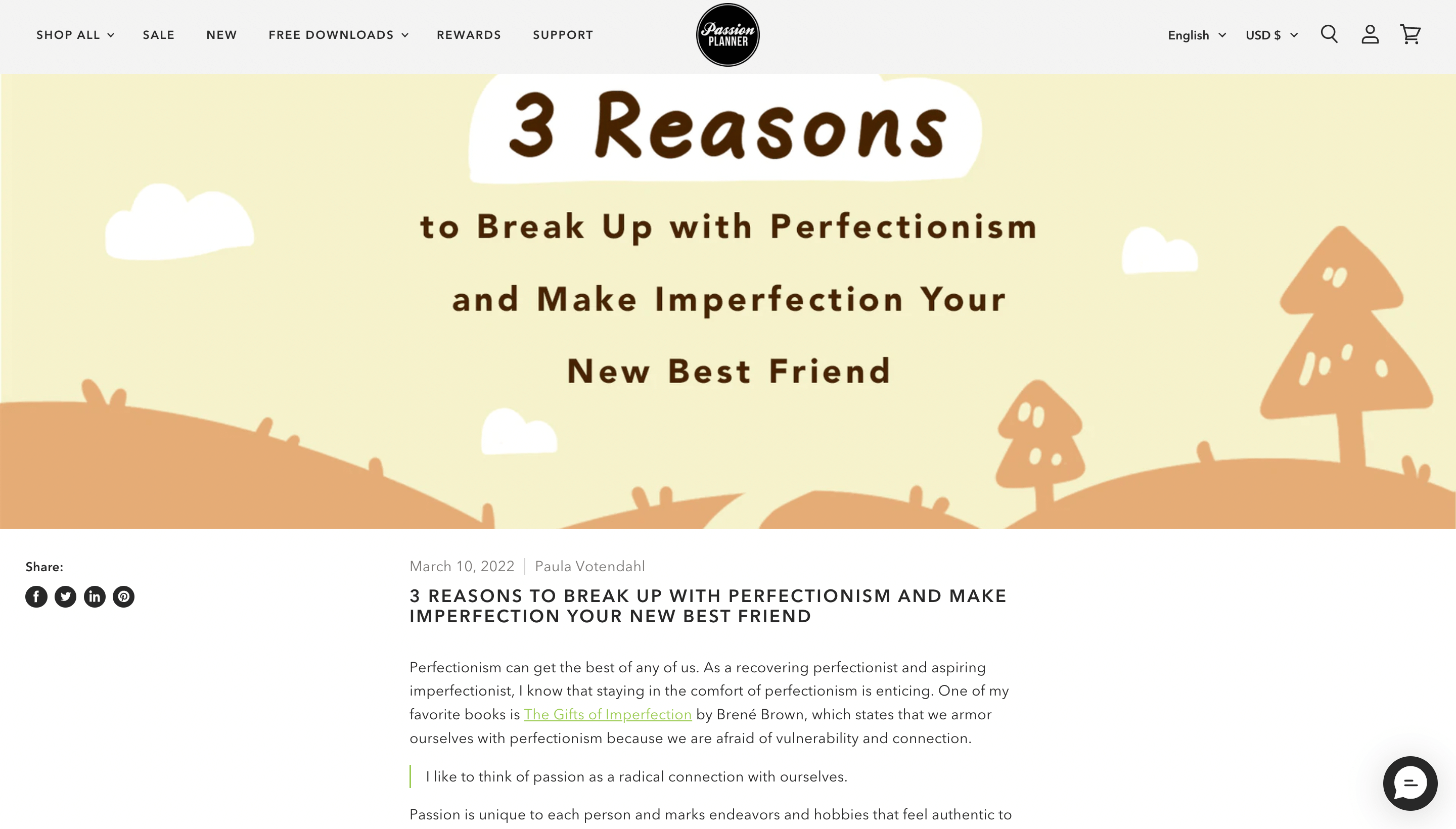
Passion Planner

Along with writing posts revolving around journaling, Passion Planner also blogs about self-care and empathy. These principles directly relate back to their company’s mission statement as part of their business’s goal is centered around helping people fulfil their dreams and feel their best.

A blog post from Passion Planner
Passion Planner also blogs about their core values 

We hope this article gave you insights into how blogging can add all kinds of value to your brand, like connecting with your audience on a deeper level. Once you have your first few posts under your belt, the writing process should become smoother, and running your blog will become a part of your regular routine!

By Umber Bhatti

Sourced from Buffer

By JiJi Ugboma

The About page is one of the most important pages in your blog. When building or running a blog, there is a lot you need to focus on — content creation, design, SEO among other things. In addition to all these, you should also spend considerable time and put sufficient thought into creating an About page for your website. 

When a site visitor navigates to your About page, it means that they have a level of interest in your site and want to know more and you.  With the perfectly crafted About page, you can grab a visitor’s attention and make it easy for your audience, first-time site visitors, and potential sponsors to learn more about your blog and about you. 

Why You Need an About page

Legitimacy

Your About page gives your site legitimacy and it is integral in creating a trustworthy brand. According to Statista, there are about 1.88 Billion websites currently existing – with more being created every minute. Many of these websites are spam websites, automatically populated by bots, and even fraudulent. This is why it is important that you differentiate your website and show that you are a legitimate brand. People want to know that a real person is running a website, and then they want to have a level of trust and familiarity with that person.

Audience Building

Your About page is your chance to speak directly to your audience and bring them into your world. It is not the place to appear mysterious or cagey. You should address your audience directly and write in the first person. Share who you are, what your blog is about, what you’re passionate about, and what they should expect from you when they visit your blog. This will also help differentiate you from the competition. 

Sponsorship Opportunities

When a potential sponsor or advertiser visits your site, the first page they go to is your About page. Think of it as the billboard of your business. Make sure the About page is professional-looking, comprehensive, and showcases your blog in the best light for sponsorship opportunities. 

SEO

When I optimize a site for SEO, one of the first things I look at is the About page. Amongst other factors that contribute to SEO, search engines crawl website About pages to determine the credibility of the website. A properly constructed About page can improve search engine rankings. Secondly, other websites will look at your About page before linking to your site. This is to ensure that they are linking to legitimate sites. So a properly constructed About page can lead you to get quality backlinks. 

What Should Be Included on Your About Page?

Your Mission Statement

Some of the most compelling writing you’ll be doing when you start a blog is crafting a mission statement. It should be a few sentences that succinctly describes the reason your blog exists. To write a good mission statement, think about what your core message is, who you want to reach with that message, and how you want to reach them. This What, Who, How approach will help you easily define your mission and communicate it to the world. It’s also a good place to include the values and guiding principles of the blog. 

About the Founder

In addition to sharing the mission statement of your website or blog, you should devote a good section to sharing information about the founder and owner of the blog. People want to know who’s running a website and this is the place to share that information thoroughly. Share your background, the origin story of why you started the blog, and list your credentials. By sharing the origin story of your blog, you are giving readers a glimpse into what inspires and drives you as you create content for them. It helps them get to know you better and form a connection with your blog. When writing about yourself, be authentic.

Target Audience Definition

As mentioned above, your mission statement should encompass your core audience. You can also take it a step further and expand on this by sharing more about why you have chosen your target audience. Your target audience definition should answer the following questions: Who do you create content for? Who are your key readers? Who do you intend to reach with your message? Your target audience should also be narrowed down to an age range and demographic. Your target age and demographic does not have to be front-facing unless it is crucial to your blog’s messaging.

Social Media Handles

Include links to your social media pages. You can also embed a social media account on the page using several plugin options. Ensure that your social links always open into a new tab. If you have a large following, this is the place to highlight it.

Press Mentions

Have you been featured in a magazine, been a podcast guest, or mentioned in the press? You should put this information on your About page. Sharing the press opportunities you’ve had gives you social proof and shows that you have a significant presence in your industry. 

Media Kit

You can include your media kit directly on the page or as a downloadable PDF. It is important to share information that will grab the attention of sponsorship partners and a media kit is the best way to do that. Your media kit should show your audience demographics, social media stats, reach, and past sponsorship partnerships. Many factors come into play when it comes to including your pricing in your media kit. Unless you are fully sure of your pricing, have done market research, and have been selling sponsorship packages for a while, it’s best to not include your prices. If you are unsure, it’s best to leave it out and instead showcase in other ways the types and tiers of sponsorships you are open to. When you start to talk with a potential sponsor, then you can share your prices.

Author Bios and Team Members

If you have contributing authors, employees, and team members, your About page is the best place to showcase them. Some websites have a large team and they showcase them on a separate page. However, if you have a small team, you should include their names and photos on the About page. Highlight your writers by including their photos, bios, and a description of their role.

Photos

Your About page should showcase a professionally taken photo of yourself. They say a picture is worth a thousand words and that holds in this case. Include photos of the founder, team photos, and any photos or videos that help communicate what you do. Your photos should be professional looking but that doesn’t mean they have to be stiff or boring. Include photos that show your personality or show you in action. For example, if you’re a food blogger, include a photo of you in an apron, in the kitchen, or with one of your creations. 

Contact Information

Some people prefer to have a separate page with your contact information and that is fine. Regardless of if you have a separate contact page or not, you MUST include your contact information on your About page. This is a key factor in making your blog user-friendly and making it easy for potential partners and advertisers to contact you. 

What Makes a Good About page

A good About page should contain just the right amount of information about you, your blog, and your business. It shouldn’t have too much information or too little. Keep the following factors in mind when creating your About page.

Don’t Bury the Lead

It takes only a few seconds to grab the attention and interest of a site visitor. At the top of your About page, you should state in a few clear sentences what your blog is about. When a reader visits, they should be able to tell in a few seconds what your website is about. You can have a long description but these few sentences (which should be your mission statement or your blogging goals) should be at the top of your About page. You can make them bold text, and put them in a unique design that pops out and grabs the reader’s attention. A site visitor shouldn’t be left wondering what your blog is about even after visiting your About page. Make your message succinct, clear, and straight to the point.

Clearly Show Who Runs the Website

Include your name, photo, location, email address, and location on the About page. If you have a registered business, include your business name and registration number, etc. If you have a team, include their names, photos, and bio as well.

Emphasize Key Points

Just as you highlight your site’s mission you should also emphasize the key points about you and your blog. State clearly who you intend to reach with your message, what city are you located, what types of partnerships are you open to etc. These key points should be highlighted and should be easy to find.

Hyperlink and Navigation

The information on the About page should all be one page and make sure the hyperlink is straightforward. Use any of these hyperlink structures

website/ about-us OR about(insert website name) OR about-me OR about-page .com/

Secondly, make sure the About page is easy to navigate to from any page on your website. Include it in the overhead menu right below or above your masthead. You can also include it in your footer menu but it MUST also be in your overhead menu. 

Keywords

Your primary keyword should be directly related to what your website is about. It’s best to choose one or two keywords and place them strategically on the About page. When choosing your keyword, make it as descriptive and niche as possible. Place the keyword within the text and if possible, include it in an H1 or H2 header. Don’t keyword stuff as that will backfire. We recommend using keywords 8-10 times for every 1000 words. Your About page should probably not contain up to 1000 words of the text so use your primary keyword 4-6 times within the page. Also, make sure your mission statement or website goal contains this keyword or a variation of it. For example, if your blog is about homeschooling kids, then your keyword should be something that describes this like “ homeschooling tips for parents” or “homeschooling tips for moms”.

Concluding Tips

As you build and update your About page, keep these important things in mind:

  • Avoid spelling and grammar errors.
  • Make it easy for site visitors to find the information they need.
  • Show them how to interact with your blog. Give them some article suggestions to get started. You can include a “start here” link or include a must-read article.
  • Be personable, interesting, and authentic.
  • Don’t stuff the About page with too much information.
  • Show why you’re different from the competitor.
  • Put the About page in the Header menu and ensure site visitors can navigate to it from any page on the website. 

By JiJi Ugboma

Sourced from BLOGHER

(Reuters) -Twitter Inc faced a sceptical audience as it showcased its advertising opportunities on Wednesday at an event in New York City, three ad agency executives told Reuters, as the social media company’s plans under billionaire Elon Musk remain unclear.

The Tesla chief executive, who is buying Twitter for $44 billion, has tweeted that the platform should not have ads so it can have more control over its content moderation policies.

Twitter has told its employees in internal staff meetings and in public filings that its advertising business and other operations would continue normally until the deal closes, but the company could not speculate on changes Musk might make.

“He’s like the ghost of Christmas future hanging over this whole thing,” said Mark DiMassimo, founder of ad agency DiMassimo Goldstein, referring to Twitter’s presentation to advertisers on Wednesday. “Whatever (Twitter) says, all anyone really wants to know is how this will be in the future.”

The social media company earned $5 billion in revenue in 2021, the majority from selling digital advertising on its website and app.

Most advertisers have not pulled back ad dollars from Twitter, but are watching closely to see how Musk could change the platform and its business, the ad executives said.

“I would like (Twitter) to address and talk to it, because there’s a lot of curiosity,” said Alex Stone, senior vice president of advanced video and agency partnerships at Horizon Media.

Ad agencies and brands mingled at a cavernous event space in NYC before Twitter’s presentation began. One ad buyer said attendees were speculating whether Twitter would joke about the take-private deal with Musk or address the matter more directly.

The buyer didn’t have to await long for an answer.

“It has been a quiet month here at Twitter,” joked JP Maheu, VP of global client solutions at Twitter at the start of the presentation.

The company announced a number of content partnerships tied to the presentation.

Twitter said it was expanding its partnerships with media companies Conde Nast and Essence, which will create video and audio programming on Twitter. E! News will launch a new live-streamed show on Twitter to discuss TV shows such as “The Real Housewives,” and “Stranger Things.”

Advertisers will be able to purchase ad spots that run next to videos from the media companies. The social media platform said it would be the first social partner to test an integration with iSpot, the firm NBCUniversal uses to measure video viewing.

Twitter also announced that Fox Sports will host live pre-game shows on the platform for every match of the FIFA men’s World Cup tournament this year in Qatar and the women’s World Cup event in 2023.

Sarah Personette, Twitter’s chief customer officer, closed the presentation expressing gratitude to the company’s advertisers.

“Your partnership makes us better each and every day. We are exceptionally grateful for how you stand with us,” she said.

At least one marketer left the presentation wanting more.

Jasmine Wang, a media director at Altice USA, said her company pulled back its ad spend from Twitter due to concerns about Musk’s potential impact on the platform.

Wang said she had expected Twitter’s presentation to be longer and more substantial and had hoped it would address possible changes that might come under Musk.

(Reporting by Sheila Dang in Dallas; Editing by Cynthia Osterman, Chris Reese and Tom Hogue)

Feature Image Credit: REUTERS/Carlos BarriaReuters

Sourced from U.S. News

By

Influencer marketing has evolved and so must your approach. Here’s what you need to do to make this powerful approach work as part of your full-funnel marketing strategy.

Like most nascent marketing channels, influencer marketing began as something of a Wild West. Metrics were thorny, processes were clouded, and many brands got burned working with influencer platforms or individual creators who produced scant measurable results.

The upshot is that, even now that influencer marketing has matured into a more structured discipline, some brands remain skeptical of the entire medium.

We are at the point where brands who have struggled to produce and prove value from working with influencers in the past, must consider starting from scratch. That doesn’t don’t mean scrapping your Influencer program, but effectively taking a beat to re-evaluate your approach and reset it.

Build an influencer marketing strategy from the ground up with the same scrutiny you would apply to any other strategy. That means a rigorous brand analysis and quantitative vetting process should drive discovery of potential influencers. While the process of engaging and partnering with or deploying an influencer should be as automated as possible. And, last, measurement should focus on influencers’ ability to drive sales. Influencers who can move the bottom line are the ones brands should redeploy to optimize over time.

Gone are the days when influencer marketing was purely a brand awareness play. In the right hands, influencer is now a full-funnel, full-service discipline, meaning it covers awareness and bottom-of-funnel activations, discovery upfront, and measurement on the back end. Here are three cores to building an influencer marketing strategy from scratch and turning it into a proven revenue generator.

Understand who you are and what you need to accomplish

Brands need to set clear specifications to select the right creators. Brands should ask themselves: What are your values? Which audiences are you trying to reach? What backgrounds would you like your creators to represent? What messages do you need to send to your audience?

Next comes the quantitative decision-making process that has historically eluded the discipline. What are your key performance indicators? What calls to action will you bake into your influencer campaigns? How will you measure success? Beyond numbers of followers (the conventional metric), what engagement rates do you expect influencers to command, and how do those rates line up with sales goals?

Once brands have figured this out, they can select influencers who meet their criteria. Brands should also implement a repeatable process for creating content briefs to set influencers up for success. These, too, can be optimized over time, allowing advertisers to eliminate ambiguities. Now is when cutting-edge influencer practices come in, transforming the discipline into a full-funnel strategy.

Maximize distribution, measure influencer success and optimize

The fatal flaw in most content marketing strategies is that brands focus all their attention on creating great content, and after they have created it, they simply slap it into a blog or repost it to a couple of social channels. The same failure has historically applied to influencer marketing.

But sophisticated practitioners can turn distribution into a source of value. For example, a video created for Instagram might be amplified by paid social, an OTT campaign, digital out-of-home billboards, or programmatic display.

After brands have transformed what could have been a simple influencer Instagram video into an omnichannel campaign, they can leverage cross-channel data to quantify sales driven collaboration. This is a far cry from the old influencer measurement framework in which advertisers would report on the number of eyeballs a campaign reached or how many comments it spurred.

Once brands understand how much revenue individual influencers are driving, they can optimize campaigns, staffing a bench of key collaborators. Over time, by following this model, they can build an “army” of Influencers who deeply understand the brand and can convert their audience, ultimately making things more efficient and seamless. This process of distribution, measurement, and optimization should ultimately equip brands with a well-oiled machine of creators proven to be worth the investment – and then some.

Raise the bar for influencer marketing

It is understandable that many advertisers are wary of influencer marketing. But forward-thinking brands should not let past failures dictate future strategy for a channel that has evolved.

Influencer marketing should be part of a full-funnel strategy. It builds awareness and trust through powerful, authentic content that resonates with consumers on an emotional level. It also drives sales and lends itself to granular measurement, which allows for optimization so that influencer becomes not only more lucrative but also more efficient over time.

The only thing standing between many brands and a revenue-generating Influencer Marketing strategy is outdated assumptions about the channel. By challenging past wisdom and applying the same structure that governs other performance marketing channels to influencers, brands can unlock fresh revenue-generating opportunities.

By

Crystal Duncan is senior vice president, head of partnership marketing, Tinuiti

Sourced from The Drum

By Aarthi Arunkumar

Job searching can be tedious. Use your time wisely by focusing on the best strategies. Follow these tips to simplify your online job search.

Trying to find a new job is not always easy. From preparing resumes to writing cover letters and keeping track of the applications, job hunting can be daunting. The best way to take the stress out of your job search is to streamline the process and be prepared.

With these simple tips, getting hold of your dream job will no longer be a far-fetched dream.

1. Be Mindful of Your Time

Searching for a job online can soon become a full-time job if you are not careful. Set aside a couple of hours to actively search for a job and wisely utilize the rest of the time. You can learn something new, get certified, watch career development Ted Talks, or listen to podcasts on personal growth.

Searching with proper keywords is crucial to finding relevant jobs. If you’re using generic words like Writer or Photographer, you will be wasting a lot of time shuffling through the irrelevant jobs. Instead, use proper keywords like Real Estate Photographer or Marketing Copywriter.

Also, you can save time if you use the filter options in the job search websites. For example, add details like your experience level, preference for on-site or remote working, salary estimate, distance from your home, etc., to narrow your search results.

3. Search Niche Job Websites

You can find most job listings on LinkedIn and Indeed job boards, but you can access specialized jobs on niche websites. For instance, if you’re looking for remote or part-time employment, FlexJobs and We Work Remotely have various opportunities worldwide. For NGO and charity jobs, Idealist can be your best bet.

4. Find Connections on LinkedIn

You know how important LinkedIn is for your career growth. So, make sure you actively find connections and follow them. You can learn about the happenings in the industry and find job opportunities through them. Remember, your new connection can be the ticket to your new job.

Spend a considerable time on LinkedIn to build your network. It is imperative if you’re just starting or trying to switch careers.

5. Tailor Your CV

Are you sending the same resume to different employers? If so, it’s time to change that. Hiring managers expect you to customize your resume for each job you apply for. You don’t have to start from scratch, but make sure to tweak your summary and bring attention to the relevant skills and experience.

Before you apply for a job, follow these steps.

  1. Read the job description from end to end
  2. Think of how you can add value to the job.
  3. List down the appropriate experience and skills.
  4. Edit the summary, skills, and experience sections of your resume.
  5. Apply with your customized resume.

It’s a good idea to keep your resume in a standard format like a Word or PDF document to make the edits quickly. You can make a template and keep it handy, or try a customizable template online. If you’re using an infographic resume, it may be time-consuming to edit, plus you’ll need special software and expertise.

6. Learn More About Your Future Employer

Instead of following the spray and pray strategy, where you apply for several jobs and wait for something to work out, spend time researching and shortlisting the companies you strive to work for. Go to each company’s website and browse the About Us page to learn more about its principles and values. Likewise, check out the Social Media pages and get to know the top management.

Researching about your future employers will also give you pointers to add to your cover letter.

7. Write a Killer Cover Letter

It can be time-consuming to write a cover letter for each job you apply for, but when you write one, it will show the employer that you’re highly interested in the position and took the time to market yourself. In addition, a well-written cover letter will give you an edge over the other applicants by urging the recruiter to look at your application more closely.

When you write a cover letter, it is vital that you don’t just repeat the information in your resume. Instead, your cover letter should have details that are not in your resume. You can also add more elements about a particular skill or experience that is only briefly listed in your resume.

Your cover letter is also a place to explain your career gaps and relevant hobbies. Give your address and contact details clearly at the top of the page. Keep your cover letter short, proofread it many times, and ensure it’s error-free.

8. Follow Up With the Hiring Manager

So you’ve found your perfect job and applied for it. You watch over your inbox like a hawk for days and days, but nothing happens. But before you throw in the towel, it is better to send a gentle reminder to your hiring manager. It will show your hiring manager that you’re seriously interested in the opportunity, and your resume will get closer attention.

You can either call your hiring manager or follow up with an email. Wait for at least two weeks before you do a follow-up, and confirm the application deadline before you do so. Usually, hiring managers will need a few days to shortlist the exciting candidates. Keep it professional, brief, and to the point when writing a follow-up email. You don’t have to repeat your entire cover letter. The same goes for the follow-up call too.

9. Check With Your References

You know how it usually goes: You apply for a job, attend the interview, get the job, and when it comes to reference checks, you scramble to find someone at the last minute. It will save you time and energy if you find at least three references before diving into your job search. It is also wise to call or email them and ask for their permission before doing so.

Your supervisors, managers, and co-workers know you well enough to vouch for your skills, work ethic, and character traits. You can also use your mentors and professors as your reference. However, avoid listing your friends and family members as your reference–it may look unprofessional and hurt your chances of getting the job.

Find the Job You Want

Streamlining your job search with proper planning will make your job search easier and may even help you enjoy the process. You will land your dream job soon enough if you’re confident, prepared, and patient.

By Aarthi Arunkumar

Aarthi Arunkumar is a writer and photographer based in Toronto. Once upon a time, she was a software developer. After trying both corporate and creative jobs, she is now happy to be sitting at the sweet spot between art and technology.

Sourced from MUO

By

Paid search is arguably the most knowledge-rich, mature digital marketing channel. It also moves fast, and can be hard for non-experts to keep track of. For The Drum’s Deep Dive into Digital Advertising, Rebecca Wilkes of performance marketing agency Summit Media looks into four trends for the year ahead and what marketers can do about them.

Paid search is the most mature digital marketing channel. It started back in 1996, with Google AdWords launching in 2000. Since then, we’ve seen the launch of many key initiatives such as product listing ads, seller ratings and expanded text ads.

Right now, paid search is also arguably digital’s most evolving channel. Here are four evolutions to look out for.

1. Changes to responsive search ads as Google focuses on automation

In August 2021, Google announced that automation should be a key focus for marketers, and from June 30 2022 responsive search ads (RSAs) will be the only search ad type that can be created or edited within standard search campaigns. Expanded text ads (ETAs) will no longer be an option for marketers.

RSAs allow marketers to enter multiple headlines and descriptions for ads. Google then uses machine learning (ML) to automatically test different combinations to find the highest-performing ad.

There should be two clear benefits for advertisers using RSAs v ETAs. First, increased engagement from customers due to improved click-through rates; and, second, lower costs due to improved ad copy.

From our testing (albeit at limited volumes), we’ve seen higher click-through rates and lower cost-per-click. You should prepare yourself by ensuring RSAs are in every ad group, and review performance of these ads to ensure they’re of the highest quality in line with Google’s scoring.

2. The start of keyword-less world: Performance Max

After its introduction in November 2021, Google announced that Performance Max will replace Smart Shopping and local campaigns by the end of Q3 2022.

Rather than the usual keyword-based search campaign, Performance Max uses your creative assets alongside business goals and automated bidding, with user signals and data-driven attribution to tailor ads to potential customers across the Google ecosystem (search, display, YouTube, Gmail and Discovery). This goal-based format helps marketers target customers at the right stage of their purchase journey, depending on the goal of the campaign.

Performance Max campaigns will be built from any existing smart shopping and local campaigns. Existing settings will remain, but will be automatically upgraded from July onward. So it’s important to start testing and learning now.

We recommend you create new campaigns and pause any relevant activity (such as Smart Shopping), then start working through the new additional creative assets available. Make sure you’re clear with measures of success – GA4 provides the most detail on performance.

3. The re-introduction of broad match (but not as we know it)

Since 2014, Google has been changing keyword match rules. This always brings unpredictability around budget and performance.

Before, broad match meant that if the search query was contextually similar to the keyword being targeted, your ad could show. This has now had a much-needed overhaul to ensure marketers remain in control of budgets. Modern search is an evolution of broad match and focuses on the meaning of your keyword and the intent behind it; this can include searches that don’t contain the original keyword terms.

Google’s BERT algorithm technology helps interpret queries, language and search intent. It uses this understanding to make keyword matching behaviour more closely aligned. That makes broad matches more relevant.

We’ve seen great results from testing, with incremental traffic and revenue. You should ensure you’re live with automated bidding, as the new broad match needs this to work effectively. Choose campaigns to switch to broad match and run a test (you could start by testing any previous broad match modifier keywords).

Test this on stable campaigns, using robust testing methodologies (such as Google’s built-in testing functions).

4. The removal of third-party cookies and the influence of audience

For years, brands have used cookies to help them target ads to the right audiences. With the removal of third-party cookies, Google is now focusing on the intent of people’s searches rather than audiences, capturing people on the likelihood that they will meet a campaign’s objectives.

Measurement and optimization will be impacted. Review your platform’s initiatives to mitigate this. Understand whether they align with business goals and objectives.

Google recently announced that it will be sunsetting Universal Analytics from July 1 2023. Think about the way you’re tracking to be able to capture and measure effectively moving forward, and what the platform you use is doing to enable continued measurement and reporting.

First-party data also becomes important in targeting an engaged audience. Contextual targeting will again rise to the frontier for display/programmatic activity.

So make sure you’re working closely with your provider and review targeting options for future activity and how to capture your target audience.

The loss of third-party cookies and how to combat this should be a key talking point across all brands to make sure you’re not left behind when the change is made.

By

Sourced from The Drum