The global CEO of AB InBev’s in-house agency draftLine believes the media industry will continue to make a “directional shift” towards attention as a primary trading metric.
AB InBev is “increasingly” moving away from buying media purely on traditional cost-per-thousand impressions (CPM) and towards buying “attentive reach”, according to the global CEO of the alcoholic drinks giant’s in-house agency, draftLine.
Media performance metrics have come under growing scrutiny over recent years, particularly those measuring effectiveness of digital media. With the value of metrics such as shares, opportunity to see and viewability being questioned, some brands are experimenting with ways to measure the level of actual attention consumers pay to their ads across different channels.
In June 2020, AB InBev joined the likes of Mars, Diageo, British Gas and Reckitt on the then-recently launched Attention Council, a confederation of brands, agencies and publishers working to understand how attention can be used as a trading currency for media.
Meanwhile, the price of media has been rising rapidly post-pandemic. Forecasts from the World Federation of Advertisers (WFA) and Ebiquity for 2022 suggest the cost of digital media will inflate by 6.4%, while total offline media will inflate 5.5%. TV is expected to have the highest cost inflation at 9%, while outdoor media’s cost inflation will be 5.7% and radio’s 4.9%.
It’s about getting the reach you need and making sure you’re capturing the right amount of attention.
Tracy Stallard, AB InBev
“The media industry has historically sold itself on CPM and on the idea that an impression is an impression and a reach point is a reach point,” explains draftLine’s Tracy Stallard, speaking to Marketing Week at this year’s Cannes Lions Festival of Creativity.
“Increasingly we’re thinking about attentive reach. How much attention are we really capturing in this moment? Is the individual in a moment when they can actually be open to a new message or a new way of thinking about a brand?”
When looking at the media marketplace from the perspective of attention, there remains some “pricing discrepancy” compared to a pure CPM perspective, she adds.
Passion points
Stallard is also global vice-president of consumer experiences at the company, leading a team which takes a particular focus on how AB InBev’s brands – which include Stella Artois, Corona and Budweiser – use passion points such as sports, hobbies or interests.
“We know that consumers are much more attune to receiving new messages when they’re in something that they’re actively leaning into and that tends to be their passion points. So we’re really looking at using attention as the way we want to transact and buy rather than just a CPM approach,” she says.
While media channels including cinema, magazines, TV and news brands have been particularly vocal in their support of attention as a metric for trading and measuring performance, Stallard says AB InBev hasn’t yet found itself prioritising one channel over another.
“We’re not channel focused, we’re people focused. At the end of the day, we’re trying to make sure we’re reaching people in the right place and the right way,” she says.
“It’s about getting the reach you need and making sure you’re capturing the right amount of attention.”
Stallard adds she is closely watching developments in the attention measurement space, predicting this segment of the industry will continue to grow.
“I do think that will be a directional shift the media industry will be making,” she says.
By improving efficiency and eliminating human error, automation might be the best move for businesses today.
You may think that automation is something that requires an intense technical infrastructure backed by a big budget to boot. But the truth is, even small businesses can use simple automation tools to improve customer success.
Business owners are always looking for ways to streamline processes and make operations more efficient. One way to do this is by using automation tools to manage customer interactions.
What is customer success automation?
Customer success automation is the process of using technology to automate tasks and procedures to accomplish goals related to customer success. This can include everything from customer onboarding and engagement to retention and support.
Automation can help you improve efficiency and accuracy, freeing up time for your team to focus on more strategic tasks. It can also help you improve the customer experience, making it easier and faster to get the help they need. Not to mention you take the element of human error completely off the board.
Every business wants loyal customers, and what better way to get them than to keep them happy and satisfied with fast and efficient service?
Is automation for customer success expensive?
The answer to this question is no–there are many ways to use customer success automation without breaking the bank. In fact, some of the most effective techniques are pretty simple and easy to implement.
You don’t need a software developer to automate some of the processes in your business. With the right tools, you can automate tasks related to customer success easily and inexpensively.
Automate emails and follow-ups.
Instead of spending hours creating and sending emails to individual customers, you can use automated tools that can send emails whenever the time is ripe.
There are a lot of email marketing tools like ActiveCampaign or Mailshake that can send those for you. Just remember that when using email automation, it’s crucial to avoid getting flagged as spam.
Fortunately, most modern email marketing tools let you specify conditions and triggers before firing off automated messages.
Automate outreach from sentiment in your existing online conversations.
A 2022 survey by CompleteCSM revealed that 79 percent of businesses struggled to manage the rising expectations of customers, with response time and “bedside manner” being two of the many challenges affecting the customer experience.
One solution is to set up automated and templated responses to an overall downturn in customer sentiment over a series of conversations. The ability to locate and respond to a situation before it escalates by looking at customer sentiment from your existing systems can give days’ or weeks’ advance warning of a waning customer.
Automate customer re-engagement.
All businesses have cold leads that haven’t responded to interactions–stubbornly refusing to move down the sales funnel.
As a business owner, you’d want to reach out to them. But it would be inefficient to implement a manual approach in doing so.
Having an automated re-engagement strategy for such situations can help you reactivate cold leads and reduce churn rate. A typical strategy is to send an automated re-engagement email after a specific number of days have passed since their previous interaction. Again, this can be easily accomplished with the right email marketing tool.
Create self-onboarding experiences.
The simplest automation strategy for customer success is to automate the onboarding experience.
Greet new users with links to important resources and free downloadables. For SaaS companies, engineer a self-paced learning process via in-app tours or tutorial videos.
Remember, customer success is your success. By improving efficiency and eliminating human error, automation might be the best move for businesses in today’s age.
Feature Image Credit: Getty Images
By Kelly Richardson
Co-founder of Infobrandz. She likes to help people build businesses through visual communication and her influential blogs.
Are you happy with the number of leads your marketing campaigns are generating? Or, do you wish they were a bit more effective?
If you’re serious about growing your business—whether it’s a B2B company, an e-commerce store, or a startup—increasing the number of leads should be a top priority. Setting up online campaigns is a good start, but it’s not enough. You need to optimize those marketing campaigns to squeeze every last lead from your funnel.
Are you ready to get to work? Here are seven strategies to generate leads like never before.
Why Are Leads so Crucial to Business Growth?
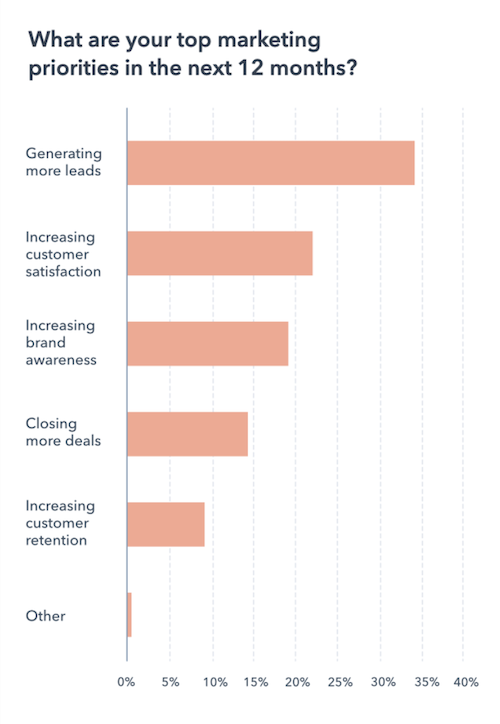
Two of marketers’ top priorities are generating leads and converting those leads to customers. Only increasing customer satisfaction comes close to the importance of getting new leads.
A bar graph of the top marketing priorities in the next 12 months.
It’s no surprise that lead generation is a top priority. Without a continuous flow of new leads, sales dry up. Without sales, there’s no revenue. And without revenue, your business folds.
What’s more, most people who land on your site won’t purchase right away. You need to constantly collect leads so you can nurture them and convert them into buyers in the future.
Not just any leads will do, however. Referrals, conferences, and cold calling are all great lead generation strategies, but they aren’t enough. You also need to learn how to generate more leads from your online campaigns.
Why are advertising leads better? Using targeting you can gather better leads faster and even automate parts of the process. How do you make sure your ads are driving quality leads?
How to Generate Leads Online: 7 Strategies to Drive More Leads
If you aren’t sure how to create a lead generation campaign, I have previous articles to walk you through the process. What I’m going to do is show you how to generate leads online by improving your existing ad campaigns.
Optimize Your Landing Page
Your landing page (or squeeze page) is one of the most important elements of your online lead generation campaign. The goal is to leave the visitor with no choice but to hand over information in exchange for something valuable.
Landing pages convert better than most other ads or offers. The average conversion rate is 2.35 percent, but some have conversion rates in excess of 10 percent. If your landing page’s conversion rate isn’t pushing double digits, you should look to optimize one or more elements ASAP.
I recommend looking at your page’s copy, including its headline, first. Make sure your copy is short, sharp, and engaging. Users need to understand exactly what your product is and how it helps them within a few seconds of landing on your site. Make sure you focus on the benefits of your product to the user, not its features.
Spend more time tweaking and testing your headline than anything else. This will be the first thing a user reads and one of the biggest deciding factors in whether they continue browsing the rest of the page.
You can speed up a user’s understanding of your product by including a video on your landing page. A good chunk of your audience would rather watch a video than read your copy, which is why 76 percent of sales teams say video is key to securing more deals.
Finally, remove all distractions from your page. The layout should be as simple as possible and there’s no need for a navigation bar or links to any other pages on your site. This leaves the user with two options: close their browser window or sign up.
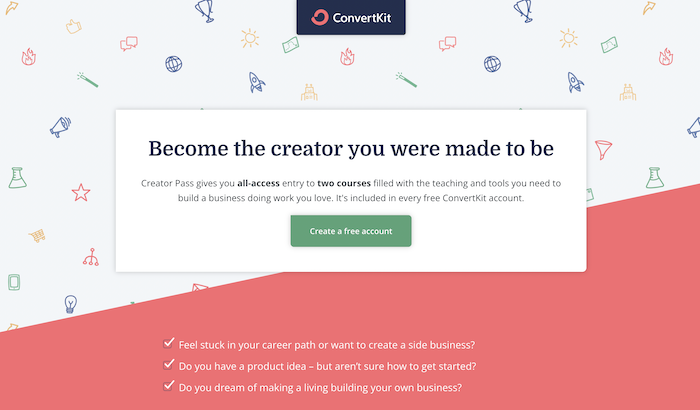
ConvertKit’s Creator Pass is a fantastic example of how to create a great landing page. There’s no headline navigation, the headline copy offers a clear benefit, and there’s an enticing call to action right in front of you.
Generate more leads by optimizing your landing page.
Offer Real Value
Arguably the most important part of your landing page isn’t the copy, image, or CTA. It’s the piece of content, tool, or resource you offer in return for each lead’s email address.
For most brands, gated content takes the form of a PDF download, something like an ebook or a whitepaper. But it doesn’t have to be. Case studies, surveys, webinars and video series are all excellent types of gated content.
Whatever form your gated content takes, it must deliver tremendous value. Otherwise leads will leave your funnel as quickly as they entered. How do you deliver value? By solving a problem your leads have. What are their pain points? Where do they get stuck? What expertise can you leverage to make their lives a little bit easier?
Delivering value also means presenting gated content in the best way possible. Make it visually appealing, with images, videos, and other forms of multimedia content. The nicer it is for your leads to consume, the more they’ll engage with it.
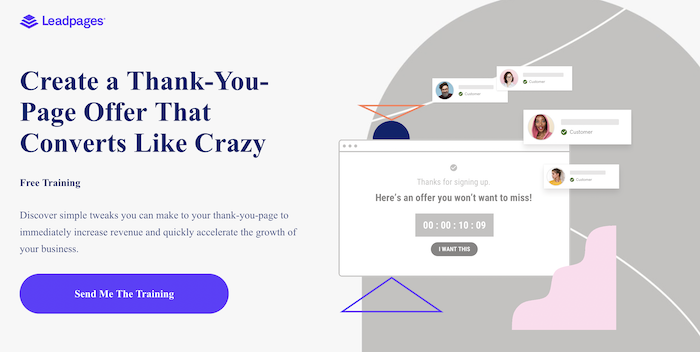
Here’s an example of a non-ebook lead magnet from Leadpages:
Generate more leads by offering real value to the consumer.
They know their leads often struggle to create high converting pages, so they created a training course to solve that issue.
Use Automation to Nurture Leads
Collecting leads is just the first step of the process; you also need to nurture them. Only two percent of sales are made at first contact, yet most salespeople give up after the first attempt. If you automate the follow-up process, you don’t have to worry about a thing.
I recommend using email to nurture when possible. It is a great way to drip feed messages to your leads, it also generates massive ROI. According to research by the Direct Marketing Association, the ROI of email marketing is £42 for every £1 spent.
If you don’t have an email automation platform yet, check out my review of the best solutions. Then integrate your landing page’s form so every email is automatically added to your mailing list.
Next, create an automated series of emails that is sent out at regular intervals. Your goal is to take leads through each stage of the buying process—and that means providing them with the right educational content at the right time. Start by educating them about your wider industry and their general problems. A couple of emails later, you can start to focus on your product and service and how you can help.
The more emails you send, the more you can make your product the hero of the email, and the more direct you can be with the lead.
Use Chatbots to Turn Conversations Into High-Quality Leads
Your salespeople aren’t the only ones who can nurture leads. Chatbots can automate almost every part of the lead generation process. They’re incredibly effective at it, too. Over half of businesses that use AI-powered chatbots generate better quality leads.
Start by replacing forms on your landing page with a chat bot. Forms can be long-winded and rarely offer a great user experience. Chatbots make it easier for prospects to fill out their details. In some cases, users may not even be aware they’re filling out a lead form.
You can also use chatbots to respond to leads at lightning speed. Response time matters in lead generation. A study by Harvard Business Review shows businesses that respond to leads in under five minutes are 100 times more likely to convert them. With chatbots, you can automate the response process and send a message as soon as a lead fills out a form.
Finally, use chatbots to nurture and qualify leads. Chatbots can ask the same qualifying question as your salespeople to separate the wheat from the chaff. The best can be sent directly to sales, while everyone else is added to a nurturing sequence.
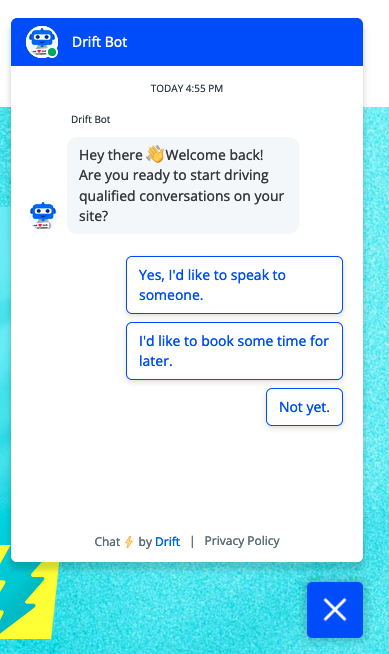
Drift’s chatbot is an excellent example of this. It asks a qualifying question as soon as someone lands on the site, putting them straight through to a sales rep if they’re ready.
Generate more leads by utilizing chat bots.
Use Multi-Platform Campaigns
How many platforms are you using to advertise your landing page and gated content? You probably aren’t using enough.
Today’s customer journey is long. Most don’t convert to customers the first time they land on your site. The majority probably won’t sign up on your landing page, either. A recent Google study found it takes between 20 and 500 touchpoints to become a customer.
The solution is a multi-touch campaign, where your message is delivered in multiple formats across multiple channels.
Advertising on a range of channels maximizes the chances that potential customers will see and click your ad. It’s a numbers game at the end of the day. The more shots you take, the more chances you have to score.
Leverage Personalization
If you want an easy way to increase conversion rates at every stage of your online lead generation campaign, try personalization. In a survey of B2B sales and marketing professionals, over three-quarters (77 percent) said personalization made for better customer relationships, and over half (55 percent) said personalization led to higher sales conversions.
How can you add personalization into your funnels to generate leads?
Start by personalizing your ads. While Apple may have made creating hyper-personalized ads a lot harder, Google still makes it relatively easy to personalize paid search ads with dynamic ads.
Next, personalize your landing page, particularly the call to action. Research shows personalized CTAs achieve 202 percent better conversions. Marketing tools like HubSpot and Unbounce can help you create dynamic CTAs that change depending on who views them. But you could also go old school and create several different versions of your page for each ad group and personalize the copy accordingly.
Finally, build personalization into your email automation tool. Every major email marketing tool makes it easy to automatically insert the recipient’s name into the subject line and body copy, so there’s absolutely no excuse not to personalize your nurturing emails.
Target Your Ads Carefully
There’s no point wasting resources nurturing leads who will never buy your product. That’s why you need to target your lead generation ads carefully.
I will say it’s important not to be too hasty when judging the performance of your landing page ads. When pruning and optimizing ad campaigns, don’t just judge performance based on how many people they send to your landing page that sign up. That’s a good measure, but it’s not as important as how many people actually convert into customers.
Think about it. One ad campaign could have a ridiculously high signup conversion rate of 20 percent. But if only a tiny fraction of those people make a purchase, it’s not a particularly effective ad. An ad campaign with a much lower signup conversion rate could be far more effective at generating high-quality leads.
Of course, this means you’re going to have to wait longer to collect relevant data. But the end result should be a much more targeted and effective ad campaign.
The best way to target ads effectively? Target keywords with higher buyer intent. These are search terms that indicate the user is closer to conversion.
Frequently Asked Questions About Generating More Leads
How do you build a lead generation campaign?
Start by having an objective and defining your target audience. Create a valuable piece of gated content and drive traffic to it using paid ads. Collect emails and then use email to nurture those leads.
What is an example of a lead generation marketing campaign?
A gated whitepaper is an example of a lead generation marketing campaign. Webinars can also be used as a lead generation marketing campaign to acquire leads and nurture them using video
How do I optimize my lead generation campaign?
There are several strategies to optimize lead generation campaigns. Improve your landing page copy, put your emails on autopilot, use chatbots to speed up response time, and personalize messaging.
Where should I advertise for my lead gen campaign?
Social media platforms are one of the most cost-effective places to advertise your lead generation campaign. But the important thing is to advertise wherever your target audience hangs out online.
Conclusion: Generate More Leads to Improve Marketing ROI
Improving your online marketing campaigns and optimizing how you generate leads are the keys to growing your business. But you don’t have to use all of the strategies I’ve listed all at once.
Optimizing your campaigns should be an ongoing endeavour, so pick one or two of these strategies to implement at a time. Pretty soon you’ll send your ROI skyrocketing.
Brands have been experimenting with branded entertainment for decades, but few have managed to cut through and become long-running international hits. That’s until Lego Masters came along and rewrote the rule book. Lucas Green, global head of content operations at international distributor Banijay, tells brands how they can replicate its success.
Lego Masters is the holy grail of branded entertainment. The show, which is jointly owned by production outfit Tuesday’s Child, and The Lego Group, represented by Banijay, was first released in 2017 on Channel 4. It has gone on to spawn 18 international adaptations and is in its third season in a primetime slot on Fox hosted by the actor Will Arnett.
“[Lego Masters] has spread all over the world and taken on a new life of its own – in quite a short space of time it’s become a global hit,” Green says.
The format originated with UK producers Tuesday’s Child, which pitched it to the toymakers. Green says Lego is inundated with requests, but the format convinced it that it would be executed in the right way and in line with its brand values.
“If you are going to do a show about competitive brick-making there is only one market leader in that space – it’s Lego, there is no question about which brand you want to be associated with,” Green says.
A tricky aspect of executing brand-related content is negotiating the various territory-specific sponsorship regulations that prohibit the number of direct brand references or logos. In the case of Lego Masters, the producers couldn’t show any Lego sets that were on sale. To overcome this, Green says any show should be a “reaffirmation of your brand values.”
“All the creative beats of the show, the tone of the show and the sense of humour and playfulness,” it’s all Lego, he says. “It’s about driving home those core principles of Lego, even if it’s not just a matter of how many seconds you can get a Lego on the screen.”
Green reminds brands and agencies executing branded content not to forget the storytelling. “That is what helps create that long-form programming beyond an advertising campaign.” In the case of Lego that’s creating epic builds, jeopardy and human stories, he says.
“Don’t underestimate the decades of experience TV format producers have learned about building a story – it’s about the narrative, how you sustain an audience, how you get them to binge-watch your show and how to integrate your brand,” Green advises.
In terms of the editorial process, Green says it involves the producers of the show in collaboration with Lego. “Without Lego’s involvement it wouldn’t be possible,” he says. “It’s a perfect example of how producers and brands can work together.”
When it comes to data, act more like Disney, software provider Treasure Data tells automobile dealers.
Dealers want the data they collect to benefit their stores, but Andrew Shaffer, automotive industry principal of software provider Treasure Data, Mountain View, CA, suggests dealers consider how that data benefits their customers.
Disney does that, Shaffer reminds attendees at Automotive Retail 2022, presented by Reuters in Las Vegas.
“They know when you’ve been to their resort three times, five times,” he says. “We are bringing a platform to the (automotive) marketplace that’s really going to help brands create more relevant experience, ultimately help them drive better segmentation.”
Treasure Data partnered with San Francisco-based marketing and data management company Acxiom’s Real Identity to assist dealerships and OEMs in identifying, acquiring and retaining customers through cookieless technologies.
“We feel we’re bringing this brand to the marketplace that’s really going to help create a more relevant experience, ultimately help them drive better segmentation,” says John Campos, industry managing director-automotive for Acxiom. And as the December deadline for the FTC’s Safeguard Rule inches close, both speakers note their companies are dedicated to reducing clients’ risks in regulatory compliance.
Successful dealers find streamlined data systems are vital to target their marketing correctly, says Campos. That isn’t easy to achieve when considering trends in the metaverse that will soon include all forms of digital marketing. The question is how to track and engage customers across all channels.
“The Acxiom side of the equation is data and identity. And the Treasury data side of the equation is a platform to help you automate that customer experience,” Campos says. “(We combine efforts to provide) a single environment where you’re able to unify all your first-party data. ‘How did the customer engage on my website, my emails? In the future, it will be digital retailing. And we’re bringing all of that together in one environment.”
The new program streamlines data delivery and analysis and allows clients to optimize it.
“That’s where you can find out ‘Am I spending my marketing budget in the right place?’” Campos says. “And customers want you to know and remember who they are. And ultimately, the best customers are going to leverage their data to truly drive the most growth pre-and post-sale and deliver a truly personalized customer experience.”
The more efficient a dealership’s marketing and customer interactions, the more likely revenue and customer retention will grow, Campos says.
One stumbling block dealers face is how to keep their brand messages on target throughout the different channels.
“We help you drive more building-specific campaigns to get people (to your) the dealership by finding what’s important to them,” says Shaffer. “(You can) offer them a very unique opportunity, a very unique incentive to come into the dealership and drive greater service.”
It’s every entrepreneur’s dream to walk away from their business with the biggest payday of their life.
“It’s important to learn from your mistakes, but it is BETTER to learn from other people’s mistakes, and it is BEST to learn from other people’s successes. It accelerates your own success.
– Jim Rohn
Truer words have never been spoken… especially when it comes to preparing your business for a successful and profitable exit.
And isn’t that every entrepreneur’s dream? To walk away from your business with the biggest payday of your life?
My friend Joey Osborne built the Mosquito Authority franchise over a 15-year period and recently had an eight-figure payday after being acquired by a private equity firm but he says:
“What you don’t know can really hurt you.”
He lost his first 7 figure deal because he didn’t have the knowledge & tools he needed. When he finally understood the process, he positioned himself to get an 8-figure deal upfront and an even larger payday down the road in what’s known in the industry as “the second bite of the apple.”
What is “the second bite of the apple?”
The private equity firm brings in professional management, helps the business grow, does more acquisitions, and at some point will sell the bigger business.
At that point, Joey will get paid again.
I’ve sold 5 businesses over the last 20 years and NOT having the information & tools that I’m about to share with you cost me over $2,000,0000 in cash, not to mention the time and effort I wasted. In Joey’s case, he would have saved $100,000’s in wasted effort, and put another $3,000,000 in his pocket.
Joey says that knowing what your business is worth is just the 1st step in selling it. The hardest part is getting your business ready to sell in order to get its best value.
You don’t know – what you don’t know.
I spent three days with Joey talking about what it takes to get acquired by a big PE firm as he did. Together we outlined “The 5 Steps to Be Acquired By Private Equity” that any founder can model.
The 5 Steps to Be Acquired By Private Equity:
Is the Juice Worth the Squeeze? (Do you and your team have the right mindset?)
Have you considered what your life will be like after you sell?
Is your spouse/partner on the same page?
Have you considered your employees and maintained confidentiality? Your employee’s first instinct will be – “How does this affect me? The buyer will want to know the employees are staying.
Are you willing to take on another full-time job? (Selling to a private equity firm is like having a second full-time job until it closes.)
Are you willing to spend six figures getting the right due diligence?
Are you prepared to work hard and fast? (Keeping in mind “Time Kills Deals.”)
Sizzle or Steak? (How’s your branding?)
Have you taken an honest look at your branding and how you appear to the public in the last six months? (The aesthetic appeal and appearance of your business matters. Does your business look like a $10mm company or does it have a $200 website?)
Do you have a branding guide or checklist? (Every business needs one.)
How are you positioned against your competitors?
Is your messaging and marketing working?
Do you and your business have a good origin story or “Big Why?” (Is it easy to tell and remember?)
Warts and All (Credibility and the Believability) FYI: Private Equity buyers do NOT want you or your company to be perfect.
They are looking for little things they can fix. They see those issues as being “Multipliers” – that they can profit from with their own unique skill sets and resources.
Part of their profit plans includes finding your company’s “warts” so they can fix them and leverage the improvements to increase their profits. Warts are good!
Are there skeletons in your closet the buyer needs to know about that could kill the deal or make a turnaround or 2nd sale impossible? You want to disclose them BEFORE they find them – because they will find them. It pays to be honest upfront, every business has negatives. Being honest increases trust with the buyer.
Good Guts (The People / Processes / Financials / Management)
Are your books in order? If not, are you willing to get them fixed?
How frequently do you audit your books? (I learned – if your books are audited every quarter, you can close a deal in 30 days.)
Have you fully documented the processes (SOPs Standard Operating Procedures) of your business? The Private Equity firm is looking for ways to cut costs, improve efficiencies, and leverage assets. Your documentation not only gives them a track to run on when they take over – more importantly, it gives them clues on improving your efficiencies.
Do you have written agreements with key suppliers / distributors / dealers / etc.?
Do you have the right management and support team in place now? (This is BIG)
If not – are you willing to start hiring the right people?
The Buyer (Absolute MUSTs when you start talking to a buyer, plus the 2nd Bite of the Apple)
The buyer has to be friendly.
You have to like them, trust them, and feel good about them
Ideally, they are willing to be flexible with the buyout structure – to fit both your needs.
Working with your buyer is a serious relationship – just like a marriage. Especially if you stay on in any fashion, or if there’s a “claw back” option for the buyer to take back some of the money.
They are intelligent and interested in making money – but not greedy. (2nd bite of apple incentive)
They need to give you a clear timeline and you need to understand them.
Being acquired by an equity firm is a lot of work but it’s well worth it. I’ve had five exits but no “2nd bites” like Joey. That’s simply because I wasn’t aware that this was an option and lacked the sophistication or opportunity to make it happen.
Joey Osborne has created a Shark Tank Matchmaking system for founders and Private Equity that leads to a highly profitable exit. If you want to sell your business, Joey is your guy. Don’t leave millions on the table! Learn from our mistakes, so you can maximize your opportunity. You and your family deserve it! Watch the whole interview HERE.
The program includes guides to advertising on TikTok
TikTok is rolling out a new program aimed at bringing more small and medium-sized businesses to the platform.
The six-week program, called “Follow Me,” includes step-by-step guides teaching businesses how to use TikTok to grow their companies — including how to advertise on the app. The courses are free to enrol in and will include lessons on running campaigns on TikTok and tips from businesses using the platform.
Virtually unknown businesses or products going viral is one of the hallmarks of TikTok, where a visit to a restaurant and a video of a kitchen sponge have the same chance of being seen by millions. Many small business owners have turned to TikTok to promote their companies, and individual customers have in turn built enormous platforms themselves through product reviews, recommendations, and tutorials. TikTok’s new courses could onboard more businesses chasing viral success and turn them into advertisers.
In the past few months, TikTok has introduced more ways for creators to make money via advertising on the platform. In May, the company said it would begin sharing ad revenue with some creators, who would get 50 percent when ads run alongside top-performing videos. Shortly after, TikTok announced Branded Mission, a feature that allows advertisers to solicit videos from creators — who essentially make content on spec — with selected posts being used as ads.
TikTok’s revenue last year was nearly $4 billion and came largely from ads, according to Bloomberg. And it’s projected to grow this year as the company continues building up its advertising apparatus in hopes of competing with Google and Meta, which dominate digital advertising.
Feature Image Credit: Illustration by Alex Castro / The Verge
As augmented reality (AR) progresses and technology continues to evolve, Tommy co-founder and chief growth officer Marcus Foley considers how it can be used in new industries.
AR has moved into the mainstream. For some age groups, it’s phenomenally familiar already. It’s still an exciting and fast-moving growth area for the marketing industry, developing at pace. The global AR market is expected to expand with a 40%+ compound annual growth rate in the next six to eight years. It’s allowing brands to create experiences that only a few years ago we couldn’t imagine delivering on a phone to a waiting crowd of millions (or billions – 3.5 billion users globally, as it stands). Even fewer than this many people would be confident enough to pick it up, play, share and create with it. Now we’re delivering hundreds every few months.
Tommy predicts where the evolution of AR will take the advertising industry / Lucrezia Carnelos via Unsplash
At Tommy, we spend a lot of time designing, making and geeking out over AR experiences. This is partly driven by being an official partner for TikTok, and working with a considerable number of household name entertainment brands. AR can be a brilliant tool for famous characters and their fans, and we’ll come on to that, but it is also becoming increasingly important for the retail sector – 71% of shoppers recently reported they would shop with a retailer more often if it offered AR.
Why is AR so attractive to shoppers? For the relevant brands, it’s the ease and speed of product trial, which can be mind-blowing these days. Want to try a new hair color? Click, it’s done. You like it? Click, it’s in your basket. Want to see that new sofa, in your chosen fabric, in your lounge? Click, it’s done. It might save two or three trips to the showroom. What has changed is that it’s become easier to deliver on devices without the need for apps, it’s much easier to use and it’s far more convincing, which has opened up the market. This is without talking about the myriad of fashion brands that have tested, trialled or permanently used AR in their purchase journey. Trying on, personalizing, seeing things in your context – these all de-risk the purchase and give customers the confidence to buy.
What else is pushing AR into familiar spaces and sometimes unexpected hands? Social media, of course. What’s interesting about AR in these spaces is that it has become a part of turning the traditional model of influence on its head. In social media, AR is helping everyday people (not brands or celebrities) to tell more immersive, richer stories with unlimited creative possibilities – without a budget or a studio – from their own special effects lab. Where once the technology barriers and costs kept this as a domain for the few, it’s now in the hands of a huge volume of people. With so many individuals and ideas with such powerful tools, it takes storytelling and share ability to a whole new level.
The younger generations are often the instigator, but all generations are being exposed to AR through their peers, friends and family. It might be in photos and videos using lenses, a shared moment playing a game at a family event, or a website where a convenient trial moment is embedded into the customer journey. If you ask them, ‘Do you use AR?’, they would probably say no, but they are part of a growing number of people who are starting to see the blend of digital and physical imagery as being ‘normal.’ Of course, it’s not just Josephine Bloggs putting bunny ears on Granny – it’s also the creators and brands that are intentionally building an audience that is driving expectation and desire for AR too.
So what about them? For one, the entertainment industry loves AR, and albeit from our slightly biased perspective, is doing some amazing work to bring their IP to people in immersive moments that were previously impossible. Combining novel experiences with getting a fan closer to their favourite characters – in many cases appearing as their favourite foe or hero – can go a long way to encourage people to try, create and share. The noise from each major release ripples through feeds and, once again, AR becomes less novelty and more expected. Those who don’t have it become the odd ones out.
AR is no longer a novelty – and the expectation and desire for it is growing. What does this mean for marketers? It means that it’s time to start having a serious think about AR, and to identify if it works for your product and target market. This is not to advocate for the use of technology where it doesn’t fit, but to encourage you to explore, and at least understand, how your customers are using these tools to engage with people, products and places. It’s great fun, and its capacity to inspire and connect people with pure entertainment moments shouldn’t be overlooked. However, it’s more than that – it’s a shift in the way we experience brand and product that is here to stay.
Take these steps to break free from the SEO-chase game
When it comes to understanding the importance of search engine optimization (SEO) to a business the pendulum swings from “ignore it completely” to “understand and chase every Google update”.
The truth, as usual, lies somewhere in the middle. Certainly a website that is structurally flawed, slow to load and fails to display properly on mobile devices is losing an important chunk of online business. Similarly, a website that is search engine optimized to the gills but then fails to understand what those who find it actually want to do once they are there, is winning only one half of the online marketing game.
How to reconcile these two approaches requires a nuanced understanding of what SEO does and what a business exists for. Stripped of all its esoteric mumbo-jumbo SEO is there to help a business find its audience at the moment that audience is actively looking for it. A business, in turn, exists to solve a problem.
From this perspective search itself, for all its many iterations through Google updates over the years, has always been focused on delivering the best relevant results in response to a searcher query. Search becomes the bridging point between a business and its audience. This, logically, means that search is marketing. But that’s not all it is.
Human Behaviour Determines Search Use
The biggest threat to your business losing that bridging connection between itself and its audience lies in factors that are far outside the remit of search itself and, by association, any SEO activity you may engage in. Following the 2018 EU $5 billion antitrust enforcement against Android, Google is now making the placement of default search engine choices on its mobile devices free to competitors.
The majority of mobile device owners are not search experts. They don’t truly understand how search engines work which means qualified choices are based on purely subjective criteria. On that basis even at a conservative estimate, Google mobile search will experience a reduction in usage. The warning bells rang as far back as 2015 when it was flagged just how few mobile devices actually use Google search.
Back then Google search was dominant on mobile devices as it was the default setting that few mobile device owners bothered to change. In the years since Google has had to change that policy and the impact of that has not yet become obvious. In addition, mobile device owners use apps and social media accounts in lieu of a search engine to find what they need. Social media accounts connect them with friends and enable them to ask for recommendations while specific apps make it easier for them to engage in search behaviour.
How To “Search Proof” Your Business
The reason we are even talking about search engine optimization (SEO) right now is because, initially, as the web grew finding anything at all in it required the help of a search engine whose crawlers had indexed websites and organized the information they contained.
The web however, no matter how global in size, always has the most direct impact at a local level. The personal devices we use are geolocated and, increasingly, so are our laptops. This makes searching for something location-determined. The recommendations of friends and the ability of apps to know where we are at and use that knowledge to provide useful information make search the means through which we find solutions to problems we experience locally.
Google rose to prominence because of the quality of its results. Search results that are delivered within the tight boundaries of a location always have the potential to be higher in quality because the two bugbears of search: disambiguation and veracity can be resolved that much faster when the information from which a pool of answers, to a search query, is drawn, is limited by nature.
The limitation imposed by geographic boundaries reduces the level of ambiguity that is created by massive amounts of information that is similar in nature but does not amount to the same thing. It also makes it easier to filter what is real from what is fake. The context of local search then makes it easy to come up with a formula that helps “search proof” your business.
Whatever happens to search next, whatever fresh updates occur in Google’s algorithm or whatever app, recommendation engine or even human-word-of-mouth channel is used they all require the same two key ingredients to work:
Experience – A taste of what your business does, how it does it and why it does it.
Confidence – A sense that your business is capable of totally solving the problem the searcher is facing, easily, quickly and at level that is good value-for-money.
Find ways to make this come through the content you create. Truly connect with those who come to you to find the solution they need to the problem they experience and you will find that fretting over SEO will be a thing of the past for you.
There’s no doubt that we are seeing a surge in digital business and digital marketing needs from businesses that are not necessarily operating online. This is especially true when potential clients are millennials and Gen-Zers, as they are likely connected to social apps and digital environments in greater numbers than their older peers.
So, how can you successfully take advantage of the trend of digital marketing? Let’s have a look at what it takes to succeed as a digital marketing entrepreneur. To succeed, you should pay attention to the following aspects of digital marketing.
• SEO.
• Social media presence.
• Pay-per-click (PPC).
• Email marketing.
• Google-friendly website.
As a digital marketing business owner of over two decades, I have a lot of experience to lean on in these respects. Let me take you through each of these important channels to help bring you up to speed on the basics of digital marketing entrepreneurship.
SEO
Search engine optimization (SEO) is one of the best free tools you can use in digital marketing. SEO can help you drive organic traffic to your websites, create more leads and generate new clients. What you need to know about SEO in 2022 is that it is becoming more and more competitive.
Thousands of websites are optimized for Google’s PageRank algorithm to appear as high up on the search results list as possible. Many companies are targeting the same words, creating a tougher environment for ranking your content at the top. So, use online keyword research tools to research keywords you can target that have a low difficulty. Basically, you should look for keywords that don’t have so much coverage.
You can also use online tools to help monitor the traffic your site receives and to find keywords and topics that you can target. There are many tools you can pay to use, or you can use Google Analytics, which offers a free version.
Social Media Presence
Social media is also a very valuable tool and will likely become more central to any digital marketing business as time goes by. Data from Statista shows that there are 3.78 billion social network users globally, and the largest social media ad market is in the United States.
Having a strong social media presence is, therefore, a must to help grow your digital marketing business while keeping in touch with customers and building customer loyalty. Social media can help you create brand awareness and give your customers a better overall experience.
This digital marketing tool has the following advantages for your clients and leads.
• Quick interactions for feedback and answers to questions.
• Easy access to your brand’s services and products.
• Social engagements with your business brand.
Pay-Per-Click (PPC)
PPC digital marketing allows you to get your brand, services and products at the top of Google’s search page with the use of paid ads. Every time a user clicks on your ad, they are redirected to your page, and you are charged a fee.
Using a PPC marketing tool allows you to grow brand awareness and attract new leads. PPC marketing tools allow you to track the performance of your ads. This allows you to calculate your return on investment, as you can see how many clicks turn into sales.
These tools also allow you to choose which geographic location you want your ads to appear in, what time of the day they’ll appear and the amount of cash you wish to spend for a given period.
Email Marketing
Email marketing is another important part of any digital marketing campaign. It may not bring the wide impact social media can create, but it is still an important tool. You can use email campaigns to create brand awareness, nurture leads and connect with active users from your website.
Various companies offer solutions for entrepreneurs to manage, construct and send their emails. You will need to investigate which service would work best for your digital marketing business. They often offer very different features with different target audiences. So, you will need to find the best match for your needs.
Google Friendly Website
Nowadays, just about every business, even a local brick-and-mortar store, has a website. This is good, as they are all potential clients of a digital marketer. But how do we get people searching on the internet to find them?
Google took around 85.5% of the desktop market share of internet search engines as of January 2022, according to Statista data. So, it is fundamental that your website is Google-friendly. When you run a digital marketing business, having a website that can rank as high as possible in a Google search is central to success.
Make sure the website loads quickly and is safe to use. If you are getting started, pick a website builder that has a secure and reliable hosting service. Improve the website’s performance with appropriate SEO tweaks to make it more attractive for Google’s algorithm.
If possible, add videos to the website. For example, you can add videos explaining what the company does and its services. The Google ranking algorithm also takes into account the amount of time users spend on your website. Therefore, adding a short video of a few minutes in length can improve the website’s ranking if people spend time watching the video.
Bottom Line
The digital marketing business is a great area to work in for various reasons. You have a potentially global reach. The power of the internet is that you are only as far away as the time it takes data to reach your clients. It is extremely cost-effective; with small amounts of money, you can get started and progress toward making your initial revenue.
Monitoring results could not be easier, as everything is digitalized. You know exactly what you put in and exactly what you get out of every action and investment. Digital marketing can have a great and verifiable impact on any business and can help it build a network of repeat customers.