Author

editor

Browsing

By Carrie Weaver

It’s all about framing yourself, and your answers, as the solution to their problem.

Amelia Earhart said that preparation “is rightly two-thirds of any venture.” Your amount of interview preparation determines how well you perform in your interview, and your interview performance is the determining factor in whether or not you receive a job offer.

Just like an audition for an actor or musician, your interview is a type of test. The good news is that a test can be aced. In order to ace any test, you first need to understand what’s going to be on the test. Think about the open position you are interviewing for as a “problem,” and you, the candidate, will be the solution to that problem.

Let’s say you’re a marketing professional. Take a step back and think about why marketing exists in the first place. It’s to inform and engage potential customers about a product or service. The next question to ask yourself is, “What’s hard about that?” You want to come up with two to three high-level reasons.

For example, first, you have to capture people’s attention in a crowded space. And then once you have their attention, you have to communicate your value so it appears better than a competitor. Now that you’ve identified the problem, ask yourself, “What are the skills that would be most helpful in solving that problem?” In our marketing example, creativity and bold communication would be incredibly useful. Now imagine your interviewer asks you, “What strengths do you possess that would make you successful in this position?”

You might answer with something like, “I’m a thoughtful and compassionate leader who listens deeply and helps level up the skills of every person on my team.” While that’s a good response, and most organizations can benefit from good leadership, that response is not as valuable as this one: “I’m a strategic and inspiring communicator who finds joy in delighting future customers with bold, value-based communication.”

The first response regarding elevating others would work well if the position problem was about levelling up a team of marketing professionals with differing levels of competency. The second response, however, is addressing the language of the problem. If you’re not presenting yourself as the solution to the problem, someone else is. Here’s a three-step process to better understand the problem of your interview so you can ace the test.

1. Conduct a high-level analysis of the industry or company pain points.

2. Gain insider intelligence from the recruiter or hiring manager.

3. Undertake a detailed analysis of the job description.

First, start with your own high-level knowledge of the industry and your role, just like the marketing example we discussed. Second, use insider intelligence. You’ll gain this through your conversations with folks who work there who can give you the inside scoop on the problem. This may be a recruiter or a colleague. Ask anyone you can this question, “What would you say is the biggest challenge this position is trying to tackle?” They’ll often tell you directly.

Lastly, use the job description. Really review it and read between the lines. How are they describing the problem? A detailed examination of the job description uses a company’s own language to give you a sense of what’s most problematic or most important.

I recommend running the job description through a word cloud generator. When using a word cloud generator, copy and paste only the descriptive portion of the job posting that describes the relevant portion of the job. Don’t copy the requirements section that says, for example, “three years of managerial experience, and five years of marketing experience.” You’ll just see the word “experience” returned. Focus on copying only the portions of the job description that truly describe the job.

For illustrative purposes, I reviewed an email marketing manager position at Amazon Fashion. Using a word cloud generator, the largest or most common words returned included, “Amazon, experience, and fashion,” which makes sense given the position. Instead, look at the next-largest or medium-sized words, as the relative size of the word indicates a greater frequency in the word use, and you can hypothesize that these words are most important to the position.

For the Amazon Fashion job description, I saw the words “high, fast-paced, helping, quality, and growing.” In rereading the position requirements, I determined that the goal of the position is to help drive sales and the word “high” appeared frequently in terms such as “high-quality,” “high-growth,” and “high-aesthetics.”

During your interview, use this information to shape all of your responses. For example, by stating that your email marketing has “high aesthetics and is reviewed with the highest quality standards in mind,” you can show how you are able to drive sales. By using the language of the problem, you will be able to position yourself as the solution. It’s that simple.

Use this three-step process to make quick work of identifying what’s going to be “on the test” during your job interview. It’s all about framing yourself, and your answers, as the solution to their problem. Be the solution.
By Carrie Weaver

Sourced from Fast Company

By

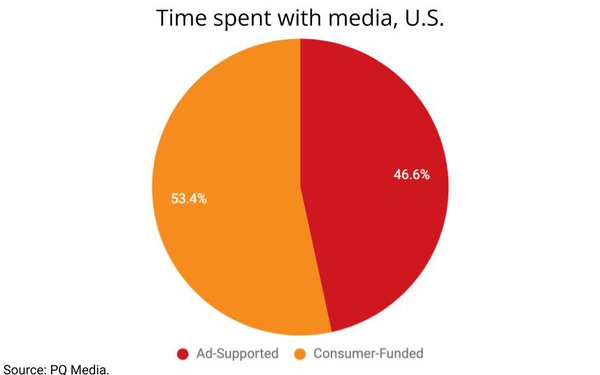
Ad-supported media’s share of total consumer time spent with media fell to its lowest point ever in 2021, and is projected to continue falling over the next several years, even as spending by advertisers continues to rise.

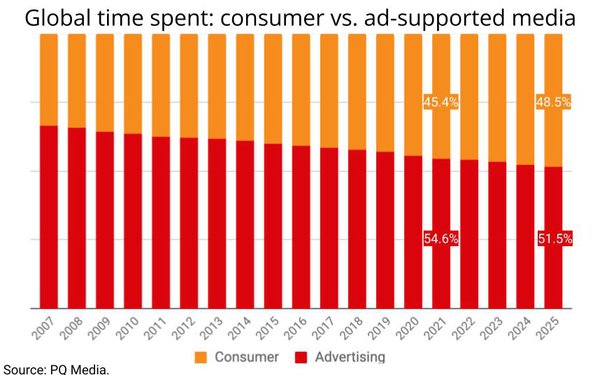
That paradox, which is based on a MediaPost analysis of data from PQ Media’s just-released consumer media usage forecast, implies a pronounced rise in ad cost inflation through 2025.

The new report — part of a regular series of annual tracking studies produced by PQ — estimates ad-supported media’s share of consumer time fell to 46.6% in the U.S. in 2021, and to 54.6% worldwide.

Thanks to a rise in total time spent with media due to the COVID-19 pandemic in both 2020 and 2021, total time with ad-supported media actually grew, even as its share dipped — but the effect has been relatively moderate and not nearly enough to impact the potential inflation of more ad dollars chasing fewer available minutes of advertising exposure.

In the U.S., for example, consumer time spent with ad-supported media rose just 0.01% in 2021, while total advertising and marketing spending jumped 8.7%, according to PQ’s estimates.

Worldwide, consumer time spent with ad-supported media rose 0.04% in 2021, but total advertising and marketing spending rose 7.2%.

“Historically, there has always been a disconnect between advertising and marketing spending vs. consumer media usage during recession and recovery periods,” PQ CEO Patrick Quinn explains, noting: “When a recession first hits, advertising and marketing growth will typically decelerate, while media usage increases, because consumers tend to use media as a catharsis during difficult economic periods.

“Conversely, when an economic recovering begins, advertising and marketing spending will outperform GDP, while media usage tends to decelerate, because consumers have less idle time as they go back o work and such.”

Quinn added that between 2020 and 2021 “the media usage gain was stronger than usual” due to stay-at-home protocols during the pandemic, while advertising and marketing declines were “steeper than usual.”

The result, he said, was a corresponding deceleration of consumer time spent with media and an acceleration of ad spending.

While total consumer time spent with media is projected to continue to expand in both the U.S. and worldwide through 2025, ad-supported media’s share will continue to erode due to secular, not cyclical shifts in consumer usage of media — something other analysts and economists have been pointing out, including the Big 3 agency — GroupM’s, IPG Mediabrands’, and Zenith’s — top forecasters during their year-end outlooks last month.

More recently, GroupM Global President of Business Intelligence Brian Wieser shared new consumer research with MediaPost indicating there also is increasing intolerance for consumers to accept advertising as a means of defraying the costs of premium subscription streaming services, which GroupM also projects will increasingly account for a greater share of total time spent watching video, while traditional ad-supported TV is expected to decline.


By

@mp_joemandese,

Sourced from MediaPost

By

Behind the pay-as-you-go pricing model, the public cloud is teeming with the latest and greatest development, devops, and AI tools for building better and smarter applications faster.

When we think of the public cloud, often the first consideration that comes to mind is financial: Moving workloads from near-capacity data centres to the cloud reduces capital expenditures (CapEx) but increases operating expenditures (OpEx). That may or may not be attractive to the CFO, but it isn’t exactly catnip for developers, operations, or those who combine the two as devops.

For these people, cloud computing offers many opportunities that simply aren’t available when new software services require the purchase of new server hardware or enterprise software suites. What takes six months to deploy on-premises can sometimes take 10 minutes in the cloud. What requires signatures from three levels of management to create on-prem can be charged to a credit card in the cloud.

It’s not just a matter of time and convenience. The cloud also enables higher velocity for software development, which often leads to lower time to market. The cloud can also allow for more experimentation, which often leads to higher software quality.

In addition, there are real innovations in the cloud that can provide immediate benefits and solve long-standing problems with on-premises computing. Here we present 16 compelling cloud capabilities.

Compute instances on demand

Need a new database on its own on-premises server? Get in line, and prepare to wait for months if not years. If you can tolerate having an on-prem virtual machine (VM) instead of a physical server and your company uses VMware or similar technologies, your wait might only take weeks. But if you want to create a server instance on a public cloud, you can have it provisioned and running in about 15 minutes – and you’ll be able to size it to your needs, and turn it off when you’re not using it.

Pre-built virtual machine images

Being able to bring up a VM with the operating system of your choice is convenient, but then you still need to install and license the applications you need. Being able to bring up a VM with the operating system and applications of your choice all ready to run is priceless.

Serverless services

Serverless” means that a service or piece of code will run on demand for a short time, usually in response to an event, without needing a dedicated VM on which to run. If a service is serverless, then you typically don’t need to worry about the underlying server at all; resources are allocated out of a pool maintained by the cloud provider.

Serverless services, currently available on every major public cloud, typically feature automatic scaling, built-in high availability, and a pay-for-value billing model. If you want a serverless app without being locked into any specific public cloud, you could use a vendor-neutral serverless framework such as Kubeless, which only requires a Kubernetes cluster (which is available as a cloud service; see below).

Containers on demand

A container is a lightweight executable unit of software, much lighter than a VM. A container packages application code and its dependencies, such as libraries. Containers share the host machine’s operating system kernel. Containers can run on Docker Engine or on a Kubernetes service. Running containers on demand has all the advantages of running VMs on demand, with the additional advantages of requiring fewer resources and costing less.

Pre-built container images

A Docker container is an executable instance of a Docker image, which is specified by a Dockerfile. A Dockerfile contains the instructions for building an image, and is often based on another image. For example, an image containing Apache HTTP Server might be based on an Ubuntu image. You can find pre-defined Dockerfiles in the Docker registry, and you can also build your own. You can run Docker images in your local installation of Docker, or in any cloud with container support. As with pre-built virtual machine images, a Dockerfile can bring up a full application quickly, but unlike VM images Dockerfiles are vendor-agnostic.

Kubernetes container orchestration

Kubernetes (K8s) is an open source system for automating deployment, scaling, and management of containerized applications. K8s was based on Google’s internal “Borg” technology. K8s clusters consist of a set of worker machines, called nodes, that run containerized applications. Worker nodes host pods, which contain applications; a control plane manages the worker nodes and pods. K8s runs anywhere and scales without bounds. All major public clouds have K8s services; you can also run K8s on your own development machine.

Auto-scaling servers

You don’t have to containerize your applications and run them under Kubernetes to automatically scale them in the cloud. Most public clouds allow you to automatically scale virtual machines and services up (or down) as driven by usage, either by adding (or subtracting) instances or increasing (or decreasing) the instance size.

Planetary databases

The major public clouds and several database vendors have implemented planet-scale distributed databases with underpinnings such as data fabrics, redundant interconnects, and distributed consensus algorithms that enable them to work efficiently and with up to five 9’s reliability (99.999% uptime). Cloud-specific examples include Google Cloud Spanner (relational), Azure Cosmos DB (multi-model), Amazon DynamoDB (key-value and document), and Amazon Aurora (relational). Vendor examples include CockroachDB (relational), PlanetScale (relational), Fauna (relational/serverless), Neo4j (graph), MongoDB Atlas (document), DataStax Astra (wide-column), and Couchbase Cloud (document).

Hybrid services

Companies with large investments in data centres often want to extend their existing applications and services into the cloud rather than replace them with cloud services. All the major cloud vendors now offer ways to accomplish that, both by using specific hybrid services (for example, databases that can span data centres and clouds) and on-premises servers and edge cloud resources that connect to the public cloud, often called hybrid clouds.

Scalable machine learning training and prediction

Machine learning training, especially deep learning, often requires substantial compute resources for hours to weeks. Machine learning prediction, on the other hand, needs its compute resources for seconds per prediction, unless you’re doing batch predictions. Using cloud resources is often the most convenient way to accomplish model training and predictions.

Cloud GPUs, TPUs, and FPGAs

Deep learning with large models and the very large datasets needed for accurate training can often take much more than a week on clusters of CPUs. GPUs, TPUs, and FPGAs can all cut training time down significantly, and having them available in the cloud makes it easy to use them when needed.

Pre-trained AI services

Many AI services can be performed well by pre-trained models, for example language translation, text to speech, and image identification. All the major cloud services offer pre-trained AI services based on robust models.

Customizable AI services

Sometimes pre-trained AI services don’t do exactly what you need. Transfer learning, which trains only a few neural network layers on top of an existing model, can give you a customized service relatively quickly compared to training a model from scratch. Again, all the major cloud service providers offer transfer learning, although they don’t all call it by the same name.

Monitoring services

All clouds support at least one monitoring service and make it easy for you to configure your cloud services for monitoring. The monitoring services often show you a graphical dashboard, and can be configured to notify you of exceptions and unusual performance indicators.

Distributed services

Databases aren’t the only services that can benefit from running in a distributed fashion. The issue is latency. If compute resources are far from the data or from the processes under management, it takes too long to send and receive instructions and information. If latency is too high in a feedback loop, the loop can easily go out of control. If latency is too high between machine learning and the data, the time it takes to perform the training can blow up. To solve this problem, cloud service providers offer connected appliances that can extend their services to a customer’s data centres (hybrid cloud) or near a customer’s factory floors (edge computing).

Edge computing

The need to bring analysis and machine learning geographically close to machinery and other real-world objects (the Internet of Things, or IoT) has led to specialized devices, such as miniature compute devices with GPUs and sensors, and architectures to support them, such as edge servers, automation platforms, and content delivery networks. Ultimately, these all connect back to the cloud, but the ability to perform analysis at the edge can greatly decrease the volume of data sent to the cloud as well as reducing the latency.

The next time you hear grief about your cloud spending, perhaps you can point to one of these 16 benefits – or to one of the cloud features that have helped you or your team. Any one of the cloud innovations we’ve discussed can justify its use. Taken together, the benefits really are irresistible.

Feature Image Credit: Deyan Georgiev / Shutterstock

By

Sourced from InfoWorld

By

A digital marketing agency can help you market your business online to attract new customers, increase sales and boost your brand’s reputation

Digital marketing is an essential component of any small business’ marketing strategy. If you’re doing it alone, or if you’re stuck doing it with a team that doesn’t know how to do it properly, then you run the risk of being left behind in today’s competitive market.

If your goal is to increase sales and traffic, it’s critical to hire a professional digital marketing company.

A digital marketing agency can help you market your business online to attract new customers, increase sales and boost your brand’s reputation. To do this, they need to know a lot about you, your business, and your competitors. They will also have specialist knowledge of search engine optimization (SEO), pay-per-click advertising (PPC), website design and other digital marketing techniques.

Choosing a digital marketing agency

Digital marketing is a process and requires a solid foundation to achieve the desired results consistently. Many companies claim instant success and solutions for businesses, but that’s not realistic. There’s no shortcut to building authority, trust and brand visibility.

First, let’s look at the smaller agencies. They are generally more in touch with the digital landscape. They have a smaller team, are more flexible and can be much more agile.

These aren’t necessarily bad things, but they mean that an agency like this will be much more invested in your project than a larger company. This means that they will take your success more personally, and you will receive more attention from them.

The flip side of this is that if things go wrong and you need to fire them, you won’t have to deal with huge amounts of red tape.

Larger agencies are the opposite in some ways. They often have pre-existing relationships with huge companies and brands. This means they can offer better rates than other agencies because someone else is paying for it (the larger company). This can mean that clients get better service from larger companies, particularly if several employees pitch in on one project or deal with one client.

Feature Image Credit: Rawpixel.com

By

Sourced from Entrepreneur Europe

By Lisa Cupido

It’s easy to assume your phone’s operating system has your best interests at heart. But there are instances where some of your phone’s features can actually pose security risks, while simultaneously causing unwanted battery drainage. What to do? According to Tech Expert Danka Delic at ProPrivacy, privacy breaches are no longer exceptions or rare occurrences but the harsh reality of nearly everyone who owns a piece of technology — and changing a few iOs features can help. “In the era when our smartphones became like an extension of our brains – memorizing our search history, correspondence, images, and other important files – it became mandatory to secure them as much as possible,” Delic says. “Luckily, there are some easy yet very effective protective measures you can take to mitigate the risk of exposure and protect your sensitive data from all sorts of prying eyes. If you are an iPhone user, simply disable these three iOS features and you’ll already be making a lot of difference in your privacy settings – and as a great bonus, you’ll extend your battery life.” You need to disable these iOs features right now, according to tech experts.

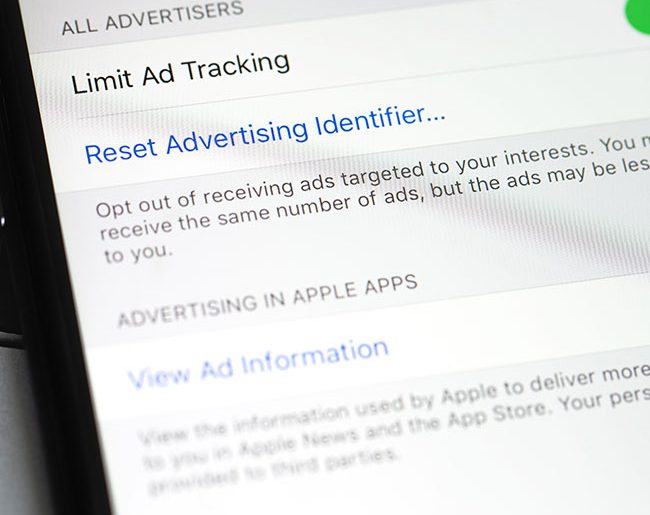
Ad tracking

Ad tracking is a common practice that companies conduct with the excuse of providing you with personalized ads, according to Delic — but that tailored advertising service often comes at a cost of jeopardizing your privacy and is regularly off-putting. “Both your iPhone and its individual apps gather loads of data about you daily, and frequently they sell the gathered information without you even realizing it,” Delic says. “This sounds scary only because it is. So here’s how to prevent it: Scroll to your iPhone Settings bottom and then choose > Privacy > Apple Advertising, and finally switch Personalized Ads off. Additionally, you can disable Share iPhone Analytics if you want to prevent Apple from checking your iCloud issues, Siri recordings, or crash reports which can contain a lot of information about you. You can do this by going to Settings > Privacy > Analytics & Improvements, and toggling Share iPhone Analytics off.”

iphone iOs features

Mail tracking 

“Your emails are a particularly sensitive category since they come with a lot of personal information that is not protected enough,” Delic says. “Besides, some newsletters or marketing emails include tracking technology that can reveal to the sender whether you’ve opened their email (and therefore showed interest in their product) and your approximate location.”

Here’s how Delic advises preventing that from happening: Go to Settings > Mail > Privacy Protection and switch on Protect Mail Activity. Once you do this, the sender can no longer see your IP address or see whether you’ve opened the email. “Keep in mind, though, that the sender could still track you if you tap on any embedded link in the email,” Delic says.”

iCloud backup (for apps that don’t need it) 

Although Apple does a great job encrypting your backups, Delic says the truth is: it still holds the key to unlock anything you store on iCloud. In other words, if required by law, the company can unlock those encryptions. “To be on the safe side: You can manually select what’s being stored in iCloud, simply by opening Settings > Your name > iCloud,” Delic says. “Go through the list and uncheck anything you don’t want to be backed up online.”

Feature Image Credit: Shutterstock

By Lisa Cupido

Lisa Fogarty is a lifestyle writer and reporter based in New York who covers health, wellness, relationships, sex, beauty, and parenting.

Sourced from SHE FINDS

By Peter Roesler

I have designed, published, and tested thousands of landing pages through my years in marketing. All this time, work, and effort resulted in discovering the main reasons why you should have landing pages for your business’s site. If you aren’t using landing pages, now is a good time to change that. Here’s why:

Increase Conversions

Quality landing pages result in more conversions. Whether it is newsletter subscriptions, sign-ups, downloads, lead generation, or something else, when you use landing pages, you experience higher conversion rates than sites that don’t.

Remember, having a landing page doesn’t guarantee a higher conversion rate. Instead, landing pages provide you with the tools to improve conversion rates as time passes.

Reduced Cost Per Acquisition

Cost per acquisition (CPA) is the total cost of acquiring a new customer. While there’s no universal set number to acquiring a customer, I’ve found that it’s much less when you have landing pages in place.

Landing pages increase conversions and help produce a higher return on investment (ROI). I’ve also found that landing pages also increase your Google pay-per-click (PPC) Quality Scores. This results in a lower cost per click, which reduces the cost per conversion and eventually a lower CPA.

Showcase and Optimize Your Offers

Every offer needs a home and landing pages provide this home. Depending on your marketing strategy, you may have several offers to showcase, including referral programs, promotions, white papers, resource guides, on-demand webinars, and more.

The information you collect and share on the landing page varies based on the type of offer you’re looking to highlight the most. Because of this, you need flexibility for changing form fields, editing layouts, and optimizing the design and copy– a standard, set template doesn’t work. Your offers also need an easy, shareable link that are easily found on your landing page.

Scale Your Marketing

With landing pages, you scale your marketing without scaling your resources, money, or time. In the past, building landing pages took a lot of time and money. However, this isn’t the case today. It’s easy, fast, and affordable to create and publish new offers and pages on your website. This makes it possible to increase your marketing efforts without spending too much time or effort.

Test and Validate New Ideas

You have the option to spend resources, money, and time to build an entire website for something new you offer and then wait and see if anyone likes it. Another smarter option is to use a landing page to validate the audience’s response and collect feedback on an idea to see if spending more money on it is a smart idea.

When it comes to creating a marketing strategy today, implementing landing pages is a must. These offer you a chance to increase conversions, reach more customers, and quickly add new offers to your site.

Feature Image Credit: Getty Images

By Peter Roesler

Sourced from Inc.

By John Hall

Digital isn’t marketing’s wave of the future. It’s the present. If your brand hasn’t devised and implemented a comprehensive digital marketing strategy by now, you’re way behind the crest.

If you do have a digital strategy in place, don’t count on riding that particular wave forever. Customers are constantly accessing digital content. If they like what they see from your brand, they’ll return for more, and they’ll want to see something new every time. That’s why your digital strategy needs constant care and attention.

Here are three major reasons you shouldn’t neglect your digital strategy, no matter how well it’s doing right at this moment.

1. Digital Is the Here and Now

It’s a digital world. Technology has ushered in new ways of reaching target audiences demanding fast-food consumption of information and instant gratification. If your digital presence only constitutes a website, you won’t be found. You and your brand will be irrelevant.

Adding a few random channels, such as a Facebook business page and a Twitter account, won’t cut it either. You should develop a cohesive digital strategy over time, layering on the channels your target audiences are using. As you add a new channel, don’t neglect the ones you’re already using, especially if they’re producing solid results.

Remember that quality content is what makes you relevant in your industry and to your customers. Your brand should be routinely auditing how your content is performing across all channels to stay on top of performance. Did a piece of content get read more often, or did more people watch the video format? How long did it keep readers or viewers engaged? How many clicks, likes and shares did it get?

Although digital marketing is here to stay, factors such as algorithms and keywords change frequently. There are a variety of tools you can use to track search engine rank page volatility, so invest in one. More importantly, use it constantly to inform your content, adjusting it as often as necessary to keep your ranking high.

It’s obvious that not having a digital marketing strategy is an error. But neglecting it once you do is just as egregious. Digital is the way your audience is consuming information now and likely will be forever. Give your strategy sufficient care and feeding every single day.

2. Digital Has Kept Companies Afloat During the Pandemic

When the world went digital at the onset of the Covid-19 pandemic, businesses had to quickly devise and execute a digital strategy. Brick-and-mortar shops on Main Street America needed to offer more than their Facebook business page. If they didn’t, their shops would fail — and many of them did.

Those who stayed in business had to pivot to online sales and figure out how to deliver orders, whether via curbside pickup or shipping them to customers. In roughly 42 days in March and April 2020, small business online sales platform Shopify saw a whopping 62% increase in customers as retailers looked for help with a new digital strategy.

For certain, the jump to online sales was spurred by the pandemic, but it’s safe to say it’s here to stay. Customers are now accustomed to the convenience of shopping online. Moreover, they’re excited about having the option of digitally supporting local small businesses instead of behemoths like Amazon and Walmart.

For businesses of all sizes to thrive in whatever world comes next, they need to constantly improve on their pandemic digital marketing strategies. When Salesforce surveyed consumers in mid-2021, 61% said they’re planning to spend more time online, 88% expect businesses to accelerate their digital presence and 69% insist that companies find innovative mechanisms for product and services delivery.

The people have spoken. To respond, keep your brand on the cutting edge of digital by developing strategies that continue to keep you relevant. Adopt successful strategies used by others in your industry but make sure you do so in a way that’s congruent with your brand. Monitor customers’ reviews and input and adjust to their needs and wants. Digital might have kept you afloat during the early days of the pandemic, but now you need to swim like a champ.

3. Digital Will Continue to Evolve

Amid constant uncertainty, businesses have adapted to one unchanging truth: Digital strategy, if done well, will always serve others. No matter what happens in the future, there will always be an online world to serve. Serve its citizens well, and you will do well in return.

The specifics of the evolution of digital marketing success are unknown, but the critical steps necessary to evolve are constant. Step one is learning how to effectively market your brand digitally. Watch what successful companies are doing to respond to their customers’ ever-changing demands. A reputable agency that helps you develop strategic content and SEO tactics will enable you to stay on top of this as well as step two, which is creating winning digital marketing strategies.

Step three is executing those strategies well and monitoring results. Step four? Repeat successes and eschew failures, which essentially returns you to step one.

Customers not only want the right content at the right time, but they want it delivered in a format they can consume easily. During the height of the pandemic, when many were spending nearly every waking moment in front of a screen, the popularity of podcasts skyrocketed. This evolutionary rise meant brands needed to reformat their relevant content to suit the preferred delivery method.

You can’t know for sure where customers will lead your company in the future. However, you can learn some valuable lessons from trends they established during the pandemic’s height. Brands will need to keep an eye on these trends in 2022 and beyond. Digital marketing’s underpinnings, such as content, speed, and SEO, aren’t going away anytime soon.

Digital marketing firmly entrenched itself from the beginning of Covid. It continues to evolve as brands get increasingly good at listening to customers and responding to their demands. Now is no time to neglect your digital marketing strategies. It’s time for your business to catch a wave that will leave you sitting on top of the world.

Feature Image Credit: getty

By John Hall

Follow me on Twitter or LinkedIn. Check out my website.

John Hall is the co-founder and president of Calendar, a scheduling and time management app. He’s also the strategic adviser for Relevance, a company that helps brands differentiate themselves and lead their industry online.You can book him as a keynote speaker here and you can check out his best-selling book “Top of Mind.” Sign up for Calendar here.

Sourced from Forbes

By

When the coronavirus crisis erupted in 2020, it became apparent that the medical emergency was accompanied by severe shortages, especially in some medical devices.

The pattern was first observed for ventilators: demand spiked everywhere and the supply chain was disrupted. This was because production of the devices spanned multiple countries, with each part dependent on other parts manufactured in different locations. The longer the chain and the more complex the dependence, the greater the exposure of any point to the disruption of another one, and to mandated shutdowns.

Now, two years since Covid first hit, this pattern has affected almost every sector of the global economy. “Supply chain issues” have become so widespread that they are now a running joke, affecting everything from furniture to groceries. But why has Covid had such a severe effect on how we receive products and goods?

In recent decades, supply chains became lean, and they lengthened as they became more cost-efficient: more and more steps were added in the manufacture and transportation of any given product in the name of speed and cost. This means there are more and more places where something can go wrong between you ordering something online and it arriving to your door.

Scandi living room interior with grey, big sofa in the center and modern picture on the wall
The supply chain crisis started with ventilators and ended with sofas. Photographee.eu/Shutterstock

Today, downstream suppliers – such as those who provide vehicle control systems to your car manufacturer – depend on upstream suppliers – such as chip manufacturers – to deliver on time so they can in turn deliver on time to you.

With long chains, risks are now shared between multiple entities all around the world.

Using AI and blockchain to protect trade

Supply chain problems have a knock-on financial effect known as trade credit contagion. This is where firms delay payments to suppliers because their customers delay payments to them. The pay-on-delivery model can lead to cancelled or delayed shipments which can in turn lead to bankruptcies.

While a high proportion of trade credit risk remains uninsured today, a post-pandemic world may see insurance and reinsurance firms fill in this protection gap.

Researchers are currently working to develop methodologies to identify vulnerabilities in global supply chains and to understand their trade credit contagion risks. The goal is to make these systems more robust overall.

How can we design ways to design insurance and reinsurance contracts in order to effectively share the risk and mitigate vulnerabilities? How can reliable trade credit lead to fewer delays in supply chains and replace the familiar predicament we face now, of paying for something in advance with an unknown delivery date?

Artificial intelligence and complex network theory are helpful in identifying the structures that could pose systemic risk. They help us ask: which patterns of connections are likely to lead to delay and trade credit contagion and which are more robust?

Using these tools, we can create large-scale simulators of global supply chains responding to a wide variety of shocks and then use machine learning techniques to detect the problematic parts of the chain. This knowledge can then be used in market designs that strengthen the system before another pandemic or disaster occurs.

Other novel technologies such as blockchain bring the promise of using high quality data to analyse supply chain dependencies. blockchain technology uses real-time data and transparent verification carried out by multiple parties. In combination with other features, such as smart contracts, this could lead to timely resolution in cases of disputes along the supply chain.

An aisle in a warehouse with shelves stacked with boxes
We need to insure each link in the chain. dreamnikon/Shutterstock

My research involves

using blockchain to streamline record-keeping and payments. This problem is challenging because the adoption of blockchain depends both on the specifics of the technology and the cost.

The problem of adopting technology in the presence of positive externalities (whereby firms adopting the technology in turn improve the operations of external parties) is an old one in economics, but now these externalities are systemic in nature: the effects propagate along the chains. The cost of the technology depends on how many firms adopt it, and each one faces business specific costs based on its position in the supply chain, its risk tolerance and its costs to insure these risks.

Real-time recording keeping, the traceability of transactions, and the immutability of blockchain can all help supply chains become more efficient. This is all the more true if we consider the full length of the chain, where transactions need to be verified by several parties: participants in the supply chain, insurance and reinsurance firms.

The future of supply chains

Trade credit insurance is likely to grow after the pandemic. It may rely on private-public partnerships – the pandemic has shown that governments become important players when they impose shutdowns in certain areas.

These funds can be used to make up for payment delays, reduce losses and jump-start critical production where necessary. But not all links in a chain can be insured, and an important challenge is to identify the most important stages under different shock scenarios.

Supply chains can also be rewired – large-scale algorithms can identify which suppliers need to be replaced and which new ones need to emerge.

In a few years, supply chains may look different, as the overall goal shifts from minimising costs, as was the case before the pandemic, to minimising delays and trade credit risks. The end consumer will drive the need to rewire the network, as demand shifts. Ultimately, the flexibility of the customer determines the resilience of the supply chain.

Feature Image Credit: Studio concept/Shutterstock

By 

Sourced from The Conversation

By Deanna Ritchie

The world is filled with billions of users on social media across the globe, and that number is growing each day; and we can watch as the issues to increase.

Social media users have resulted in social media platforms becoming among the most popular virtual places.

Traditional marketing methods, such as commercials on TV, are usually only one-way communications, delivering a brand to the consumer. But social media marketing encourages engagement. It facilitates multi-directional communication, which:

  • Businesses can interact with their customers
  • Customers can interact with the brand’s image by providing feedback.
  • Customers can connect with fellow customers via posting posts.

As a brand’s owner and marketer, you can connect with a variety of potential customers in a matter of seconds with the use of pay-per-click.

There’s plenty to benefit from using social media for marketing. However, if your efforts haven’t yielded any results, you may be making some of the typical marketing mistakes that people make. Becoming aware of these marketing mistakes can help make the right choices and avoid the following mistakes.

1. You’re Operating Blindly

One of the most costly mistakes you can make with your advertising on social networks is to shoot blindly and expect to see results. Instead, you must be sure to treat it with the same seriousness that you would for any other campaign in marketing.

Make a strategy — a clearly defined social media marketing strategy. It’s an essential ingredient in an effective social media presence.

  • An effective social media advertising plan will guarantee that you’re posting content that will help you achieve your business goals. This will stop you from investing your time and energy in a campaign that is bound to fail.

You have scheduled and planned your posts in time. Regularly posting helps you build and maintain your online presence that is organic.

How can you develop an effective strategy?

A simple plan is not enough. You require a master plan that covers:

  • What are you hoping to benefit from your social networks? New leads? Increased brand recognition? If you aren’t sure what you’re after, it’s impossible to achieve it.
  • Who do you want to target?
  • Your action plan. What type of posts will you create? What strategies will you use to promote your content to reach your desired viewers? Do you require more videos?
  • The team is responsible for the management of your accounts.
  • The time and the money you’ll invest in social media advertising.

Your most crucial performance indicators.

Find out what you want from social media — and learn how you can achieve it. Then you will be on the right track towards achieving your total capacity on social media.

2. You’re Aiming at the Wrong People

There is a plan in the right place. However, if you’re trying to reach the wrong people or not targeting the right audience, you’ll have an issue of wasting time and funds. There will be a lot of followers with little contribution to your objectives–an audience that isn’t the ideal client.

In general, Facebook is the most popular social network in the world.

But, it doesn’t suggest that you should solely focus your marketing efforts exclusively on Facebook.

Social Media Platforms

First, define your target audience. The target audience is the group of people who are most likely to be interested in your service or product. You can determine who these individuals are based on income, age or education level, location, or even behaviour.

If you’re active across multiple social media platforms, be sure to focus on the popular platforms for your targeted audience.

For example, data shows that Instagram is most popular with those aged between 18 and 29.

Pinterest is the most popular social media platform among women. While Snapchat, as well as Twitter, are popular with those aged between 18 and 29.

LinkedIn might be more suitable for you if you’re working in the B2B sector.

People tend to overlook irrelevant content. Therefore, it is best to be careful not to make assumptions about the audience you intend to reach.

Examine them and modify your content to meet the needs and expectations of your audience. Your content should be valuable to your readers and incentivize them to interact with it.

Your tone must also be appropriate for the social network platform you are using. The type of content that your viewers are looking for varies across platforms.

Facebook users, for example, will expect a casual, fun, playful, and fun tone — it is an excellent place to connect and advertise. However, LinkedIn works best with a moderately formal tone, and Instagram is predominantly focused on aesthetics and is a great place to show your diversity.

  • Increase the reach of your potential audience with features such as captions and subtitles.
  • You can watch your videos even in loud spaces, like office spaces or in noisy areas.
  • Understand dialogues where participants speak rapidly.
  • Be alert, and help you transmit your message.
  • Access your content even if you have hearing difficulties.

3. SEO Best Practices are Neglected in Your Social Media Marketing

The biggest mistake companies make is not recognizing the importance of SEO to make their social media campaigns effective.

Similar to how you’re focused on SEO when writing content for your blog, such as landing pages and other web content. It would help if you did the same thing with social media.

Engaging in SEO will aid in ensuring your profile, product, or service is ranked higher in results from searches. This increases the organic search engine traffic that comes to your website and boosts your following.

The number of shares, likes, and comments your posts receive online determines your posts’ social media rankings and reach. So, especially to begin with — you will want to post regularly and share quality and exciting content. To stay competitive, plan to always show up with info, and put out quality content. Also, set your social media up to make it easy for your readers to share your content with friends and contacts by including attractive CTAs.

Use keywords. Find the most compelling phrases and words when researching keywords for your blog posts. Then, use them in the social posts you make.

Visual content is among the most powerful SEO strategies you can employ. Use relevant and high-quality images, video, additional images of products or services, and GIFs. Use all content that loads fast — and make sure your site loads fast.

The decision to include subtitles on videos and captions on images or GIFs is also to your advantage. Google, as well as other engines, can’t view the video. However, the search engines can read the text to index and search for the content, making your content more visible.

Implement SEO strategies, and you’ll notice an increase in impact.

4. Over-the-top brand promotions with no actual content

For most people, social media is an opportunity to connect and discuss opinions, keep informed on the latest happenings, and be motivated.

So, if you’re using it only to increase brand awareness and create auto-generated backlinks to your website, you’re not doing it right.

Why are you looking to create content that sparks people’s curiosity and conversation? First, have your goal very clear in your mind.

Feature Image Credit: George Becker; Pexels

By Deanna Ritchie

Managing Editor at ReadWrite

Deanna is the Managing Editor at ReadWrite. Previously she worked as the Editor in Chief for Start-up Grind and has over 20+ years of experience in content management and content development.

Sourced from readwrite

By Joe Galvin

Four factors are shaping dramatic shift in buyer behaviour. What the C-suite needs to do in response

Feature Image Credit: Getty Images

By Joe Galvin

Sourced from Inc.