Author

editor

Browsing

By

The world of search engine optimization is changing all the time. Here are the latest SEO trends to be aware of.

When it comes to online marketing, there are a variety of different tools that businesses can take advantage of. Pay-per-click, social media, review websites such as Yelp, and search engines are just some of the online ways that consumers come across websites of all sorts.

Search engines are one of the best ways to get clients of all types. Hair and makeup product customers, storage facility customers, personal injury clients, and so many other consumers can be found through businesses utilizing these search engines properly.

With such a promising market future, it’s no wonder that SEO (Search Engine Optimization) is utilized by an abundance of different businesses. This system creates great results, is cost-effective, and can easily be implemented and maintained. Unfortunately, many website owners aren’t as familiar with the industry of SEO.

interface, internet, program

The Search Engine Optimization Market

SEO is a growing industry thanks to its proven success and usage. Businesses all over the country and world are participating in this market, contributing to its high potential in the future. Understanding how this industry is stable and growing is important for businesses looking into utilizing SEO.

It is estimated that businesses are spending more than $80 billion on SEO services just this year. This is much higher than in 2018 when the estimated business spending for SEO was around $72 billion. Within just three years, the Search Engine Optimization market has grown substantially, and we can expect more of this in the future.

68% of online experiences begin with a search engine, representing a large portion of online traffic. In fact, 92.96% of all global traffic comes from Google search, Google Images, and Google Maps. With such high usage and acknowledgment, it’s no surprise that most businesses take advantage of this tool.

Why SEO is Important for Business

Such a large market means ample opportunities for businesses. Businesses who utilize SEO can sometimes expect 1000%+ more traffic than they would from organic social media. Of this traffic, SEO leads can have a 14.6% close rate.

Search Engine Optimization is one of the most effective forms of online marketing. It has great success rates and doesn’t cost an abundance of money to use. Even businesses with small marketing budgets can use SEO to their advantage.

Since search engines are so commonly used, SEO best practices are essential for businesses when it comes to making these engines work in their favor. Without SEO usage, websites are highly unlikely to get search engine exposure. 90.63% of websites get no organic search traffic on google, meaning their traffic relies almost entirely on SEO.

Find an SEO Agency Specializing in Your Niche

Effective SEO services such as the legal SEO agency Rankings, help websites ensure they are one of the first results within a search engine. This high ranking is the key to getting the most traffic that you can through search engines. Studies have shown that 0.78% of online users click on Google results that are on the second page. It’s advised you find an agency that specializes in your specific niche as they will be the experts in understanding your competitive landscape and how to implement an advantageous strategy for your business.

Businesses that successfully implement this type of marketing can reap the benefits this approach provides. SEO is one of the most effective ways to reach high-quality leads online and convert them into customers in the future.

Learning how to implement SEO on your own or having a professional assist you are two easy ways to make search engines work to your advantage.

Keeping up with SEO is highly recommended for businesses. Whether you are looking to maintain or increase your current customer volume, SEO is one of the best ways to do so.

Feature Image Credit: Photo by janjf93 on Pixabay

By

Sourced from Influencive

By

Learn more about digital marketing for small business

Digital marketing, also known as online marketing, involves publishing online marketing communications, promotions and digital adverts to connect with customers. It can include email, social media, and web-based ad banners.

Using the best CRM software can be a good starting point with digital marketing, helping develop customer relations and establishing what connections they may have with your firm. From there, you can use targeted marketing for specific interests.

What does digital marketing do?

woman giving presentation on digital marketing

Digital marketing transposes standard marketing into the online world (Image credit: Pexels)

Digital marketing is the natural evolution of traditional marketing. While the latter focuses on magazine ads, billboards, and direct mailings, digital marketing uses online video, website adverts, search engine marketing, and much more.

It can be divided up into more hands-off advertising, such as by displaying an advert to a customer as they watch a video or browse a website; or it can be more direct, such as via social media. Whether through sponsored adverts on a social media platform, or by a company posting information on their social media, it all comes under the banner of digital marketing.

A separate field includes search engine optimization (SEO), with websites that rank highly in search results often performing best amongst their customers. In conjunction with content marketing, it enables customers to gain more attention from potential clients, via driving awareness of the product.

After all, Google is often a key place for all consumers to search for something, so ranking highly proves beneficial.

How departments can use digital marketing for small businesses

whiteboard with digital marketing written on it

Various different SMB departments can take advantage of, and utilize, digital marketing functions and services (Image credit: Pexels)

Customer service

Digital marketing in conjunction with good customer service can build up customer insight, ensuring that customers get the best service possible. Combined with digital marketing tools like HubSpot, Hootsuite, and various CRM software platforms, customer services can be more informed about the past history of a customer, as well as how they have previously interacted with a marketing campaign.

That leads to better customer service for the client, as they feel more like they’re gaining an individual service rather than being treated as a number. It also typically leads to issues being solved faster.

Sales

Sales relies heavily on good marketing. With more people using the internet and social media than ever before, digital marketing is a key component of that. With good quality digital marketing providing a strong message to potential customers, a sales team has an easier job converting a lead into a sale.

In turn, a customer feels far more informed thanks to seeing more of a product via digital marketing, so that they feel more confident in knowing they have purchased the right product for their needs.

Particularly for small businesses, a good reputation and a personal service goes a long way, meaning a well-combined digital marketing campaign and sales department ensures everyone is happy, and that feedback is positive.

Marketing

Traditional marketing and digital marketing can co-exist. For some businesses, one type may work better than the other.

It’s important to keep options open when starting out on a marketing campaign. Using marketing automation can help cut down some of the more tedious tasks associated with both traditional and digital marketing. B2B marketing automation may be required for small businesses that work with other companies.

Via automation, it’s possible to schedule social media messages to be sent out at a specific time. Automated emails can also be helpful. At all times, it’s important for both sides of marketing to communicate too, with CRM software helping here.

HR

HR departments can use digital marketing as a form of virtual paper trail. The HR department can check that marketing is working effectively by monitoring sales leads that are developed through it, via the use of relevant software.

They can also predict more accurately what the future holds for a small business based on prior results. From there, the department can work out if more investment in terms of employees need to be made when it comes to digital marketing services, which can also be used to help with recruitment.

Finance

Finance’s main role in conjunction with digital marketing is to determine budgets. A finance department can track the performance of individuals as well as specific campaigns, knowing where investment needs to be made to make the best of a digital marketing strategy.

It can also test scenarios to determine where the most successful marketing campaigns might lie, before creating reports that show what’s likely to occur. Being able to allocate budgets most appropriately is immensely useful to digital marketing, especially when it comes to acquiring funds for SEO-based campaigns, or purchasing social media software that aids automation.

Features and benefits of digital marketing for small business

laptop displaying slideshow with meeting in background

You can reach more customers and improve sales by investing in digital marketing (Image credit: Pexels)

Modernization

Digital marketing is the most modern form of marketing. It’s not essential for all firms to implement, but it’s a good way of making even the smallest of businesses look very modern. Its modern nature is highly varied, ensuring that anyone can reach out to potential clients through various forms of social media, or go further by using advertising services to expand their horizons online.

Reaches a wide range of people

Because digital marketing is online, it can reach a wider range of people than traditional marketing that often relies on geography to make things possible. A social media presence ensures that a business can reach out to potential clients hundreds or even thousands of miles away, with locale no longer being a limited factor in getting the message out.

Thanks to algorithms on social media platforms, such messages can also pinpoint users that find the service more relevant, rather than relying upon adverts at bus stops or in local magazines, which tend to provide more scattershot results.

Better return on investment 

A lot of digital marketing can be achieved relatively inexpensively compared to billboards or TV adverts. Devising a social media campaign takes time and money, but issuing it is relatively straightforward, meaning a better return on your investment.

It’s also more efficient, which saves the business time. Once certain services are set up, digital marketing can soon pay for itself through better reach and sales performance.

Better lead quality

Much of digital marketing is focused on a personalized service. Facebook, Twitter, Instagram, and other social media services all use algorithms to recommend services and accounts that are most likely to be of interest to a user. By using social media for your digital marketing, users can instantly appeal to the customers best suited to them; meaning customers aren’t distracted by something irrelevant, and that a company’s sales team has genuinely-interested clients.

Builds up brand recognition

Marketing isn’t just about sales. It’s also about establishing brand familiarity. A name that someone sees everywhere is a name they are more likely to recommend to people, even if it’s not a product they use themselves. In the case of digital marketing, a strong social media presence can help immensely with creating a positive view.

It doesn’t need to be used for customer service or selling products. Many successful campaigns simply encourage interaction in a fun way, making a company seem more human than just a place to buy a product. It can even be used to develop product ideas.

Feature Image Credit: Pexels

By

Sourced from techradar.pro

By Aisling Ní Chúláin

If we’ve learned anything about new means of communication over the last century, it’s that where technology attracts people’s eyes and ears, advertisers won’t be long chasing after them.

It’s been the case with radio, cinema, TV, the Internet and social media, so it seems almost impossible that it won’t be the case in the so-called metaverse – the new fully realised, shared universe that companies like Meta are proposing to build.

In perhaps a sign of things to come, a host of brands have already dipped their toes into gaming metaverses, hosting virtual fashion shows and dropping exclusive collections in game.

Luxury fashion houses like Louis Vuitton, Valentino and Marc Jacobs have all designed digital items for the social simulation game Animal Crossing – and Balenciaga has collaborated with Fortnite on an exclusive drop of wearable skins for in-game characters, to name but a few.

‘Think about it as placement in the product instead of product placement’

But now that Meta, a targeted advertising powerhouse, has staked its claim to the metaverse, some experts are raising the alarm about the specific implications immersive advertising will have for user privacy, safety and consent.

“When you think about advertising in XR, you should think about it as placement in the product instead of product placement,” Brittan Heller, counsel with American law firm Foley Hoag and an expert in privacy and safety in immersive environments, told Euronews Next.

“The way that advertising works in these contexts is a little different because you seek out the experiences. You like the experiences,” she explained.

We’re rapidly moving into a space where your intentions and your thoughts are substantial data sets that have technological importance in a way that they didn’t before.

Brittan Heller
Human Rights Counsel – Foley Hoag LLP

“An ad in virtual reality may look like buying a designer jacket for your digital avatar [but] that’s an ad for a clothing company that you are wearing on your body”.

“It may look like buying a game that puts you into Jurassic Park – [but] what better way to advertise the movie franchise than to actually put you in the experience of being in Jurassic Park?”

What is biometric psychography?

The problem here, according to Heller, is that in the metaverse, the capability for harvesting biometric data and using that sensitive data to target ads tailored to you, goes far beyond the considerable amount of data Facebook already uses to build our consumer profiles.

If the technology that Meta is promising comes to fruition, the possibility exists that a form of targeted advertising which tracks involuntary biological responses could be proliferated.

The risk that I think we’ve learnt from Cambridge Analytica is that privacy risks come into play when you have the combination of unanticipated data sets, especially when you’re looking at emerging technology.

Brittan Heller
Human Rights Counsel – Foley Hoag LLP

For VR headsets to work in this environment, Heller says, they will have to be able to track your pupils and your eyes.

This means advertisements could be tailored according to what attracts or holds your visual attention and how you physically respond to it.

Heller has coined a term for this combination of one’s biometric information with targeted advertising: biometric psychography.

If an entity had access to biometric data such as pupil dilation, skin moistness, EKG or heart rate – bodily indicators that happen involuntarily in response to stimuli – and combined it with existing targeted advertising datasets, it would be “akin to reading your mind,” Heller said.

“The type of information you can get from somebody’s pupil dilation, for example – that can tell you whether or not somebody is telling the truth. It can tell you whether or not somebody is sexually attracted to the person that they’re seeing,” she explained.

“We’re rapidly moving into a space where your intentions and your thoughts are substantial data sets that have technological importance in a way that they didn’t before”.

“The risk that I think we’ve learnt from Cambridge Analytica is that privacy risks come into play when you have the combination of unanticipated data sets, especially when you’re looking at emerging technology”.

Regulating the metaverse

Heller believes that biometric laws in the United States are insufficient in protecting users from use or misuse of this kind of data because “biometrics laws in the States are defined by protecting your identity, not protecting your thoughts or your impulses”.

With the metaverse, the risk remains that the pace of development of the technology will outstrip the ability of institutions to regulate them effectively as has arguably been the case with social media platforms.

In light of the fact that companies hoping to build the metaverse are multinational and operate across borders, Heller believes the most effective way to deal with these issues of user protection is a “human rights based approach”.

“There are many stakeholders in this, there’s civil society, there are public groups, there are governments and then there are intergovernmental organisations as well,” she explained.

“A human rights approach has been the way that we’ve been able to bring all of these players and their concerns together and make sure that everybody is heard”.

But what can companies do to protect people in the metaverse?

If tech organisations are serious about guaranteeing users’ digital rights in immersive environments, it will depend on them being open about the technology they are developing.

“I would want companies to be more transparent with the functionality of their technologies, not just their intentions and their business plans, but how this will work,” Heller said.

“That will help lawmakers ask the questions that they need to protect the public and to cooperate with each other for trans border technology”.

By Aisling Ní Chúláin

Sourced from euronews.next

By

Here are three tips to retain your customers.

You already know that relevant, personalized messaging can make or break your digital marketing campaign. So as we think about cutting through the noise during the increasingly competitive holiday season — where brands fine-tuned their Cyber Monday promotions for months and worked to solve supply chain shortages — how can your company use personalized content to stand out and drive incremental revenue, both for the all-important holiday season and beyond?

While technology has enabled more personal, immersive experiences, consumers’ expectations remain higher than ever. Having a seamless e-commerce website experience is expected, and now is the time to go beyond offering transactional benefits — like low prices or free shipping offers — and instead focus on providing an enriching consumer journey, like with targeted messaging.

And there’s no time like the present if you’re looking to grow your brand’s holiday revenue. In fact, almost half of consumers start their holiday shopping by mid-November (before Black Friday and Cyber Monday), and 56% finish by mid/late December (Dec 11-31), according to the Facebook Holiday Discovery Moment Study by YouGov.

So, how do you make the most of it? Based on my experience managing digital marketing at companies like Nike, L’Oreal, and Meta (formerly Facebook), here are my three tips to increase brand loyalty and reconnect with ambivalent consumers to improve your online revenue.

1. Craft purpose-driven messaging

Think about how your customers’ priorities may have shifted this season and how your brand can meet their changing needs. Successful companies are re-evaluating how to stay relevant by crafting more purpose-driven messaging rather than creating purely transactional content. Your brand’s communication strategy should be an extension of its DNA and amplify what your company believes.

According to a Deloitte study, 25% of respondents said they stopped shopping with brands that appeared to be acting in their self-interest. My takeaway? Consumers will stay loyal to the companies that demonstrate authentic empathy, and relationships will last longer when your customers feel invested in your company’s success. When analysing your outreach strategy to your consumers, whether through social media or email, ensure that your messaging engages, inspires, or impacts others.

Consider the three phases of a consumer’s traditional path-to-purchase:

  • Discovery phase: How does your brand show up when your audience conducts research? When a consumer Googles you, do your brand’s philanthropic initiatives show up at the top of the search results page?
  • Consideration phase: How does your brand show up when a consumer engages with your content? Do your influencer/creator’s social media posts represent your brand’s values?
  • Conversion phase: How does your brand show up when a consumer ultimately shops on your website? What action do you want your consumer to take beyond making a one-time purchase?

Ensure that your purpose-driven messaging is woven throughout all of your brand’s “owned” channels.

For example, a recent blog post by Sheryl Sandberg, Meta’s (formerly Facebook’s) Chief Operating Officer, announced its #BuyBlack Friday Show. It features episodes led by television host Elaine Welteroth on their Facebook Shops tab — to highlight select Black-owned businesses that have continued to be the hardest hit by the pandemic, helping consumers learn about their business journeys and encouraging people to #BuyBlack for the holiday season.

Related: Retailers Prep for Early Holiday Shopping Amid Supply Chain Woes

2. Build an affinity-focused customer profile

Who are you talking to? Get to know your audience. Data is one of the most valuable resources that companies have. We know cookies are going away, which will make it more challenging for brands to collect and attribute third-party data. This makes it critical to continue gathering information directly from your consumers on your brand’s owned website, like a consumer’s first name, gender, and the last category shopped (foundational data points to build customer profiles to better market to them).

But, be sure to take it one step further and go beyond merely capturing transactional data points. Instead, use this as an opportunity to learn more about your consumer’s interests and affinities. For example:

  • Are they interested in researching or buying? If they’re undecided, would they prefer that you send them a sample to “try before they buy”?
  • Who are they buying for? Are they interested in purchasing the product for themselves, or are they buying gifts for a friend?
  • After they complete a purchase, would they like monthly stylist tips on how to “update their look?”
  • To continue the conversation, either after they browsed your website or purchased, would they prefer to get text messages or email communications from your brand?

Rather than making assumptions about vague customer personas, humanize the data capture experience. Get to know your audience by understanding their unique preferences, which will ultimately help you retain your consumers and reduce their churn rate.

3. Redefine customer retention

Marketers closely monitor traditional e-commerce metrics like conversion rate and bounce rate and often keep a careful watch on CRM (customer relationship management) analytics, like the monthly number of one-time purchases, repeat purchase rate (usually defined by 2+ purchases), and consumers’ average replenishment rate (how long it takes a consumer to re-purchase from your brand’s website).

While consumer demand for online buying hasn’t waned, according to McKinsey, as many as 30 to 40% of consumers continue to switch brands or retailers. I encourage marketers to take this opportunity to redefine brand loyalty and retention before their customers start shopping elsewhere.

We should go beyond merely defining retention as a customer making two or more purchases and instead try to understand consumer behaviour across all channels. This goes beyond “last-click attribution,” which tells us the last channel they clicked before purchasing from your website.

What if we assigned tiered “values” to consumers who engaged with the brand during the “consideration” phase of their path-to-purchase, rather than just monitoring shoppers during the “conversion” phase of their journey? In other words, a loyal customer should be defined by both shopping and engagement behaviours.

For example, if a consumer searched for non-branded keywords in Google (“how to get glowing skin”), watched a how-to video, and then signed up for emails on your brand’s website, traditional marketers might disregard this research behaviour since they’re only in the “consideration” phase of their path-to-purchase. However, a more nuanced marketer might consider this an excellent opportunity to assign a tiered “value” to this type of consumer and develop relevant content with a targeted communication strategy — hopefully converting them to a purchaser and brand loyalist down the road.

By

Sourced from Entrepreneur Europe

By Kehl Bayern

Facebook has had a big year. It changed the company name to Meta. It endured multiple scandals.

And its darling division, Instagram, went largely unscathed until just recently. Now it looks like some more stuff is cropping up in the Insta camp as The Wall Street Journal reports the platform is actively pushing users to create multiple accounts. Of course, as anyone who knows anything about social media will tell you, the more usernames, the better, and it looks like Instagram has taken that to heart.

First, the process of creating a second account on Instagram has never been complicated. The only real question is “why now?” For that answer, we have to turn to advertising and the other ways that the platform makes money.

Still, it’s all quite interesting to discover that Instagram is pushing the creation of multiple accounts while also publicly talking about mental health and responsible usage of the app. Namely, keeping yourself off of it and enjoying life; creating multiple accounts, ostensibly geared towards different types of content or followings, somewhat undermines this proposition.

But it seems like that is exactly the goal of prompting users to create more than one Instagram username.

A spokesperson for Meta, Christine Pai, told the WSJ, “We know people come to Instagram to connect with those closest to them and to explore their many interests…By allowing the creation of multiple accounts, whether it be for professional or personal purposes, we hope to give people more ways to express themselves and have more control over the content they see and share.” She added that, with this tool, the process “can be seamless.”

What do you think of Instagram’s push to get users to manage multiple accounts? Savvy business move or sign of desperation? Let us know your thoughts on Instagram’s push to up the number of registered accounts in the comments below.

Check out some of our other photography news on Light Stalking at this link right here.

Feature Image Credit: NeONBRAND

By Kehl Bayern

Kehl is our staff photography news writer and has over a decade of experience in online media and publishing and you can get to know him better here

Sourced from Light Stalking

By Chkad Kodary

YouTube videos offer endless entertainment, quality education, the latest news, and updates on virtually every topic on earth. It makes it one of the most popular social channels, where people come to binge-watch videos.

You’ll be surprised to know that 80% of online traffic is video traffic. Therefore, intelligent marketers can’t afford to ignore this gold mine of online traffic. Most top-rated brands such as Apple, Microsoft, IBM, Cisco, Facebook, and Google systematically invest in video ads on YouTube.

The best part of YouTube advertising is that smaller brands can also reap its benefits to leverage the popularity and reach of the network. However, it requires setting clear goals and creating campaigns with laser-sharp targeting to achieve a positive ROI.

There are various ways of using YouTube to market your business. YouTube advertising is among the most effective strategies to boost your brand and achieve conversion goals. Brands have been bullish on increasing their ad spend on YouTube ads.

According to Statista, Apple Inc. was the top spender on YouTube ads in the US between March 2020 and February 2021, with an ad spend of $237 million, followed by Disney and presidential candidate Donald Trump with $178 and $146 respectively.

Here is the step-by-step checklist to run a successful YouTube Ad campaign:

Launch your YouTube Channel

Before you even think of running a successful YouTube ad campaign, you will first have to create a YouTube channel.

Check out some YouTube guides or follow these steps to create your own YouTube channel:-

  1. Sign in to your personal or business Google account
  2. Open YouTube and sign into it with your Google account. It will automatically fetch details from your Google account.
  3. Go to “All My Channels” page>> Click on “All My Channels” tab>>A dialogue box will open>> Click on “Create a New Channel“>>Choose a name for your channel in accordance with your brand or theme>> Select a category for your YouTube channel.


YouTube allows you to launch a channel to promote your product or brand and represent your entire company.

Create a YouTube account for your brand

If you are a startup, you can create a single channel representing your company and core products. However, the more prominent companies can create multiple channels to meet their needs.

It is essential to do some homework before you click the “Create” button. Pay attention to the title of the channel and also the category you have chosen. It’s crucial as it helps boost your branding and search engine rankings.


It is also essential to add relevant keywords in your title, including the keywords representing your industry and location. Don’t forget to mention your brand name, as many people will be searching for it.

There are several other measures you can take to boost SEO on your YouTube channel. You can add crucial keywords in many places, including in the video descriptions.

  • Add Details

Now that your YouTube channel is ready to use, it’s time to add information for your viewers. To help your viewers understand the type of content they can find, it’s essential to add critical information related to your channel. A proper channel description will also allow viewers to follow your channel.

Go to your channel Customization page>>Click the “About” tab on it>>Click on the “+Channel Description” button>>Add description in the form.


The next step is to upload videos.

Tips for writing the description:

  1. Add a short intro to your brand and topics you want to include.
  2. Add your target keywords in the first 70 characters to boost SEO, but do it naturally.
  3. Add links to your website or social media profiles. It can either be a branded link or a link placed on a call-to-action.

Remember, YouTube can flag spammy links, so make sure you structure them properly and never overdo them.

The first thing visitors do is go through your description. Therefore, the description must be written carefully. Your video channel description not only represents your branding but also drives traffic.

  • Create and Publish Your Videos

To strengthen your branding and engage your audiences, create engaging videos. These videos should boost your brand and should aim to create a buzz around it.

Don’t aim for perfection in the first few videos. As famous entrepreneurs like Gary Vaynerchuk and brands like SONY have had extremely disappointing experiences when they began creating YouTube videos.

You can begin your journey with a positive frame of mind and persistently go through the learning curve.
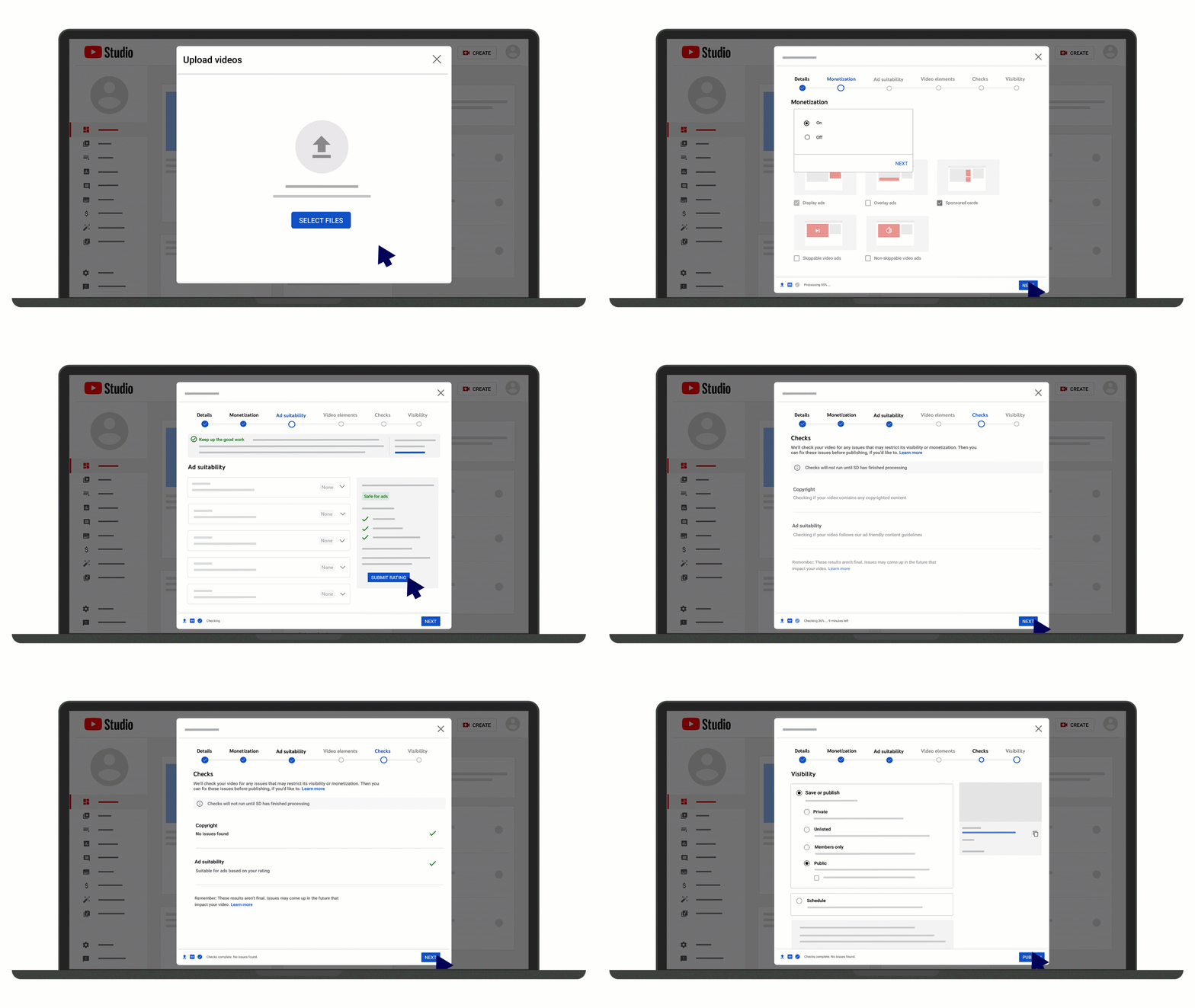
Create and Publish Your Videos

  • Pay Attention to “Watch-Time”

Since YouTube is the biggest video platform globally, it helps advertisers, entrepreneurs, marketers, and influencers earn regular income. To suggest the best videos to the users and decide their rankings, YouTube uses algorithms, and a metric is known as “watch-time.” In May 2019, people uploaded 30,000 hours of newly uploaded content per hour on YouTube. To boost their rankings, you need a strategy and a few action steps. First, you need to know how to increase the YouTube watch-time to gain visibility for your videos in YouTube search results.

Link Your Ads Account to Your Channel

The next step is to link your Google ads account to your YouTube channel. Remember, Google treats both the products as separate entities, so someone with access to Google Ads cannot change your YouTube campaigns or videos in the channel, even if Google owns both the platforms. Similarly, you can’t create Google Ads with the YouTube channel manager.

Here are the steps that you can follow to link both these accounts:

Steps to link a Google Ads account to a YouTube channel:

  1. Sign in to your YouTube Studio>>Click Settings>>Click Channel>>Click the Advanced settings tab.
  2. Click Link Account>>Enter a name for the link, a Google Ads customer ID>>Choose permissions to be granted.
  3. Click Done>>Click Save.
  4. Your YouTube channel will be linked to the Google Ads account after the Google Ads account’s owner approves your request.


Create Ads

Once you’ve launched your YouTube channel, you can start creating ads. Here are the steps to begin this process:

  • Choose a Bidding Strategy

There are majorly two types of bidding strategies available for Google ads. Cost-per-click or CPC, and cost-per-view or CPV. However, CPC is more popular. It is also considered less risky and easier to implement.

When you choose CPC, you pay for each click a user makes. On the flip side, with CPV, you only pay when a user watches the video for at least 30 seconds or an entire video if it is less than 30 seconds.

However, YouTube ads allow only CPV bidding, and it can be difficult for marketers who aren’t used to it.

This type of bidding is considered advantageous for the marketers as you will pay only when viewers watch your videos.

However, you should decide your budget before launching your ads, as with a CPV bid, you will pay for each video view. So, you have a minimal choice with CPV ads compared to CPC campaigns, wherein you are charged when someone clicks it.

Even though it’s tempting to increase your bid to get more traffic, you need to choose your bids carefully so that it doesn’t exceed your budget. The reason is CPVs fluctuate a lot when other advertisers adjust their bids or try to target different audiences.

How to Set Bids for Your YouTube Ads?

Your bidding strategy will largely depend on your business objectives, including the amount of traffic you want and the targeting strategy you choose. With Google Ads, you can target different groups through custom bidding.

  • Control Your Targeting

The effectiveness of your ads depends on whether they are served to the right people. With some fantastic targeting options, you can be sure that the right people are watching your videos.

For better targeting, you have the following options:

  • Choose Relevant Topics

To ensure that your ads are served to the right audiences, you must carefully choose your topics. First of all, make sure that the topics you choose are relevant to your niche. For example, you can’t serve the ad of online coding classes on the recipe videos.

Google helps you with choosing topic categories and subcategories and provides you with thousands of choices. So, if “fast food cravers” seem like too broad a topic, you can select “sea-food lovers” as a subcategory.

In the beginning, choose a few categories and keep on testing.

  • Target User Interests

To help you with laser-focused targeting, Google has now introduced many new targeting options based on interests. For example, you can choose sports lovers as your target audience and further narrow it down to tennis lovers. It will improve conversion.

  • Target Specific YouTube Videos

To find the most relevant audiences for your products, you can also choose and target specific YouTube videos to run your ads. All you need to ensure is that the particular video has high traffic on it.

  • Target Search Terms

Search terms can be the best way to target your audiences precisely. Research the keywords using a tool as you do while running a Google Ads campaign. Google Keyword Planner allows you to research keywords people use in the YouTube search bar. It helps your ads to appear in the same match cases.

To sum up, YouTube offers many targeting and filtering options according to demographics and user behaviour, which you can test for effectiveness.

  • Construct Your Ad

After zeroing in on your targeting options, you can create your ad. Once again, you have a variety of options to choose from.

What Are Your Ad Options?

Different types of ads are needed for different kinds of campaigns. For example, you can choose a video Ad to play before or after the video and whether it can be skipped or not.

Here are some of the ad formats which you can use:

  1. Video Ads – These ads play before you are allowed to watch a video. With these video ads, you can also show a banner ad almost free of cost. You can place it next to your in-stream ads. Some of these ads can be skipped, while most can’t. If you can’t skip the ad, its maximum length can be up to 15 seconds. If you can skip the ad after 5 seconds, its length can be up to 60 seconds.
  2. Overlay Ads – These ads are meant only for the desktop version of YouTube. They appear in the form of a rectangular and semi-transparent strip on the bottom 20% of the videos you choose to show your ads. These ads are primarily text-based.
  3. In-Search Ads – These ads are displayed at the top of the search results page on YouTube. You can easily spot them as they appear on top below “filters” and above organic results. In addition, these ads are less intrusive than the regular video ads that pop up when a video is playing.
  4. Discovery Ads – These are thumbnail image ads found in the top right corner of the result pages on YouTube.

Choose a Video for Your Ad

The next item in your checklist is a video you have to create and upload to your YouTube channel to display your ad. You can choose any other video, but it should contain your ad message. Make sure that your video’s length is within the specified limit for your ad type. You should pay attention to the other aspects of the ad, such as the stage of the buyer’s journey and their psychographics, while creating a video for your ad.

If they are looking for introductory or how-to videos, serve them educational content.

If they are looking for videos related to your company, brand, or financial results, it is time to pitch them your product in the video ad.

Set the Destination for Your Ad

Google Ads allows you to choose the destination where you want your visitors to land. It could either be your YouTube channel or one of your videos. However, in the early stages of the sales funnel, sending your visitors to your YT channel would be a more sensible step, as it will allow them to browse your brand videos and learn more about your brand.

On the flip side, if you target the users at the end of the sales funnel, where people are ready to convert, you can link to videos with a clear call-to-action.

However, regular testing will help you know if your choice of destination for your YouTube ad is correct or not.

Tip: Try to engage with your audience with your YouTube ad campaign. Craft your ads to target your desired customer base and to achieve your conversion goals.


Image Source


SEO, Keyword Analysis, and A/B Testing

You can save time and grow your YouTube channel by downloading a browser plugin. It will help you perform advanced keyword research, reduce publishing time, rank higher in search results, get more views and subscribers, and test, tweak, and attract traffic.

Browser plugins will also help you with the following:

  1. Auto translation for global viewership
  2. Auditing your videos and channel
  3. Tag suggestions
  4. Keyword research
  5. Search rank tracking
  6. Video A/b testing

YouTube Advertising Best Practices

YouTube offers a powerful advertising engine, but the success of your campaign depends on how well your videos connect with your audience. Here are a few tips that will help you immensely:

  1. Grab the attention of your audiences through familiar faces, moods, emotions, and music
  2. Focus on branding for the top of the funnel viewers
  3. Use storytelling and emotional appeal
  4. Add a solid call to action and tell people what to do next
  5. Use templates if it produces better results

Final Words

With over one billion users, YouTube is undoubtedly the most popular video-sharing site. In addition, the site has over 1 billion users, making it the favorite website for marketers to find their target audiences easily.

Creating and running video campaigns can be comparatively easy, but you won’t achieve the required ROI if you don’t use predefined audiences. Don’t overspend in the beginning and create a scalable video campaign structure. The key to success and profitability is setting your campaigns the right way and refining them using analytics.

Achieving your conversion goals may require a lot of work. For example, creating video ads that engage and convert requires targeting and consistent testing & tweaking.




By Chkad Kodary

Sourced from readwrite


The report says Amazon made $121 billion this year alone from the fees it charges sellers

The massive reach of Amazon’s e-commerce platform is appealing for any small business that wants to sell its products online. But a new report suggests that the cost of doing business can become a Faustian bargain for a third-party seller, as the fees that Amazon charges them can quickly eat into profits.

Amazon Toll Road, a report from the non-profit Institute for Local Self-Reliance (ILSR), found that Amazon charged third-party sellers a total of $121 billion in fees this year alone. According to the report, written by ILSR co-director Stacy Mitchell, those fees — for things like advertising, referrals, and shipping — usually mean that small businesses lose money to Amazon; Mitchell said that in 2014, sellers paid Amazon $19 of every $100 in sales, and today, it’s more like $34 per $100 in sales.

And, Amazon obscures the profit it makes from these small businesses in its financial reports, lumping it in with other less lucrative divisions “because showing that they generate these profits from small businesses is not a good look,” Mitchell said in an interview with The Verge.

But its Amazon Prime subscription service — believed to be a money loser for the e-commerce giant — provides Amazon a loyal base of shoppers who want to get their money’s worth of free shipping. The profits Amazon makes from seller fees subsidize the losses from its Prime division, according to the report.

“If you’re a company that makes or retails consumer products, you’re damned if you don’t sell on Amazon and damned if you do,” Mitchell said. A small retailer could try to use its own website to reach customers, but Mitchell says that’s often akin to “basically hanging your shingle out on a dirt road because of the role that Prime has in making Amazon often the first and only place customers go when shopping on the internet.” Former Amazon CEO Jeff Bezos said in his final annual letter to investors in April that by that point, Amazon Prime had grown to 200 million subscribers.

There are other e-commerce platforms where a small business could sell its products online, theoretically charging customers on those sites different prices than its Amazon customers. But if the seller also wants to continue selling on Amazon, it has to keep the same prices across the board. Under Amazon’s Fair Pricing Policy, a seller could be penalized if Amazon discovers the seller charging customers a different price for its products on other e-commerce platforms. Penalties can range from removing the seller’s product from the prominent “buy box” on a product listing page, all the way up to termination of selling privileges.

Amazon says the Fair Pricing Policy is aimed at pricing practices that “harm customer trust,” but the ILSR report concluded that it usually means customers may end up paying more overall because third-party sellers have to inflate the prices they charge customers to be able to pay Amazon’s fees and turn a profit, Mitchell explained.

Brooke Oberwetter, an Amazon spokesperson, said in a statement emailed to The Verge that the ILSR report was “intentionally misleading” and that it conflated Amazon’s selling fees with the cost of “optional services” that some sellers purchase, like logistics and advertising. Those fees range from 8 to 17 percent of the selling price, Oberwetter said. “These selling fees are highly competitive when compared to other selling options such as marketplaces like Walmart, Target, eBay, Etsy, and others, or direct-to-consumer via companies like Shopify and BigCommerce.”

In addition, Oberwetter said, some Amazon third-party sellers buy its Fulfilment by Amazon logistics service, which she said offered fulfilment services 30 percent cheaper than other logistics providers, as well as faster shipping.

“Some sellers also choose to purchase advertising from Amazon or use other advertising providers like Google, Facebook, and Twitter,” Oberwetter added. “Sellers are not required to use our logistics or advertising services, and only use them if they provide incremental value to their businesses.”

This assertion that the seller fees are not mandatory echoes testimony Bezos gave before Congress last year. Asked by Rep. Mary Gay Scanlon (D-PA) about what appeared to be sharp increases in the fees sellers pay to Amazon, Bezos said, “When you see these fees going up, what’s really happening is that sellers are choosing to use more of our services that we make available.”

The ILSR report, however, posits that the fees are all but necessary if sellers want their products to be visible in places like Amazon’s “customers who also viewed this item” carousels on search results pages. And unlike other forms of advertising, where a business places ads, reaches customers, then sells to those customers directly, Amazon’s policies limit most sellers from building these kinds of direct customer relationships. But, Amazon did test a feature earlier this year that would let sellers contact customers directly.

Mitchell writes in the report that an effective policy solution would separate Amazon’s divisions — marketplace, retail, AWS, and logistics — into standalone companies. She said a breakup of Amazon seems more likely than it has in recent years; the new chair of the Federal Trade Commission, Lina Khan, “sees the dangers of big tech.” Earlier this year, Amazon actually petitioned to have Khan recuse herself from being involved in proceedings that dealt with the company. And while there’s been an overall increase in antitrust scrutiny by President Biden’s administration and from Congress, Mitchell notes, whether there’s enough momentum behind the renewed focus on antitrust issues remains to be seen.

“A year ago, if you had asked me would we have bipartisan antitrust bills in Congress with the kinds of co-sponsorship we’re seeing, I would have been surprised by how much progress has been made,” she said. “We’ve gotten a lot further a lot faster than expected.”

Feature Image Credit: Illustration by Alex Castro / The Verge

Sourced from The Verge

By Maxwell Timothy

If you stick to known vendors and legitimate websites, shopping online is generally secure. But you should always remain vigilant.

If you shop online frequently, there’s a huge chance you’ll run into a scam vendor. These vendors are either going to sell you fakes or brazenly take your money without delivering any goods at all.

They model their operations to resemble legitimate vendors. This makes it incredibly hard to notice their malicious intentions until it’s too late. You can run into them on any open eCommerce marketplace like Amazon, Aliexpress, and Taobao. To stay safe when shopping online, it’s important to be on the lookout for telltale signs of malicious vendors.

Here are useful tips to help you spot scam vendors when shopping online.

1. Check the Origin of Shipment

Researching a vendor

The location of a vendor holds immense weight in determining your chances of them scamming you. While scam vendors can operate from anywhere in the world, some countries are more likely to be a base for scam vendors than others.

China, Turkey, Singapore, and Thailand are well-known havens for scam vendors. China is particularly notorious. Statista places China as the single largest origin of fake products worldwide. China accounts for 62.5% of fake products circulating globally.

Ecommerce marketplaces like Amazon and China-based Taobao and Aliexpress are prime examples of hosts for malicious Chinese vendors.

Unfortunately, some vendors falsely claim to ship from places like Canada or the US in other to avoid the scrutiny of consumers. Watch out, during your transaction, for any signs that a vendor is shipping from a location different from their claim. If you spot any, proceed with extreme caution or cancel the order altogether.

However, it would be unfair—and unnecessary—to completely blacklist vendors from high-risk countries. There are still a lot of legitimate vendors shipping from these locations. Rather, commit to closer scrutiny when dealing with vendors from high-risk countries. The origin of a shipment shouldn’t be the ultimate deciding factor.

2. Look Up the Vendor on Social Media

verified business on Twitter

Most legitimate businesses try to maintain a considerable social media presence. If a vendor has no social media footprint, you should flag it as suspicious.

Look up the vendor on Facebook, Twitter, Instagram, Pinterest, and other relevant social media platforms. Visit their pages and scroll around. Pay attention to how they engage with followers. Check out how frequently they post updates and the nature of feedback they receive.

Ideally, the vendor’s social media page should be verified. However, the majority of legitimate businesses aren’t verified. A lack of verification doesn’t necessarily imply that a business profile is malicious.

The number of followers on a vendor’s page also matters. A vendor’s following can vary depending on their popularity. But legitimate businesses should typically have a considerable number of followers.

On Facebook and other social media platforms, you should be able to find out how long an account has been active. If a vendor’s page seems too recent, it’s a red flag. If it is an old account, check to see that the account wasn’t only recently repurposed as a business’ social media profile.

If you see past activities from the account that seem unrelated to the vendor’s business, that’s another red flag.

By Maxwell Timothy

Sourced from MUO


By D. Cooper

Is this the end for the consent pop-up?

An Irish civil rights group believes that it has successfully exposed the so-called legal fictions that underpin the online advertising industry. The Irish Council for Civil Liberties (ICCL), says that Europe’s data protection regulators will soon declare the current regime illegal. At the heart of this complaint is both how the industry asks for permission, and then how it serves adverts to users online. Describing the situation as the “world’s biggest data breach,” the consequences of the ruling could have staggering ramifications for everything that we do online.

“The world’s biggest data breach”

Real-Time Bidding (RTB) is the mechanism by which most online ads are served to you today, and lies at the heart of the issue. Visit a website and, these days, you will notice a split-second delay between the content loading, and the adverts that surround it. You may be reading a line in an article, only for the text to suddenly leap halfway down the page, as a new advert takes its place in front of your eyes. This delay, however small, accommodates a labyrinthine process in which countless companies bid to put their advert in front of your eyes. Omri Kedem, from digital marketing agency Croud, explained that the whole process takes less than 100 milliseconds from start to finish.

Advertising is the lifeblood of the internet, providing social media platforms and news organisations with a way to make money. Advertisers feel more confident paying for ads, however, if they can be reasonably certain that the person on the other end is inside the target market. But, in order to make sure that this works, the platform hosting the ad needs to know everything it can about you, the user.

This is how, say, a sneaker store is able to market its wares to the local sneakerheads or a vegan restaurant looks for vegans and vegetarians in its local area. Companies like Facebook have made huge profits on their ability to laser-focus ad campaigns on behalf of advertisers. But this process has a dark side, and this micro-targeting can, for instance, be used to enable hateful conduct. The most notable example is from 2017, when ProPublica found that you could target a cohort of users deemed anti-semitic with the tag “Jew Hater.”

Every time you visit a website, a number of facts about you are broadcast to the site’s owner including your IP address. But that data can also include your exact longitude and latitude (if you have built-in GPS), your carrier and device type. Visit a news website every day and it’s likely that both the publisher and ad-tech intermediary will track which sections you spend more time reading.

This information can be combined with material you’ve willingly submitted to a publisher when asked. Subscribe to a publication like the Financial Times or Forbes, for instance, and you’ll be asked about your job title and industry. From there, publishers can make clear assumptions about your annual income, social class and political interests. Combine this information — known in the industry as deterministic data — with the inferences made based on your browsing history — known as probabilistic data — and you can build a fairly extensive profile of a user.

“The more bidders you have on something you’re trying to sell, in theory, the better,” says Dr. Johnny Ryan. Ryan is a Senior Fellow at the ICCL with a specialism in Information Rights and has been leading the charge against Real-Time Bidding for years. In order to make tracking-based advertising work, the publisher and ad intermediary will compress your life into a series of codes: Bidstream Data. Ryan says that this is a list of “identification codes [which] are highly unique to you,” and is passed on to a number of auction sites.

“The most obvious identification is the app that you’re using, which can be very compromising indeed, or the specific URL that you’re visiting,” says Ryan. He added that the URL of the site, which can be included in this information, can be “excruciatingly embarrassing” if seen by a third party. If you’re looking up information about a health condition or material related to your sexuality and sexual preferences, this can also be added to the data. And there’s no easy and clean way to edit or redact this data as it is broadcast to countless ad exchanges.

In order to harmonize this data, the Interactive Advertising Bureau, the online ad industry’s trade body, produces a standard taxonomy. (The IAB, as it is known, has a standalone body operating in Europe, while the taxonomy itself is produced by a New York-based Tech Lab.) The IAB Audience Taxonomy (subsequently revised to version 1.1) will codify you, for instance, as being into Arts and Crafts (Code 1472) or Birdwatching (435). Alternatively, it can tag you as having an interest in Islam (602), Substance Abuse (568) or if you have a child with special educational needs (357).

But not every bidder in those auctions is looking to place an ad, and some are much more interested in the data that is being shared. A Motherboard story from earlier this year revealed that the United States Intelligence Community mandates the use of ad-blockers to prevent RTB agencies from identifying serving personnel, data which could wind up in the hands of rival nations. Earlier versions of IAB’s Content Taxonomy even included tags identifying a user as potentially working for the US military.

It’s this specificity in the data, coupled with the fact that it can be shared widely and so regularly, that has prompted Ryan to call this the “world’s biggest data breach.” He cited an example of a French firm, Vectuary, which was investigated in 2018 by France’s data protection regulator, CNIL. What officials found was data listings for almost 68 million people, much of which had been gathered using captured RTB data. At the time, TechCrunch reported that the Vectaury case could have ramifications for the advertising market and its use of consent banners.

The issue of consent

In 2002, the European Union produced the ePrivacy Directive, a charter for how companies needed to get consent for the use of cookies for advertising purposes. The rules, and how they are defined, have subsequently evolved, most recently with the General Data Protection Regulations (GDPR). One of the consequences of this drive is that users within the EU are presented with a pop-up banner asking them to consent to tracking. As most cookie policies will explain, this tracking is used for both internal analytics and to enable tracking-based advertising.

To standardize and harmonize this process, IAB Europe created the Transparency and Consent Framework (TCF). This, essentially, lets publishers copy the framework laid down by the body on the assumption that they have established a legal basis to process that data. When someone does not give consent to be tracked, a record of that decision is logged in a piece of information known as a TC String. And it’s here that the ICCL has (seemingly) claimed a victory after lodging a complaint with the Belgian Data Protection Authority, the APD, saying that this record constitutes personal data.

A draft of the ruling was shared with IAB Europe and the ICCL, and reportedly said that the APD found that a TC String did constitute personal data. On November 5th, IAB Europe published a statement saying that the regulator is likely to “identify infringements of the GDPR by IAB Europe,” but added that those “infringements should be capable of being remedied within six months following the issuing of the final ruling.” Essentially, because IAB Europe was not treating these strings with the same level of care as personal data, it needs to start doing so now and / or face potential penalties.

At the same time, Dr. Ryan at the ICCL declared that the campaign had “won” and that IAB Europe’s whole “consent system” will be “found to be illegal.” He added that IAB Europe created a fake consent system that spammed everyone, every day, and served no purpose other than to give a thin legal cover to the massive data breach in at the heart of online advertising.” Ryan ended his statement by saying that he hopes that the final decision, when it is released, “will finally force the online advertising industry to reform.”

This reform will potentially hinge on the thorny question of if a user can reasonably be relied upon to consent to tracking. Is it enough for a user to click “I Accept” and therefore write the ad-tech intermediary involved a blank check? It’s a question that ad-tech expert and lawyer Sacha Wilson, a partner at Harbottle and Lewis, is interested in. He explained that, in the law, “consent has to be separate, specific, informed [and] unambiguous,” which “given the complexity of ad tech, is very difficult to achieve in a real-time environment.”

Wilson also pointed out that something that is often overstated is the quality of the data being collected by these brokers. “Data quality is a massive issue,” he said, “a significant proportion of the profile data that exists is actually inaccurate — and that has compliance issues in and of itself, the inaccuracy of the data.” (This is a reference to Article 5 of the GDPR, where people who process data should ensure that the data is accurate.) In 2018, an Engadget analysis of data held by prominent data company Acxiom showed that the information held on an individual can be often wildly inaccurate or contradictory.

One key plank of European privacy law is that it has to be easy enough to withdraw consent if you so choose. But it doesn’t appear as if this is as easy as it could be if you have to approach every vendor individually. Visit ESPN, for instance, and you’ll be presented with a list of vendors (listed by the OneTrust platform) that numbers into the several hundreds. MailOnline’s vendor list, meanwhile, runs to 1,476 entries. (Engadget’s, for what it’s worth, includes 323 “Advertising Technologies” partners.) It is not necessarily the case that all of those vendors will be engaged at all times, but it does suggest that users cannot simply withdraw consent at every individual broker without a lot of time and effort.

Transparency and consent

Townsend Feehan is the CEO of IAB Europe, the body currently awaiting a decision from the APD concerning its data protection practices. She says that the thing that the industry’s critics are missing is that “none of this [tracking] happens if the user says no.” She added that “at the point where they open the page, users have control. [They can] either withhold consent, or they can use the right to object, if the asserted legal basis is legitimate interest, then none of the processing can happen.” She added that users do, or do not, consent to the discrete use of their data to a list of “disclosed data controllers,” saying that “those data controllers have no entitlement to share your data with anyone else,” since doing so would be illegal.

[Legitimate Interest is a framework within the GDPR enabling companies to collect data without consent. This can include where doing so is in the legitimate interests of an organization or third party, the processing does not cause undue harm or detriment to the person involved.]

While the type of sharing described by the ICCL and Dr. Ryan isn’t impossible, from a technical standpoint, Feehan made it clear that to do so is illegal under European law. “If that happens, it is a breach of the law,” she said, “and that law needs to be enforced.” Feehan added that at the point when data is first collected, all of the data controllers who may have access to that information are named.

Feehan also said that IAB Europe had practices and procedures put in place to deal with members found to be in breach of its obligations. That can include suspension of up to 14 days if a violation is found, with further suspensions liable if breaches aren’t fixed. IAB Europe can also permanently remove a company that has failed to address its policies, which it signs up to when it joins the TCF. She added that the body is currently working to further automate its audit processes in order to ensure it can proactively monitor for breaches and that users who are concerned about a potential breach can contact the body to share their suspicions.

It is hard to speculate on what the ruling would mean for IAB Europe and the current ad-tech regime more broadly. Feehan said that only when the final ruling was released would we know what changes the ad industry will have to institute. She asserted that IAB Europe was little more than a standards-setter rather than a data controller in real terms. “We don’t have access to any personal data, we don’t process any data, we’re just a trade association.” However, should the body be found to be in breach of the GDPR, it will need to offer up a clear action plan in order to resolve the issue.

It’s not just consent fatigue

The issue of Real-Time Bidding data being collected is not simply an issue of companies being greedy or lax with our information. The RTB process means that there is always a risk that data will be passed to companies with less regard for their legal obligations. And if a data broker is able to make some cash from your personal information, it may do so without much care for your individual rights, or privacy.

The Wall Street Journal recently reported that Mobilewalla, an Atlanta-based ad-tech company, had enabled warrantless surveillance through the sale of its RTB data. Mobilewalla’s vast trove of information, some of which was collected from RTB, was sold to a company called Gravy Analytics. Gravy, in turn, passed the information to its wholly-owned subsidiary, Venntel, which then sold the information to a number of federal agencies and related partners.

i
This content is not available due to your privacy preferences. Update your settings here, then reload the page to see it.

This trove of information may not have had real names attached, but the Journal says that it’s easy enough to tie an address to where a person’s phone is placed most evenings. And this information was, at the very least, passed on to and used by the Department of Homeland Security, Internal Revenue Service and US Military. All three reportedly tracked individuals both in the US and abroad without a warrant enabling them to do so.

In July 2020, Mobilewalla came under fire after reportedly revealing that it had tagged and tracked the identity of Black Lives Matter protesters. At the time, The Wall Street Journal report added that the company’s CEO, in 2017, boasted that the company could track users while they visit their places of worship to enable advertisers to sell directly to religious groups.

This sort of snooping and micro-targeting is not, however, limited to the US, with the ICCL finding a report made by data broker OnAudience.com. The study, a copy of which it hosts on its website, discusses the use of databases to create a cohort of around 1.4 million users. These people were targeted based on a belief that they were “interested in LGBTQ+,” identified because they had searched for relevant topics in the prior 14 days. Given both the unpleasant historical precedent of listing people by their sexuality and the ongoing assault on LGBT rights in the country, the ease at which this took place may concern some.

Looking to the future

On November 25th, the APD announced that it had sent its draft decision to its counterparts in other parts of Europe. If the procedure doesn’t hit any roadblocks, then the ruling will be made public around four weeks later, which means at some point in late December. Given the holidays, we may not see the likely fallout — if any — until January. But it’s possible that either this doesn’t make much of a change in the ad landscape, or it could be dramatic. What’s likely, however, is that the issues around how much a user can consent to having their data used in this manner won’t go away overnight.

Feature Image Credit: #Urban-Photographer via Getty Images

By D. Cooper

Sourced from engadget

By

Jack Dorsey’s legacy as Twitter’s CEO is deeply mixed and one that doesn’t give his successor, Parag Agrawal, a smooth path forward.

Since its founding in 2006, the company has grown to 211 million active daily users, 37 million of them in the US as of September 30. It plays an important role in global politics, brand building, and daily discussions on an array of topics but also is a growing source of hate speech, conspiracy theories, and worsening mental health. Experts told Insider the company needs to address Dorsey’s missed opportunities regarding monetization, product development, and content controls.

During his leadership stints (2006-11 and 2015-21) Dorsey has been questioned for his “hands-off” leadership approach. He’s been public about his two hours of daily meditation, his 5-mile walk-commutes to work, plans to spend three to six months in Africa, and how often he delegates major decisions to people like Agrawal at both Twitter and the fintech payments company Square.

Here are the five most important missed opportunities, according to experts.

1. Banning Trump too slowly

On January 8, two days after the insurrection on the US Capital, the Twitter account for then-President Donald Trump was suspended indefinitely. But the move came after the account @realDonaldTrump sent out two tweets widely seen as increasing risk of “further incitement of violence,” the company said in a blog post.

For years, Trump was known for being controversial, insulting, and racist on Twitter, including making inflammatory comments about specific House Democrats. The account had 88.7 million followers at the time of its closure, but that number wasn’t necessarily an accurate representation of its popularity. One report in 2018 found 61% of the followers were bots, spam, inactive, or propaganda. Jane Lytvynenko, a senior research fellow at Harvard, wonders what would have happened if Dorsey had acted earlier.

“Would we have ended up with the shitstorm that was 2020 and disinformation had Jack Dorsey and Twitter decided to ban Trump in 2018, after the North Korean missile scare?” Lytvynenko asked.

A 2018 Gallup poll found 76% of Americans were aware of Trump’s Twitter usage, but only 4% of Americans overall have a Twitter account themselves, followed Trump’s account and read all or most of his tweets. The company also said it continued to gain users in January after Trump’s account was banned.

“We are a platform that is obviously much larger than any one topic or account,” Dorsey said during an earnings call that referenced Trump’s suspension from the platform.

2. His handling of misinformation

Research published in 2014 showed how the platform helped spread misinformation during the Boston Marathon bombing and the Ebola outbreak. During Dorsey’s second tenure, new research continued to show how Twitter enables the spread of false news much more quickly than true reports, particularly during the COVID-19 pandemic.

“There’s much more that Dorsey could have done to address the problem domestically and internationally,” Lytvynenko said. “The problems that he was grappling with as a CEO persist. I don’t know if he succeeded in resolving them. I would say that he sort of left the job unfinished.”

3. His handling of harassment, death threats, and hateful content

Harassment and hate speech have been consistent issues at Twitter. Dorsey has been taken to task about this several times, as recently as last year during a Senate committee hearing. The platform has been criticized for its delayed or lack of response to white supremacist, Nazi, anti-Semitic, or anti-Muslim content, especially the disproportionate abuse and death threats directed toward people of color, specifically Black women.

In 2016, the actress Leslie Jones was targeted with racist and sexist memes. Dorsey reached out to Jones and later said the abuse and harassment were not part of “civil discourse” and promised more improvements. In 2018, he acknowledged how Twitter had become known for negative kinds of content.

“We have witnessed abuse, harassment, troll armies, manipulation through bots and human-coordination, misinformation campaigns, and increasingly divisive echo chambers,” Dorsey wrote in a tweet. “We aren’t proud of how people have taken advantage of our service, or our inability to address it fast enough.”

In 2019, Dorsey said the company had not done enough to combat abuse online. Later that year, he was grilled about the issue by the head of TED, Chris Anderson, and Whitney Pennington Rodgers, TED’s current affairs curator. Dorsey said Twitter was trying to be more proactive through machine learning and the use of algorithms to identify abusive tweets, “so we can take the burden off the victim completely.”

4. Failure to better monetize advertising and marketing

Twitter has become an essential part of mainstream media and the political economy worldwide. Politicians who build large followings on the platform can see real benefits, like raising more money and increasing their chances of being elected. Brands can go viral.

But a lot of Twitter’s viral engagement has been organic, rather than through paid promotion or marketing, said Pinar Yildirim, associate professor of marketing at the University of Pennsylvania. “He missed a lot of opportunities to increase the company’s advertising share compared to other social-media platforms.”

The company also banned political advertising in 2019.

Yildirim said Dorsey’s ideals were focused on making Twitter a place for open discussion instead of trying to target them with lots of advertising and monetization like Facebook. “They remained very limited in these functionalities, which eventually made Wall Street not so happy.”

5. Slow product updates

One of the biggest changes during Dorsey’s time as Twitter’s CEO was the shift from 140 characters to 280 in 2017. But Yildirim said Dorsey’s vision kept the platform “in many ways, frustratingly, too simple.”

Yildirim said in her research and interviews with Twitter employees, the company has been working on ideas for monetization and to enhance the customer user experience, but they haven’t materialized. “They have tried many different things, many different beta products,” she said. “And somehow it hasn’t really been embedded into products. They have a long way to go.”

Feature Image Credit: Joe Raedle/Getty Images

By

Sourced from INSIDER