Author

editor

Browsing

By Queenie Wong

You can get rid of the last 15 minutes of your Google search history. We’ll show you how to do it.

Did you just search something embarrassing on Google? Whatever your reason for searching may be, Google has a quick and easy way to delete those last search queries. (You can check out how to stop Google from tracking you and how to automatically delete your location and activity history, too.) The feature, which the search giant unveiled at its Google I/O developers conference in May, is among a handful of options designed to protect user privacy.

While Google didn’t get into the nitty-gritty of the various reasons why someone might want to expunge the record of their search history, the company did demonstrate how to do it, along with hiding select pictures from Google Photos.

You can watch in the video below, or scroll down for instructions on how to delete your recent search history.

How to quick-delete your Google search history from the last 15 minutes

Step 1: Tap on your profile picture to access your menu.

Step 2: Click Delete last 15 minutes.

That’s it! When you’ve done that, Google will erase all your search history from the previous quarter of an hour.

For more, check out how to control what information your apps can access in Android 12 and six hidden Google Maps tricks.

Feature Image Credit: Sarah Tew/CNET

By Queenie Wong

Sourced from C/NET

Sourced from edX

Social media management isn’t just about great photos and videos or learning today’s hottest platform; it’s about translating marketing fundamentals and core skills across all platforms, to inform a data-driven approach that fits into a broader marketing strategy.

So what does that look like in practice? We asked resident edX social media expert Livia Halltari for her insights.

What Makes a Good Social Media Manager?

Whatever your age and level of personal experience, transitioning into a social media career will take some learning. Running your own social media account is very different from managing one for an employer or client. A successful social media manager stays on top of trends, platforms, and social media management tools to schedule posts, monitor analytics, and more.

In other words, you must embrace lifelong learning, whether you plan to stay in social media long-term or hope to advance to other marketing roles in the future, and whether your aspirations are full-time or freelance. Working in social media provides great insight into a wide range of marketing roles and makes an ideal launch pad into the industry.

“Social is one of the most generalist marketing roles you can get,” said Halltari. “You really gain exposure into how email does their work, how content marketing does their work, and how PR, design, and copywriters do their work because you’re working with all these different teams so closely. And you gain experience advocating for yourself, reporting, and the analytical part of marketing, as well as the creative, interactive, brand-focused part. It’s the kind of role where you gain a really foundational knowledge of marketing.”

layer “It’s the kind of role where you gain a really foundational knowledge of marketing.”

Forbes, she added, is calling today’s social media managers “the next generation of CMOs,” and with this holistic background, they are certainly on track to be.

Building A Social Media Skillset on Marketing Foundations

There are many different marketing skills and backgrounds that can usefully inform a social media career, and many of them have their basis in general marketing. Here, we picked just a few of the most important to unpack.

  • Brand marketing: To build lasting connections with customers, companies must establish a strong brand perception, and few avenues facilitate this as well as social media. Storytelling and visuals are the mechanics by which this perception and relationship are built, so these are key areas to upskill when breaking into the field.
  • Analytics: The data is out there. You, as a social media manager, must know where to retrieve it and what to do with it. You must be able to draw conclusions from metrics like followers, page views, clicks, likes, shares, comments, and impressions and form a plan of action in response.
  • Reporting: This skill isn’t just about collecting and sharing data with leadership; it’s about curating data. Halltari says you can set yourself up for success by working with leadership early on to determine goals and the metrics by which you’ll measure success. Only then can you create useful goals, forecasts, and benchmarks.
  • Communication: Not only are you the public voice of the organization—you also need to effectively work with internal stakeholders to develop and adapt strategies, as well as collaborate across the marketing department and beyond.
  • Writing: Nothing can take the place of good storytelling and content. Your copywriting should be concise, evocative, and tailored for the appropriate audience or platform. A background in creative writing, English, or literature can be invaluable.
  • Project management: Organizational and time management skills are key. You need to be able to plan ahead and post content consistently, juggle simultaneous projects, align calendars, and communicate, collaborate, and delegate to members of the marketing team.
  • Design: While it’s not necessary to be a master of graphic design, it helps to know the basics. Social is ultimately a visual channel, and a heavily saturated one—it takes unique images to stand out against the competition. Especially in smaller companies where social media marketers often wear many hats, an understanding of design practices and tools is a valuable skill to have.
  • Strategy: How does your social media strategy fit into the bigger picture? Understanding context, target audience, and analytics can help shape social media into a powerful piece of a company’s overall business strategy.
  • Customer Service: A background in sales or customer service can be valuable, as these roles overlap with some key components of marketing such as conversion, awareness, and customer acquisition. If you’ve worked in retail, then you understand the importance of addressing customer complaints promptly, and social media is no different: You must be prepared to pivot at any time to respond to customers or developing trends.

If you are just breaking into the field, start by learning the fundamentals of digital marketing, especially if you are using social media as a launchpad for greater marketing career aspirations. An entry-level job in social media can be even more powerful than a classroom for honing skills and picking up new ones, so it’s a great way to learn about a variety of marketing roles and decide which one is right for you.

How to Become a Social Media Marketing Manager: 5 Steps

Some useful backgrounds for social media specialists include business, marketing, advertising, public relations, communications, psychology, writing, public speaking, and photo or video skills. But you may be surprised that social media mavens can also come from backgrounds as diverse as political science, fashion design, or retail. In this field, you can start from anywhere, with little to no experience. Here’s how:

1. Close skill gaps

Developing a few key marketing skills will serve you well, and you don’t have to get a college degree to learn them. According to Halltari, hiring managers are more interested in examples of project management, organization, good communication, strong copywriting, adaptability, eagerness to learn, and the ability to work independently as well as with a larger marketing team. A bachelor’s degree is just icing on the cake.

2. Learn Social Media Platforms and Marketing Analytics

Get to know the strengths and weaknesses of major social media channels: Facebook, Instagram, LinkedIn, Twitter, YouTube, and Pinterest. Study how your competitors are using these social networks. Familiarize yourself with tools for scheduling and publishing content, social media listening, analytics, and more. But remember that basic familiarity is just the first step. You must continue to build your skill set.

“Employers don’t want to know if you use those platforms to develop and manage your personal social media accounts,” said Ewelina Lacka, lecturer in digital marketing and analytics at the University of Edinburgh Business School and instructor for the Digital Marketing Fundamentals Professional Certificate program on edX. “They want to know if you understand how to use social media to achieve marketing goals.”

Online courses can help you learn about tools like Google Adwords, WordPress, and Facebook Ads, as well as teaching evergreen skills like graphic design and SEO, which remain relevant even when the platform of the day inevitably changes.

Pro Tip:

edX_Icon_LearningNeuroscience “I am a big believer in the fundamentals of marketing. A real grasp of what is a positioning, and the related branding strategy, along with the 4 Ps [product, price, place, and promotion] is vital. An appreciation for what motivates or is important to a given target market is critical. Being able to put yourself in the shoes of the customer is a great skill. Writing and general communication skills are extremely important. Finally, any experience that puts you in front of customers is valuable, so seeing transactions of any kind is important because ultimately everything is marketed… or at least, it should be!”

Jeffrey Frohwein, instructor for the Marketing Foundations course from DoaneX

3. Gain Relevant Work Experience

The best way to master social media management is to do it. An internship is one avenue. Another option is to connect with small businesses or non-profits that need someone to manage their social media presence. Don’t be afraid to do free work while you’re learning, but also be sure to draw a line after which you will stop working for free and start charging clients as a freelancer or start looking for that salaried role.

If you’re pivoting to a new career and can’t currently accept unpaid work, then online certifications are another good option for upskilling. Or, simply create a social media account of your own and start building your online presence! After a few months, you should be able to demonstrate your ability to post consistently and grow your following.

4. Develop a Portfolio

Your portfolio is your key to social media success, whether you are working in-house or on a freelance basis. A portfolio demonstrates your work and its impact. Remember that experience does not have to be professional: Passion projects and side hustles can be a fun way to learn your way around platforms and discover the best strategies for each. Consider building a website to showcase your most successful social media posts.

5. Market Yourself to Potential Clients

Whether your goal is to land a salaried position working in social media or to go into business for yourself as a freelancer, you are a brand, and your ability to market yourself as such will show employers or clients that you can also successfully market their products or services.

Be aware, however, that social media is a highly competitive field. Instead of applying to jobs online, try attending conferences and small business events. Introduce yourself in person. Give people your card. Let them meet your brand face-to-face.

Pro Tip:

edX_Icon_LearningNeuroscience “The most important thing is the enthusiasm and willingness to learn and contribute.  Let’s face it, someone with all the certifications in the world is going to be a net loss if they have a poor attitude and are not willing to work with others and really see their role as a problem solver.  Technical skills are teachable, attitude is another matter,” said Frohwein, instructor for the Marketing Foundations course from DoaneX.
Start Learning Foundational Marketing Skills

Social media is constantly changing. Platforms and trends come and go. Algorithms evolve. Current events spark new conversations. Staying up to date on new channels is important, but it’s even more important to lay a good foundation. There are plenty of reputable resources online to help you upskill in marketing. Explore edX marketing courses to get started.

Sourced from edX

Sourced from The Association of Advertisers in Ireland

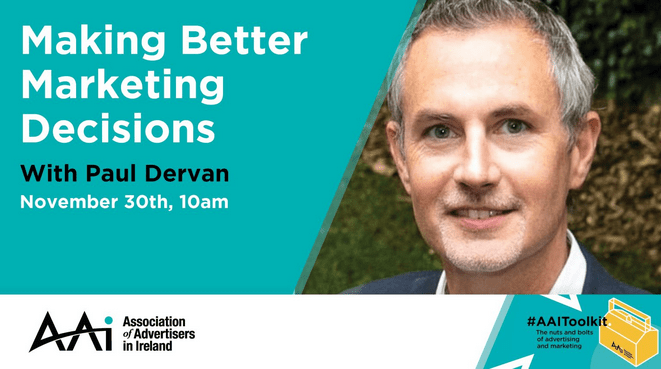
On Tuesday 30th of November, Paul Dervan joined us to host “Making Better Marketing Decisions” an event for anyone working in marketing and communications for brands and businesses.

In many ways, advertising is about trying to predict how our communications will influence future consumer behaviour. Predicting this successfully is very difficult. In this fascinating webinar – Paul Dervan shared insights on how to make better decisions in advertising – based on the mistakes he has made, the lessons learned and insights from the global experts he has tracked down and quizzed on effectiveness in marketing.

Paul is the author of ‘Run with Foxes – Make Better Marketing Decisions’ and also the CMO for Ireland’s National Lottery.

Over the past 20 years, Paul has held numerous leadership marketing positions in various companies. Previously he was the Global Brand Director at Indeed, the world’s largest and fastest growing job site, with over 250 million visitors every month.

He also started a Marketing Campaign Lab, where he created and tested hundreds of marketing experiments in America, Europe, Australia and Asia. Before that, Paul was with PokerStars, the world’s largest online poker brand, as Creative Director for their Full Tilt brand. Prior to that Paul was Head of Brand for O2 in Ireland and Brand Director for Telefonica Digital.

Sourced from The Association of Advertisers in Ireland

By

Fight back against intrusive ads and data collection on your smart TV with these tips

Here at Tom’s Guide, we love TVs, especially smart TVs. The move to internet-connected TVs that can run apps and stream from all your favourite services has largely been a good one, freeing people from the limited options of local broadcast channels and providing a whole landscape of alternatives to traditional cable subscriptions. There’s a reason that our best TVs list is almost entirely made up of smart TVs.

But there’s one aspect of smart TVs that’s not so hot. And that’s the whole range of invasive ads and uncomfortably detailed information that TV makers – including all of the best TV brands – are able to collect about your household’s viewing habits.

From what apps you open to what shows you watch, your TV is paying close attention to what you do, and reporting back so that the collected data can be used to tailor ads to you or to be sold to other groups (again, mostly advertisers).

smart tv

(Image credit: Dmitri Ma/Shutterstock)

Just recently an earnings report from Vizio revealed that advertising and viewer data was more profitable to the TV maker than the TV hardware itself, and Vizio’s not alone in this. According to an interview with Variety in 2018, Roku’s profitable advertising and licensing business reached 1 in 4 US households, and also made the lion’s share of money for the smart streaming platform.

It’s one of the reasons TVs have become so affordable in the last few years, because these advertising and data gathering opportunities provide an additional revenue stream for companies, making TVs profitable beyond the sale of the physical hardware. With smart TVs boasting software made by data-hungry companies such as Google and Amazon, this lucrative facet of the smart TV industry is a mainstay for every player on the TV aisle.

Using a variety of technologies, from tracking what shows you watch and which apps you open to matching up your viewing data with web browsing from other devices thanks to location and IP address information, smart TVs are gathering a lot of information. In the best case, that data is being used to provide you with more relevant ads and better content suggestions. More often than not, however, it’s also being sold to third parties.

The worst part? You likely gave them the okay to do all of it when you set up your TV in the first place. Powering on a new smart TV invariably includes a few brief screens of user agreements that rarely get a second glance from users as they hurry to get online and start streaming. But those brief screens often include user agreements that can be dozens or even hundreds of pages long. And it includes granting the TV permission to snoop on your viewing habits.

While there’s plenty to say about the ethical concerns around these practices, one thing is very clear: People want a way out.

So here are a few things you can do to fight back against the march of intrusive ads and creepy monitoring.

Opt out of ads and tracking

Finally, the easiest option  is to opt out of the ads and tracking where you can. Thanks largely to laws like Europe’s General Data Protection Regulation and the 2020 California Consumer Privacy Act, TVs sold in the United States have to offer users a way to opt out of most tracking and data collection.

The biggest offender comes in the form of Automated Content Recognition (ACR). This technology takes a small sampling of the pixels on your screen as a fingerprint to identify what content you’re watching. This lets the TV have a fairly high level of detail about your viewing habits  whether you are streaming through an  independent app or watching from an external device.

Turning off ACR will stop most data collection with a single setting change. But it’s not a one-size-fits-all solution. Data collection methods vary widely between brands, and the process is made a bit opaque by burying the options deep in the settings and using benign sounding names for tracking features.

Opting out of these practices will eliminate the majority of the worrisome behaviours, but it’s not a cure-all. There will very likely still be some information gathered on any connected device, and you will still be served ads and content recommendations, though they may not be fine-tuned to your tastes.

There’s also the justifiable fear that TV brands won’t fully honour an opt-out request. This is not an unfounded fear, because several major brands have been caught acting a little shady about these practices. Trusting them to honour a checkbox or a settings change that cuts off a major revenue stream is understandably suspect.

Raspberry Pi 4 Model B

(Image credit: Tom’s Guide)

Try a Pi-hole

If you want to keep the ability to stream while filtering out the ads and tracking you don’t want, one option you can try is to actively block just the unwanted traffic on your network. This can be done pretty easily with a device called a Pi-hole, a Raspberry Pi-based device that applies ad blocking scripts to every device on your network, and lets you monitor outgoing traffic.

To set it up, all you’ll need is an inexpensive mini PC, like the Raspberry Pi 3 Model B+ or the newer Raspberry Pi 4 Model B. From there, you can follow the handy instructions offered by our sister site, Tom’s Hardware to learn How to Block Ads Network-Wide With Pi-hole on Raspberry Pi.

Lobotomize your smart TV

Another simple method for cutting off any data practices that you find unwelcome is to stop it at the source, the internet connection. When setting up your TV, don’t connect it to Wi-Fi, and don’t plug in an Ethernet line. With no internet connectivity, your smart TV remains pretty dumb. (On some sets, an internet connection is mandatory to complete the setup, so this might render a TV so dumb as to be useless.)

If you already have a smart TV set up, you can still lobotomize it by performing a factory reset, which will wipe all of your apps and settings, but also lets you set up the TV like new, complete with the opportunity to skip the Wi-Fi sign in.

But, as with buying a dumb TV, dumbing down a a smart TV and cutting off the built-in features you paid for won’t appeal to everybody.

Buy a dumb TV

The easiest way to keep your TV private, without all the extra stuff, is to never invite it into your home. You can buy a dumb TV, one made just for flipping through channels and pulling in local stations. You can learn all about the options in our article How to buy a dumb TV — and why you’d want to.

The solution won’t be to everyone’s liking though, since it removes all of the handy features that make smart TVs so appealing in the first place. You can always add a measure of smart functionality by picking up one of the best streaming devices, but be aware that every streaming device (be it a smart TV or a streaming stick) will have some combination of data gathering and advertising.

How to disable ads and tracking on smart TVs

Here’s how to find the necessary menus and settings for your smart TV, categorized by brand and smart TV platform.

Amazon Fire TV

  • Go to Settings > Preferences > Privacy Settings
  • Select Device Usage Data to limit data collection
  • Select Collect App and Over-the-Air Usage to turn off content tracking for apps and broadcast channels
  • Select Interest-Based Ads to limit ad personalization

Android TV & Google TV

  • Go to Settings > About > Legal Information
  • Here you can disable personalized ads

On Sony TVs, you will also need to disable Samba TV

  • Go to Settings > Device Preferences
  • Turn off Samba Interactive TV to disable ACR

LG webOS

  • Go to Settings > Additional Settings > General
  • Select Live Plus to disable ACR
  • Select Advertisements and change the setting to “Do Not Sell My Personal Information”
  • Go to Settings > Additional Settings > User Agreements
  • Review terms of use and privacy policy and then opt out of Viewing Information, Voice Information, Interest-Based & Cross Device Advertising, and Live Plus Automatic Content Recognition

Roku TVs

  • Go to Settings > Privacy
  • Select Smart TV Experience to disable “Use Info from TV Inputs”
  • Select Advertising to adjust ad tracking settings
  • Select Microphone to adjust the settings for Channel Microphone Access and Channel Permissions

Samsung Tizen

  • Got to Settings > Support > Terms & Privacy > Privacy Choices
  • Select Viewing Information Services to disable ACR
  • Select Interest-Based Advertising to adjust ad personalization settings
  • Select Voice Recognition Services to adjust voice data collection

Vizio SmartCast

  • Go to Settings > Admin & Privacy
  • Select Viewing Data to turn off ACR
  • Select Advertising to to adjust ad tracking

Feature Image Credit: Samsung

By

Brian Westover is an Editor at Tom’s Guide, covering everything from TVs to the latest PCs. Prior to joining Tom’s Guide, he wrote for TopTenReviews and PCMag.

Sourced from tom’s guide

By Phil Rowley

We are heading for a demographic disruption that will redefine and reshape our relationship with consumers.

Imagine a demographic chart with age along the vertical axis and gender left and right of the horizontal. Traditionally, the distribution would take the form of a pyramid, with more young people at the bottom, and tapering toward the apex, as fewer people from older generations survive.

However, in the West, our demographic chart is coming to resemble not an Egyptian pyramid, but The Shard in London: fatter for longer and not tapering off until the very top.

In short, we are a society with more older people than ever before, a world where there will soon be more grandparents than grandchildren. And it’s going to intensify. By 2043, the U.K.’s Office of National Statistics projected an average life expectancy of 90.4 years for men and 92.6 years for women, leading commentators to express concerns that current healthcare systems are unsustainable over the long term.

Technology will fill the ‘care gap’

Not only will older people live longer, but there is also a prediction of a global lack of healthcare workers to look after them, with a shortfall of 9.9 million doctors, nurses and midwives expected by 2030. In some countries governments are already reviewing their immigration policies, knowing that carers will need to be secured from a shrinking global pool. Japan, meanwhile, has begun experimenting with robot carers.

This profound shift will require us to get to grips with understanding greater nuance and speciation among older demographics.

Phil Rowley, head of futures, Omnicom Media Group U.K.

Extending that thought, it is possible that tech giants will increasingly look to fill some of that care gap.

Google, Amazon and Apple are starting to view health as “IT for the body,” with investment in the digitization of health expected to reach $379 billion by 2024. Notably, Jeff Bezos has invested in a new “rejuvenation” startup called Altos Labs. Elsewhere, Google has bought Fitbit, and its Deep Mind algorithm is busy using AI to solve challenges with proteins for medication.

Together with the growth in wearables—projected to be worth nearly $120 billion by 2028—we are seeing growing democratization of knowledge of one’s own body, with tech enabling consumers to take a more active and regular role in their own healthcare.

The next stage, however, will be to optimize our organs, turbo-boost our cognitive functions and fine-tune our genetics. We will upgrade our bodies when they begin to wear out. Rebel gerontologist Aubrey de Grey predicts that in the next two decades humans will reach what he coined Longevity Escape Velocity in 2004, meaning the longer we live, the more likely we are to be alive to use ground breaking technologies to extend our lifespans even further.

Whether that happens remains to be seen, but we won’t have to wait long to see how this will impact marketing. There are already hints at how the industry will need a new frame of reference.

Marketing will focus less on young people

You can likely cite many marketing campaigns targeting older audiences, but it is often the younger, more aspirational segments that set the creative direction of messaging strategies. And while using Gen Z as a targeting proxy seems like a blunt instrument for generalizing a younger demo, this pales in comparison to the broad strokes given to older demos.

Look at the checkboxes on any mechanism seeking to segment by age. How often have you seen this: 16-24, 25-34, 35-44, 45-54, and then 55+. It’s as if anyone over 55 is, for all intents and purposes, identical in their needs and aspirations, and are all charting an inexorable course toward irrelevance and senescence.

This won’t cut it in the future. We’ll have to get to grips with the idea that adults will work longer and retire later, but go on living with more energy and more cash, and want the best life has to offer into their 70s, 80s and 90s.

Not only that but given brands have always yearned to be part of culture, consider for a moment the social, political and cultural impact of a generation that lingers. In the U.K., statistically, Brexit was delivered by older cohorts. Also, the rise of “anti-woke culture” is arguably enabled by a more vocal, active and swelling generation of “life veterans” pushing back on trends that don’t fit with their more traditional values. How are brands trading on progressive causes like LGBTQ rights or Black Lives Matter meant to connect with a growing, more influential, conservative cohort?

Is this a new phenomenon? No. Will it become more pronounced as the older generation continues to outnumber the younger generation? Yes.

A strategic shift

Crucially, then, this has important implications for how we pitch goods and services.

This profound shift will require us to get to grips with understanding greater nuance and specialization among older demographics. My previous generalization of the older generation as conservative and intolerant is a good place to start, and we would do well to subdivide this expanding and extended demo into more useful refined cohorts; finessing the messaging we employ, the channels we use, the need states we should be tapping into.


This demographic shift and its implications for marketing is likely to be one of the most profound disruptions in centuries.

Within marketing, rather than agencies clamoring to employ people young enough to understand what emerging cultural trends brands should exploit in their campaigns, they may instead need to lean on more experienced veterans and professionals to comprehend the needs of older demos.

Media strategies may come to be led not by the desire to cram more modern technologies into plans, but to work out ways of using existing and well-loved channels with greater efficiency, and to include older cohorts in campaigns rather than intimidate or exclude them. And all without condescension.

Brands, too, may need to work to ensure their products and services are appealing to older generations. Will consumers want a constant procession of new versions and upgrades? Can products be accessed by those impatient with the new intricacies and complexities that modernity inevitably brings?

This demographic shift and its implications for marketing is likely to be one of the most profound disruptions in centuries. With dramatically falling global fertility rates, and a fortified older generation, we’re headed for a planet populated by old people who will remain healthier for longer by using technology to maintain their own bodies.

Thus, the days of marketing sneakers to young people and stairlifts to old people may be coming to an end. Whereas previously we may have intoned “Get with the program, Granddad,” we will be required to get with granddad’s program.

Feature Image Credit: Nick Dolding/Getty Images

By Phil Rowley

Sourced from ADWEEK

By Sadaf Tanzeem

Here are some LinkedIn profile tips that will help you get more clients and show up in searches. Learn how!

If you’ve just stepped into freelancing, or you’re looking to get regular clients, you need a solid platform for them to land on. You can stand out from the crowd by optimizing your LinkedIn profile.

Follow these steps to set yourself apart from the crowd and show how you can help your prospective clients. Let’s dive right in.

1. Create and Upload a New Header

When a recruiter first lands on your profile, the first thing they see is your header. So you must ensure that it acts as an introductory element for you and specifies the necessary information.

A generic cover photo, like the one you may have on Facebook, can be a bad choice here. Instead, create a professional header using a picture editor. That’s because personal branding can help freelancers go miles.

Here’s the step-by-step process to create a header using Canva.

Step 1: The obvious: open the site.

Home page of platform Canva

Step 2: Click on the Create a Design button and start typing “LinkedIn” in the search bar. It’ll automatically show you the dimensions of the LinkedIn banners to use.

It’s wise to choose from the given dimensions. That’s mainly because if you select the dimensions yourself, and they turn out to be wrong after creating your design, you’ll have to pay a little fee to fix it.

Results by typing LinkedIn on the search box of Canva

After clicking on it, you’ll see a screen like this:

Blank LinkedIn banner on the screen

Step 3: Select one of the free or paid templates or upload your own background image.

Templates on the Canva library

After selecting the template, it’ll appear in the blank field like this:

Template in use for LinkedIn banner

Step 4: Add your picture to the banner by clicking on the Upload Media button given on the left side of the screen. The image will appear in your Canva gallery once uploaded.

Uploaded image on Canva library

Click on the image and drag it to the preview shown on the template, then release the button. The image will automatically appear in the round section of the banner. Once it’s there, rearrange it to get your face in the right position in the frame.

Placing image in the LinkedIn banner

If you’re creating a header from scratch, you can choose your frames from the Element section. Then upload the image in them as shown in the previous step.

Uploading frames from the element section of Canva editor menu

Step 5: Edit your headline by clicking on the text button at the left of the banner.

Editing the Headline on LinkedIn banner

If you’re creating an image from scratch, you can also add the headline by clicking on the text on the left side of the screen.

Text section in the menu of Canva

Step 6: Click on the expand button at the bottom of the page to review your banner once. You can adjust the positions of the text and the image if needed.

For instance, we may have to pull the banner headline a bit upward or the display picture may cover it on LinkedIn.

Optimized LinkedIn banner

Step 7: Save the image by clicking on the Download button in the top right corner of the screen. You can also select the format in which you want to download your image. I prefer PNG as it doesn’t compress your image while downloading.

Downloading the optimized LinkedIn header

Step 8: Once it’s all done, just upload the banner to your LinkedIn profile.

Optimized banner uploaded on LinkedIn profile

2. Edit Your Tagline

Your next step is to edit your tagline (or headline). It should be more than just plain text like “open to work”. So write something that clearly explains what type of freelancer you are—for instance: Pet writer, website designer, SEO consultant & specialist, UX designer, etc.

headline of LinkedIn profile

If you offer more than one service, you can add them all in your headline by separating them with a vertical bar (|). Consider writing you’re “Open to Work” or “Available for Hire” at the end, just to make sure your prospective clients get the idea.

3. Rewrite Your Summary

About section of Linkedin

Your LinkedIn profile summary is not just about the degrees you hold or what experience you have, but also about how you can actually help your potential clients solve the problem they’re facing.

So, brush up on your copywriting skills before you write this section. The following tips can help:

  • Define your prospects, ensuring they’re the ones you serve.
  • Describe their pain points, defining you get them.
  • Add your experience and credibility, explaining why you’re the best person to get help from.

4. Edit the Rest of Your Information

The next step is to optimize the rest of your profile.

Step 1: Start by personalizing your URL.

When you create a new LinkedIn profile, it gives you a generic and ugly URL. But don’t worry. You can change it. Just go to your profile and click on “Edit your profile and URL” at the right corner of the screen.

Profile and URL section

Then personalize your URL from here.

Custom URL field
successfully changed LinkedIn URL

Step 2: Upload your already published work in the featured section. It’ll help your potential clients take a look at your work if needed.

featured media section on LinkedIn

You can also upload media to this section to make your profile pop up. For instance, if you spoke at a conference or have made a great personal branding video, this is the place to add that. If you face difficulty uploading it, fix it like this.

Step 3: Add all the companies you’ve worked for in the past. If you’re a fresher, your volunteering experience will work just fine.

Experience field of LinkedIn profile

Step 4: Add your educational details in the following fields.

Education section of LinkedIn profile

Step 5: If you have any certificates and licenses, add them here.

Certificate and licenses section of LinkedIn profile

5. Less Known Ways to Find Work on LinkedIn

When it comes to finding work on LinkedIn, most people just click on the job searches and start applying. Even though that’s one of the good ways to find work, but that’s not all. You can leverage LinkedIn for more.

If you’re into cold pitching, consider exporting your LinkedIn connections on a spreadsheet. Yes, LinkedIn allows that. To export your connections.

Step 1: Click on My Networks.

Step 2: Click on Connections.

Step 3: Go to Manage and Sync contacts.

Step 4: Click on the Export Contacts button on the right section of the screen.

Step 5: Click on Archive Request.

request archive section

LinkedIn will send you an email when your downloads are ready.

Apart from this, use the advanced search option in different ways to find the best matches.

All filters for advanced search

Here are a few ways to do it.

  • Look for companies in the niches and the location you’re willing to serve.
  • Find people in your 1st, 2nd, and 3rd connections.
  • Search for people currently working in the company you’re looking for.
  • Find former employees of companies by selecting past companies in all filters. [Tip: Network with them. You may find a way to get in or find out about the person involved in the decision-making process.]
  • Locate people based on the language they speak, the categories they have listed on their profiles, and by using various keywords.

LinkedIn at Its Best

Most people check their LinkedIn profiles once or twice a week without realizing how much they’re missing out on.

Don’t be those people. Optimize your LinkedIn account to get the best out of it. Who knows, your potential client is looking for just what you have to offer, but it’s not clearly visible to them yet.

By Sadaf Tanzeem

Sourced from MUO


By Dan Pontefract

As the pandemic rages on yet offices begin opening back up, a new hierarchy is emerging. Like it or not, we’ve started prioritizing who we meet with when it comes to face-to-face or virtual meetings.

If you’re in sales, you already know what I’m referring to. You have existing clients and those that aren’t yet your customers. Some people refer to the latter as “new logos.” You want to meet with both types, and you’d certainly rather do so by meeting with people face-to-face. It’s what you’ve always done. You’ve mastered it.

Building “new logo” relationships can be quite tricky over Teams or Zoom when you’re not witnessing body language, or you’re unable to buy them a cocktail or lunch. It’s not like you can send a drink cart over to that person’s home as a way in which to break the ice about your product stack.

As people are slowly inching their way back into the office, many operate by working one, two or maybe three days a week. And with that reduction in office time, there is a corresponding decrease in the amount of available time to meet with people face-to-face.

And when there is less time to meet people face-to-face, it reasons to stand that office leaders and employees are prioritizing time differently than before the pandemic.

Some might even prioritize time with their peers over opportunities to be sold something by an account executive from a company they don’t know.

I attended my first face-to-face conference in 21 months this past week in Los Angeles. While it was great to finally meet people, swap stories, and have a few cocktails with live human beings, I made certain that almost every one of my conversations asked the question: how are you prioritizing your face-to-face time when in the office?

Those in sales—without any real difference in opinion—were feeling the difficulty of maintaining or building face-to-face relationships. “Nobody wants to meet me face-to-face because they think it’s easier to have meetings with me virtually,” said one account executive to me. “And what am I to do? Tell them they’re wrong?”

A couple of high-tech partners that I spoke to shared the same verdict. “We’ve conducted all of our meetings virtually for 20 months now,” said a leader, “and our clients see no reason to meet face-to-face.” She went on to say, “That’s their choice, not ours. But we’ve met this week face-to-face only because we’re both at this conference. And we have no future plans to meet face-to-face.”

Canvassing opinions from a group of practitioners and leaders, they unanimously stated that time in the office was being dedicated to brainstorming, creative thinking, training, one-on-one and team meetings, and other opportunities to bond. “We won’t have time to do anything else,” said one of the leaders I was speaking with.

Another was bold enough to tell me that there are certain internal meetings (and people) that are continuing to be virtual because they don’t want to waste their valuable face-to-face time on the “soul suckers of my time.” (Sidebar: I really liked that line.)

As we begin to sort out our hybrid working models, there are a few apparent elephants in the room to point out when it comes to conducting our time going forward:

  • How are you prioritizing time with members of your direct team?
  • What about team members on other teams or business units? Will you meet with them face-to-face, or is it a virtual-only mantra that you’re adopting?
  • And when it comes to people who do not directly work in your organization (sales, partners, suppliers, ambassadors, consultants, contractors, agencies, etc.), have you subliminally adopted a “they’re not worthy of my face-to-face time” ideology?

If I were you, I’d be spending some time crafting my own personal norms regarding how I want to be known when I’m in the office.

Don’t be that person who has instituted an invisible face-to-face meeting hierarchy. Instead, find an approach that is measured, balanced, and uses fairness when it comes to your time in the office.

You might be unknowingly ruining your reputation, let alone missing out on crucial opportunities that advance your understanding of how best to perform in your role.

Feature Image Credit: getty

By Dan Pontefract

Follow me on Twitter or LinkedIn. Check out my website or some of my other work here.

CEO, Author, Keynote Speaker, Leadership Strategist, Poet

Check out my 4th book, “Lead. Care. Win. How to Become a Leader Who Matters.” Amy. C. Edmondson of Harvard Business School calls it “an invaluable roadmap.” There’s also a self-paced online leadership development masterclass available. Nearly 100 videos across nine practical leadership lessons.

Sourced from Forbes

By

Global investment firm Abrdn (formerly known as Standard Life Aberdeen) has unleashed its first campaign since consolidating its business under a single brand in July.

‘The Power of Investment’ seeks to reframe high finance as a force for good by highlighting the positive impact research, industrial and real estate investors make from the development of prosthetic limbs to financing your favorite football team and equipping hospitals.

Amid images of happy, smiling beneficiaries of capital investments, a narrator informs viewers that “… when your investments do good things, so can you. We are millions of people, we are billions of pounds and together we are changing our future.”

Developed by Iris Worldwide, the uplifting campaign builds on Abrdn research, which found that 54% of the public believe that investing not only secures their financial future but can have a positive impact on society.

Reflecting a simplification of the Edinburgh-based firm, the campaign moves beyond cold pounds and pence to the societal benefits that accrue from efficient investment through real-world examples such as Sol and his dad Ben, who demonstrate how recent robotics advancements have enabled the mass production of prosthetic limbs.

Global investment firm Abrdn (formerly known as Standard Life Aberdeen) has unleashed its first campaign since consolidating its business under a single brand in July.

‘The Power of Investment’ seeks to reframe high finance as a force for good by highlighting the positive impact research, industrial and real estate investors make from the development of prosthetic limbs to financing your favourite football team and equipping hospitals.

Amid images of happy, smiling beneficiaries of capital investments, a narrator informs viewers that “… when your investments do good things, so can you. We are millions of people, we are billions of pounds and together we are changing our future.”

Developed by Iris Worldwide, the uplifting campaign builds on Abrdn research, which found that 54% of the public believe that investing not only secures their financial future but can have a positive impact on society.

Reflecting a simplification of the Edinburgh-based firm, the campaign moves beyond cold pounds and pence to the societal benefits that accrue from efficient investment through real-world examples such as Sol and his dad Ben, who demonstrate how recent robotics advancements have enabled the mass production of prosthetic limbs.

By

Sourced from The Drum

By Tess Wicksteed

When I first started in brand strategy, I was introduced to the ‘brand key’. One of many generic strategy models that ensures that all the right bits and pieces are in one place. I can remember thinking, “surely the key to a brand’s strategy should look and be different for each brand it unlocks, right?” I was such a greenhorn, I kept quiet, thinking that there was probably a good reason for it that I was too ignorant to understand. Some 25 years on and I’m not such a greenhorn and the same question still bothers me – strategy positions a brand, describing its relation to its competitors and to its consumers. It dictates the form of all that follows, so why is it formless itself?

After my early training in a pure brand strategy agency, I quickly moved into heading up the brand strategy in a design agency and have stayed in this realm ever since. It strikes me as the best place to create properly rigorous brand strategy because your work is always in conversation with reality – is this theory actionable? Can we create something from it or is it just clever-sounding hot air? Over time, another thing happened from being in a creative environment where things became real. I came to believe that, in order for it to inspire, a great activation strategy needs to be something more solid than a theory. It needs to practice what it preaches and establish a form to match its content.

I’ll give you two examples of what I mean. Allpress is an incredible quality coffee company from New Zealand. It has a B2B component selling bulk coffee to independent coffee shops and gorgeous branded retail hubs in NZ, Japan, and London. We repositioned the company for its next stage of growth – kicking off with global semiotics of coffee and a series of stakeholder interviews. The resulting positioning captured the soul of the company, the values of its founders, and added a healthy dose of aspiration for the future – when we were finished, it was a thorough and inspirational blueprint to unify all brand activity. Signed off by the management, the next step was to share it – to take that beautiful keynote/ppt and present the hell out of it. But here we were talking about independent thinkers in this utterly generic form – it just didn’t feel right. So we made a comic. The first strategic comic ever. The brand history, brand strategy, behavioural principles were all covered, and form and content were in harmony. The way we said it was half of the message.

The same was true of a very different brand – Farmacy, Camilla Fayed’s biodynamic gourmet restaurant. As a lifestyle brand, a flat document wasn’t going to cut it so we made a beautiful, moving, and evocative film that spoke the strategy through the head of its biodynamic garden – the source of its difference and its beliefs.

If we look to art and culture it has always been acknowledged that form and content must match, so why has strategy been allowed to become a neutral ‘theory’ that is then given form by a creative vision? A strong strategy will always have a form that can be brought to life creatively. Strategy needs to get off the fence, put a stake in the ground, and stand for something.

Feature Image Credit: jens schwan

By Tess Wicksteed

Sourced from Brandingmag

Sourced from TED Masterclass

You can’t always get what you want, but there is a way to increase your chances of a “yes.” We’re talking: persuasion.

Also known as the art of rhetoric, it’s a centuries-old practice that is still relevant today. TED-Ed’s video about rhetoric, written by Camille Langston, shows that this practice is present in many well-known speeches, including those of powerful politicians, such as Ronald Reagan and Winston Churchill, and activists like Martin Luther King Jr. While it takes a certain amount of chutzpah to convey our ideas — and persuade others of them — using rhetoric isn’t a skill or a secret reserved only for oratory luminaries. You can master the language of persuasion, too. And it’s not as complicated as you might think (we promise!).

The three components of rhetoric

Langston simplifies the art of persuasion to three main components which are present in all persuasive endeavours: ethos, pathos, and logos. While ethos is important in presenting yourself as an authority of the point you wish to convey, pathos and logos centre around the audience. Pathos works to tug at your audience’s heartstrings, whereas logos appeals to the analytical left side of the brain. This isn’t to say, though, that you should resort to smoke and mirrors to play with others’ emotions. Too often, people equate rhetoric to manipulation, which isn’t the aim of the craft.

In any rhetorical situation, it’s important to stick to the truth, even when you want to state an unpopular opinion. While this leaves your ideas at the whims of your audience’s different backgrounds and thought processes, using rhetoric can help you make a good case for your argument and perhaps convince others to see things in a new light. And if you aren’t successful, what might arise is an opportunity for conversation, in which you and your audience can arrive at an understanding.

Putting rhetoric into practice

All that said, how can you actually use rhetoric? Here are five tips on ways you can apply rhetoric, verbally or in writing, to level up your skills. With practice, you can present your point successfully and, maybe even get what you want.

  1. Introduce yourself. It’s crucial that your audience know why you are sharing your viewpoint. Are you a respected authority with the credentials to prove it? Or if you’re unable to quantify your experience, you can share personal stories, struggles or insights that contextualize why you arrived at your idea. This will not only lend you an air of expertise, but also show your audience that you’ve taken careful consideration of the matter at hand.
  1. Unlearn your prejudices. Whether you’re just beginning the process of preparing a presentation or applying the finishing touches, keep in mind that there are always multiple sides to a story. Try to pinpoint any blind spots you might have. It helps to put yourself in the shoes of people who might have opposing viewpoints and think about why they might believe something different as truth. You might also want to conduct research, or consult someone who can give you another perspective.
  1. Make your audience a top priority. The main intention of persuasion may be to get what you want, but it should never be at the expense of anyone else. While it might be difficult to please everyone, it’s important to consider how your viewpoint might affect your audience. Could your viewpoint give rise to any unwanted consequences? Or even convince people to believe that something harmful is true? Alternatively, ask yourself what’s in it for your audience when stating your opinion.
  1. Support your statement. There are many nuances to what might be considered as fact. But, in any case, ensure you have the data to support your claims. Use reliable statistics, figures, or charts, and avoid any jargon that might muddle your statement. Remember, your audience is a top priority, so you want to present your points with the utmost clarity. Otherwise, this might alienate your audience’s views from your own — which doesn’t make a good case for what you’re trying to say either.
  1. Leave room for compromise. Not all disagreements are bad, and if any arise from your statement, that’s okay. There’s always room for healthy discourse. That said, it’s important to create an atmosphere of safety, where your audience can air out concerns or questions that might’ve arised. And if you’re open to hearing other perspectives, even if they don’t necessarily conform to your own, you may actually come to a better conclusion in the end.

Whether you’re looking to persuade your colleagues, friends, or family, rhetoric will come in handy. Like any skill, though, it requires time and practice to master.

If you want to learn more, visit TED Masterclass. There, you can learn all the most important information about the art of rhetoric, among other communication tips.

Sourced from TED Masterclass