It’s no secret that e-commerce is growing. It’s estimated that there will be 2.14 billion global digital buyers in 2021. The global pandemic has fast-tracked a change in how we, as a society, now purchase goods and services.
Customers are becoming more tech-savvy and are now familiar with making and taking payments online. People today want speed, choice and convenience. They’re often willing to browse and shop around to find the best deals, and as a result, they may not remain brand loyal to traditional brick-and-mortar businesses. Instead, with the click of a mouse, shoppers can compare features, prices and shipping costs.
The following are five ways to drive traffic to your online store.
1. Facebook Ads
Facebook Ads is an ad system for businesses that allows them to showcase their products and services to Facebook’s users. The platform has a number of different ad types that you can choose from. These include image ads, video ads, carousel ads, collection ads, canvas ads, lead generation ads, offer ads and event response ads.
In terms of e-commerce, I find that one of the most popular ads is the website conversion ad. This type of ad allows you to optimize your ads for people who are most likely to perform an action, like making a purchase. These ads are easy to start with on Facebook, and you can set a daily budget of just $5 to get up and running.
Facebook has various data points on its users; it knows the posts users interact with, the brands they follow and the stores that they visit. As a result, the platform is extremely clever at finding your ideal customers. Further, by installing Facebook Pixel, you can track site activity, which gives you information and data on what’s happening in your store.
When creating your ads, you can target people based on age, interest, demographic, location, occupation and even salary. For example, dog moms in California, who are 45 and older and earn over $100,000 per year.
2. Google Ads
Google Ads are similar to Facebook Ads, but the main difference is that Google Ads are intent-based. What this means is that the ads are designed to attract people who are actively searching for the products you’re selling. An example might be, “best coffee in Miami.” The power of intent-based advertising is that the shopper who’s performing the search is already committed and interested in purchasing the product or service you may be selling.
Some of the Google ad types available to you include search campaigns (text), display campaigns (images) and video campaigns. Again, you can start for as little as $5 per day.
3. Influencers
Influencer marketing has become popular over the last few years due to the explosion and growth of social media marketing. Think of an influencer as someone with a specialized skill or knowledge that has amassed a large, loyal and passionate following. Their following might be on Facebook, Instagram or TikTok.
Let’s say you sell a fitness product that helps mothers lose weight post-pregnancy. You can search for influencers within that niche who may have an audience that you can leverage. Perhaps, the influencer is someone who coaches women with weight loss but isn’t selling a physical product. The agreement is usually made between the influencer and brand based on a number of story and feed posts or based on the number of sales made through their link.
One important factor to consider when finding the right influencer is to check the level of engagement on their posts and whether the audience is a good fit for your brand. An influencer might have one million followers but the engagement rate might be low. This usually means that the influencer might have purchased those followers, or they don’t really have an engaged enough audience to make the promotion worthwhile.
It’s often best to start with a low-budget promotion and test the results.
4. Email Marketing
Email marketing has been around for years and isn’t going anywhere. Email marketing allows you to essentially remarket for free to your existing subscribers.
You can create campaigns that are one-time promotions, like Valentine’s Day or Black Friday offers, or you can set up flows that are automatically sent based on a user’s profile activity. An example might be when someone subscribes to your newsletter and you send them a welcome email where you nurture them, talk about your product and brand and, at the end of the email, offer them a one-time special offer to become a customer at a discounted rate.
Building an email list is hugely powerful; in my experience, I’ve been able to reach up to $1 per subscriber in monthly revenue. You can use pop-ups and exit intents to capture emails by incentivizing visitors to subscribe to your newsletter for value or offer some type of discount coupon code.
5. Blog Posts
I highly encourage you to start creating blog posts. It does take time to create blog content and be consistent, but it’s so important to the long-term success of your business.
Ideas for blogs are endless and can be scheduled out automatically over the month. You can also invite guest bloggers to help you write if you find that your time can be more valuable elsewhere.
When I sold in the dog niche, I had a very passionate dog customer of mine who found a blog article I wrote and asked me if she could write about her life with dogs. Of course, I said yes, and to make it a win-win for everyone and to encourage her to write great articles, I offered her free dog merchandise.
These are just a few of the many ways to drive traffic to your store. Remember, not everyone who visits your store is going to buy. In fact, I’ve found average store conversion rates are usually 5% or less. Keep delivering great content and run retargeting strategies to convert your non-buyers to buyers.
Want to reach new audiences on Instagram without running ads? Have you considered branded content but weren’t sure where to start?
In this article, you’ll learn five simple steps to create, launch, and promote Instagram branded content campaigns to reach new people.
What Is Branded Content on Instagram?
Here’s what you need to know before you dive into the world of branded content creation, influencer marketing, and Instagram settings.
Branded content is one of the most powerful tools for Instagram marketing. It bridges the gap between organic content and paid ads, commercial partnerships and authentic recommendations. But as you might imagine, building that bridge takes some skill.
You need to find the right partnerships, set guidelines for your content, and finally, have a plan for boosting and resharing branded content.
Let’s start with some definitions. You might think that any content you produce as a social media manager is branded content: It’s content by a brand.
But Instagram thinks differently. Within this social network, “branded content” has a specific meaning. It’s content that markets your brand but it’s not created or posted by you.
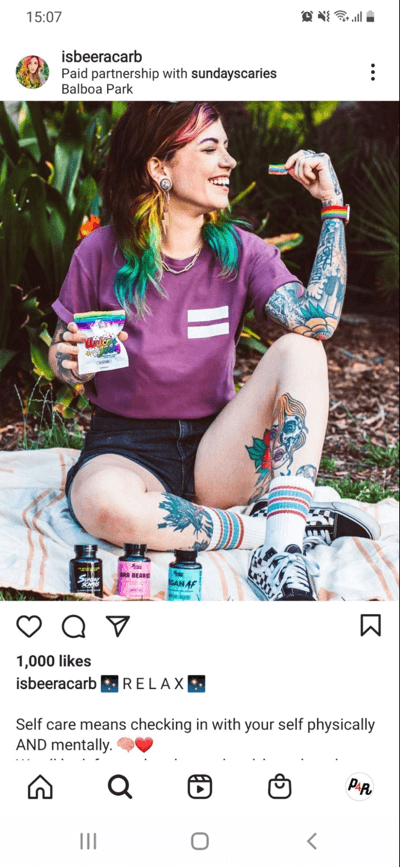
Influencers or creators create this content on your behalf. They receive “an exchange of value” in return, whether that’s payment, product samples, or gifts. And that exchange of value has to be disclosed by using the branded content tools on Instagram.
Social media offers new brands an incredible opportunity to launch a new product to a highly targeted, engaged, wallet-out audience.
Social media provides new brands with an incredible opportunity to launch a new product to a highly targeted, engaged, wallet-out audience. You have access to consumers located all over the world along with the ability to target them based on very specific parameters.
Brands today have such a massive advantage over brands that got their start just ten years ago. While this all sounds great, it’s not as simple as making a few posts on launch day and watching the sales snowball.
It takes a lot of preparation and planning, along with a great product, to have a successful launch on social media. Here are the seven steps required to expertly launch a new brand on social media, regardless of the niche.
1. Establish a clear set of goals
You need to identify your KPIs and goals before anything else. What is going to make your particular launch successful? This will be drastically different for every brand. It might be based on sales, email-list growth or just the generation of buzz that translates into long-term brand awareness.
If it’s sales- and revenue-based, be specific. How many sales? How much revenue? You need to have all of this figured out ahead of time. Determine how much money you are going to invest in the launch and be sure that whatever your goals are, you break even, at the very least.
2. Develop a timeline
When you have your launch date set, you will need to back up and map out the timeline from the current date to the launch date. Then, break that window of time into blocks. Every step of creating a launch will require time. If you feel that your timeline is too tight, push it back.
The last thing you want to do is commit to a launch date and then a week prior have to push it back. That can be a death sentence for a brand, especially if you have already hyped up the date to a social audience that’s waiting in anticipation.
3. Select the best social-media platforms
This is where your strategy starts to play out. What social-media platforms are you going to want to focus on to reach your target audience? While you may think going super wide and launching on every platform available is the correct play, it’s the opposite.
Focus on the two to three best platforms for your launch. This allows you to put more effort into each one, which will greatly impact the return on investment. Pick the social-media platforms that best match your brand and its target audience.
Going after a younger 18- to 20-year-old demographic? TikTok is the place to be. Interested in connecting with a 32- to 45-year-old homeowning demographic? Then Facebook should be your number one platform. Don’t worry about what social platform is the most popular: Select based on where your target audience is active.
4. Map out an influencer-marketing strategy
Aligning with the right influencers to help give your launch a boost can give you momentum unobtainable elsewhere. Try to work out deals with influencers who have engaged audiences that match your target market.
From a flat fee per post to a revenue-sharing agreement, work out something that makes sense and allows you to tap into those followings. If you break even or even take a slight hit, consider the upside, which is gaining a large customer base on day one that can be marketed to down the line multiple times.
And here’s a pro tip: Let the influencer introduce and announce your brand and product to his or her audience as he or she sees fit. The response will be much better if this is done naturally and not something that feels staged and planned. Giving influencers total creative control will yield the best results.
5. Design launch-campaign assets
You’re going to need a wide variety of content assets and formats. On launch day, you will need to have several campaigns loaded up and ready to go that you will closely monitor and optimize in real time.
If one format or image is performing better, you will need to adjust. Will a meme outperform a GIF? What about a video? You need variety to collect as much data as possible. Some examples of campaign assets include high-quality product images; lifestyle images; videos, both long and short; GIFs and memes.
It’s also important to design each content asset specifically for the platform it will be used on. This includes formatting video run times for the specific social channel and making images the correct size to ensure proper display.
6. Schedule your social-media content
Once you have your social platforms identified and all of your content assets created, you now have to schedule it. You have your official launch date, but don’t forget the days leading up to it. This is a perfect time to build anticipation with teaser content.
You can schedule your entire organic campaign in one of the SaaS tools like Hootsuite, which helps you organize the launch as well as reply and engage during the launch. You are going to want to be available to answer questions and reply in real time.
Participating in the discussion will drive more sales, and the engagement boost will help further your organic reach. Even if your launch strategy revolves around paid social-media ads, you still want to have an organic campaign scheduled.
7. Launch your campaign
If you planned for enough time to get everything mapped out and situated, you will be ready to go on launch day. Be sure to have extra hands on deck to handle customer-service issues, answer pre-sales questions and ensure everything goes smoothly.
A poorly executed launch can sink a brand before it even has a chance to thrive. Be sure to plan for every possible mishap because a launch without some hiccups is unheard of. Be prepared for the unexpected and ready to make adjustments as you go.
This woman was influencing me across social media platforms for the best part of a decade. She once influenced me to buy a Fitbit that I never used. I watched her relationship form and marriage crumble and was influenced to feel a great deal of sympathy for her. I saw her decorate her house in meticulous detail, reminding me that I too wanted to one day buy a property, and influencing me to feel shameful about the fact I can’t (and to also make a mental note that I need a Smeg fridge).
Then she posted a video like many others have – women in particular – about “influencer” being a shameful word and that she didn’t want to associate with it. What a curious thing to say, I thought, when I couldn’t think of a better word to describe her.
You’ve probably seen crotchety British Gen Xers on social media say a variant of “everyone’s an influencer now”. What they really mean is that everyone is too online and has a personal brand, always pushing something, whether it’s their opinions or their work; a persona that’s only loosely related to the person you know or suspect them to be in real life. But it’s also true that “influencer” is now a sweeping term that is used to mean anything from “aspirational career path to riches” to “talentless internet shill for brands”, depending on how old or how online (or not) the individual using it is.
“‘Influencer’ is a weird term in that it both works perfectly – in that the direct connection online celebrities and creators have with their audience makes them more influential and able to affect the likelihood of purchases – and is also essentially so broad as to be meaningless,” tech journalist and author Chris Stokel-Walker tells me. Does it mean your sister who recently signed up to an MLM business flogging essential oil blends, or your Dad sharing anti-vax memes with all his Facebook friends? The way people use the word colloquially now, who can say?
I suspect much of this amorphousness is down to the power of the word “influencer” in the first place. It says “I can make you do what I want”. It has clout and energy. You can also “influence” anyone in any manner of ways – emotionally, psychologically. In 2019, the year the Mirriam-Webster Dictionary added “influencer” to its lexicon, its editor-at-large Peter Sokolowski explained to AdWeekthat “all of us are consumers, even if all we are consuming is information”.
We’re not just being sold influencers’ ads – we willingly sell our attention and engagement in increasingly obtuse but intense ways. As Stokel-Walker points out: “In the dictionary definition of the term, people who have clout with their audience are influencers – in that they can influence people to do things, or to buy products if they choose.” It’s little wonder we throw the word around so carelessly.
Influencing has existed as a concept for as long as Western capitalist culture. Influencing is the reason the advertising industry exists; it birthed seismic tomes like Dale Carnegie’s How To Win Friends And Influence People. The valorisation of influence in American culture is the bedrock of the entrepreneurialism that all young people seemingly now have to partake in.
At the end of 2011, an updated version of Carnegie’s book was published: How to Win Friends And Influence People in the Digital Age. The following year Emily Hund, a social media and influencer researcher then working in the magazine and publishing industry, watched the blogging phenomenon begin. It was an exciting time, Hund recalls, when names like Susie Bubble and Fashion Toast were launching incredibly successful careers off their influence.
“No one planned to create this industry,” explains Hund. “It happened by accident. People fell backward into it, because of this perfect storm of events; of the advent of these different technological platforms; and the crumbling of legacy media and creative industries, where there were a lot of people who were trained in or interested in creative jobs who weren’t getting traditional jobs. There was this glut of people who were turning to the internet at a time when the internet was gonna save everybody.”
In the early 2010s, people were referred to by the platform they were famous on: YouTubers, Viners, YouNow stars. “You saw the rise of this new group who were true multi-platform creators and there needed to be an agnostic term for them,” New York Times tech reporter Taylor Lorenz says. That term couldn’t be ‘creators’, because that word was synonymous with YouTubers. “This was also when brands really came into the picture and did bigger brand deals. ‘Influencer’ was the word that the marketing industry applied to creators, and people started using it.”
For years, Lorenz battled to even use the word “influencer” in her day-to-day work as a reporter for one of the most respected publications in the world. “I’ve had literally hours of arguments and conversations with editors at literally every place I’ve ever worked,” she says, “to try to describe people accurately and in a way that will be accessible to all audiences, and that old people and young people will both understand who you’re talking about.”
As Lorenz points out, these arguments about language happen with any emerging journalistic beat, but the reluctance to name influencers speaks to the fact that the industry felt both terrifyingly new and yet evolving and changing at an exponential rate.
A shift occurred in 2017 and 2018, when “influencer” took on a new negative connotation. Hund ties this to a wave of new influencers following what had previously been financially successful for their predecessors and ushering in repetitive content and trends – all of which was obvious to audiences. Think millennial pink, brunches and girlbossery but also spon con.
“People started to sense that the influencer class maybe was losing their edginess that maybe they had in the very beginning – and then also it started to become more clear that people that influencers were selling something,” says Hund.
Similarly, Lorenz notes that most people weren’t paying attention to the influencing industry until around 2017, and associate “influencer” with the creators from that era: female, hyper-curated, millennial. “There’s a charge that comes with the word influencer and a lot of it is sexism,” she says. “Someone will say ‘I’m not an influencer’, but if you ask them what an influencer is, they’ll say it’s a beautiful young woman that they see as vapid and shouldn’t be building their brand and doing sponsored content.”
At exactly the same time, “influencer” became an aspirational word to Gen Z. The youngest creators self-identify as influencers, and for the wannabes or future influencers, the word translates to the lifestyle and income of mid-to-top-tier creators.
Whether a slur or dream career, the word now reflects how the majority of us present and graft online. I always feel an uncanny jolt whenever I see people tagging brands in their Instagram stories of items they’ve bought themselves – as if that either makes them appear as an influencer or as if they assume that’s how friends and colleagues engage with their “content”.
“Everyone is sort of adopting this mindset of the advertising industry or the media industry logics that have existed for a long time,” explains Hund. “Now, they’re kind of being applied to the individual, where it’s like, ‘OK, now my M.O. is to influence.’”
We’re all using influencer tactics, from the celebrity actresses turned cookery range floggers (acting like influencers but not technically influencers, according to Lorenz) to you sharing other people’s work in the hope of one day getting reciprocal shares on your own.
So do we need new words to name the actual influencers? What actually is an influencer? “My feeling is that influencers – and creators – are a subset of entrepreneurs,” says Lorenz, adding that what is important is that we have a term at all so that people can recognise and understand the industry. To say we’re all influencers makes it difficult to talk about or critique influencer behaviour and the ways in which they sell and or behave as an extension of the brands they make deals with.
When I ask Stokel-Walker, he says, “There needs to be a term for digital-first – and largely digital-only – ‘influencers’, for whom the stakes are higher if they misstep and therefore are more likely to follow the rules around disclosure and more carefully protect their online brand, versus the traditional celebrities who get bunged a few quid every few months to plug a product online and are doing it as a bolt-on to their income, so aren’t necessarily as careful about how they do it.”
The issue with making language more specific is that it would show the problem with the latter: “What we think of as a more authentic way of marketing products isn’t authentic when you’re not that bothered if your Instagram audience turns away from you, because you’ve still got your TV presenting gigs.”
Interestingly, the drive to re-define these terms is coming from influencers themselves. In a recent bid to legitimise their jobs and standardise practices and rates, they hope to unionise. “They’re upfront, saying ‘we create our own content, but we’re here to work with brands and do it in a professional way’,” says Hund, “They’re trying to really clean up the field and normalise it.”
If our favourite influencers – the ones who’ve influenced us the most – insist they don’t really relate to the dirty word, this is a chance for them to reclaim it. Or, at least, use their social currency to become someone new.
Over the past few years, social media has grown exponentially from something only the geeky boys and girls in college spent time on to something that’s now a ubiquitous aspect of life across the world.
For businesses, it’s clear that social media can be a goldmine of leads and conversions, if handled correctly. That’s why many companies have focused their marketing budgets on social media, trying to build a following and cultivate customer loyalty as well as new buyers. Here are a few tips you can implement to make your social media marketing much more effective in bringing in sales.
1. Focus on your audience
One of the easiest ways to burn a lot of money on social media marketing without achieving much is to attempt to appeal to everyone. What you need to do is to narrow down your audience, create a customer profile and then target your marketing toward that persona’s needs and motivations. It will make your marketing much more effective than if you were taking a more general approach.
You might also need to segment your audience by different parameters to be able to target them more effectively. Essentially, segmentation will allow you to work with multiple customer profiles and tailor your marketing based on their specific characteristics.
2. Pick your platforms and optimize for them
Attempting to maintain an active presence on all the social media platforms available is going to stretch most businesses too much. Whoever is handling your social media will likely be overwhelmed and your efforts across all the platforms will not be effective. Instead, analyse your buyer persona and decide which platforms are best for engaging your target market. Two or three are good, and you shouldn’t undertake more than that unless you have multiple staff to handle them.
When you’ve selected your content, you will be able to optimize your content for that platform and thus get much more engagement. If you’re focusing on Instagram, for instance, you’ll be able to focus your resources on making quality images, since that’s what gets the most traction on the platform. On Twitter, conversely, making highly informative threads will likely see more engagement and get the word out about your brand more.
3. Create and share content
Content marketing is not just a buzzword. It actually works and the effects are visible on social media too. Publish content that’s short and entertaining or informative and you can be sure you’ll get some social media engagement. Over time, you’ll have some content (whether it’s text posts, photos, infographics etc.) that’ll go viral and bring tons of traffic to your website. Be sure to work with content creation professionals to be sure your website is up to par.
Putting your content out there is the first step to building a formidable brand, and one easy hack is to tweak your content strategy continually, so it’s aligned with topical issues. By creating quality content and using interesting captions for Instagram, Twitter and other platforms, you’ll be able to plug into trends and get your content in front of many more people, such as what brands like Vape4Ever achieved by providing timely information on marijuana laws at a time when there’s a lot of confusion and public discourse about them.
4. Promote user-generated content
People trust their friends more than they trust a company, no matter how loyal they are to the brand. You can take advantage of that by encouraging people to post content on social media that validates and promotes your products or services. One popular instance of this was the “Share a Coke with…” Coca-Cola campaign where users posted pictures of themselves with their soda bottles. You don’t have to start at that level either; with creative marketing or a small giveaway, you can incentivize people to post positive info about your product or service. For a travel service, for example, getting customers to write about their trips in a way that’s authentic and fun will provide solid social proof and encourage FOMO among your target audience, thus increasing the likelihood of conversion drastically.
5. Provide stellar customer service
Positive reviews are great, but many of your customers will also likely reach out via social media when they’ve had unsatisfactory experiences with your products or services. The solution is to be ready to engage with them and find fixes for their issues in a timely manner. Give opportunities for feedback, resolve any concerns they have and encourage them to share their thoughts with their network.
Over time, that will boost your customer loyalty, encourage referrals and the influx of new customers and also help to build a positive reputation on social media. As your followership grows and validates your products or services, your social proof will increase and more people will be attracted to your brand, thereby boosting sales and your bottom line.
Founder of Tech Law Info. Kunbi is a lawyer based in Lagos and is focused on the tech industry, advising startups on regulatory compliance, market-entry and investment (PE and VC). He is also the founder of Tech Law Info, a website to provide founders with essential legal information and resources. https://www.techlawinfo.com
Teens are scouring TikTok for fashion inspiration.
Thanks to the social media platform’s easily searchable hashtags and the power of influencer accounts, retailers have seen a number of products become viral sensations, including a Lululemon skort, a Gap hoodie and a pair of Aerie leggings.
Eyeing a bigger opportunity to win sales, retailers such as Aeropostale and Abercrombie & Fitch are looking for ways to capitalize on these viral moments.
When a Lululemon skort went viral across TikTok earlier this summer, 16-year-old Kylie knew she had to get her hands on it.
But by the time she was searching for her size on Lululemon’s website, it was already sold out. The sought-after skort — part skirt, part shorts with a two-inch inseam — was also totally bought up in a nearby store in Boulder, Colorado, according to Kylie’s mom.
The teen then relied on her favourite TikTok influencers, who often post #fashionhauls and #OOTD (outfit of the day), to alert her when the skort would be back on sale. She was also closely monitoring, even during school hours, other hashtags on the social platform, like ”#preppy” and ”#closettour.” Ultimately, Kylie ended up snagging it in a bigger size and taking it in for alterations.
“My kids come to me all the time now showing me TikTok videos, pointing at them, saying, ‘I want to buy this’ or ‘I think this is cute for the fall,’” said Nicole Leinbach, a Boulder resident who is the mother of Kylie and 13-year-old Claire. “They’re definitely leaning into TikTok to help guide them in what they want.”
It used to be a trip around the mall with friends, but many teens today are scouring TikTok for inspiration. Tethered to their phones, this generation spends an average of 12 hours on social media apps per week. They desire authenticity and individualism, with clothing serving as a key form of self-expression, but Gen Z’s social habits reveal they are seeking guidance from others they trust before committing to a dress or a pair of sneakers.
Thanks to TikTok’s easily searchable hashtags and the power of influencer accounts that boast anywhere from a couple thousand to millions of followers, viral sensations keep occurring for products like the Lululemon skort. For Zara, it was a pair of wide-leg denim pants, while Aerie sold out of a pair of leggings with a unique crossover waist. Ahead of Valentine’s Day, Kate Spadesold through a heart-shaped bag thanks to a popular TikTok video. Eyeing a bigger opportunity, retailers are looking for ways to capitalize on these viral moments. And it will likely become an even bigger part of business strategies this back-to-school season.
“TikTok has the ability to make something go viral much quicker than anything we see on Instagram,” said Jessica Ramirez, retail research analyst at Jane Hali & Associates. “For retailers, that is a huge advantage.”
Gap’s hoodie moment
In January, TikTok star Barbara Kristoffersen posted a video of herself wearing Gap’s iconic logo hoodie in dark brown. It was a vintage find. Gap hadn’t manufactured that style in more than a decade.
Fuelled by the power of TikTok influencers and their devout followings, brown hoodies started appearing on resale sites for as much as $300. People who had the hoodie stowed away in the back of their closets were sharing videos pairing it with Louis Vuitton bags and other luxury brands in neutral hues.
After it went viral on TikTok, Gap is relaunching its logo hoodie in a brown colour. It’s currently available for presale.
Source: Gap PR
Kristoffersen’s post has since racked up nearly 2 million views. And the hashtag ”#gaphoodie” has more than 6.6 million views — and growing — on TikTok.
Gap noticed the momentum shortly after Kristoffersen’s post and began sending her more logo hoodies in various colours. The company also sent hoodies to a handful of other TikTok users. The retailer’s strategy was to rely heavily on the influencer community, Gap Chief Marketing Officer Mary Alderete explained in an interview.
“We did start [a TikTok] account, but we didn’t rush to do a lot of posts,” she said. “These creators get on there … and they’re influencing literally what the trends are.”
To tap an even bigger sales opportunity, Gap decided to manufacture a fresh batch of brown logo hoodies. The product is available for presale and will ship later this fall. The company also partnered with TikTok to crowdsource its next colour based on user votes.
“I don’t think we ever anticipated the arch logo [hoodie] — it’s a classic of ours — but I don’t think we would have necessarily anticipated it taking off like this,” Alderete said. “The key thing is you can’t really force it. You have to ride it.”
After a winning colour is selected, the new hoodies will hit Gap stores and its website just in time for back-to-school shopping, Alderete said. Aside from the holidays, it’s one of the busiest sales periods of the year.
Gap also expects the renewed momentum for its boldface logo to benefit Gap Teen, an apparel vertical it launched in early 2020 to cater to tween and teen girls.
“We have our kids’ back-to-school campaign, but we wanted to do something disruptive for back-to-school for teens,” Alderete explained. “And this crowdsourcing job was our teen approach.”
Teens love #tinytops
The teen retailer Aeropostale is leaning into a similar viral experience it had with its crop tops.
The hashtag ”#tinytops” started blowing up on TikTok in early April, and some of Aeropostale’s merchandise was in the mix, alongside that of American Eagle and Abercrombie & Fitch. The trend refers to crop tops, which have exploded in popularity in recent months, especially among tweens and teens who are pairing the skin-baring shirts with high-waisted and looser-fitting bottoms.
“It’s very ’90s, Y2K — as the bottoms get bigger with more volume, that’s when the tops get tinier and smaller,” said Natalie Levy, president and chief merchandise officer at Aeropostale’s parent, SPARC.
Aeropostale found itself trending on TikTok when the hashtag ”#tinytops” went viral among fashion influencers.
Source: SPARC PR
After some TikTok posts started going viral, including one by Lexi Hidalgo, who has more than 1.6 million followers, people were not only visiting Aeropostale’s website in search of the crop tops, but they also came into stores asking employees specifically for “TikTok items,” Levy said.
Aeropostale reacted fast. It now has sections of its stores devoted to clothing that’s gone viral on TikTok: Crop tops, baggy denim and oversized sweatpants. Those will remain throughout back-to-school season.
“What’s great is we aren’t paying for celebrity influencers or talent … it just happened organically,” Levy added. “We’re really authentic about it.”
Some retailers, though, have taken the approach of directly tapping big-name talent. Abercrombie & Fitch’s Hollister brand debuted a new line of clothing called Social Tourist, in a partnership with TikTok superstars Dixie and Charli D’Amelio. Terms of the deal were never disclosed, but Abercrombie said it has a multiyear deal with the sisters, who combined have more than 170 million followers.
Sharing ideas with a stranger
According to one Gen Z expert, letting content flourish organically might be the best approach to reach consumers under the age of 24.
Hana Ben-Shabat, founder of the advisory and research firm Gen Z Planet, said that many younger TikTok users prefer seeing posts from so-called micro- or nano-influencers, who might only have a couple hundred or thousand followers. They feel as if these people, unlike the D’Amelio sisters, are much more relatable, she said.
“This is a generation that is seeking authenticity in everything they do,” said Ben-Shabat, who is also the author of the upcoming book “Gen Z 360: Preparing for the Inevitable Change in Culture, Work, and Commerce.” “Tiktok is a platform that allows you to go there and be yourself. ‘Be yourself’ is the Gen Z mantra. There’s no doubt about it.”
“And what is the best way to express individuality? Beauty and fashion,” she said.
Across all generations, though, there’s clearly a growing buy-in from people to shop directly from social media apps.
Social commerce sales in the United States are forecast to rise 35.8% this year to $36.62 billion, according to eMarketer. This would mark a slight deceleration from year-over-year growth of 38.9% in 2020, eMarketer said, when the Covid pandemic kept more people at home and shopping from their phones. EMarketer defines social commerce as products or services ordered via social networks, such as Facebook, Instagram, Pinterest and TikTok.
The U.S. lags in comparison with China, which is expected to see social commerce sales eclipse $351.65 billion in 2021, according to eMarketer’s data.
EMarketer doesn’t break out social commerce spending by generation. But it’s worth noting that TikTok usage among teens is still growing, relative to other social platforms. TikTok is now teens’ second-favorite social media app, according to a survey of 7,000 teens from Feb. 19 to March 24 by Piper Sandler. It’s stealing share from Instagram and Snapchat.
And earlier this month, TikTok announced that in the coming weeks it will be rolling out the option to all users to create videos as long as 3 minutes. The shift could make the app even more appealing to influencers and creators hoping to share longer-form content, such as longer fashion hauls or beauty tutorials.
Forty-one percent of back-to-school shoppers are planning to use social media platforms to help them decide what to buy before going back to the classroom, according to a Deloitte survey of 1,200 consumers. That’s the highest percentage Deloitte has tracked in the six years it has asked this question.
“People are attracted to the idea of another stranger sharing ideas, whether it’s their fashion style or just their thoughts,” 43-year-old Leinbach said about her daughters spending time on TikTok.
“Users of TikTok don’t want to see brands trying to push something to them. They’re looking to influencers for inspiration,” she added. “They also, in many ways, feel as if they’re their own influencers within their smaller networks.”
Marketing used to be a thing on the street. Marketers would jump from block to block, convincing prospective customers to try their products and services.
While this traditional procedure achieved a lot of results, there’s something better and easier in town.
Social media marketing has eased the pressure of moving about searching for that customer that needs your product.
Since everyone is now on popular social media platforms like Twitter, Facebook, Instagram, etc., you can quickly reach them with your products and services.
Of course, you are not the only one using this medium. As such, it is not just about engaging in social media marketing, but about doing it the right way.
Without increasing and converting your leads, clicks, sales, and followers on these platforms, you are not engaging in social media marketing the right way.
This article will help you improve your sales and convert more leads with social media marketing.
Why worry about social media leads?
As a marketer, your goal is beyond creating awareness about your product. Yes, you need engagements, but these are just the basics for the final destination.
Only when you collect leads can you truly find individuals interested in using your company’s products or services.
When you collect leads, it will be easier to communicate and stay in touch with individuals that are ready to use your services.
Introduction to social media lead marketing
Here is some of the essential information you need to know about lead marketing before you commence:
Social media lead generation
Lead generation refers to all activities you undergo to accumulate leads on social media.
Social media lead nurturing
After generating leads on social media, the deal is not complete. There is a need to always follow up and nurture the lead. You need to walk them through your company’s process or the sales funnel.
Social media lead conversion
Having nurtured a lead, you can then turn a prospect into a customer.
What platform can I use for social media lead generation?
Use platforms that contain prospects that need the products or services you are selling. One of the most popular options you have is Facebook. This platform offers you diverse means for successful social media lead generation.
Facebook has more than 2.45 billion users every month. This population means that you have a higher chance of meeting your desired audience within the shortest time.
Most B2B marketers have also enjoyed rich results from LinkedIn. The record shows that around 80-90% of B2B marketers make use of this platform.
Hence, you need to consider the type of products and services you offer. You can then target the right audience that will help you reach your desired goal.
Understanding all platforms’ demographics will make it easier for you to pick the right one for your business.
Now, let’s get to the details!
Tips to increase and convert leads with social media marketing
These detailed tips are designed to help you with your lead generation and conversions:
Hone your profile
The first step to reaching your desired destination of generating leads is to improve your social media profile. Collecting more leads organically depends on the details in your social media profile.
The basic standard is to include a medium where your prospects can contact you or gain access to your newsletter. If you sell products, you can also include a link for shopping.
Providing your contact information will ensure that customers can get support from you when needed. Valuable options include your email, your phone number, your WhatsApp contact, Messenger, etc.
Adding a call-to-action button to your website will increase your chances of generating leads. Most platforms have more than one call-to-action button. Try exploring the one that works best for your industry.
If you want to move your leads to your company’s website, consider adding a direct link to your profile.
Develop a strategy
Without having the right strategy, you can only achieve little results. You need to consider how you will reach your audience, who your audience is, and how you will get them engaged with your posts.
Before you post, be sure that you have the right content that your prospects are expecting. The sort of message sent can motivate or demotivate the reader.
Carefully pick the right platform to meet your audience, then prepare your posts with your audience in mind.
Your message cannot reach all users on these platforms. Even if it does, the chances are high that many will not pay attention to these posts. Hence, you need to be specific to your audience.
You need to know: What gender needs the service you are selling? Is your product age-specific? Who are your competitors targeting? Is your offer seasonal? When you find answers to questions like this, you can then work on reaching your desired customer.
Additionally, you can speak privately with some of your customers and seek their opinion on your products or services. Ensure that you are selecting the right audience, and the result will be optimal.
Work with clickable content
If your content is not compelling enough, lead generation will be impossible. Your business is not the only thing competing for an audience in the social media space. Your prospects are all searching for attention too.
Distractions will always come in the way of your customers. Unless you have valuable content to tie them down, they will be off in a split second.
You might need to seek the help of a professional at the onset. Make sure that your content is well-tailored and detailed to touch the mind of your prospect.
Your clickable content will yield no result if it does not hold values that compel a customer to click it. Hence, work on the details of your content.
Then add links with calls-to-action like, click here for more, learn more here, discover the secrets here, etc.
You can get the right call-to-action on most platforms. Make use of these options.
Try social lead ads
You can only achieve minimal results on your own. As such, when your organic content has generated all possible results, at least at the moment, switch attention.
Most social media platforms provide social lead ads to help you reach more audiences.
To make your ads stand out, you need to communicate in a clear and simple pattern. Viewers should understand why they see your ads.
Providing too much information for viewers who are not patient and attentive to details will do you no good. Hence, let your point be brief and stand out.
Asking a few questions and providing a clear and straightforward answer will result in generating leads easily.
Let’s talk about some of the platforms you can use:
Facebook lead ads
Lead ads provided by Facebook are delivered in several forms. You can then analyze them easily and evaluate the results. It also comes with retargeting tools that make nurturing a lead possible.
Instagram lead ads
Instagram lead ads allow you to collect information from your prospects. You can also use forms to seek their opinions and answer their burning/crucial questions.
LinkedIn lead gen forms
You can also engage in lead generation with the LinkedIn lead generator form. User profiles are used for pre-filling sections of the ads. Ads are presented in the form of sponsored InMail or Message Ads.
Make your landing page user friendly
If your content and call-to-action are detailed and catchy and distinct, you are likely to get frequent visitors to your company’s website.
Converting leads will be impossible if your landing page is not user-friendly. Hence, your ability to convince a prospect to click your content must also be used in designing your landing page.
The landing page needs a lot of valuable and useful content. If the details are irrelevant, people will close the page. Since other resources battle for attention, they may never consider you again.
Have you brought them to your website to see the products you are offering? If yes, ensure the landing page provides information on getting the product or leading them to the product directly.
By merely scanning your landing page, they should be able to grasp the idea you are painting. The content should not be vague. It should be as detailed as possible for your audience to benefit from.
Will they need to fill in forms upon reaching your landing page? Then make it snappy and straight to the point. Please don’t go too personal on the details. Basic information is sufficient.
A unique landing page will help you get more results from the prospects you attract to the page.
Deliver mouth watering incentives
Who doesn’t love a box of ice cream added as an incentive for buying small chops from their favourite eatery?
When your prospect sees what they stand to gain from you, they end up sharing your services with others. You need to be careful and pay attention to the type of lead you want to generate.
You can go the contest way on social media. When you host a contest, you generate leads effortlessly. You might give them a simple and essential task before they can join the contest. You can also seek their opinions on why they are joining your company’s contest.
Work with influencers and brand partners. Influencers on social media have thousands/millions of followers. They can be the key to reaching more audiences that need your product and services.
Do you know providing a prospect with a discount code for signing up for your newsletter can help you generate more leads on social media? But make sure leads generated can be nurtured and converted with follow-up emails.
Other forms of incentives include giving out whitepapers, webinar invitations, or granting them free access to closed groups. When they can see how beneficial the incentives are, the engagement improves.
Personalize your offers
A key to generating more leads through social media is by personalizing your offers. Personalizing makes reaching your target easier.
Most social media platforms offer tools that make targeting the desired audience easier. You can target them by age, occupation, gender, or social status.
Ensure that your offers are designed for each individual that comes in contact with the ads. As such, they will be able to interact and subscribe to your service.
Monitor your progress
It is best to monitor your lead generation process. There are numerous analytics tools provided by social media platforms. Do your research and find the one that works well for you and your brand.
One of the most popular options is Google Analytics. It makes tracking your leads easier and detailed. From your website, you can easily track where your leads are coming from.
It is best to start with multiple platforms. When you detect the one bringing more results, you can then focus on using that platform.
Wrapping up
Generating leads is a continuous process. Your skills and effectiveness will improve over time. The details provided in this guide will help you better understand how to get good results from your social media marketing endeavors.
Remember, your posts must be detailed and clear. They should be straight to the point. Your audience should see how it is relevant and what they stand to gain.
It’s up to you to decide the results you want. Digest the information in this guide, and you will see massive improvements.
Social media lead generation works, but it must be done the right way.
Michael is an Online Marketing Consultant, Tech Pr Expert, and also the COO of Visible Links Pro. He shares actionable content which assists businesses to thrive online. He can be reached on Twitter, and Linkedln.
With Apple’s App Tracking Transparency having been available for several months now, advertisers have begun shifting their spending patterns. A new report indicates that the prices for mobile ads targeting iOS users have dropped, while prices targeting Android users have increased.
When Apple released iOS 14.5 with the new App Tracking Transparency feature, a report by the Post-IDFA Alliance showed that two weeks after that, advertisers have started spending more on the Android platform.
Now, according to a report by the Wall Street Journal, “the prices for mobile ads directed at iOS users have fallen, while ad price has risen for advertisers seeking to target Android users.”
“Digital advertisers say they have lost much of the granular data that made mobile ads on iOS devices effective and justified their prices. In recent months, ad-buyers have deployed their iOS ad spending in much less targeted ways than were previously possible, marketers and ad-tech companies say.“
Digital-ad agency Tinuiti Inc., for example, says its Facebook clients went from year-over-year spend growth of 46% for Android users in May to 64% in June. Its iOS clients, on the other hand, saw a corresponding slowdown from 42% growth in May to 25% in June.
Research director Andy Taylor explained that “Android ad prices are now about 30% higher than ad prices for iOS users.” The report also shows many advertisers have shifted their spending on Facebook’s owned-and-operated app as well.
“Instagram and its namesake social network, which form the core of its business, Mr. Taylor said. Spending to reach iOS users on Instagram and Facebook also slid since Apple’s change, he said, but by less than on third-party apps.
Since the switch, Facebook has significantly altered its Audience Network, which has relied heavily on device identifiers. The company told advertisers in an email last week that it was adding the capability to place contextual ads—which consider factors like time of day and the app’s content—as a way to continue providing relevant ads when certain identifiers aren’t available.“
In May, Flury Analytics data provided the unsurprising evidence that vanishingly few Americans were choosing to allow apps to track them, although it has risen from 4% at that time to 9% now.
The ad industry was afraid that users would largely opt out as a matter of course, and this data does suggest that’s the case.
A 9to5Mac reader poll also showed that almost nobody is opting -in for App Tracking with all apps, while a fifth of readers are letting trusted apps track them while blocking others.
Over the past year, a lot of brands have started to do a much better job when it comes to representation in their marketing. Whether it is in diversifying the speaker lineup at conferences or ensuring the visual imagery portrayed in ads and photography looks more like the people who are attending the conferences and or consuming the content, there is a noteworthy positive change.
For instance, a few months ago, I talked to the chief marketing officer of one brand whose team had even gone so far as to put clear metrics in place as to what representation should look like, by matching it to the latest population demographics of various groups from an ethnicity standpoint, and noting that negative stereotypes should be avoided.
Even though there is plenty of progress happening on the representation-in-marketing front, there are some common mistakes being made that prevent the brands creating them from getting the results they seek.
1. Including the token diverse person
When you’re looking through a conference lineup, and you see the same usual speakers and then one person who is part of an underrepresented group, it feels like the brand did it to check their “diversity and inclusion” box. As a consumer, it feels kind of insulting.
Same goes when you’re looking at the makeup of a brand’s internal team, and they’ve got one person who looks different from all the rest.
If you really want to signal to your customers that they belong with you, particularly your diverse and niche consumers, don’t make representation feel like an afterthought or something you have to do.
Instead, focus on diversifying your network and circle of influence so you’ve got plenty of diverse talent to feature for events and to work with on your team.
2. Thinking that photography is enough
I recently conducted a representation-in-marketing research study with more than 1,000 consumers. One thing that came through loud and clear was that consumers want more than just representative photography from a brand.
Your customers want features, storylines, and more in-depth content from people who look like them and have backgrounds similar to theirs.
That may mean featuring more diverse experts in your educational content, spotlighting the stories of your customers from a number of different backgrounds in your ads and social media content, or showcasing testimonials from your diverse and niche consumers on your sales pages.
Photos can be bought, but real stories and expertise from real people cannot.
If you want to make diverse and niche consumers feel like they belong with you, go deeper than the photos. David’s Bridal does a great job of this. They feature a lot of user-generated content on their social channels that features a broad variety of customers. And on their website, they feature the wedding stories of an impressive cross-section of their diverse customers.
3. Not building a truly inclusive brand
Increasingly, consumers are looking beyond just a brand’s marketing in terms of the products, services, and experiences they deliver to determine whether or not they are truly representative.
They are turning their attention to the internal teams and board of directors to see if they are representative as well. If representation only matters in your marketing, and not in your team building, then consumers get the signal that diversity, inclusion, and belonging aren’t as important to you as you would have them believe.
The fix is to build an inclusive brand from the inside out. Your customers, particularly diverse, niche, and marginalized consumers, want to spend their money with a brand that aligns with their values. They prefer to steer clear of the brands that are only being representative in their marketing just to get diverse and niche consumers to spend money with them, and those they don’t feel truly value or care about those who are a part of their community.
Representation matters. More and more, this is becoming accepted. But not all representation is created equal. Avoid the mistakes above to ensure your representation efforts are seen as authentic and by the customers you want to serve.
Get the word out about your blog with these strategies.
Writing high-quality content is only a small part of creating and maintaining a successful blog. To further increase site traffic and attract more readers to your site, you’ll need to work on blog promotion.
Luckily, there are plenty of strategies that are cost-effective and easy to implement.
Read on to discover how to promote your blog effectively in ten different ways – start experimenting with any of these solutions and watch the traffic roll into your site.
Before learning how to promote your blog, the first step you should take is optimizing your site for search engines. With good SEO, it will be much easier for a blog to rank high on search engine result pages (SERPs) and attract more traffic.
Many factors impact a site’s SEO performance, including the website platform and hosting service you choose to create a blog. These two aspects determine the overall consistency of the site experience you offer to visitors.
When choosing a platform to build a blog, consider starting with a content management system (CMS). This tool makes it easy for non-technical users to create and manage a website. It also offers complete control over a site’s design, functionality, and SEO.
One of the best CMSs to get started with is WordPress. It comes built-in with many SEO features, including meta descriptions, a customizable URL structure, and the ability to use page titles.
Keep in mind that there are two different versions of WordPress – WordPress.com and WordPress.org. Although both platforms provide the same quality of SEO performance, the latter gives users more freedom to utilize plugins to further improve their SEO.
Make sure to also pick a web hosting service that’s reliable, fast, and secure. Some of the top hosting providers to consider are:
Hostinger – has excellent performance and comes with an SEO toolkit to evaluate technical SEO issues on a website. Their hosting prices start at $1.39/month.
Bluehost – offers several SEO tools to increase site traffic. The cost of starting a WordPress blog with their shared hosting plans startsfrom $3.95/month.
HostGator – provides great uptime and speed. The fee of creating a blog with this web host’s shared hosting solutions starting at $2.75/month.
Aside from choosing the right platform and hosting service, there are other blog SEO practices to keep in mind in order to increase blog traffic:
Choose a mobile-friendly theme – Mobile page load speed is a key metric that Google uses when determining a site’s search ranking. That’s why it’s crucial to make a blog responsive to any device.
Internal linking – Internal links can boost a blog’s traffic since they help Google understand and rank the site better. Internal linking also allows visitors to navigate a blog easily.
Use a CDN provider – A content delivery network (CDN) can boost the speed and reduce the resource usage of a website.
Link out to other sites – Including links to some high-quality and authoritative websites can help search engine crawlers understand what a post is about.
Compress images – Reducing the file size of blog posts’ images can speed up a site and improve page loading times.
To manage and monitor your blog’s search engine rankings, make sure to use the best SEO tools for the job, such as SEMRush or Ahrefs.
Additionally, take advantage of free Google SEO tools such as Google Analytics to see the in-depth breakdown of your blog traffic, helping you identify how well your SEO efforts are working.
Knowing the important keywords to use on your blog posts can also improve the blog’s ranking on SERPs and generate valuable traffic. These terms can be discovered by doing keyword research.
Keyword research helps bloggers to create content their visitors are searching for. This process also reveals how many people are searching for a specific keyword and how high the competition is.
(Image credit: SpyFu)
There are plenty of keyword research tools such as KWFinder and SpyFu that can be used to discover keywords, common questions, and topics for content.
When doing keyword research, consider these aspects to decide the best keywords for your blog:
Searcher’s intent – This refers to website users’ intention when searching Google for a specific term. To attract qualified traffic, be sure to choose keywords that match your target audience’s user intent.
Search volume – A keyword’s search volume shows how competitive the term is. Try to target keywords with great search volume since they can increase a blog’s chance to generate significant organic traffic. Keep in mind, however, that it requires more effort to rank for terms with high search volume.
Traffic potential – To identify the keyword’s traffic potential of a topic, use tools like Ahrefs and see how much traffic the current top-ranking pages get and what other keywords they rank for. This process can help you prioritize your keywords and find related terms that users are searching for.
Keyword difficulty – Many SEO analytics tools provide this metric to show how difficult it is to rank for a specific keyword. The higher the score of the term, the more competitive it is.
(Image credit: Pixabay)
Once you have a list of terms to rank for, it’s time to use them for on-page SEO. Here are some key places on a blog to use these keywords:
Page titles – A blog page title is the first element of a site page that people notice in the SERPs. Make sure to use a target keyword at the start of the page title to have both Google and your audience recognize the main subject of the page.
Subheadings – The purpose of subheadings is to make content scannable. Using target keywords in subheadings can increase a content’s relevance for the readers.
Content – It’s one of the most important search ranking factors. Thus, try to include keywords naturally throughout the content and avoid keyword stuffing.
URLs – Using a clean URL with a keyword can improve a site’s architecture, make a blog easier to navigate, and help it rank higher in relevant search results.
Meta descriptions – A meta description is a short explanation that shows up on SERPs under the page title. To boost a page’s click-through rate, try to create a compelling description using target keywords.
Images – Always use alt text for pictures to help search engine crawlers understand your images. Additionally, alt text is vital to a blog’s accessibility since it allows visually impaired users better understand an on-page image.
Remember to use Google Search Console to track your current keyword positioning and analyse which pages drive traffic to your blog.
(Image credit: Geralt / Pixabay)
3. Use email marketing
Email marketing can be one of the most effective ways of promoting your blog and converting visitors if done correctly. This blog promotion strategy helps you notify readers of new blog posts or share any good news with ease.
Sending personalized messages to blog visitors can also help create meaningful relationships with them, keep the audience hooked with high-quality content, and boost engagement on a blog.
The first step to take before getting started with email marketing is to build an email list, a collection of email addresses used to send promotional material.
Here are a few ways to build an email list:
Offer an incentive – Consider giving readers an incentive like a free course, eBook, or cheat sheet in exchange for their email address.
Collect emails directly from the blog – Create a signup form and place it on your home page. Make it stand out and attract readers’ attention with a strong and compelling call to action (CTA).
Create content upgrades – A content upgrade is a valuable offer that complements an article that the reader is already interested in, created to get a visitor’s email address.
Once you have a mailing list, look for email marketing software like Constant Contact or MailChimp. Using an email marketing tool makes it easier to create attractive email templates, deliver emails to large groups of contacts, track messages, and view analytics.
The next step is to craft email content that can lead visitors back to your blog. Here are some tips on how to promote your blog with the use of effective promotional emails:
(Image credit: Darius Foroux)
Provide valuable insight for readers – Use your email to convince readers that your blog post can solve their problems. This email newsletter from Darius Foroux is a great example:
Highlight the content value in the email subject – Readers might receive dozens of promotions every day, so try to capture their attention by creating a short, compelling email subject that clearly states the value of your content.
Create personalized subject lines – Including recipient names in the email’s subject can lead to a 21.2 percent open rate. It can also make the subscribers feel like the email is crafted specifically for them, which helps to build relationships and establish trust.
Make it easy to read – Keep the email clean and easy to digest by using appealing pictures and paragraph breaks.
Use links – Avoid adding attachments to a message since it can affect email deliverability, making it more likely to get lost in spam filters. Instead, use call-to-action links to grab subscriber’s attention and encourage them to act.
Proofreading – To make your emails look more professional, be sure to check for any grammar errors before sending them out.
To get more exposure quickly and efficiently, try sharing your blog post on popular social networks such as Facebook, Instagram, or Pinterest.
Here are some of the benefits of using social media sites to promote your blog:
Increase blog traffic – Sharing content on different social networks helps bloggers reach a wider audience. Additionally, if the content provides value to the users, they might share it further and recommend it to others.
Cost-effective – With social media channels, bloggers can make their site visible to a targeted audience for free.
Improve engagement with the audience – A blogger can also have a personal and meaningful conversation with their readers through social networks. Devoting time to communicate with the audience will help to build trust.
Social media platforms aren’t all created the same, so try to focus on the most relevant social networks that suit your target audience. For instance, if you’re targeting female readers, then Pinterest might be the right social media for you.
Here are other tips for leveraging social media and bringing more traffic to your blog:
Add a blog link to the bio – A social media bio is the first thing people see on an account. Make sure to use it to drive traffic to your site or blog content.
Share engaging content using existing posts – Use a free tool like Canva to convert your top blog articles into appealing graphics.
Integrate social media icons into the site – Adding social media icons to a blog makes it easier for visitors to share blog content with their audience.
Post regularly – Be sure to know how often you should share in a specific social network. For example, Twitter users should share at least one tweet a day.
Use hashtags – Utilizing a hashtag is a great way to expand the reach of a post and connect it to a specific conversation, topic, or event. Hashtags also make it easier to locate other relevant content around particular terms.
Join online groups – Become part of a social community such as the ones found in LinkedIn, or a Facebook group to share content and increase the visibility of your blog.
Find the optimal time for posting – Knowing the optimum time to post on your chosen channel can help you get more clicks and engagements. Thankfully, most social platforms have an analytics or insights tool that provides this information. Once you know the best times to post, start planning and preparing your content in advance using social media management tools like Buffer.
Remember that social media is a two-way engagement platform that requires actual interaction. Don’t just reappear whenever you have a new blog post – instead, maintain a regular presence on a social network by starting conversations, responding to comments, and answering questions.
5. Promote your blog with online paid advertising
If you have a budget you’re willing to spend, consider using online paid advertising to promote your blog content. This strategy refers to a marketing method where you pay for ad spots to attract internet traffic.
With the paid promotion, your page can appear right in front of your target audience in no time. It’s also possible to see the results as soon as your ads go live.
Online paid marketing can feature one or more digital channels, including search engine results pages (SERPs) and social media platforms.
The process of increasing blog visibility on SERPs through paid advertising is usually known as search engine marketing (SEM). This method relies on keywords to target users when they’re performing searches in a search engine.
Here’s an example of how advertisements appear for the keywords “how to boost your SEO”:
(Image credit: Google)
To promote a blog with search advertising, try using a popular online marketing service like Google Ads.
Also, consider the following suggestions before getting started with paid search ads:
Be clear on budget and expectations – Make sure to have a specific budget to avoid overspending and clear goals in order to analyse whether a campaign works or not.
Keep the quality score up – A quality score rates the relevance of both your ads and keywords. Having a great quality score can help to keep your ad costs low.
Bid on competitive blog keywords – If your competitors have a lot of traffic for their brand name, try to target those keywords with your ads. This way, searchers will see your relevant content and go to your blog post instead of those of the competitors.
Another form of paid advertising is social media ads. This blog promotion method lets you target users based on their locations, specific interests, and buying behaviours.
Some of the best social media sites for advertising are Facebook, Instagram, LinkedIn, and Twitter.
Here are a few tips on how to promote your blog with social media advertising:
Design the ads with mobile in mind – Since 91 percent of users access social channels via mobile devices, ensure your ads incorporate easy-to-view images on the small screen.
Use videos – A video is more engaging and has a better return on investment (ROI) than other media types.
Test your ads – Try A/B testing your ads to see what works best for your campaign and make the most of your spending.
(Image credit: Pixabay)
6. Guest post on popular blogs
Guest posting on other blogs is an excellent way to promote your blog since it lets you expose your brand to other bloggers’ loyal audiences. This method also helps to establish yourself as an authority figure and connect with other thought leaders in a niche.
(Image credit: OnTopList)
To find guest blogging opportunities, go to blog directories like AllTop, Bloglovin, and OnTopList. These websites can help people discover relevant blogs in a niche that might accept guest posting.
Once you have a list of potential blogs to guest post on, use a backlink analysis tool like Moz to check the domain authority for each of the sites you’re considering – the higher a blog’s domain authority, the easier it can rank in search engines. Doing this also showcases whether these sites provide good value in terms of links.
Keep the following tips and tricks in mind to get started with guest blogging:
Form a genuine relationship with the site owners – Many website owners only take guest content from bloggers they already know and trust. Thus, try to connect with them first before sending a pitch by subscribing to their newsletter, leaving comments on their blog posts, and commenting on their social content.
Keep the pitch short and straight to the point – Since most site owners don’t have the time to read long emails, keep your email as brief and direct as possible.
Link to your blog articles – Some sites might let guest bloggers backlink to their site, helping to drive referral traffic and lead to better search visibility for the blog. Bloggers can use Google Analytics to track traffic from this guest posting effort.
Ask the audience to leave comments – Encourage readers to post their opinions and share the content. This helps to have the content rank for different keywords that are naturally mentioned in the comments.
Take advantage of the author’s profile – Guest bloggers can also include their blog’s link in the author’s bio, which helps to drive people to their site.
7. Reach out to other bloggers
Another viable blog promotion solution is the conduction of blogger outreach. It’s a marketing strategy that involves getting the help of well-known bloggers or influencers to improve a blog’s exposure by offering something in return, such as a fee, backlink, product, or service.
With this blog promotion method, new bloggers can acquire high-quality backlinks, attract quality traffic, and expand their network.
(Image credit: Lumanu)
To get started with blogger outreach, look for influencers in your niche using tools like GroupHigh, Influencity, and Lumanu.
Then, refer to these tips on how to promote your blog by leveraging the loyal audience of others:
Get the influencers to notice you – Mention influencers on social media and promote their relevant content to make them recognize you.
Interview professionals – Aside from asking for an inbound link from influencers, bloggers can also invite them for an interview. When the interview is published, the influencers might also share it with their audiences.
Try broken link building – A great tip to get backlinks from influencers without paying a dime is to identify broken links on their blogs and present your content as an alternative replacement.
Track the results – Use a backlink checker like Majestic to see which influencers are giving you the best coverage and the most leads.
Cultivate relationships – After getting blog coverage from an influencer, make sure to maintain your relationship with them. The stronger the relationship, the longer the benefits can last for your blog.
8. Get your blog on social bookmarking sites
A social bookmarking site is a platform to read and save a specific web page or article. With this tool, users can access their bookmarks from any device at any time.
Social bookmarking sites are great places to share blog posts with new readers. When your content is listed on or shared through a bookmarking site, it can result in massive increases in traffic back to your blog.
To begin with this blog promotion method, bloggers need to choose a platform to participate in and submit their content to that site. Some of the most popular bookmarking websites are Digg, Flipboard, and Pocket.
(Image credit: DZone)
Bloggers can also share their blog posts on niche social bookmarking sites like GrowthHackers and DZone to generate more relevant shares and traffic.
Here are a few tips on how to promote your blog content on a social bookmarking site:
Make the headlines count – Some social bookmarking platforms might only display the article’s title. Thus, compel potential readers to click on your link by using a catchy, captivating headline.
Add a featured image – Make the article stand out on the news feeds by using attractive graphics.
Keep the description length in mind – Some sites might limit the description space to 150 characters, so try to make the description short and match the content.
Utilize social bookmarking buttons on the blog – Consider adding a social bookmarking button on your site to let readers bookmark content with ease.
9. Promote your blog in online forums
Another excellent method of blog promotion is to join online forums. Being part of online communities lets you interact, contribute, and bring value to a niche group of people.
Joining online forums also allows bloggers to share their knowledge, which can help establish their expertise in a field.
However, finding niche forums can be overwhelming, especially in some of the biggest online communities like Reddit.
(Image credit: FindAForum)
To discover a forum that matches your field faster, try using an internet resource like FindAForum. Simply go to its categories section or enter your niche in the search bar to find a list of discussion forums.
Here are some suggestions on how to promote your blog via online forums:
Participate – To develop trust and make people more willing to engage in a blog, be prepared to contribute to the forum regularly. Try to answer questions, provide quality responses, and link to helpful resources.
Start a thread – Another way to prove that you’re a valuable member is to create your own threads. Begin by making a shorter and different version of your blog content and use it to start a new thread.
Create a signature – Some forums let users create a signature or a text that appears below a post or thread. Take advantage of this signature to make a call to action to bring traffic to your site.
10. Try reciprocal sharing sites
Bloggers can also use a reciprocal sharing site to promote their blog. Using this method, they need to share other users’ content on their social media accounts to get their blog posts promoted.
(Image credit: Triberr)
One of the most popular reciprocal sharing websites is Triberr. This tool makes it simple and easy to grow your audience, find great posts to share with readers, and network with other bloggers.
When using a reciprocal sharing site, make sure to share content that is editorial in line with the type of post you want to be known for curating – it helps increase your credibility and exposure in a specific niche.
Also, remember to include relevant images, graphics, or relevant stock photos to make your content stand out.
Another tip is to be consistent and make it a habit to regularly share posts or respond to comments. The more consistent you post and interact with other users, the more reliable you seem to be.
(Image credit: Pixabay)
Promoting your blog
Aside from publishing awesome content, bloggers must also spend time and effort promoting their blogs. Without a promotion strategy, it can be difficult for a blog to grow and generate a steady stream of readers coming to check the site out.
The most effective strategy for you also depends on the resources at your disposal, such as the budget, skill set, and timeframe.
Here are ten strategies on how to promote your blog and get more qualified visitors:
Utilize SEO for your blog
Do proper keyword research
Use email marketing
Share your blog on social media
Promote your blog with online paid advertising
Guest post on popular blogs
Reach out to other blogs
Get your blog on social bookmarking sites
Promote your blog in online forums
Try reciprocal sharing sites
Keep in mind that it may take a few weeks or months before you notice a significant increase in your traffic and online ranking.
Also check out our complete list of the best web hosting services
Désiré has been musing and writing about technology in a career spanning four decades. Following an eight-year stint at ITProPortal.com where he discovered the joys of global techfests, Désiré now heads up TechRadar Pro. He has an affinity for anything hardware and staunchly refuses to stop writing reviews of obscure products or cover niche B2B software-as-a-service providers.