Author

editor

Browsing

Why media companies need to put social media at the centre of their content and distribution strategies

The attention and support of younger readers is critical for the survival and sustained growth of publishers. However, “the millennial audience strategy honed over the better part of a decade will not work on Gen Z (born between 1997 to 2012)” says Kayleigh Barber, Senior Reporter, Digiday. This is because their media consumption habits are vastly different from the preceding generations.

57% of Gen Zers’ first interaction with news is on social media

“Despite being a significant portion and growing force on the internet for over a decade now Gen Z remains an enigma for many media companies and brands,” writes Barber in a recently published Digiday guide, “Everything you need to know about Gen Z’s media consumption habits.” It offers a comprehensive look at Gen Zers’ media consumption habits and shares actionable insights for publishers and marketers.

Whether or not Gen Z is currently a target demographic in your business strategy, creating a positive connection with this generation and beginning to build brand affinity now is important to ensure the longevity of your brand or publication in a decade or two down the road.

Kayleigh Barber, Author, Everything you need to know about Gen Z’s media consumption habits

41% of US adults, including both young millennials and Gen Zers (18-29 years), say they primarily get their political news from social media, according to a Pew research study of more than 12,000 individuals. A 2019 Reuters Institute study had 57% of Gen Zers reporting that their first interaction with news in the morning is on social media platforms and messaging apps.

Brie D’Elia, 20, a fashion student who is building her personal brand on TikTok, tells Barber that Twitter is her go-to platform for news. “When I want a specific trending piece of information, I always go there because you can see the hashtags and what’s going viral. I just want that [information] fast,” she says.

“Social media at the centre of their content and distribution strategies”

Publishers targeting Gen Z “have put social media at the centre of their content and distribution strategies,” Barber writes. They include Group Nine, Yahoo’s In the Know and Overtime. Legacy publications including The Washington Post have embraced newer platforms like TikTok, frequented by Gen Z. Video is critical for engaging this generation and the Post’s success with TikTok offers valuable lessons for other publishers.

The unique thing about Gen Z is that while millennials have grown up with social media, Gen Z has grown up with video-first social media.

Nick Cicero, VP of Strategy, Conviva

Dave Jorgenson, video producer for the Post, has been creating content for the platform since 2019. His often quirky videos tailored for TikTok have helped the publisher notch 1M followers and 40M likes on the platform. It looks at TikTok as a tool for building relationships with younger readers.

“With our focus on reader revenue at the bottom of the funnel, loyalty is incredibly important to us. But in order to get to a place of loyalty, it starts with a relationship at the top of the funnel,” says Kat Downs Mulder, Managing Editor at the Post.

A lot of what we’re doing is exposing people to The Washington Post [and] getting them to start to develop that affinity to trust in our brand.

Kat Downs Mulder, Managing Editor, The Washington Post

“Inherently a publisher that talks to Gen Z is going to have positive things to say about climate change, and pushing innovation and progression,” Clair Bergam, Associate Media Director, Media Kitchen told Digiday earlier this year. “Brands generally are realizing that they have to get behind these larger social issues or they will quickly become irrelevant.”

In the Know was launched to produce evergreen video content for younger audiences across Yahoo’s suite of sites and channels. It became popular enough to get its standalone site in February 2020. The site notched 25M monthly unique visitors in March, according to Comscore.

The brand had also been experimenting with affiliate shopping since 2019 and moved on to producing shoppable video. It’s gross merchandise value increased by 125% over the past year, according to Andrea Wasserman, Head of Global Commerce, Verizon Media.
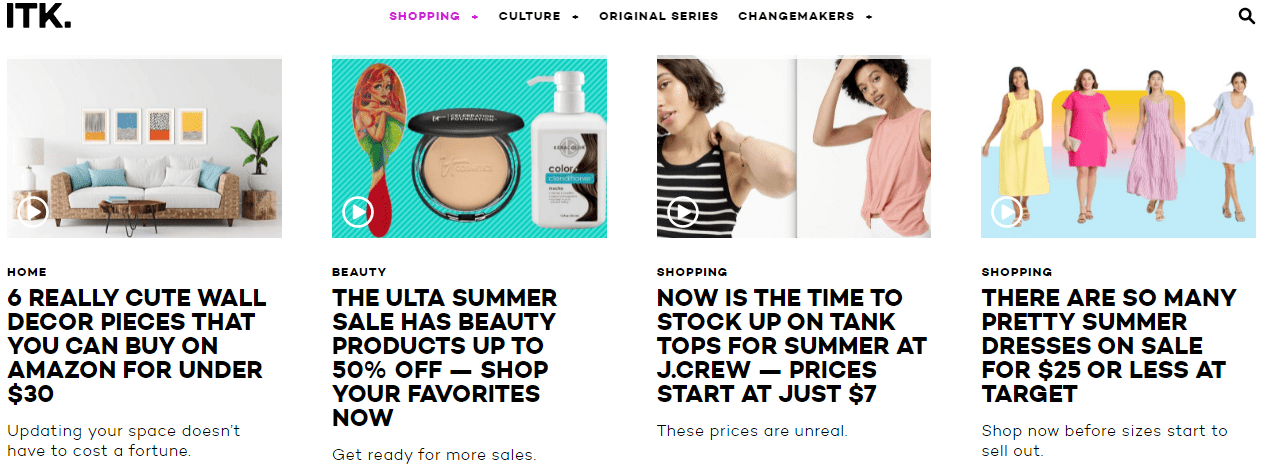
Source: In The Know

The brand also uses Instagram, Snapchat and Facebook to distribute its videos. A single video on Snapchat is able to drive over 1M unique views from the 13-to-24 years group, Wasserman tells Barber.

“Consumption behaviour is driving them towards these platforms”

Digital video sports publisher Overtime has reached 16.6M followers on its main TikTok account—it joined in March of 2019. The publisher has also achieved over 1B likes across the 2,000-plus videos it’s posted during this period. It has 5M followers on Instagram and 3M subscribers to its Snapchat show Overtime Now.

The publisher’s distributed content strategy across social media platforms has been its bread and butter since its launch in 2016, according to its CRO Rich Calacci. “Quite frankly, we don’t see that changing,” he says. “That’s going to be a very critical part of our growth and development, especially as it relates to Gen Z and millennials.”

Gen Z’s “consumption behaviour is driving them towards these platforms and it’s creating digital daily habits, and those digital daily habits are where we want to be.”

Rich Calacci, CRO, Overtime

The full guide is available here:
Everything you need to know about Gen Z’s media consumption habits
Sourced from WNIP

By Erika Wheless,

Justin Moore and his wife, April, have only been selling products through Amazon Live for a few months, but it has already completely changed the way they do business.

The veteran YouTubers, who had been selling things online for years, were recruited by Amazon in late November to start using the growing video channel, and soon were pulling in tens of thousands of dollars of revenue on their best days. The Moores now field dozens of requests every week, many from curious ad agencies, for guidance on how Amazon Live works. The requests have been plentiful enough that the couple now offers Amazon Live show hosting services.

“The numbers were astronomical,” Justin Moore said, saying that the return on investment was clear the first time they used Live, around Black Friday and Cyber Monday last year. He declined to give specific figures but claims that this year’s Prime Day sales surpassed last year’s Black Friday sales by 52%.

The Moores’ experience may have piqued agency and brand interest in Amazon Live, but it hasn’t drawn a ton of adoption so far. Even as more social media platforms add live shopping to their roster of features and Amazon makes new investments in its Live product, most brands are still hesitant to try it out.

Many brands aren’t sure they want to go beyond traditional ads — or the additional hassle of making a video or hiring a creator. When brands do get into live streaming, cementing a preferred time slot in the Amazon Live lineup can be a long climb up the Amazon rankings.

“Brands know something is there, but they aren’t running to sign up,” said Eddie Segev, studio manager at Top Rated Studio, which creates videos for Amazon sellers and hosts live streams in its studio.

Amazon Live launched in 2016, but it wasn’t until recently that Amazon began making more investments in the channel. In February of 2019, Amazon launched its Live Creator app, which allows users to sell via live stream directly from their phone. Then, in July 2020, Amazon expanded the app to include influencers who are part of the Amazon Influencer Program. An Amazon spokesperson declined to give numbers on how many people are using Live but did say that there were over 1,200 live stream shows during Prime Day 2020.

Today, there are about a dozen live streams happening at one time on a dedicated Amazon Live homepage, with one stream as the “feature” video on the page. These video times and placements are determined by Amazon’s ranking system, which includes three levels: “Rising Star,” “Insider,” and “A-List.” Each level offers progressively better video placements on the Amazon Live page. To ‘level up’, sellers must consistently create content to amass a following and drive sales, similar to YouTube streamers looking to build their subscriber base.

Users must either be a brand registered seller, a U.S. vendor with an approved Amazon store, or an Amazon influencer with an active Amazon storefront to use the Creator app and stream.

But rather than an easy path to incremental revenue, it takes time and effort for brands to see returns. Amazon recommends streaming for at least an hour once an account is approved.

“For Amazon Live to materially impact sales on, say, Prime Day, sellers would need to have been using it consistently for months so they’d have the status necessary for winning a highly visible location,” said Katie Capka, inbound marketing manager at Kaspien, which does Amazon marketing, in an email.

According to a January 2021 survey of U.S. creators by Mavrck, 85% said they use Instagram the most often to live stream, followed by Facebook (7%), and TikTok (4%). Less than 2% of respondents said Amazon Live was their main live stream platform.

For now, many brands would rather use static photos and traditional ad placements, instead of making a video or hiring someone to host a live stream, Segev said.

Melissa Ardavany, director of marketplace client services at Blue Wheel, echoes this. “Live is in the ‘test and learn’ phase,” she said, “It’s also not as mature as the ad placements clients are used to.”

Brands should instead look at Live as a long-term investment, especially if they want to be competitive for the holiday shopping season, or next Prime Day. “I understand that some brands see it as a new format,” said Moore. “Even so, being able to directly attribute revenue from a stream — that’s huge.”

Feature Image Credit: Ivy Liu 

By Erika Wheless,

Sourced from DIGIDAY

By Omega Fumba

Thinking about building a website? Keep these points in mind for sure-fire success.

Are you planning on creating a website? Here are a few things to consider before you get started.

If you’re thinking of growing your business, a website is a great tool to help you achieve that growth. Having a website allows you to showcase the products or services that your business offers. In addition, it can help your business build credibility and gain more customers.

For your website to become a success, a good amount of planning should take place beforehand. Even if you’ve hired someone to assist you, don’t sit back and relax! It’s important to take note of what your website should include.

1. Branding

Brand identity book next to a keyboard.

Your website is a representation of your company. So, it is important to thoroughly consider its branding. Why? It’ll help attract visitors and contribute to your overall return on investment.

Thinking about branding throughout the entire development process is a surefire way to build a brilliant site.

The branding of a website includes the following:

  • Logo
  • Tone/Core Message
  • Colour Schemes
  • Design
  • Fonts

A logo plays a huge role in the identity of your business. Your company logo gives your work an identity that visitors can recognize. You can hire a graphic designer to create one for you.

If that isn’t an option for you, there are websites you can use to get help creating a logo.

Your website should carry out the core message of your business. Visitors should be able to quickly understand what you’re all about when they land on your page. It should have a consistent tone that connects to that core message.

The colour schemes, design, and fonts that you use in your website should complement the message and tone of your brand.

2. Usability

two people using a laptop.

Customers are more likely to get drawn to your website if it’s easy to use. You can increase your website usability by including the following:

  • Navigation Menu
  • Headings and Labels
  • Search Bar
  • A Mobile-Friendly Website

Having a navigation menu gives your visitors an idea of what content is included in your website. Providing seamless navigation also allows your visitors to find the information they’re looking for more easily.

If your website is easy to use, visitors are more likely to spend more time browsing it. Including headings and labels allows your visitors to better understand your website’s content.

Depending on the context of your site, including a search bar can improve its usability. Visitors can simply search and find what they’re looking for instead of digging through your site not knowing if they’ll find it.

You must also make sure that your website is mobile-friendly. Lots of people use their phones to browse the internet and having a mobile-friendly design will increase your credibility.

3. A Consistent Blog

Hands typing on laptop keyboard.

An active blog on your website helps you keep your audience engaged. Your blog should provide helpful content to visitors. Producing regular content can increase traffic to your website and encourage users to spend more time on it.

In addition, having a consistent blog makes your website a trustworthy source of information. When people have questions, you’ll be the go-to!

4. Website Security

Padlock on laptop keyboard.

Security threats are a website’s worst enemy. Websites get hacked every day and it’s very important to ensure that your website is secure.

Hackers can use your website to infect visitors with malware. You don’t want to gamble on the risk of having your website’s infrastructure invaded. Luckily, you can protect your website through web application firewall services and server-side security tools.

5. A Solid SEO Strategy

SEO capital letters with a graphic pattern

Your website needs a good SEO strategy. For your website to be a success, it needs to be as visible as possible, and that’s exactly what SEO does for you. When potential visitors use search engines, they will most likely use keywords and terms that are linked to the content on your site.

Your job is to make sure that your website is optimized enough to appear on the results page. Even hitting the bottom of page one on Google can net you thousands of views a month.

6. Choose a Domain Name

List on how to find a domain name.

Finding a personal domain name that you can be proud of is not easy. If you’re looking to create a website for your business, it only makes sense to use the same name for your website. However, if you are still searching for the perfect name, you might need to brainstorm a few ideas. A domain name is an opportunity for your website to gain brand recognition.

It is important to have a memorable domain name that resonates with your target demographic. Your website’s domain name can be used for your branding across all social media platforms, that way, it’s easier for people to find you.

7. Cost

Coins spilling out of a jar.

Once you have considered all the above-mentioned factors, it’s time to think about the cost of creating your website. You have to ask yourself whether you are going to hire people to help you create your website or if you’re willing to work on your own. Creating a website could require you to hire people such as a web designer and a content writer for your blog.

However, you’re not doomed if you aren’t in a position to spend money on hiring people. There are several low-cost to zero-cost tools that you can use to help you create your website. For instance, you can use websites to help you create a logo for your business.

You Can Easily Build Your Website

Some websites do not need to be created from scratch. People often pay large amounts of money for a basic website. You don’t have to worry about the cost of hiring a web developer to help you build your site from the ground up. If you want to create a simple, quick website, you can build it using HTML templates. That way, you can cut costs while you witness your website come to life.

HTML templates act as a guide to help you build your website. The best part about using HTML templates is that you don’t need to have any HTML skills.

By Omega Fumba

Omega enjoys using her writing skills to interpret the digital space. She describes herself as an art enthusiast who loves to explore. More From Omega Fumba

Sourced from MUO

BY JEFF BEER

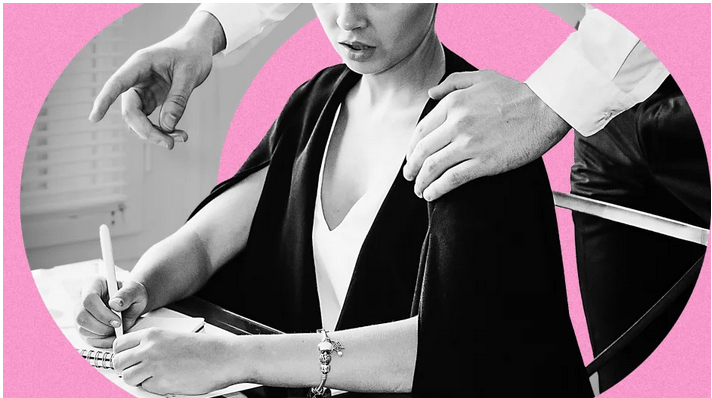
Hundreds of women have shared horror stories, after brand strategist Zoe Scaman penned a letter exposing the sexual harassment and mistreatment she has endured in her two decades in the ad industry.

Twelve years ago, advertising and brand strategist Zoe Scaman was sexually assaulted by her boss after he followed her into a washroom stall on a work night out. The next morning, while sitting six feet away, he sent her an email suggesting she “forget about last night,” because he had a wife and kids, as if what happened was either consensual or mutual. It was neither. Scaman told a few people about it, but the general response was that she shouldn’t “kick up a fuss” because “it wasn’t worth it.” That same man went on to become a client at her next agency job, where she’d often hide and cry when he was in the building.

This is just one incident of many over the course of her career that Scaman details in a new essay. The founder of UK strategy studio Bodacious, has built a following on Twitter around her insights on consumer culture and brand strategy, and a resume that includes global advertising names like Droga5 and Universal McCann, as well as work on major brands like Adidas and Nike. On Sunday, she published the piece on her “Musings of a Wandering Mind” newsletter that has caused the ad industry to really sit up and take notice.

“Mad Men. Furious Women.” begins by chronicling a few of the incidents of sexual harassment, bullying, and gaslighting she has experienced over her 18-year career. The essay also includes a number of anonymous accounts from others. It paints a picture of an industry that sees itself as progressive and innovative, but still has a long way to go when it comes to the treatment of women in its ranks.

“We like to believe that misogyny and the mistreatment of women is a thing of the past, it is not,” she writes. “Instead it has morphed and evolved into something insidious; no longer overt and no longer a common occurrence carried out in public for all to see. Instead it’s moved behind the curtain where it operates in the shadows, in private messages, in whispered comments and in the deeply disturbing behaviour [SIC] many of us experience individually, quietly, and about which, due to fear of reproach or reprisal, we rarely share openly.”

The idea for the piece came out of a conversation with a fellow ad strategist she had just met, who made the move to London from New York. “Within a few minutes we were warning each other about who to avoid in the different markets, and sharing horror stories,” Scaman tells Fast Company. “At one point we both sat there and said, ‘Hold on a second, what are we doing?’ We were shocked at that behaviour, but it’s become so normalized for women, not just in advertising but most industries. I just found myself incensed that this had become normalized to the point where we didn’t question the fact we’re warning other women how to stay safe in their workplace.”

In late 2017, around the same time Hollywood was in the midst of its MeToo reckoning with allegations against Louis CK and Ashley Judd’s accusations against Harvey Weinstein, an anonymous Instagram account called Diet Madison Avenue began sharing accusations of sexual harassment and mistreatment in the ad industry. Diet Madison Avenue named names and called out executives who had recently been fired from major agencies. Former chief creative officer at The Martin Agency Joe Alexander sued both Diet Madison Avenue and his former employer, after he was fired following multiple sexual harassment complaints. The former suit was dismissed in 2020. Amid several other defamation suits, Diet Madison Avenue shut down its social accounts and website in May 2018.

Scaman sees these incidents as just the tip of the iceberg. The ad industry was long known as a fun time boys club, one that closely reflected the grab-ass banter and darker undertones of the fictional hit TV show Mad Men. That sexism was apparent in the work. Taglines like “Is it always illegal to kill a woman?”  and “Keep her where she belongs” were common in the 1960s, but still held a grip well into the 21st century.  In more recent years, many brands and advertisers have begun to use the language of empowerment in their pitches, giving a false impression that misogyny, gender pay gaps, and other sexist behaviour are relics of the past. In the last two days, Scaman has received hundreds of stories from women around the world, detailing their own traumatic experiences. Many others have taken to Twitter to retweet the newsletter and share stories.

“Nothing really happened after MeToo, a couple of heads rolled, but it was symbolic,” Scaman says. “No real policy changes were enacted. There were a lot of pledges, a lot of heartfelt open letters, conference panels, but nothing has really changed. I don’t think the men who have done stuff already are going to be held to account. I think they’ve gotten away with it.”

She hopes that by speaking out, she can help effect change that will move the industry forward. She’s encouraged by more stories being shared, and names being named, on industry message apps like Fishbowl. “Right now there is a culture of silence, fear, and shame that we need to break,” she says. Case in point: The call to name more names has actually been going on for years. Former advertising executive and Make Love Not Porn founder Cindy Gallop addressed this need in a 2017 industry conference keynote.

Outside of more women sharing their stories, Scaman says two major things need to happen. The first is that companies need to get rid of non-disclosure agreements. NDAs are legally binding documents many employers ask employees to sign when they take a job. They are essentially designed to prevent people from speaking out. Other female industry leaders, like Katherine Gordon, CEO of the 3% Movement, have also called for a ban on NDAs. Second, an independent organizations needs to be established on behalf of victims. Human Resources departments exist to protect companies not people, and can’t be fully trusted.

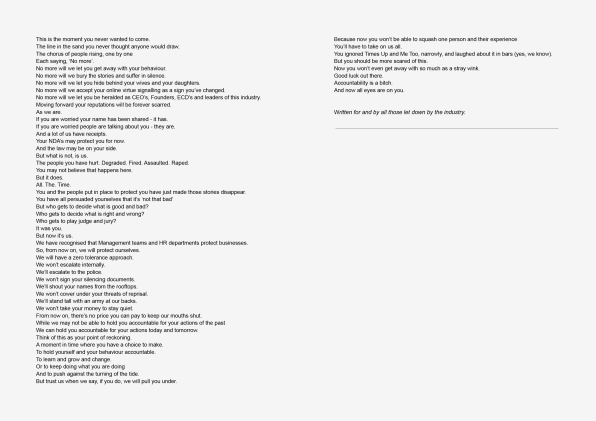
On Tuesday, Scaman and a group of industry colleagues created a call to arms, warning past and would-be perpetrators that their behaviour will no longer be tolerated. It reads:


[Click to Expand]

Scaman has never pressed charges or sought official accountability from any of her past harassers. Since her essay was published and widely circulated, one of the men who harassed her emailed her. Her whole body went white hot, and she felt lightheaded and nauseous. “That is a fear and trauma response, still strong, years and years and years later,” she wrote on Twitter. “This is what it does to us.”

For those looking to contribute and help make the changes needed in the ad industry, Scaman suggests getting in touch with and helping organizations that work to support women in the ad industry, like The 3% ConferenceCreative EqualsTimeTo, and Women in Advertising and Communications, Leadership (WACL).

If you have experienced workplace abuse and would like to share your story, I will honour your anonymity. You can email me here or DM me on Twitter here.

Feature Image Credit:  iStock

BY JEFF BEER

Jeff Beer is a staff editor at Fast Company, covering advertising, marketing, and brand creativity. More

Sourced from Fast Company

By

This is really all you need, check it out!

A podcast is one of the best ways that people can share their ideas, experiences, and views on a particular topic.

But many will wonder: What is a podcast? Here we go: It is about preparing content in audio format and it is posted on the open Internet or within certain platforms such as Spotify, Apple Podcast, Google Podcast, Ivoox, SoundCloud, among the most popular, so that the rest can listen to it. of people.

The word ” podcast ” comes from merging two words in English: “pod” (referring to a portable audio player) and ” broadcast ” (transmission or broadcast).

Make your voice heard

Sometimes the excuse for not starting our own podcast is that we have no experience or that we are not star experts in the field where we want to start; However, the idea of making our own podcast is that we reach our target audience, who may be interested in our ideas, and that we help them solve their most common problems.

For example, if you are a health professional, you can start sharing experiences and tips that help people control their weight, take care of their physical condition or tips to improve their well-being in general. You can do it using your own knowledge or you can have other guests, colleagues and specialists to help you develop the topic.

An important clarification: You don’t have to be a star to podcast. In fact, it is exactly the other way around. You will be recognized for your ideas as your audience begins to listen to you and grow with you, and become interested in your content.

The importance of personal branding

Another advantage of doing a podcast is that you will be aligning it with your personal branding strategy. As I always share, it is about reaching to develop it in the medium and long term, because it pays off to the extent that you can grow and share your ideas with an audience that will become faithful to your content; In the case of your audio content, they will not only listen to you or share and comment, but they can also subscribe to listen to your new episodes.

On another level, brands and products could be interested in what you share, generating income from your project.

4 simple steps to start your first podcast

Here are the basics you need to keep in mind when thinking about having your own podcast, in these 4 easy steps:

1. Define a topic and format: One of the most important things when starting a podcast is that you define what you want to talk about. Pick a topic that you are proficient and that you think will be useful to your audience. The most common formats are podcast with specific weekly topics, podcast with interviews, podcast with guests, or podcast with book and movie reviews related to your main topic. Although there are an infinity of themes. The duration is variable, from 5 or 10 minutes to programs of an hour or more. There is an audience for all tastes.

2. Define a publication schedule : It is important that you define the frequency in which you are going to launch each new episode. Will it be a weekly, biweekly or monthly podcast? Once you have established it, you should plan and research the topics that you are going to cover in each episode. Take the time to find sources, interviewees, or ideas that you want to implement in each episode.

When you feel ready, grab your phone (or hire a professional studio) and record your first episode. If you have the ability to edit audio, you can incorporate resources such as music, sound effects, pre-recorded voices and a large number of artistic elements that will give more body and appeal to your content. How to record? Many do it directly with the voice recorder built into the cell phone; others add an external microphone, and even get a more professional one and record on their computer.

3. Define the platforms where to post: It is undeniable that to have reach you will need to have a Spotify account for Podcasters. There are also other platforms in Spanish, as I mentioned above. And I suggest that you do not rule out local platforms and in your language, since the more you have a presence, the more viral your content could become, encompassing niche audiences and other broader ones, always depending on the topics you address.

4. Make it recurring and share it on your social networks: Now it’s time to share your podcast with the world. The first place where you should start sharing your episodes on all your social networks. If you have interviews, mention them with @ so they also help you spread the word. And remember to mention this new tactic of your Personal Brand in any other communication, for example, with a direct link on your website, or by recording yourself on video while you prepare the podcast and upload it to your YouTube channel. In other words, you do what is called “transmedia”, you take advantage of the synergy between one medium and the others. In a podcast your primary audience will be the people who already follow and know you, then new followers will come. Here the key is in the constancy, in how frequently you publish and generate loyalty and recommendations from your followers.

A help for you: The best platforms to share your podcast

Once you have your first episode recorded and edited (which you can do directly from your phone with applications such as Mobile Podcaster or Dolby On, or in a professional studio) you must share it.

One of the best ways to quickly and professionally share your podcast across multiple platforms is through Anchor.fm. This website is one of the best options to upload your episodes on several other platforms at the same time, without having to do it manually on each of them. In addition, it is an official Spotify website.

Another of the most popular aggregators where you can upload your podcast to be shared automatically on multiple platforms is Spreaker.com. Here you will also have the option to have your podcast automatically uploaded to Google Podcast, iTunes, Deezer, Stitcher, Spotify, and so many more.

My final recommendation is that you cheer up. Record your first episode and then share it with the world. Your ideas and your experiences can help many if you dare to share them. Don’t keep them, amplify them!

Feature Image Credit: Kate Oseen vía Unsplash

By

Sourced from Entrepreneur Europe

By Amelia Torode,

Presenter Vanessa Feltz’s BBC Radio London researcher messaged me last week asking whether I’d be happy to give an industry insider response on-air to the news that, in an effort to curb childhood obesity, the British government had enacted a new watershed TV and online ban on high fat, sugar and salt (HFSS) food advertising.

I’d seen the official industry response, and it had made me uneasy.

The Advertising Association declared themselves to be “dismayed” by the news. The Food and Drink Federation said that they were “disappointed …the proposals would make it difficult to advertise many products that have been carefully reformulated or created in smaller packaging. … Many food and drink companies won’t be able to advertise new product innovations … and larger food-on-the-go, pub and restaurant chains may not be able to tell their customers about their menus.”

Elsewhere, the IAB wrote that the ban “will create untold damage to the advertising industry” and that banning ads online will achieve “next to nothing in terms of reversing children’s obesity rates.” The News Media Association declared the ban “draconian.”

I am aware that I am in a position of privilege in so much as I work as an independent strategy consultant, so I’m not beholden to a global agency network and can consequentially give my opinion and not have toe the party line. But there comes a point when we all have to be honest about what we’re hearing and feeling.

At a fundamental level, we have to make a choice: either we believe advertising works or we don’t.

The moral issue

If we think advertising does work, then we probably shouldn’t be getting to upset about a pre-9 p.m. junk food advertising ban aimed at children. If, however, we believe that advertising doesn’t work then we’re probably in the wrong business.

When I posted about the HFSS ban on Twitter, the strategy community seemed divided and conflicted. I was warned about culture wars, told that “no government should be allowed to tell me what I can eat or drink,” that obesity has nothing to do with advertising. I had Jeremy Bullmore, author and former chairman of JWT London, quoted at me as saying, “Advertising’s role is to provide the best advice to clients to meet their business objectives. It has no remit to take a stance on issues.”

Really? I felt so sure this quote was not something Bullmore would actually say. So I emailed him, and he said the quote is fake.

“I’m pretty sure I’ve never written anything along those lines. It’s meaningless anyway since a company’s known stance on issues can help or impede the meeting of its business objectives,” he responded.

I have also heard a lot of anger at the perceived hypocrisy of our industry. Anger at (unnamed) IPA Effectiveness winners declaring at an ISBA conference that HFSS advertising had no significant effect on consumption.

HFSS food pun intended, our industry wants to have our delicious cake and eat it.

During Cannes Lions, when our industry is heartily patting each other on the back for the brilliance of our social purpose advertising campaigns that have apparently changed hearts and minds around the world, it just seems funny how advertising doesn’t do anything when it comes to HFSS.

Thank you for smoking

There’s a brilliant dark comedy Thank You for Smoking in which Aaron Eckhart, the lobbyist for Big Tobacco, tries to remain a role model for his 12-year-old son while simultaneously doing his job standing up for the cigarette industry. Spoiler alert: He fails.

The language that our industry is using around HFSS and children seems to be remarkably similar to the language the self-titled MOD (Merchants of Death) Squad tobacco, firearms and alcohol lobbyists use in this damning satire. It got me thinking about whether we use the same language back in 2003 when cigarette advertisements were finally banned.

Trying to understand from a client that was grappling with the new implications and impact of the ban, I spoke to Ross Farquhar, CMO of cult mochi ice cream brand Little Moons.

Ross and the Little Moons team worry this ban is devastating. “For a company like McDonald’s, Dominos or Unilever, they can side-step the ban because they can still run brand adverting that doesn’t show product. Our brand isn’t that widely known yet so we can’t do that.”

One of the loopholes would be that a company like McDonalds, so long as they didn’t show hamburgers, would be fine. In fact, they can actually advertise chicken nuggets as those fall within the acceptable HFSS range.

Farquhar’s point was that for a company like Little Moons that has yet to break into the mass mainstream and doesn’t have the brand awareness has to talk about product, especially when it’s a Japanese product that is not very well known. Now they’ve lost that opportunity on television.

There are a number of other loopholes and exceptions. OOH advertising is still permitted; small- and mid-sized businesses with less than 250 employees will not be impacted by the ban. However, Little Moons produces all their ice cream in the U.K., so while they are a small company, their headcount takes them above the magical 249 number and they’re therefore applicable to the new ruling.

My overarching view remains the same. We have the most overweight children in all of Europe. It’s a health time bomb of epic proportions, and we need an honest approach to tackling it, of which advertising is a part. For our industry to deny that advertising can shape desire and prompt purchase is simply mealy-mouthed.

By Amelia Torode

Amelia Torode is a co-founder of The Fawnbrake Collective.

Sourced from ADWEEK

By Seth Price,

Search engine optimization can help the right customers find your company. Embrace it.

Feature Image Credit: Getty Images

By Seth Price,

Managing Partner of Price Benowitz LLP and Founder & CEO of BluShark Digital

Sourced from Inc.

By

Jack Butcher spent 10 years working in advertising as a creative director for multi-billion dollar brands. And then he realized he was missing something: Freedom.

“So in search of freedom, I started my own advertising agency,” he wrote. “No fun, and even less freedom.”

After two years of working on his own agency, Butcher figured out that he needed a model that could scale infinitely. “The insight behind this transition? Productizing myself,” he said.

He pivoted to a business he called Visualize Value, which consists of a $1 million per year product business and a media platform with an audience of more than 500,000 people. (You may remember when Butcher illustrated a guest post I wrote for his website.)

Recently, Butcher participated in an hour-long, live “Ask Me Anything” with readers who are part of The Profile’s members-only Telegram chat. (To join, consider becoming a premium member here.)

Below are the highlights of his Q&A with the readers:

Q: Jack, you recently became a dad. How did you continue to consistently produce content without losing momentum even though (I assume) you had to make more time to spend with your new baby?

Butcher: I’ll start by saying my wife Celia is an incredible mum, so that definitely accounts for 90%. The other 10% I think comes down to a shift in priorities that a life event like that brings. It’s amazing what you’re actually capable of in five minutes if you literally only have five minutes. So you start to prioritize the things that have the maximum (or close to) amount of impact for time spent.

Q: To follow up, what things are maximum impact for you?

Making visuals or working on the systems in the back end of the business (email sequences, product updates, stuff that you can do once that works in perpetuity)

Q: I wanted to know if you were influenced by the Bauhaus movement or Japanese minimalism? Do you have an opinion on them?

Probably subconsciously yes. Not much of an academic so can’t credit as accurately as I’d like, but Swiss graphic design had a huge influence on me: Josef Müller-Brockman. Also product designers like German industrial designer Dieter Rams.

Q: You recently appeared on Jim O’Shaughnessy’s Infinite Loops. Which one of the question stumped you the most?

I can’t recall the exact set of questions he asked, but the hardest question to answer is always “What’s next?” I plan maybe two weeks out versus 10 years.

Q: How do you get ideas, and is there a reason you prefer to work in the short-term?

I think I just forged a preference for working under pressure in an agency environment, and the idea of “running out” of ideas is weirdly motivating. Each iteration of the business wasn’t planned in a traditional sense. It was more of an organic evolution, so I’ve stopped trying to predict those things and just lean into trusting the process and see where it ends up.

Q: Do you recall the moment that your visuals gained traction on Twitter? What was that feeling like? And how did you know that what you were working on was working?

I think it was a Nassim Taleb retweet that made me realize that this thing could work. I was new to Twitter and experiencing the power of network effects on that platform when it shifted something in my brain. I went all in after that.

Q: How did you decide to monetize your graphics after realizing there is a chance post-Naseem Taleb’s RT? How did you figure out the skill-market fit?

My background is in advertising, so I think I understood that the ability to capture attention organically is worth something. The first product took that idea and turned it into an education product “How to Visualize Value.”

Q: What advice or tips would you give to educators who are creating content to teach online when designing content to have maximum learning impact?

My personal approach is “principles first” — so understanding the building blocks of knowledge that are necessary for someone to practice something effectively, and introducing them one at a time.

Lots of online education teaches tactics first (or the memorization of something), which is much less effective than teaching someone the fundamentals and letting them figure it out for themselves.

It’s also about encouraging people to create things off the back of what they learn creates the best kind of feedback loop — “If you can’t explain it to a 5-year-old, you don’t understand it.”

Q: Have you thought about creating a book for toddlers or younger kids? Your graphics are exceptionally simple to understand, which is the best part of the creation.

I had a baby recently and did not know that the black and white high contrast images were a cognitive development thing. I’m looking into it right now. (There’s also room for something for older children too I think).

Q: Have you built a personal brand for anyone using VV methodology and if so, was it as effective as doing it for a product or business?

There have been plenty of graduates of our courses that have built solid personal brands on the same principles that VV uses:

By

Sourced from INSIDER

By Phoebe Bain

Nandini Jammi and Claire Atkin are the cofounders of Check My Ads, which helps marketers keep their advertising away from fake news and the like.

ICYMI, Marketing Brew hosted a virtual event on Wednesday with the cofounders of Check My Ads, a consultancy that helps advertisers navigate the chaos (and danger) of the ad tech world.

  • Morning Brew’s B2B Executive Editor, Josh Sternberg, chatted with cofounders Nandini Jammi and Claire Atkin about where ads lost in the ad tech pipes actually land. Often, they end up alongside misinformation, fake news, and conspiracy theories.
  • That’s where Check My Ads comes in. Jammi and Atkin’s consultancy works with marketers, providing them brand safety training to help them steer their ads away from such content.

Watch the recording of the full event here, or read on for our three favorite quotes from the thirty minute conversation.

  • “We have yet to work with a brand that hasn’t been on some kind of disinformation [site].”—Atkin, on just how common it is for ads to get funneled into the worst places on the internet without marketers knowing it.
  • “Google, Criteo, OpenX, [and] Taboola are some of the biggest funders, monetizers of hate speech and disinformation. That’s something we have seen in our own work with clients, and it’s also something that I see as a disinformation researcher.”—Jammi, on which ad tech companies she and other anti-disinformation professionals believe to be the worst offenders.
  • “You cannot automate your way to brand safety.”—Atkin, on why all marketers should, quite literally, check their ads.—PB

By Phoebe Bain

Sourced from Marketing Brew

Want better results from your Instagram ads? Wondering how to optimize your top-performing Instagram ads?

In this article, you’ll find a comprehensive process to test your Instagram ads campaigns and scale your results.

Instagram Ads Are Different From Facebook Ads

Instagram may still have great (relative to Facebook) organic reach, but if you really want to scale, you need to reach people outside of your existing audience. How do you do that? Therein lie the art and the science (mostly the science) of Instagram ads.

Instagram is a unique platform for running ads for several reasons.

The most active demographic on Instagram has changed dramatically in the last 5 years. Five years ago, 45-year-olds were barely on Instagram and the under-25 crowd dominated the platform. Now, the under-25s are on TikTok and 45-year-olds are all over Instagram.

Aside from a massive demographic shift, user behaviour can make Instagram a challenging platform to convert buyers or leads—namely, people aren’t in the habit of clicking off of the platform. Organic content on Instagram almost always keeps people on the platform.

Sure, some accounts have 10,000+ followers and a swipe-up link on Stories. Sure, people can climb a mountain, cross a fjord, and hop on a zipline to get to an account’s “link in bio.” But that link-clicking behaviour happens on a minority of content on Instagram.

Ninety-nine percent of the organic content people engage with on Instagram keeps them on the platform. Conversely, on Facebook, Twitter, LinkedIn, and Pinterest, people regularly click off of the platform to read articles, explore products, or opt into free offers.

Instagram ads require different behaviour than organic content, and whenever you have this discrepancy, you’ll have a lower click-through rate. This is the challenge of Instagram.

Click HERE to read the remainder of the article

Sourced from Social Media Examiner