Author

editor

Browsing

By Martin Zwilling

Innovative ideas often come from one person, but great businesses require the right team.

As an adviser to new businesses, I’m a strong believer that no one succeeds alone in business.

Yet I find that many entrepreneurs struggle and fail with the transition from personally developing an innovative new idea to building all the relationships necessary to transform their idea into a successful business. These relationships include investors, an operational team, and customers.

I found that challenge confirmed and amplified in an inspirational new book, No One Succeeds Alone: Learn Everything You Can From Everyone You Can, by Robert Reffkin, which chronicles his own ups and downs through many companies, to success at real estate platform Compass.

He credits his own rise to this strategy, and I certainly agree with his key guidelines on how to get there:

1. Dream big — this inspires strong people to join you.

You won’t learn much from a small dream or an idea that has minimal risk, and you won’t inspire the people you need to help you. Thinking small won’t stir their passion, create meaning, or spur creative thinking. Strong people love an “impossible” challenge with a large opportunity.

2. Move fast — speed highlights energy and impact.

Moving fast is about going from not knowing to knowing as quickly as possible, and everyone loves to maximize this learning. The world around you is moving faster and faster these days, and not moving fast likely means you are not keeping up with the people and customers you need to succeed.

3. Learn from reality — test new ideas and get feedback.

Learning from reality takes humility, courage, and really listening to others, but it allow you to change quickly for the better, and you will enjoy the journey, as well as the destination. Study what has come before, capture what works right now, and ask customers what they want in the future.

4. Be solutions-driven — to drive success and learning.

Ideas and problems are the opportunity, but collaboration with the right people gives you the energy to achieve great results. This will give you the confidence to surface breakthrough ideas, proactively attack impossible challenges, and lead others to leverage what you and your collaborators have learned.

5. Obsess on opportunities to improve customers’ lives.

The more you listen to other people about opportunities, the more you will see, and the quicker your business will be responding. If you want to do something more meaningful with your life, find a passion for a customer-driven higher purpose, such as a social need or improving the environment.

6. Build relationships with respect and without ego.

Check your ego at the door, since outsize egos make trust and teamwork nearly impossible. Inspire everyone you interact with today to feel like they want to work with you again tomorrow and learn more from you. Give credit and thanks freely, knowing you will be repaid handsomely in other ways.

7. Play to your strengths, and seek strengths in others.

Don’t waste time trying to fix or hide all your imperfections. Spend the time capitalizing on the strengths of others on your team, and focusing on your own strengths, to maximize results and minimize time spent. Trying to be the best at everything that needs to be done isn’t fun and doesn’t work.

8. Bounce back from every failure with passion.

The truest test of character is not how you act when things are going great — it’s what you do and how effectively you use other people to recover when you hit bottom. Many people are willing and able to help you stand even taller, if you show the resilience, learning, and grit to never stay down.

Steve Jobs is a famous example of someone who bounced back from failure. After his early forced resignation from Apple, Jobs learned to rely on the help of many others, and came back to make Apple one of the most successful companies of the past decades.

The real message here is that no matter how good and how determined you are, you can go only so far alone. Your biggest challenge in business is to find those complementary and supportive relationships that can amplify your passion and strengths, and take you to the next level. Together, anything is possible. Start today.

Feature Image Credit: Getty Images

By Martin Zwilling

Sourced from Inc.

By Andy Walker

Have no idea how to opt-out? Don’t worry. We explain all below.

  • Amazon Sidewalk goes live across the US next month.
  • The crowdsourced internet sharing service uses Amazon devices to create a free mesh network.
  • Supported Amazon devices will automatically form part of the service unless users unenroll.

Amazon Sidewalk, the company’s crowdsourced mesh network program, will be switched on across the US next week. But, if you own an Amazon device and don’t want to be part of it, you have just a few days left to opt out.

Amazon devices will automatically enrol in the program unless users explicitly visit their settings menu to withdraw. These include devices in the Alexa series, the Echo line, the Ring family, and other smart home equipment.

Sidewalk uses these devices as nodes that form the cornerstones of a crowdsourced Amazon mesh network. The service employs Bluetooth connections and other spectrum bands with network speed limited to 80kbps. A data cap of 500MB per month is also standard.

Amazon’s plan for Sidewalk

Amazon’s grand design for Sidewalk is simple. The free service allows the company to easily broaden the coverage and connectivity of smart home devices beyond a Wi-Fi network. “For example, if your Echo device loses its Wi-Fi connection, Sidewalk can simplify reconnecting to your router,” it explains. “For select Ring devices, you can continue to receive motion alerts from your Ring Security Cams, and customer support can still troubleshoot problems even if your devices lose their Wi-Fi connection.”

While Amazon does provide documentation (h/t Ars Technica) on how it uses the service, the encryption it employs, and user privacy, it’s likely many users aren’t too thrilled by the concept. Some might find it beneficial. Those who don’t want to take part do need to visit the Alexa app’s settings menu.

How to opt out of Amazon Sidewalk

Thankfully, it’s simple enough to opt out of Amazon Sidewalk. To do so:

  • Head to the Alexa app on your device.
  • Open More and hit Settings
  • Select Account Settings
  • Select Amazon Sidewalk
  • Turn Amazon Sidekick Off

Sidewalk goes live from June 8 across the US. Amazon hasn’t yet published availability plans for other regions.

By Andy Walker

Sourced from Android Authority

By

Want more sales from your ads? Wondering how to write Instagram ad copy that converts?

In this article, you’ll discover how to create ads specifically designed to sell products and services on Instagram.

Why Instagram Ad Placements Need Dedicated Copy

Instagram is often thought of as a purely visual platform, and while that’s true in part, the information you provide along with your ad visuals is what persuades the audience to take action. Getting your copy right is just as important as finding the perfect image or video.

When you use Facebook Ads Manager to create your Instagram ads, you can choose from multiple ad placements including Facebook. But you don’t want to rely on Ads Manager to auto-generate your ads from one set of copy and assume it will work on all placements. Instead, edit each placement so the copy works within the limitations of that platform.

For example, when you include links in your ad copy, they’re clickable in Facebook ads but not Instagram ads. So adding links to your Instagram copy is a waste of time and takes up valuable real estate. And people who are expecting to tap through to your website from the copy may get frustrated. To avoid this issue, stick with the features provided and direct the audience to tap on your call-to-action (CTA) button.

It’s also important to treat the ad copy for Instagram story ads differently from what you use in the Instagram news feed. Stories are displayed for up to 15 seconds so your audience won’t have time to read long copy. Plus, if you rely on Facebook to auto-generate story ads from your news feed ads, your copy is unlikely to display correctly.

Short, snappy ad copy is an effective way to capture your audience’s attention in an Instagram story ad. You can also get good results by using a captivating image and a strong CTA.

Click HERE to read the remainder of the article.

By

Sourced from Social Media Examiner

By Arif Chowdhury,

Content is the king of any type of marketing; there is nothing new here. However, creating a perfect plan for your next content marketing is the key to success. Almost anyone can create content but making it perfectly suited for your business is the key.

Long ago, before 2005, B2B and B2C businesses usually did not care about creating fresh content regularly. However, because of the audience’s ever-increasing desire for fresh and engaging content, search engines like Google, Bing, Yahoo, etc., also give priority to fresh and engaging content.

Create a Perfect Content Marketing Plan for Your Business

And this is where it begins; from personal bloggers to big brands, all are racing to create fresh and engaging content regularly for their business website to get their share of organic traffic.

Because only by creating fresh & engaging content that their audience love, a business can increase not only sales but also build a brand name among the crowd. Thanks to social media, audiences can share content among them that creates a massive awareness for a business. Which, in turn, helps to increase revenue by many folds.

A recent study says 69 percent of B2B businesses have documented content marketing strategies. And 76 percent of marketers judge the success of a business by measuring their organic traffic statistics. As you can see, in this new digital marketing era, content marketing is the key to drive more organic traffic to your business.

In this article, I will discuss how you should build a perfect plan for your content marketing.

Step 1: Build Your Brand by Creating Mass Awareness

If you want to get success in the long-term, then branding is essential. Look at the big brands; their audience knows them for their brand name, not the product itself. This is a smart way of marketing that your audience will purchase because they trust you more than they trust their judgment.

Let me give you a perfect example of this. You may have seen many of your friends buy an iPhone without even a second thought. Even if they have seen recent bad reviews about that phone.

Why does it happen? Well, it does not happen in one day; it took them years to gain trust from their audiences. Now people buy iPhones from day zero when they get released.

This is a vital reason why you should focus on building a brand among your audience using mass awareness. However, before you do that, ask yourself the below questions to identify the right approach.

  • Who is my target audience?
  • What type of content is my primary focus? Text, visual, audio, or a combination of all.
  • Who are my competitors? What kind of content are they using?
  • How do they create mass awareness? Which online platform are they using?

Step 2: Tweaks Your Existing Marketing Campaign

Again, I am saying this; nowadays, it is a highly competitive era. It’s not 2000 where people are just starting to get along with online content & bloggers are just emerging from the womb.

It is 2020 & to date, more than 500 million blog posts exist & 1.7 billion websites all over the globe. In recent statistics, almost 80 percent of people do not even read your entire post, only read the headline and pass it. According to MOZ, 92 percent of Google searches never visit the 2nd page.

These statistics only tell us one thing. Content marketing is becoming harder every day. You have to focus on your target audience by creating highly engaging & relevant content. Otherwise, all your efforts will go in vain.

So, the question is – how are you supposed to tweak your existing campaign? Well, it is simple. Take a look at the below table. I have presented 3 of my favourite content & keyword analysis tools for you to get started. If you plan for long-term business, then you must have to use a tool like this.

Best tools for Content & Keyword Analysis 

Best tools Costing Free Trial
Ahref $99 per month 7-days for $7
Semrush $99.95 per month 7-days free
Ubersuggest $12 per month 7-days free

Step 3: Set Your Marketing Goals & Stick with It

Before you do anything, it’s always better to create specific goals of marketing your content and stick with it. Set your goals and synchronize them with your entire team for better collaboration. This is the digital era — do not forget that.

You do not have to arrange a meeting every single time you update your decision. Use the power of management tools to collaborate with your entire team, including sharing files, photos, and videos on the fly. Use a secure channel to share classified information without using third-party applications like Gmail, Facebook messenger, WhatsApp, etc.

Once you can collaborate with your entire team securely & on time, it is time to set specific goals that can be achieved within a specific timeframe. Do not target a goal that cannot be achieved or too hard to get desired success.

Also, you need to focus on time management. Look for your competitors’ weaknesses to identify the untapped opportunity to seize it. For example, if your competitor is Microsoft, you can still beat them without directly targeting their focused objective. Instead, find the hole to get into the market by searching for an untapped opportunity that even Microsoft didn’t see.

It’s so obvious, you cannot fight head-on against a powerful opponent, but as they are your opponent, you have to find their weakness and hit hard to beat them.

Find Content Gap using Ahref “Content & Keyword Analysis Tool.”

It’s so obvious if your competitor is strong, then there is no way you can beat them head to head unless you have a large amount of funding to back you up.

So, what to do? Here is the answer for you. I have given you 3 of my best content & keyword analysis tools to begin with.  For this example, I have used the Ahref tool. Take a look at how I find more than 2,000+ keyword gaps in their website.

If you want to beat your competitor, then this is the chance. Find their weakness by using “content gap” to find out which type of keywords they haven’t ranked yet.  Now, create powerful content on that keywords & start to win the market.

Step 4: Plan for Your Target Audience

Always remember that the audience is the ultimate success key. Without them, no business could exist because they are buyers & the lifeblood of any business.

Every business’s target audience could be different. It is a vital task to identify the customer’s interest, habit & lifecycle. If you do not analyze your audience and build the correct content, then even if you have high quality and engaging content — your target audience may not be interested in those.

Some audiences may be interested in video rather than simple text content. Some may be interested in audio content but feeling bored with video & text. It can vary from the audience. Thus you should find out in which type of content they have an interest.

You may face that some group of the audience does not buy products right away. They always research first and take a decision after a while. Your task is to convert them before your competitors convert them. To do that, analyse your target audience and build a perfect marketing strategy.

How to Identify Your Audience Interest?

Using Google analytic, you can easily do it. Visit Google analytic, then click on the audience tab. Here you will find all sorts of information regarding your existing audience. Their age, location, gender, interest, income level, etc.

Visit Google Analytic – Audience

Step 5: Create a Plan for Content Creation

It completely depends on your business brand & target audiences. Some content creation strategies may work for my business. However, the same strategy may not suit your business.

For example, my target audience always searches through Google and research by reading the blog, article, forum post, social media post, etc. Therefore, my content creation plan is – highly engaging, helpful & fresh content that is built with text & images.

Because search engines like Google love text & images, which is perfectly suited for my business marketing plan as well. Now think very carefully what type of business you have, thus building your content creation strategy. For example, if it is a cooking course, then you should focus on video rather than text & images.

Step 6: Leverage Social Media to Create Mass Awareness

Though you can spend thousands of dollars on your business to market it. However, this is not a cost-efficient method. Better to focus on social media like Facebook, Instagram, Twitter, etc., for online marketing.

If you use Google ads service for marketing your business, then for a single visitor, you may have to spend $1-2 on average. Most businesses from small to large spend $9,000 per month on average for online marketing.

However, if you can build a community on social media platforms, then you may get millions of visitors to your website without spending a dime. Though, not all social media may suit your business. For example, if your business is cooking-related or furniture-related, you may get massive visitors from Instagram & YouTube.

Step 7: Analyse & Track Your Business Performance

This is the final stage of success. After you have planned for your audiences & build a powerful content marketing strategy now, it’s time to focus on the result. By analysing your website visitors, subscriptions, sharing on social media & purchases made by the audience. It’s so obvious; not everyone gets their desired result without trial & error.

You may create an excellent strategy, but it will only become perfect when you test it out and get the desired result. If you do not get it — then find out the errors and fix it & again test it.

There are several metrics to test your business performance.

  • Audience Behaviour: bounce rate, visit duration, etc.
  • Revenue: subscription, conversion, etc.
  • Mass awareness: sharing, comments, backlinks, etc.
  • Organic Traffic: visitors from search engines, fewer advertisements needed

These are just sample metrics you could use to measure your performance. However, there are many CRM software out there you could use to handle these complex analysing tasks automatically.

Conclusion

How you should market your content completely depends on your business & audience. I can only show you a general way to get success. However, you have to walk by yourself. Analyse your audience & learn about them.

Then build a content-making & marketing plan. Finally, analyse your business performance to see if it works. Remember, every big brand once struggled many years to get the desired success. But they never give up.

Feature Image Credit: rodnae productions; pexels; thank you!

By Arif Chowdhury

Arif Chowdhury is the founder of Cliobra. An active digital marketer specialized in both search engine marketing and social media networks. With more than 10 years of practical experience in small to large organizations management, he provides consultancy on how to manage both sales & marketing departments.

Sourced from readwrite

By

Entrepreneurs should do what they can to avoid time-consuming and costly mistakes when starting a new business.

I started my business, six years ago, by accident. I had an idea for a unique wedding business, where strangers could hire me to be their bridesmaid, and decided to test that idea out by posting an ad on Craigslist. The ad drew hundreds of interested people to reach out to me and within a matter of days, I officially launched Bridesmaid for Hire.

Because I started my business so quickly, I found that in the first year I made many mistakes that cost me a lot of money and precious time. It’s been six years since then and looking back, I wish I had avoided these costly errors from the very beginning.

If you’re thinking of starting a side hustle, these are the mistakes I made that you should try to avoid.

1. Ditching a budget

When I started my business, I wasn’t sure how much money I needed to get the website up and running, to market to new clients, and to hire professionals (lawyers and accountants) along the way. During the first few months, I was charging every little thing on my personal credit card and not realizing how much I was spending.

I spent close to $500 to launch my website, pay for different software products to help with email marketing and social media, and get official branding for the company. This was all just in the first few weeks of starting the business.

Rather than just paying for things and racking up credit card debt, I wish I’d had a budget. If I could go back in time, I would first decide how much of my personal cash I wanted to loan to the business. Then, I’d create different categories for spending (marketing, software, professionals, freelance hires, etc.) and determine how much of that total cash I’d allocate per category. This would help me stretch a predetermined amount of money to pay for everything during that first year. Instead, I did things in reverse and when I needed something, I just charged it and didn’t keep track.

Set a budget before you start the business. Determine how much of your own cash you’re willing to pump into the early days of getting your idea up and running and stay meticulous about tracking your spending on a weekly basis.

2. Taking too much from my personal savings 

When I first started my side hustle I was working full time and took some of my income from that job to help fund my business. Without realizing it, I was slowly draining my savings account to pay for a lot of the early expenses. Since I wasn’t earning that much yet from clients and services, I was using too much of my personal cash, too fast, to pay for things.

Rather than pulling out too much money from your personal accounts, and impacting your personal financial goals (such as saving for retirement or creating an emergency fund), it’s best to put a limit on how much of your own cash you’ll loan the business and have the intention of paying yourself back once the business makes money.

When you start a business, everything always feels urgent. What I should have done was prioritize what needed to be funded immediately and what could wait. That way, I wouldn’t have put so much of my cash into the business up front and taken on personal risk without knowing if the idea would generate income in future months.

3. Not asking for advice or mentorship

I didn’t have any friends who were entrepreneurs when I first started my company so I felt very alone in the process. When I’d ask my friends for help or ask their advice on certain situations (such as how much to charge clients or how much to spend on a logo) they wouldn’t know what to advise me.

I had to learn things the hard way by making my own mistakes, when a mentor or circle of entrepreneur friends could have helped me make better decisions with their lessons learned, industry knowledge, or just entrepreneurial experience.

Even if you’re not surrounded by people creating side hustles, find online communities or reach out and find a mentor who can be there for you to answer questions, help you avoid mistakes, and stay smart with your money.

4. Refusing to hire a virtual assistant

I started the business solo and found myself taking on too much work. I was working full-time and working on my side hustle during any free moment I had (early mornings, nights, and weekends). I could have accelerated the growth of my company, big time, by hiring a virtual assistant to help with more time-consuming tasks that didn’t need to be done by me (organizing emails, uploading blog posts, creating outreach emails, etc.). Instead, I took the time to do these smaller tasks that took hours or a half the day, when I could have been working on more important areas of the business like scaling, growth, or brainstorming ways to get new clients.

Hiring a virtual assistant would have cost around $25 an hour and that’s something I could have budgeted for knowing that if I used those “free hours” I could find ways to double or triple the growth of the business.

5. Setting my prices too low 

One of the most rookie mistakes I made was when it came to figuring out how much to charge. I set my prices very low and because of that, I wasn’t profitable during the first few months when I could have been. I had many clients and was working more than 40 hours a week with this side hustle, yet my finances didn’t show success. I was undercharging for my services for two main reasons: I didn’t truly know my value and I was scared if my prices were higher I wouldn’t have any clients.

I was wrong. This was a costly mistake because I found I was providing clients with more hours of my time than they originally paid for at a very low cost. This meant I couldn’t take on new clients (because there just weren’t enough hours in the day) and it meant even though I was working hard, and working long hours, my business wasn’t making enough money to be viable.

When you notice a mistake in your pricing, make changes to how much you’re charging or your business plan. This can make or break a business early on.

Everyone starting a side hustle makes mistakes but when it comes to errors that cost time and money, it’s best to avoid those when you can. Set a clear budget, limit how much you’re pulling from personal finance, and ask for advice so you can make smart and efficient decisions along the way.

Feature Image Credit: Cavan Images/Getty

By

Sourced from INSIDER

By Alex Kantrowitz

Key Points
  • Sridhar Ramaswamy is CEO of Neeva, an ads-free search engine he helped found after running Google’s ads and commerce business.
  • In this interview with Big Technology’s Alex Kantrowitz, Ramaswamy explains how Google’s increasing reliance on ads has decreased the quality of its search engine and has real costs for users.
  • “I personally do not think of ad-supported free products as being good for consumers, good for our country in the long term, because it is very hard for them to stay true to what you and I want, as users, and as customers of these products.”

The following Is a transcript of Big Technology Podcast, edited for length and clarity. You can listen to the full episode on Apple Podcasts, Spotify, or your app of choice

Sridhar Ramaswamy is CEO of Neeva, an ads-free search engine he helped found after running Google’s ads and commerce business. Ramaswamy spent seventeen years inside Google, and eventually grew disillusioned with its ad business. Now, he’s trying to build the solution with $77.5 million in funding. In this conversation, we discuss his evolving view on advertising, what decoupling search from ads allows from a product standpoint, and how the current antitrust environment is opening Google up to competition.

Alex Kantrowitz: Google, where you used to work — they call it Alphabet now — made $31.9 billion in search ad sales last quarter alone, up from $24.5 billion in Q1 2020. YouTube ad sales were up 49% to $6 billion in Q1. This growth is going to hit a ceiling, one would imagine?

Sridhar Ramaswamy: That will happen when digital advertising is most all of advertising, and we have not quite hit the ceiling yet. We’ve hit ceilings in a number of areas, like smartphone sales — year on year it’s not really growing significantly — but he move to online advertising is part of the way there.

Yet you’re building a search engine with no ads? 

In the history of business, there has never been a company that’s commanded 90+ percent market share in a market that’s $100+ billion. If you look art previous cases of what has disrupted them? It is typically a subscription play. What did HBO do to Time Warner? What did Netflix do to ad-supported television? What did Amazon Prime do to traditional e-commerce?

The common theme is the subscription model. Back to my earlier point about how smartphone sales have tapered off, Apple has actually not grown revenue significantly, but its subscription business and stock are growing because it has invested more and more into services and subscriptions.

So, Neeva is an entirely subscription-based search engine, trying to follow this pattern?

The ads model has always gotten disrupted. I know from both personal experience and the enormous amount of user studies that we have done, that there is resentment about it. So we wanted to create Neeva as a product that catered only to customers and was very, very strict about things like not having ads in it.

To us, subscription search was the way to create a superior product. And having really squeaky clean business principles — not just no ads, but no affiliate links ever, no data getting packaged and sold ever, being privacy-first — all of those are consequences of the model where we say, “We want to create the best product for you.”

So is your product going to be a nice luxury product — privacy for the rich — or do you think it can be something that will appeal to the masses? And if so why?

Our aspiration is to be a product that everybody will want. Search is something that people do a dozen times a day, there are not many things that people go back to time and time and time again. We think of ourselves as creating a daily-use product without any worries, without any gadgets, so we think will be able to price this at a point where lots of people really, really get value from it, and will pay for it.

Scott Galloway, who wrote “The Four,” compares Google to God. It used to be you would ask God, “When will my sick kid be healed?” Now you type the symptoms into Google. I suppose it doesn’t occur to us that when we’re speaking to our god stand-in we’re speaking to an advertiser at the same time. 

You know something? The ad-supported model, even for queries like that sick child, tends to favour high engagement sites that have figured out how to get your attention, and how to cram a lot of ads. In fact, I joke to people that anytime I do a medical search and go to a medical health site, generally my conclusion is like, “I have a serious problem and I’m dying.”

I went to WebMD a little while ago and it was for scratchy throat, and WebMD was like, “Well, you may just have the common cold, or you might have Ebola.” 

It’s the same as clickbait. It’s the system that is working as it is designed, On those queries the features we at Neeva think about are, “How do we surface government website? How do we surface high authority websites, and not the ones that are chasing after clicks?” Part of the benefit of the subscription model is that it can focus a lot more on what is authoritative, what is higher quality information for you.

Okay, but isn’t the purpose of Google to get you useful results so that you just keep coming back?

The answer depends on what queries you’re thinking about. When it comes to commercial queries, the algorithm is now optimized towards showing your results in which you click on ads, and those are the ones that are taking up more and more of the space. One of the ways in which you get that growth is by taking that extra line, and search ads over the years have gone from taking 3% of the result on the page to 10%, 20%. I joke to people, if you search on a place like yahoo.com, even on a large screen you only see ads. And so, there is now this very strong incentive to show you results that are ads. And ads are a conflict of interest for the search engine. Should they show you an ad or should they show you the best result?

It’ll surprise you to know that one of the biggest feature asks that we have, are things like, “I want to control what retailers I see. I do not want to see big retailers when I search. I want smaller retailers. If I’m looking for clothing I only want to be shown stores that make a commitment to ethically sourcing their material.” Not showing the top retailer in the country is not an option for an ad-driven search engine. For us, it’s a feature we must build because that’s what keeps you as a customer.

Right, because that top retailer is also going to be a top advertiser for Google. 

That’s right.

You also allow people to also tailor the news results they want to see. On NFL draft weekend, I was searching for the Jets picks and Neeva let me decided whether I want to see more ESPN or more of the fan blogs when I search. That struck me as a cool feature — now I have some more control in terms of what I’m seeing when I search — is that intentional?

That’s 100% intentional. Giving you agency over the search results is one of the things that we focus on a lot. The other features we have built around personalization being able to bring your personal data into a safe environment where you can search. Lots of us have multiple email accounts multiple [Google] Drive-like accounts, I was talking to someone I think that had nine email accounts that they connected to their Neeva account because they were like, “Yeah, how am I going to search through all of them?”

So, things like personalization, giving you agency, is very much a core part of the product. And in some ways we are impatient about the tech that we have to build, because we want to be able to support things like this more and more.

With news, we worry about things like filter bubbles. We have ideas for how we present different perspectives. In a couple of months I want to be able to come back to you and say, “Hey, Alex you’re a public personality, would you be open to having your news preferences be available to any nearby user, so they can see the world the way you see it?”

Oh that’s interesting.

I often have diametrically opposite viewpoints on my screen. I like looking at CNN on one side and Fox News on the other side and going, “This is the same country, this is my country. Let’s see what’s here.” It goes back to this thing of — you have choice and we should make it possible for you to exercise choice in different ways.

I was going to ask you the filter bubble question but you preempted me. The most basic layer of this is to pick your news sites. But then one level deeper than that is starting to pick viewpoints — do you want the left or the right view?

Or, do you want a particular person’s view? We relate to people we don’t relate to abstract concepts. So, you want to see the world that Alex does, or David Brooks? To me that’s super cool. We are a signed-in product, we are a subscription product, I’m not ashamed of either of these. I believe capitalism should enable great products at scale, so I don’t think of ourselves as creating somehow this elitist premium product. You pay for it but that makes the product better, that allows us to serve you better. And along the way we want to be able to build the features that make the product your own.

Could any of this stuff happen at Google? Because I imagine Google allowing people to customize the publishers that they get, or making decisions about what type of publications to show, would be a little bit tricky…

Google can do anything. It’s an enormously powerful, enormously successful company. But then people ask me, “Why did you not want to do this within Google?” The answer is that sometimes principles have to be thought over from the ground up, and a successful company is necessarily and correctly hesitant about what it sees as heretical ideas. And so this is the reason why I felt it was really important that I press the reset button in my life. Some things are easy, but will Google ever really want to create a completely ads-free product in which you can customize everything? I say they can do everything, but at this point in their history with all the antitrust stuff, it is also going to look very odd if they were to do that right now. I think this is one of those classic cases where success hinges on a set of parameters that are going to become hard to change, especially after you achieve, what, $120 billion of success. That’s a lot of dollars speaking here.

When you talk about “heretical ideas,” would it be a heretical to bring this ads-free idea up inside Google?

I’ve done many of these things before. Even the move that we made to have desktop and mobile advertising be a single concept, we call this enhanced campaigns, this was like 2013, 2014….

Inside Google?

Inside Google. And it is just so hard to pull off because you have people that are wedded to one way of doing things. I was in charge of making all of the shopping property into a paid property. So, I’ve gone through these changes, but some changes are extra super hard.

I want to hear a little bit more about your personal story. We talked a little bit about how ads have started to fill up more and more of the Google page. This happened under…

My watch.

So did it happen slowly where you started to say, “Maybe this isn’t the right way to do search,” or did it happen all at once?

I was the exec in charge of many of the increases in ad load, there was an expectation of a certain amount of growth, there were a set of techniques that were available for how you increased growth, you’re always very thoughtful about the trade-offs implied by growth. There came a certain point in time that when it came to the overall ad ecosystem I said, “I don’t want to be working on that anymore.” I’m an accidental ads person, I had nothing to do with ads before I joined Google. I joke to people, my first boss found the word “database” in my resume and sent me to work on the ad system, that was the reason why I’ve worked on ads for 15 years.

If you look at the math of how Google works, a vanishing fraction of people work on Google search…The size of the Google Ads team and the Google Ads product team dwarfs that of the search team.
Sridhar Ramaswamy
Neeva CEO, former Google Ads boss

This idea of Neeva came later. We love the problem, with a different model it can be a powerful differentiator. I started the subscription business initially as, “This is the best way to provide alignment between you, the customer, and as the provider.” But then you learn all of these other qualities that they bring. 100% of your team is focused on creating the product. If you look at the math of how Google works, a vanishing fraction of people work on Google search. And you would think like, “How can that be?” But that’s the reality, the size of the Google Ads team and the Google Ads product team dwarfs that of the search team.

The Google ads team’s bigger than the search team?

100%.

Wild.

And if you take the ads business team and the ads product and engineering teams, they’re way larger than the search team.

Obviously people are going to look at it as competitive to your old employer. Did you worry about relationships there or how it might be received? What has the feedback been from your former colleagues?

I obviously do worry about it, I have a lot of close relationships with a lot of people at Google. And I would roughly say that feedback falls into two buckets, one set of people that go like, “Yeah, we understand why you’re doing this and why you didn’t think you could do this within Google.” And a different set that goes, “We wish, really, you had done this within Google because if anyone could have changed what Google was, it should have been you.”

Both are reasonable points of view and there are some people that don’t just want to deal with it, this is all too much for them, and I respect those points of view but at some level one has to be driven by what one sees is the right, long-term outcome. I personally do not think of ad-supported free products as being good for consumers, good for our country in the long term, because it is very hard for them to stay true to what you and I want, as users, and as customers of these products.

That conflict of interest is just really, really unavoidable. And the fact of the matter, Alex, is that while at one level the products are free, all the benefits of scale for products like this, they go to the creator of the product, they don’t come to you and me. When it comes to Neeva, for example, I talk about charging a subscription of like $5 to $10 at most per month.

Okay, so we got the price…

And as we gain scale I expect the product to actually get cheaper over time. When you start with a free product the product does not get any freer for you, all the benefits of scale go to the creator of the product. So, in many ways, I actually see these as not even working with the same principles of capitalism that’s worked so well for us as a country, and honestly as a globe, for the last 100, 200 years. And so we think a back to basics of, “You’re the customer you pay for the product, in the long term it’s going to give us better products than free products that basically they all charge the advertiser.” And do you know who then turns and gives you and me a higher price?

The advertiser.

They’re the retailer, they are the merchant. And in ecommerce, by the way, it’s well known that a marketplace can squeeze out between 15 to 20% of GMV..

Which is?

The Growth Merchandise Value. If you run a marketplace and…you’re selling goods worth $1 billion, you can extract between 15 and 20% of that as an ads tax just by showing ads on top of that marketplace, but it comes from the users, that customers of the marketplace, you and me. So, this whole fallacy that ad-supported products are good because they give everything else to us for free is just what it is, it is a fallacy. You and I are paying just indirect place and not knowingly.

One of the things that’s been left unsaid through this whole conversation is that with search you just type in your intent, you don’t really need to be tracked, and the advertiser goes in and tries to match their ads with the keywords you type. They don’t really have to know who you are. And in fact, a lot of people would say that Google search ads are the least invasive of all ads online…

First of all, there’s no limit to how many ads can be shown to you. By the way, it is perfectly legal under current interpretations of antitrust, for the entirety of a search result page to only have ads. It’s perfectly legit. And the fact that so much of your attention is taken by these ads and you have to make a conscious effort to get past them, is a subtle and indirect tax. All of us are more susceptible to having our choices influenced than honestly any of us wants to admit, and so how are choices presented to you?

We’re very suggestible.

How are choices presented to you has a huge influence. And so the fact that you have to go through reams and reams of these affects you, even if you think it doesn’t affect you. I tell people, “I eat what I keep on the surface on my kitchen.” I think I’m full of self-control but, honestly, I just see what’s out there, over the long term. So, I think there is that effect.

The other thing to keep in mind is that keeping track of conversions, wherever they happen on the internet, having all of the data come back to Google, come back to Facebook, is the core part of ads technology. And it is then very difficult to then say that this information is not going to be used to serve ads in other places.

To give you a concrete example, your searches can be used to show you ads on YouTube, they can be used to show you ads on Gmail. And so there is really no limit to how information gets used, and this is one of the reasons why we are so adamant about having these core principles for Neeva. Your data is yours, we are not going to profit off of the data, other than in creating the service that works for you.

Yeah, there used to be a firewall between what you searched for on Google and the search ads you were shown, and the rest of the business, Eventually was broken down. How did that happen?

It is a very long and very complicated topic, but…

Give us the Cliff Notes.

The Cliff Notes is roughly that whenever you were signed in across different Google properties, it was always okay for that information to get moved around to show you ads, that was always part of the equation. There were boundaries that were kept between what happened outside Google and what happened inside Google, but information always flowed into Google via the various conversion tracking pixels that there were.

Last thing we should talk about is the fact that Google is under some antitrust scrutiny right now, because of the way that it’s iced out businesses like yours. The Department of Justice is suing Google over how it’s paying Apple billions of dollars a year to be the default on the iPhone and iOS. Is it intimidating to you to try to go up against Google now knowing the tactics? 

Choice is important. Search is the gateway to information for tons and tons of people. So, when it comes to Google and search, yes I worry about just getting in front of users. We understand that we have a lot more to build — whether it’s in terms of personalization or the 1,000 features that people have — but I can tell you with a straight face that there is also an amount of joy that people get when they use Neeva, that feeling of relaxation, “Oh wow, I’m not getting stressed out by lots of stuff,” is also very real.

So, I worry about having the chance to get in front of you, to get in front of 100 other people like you, and say like, “Hey, give us a chance. If you think it’s worthwhile pay, If not that’s also fine.” To me that is the important part, and the DOJ case at least gets to the heart of it, which is, how does a monopoly not prevent others from even being able to compete? It is a fair chance that I want for you.

The DOJ is taking on Google in terms of its search distribution deals. Where do you think this all leads? Because these hearings could go on forever, the cases could go on forever, but do you as a business owner that could really use a little bit of help, anticipate it’s ever going to show up?

The scrutiny helps, I think it heightens awareness that these are real issues. Do I expect an actual outcome in this? No, not anytime soon. But the scrutiny helps, it gives us that little bit of a chance.

Feature Image Credit: Krisztian Bocsi | Bloomberg | Getty Images

Google’s senior vice president of advertising and commerce Sridhar Ramaswamy

By Alex Kantrowitz

Alex Kantrowitz is the founder of Big Technology, a weekly newsletter and podcast that cover the inner workings of Amazon, Apple, Facebook, Google, and Microsoft. He is also a CNBC Contributor.

Sourced from CNBC

By Dr. Augustine Fou

Most marketers had been happily paying for programmatic advertising for the last decade, very proud of themselves for being “digitally transformed.” They were also happily using vanity metrics like CPM prices, number of impressions, and click through rates because those were easy to measure and easy to report. Buying digital ads became as easy as playing a video game, with colorful dashboards that showed them what great discounts they got (“cost efficiency”), the number of impressions they bought (“reach”), and how many clicks they got (“performance”). But this triple cocktail of low price, large reach, and high performance was so addictive because every part of it was faked by fraudsters.

The low CPM prices were only possible from fraudulent or fake sites that plagiarized all their content or used no content at all. Real publishers with real human audiences had real costs of producing the content; so they could not sell ads for very low CPM prices. Further, there’s a finite number of humans that visit their sites every month; so they could not magically manifest a lot more reach. But fake sites could easily do this by buying traffic and doing audience extension. No one can force a herd of humans to all go to the same site at the same time to increase its traffic and audience; but it takes no more than one command line to instruct a vast botnet to generate a large number of pageviews on a site — exactly the amount that was paid for. And these same bots click on the ads too. Not too much or else that would be suspicious. Bots tune their click through rates to be in the 5 – 15% range, which is always higher than real human click rates. This way, marketers are tricked into thinking ads on fake sites are performing so much better than ads on real sites with real humans, so they allocate more or all of their budget to programmatic channels, which are teaming with such fake and fraudulent sites.

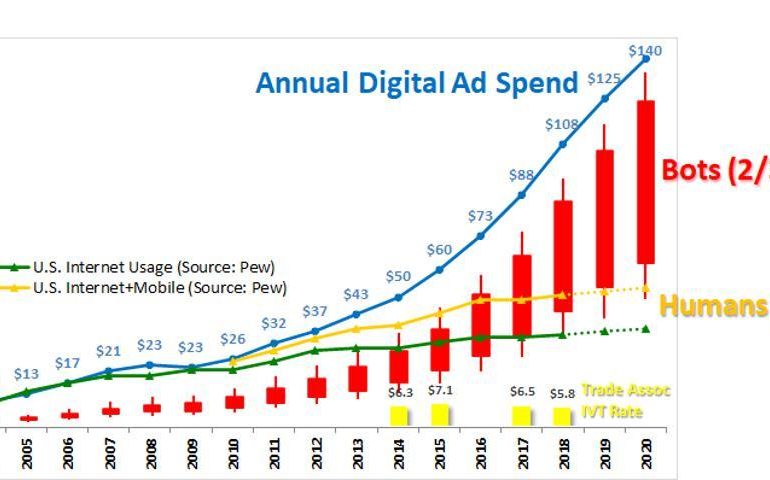
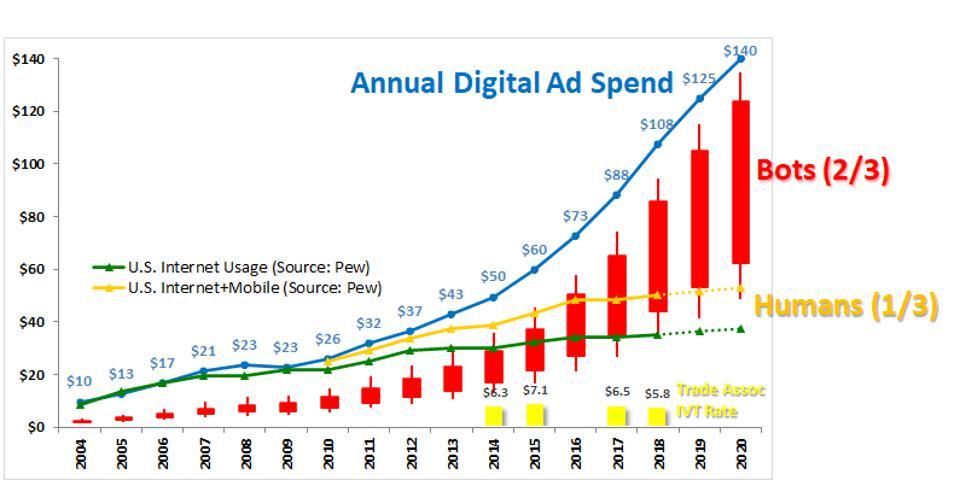
Do you see how this all worked together? Larger quantities of ad impressions, lower CPM prices, and better performance — indeed the illusions of vast reach, cost efficiency, and performance — led to what is now known as “digital marketing’s lost decade.” When “programmatic” ad buying really took off in 2012-13, the disparity from reality really took off as well. Note the green and yellow lines in the chart below — those represent humans’ usage of the Internet, social media, and mobile. Those two lines are pretty much flat across since 2012-13; indicating that real humans’ usage had all plateaued, already maxed out. But the blue line representing digital ad spending continued upward. How can this dissociation from reality be explained? Easily, with bots. Bots are simple software programs that can be remotely controlled to automate browsing (load more pages) and simulate desirable human actions, like clicks on ads. It was technically trivial to simulate all the things that marketers wanted to buy — more reach, more clicks, lower prices.


Some marketers have had the courage to run “turn off” experiments with their digital media. What was interestingly consistent is that all of them found that turning off their digital ad spending didn’t change business outcomes — eBay (2015), P&G (2018), Chase (2017), Uber (2019), AirBnB (2020). So what were they spending millions of dollars on in digital, if it were not producing real, measurable business outcomes? We may never know. But what is clear is that more marketers need to check their own digital spending more closely, and do things differently than they have been doing for the last decade — or shall I say “lost decade?”

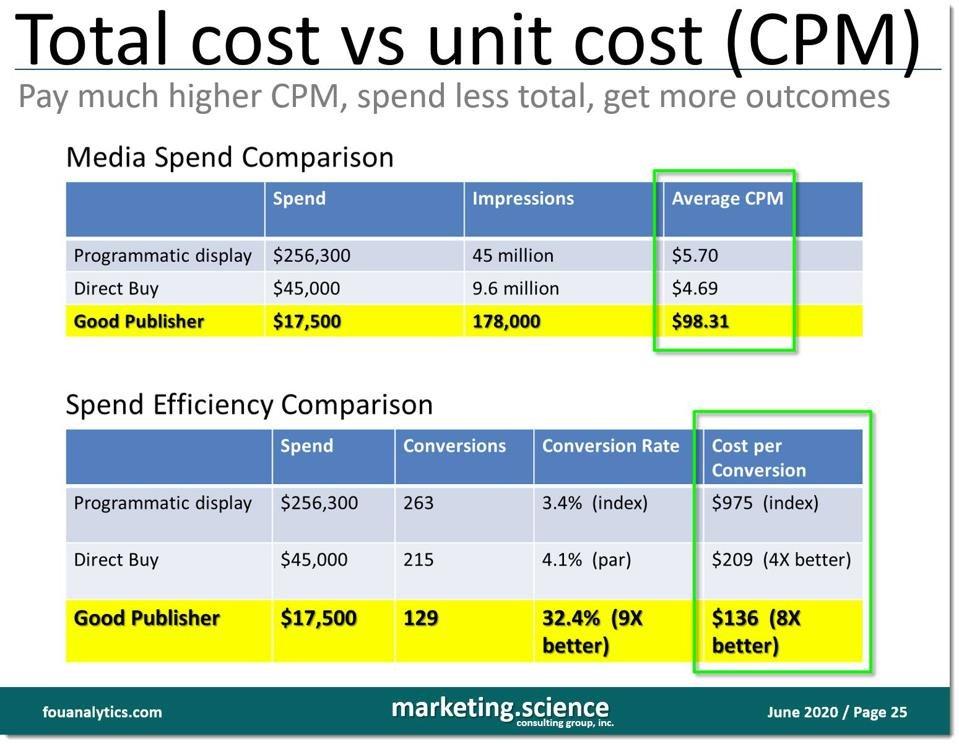
Marketers should pay higher CPMs by buying ads from real publishers with real human audiences. You know that you have to show your ad to a human before you can get any kind of business outcome right? Showing ads to bots, no matter how low the CPM prices, will drive no incremental business for you, even though it looks really good in the video game called digital advertising — you got the highest score ever this year because you bought more ads than ever before at lower CPM prices than ever before. Yay! But that was not marketing.

Paying higher CPM prices don’t necessarily mean greater costs either. That’s because CPMs are unit pricing (cost per thousand digital impressions). If you bought fewer ad impressions, even at higher CPMs, your total cost could actually be lower. You don’t need the vast quantities or enormous “reach.” It’s not real reach, it’s just the illusion of reach, if you’re not “reaching’ humans anyway. You don’t need to buy as many ad impressions to reach real humans. Humans tend to visit a small handful of mainstream sites repeatedly. Even though they do visit long tail sites for niche content once in a while, the “at-scale” quantities of impressions from the programmatic long tail are also an illusion, that conveniently helped fraudsters feast on marketers’ ad dollars for the last decade.

Finally, accept lower click through rates. Humans click on ads very rarely (when was the last time you deliberately clicked on any ad?). But the lack of clicks does not mean the campaign performed poorly; on the flip side, the presence of clicks faked by bots does mean the campaign performed poorly. Those clicks are not real, and the high CTRs (click through rates) don’t mean real performance. If you understand the above, you will also understand that the single most important factor in digital marketing is getting your ad in front of a human in the first place. Everything else — like targeting, viewability, click rates, etc. — is secondary. Smart marketers are ditching the ad tech targeting (costs more, works more poorly) and simply showing ads to Safari and Firefox users; savvy humans use iPhones (Safari browser) and Firefox browsers; bots prefer to pretend to be Chrome, to earn more money due to ad targeting. Advertisers showing ads to Safari and Firefox users are also getting a great deal — 50-70% lower CPMs — because other marketers are not even bidding on these browsers. Showing ads to humans in the first place always beats targeting for business outcomes, because the targeting may not be accurate and bots are pretending to be the audience segments you target.

After the last decade of digital transformation, marketers should now pull themselves out the “lost decade” of digital marketing based on vanity metrics – low prices, vast reach, high clicks. Time to think differently and do different digital marketing. Pay high CPM prices for ads on real publishers’ sites, shown to real human audiences (finite reach) and low clicks. You will see that you are doing better digital marketing, indeed marketing that actually drives real business outcomes.

By Dr. Augustine Fou

I am a marketer of 25 years. I witnessed the entire arc of the evolution of digital marketing. Now I help marketers audit their digital campaigns for ad fraud and optimize campaigns based on accurate analytics. I taught digital strategy at NYU’s School of Continuing and Professional Studies and Rutgers University’s Center for Management Development. I worked on the “client side” for American Express, and on the “agency side” as Group Chief Digital Officer of Omnicom’s Healthcare Consultancy Group and SVP Digital Strategy Lead at McCann Worldgroup/MRM Worldwide. I started my career in New York City with McKinsey & Company.

Sourced from Forbes

By

We know this – quality content that attracts lots of organic traffic takes time to write. And you don’t want to sit for hours writing a post that collects dust on your blog.

I surveyed professional content writers on LinkedIn to know how long they research and write a 1000-words blog post.

The result – 33% of writers use a staggering 6 to 8 hours.

How-Long-Does-It-Take-To-Research-And-Write-A-1000-Word-Content-Piece

Sadly, many blog posts do not get read because they fall for several content marketing mistakes. According to research by Ahrefs, 90.63% of pages get zero organic traffic from Google.

90.63-0f-Pages-No-Organic-Search-Traffic-From-Google

Your posts can be among the 9.37% of content that gets organic traffic from Google. To achieve this, you need to avoid the content marketing mistakes in this post, including those of 2012 and 2015. They are all capable of suffocating your blog posts among the millions of posts published daily.

So let’s dive in.

Content marketing mistake #1 – Targeting keywords instead of topic clusters

In the early days of Google, it was easy to grab a keyword, write a post on it, and boom, the content ranks. The story is different in 2021. Many websites are competing for Google’s top spots by targeting keywords. Rather than join the crowd, use the topic cluster model.

The topic cluster approach has been around for a while. It was introduced and first tested by HubSpot in 2015. This approach requires the creation of pillar and cluster content.

Topic-Clusters

Pillar content: Pillar content is detailed posts or pages on your website. These posts contain a broad range of keywords that you want to rank. An example is this Google Tag Manager guide.

Cluster content: Cluster content is posts or web pages that thoroughly discuss topics on the pillar page.

According to Anum Hussain, a former growth marketer at HubSpot, focusing on topics rather than keywords resulted in a better organic ranking.

In-Fact-The-More-Links-To-Related-Content-We-Had-Across-Our-Site-The-Better-We-Ranked

HubSpot isn’t the only brand that benefits from adopting the topic cluster model. Ninja Outreach had a 40% increase in organic traffic a few months into an internal linking campaign similar to the topic cluster method. And yes, good ol’ Google wants you to implement this SEO strategy. According to Google Webmaster guidelines, your website should have a clear conceptual page hierarchy.

Google-Search-Central

Keep the following in mind as you use the topic cluster model:

  • Your pillar page should link to all cluster content once
  • Your cluster pages should link once to the pillar page
  • Your cluster page could link to other cluster pages once (where the text fits naturally. Don’t force it!)
  • Cluster pages should cover only one subtopic in detail. Don’t discuss something else. Instead, create another cluster page
  • Write your cluster pages like regular blog posts while following SEO best practices

Content marketing mistake #2 – Zero voice search optimization

Voice search is on the rise. And many voice search stats show you should capitalize on this emerging trend.

Here are some of the interesting statistics:

  • According to a PWC survey, 50% of respondents use voice search to buy or order an item.
  • The average voice search query contains 29 words
  • Pages using Schema Markup provide 36.4% of voice search results
  • 40.7% of voice search answers are pulled from a Featured Snippet
  • Voice search result pages have an average of 2,312 words

Failing to optimize your pages for voice search is a content marketing mistake capable of reducing your organic traffic. There is a claim that websites using schema markup rank an average of four positions higher in the search engines than those without schema markup. Also, less than one-third of websites use schema markup. This offers massive SEO real estate for improving your organic traffic.

So, how do you optimize your website pages for voice search:

1. Find Long-tail keywords

Long-tail keywords are search terms of three or more words. You can find them with keyword research tools like Answer the Public or Long-tail Pro. For instance, after typing my seed keyword (voice search) in the Answer the Public search bar, it returned 321 results.

  • Questions – 55
  • Prepositions – 43
  • Comparisons – 23
  • Alphabeticals -192
  • Related – 8
Voice-Search-192-Alphabeticals

This data has lots of questions like:

  • What is voice search?
  • What is voice search optimization?
  • What is voice search app?
  • What is voice search SEO?

Here’s why you should care about these long-tail keywords framed as questions.

  • According to a voice search SEO study by Brian Dean, many voice search queries are question-based
  • Since 40.7% of voice search answers are from featured snippets, it means you should answer questions that your audience is asking

So, how can you effectively use the long-tail keyword data?

  • Use them to form headings for your posts
  • Use them to answer questions in your Frequently Asked Questions pages/posts
  • Use them to create long-form content that satisfies your audience

2. Schema markup

We have discussed how schema markup can increase your organic ranking and traffic. If you don’t have trouble with coding, you can apply schema to your posts by following the Google schema markup guidelines.

But if you are not good with code, you can use a plugin like Rankmath, assuming you use WordPress as your content management system.

This is how a recipe blog post looks after schema markup implementation.

The-Best-Vanilla-Cake-I've-Ever-Had-Sally-Baking-Addiction

It is important to note that there are different types of schema markups and you should choose the one that applies to your page.

Structed-Data-Markup-Helper

Content marketing mistake #3 – Lack of content promotion

You’ve sat down for hours to write and edit a post. You finish and hit the publish button.

Now you are waiting, hoping, and praying that your ideal audience searches for your target keyword and finds your blog post.

My friend, that is how blog posts stay within the confines of page 2 and beyond of search engine results. They don’t attract organic traffic from Google… even though they are well-written.

Many people now know the benefits of publishing blog posts. But only a few get the desired results because they care to promote what they write. Here are two ways of avoiding this content marketing mistake and putting your posts before your audience:

1. Find broken links

Broken links are links displaying a 404 error message and they are bad for SEO. Finding broken links is an easy way of attracting quality backlinks to your content and getting organic visitors to your website. You can use a tool like screaming frog to find broken links.

After identifying a broken link in the target website, you can send an email to the website owner. Here’s a sample Backlinko email template you can model.

Brian-Dean

2. Write Guest Posts

Writing guest posts is an efficient way of proving your authority to your target audience. It also adds the benefits of getting you at least one link to your website. Take the Jeff Bullas blog as an instance. This blog has 459 articles on just the B2C website alone.

B2C-JeffBullas

And the B2C website get a tremendous amount of organic monthly traffic – 507,469

Traffic-Overview

This amount of traffic means a lot. For instance, as people read any of Jeff’s 459 guest posts, they could view his website as well. As they check his website, they could subscribe and join his email list. If they love the content they receive from his list, they could buy any of his products or subscribe to a product or service via any of his affiliate links. This and other ways of content promotion is how a post can make you money through guest posting.

Content marketing mistake #4 – Publish, forget, and don’t update

Write it, promote it, then forget it.

Here’s the result of such a dreadful SEO effort – Google will send your content to the pile of posts resting on the other side of search results where no one reads them.

What if you update them. Any benefit? Of course.

According to Pamela Vaughan, HubSpot achieved the following after refreshing its old content:

  • Doubled their monthly leads
  • Had a 106% increase in organic traffic

This is why marketers like Neil Patel update and sometimes rewrite up to 90 of his articles monthly. But don’t go on a content updating spree yet. Before updating any content, ensure it has organic traffic potential. There is no point in updating an article that won’t get you the results you want.

So, how can you update an old post?

  1. Use Google Search Console and Google Analytics to find posts with organic traffic potential
Overview

2. Read the posts you’ve identified and look out for the following:

  • Can the introduction be better?
  • Are there outdated stats and facts in the article?
  • Can you include videos in the article to better explain a concept and attract traffic through video optimization?
  • Can you change any image?
  • Can you tweak a section of the post to read better and sound more human?
  • Can you add more keywords to get found in search engines?

Once you’ve updated an article, the next step is to monitor your results with a free tool like Google Analytics.

Navigate to Behaviour >> Site Content >> All pages. This gives you an overview of your “before and after” organic traffic based on the selected timeline.

Content marketing mistake #5 – Poor user experience

Writing quality content is not good enough to attract organic traffic from Google. You need to provide users with an excellent experience on your website. From May 2021, Google will implement its page experience update.

This update will take the following into cognizance and impact your organic search rankings:

  • Core web vitals
  • Mobile-friendliness
  • HTTPS-security
  • Intrusive interstitial guidelines (aka annoying popups)

Here are some ways to avoid reducing your organic rankings due to poor user experience.

1. Check Your Website on PageSpeed Insights

PageSpeed Insights gives you a quick scoop on what you need to fix.

PageSpeed-Insights

2. Optimize Your Images and Videos

If you use WordPress, you can use a plugin like WP Smush to reduce your image size. A better alternative is reducing the image size with an online tool before uploading them to your website. When using videos on your content, copy the video link and embed it in your post.

3. Use a CDN

A CDN (Content Delivery Network) like Cloudflare helps speed up your site and quickly deliver content to your audience.

4. Eliminate Render-blocking CSS and Enable Browser Caching

If you don’t use WordPress, you’ll have to do this manually. For WordPress users, you can use a plugin like WP Rocket. WP Rocket also has other awesome functionalities that help speed your website.

Final thoughts

Writing quality content is great. But what’s the point if no one reads it?

The first page of Google search results accommodates only ten blog posts. And that’s when ads are excluded. Many website owners want to gain page one rankings because that could translate into revenue for their brand. You could be among such website owners if you care to avoid these content marketing mistakes.

So what’s your next step – take action and start implementing.

By

Guest author: Precious Oboidhe is a Copywriter and SEO Content Writer at Content Estate. You can learn more about Precious at contentestate.com and connect with him on LinkedIn.

Sourced from Jeff Bullas

By Soren Kaplan,

Brainstorming is an art and science. Here’s how to help your virtual team generate and prioritize the best ideas.

Over the past 25 years, I have run hundreds of brainstorming workshops for high-performing teams. My sessions are often part of larger strategy and innovation initiatives. But all sessions are focused on the same thing: generate, prioritize, and develop great ideas to create a big impact. Though I’m no longer jetting off each week to lead face-to-face sessions, I’m now sitting behind my screen leading programs with teams dispersed across home offices from around the world.

Ideas aren’t innovations in themselves. Innovation happens when ideas are implemented and add real value for customers. The problem is that most brainstorming sessions stop with a big list of ideas. The most effective teams prioritize the best ideas and create action plans that move the most powerful opportunities forward. While this critical fact has always been true, it’s even more important in a virtual world, where accountability and focus can easily cease the moment people click “end meeting” and webcams turn off.

There are many collaborative tools out there for generating ideas. I’m not going to write them here. Why? Because successful brainstorms aren’t about technology at all. Sure, you need to have tools to list, theme, and prioritize ideas. Finding an online tool is the easy part. The “hard” stuff is actually the “soft” stuff — setting the right environment and tone that gives everyone the mindset, motivation, and focus to work together in new and creative ways online.

That said, here are the success factors.

1. Get focused.

In a single sentence, describe the challenge, problem, or topic of your brainstorm. Consider statements that start out like: “How can we …,” “What if we …,” and “How do we …”

2. Define idea categories.

Identify categories for your ideas before you start. Place ideas into these categories as you go. Consider categories like: products, services, processes, business models, and customer experiences.

3. Create prioritization criteria.

Once you have a bunch of ideas, get clear on the criteria you’ll use to prioritize. Share criteria and then vote on the best ideas using it. Consider criteria like:

  • feasibility (easy to hard)
  • impact (low to high)
  • customer Value (low to high)
  • return on Investment (low to high)

4. Confirm ground rules.

Be sure everyone understands the norms for the brainstorm. Consider ground rules such as deferring judgment until it’s time to prioritize ideas, or aiming for quantity or creativity of ideas. Or you could ask that participants build on one another’s ideas when they’re shared.

5. Create implementation teams.

After you generate and select your top ideas, choose a pair-team to “own” the implementation of them. Pairing people up creates a sense of shared accountability and commitment. Set a timeline and due date for results. Provide support along the way through regular check-ins.

Ideas themselves are a dime a dozen. Ideas that get implemented are worth their weight in gold. That fact doesn’t change in a virtual world.

Feature Image Credit: Getty Images

By Soren Kaplan,

Sourced from Inc.

By

When you launch an eCommerce, the first sale is as symbolic as it is necessary

When you launch an eCommerce, the first sale is as symbolic as it is necessary. It is not so much because of the income or because it is extremely complicated, but because of the optimism and tranquillity, it represents for the team. It can mean the biggest turning point in the life of the company. Obtaining that first customer will be a long and complicated battle, so in this article, we explain how to grow an eCommerce while spending the least. Keep reading!

How to grow an eCommerce with minimal expense

Without a doubt, the first sales are the most complicated and the most exasperating. Consumers won’t come to your platform by magic. Therefore, if you want to know how to grow your eCommerce investing little money, you must aggressively market your business and take advantage of the weaknesses of your competition to attract customers and traffic.

Take note of the following techniques that will help you achieve this. Keep reading!

1 # Presence in social networks

The first point on the list of how to grow an eCommerce could not be other than social networks. To start making yourself known, you must open an account. It is not about being in all of them, but about selecting the ones that will be useful to connect with your target audience, but how do you know which is the ideal one?

TWITTER

The simplicity of Twitter makes it one of the most effective ways to engage with your audience. A good way to find potential clients is to proactively find people who post questions about your field and reach out to them so they keep you in mind. The idea is not to present or mention your products but to help them answer their questions. If you do it right, users will investigate your existence and discover your business.

LINKEDIN

Second, Linkedin is the Internet office. On this platform you can find professionals and executives of all kinds, showing off their skills and connecting with others. Once you have configured your e-commerce profile, you can start doing the same.

You may not sell anything directly through Linkedin, but you will discover many opportunities with other companies, providers and related websites. There are dozens of public and private groups created for specific niches, allowing you to post questions and talk to other members.

INSTAGRAM, TIKTOK AND PINTEREST

On the other hand, social networks like Instagram, TikTok or Pinterest allow you to take a different approach if the audience is young. They are ideal platforms for original and creative content. Take photos of your products as well as videos and tell an engaging story.

FACEBOOK

And finally Facebook. This is still a very powerful social network. Take advantage of your professional profile and create a business page to interact with friends, family and acquaintances and make people talk about your brand. Get creative with status updates and engage in public groups and fan pages relevant to your niche. In addition, you can do paid campaigns.

2 # Create a blog

If you are not yet building a blog associated with your e-commerce or product, you are losing the unlimited potential of content marketing. Producing free and valuable content builds brand trust. It also offers you content to share on social networks and helps you rank in search engines.

To start, think about all those initial inquiries that the audience has about your products and your sector. Use the blog to answer those questions with individual articles. Plus, you can use it to provide lifestyle tips, tutorials, and resources around your products. If you can create regular content, you will soon start to see results thanks to social networks and search engines.

3 # Send your product to influencers

Third, the list of how to grow your eCommerce could not be without influencers. In recent years, influencers have become key pieces for marketing strategies. The Internet is full of bloggers, journalists, entrepreneurs and vloggers of all types specialized in all fields. You need to find the right ones. Many of them have a large following and a loyal following on their web pages.

Therefore, you can send a free sample of your product to those who best fit your brand. Hopefully, you will get a mention on one of their platforms, and you will also let them know that as a company you appreciate their work with a small gift.

In this sense, you can also conduct interviews with them. It is a good way to create original and different content. Interviews work because they are win-win situations. The interviewee gets more visibility and the interviewer has good content to post on the blog, for example. Take the opportunity to ask questions about their lives and careers, but also about the industry in general.

On the other hand, to collaborate with them, you can also run contests or raffles. We all love free stuff and if you’re looking to build trust, running a contest or giveaway could help you get there. This can be done with the collaboration of influencers or on your social networks.

4 # Public relations and communication strategy

If you want to know how to grow your eCommerce, make a public relations strategy. They have the same effect as when a video goes viral and can propel your brand to success. A sure fire public relations trick is to do something unusual, outrageous, funny, or important enough to merit media attention.

If it goes well, your eCommerce will benefit from many high-profile news source links, which is great for both short-term traffic and long-term SEO.

In terms of communication, many electronic businesses publish press releases to attract the attention of the media, although most of them fail. It is a less useful strategy than it used to be but still sire. The secret is to make sure your story is newsworthy, concise, and professional, without being too monotonous.

5 # Create a Mailing list

Email is one of the best channels for attracting leads, and it can even be free. You can create a mailing list of previous and potential customers and send them information, products and content. Include an email subscription form on your website. This is an effective way to convince visitors to sign up for your database.

Instead of just saying “sign up for our newsletter,” offer an incentive or some kind of added value for subscribing.

Another use that you can give is conducting surveys to your consumers, so you receive comments to improve. Customers often have no qualms about saying what their experience with the store has been like and whether something was done wrong.

6 # Experiment with Google Ads

To know how to grow an eCommerce you have to know what Google Ads is. In case you don’t know yet, Google Ads is Google’s pay-per-click advertising platform. It enables online merchants to place ads on almost all Google results pages, YouTube videos, and partner websites.

The biggest advantage of Google Ads is its speed and massive reach. In a few minutes, you can set up and launch an advertising campaign that makes your text, image or video ads appear. You can also set the option for them to be activated and displayed next to Google results when users search for predefined or similar keywords.

7 # Pay attention to web analytics

The behaviour of each user when he visits a web page from when he enters to when he leaves helps you understand why you are or are not selling. Your page statistics will show you what your customers are doing on your website, including the websites they enter, the time they spend on each one, and the route they choose to exit.

Some tools also display additional information. For example, how often a customer visits your website. In this sense, Google Analytics is a totally free tool that helps you measure traffic in many ways.

8 # Sponsor an event

To get good results sponsoring an event you have to give it the right approach. First, you will have to make sure that you select the right event and that the target audience is the same as yours. Will your potential clients be among the attendees? Would your product interest them? How many attendees will it have?

Once the data in hand, classify them according to the type of audience and sponsorship price. Once you attend, avoid typical marketing strategies like handing out flyers. You will have to be creative to establish and build relationships.

Show off some of your most interesting products to tell their story, get people talking about it, and offer immediate promotions like free coupons in exchange for email list subscriptions or social media follow-ups.

9 # Make use of affiliate marketing

Affiliate marketing is those actions by which you allow other people to market your products and send traffic to your website. In return, for each sale, you pay a percentage. You can track it by giving it a custom link or a unique coupon code.

The great thing about this sales strategy is that you only pay if sales are made, which makes affiliates do their best.

10 # Outperform the Competition on Price Comparison Platforms

Most consumers like to shop around before making a purchase, this includes browsing Google and sites like Amazon for the best options. The most popular platforms are Google Shopping, Yahoo Shopping, Kelkoo, idealo, etc.

To achieve notoriety, you have to follow the rules of each platform, stay competitive on pricing, and wait while you experiment to find out which platform is the best fit for you and offers the best ROI.

What did you think of this article on how to grow eCommerce? Leave your comments and share!

And if you want to set up your own e-commerce and you don’t know how to launch your project, take the Master in e-Commerce & Digital Marketing. You will learn everything related to managing electronic commerce with a comprehensive vision with the best business models and strategies. We will wait for you!

By

Author Selena is a blogger and a guest contributor for a well-known brand that includes MESHEBLE, Saveucoupon & INTHEMARKET. In her leisure time, she plays tennis.


Sourced from INFLUENCIVE