Author

editor

Browsing

By

The pandemic has many downside

The pandemic has many downsides, like the increased difficulty of beginning a new enterprise. Funding, for example, proves complicated as financial institutions become tight-fisted with their money. So, aspiring entrepreneurs find it hard to get cash.

Existing businesses have also been hit hard by the coronavirus, resulting in higher levels of unemployment all around.

Fortunately, many with jobs have saved a substantial amount of money during the pandemic using financial instruments such as tax-free ISA shares and stocks and money market mutual funds. This increase in disposable income could translate easily into golden business opportunities for the savvy entrepreneur.

A depressed economy doesn’t have to mean the end of the world. Hard times build good character and create good businesses. The best way to take advantage of this unique opportunity afforded by the pandemic is outlined in this article, starting with the benefits.

Benefits of starting a business during the pandemic

Common sense dictates that starting a new venture while the world is in chaos is not the best idea. Yet, companies founded during difficult times are better able to weather storms than their fair-weather counterparts.

Because most ventures launch during economically robust times, pandemic-era businesses enjoy the exclusive pleasure of having fewer competitors with whom to deal. During uncertain times, existing organizations do not want to spend money drumming up new ideas. Here lies a gap for an enterprising individual to contribute bold, original ideas to the marketplace.

Lurking in the turbulent economy are increased cost savings for newcomers who wish to open a business at this point. Operating expenses decrease as things like fixed cash outflow – mortgage, for example – can now be appropriated at inexpensive rates. Novice business owners can also benefit from their more influential bargaining power. They are in a position where they can come to agreeable terms with various stakeholders and develop beneficial new business relationships as a bonus.

New businesses stand to benefit from spiked levels of customer loyalty. This consumer-facing advantage contributes significantly to the permanence of a small organization. Country-specific tax incentives also aid business robustness. In the U.K., for example, small businesses receive VAT relief and have grants earmarked for them in the national budget.

Eligibility for government assistance will largely depend on the organization of the business in question.

Use market research to choose the right business type

When uncertainties arise, a sound organizational setup will stand any entrepreneur in good stead. Market research provides a wealth of information that can aid the decision-making process in the early stages of beginning a business.

Studying the business environment – particularly the activities of similar companies – can inspire prospective merchants. In the marketplace of ideas, there is often no need to reinvent the wheel. By offering minor changes to already established, successful commercial concepts, a new enterprise can easily make the best of the pandemic.

Analysing future customers is another way to get valuable information for planned business ventures. Well-organized focus groups allow participants to describe their attitudes towards products or services in their language. This information is necessary feedback for those looking to dip their toes in entrepreneurship.

There are several ways to seize the opportunities afforded by the pandemic. Some business types that are thriving right now include cleaning services, virtual exercise sessions, and mask-making.

COVID-compliant surroundings are in high demand. Both corporate bodies and private individuals increasingly require expert cleaning services in the New Normal. For this type of business, demand will very likely outlast the pandemic.

A healthy immune system is a somewhat effective weapon against the coronavirus. Keeping fit is a great way to boost the immune system. Ordinarily, going to the gym formed part of most people’s health regimes. However, the pandemic tangibly hit the exercise industry. It bounced back through the popularization of virtual exercise. In this way, the fitness market cleverly demonstrated its resilience and ability to reinvent itself.

Using masks as protective gear is common for non-essential workers. Everyone wears one now out in public. As the pandemic rolls on, consumer demand is increasing for chic and trendy masks. For example, many actors during awards season often have designer masks to match their bespoke outfits. Large corporations have contributed to the demand by having their employees wear trademarked masks.

Whatever business type a budding entrepreneur chooses, a key ingredient is the new company’s flexibility.

Adaptability

Part of staying adaptable as a new business is writing a recession-proof business plan. A detailed strategy like this will show prospective investors, vendors, and other stakeholders that the individual behind the enterprise knows what they are doing.

Separating private funds from company funds is a solid strategy that will help a novice firm remain flexible. The wise entrepreneur will open a dedicated bank account for business operations and budget prudently so the new business can endure.

It was mentioned above that cost savings are lurking in upheaval caused by the pandemic. Human Resource is an area in which a company can demonstrate flexibility and prudence. Rather than adding full-time staff members to the payroll, begin by subcontracting talented individuals as needed. If it is necessary to hire any employees, honesty about what the company can afford to offer is a good policy.

Digital Marketing

Marketing online is about more than selling goods virtually. A thriving online personality based on empathy and efficiency helps a business to stand out.

Empathy is enhanced when a business makes clever use of its social media accounts to engage its client base. Companies demonstrate efficiency when they make the most of technology to enlarge their market reach. Innovative email campaigns and user-friendly websites play a big part in crafting a company’s virtual image.

Overall, it is a good business practice to have a robust online presence. Marketing in this way increases the longevity of new organizations.

Conclusion

Contrary to received wisdom, it is possible to begin a small business amidst challenging global circumstances. Success depends on flexibility, a reliable online presence, and a sturdy business plan.

No one knows how long the pandemic will last. Plucky entrepreneurs who show foresight in their business planning will do well in current and future uncertainties.

By

Sourced from INFLUENCIVE

By Dave McKeown

The last year has been exhausting for leaders but now might be the perfect time to reassess.

When countries and states began to declare stay-at-home orders at the beginning of the pandemic, most business leaders took a strategic nose dive right into the runway. Forget annual plans or even quarterly goals; the only strategic outlook was on the day-to-day actions to mitigate the immediate crisis, ensure the safety of their people, and to put in place a plan for survival.

Then, over the course of the ensuing 12 months as local economies ebbed and flowed with changing case rates and shifting guidelines and mandates, many organizations began to cast longer-term plans only to have them thrown back on the trash heap due to another circumstance outside their control.

The result of all this is an exhausted workforce and a lack of appetite from leaders to begin lifting their horizon of focus. The question I get asked most often now is “Should we even look to build long-term plans with so much uncertainty still around?”

To which my answer is an unequivocal ‘yes.’ From my perspective, proactivity is always better than reactivity and there’s actually much that you can still control. Not to mention that thinking long-term will help to rev up your engines again and ensure you’re not caught flat-footed.

To that end, here are three practical things you can do today to elevate your focus to the long term.

Reset your guiding principles

A strange thing started to happen about 3 months into the pandemic. All of a sudden, leadership teams started to get laser-focused on what was truly important to them. Whether it was their core values and culture, key customers, or their core offering, they found themselves in a position of greater clarity of what guided them.

Things are allowed to accrete when organizations are growing; a product line here, a new process there. None of which on their own are problematic but over time they add up and run the risk of obscuring who you are, what you do, and who you serve. It’s not that you’ve lost sight completely, but things are definitely murky.

Then, when options are limited and you’re forced into survival mode, those additions which seemed like a good idea at the time start to feel more like a liability and it’s much easier to shed them.

Now is a good time to codify those shifts, to reset your guiding principles. Get your team in a room and answer these questions with a forward rather than backward-looking perspective:

  • Who do we serve?
  • What problem do we solve?
  • What’s our solution?
  • What makes us different?
  • What impact does that have?
  • Why is that important to us?
  • What characteristics do we value?

There’ll likely be some spirited debate to the answers here and that’s great. Your job is to look for key themes and then capture the consensus.

Re-imagine what you could achieve

For a great number of business leaders, the last year has sucked out the appetite for risk. Too many variables have reduced their ability to realistically size up the potential upside of rolling the dice on a new product offering, marketing campaign, or geographical expansion.

And yet, the dynamics of these next 12 months could well be ideal for experimenting with some new ideas. With economists estimating global growth this year around 4 percent, there will be a lot of opportunity for those organizations that are ready.

Having re-set your guiding principles, you could be well poised to capitalize on this coming period of exuberance by re-imaging what you could achieve as an organization.

Here are some great questions to ask your team to begin that discussion.

One year from now what would be the:

  • Most obvious thing for us to achieve?
  • Boldest thing we could achieve?
  • Easiest thing we could achieve?
  • Hardest thing we could achieve?
  • Wackiest thing we could achieve?

Encourage your team to dream a little bigger and then set two or three specific goals for the next 12 months.

Run some experiments

One thing we have learned from the last 12 months is that it’s important not to keep all your hopes pinned on one strategy or one product or one market. When the rug gets pulled out from underneath it’s much easier to survive when you have a number of horses in the race.

When you run multiple strategies toward the same goal you get the opportunity to spread your bets, see which one takes off and if needs be pivot to another approach at a moment’s notice.

Rather than defining one clear strategy for each goal that you have, run three to five shorter-term experiments to see which might pay off and then go all-in on those that are bringing you success.

Feature Image Credit: Getty Images

By Dave McKeown

Sourced from Inc.

By Zaheer Dodhia

Having a solid branding strategy is key for a smooth launch.

Getting your start-up off the ground takes a hefty dose of planning, as any seasoned entrepreneur will tell you. It isn’t just about listing your products and services and finding financial backing, either — though those are important keys.

One of the most vital aspects of getting a new venture off to a good start is the branding — and not just colours, fonts, and so on, but the strategy behind every branding decision you make. As an entrepreneur myself, I can vouch for the importance of strategizing, rather than a scattershot approach! Of course, newcomers to the start-up world may not have a solid grasp on this.

Here are four that every start-up founder should know going in.

Related: The Secret Ingredients to a Successful Branding Strategy

1. Brand your promotions

It’s a common experience, and I’ve seen it myself — a new start-up launches, only to see a slump in expectations. The idea, concept, execution, brand personality, all of the details that matter are great. Logically, the start-up should succeed.

What was lacking? Many times, the founder and branding team neglected to demonstrate an immediate value to the potential customer. A customer that is on the fence about trying out a new brand can often be swayed by a promotional aspect. That could be anything from a free gift to a percentage off their first purchase and beyond. The point is that it adds extra impetus to their consideration of you as a newcomer.

Beyond that, however, there are other aspects to promotions that can enhance this branding strategy. Namely, branding your promotions. As we know, branding isn’t just about the visual aspect — it’s about the experience, the values, and other more intangible things. So when I say “brand your promotions,” I mean more than just stamping your advertising with your .

Ensure that your promotions fit the spirit, purpose, and values of your start-up. And it’s not about just the initial purchase from a new customer — you want to build a repeat client base. Choosing an initial promotion combined with a loyalty program is an excellent two-for-one branding strategy that can intrigue your audience and help them along down the consumer’s journey.

2. Establish and maintain your social media presence

A second branding strategy centres around social media. These days, what doesn’t? Social media is a useful tool for start-ups. More than three and a half billion people use social media worldwide, with numbers projected to continue to climb steeply. Consumers are increasingly turning to official social media accounts to research new , learn more about them, get the opinions of others regarding them, and interact with the brands themselves.

Here are a few important aspects of this particular brand strategy:

  • Know your audience, and know what social media platform they favor. is the top platform for most brands, but the demographic that uses it is gradually changing. For example, the percentage of teens on Facebook has gone from 71 percent to 67 percent over the last six years, and continues to drop. Teens as a demographic are increasingly turning to and other platforms that are still building, like Snapchat. So analyse your audience, and leverage their social media preferences to get the most bang for your branding buck.
  • Get verified. Sites like , Facebook, Instagram, and all have a verification process for brands, celebrities, and other types of accounts. Verified status elevates your content and can even affect how readily and frequently it is viewed. Check on the process for each social media platform and let your audience know that they’re interacting with the real deal.
  • Speaking of interacting, respond to everything. Everything. Even if it’s just a thumb’s up or a like, it’s a great way of building a connection with your customer on an individual level. If you can’t handle all of that yourself, outsource it to a social media manager with a friendly, respectful disposition.

3. Use cohesive visual branding

Through your start-up’s development, you’ve worked with graphic designers and brand developers to put together a style guide for your branding. Colour palettes, fonts, graphics, visual styles, and so on — everything needs to fit together coherently, as though it belongs to the same family. Because it does, but you might be surprised at how many small business owners and start-up entrepreneurs then forget about the importance of using that style guide once they get going.

Don’t forget about it. Keep going back to that well. Use your style guide to inform every visual and stylistic decision you make for every piece of product packaging, , and beyond. This is especially important when it comes to your website. Ensure that your website is so well-branded that everyone knows what brand it belongs to when they visit, even if they don’t see the logo right off the bat. But also, make sure your logo is on there.

It’s true that branding strategies aren’t solely about the visual aspects. But that’s no excuse for letting that slide. With your site, social media accounts, and marketing materials, you’ve given your brand a place to live. Make sure you mark it and own it.

4. Evoke an emotional response

A final branding strategy that really works for start-up founders is a little more difficult to pinpoint, but no less effective for all that: get an emotional reaction. How you ask? Here are a few methods:

  • Tell your story. Get to the nitty-gritty of why you started this business, what motivates you to continue, the challenges you went through, everything. Everyone loves a good story.
  • Broadcast your values. Make sure that your audience understands where you’re coming from and what you want to achieve — and why. Ideally, your brand’s values will align with your audience’s values and make an emotional connection.
  • Be yourself. Audiences react well to brands that they perceive as authentic and personal. Don’t cover over the things that make you unique; celebrate the quirks of personality that made your brand what it is.

Each of these aspects — and more — contributes to an emotional connection between your brand and your audience. Research, real life, and common sense all point to the fact that consumers are more likely to work with a brand when they feel a personal connection it.

Your start-up can be the new best friend of your audience — and there’s no more successful way to help a new brand grow than that.

By Zaheer Dodhia

Sourced from Entrepreneur Europe

By Devansh Khetrapal

Aren’t you tired of skimming through the internet and not being able to find a Digital Marketing Strategy that would help you scale up your business and generate steady growth? We were all looking for that magic pill, until now!

What I’m about to share with you is a thought process most elite marketers wouldn’t dare to talk about, just so that they can keep the cream to themselves. I started researching about this a year ago and the information I’ve gathered during this period is every last drop of the good stuff that I’ve shared below.

The Holy Trinity of Digital Marketing

Did you know that global B2C eCommerce sales are expected to reach $4.5 trillion by 2021? As more and more businesses are growing, Digital Marketing Experts are constantly calibrating and testing their own strategies to stand out and grow.

However, no matter how unconventional their methods may be, you don’t need to worry. All you have to do is optimize the following 3 aspects of your website and you’re bound to see substantial growth.

Traffic

One of the main focuses of a Digital Marketing Strategy is to drive traffic to your website, and not just any traffic, but relevant traffic. In order to make sure that happens, you have to incorporate keywords throughout your landing page that are relevant to what you’re selling, whether directly or indirectly.

There are 2 ways to drive traffic to your website:-

Paid Traffic

Let’s be honest. Most of the niches are highly saturated and in order to stand out, you either have to come up with something entirely new so you’ll organically thrive or advertise your services. Most successful businesses rely on both. However, advertising seems to be an effective revenue-generating tool if done right.

A good advertisement involves a headline that hooks, and a landing page with an attractive banner and sufficient information about your product.

There are 5 typical sources wherefrom you can drive paid traffic to your website:-

  • Display Ads – The ones that you see when you’re reading a blog. They’re around the edges, adjacent to the blog, usually in a square or rectangular box.
  • Search Engine Ads – The ones that pop on top of other search results. They look like the first search results but you see a little “ad” icon to signify that it’s an advertisement.
  • Discovery Ads – If you’re ever scrolling on Google, YouTube, or Gmail, then you have come across a Discovery ad. On YouTube, it has a panel with an image and “Learn More” is written below it. In Gmail, you’ll find it in Social and Promotion Tabs.
  • Sponsored Content – When you’re reading a blog and there’s a panel that looks like another blog but it’s actually a landing page, which could be anything from a blog to a product advertisement.
  • Influencer Marketing – Using social media influencers to promote your product. Lately, this has become just as mainstream as other forms of advertising.

Organic Traffic

When someone discovers your business on the internet when you didn’t advertise it, it means you were able to drive traffic organically on your website. Growing your business organically is a discipline in itself. The fact that people were able to discover you organically, indicates that you did a good job with SEO.

People find you either when they’re searching for you (or for similar services) on Google, or on Social Media platforms (could be Facebook, Instagram, LinkedIn, etc). According to Search Engine Journal, 70% of the links people click on are Organic. Even though ads work, it’s clear that a lot of people just skip the first 3 links on Google because we habitually understand that they’re advertisements.

How Do I Maximize Traffic On My Website?

Create a Keyword Database

In generating both organic and paid traffic, you require keywords that resonate with your target audience. What most people underestimate is the power that these keywords hold. Using tools like SEMrush, Ahrefs, etc will help you find the right keywords by offering several parameters.

Any SEO expert can tell you that you should use keywords with high search volume and low keyword difficulty, but knowing what keywords to target is a refined process, and if you’re serious about your business, then here’s what you should do:-

Make 5 columns in an excel sheet. One for the keywords, and the other 4 for “Intent”, “Relevance”, “Trending”, and “IRT Score”. Refer to the excel sheet below:-

In the above image, I have taken an example of a web development company and used 4 keywords. Each of these has been assigned a corresponding score between 1 to 4 and has been totalled in the column IRT score. Let me explain what these are and what their implications are:-

  • Intent – This signifies how transactional is the intent of the keyword. If the keyword is highly transactional, it has a score of 4, and if it’s not at all transactional, it has a score of 1. In the above image, the keyword “Hire Web Developer” is highly transactional, and the keyword “ReactJS vs Laravel” isn’t transactional at all and hence, they’ve been assigned scores 4 and 1 respectively.
  • Relevance – This will signify how relevant the keyword is for you. If the keyword has a product or service that you offer, then you may rate it between 1 to 4 in terms of relevance. In the above image, the keyword “Hire a .Net Developer” is rated as 1 because the web development company isn’t relevant to the kind of development services they’re offering.
  • Trending – The more the keyword is trending on Google or any other search engine, the higher will be its trending score and vice versa. In the above image, “ReactJS vs Laravel” is a keyword that has a significantly high search volume on Google and hence, has a trending score of 3.
  • IRT Score – IRT is simply the aggregate score of the columns “Intent”, “Relevance”, and “Trending”.

If you make a list of all the relevant keywords, you can segregate and prioritize them on the basis of these 3 parameters. The IRT score will serve as an extremely quick and reliable guide since the higher the IRT score, the more important the keyword will be for you.

Optimize Technical Performance

Did you know that the first 5 seconds of page-load time have the highest impact on the conversion rate? According to Portent, website conversion rates drop by an average of 4.42% with each additional second of load-time.

Optimizing page loading speed is only a factor and not a Digital Marketing Strategy in itself. However, improving the overall architecture of your website can help you make sure that your target audience doesn’t wander away from your landing page. Besides, the longer the page load time, the worse it is for SEO performance.

Here’s are some questions you need to ask yourself:-

  • Are internal pages getting enough internal link votes?
    The internal pages of your website should have at least 10 internal links. The more links, the more will be the Page Authority.
  • Are all pages 3 (or less) clicks deep?
    No pages should be more than 3-clicks deep. This is to make sure that your pages are being crawled and indexed well. For Google, more clicks mean less valuable, and vice versa.
  • Are all internal links using effective anchor text?
    Always use exact match anchor text with your links. Here’s a catch though – If you have a huge site, you will end up using several internal links for a keyword in pursuit of site navigation, in which case you need to dial down on external links. You need to make sure that you avoid getting external links otherwise it will lead to over-optimization of the anchor text. Eg. if you have 1000 internal links for “chamomile tea”, be less aggressive on having external links with the same anchor text.
  • Are there any pages with existing backlinks?
    Your top internal linking targets should be pages with high Page Authority. You can boost the page authority by linking pages that already have high authority.

Create Intelligent SEO Content

Having intelligent SEO content serves you in 2 ways – It will help you rank your content and will be interesting to read as well. Most writers can’t get the right mix of these 2 tangents in their content.

Ideally, 80% of your content should be keyword targeted and 20% of it should be a link bait (designed to attract backlinks). This is a long-term strategy to improve the Domain Authority of your website. This means that you’ll be able to rank on highly competitive keywords.

Here are the steps you need to follow:-

  • Select a qualified keyword – We already discussed this in the above header “creating a keyword database”.
  • Map the keyword to an existing page – If you don’t have a page targeting this qualified keyword, create a new one. Update and optimize the existing pages before creating a new page.
  • Only target one keyword on one page – If you have multiple pages targeting the same keyword, you either consolidate those pages, and/or delete or redirect the pages that don’t have good quality content.
  • Create an SEO content brief – In the SEO content brief you’ll hand over to your writer, you can mention the estimated value of this keyword (CPC x clicks), the SERP features that need to be kept in mind, the estimated organic CTR of the keyword, target word count, search intent, how many backlinks you need to rank, etc.

Conversions

Did you know that 92% of your website visitors aren’t ready to buy? We’ve talked about how you can generate traffic to your website to generate more leads, but that wouldn’t mean anything if your leads aren’t getting converted.

What you need to do is nurture these visitors until they become a qualified lead. The majority of those remaining 8% visitors are highly motivated to buy, so even if you use decent keyword targeting and copywriting, you can easily convert these. However, to get the rest 92% on board, you need to create a nurture sequence.

Here’s what you need to do:-

Create a Lead Magnet

Anything that incentivizes the visitor to sign up for your email list is called a lead magnet. It could simply be a free training webinar, a video series, or an ebook. The key is to keep these incentives really simple.

Segregate the Qualified and Unqualified Leads

Just because some visitors signed up via email, doesn’t mean they’re qualified. You can find out which leads qualify and which don’t by using 2 ways:-

  • New Subscriber Survey – This can include all the basic questions relevant to your target customer.
  • Use Trigger Links – Send a welcome email with 2 or 3 links and when the subscriber clicks on one of those, they get tagged based on what they clicked. For example, if you send an email saying “What best describes you?” and give 2 or 3 options, and based on what they click on, they get tagged accordingly, so that you can send them relevant content from that moment on. You can use Drip to accomplish this.

Created Automated Nurture Sequence

Now that you’ve qualified those leads and have segregated them into relevant categories, it’s time to nurture them. You have to accept the fact that leads convert instantly. Realistically, you have to treat them as if they don’t plan on buying for the next 6 – 12 months.

You can lay back and take your time to plan how you can add value to these people’s lives every now and then during this period. What you should do is to create an automated nurture sequence and send them value-added material, which will develop trust over time. Next thing you know, they’ll already be sold.

If the nurture sequence is solid, then these leads will be moved into a different automated sequence. This is highly dependent on your business model, but with a successful digital marketing strategy, the goal is to gradually build up and pitch them when the time is right.

Remarketing

You already understand that 92% of your website visitors aren’t interested in buying anything, so basically, they’re just bouncing away from your website without taking any action. This means that there’s so much untapped potential that you’re missing out on, unless you’re remarketing.

Remarketing is the way to reach those 92% by reaching them even when they aren’t on your website. This can be achieved through the following ways:-

Enable Tracking Pixel

A tracking pixel is an HTML code snippet that is loaded when a user visits a website or opens an email. It is useful for tracking user behaviour and conversions. At a bare minimum, you should have Google and Facebook tracking enabled on your website. Depending on the nature of your business, you could enable it on Bing, Instagram, Quora, Reddit, or even TikTok.

Create Intent-Based Campaigns

Based on what pages a visitor is viewing, you can understand their intent and should target advertisements that are designed accordingly. For example, if someone visits your website, read a blog, and just exit, then you shouldn’t advertise to them to buy your service right away.

What you can do instead is move them down your sales funnel and target with a lead magnet that’s related to the blog that they were reading. Heck, you can even split test your visitors, see what induces a favourable response for you and then use that as the main campaign.

Wrapping Up

If you were trying to understand how to reduce marketing costs, I wouldn’t blame you. All these tools can be costly and when you’re starting out, it can be an unexpectedly high expense. You can rely on free tools or consult a Digital Marketing Expert as well.

Hopefully, this Digital Marketing strategy served as an all-encompassing guide for you to understand how marketing really works, and how vast the role of relevant targeting can be. You can do your own litmus test to figure out what works for you.

By Devansh Khetrapal

View full profile ›

Sourced from Business 2 Community


By Alireza Golmohammadi, Taha Havakhor, Dinesh Gauri, and Joseph Comprix

Over the last several years, it’s become increasingly common for consumers to share their negative experiences with brands on social media. According to the 2020 National Consumer Rage Study, the number of customers who prefer to vent their grievances via digital platforms rather than by phone or in-person has tripled in the last three years, and 48% of American consumers rely on social media to gauge other people’s experiences with a company’s products and services. This represents a major shift from traditional, more private mechanisms for fielding customer complaints, creating both challenges and opportunities for brands looking to engage with their customers.

Specifically, while the common wisdom for many firms has been to respond to complaints promptly and publicly, this approach comes with some major potential drawbacks. Public responses can demonstrate that an organization cares about its customers and is proactive in addressing their needs, but these responses can also attract attention to those negative experiences. On Twitter in particular, responding to a complaint makes the original post visible to the brand’s entire audience (whereas if the brand doesn’t respond, the post will only be visible to the customer’s followers). A high volume of customer complaints can turn a firm’s page into a complaint arena, potentially impacting both consumer and investor sentiment towards the brand (a phenomenon we call complaint publicization).

Given these trade-offs, what’s the best way for companies to handle complaints on social media? We conducted a large-scale analysis of Twitter traffic for S&P 500 companies that had Twitter pages from 2014 and 2015 (a total of 375 firms), and found that the negative effects of complaint publicization consistently outweighed any positive impact of signalling care for customers.

In our first study, we measured the volume of firm tweets, customer complaint tweets, and firm responses for each quarter, and then compared those numbers to changes in the firms’ market value and perceived quality (a measure of consumer attitudes towards brands, based on large-scale survey data). Based on this data, we defined two types of social media strategies: open strategies, in which firms provided public responses to at least 75% of complaints, and closed strategies, in which at least 75% of the time, firms responded with just a single message directing the complainant to a private forum.

We found that the more a firm responded to complaints, the more likely it was to fall in both value and in perceived brand quality. In addition, we also found that when firms responded to complaints publicly on Twitter, it would often drown out their other tweets, leading to lower engagement rates for their non-complaint-related tweets.

In our second study, we looked at firms’ social media activity in the wake of product recalls. Product recalls offered a useful, controlled setting for our tests because they tend to generate a large volume of unexpected negative customer feedback, making it easier to compare the immediate impact of different social media strategies. Controlling for other factors such as the seriousness of the recall, the firms’ financial position, and brand recognition, we looked at whether these different response strategies were associated with short-term changes in firm stock price or changes in the volume of complaints going forward. We found that closed strategies were associated with less volatility in stock price and a lower number of future complaints, while companies that pursued open strategies were likely to experience a greater drop in stock price and deal with a greater number of customer complaints the following month.

Clearly, public engagement with unhappy customers isn’t always the right move. Of course, the answer isn’t just to ignore complaints, but rather, the most successful companies in our sample generally responded to complaints with a public message inviting the customer to continue the conversation using a private channel — that is, a closed response strategy, in contrast to an open strategy that inundates a firm’s page with lengthy exchanges with each complainant.

Delta uses an open response strategy.

For example, Delta Airlines uses an open response strategy, consistently responding to customer complaints on Twitter with multiple public messages. The brand is so committed to openly engaging with customers that they actually shut down their designated customer service handle (@DeltaAssist), and now respond to customer service complaints directly from their primary Twitter handle (@Delta). While Delta’s focus on providing customers with a seamless, transparent experience is admirable, our analysis suggests that this strategy could be dramatically increasing the public exposure of their negative customer interactions, and is thus likely having a significant negative impact on their stock price and brand image.

McDonald’s uses a closed response strategy.

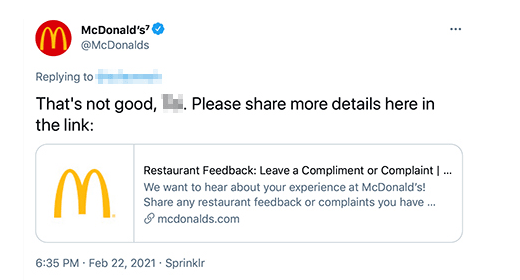
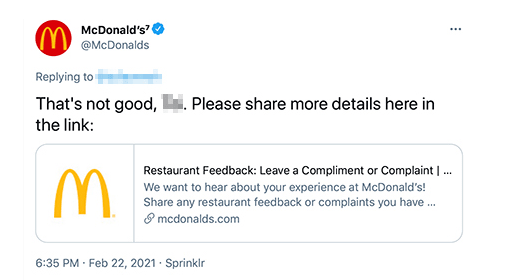
McDonald’s, on the other hand, mostly uses a closed response strategy. They generally respond to any negative tweets that tag their account (@McDonalds) or include the word “McDonald’s” with a survey link, ending the Twitter exchange and allowing the company to respond in a private channel. As a result, their Twitter presence is much less dominated by complaints.

Of course, the complaint response strategy is just one lever marketers can pull when attempting to balance attentiveness to unhappy customers with harmful complaint publicization. For example, many social media platforms offer features that can reduce the visibility of complaints, whether the brand engages with them or not. On both Facebook and Twitter, firms can “pin” posts to the top of their page, ensuring that their own content (rather than complaints and response communications) is always displayed most prominently.

Furthermore, it is always important to consider the unique context of each social media platform, as well as the particular customer engagement strategies that will align the best with a brand’s unique business context. But in general, our results suggest that the broadly accepted best practice of providing timely, detailed, public responses can have some serious negative repercussions, especially on social media platforms where content sorting algorithms are likely to promote complaints more heavily if brands respond to them. Customers love to voice their complaints on social media — but engagement on these highly public platforms can end up excessively amplifying these voices, encouraging other unhappy customers to chime in and ultimately reducing the brand’s value in the eyes of both customers and investors.

Feature Image Credit: HBR Staff/Twitter illucesco/Getty Images

By Alireza Golmohammadi, Taha Havakhor, Dinesh Gauri, and Joseph Comprix

  • AG
    Alireza Golmohammadi is an Assistant Professor of Marketing in the Collins College of Business at the University of Tulsa. His research focuses on digital marketing and social media analytics. He has published in the Journal of Marketing and the Journal of Retailing, among others.
  • TH
    Taha Havakhor is currently the Research Director of the Institute for Business and Information Technology (IBIT) and an Assistant Professor of Management Information Systems in the Fox School of Business at Temple University. His scholarly work, published in top business outlets such as MIS Quarterly, Journal of MIS, and Information Systems Research, focuses on IS strategy and the business value of IT. Taha actively engages with tech entrepreneurial communities in various advisory roles.
  • DG
    Dinesh Gauri is a Professor and Walmart chair in the Department of Marketing at the Sam M. Walton College of Business at the University of Arkansas. He is also the Executive Director of retail information at the Walton College. His research and teaching interests include retailing, pricing, marketing analytics, shopper marketing, e-commerce and social media marketing. He advises for various companies in these areas and is a recognized leader in marketing.
  • JC
    Joseph Comprix is a Professor at the Whitman School of Management at Syracuse University. He has a PhD from the University of Illinois and taught at the State University of New York at Buffalo and Arizona State University before joining Syracuse in 2008. He has published in journals such as the Journal of Accounting and Economics, Contemporary Accounting Research, Accounting Horizons, and the Journal of the American Taxation Association.

Sourced from Harvard Business Review

By Stacey Williams

Are you a consultant or freelancer? That’s the first question.

When I started my communications consulting career, my goal was to get six-month, on-site contracts from big corporations that paid large hourly fees. I would extend the contract for another six months when it ended or move on. I was more interested in getting steady contract work than building a .

It worked out great for about five years. Unfortunately, I got sick, had surgery, and couldn’t work.

Hourly consultants don’t get paid when they don’t show up. And I didn’t show up for several weeks. The good news — companies kept calling to see if I was available. The bad news — I couldn’t leave home. wasn’t an option. My duties required working with executives to gather information to set up internal processes. I didn’t have off-site access to the clients’ systems.

During my recovery, I decided to change my and improve my processes. It was time to build a business.

Most entrepreneurs learn by trial and error. My journey was no exception. Even with extensive industry experience, a mentor and great business contacts, it wasn’t easy to go in a new direction after my surgery. But I needed to survive, and it’s hard to know what works or doesn’t work if you don’t try new things.

There are many facets to becoming a successful consultant. I’ve perfected my process and believe these six things helped scale my business.

1. Consultant or freelancer?

Freelancing and consulting are two very similar but different entrepreneurial paths. One title is not more prestigious than the other, but prospects and clients may disagree, preferring freelancers for short-term creative work and consultants for in-depth industry expertise.

When you are starting out, it’s easy to use the titles interchangeably to describe who you are and what you do. Your goal is to get new clients and if prospects are looking for a freelancer, you are happy to be one to land the business. This can be a mistake.

Most companies hire freelancers for projects that require creative skills and often consider them gig workers. They hire consultants to help restructure their businesses or implement company policies and procedures — and they’re willing to pay for it.

Freelancers and consultants may provide identical services and charge the same fees, but it’s better for your brand to choose the right title to land the right clients. As a new consultant, you are the brand. It’s important to remember that at all times.

2. Pricing your services   

Pricing is more art than science. Large consulting firms know the value they bring to their clients, and they charge accordingly for their expertise. You should, too. To stay in business, you need to know what it costs you to do business. That means understanding your business margins.

Most novice business consultants don’t know their margins and work for low project or hourly fees. This strategy may get you a client, but it won’t keep you in business. Know what you want to earn each year. Come up with a formula for what to charge based on what you want to earn. Focus on prospects that will pay for your expertise.

As an expert, you are providing expert skills and advice. Like large consulting firms, charge for your expertise. Know what you are worth. Charge for the problems you solve and the value you bring. The client expects to pay for it.

3. When to say no

Clients won’t always agree with your findings and solutions. Sometimes, they’ll even refuse to implement them or suggest you change them. This is a tricky situation that may not be about your work. Perhaps it’s about someone who doesn’t want to change the status quo. When this happens, you need to find out why the client is resisting so you can address it. If the client still refuses to move forward, you have two options. Do what the client asks or say no and provide documentation on why your solution is right.

To say no, you must have confidence in yourself and the services you provide. They hired you to make an immediate difference. You should do that even when it means saying no.

It’s better to provide the right solution than be blamed for a failed project. Nothing is worse.

4. Choose a niche

Choosing a niche is important to developing your brand. It differentiates your business and can help you determine what services to provide. It will also make it easier to be recognized as an expert.

Give some thought to this before you start consulting. It will help you market to the right prospects, research your competitors and stand out from the crowd. You can always expand your services later, but a healthy business needs the right clients.

5. How to market your services

your services is key to having a successful consultancy. To stay in business, you need to think of marketing as a long-term plan. There’s no one-size-fits-all strategy that works. Test and measure different strategies until you find the ones that work for you.

Establish good lead generation strategies that include a website and social media platforms that speak to your . Keep it simple. The key is to understand who you are, what you do, how to reach your target audience, and how to communicate with them to set yourself apart from your competitors.

6. How to manage your time

When you’re a busy consultant, it’s easy to fall into the trap of working for clients all day instead of focusing on growing your business. Even if you’ve worked on a similar project, each new project comes with different clients and challenges.

You will need to create a plan and set up priorities and a schedule with deadlines at the beginning of each project. Create and use productivity strategies to monitor your time. You’ll also need tools to ensure you deliver on time.

There are other things new consultants should know but these six things, along with the ability to adapt to changing environments, will set you on the path to success.

By Stacey Williams

Sourced from Entrepreneur Europe

By Marcel Sattler

Email marketing is still relevant in 2021, and it will likely continue to be in the years to come. Why? Because you can monetize your list of contacts.

With email marketing, in contrast to Facebook Custom Audiences or Google Ads targeting, you don’t have to build your business on rented land. Maybe Facebook will turn off the Custom Audiences feature tomorrow, or Google will restrict targeting options. If you build your business exclusively on third-party systems, you run the risk of losing revenue sources.

That’s why your email list is a treasure. The contacts are your contacts, and you can contact them whenever you want (until they unsubscribe) — for free.

Drawing on my own experience with email marketing, here’s my advice on who it is for, what tools you can use and how to get started.

Who Is Email Marketing For?

Email marketing makes sense for most businesses, whether you have a Shopify store or are a local dentist. Why? Because it is an easy and cheap way to get in contact with your customers and leads.

Consider these two cases in more detail:

• A Shopify store: Let’s say you have a small range of baby products and have generated many sales in the last few years. Now you have a new collection of baby shoes in different colours and sizes. You already have a lot of customers who are happy with your products. They are exactly the right audience. Leverage your previous sales by sending out a few emails to the people who’ve already purchased from you. You will likely get sales without spending anything on advertising.

• A local dentist: If you collect email addresses from your customers, you can get in touch and boost your sales dramatically. Maybe you offer a new bleaching service and want to make it public. The best way to do so is to email clients who already trust you.

As you can see, email marketing can work for just about any kind of business. It can be effective for B2B marketing too.

The Connection Between Your Audience and Your Business

In my experience, no advertising method is as effective as an email in your customer’s inbox. You can build trust by sharing valuable content, generate engagement by sharing insights from your company, or sell more by sending great offers.

One of the many significant benefits is that the audience already has a connection with you. Your contacts already gave you their email addresses — maybe during the purchasing process or in exchange for a white paper or another goodie.

Trust can be the key to boosting sales. If customers were happy with their previous purchases, why shouldn’t they buy another product from you?

Let’s jump back to the Shopify store with the baby products. Maybe a young mother purchased a bathtub for infants in January. It makes sense to show her your collection of infant rompers in February and shoes six months later.

With this logical understanding of your audience, you can turn your email list into money.

Email Marketing Software

There are a lot of email marketing tools out there. There are fantastic free tools and also complex and expensive tools.

I’ll be completely honest: If you are a consulting business and have 50 clients, you likely don’t need email marketing software. It may be enough to manage your contacts in Outlook or Gmail and send out messages from your personal inbox. You can use the BCC field to send emails to your crowd without letting them know who else is getting the email.

If you have a large contact list or need additional features, I recommend using tools like Mailchimp, ActiveCampaign or HubSpot.

To choose the right email marketing software for your business, make sure you have the end in sight. What’s your main goal for your list? What would you like to accomplish in two to three years? Perhaps you would like to automate your lead generation and send out many emails in a special order to your contacts or automate birthday and Christmas wishes for your clients. No matter what ideas you have to boost your business, there is a tool for you.

The Best Time to Start Email Marketing

Do you already have a thousand ideas on how you can boost your sales, push your customer engagement and leverage your business with email marketing?

The best moment to start is right now. The sooner you start, the faster you will see results.

Maybe the automation stuff above sounds overwhelming to you. Do not let that distract you. Start small. Just collect email addresses, and send out your first message after collecting 100 or 500. Get familiar with the tools and your crowd.

Email marketing is a process that never ends. And the best moment to start this process is right now.

Feature Image Credit: getty

By Marcel Sattler

Marcel Sattler is an entrepreneur and founder of an agency. He is the brain behind many profitable brands with his sustainable strategy. Read Marcel Sattler’s full executive profile here.

Sourced from Forbes

Google Chrome is the most popular web browser in the world, but did you know it holds some secrets, too? You might be using Chrome to access your social media, work-related programs, and more, but there’s a lot of other interesting built-in features in the web browser that can prove to be very useful throughout your busy day.

From sending webpages to your phone to controlling media more easily to so much more, we’ve uncovered several things that you didn’t know you could do in Google Chrome.

Group and manage your tabs with built-in controls

Arif Bacchus/Digital Trends

Are you a person who has a lot of tabs open at once? You might be doing some shopping or working on an important project for school or work. Well, Chrome has your back with several built-in features. These include Tab Group, as well as some manual tab controls that are built into the right-click menu on the New Tab bar.

We’ll start with Tab Groups, which lets you couple together tabs under a specific colour and name, rather than keep them separate across the top of your browser window. This is useful for separating out the things you might be shopping for online, for example, or a specific part of a research project, or even anything you might be currently actively browsing for or on.

To use Tab Groups, you need to have a set of tabs open. Then, right-click on the tab that you want to group and choose Add tab to new group. You can then name the tab group and assign it a colour. Any subsequent tabs can be added to the group by also right-clicking and then choosing Add tab to group. You can close and remove groups at any time by just right-clicking the group.

You also can manage your tabs manually from the right-click menu on that tab. If you right-click a tab, you’ll see access to controls for moving the tab to a new window, closing all tabs to the left or right of it, or even opening a new tab next to it.

Send webpages to your other devices

Arif Bacchus/Digital Trends

Want to send a webpage you’re currently looking at on your PC to another device you own? Chrome makes it easy to do this. If you’re using the Chrome app on iOS, Android, and your other devices, and are signed in to the same Google account, you can send pages across devices with just two clicks.

All you need to do is simply right-click on the tab at the top of the tab bar in Google Chrome. From there, choose Send to your Devices. You’ll then see a list of your devices with Chrome installed, and you can quickly send the link from there. Just make sure that Chrome is active on the device you want to open the link on and choose the Open link on the Tab Received pop-up you see within Chrome.

Reopen that window or tab you accidentally closed

Arif Bacchus/Digital Trends

Were you working on something important and accidentally closed the tab or the window? No worries, accidents happen and Chrome has your back. All you need to do to get your tab back is to right-click on the new tab button and select Reopen closed tab. This also works for Reopen closed window, too. This is a nice shortcut that keeps you from having to go through the history menu.

Scan a QR code so you can open a website on your phone

Arif Bacchus/Digital Trends

We mentioned sending open Chrome tabs to your other devices earlier, but this requires signing in with a Google Account. If you’re not using Chrome with a Google account, you can still open websites on your phone, without the use of Chrome or even a Google account.

This is possible thanks to the use of a QR code. Just note that only certain websites support it. You’ll know when it is supported when you see a little QR code in the address bar when you click a URL (it will show up next to the favourites icon.) Just click on the QR code icon to summon a special QR code for sharing.

After that, you can swipe down on the home screen on your iPhone and search for Scan Code. Click Code Scanner to open up a barcode reader. You can then scan the code you see in Chrome on your desktop. Your iPhone will show you a cool animation and will automatically open up the Chrome webpage from your desktop in the default web browser on your iPhone — it doesn’t have to be Chrome!

Use the integrated media controls

Arif Bacchus/Digital Trends

Listening to some tunes on YouTube? Or how about watching a YouTube video? If you want to play or pause the song or video, you don’t actually need to head into the tab or the video player itself. Chrome has built-in media controls.

To control media that’s currently playing from an active tab, or another tab, you’ll just want to look for the little music icon next to your profile icon in the top bar in Google Chrome. If you click this, you’ll see a media player, with pause, fast forward, and rewind buttons. On some websites like YouTube, you even can pop out the video from here, too. This will ensure the video follows you around.

Change the default search engine

Arif Bacchus/Digital Trends

If you find yourself looking through another search engine other than Google Chrome, maybe DuckDuckGo, you can actually save yourself some time by adding that website as a search engine inside Chrome. Doing so will allow you to use the Chrome address bar to search the site, rather than having to go through the website itself.

You can add a website as a search engine manually by clicking the three downward-facing dots next to your profile icon, and then choosing Settings. From there, pick Search Engine from the sidebar. Then, click the Manage Search Engines > Add. In this case, we’ve added Wikipedia manually, but you also can search for it using the Search feature. Now, any time you type Wikipedia into the address bar, you’ll see a prompt to press Tab to search through it!

Cast your screen

If you want to connect your laptop or PC to a second screen to showcase something, you might think you need wires to do so. However, if you purchase (or already own) a Google Chromecast or other Chromecast-enabled stick and then hook it up to your TV or monitor (they are usually around $20), you can wirelessly beam whatever is on your Chrome tab or desktop right to your display.

To cast in Chrome, you just need to click the three downwards-facing dots next to your profile icon and then choose Cast. Be sure that your Chromecast-enabled device shows up in the list. From there, you can then select Sources, and pick a source from the list.

Sourced from digitaltrends

By Frank Landman

When marketing becomes too much to handle, most businesses assume that they need to hire an employee or outsource to a contractor. But don’t be so quick to grow your payroll. It’s possible that you could automate many of these tasks with streamlined digital solutions.

4 Powerful Ways to Automate Your Marketing

By its very nature, marketing is an activity of scale. In order to successfully build up your business and grow your brand, you have to get in front of as many people as possible. But if you’re trying to handle all of your marketing efforts manually, you’re probably exhausted. There’s simply too much for any one person (or department) to handle alone. And this is where automation comes into play.

Automation – which is basically the strategic combination of software, applications, and artificial intelligence to streamline time-consuming processes and produce results at scale – is a powerful tool that is not deployed nearly enough by small businesses and growing brands. But if you can pick the right spots to automate your marketing, it could change everything.

Whether you’re nursing a small start-up or you have a booming business that’s bursting at the seams, the following solutions could provide exactly what you need at this precise moment in your company’s life:

1. Automate Email Campaigns

Did you know that more than 68 percent of businesses spend seven days or more on the production of just a single email? (It takes 14 percent of businesses a month or longer to push out an email!)

Or did you know that most companies are in the process of producing between one and five emails at a time?

We’ll let you do the math…but that’s a lot of time spent building and sending emails. And yet nobody is denying the value of email. So the question becomes, how do you automate your email campaigns so that you can enjoy the benefits without unnecessarily wasting hundreds or thousands of man-hours each year?

One answer is to leverage an email marketing platform that allows you to use automations and triggers to streamline these touchpoints. Any major email marketing platform is going to have similar features, but we’ll use a tool called ActiveCampaign to illustrate how effective this can be.

Within the ActiveCampaign platform, you can create individual campaigns that are automatically managed using “triggers.” A trigger is any event that your business can track – like subscribes, unsubscribes, form submissions, email opens, web pages visited, links clicked, purchases made, or specific dates (like a birthday or customer anniversary).

Once one of these triggers is “tripped,” you can create an automated email sequence that’s sent out to that user. This sequence can include anywhere from one message to a dozen or more (sent out at predetermined times and intervals).

Once you draft the email copy and create the campaign, it all happens automatically…at scale. Whether you have 10 people on your email list or 100,000, everything happens flawlessly. It can literally save you thousands of hours every year.

2. Automate Content Promotion

Content promotion is another time-consuming element of marketing that we hear a lot of people complain about. And while it is time-consuming, it can be automated without much effort. You simply have to develop a plan and create the right processes on the front end.

Here’s one dead-simple process you can replicate:

  • Step 1: Sign up for a social media management tool like Buffer or Hootsuite, which allows you to manage all of your accounts (Facebook, Twitter, Instagram, LinkedIn, etc.) from one place.
  • Step 2: Create an account for a tool called Zapier. This is an automation service that makes it easy to connect apps and create powerful automated workflows. It works great for marketing and content promotion.
  • Step 3: Create an automation process (called a “Zap”) that connects your blog’s RSS feed to your Buffer or Hootsuite account. Optimize it so that your blog post is shared to each of your social networks every time the RSS feed refreshes with a new blog post.

That’s just one example of how you can automate content promotion using Zapier. There are literally dozens of other ways to spread your content without lifting a finger. If you haven’t explored these opportunities yet, you’re doing yourself a disservice.

3. Automate Customer Feedback

Customer feedback is the lifeblood of successful companies. Unfortunately, most businesses don’t collect enough data to produce meaningful insights and takeaways. And of the companies that do, just a small percentage are able to make sense of the data they collect. Automating customer feedback and analysis could be a vital decision for your business moving forward.

There are plenty of ways to automate your feedback loops, but we’ll touch on just a couple. The first approach is to use an advanced SMS text survey software like Delighted to procure instant customer feedback in a convenient and streamlined process. Here’s how it works:

  • You craft a simple survey within the Delighted platform and initiate a campaign.
  • Each customer receives the survey in an SMS format.
  • Customers reply with a numerical score to each question.
  • The Delighted platform responds with a free-form follow-up question.
  • Customers can provide a more detailed explanation in their own words.
  • Data is organized for easy analysis.

If you have a Zapier account, you can trigger surveys to be sent out after specific actions are completed in a customer’s lifecycle.

You may also find it helpful to automate feedback related to customer churn. (This is especially important for subscription businesses that rely on customer retention to sustain revenue.) There are tools that can be leveraged to send out exit surveys any time a customer cancels a subscription and/or fails to upgrade from a free trial. These surveys won’t do anything to keep the customer, but they can give you a good idea of why people are leaving.

A third option is to automate your feedback analysis by using a “customer sentiment” tool. Services like MonkeyLearn can “read” your feedback and effortlessly organize all responses into general theme-based buckets. This lets you identify and group common pain points, which makes it easier to track customer sentiment and address pressing issues as quickly as possible.

4. Automate Lead Generation

You might assume that automation stops at lead generation, but you’d be wrong. While there are certain aspects of lead generation that can’t be handled by an algorithm, this list is growing smaller by the year. Thanks to advanced technology and artificial intelligence, lead generation automation is more practical than it’s ever been.

Chatbots are among the fastest-growing technologies in this niche of advanced tech. They can be used to automate and enhance the overall customer experience by increasing engagement and initiating high-value touchpoints that would otherwise go ignored.

One of the more impressive use cases for chatbots involves the use of Facebook’s native Messenger platform. Because regardless of how much experience you have or what type of skills you possess, you can create interactive chatbots with no coding required.

Facebook chatbots are basically automated customer service agents/sales reps that empower your business to engage with Facebook prospects at scale. And while you’re probably not going to close deals on Facebook Messenger, these bots are excellent “setters.” They can indoctrinate prospects into the funnel and provide a steady flow of pre-qualified leads to your actual sales team.

Here are some examples of powerful ways you can leverage Facebook Messenger chatbots to assist with lead generation:

  • Blast out content and share it with your most loyal followers
  • Conduct quick webinar signups and get people to show up to live events
  • Automate your drip campaigns and nurture leads
  • Send out appointment and event reminders so that people never miss an engagement
  • Provide powerful customer service (including answering FAQs and giving out directions)

As mentioned, you can build your own bots for free (and it’s relatively easy for anyone to learn). Rather than having to code, you simply create logical workflows that operate on an if/then basis. These bots can take some time to build (depending on how intricate you want to go), but will ultimately save time when deployed on a large-scale basis.

Reduce Bloat With Automation

Automation can’t solve everything, but it can provide relief in areas where you need it most. Advanced technology, like the solutions outlined in this article, prevents bloat and allows you to scale without having to continually add more people to the payroll. It’s an efficient way to manage resources and grow in a timely and sustainable manner that respects both the brand and the bottom line.

You don’t have to implement each of these solutions today, but it would be wise to take action as soon as possible. Pick one area where you stand to improve the most and put that strategy to work.

Then, once you have that piece in place, move on to another one. It’s through this diplomatic yet proactive approach that you’ll find results.

By Frank Landman

Frank is a freelance journalist who has worked in various editorial capacities for over 10 years. He covers trends in technology as they relate to business.

Sourced from readwrite

By Jason Aten

Apple put the M1 in the new iPad Pro and it’s ridiculously good.

I’ve been such a big fan of my 2018 11-inch Pad Pro that I couldn’t find a reason to upgrade last year when Apple added a slightly better processor and a LiDAR sensor. If you don’t know what a LiDAR sensor is, well, then you understand why it wasn’t something I felt like I just had to have.

I do love my iPad Pro, however, and it’s often my preferred device for work for a lot of reasons. It was already the most powerful tablet you could get, and it was faster and more powerful than most laptops you could buy, even with a three-year-old processor inside.

null inline image

Courtesy company

Now, Apple just made it even better, and not by a little. In fact, Apple made the new iPad Pro so good, it’s hard not to think it’s just showing off at this point. Here are just a few of the reasons why:

M1 Chip

You only need to know one thing about Apple’s M1 processor–it’s one of the most powerful and efficient chips you can get inside a computer. Except, now you can also get it inside an iPad. That means that the iPad Pro is more powerful than almost any PC you can buy that isn’t a highly customized setup that will also certainly be power-hungry and expensive.

Apple has no business putting this chip in a tablet. The only reason it did is simply because it could. The M1 isn’t just powerful, it’s also extremely efficient, which means it can run off an iPad’s battery and still handle anything you can throw at it. It also can run just fine in the small enclosure of an iPad, without a fan.

null inline image

Courtesy company

It is fair to point out that Apple didn’t talk much about battery life. It only described it as “all-day,” which is certainly open to interpretation. Still, I’ve been using a MacBook Air with an M1 for months, and I regularly make it through a day of working unplugged with 60 percent or more battery life remaining. That’s just showing off.

Liquid Retina XDR Display

The display got a big upgrade as well. Apple is using MiniLED technology, which it calls Liquid Retina XDR, though it will only be available on the 12.9-inch model. Apple says it uses 10,000 LEDs, grouped in 2,500 local dimming zones, in order to provide “a stunning visual experience that reflects what can be seen in the real world by capturing the brightest highlights and the most subtle details in even the darkest images.”

Thunderbolt

This might be the most absurd thing Apple added to the 2021 iPad Pro, and I don’t mean that in a bad way. The Thunderbolt port gives the iPad Pro up to 40Gb/s of bandwidth. That’s enough to support a 6K HDR display, and 10GB Ethernet, meaning that the iPad Pro is capable of handling almost any pro workflow. You can also connect it to a Thunderbolt dock to give the iPad Pro even more connectivity.

That makes me optimistic that we may see some very interesting changes to iPadOS at Apple’s upcoming Worldwide Developers Conference in June. Adding better windowing support would make using an iPad with an external display that much more useful, especially with the ability to connect external drives and other peripherals via Thunderbolt.

Feature Image Credit: Getty Images

By Jason Aten

@jasonaten

Sourced from Inc.