Author

editor

Browsing

By Sara Guaglione

The New York Times’ flagship morning newsletter The Morning hit a milestone in January 2021: over 1 billion unique opens since it launched in May 2020.

The newsletter represents a direct and important relationship between the Times and its readers, and a path to converting daily newsletter subscribers into subscribers of The New York Times’ journalism, according to Adam Pasick, editorial director of newsletters at The New York Times.

“Newsletters are a great way to grow a subscription business. Subscribing to a newsletter is a healthy habit that can bear fruits down the line,” said Pasick. However, the strategy for converting The Morning’s subscribers to Times subscribers “is still in progress, and we are continuing to learn how to optimize that dynamic,” he said. The Times would not share how many subscribers have been converted from the newsletter. A digital subscription to the Times currently costs $8 a month for the first year, before going up to $17 a month.

The Times also would not say how many people subscribe to The Morning newsletter, which is the publisher’s largest newsletter. The average open rate is “significantly higher than when we launched” in 2020, according to Jordan Cohen, executive director of communications at the Times, and the “vast majority” of opens for The Morning occur within the first three hours of it being sent, due to the West Coast time zone, noted Pasick.

The Times has over 71 newsletters. Readers opened more than 3.6 billion newsletter emails from the publisher in 2020, a 150% increase over 2019. In 2020, pop-up newsletters around big news events (such as the “Coronavirus Briefing,” “Coronavirus Schools Briefing,” “Impeachment Briefing” and “At Home”) had 180 million opens. Those numbers do not include readers who get served push notifications from the Times app and consume the newsletters there.

There was a “big surge of reader interest with the pandemic and the election,” Pasick said.

According to a survey conducted in July by email marketing company LiveIntent — which works with the Times on monetization and subscriber acquisition efforts — 53% of publishers had experienced an increase in open rates for their email newsletters since the start of the pandemic. LiveIntent CMO Kerel Cooper said he has seen newsletter consumption increase with people spending more time in their inbox as they are spending more time at home.

Newsletters support the Times’ subscription-driven business by getting readers into the habit of consuming its content everyday via The Morning. The idea is this will lead them to pay to be able to access more than what is available in front of the paywall.

“The strategy behind putting so many resources behind this email is it’s a great way to introduce new readers to what the newsletter has to offer, habituate them and have a long term relationship with us. It leads eventually to people paying for the paper,” Pasick said.

The New York Times has over 7.5 million subscribers, according to its most recent earnings report. Of those, 6.69 million are digital-only subscriptions. Last year, the publisher hit two milestones: digital revenue overtook print revenue, and revenue from digital subscriptions was its largest revenue stream.

The Times makes money from The Morning by directly selling single-day sponsorships to advertisers. The Times’ sales team goes out and sells ad space in The Morning, and the publisher uses LiveIntent’s technology to place the ad in the newsletter, according to Cooper.

In general, newsletters are increasingly attractive for publishers as a revenue stream and as a way to convert subscribers. Bustle Digital Group —which currently has 2 million email subscribers across its 14 newsletters — says by the end of the year it wants to have 10 million email subscribers and increase the newsletter business from a seven-figure revenue stream to an eight-figure revenue proposition year-over-year. And Forbes is launching a newsletter platform for journalists to create their own paid newsletters and share the revenue with the publisher.

Another benefit of newsletters is they provide publishers with people’s email addresses. That information is especially valuable as the impending demise of the third-party cookie has pushed the digital ad industry to prize first-party data, like email addresses, as a means of targeting people with ads.

“More and more of our customers are doubling down on email newsletter strategy as a way of building a direct connection with consumers, as a way of offering advertisers unique products and services and bridging that gap from a third-party world to a first-party world,” Cooper said. “An email newsletter is a great digital handshake between a consumer and a publisher…. You hand over your email for good content… and you as a consumer can end that contract by hitting the unsubscribe button,” he added.

Newsletter companies are getting acquired by platforms as they seek consumer revenue, too. CRM software platform HubSpot is buying The Hustle, a business email newsletter publisher with 1.5 million readers. Twitter purchased newsletter platform Revue in January.

Newsletters are having a “cultural moment right now,” Pasick said. “When social media has become problematic… newsletters feel intimate and direct and can explain complex topics in a conversational way.”

In April 2020, David Leonhardt took over as the lead writer for The Morning. Leonhardt and his team are “constantly iterating, with different formats, focuses and voices,” Pasick said.

For example, the opening section of each morning newsletter is now similar to a “mini essay,” focusing on one big topic. The lead items that covered the COVID-19 vaccine resonated particularly well with readers, as do data visualization features, according to Pasick. Leonhardt recently wrote an opening piece about a 1,600-mile road trip he took to get his mother vaccinated. Content from the Times’ other paid digital products like Cooking and Games also make it into The Morning.

As the Times is looking to grow its core portfolio of newsletters, topics covered in The Morning can be spun out into standalone newsletters that “don’t have to last forever,” Pasick said. A newsletter on the impeachment hearings for President Donald Trump, for example, was revived for the second trial, which begins this week.

When a big news event happens, the newsletter team now has the ability to quickly build a pop-up briefing around it. A briefing on COVID-19 was created in just a few weeks last year, and now is one of the top five newsletters for the Times.

And the publisher has beefed up its CMS and newsletter tools “so that when that moment arises we can move really nimbly… a checklist and a playbook means we don’t have to reinvent the wheel every time,” Pasick said.

Feature Image Credit: Ivy Liu 

By Sara Guaglione

Sourced from DIGIDAY

By Sara Fischer

Facebook is testing a notification that notifies Apple iOS users about ways the tech giant uses their data to target personalized ads to them.

The big picture: The test is happening in light of upcoming changes to Apple’s privacy settings that will make it harder for Facebook and others to collect data on Apple users for ad targeting.

Catch up quick: Facebook warned investors last week that changes to Apple’s “Identifier for Advertisers” (IDFA) user tracking feature will likely impact its business.

  • The feature asks Apple iOS users to opt-in to having their data collected, instead of asking them to opt-out. Developers forecast that only around 10-30% of users will actually opt-in to having their data collected, making it much harder for advertisers to target potential Apple customers without as much access to their data.
  • Despite an earnings beat, Facebook’s stock has been down due to investor fears that the Apple changes could significantly impact its business moving forward.

Details: In an updated blog post, Facebook says it will be showing their prompt “to ensure stability for the businesses and people who use our services.”

  • The prompt, which provides information about how Facebook uses personalized ads, will be shown to users globally on Facebook and Instagram.
  • In the post, Facebook says that if users accept the prompts for Facebook and Instagram, the ads you see on those apps won’t change. “If you decline, you will still see ads, but they will be less relevant to you.”
  • The tech giant notes that Apple has said that providing education about its new privacy changes is allowed.

Between the lines: As Axios has previously noted, Apple’s newest software updates ask users whether they want to allow apps like Facebook to track their activity.

  • Facebook has long asserted that these changes will make it harder for small business to place targeted ads. In the updated blog post, Facebook doubles down on that argument saying, “Apple’s new prompt suggests there is a tradeoff between personalized advertising and privacy; when in fact, we can and do provide both.”

Our thought bubble: Usually consumers are left out of these types of corporate battles over policy changes. By prompting users, Facebook is exposing its billions of users more directly to its very messy public battle with Apple over these privacy changes.

Feature Image Credit: Facebook

By Sara Fischer

Sourced from AXIOS

By Erika Wheless

In November of last year, Tushy, the DTC bidet attachment company, debuted an ad on Reddit where it agreed to make a limited edition bidet that changed the “Bum Wash” label to “A** Blast” if the ad was upvoted 10,000 times.

Andy Stone, director of growth marketing at Tushy, says the company took a closer look at advertising on Reddit after being approached by Joe Federer, the former head of brand strategy at Reddit who founded [An Internet Reference], which specializes in advertising on the platform.

According to Stone, Tushy saw an average of 4.5x return on ad spend looking at the full scope of the customer journey. They plan to have Reddit as part of their regular ad strategy this year.

As e-commerce has boomed, Reddit has started to become a player in the consumer buying funnel. The site’s honest, in-depth reviews make it attractive to high-intent customers. “The path to purchase is changing and we’re seeing that Reddit is more front and centre in the e-commerce experience,” said Jen Wong, COO of Reddit.

Late last year, Reddit rolled out three ad inventory tiers with a focus on targeting and brand safety, which has been an issue. Marketers didn’t want to risk brand safety on the opinionated site. Despite these updates, Reddit is still an experimental space for marketers and requires a more nuanced approach than repurposing an ad from Facebook. But there are some brands who have managed to strike the right tone and have seen successful conversions.

Breaking into these communities can be a challenge for marketing teams. It’s particularly important to have thoughtful targeting and creative, and to be ready to engage with users’ questions and comments. Reddit users are notoriously opinionated.

“It’s not a one-size-fits-all approach,” said Stone.

Reddit’s ad platform is still relatively new. “Advertisers can’t yet expect the bells and whistles they might expect elsewhere,” said Alex Young, director of paid social at Carat. “There are only a few ad formats, buying methods, and optimization functionalities.”

Redditors are not shy about downvoting brands who don’t engage in the spirit of the site. Electronics Arts ended up with a world-record, most-downvoted comment after a poor response to a Redditor’s question.

“A brand’s success is more to do with the demeanour of the brand than the brand itself,” said Federer. “They have to come correct and take time to get those community nuances.”

Federer says he would love to see Reddit’s ad offerings lean into their unique communities. “Right now it feels pretty in line with other social media platforms,” he said. “I wish there was a clearer way to ad value, like adding a filter or widget in the sidebar for r/adobe.”

There is a lot of potential upside for brands that get it right. Last October, the site said it averaged 52 million daily viewers. (Facebook said it had 1.82 billion daily users last September.) In December, Wong told the Wall Street Journal that Reddit’s ad revenue totalled more than $100 million in 2019 and was on track to rise by more than 70% in 2020. Reddit declined to breakdown or share revenue details.

Oh and Tushy’s limited edition bidet? “OP will make good on the actual product,” assures Stone

By Erika Wheless

Sourced from DIGIDAY

By 

Like almost all operating systems, Windows 10 is vulnerable to security and privacy issues, and researchers have proved that Microsoft can track a lot of your activities to improve their products and enable personalized ads and promotions.

Thankfully, Windows 10 allows us to improve the operating system’s security and privacy using the built-in settings app. If you’ve concerns about your data security and privacy, you should consider making the below changes.

Security features you should know about

Below we outline some important features that can enhance the security of Windows 10 devices.

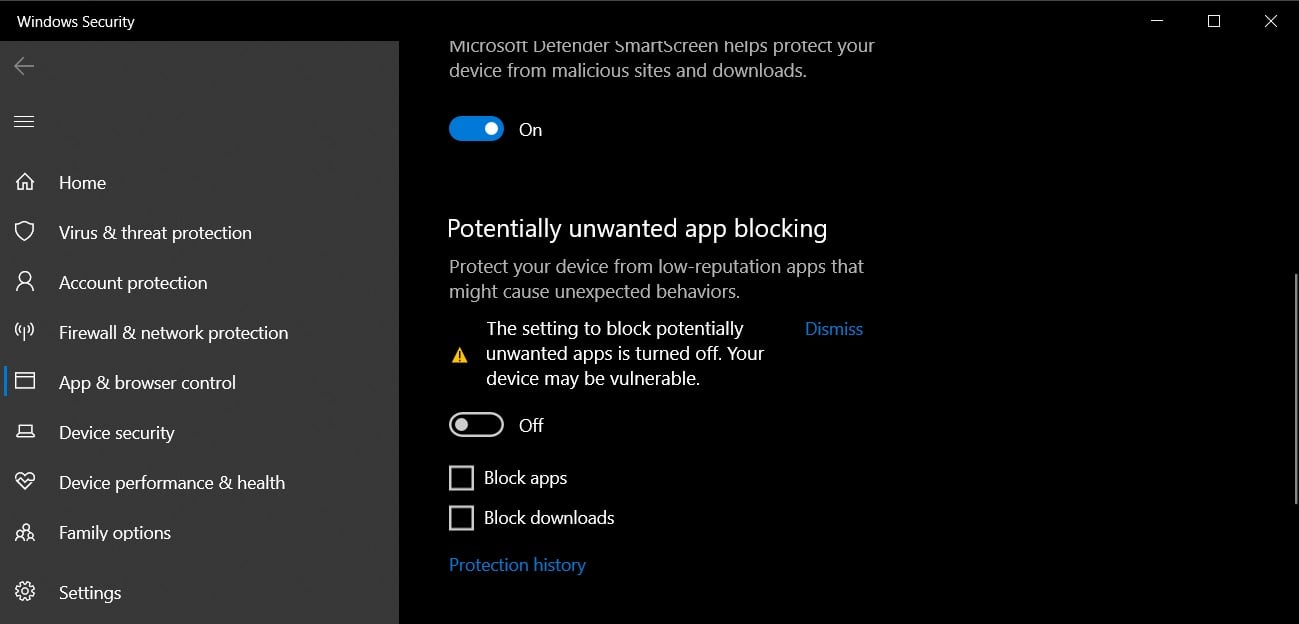
Potentially Unwanted App (PUA)

In Windows 10 version 2004 or newer, there’s a new feature called Potentially unwanted applications (PUA) protection. As the name suggests, PUA protection allows Windows 10 to detect potentially unwanted apps using Microsoft Defender (formerly known as Windows Defender).

PUA

For those uninitiated, potentially unwanted applications (PUA) generally cause issues with Windows and other installed apps, and they can also make your device slower or buggy. These unwanted apps are not considered virus or malware, but it’s widely believed that they can modify your web browsers, change the default behaviour and perform other actions without your permission.

To enable PUA/PUP protection in Windows 10 2004, follow these steps:

  1. Open Settings.
  2. Navigate to Update & Security > Windows Security > App & browser control.
  3. Look for a new section titled ‘Reputation-based protection‘.

You can click on the ‘Turn on’ button to enable the feature. If you want to configure PUA/PUP, you can also click on the ‘Reputation-based protection settings’.

This will allow you to access the following settings:

  • Check apps and files.
  • SmartScreen for Microsoft Edge.
  • SmartScreen for Microsoft Store apps.

For more detailed information, see our article on how Windows 10 2004 improves potentially unwanted app protection.

Memory Integrity

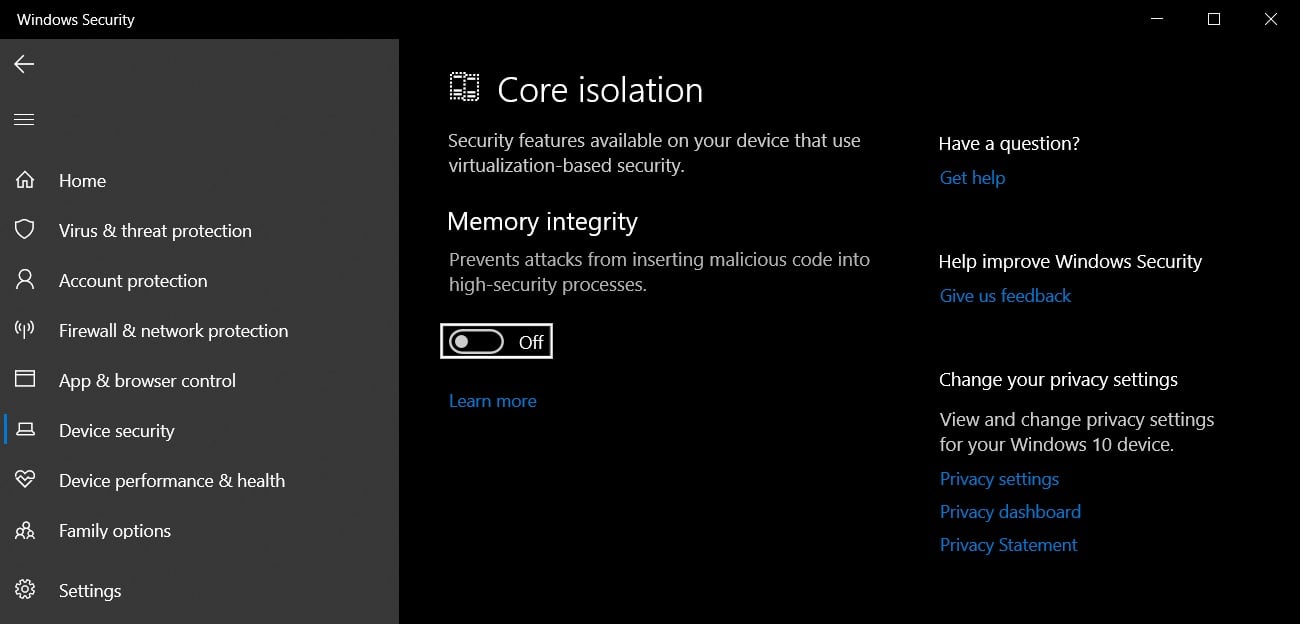
Windows 10 comes with another brilliant feature called “Core isolation”, which aims to protect your device against malware and other attacks. Core isolation feature isolates computer processes from the software and hardware, and it enables an extra layer of security against sophisticated attacks.

Memory integrity, which is a part of Core isolation, uses hardware virtualization and Hyper-V to prevent attempts to inject and run malware in Windows kernel-mode processes.

Memory Integrity

In order to use core isolation’s memory integrity feature, follow these steps:

  1. Open Settings.
  2. Navigate to Update & Security > Windows Security.
  3. Click on Device security.
  4. Under “Core isolation” and “Memory integrity“, turn on the Memory integrity toggle switch.
  5. Restart Windows to apply changes.

Controlled Folder Access

Another exciting security feature in Windows 10 is  “Controlled Folder Access”, which basically allows you to prevent unauthorized access to certain folders.

This feature gives you greater control over sensitive folders and it can also prevent ransomware or any attempt to access and encrypt your documents, pictures, and other files stored in those folders.

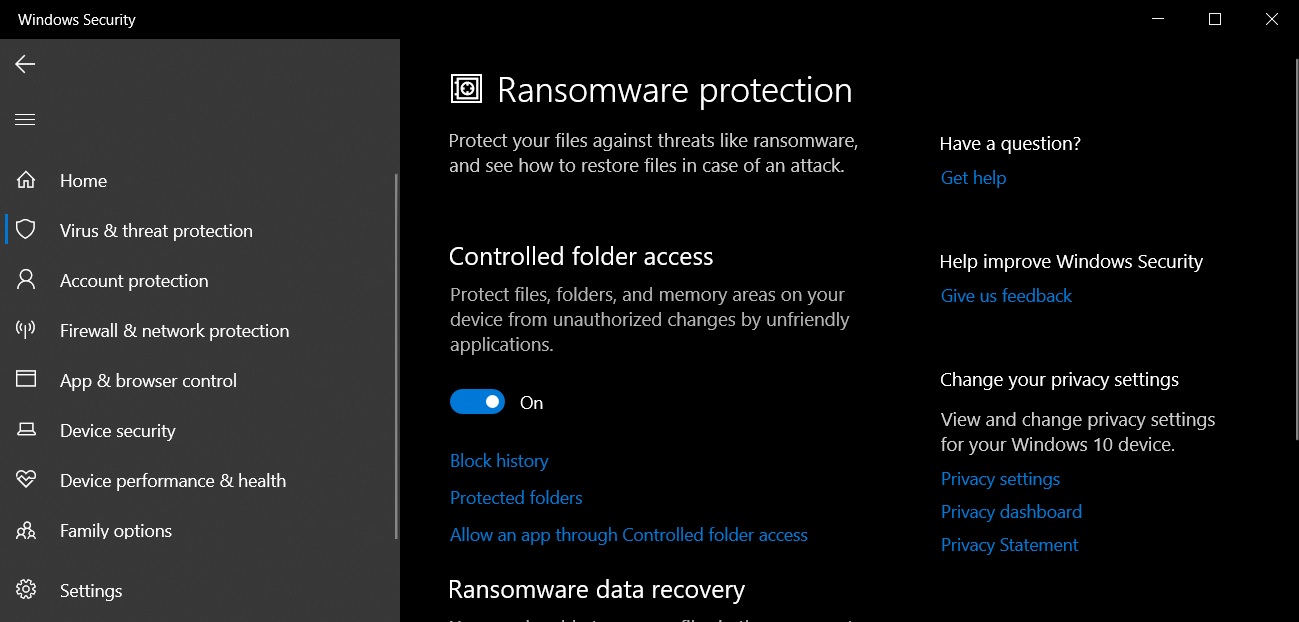
    1. Open Windows Security.
    2. Click on ‘Virus & threat protection
    3. Click on ‘Ransomware protection
    4. Locate the “Controlled folder access” section and click the On/Off toggle.Controlled folder access
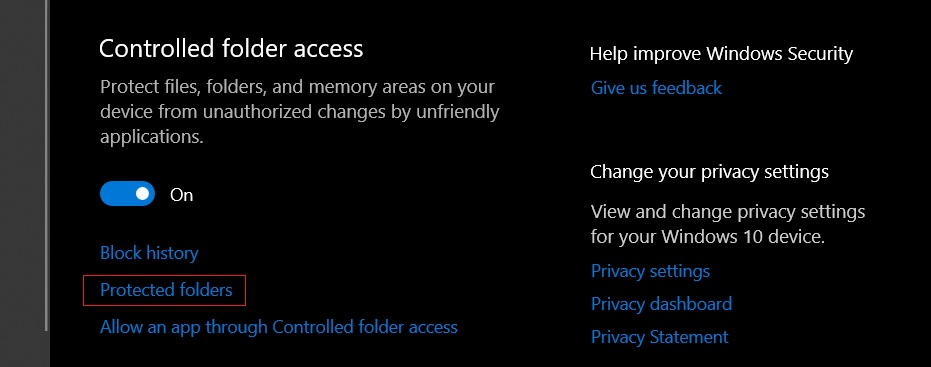
  1. Select the “Protected folders” option.Protected folders
  2. Add all the folders that you want to restrict access to.

For more detailed information, see our article on how Controlled Folder access works.

Network scanning

Network scanning is included with Windows Defender and it allows you to scan your network files. However, the feature is disabled by default and interested users need to enable it manually with PowerShell.

To use enable network scanning, follow these steps:

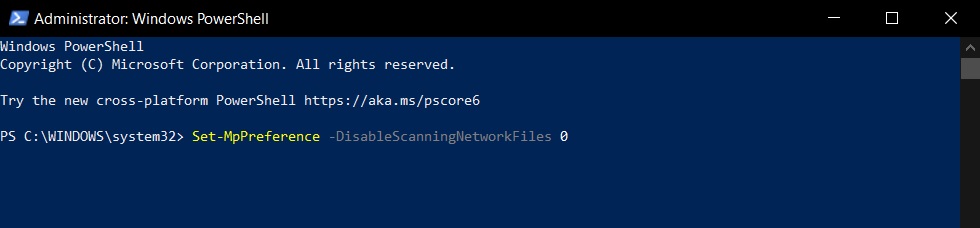
  1. Open Windows Search.
  2. Search for PowerShell and click the Run as administrator option.
  3. Type the following command:
    Set-MpPreference -DisableScanningNetworkFiles 0Network scan
  4. Press Enter to enable scan network files

By following the above steps, you can use Defender to scan network files. If you want to turn off the feature, enter the following command in PowerShell:

  • Set-MpPreference -DisableScanningNetworkFiles 1

Windows 10 settings to increase your privacy

If you’re concerned about privacy and how your data is being used by Microsoft, you should make the below changes to increase privacy in Windows 10.

Turn off ads and tracking

All consumer-oriented versions of Windows 10 show ads or recommendations by default and Microsoft also create an advertising ID for your user account. The advertising ID is linked to your Microsoft account and it is used to trailer recommendations/ads for Microsoft services.

Fortunately, Windows 10 allows you to turn off the advertising ID and it even lets you disable the ads that you see in the Start menu and other places.

To turn off the settings, follow these steps:

  1. Launch Settings.
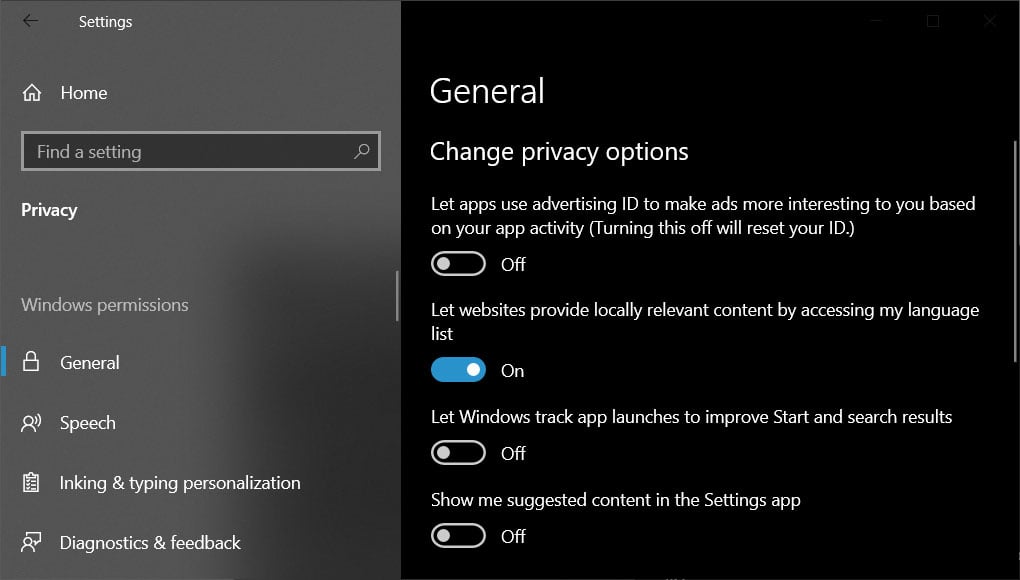
  2. Go to Privacy > General.
  3. Under the “Change privacy options” section, toggle Off the following options:
    1. Let apps use advertising ID to make ads more interesting …
    2. Let Windows track app launches to improve Start and search results
    3. Show me suggested content in the Settings app“.

When done, your General settings should look like the following image.

Settings privacy

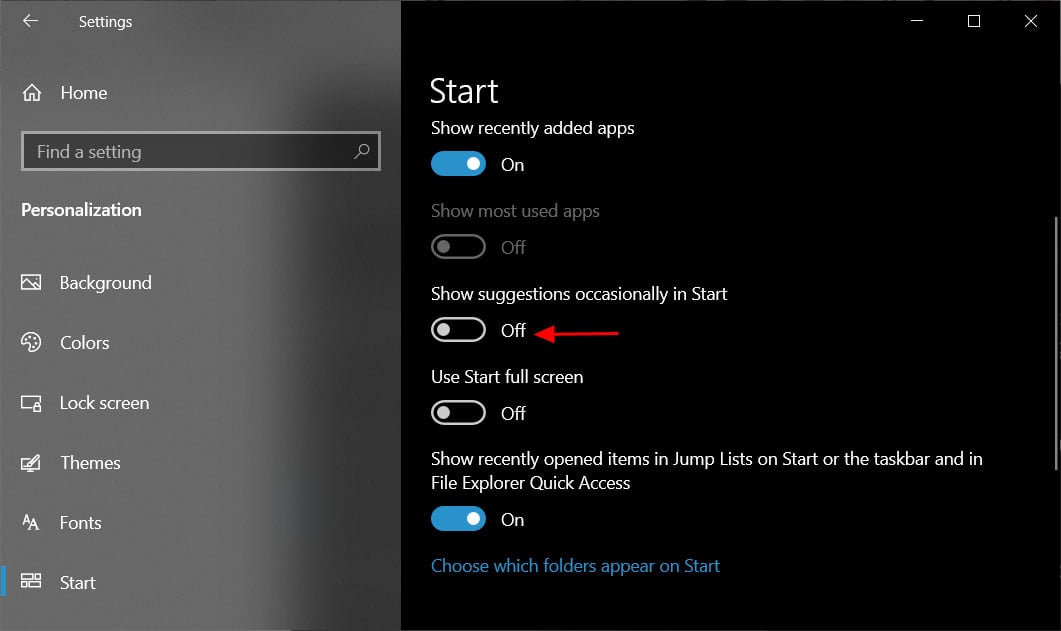
Disable Start Menu suggestions and promotions

As mentioned above, Microsoft uses Start Menu to show suggestions/ads/recommendations for Microsoft Store apps and services. For example, Microsoft recently started displaying ads for the new Microsoft Edge browser in the Start Menu.

Disable show start menu suggestions

To disable these suggestions, go to Settings Start and disable ‘Show suggestions occasionally in Start‘ as shown above.

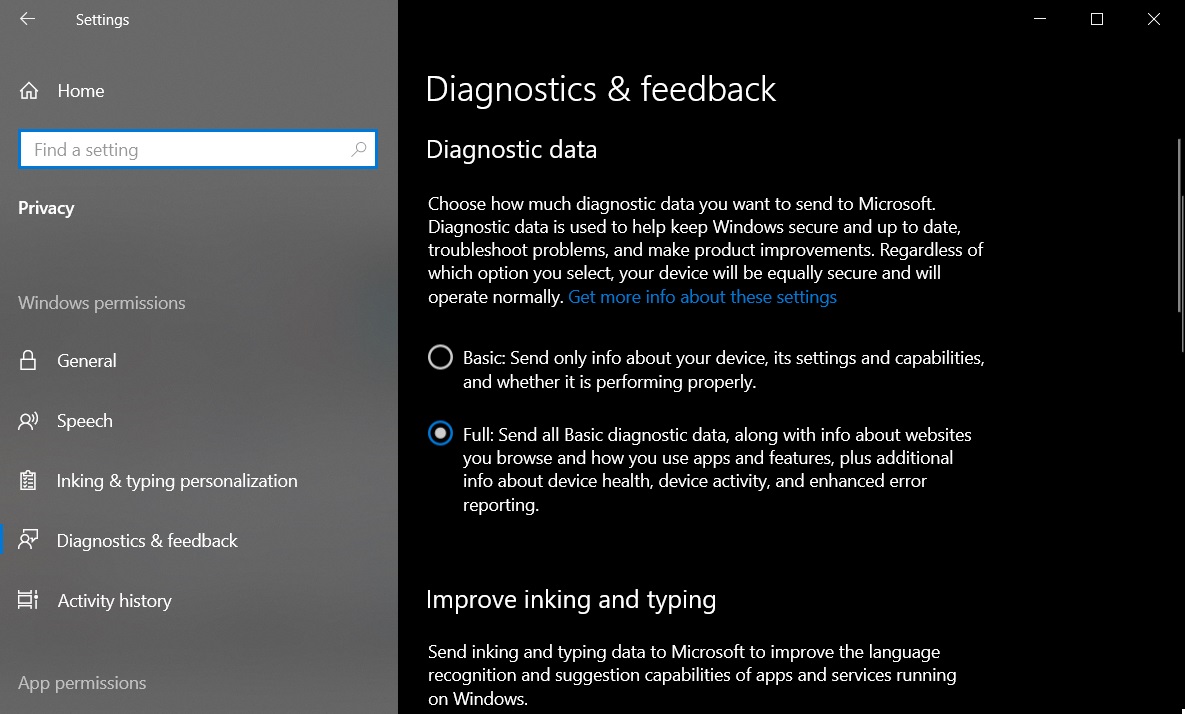
Restrict Diagnostic data

Windows 10 collects the hardware and software diagnostic data on a regular basis to improve Windows experience on your device, according to Microsoft. The data collection cannot be turned off completely, but you can control what kind of diagnostic data is gathered about you, your applications, and your device.

To manage your diagnostic data, head to Settings Privacy > Diagnostics & Feedback.

You’ll see two options—Basic and Full.

Diagnostics

To reduce the data collection, select the first option (Basic). When the Basic option is selected, Microsoft will only record and collect your device’s basic information including settings, features, and performance.

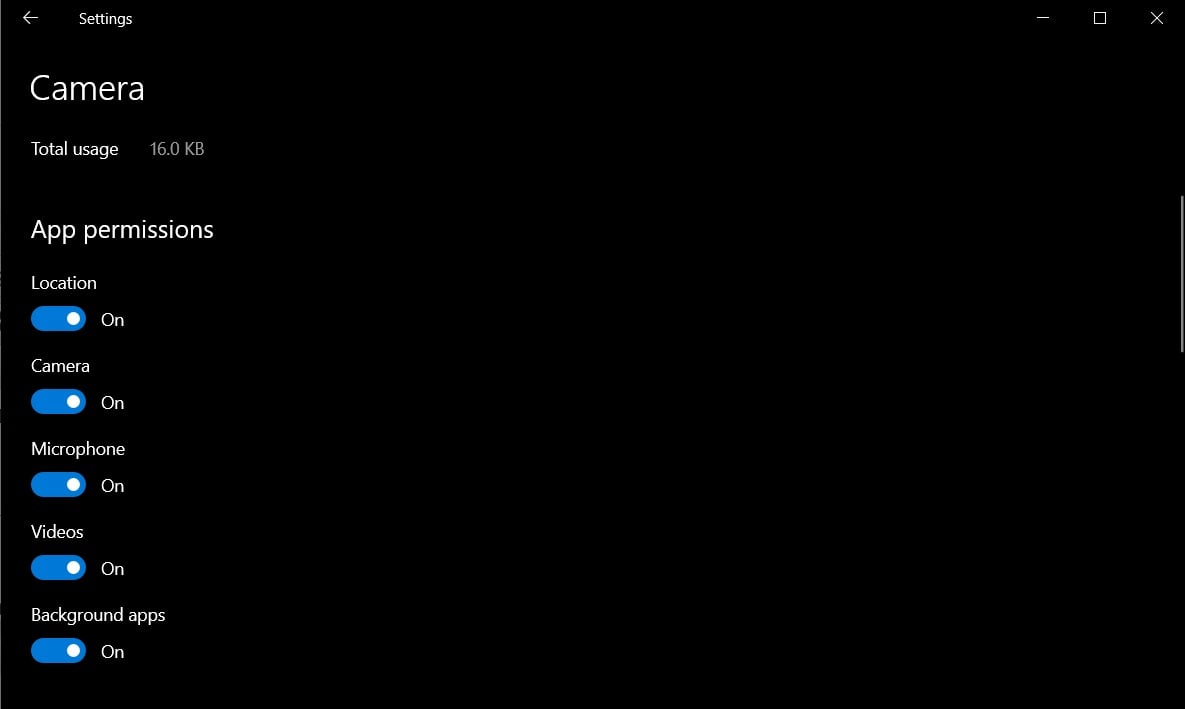
Manage permissions for location, microphone, camera

Like diagnostic data, Windows 10 Settings app also allows you to manage permissions for hardware features, such as location, microphone and camera. To disable location access for apps and Windows, you need to launch the Settings app and go to Privacy > Location, and turn off the location access option.

Similarly, you can open Microphone and camera privacy pages, and turn off the access.

When the permission is set to ‘off’, Windows will block all apps from using location, microphone or camera.

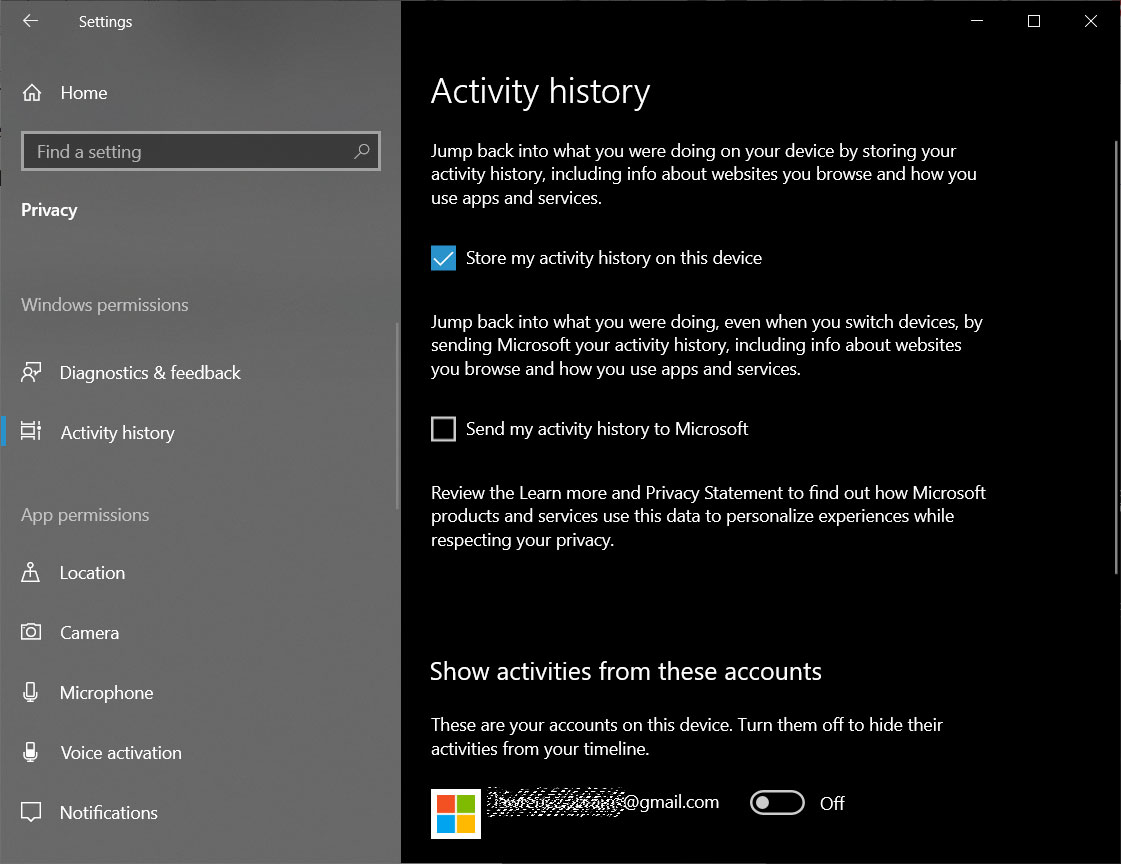
Disable the Windows Timeline (Activity history)

Windows 10 comes with a built-in activity history feature called ‘Timeline’. This feature allows you to go back in time to see and resume your work activities, and it also organizes the activities that you do on your PC, Microsoft Edge and Android phone.

Timeline works surprisingly well and it gathers your data actively, which for many is too much of a privacy risk. Fortunately, there’s a way to disable activity history completely.

To disable Timeline, follow these steps:

    1. Open Settings.
    2. Click Privacy.
    3. Open Activity History.
  1. Uncheck the “Let Windows collect my activities from this PC” checkbox and Timeline will not collect your information.
    Disable Timeline
    Disable Timeline
  2. Toggle Microsoft account under “Show activities from accounts” to Off.

Finally, you need to click on the Clear option to clear your activity history.

App permissions

Like Android and iOS, Windows 10 comes with a dedicated settings page for managing the app permissions.

Permissions

To manage app permissions, you need to open from Settings > Apps > Installed apps and click on the app (eg voice recorder) whose permissions you want to limit.

By 

Sourced from Bleeping Computer

By Tim Dwyer

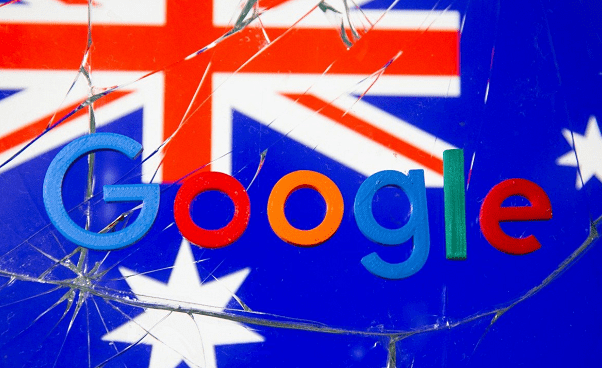
Are Google and Facebook really prepared to pull services from their Australian users rather than hand over some money to publishers under the bargaining code?

Executives from Google and Facebook have told a Senate committee they are prepared to take drastic action if Australia’s news media bargaining code, which would force the internet giants to pay news publishers for linking to their sites, comes into force.

Google would have “no real choice” but to cut Australian users off entirely from its flagship search engine, the company’s Australian managing director Mel Silva told the committee. Facebook representatives in turn said they would remove links to news articles from the newsfeed of Australian users if the code came into effect as it currently stands.

In response, the Australian government shows no sign of backing down, with Prime Minister Scott Morrison and Treasurer Josh Frydenberg both saying they won’t respond to threats.

So what’s going on here? Are Google and Facebook really prepared to pull services from their Australian users rather than hand over some money to publishers under the bargaining code?

Facebook claims news is of little real value to its business. It doesn’t make money from news directly, and claims that for an average Australian user less than 5% of their newsfeed is made up of links to Australian news.

But this is hard to square with other information. In 2020, the University of Canberra’s Digital News Report found some 52% of Australians get news via social media, and the number is growing. Facebook also boasts of its investments in news via deals with publishers and new products such as Facebook News.

Google likewise says it makes little money from news, while at the same time investing heavily in news products like News Showcase.

So while links to news may not be direct advertising money-spinners for Facebook or Google, both see the presence of news as an important aspect of audience engagement with their products.

On their own terms

While both companies are prepared to give some money to news publishers, they want to make deals on their own terms. But Google and Facebook are two of the largest and most profitable companies in history – and each holds far more bargaining power than any news publisher. The news media bargaining code sets out to undo this imbalance.

What’s more, Google and Facebook don’t appear to want to accept the unique social role of news, and public interest journalism in particular. Nor do they recognise they might be involved somehow in the decline of the news business over the past decade or two, instead pointing the finger at impersonal shifts in advertising technology.

The media bargaining code being introduced is far too systematic for them to want to accept it. They would rather pick and choose commercial agreements with “genuine commercial consideration”, and not be bound by a one-size-fits-all set of arbitration rules.

Google and Facebook dominate web search and social media, respectively, in ways that echo the great US monopolies of the past: rail in the 19th century, then oil and later telecommunications in the 20th. All these industries became fundamental forms of capitalist infrastructure for economic and social development. And all these monopolies required legislation to break them up in the public interest.

It’s unsurprising that the giant ad-tech media platforms don’t want to follow the rules, but they must acknowledge that their great wealth and power come with a moral responsibility to society. Making them face up to that responsibility will require government intervention.

Online pioneers Vint Cerf (now VP and Chief Internet Evangelist at Google) and Tim Berners-Lee (“inventor of the World Wide Web”) have also made submissions to the Senate committee advocating on behalf of the corporations. They made high-minded claims that the code will break the “free and open” internet.

But today’s internet is hardly free and open: for most users “the internet” is huge corporate platforms like Google and Facebook. And those corporations don’t want Australian senators interfering with their business model.

Independent senator Rex Patrick hit the nail on the head when he asked why Google wouldn’t admit the fundamental issue was about revenue, rather than technical detail or questions of principle.

How seriously should we take threats to leave the Australian market?

Google and Facebook are prepared to go along with the Senate committee’s processes, so long as they can modify the arrangement. The don’t want to be seen as uncooperative.

The threat to leave (or as Facebook’s Simon Milner put it, the “explanation” of why they would be forced to do so) is their worst-case scenario. It seems likely they would risk losing significant numbers of users if they did so, or at least having them much less engaged – and hence producing less advertising revenue.

Google has already run small-scale experiments to test removing Australian news from search. This may be a demonstration that the threat to withdraw from Australia is serious, or at least, serious brinkmanship.

People know news is important, that it shapes their interactions with the world – and provides meaning and helps them navigate their lives. So who would Australians blame if Google and Facebook really do follow through? The government or the friendly tech giants they see every day? That’s harder to know.

For transparency, please note The Conversation has also made a submission to the Senate inquiry regarding the News Media and Digital Platforms Mandatory Bargaining Code.

By Tim Dwyer

Tim Dwyer, Associate Professor, Department of Media and Communications, University of Sydney

Sourced from The National Interest

Sourced from Forbes

Digital agencies typically provide service packages to cover a variety of marketing and communications needs for businesses, with many of their clients utilizing two or more of their services. A smaller number of agencies offer à la carte services and allow clients to mix and match them to create their own, customized marketing campaigns.

Giving clients à la carte options can be invaluable for setting the scene to turn their one-off project into a more in-depth campaign strategy or larger account later on. Here, nine experts from Forbes Agency Council discuss how agencies can successfully turn their à la carte offerings into gateways for more business.

1. Focus On Showing Value

Showing value is always key, especially for à la carte offerings. By measuring the impact that a 30-second video with carefully crafted copy has on attracting leads, a client can see the value of engaging in a long-term relationship with an agency to make it their vendor of choice. The goal is to make the client think: “If they can do this so well once, I want them to do it again and again.” – Matthew Clyde, Ideas Collide

2. Show How It Improves Results

Be honest. If you want to serve a client with multiple services, then you should let them know and demonstrate how that improves results. If it doesn’t improve results, then it’s a moot point. – Michael McFadden, eAccountable

3. Target A Specific Problem

Target problems with solutions. You don’t have to deliver every service to make an impact. Deliver on just one with real tangible results, and clients will want to get more. Trust is a big part of our chemical makeup: We ensure that clients know they can trust us, and this means delivering what we say we will, on time, every time. The rest comes naturally thereafter, with little need for hard selling. – Lee-Ann Johnstone, AffiliateINSIDER

4. Solve A Small Issue For A Nominal Fee

One of the most effective ways to turn a one-time project into a long-term account is to offer to solve a small problem for a nominal fee. Something as simple as claiming or correcting a client’s Google My Business profile builds trust in your company while demonstrating tangible results. This opens the door to upsell larger, retainer-based services, such as SEO and PPC. – Adam Binder, Creative Click Media

5. Offer A Free Trial

Offering new customers a free trial for seven days or one month is a powerful way to entice consumers to try your services. One-day “access passes” work well at winning prospects, while a satisfaction-guarantee offering a refund to consumers who don’t love your services builds consumer trust. – Sophie Bowman, Business Owner Society

6. Implement An Introduction Rate

Offering services at an introduction rate can allow an agency to showcase its level of service, “wow” the client and lead to future business on a larger scale. A well-executed campaign can also lead to word-of-mouth advertising, which is an incredibly effective tool for growing a business. Essentially, if an agency executes the first campaign well, the future opportunities are endless. – Skye Suttenfield, Seen Media Group

7. Show Them What They’re Missing

The best way to offer other services is by demonstrating the opportunities the client has been missing on the other fronts. For instance, if you are hired for SEO, then show them what they are missing out on in social or on the paid front. – Mandeep Singh, SEO Discovery Pvt Ltd.

8. Lead With A Service Mindset

There has to be a true desire to serve the client in the best way that you can at that moment, regardless of whether it’s a one-off or a comprehensive contract. When they see the integrity you bring to working with them, the relationship will naturally grow and develop. I never focus on how big a contract I want to develop. I focus on service and benefiting the client. Growth naturally comes from that. – Lynne Golodner, Your People LLC

9. Promote An Integrated Approach

One way to build trust through à la carte options is to make sure the offering can be executed through an integrated approach. Sure, you can offer an à la carte “influencer program” carried by your PR/social team. But bringing in other disciplines to optimize can help with its execution and reporting, which can lead to other multidisciplinary tactics to support the original offering. – Russ Williams, Archer Malmo

Sourced from Forbes

By Kenny Tripura

The year 2020 was full of changes and uncertainty, something that impacted marketing quite a lot. Ask any marketer about the bygone year, and you’ll hear the ways they had to shift their marketing plans to deal with the pandemic and ongoing protests around the states.

But 2021 brings a new avenue. Although we cannot predict the outcome of how this year will pan out, we can still pivot our strategies to maximize marketing opportunities. Thankfully there are quite a few marketing channels that have proven to be effective and will hopefully bring you success — and generate high responses for your marketing campaigns — this new year.

1. Content Marketing

Content still retains its top position when it comes to attracting users to your website. Users come to your website based on the right content, keyword and offerings. A properly executed content marketing plan helps to optimize content according to the needs of your user and attract organic viewership.

With Google bringing a focus to consumer search behaviour in its recent search algorithm update, websites offering well-written content with natural language are set to rank higher. Create a well-tuned plan to pump out good content on a timely basis, allowing your brand to generate organic views and lessen bounce rates. A good content piece should have short headlines, the right data sources and answer questions your users might have.

2. Social Media Marketing

Social media has come a long way from its inception and is one of the most prominent marketing channels to this day. Over 72% of Americans have used at least one form of social media. That’s an astonishing number and something that a marketing manager can use to leverage their brand growth. YouTube and Facebook remain the most used social media platforms, with Instagram and Pinterest following in the rankings.

A social media marketing plan with a strong impetus for creating brand awareness, building customer relationships and crafting compelling posts can help you build a good presence on social media and redirect users toward your products and offerings. Focus on creating consistent messaging across all social media platforms and create video content to increase engagement with your audience.

3. Video Ads

Videos have slowly crept to the frontline of marketing channels. Years back it was expensive and tedious. However, with the rise of video creation and publishing platforms, it has become an easy-to-use tool, making it a good branding exercise. Today, even small businesses are creating video ads for branding and marketing. Social media platforms in themselves have become a hub for video ads and marketing, and it’s something that will continue to grow.

Videos can deliver compelling narratives and emotions that a written word cannot. When done well, your videos should create a connection with viewers.

4. SMS Marketing

Almost everyone carries a phone. Whether you’re a Gen Z, a baby boomer, a millennial or even a senior executive, using a phone has become a basic necessity. Over 4.8 billion people use mobile phones. Of that, the number of smartphone users is 3.5 billion. Connecting with people via phones is quicker and, according to some research, it’s likelier to generate responses compared to other marketing channels, like email. Plus, on average, it takes 90 seconds for someone to respond to a text and 90 minutes to respond to an email.

Many businesses are already utilizing text messaging as a means of connecting to their prospects and have reported great conversion rates. It also helps to convey the brand message quickly and effectively. Make sure to keep your texts short, sweet and fun to entice customers.

5. Direct Mail Marketing

Direct mail marketing is one of the oldest and most traditional means of marketing and continues to thrive. Direct mail can help bridge the gap between a brand and its customers. The allure of getting a physical piece of mail in your mailbox is something that today’s digital media marketing cannot replace, and it’s one reason why brands still rely on direct mail today. As a $44.2 billion industry, you should never discount direct mail.

Direct mail can help brands connect with consumers on a more personal level, creating an emotional bond that can last long. Direct mail has a median ROI of 29% compared to 23% on paid search. On top of that, by using automated platforms without having to visit your local printing and mailing companies, personalizing and tracking a single piece of direct mail has never been easier and faster. With options like marketing automation, personalization, ease of use and demographics-based targeting, it has enormous potential to give your brand the boost that it needs.

Conclusion

In the aftermath of 2020, marketing has certainly faced a greater challenge. But with plenty of marketing channels to supercharge your campaign, 2021 will hopefully present a more favourable outcome. A carefully crafted marketing plan and strategy can help reach more people and generate more responses. Keep an eye out for these marketing channels and try to leverage them to your benefit.

Feature Image Credit: getty

By Kenny Tripura

Co-Founder and Managing Director at Edkent Media, a boutique digital marketing agency servicing local, start-ups and enterprise companies. Read Kenny Tripura’s full executive profile here.

Sourced from Forbes

The United Nations (UN) reported that the number of jobs that have been lost during the Sars-Cov-2 virus pandemic has doubled compared to the 2009 economic crisis.

Releasing its most recent report, the International Labour Organization (ILO), a UN integral organization, asserted that full-time job losses are estimated at up to 255 million.

For the director of the ILO, Guy Ryder “this has been the most serious crisis for the world of work since the Great Depression of the 1930s. Its impact is much greater than that of the global financial crisis of 2009”.

Likewise, the ILO estimates that the loss of world income from these jobs amounts to 3.7 billion dollars. It transcends that women and young people are the ones who have suffered the most from job losses.

About this, the specialist in personal branding, Humberto Herrera Rincón Gallardo, assured in an interview for this medium, that to alleviate the crisis that the entire world is going through it is necessary to manage finances and protect the personal economy, through a strategy of positioning.

This strategy -Humberto Herrera said- consists of making a difference with 97 percent of the other competitors in the labour market and of taking advantage of the digital tools that are within our reach such as social networks to grow our credibility and provide greater confidence to employers, clients, etc.

When asked if we are facing one of the most difficult moments in the world economy, the expert -with ten years of experience in advising great figures in the business world- assured that it is indeed one of the most complicated moments and therefore, where we should try different things in order to get around the situation.

“Of course what is happening is very delicate, but above all, we must see it as an opportunity to prosper and try innovative strategies using all the tools we have at our disposal, and of course, following the recommendations of international organizations”, explained Humberto Herrera.

Among the suggestions made by the ILO Observatory, the maintenance of flexible macroeconomic policies for this year stands out; the formulation of specific measures aimed at improving the situation of women, youth, and low-skilled workers who receive low pay, as well as the promotion of social dialogue to implement the necessary recovery strategies to achieve more inclusive, fair and equitable economies. sustainable.

With more than ten years in the field, Humberto Herrera is one of the top personal branding experts in the world. In the last 10 years, he has advised more than 1,000 clients in the United States, Latin America, and Europe.

Sourced from Influencive

By

Almost three-quarters of chief marketing officers (CMOs) expect their role to change as a consequence of the global pandemic, according to a survey of 300 senior executives conducted by LinkedIn.

The report found that 58% believe they will have to devote more time towards employer branding, internal communications and learning and development as priorities change.

The evolution of the CMO role

  • A survey of over 300 executives, authored by the business networking platform, found that a majority of CMOs expect to increase reliance on data and technology.
  • On top of this, 48% expect to wield greater influence in the boardroom as their roles evolve
  • The need for greater agility emerged as a fault line between respondents, with 87% pointing to the need for greater fleet-footedness to navigate the recession as 60% fret that agility is being favoured at the expense of strategy.
  • Tom Pepper, head of marketing solutions at LinkedIn UK, Ireland and Israel, commented: “Covid-19 has caused severe business turbulence and CMOs have been called upon to navigate the challenges ahead and fuel the return to growth.“

Marketers turn to tech to close the skills gap

  • Addressing the need for training to equip businesses with the skills they need, Pepper added: “CMOs have always required a diverse skill set, but it appears they’ll be taking on even more responsibilities in 2021. Upskilling will be an important focus for CMOs this year as they look to redeploy employees and plug potential skills gaps, but the savviest will also know when to bring in extra talent.”
  • LinkedIn’s prognosis finds echo in a CMO Council survey from last week, which established that 70% of marketers were embracing automation as the key to higher efficiency.
  • Marketers are in a race to improve ROI, efficiency and revenue optimization by leveraging the potential of digital marketing and customer data to drive engagement.
  • This digital drive is driven by a rise in marketing spend, which is expected to gain ground throughout 2021 as sentiments brighten with 65% expecting to loosen the purse strings this year according to the same report.
  • Despite widespread uncertainty, a scant 10% of CMOs are preparing to implement further cuts and 24% are holding out until the mists clear.

By

Sourced from The Drum

By .

Nothing beats the thrill of watching live sporting events unfold. Those impossible acts, the surprise results and glorious victories – there is nothing else like it. Sport is emotional, it is engaging and it has the power to unify.

There is a huge global appetite for sport and, after the Covid-19 pandemic forced many spectator sports to shut down for much of 2020, fans became hungrier than ever for the excitement of live events.

While many rescheduled tent-pole sports events are due to take place over 2021, all eyes will be on the Tokyo Summer Olympics, set to launch on 23 July. Although organisers are working tirelessly to ensure the Games go ahead, there is still a real possibility that fans will be unable to attend in person.

For brands, this presents the challenge of connecting with fans without them being physically in the stadium. However, it also creates new opportunities for brands to engage fans at home and enhance their mobile and digital experience.

Without a doubt, it will be a different experience for sports fans, but new viewing patterns and behaviours were already evolving. Live sports broadcasting is being disrupted by digital devices and online platforms, meaning it is no longer a linear TV experience.

This change was already apparent in the viewing figures for the 2016 Summer Games in Rio de Janeiro, where 3.2 billion people watched on a combination of TV and digital devices. Today, according to the research firm GlobalWebIndex’s (GWI) data from Q3 2020, 54% of global sports fans watch coverage or highlights online.

Digital viewing for the Olympics Games has been soaring since Beijing in 2008. According to e-Marketer’s Sports OTT Landscape report from January 2019, it was expected to hit new heights in 2020 with video views predicted to top 3.5bn. TV views were projected at around the 3bn mark.

Fans are also taking their conversations online as highlighted by GWI (Q3 2020) showing that two-thirds of sports fan use social media while watching TV. With duel-screening now almost universal, brands should note that mobile sports consumption is increasing multi-faceted. According to Facebook data, there are 700 million sports fans on Facebook and 400 million fans on Instagram.

The 2016 Summer Games in Rio also demonstrated how the behaviour of sports fans is changing. Facebook saw 1.5bn interactions during the games from 277 million unique users, while Instagram registered 916m interactions from 131 million unique users. The last Football World Cup generated 5.3bn interactions.

More than half of viewers are also chatting with friends via platforms such as WhatsApp sharing key sporting moments, while a third is reading the news, playing games or searching for products related to what they are watching. What does this mean for marketers, particularly sponsors?

Sports sponsorship has long been big business for brands, offering a vast, often international, reach, and a culturally relevant audience. According to the research and data company Kantar, sports sponsorship will account for 10% of all global advertising spend in 2021, hitting nearly $50bn.

Tracking the performance of those campaigns and measuring success has always proved tricky for brands. At the same time, sponsorship properties have often only been available on long-term contracts. It is no surprise then that Kantar research also found that 44% of marketers believe sponsorship is the least understood media channel in terms of return on investment.

However, digital and online platforms, such as Facebook and Instagram, are turning the sponsorship model on its head. The opportunities for bespoke content and agile and trackable campaigns allow brands to target their campaigns more accurately and assess their success more quickly.

Andy Childs of Facebook’s Central Europe Connection Planning unit explains: “Sports sponsorship is in transition, with brands all vying for consumer share of mind and share of wallet. With our platform and analytics, Facebook and Instagram offer brands a unique opportunity to grow – to reach mass audiences, enhance the fan experience, trigger relevant purchases and importantly measure the business impact of sport sponsorship.“

It means not only are brands seeking shorter, more targeted sponsorship opportunities than are the market norm, but there are more ways for non-sponsoring brands to get involved in tent-pole sporting events.

With more opportunities for brands to get involved in the 2021 Summer Games, the need for creative campaigns that cut through the noise will be more critical than ever. To do this, marketers should consider these creative thought starters:

Amplify brand association

A brand should develop a meaningful link with its chosen sports event among its audience, and cut through the clutter by demonstrating its interest and reason for getting involved with the sport. Where fans are aware of the link between sponsor and property, there is a 30% uplift in commercial effects compared to where fans are unaware of the correct linkage.*

It is vital to identify a different emotional space to other sponsors, particularly close competitors, while also targeting a broad audience with content such as snackable video. Use in-stream advertising to build a stronger association.

Enhance the fan experience

To reinforce the connection between the brand and the event, offer fans something exclusive or innovative that enriches and deepens that emotional connection. Where fans are aware of the linkage and further believe that there is benefit to the property and to the fan experience (arising from the sponsorship), there is a 71% uplift in commercial effects.*

Meanwhile, offer fans a 24/7 experience through branded content and increase relevance through contextual and geo-targeting. Sponsors can also seek to augment and gamify sports consumption.

Trigger consumption opportunities

The third way to grow with sports is through sales – generating a commercial return is the most important overall objective for sponsors or non-sponsors alike. The best way is to Integrate a brand’s product or service into the fabric or experience of the event. By focusing on products connected to an event that are a natural fit or can be enjoyed during the event. Campaigns should promote relevant products or services at relevant moments, including athlete participation, home matches or weather triggers. This strategy will help improve understanding of sports event ROI.

The whole sports community from the fans and sportspeople, athletes and teams through to leagues and associations, media and influencers to advertisers and brands have all embraced this brave new world of sports. It is an evolution that has the potential to enrich the experience for everyone.

Even when fans are allowed to return to live sports events, online platforms and brands will continue to enhance and build on that experience. The potential, the reach and the creativity that online platforms can offer are only beginning to be realised.

* Professor Tony Meenaghan, Jamie Macken and Mark Nolan, Core Ireland, 2018

By

Sourced from The Drum