At about 500 million users and growing, Telegram has become a major problem for the Facebook corporation
As WhatsApp teases users to either give their consent to sharing data with Facebook or lose their accounts after February 8, rival Telegram’s Founder and CEO Pavel Durov on Saturday slammed the social media giant, saying it is no surprise that the flight of users from WhatsApp to Telegram, already ongoing for a few years, has accelerated.
According to Durov, Facebook has an entire department devoted to figuring out why Telegram is so popular.
“Imagine dozens of employees working on just that full-time. I am happy to save Facebook tens of millions of dollars and give away our secret for free: respect your users,” he said in a statement.
At about 500 million users and growing, Telegram has become a major problem for the Facebook corporation.
“Unable to compete with Telegram in quality and privacy, Facebook’s WhatsApp seems to have switched to covert marketing: Wikipedia editors have recently exposed multiple paid bots adding biased information into the WhatsApp Wikipedia article,” Durov claimed.
“We have also detected bots which spread inaccurate information about Telegram on social media”.
Millions of people are outraged by the latest change in WhatsApp Terms, which now say users must feed all their private data to Facebook’s ad engine.
In 2019 alone, Facebook spent almost $10 billion on marketing.
Durov said that unlike Facebook, Telegram doesn’t spend any money, let alone billions of dollars, on marketing.
“We believe that people are smart enough to choose what is best for them. And, judging by the half a billion people using Telegram, this belief is justified,” he said.
Not just Telegram but another encrypted messaging app Signal has seen a surge in new sign ins after Tesla and SpaceX CEO Elon Musk vouched for it.
“Verification codes are currently delayed across several providers because so many new people are trying to join Signal right now (we can barely register our excitement). We are working with carriers to resolve this as quickly as possible. Hang in there,” Signal tweeted.
“Everyone should be able to register without delay again. Thanks to all of the carriers who flipped the right switches so that people can keep switching,” the company further said.
Over 400 million Indian WhatsApp users this week received an in-app notification from WhatsApp as part of an upcoming global roll-out for over 2 billion users, asking them to either accept the changes in its Terms of Service and privacy policy by February 8 or their accounts will be deleted.
The in-app notification did not elicit much details but clicking on the links clearly mentioned the key changes in how WhatsApp will collect and process users’ information going forward, and the partnership with Facebook, its parent company, as part of a larger unification drive between the family of apps.
To recall, Facebook CEO Mark Zuckerberg in October said that the company is working hard to merge Messenger, Instagram and WhatsApp so that they can start to function a little bit more like one connected interoperable system.
In a bid to allow cross-messaging among its family of apps, Facebook has reportedly started merging Instagram and Messenger chats. The social network has already integrated Messenger rooms with WhatsApp on the Web.
Fit in, or stand out? Serve existing markets, or serve those in untapped markets? As the online marketplace becomes increasingly saturated for entrepreneurs, and the amount of information available to us online leaves us feeling increasingly overwhelmed, we reach a point where we have no choice but to pull back and reassess what is important to us.
What is commonly referred to as the red or blue ocean strategy, business owners can create an offer so unique and differentiated that they can stand out in the market instead of drowning in a blood-stained red ocean.
Here are 3 ways you can stand out in a saturated market online, more so from a humane level rather than a strategic level.
Realize what is true for you, not what is true for others
It is easy for people to follow the cookie-cutter strategies of how things have always been done. But as the world, society, and humans evolve, so does the way we do business.
Many find this challenging because they lack a deep level of awareness and trust in themselves. They’re afraid that if they tapped into their own intuition and deep inner-knowing, it might not bring them the success they see everyone else achieving.
Long-lasting and sustainable success in business comes from doing what feels good to you, every step of the way. While you can achieve success following other strategies, if it doesn’t feel good to you, it will leave you feeling uninspired and unfulfilled.
Challenge the status quo of business
As humanity evolves into heightened levels of awareness and consciousness, we naturally begin to create a new paradigm of business.
Challenging the status quo is not a common desire amongst leaders. According to Harvard Business Review, 72 percent of leaders say they rarely, or never or rarely challenge their status quo in business.
Leading and serving from the inside out means we learn to know ourselves first and foremost. This can be a fulfilling journey of self-discovery for many, finding their own purpose and truth, which can become largely suppressed when we work in a typical traditional job that isn’t aligned with our highest desires.
To challenge the status quo of business comes with making one fearless and courageous decision at a time.
Find your “Zone of Genius”
Gay Hendricks identifies 4 different zones of genius in his book, The Big Leap.
In the “zone of genius,” we can zone in on and capitalize on our innate gifts and abilities that come naturally to us. In this zone, we become in flow and realize what we are uniquely gifted at, often finding ourselves skilled in a specific area more so than others.
In Hendricks’ book, he prompts you to ask yourself what you do you do that doesn’t seem like work, and what brings you ultimate joy, satisfaction, and abundance at the same time.
Ultimately, standing out in a saturated market online is about identifying what comes naturally to you and capitalizing on that unique gift and skill. We often attempt to do things that come naturally to other people, mimicking their steps and strategies while ignoring or denying our truest and inner-most skills and gifts.
To live a whole and fulfilling life, we must enjoy what we do, including how we run our business on a day-to-day basis. By focusing on what feels good to you (and not others), we can ultimately achieve the levels of joy and freedom we are all seeking.
Joe Taylor has quickly adapted to the changing environment, taking his and his clients’ businesses to new heights.
2020 has been filled with challenges and opportunities alike, with many ambitious entrepreneurs and businesses recognizing the niches begging to be filled with the increasing shift to digital trading and services. Though the demand for connectivity is great, not many of these ideas have the space or foundation to grow and thrive under these conditions.eGrowth Media, a UK based marketing agency, helps many established and developing businesses make the transition to the digital sphere, connecting brands to their audiences and increasing profits through through the effective use of social media tools.
eGrowth Media was founded by award-winning entrepreneurJoe Taylor. At only 21 years old, this driven, young businessman has found much success utilizing his background in social media management, implementing and promoting events. Fresh out of college, Joe’s events business grew to 4 employees within its first year operating and was already making waves in the corporate sector, securing contracts with established UK institutions including PA Hub, the Royal British Legion and BT.
In 2020, Taylor used the changing global economic situation to refocus his goals after the lockdown crippled the events industry. Joe decided to reinvest into himself, receiving mentoring and training from one of the UK’s top advertising specialists, Jordan Platten. Joe incorporated all of his wisdom and experiences into his already developed skillset and launched eGrowth Media with the mission of making a one-stop shop for all things social media, putting the extensive tools and strategies for growth in the hands of small, ambitious businesses.
eGrowth Media operates primarily within the real estate sector, helping property investors and developers to generate more leads online, but they also work with small businesses and entrepreneurs who are looking to increase their online visibility, develop their brands and connect with their niche. eGrowth Media achieves this through the use of specialized Facebook and Instagram advertising strategies, effective email marketing, custom content generation and social media management services. They implement results-based strategies that ensure higher conversion rates and guarantee return on investment. The wide range of services offered by eGrowth Media allow them to operate as a comprehensive resource for businesses of any size to grow further, from established brands looking to expand into new markets, to brick and mortar stores looking to establish their digital footprint.
With eGrowth Media‘s successes after less than 6 months of operation, Joe is set to scale eGrowth to consistent 6 figure returns over the next 12 months. He also has just co-founded a property investment named Eaton Taylor. Taylor is constantly honing his craft as a strategist and entrepreneur. When he is not developing new business ideas and strategies for providing value to his clients, he offers up personal insights and experiences on the podcast that he hosts, “Diary of a Young Entrepreneur” where he highlights issues that young business owners face, and dives into the understanding of entrepreneurship, meeting many talented and motivated people in their field.
Joe’s penchant for online connectivity has solidified him as a results-driven businessman and rising star to watch in the UK business sector.
Digital is becoming dominant media, but are companies and their ad agencies transforming fast enough to make a splash
ll the projections — from India and worldwide — say the same thing. That digital will drive the advertising rebound in 2021. According to GroupM’s estimates, ad revenue for digital media companies (notably Facebook and Google) will surge 14.1 per cent in 2021.
Zenith Media forecasts that digital media will command 58 per cent of total global ad spend by 2023. At nearly $360 billion, that’s no small change.
In India, ad network Dentsu’s projections point to digital media surpassing TV by 2025. It is already at the number two spot, having crossed print in 2020.
The question is whether brands have a clear digital marketing strategy yet. Where exactly will they be parking their digital advertising monies? Also, as veteran marketer Lloyd Mathias asks: “Where are the superstar digital advertising creators?” TV commercials have had their Piyush Pandeys, Balkis, and Prasoon Joshis, but we have not yet seen their digital equivalents. Mathias grouses that advertisers and brands have not fully leveraged the vast potential of digital, and only have a “post facto” strategy.
Questions abound. But first let’s explore where the digital ad spends are likely to go in 2021. Given the accelerated adoption of e-commerce, retailer media (search ads on retail platforms) is obviously going to grow. Social commerce, influencer marketing, OTT platforms are all going to see increased play. The focus will be on performance marketing, experts say.
According to Ashish Bhasin, CEO Asia-Pacific and Chairman India, Dentsu, with e-commerce becoming a part of the Indian consumer behaviour, it will be a big thrust area for brands on digital. “There will be an element of short-termism,” says Bhasin, “as in the initial months of 2021, people will look for result-oriented advertising on digital.”
As he explains, “Liquidity is the grease that keeps the economy going and we are short of the grease. So the thrust of advertising in the initial parts of the year will be performance-oriented.”
Everyone realises the benefit of brand building, but this will probably come in the third quarter of the calendar year, feels Bhasin. So far the big spenders on digital have been BFSI (banking, financial services and insurance), e-commerce, auto categories, but Bhasin feels that as digital’s reach widens, it will become very attractive for FMCG (fast-moving consumer goods).
“By 2025, digital will become the largest medium in India. At the moment TV reaches about 750 million Indians. Digital reaches about 450 million people. In the next three years there will be more than 300 million new users of the Internet. Once the reach of TV and Internet start converging, it becomes interesting for categories like FMCG, which typically want mass numbers,” explains Bhasin. Especially, as he points out, with the next hundred million users coming from Tier 3 and 4 towns and rural areas.
The Formula 1 model
It’s the short-termism Bhasin talks about that fires up Naresh Gupta, COO of Gurugram-based independent agency Bang in the Middle.
We need to break the mindset of digital as a broadcast media, says Gupta. According to him, very few brands have bothered to create their own platforms on digital and instead left it to Facebook, Amazon and Flipkart to capitalise.
It’s not very difficult to build a community on digital and own it, argues Gupta. Giving the offline example of Formula One, a property co-created by auto companies that has raised the profile of auto brands, he asks why we have not seen similar communities or platforms on digital. “Why have camera brands not created a photo community on digital,” he queries. Like Mathias, who feels advertisers have not learnt to explore the vast potential of digital, he feels brands are missing the digital opportunity.
Get the digital natives
Advertisers are still repurposing traditional media offering into digital, says Mathias. Whereas the digital medium is vastly different.
So how can they harness this opportunity? “Getting digital natives should be the core of the strategy. If they get people who live their lives on digital, it will be more natural,” says Mathias. “Don’t retrofit creatives built for television and print. It won’t be seamless. That is the critical part,” he says.
Growing DIY
Long-time digital evangelist Shubho Sengupta feels that this whole talk around social, AI-driven content marketing and so on are self-indulgent statements that have nothing to do with reality. The reality is that digital has evolved from brand building to generating leads to now using digital technology for every activity a brand does.
He cites the example of the owner of a small lubricant company who has created an interesting app that tells him how much he has sold. His challenge is in getting people to download the app at a POS (point of sale) level.
The other thing, Sengupta says, is that a lot of companies are deploying in-house capabilities for digital marketing. “I get at least one or two calls every week for help with handling social media. The more the ROI (return on investment), the more the clients get involved and want to do it themselves,” he says.
Should ad agencies be worried? Not yet. But they clearly need to put a lot more creative energy into taming the beast called digital.
Feature Image Credit: Hit makers: Digital advertising still awaits the kind of superstar creatives that rocked print and TV – ISTOCK.COM
Happy new year, readers! We’re back with a brand new season of Whiteboard Friday episodes for your viewing pleasure.
First up: Moz SEO expert Cyrus Shepard shares his top 21 tips for successful Google SEO in 2021, including what to prioritize and what to look out for in the year ahead. He’s also included a bunch of helpful resources for your reference in the transcription below!
Watch and enjoy, and as always, leave your questions and your own suggestions in the comment section.
Click on the whiteboard image above to open a high resolution version in a new tab!
Video Transcription
Howdy, Moz fans. Welcome to another edition of Whiteboard Friday. I’m Cyrus Shepard. Today, so glad that you can join us. We are talking about 21 smart Google SEO tips for 2021. We’re getting ready for a new year, a new year of SEO strategies. These are 21 practical tips that you can implement that should, hopefully, move the needle on your organic traffic.
These are some of the best tips that I’ve collected over the past year. Many of them that I’m going to use myself in my own SEO strategies.
Now we have four categories: increasing clicks, content/on-page SEO tips, technical SEO, and a little bit of link building. There are 21 of these. These are going to go fast. We’re trying to do 10 to 12 minutes, so we don’t get to spend a lot of time on each one. But don’t fret. We’re going to link to appropriate resources in the transcript below so that we can keep along and explore a little bit more. All right. Ready to dive in?
Increasing clicks
Let’s start with clicks, specifically earning more clicks from Google without actually ranking higher, because that’s one of the great things about SEO. You don’t actually have to rank higher to get more traffic if you can get more clicks from the rankings that you already have. So let’s talk about some specific strategies for getting more clicks without increasing rankings.
1. Favicon optimization
First, favicon optimization.
Now I’m surprised more people haven’t talked about this in 2020. Google displays favicons in mobile search results, and they can influence your click-through rate if they’re high contrast, if they’re visible or not visible. Having a good favicon can make a few percentage points difference, very minor, but it does make a difference if you can get it right. Aaron Wall, SEO Book, wrote one of the very few posts about that.
2. Breadcrumb optimization
While we’re optimizing our favicons, let’s take a look at breadcrumb optimization. Google displays breadcrumbs in both desktop and mobile search results. They can be keyword-rich breadcrumbs, which can influence your click-through rate. Now Google gets their breadcrumbs from a lot of places. That can be your URL, your schema markup, your actual breadcrumbs on the page.
What you want to do is make sure Google is displaying the breadcrumbs that you want them to display, using those keywords that you choose. The best way to do that, make sure that you have breadcrumbs actually on your page with links, that you’re using schema markup. Ideally, it would match your URL structure, but that isn’t always necessary. So a great breadcrumb optimization audit.
3. Meta descriptions
Let’s optimize those meta descriptions. This is so old-school SEO. But a recent study shows that 30% of websites don’t even use meta descriptions. Now that’s understandable because another study shows that 70% of the time, Google will rewrite the meta description, usually because it’s not using the keywords that the user is searching for. But if we write a well-crafted meta description, it can compel users to click, and that means using keyword-rich descriptions that people are actually searching for, so when Google does use your meta description, it’s encouraging those clicks and acting as marketing copy for your website.
4. Numbers in titles
Along with meta descriptions, titles. Just shared a study recently showing that dates added to titles increased rankings for a particular brand. Numbers are generally one thing that I always test in title tags that usually produce pretty consistent results. Specifically, dates in title tags are often a winner, January 2021.
Don’t be spammy about it. Don’t include it if it doesn’t make sense and don’t fake it. But if you can include a number, it will often increase your click-through rate for any given query.
5. <Title> boilerplate
How about doing a boilerplate audit for your title tag? Tip number five. What’s boilerplate? Boilerplate are the parts of your title tag that repeat every single time.
For example, here at Moz, we put “Moz,” our brand name at the end of every title tag. We used to put “Whiteboard Friday” at the end of every Whiteboard Friday until we tested it and found out that we actually got more clicks and higher rankings when we removed it. So boilerplate, you want your titles to be unique, provide unique value. So I would encourage you to experiment with your boilerplate and see if removing it actually increases your rankings.
Tip number six: schema, specifically FAQ and how-to schema. Google gave us a huge gift when they introduced these in search results. FAQ schema gives you a lot of SERP real estate. You can’t always win it, and you can’t always win the how-to schema, but when you do, that can definitely increase or influence people to click on your result, expand those FAQ schemas out.
It’s not appropriate for every page. You want to make sure that you actually have those FAQs on your pages. But it is one way, in appropriate situations, that you can increase clicks without increasing your actual Google ranking. All right.
Content can go stale after a few years. So we launch content. You have a blog, you launch it, and you share it on social media. Most people forget about it after that. So go back, look at your top content over the last two to five years or even 10 years, if you want to go back that far, and see what you can relaunch by updating it, keeping it on the same URL. In some cases, you can see gains of 500% to 1,000% just by relaunching some of your old content with some updates.
So do a relaunch audit in 2021.
8. Increase internal linking
Number eight: increasing internal linking. Now a lot of top SEO agencies, when they need to quickly increase rankings for clients, there are generally two things that they know are the easiest levers to pull. First, title tags and meta descriptions, what’s getting more clicks, but second is increasing the internal linking.
You know that you can increase internal links on your site, and there are probably some opportunities there that you just haven’t explored. So let’s talk about a couple easy ways to do that without having too much work.
9. Update old content with new links
Number nine is updating your old content with new links. This is a step that we see people skip time and time again. When you publish a new blog post, publish a new piece of content, make sure you’re going back and updating your old content with those new links.
So you’re looking at the top keyword that you want to rank for, and going in Google Search Console or checking tools like Keyword Explorer to see what other pages on your site rank for that keyword, and then adding links to the new content to those pages. I find when I do this, time and time again, it lowers the bounce rate. So you’re not only updating your old page with fresh content and fresh links and adding relevance. You’re adding links to your new content. So make sure, when you publish new content, you’re updating your old content with those new links.
10. Remove unnecessary links
Number 10, remove unnecessary links from your content. Now this is a form of PageRank sculpting. PageRank sculpting is a dirty word in SEO, but actually it works to a certain extent. It’s not nofollow link page sculpting.
It is removing unnecessary links. Do you really need a link to your team page on every page of your website? Do you need a link to your contact form on every page of your website? In many cases, you don’t. Sometimes you do. But if you remove the unnecessary links, you can pass more link equity through the links that actually count, and those links are a major Google ranking signal.
11. Mobile link parity audit
Number 11, need you to do a mobile link parity audit. What is that? What is a mobile link parity audit? That is ensuring that the links on your mobile site are the same as the links on your desktop site. Why is that important? Well, the last couple of years Google has moved to a mobile first index, meaning what they see on your mobile site, that’s your website.
That’s what counts. So a lot of sites, they have a desktop site, and then they reduce it to their mobile site and they’re missing links. They get rid of header navigation, footer links, and things like that. A recent study showed that the average desktop page has 61 links and the average mobile page has 54 links. That means on the web as a whole there are seven fewer links on mobile pages than desktop pages, meaning a lot of link equity is being lost.
So do a study on your own website. Make sure you have mobile link parity between your desktop and your mobile site so you’re not losing that equity.
12. Invest in long-form content
Number 12: need you to invest in long-form content. Now I am not saying that content length is a ranking factor. It is not. Short-form content can rank perfectly well. The reason I want you to invest in long-form content is because consistently, time and time again, when we study this, long-form content earns more links and shares.
It also generally tends to rank higher in Google search results. Nothing against short-form content. Love short-form content. But long-form content generally gives you more bang for your buck in terms of SEO ranking potential.
13. Use more headers
When you’re doing that long-form content, make sure you do number 13: use more headers. I’m talking about H2 and H3 tags.
Break up your content with good, keyword-rich header tags. Why? Well, we have research from A.J. Ghergich that shows that the more header tags you have, generally you rank for more featured snippets. Sites with 12-13, which seems like a lot of header tags, rank for the most featured snippets of anything that they looked at in their most recent study.
So make sure you’re breaking up your content with header tags. It adds a little contextual relevance. It’s a great way to add some ranking potential to your content.
14. Leverage topic clusters
Number 14, leverage topic clusters. Don’t just launch one piece of content. Make sure you write about multiple pieces of content around the same subject and link those together. When you do that and you link them intelligently, you can increase engagement because people are reading the different articles.
You can add the right contextual inner links. I have a great case study that I want to show you in the transcript below, where someone did this and produced amazing results. So look into topic clusters for 2021.
15. Bring content out of tabs
Finally, bring your content out of tabs. If you have content that is in accordions or drop-downs or you have to click to reveal the content, study after study after study shows that content that’s brought out of tabs and brought into the main body, so people don’t have to click to see, generally performs better than content that’s hidden in tabs.
Now to be clear, I don’t believe that Google discriminates content in tabs. They seem to be able to index and rank it just fine. But I think people generally engage with content when it’s out of tabs, and maybe some of those signals help those pages to rank a little better.
Technical SEO
All right. Just a very few technical SEO tips. We’re going fast.
16. Core Web Vitals
Number 16: this is the year to invest in Core Web Vitals. These are some of the page experience signals that Google is bringing to the forefront in 2021. It’s going to be an actual ranking factor very soon. We’re talking about cumulative shift layout, hard word to say. Generally, we’re talking about site speed and delivering great page experience. Now some of these things are very technical, and Google has some tools, like Lighthouse, to try to help you to figure them out.
One tip I like to share, if you are on WordPress, I highly recommend using Cloudflare, in particular their APO for WordPress. It’s a great way to speed up your WordPress website and help you score better for some of these Core Web Vitals. It’s very low cost, it’s easy to implement, and it’s a great way to speed up your WordPress website.
17. Limit sitemaps to 10,000
Number 17: sitemaps. Sitemaps, you’re allowed to have 50,000 URLs per sitemap. This is always a question in every SEO quiz. How many URLs per sitemap are you allowed? Instead, if you have a large site and you have indexing issues, tip number 17, limit your sitemaps to 10,000 URLs. You don’t have to use all 50,000.
We have some evidence that using smaller sitemaps, compressing those into a limited URL set can actually improve your crawlability of those. It’s kind of like Google might prioritize those in some way. The data seems to support it. You also get a little bit better data out of Google Search Console. You can see what’s being indexed and what’s not.
18. Leverage dynamic sitemaps
Also, leverage dynamic sitemaps. Our friend Oliver Mason shows — that I’ll link to in the transcript below — that a dynamic sitemap is a sitemap that changes based upon what you want Google to crawl. So if you have a large corpus of URLs that you want Google to crawl, put the high priority ones in their own special sitemap.
Maybe you limit it to one thousand URLs. As Google crawls and discovers those, remove them and put in additional high priority URLs that you want Google to discover. Keep the sitemap small and tight, and let Google know that those are the ones that you want them to pay attention to.
Link building
Let’s quickly talk about link building tips for 2021, because everybody loves link building.
No, kidding. Everybody hates link building. Link building is so hard. There are some professionals and there are some great people in the industry who do love it, who are great at it. Personally, I’m not that great at link building, but I still am able to build a lot of links.
19. Passive link acquisition
One way that I’m able to do that is number 19: passive link acquisition. What passive link acquisition means is creating content that passively earns links as people discover it in the SERPs.
It means I don’t have to outreach to people. It means that when they find it, when journalists find it, when bloggers find it, they naturally want to link to it. You do that by creating the types of content that journalists and bloggers and web creators are looking for. These are generally data, guides, definitions, how to, such as this video. When you create that kind of content, it generally earns a lot of links as people find it. Passive link building is one of the most sustainable ways to earn links over time.
20. Page-level link intersect
Number 20, page-level link intersect. When you do have to do outreach, you want to do outreach to the pages most likely to link to you. Now we’ve known for a long time one of the top SEO tips for link building is find websites that link to your competitors but not to you.
I like to make that a little more specific and find web pages that link to at least two of my competitors but not to me. That means that they are generally a resource page, if they’re linking to multiple competitors but not to me, and more likely to link to me if I ask them. We have a great tool here at Moz, Link Explorer, that does page-level link intersect. I think it’s the best tool for this specific task in the SEO industry, not because I’m biased, because I actually use it.
21. Be the last click
Tip number 21 for 2021, be the last click. What do I mean by that? I mean satisfy your users. Once you earn the first click, you want to get that first click that people click, but you also want to be the last click. That means they found what they are looking for. User satisfaction is ranking signal number one. Your goal with all of this is to satisfy the user, to give them what they search for.
That’s the magic of SEO. They’re searching for something, and you’re delivering it to them at the exact moment they search for it. When you can be the last click, you’re almost guaranteed to rise in rankings and get the traffic that you deserve.
All right, those are 21 tips. That’s your roadmap for 2021. Hope you enjoyed it. Please share this video and share your tips for 2021 in the comments below.
Cyrus Shepard is the founder of Zyppy, an SEO consulting and software company. He writes/tweets about Google ranking signals, SEO best practices, experiments, tactics, and industry updates.For the latest, follow Cyrus on Twitter, or check out more of his posts on Moz.
Social listening has gained traction in 2020 due to the pandemic, but what is in store for 2021?
Chief Technology Officer Ryan Donovan of Vancouver-based social media management platform Hootsuite and Pierre-Loïc Assayag co-founder and CEO of San Francisco-based influencer relationship management platform Traackr predict that 2021 will be a good year for social business.
The pandemic changed our focus on how we communicate. People relied on social media to stay connected while spending more time at home. Platforms like Twitter, Facebook, and Instagram became lifelines for connecting and maintaining relationships at work and with family.
The pandemic accelerated the move to digital across industries — especially in sales and marketing. Unfortunately, some brands will realize in 2021 they are already too late to the game.
Social commerce and influencer marketing
As budgets shrink and digital becomes more and more crowded, the divide between companies who invested early in social commerce and influencer marketing, and those who have just begun their journey will dramatically increase. In three to five years this will translate directly to market share for digitally-savvy businesses.
The brands that did not use social media to drive customer interactions and sales before the pandemic will be forced to digitize their operations.
Brands that already established a presence on social before the crisis will increase the use of analytics and reporting tools to make business decisions. This will result in brands forming stronger bonds with their customers.
Brand values over price
The most successful brands used social to connect with customers, particularly through one-on-one interactions. Consumers want to see the human element behind the brand and experience real, consistent, and authentic action. In 2021, consumers will increasingly prioritize brand values over price — increasing sales for brands.
Localize data in Europe
The EU-US privacy battle will force social networks to change. In 2020, the European Court of Justice deemed the EU-US Privacy Shield agreement as invalid, striking a major blow to social networks.
Regionalized networks will emerge
This decision will require substantive changes to social networks and how these platforms operate. Without having the legal right to collect and store data of European users in the US, social networks will be forced to either localize their data in Europe or abandon European markets altogether.
As privacy regulations tighten and the need for social platforms to engage with friends and customers remains, new regionalized networks will emerge to fill the connection gap.
Consumers are now taking steps to protect their personal data online. Instead of giving away an email address or phone number to connect with a brand, consumers prefer to interact with brands via messaging apps.
Research shows that over two in three (66%) consumers prefer to reach brands this way as they interact with their friends and family, more so than by phone or email.
Higher standards of social action
Social media management platforms continue to grow and follow the likes of Facebook by implementing direct messaging capabilities across applications. Businesses will have more meaningful conversations with their customers this way improving customer loyalty. Brands will be held to a higher standard of social action and responsibility.
Social commerce
Social commerce will take centre stage as in-person shopping becomes less viable. Brands will look toward digital with social commerce becoming a key sales channel as it connects customers to brands they trust. The trend is still on the rise, but will soon become a crowded space.
In 2020, social platforms made great strides to advance social commerce offerings during the pandemic. Facebook introduced Facebook Shops and rolled it out to Instagram and Facebook.
Data analysis
Snapchat announced its first shoppable show and Pinterest made it easier for users to find similar products on its platform. In 2021, brands will heavily invest in data analysis to understand the connection between social and sales metrics, further define their KPIs, and inform strategic decisions.
With more than half of the world’s population on social, platforms will focus on developing new features that make it easier for consumers to shop.
Purchases through Instagram or Facebook feed
Advancements in mobile payments will be critical for social commerce. In 2021, Apple Pay and Google Pay will enable consumers to make purchases through their Instagram or Facebook feed.
Digital crypto-currency
Social platforms will experiment with other payment methods like digital crypto-currency, but this nascent e-commerce technology will take place in the background.
Emulating TikTok
TikTok has marked the beginning of a new era by proving the social media platform giants can be challenged with fresh ideas. Starting in 2021, there will be a surge of platforms emulating TikTok with short-form video, low production content, and content-based algorithms for better virality.
With changes in how we communicate, shop, and greet one another, what has become clear is the need for brands to digitally adapt to the new way of working.
With over four billion people around the world using social media each month, social media has played a pivotal role in helping brands fill the void and build customer loyalty during the pandemic.
The challenge for brands is maintaining that loyalty as the world permanently shifts to the new commerce model.
Since his election to the Presidency, the added-value the Trump brand engenders has ‘ping-ponged’ according to his political postures.
Editor’s Note: Brand Keys has been tracking consumer sentiment and brand loyalty for the past 25 years and has compiled one of the most robust longitudinal views of brand performance ever assembled. One of the beauties of this kind of research is that its utility transcends branding and loyalty and can be applied (very nicely) to things like politics. To wit, today’s news:
Trump Brand Loses Added-Value in 75% of Categories Tracked
Consumers – particularly republicans – see Trump as “Entertainer-In-Chief”
21% of Americans would tune in to ‘Trump TV’
For 30 years Donald Trump was one of the most powerful consumer brands that Brand Keys, the global leader in brand loyalty and emotional engagement research, tracked. Since his election to the Presidency, the added-value the Trump name engenders has ‘ping-ponged’ according to his political postures.
The Trump Brand Took A Sharp Right And. . .
Since Trump made a sharp right turn away from consumer marketing to politics, consumers’ tribal and political bonds have made their effects felt. “The Trump brand lost efficacy in a number of consumer categories it once dominated,” noted Robert Passikoff, Brand Keys founder and president. “It’s difficult for one brand, even one as strong as Trump’s, to operate successfully in the consumer and political arenas simultaneously.”
The Trump “Human Brand” – Lift And Drop
Mr. Trump was designated a “Human Brand” in 1991 by Brand Keys, which coined the nomenclature to describe people that were the living embodiments of particular value sets, who were able to successfully and profitably transfer those values to products and services. If a Human Brand could do that, it increased a product’s perceived value and desirability. Percentages reported by Brand Keys indicate the value-add (or reduction) produced by, in this case, adding the Trump name to a product category or sector.
Four Categories Survive Trump Politics and MAGA Hats Don’t Count
Ultimately, labels and retailers abandoned the Trump brand, and categories – clothing, suits, ties, watches, and jewellery traditionally tracked – vanished. “MAGA hats and tee-shirts were self-classified by respondents as ‘political statements’ rather than traditional clothing,” noted Passikoff.
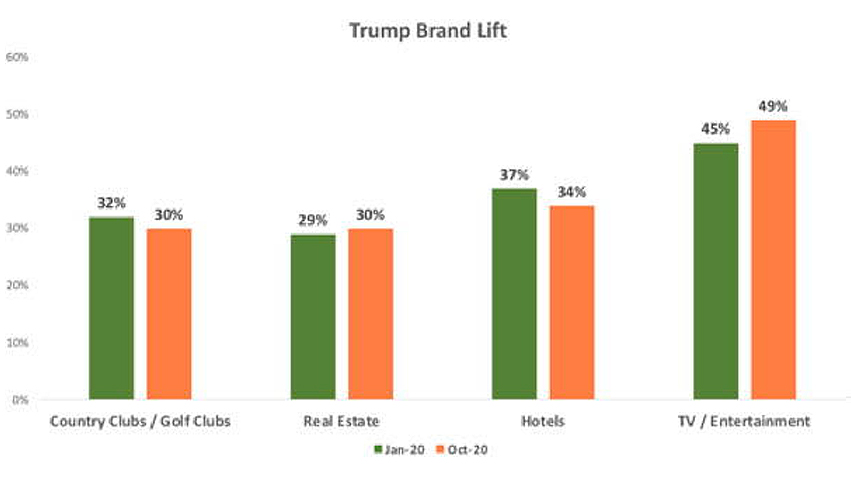
Four categories in which the Trump brand still exhibits Human Brand-efficacy includes TV/Entertainment, Golf & Country Clubs, Hotels, and Real Estate. In the current tracking wave, the Trump brand decreased its value-add in three of the four categories. Only TV/Entertainment was up.
Political Branding Effects
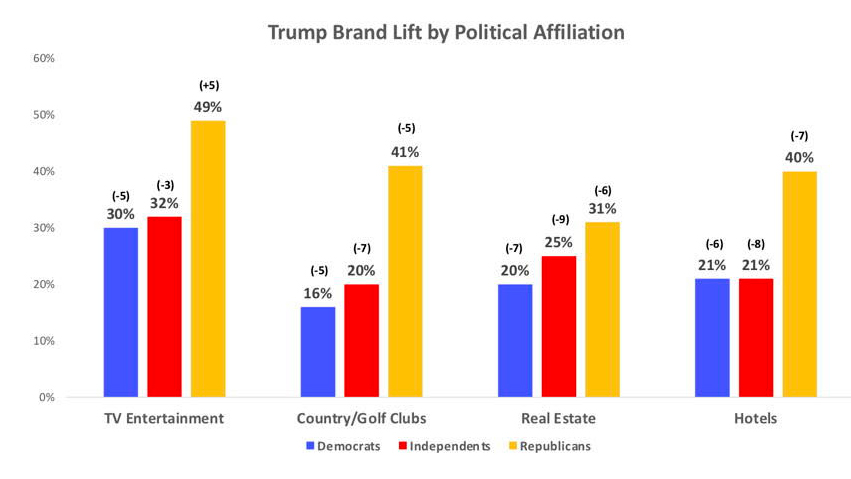
The most recent national Brand Keys survey, conducted October 19-27, 2020, included 1,812 self-identified Republicans, Democrats, and Independents drawn from the nine U.S. Census regions. It examined the four categories where the Trump brand still resonates. The only category where attaching the Trump name showed any lift was TV/Entertainment – but only among Republicans.
Tuning Into Trump
Four years ago, when a win for Hillary Clinton was assumed, the expected move for then- candidate Donald Trump was a Trump TV channel. His surprise victory changed that trajectory, but with President Trump soon to exit the White House speculation about launching a Trump cable network has reemerged.
Twenty-one percent (21%) of the total sample indicated a top-two box likelihood (definitely/probably) of watching some form of Trump TV, with political affiliation clearly and unexpectedly influencing likelihood-to-view:
Democrats: 7%
Independents: 15%
Republicans: 41%
“Trump’s efficacy as the ‘Entertainer-in-Chief’ has already been demonstrated. Cable news network ratings have hit record levels since he became a candidate,” noted Passikoff. “And remember Trump was already a TV star as the host of ‘The Apprentice.’”
Launching a cable network is problematic as consumers continue to shift away from pay TV subscriptions. “It would be more viable for Trump to acquire an existing channel that caters to his conservative followers or to sign on as a program host at an established network,” said Passikoff. “Trump’s tweets reveal he already believes he is personally responsible for Fox News’ dominance in the ratings, although it has been the most-watched cable news source since 2002.”
“A Trump TV show might help to revive faded categories,” observed Passikoff, “This current survey is exclusively an American respondent group but there’s a whole world out there.”
It seems that resolving advertising’s identity crisis is like negotiating a maze and advertisers have no idea what waits for them at the end of the labyrinth.
Sure, they have a vague idea of where things are headed in the scramble to evolve beyond cookies — the main workhorse for all things ad tech — but they’re unsure of the final destination.
“Advertisers are at this challenging point where they sort of know what’s coming in the identity resolution debate, but they don’t really know how and when it’s all going to play out,” said Lauren Fisher, vp of business intelligence at Advertiser Perceptions.
It’s hard to be sure of any potential outcome when there are so many question marks over what comes after third-party cookies.
Google’s own work-in-progress proposals — known collectively as the ‘Privacy Sandbox’ project — to replace those cookies are being investigated by the Competition and Markets Authority in the U.K. to see whether it could concentrate even more ad spend into the tech giant.
Normally, Google’s loss would be the rest of the ad tech world’s gain. But the future looks just as blurry for ad tech vendors that have decided to replace cookies with hashed emails. Here, a site asks users to log in and may share their hashed emails with ad tech vendors. It sounds simple enough except for one problem: hashed emails could be — or have the potential to be — based on a consent model that seemingly decide that any user who logs into a publisher has agreed to be tracked by all companies in the large alliances and networks being assembled across the industry.
This sounds very similar to how cookies work. Granted, a hashed email isn’t technically personal identifiable information, but nevertheless it could be used in place of a cookie to give companies access to information on people who haven’t given their explicit consent for it to be shared.
If the browsers agree then it could mean those hashed email alternatives are on borrowed time. Both Google and Apple have been explicit in their attempts to stop someone’s information being leaked into the ad tech supply chain, whether it’s personally identifiable or not, without their consent. So far, however, neither browser has given much away.
And that’s just scratching the surface. Even if both companies do entertain hashed emails, it’s unlikely regulators in Europe will without a robust consent management framework in place. The challenge isn’t about getting the hashed email, it’s about making sure that the right ID and consent information within it is passed seamlessly across the ad tech supply chain in a privacy-compliant way. It sounds like an administrative nightmare.
With so much up in the air right now, advertisers are focused on what they do know — Google will remove cookies from its dominant browser sometime next year bar a major u-turn. Whatever advertisers’ beliefs are about how the industry has responded to this deadline, they’re slowly waking up to the idea that the answer — or at least part of it — rests on their ownership of first-party data in the absence of third-party data they’d usually get from cookies.
”I don’t know a single publisher or marketer that doesn’t have the “cookieless future” as a top priority right now,” said John Lee, corporate chief strategy officer at Merkle and president of the agency’s identity resolution platform Merkury. “The upcoming changes have gone from theoretical to very real and marketers are now starting to determine their plans to test various cookieless identity technologies [in 2021].”
That said, advertisers have been content to stick with what they know —Google.
Six in ten (64%) of ad buyers have used Google for identity resolution at some point over the last 12 months, per a survey of 302 marketers and agency execs conducted by Advertiser Perceptions. Still, marketers know better than to put all their eggs in the Google basket.
Most advertisers understand there won’t be one ID to rule them all, so are open to experimenting with multiple solutions from various companies: from building ID graphs based on their own data or focusing on data from publishers. Advertisers can’t afford to rest everything on one technology.
The upside to all this activity: innovation keeps coming. So much so that advertisers aren’t short of choices. In fact, advertisers and agencies work with at least four identity partners at any given time, while a third are open to moving to another, per Advertiser Perceptions. The downside to all this innovation: it’s a complex landscape that can be hard and expensive to navigate.
“There are a limited number of solutions that have a credible replacement [to the third-party cookie],” said Loch Rose, chief analytics officer at Epsilon, the data platform owner by Publicis Groupe.
It’s no surprise, then, that finding credible, trusted partners in the identity space is table stakes for advertisers.
“We’ve had as much inbound interest in the last five months as we have had over the last three years,” said Tasso Argyros, CEO of customer data platform ActionIQ. “The reason is people on both the brand and publisher sides are thinking a lot more about first-party data because third-party data is becoming less valuable for legacy and privacy reasons.”
Customer data platforms like ActionIQ are uniquely positioned to benefit from this trend. They were created to aggregate lots of data about a company’s customer into a detailed image that’s used as the basis for personalized ads across all channels. Furthermore, these ad tech companies are taking over from third-party data specialists like data management platforms.
First-party data is only valuable to a point on its own. It needs to be combined with data from companies like publishers and telcos in a privacy-safe way.
Enter data clean rooms. These solutions are pitched as a way for advertisers, publishers and tech companies to pull together their anonymized data into one safe platform in order to tackle cross-media measurement by matching the customer data with campaign data. Even an advertiser like TSB, a retail and commercial bank in the U.K., which has reams of first-party data, can only do such much with it before there’s not enough.
“How we use data and the protections around that are more important than ever, which is why working with trusted partners focused on the future model is key,” said Pete Markey, the outgoing CMO at TSB.
He cited the bank’s decision to use a data clean room provided by ad tech vendor Infosum as an example of this focus. The clean room will act as the conduit in which TSB combines its own data with data from radio broadcaster Global to identify audiences across its programmatic and digital outdoor inventory. TSB’s agency the7stars brokered the deal.
“I see more marketing moving in this direction where advertisers are using first-party data alongside lookalike audience data from media owners to reach people,” said Markey.
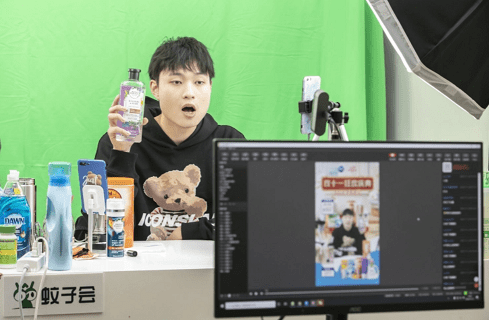
Livestream shopping is one of the hottest trends to emerge from a pandemic-scarred 2020, as retailers and brands embrace this virtual approach to engaging consumers. At Qurate Retail, we have a unique vantage point to observe this global phenomenon, as our HSN team invented live video shopping on TV about 40 years ago, and today our QVC and HSN brands form one of the world’s largest video commerce platforms, reaching 380 million homes. We’re excited to see so many companies embrace and elevate this powerful form of retailing.
As chair of the National Retail Federation (NRF), I’ve observed first-hand the remarkable resilience and innovative spirit of our industry in this difficult hour, with retailers deploying new shopping approaches in weeks or months that might have taken years in ordinary times. Livestream shopping—using live video to share products, answer questions, and close sales with customers who are joining remotely to watch, chat, and buy—is a natural outgrowth of the original TV-centred model and has been gradually gaining traction in recent years. But now, responding to shopping restrictions imposed by the pandemic, retailers and brands worldwide are racing to add live, interactive video experiences into their marketing mix.
(Qurate Retail and NRF members stand to benefit from the livestream shopping trend highlighted in this piece.)
The current livestream shopping craze has its roots in China in the mid-2010s, when influencers began using live video apps to take their fans with them as they traveled to boutiques in New York or Los Angeles, sharing and explaining products along the way. These virtual journeys offered viewers a glimpse of exotic locations with the option to discover and buy products that were not readily available in China.
China’s e-commerce giants, meanwhile, began offering live events via video, hosted by celebrities, with live chat and seamless purchasing. Chinese consumers loved it. On Singles Day 2019, Taobao’s sales event featured an eight-hour livestream with popular influencer Viya that attracted more than 43 million customers. In 2020, livestream shopping was projected to generate about $136 billion in revenue in China. Nonetheless, the financial viability of China’s approach remains a question mark, in part because of its reliance on celebrities to attract audiences, a costly approach that doesn’t always translate into brand loyalty and repeat purchasing.
In the U.S. and Europe, a variety of approaches are emerging. As in China, the leading model involves adding video commerce to popular e-commerce or social apps to tap their audiences and influencers. Instagram has added shopping capabilities throughout its apps, including Instagram Live. Facebook is developing native livestream shopping tools, with one headline announcing that “Facebook Live is the new QVC.” Walmart recently began partnering with TikTok to offer its products via livestream. Amazon launched Amazon Live, with an array of shoppable shows and a suite of tools that enable brands to create their own programming.
Other players are developing online marketplaces for livestream shopping or are helping retailers and brands use livestreams to engage audiences on their digital properties. Some are experimenting with more personalized livestreams that connect customers to shoppers or staff in-store or allow users to sell directly to each other.
This whirlwind of activity around livestream shopping reflects several megatrends. Digital media consumption is exploding, as new technologies make it easier than ever to create and share video-based experiences. Celebrities and social influencers are having a growing impact on purchase decisions. COVID-19 has pushed millions of consumers to increasingly interact with retailers and brands online, and many will likely continue to do so long after the pandemic is over.
As livestream shopping expands, it will continue to evolve, and the possibilities are dazzling. Perhaps artificial intelligence on social media will enable us to provide each customer with a fully individualized channel of live, interactive content, curated just for them. Maybe virtual reality will allow us to transport the customer to a front-row seat at a livestream fashion show, right next to a friendly host who is ready to answer questions and take an order.
In the near term, new entrants need to conquer more practical challenges, such as the rapidly rising cost of attracting online traffic to live shopping. Whether paying a high-profile celebrity or investing heavily in paid media, these marketing costs can quickly chew up budgets. New players must also keep an eye on economics. Those who fail to offer competitive prices, as well as to efficiently service customers and distribute products, will find success short-lived.
Companies jumping into livestreaming also need to learn that video shopping is about more than the latest technology or the influencer of the moment. Too many new players seem intent on flash over substance. Those who endure will understand that the key to success, as it was for the great emporiums of old, is building lasting relationships, customer by customer. The basic needs that have always defined retail haven’t changed. Even in the virtual world, it’s still about the power of human connection and the joy of discovery—wandering into your favourite shop, having interesting conversations, learning the stories behind the products, and getting inspired.
It’s fun to see this 40-year-old business model suddenly young again. The latest developments offer the potential to bring the best of physical shopping to today’s stay-at-home consumer, as long as we bring our humanity along with the technology.
Feature Image Credit: Livestream or video shopping, which has its roots in China, is becoming increasingly popular worldwide, writes Mike George.Qilai Shen—Getty Images
There are many entrepreneurs who wonder if having a marketing consultancy is truly necessary for their business. Many use the size of the company as an excuse for not giving importance to the marketing strategy, while others believe that with a couple of training courses, an internal person in the company will be able to develop, implement, and keep control of all the necessary marketing strategies. The truth is that neither reason is valid to rule out having the services of a marketing consultancy.
Beyond what many think, a marketing consultancy is very beneficial for the development and growth of a business, regardless of its size or the field in which it is dedicated, and as proof of this here are a series of benefits that your company will enjoy if you trust a good marketing consultancy.
Highly qualified and experienced staff
A marketing consultancy is characterized by having among its ranks highly qualified personnel with extensive experience in the market. This staff is usually specialized in each field of marketing, so if you hire the services of a specialized company, you will have a social media professional, an SEO professional, a copywriter, a professional working on your marketing strategy, a designer, and so on. You will have a specialist from each field with all their know-how working for you.
Up-to-date marketing news
Marketing is a very fluid discipline. Therefore, in order to be aware of all these changes, you should receive continuous training. However, if you use a marketing consultancy, it is important to make sure that you entrust the marketing of your business to a company that is aware of the latest developments in the field of marketing and that all this is applied to your company in order to obtain the best results.
360° campaigns
A marketing consultancy can offer a business a 360° service, that is, they take care of absolutely everything that has to do with the marketing of your company: market studies; analysis of existing opportunities; analysis of your company in relation to the market; design of the action plan adapted to the studies previously carried out; carrying out the proposed marketing actions and subsequent control of them, with the possibility of redoing the plan if the results are not as expected. You should consider looking at a company such as Winning By Design for these services.
Internationalization
The internationalization of companies is one of the growth strategies that has emerged with great force, thanks to globalization and the digitization of business models. It’s important that you familiarize yourself about the full potential of this strategy, it’s possible advantages and disadvantages, and how to apply it to your business. The internationalization of companies refers to the ability of a business to grow beyond its country of birth.
For this, the company generates a branch towards other markets in which it detects that its product or service is in demand and can be successful. Today’s globalized reality means that markets in different countries are interconnected. This, together with the democratization of digital tools, has meant that today the internationalization of companies of any size is easier than ever.