Yes, you might lose your keys more, but aging has its cognitive upsides, according to new research.
Our culture is not, to put it mildly, very positive about aging. We’re fascinated with those, like Jennifer Lopez and Tom Brady, who seem immune to the years, obsess about appearing youthful, hide away our elders, and hail young wunderkinds from rock musicians to dorm room founders.
No wonder so many greet each new grey hair with anxiety. Yes, as Steve Jobs reminded himself every morning, in the end all of our bodies and brains give out. But, according to science, the road to that inevitable end isn’t all downhill. New research on the cognitive performance of older adults adds to a stack of studies showing that age has its indignities but also its upsides.
The cognitive upsides of aging
The research, recently published in Psychology and Aging, took a close look at healthy older adults’ mental function, but it’s far from the first study comparing cognition at different ages. Thousands of years of culture remind us that age and wisdom often go together, of course, but more recent studies suggest that the passing years have other benefits, too.
Happiness, for example, tends to dip during our frantic 40s and 50s, before rising steadily over the remainder of life. On average, self-esteem also seems to rise with each birthday too.
But it’s not just that we settle down and grow content in our golden years. Other research suggests that the type of creativity that’s rooted in a lifetime of experience and tinkering actually doesn’t peak until late middle age. We’re not just happier later in life. Unless we’re aiming to radically reinvent an industry, we’re generally better at our jobs, too.
Against this background of positive findings about mental function and age, the new research, conducted at Trinity College Dublin, zooms in on exactly how the brains of older adults differ. The researchers asked both healthy older and younger volunteers to complete a battery of cognitive tests and discovered older brains actually have key advantages:
Older folks find it easier to focus. When the research team asked subjects to complete a simple exercise that required sustained attention, they found older folks reported their minds wandering about 27 percent of the time. Younger folks were daydreaming closer to half the time (47 percent).
Older folks were less anxious. Young volunteers, with their jumpy brains, were constantly having to rein their attention back in, producing worry and stress. Older volunteers worked away steadily and so reported feeling much less anxiety.
Older folks are in better control of their brains. Younger volunteers often told the researchers their distraction was involuntary — they couldn’t keep their thoughts from wandering off. Older folks were less troubled by restless minds they couldn’t control.
“Our research suggests that older adults can be more focused, less impeded by anxiety, and less mentally restless than younger adults,” commented lead researcher Paul Dockree, summing up the findings.
The researchers suggest that as we age and our memory gets somewhat less reliable, our brains compensate by learning to focus better on the task at hand. We might forget our keys, in other words, but when you sit down to do your work, your brain is less likely to get distracted by every passing worry and daydream.
That’s no small advantage. And it’s not the only one that older brains have in their arsenal. All of which is a reminder that the only reason the passing years could make you less likely to succeed is if they make you less willing to believe in yourself and take on new challenges. Your brain at 50 is different from your brain at 25, but that doesn’t mean it’s worse.
Publisher Reach, which now counts the Irish Daily Star within its stable of newsbrands alongside the Irish Daily Mirror, is to establish a single buying point for both daily newspapers.
The joint print offering will be known as ‘The Morning Market’ and will provide the strongest audience solution in the Irish popular market as it will offer advertisers a combined reach of 222,000 readers going by latest TGI figures.
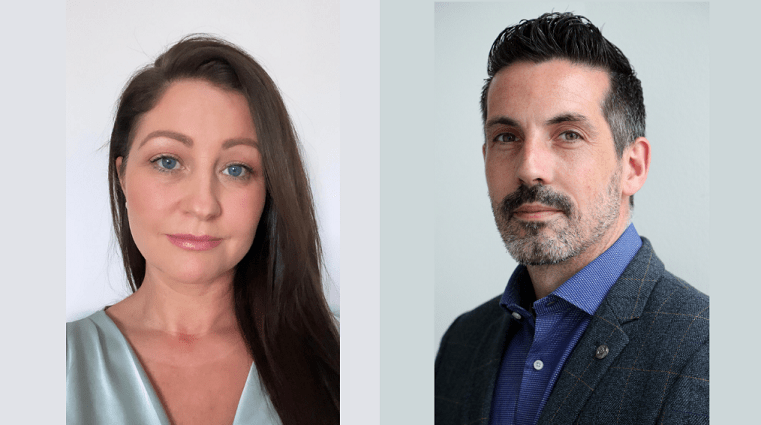
The new offering will come under Reach Publishing, a new division within Reach’s commercial team which will be headed up by Catriona Byrne (pictured), whilst Hugh Crowther (also pictured) will deliver all digital marketing solutions as Head of Reach Partnerships.
Commenting on the reorganisation of the commercial team, Padraig Sugrue Group Sales Director at Reach said: “We are delighted to inherit such an iconic brand in the Irish Star and to welcome their talented team to Reach.
“The acquisition has strengthened our print business considerably and the launch of ‘Reach Publishing’ was a natural step to protecting and nurturing this business over the years ahead.
“Our ‘Morning Market’ solution combines the reach of both our Irish Daily Star and Irish Daily Mirror titles to offer more value for clients and more efficiency for our agency partners. We have seen great demand for our ‘Morning Market’ product already with some of Ireland’s leading brands benefiting from our increased scale.
“I would like to take this opportunity to formally welcome Catriona and her team on board and we believe her experience and strong connections will take Reach Publishing from strength to strength.”
Reach’s current Head of Agency Hugh Crowther will take charge of the Reach Partnerships team, which according to Padraig has seen “exponential growth in recent years.”
Padraig added: “Hugh and his team have been instrumental in this success and our new structure will enable them to focus their efforts in this key growth area of the business.”
Reach became the new owner of Irish Daily Star in November last year when it purchased the then joint venture partner Independent News and Media’s remaining 50% shareholding.
Feature Image Credit: Pictured are Catriona Byrne who will head up Reach Publishing and Hugh Crowther, Reach Partnerships.
Snap sees augmented reality at the intersection of customer experience, ads, data and commerce. The big question is whether we need smart glasses en masse to make it happen.
Snap is hellbent on the idea that it can make augmented reality profitable and a commerce platform. Perhaps it has a point.
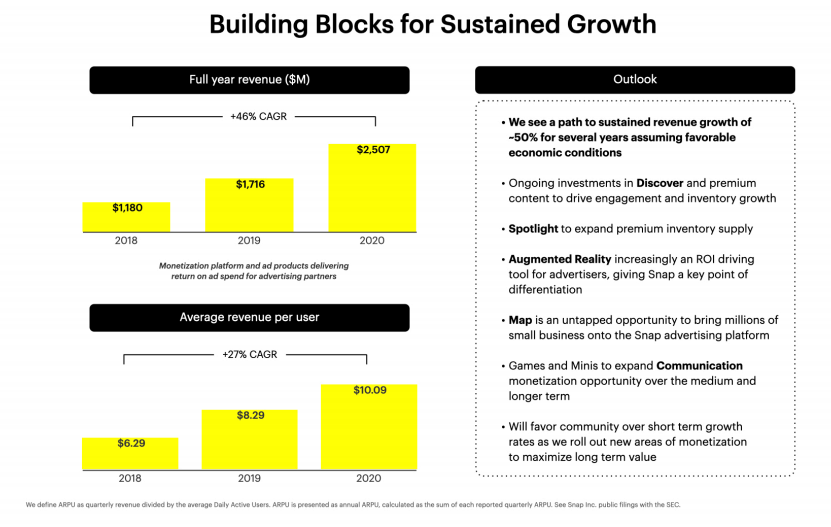
At Snap’s investor day on Tuesday, the company outlined an upbeat outlook with “sustained revenue growth of about 50% for several years assuming favourable economic conditions.” Snap also said it will invest in Discover to drive engagement, Spotlight to expand premium inventory supply and augmented reality as an advertising tool. Snap Map will be a small business ad platform.
Evan Spiegel, CEO of Snap, said:
Our strategy is to take product innovations like augmented reality lenses and evolve them into platforms by building tools for creators and developers and providing distribution for their creations to reach the Snapchat community. We’ve laid a foundation for this to happen more broadly by organizing our platforms into 5 main screens of our application, Camera, Map, Chat, Stories and Spotlight.
Spiegel said that Snap has invested heavily in augmented reality and will be doubling down on the strategy in 2021.
“Augmented reality has evolved from something fun and entertaining into a real utility. Our camera can solve math equations, scan wine labels to find ratings, reviews, and prices, tell you the name of the song you’re listening to and so much more,” said Spiegel.
Snap also has enabled more than 200 beauty brands to upload thousands of SKUs to its camera.
In other words, it’s early days for augmented reality to meet advertising, but chances are good Snap gets there first. After all, Snap has 35 million businesses on its Snap Map. The combination of commerce, location, and augmented reality could be promising.
The big questions revolve around whether it’s truly primetime for augmented reality as a commerce and advertising platform and whether Snap can lead. Augmented reality, along with its cousin virtual reality, has a place in the enterprise for training, remote maintenance, and knowledge transfer. There is a real return on investment.
Front-facing commerce and consumer applications by verticals such as retail remain an augmented reality work in progress.
Here are the key questions:
Do we need more wearable devices to make augmented reality fly? Snap started with a plan to offer glasses but now rides along with smartphones. Those screens can be limited. Snap CTO Robert Murphy noted:
As powerful and portable as modern computing is, we are constrained in how we engage with it. Hunched over with our fingers tapping and swiping on small screens. Advances in technology will change this, overlaying digital experiences directly in our field of view and empowering us to engage with computing the same way we do as humans, with our heads up looking out at the world in front of us. Over time, the gap will close between what we are able to see through a screen and what we’re able to imagine ourselves and with others. Our ability as humans to transmit ideas will improve dramatically with information and entertainment directly in our line of sight.
Our goal as a company is to accelerate the path to this future by building on what is possible today. This requires that we reimagine the role of the camera. Historically, cameras were used for documenting moments, capturing a scene exactly as it is for the purpose of viewing it later in time. Now through developments in hardware and software, we can do a lot more than just capture a scene. We can understand, interpret, edit and augment a scene, and not just for later, we’re increasingly able to do all of this in real time. This is the camera that will enable the next-generation of computing. And that’s why we are a camera company.
Does Snap have the scale to make augmented reality a mainstream option? In a word: Yes. Snapchat is used by 265 million people daily and that audience creates 5 billion Snaps. These users have captions and lens. It’s just a matter of time before data and commerce follow.
Murphy said:
Our augmented reality platform is driven by 3 major efforts: one, innovating in technology to unlock new capabilities in the camera; two, exploring creatively to design exciting and informative experiences; and three, supporting a growing community of AR consumers and creators. We’re investing heavily in each of these with incredibly talented technical and creative teams in which scientists, engineers, designers and product and community thinkers are working together to invent the future.
What augmented reality data overlays can drive monetization? Murphy said the ability to use neural rendering to change faces could have implications for fashion and beauty. Understanding facial expressions could also have a role. Landmarkers can drive brick-and-mortar commerce. Murphy said:
Neural rendering will lead to even more realistic visual transformation, enabling real time, high-quality special effects. Landmarkers and local lenses are the precursor to large-scale robust 3D mapping, which will someday allow anyone, anywhere to engage with AR connected to any physical space. And scan is the starting point to bring our vast growing library of AR experiences, not to your fingertips but immediately into your line of sight.
Are augmented reality glasses necessary? Snap is planning for the day and it may advance its own hardware or leverage other vendors (think Apple AR glasses). Murphy said:
We are extremely optimistic about all the growing momentum in AR for smartphones. It’s a starting point to imagine AR beyond the phone. To fully realize this idea of computing overlay directly on to the world will require a new device. A completely new kind of camera that is capable of rendering digital content rights in front of us, put the power to instantly and continuously understand the world as our own eyes do, and all in a light wearable form factor.
Spectacles is our investment in this future. It’s an opportunity to design and develop a device specifically for augmented reality. We’re doing this incrementally by building and releasing increasingly more capable devices that are connected to the Snap platform. Over time, the same lenses that we’re starting to see on today smartphones, lens that can help you shop new outfits, see your favorite characters come to life or learn new things about the world, will be able to be experienced in full immersive 3D.
Will AR be an advertising platform? Snap certainly sees AR as part of its ever-evolving ad stack. Peter Sellis, senior director of product at Snap, said:
Our team will focus next on the camera via AR advertising. We’re going to do this by first, building the core behavior of AR as a utility; then second, making it easier for brands to create and experiment; and then third, we’ll pair it seamlessly with our powerful advertising platform.
We are investing in building new experiences for specific verticals where we believe AR can clearly augment the customer journey and provide value to businesses. We’re going to start with shopping. We’ve already partnered with several leading brands to leverage our technology for virtual try on experiences. Through our recent beta program with over 30 brands across verticals from beauty to auto,
Snapchatters tried on products over 250 million times. These same Snapchatters were 2.4x more likely to click to purchase an average. Next, we’re making it easier for businesses to create, publish and share lenses with millions of Snapchatters.
Can AR attract the big ad budgets? Jeremi Gorman, the chief business officer at Snap, said:
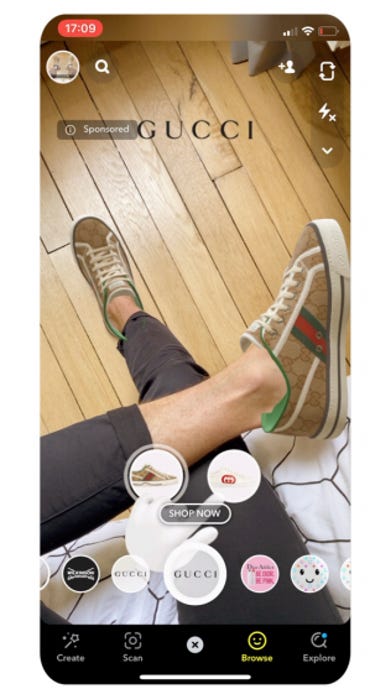
Over the next few years, we believe our AR capabilities will become the next industry standard for mobile native advertising. We have already partnered with several leading brands to leverage our AR and ML technologies to power virtual storefronts and try on experiences such as Champs, Clearly, Dior, Essie, Kohl’s, Levi’s, Jordan Brand, Sally Hansen and Gucci, just to name a few.
The challenge with AR, which is different from our existing video ads business is that we’re still in the early stages of development of the AR industry in its entirety.
They are not often existing augmented reality budgets that these large agencies are within the brand. However, I’ve been in this industry a long time. And I remember when there weren’t distinct mobile budgets, video budgets, social budgets or e-commerce budgets either, but here we are in a place where those are core disciplines that each brand and each agency, so too will be augmented reality.
Add it up and Snap is seeing AR blend with a direct response to deliver real returns with a strategy to target key verticals. The biggest wild card will be timing.
Facebook, following in Google’s footsteps, says it plans to invest $1 billion to “support the news industry” over the next three years.
The social networking giant, which has been tussling with Australia over a law that would make social platforms pay news organizations, said it has invested $600 million since 2018 in news.
Google said in October that it would pay publishers $1 billion over the next three years.
News companies want Google and Facebook to pay for the news that appears on their platforms. Governments in Europe and Australia are increasingly sympathetic to this point of view. The two tech companies suck up the majority of U.S. digital advertising dollars, which — among other problems — has hurt publishers.
Facebook said on Tuesday it would lift a ban on news links in Australian after the government agreed to tweak proposed legislation that would help publishers negotiate payments with Facebook and Google. Facebook was criticized for its ban, which also temporarily cut access to government pandemic, public health and emergency services on the social networking site.
Facebook said Tuesday that the changes allow it to choose which publishers it will support and indicated that it will now start striking such deals in Australia.
Google had already been signing content licensing deals with Australian media companies, and says that it has arrangements with more than 50 publishers in the country and more than 500 globally.
There may be more such regulation in other countries. Microsoft is working with European publishers to push big tech platforms to pay for news. European Union countries are working on adopting copyright rules that allow news companies and publishers to negotiate payments.
Your business is the key to your legacy and your future. If you decide to sell, it pays to do it right.
There comes a time in the life of every business owner when you need to move on to something new, retire, or let your business go to someone with new energy and ideas.
As a business advisor, I always have qualms about recommending this move, because the process of selling your business can generate more pain and loss than continuing to run it yourself.
Since I’m not an expert in this area, I was pleased to see a new book, “Exit Rich,” by a couple of leading authorities on how to do it right, Michelle Seiler Tucker and Sharon Lechter. They not only focus on the positives, but include some succinct advice on what not to do.
Their top items of guidance resonated with what I have seen in my own experience, paraphrased here as follows:
1. Don’t wait until you are burned out or lost interest.
Selling your business requires the same energy and passion as growing it. Once you have lost that edge, and potential buyers will sense it quickly, the value of your business will trend down quickly. You should plan an exit strategy, and optimize your activities and timing to get top dollar.
2. Refrain from telling associates that you are selling.
It’s amazing to me how people always assume the worst. Especially if people hear rumours of your interest in selling, they will assume that you are fighting bankruptcy, being pushed out, or your personal life has fallen apart. Limit your disclosures only to business brokers, and serious potential buyers.
3. Don’t decide to do it yourself, without professional help.
Selling your business is much like starting it, and not something you can do in your spare time. The critical tasks, which require professional skills, include packaging the business, actively marketing it, negotiating terms, and due diligence. Trying to do all this yourself is a recipe for disaster.
4. Depend on a business broker.
Selling a business is not just selling a business property. The buyers are different, the rules and contracts are new, and focused marketing is required. I recommend contracting early with an experienced M&A advisor or business broker, and following their lead, rather than finding a friend.
5. Don’t negotiate based on current month-to-month lease.
If your location is key to the value of your business, make sure you have a long-term lease, or at least a guarantee of renewability. What you don’t need is a buyer dealing directly with your landlord to get your key asset, leaving you with no leverage and minimum value for the sale.
6. Don’t price the business based only on your instinct.
Selling a business, like any other asset, requires a realistic appraisal of value. Many owners have no appreciation for the value they have built up over the years, while others tend to always have an inflated view of their worth. Neither perspective is good for credibility or a fair result from your sale.
7. Don’t disclose proprietary information without an NDA
I have found that entrepreneurs often don’t appreciate the need for intellectual property or their “secret sauce” when looking for an investor, and are quick to give away the details when selling the business. Not getting a signed non-disclosure before negotiating can cost you dearly in value.
8. Sign with a buyer with proper due diligence.
Just like potential buyers will do the due diligence on you, you should be as thorough in checking their credentials, intent, and history. Don’t risk your business, your personal legacy, and your time on unqualified buyers and scams. This task is a key one for your professional business broker.
9. Never grab the first buyer’s offer without a plan B.
The evidence I see indicates that less than forty percent of business sales come to fruition the first time around. Create a sense of urgency by setting up back-to-back buyer meetings, and letting potential buyers see each other. Always be ready to talk about future growth plans, as an alternative to a sale.
10. Also never assume that selling to an employee is quick and easy.
Here the evidence is strong that sales to employees don’t work out well. Most employees have a limited perspective on the role and financial requirements to be an owner. In addition, normal negotiations may cause employees to become emotional and leave the business or work against you.
I always remind business owners that their business is likely their most prized possession, and the sale is one of the biggest decisions in their life. It’s a very complex process, as well as an emotional one.
From your own experience, you know that complex decisions should never be made on emotion. Get good professional help here, and enjoy the legacy you deserve.
The audio-chat app offers a dauntingly vast collection of groups and events for business owners. Here are some recommendations to cut through the noise.
Upon its launch last March, the social app quickly became popular among investors, who hold regular, live audio-only discussions, called “rooms,” in some cases within various topics of interest to groups called “clubs.” Business owners soon followed, building a roster of virtual educational events and places to hone their storytelling skills, commiserate about entrepreneurial life, and share experiences with the likes of high-profile users like Daymond John and Jason Fried.
If you can get an invitation–Kristin Marquet Chester, owner of New York City-based Marquet Media, recommends starting by asking your closest friends and then making requests on social media if needed–here are three types of rooms and clubs worth checking out for entrepreneurs. To find these events in the app, search for the relevant speakers or the name of the club.
The stars
The access to famous people on Clubhouse is “mind blowing,” says Jeremy Knauff, CEO at digital marketing agency Spartan Media. “It’s like cramming everybody into a stadium and doing an episode of Shark Tank.” Spend enough time networking with people on the app, and you might be able to connect with and ask questions of celebrity entrepreneurs directly. Here are a few people whom you should follow:
Shark Tank star Daymond John runs a club called If You Want to Be Rich, Think Like This!!! He often pops into other rooms as well to opine on everything from building a diverse pipeline to cryptocurrency, advises Zachary Klempf, CEO of San Francisco-based Selly Automotive CRM.
John’s fellow Shark Barbara Corcoran doesn’t have a club but hosts in her own rooms and speaks as a guest in others. This week, she hosted a charity event in the club Leadership Lab with Kat Cole, former president of Cinnabon and another frequently recommended Clubhouser, focused on breaking barriers for women at work. One piece of advice she shared that she regularly gives to her Shark Tank companies’ founders when they’re burned out: Make a list of everything you love and everything you hate about running your business, and delegate the latter.
Other recommended speakers, from Clubhouse power usersincludingKlempf and Abhi Mathur, founder and CEO of New York City-based Acoustic Meta Materials: Elon Musk, who speaks in Clubhouse sporadically (memorably once to grill Robinhood CEO Vlad Tenev), investor Ben Horowitz, entrepreneur Rebecca Minkoff, and Basecamp CEO Jason Fried.
Startup and pitch rooms
There are practically too many start-up and pitch rooms and clubs to count, but here are a few recommendations:
Startup Club,run by Ed Nusbaum—start-up mentor and co-founder of Agora, which helps companies with tasks like conversion and monetization–is one of the best clubs for founders to learn, practice their pitches, and even make hires, according to multiple founders. You can follow frequent moderator and admin Soumeya Benghanem, product management lead at VMware and an entrepreneur. And check out Pitch Practice, which is run in the club every Tuesday by Shondra Washington, president and co-founder at TBC-Capital, and Chris Moreno, an investor focused on Latinx entrepreneurs.
Deal or Bust: Founders Shoot Their Shot, hosted by Nathan Latka, CEO of Founderpath.com and a business podcaster. In this room, investors wire money on the spot to promising start-ups, and Latka says he plans to run one each Monday moving forward.
Startup Hotline: What Investors Really Think of Your Idea room (in the VC & Angel Investors Club), hosted each Wednesday by San Francisco-based Hustle Fund general partner and co-founder Elizabeth Yin. It’s not always easy to get kind or straightforward feedback from venture capitalists, Yin says. That’s where this room comes in: It’s a no-pressure forum to practice and get honest commentary. Mac Conwell, managing partner at RareBreed Ventures, says he has scouted companies while moderating in the room.
Future of Work, which delves into topics from entrepreneurship to raising capital. Bob Myers, chairman of SKYL, a start-up consultancy, says he swears by the room for “thinking creatively about how working culture might change as time goes on.”
Scott Omelianuk, editor in chief of Inc., regularlyhosts events on entrepreneurship.
Other recommended rooms, from Myers, Yin, Burning Soul founder Lauren Eckhardt, and Pietra Communications CEO Olga Gonzalez: Breakfast With Champions – Millionaire Breakfast Club for its thought-provoking sessions; The Hustler Club for unvarnished feedback from other founders; and Leadership Lab for deep dives on company culture.
Networking and affinity groups
Katherine Lynn, founder and CEO of job application platform NextSteps, was tired of hearing men on Clubhouse talk about how easy it was to raise money. So she started Women Founders Club in September with Liana Fricker, founder of Inspiration Space, a virtual community for entrepreneurs. The Women Founders Club now has more than 70,000 followers, and features stars likeAlli Webband investor Brit Morin as speakers. Here are some other affinity and networking groups to try:
The Sisterhood of Influential Entrepreneurs, run by fashion blogger Zavanna Dova. While many clubs are good for practicing and learning, this one, along with Women in Business 40+, also provides a venue to share your experiences, says leadership coach and consulting business ownerKaren Laos. Keya Grant, director of supplier inclusion at Papa John’s, also recommends Tryb because it “holds space” for Black women entrepreneurs that can be difficult to carve out on other social media platforms.
Entrepreneur Noir.Grant is a founder of this room and says besides being a diverse space where everyone is welcome, it’s an opportunity for business owners to connect with corporate buyers like herself who are looking to diversify their supply chains.
Small Business Saturday. Every Saturday, Bria McNair, an HR professional who also runs a professional coaching business called Be Wise Forever, hosts a room in The Hustler Club for business owners to share their experiences and support one another.
Feature Image Credit: Barbara Corcoran, Elon Musk, and Daymond John. Image: Getty. Illustration: Chloe Krammel
Amazon’s unique approach to innovation helps teams “work backwards” to create breakthroughs
The best business strategies focus on meeting and exceeding customer needs and expectations. This means envisioning customer problems as well as ideal solutions to those problems before actually developing a product or service–and this is exactly how Amazon innovates.
Amazon’s secret to innovation is the focus of a new book, Working Backwards by Colin Bryar and Bill Carr, two former Amazon executives who started working in the company in the late 1990s. As noted in the book, Amazon’s “working backwards” process includes four steps:
Step 1: Define the customer problem or pain point
Start by determining what the customer problem is that you’re trying to solve. If you don’t know what that customer problem is, then you won’t be able to build a meaningful solution. Identify customer pains that are not going away and are persistent and repetitive, like how many aggravating clicks it takes to purchase a product.
Remember that if you have a clear idea of the problem you are trying to solve, you will be better able to develop a working prototype or minimum viable product (MVP) quickly. If you focus on the wrong problem, the product won’t be viable when it reaches the masses.
Step 2: Define the ideal product solution
After defining the right customer pain point and problem, brainstorm and describe the ideal solution or product that will help. Remember that the right solution may require bringing on new staff members or individuals with different skill sets and ideas. Don’t allow this to be a barrier or a constraint; rather, look at it as an opportunity to grow your business more quickly.
Focus on what would be the ideal product solution from your customer’s point of view and then act on that. The book shares that this is the same way that Amazon developed Amazon Web Services (AWS), by engaging and empathizing with target customers more closely and helping to establish entirely new business categories that didn’t exist before.
Step 3: Work backwards from the ideal customer experience
In this step, you assess and define the ideal customer experience, and then identify challenges or issues associated with making your new product or service a reality that achieves the experience. During this stage, it is very important to be as detailed as possible to identify the technical, financial, legal, partnership, and other hurdles you’ll have to overcome to bring this ideal product to life.
Step 4: Refine and repeat previous steps
Continue to iterate and operate using “sprints” that focus on short-term milestones. The perfect product, service, or customer experience usually doesn’t occur on the first try. As the authors wrote, all of Amazon’s most successful products required iteration over the course of many months, and sometimes years.
Most of us have heard about the age-old idea that we should “start with the end in mind.” That’s exactly what working backwards is all about. But it’s also more than that. Yes, you need a vision of what you want to achieve. But you also need the tactical tools and approaches to get you there. When you focus on the customer in everything you do, innovation moves from an ambiguous concept into a concrete way to change the world.
Feature Image Credit: Photo: Getty Images. Illustration: Inc. Magazine
It’s clearly true, but as I remember it (as an EMEA chief creative officer of a WPP network), the barrier to reinvention was also the fact that WPP would never sign off any margin relief to do anything. That and the institutional immune system in agencies that tries to attack anything acting differently or entrepreneurially. Anyway. Financial performance has been in decline for years. On that, we agree.
Further down the piece, someone was talking about a supposed “shortage of talent” to capitalise on growth opportunities. We can argue the toss about whether or not there is a shortage in agencies. But in the market there is absolutely no shortage of talent. It’s just that agencies are looking in the wrong place. And if they should happen to find it, they are just not set up to work with the growing global pool of A-list “independent” creatives, strategists, technologists and entrepreneurs that are the key to growth.
There is an incredibly talented crew out there for whom the agency Kool-Aid has curdled. All ages, all genders, all over the world, don’t understand why they need to work all the hours god sends and have zero work/life balance when there is an alternative. There is an exodus to the portfolio career. Some have private clients, some work with a number of agencies, some work directly with brands, some are entrepreneurs, some have personal projects. They flourish.
On the whole, they haven’t been forced to work from the kitchen table by a global pandemic: they made the explicit choice to jump off the burning platform and find sanctuary.
You can find them in the north of Scotland, on the west coast of France, a beach in Indonesia, Crouch End, Goa, Wherever. Technology allows the creative diaspora to go wherever it damn well wants to, in a way that couldn’t happen just five years ago. Technology has changed the game for good. And the pandemic has only expedited this process.
But here’s the rub. As I was leaving my big old network job, I excitedly explained my start-up idea to a European chief creative officer. A mate. Someone I rated.
He raised his eyebrows and said: “Wow, so you’re going to do that with freelancers?” He sort of spat that last word and at the same time left it hanging in the air. That’s the issue there. What is it with the pejorative use of that word?
In a more chivalrous time, when knights wore shining armour and rode white horses, the Free Lances were the elite. A warrior class for hire. Tied to no one. Not your poor plodding foot soldier. Not pawns on the battlefield for a top-down feudal system (bit too obvious for a network analogy?) – but the best and most skilful crew money could buy.
They went wherever they wanted to and commanded a huge price because they got the job done brilliantly and quickly. Everybody wanted them… Pretty fucking cool right? When did the word get its negative connotation? How did it fall from grace? Where did that arrogance creep in? Is it somehow better to have a full-time job in this business? Right now? Not sure.
Just like the knights who pledged their allegiance to whoever treated them the best (and I don’t mean paid the most), that independent elite does the same today. But agencies don’t get it. Treat them like you hate them, crush them on cost, cancel at the last minute, make them work the weekend, all of that… isn’t going to have them queuing up at your door.
What’s the best way to add some Free Lances to your ranks?
Put people first. Those beautiful, crazy, amazing people and the ideas they have are the reason we all got into this business in the first place. Rebuild your processes around the portfolio careers of the world’s top independent talent
Pay them well, pay them fast. Don’t haggle. It’s beneath you
Because the scales have tipped, let the talent retain the IP of the work that doesn’t run. It matters. It’s theirs
And yes, culture is important. But theirs, not yours. Great talent wants self-determination now. They’ve stopped believing the hype. Agencies don’t hold the glamour they used to have, pretty much anything from a tech giant to a start-up to a walk on the beach is more attractive.
Please don’t tell me there’s a shortage of talent, when, actually, the shortage is in the vision to see where the opportunities for growth will come from… and the ability to lose our arrogance.
Feature Image Credit: peepo/Getty Images
By Jon Williams
Jon Williams is chief executive of The Liberty Guild and the former chief creative officer at Grey Group EMEA.
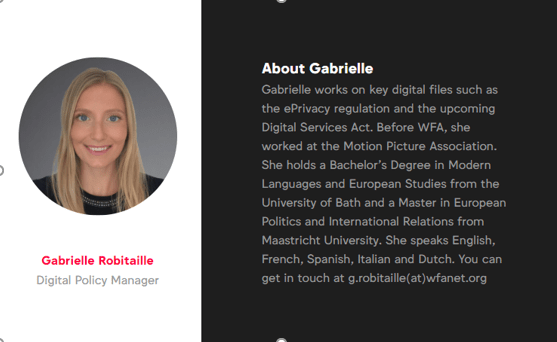
The Association of Advertisers in Ireland are delighted to welcome Gabrielle Robitaille, Digital Policy Manager, World Federation of Advertisers, as a guest for our next Toolkit webinar on Tuesday March 30th.
In this session, Gabrielle will provide the Toolkit group with a summary of latest developments, expected next steps and WFA action on all relevant EU digital policy files likely to have far-reaching impacts on the digital advertising market. Gabrielle will look at:
Recent moves to regulate online platforms via the Digital Services Act and Digital Markets Act and how these could result in increased transparency in the digital advertising market and support advertisers’ brand safety efforts;
The state of play on the ePrivacy Regulation, which will set new rules on the use of cookies within the EU;
Plans to introduce an EU-wide digital levy and how this could have unintended consequences on advertisers;
Proposals to introduce new rules on transparency in political advertising and how these could inadvertently impact commercial advertisers.
When: Tuesday 30th March Time: 10am – 11am Registerhere
Author and speaker Mark Crowley explains how great leaders use their data-driven business mindsets and tap into a kind of intuition that transcends the instinctive, gut-based one to be successful.
Thanks to Malcolm Gladwell and Nobel Prize-winning economist Daniel Kahneman, we’ve all been sternly warned about the risks of employing intuition when making important decisions. In his book Blink, Gladwell asserts that while our unconscious thinking is “a powerful force, it also can be thrown off, distracted or disabled.” And in his classic, Thinking, Fast and Slow, Kahneman stresses that gut instincts can fail us when we unwittingly apply familiar patterns of experience to unrelated circumstances or situations.
The truth is, most of us have spent a lifetime developing our rational minds and rely solely upon their counsel when making consequential life choices. And we know that in business today, innumerable companies such as Amazon have placed data at the centre of their corporate cultures—and routinely rely on metrics to find the best ways of growing their businesses.
In light of this, it may come as a surprise to learn that some of the world’s most successful leaders and innovators intentionally tap into their intuition before making critical decisions.
“Jeff Bezos is a brilliant guy who has built a great company—a data-driven company,” Rubenstein told me recently. “But most people who’ve become very successful, certainly in the business world, had an idea—an intuition—that pushed them forward. It wasn’t analysis. Like the best decision-makers, Warren Buffett makes investment decisions in minutes. And, in my opinion, if Steve Jobs had relied on analytical thinking, he never would have built Apple.”
If you’re wondering how great leaders managed to square their data-driven business mindsets with a routine reliance upon intuition, it’s because they most often tapped into a kind of intuition that transcends the instinctive, gut-based one about which Gladwell and Kahneman both had concerns. There really are three kinds of intuition. An understanding of each will profoundly enhance the success of all your future decision-making, not to mention prevent you from making choices you end up regretting.
“Expert knowledge” intuition
“Thinking fast” is where our most common understanding of intuition comes in. As Kahneman describes, it operates automatically, quickly, and sometimes impulsively. But while Kahneman asserts that gut instincts can be wrong, they can also be right when applied to familiar patterns and challenges.
For example, an experienced nurse walks into a hospital room and tells a new nurse that the patient is about to go into cardiac arrest. And within the next hour, it frequently happens. While the nurse may later be unable to explain how she “knew,” through her experience, she learned to identify subtle cues such as how a patient is breathing, their colour, or some other signs she locked away in her unconscious. And when she recognizes these patterns again, she takes quick action.
“Implicit knowledge” intuition
When any of us is faced with a new problem, with no experience in solving it, our common approach is to think about it, scratch our head a little, and inevitably stop working on it. But then, while in the shower or out on a run, we experience a sudden epiphany where, voilà, we’re guided to the solution. Allowing our minds to process the problem behind the scenes often provides the answers we need.
College student Nikola Tesla was mocked by one of his professors after he proposed creating the first alternating-current-driven motor. Stumped by how to make it, Tesla and a friend went out for a walk—to discuss poetry—and the insight came to him. “The idea came like a flash of lightning,” he wrote, “and in an instant, the truth was revealed.”
Albert Einstein often stressed the value of intuition and described his own theories as “free invention of imagination” rather than the result of rigorous analysis. “There are no logical paths to these [natural] laws,” he wrote.
Even modern-day real estate brokerage tycoon and Shark Tank investor Barbara Corcoran believes she owes much of her success to trusting her inner knowing. Here’s how she described it:
“You really have to listen to that inside intuition. And it’s kind of weird, I think, for me, because everything in our education system says listen to your left brain. Everything we’re taught is listen, analyse. A leads to B, leads to C. But in real life, it doesn’t work that way. A leads often to F, and then comes back to B. And so, the only piece of your mind that’s able to grasp that, and see the truth, is your intuition.”
“Nonlocal” intuition
According to researchers at the HeartMath Institute, numerous studies have validated the existence of a form of intuition that author and medical doctor Deepak Chopra says “allows us to eavesdrop on the mind of the universe.” While our rational minds operate on the basis of our five senses, nonlocal intuition seems to access not just information stored in our subconscious but also a deep storehouse of knowledge and wisdom, perhaps best described as universal intelligence.
Starbucks founder Howard Schultz, for example, always had access to financial analysis and predictive data, but he also proved to have an instinctive feel for what products, store design, and culture he wanted his customers to experience. By his own admission, he routinely acted on his intuition and, in effect, followed his heart.
The truth is all of us have intuitive feelings like these all the time, but we’ve been conditioned to ignore or discount them. That’s because they’re an aspect of human intelligence we often don’t believe is appropriate or reliable. Nevertheless, we can all recall times when we overrode an inner voice or feeling that urged us not to take a job, trust another person, or send an email. And we can relate to Oprah Winfrey when she said, “The only times I’ve made mistakes is when I didn’t listen.”
Researchers at the Australian Graduate School of Entrepreneurship studied serial entrepreneurs—people who had built multiple businesses with great success—and discovered that 80% of them intentionally relied on intuition and knowingly integrated it with their cognitive capacities when weighing options. In other words, they purposely acted on hunches tied to a feeling that it was the right choice and embraced the idea that what they sensed was no less valuable than empirical data and analytics.
More than 2,000 years ago, the Greek philosopher Aristotle said, “Wisdom is intuitive reason combined with scientific knowledge,” a conclusion that reminds us that our minds and hearts are intended to work together. And that’s the important insight successful leaders such as these clearly understand.
When faced with an important decision, they run the numbers and perform all the critical analysis. But right before they make the final call, they ask their inner wisdom to weigh in. Most importantly, they routinely trust that whatever feeling it yields will guide them to making the best possible choice there is to make.
In the words of Ralph Waldo Emerson, “Trust instinct to the end even though you can give no reason.”