Both B2B Marketers and Buyers Increasingly Sold on Conversational Marketing
B2B marketing professionals have found email, online live chat, social media, and chatbots have all seen increased usage in 2020, while phone and video call use has fallen by more than 10 percent, according to recently-released B2B buyer communication survey data of interest to digital marketers. MarketingCharts
B2B Tech Firms Cut Marketing Budgets Due To Pandemic: Study
Despite an overall drop in marketing spending due to the global health crisis, budgeting for digital and content marketing are the most likely to see increased spending, while some 60 percent of B2B technology firm executives say that their key performance indicators (KPIs) haven’t undergone change. MediaPost
Subject Matter Expertise A Growing Factor for B2B Buyers When Evaluating Vendors
In 2020 over 32 percent of B2B and professional services buyers see subject matter expertise and industry knowledge as the top attribute when evaluating firms, a rate over 11 percent higher than 2018 figures, with client service flexibility the only other element that became more important during the past two years — two of several statistics of interest to online marketers in recently-released survey data. MarketingCharts
7 ways COVID-19 has changed B2B customer experience forever
The pandemic has blurred the lines between B2B and B2C marketing, brought more intelligent automation to customer experience (CX), and made trust a more important factor, and Adobe has taken a look at how these changes will play out in 2021 and beyond. Adobe (client)
Linked Rolls Out Company Engagement Report
LinkedIn (client) has launched a Company Engagement Report offering new insights for B2B marketers, especially those using account based marketing (ABM), featuring a variety of organic and ad engagement metrics, the Microsoft-owned professional social platform recently announced. Adweek
Facebook Once Again Experiments with Up and Down Votes for Comments to Optimize Engagement
Facebook has begun limited testing of Reddit-like upvoting and downvoting options among certain Facebook Groups, with an eye towards boosting relevant content and engagement levels, recent observations of the social media giant have shown. Social Media Today
Google’s Working on a New Process Which Would Convert Static Website Assets into Video Content
Google has launched URL2Video, a new prototype utility that incorporates some of Google’s AI systems to turn static website digital assets into video content, in a move that could lead to new digital marketing opportunities, the search giant recently announced. Social Media Today
Social Media Trends 2021 Global Report
Content remixing, memetic media, and nostalgia marketing are among the trends marketers are likely to see more of during 2021, according to recently-released global social media survey trend data from HubSpot and Talkwalker. Talkwalker
Microsoft Clarity, the company’s tool for visualizing user experience, is out of beta
Microsoft has widely released Clarity, a free service offering a variety of user engagement and other metrics using site JavaScript, previously available only in beta form, the firm recently announced. Marketing Land
B2B Content Marketers Getting More Successful in Building Credibility
B2B content marketers say they have found creating brand awareness, educating audiences, and building credibility and trust as the top three benefits of B2B content marketing over the past year, followed by lead generation and building loyalty with existing customers, according to recently-released survey data of interest to digital marketers. MarketingCharts
ON THE LIGHTER SIDE:
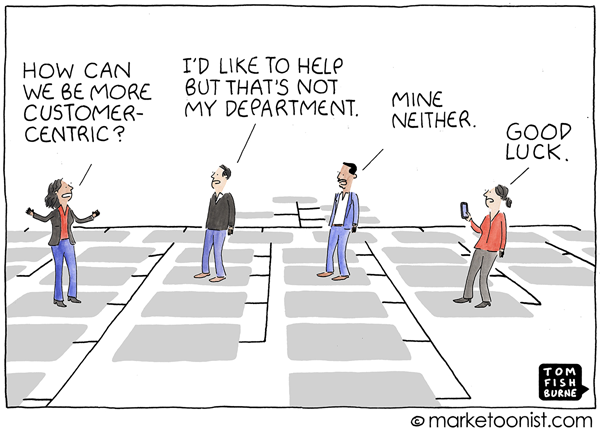
A lighthearted look at “CX is more than a department” by Marketoonist Tom Fishburne — Marketoonist
New Photo Filter Shows What You Would Look Like in Facial-Recognition Database — The Hard Times
TOPRANK MARKETING & CLIENTS IN THE NEWS:
Lee Odden — #TimTalk – The Business of B2B Influence with Lee Odden — Timothy Hughes
Lane R. Ellis — 10 Tips for Prioritizing Tasks to Make the Most of Limited Small Business Resources — Small Business Trends
Lee Odden — 40 Marketing Quotes to Provoke Thought and Inspire — Visitor Queue
Have you found your own top B2B marketing stories from the past week of industry news? Please let us know in the comments below.
Thanks for taking the time to join us for our weekly B2B marketing news, and we hope that you’ll return again next Friday for another examination of the most relevant B2B and digital marketing industry news. In the meantime, you can follow us at @toprank on Twitter for even more timely daily news.
By Lane Ellis
Lane R. Ellis (@lanerellis), TopRank Marketing Social Media and Content Marketing Manager, has over 36 years’ experience working with and writing about the Internet. Lane spent more than a decade as Lead Editor for prestigious conference firm Pubcon. When he’s not writing, Lane enjoys distance running (11 marathons including two ultras so far), genealogical research, cross-country skate skiing, vegetarian cooking, and spending time with his wonderful wife Julie Ahasay and their three cats in beautiful Duluth, Minnesota.
Google will roll out an option in the coming weeks that allows users to opt out of having their Gmail, Chat, and Meet data used to offer “smart” features like Smart Compose and Smart Reply.
Gmail permissions are being featured by Google as the next privacy setting. Whatever the choice users make, “Google ads are not based on your personal data in Gmail, Maalika Manoharan, product manager at Google, wrote in a blog post.
Earlier this year, Google advertisers gained the option to buy Product Shopping ads and Showcase Shopping ads for Gmail campaigns in March. They are reported in the Google Display Network.
Standard Shopping campaigns will automatically run on Gmail, when marketers opt in to Gmail, Discover, and YouTube campaigns.
Manoharan explains that automated algorithms, not manual review, make it possible for Google to offer the new privacy feature. A toggle disables the background data processing that makes it possible to collect and use the data, Manoharan explained Monday.
Users remain in control of their data, whether they are an individual Gmail user or a Google Workspace administrator.
The new option will roll out in the coming weeks.
The Privacy Checkup tab allows users to control whether the data in Gmail, Meet, and Chat can offer smart features in the tabbed inbox for Smart Compose and Smart Reply in Gmail, as well as a reminder when bills are due in the Google Assistant and restaurant reservations in Google Maps.
Google’s engineers at the Google Safety Engineering Center in Europe developed the setting, which may have been based on the Global Protection Data Regulations (GDPR).
Auto-delete was introduced as the default to give consumers greater control of their data.
The ability to turn on and off some individual smart features is not new. The setting, which now gives users a choice whether or not the data can be used, is designed to reduce the work of understanding and managing that process.
As with all Google products, Gmail, Manoharan writes, Meet and Chat are secure-by-design to help protect consumer data and safeguard privacy.
A slew of famous media defectors who jumped onto the platform recently raises the question of whether Substack can address media’s woes
I started a Substack two weeks ago and it’s going better than I thought it would. Friends texted me: “Congratulations on the launch.” To which, I responded: “Heh, thanks it’s a blog.” Another pinged: “You joined the movement!” The best reaction was an encouraging tweet from fellow Substacker, Michelle Lhooq: “Let us all welcome [Sean] to the Substack stripper pole, where writers dance for our readers loose change and tell ourselves we’re the future of media hehe.”
Michelle’s sangfroid about the media hullabaloo regarding Substack makes sense to me. It’s a Faustian bargain to commodify your personality. You’re free from the limiting influences of institutions. This is of course why the most famous Substack defectors – Glenn Greenwald, Matt Taibbi, Andrew Sullivan and now Matt Yglesias – moved to the platform. Yet, input from editors is inevitably just replaced with the pressure of analytics. As teen YouTubers, who were the earliest to experiment with commodifying their personalities confess, the quantification of attention both positive and negative quickly influences our decisions. There are some sides of ourselves our subscribers want to see, others people would prefer not to … This applies doubly to controversial views.
But no matter how you feel about it: we live in a personality-based economy now. Cancel culture and platforming, the two discourses that help us navigate the dynamics of our social media ecosystem both point back to this state of affairs. When Yoni Appelbaum snarks: “PITCH: Like Substack, only with the best writers, rigorously edited, beautifully illustrated, accessible online, but also bound together and delivered directly to your door, for a small fraction of the price of subscribing to each individually” – and then tweets a link to the Atlantic’s digital subscription page, his first appeal is to the publication’s stable of writers. The Atlantic’s brand is not its 163 years of illustrious history or its institutional reputation. It’s brand is a meta-affect of the media personalities it platforms, and most importantly – those it doesn’t.
Personality is upstream from institutions in the same way culture is upstream from politics. Substack has clearly taken note of this. Consider Ezra Klein: an influential proponent of the netroots activist blogging movement in the early 2000s, his Wonkblog was essential reading for those closely following the passage of Obamacare. Originally a solo project, it was quickly acquired by the Washington Post. But by 2014, Klein had attracted the attention of venture capitalists and was installed as the editor in chief of Vox, a leader in the data journalism movement, clearly indebted to Klein’s explanatory style of journalism. Ezra Klein’s personality is lightning in a bottle. It flows from him, not the media properties he has founded.
There’s a tedium to the hamster wheel of personal brand, and as so many have noticed the causality from followers to funds is opaque at best, a con at worst. In a world where podcasters get Patreons, sex workers get OnlyFans, and influencers get brand partnerships, writers have taken note. If Substack is a stripper pole at least it’s not pro bono.
Substack is not quite the ‘revolution’ tech critic Jaron Lanier envisioned in his 2013 book, Who Owns the Future? For Lanier, our current detente wherein users receive free services and creators receive free exposure in exchange for free content, was never viable. A few monopolies control (and monetize) an inordinate amount of all the information created around the world, while the masses would be left out in the cold. He proposed users – creators in his estimation – be reimbursed with micropayments for content they contributed to the internet. Substack isn’t quite the equivalent of Twitter paying us a penny per tweet, but it seems the closest thing we will get to a fairer ecosystem in the near future.
For many people, the issues surrounding Substack strike at the heart not only of what free information has done to society – but what free information has done to the media industry in particular, which has been decimated by declining profits. In 2020, Google, Facebook and Amazon are on course to consume 62.3% of US digital ad revenue – to say nothing of Craigslist’s fait accompli on the classified ads that formerly supported local journalism … Substack is a pragmatic response to one issue plaguing an industry in crisis – a collapsing ad-based revenue model. Rather than propose more voodoo innovation, it addresses the issue head on with the straightforward transaction of a subscription, a shift that industry leaders such as the New York Times have also pursued to great effect. A new micropayments platform for newsletters won’t magically liberate public intellectuals from commercial pressures; it won’t solve the tensions between free speech and safety; and I highly doubt it will make having a career as a writer any easier. But it will create space for writing not tailored to the trending on Twitter section, encourage writers to develop a deeper relationship with their audience, and promote the sort of writing (both longform and short) that doesn’t fit neatly into the categories of legacy media.
In a few years’ time, I predict we may look back at the chaotic information ecosystem of the 2010s as a sort of social media interregnum. Seduced by the seemingly magical qualities of our new powerful technological tools, we deluded ourselves into believing clout and exposure could be a replacement for dollars and sense. The fragmentary properties of the internet remain in place. Strong-willed media personalities now have the tools to set up shop and operate independently. Legacy publications will worry less about trending in social media feeds and more about the conversion rate for subscribers. Audiences will be less global and more curated. And most important of all, the social media channels – chastened by the techlash – will return to what they were always meant to be: places for self-promotion, not self-publishing.
Feature Image Credit: ‘We may look back at the chaotic information ecosystem of the 2010s as a sort of social media interregnum.’ Photograph: Léo Corrêa/AP
Sean Monahan is a writer and trend forecaster based in Los Angeles. He co-founded K-HOLE, the trend forecasting group. He releases a weekly trends newsletter at 8ball.substack.com
As advertising budgets get tight, remain tight, and come under increased scrutiny from CFOs and CEOs, marketers must not only increase the effectiveness of their marketing, but also look for ways to cut unnecessary expenses. The savings drop straight to the bottom line. A dollar saved is a dollar earned on your P&L, the “P” line, literally. The dollars saved have significantly more impact on profitability than the many dollars spent on getting more sales, especially in low-margin categories and industries.
Take for instance P&G cutting $200 million in digital ad spending, and seeing no decrease in business activity. In fact, during the same timeframe, “Jon Moeller, P&G’s chief financial officer, said the reduction in ad spending obviously didn’t hurt the company’s performance in the recent fiscal year because sales increased, up 1% from the previous year [and] organic sales grew 5%.” P&G saved another $750 million by 1) slashing its agency roster by 50% (CNBC), 2) reducing the complexity and number of adtech middlemen in the programmatic supply chain through in-housing (FT), and 3) increasing price transparency and accountability by buying from vendors directly and avoiding undisclosed mark-ups by agencies. Of course not every marketer can save a billion dollars like P&G did, but marketers of all sizes can find and cut unnecessary costs. Here are a few to start with.
Cheap Ad Impressions on Long Tail Sites
Many marketers, especially the biggest spenders, were lured by the large numbers of ad impressions and low prices offered by programmatic ad exchanges. These ads were supposedly shown on millions of “long tail sites.” But common sense will tell you there aren’t enough humans visiting millions of long tail sites enough times to create the trillions of ad impressions bought and sold through programmatic exchanges; fake sites and fake users (bots) are creating those impressions out of thin air. Those sites can sell ad inventory at low CPM prices because they pirated or plagiarized all the content and had little to no cost. There’s a reason mainstream publishers can’t sell you ads for much lower costs; their content is expensive to make. Good publishers have real journalists, real editors, and real content and therefore real human audiences.
The first thing to cut is unnecessary ad spending on large quantities of low cost ads. If it seems too good to be true, it is (too good to be true). You can do this aggressively by turning off Google Display Network and search partners and by turning off Facebook Audience Network. You can also start to use an allow-list or include-list of domains, instead of a block-list; there are so many fake and fraudulent websites you can’t block them fast enough. Don’t take my word for it; run your own experiment cutting low cost ads on long tail websites from your media buys. See if there is any change to your business activity and outcomes. I’ll bet you that you won’t see any difference. When Chase cut the number of long tail sites showing its ads from 400,000 to 5,000 (a 99% decrease) they saw no change in business outcomes, either (NYTimes).
Buying Your Own Branded Keywords in Paid Search
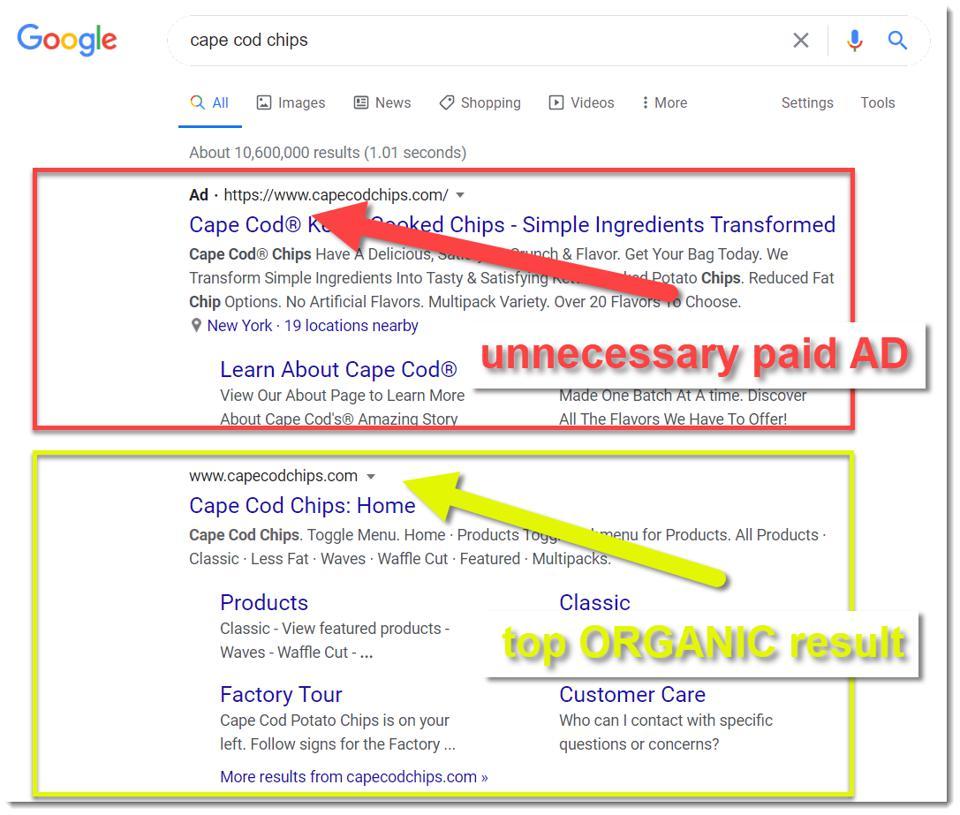
Many marketers, especially the biggest spenders, were duped by their agencies into buying their own branded keywords in paid search marketing. Why would agencies do such a thing? It is possible they didn’t know better. But it is also possible that those keywords are by far the highest volume ones (people knew the brand already) and had the highest click through rates, by far (people were going to click on the search result anyway). Those brand advertisers whose branded keywords already appear as the first organic search result should not be paying for search ads on those same brand keywords. Otherwise, a search ad is placed directly above the first organic result and users accidentally click the paid ad instead of the organic search result they would have clicked anyway. This costs the advertiser unnecessary expenses (see chart below). Agencies won’t tell you that because without the high volume brand keywords and high click through rates, their excel spreadsheets wouldn’t look as good, and they’d have to do more work to drive results for your paid search dollars.
Google search results (screen shot)
Fraud Verification Tech That Doesn’t Work, and is Black Box
Many marketers, especially the biggest spenders, were tricked into thinking they can detect their way out of trouble when buying low cost ads in programmatic channels. They thought that if some other party checked the ads for bot activity and fraud they would be protected from wasting money. But what they didn’t realize is that the bots can easily trick the detection too, and not get marked as “invalid” — as in IVT “invalid traffic.” Not being marked as invalid, does not mean that it is valid. It could be that the detection simply failed to detect the bots. To put it simply, bots can either alter the measurement with malicious code to defeat it; or bots could simply block the detection tags of the fraud verification companies to avoid detection altogether. Yes, read that one more time — the bots simply block the detection tags of these vendors, and get away with it. “Not measured” is also not the same as “valid.”
Don’t take my word for it; turn off fraud detection for a period of time and see if you notice any changes in your digital campaigns. I’ll bet you that you won’t see any change. And you’ll never be able to verify if they measured correctly or not, because these detection technologies are “black box.” This means they give you a number — e.g. 9% IVT — but do not explain how they measured it. Even the MRC-accredited vendors may not be measuring correctly. MRC accreditation simply means they paid a fee to MRC, MRC had an accounting firm — E&Y — interview the vendor and verified they are measuring what they said they would measure. That is entirely different from measuring bots vs humans correctly.
Cut the fraud detection tech that does not work; you can’t verify if they work anyway. Oh, and definitely stop paying those fraud detection tech companies that extort their own customers, by threatening to mark them as fraudulent or remove them from indexes if they don’t pay up. That’s “protection money.” Don’t pay it. And you wouldn’t need fraud detection in the first place if you bought ads from real publishers, instead of millions of fake sites with fake traffic.
Fake Certifications
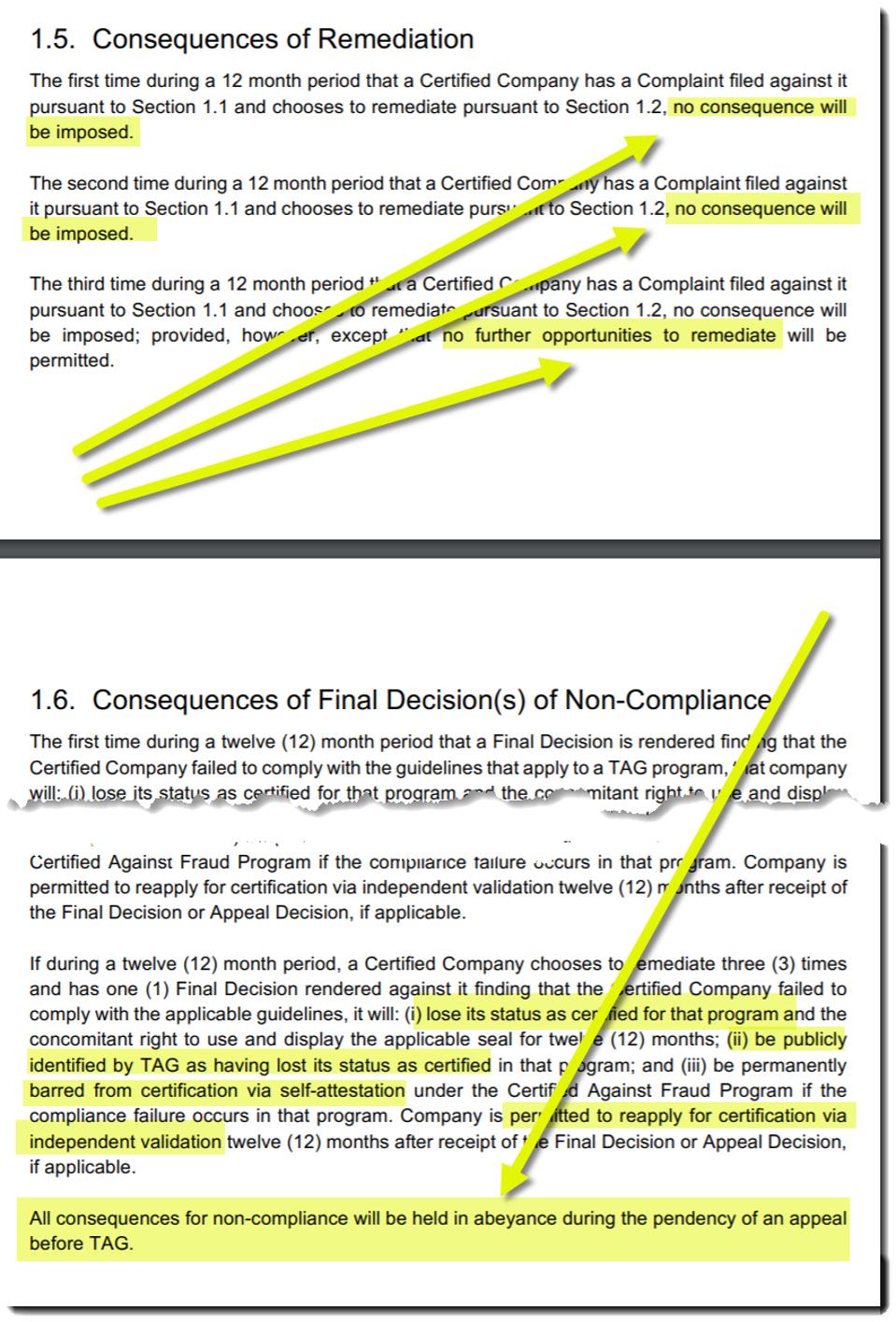
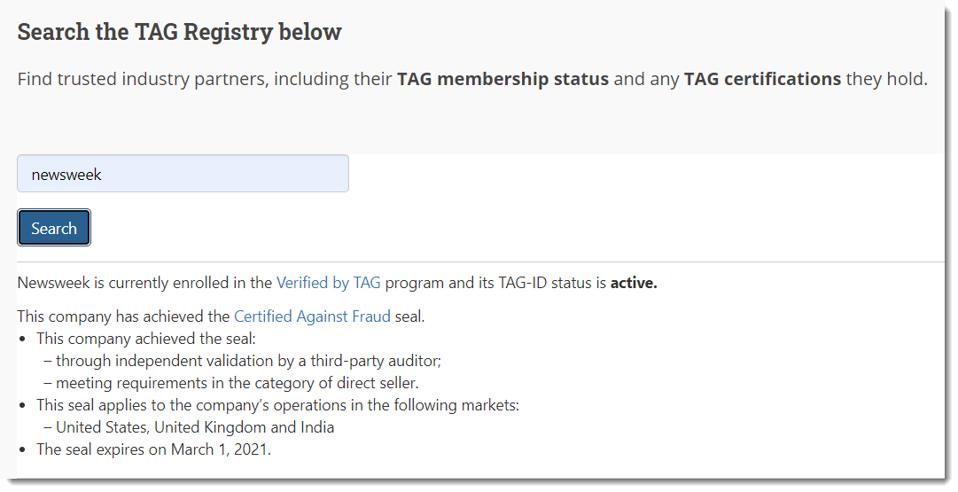
Many marketers, especially the biggest spenders, were lulled by fake certifications offered by industry trade associations into a false sense of security. They thought that if they bought from TAG Certified Against Fraud vendors that there would be less fraud. But what they didn’t realize is that the “certifications” are pay-to-play and self-attested. This means vendors pay the fees, complete paperwork, and promise they will do no fraud to get their certifications. Do you think bad guys intent on committing fraud will actually follow the rules? Even if they are caught three times, TAG’s own documentation shows consequences that amount to less than a “slap on the wrist” and “all consequences for non-compliance will be held in abeyance during the pendency of an appeal before TAG.” If ever they are caught, fraudsters will just appeal and continue business as usual “during the pendency.”
Judge for yourself whether this expense is necessary, or useful at all. You can buy ad inventory that is already “filtered for IVT” and achieve the same “low, low fraud rate of 1.05%,” without paying for TAG certification. Just note that it may be that low because the fraud detection tech couldn’t detect the bots. So better yet, buy more from real publishers and less from programmatic long tail sites. You’ll have reduced your own exposure to ad fraud, certifications or not.
Targeting Data and Look-Alike Audiences
Many marketers, especially the biggest spenders, were suckered into paying for more targeting parameters thinking that would improve “relevancy” of their ads. While some targeting is better than no targeting at all, too much targeting is a complete waste of money. Beyond about 3 – 5 targeting parameters, the extra expense of hyper-targeting outweighs the incremental business outcomes that it drives. In fact, academic research has shown that more targeting, beyond a point, results in less business outcomes than less targeting. This is because the data used for targeting was crappy. The data was collected in privacy-invasive ways (observing what sites users visited, tracking them across sites, setting cookies, etc. all without their knowledge or consent). The insights and audience segments were entirely derived, because none of the users were logged in and none of them volunteered information themselves. (This is the opposite for so-called “walled gardens” where users are logged in to one or more Google services at all times, and voluntarily provided demographic and other info in exchange for the free services they were using).
On top of the general crappiness of the data, there’s also the bot problem. Bots know that ad tech companies look at website visitation patterns to deduce what a user likes and which audience segments they belong to. So bots conveniently trick the ad tech targeting companies by visiting medical journal websites, so they look like doctors; or by looking at swing sets in the spring, and backpacks in the fall, so they look like “swing set intenders” or “back-to-school intenders,” respectively. These are bots, not humans who really want to buy from you. By pretending to be in high-value audience segments, like doctors, bots can trick pharmaceutical advertisers to pay higher CPMs in their desperation to get ads in front of physicians. Bots make more money; advertisers waste more money on said bots.
Don’t take my word for it. Cut the targeting data you pay more for in your digital campaigns and see if you notice any impact on your campaign outcomes. I bet you there’ll be none that you can notice.
Remarketing to Your Own Customers
If you thought black box fraud detection, fake certifications, and targeting audience segments of bots were ridiculous, wait till you hear this next unnecessary expense. Ad tech companies are charging clients to “remarket” to their own customers. They even require ecommerce merchants to upload email lists of customers who already bought from their online store, so they can remarket to them. Think about that for just one second longer. These are customers who already know the brand, and like it enough to have already purchased from their ecommerce stores or physical stores. What’s the likelihood of this customer buying more from the same advertiser? Pretty likely, if not 100%.
Oh, the remarketing company told you they have some special sauce that gets these customers to buy more from you? And they tell you not to worry because you only pay when you get the click anyway (performance)? They tell you, trust us, you don’t need to know where we run the ads since you’re only paying when you get the click. Did they run your ads on porn sites? hate speech sites? fake news sites? popunders? And they don’t provide you with placement reports of where ads ran? Are you sure that ads ran in the first place? Remember Uber’s lawsuit against 100 mobile ad exchanges for falsifying placement reports or fabricating them entirely when no ads were ever run.
Cut your remarketing expense and see if the sales continue. If they do, then those sales would have happened anyway – because your customers know you and will buy from you again — not because of some magic done by the remarketing company. The only magic they are doing is tricking you into paying for sales that would have happened anyway. See: Fraudsters Cheat By Tricking The Reporting to Look Awesome
Cut, Cut, Cut More
While you’re cutting, note the 50% “ad tech tax” when buying through programmatic supply chains. Fifty percent of every dollar you spend goes into ad tech middlemen’s pockets, instead of towards showing your ads. What if you bought direct from a good publisher? Every cent of your dollar will go towards showing your ads; that’s the whole idea behind digital advertising anyway, right? Save yourself 50% or more by “buying direct” from good publishers. They will still use programmatic technologies to place the ads, but you are shortening the supply path and cutting out the middlemen who are trying to maximize their own profits, on your dime.
If you were to look even more closely you may find that between crappy targeting due to crappy data and other “drop-offs” due to the limitations of technology, you’re left with 6 cents on the dollar going towards showing ads. It’s almost like a sale at Macy’s — save 94%! By cutting unnecessary expenses in digital, you’re saving money. The above examples are not a case of “save more when you buy more” (like at Costco, or UNinformed programmatic media buying for that matter); it’s “save more when you cut more.”
Cut costs; increase savings, and get better outcomes all at the same time. Who doesn’t love that. Go check your own spending. And let me know what unnecessary costs you decide to cut.
The lucrative dream is still alive regardless of what this pandemic has done to our world over the past year. Many industries are looking for viable candidates who of course have the passion, education and experience to get hired and greatly expand on their bank accounts.
Take a look at six crucial ones worth looking into should you be navigating the world of high-paid employment.
Financial management
Everything from knowledge of IT software to analytical reporting to management experience make up someone who is good in the Financial Management industry. And the paycheck that goes along with something like this is astounding as being a Senior Finance Manager can net you up to $150,000 a year according to Payscale.
Becoming a Certified Financial Planner, or CFP for short, can only help in the process as people will feel that much more comfortable with you advising them on how to use their money in a smart way.
Sales
Take it from someone who knows. Stuttering during a sales pitch as part of an interview for you to get hired, or even worse acting nervous while talking to an actual employer who could easily fatten your piggy bank, is cause for disaster regardless.
Luckily there are tons of sales training videos out there that will help you hone in on these kinds of skills and give you the confidence to secure the bag or position at hand depending on what you’re going for.
Writing
There are many jobs out there in the world of journalism that are paying in the really high numbers. Celebrity culture, sports, banking, the list goes on and on for you to make mint in this highly coveted industry.
Skills that are worth brushing up on in order for them to be super impressed include everything from taking grammar quizzes to knowing who your audience is and even varying your sentence structure accordingly.
Communications and public relations
The gift of gab is something that many have possessed since the day they were born. Being Most Talkative in high school could turn out to be a good thing should you want to enter the communications and public relations industries, many of which are hiring at over $100K per year.
An important skill set for this is something quite simple yet many seem to overlook it: your social media presence. Take a look at how big companies that have millions of followers are doing their and try to mirror yours so that it looks professional, fantastic and something people want to like or double tap on.
Project management
Be the leader that you’ve always dreamed of being. Find yourself as the focal point of each Zoom meeting (as opposed to the in-person ones that at one point were the norm).
Mastering key skills like mapping out a timeline, troubleshooting any issues and planning your project from conception to inception will only make things better although getting to that point should require some sort of bachelor’s degree in project management from PMI (Project Management Institute).
Fortunately all that time studying will help out in the long run (regardless of where you are on your own personal ladder in life) as Salary.com reported that the median amount for this position is about $92K which can go as high as $120K.
Life Coach/public speaking
The gift of gab is once again brought up except this time it revolves around being a life coach or doing something with public speaking where people are paying you big bucks to talk about something that will hopefully change their lives for the better.
Normally a good way to hone in on this skill would be to engage with your audience in an outdoor environment, but seeing as that is not a possibility a good way to do so would be to check in on them periodically online and let you know that you are there for them beyond a simple email.
Create group Zoom chats and really hear what some of them have to say about the matter at hand so you know they are really feeling about what you are trying to put out into the world.
Email marketing remains one of the most popular, consistent marketing platforms around. Entrepreneurs and businesses big and small depend on their email lists as a source for their leads. Yet many of these same businesses don’t update their email lists as often as they should. The problem that arises is that consumers on these lists don’t always stick to the same email addresses. After a time, the lists become outdated, and it’s impossible to be sure if your emails are actually reaching your audience.
In addition to maintaining an updated list, companies need to make sure their subscribers are people genuinely interested in their offers. Sending emails and newsletters to the wrong audience is a waste of time and money. Cleaning, pruning and enhancing an email list is therefore crucial for any modern business.
So how can an organization make sure its email list is both accurate and targets the right people? These seven experts from Ad Age Collective share their strategies for how to improve an email list and ensure it remains an effective form of marketing for your business.
1. Optimize your content to make it relevant.
My strategy is to optimize the digital content so that it is relevant to our target audience. Many consumers have a short amount of time, and they are less likely to open a marketing email if it seems to be blatant advertising or spam. Thus, every email should give the reader a reason to open it and to pass on word-of-mouth to other interested viewers. – Duran Inci, Optimum7
2. Focus on ongoing verification and consent.
Conduct ongoing verification of your list and make sure you have consent. I don’t know how many times someone has tried to sell me a list with my own name on it and my college address. – Lana McGilvray, Purpose Worldwide
3. Segment your list based on common features.
You can improve the email list you already have by segmenting it. This means grouping people based on similar characteristics. You can do this according to demographics, interests, purchase history and other relevant details. When you have a segmented list you can send an even more targeted email campaign, which is certain to see higher open rates and conversions. – Syed Balkhi, WPBeginner
4. Use industry-specific gated content.
My advice is to use industry-specific gated content. Let’s be honest, we want ideal customers in our email list. By providing gated content that is relevant to industries that your business is targeting, you’ll naturally gather quality people for your email list. Adding further self-qualifying questions can also allow you to segment the list further into prospects to follow up with, depending on how they identify. – Patrick Ward, Rootstrap
5. Make sure you respect their privacy.
Privacy has become more and more of a concern for consumers, so don’t waste their time or yours. Make sure that your consumer has opted in to your messaging with their initial interest, and then follow up with messages that are relevant, such as discounts or similar content. – Jessica Hawthorne-Castro, Hawthorne Advertising
6. Include fun articles in your email marketing.
In the service business, we’ve had great success engaging prospects by having more fun articles and references within our email marketing. Being human is still a good trait to carry into your marketing strategy — imagine that, right? Anything from cooking or baking recipes, personal picks for color choices on decorations and before-and-after photos has made an impact on open rates. – Rob Palowitz, PALO Creative
7. Attach audience acquisition to your strategy.
Attach audience acquisition to your content marketing strategy! Whenever you produce a valuable piece of content for your audience, include a call to action for the reader to sign up for an email list or newsletter, or to be alerted of future blogs, podcasts, etc. Not only do you have interested parties opting into your content this way, but you’ll also know what interested them. – Holly Fearing, Filene Research Institute
Every day, billions of people use the internet and smartphones. Because of this, digital marketing has become one of the most important aspects of an organization’s overall marketing strategy.
What is digital marketing?
Digital marketing can mean slightly different things to different people. For example, the tactics used by an e-commerce platform will be different from bricks and mortar businesses.
The most common types of activity encompassed within digital marketing include:
Content marketing
The shift towards content marketing has been significant over the last decade. Creating and distributing valuable content to your target audience to build awareness, trust, and inbound leads.
Content marketing can take the form of blogs, whitepapers, video content, case studies, infographics, and podcasts.
Social media marketing
There are a number of social media platforms used by brands in order to drive traffic and engagement. While much of the activity on social media can be classed as content marketing, the chance to listen and engage with an audience makes it a viable marketing channel in its own rite.
Social media continues to evolve as new platforms emerge. The most popular being Facebook, Twitter, Instagram, YouTube, Snapchat, WeBo, and TikTok.
Search engine optimization (SEO)
Gaining quality organic traffic through major search engines such as Google and Bing. Strategies can include optimizing websites, building backlinks, and SEO friendly content.
Search engine marketing (SEM)
The other side of the search engine coin to SEO. Search engine marketing refers to the paid activities used to increase search engine visibility and drive traffic through Google Adwords or Bing Ads.
Affiliate marketing
This particular form of marketing is becoming extremely popular. Affiliate marketing is when a person or company is paid a set commission for every sale or traffic they generate for another company. This particular form of marketing is popular with bloggers and solopreneurs, who can pivot content quickly in order to showcase affiliate links.
Every year Amazon pays out hundreds of millions of dollars in affiliate fees and is one of the most popular programs of its kind in the world.
Pay per click (PPC)
Similar to paid search, you pay a pre-set amount whenever someone clicks on your ad.
Email marketing
The granddaddy of digital marketing. Every year we hear that email marketing is dead, but it is still a staple of a solid digital marketing strategy. When it’s done properly, regular or automated email marketing is still a powerful tool, especially combined with personalized marketing techniques.
Instant messaging and bots
WhatsApp, Facebook Messenger, and WeChat have, between them, billions of users all around the world. That is an unmissable opportunity for brands looking to get their messages out there.
The use of bots, in particular on Facebook, is a great way of interacting with your audience in a scalable, on-brand way.
What does it mean to outsource digital marketing?
Outsourcing your digital marketing means that you are using a person, company, or companies to take care of those aspects of your overall marketing strategy. This could be for a number of reasons including a budget, lack of internal resources, or being too big or too small to be able to have the necessary resources in the house.
What does in-house digital marketing mean?
An in-house team will plan, execute, and report on all digital marketing activities using a team employed by the organization.
What are the benefits of outsourcing digital marketing
There are many reasons that you might want to outsource your digital marketing, including:
Budget – smaller businesses know that they need to implement some form of digital marketing to grow, but cannot afford to hire a team full time to do this. Instead, they will use third-party/parties to plan and implement digital marketing on their behalf. Types of outsourcing could include web design, social media, SEO, and so on.
Knowledge – because digital marketing companies make their money from just that, they need to keep their knowledge, skills, and technologies on the leading edge at all times. You can benefit from this continuing development without having to put yourself off your team through the recommended training or costs.
What are the cons of outsourcing digital marketing?
There are some potential downsides to turning over your digital marketing to a third party.
Less personal – by handing over your marketing strategy to someone else, you might find that your brand begins to develop in different ways in order to attract new audiences and customers. If you’ve been responsible for your brand and marketing to date, it can be difficult to let go.
Finding the right team can be difficult – while working with the right team can fundamentally change your business success for the better, choosing the wrong team can be damaging.
It takes time to find the right people. You need to work with those that you connect with and work hard for you. There are plenty of horror stories out there that put people off hiring an outside agency.
You need to commit to a strategy – in order to create a comprehensive digital marketing campaign, you need to commit to a budget, and strategy at the outset, as well as have. It is unfair for you to move the goalposts frequently. You’ll also need to sign something along the lines of a digital marketing proposal and it’d make sense to get acquainted with one prior to signing it.
You are one of a number of clients – your business may not be as important to them as you’d like it to be. That’s not to say that you won’t be treated professionally, but you cannot always expect to be a top priority.
What are the benefits of in-house digital marketing?
Dedicated to one client, you – there are no other clients vying for your marketing team’s attention, so you know that your company always takes top priority.
Quicker response times – if your marketing team works with others within your organization on various tasks, having a team on-site, dedicated to you can cut out a lot of red tapes. For example, if a certain department has an idea for a campaign or would like something promoted at short notice, you don’t have to try and negotiate with an outsourced team to try and bump your request to the top of the list.
Better brand knowledge – because the team is part of your organization, they live and breath your brand every day. This can then be translated seamlessly into your campaigns.
What are the cons of in-house digital marketing?
Costs – as covered earlier in the article, digital marketing encompasses a lot of different specialisms. Recruiting and training people in all of these areas can be very expensive. In addition to salaries, you also have to consider recruitment costs, benefits and ongoing training needs.
Skill levels – each area of digital marketing could be done by one person full time. But it is usually down to a few people who are expected to do everything. They often end up gravitating towards the areas they prefer, or never developing in-depth knowledge in a number of areas.
Potential to be overworked – if you hire a single person to do all of your digital marketing, as well as your traditional marketing tasks, you run the real risk of burning them out quickly.
Fewer contacts and special deals – digital marketing agencies can often have great contacts and deals in place with other sites or providers. In house teams often don’t have the time of the financial clout to do this.
Less strength in depth – if you are using an agency and someone is out sick, then there are usually other people who can take over the project at short notice. This usually isn’t the case with small in house teams. If someone in your team leaves, you are without any skill in certain areas until they are replaced.
Does it make sense to combine the two?
Many businesses find a good balance between in-house teams and outsourcing. It usually works best when there is an experienced marketing point person who can lead on the strategy development and then recruit and oversee the people or companies who will then actually implement the digital marketing campaigns.
This works well for a number of reasons. Having a single point of contact who has overall responsibility for digital marketing helps to streamline planning and decisions. Small in-house teams can also take care of some of the days to day digital marketing tasks that need doing and respond to in house requests quickly.
From a digital marketing agency perspective, it is always easier to deal with someone who knows what they are doing when it comes to leading a marketing function within a company and has realistic expectations.
For those companies who are deciding whether or not to recruit an in-house team, or outsource, this article provides some of the pros and cons of each course of action. Remember, what works for one company will not always work for another. It might make sense to outsource your digital marketing requirements at the beginning, then move towards a blended team as you scale up. Alternatively, if you are large enough to recruit a full digital marketing team, then you will have an entire department dedicated only to your organization.
Darya Jandossova Troncoso is a photographer, artist and writer working on her first novel and managing a digital marketing blog – MarketSplash. In her spare time, she enjoys spending time with her family, cooking, creating art and learning everything there is to know about digital marketing.
There are so many directions in which you can take your marketing strategy these days, it can make you dizzy.
SEO, PPC, email, social… the list goes on! Of course, most brands will choose a combination of several of these methods.
But I’m going to explain exactly why I think content marketing is better than PPC and why you should focus the majority of your efforts on your content strategy.
Quick Takeaways
When implemented properly, content marketing offers a higher ROI than PPC in the long-term.
PPC might bring traffic to your site but it won’t make it convert. Only content can do that for you.
Paid search and other types of advertising have their place but it’s essential to have a solid content strategy to back them up.
What Is PPC Marketing?
But first, let’s recap what exactly I’m talking about when I say “PPC”. PPC stands for “pay per click,” is also known as “paid search” and is technically a form of advertising. PPC ads show up on top of “organic search” results on your search engine.
When you launch a PPC marketing campaign, you’ll place ads on a search platform like Google or Bing (this is also known as paid search marketing), on a social network such as Facebook or Twitter, or on other ad platforms.
Rather than paying upfront to place your ad for a set amount of time, you’ll pay the ad platform when your ad is clicked.
In most cases, there are many more advertisers than there are ad spots. The platform decides which ads to show by using a bidding procedure. The advertiser that has bid the highest amount for a particular search query or audience will get the best ad placement. However, they’ll also pay more when someone clicks through to their site.
What Is Content Marketing?
Content marketing is a strategy that revolves around using content (blog posts, videos, podcasts, etc.) to attract relevant visitors to your website, raise awareness of your brand, and boost sales and conversions.
Rather than being sales-focused like an ad, in most cases, this content doesn’t directly pitch your products and services. Instead, you provide useful, entertaining, or inspiring content that improves the lives of your audience in some way.
Publishing a blog is one of the most common types of content marketing and one that’s easy for anyone to start, whether they’re an individual on a shoestring budget or a large enterprise.
1. Content Marketing Is Significantly Cheaper in the Long Term
When comparing different digital marketing strategies, PPC is right up there with some of the most expensive.
PPC can get you to the top of Google if you’re willing to pay for it. But you’ll have to keep paying to stay there.
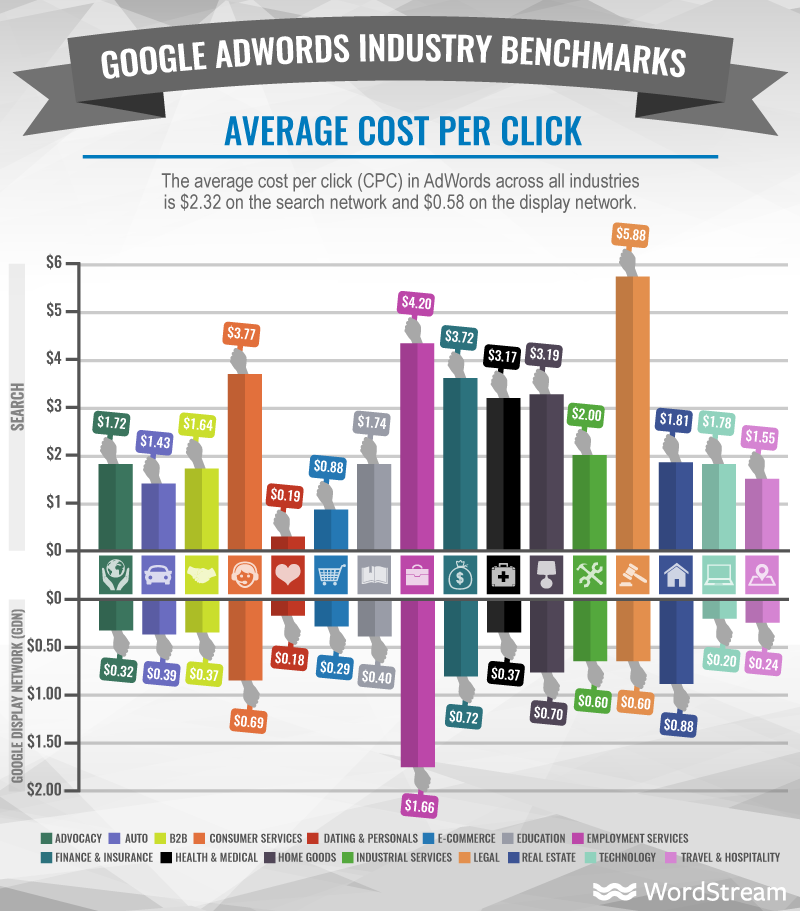
These costs can add up quickly, especially in competitive industries where keywords can go for several dollars a click.
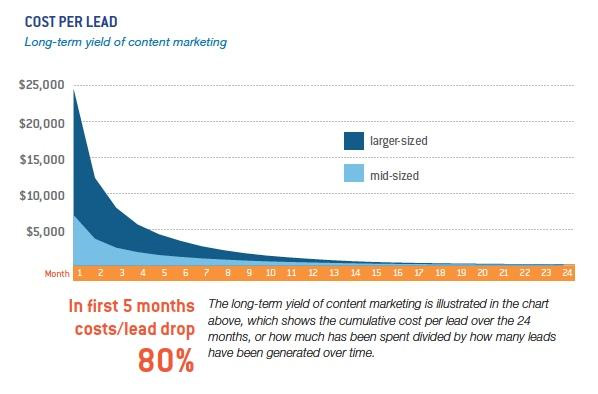
On the other hand, content marketing needs only a modest initial investment to get you started. If you’re really running on a tight budget, you can create content yourself with the only cost being your time.
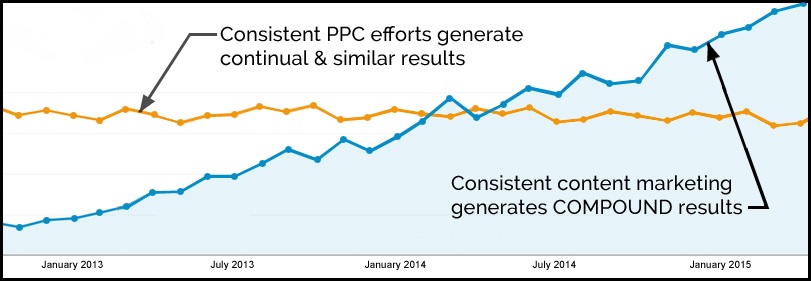
With time and effort, high-quality content can reach the top of search engine results naturally. This means you can be getting those clicks for free instead of paying for each one. And you won’t lose your rankings until someone creates better or more relevant content than you.
The ROI of content marketing and PPC has too many variables to suggest an “average” for each method, even on a per industry basis. But whatever industry you’re in, while PPC may seem to offer a more attractive ROI initially, content marketing almost always offers a better ROI in the long-term.
Content marketing not only attracts more leads for your money, but it generates better quality leads too.
Lead quality is critical for optimizing ROI and increasing revenue. There’s no point in paying for leads (via any method) if they’re not converting.
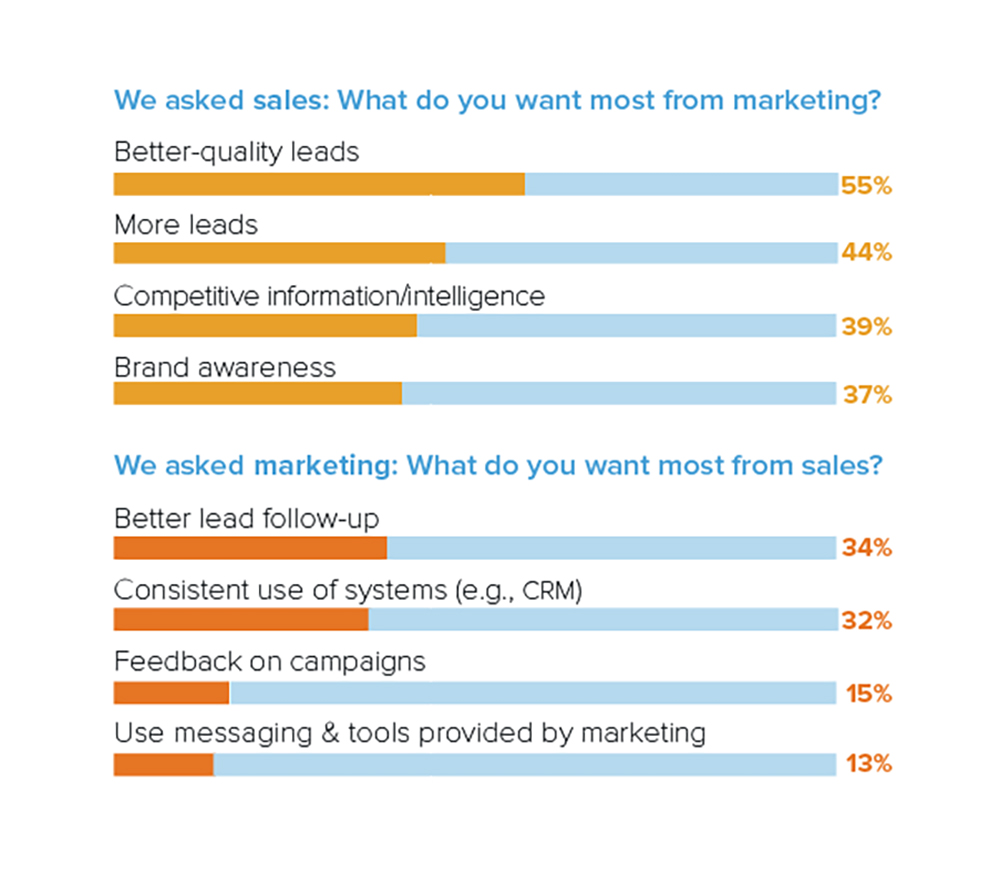
One of the biggest complaints coming from sales teams is that the leads they get from marketing are low-quality ones. This situation can easily happen when sales and marketing aren’t in alignment and only care about their immediate targets. 55% of sales reps surveyed by Demand Gen said that what they want most from marketing is “better leads”.
Producing high-quality content is one of the most effective ways of attracting high-quality sales leads.
Just because you’re paying for leads, it doesn’t mean they’re great quality. A lot of the time leads from PPC are poor because they don’t know your brand or understand your product when they click your ad.
On the other hand, leads generated by content have already been introduced to your brand and educated on some level. And the longer they stick around and keep consuming your content, the better these leads become.
3. Content Marketing Generates Long-term Results
Content marketing campaigns must be planned on a much longer timescale than other marketing techniques. Some people consider this a negative, but being a slow burner offers huge benefits too.
Content marketing builds traffic and rankings that you own. This may happen very gradually, but once you start seeing the results you want, you’re not going to lose them overnight.
The time and money you invest in content marketing now will continue paying dividends well into the future. A single piece of content that might have cost you a couple of hundred dollars to produce could end up generating business and leads worth tens or hundreds of thousands of dollars for years to come.
PPC, on the other hand, is most definitely a short-term strategy. You’ll see the results immediately but if you want to keep having success, you’ll need to keep going.
Anyone can buy clicks, but the value drops to zero once you stop.
4. Content Marketing Is a Simple Model That’s Hard to Mess Up
There’s a real art and science to successful PPC marketing. Not only do you have to know what keywords to bid on, but you also need to bid the right amount, optimize your ads for a high click-through rate, and craft your landing pages carefully to get the results you want.
PPC can be very effective when done well, but in most cases, you’ll have to invest a significant amount of cash before you can see results. If managed properly, PPC can be a good investment but you need a decent budget to get started.
For this reason, it’s sheer madness to attempt a PPC campaign unless you know what you’re doing. If you get lucky then you might see results, but more often than not, you’ll burn through a significant amount of money and have no results to show for it.
As PPC is so complicated, with many moving pieces, most brands using PPC marketing will either employ an in-house expert or outsource to a marketing agency specializing in PPC. Of course, this adds more expense to an already pricey marketing model.
Content marketing, on the other hand, is about as simple as you can get. While there’s certainly a lot to think about when you’re putting together a content marketing campaign, you can’t really get anything “wrong”.
In the worst-case scenario, you’ll publish some content that doesn’t really do anything for you. But all you’ll have lost is the time it took you to create that content or what you paid for it (and content marketing is very affordable compared to other types of marketing, remember).
I’ve seen organizations achieve impressive success with content marketing without following any real plan or tracking results, which just goes to show how simple it is. Those who regularly publish high-quality content and consistently deliver value will be rewarded for their efforts eventually, even if they don’t get all the fine details perfect.
5. People Trust Content More Than Ads
Google is constantly changing the way in which paid ads are displayed in the search results to try and make them blend in more seamlessly with the organic results. The reason for this is that most of the time, searchers don’t want to click on ads.
Most web users these days know that companies have paid to appear in the ads at the top of the search results, whereas web pages that are listed at the top of the organic results are there because they’ve earned it with a great reputation and high-quality information.
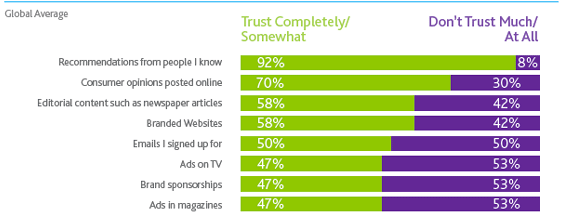
Research by Nielsen has found that 53% of consumers don’t trust ads listed in search engine results and 52% don’t trust ads on social media.
Trust in advertising, in general, has been gradually declining in recent years, with customers preferring to do their own research and more likely to follow recommendations from their peers than brand ads.
Content marketing isn’t advertising. It’s a great way to build trust rather than erode it.
5. You Can’t Succeed in PPC Without Also Investing in Content Marketing
So let’s say you do have the budget to inject into running a PPC campaign and you’re working with an agency that really knows what they’re doing.
You still won’t get the best results unless you also concentrate on creating really great content.
Just think about it – even if you’ve got a really well-written ad and your targeting is spot on, you still have to win over the users that click on the ad.
So that comes down to sales copy, right? Well, yes and no. It’s certainly important to have really well-crafted and optimized landing pages. But your success will be limited unless you’ve also thought about your content marketing strategy.
You might get some sales from users who’ve never heard of your company before and end up on your landing page. But you can greatly increase your chances if you’ve got a library of great content to back you up.
Great content gets shared and comes up frequently in search results. So, if you’ve been doing your job with content marketing well, there’s a good chance that the user who sees your ad and clicks through to your landing page might have seen one of your articles or videos while researching or on their social feeds. When they keep seeing great content from your brand, they’ll remember it and you’ve got a much better chance of making that sale.
While PPC might be great for attracting people to your funnel, you still have to get them through the funnel. And websites that have adopted content marketing convert at a rate that’s six times higher than those that haven’t.
PPC ads can convert well for users who are ready to buy. But for the rest? A report by Gleanster Research revealed that only 25% of your leads are ready to buy at any given time. So what do the other 75% want?
They want to find out more about your company and products or services. They maybe don’t even know yet that they have a need for your products and services. By publishing high-value informational content that addresses their challenges, you can ensure that they stick around for longer. You have a much better chance of making that sale when they’re finally ready to buy.
PPC can still be an effective part of your overall marketing strategy when planned carefully. But it must be used in combination with content marketing if you want to achieve the best results.
Content marketing is a low-cost marketing technique that offers an impressive ROI if you’re willing to stick with it for the long-term.
If you are ready to get more traffic to your site with quality content published consistently, check out our Content Builder Service.
Marketing automation can help a business make the most of their online marketing efforts. Today’s business owner is busy, and not every small business can afford an entire marketing department. Automation is designed to streamline the marketing process and provide a more hands-free experience.
With marketing automation, sales teams can focus more on nurturing customers and leads, and customer service people can follow up and make connections with new clients to help them find their way. From email campaigns to pop-up ads, business owners can automate just about every aspect of marketing.
With more than 10 years of experience in public relations, marketing, advertising and marketing automation solutions, and as the founder of Quarterly Global and various other marketing and advertising-focused enterprises, I believe this guide will help other business owners learn everything they need to know about marketing automation.
What is marketing automation?
Put simply, marketing automation is the process of putting various marketing tasks or efforts on an automated schedule or platform. Rather than implementing all marketing efforts manually, businesses can set schedules and deploy multiple tools to manage and monitor all marketing efforts. This can help make online marketing more straightforward and more efficient.
According to Salesforce, those who use automation can see conversion rates increase by 30% or more. Marketing automation can also help employees save time, increase productivity in sales by more than 14% and reduce marketing overhead by more than 12%.
And with scalable technology growing in availability, there are more solutions for small-business owners and entrepreneurs who don’t have a corporate budget or marketing department.
Working Smarter, Not Harder, With Automation
Marketing automation can make things easier for the business and its marketing department. Automation tools are available for landing pages, email marketing, lead management, analytics, social marketing, pop-up conversions and much more.
Through my company’s own automation strategies, I know there are a few common use-cases for automation you might consider, such as using automation to create dynamic content that is “smart” or “adaptive.” This type of strategy involves using content in ads, emails or websites that change based on user behavior or preferences. This creates a fully customized experience for the user on the spot.
A few other potential use cases for automation may include:
• Automating team collaborations: Some automation tools can aid in collaborative efforts by transmitting information in real-time, which helps departments communicate and keep everyone on the same page.
• Setting up automated nurturing: Not every user is ready to become an immediate customer. However, they might be prepared to learn more information, get a coupon or sign up for an email newsletter. Automated nurturing tools can help companies create a variety of conversions along the sales funnel based on a specific user’s behavior.
• Using email sequencing for follow-up: Creating a sequence that nurtures the lead and invites them to explore more can be especially helpful in a time when people are inundated by spam and junk newsletters.
• Automating list segmentation: Manual segmentation is possible, but it is time-consuming and can also result in errors, which is why some might choose to use automated tools for this task.
• Automating analytics: Business owners can’t measure the success of any marketing efforts without analytics and metrics. There are affordable and free resources online to measure campaigns that can help ensure reports are current and data is fresh.
Choosing The Right Tools For Your Business
Most marketing automation tools will offer some benefits to almost every business. However, some are typically going to be more useful or relevant than others. Here are some questions to ask yourself when searching for the best fit for your company:
• Is it a full-service automation platform? Business owners don’t necessarily have to choose this type of automation tool. However, if they intend to automate multiple marketing elements, it could be easier to have everything in one place.
• Does the automation software include the resources that are required? Although most will cover a variety of automated tasks, some limit their offerings. Review the tools and resources out there to find the ones that deliver precisely what your business needs.
• Am I receiving a one-time charge or a regular fee? Some automation tools can be free to use with limited access. Others might have a one-time use or purchase fee. Still, others may have a monthly or semi-annual fee involved.
• What challenges can I expect along the way? Be particular in analyzing whether the goals of the automation tool are the same as your business’s goals. For example, it wouldn’t make sense to implement an email campaign autoresponder if improvement in website sign-ups is what is desired. That would require automation of a pop-up campaign or another type of conversion optimization.
Conclusion
The numbers don’t lie: Those using marketing automation may see improvements in engagement, conversions, sales, productivity and other aspects of business operations, therefore creating a win-win situation for everyone involved. Automation can also increase a company’s return on investment and free up your sales team’s time so they can focus on nurturing relationships and working through the customer life cycle.
While there is a wide selection of solutions from which to choose, it’s important to ensure the solution you’re considering makes sense for your business. In doing so, organizations can adopt useful automation software and offer an engagement-focused approach to building and growing customer relationships.
When online marketing first began, it was relatively simple.
You ran some PPC ads, an email marketing campaign, and worked on your content marketing.
Today, however, it’s not just a case of creating these things and seeing how they do. You’ve got to successfully manage your social media marketing, social media advertising, PPC ads, email campaigns – if you’re not careful, it can feel like throwing spaghetti at the wall just to see what works.
Fortunately, data analysis and – more specifically – data blending can make your marketing decisions faster and easier to make, with more impact.
What is data blending?
Data blending is simply where you take data from multiple sources and combine them to give you one united dataset.
This is incredibly beneficial regardless of what data you’re looking at but can be even more so for online marketing.
Let’s take a closer look at the benefits of consolidating your marketing data with data blending.
The benefits of consolidating your marketing data
See results across multiple platforms
If you’re running PPC ads on various search engines and platforms, it’s going to take time to look at each individual ad or campaign and assess all the different metrics. It’s going to be even more difficult if you want to see your overall costs at a glance, your overall conversion rate, and more. This is where data blending steps in.
If you’re using a business analytics platform like Sisense you’ll be able to automatically generate data blended dashboards that will present anyone at any level with easy-to-analyse data. You don’t need to pay for data entry to unite your dashboards, and you don’t need to waste your marketing team’s valuable time. They can see what’s going right – or wrong – and make new decisions.
And for the sake of a visual example, a PPC blended view within Sisense would look something like this:
You can see everything about your PPC campaigns – your cost-per-click, conversion rate, and whether or not there is a problem in your funnel.
In the above example, we can see that the funnel is working perfectly, filtering down from impressions to won opportunities. If that funnel effect suddenly dropped off at leads created, you know you have a chink in your armour.
Create anyone-can-read reports
Reports and dashboards really aren’t worth the money if there are only a handful of people on your team that can read them. Especially if they’re not the people that need the data.
If your data essentially needs translating before it’s useful, it’s not doing anyone any good. Sisense reports can be read by just about anyone – if they understand the terms, they can understand the data. It’s crystal clear, which means the right decisions can be made fast.
Identify trends
Do you know that your Instagram ads almost never get clicks on a weekend? Is it like that for all your ads across the board? Using complex data, you can see which campaigns are most effective – or not – and when.
And to truly see such statistics and trends in action, refer to the visual below.
Save money and increase revenue
To build on my point above, knowing when your campaigns are most effective will help you save money and increase revenue. For example, if you are a B2B organization and you realize that you get almost no new leads over the weekend, you could dramatically decrease your spend over the weekend and save money.
Alternatively, if you identify that you get the most for your money on a Monday, you could increase your ad spend and thus increase revenue. It’s important to remember that your ROI depends on smart spending and marketing, not blanket marketing, so it’s worth using a data blending tool to ensure your marketing budget is being utilized effectively.
Hit KPIs or identify where you’re falling short
Your online marketing efforts are one of the biggest reasons why you will be meeting or falling short of KPIs, such as MQLs, sales revenue metrics, and more. Using one dashboard with a blended view will allow you to see if your online marketing is contributing to the problem.
If you have a sales team, you may find for example that your online marketing gets the leads, but they fail to convert once they’re talking to a member of the sales team.
Even if your sales process takes place entirely online, you’ll be able to see how each marketing activity contributes to your results – you may find your PPC ads aren’t converting, but your content marketing and email marketing are. You can then reassess, make changes, and see how things change for you.
As highlighted by Indeed, KPI metrics within business and marketing may include:
Dollars spent on marketing over a certain period
Online traffic (the number of visitors to the company website)
Organic online traffic (the number of visitors to the company website via search engines)
Web traffic (to determine how many visitors are new vs. returning)
Mobile traffic
Click-through rate (the ratio of web traffic that clicks on a particular ad)
The number of visits to a particular piece of content
And based on the needs of your business or client reporting, these KPI metrics can scale further in either direction.
Finding the right tools
Blended view analytics tools are the key to success in online marketing, but it can be difficult to decide which is the best fit for you.
Here are two tools you need to know about:
Sisense
If you’re looking for a tool to manage your complex data, optimize campaigns, and manage your multi-channel marketing efforts, you won’t find better.
Sisense allows everyone in your team to see vital data at a glance, whether or not they have an analytical background. You’ll be able to track the impact of each campaign in one place, see which campaigns and platforms are delivering, and which aren’t. You can then decide if you need to tweak the ad to better suit the audience, or scrap it and double your efforts on a platform that is converting well.
For a complete visual of the platform and it’s many different marketing dashboards (from digital to traditional), you can view them all in action here.
Google Data Studio
If you’re new to using blended dashboards and complex data and are a small business, Google Data Studio is a great place to start. While it is largely a platform that allows you to create reports, you can also use some blended views.
As with many Google tools, it is easy to use but it will throw you right in with no introduction, so you may have to spend some time Googling (ironically) how to get the most out of this tool.
To learn more about the many benefits of Google Data Studio and how to best use this solution, feel free to read over this helpful overview.
Wrapping up
If you’re a large organization, you’re not going to find a better tool than Sisense. Their solution is currently being used by businesses in nearly all industries to access the at-a-glance insight they can’t get from their complex data.
However, if you’re new to using insights or are a small business, Google Data Studio is one of the best tools to help you get started and understand what you want to see from your analytics tools.
No matter what solution you end up going with, it’s more important than ever to start using data blending in your business and marketing efforts.
Guest author: Zac Johnson is a world-renowned blogger and entrepreneur with nearly 20 years of experience in the online marketing space and has helped his readers generate millions of dollars online. He shares his story and guidance at ZacJohnson.com