AI art seems to be everywhere, from social media content created for quick engagement to games on Steam and even Coca-Cola’s Christmas ad. But how prevalent is the use of generative AI among creatives?
The tech is such a controversial and potentially radical force for change in the creative industries, that a range of surveys are trying to get a handle on how much it’s really being used and by whom. So far, there have been some widely divergent findings.
Envato’s recent survey on the State of AI in Creative Work suggested that nearly half of all creative professionals now use AI tools daily, leading to the emergence of an AI-native generation that it’s necessarily sure about what it’s doing. But another survey now suggests that this uptake hasn’t carried over into 3D art, at least not when it comes to AI image generators.
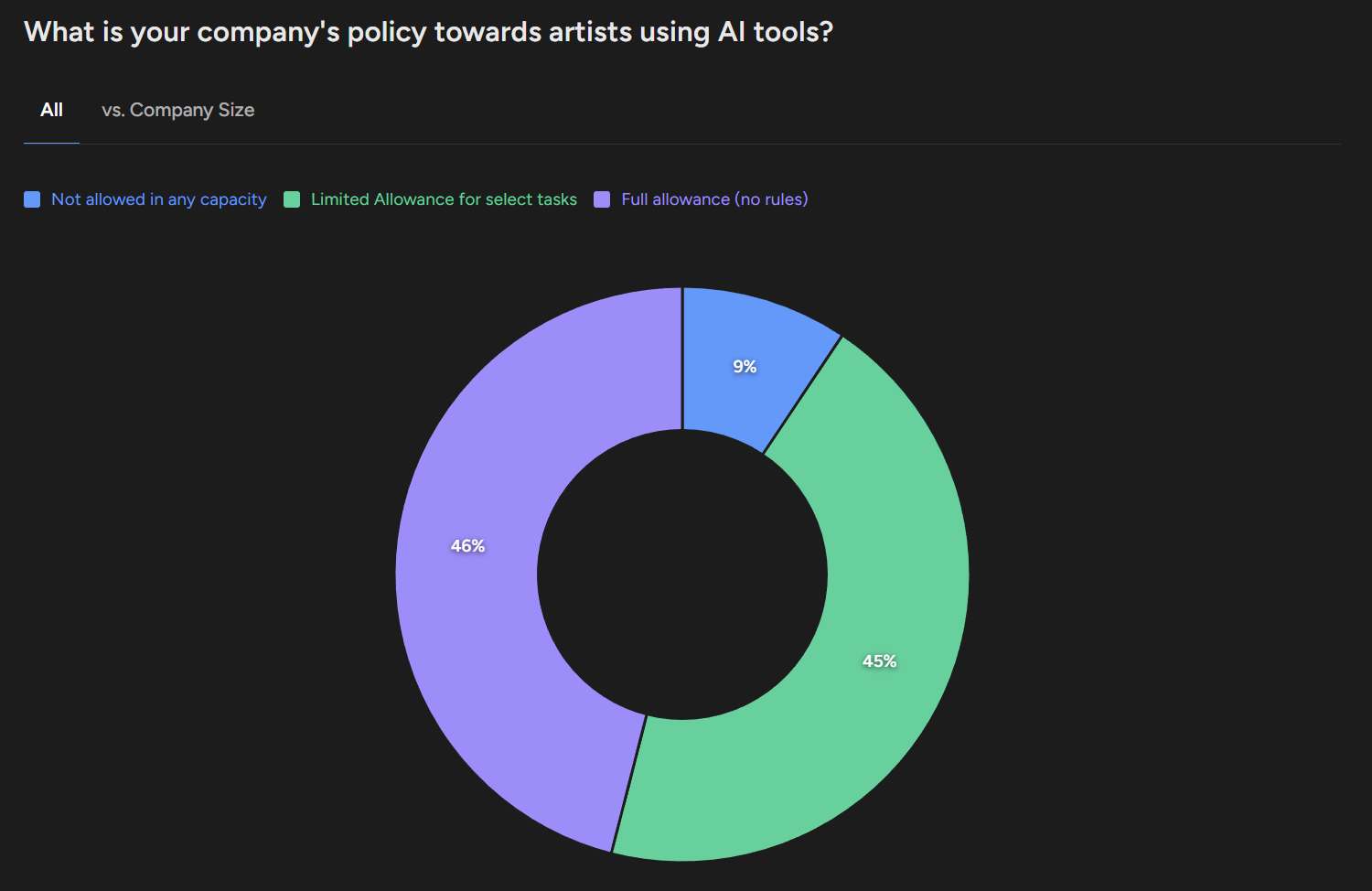
Figures on AI policy from Poliigon’s State of 3D 2025 survey (Image credit: Poliigon)
Poliigon, the 3D resource library founded by Andrew Price, has published State of 3D 2025, its latest annual survey of 3D artists. It received 3,779 responses from 3D artists around the world via its own newsletter, the This Week in 3D Newsletter and social media.
According to the responses, only 22 per cent of 3D artists use AI in their work daily or a few times a week. That’s despite 46% of companies having no restrictions on the use of AI, while only 9% ban all AI use. Some 26 per cent of respondents said they never used AI image generators and 24% used them only a few times per year.
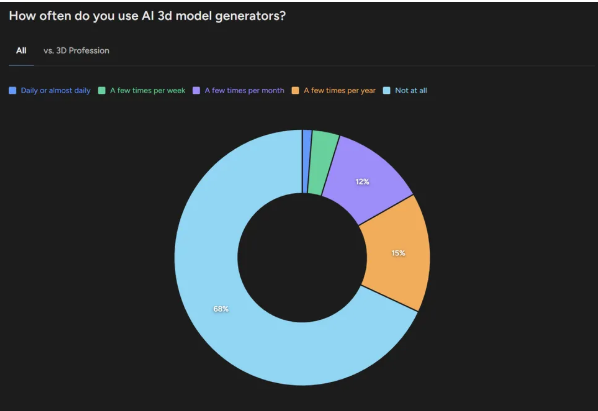
As for AI 3D model generators, usage was even lower. Some 68% said they never used them, and under 5% said they used them daily or a few times a week while 15% said they used them a few times a year.
(Image credit: Poliigon)
Among those who do use AI 3D model generators, there were more non-professionals than professional artists. And the majority of people who say said they use image generators used them for concept art or look dev – although 18% of all respondents said they used AI generators for final assets.
While some see the survey was a rejection of generative AI for 3D work, it may also be the case that the tech still just isn’t good enough for creating final 3D assets. 3D model generators remain severely limited compared to image generators.
Other data from the survey suggests that the advertising industry remains the dominant source of 3D work, while Blender was the most-used software among 3D artists (79% of respondents).
Blender was followed by Photoshop (56%), Substance Painter (29%) and Unreal Engine (27%). However, Houdini scored best when respondents were asked to rate how well their software of choices meets their needs (see our guide to the best 3D modelling software for more options).
As for model libraries, CG Trader is now ahead of TurboSquid in the survey. Almost three quarters of respondents had fewer than 10 years experience in the industry, and the majority were aged between 25 and 44. Over a quarter earn under $20,000 a year. Those with a degree in a related field (nearly half of participants) tend to earn slightly more.
Joe is a regular freelance journalist and editor at Creative Bloq. He writes news, features and buying guides and keeps track of the best equipment and software for creatives, from video editing programs to monitors and accessories. A veteran news writer and photographer, he now works as a project manager at the London and Buenos Aires-based design, production and branding agency Hermana Creatives. There he manages a team of designers, photographers and video editors who specialise in producing visual content and design assets for the hospitality sector. He also dances Argentine tango.
New Content Protection tools let you spot, block, or claim copied videos.
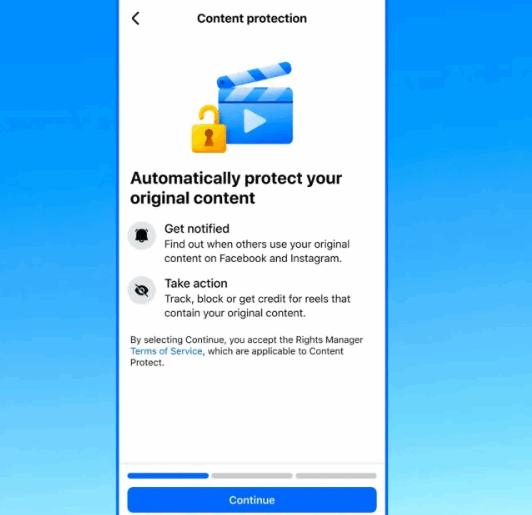
What’s happened?Meta has launched a new Content Protection tool on Facebook to help creators stop people from reposting their videos without permission. It automatically scans Facebook for copies of your reels or videos and alerts you when a match is found.
When someone uploads a video that looks like yours, Facebook will flag it and show you details like match percentage, view counts, and the other account’s audience.
You can then choose to either block the repost, claim it for yourself, or allow it.
The feature is rolling out globally on mobile first, with desktop support coming soon inside the Professional Dashboard.
Meta
Why it matters? Creators have been frustrated for years with people re-uploading their videos, earning views or money off someone else’s hard work. Meta is trying to fix that by giving creators more control and real-time visibility.
The system uses matching tech similar to Rights Manager for identifying exact and near-exact copies.
It gives creators options beyond takedowns, and you can claim credit or decide whether to allow the reuse.
Meta’s goal is to reduce spammy or recycled content across feeds and make original videos stand out more.
Why should I care? If you’re a creator, this tool helps you protect your videos without constantly hunting for reposts.
You’ll get alerts as soon as your video is reused, so you stay in control.
Creators who rely on credit, reach, or monetization get a better shot at protecting their work.
If you’re not a creator, this still affects you as a viewer by showing fewer low-effort duplicates in your feed and more genuine content.
Meta
OK, what’s next? Before using this feature, here are a couple of things you should know:
Content Protection only covers videos originally posted on Facebook; it can detect copies on Instagram, but only if the original reel was uploaded to Facebook first.
The feature is rolling out to creators in Meta’s monetization program who meet its “enhanced integrity and originality standards,” along with creators already using Rights Manager. Others can apply for access directly.
Imagine one night, you’re scrolling through social media on your phone, and the ads start to look remarkably familiar. They’re decked out in your favourite colours, are featuring your favourite music and the wording sounds like phrases you regularly use.
Welcome to the future of advertising, which is already here thanks to AI.
Traditionally advertisers on social media could target people by the demographic segment they were deemed to fit into – for example, if you’re a student in Edinburgh or a 35-year-old woman who likes yoga. Ads would “follow” you around the internet based on what you’d been searching.
But using the ability of AI to draw on vast quantities of data, companies like Cheil UK can create thousands of different ads that are tailored to different personalities and personal situations. The aim is to show countless different ads to millions of people, all unique to them, down to the tone, phrasing, music and colours used.
To do that Cheil UK has been working with start-up Spotlight on an AI platform. To get extra layers of information they ask large language models (LLMs), like ChatGPT, lots of questions about a particular brand to find out what people are saying about it on the internet.
From those answers they might, for example, be able to create an ad that not only suits a 35-year old woman who likes yoga, but also one that has just been on holiday or was about to get married.
“The shift is that we are moving away from what was collected data based on gender and age, and readily available information, to now, going more into a deeper emotional, psychological level,” says Mr Camacho.
“That level is far deeper than it was previously, and that’s when you start to build a picture to understand that individual.”
Cheil. AI ads will attempt to discover and use your emotional state says Chris Camacho
An added bonus for advertisers is that they might not even need a bespoke AI system to personalise their output.
Researchers in the US studied the reactions of consumers who were advertised an iPhone, with tailored text written by ChatGPT based on how high that person scored on a list of four different personality attributes.
The study found the personalised text was more persuasive than ads without personalised text – and people didn’t mind that it had been written by AI.
“Right now, AI is really excelling on that targeting piece. Where it’s still in nascent stages, is on that personalisation piece, where a brand is actually creating creative copy that matches some element of your psychological profile,” explains Jacob Teeny, an assistant professor of marketing at Northwestern University’s Kellogg School of Management, who led the AI research.
“It still has some development to go, but all roads point to the fact that this will become the way [digital advertising is done],” he adds.
Personalised AI ads could also provide a solution to the problem of digital advertising ‘wastage’ – the fact that 15% of what brands spend on digital advertising goes unseen or unnoticed, so it generates no value to their business.
Alex Calder. Alex Calder warns that adverts could turn into “creepy slop”
Not everyone is convinced that personalisation is the right way to go.
“Congratulations – your AI just spent a fortune creating an ad only one person will ever see, and they’ve already forgotten it,” says Brighton-based Alex Calder, chief consultant at AI innovation consultancy Jagged Edge, which is part of digital marketing company Anything is Possible.
“The real opportunity lies in using AI to deepen the relevance of powerful, mass-reach ideas, rather than fragmenting into one-to-one micro-ads that no one remembers. Creepy slop that brags about knowing your intimate details is still slop.”
Ivan Mato at brand consultancy Elmwood agrees. He is also questioning whether people will accept it, whether regulators will allow it, and whether brands should even want to operate this way.
“There’s also the surveillance question. All of it depends on a data economy that many consumers are increasingly uncomfortable with,” says London-based Mr Mato.
“AI opens new creative possibilities, but the real strategic question isn’t whether brands can personalise everything – it’s whether they should, and what they risk losing if they do.”
Elmwood “Should brands personalise everything?” asks Ivan Mato
AI-personalised ads could also take a dark turn, Mr Camacho at Cheil UK acknowledges.
“There’s going to be the camp that uses AI well and in an ethical manner, and then there’s going to be those that use it to persuade, influence, and guide people down paths,” he says.
“And that’s the bit that I personally find quite scary. When you think about elections and political canvassing, and how the use of AI can influence voting decisions and who is going to be elected next.
But Mr Camacho is committed to staying on the right side of ethics.
“We don’t have to use AI to make ads creepy or to influence individuals to do things that are unethical. We’re trying to stay on the nicer side of it. We’re trying to enhance the connection between brands and individuals, and that’s all we’ve ever tried to do.”
This article was updated on 18 November 2025 to clarify how Cheil UK and Spotlight create their adverts.
While marketing industry buzz tells us to expect more automation, so far, the rate of adoption has not reflected expectations. Is this because Machine has not yet reached the perfection that we demand (despite our ample room for human error)? What is it that we fear when we read about the newest automation tech on the block? Realistically, you’re not going to be replaced. Truthfully, all to be feared is that we’ll have more time on our hands to do what we’d prefer to be doing. And yet, the reluctance to automate is strong.
Looking back over the last decade, it’s clear that the introduction of new technology has created greater possibilities and more roles for marketers. It’s inevitable automation and technologies will be playing an even more integral role in the future of marketing. The good news is that it’s OK to take baby steps with automation at first. All automation technologies exist to simplify work processes, however, they come on a scale of complexity. Smaller-scale marketing technologies are designed to relieve you of the more repetitive, mundane tasks. These are the technologies we can hopefully agree are best to start with and therefore more realistic to adopt first. You’re not going to buy a Ferrari when you just passed your test.
Feed automation
You may or may not already be using data feeds in your daily work. If you’re not, a data feed is merely a file that contains information such as inventory. The possibilities a data feed can unlock in marketing have steadily grown. They are mostly used when a marketing channel (e.g. Google, Facebook, AWIN, Amazon) requests your inventory in order to create ads or listings. Relying on the IT department to adapt the data can cause a huge delay and friction in making dynamic and responsive ad campaigns online. This is where a feed automation tool, such as Channable’s feed manager, simplifies the work process. A feed automation tool can automate the creation of feeds for retargeting, social ads, display and many more. Look out for a technology with a good UI and UX because you’re hoping to steer clear from overcomplicating processes.
Online ad automation
If you’ve ever had to write or implement ad copy for PPC ads, you can probably agree it’s fairly cumbersome. There are automation systems on the web that can help you generate hundreds of highly relevant copy for ads, sitelinks and keywords. You do this by building a template using dynamic fields. The system will be directly liked to your ads account, so after you’ve built the ad structure, it’ll only take a click of a button and potentially hundreds of ads are in your account. This then frees up time to focus on optimizing campaigns or bidding. Bidding is also something that you can now automate. AI technology will analyse the optimal time and budget for your keywords. Channable’s PPC tool is an automation tool that can generate the ad copy straight to your account, but there are others that include bidding and advanced targeting possibilities.
Social media automation
Social media has become the best online place to reach your target market. Posting regularly allows you to communicate directly with your audience, helps build a brand image as well as many other things. Social media automation tools allow you to schedule posts so you can prep them in advance and get on with other tasks in the meantime. Tools include Hootsuite and Buffer for scheduling social media posts. There are also tools that can provide you with insights for social media content based on influencers and your competition, such as BuzzSumo. If you’re interested in automating product ads for social media channels, you would actually need a feed manager because the channel will require your inventory in their specific feed format.
Marketplace listing automation
If you or your client is a retailer that sells via the giant online marketplaces, such as eBay or Amazon, marketplace automation can help list products, add new listings, and make easy modifications to existing listings. This is really a plug and play technology as once the connection is made everything is real-time. Check out Channable’s marketplaces integrator to upload to multiple marketplaces from one place or see the possibilities offered by each marketplace.
Email marketing automation
Sending emails to existing clients, reminding old ones that they can still use you, or reaching out to prospective customers are all activities that can be automated. Low-level email automation purely enables you to send a group a certain email at a scheduled time. Mailchimp and Dotmailer are popular choices for email automation. But you can do so much more such as creating different segments, which will allow for specifying the message of the email to the audience you want to read it. Or setting up a sequence, so that a reader will receive follow up emails that you only had to set up once. This is easily created if you’re using a CRM such as Hubspot.
If you’ve gotten to the end of this list and realised you’ve either implemented some or all of the above levels of automation, give yourself a clap on the back. You’re already more adapted to the technological future than you thought. It’s not something to fear and is easier to implement than it appears. If you haven’t implemented them all, remember how much better your life is with one of them and the possibilities the others could open up for you. Automation technologies will be more commonplace in our future and it’s best to start now. It’s all about enabling you to spend your time more wisely. Read Channable’s guide on how to choose a feed manager for the next step in adopting marketing technologies.
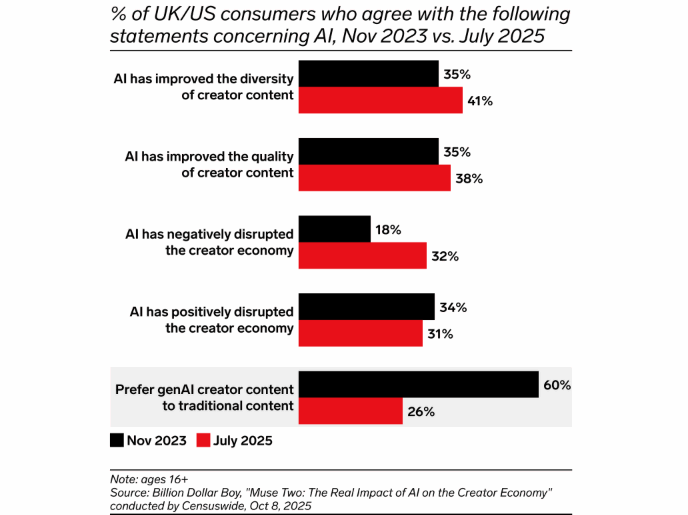
Key Stat: 32% of US and UK consumers say AI is negatively disrupting the creator economy, up from 18% in 2023, according to July 2025 data from Billion Dollar Boy.
Beyond this chart:
Gen Z’s AI tolerance depends on the use case. Some 54% prefer no AI involvement in creative work, but only 13% feel this way about shopping, according to an August 2025 Goldman Sachs survey.
Coca-Cola is betting big on AI ads despite the backlash. The brand released its second AI-generated holiday campaign this season, even though 31% of consumers say AI in ads makes them less likely to pick a brand, according to a July 2025 CivicScience survey.
Use this chart: Marketers can use this chart to look for a performance gap between human-first content and AI-assisted posts, and continuously track consumer sentiment around AI content.
They prove minimalist design can have a big impact.
Today’s advertising sphere often revolves around loud design and wacky viral moments, rarely giving us a slice of earnest branding. Cutting through the noise is Ikea’s new campaign, celebrating the intimate moments of life in its understated yet heartfelt ads.
Known for creating some of the best adverts, thanks to its stripped-back yet strong brand aesthetic, Ikea proves that minimalist design can be just as evocative as loud branding. Homely, relatable and genuine, Ikea’s new campaign captures a slice of life atmosphere that stands out in its simplicity.
(Image credit: IKEA Sweden)
Created by Ikea Sweden in collaboration with creative agency Åkestam Holst NoA, the ‘Wherever Life Goes’ campaign positions the brand as a companion through life’s intimate moments. A warm, close-up shot of a kiss is paired with a cheeky yet subtle price tag for the SÄBÖVIK double bed, while a teary-eyed zoom-in simply gestures to the DUNDERGUBBE moving box, positioning Ikea as a key part of life’s narrative.
Spanning film, print, OOH, radio, and socials, the campaign plays on the universal moments of the mundane, transforming them into tender vignettes. “There are many things that are iconic about IKEA, and the price tag is one of them,” says Michal Sitkiewicz, art director, Åkestam Holst NoA. “By letting something as simple as a price tag become a central part of the storytelling, we can capture the moments that lead to change and show how IKEA can support you through them.”
It’s fun — and often accurate — to think of tech companies in pairs. Apple and Microsoft defined the PC market; Microsoft and Intel won it. Google and Meta dominate digital advertising; Apple and Google won mobile. That, however, is not the defining pair of the smartphone era, which ran from the introduction of the iPhone in 2007 to the launch of ChatGPT in 2022; rather, the two most important companies of the last two decades of tech were Apple and Amazon, specifically AWS.
The Apple part is easy: the iPhone market created the smartphone paradigm, from its user interface (touch) to its distribution channel (the App Store), and was richly rewarded with a bit under half of the unit marketshare and a bit under all of the total profits. Google did well to control the rest in terms of the Android operating system, and profit from it all thanks to Google Search, but it was Search that remained their north star; the company’s primary error in the era was the few years they let the tail (Android) wave the dog (Google).
The AWS part is maybe less obvious, but no less critical — and the timing is notable. Amazon created AWS in 2006, just 10 months before the iPhone unveiling, and the paradigm they created was equally critical to the smartphone era. I explained the link in 2020’s The End of the Beginning:
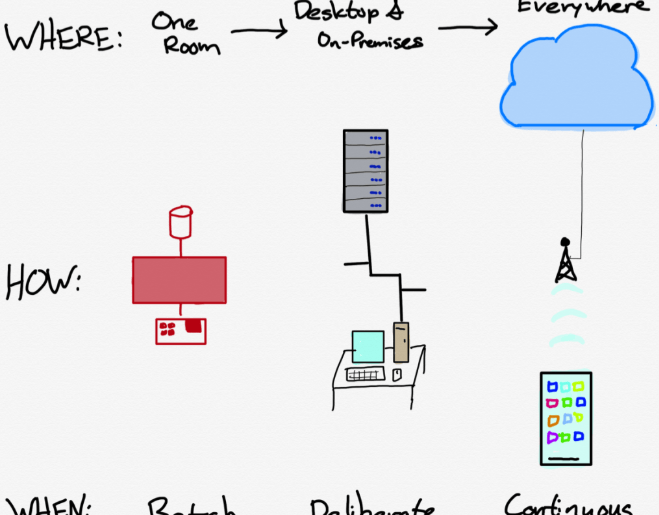
This last point gets at why the cloud and mobile, which are often thought of as two distinct paradigm shifts, are very much connected: the cloud meant applications and data could be accessed from anywhere; mobile made the I/O layer available everywhere. The combination of the two make computing continuous.
What is notable is that the current environment appears to be the logical endpoint of all of these changes: from batch-processing to continuous computing, from a terminal in a different room to a phone in your pocket, from a tape drive to data centres all over the globe. In this view the personal computer/on-premises server era was simply a stepping stone between two ends of a clearly defined range.
AWS was not the only public cloud provider, of course — Azure and Google Cloud Platform were both launched in 2008 — but by virtue of being first they both defined the paradigm and also were the the first choice of the universe of applications that ran on smartphones or, more accurately, ran everywhere.
Smartphone Winners and Losers
If Apple and AWS were the definers — and thus winners — of the smartphone era, then it was Microsoft and Nokia that were the losers. The reasons for their failure were myriad, but there was one common thread: neither could shake off the overhang of having won their previous paradigm; indeed, both failed in part because they deluded themselves into thinking that their previous domination was an advantage.
For Microsoft that previous paradigm was the PC and the Windows platform, which the company thought they could extend to mobile; from 2014’s Microsoft’s Mobile Muddle:
Saying “Microsoft missed mobile” is a bit unfair; Windows Mobile came out way back in 2000, and the whole reason Google bought Android was the fear that Microsoft would dominate mobile the way they dominated the PC era. It turned out, though, that mobile devices, with their focus on touch, simplified interfaces, and ARM foundation, were nothing like PCs. Everyone had to start from scratch, and if starting from scratch, by definition Microsoft didn’t have any sort of built-in advantage. They were simply out-executed.
It took Microsoft years — and a new CEO — to realize their mistake, up and to the point where they put their enterprise productivity dominance at risk; from 2015’s Redmond and Reality:
There’s reality, and there’s Redmond, and if one thing marked the last few years of Steve Ballmer’s tenure as the CEO of Microsoft, it was the sense that those were two distinct locales. In reality, Android (plus AOSP in China) and iOS were carving up the world phone market; in Redmond Ballmer doubled-down on the losing Window Phone bet by buying Nokia. In reality Office was losing relevance because of its absence on the mobile platforms that mattered; in Redmond Ballmer personally delayed Office on iOS until the Windows Modern née Metro version was finished. And in reality, all kinds of startups were taking aim at the Microsoft enterprise stack; in Redmond, Microsoft was determined to own it all, just as they had in the PC era.
It’s fitting that Microsoft and Nokia ended up together; perhaps they were able to jointly go to therapy for success-induced obliviousness of market realities. Nokia dominated the phone market for the decade prior to the iPhone, and even once the iPhone was announced, blithely assumed that they could simply lean on their existing advantages to fend off the Silicon Valley usurper. From 2013’s Blackberry — and Nokia’s — Fundamental Failing:
Nokia dominated all the parts of this stack you don’t see: they had, and in some respects, still have, the best supply chain and distribution network. In addition, they had high quality hardware that served every segment imaginable. Notably absent in these strengths is the OS and Apps. By 2009, BlackBerry OS and Symbian were clearly obsolete, and their app ecosystems, such as they were, were eclipsed by iOS and then Android. The problem, as I alluded to above, is that while the OS was ultimately under the control of BlackBerry and Nokia, respectively, and thus could be fixed, the efficacy of their ecosystem wasn’t, and wouldn’t be…
And so, by far the smartest strategic thing either could have done would have been to accept their weakness — they didn’t have an adequate OS or ecosystem — and focus on their strengths…Nokia should have adopted Android-stock, and used their unmatched supply chain and distribution to do to their competitors, well, exactly what Nokia had been doing to their competitors for the last decade (if you think Samsung is running roughshod over everyone today, in 2007 they could only manage 41 million phones compared to Nokia’s 110 million).
Both BlackBerry and Nokia would have gotten a good OS and thriving ecosystem for free and been able to compete and differentiate themselves on the exact same vectors they had previously. To put it another way, RIM and Nokia had never been successful because of their OS or ecosystem, yet both decided their best response to iOS and Android was to build a new OS! In fact, the strategic superiority of the Android option for RIM and Nokia was even then so obvious that I suspect their core failing was not so much strategic as it was all-too-human: pride. Owning an ecosystem seems much more important than owning services or supply chains, even if building said ecosystem completely devalues what you’re actually good at.
If the first commonality in Microsoft and Nokia’s failure is the assumption that dominance in one paradigm would seamlessly translate into dominance in the next, then the second was in not making the strategically obvious choice — embracing iOS and Android for Windows, and Android for Nokia — for fear of losing control and long-term relevance. What separates the two companies is that Microsoft, under CEO Satya Nadella, rectified their mistake, while Nokia doubled-down with Windows Phone; that is why Microsoft still matters today — more than ever, in fact — while Nokia phones no longer exist.
The two companies that stood in contrast to Microsoft and Nokia were Google and Samsung; while their dominance of the non-iPhone market seems obvious in retrospect, it wasn’t at all pre-ordained. What is impressive about both companies is that they had the opposite of pride: both were quite shameless, in fact. From 2013’s Shameless Samsung:
Every pre-iPhone phone maker is irrelevant, if they even exist, except for Samsung, who is thriving. Samsung the copycat was smart enough to realize they needed to change, and quickly, and so they did.
Or maybe it wasn’t being smart. Maybe it was simply not caring what anyone else thought about them, their strategy, or their inspiration. Most successful companies, including Apple, including Google, seem remarkably capable of ignoring the naysayers and simply doing what is right for their company. In the case of smartphones, why wouldn’t you copy the iPhone? Nokia refused and look where that got them!
We, especially in the West, have a powerful sense of justice and fairness when it comes to product features and being first. Business, though, is not fair, even if it is more just than we care to admit.
Just as Samsung blatantly copied Apple hardware, Android blatantly copied the iOS interface:
Plenty of people mocked Google for this shift, but not me: Apple figured out what worked; it would have been foolish to not copy them.
Cook struck an optimistic tone, noting that Apple is typically late to promising new technologies. “We’ve rarely been first,” the executive told staffers. “There was a PC before the Mac; there was a smartphone before the iPhone; there were many tablets before the iPad; there was an MP3 player before iPod.” But Apple invented the “modern” versions of those product categories, he said. “This is how I feel about AI.”
Andy Jassy:
The first thing I would say is that I think it is so early right now in AI. If you look at what’s really happening in the space, it’s very top heavy. So you have a small number of very large frontier models that are being trained that spend a lot on computing, a couple of which are being trained on top of AWS and others are being trained elsewhere. And then you also have, I would say, a relatively small number of very large-scale generative AI applications.
We Will Serve Actual Use Cases
Tim Cook:
We see AI as one of the most profound technologies of our lifetime. We are embedding it across our devices and platforms and across the company. We are also significantly growing our investments. Apple has always been about taking the most advanced technologies and making them easy to use and accessible for everyone, and that’s at the heart of our AI strategy. With Apple Intelligence, we’re integrating AI features across our platforms in a way that is deeply personal, private, and seamless, right where users need them.
Andy Jassy:
We have a very significant number of enterprises and startups who are running applications on top of AWS’ AI services and but, like the amount of usage and the expansiveness of the use cases and how much people are putting them into production and the number of agents that are going to exist, it’s still just earlier stage than it’s going to be, and so then when you think about what’s going to matter in AI, what are customers going to care about when they’re thinking about what infrastructure use, I think you kind of have to look at the different layers of the stack. And I think…if you look at where the real costs are, they’re going to ultimately be an inference today, so much of the cost in training because customers are really training their models and trying to figure out to get the applications into production.
Our Chips Are Best
Tim Cook:
Apple Silicon is at the heart of all of these experiences, enabling powerful Apple Intelligence features to run directly on device. For more advanced tasks, our servers, also powered by Apple Silicon, deliver even greater capabilities while preserving user privacy through our Private Cloud Compute architecture. We believe our platforms offer the best way for users to experience the full potential of generative AI. Thanks to the exceptional performance of our systems, our users are able to run generative AI models right on their Mac, iPad, and iPhone. We’re excited about the work we’re doing in this space, and it’s incredibly rewarding to see the strong momentum building.
Andy Jassy:
At scale, 80% to 90% of the cost will be an inference because you only train periodically, but you’re spinning out predictions and inferences all the time, and so what they’re going to care a lot about is they’re going to care about the compute and the hardware they’re using. We have a very deep partnership with Nvidia and will for as long as I can foresee, but we saw this movie in the CPU space with Intel, where customers are anchoring for better price performance. And so we built just like in the CPU space, where we built our own custom silicon and building Graviton which is about 40% more price performance than the other leading x86 processors, we’ve done the same thing on the custom silicon side in AI with Trainium and our second version of Trainium2…it’s about 30% and 40% better price performance than the other GPU providers out there right now, and we’re already working on our third version of Trainium as well. So I think a lot of the compute and the inference is going to ultimately be run on top of Trainium2.
We Have the Data
Tim Cook:
We’re making good progress on a more personalized Siri, and we do expect to release the features next year, as we had said earlier. Our focus from an AI point of view is on putting AI features across the platform that are deeply personal, private, and seamlessly integrated, and, of course, we’ve done that with more than 20 Apple Intelligence features so far, from Visual Intelligence to Clean Up to Writing Tools and all the rest.
Andy Jassy:
People aren’t paying as close attention as they will and making sure that those generative AI applications are operating where the rest of their data and infrastructure. Remember, a lot of generative AI inference is just going to be another building block like compute, storage and database. And so people are going to actually want to run those applications close to where the other applications are running, where their data is. There’s just so many more applications and data running in AWS than anywhere else.
Both Apple and Amazon’s arguments are very plausible! To summarize each:
Apple:Large language models are useful, but will be a commodity, and easily accessible on your iPhone; what is the most useful to people, however, is AI that has your private data as context, and only we can provide that. We will provide AI with your data as context at scale and at low cost — both in terms of CapEx and OpEx — by primarily running inference on device. People are also concerned about sharing their personal data with AI companies, so when we need more capabilities we will use our own compute infrastructure, which will run on our own chips, not Nvidia chips.
Amazon:Large language models are useful, but will be a commodity, and widely available on any cloud. What is the most useful to companies, however, is AI that has your enterprise data as context, and more enterprises are on AWS than anywhere else. We will provide AI with a company’s data as context at scale and at low cost — both in terms of CapEx and OpEx — by primarily running inference on our own AI chips, not Nvidia chips.
What is notable about both arguments — and again, this doesn’t mean they are wrong! — is how conveniently they align with how the companies operated in the previous era. Apple powered apps with Apple Silicon on the edge with an emphasis on privacy, and Amazon powered apps in the cloud with its own custom architecture focused first and foremost on low costs.
The AI Paradigm
The risk both companies are taking is the implicit assumption that AI is not a paradigm shift like mobile was. In Apple’s case, they assume that users want an iPhone first, and will ultimately be satisfied with good-enough local AI; in AWS’s case, they assume that AI is just another primitive like compute or storage that enterprises will tack onto their AWS bill. I wrote after last fall’s re:Invent:
The emphasis on “choice” in the presentation, first in terms of regular AWS, and then later in terms of AI, is another way to say that the options are, in the end, mere commodities. Sure, the cutting edge for both inference and especially training will be Nvidia, and AWS will offer Nvidia instances (to the extent they fit in AWS’ network), but AWS’s bet is that a necessary component of generative AI being productized is that models fade in importance. Note this bit from Garman leading up to his Bedrock discussion:
We talked about wanting this set of building blocks that builders could use to invent anything that they could imagine. We also talked about how many of the cases we walked through today, that we’ve redefined how people thought about these as applications change. Now people’s expectations are actually changing for applications again with generative AI, and increasingly my view is generative AI inference is going to be a core building block for every single application. In fact, I think generative AI actually has the potential to transform every single industry, every single company out there, every single workflow out there, every single user experience out there…
This expansive view of generative AI’s importance — notice how Garman put it on the same level as the compute, storage, and database primitives — emphasizes the importance of it becoming a commodity, with commodity-like concerns about price, performance, and flexibility. In other words, exactly what AWS excels at. To put it another way, AWS’s bet is that AI will be important enough that it won’t, in the end, be special at all, which is very much Amazon’s sweet spot.
Go back to that illustration from The End of the Beginning: Apple and Amazon are betting that AI is just another primitive in continuous computing that happens everywhere.
The most optimistic AI scenarios, however, point to something new:
A better word for “Anywhere” is probably autonomous, but I wanted to stick with the “Where” theme; what I’m talking about, however, is agents: AI doing work without any human involvement at all. The potential productivity gains for companies are obvious: there is a massive price umbrella for inference costs if the end result is that you don’t need to employ a human to do the same work. In this world what matters most is performance, not cost, which means that Amazon’s obsession with costs is missing the point; it’s also a world where the company’s lack of a competitive leading edge model makes it harder for them to compete, particularly when there is another company in the ecosystem — Google — that not only has its own custom chip strategy (TPUs), but also is integrating those chips with its competitive leading edge large language model (Gemini).
Still, all of this is a stepping stone toward Cook’s grand vision, which hasn’t changed in a decade. He wants true augmented reality glasses — lightweight spectacles that a customer could wear all day. The AR element will overlay data and images onto real-world views. Cook has made this idea a top priority for the company and is hell-bent on creating an industry-leading product before Meta can. “Tim cares about nothing else,” says someone with knowledge of the matter. “It’s the only thing he’s really spending his time on from a product development standpoint.”
Still, it will take many years for true AR glasses to be ready. A variety of technologies need to be perfected, including extraordinarily high-resolution displays, a high-performance chip and a tiny battery that could offer hours of power each day. Apple also needs to figure out applications that make such a device as compelling as the iPhone. And all this has to be available in large quantities at a price that won’t turn off consumers.
What seems likely to me is that for this product to succeed, Apple will need to figure out generative AI as well; I posited last year that generative AI will undergird future user interfaces in The Gen AI Bridge to the Future. From a section recounting my experience with Meta’s Orion AR glasses:
This, I think, is the future: the exact UI you need — and nothing more — exactly when you need it, and at no time else. This specific example was, of course, programmed deterministically, but you can imagine a future where the glasses are smart enough to generate UI on the fly based on the context of not just your request, but also your broader surroundings and state.
This is where you start to see the bridge: what I am describing is an application of generative AI, specifically to on-demand UI interfaces. It’s also an application that you can imagine being useful on devices that already exist. A watch application, for example, would be much more usable if, instead of trying to navigate by touch like a small iPhone, it could simply show you the exact choices you need to make at a specific moment in time. Again, we get hints of that today through deterministic programming, but the ultimate application will be on-demand via generative AI.
In the very long run this points to a metaverse vision that is much less deterministic than your typical video game, yet much richer than what is generated on social media. Imagine environments that are not drawn by artists but rather created by AI: this not only increases the possibilities, but crucially, decreases the costs.
That may have also sounded fanciful at the time, but it’s already reality: just yesterday Google DeepMind announced Genie 3; from their blog post:
Today we are announcing Genie 3, a general purpose world model that can generate an unprecedented diversity of interactive environments. Given a text prompt, Genie 3 can generate dynamic worlds that you can navigate in real time at 24 frames per second, retaining consistency for a few minutes at a resolution of 720p.
[…] Achieving a high degree of controllability and real-time interactivity in Genie 3 required significant technical breakthroughs. During the auto-regressive generation of each frame, the model has to take into account the previously generated trajectory that grows with time. For example, if the user is revisiting a location after a minute, the model has to refer back to the relevant information from a minute ago. To achieve real-time interactivity, this computation must happen multiple times per second in response to new user inputs as they arrive…
Genie 3’s consistency is an emergent capability. Other methods such as NeRFs and Gaussian Splatting also allow consistent navigable 3D environments, but depend on the provision of an explicit 3D representation. By contrast, worlds generated by Genie 3 are far more dynamic and rich because they’re created frame by frame based on the world description and actions by the user.
We are still far from the metaverse, to be clear, or on-demand interfaces in general, but it’s stunning how much closer we are than a mere three years ago; to that end, betting on current paradigms may make logical sense — particularly if you dominate the current paradigm — but things really are changing with stunning speed. Apple and Amazon’s risk may be much larger than either appreciate.
Google Appreciation
Genie 3 is, as I noted, from Google, and thinking about these paradigm shifts — first the shift to mobile, and now the ongoing one to AI — has made me much more appreciative and respectful of Google. I recounted above how the company did what was necessary — including overhauling Android to mimic iOS — to capture its share of the mobile paradigm; as we approach the three year anniversary of ChatGPT, it’s hard to not be impressed at how the company has gone all-in on relevancy with AI.
This wasn’t a guarantee: two months after ChatGPT, in early 2023, I wrote AI and the Big Five, and expressed my concerns about the company’s potential disruption:
That, though, ought only increase the concern for Google’s management that generative AI may, in the specific context of search, represent a disruptive innovation instead of a sustaining one. Disruptive innovation is, at least in the beginning, not as good as what already exists; that’s why it is easily dismissed by managers who can avoid thinking about the business model challenges by (correctly!) telling themselves that their current product is better. The problem, of course, is that the disruptive product gets better, even as the incumbent’s product becomes ever more bloated and hard to use — and that certainly sounds a lot like Google Search’s current trajectory.
I’m not calling the top for Google; I did that previously and was hilariously wrong. Being wrong, though, is more often than not a matter of timing: yes, Google has its cloud and YouTube’s dominance only seems to be increasing, but the outline of Search’s peak seems clear even if it throws off cash and profits for years.
Meanwhile, I wasn’t worried about Apple and Amazon at all: I saw AI as being a complement for Apple, and predicted that the company would invest heavily in local inference; when it came to Amazon I was concerned that they might suffer from not have an integrated approach a la Google, but predicted that AI would slot in cleanly to their existing cloud business. In other words, exactly what Apple and Amazon’s executives are banking on.
I wonder, however, if there is a version of this analysis that, were it written in 2007, might have looked like this:
Nokia will be fine; once they make a modern OS, their existing manufacturing and distribution advantages will carry the day. Microsoft, meanwhile, will mimic the iPhone UI just like they once did the Mac, and then leverage their app advantage to dominate the lower end of the market. It’s Google, which depends on people clicking on links on a big desktop screen, that is in danger.
I don’t, with the benefit of having actually known myself in 2007, think that would have been my take (and, of course, much of the early years of Stratechery were spent arguing with those who held exactly those types of views). I was, however, a Google skeptic, and I’m humble about that. And, meanwhile, I have that 2023 Article, where, in retrospect, I was quite rooted in the existing paradigm — which favours Apple and Amazon — and sceptical of Google’s ability and willingness to adapt.
Today I feel differently. To go back to the smartphone paradigm, the best way to have analysed what would happen to the market would have been to assume that the winners of the previous paradigm would be fundamentally handicapped in the new one, not despite their previous success, but because of it. Nokia and Microsoft pursued the wrong strategies because they thought they had advantages that ultimately didn’t matter in the face of a new paradigm.
If I take that same analytical approach to AI, and assume that the winners of the previous paradigm will be fundamentally handicapped in the new one, not despite their previous success, but because of it, then I ought to have been alarmed about Apple and Amazon’s prospects from the get-go. I’m not, for the record, ready to declare either of them doomed; I am, however, much more alert to the prospect of them making wrong choices for years, the consequences of which won’t be clear until it’s too late.
And, by the same token, I’m much more appreciative of Google’s amorphous nature and seeming lack of strategy. That makes them hard to analyse — again, I’ve been honest for years about the challenges I find in understanding Mountain View — but the company successfully navigated one paradigm shift, and is doing much better than I originally expected with this one. Larry Page and Sergey Brin famously weren’t particularly interested in business or in running a company; they just wanted to do cool things with computers in a college-like environment like they had at Stanford. That the company, nearly thirty years later, is still doing cool things with computers in a college-like environment may be maddening to analysts like me who want clarity and efficiency; it also may be the key to not just surviving but winning across multiple paradigms.
With the launch of GA4, Google has put in place its biggest change to analytics in the company’s 21-year history. The new system unifies the measurement of apps and websites and is intended to provide marketers with a far more detailed understanding of their campaigns.
Fifty-five London waxes lyrical on the potential of GA4.
As it is set to replace the older version of Google Analytics, digital marketers should develop a plan now for fully implementing it. Here are six things you need to know about the new system.
1. It is built for the mobile-first era
Google Analytics has been around for 21 years and was built with desktop websites in mind. But in today’s mobile-first environment, the insights we need are different. Apps have been the catalyst to transform how we consume information on mobile by providing brands with controlled content environments. GA4 combines data from the two sources into a single suite. Although this was possible before, GA4 has introduced a new framework to make this far more practical and intuitive. This enables us to glean richer insights with customers behaving very differently across apps and websites.
2. It’s not just about app and web measurement
Google’s new platform was initially named App+Web. However, the new system isn’t just about analysing data from mobile apps and websites in one screen. GA4 will become the new version of Google Analytics. However the new product has different and more advanced capabilities than Universal Analytics. It uses machine learning based automated insights, new report types and improved data sampling behaviour to provide actionable insights. This will enable practitioners to develop more sophisticated and personalised customer experiences and journeys. This will also apply even if they are just focusing on website data.
3. Events are the new building block
The old product was based on the idea that people have ‘sessions’ and ‘page views’. This was behaviour compatible with a web and content-focused approach. GA4 takes a radically different approach, looking at user behaviour through a different lens. It replaces page views and sessions with a building block called an ‘event’. This could refer to a variety of different behaviours. It could still be a ‘page view’ to understand how people consume content. However it could also be people completing a specific series of actions, like a funnel. Therefore, it is more suited to the way modern brands want to engage with their customers. It represents a fundamental change in the framework of how we measure people doing things.
4. It enables more advanced personalisation
The platform can be coupled with other Google products including the Google Marketing Platform, Google Ads and its personalisation platform – Google Optimize. This will enable marketers to glean new machine learning led insights about individual behaviour. Currently, Google Analytics based audiences in Optimize take several minutes to be processed and calculated. The new data model enables this in a matter of seconds. Additionally previously challenging analyses, for example segment overlaps or user journey pathing, can now be built in a matter of minutes thanks to the new Analysis section of the platform. GA4 also means better calculation of audiences and the ability to serve ads to these audiences at a cross-device and cross-platform (web & app) setting. This is of course provided that the advertisers have the required consent on multiple devices.
5. Don’t delete your old analytics yet…
Despite its potential, it is important to work with the right experts to unlock the system’s potential. Part of this is setting up the right parameters. Like with any new system, upgrades are occurring each quarter which are then being refined and improved as result of user feedback. It is critical to manage expectations as to what can be achieved. Although GA4 is a massive step in the right direction, there are some features missing that exist in Universal Analytics. This includes important marketing analytics functions such as multi-channel funnels and data-driven attribution. Therefore you should retain access to the old Universal Analytics and GA4. This will be crucial for year on year reports for a holiday season comparison for example.
6. It presents an improved suite of privacy & consent options
There have been significant changes to privacy regulations and more importantly, the public’s awareness of how their data is used, since the inception of Google Analytics 21 ago. Google is working on a new suite of features to ensure compliance with modern privacy regulations that will be applicable to GA4. This ranges from region-specific audience personalisation settings to their new Consent Mode product. We can expect GA4 to receive continuous improvements on this front.
By engaging with the platform now, digital marketers can get a head start on competitors by truly realising its potential. With GA4 set to become the mainstream Google Analytics platform in 2021 there is no time to waste.
OpenAI’s latest reported change being considered to ChatGPT is drawing a wide-range of strong reactions from users.
The ever-evolving world of artificial intelligence features frequent updates to tools, often including new models and features. However, the latest chatter surrounding the biggest name in AI is a potential change that would almost certainly spark immense user pushback. While OpenAI has rolled out several updates to ChatGPT and most recently launched their new browser ChatGPT Atlas, the latest reported change being considered has all the makings of a financial decision.
Although streaming giants such as Netflix, Hulu and Amazon Prime Video land in a somewhat different area of the technology landscape, they may soon have something in common with ChatGPT—ads.
OpenAI Reportedly Considering Bold Change to ChatGPT by Integrating Ads
Although nothing has been confirmed yet, The Information reportedly stated that OpenAI is considering integrating advertisements into ChatGPT. The report, as Culture Crave revealed, also says that the company is exploring the possibility of basing the ads shown on ChatGPT on user chat memory.
It’d be a major move, and one that would likely lead to pushback from a large share of ChatGPT users. However, it’s unclear whether users who pay for a higher-tier AI tool would be excluded from seeing advertisements. If that were the case, it would avoid at least some of the general pushback against the possible move.
It sounds as though the idea is still in its early stages at OpenAI, but as we’ve seen in the world of artificial intelligence, things can move quickly. Regardless of whether it happens or not, the responses to the report poured in, and it’s fair to say they didn’t include much positivity.
ChatGPT Users & Others React to OpenAI Possibly Integrating Advertisements
Although the negative comments far outweighed the positive regarding the news, there was a fair mixture of comedy as well. In some cases, the comedic reactions prompted real questions about how OpenAI would roll out these ads.
“Imagine if the AI responded like in ads: ‘Great question! But before I answer, let me tell you about today’s sponsor – NordVPN,’” one user wrote.
Among the several noteworthy responses that poured in, a few key takeaways included:
Opinions that this will hurt the brand
Possibilities of a subscription fee to avoid the advertisements
Frustration over the inability to use many types of technology without ads
Pushback stating that if the ads were integrated into paid ChatGPT subscriptions, some would cancel their accounts
While this is comical to consider, it would also be a legitimate worst-case scenario for users. However, it’s hard to envision OpenAI choosing this path for integrating ads into ChatGPT, a tool that prides itself, at least in part, on speed.
Another user responded jokingly, pointing to ChatGPT monetizing their “late-night rants about cat conspiracy theories.”
“Oh, brilliant! Now ChatGPT can monetize my late-night rants about cat conspiracy theories with perfectly timed cat food ads. Truly living the dream in this brave new ad-infested world!”
The possible move from OpenAI also sparked confusion among users about why they’d even consider it over continuing to build something bigger.
“Why don’t they just focus on building superintelligence? It’s way bigger than ads, lmao, and it’s not like they’ll run out of funding anytime soon,” said one user.
“Because as we all know, putting ads on stuff doesn’t immediately tank anything in lieu of an ad-less version,” replied another user. “After putting ads on it they’ll bring out a small subscription fee to remove them. Make everything worse, charge to restore it.”
Others raised concerns about OpenAI using chat history for the ads.
“Using our chat history for advertisements is absurd. This is essentially the quickest way to discourage people from using ChatGPT,” read another reply.
Regardless of what aspect of the possibility that ads could be integrated into ChatGPT they were most concerned with, it appears that the feeling is mostly a widespread consensus.
Controversial brands, campaigns or rebrands tend be the ones we remember. We’re all still talking about Cracker Barrel and Jaguar after all. But what happens when the controversy works in a brand’s favour?
What about when a brand does something so bold is ends up skewing public opinion towards it?
Here are eight examples of when it works, chosen by Patrick Dillon from WISE Digital Partners, a digital marketing agency.
01. Nike – Dream Crazy
‘Dream Crazy’ – Colin Kaepernick Nike Ad 2019 – YouTube
American football star Colin Kaepernick taking the knee at an NFL game in protest at police brutality was a landmark political event of the 2010s. And to reflect this growing movement, Nike released Dream Crazy, with the slogan ‘Believe in something, even if it means sacrificing everything’ and Kaepernick as its star.
Because of Kaepernick’s political affiliations, the ad was seen by some as anti-American, and protests soon erupted with the hashtag #JustBurnIt seeing people burn their shoes.
However, this turned out not to be the disaster some predicted, as Nike’s online sales surged by 31 per cent.
“Nike understood that controversy can clarify a brand’s identity,” says Patrick. “They didn’t chase everyone’s approval; instead, they strengthened their bond with those who shared their values.”
In 2015, everyone was talking about this billboard. Not because it was one of the best billboards around, but because of its controversial message ‘Are you beach body ready?’ paired with an image of a woman in a bikini.
The advert was accused of promoting unrealistic beauty standards and ads were vandalised and penalised across England’s capital.
But… the outrage drove awareness, and Protein World reported profits of around £1 million from a £250,000 spend.
“While the message was tone-deaf, the conversation it started dominated headlines,” says Patrick. “Controversy multiplied Protein World’s exposure at a fraction of the cost of traditional advertising.”
Benetton is no stranger to controversial ads but its 2011 Unhate campaign, which showed world leaders kissing (including the Pope) took things to another level. The Vatican condemned it, governments demanded its removal, and some citizens tore down posters.
Benetton refused to apologise, and the campaign ended up winning a Cannes Lions award. The brand’s stance reinforced its identity as a provocateur unafraid to challenge global politics through art.
04. Pot Noodle – Nothing Satisfies like Pot Noodle
Last year, a UK commercial for Pot Noodle caused a wave of disgust to sweep the nation. It featured an exaggerated slurp noise that caused many to cringe/mute their TVs.
People complained and the brand responded with a tongue-in-cheek “apology” campaign and a quieter version of the ad.
“Humour can disarm outrage. Pot Noodle leaned into the criticism rather than retreating, and the controversy boosted engagement massively,” says Patrick.
Burger King isn’t exactly known for making huge political statements, but its Whopper Neutrality advert took on the thorny issue of net neutrality. In the ad, customers were told they needed to pay extra to get their Whopper faster, mimicking what internet slowdowns could look like without regulation.
The concept was divisive but the brand racked up over 4.6 million YouTube views and 127k likes.
“Burger King showed that controversy doesn’t always need to offend; it can challenge,” says Patrick. “It’s a fantastic example of how good advertising can translate a complex policy issue into something everyone can understand.
06. Gillette – The Best Men Can Be
Commercial Ads 2019 – Gillete – The best men can be – YouTube
While some viewed the ad as progressive, others found it patronising.
But in terms of numbers, the ad was a success, racking up more than 30 million views. “Gillette reframed its heritage slogan for a new cultural moment, expanding the brand’s appeal among socially conscious millennials,” says Patrick.
It’s not easy to market a toilet spray, but Poo-Pourri won audiences by embracing blunt humour.
Its viral video featured a well-dressed woman candidly discussing “dropping the motherload.” The brand got over 40 million YouTube views and became a household name overnight.
“Humour, honesty, and the willingness to say what others won’t became the winning formula,” says Patrick. “Poo-Pourri proved that relatability beats refinement when talking about awkward products.”
During heated political debate over immigration, Budweiser aired a Super Bowl ad chronicling its founder’s immigrant journey. Some saw it as a subtle critique of travel bans; others viewed it as a patriotic reminder of the American dream.
The ad went viral with over 21 million views in three days.
“Budweiser reminded Americans that every brand has a story rooted in human ambition; the message resonated because it felt real and sincere, not opportunistic,” says Patrick.
Rosie Hilder is Creative Bloq’s Deputy Editor. After beginning her career in journalism in Argentina – where she worked as Deputy Editor of Time Out Buenos Aires – she moved back to the UK and joined Future Plc in 2016. Since then, she’s worked as Operations Editor on magazines including Computer Arts, 3D World and Paint & Draw and Mac|Life. In 2018, she joined Creative Bloq, where she now assists with the daily management of the site, including growing the site’s reach, getting involved in events, such as judging the Brand Impact Awards, and helping make sure our content serves the reader as best it can.