Are you using Instagram Stories to its fullest potential? Want to make your stories more consistent and engaging?
To explore how to use Instagram Stories for your brand, I interview Sue B. Zimmerman on the Social Media Marketing Podcast.
Sue is an Instagram marketing expert and author of The Instagram Strategy Guide. Her online course is called Ready, Set, Gram.
You’ll find tips and techniques for using Instagram Stories to help your business stand out, and discover how to use the new Create features that just dropped.
TikTok is attracting a small but growing group of publishers eager to master the short-form video platform and its young and growing audience.
While most are still in an experimentation phase when it comes to using TikTok, they’re learning what works and what doesn’t on an app that doesn’t yet have publisher-friendly resources like discovery tabs or the sharing of ad revenues. For now, few have dedicated resources to the platform, choosing instead to treat it as an experimental channel.
Vice, which just started using TikTok earlier this year, is finding its TikTok followers crave exclusive content. Next month, Vice is planning to launch a Munchies by Vice account on TikTok and Vice Chief Digital Officer Cory Haik said the account will feature exclusive content made specifically for TikTok by Vice’s own social innovation team, which produces content for a variety of platforms.
“We need to go in with a specific offering that feels native to what users of TikTok are producing themselves,” said Haik. “We can’t do a derivative.”
Those daily short-form videos, she said, “will still feel like Munchies,” but will also “feel very TikTok. It will have a different voice.”
Vice is still figuring out exactly what kinds of videos to post on TikTok for Munchies, but some early ideas include celebrating food bloopers, using recipes many people know but often mess up on, but embracing those failures. Or developing viral skits that look more closely at trending food items or themes. One example is, if throwing cheese on walls is trending on TikTok, Munchies might create a video that looks at which cheeses stick and why.
“It sounds like a big investment but we’re just optimizing teams that already exist,” Haik said.
BuzzFeed, which also started using TikTok earlier this year with four different accounts, isn’t creating exclusive content for TikTok just yet, but said reception to its repurposed video content has been positive. One of BuzzFeed’s most popular posts is from Nifty, demonstrating a baking hack.
“One of our motivating factors to be on TikTok and create a Tasty account was that we were finding a lot of copycat Tasty accounts on TikTok,” Tabir Akhter, head of platform strategy at BuzzFeed said. “People want to see food content on TikTok. It’s not only videos from high school bathrooms. It’s more than that. It’s a huge and robust platform of lots of people with lots of different interests, and people are really responding to our huge viral food videos on Tasty.”
She said her team has been very strategic and thoughtful about how they adapt existing video content for TikTok so that “it doesn’t feel like an imposter. If feels very native.” BuzzFeed is also thinking about launching more original TikTok content next year.
Hearst Magazines, which has been using TikTok and its former iteration, Musical.ly, since May 2017, also repackages content from other platforms onto TikTok. It’s found certain types of content to be the most engaging: namely, anything featuring celebrities and “mesmerizing” content, said Sheel Shah, Hearst Magazines’ vp of strategic partnerships and consumer products. One of Seventeen’s most popular TikTok posts, he said, was one that showcased the art of bullet journaling.
Historically, publishers have been reticent to spend time and money on platforms where it’s not clear how they can generate revenues. Currently, there is no mechanism for creators or publishers to directly monetize on TikTok, such as with sharing ad revenue, but all three publishers are hopeful there will be one day.
The short-form nature of TikTok videos, however, makes it relatively cost-effective to produce new content as Vice intends to do, but it also forces creators to get creative, even when they’re adapting existing content.
“What makes TikTok unique is the hyper-speed at which content is created and consumed,” said Akhter. “We do enjoy the really short-form nature of the videos … it forces your creativity in the adaptation process.”
Shah, however, said he wonders if TikTok will eventually allow longer-form video content like Musical.ly did before, since he finds the 15-second video format somewhat limiting.
All three publishers said they view TikTok primarily as a long-term way to engage and grow their respective audiences, similar to how they did with Snapchat a few years before.
“For TikTok, right now it’s more about long-term audience development and one day, maybe, monetization,” Shah said. “We want to figure out what this audience is interested in and how we can extend this understanding onto other platforms where we do have ROI.”
The strategies for the two platforms, however, are different, although both TikTok and Snapchat appeal to younger user bases and feature short-form video content.
“Snapchat, for us, is very curated and magazine-like,” said Akhter. “But on TikTok, there’s a huge potential for binge behavior and to go into a rabbit hole of our content, and we’re eager to serve them with that.”
At Vice, Haik said they’ve gotten their Snapchat strategy “down to a science” and they are not aiming to do original content on that platform, or on Instagram in the same way they’re doing it on TikTok.
One thing all can agree on about TikTok, however, is that its user base skews young. A leaked ad pitch deck fromJune 2019 said the majority of TikTok users (69%) are from Generation Z (ages 16 to 24), while 25% are age 25 and older. Most users are also female (60%). In the U.S., TikTok has more than 30 million monthly active users who spend, on average, 46 minutes on the app, per user, per day. Globally, the number of monthly active users is 800 million, with 500 million based in China.
Snapchat, by comparison, has 210 million daily active users worldwide, and eMarketer estimates it reached 297.7 monthly active users this year.
“We still believe, more so than ever, there’s a huge audience on the platform,” Shah said. “It’s a great opportunity for us to engage and interact with that new generation of consumers. We want to make sure that we’re there. We can get feedback on what this audience likes and doesn’t like, which informs our broader content strategy.”
While all three publishers have participated in trending hashtags on TikTok, none we spoke to have purchased a hashtag challenge or branded lens.
Looking ahead, Vice’s Haik said she wonders if TikTok will enable creators to have direct-sell ads and she thinks it could also be a platform where Vice could place branded content. She, along with Shah and Akhter, also said they wonder if and how TikTok will eventually make it easier for users to discover creators, their media titles included.
Smartphone traffic now accounts for the majority of visits to retailers, but mobile conversion rates lag behind desktop. We take a look at the reasons for this.
A decade on from the release of the first iPhone, mobile shopping is massive. Much of this is thanks to Apple, and the many smartphones which followed, but there are still obstacles for retailers to overcome.
According to stats from Monetate, smartphone traffic worldwide to retailers is at 56.2%, and 34.5% for desktop.
However, this mobile traffic is converting at less than half the rate of that on desktop, at 2.25% compared to 4.81% for desktop. Even tablet fares better, converting at 4.06% on average.
We’ve seen the same pattern in our own stats. Around half of all visits to retailer’s sites come from mobile, but just 36% of purchases take place on mobile.
It seems that people are happy to browse on mobile, but many still prefer to buy on desktop, so let’s look at the reasons why.
There are several reasons why people prefer to buy on a laptop or PC. For one, it can be easier to navigate around the site and view images on a bigger screen, so some shoppers may browse on mobile and select products later on.
People are also more likely to buy on desktop when purchases are more complex. Travel purchases are generally more expensive and complicated – only 18% complete bookings on mobile.
Much of the issue comes down to checkout. Indeed, the add to cart rates shown above suggest this. While mobile conversion rates are less than half that of desktop, add to cart rates aren’t so far behind.
Even in sectors where shoppers are more likely to use mobile, such as fashion, mobile conversion rates still lag behind desktop.
Fashion sites attract a greater proportion of sales on mobile. In fact, this is the only sector to attract the majority of its sales from mobile shoppers (51.39%).
However, data from our recent Fashion Ecommerce Trends Report finds that fashion conversion rates are almost twice as high on desktop when compared to mobile.
Mobile usability on fashion sites has improved greatly, but some customers are still reluctant to convert via mobile devices.
The average mobile add to cart rate is 10.4%, compared to 12.9% for desktop. This implies that people are adding items to their cart at similar rates, but many more are bailing out during checkout.
The biggest issue behind lower mobile conversions is the checkout. So how can checkout be made easier? Here are three ways to do this…
People hate registering before they begin a purchase, and it seems like hard work for mobile shoppers, so providing a guest checkout option is one way to improve conversion rates.
It’s a barrier for customers, and one that isn’t necessary, as they can complete registration after purchase anyway. Streamlining forms makes checkout easier and faster, reducing hassle for shoppers, and removing sources of friction where people might abandon checkout.
Sites can allow users to autofill address and payment details saved on their phone’s browser, or postcode lookup tools to reduce the number of steps customers need to take.
Small details matter, such as defaulting to the most appropriate smartphone keyboard, like the numeric version for entering payment card details. It’s about making it easier for customers through marginal improvements.
Payment methods matter too, and providing alternatives can make it easier for mobile shoppers. Card details take time to enter, but PayPal and digital wallet options like Apple Pay can make payment fast and smooth.
Mobile is a challenge for retailers, but now that customers have shown they’re willing to browse and buy on mobile, it’s all about making the payment process smooth and easy for shoppers.
Feature Image Credit: Photo by William Iven on Unsplash.
As privacy concerns grow, companies like Google and Facebook that rely on data collection and advertising for revenue are increasingly in the spotlight. But is it really possible to give up Google’s vast range of services? Here are my recommended alternatives.
Over the past two years, I’ve been switching between a succession of iPhones and a series of Android devices, using each for an extended amount of time. Spending months with each mobile platform has been a tremendously useful exercise, helping me understand the strengths and weaknesses of the two dominant smartphone options.
But every time I pick up one of those Android devices, a nagging question pops up in the back of my mind. It’s the same one I hear from friends, family members, and readers every time the topic turns to smartphone platforms: “Aren’t you worried about your privacy when you run Google’s software?”
It’s a legitimate question, and there’s no easy answer.
Google, like Facebook, has a business model that’s built on surveillance. The company’s stated mission of “organizing the world’s information” also includes capturing as much as possible of your information. That information is the base layer of some undeniably useful services, which in turn fuel the advertising that makes up the overwhelming majority of Google’s revenue.
In the first six months of 2019, Google took in just over $75 billion in revenue. More than 84% of that revenue, about $63.3 billion, came directly from the advertising platform made possible by data collected from a few billion people, including you and me.
To be fair, Google provides ample privacy controls, including options to delete saved data. They also count on most people being too busy, distracted, or unconcerned to actually use those controls. And even if you meticulously delete your activity history. there’s not much you can do about the profile that Google and its subsidiary DoubleClick (and the advertising ecosystem that’s grown up around them) create based on those activities in real time.
Going through Google’s default privacy controls is an exhausting task.
Unlike the other giant of online advertising, Facebook, the option to delete your Google account isn’t very practical. It’s hard to imagine a world without Google’s outsized influence, but it is possible to rebuild your personal online environment around an alternate set of services and experiences.
There are plenty of options from smaller third parties, but for the most part the replacements for the Google services you know come from Apple and Microsoft. Those two tech giants have the requisite scale, but their business models don’t rely disproportionately on data collection and advertising. When your revenue comes mostly from high-margin hardware (in Apple’s case) and business-focused productivity services (in Microsoft’s case), it’s easier to place greater value on personal privacy, and there’s less incentive to design products and services that explicitly turn data into revenue.
So how do you reduce the role of Google in your tech life? I took a look at my own experience to see where you’ll find the most interesting alternatives. Note that some of these options require paid subscriptions, in contrast to Google’s ad- and data-supported services.
Say adios to Android
There are two and only two mobile device platforms that matter: Android and iOS. As a result, ditching Google means learning to love Apple hardware and software. Because of the way Google licenses Android, it’s almost impossible to find a device that isn’t loaded with Google services. And although you can tweak and tune privacy settings and replace default apps, you can’t easily get rid of the Google Play services and store.
Switching to an iPhone isn’t exactly painful (except perhaps for the pricetag). You get world class hardware, and you also avoid one of Android’s worst flaws: unpredictable updates.
Apple devices get fully supported updates for years, and you are not at the mercy of a carrier to get the latest version. That support lasts a long time, too. The iPhone 6S, for example, which debuted more than four years ago, runs the brand-new iOS 13 and will be supported for another year. You can’t say that about any Android phones released in 2015.
In fact, even new devices often have to wait, sometimes forever, for upgrades. I have three Android phones on my desk right now, from Motorola, Samsung, and Google. All three devices were released in 2018, but each one is running a different Android version (8, 9, and 10). I have no idea if or when those two phones running out-of-date Android versions will get the latest features.
And I have to say I trust Apple’s biometric support more than I trust the same features on Android devices. A pair of snafus involving biometric technology this week, on the latest premium devices from Samsung and Google, make me even more comfortable with switching platforms.
Choose an alternate default web browser
If your objective is to cut ties with Google, you’ll need to choose a different web browser than Google Chrome, naturally. The logical alternatives are Mozilla Firefox and Opera; on MacOS and iOS, you can also choose Safari.
Several people in the comments section have recommended the Brave browser, a relatively recent addition to the category, led by Mozilla co-founder Brendan Eich and focused relentlessly on privacy. I tried Brave when it first came out and will take another look. It’s a strong contender.
The dark horse in this field is Microsoft’s new cross-platform Edge browser, based on the open-source Chromium engine. (I do not recommend the current Edge browser, available only in Windows 10, which is deprecated and will probably be replaced within a year.)
The most relevant feature is tracking protection, which offers this simple but easy-to-understand interface in the new Edge Settings pane on the desktop.
This Edge setting blocks trackers without requiring third-party software.
How effective is it? Click that Blocked Trackers link to see a running count. On this browser, the number-one source of trackers is Google, which accounts for more than 20% of the blocks on my production PC.
Although it’s technically in a beta release, the new Edge browser has been extremely stable on Windows 10 for me; it also runs on MacOS and has versions for iOS and Android. It allows you to install extensions directly from the Chrome Web Store, and pages you visit look like they’re running in Chrome.
The Bing brand is an easy punchline for anyone trying to get some cheap tech-oriented laughs, but the underlying data is no joke. In its just-concluded 2019 fiscal year, Microsoft brought in more than $7.6 billion in revenue from search advertising. That’s a fraction (less than 10%) of what Google makes, but it’s still a very big business on its own; that revenue makes it the fifth biggest division at Microsoft, one of the only companies big enough to compete with Google on this playing field.
But you don’t have to insert yourself into Bing’s advertising ecosystem, either. The privacy-focused DuckDuckGo (“the search engine that doesn’t track you”) returns results using Microsoft’s data along with a few hundred other primary sources,
In the comments, several readers have recommended Startpage.com, a Dutch company that uses Google search results repackaged in a privacy-focused format that eliminates tracking.
Replace Google Voice
I’ve always been reluctant to use Google Voice for any serious business-related purpose, because it seemed like yet another free service that Google would eventually kill off. One plausible theory I’ve heard is that Google Voice is so widely used by Google execs that discontinuing it is not an option.
Google Voice has the twin benefits of being device-independent and supporting SMS messages. That means you can use a virtual number other than your regular mobile phone number for security-related tasks, like two-factor authentication. That makes SIM-swapping scams dramatically less effective.
Google Voice also runs on multiple devices, which is handy for someone who switches devices regularly. Not having to reconfigure 2FA when you switch to a new device is liberating.
I can’t find a free alternative to Google Voice that I can comfortably recommend, but the venerable Line2 service, at $10 per month (or $99 a year, billed annually) fills the bill. YouMail, a call-blocking and voicemail service, includes a second line with SMS support as a standard feature on its $10.99 per month YouMail Professional products. I’ve used it for several years and recommend it.
Use something other than Gmail as your default email client
I’m old enough to remember when Gmail was a closed beta and you had to have an invitation to get your own account. In retrospect, we should have gotten a clue that something was amiss when the Gmail beta launched, officially, on April Fool’s Day, 2004. (Not a joke. DuckDuckGo it.)
Back in 2017, Google stopped its controversial practice of scanning the content of free Gmail accounts for the purpose of targeting ads, and the company says any processing it does of message content (to generate reply suggestions, for example) is done by machines. And, of course, paid GSuite business accounts have always been disconnected from Google’s ad infrastructure.
The main reason I don’t use Gmail, though, has nothing to do with privacy. It’s just that I really really don’t like the browser-based interface on the desktop, where I do most of my serious email work. Alas, that’s how Google wants its customers to use Gmail on PCs, and Gmail developers don’t seem to care that their service doesn’t play well with other clients.
For business accounts, I use Office 365, and most of my personal accounts are on Outlook.com. If your employer uses Gmail, you’re not free to switch, but for personal mail it’s easy to set up a new default address, forward messages from Gmail, and hardly skip a beat.
For paid business email, there are third-party alternatives if you’d rather avoid working with Microsoft directly. I recommend Intermedia, which offers hosted Exchange and Office 365 with a much less intimidating interface. Many hosting providers offer email options to go with your custom domain; for example, you can get Office 365 subscriptions from GoDaddy, with or without a hosting package. It pays to check with your current hosting provider.
Simple steps can make the difference between losing your online accounts or maintaining what is now a precious commodity: Your privacy.
Some of Google’s stickiest services are its cloud-based storage and collaboration tools: GSuite (Docs, Sheets, Slides), Google Drive, and Google Photos.
Office 365, which includes a terabyte or more of OneDrive storage with every subscription, is the logical alternative to GSuite and Google Drive. Earlier this year, I did a comprehensive comparison of the two services, “Office 365 vs G Suite: Which productivity suite is best for your business?” Read that for a quick refresher on what makes Office 365 different from GSuite.
You can also choose from a wealth of independent cloud storage providers, including well-known services like Dropbox and Box and others that are less well known but technically superior, like Intermedia’s SecuriSync, which is available bundled with email and Office or as a standalone product.
Google Photos is a harder service to replace. For the basic task of backing up and organizing your digital photos, both Apple (iCloud) and Microsoft (OneDrive) offer options to upload photos from the default camera roll on your mobile device to their respective services. OneDrive is the clear choice if you also want those photos to be accessible on a Windows 10 PC.
But no one quite does the AI-powered magic that Google does with Photos. Just be aware that all that magic also feeds Google’s insatiable appetite for data.
Consider Apple’s Maps app
In its early days, Apple’s Maps product was clearly inferior to Google Maps. That’s no longer true, and Maps now plays the same counterweight-to-Google role on iPhone that Bing plays to Google Search. Location tracking is one of the key privacy concerns of our time, so it’s worth at least trying to make the switch.
For those who decide Apple Maps is not good enough, though, you have no credible alternatives to Google.
How do you solve a problem like YouTube?
If you’re a YouTube fan, there’s virtually no way to avoid having your activities tracked by Google, with the inevitable algorithmic recommendations not far behind.
And there’s nothing quite like YouTube on the planet. You can avoid some tracking by using your browser’s private/incognito mode, but that’s at best a partial fix.
Do you see any options I missed? Use the contact form to send me your thoughts via email, or share other alternatives in the comments section below.
Despite a strong third quarter, Snap’s future there are still concerns about future growth thanks to growing competition from other youth-targeted apps like TikTok.
Snap reported earnings after the bell on Tuesday. The company posted a 4 cents per share loss, beating the Refinitiv analyst estimate of a loss of 5 cents a share. It also had higher-than-expected revenue for the quarter, bringing in $446 million versus the $435.1 million estimate.
The report also noted that about 210 million accounts use Snapchat on a daily basis, above the 207 million user estimate. Each daily user opens the app about 30 times.
But despite the earnings wins and stock prices that have skyrocketed 154 percent year-to-date, Snap’s fourth-quarter guidance came in a little lighter than analysts expected. The company advised revenue would be $540 million to $560 million next quarter. Analyst estimates from Refinitiv expected the company’s midpoint revenue to be at $555.4 million.
Snap pitches its advertisers heavily on the fact that its app Snapchat is one of the only places to reach younger audiences who may no longer be watching traditional media like television. The company claims to reach about 90 percent of 13- to 24-year-olds in the U.S., and three-quarters of 13- to 34-year-olds.
“Snapchat helps brands reach Millennials and Gen Z, hard to reach and highly coveted audiences,” Snap chief business officer Jeremi Gorman said during an investor call on Tuesday. “Together, these generations have over $1 trillion dollars in direct spending power, and they are not as active on more traditional advertising mediums. Meaning to reach them, marketers need to find them on immersive mobile platforms, like Snapchat.”
However, Snapchat may not be the platform of choice for younger generations in the future. Video editing platform TikTok is already pulling in a strong youth base, despite only being a year old. According to Apptopia, about 48 percent of TikTok’s users are under 20, or about 288 million of their estimated 600 million monthly active users.
“Snap’s user base may be growing, but it now faces fierce competition not only from Instagram but also from TikTok when it comes to attracting advertisers eager to reach younger audiences,” social media marketing platform Socialbakers CEO Yuval Ben-Itzhak said via email. “There was a time when Snap was considered indispensable for reaching this younger market. But today, in addition to the ongoing threat from Instagram, many marketers see TikTok as the most relevant platform for reaching teens and young adults.”
Only 67 million of Snap’s user base are in their teens, per Apptopia data, and the 297.7 million monthly active user estimates from eMarketer doesn’t indicate the growth of habitual daily users. (Snap does not disclose monthly active users, only daily active user rates.)
“Competition from upstart social platform TikTok is still looming, however, and it could lead to lower engagement for Snapchat in the future because both platforms target the youth audience,” said eMarketer principal analyst Debra Aho Willaimson via email.
Meanwhile, multiple publishers told Cheddar the cost of creating original, bespoke content for Snapchat was often not worth the ad revenue it would receive for the projects.
Snapchat is relying on original series to help draw in new users and keep them on the platform longer. Viewing times on the platform has increased 40 percent year-over-year, said Snap CEO Evan Spiegel on a call with investors on Tuesday.
“Time spent and viewership on our content platform continue to grow rapidly, with more than 100 Discover channels reaching a monthly audience of over 10 million viewers in Q3,” he said.
You can offer educational content as a primary or complementary business line in your organization.
Every business must attract and grow a user base. You could have the best idea in the world, but without users, there is no revenue — and without revenue, there is no business.
You are an expert in your respective domain. You understand the ins and outs of the space you operate in and the pain points in the market. So, why not take that knowledge and repurpose it into a membership site to better engage customers, increase loyalty and generate even more revenue?
What do I mean by a membership site? I mean a digital portal where, based on your strategy, customers can access content about specific subjects related to the industry in which you operate. This is generally a mix of educational and informative content such as courses, white papers, webinars and more.
This idea is becoming more popular as a primary or complementary business line in an organization. Having built these sites for organizations, I suggest you consider a few key things before creating your own.
Determine how you can add value.
The point of a membership site is to drive value for existing and new customers. The benefit to you is that you will have an engaged community that is loyal and more likely to purchase from you.
So, like most things in business, make sure you address a problem your members are having and create a solution that helps them solve it.
Create a solution that works for your members.
When you implement a paid (or free) membership solution, chances are the members are busy people who are focused on improving their businesses. They are using your solution as a tool to help them achieve this goal. That’s why quality matters.
Your messaging needs to be clear and concise. Navigation needs to be intuitive and easy. And your site needs to offer value in order for people to stay engaged (and continue paying).
Before you market your solution, create a plan around this. Determine what your messaging will look like, how often you will communicate and how frequently you’ll make updates or add content. I also recommend implementing marketing automation where possible so the manual burden is reduced.
Create a solution that works with your business case.
Build a platform that supports what you want to accomplish. Too often people overlook the importance of making sure the technology and software used to create the platform are right for what they want to accomplish.
Scope out and summarize what you envision the future features/functions to be so the team building the platform can make the right decisions from the start. Some basic things you might want to consider include:
What type of content will be in your membership portal?
How often will data be backed up?
How many members will you have?
Will you be able to scale your servers in the event there is high demand?
Will the site be able to load fast and run smoothly for users?
What type of data and analytics do you want/need?
Will people use the site on mobile? If so, is it optimized for mobile?
Build a valuable brand.
This is something I encourage every single business I work with to do no matter what. Your brand is one of the only things that sets you apart from the competition — so make it good.
A membership site can be a great core business or complementary product to an existing business line. However, you need to ask yourself why someone would pay to be a member when, chances are, they could find a good amount of the content you’re providing online already.
The answer is because they trust your brand to provide high-quality and credible content that can give them an edge, and they like the idea and benefits of being part of an exclusive community and the convenience of having everything in one place.
Determine your monetization strategy.
This is something that can evolve over time, but determine how you will monetize your membership site, what success looks like and how you will measure ROI. Here are a few common monetization strategies:
Offer a recurring membership fee-freemium model, where you have some free content and other content that requires a paid membership.
Monetize through advertisements/sponsorship.
Upsell extra features or services to your core business.
Mix and match the tactics listed above.
A membership site can be a great way for your business to grow and retain loyal customers. Spend time thinking about how this can best fit into your organization and how it can add the most value.
Feature Image Credit: Getty Images
By Kasey Kaplan, founder of KWK Studio & Quuie, nd co-founder of Urban FT. His business passions focus on strategy, marketing & product.
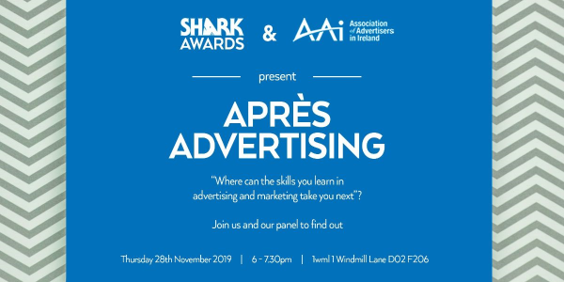
Après Advertising: Where can the skills you learn in advertising and marketing take you next?
About this Event
The Shark Awards and the Association of Advertisers in Ireland bring you this special event – looking at and chatting about:
How the skills you develop in the world of advertising & marketing can take you almost anywhere in your working and creative life.
A special showing of Donal Moloney’s short film “Ad Men in Sheds” will be screened as part of this event, with two of the featured Ad Men joining the panel to discuss this topic.
On the back label of every Drumshambo Gunpowder Irish Gin bottle it states in bold type: ‘From The Curious Mind of PJ Rigney.’
Well, Pat’s ‘curious mind’ began getting very curious when he worked in marketing at Gilbeys. His tale about how he went on to create his own famous drinks brands is well worth listening to – over a drink.
Pat will be joined by Barry Devlin, who began his career as an advertising copywriter and went on to become a rock star, and a writer, and a filmmaker – and you’ll need a long drink for his tale as well.
Camille Donegan began her career in the creative/arts sector as an actor. Her working environment there exposed her to another, more tech-led career that involved intense study in the IT sector to gain the knowledge that has brought her to the XR sector of Augmented Reality and Virtual Reality. See and hear the real Camille.
Loretta Dignam has worked most of her career at Marketing Director level in blue-chip multinationals: Mars Inc, Diageo, Kerry Group, and Jacob Fruitfield. She was the winner of the Marketer of the Year Award in 2011, chaired the Gender Equality committee of the Abbey Theatre and is chair of the Development Committee. She set up The Menopause Hub, Ireland’s first and only dedicated menopause clinic. Loretta is a truly enlightened marketeer and you’ll hear her story at Après Advertising on Thursday.
Panel moderator for the evening is Orlaith Blaney formerly CEO of McCann Dublin and former President of IAPI. Orlaith is now Chief Communications and Marketing officer at Ervia, with responsibility for Irish Water and she will share some of her own views on the topic.
Tea, coffee and biscuits will be served on arrival and there’ll also be a glass of wine on offer later to wrap up the evening.
Dwell time is one of those ranking factors which is proven to impact your overall site’s SEO.
It is a user-based metric that refers to the period or length of time that a user spends on a page after a click. It is not the most talked-about metric. But it is an important measurement that every marketer should be paying attention to.
Dwell time is a good indicator that can help in evaluating the quality of your website traffic. However, the results of this metric can be misleading at times.
In this article, we will discover more about dwell time and its relationship with SEO.
What is Dwell Time?
The concept of dwell time was first introduced in 2011 in a Bing article. The blog post written by Duane Forrester indicated how to build quality content. This was the first time that the idea of dwell time was talked about and now it seems that the whole digital marketing community is raving about the concept.
In the blog, dwell time was defined as the actual time duration that a visitor spends on a page before going back to SERPs (Search Engine Results Pages).
Suppose I’m researching “Best digital marketing practices for startups in 2019”, I’ll type this into the search engine box. I’ll likely click on the results that interest me the most. Let’s say it took me 5 minutes to read the article I land on, and after reading the whole article, I return to the SERPs. The time between these two clicks is what dwell time is. So in this instance, 5 minutes is my dwell time.
Longer dwell times are considered as beneficial for businesses. If a person spends one minute or more on your page, then it is considered positive, and it concluded that the visitor is consuming the content. Duane considered it as a good signal. On the other hand, less than a couple of seconds time period is considered a poor result.
It is also important to understand that all three metrics, namely, dwell time, bounce rate, and average time-on-page are indicators of different results. These terms are not interchangeable.
Dwell time is not the bounce rate of the website.
It is not the average time a user spends on your page.
It is not the click-through rate. The role of dwell time only measures the results of what happens after the click. It does not measure or calculate the percentage of users who click on a result.
It is not session duration. The session duration is the amount of time a user is spending in clicking around your website. And in this case, the session didn’t begin with a keyword search. Therefore, it cannot end back at the SERPs, and it won’t calculate the time between those clicks.
Does dwell time really affect your SEO?
Now, let’s understand the relationship between dwell time and SEO. First of all, dwell time is a metric that we cannot measure. Only Google has access to measure the length of clicks. You can track a user’s engagement with the help of Google Analytics but can only measure dwell time with a third-party tool.
Classification of dwell time:
30 seconds or less than – The content was not up to the mark, and the user was not satisfied. So, he/she went back to find something better.
1 to 2 minutes – The content was useful for the user because they spent a couple of minutes reading the information.
15 minutes – The user finds the content super-useful.
On the basis of the above classifications, we can say that dwell time is a good indicator of the relevance and the quality of the content. It can have a big impact on SEO as it is an indicator of engagement and SEO is all about creating more engagement. Low dwell time is a clear sign that the users are not getting the desired or useful information on your site.
We all know the fact that every click is a visit. But as a businessman, all of us would like to engage with our customers for a longer duration of time and the dwell time is an exact measure of that time.
However, even if you click back after 15-20 minutes, Google will consider it as a bounce. Therefore, it is clear that bounce rate cannot give results about the level of engagement.
Instead of bounce rate, dwell time can be used as a ranking signal because people can bounce for a number of reasons. Also, it is easier for Google to calculate the data and measure the dwell time.
Dwell time can be measured by taking two other metrics into consideration – time on page and bounce rate. If the time on page is high and there is a low bounce rate, then it will be considered as high dwell time.
Factors which affect dwell time
Here are some of the factors which may affect dwell time:
Slow page load speed.
Your website is not mobile-friendly (Since a lot of users are using mobile phones, it is important for you to ensure that your site is mobile-friendly).
The title tag and description are inaccurate.
Improve your dwell time by improving your content and working on the above factors.
Guest author: Aditya works as a Growth Assistant at AirTract.Com, a social platform wherein people ask questions and get answers, share knowledge and experience. He has a Bachelor’s Degree in Computer Science Engineering and has been working in the field of Digital Marketing for the past two years. He is also a voracious reader and a big sports fan.
I spend about $100,000 every week marketing my company to businesses nationwide. Spending that much per week on marketing may strike many business owners as excessive. And for some businesses, it is.
Obviously, I wasn’t spending $100,000 on marketing when I first started out in 1998. I didn’t have much working capital back then (just a $5,000 credit card, if you can call that capital), and I bootstrapped everything. I paid myself a minuscule salary for years in order to invest as much as possible in marketing. As a result, I’ve closely tracked my marketing returns — and failures — from the beginning.
Here are the two biggest, most business-defining lessons I’ve learned since spending my first dollar on marketing.
Lesson 1: Any decrease in your overall marketing can have a similar effect on your revenue.
I learned this lesson early on. Back then, my only marketing strategy was sending 1,000 postcards per week to businesses around me.
As those 1,000 postcards brought in new leads and those leads turned into revenue, I started to increase the quantity of my weekly outflow — first to 2,500 and then to 5,000. Each time I increased my weekly marketing expenditure, leads and revenue followed after about four to six weeks, like clockwork. Since then, I haven’t missed a mailing in 21 years, and we mail about 180,000 postcards each week.
My point is that your marketing sets a pace for leads and revenue. This includes cutbacks. I learned this in 2008. The housing market crashed, and I lost virtually all of my mortgage clients, who made up 46% of my entire client base.
I was advised to cut my marketing budget midway through 2008, and I reluctantly agreed in order to avoid layoffs. Shortly after, incoming leads started to slip. At the close of 2008, gross revenue was down 7.2%.
That was the first and last year our revenue ever decreased. In early 2009, I returned our marketing budget to its rightful place. By the end of that year, we had regained all lost ground and then some with a 14.5% increase in revenue.
How much your business should allocate toward marketing will vary, but it typically will be a percentage of your gross annual revenue. From what I’ve seen, larger businesses hover somewhere between 5% and 25%, with an average of about 12%.
Small businesses, on the other hand, often spend a significantly smaller portion on marketing. In fact, 50% of small business owners don’t even have a marketing plan. And the majority (55%) spend less than 5% of their annual revenue on marketing.
If you’re a small business owner reading this and want to increase leads and sales and grow your business, I recommend increasing your marketing budget by at least 3%.
Finding the right number for your business will require testing and (most importantly) close tracking and monitoring.
Lesson 2: If you have any competition whatsoever, you likely need a unique selling proposition (USP).
Your USP can set your business apart and give prospects a reason to choose you. Without one, you’re effectively surrendering to the buying process and relying on luck (or worse — being the cheapest) to attract new business.
I learned this lesson not long after founding my company. To compete with other direct mail companies, and ensure that we wouldn’t become another commodity racing to the bottom on price, we had to develop a USP.
Now, a real USP goes beyond merely positioning your business and actually offers something unique and tangible. Let’s say you’re a dentist. It’s the difference between statements like “We put dental health first with excellent board-certified care and attention” and “We put dental health first — if you develop a cavity within six months of your last appointment, we’ll fill it for free.”
The first merely positions the dentist as an expert. The second offers a real and tangible selling point: “No worrying about cavities as long as you’re with us.”
To develop your USP, start with competition research. Blind shop them. That means going through the entire customer journey, from new lead to buyer. Along the way, note what you like about their processes and what could improve.
Then, repeat the process within your own business. Compare notes to see what differences emerge, and analyze those differences. Do any stand out? Would any actually sway someone to choose you?
For my business, back then, the answer was no. Sure, I could say we did this and that better, but every business claims that. You need something real.
At this point, I suggest listing the pain points in your industry. What do consumers dread about your industry? If you can eliminate that from their experience with you, you can really stand out.
For my business, a marketing agency, consumers usually dread wasting money and getting zero results. I addressed that apprehension with our USP. We created a new position (our results manager), whose role is to compile results from our clients and train staff on successful tactics to ensure expertise from top to bottom.
Formally, we came up with this USP: “PostcardMania is the only marketing company to create your campaign based on the results of thousands of small businesses.”
Not only is this still our USP (though the number of businesses is up to 87,537), but we’ve outlasted and outgrown many of our competitors. So if you’re facing commoditization, don’t wait — run toward a USP for your business now.
There you have it: my two biggest marketing lessons. Hopefully, you’ve gained some insight to help you grow your business with smart, well-spent marketing dollars.
Customers are dramatically more likely to engage with ads on Instagram than Twitter or Facebook. If you choose to place your bets–and your budget–on IG stories, here’s how to ensure a bigger payoff.
In case you hadn’t heard, consumers love Instagram Stories. And because of that, brands do too.
For those new to the platform, Instagram Stories are images and videos located at the top of the Instagram app that last for 24-hours then disappear. When users finish a story, the next one starts playing immediately.
The nature of IG stories–one image or clip appearing on your screen right after the other, makes the medium ideal for advertising. Since the ads flow along with the organic content, some users don’t even realize they are watching them at all. Others actually welcome the interaction from brands that they like. A recent study reveals that a quarter of millennials and Gen Z check out IG Stories for the products and services they may want to buy.
That level of brand integration and user engagement can be huge for brands–particularly those that make the most of their advertising opportunities while the platform is still fresh and consumers are open to messaging.
As you plan your IG Stories strategy and budget for 2020, here are three recommendations to keep in mind.
But consumers don’t stop to engage with just any type of advertisement. To grab users’ attention, you need a combination of powerful images, clear content, and a persuasive call-to-action (CTA). If your CTA effectively communicates where the user should go next, they will be more likely to swipe up on your advertisement and head to your linked content (this could be a landing page, product page, blog, etc.).
There are seven objectives that companies can select from for their Instagram story ads: brand awareness, reach, video views, conversions, app installs, lead generation, and traffic.
Be sure to choose the objective that best falls in line with your business goals, and build your content around that.
Make Your Ads Memorable
With a quick swipe of the finger, users can disregard your advertisement and move into the next story. For this reason, your advertising needs to command their attention right away.
One way to create memorable ads is by using storytelling that plays to consumers’ emotions. You can make your advertisement funny, interesting, nostalgic, or educational. Making users feel something builds a connection between them and your brand.
Use high-quality, eye-catching videos and images. Make sure you include your brand name and use clear wording so that users understand what your business does and how you can solve their problems in a matter of seconds.
Be aware: captivating videos and photos can come at a cost so you should set aside some real marketing dollars for creative (an intern with an iPhone probably isn’t going to get the job done).
Go for Videos
Advertising with videos instead of images on Instagram Stories is more effective for a simple reason: you have more time to capture users’ attention. With videos, you get one whole minute to sell to consumers whereas images only are featured for five seconds.
Your videos must communicate what your company does and focus on how your products can fix users’ pain points. They should be short, sweet, and most importantly, entertaining. Remember, users can click out of your ad at any time. Think about what you can do to make them want to watch your video until the very last moment.