Procter & Gamble’s attempt to connect with a millennial audience by trademarking acronyms such as WTF, LOL and NBD has raised eyebrows, but the practice of laying brand claim to everyday slang is not as unusual as it may seem.
P&G has filed to trademark LOL (laugh out loud), WTF (what the fuck), NBD (no big deal) and FML (fuck my life).
Initially reported in AdAge, the news has drawn the attention of global outlets such as the BBC and Bloomberg, which have questioned if owning such colloquialisms will really end entice a younger customer base.
However, the conglomerate is not the first company to attempt to brand everyday slang.
“Trademarking colloquial language is nothing new – McDonald’s somewhat depressingly trademarked Maccy D’s, for one – and other than it being an interesting headline, I’m not sure there’s not much to see here,” said Rich Leigh, founder of Radioactive PR.
“A quick search of the US Patent and Trademark Office shows that there are multiple other live trademarks for the term ‘WTF’, for instance, across a handful of goods and services categories, including hand tools and fashion.”
Indeed, there have been 246 trademarks filed for LOL or phrases containing LOL, 147 for WTF and its offspring, 71 for NBD and 61 for FML. Many of the files have been labelled as ‘dead’, meaning the application was ‘refused, dismissed, or invalidated by the office’ – all potential outcomes of P&G’s attempt.
Leigh added: “I can understand that the suits at a big corporate entity like P&G even being aware of slang is jarring, like when your mum asks if you’d like to be in a selfie (and then asking somebody else to take the ‘selfie’), but bless them, they’re trying. Whether it helps them hoover up all that sweet, sweet MilleXZial cash remains to be seen, but that’s no doubt their intent.”
David Born, director of entertainment licensing firm Born Licensing, agrees that P&G’s interest in the acronyms is driven by a millennial targeting strategy that a number of brands are actively undertaking.
“This also appears to be the reason why we are seeing emojis almost everywhere we turn, whether on product or in advertising,” he said. “We recently worked with Just Eat who licensed emojis as part of their Real Reviews campaign, and have a number of other advertisers that have shown interest in using emojis as a way to communicate with their target audience.”
Melissa Robertson, chief executive of Now, is cynical that the tactic will work, however: “WTF P&G! They must have a GSOH if they really think they can claim ownership of generic text language IMO. WTF is going on when marketeers become that greedy? Are they going to sue our Whatsapp groups for using their owned language?
“FWIW, I think it’s ridiculous. Don’t make me LOL.”
Feature Image Credit: P&G has filed to trademark LOL, WTF, NBD and FML
Google is opening up Google Search Console automatically, so countless webmasters and site owners will have more access to data and important website alerts.
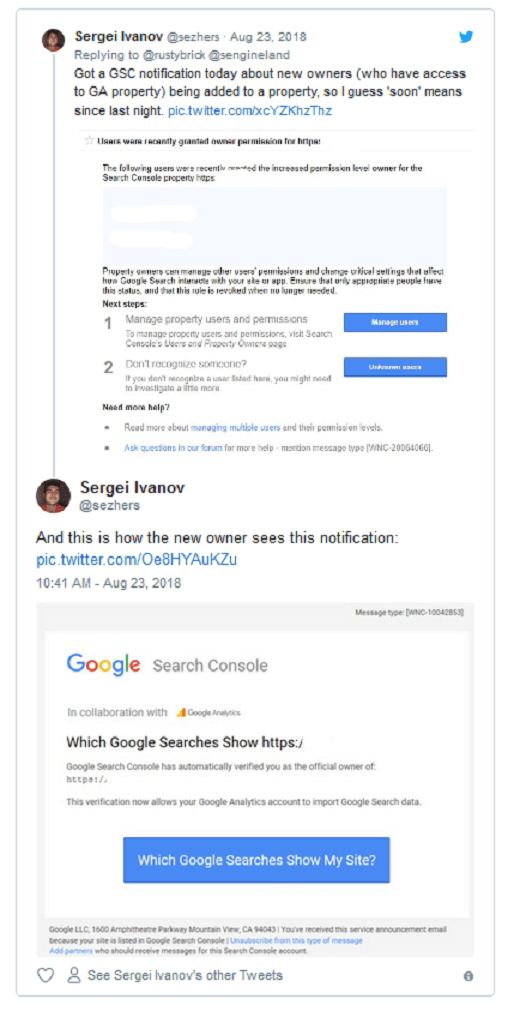
Google has announced that it will soon automatically verify you for a website in Search Console if you are already a verified owner of the same property in Google Analytics.
This means you don’t have to request manual verification within Google Search Console if you’ve already set up Analytics, and it streamlines the process of giving site owners access to Google Search Console.
Even more importantly, those with Google Search Console access will get emails and notifications of issues in their inboxes. These messages can include manual actions, hacks, WordPress and other CMS upgrade alerts, as well as other notifications — all aimed at helping you keep your website healthy, indexed and ranking.
Google said, “If you don’t want to be verified for Search Console, simply delete the property in Search Console.”
Google explained why Google Search Console is important and useful:
Search Console is a free tool that provides website owners with information which can be critical to performance in Google Search. Once verified, Search Console compiles reports on the website’s performance in Search, including search queries, the website’s rankings, and the number of clicks and impressions. Additionally, there’s information about a site’s indexing, the status of various implemented features on the website, as well as reports and notifications of critical issues.
Here is a screen shot showing the notification when someone is automatically verified via this method:
Barry Schwartz is Search Engine Land’s News Editor and owns RustyBrick, a NY based web consulting firm. He also runs Search Engine Roundtable, a popular search blog on SEM topics.
Content marketing is an all-encompassing term that has peaked and fallen off in years past. But just because use of the term is on the decline, doesn’t mean that successful content marketing strategies are any less effective.
In fact, the companies that are succeeding with content are using it to drive more sales, more loyalty, more brand awareness, higher levels of community engagement, and more.
But too many companies are still wasting their time doing content for content’s sake. It’s time to take a hard look at the return on investment of your content marketing efforts. What is it doing for you? What value is it adding?
If your content marketing is barely moving the needle, you need to make some changes. And if you are not ready to throw in the towel for good, you need to test some new practices that have potential to improve your results.
Here are three things you can do to get more about of your content marketing efforts:
1) A/B Test Your Headlines
Just like we test different subject lines for our emails, in an effort to get more people to open and read them, we should test different headlines for any piece of content.
A good headline makes all the difference. The right headline grabs attention and leads a user to view the piece of content we publish.
And though there are countless resources for best practices when it comes to headline writing, the only way to know for sure what headline will attract more readers is to test them in the real world. A free tool like Google Optimize will allow you to test multiple headlines for every article and settle on the one that gets the most visits, clicks, reads, conversions, etc.
2) Make It Easy to Share
The sites that succeed with content benefit from engaged readers/users. As a company, there is only so much that you can do to promote your content by yourself. To get real results, you need to leverage the virality of the web.
Content that is easy to share is more likely to get shared.
Making your content easier to share is not hard. There are existing plugins you can add to your website that allow people to publish to their preferred social network with one click. And you can (and should) customize the way your content appears when someone adds them to Facebook, Twitter, Pinterest, and others.
3) Invest in Media
Too many marketers treat content as a one-size-fits-all process. We write blog posts and articles and hope they get shared. But this outdated vision of the web is bound to fail.
Today, there are so many different formats to experiment with, that if you only write articles, you shouldn’t expect to succeed.
It may take more time and money to create engaging video content, live video, Snaps, images, and infographics, but this is exactly the type of content that gets shared. The content and the audience should determine the format, not the team you have or the budget you’re working with.
If budget and people are limiting factors for your company, perhaps you should invest elsewhere and ignore content marketing for now.
My name is Zach Heller. I am a marketing professional with years of experience in branding, digital marketing, direct response and marketing communications. I have entrepreneurial and consulting experience, and love working with small and medium sized companies to help direct marketing efforts toward growth. I am the sole operator… View full profile ›
In recent years, video marketing has burgeoned in popularity and it has exploded unlike any other digital marketing trend. Gradually, over time, it became one of the main aspects of any online marketing strategy. Numerous marketers have kept jumping on to the video marketing bandwagon and many among them are still not sure about the steps that they should take to become successful. This is because customers are 4times more likely to watch videos on a product than read what is written on it.
Majority of the digital marketers (54%) claim video marketing as the most appropriate form of ROI. 65% of the customers are more likely to purchase a product after they’ve watched the video on the pros and cons of the product. So, video marketing should never be the least prioritised item lying at the bottom of your list but it should be the integral and key part of the marketing and communication strategy.
Explainer videos – Be creative about your marketing efforts
It is worthy being unique and creative about your online marketing efforts. Animated videos and whiteboard animation add curiosity to the video. Here are few things to know on how a whiteboard animation can electrify your brand and improve your business.
Worthy reasons behind the soaring demand of videos
Art that is drawn by hand is always convincing and scientific
Easy to operate and doesn’t involve any high costs
Writing in an animated manner and erasing on a whiteboard has always been entertaining
Can be updated and edited easily
Short-cut process of content marketing
Amalgamating e-commerce with art
If you take into account creation of videos for engaging customers, they are an impressive way of capturing the imagination of people, regardless of the kind of business you have. This is one of the ways in which you can impress people on both logical and emotional levels. The animated videos are the kind of artwork which is the work of creative minds. The most powerful feature of these videos is that they are an easy way of informing the targeted audience on the brand.
There are different ways in which explainer videos can be related to purchases and sign-ups. However, the video can focus on the perspective of information. In fact, nowadays, there are many who enjoy knowing about products from videos rather than from reading.
Whiteboard animation videos – How they can increase conversions into buyers
It is a style of video where the viewer sees static images which are drawn by a person on the screen. The script is written in a third-person narration or is written in a case example which has to be extremely engaging and intriguing. Here are few ways in which whiteboard animation videos can be the best for your business. Read on to know how it can boost your conversions.
They’re an innovative way of advertising
Whiteboard animation videos are one of the most innovative and exciting ways in which you can promote your products and services. If you set them against all the other forms of promotion, you will find them to be the most economical among them. They can cater to creating a specific message with no tone of extra fluffy things and this is why they fall under the category of explainer videos.
They are placed anywhere, at any platform
Whiteboard animation videos are extremely flexible and versatile and hence they can be placed anywhere. While you can place them directly on the homepage of your website, you can also share them on social media or bind them to a specific landing page. You can specifically relate the page to any other page.
Making them is fun!
When done in a proper manner, whiteboard animation videos can be extremely effective and impactful, provided they have a powerful script. The viewer can feel immensely entertained by watching such an explainer video. When you’re able to create a video that’s informative and fun at the same time, this boosts the credibility of your company. More clients become interested in working with you.
They make it easy for customers to understand a product
When you create a whiteboard animation video creatively, they make it easier for the customers as well as the fans to understand your services or products. You can add them to social networking sites so that they can be shared by many others. This way you can spread the word about your product or service and also build the following.
They are kept as memorable
Once you create an animation video, you will see that majority of the customers will tend to remember your video. This way, they also remember the service or product. It is only when they remember you that they can tell others about you.
They have a definite CTA
This is perhaps the most vital reason behind why the whiteboard videos covert more viewers into buyers. They have a definite CTA power. The viewer will exactly know what they require doing, whether they require visiting a site or calling a number or buying a product. They will be sure about completing the task.
Hence, as we see, all the reasons listed above play a vital role in converting more viewers into customers. These videos have a record of providing you with the greatest conversions when all are used in a specific form. They’re economical too.
One of the best ways to discover keyword opportunities for pay-per-click advertising campaigns, content marketing topics, and search engine optimization is to identify which keyword phrases your company’s competitors are ranking for on popular search engines.
Thanks in part to keyword analysis tools such as Ahrefs, SEMrush, SpyFu, and Moz’s Keyword Explorer, it is easy to identify competitors, see which keyword phrases they are successful with, and find opportunities to grow your own business.
In this article, I’ll address a few ways to identify the keywords that may be working well for your competitors. In all cases, I’ll assume we are researching for a hypothetical farm and ranch supply retailer, and we will use Tractor Supply, which is perhaps the largest farm and ranch chain in the United States, as our competitor.
Organic Keywords
Let’s start by looking for some of the keyword phrases Tractor Supply ranks for organically. For this example, we’ll use Ahrefs.
The Ahrefs’ Site Explorer estimated that Tractor Supply is ranking for about 1.3 million organic keywords.
One quick search on Ahrefs and we learn that Tractor Supply ranks for about 1.3 million keywords.
We can dig a little deeper with the tool’s organic keyword report. This report can be filtered by position on a typical search engine results page, the estimated monthly search volume, the keyword difficulty, and several other factors.
Let’s only consider keyword phrases for which Tractor Supply ranks in the top five positions on a typical SERP. We’ll filter further, returning only phrases that get about 5,000 searches or more per month, and, lastly, we want to target keywords with a relatively low keyword difficulty score of 20 or below, meaning they may be relatively easy to target.
We discover 259 keyword phrases that meet our criteria. Here are a few examples.
Keyword Phrase
Volume
Difficulty
Position
“Coveralls for men”
6,400
7
3
“Air compressor”
112,000
18
4
“Muck boots”
77,000
6
5
If we carry these products, we may be able to rank for them pretty quickly, possibly displacing our competitor in one of these positions.
We could make “Muck boots” a focus of our SEO efforts, develop content around Muck Boots (which is a brand name), or we could consider the term for a PPC campaign.
PPC Keywords
Having identified good organic keywords, we may be interested to learn which phrases our competitor buys. We’ll use SpyFu to identify those phrases.
SpyFu focuses specifically on competitors and helps us discover which keywords Tractor Supply buys for its pay-per-click campaigns.
The tool informs us that Tractor Supply had 61,223 paid keywords. It is generating about 772,000 PPC clicks each month on an investment of around $385,000.
If we start to look at the individual keywords Tractor Supply purchases, we can see that it is buying “waterproof work boots.” The phrase is driving around 12,000 visitors to the Tractor Supply site at the cost of around $3,180 per month.
We can identify the individual keyword phrases and learn a lot about how they might perform.
This information is interesting because “Muck boots,” one of the keyword phrases we identified in the previous section, is a brand of waterproof work boots.
If Ahrefs and SpyFu are correct, Tractor Supply may be driving a lot of traffic to this category of products. In turn, this may be an indication of buying intent. We don’t know for certain, but it may be that shoppers who search for “Muck boots” or “waterproof work boots” do so because their feet are getting wet and they want a solution. Targeting these keywords or similar ones might lead not just to site traffic, but also to sales.
Keywords from Top Pages
A third technique for mining keywords from competitors is to look at a competitor’s best-performing pages and learn which keyword phrases are driving the traffic.
This data can be uncovered with SEMrush’s Organic Research Pages report or Ahrefs’ Hot Pages report, among others. The Ahrefs tool, as an example, listed thousands of individual pages from the Tractor Supply website, including the Muck Boots brand landing page, which was ranking for 863 keyword phrases and earning around 9,400 monthly visitors.
We can examine a competitor’s top performing pages, reviewing the individual keyword phrases those pages support.
We can look through the list of associated keyword phrase and find opportunities. “Muck boots for women” could be a good niche page or the topic of a blog post that featured the styles our store carries for women.
We can use this approach repeatedly to generate a long list of good keyword phrases that may represent buying intent.
Repeat the Process
With just a bit of research, we have several potential keyword opportunities taken from a competitor’s keyword profile. But we don’t have to stop with just one competitor.
Even if we are just familiar with a few competitors, we can generate a list of potential subjects using the very same tools that help us identify their keywords.
We can use SEMrush to generate a list of potential competitors. Tractor Supply, our imagined competitor throughout this article, is just the beginning as we can identify many similar companies using SEMrush’s competitors’ report. For each competitor, there will likely be unique keyword opportunities.
There is a clear tie between transparent business communications on social media and consumer spending, according to a new report.
Data breaches, fake news, and misinformation have seeded doubt in consumers. Organisations want to step up and restore customer confidence. With this crisis in trust, organisations are looking to add transparency to their business practices according to a new report.
It surveyed 1,000 US consumers on their transparency beliefs, expectations and desires.
It discovered that consumers’ expectations of transparency grow daily. Almost nine out of 10 Americans believe transparency from businesses is more important than ever before.
And transparency is important to Americans with 85 percent of respondents saying a business’ history of being transparent makes them more likely to give it a second chance after a bad experience.
Almost nine out of 10 people (85 percent) are more likely to stick by a business during a brand crisis if it has a history of being transparent.
Organisations can reap rewards from being transparent. Nine out of 10 people (89 percent) said a business can regain their trust if it admits to a mistake and is transparent about the steps it will take to resolve the issue. A similar ratio (85 percent) are more likely to stick with them during crises.
But transparency is not enough. Companies need to tell their customers that they are transparent. Two out of five (40 percent) of people who say brand transparency is more important than ever, attribute it to social media.
Over half of consumers (53 percent) are likely to consider brands that are transparent on social for their next purchase.
Four out of five (81 percent) of people believe businesses have a responsibility to be transparent when posting on social media–a higher standard than they set for politicians, non-profits, friends, family, and even themselves.
However, only one in six (15 percent) of consumers believe brands are currently “very transparent” on social.
(Image: Sprout Social)
People feel brands lack transparency when they withhold information (69 percent). Ignoring questions — regardless of who asks them — can be deemed to be detrimental to the brand as well.
If companies are not transparent, then consumers will look elsewhere. A lack of transparency on social means that nine out of ten (86 percent) of people are likely to take their business to a competitor.
Transparency is not simply a sales tactic, or a way to communicate a new marketing message.
Organisational transparency asks every level of an organization to adjust how it engages, to demonstrate its aspirations and its values. Brands should commit to being transparent in both reactive and proactive ways.
Jamie Gilpin, chief marketing officer at Sprout Social ,said: “Our data shows that transparency truly makes the difference in forming lasting connections between businesses and consumers.”
This company-wide effort should have buy-in from the top. CEOs that are more present on social makes it easier for organisations to connect with target audiences and earn their loyalty — from shoppers and from potential employees.
Give your boss the microphone and embrace the social channels that will ultimately bring in business for the brand. Transparency drives loyalty, and loyalty will bring benefits for the business.
Advertisers with in-house agencies increased to 64% from 42% a decade ago, according to an in-house agency trade group
In-house advertising agencies are on the rise as marketers look for more effective and cost-efficient ad models, according to a new study from Forrester and the In-house Agency Forum, which represents hundreds of large brands that have their own internal agency groups.
Advertisers with in-house agencies increased to 64% of the survey’s respondents from 42% a decade ago, according to the study.
In 2008, most marketers that replaced or supplemented their external agency with an in-house agency prioritized cost savings and speed, according to the report. Today, cost efficiency and speed are still hallmarks, especially as marketers need to produce more digital creative work at a faster pace, but they aren’t alone in driving the in-house trend.
More than one-quarter of respondents said the greatest advantage of having an internal agency was “knowledge of the brand,” while 20% said the greatest advantage was the group’s “knowledge of the business.” A number of respondents also selected “cost effectiveness” and “speed,” with fewer selecting categories such as “confidentiality” and “dedicated resources.”
Ten years ago, amid the recession, clients were cutting back on external services, making cost efficiency a priority, said Marta Stiglin, a consultant, former in-house agency executive and founding member of the In-house Agency Forum.
Today, in a stronger economy, there is less pressure to cut costs, and hiring a team internally that can do the work “fast and cheap” is irrelevant if it doesn’t perform in the market, she said. “You need measurement and analytics and insights to drive new programs and strategies,” she said.
“Knowledge of the brand and integrating at all points of contact, particularly with what’s going on with digital, is of paramount importance,” Ms. Stiglin added.
The In-house Agency Forum surveyed 325 companies, including marketers with and without in-house shops, as well as external agencies and vendors. Of the corporations that responded, 64% said they have internal agencies, 30% said they don’t and 6% said they don’t know. The number of questions that respondents answered varied depending on their industry.
In-house agencies might compete with external agencies for business from a brand team, but they also often hire external agencies. The majority of people who took the survey said that an uptick in internal agencies doesn’t pose a threat to external agencies.
The majority of brands surveyed said they can choose whether they want to work with internal or external agencies. External agencies can be more expensive for ad clients than in-house shops because their fees tend to include overhead, according to industry executives.
Blended in-house rates range from less than $50 an hour to $175 an hour, according to the survey. The rates come from companies with a range of models—some that include overhead costs in their hourly rate, and some that don’t, said Ms. Stiglin.
“We’re not trying to make money in the operation,” said Jarrett King, who runs the in-house agency at the Coca-Cola Co. focused on business-to-business marketing and internal communications. External agencies are “profit centers,” she said. “We’re here just to cover our costs. We’re studying rates; it’s all about getting to net zero versus showing shareholders or constituents a profit.”
“I’m salaried and bonused based on the success of work I’m actually doing for the business,” said Roger Hyde, who oversees the in-house agency for mobility and entertainment products at AT&T Inc. “That’s a very hard thing to swap in the external agency world.”
Omnicom Group Inc.’s BBDO handles AT&T’s external advertising, he said, including coming up with many of the company’s marketing strategies and ad campaigns. The in-house group handles marketing aimed at existing customers.
Feature Image Credit: More than one-quarter of a new survey’s respondents said one of the greatest advantages of having an internal agency was ‘knowledge of the brand.’ Photo: Otavio Photo/Otavio Barbosa
Where do great ideas come from? We asked artists, designers and writers, including Marina Abramović, Richard Quinn and Ben Okri, what gets their minds whirring
Judith Kerr, children’s author and illustrator
I’m not sure I’d call it creativity. It feels like getting on with the job. It feels like something you’ve got in your head that should be drawn. Walking often helps me to think of things or solve problems I’m stuck with, but mostly it’s just going up into that room and sitting down and then comes the “Now what?”
Practically all my ideas are autobiographical. The Tiger Who Came To Tea came about when I was trying to entertain my daughter with a bedtime story. Mog, the first of that series, was just about our cat. I’d never had a cat and always wanted one, and it was just about all the things he did, which to me were such a surprise. The Crocodile Under The Bed came about because my children used to think there might be something under the bed. Ideas come in bits and pieces.
Judith Kerr’s new book, Mummy Time, is published on 20 September.
Kengo Kuma, architect, V&A, Dundee
My creative sparks come at the moment when a meeting is over and everything has been decided and agreed on. Of course, during the meeting – typically, with clients and staff members – we brainstorm and discuss a lot, rapidly and with incentive. Even so, there are times right afterwards that I realise I was wrong and made bad decisions. Then I immediately call the people who were present and tell them I’ve changed my mind, with sincere apologies.
I don’t behave like a God-like architect. Being able to say sorry is key to being a designer, and can be a source of inspiration.
The V&A, Dundee, Scotland’s first design museum, opens on 15 September, vam.ac.uk/dundee.
Tom Dixon, designer
It’s putting yourself into unfamiliar worlds that does it, looking at something from a naive perspective. I’m lucky enough to travel a lot. I go to the local museums and like being exposed to the worlds of sculpture or cooking, or music – anything that is not my core area of design.
Marina Abramović, artist
I am always coming back to certain lessons that I have learned over the course of my career:
Lesson 1: The worst is the best. (A Sufi saying.)
Lesson 2: More and more of less and less.
Lesson 3: “What you’re doing is not important, what is important is the state of mind in which you are doing it.” (Constantin BrâncuȘi)
There is something about movement that is very good for allowing my brain to go into free flow. I’m quite good at having thoughts when I’m driving or cycling or walking. I think you go into this place when you do something very physical and your brain starts to put together interesting thoughts. I also get this when doing something mechanical with my work, like collage. The act of cutting out pieces of paper, the intricacy and the concentration combined, allows my brain to pick up on other thoughts.
I often find myself staring out of the window. I think we assume that’s dead time, or an act of procrastination, when actually that time of just staring, when your brain goes into a slightly bored state, is quite important. In it, we start to notice things and put them together.
But if I get really stuck, I’ve learned not to just sit with it. If I’m working on a novel or picture book and I get downhearted, I go and do something different. I might start on a new story, or revisit one I started a while back. Sometimes I’ll draw. Sometimes the movement of the hand releases something else that’s stuck in my mind.
Richard Quinn, fashion designer
I like to try to find something that’s not on the internet. I go around lots of old bookshops. There are amazing charity shops in Walthamstow, east London that sell rare, limited editions. I like finding odd, obscure objects, so odd that when you type their name into the internet nothing comes up.
The collection I currently have in shops was inspired by a really obscure book about upholstery and fabrics from the 60s that featured bold florals, sort of Americana: camper-van florals. More recently, a picture of an artist covered in oil got me thinking about using an oil effect on shoes and bags. I like collecting a physical thing that you can touch, and turning it into something new.
Camille Walala, artist
Creativity is good in the morning. I take one hour for myself to just play around without any purpose or design in mind. I always carry a sketchbook with me, a pencil, some tape, a file with different-coloured paper, and things to collage with. Most of my work is based around graphic elements and colours, and I fill my sketchbooks with patterns and designs that I often refer back to. I love going for a coffee in that hour: I’ll spread out on the table, usually outside; or it might be when I’m travelling, when there is more freedom to be playful.
Tamara Rojo, artistic director, English National Ballet
I love going to see other art forms, especially theatre, and I’m an obsessive reader, not just of books but everything – magazines, newspapers, Twitter. I also love listening to the radio. My mind has a strange habit of remembering all kinds of information that often seems completely pointless, yet sometimes it all comes together to form this clear concept from beginning to end; and then it becomes a story that I feel has to be told. After that, all I have to do is convince everyone else to help me make it real. That’s usually the hardest part.
Ben Okri, author
I walk long distances. I walk to go through zones of the mind. I become empty and aware and I listen. I never know what I am listening for and then it comes, sometimes indirectly, sometimes as a stirring.
Creativity is our normal and fundamental way of being. It is everything else – our education, our social conditioning, our cultural mores, our upbringing – that imprisons our creativity. If you don’t believe me, watch a child at play. To them all things are possible because they have not learned that some things are impossible. We don’t need to learn to be creative. We need to unlearn not being creative.
Faye Toogood, designer
I am always most creative in a quiet and peaceful environment, somewhere I can escape the overload of the senses that we are all subjected to now. For me, being in nature and in particular the British landscape, with no distraction, is my main source of inspiration. Also, I have three young children, so at the moment I find their naivety and wide-eyed view on the world refreshing and unexpected. I can find inspiration in my girls’ drawings, what they collect on a walk and what they notice.
Wolfgang Tillmans, photographer
I find that the best ideas well up from the subconscious and knock on my “conscious” door. When I hear one knock for the third time, I know I must act. It happened like this with my series of photographs, Concorde. At the time it was in no way obvious that spending weeks around Heathrow and south London, looking out for the Concorde plane, would result in a strong work. But in the previous two years, the idea to do just that had popped into my mind on three or more occasions, without any outside cue. Listening to those ideas is important – to hear the faint voice of what you’re genuinely interested in, and filter out the loud noise of desire and vanity.
• Commenting on this piece? If you would like your comment to be considered for inclusion on Weekend magazine’s letters page in print, please email [email protected], including your name and address (not for publication).
Feature Image Credit: ‘Play around without any purpose or design in mind.’ Illustration: Nishant Choksi
Summer brings with it several rites of passage: warmer weather, extended daylight — time for businesses to revisit their annual marketing plans. It’s time to look at sales results, review customer feedback and decide which activities are worth continuing — perhaps ramping up — and which you need to retool or even retire.
As CMO and principal of a company that works with marketing and PR trends on a daily basis, I can say that these four business-to-business (B2B) marketing trends, in particular, are worth considering when reviewing your plans. Discuss among the members of your team which of these could demonstrate enhanced capabilities and wow with innovative new ideas.
Give Thought To Thought Leadership
Positioning a company’s experts as “thought leaders” is hardly a new idea. From bylined articles and blog posts to videos and webinars, such “content” helps give your brand a face and shows you have a finger on the pulse of the industry. Customers appreciate it too: 96% of B2B buyers say they would like to see even more expert perspective.
But how much original “thought” actually goes into thought leadership content? Are these trusted leaders truly breaking new ground, or are they simply regurgitating statistics and talking points already understood?
Before simply ordering your marketing team to get more expert thought leadership coverage, it pays to take time to develop a unique and authentic point-of-view. By bringing something new to the conversation, you’re much more likely to deliver that “aha” moment that inspires readers to engage and want to learn more.
Need to amplify your perspective? Consider generating your own data by conducting a survey of topics and issues within your industry — then mine the responses for interesting trends and surprising outcomes. Your experts can analyze and comment on the findings — building credibility by connecting their insights with data that’s unique. Publish a report, an infographic, whitepaper or e-book, and market across all channels. Then parse the report into bite-size message points that are ideal for social media.
Sell Your Brand Experience
Today’s markets are plagued by product parity. Despite marketers’ efforts to find points of differentiation, the majority of goods, services and technologies do pretty much the same things as their counterparts. This sense of commoditized sameness makes it difficult to deliver the exceptional, next-level experience customers crave.
Instead of repeating product-centered campaigns, consider emphasizing the product experience instead. Customers may not always care — or even understand — what nuance makes your solution better. But they certainly relate to how it makes them feel and how it improves their lives. This requires taking a holistic view of one’s customers and finding ways to personalize their journey, to the point where the experience supersedes — or even becomes — the product.
A recent partnership between Ford, Amazon and Starbucks highlights the type of connection customers love and businesses should strive for. As a Ford driver approaches her local Starbucks, the car’s embedded Alexa service will ask if it should order her favorite coffee for pickup. The brand experience is now far more than just a car.
Challenge your B2B marketing team to understand and articulate how the experience can become the product.
Extend Your Influence
As I previously described, many B2B marketers are turning to influencer marketing having observed the success of such brand voice amplification in the business-to-consumer (B2C) world. Individuals with recognized expertise in a specific market, plus a significant following on social media, can be powerful signalers to new customers. Buyers give credence to such influencers when making their own purchasing decisions.
When you think about it, influencer marketing has been a staple of B2B marketing for years. Your company has likely hired a “third-party expert” to give a webinar or host a speaking panel. The labels may be different today, but the principle is familiar — capitalize on a trusted independent voice to capture audience attention and talk meaningfully and substantively about your product.
B2B marketers need to move beyond the perception that influencer marketing is solely a B2C strategy, or that only celebrities with massive followings can be influencers. Spheres of influence exist in every market — from agriculture to artificial intelligence and from supply chain to semiconductors — and audience size should be low on the list of selection criteria.
Consider whose voice will attract the audience most likely to take action rather than whose megaphone is the largest or loudest. TV stars may not be a good fit for a specialized B2B product, but researchers, think-tank leaders, analysts and other microinfluencers with small but dedicated followings make great partners.
Deliver A Personalized And Interactive Experience
Time-pressed prospects are increasingly looking for information that is specific to their interests and concerns and have a growing preference for interactive content. They don’t just want to acquire information — they want to experience it. Marketers who can deliver on both demands are likely to find favor over those delivering more standard fare.
The growth of video as a B2B marketing tool continues to explode. Research shows that four times as many people would prefer to watch a video about a new product than to read about it. Building on this popular format, advanced technologies now allow marketers to customize videos with personal details such as the customer’s name, industry and even the location where they are watching — as is routinely done in email. Beyond the sheer surprise value, personalized videos also allow convenient calls-to-action to be embedded in the video.
This technology makes it possible for the viewer to set an appointment, access additional information or contact a company representative directly from the video screen, eliminating the risk of losing interested customers when they have to take a follow-up step outside the video.
With much of the year still ahead, 2018 is proving to be an active year for B2B marketing, and there’s undoubtedly more to come. By harnessing emerging techniques and focusing on the customer experience, marketers can translate the learnings from the year’s first half into engaging campaigns that build relationships and deliver results to the bottom line.