Author

editor

Browsing

By Jacob Kleinman

There are plenty of great ad blockers to choose from, but most just delete the ads or replace them with something less offensive. If you’re looking for an ad blocker that can do a little more (and you have a Samsung phone) here’s a new app worth checking out.

Created by developer NeedleGames from the XDA forums, Simple Ad-blocker for Samsung (SABS for short) promises to remove all those pesky ads and then some. The app works by tapping into Samsung’s ultra-secure KNOX software. That gives it the ability to disable packages — A.K.A. the terrible bloatware slathered on by your carrier. SABS also includes a system-level permission manager, giving you an extra level of control over what apps can see and do on your phone.

Simple Ad-blocker for Samsung was created specifically for the Galaxy S8, S8+, and Note 8, but NeedleGames says it should work on any Samsung phone running Android 5.0 or up. That includes the brand new Galaxy S9, along with a bunch of older models. You don’t need to root your phone to run this ad-blocker either, though the setup process does get a little complicated and requires some technical know-how.

The first thing you’ll need to do is get a licence key from Samsung (follow along with the instructions here). Then disable any other ad blockers you might be running on your phone and download the SABS source code from GitHub. You can do this on your computer if you prefer, or directly on your phone for a slightly quicker process.

Just make sure to follow the directions carefully and you should make it out the other side with a powerful new ad-blocker up and running on your Samsung phone.

Photo Image Credit: Samsung

By Jacob Kleinman

Sourced from lifehacker

By 

Reflecting a strategic push by marketers to bypass conventional advertising and media-buying, so-called “content marketing” has grown in a relatively short period of time into a $16 billion global industry. That is among the top line findings of the 2018 edition of media research and economists PQ Media’s Global Branded Entertainment Forecast.

In the U.S., consumer content marketing has grown to a more than $7 billion industry.

Consumer content marketing, a subset of the overall branded entertainment marketplace, is defined by PQ Media as “paid marketing messages developed to simulate a news story or entertainment program that is cohesive with the media’s content structure, including assimilated design that is consistent with the media platform. Also known as native advertising and custom publishing. Not included in this report is business-to-business content marketing, such as white papers and research webinars.”

The report finds the overall branded entertainment marketplace — which includes traditional forms such as product placement, branded entertainment and experiential marketing — is expanding much faster than the overall economy, or overall advertising and marketing spending, both globally and in the U.S.

In fact, branded entertainment has been expanding at about twice the rate of general advertising and marketing spending.

By 

@mp_joemandese,

Sourced from MediaPost

By

Europe’s General Data Protection Regulation (GDPR) will kill the third-party data ecosystem. Or third-party data isn’t going anywhere.The truth sits somewhere in the middle, said Alice Lincoln, MediaMath’s VP of data policy and governance, at AdExchanger’s Programmatic I/O in San Francisco on Wednesday.

“Third-party data is here to stay – if it’s high-quality,” said Lincoln, who’s both a man and a woman – if you go by the data floating around about her in the third-party ecosystem. She’s been targeted as both.

Patrick Salyer, CEO of SAP-owned Gigya, is slim and around six feet tall, but when he looked up what data the brokers have on him, “weight-loss products” was listed as an interest.

“I question the validity of third-party data moving forward,” Salyer said. “The brands we’re working with, including large CPGs, are realizing that a direct digital connection with consumers is extremely important – in fact, it’s a differentiator.”

Third-party data has been having a hard time lately.

Post-Cambridge Analytica, Facebook decided to kill third-party partner targeting through its platform to the great consternation of data brokers, like Acxiom. And with GDPR coming down the pike, advertisers are increasingly looking inward to foster their first-party relationships.

But that doesn’t mean third-party data is circling the drain in a GDPR world.

Some brands will always need to supplement with third-party data, and the data will just have to get cleaner out of necessity. Not every brand has enough first-party data to power a digital advertising strategy, said Fatima Khan, chief privacy officer at Demandbase

“I don’t want to go to a website and for it to think that I’m a man in his 40s,” she said. “Third-party data … is an important thing, but it will need to be fixed going forward.”

GDPR will help by encouraging data controllers to shore up their supply chain partners, as it lists clauses that have to be included in data protection agreements, including a requirement for processors to help their controllers fulfill data subject requests and cooperate in the case of a breach.

But third-party vendors shouldn’t just sign whatever lands on their desk, said Emily Jones, a data privacy and technology partner at law firm Osborne Clarke LLP, where she leads the Silicon Valley office.

GDPR codifies what should be in these agreements, but that “doesn’t mean every agreement looks the same,” she said. “Be careful about what you’re asked to sign, and don’t just assume it’s covering the bare minimum. We’ve seen a lot of companies try to include additional obligations.”

But the risk cuts both ways.

In doing its due diligence on partners, MediaMath has seen some try to claim in their written responses that they’re 100% GDPR compliant already – and there’s just no way that’s true.

“I have to call BS on that,” Lincoln said. “I don’t think anyone can say that with certainty at this point. The spirit of GDPR is clear, but what that means practically is unclear. May 25 is just the beginning of how regulation will be implemented and applied, especially across an ecosystem as complex as ours is.”

By

Sourced from ad exchanger

By 

  • Facebook CEO Mark Zuckerberg testified before Congress for over five hours on Wednesday, where he answered questions from senators on a broad range of subjects.
  • During an exchange with Senator John Cornyn, Zuckerberg laid out a simple explanation for how Facebook makes money with user data.
  • Zuckerberg’s explanation is a concise walkthrough of how your data is turned into profit.

You’re forgiven if you didn’t watch all five-plus hours of Facebook CEO Mark Zuckerberg answering questions during a joint Senate Judiciary and Commerce Committees hearing on Tuesday.

Even if you were watching, it’s entirely likely that you missed a crucial, brief segment around the two-hour mark, where Senator John Cornyn asked Zuckerberg about how Facebook handles ex-user data.

Though somewhat unrelated to what Senator Cornyn asked, Zuckerberg’s answer was a fascinating, concise look into how Facebook turns its vast quantity of user data into profit.

“There’s a very common misperception about Facebook — that we sell data to advertisers,” Zuckerberg said on Tuesday. “And we do not sell data to advertisers. We don’t sell data to anyone.”

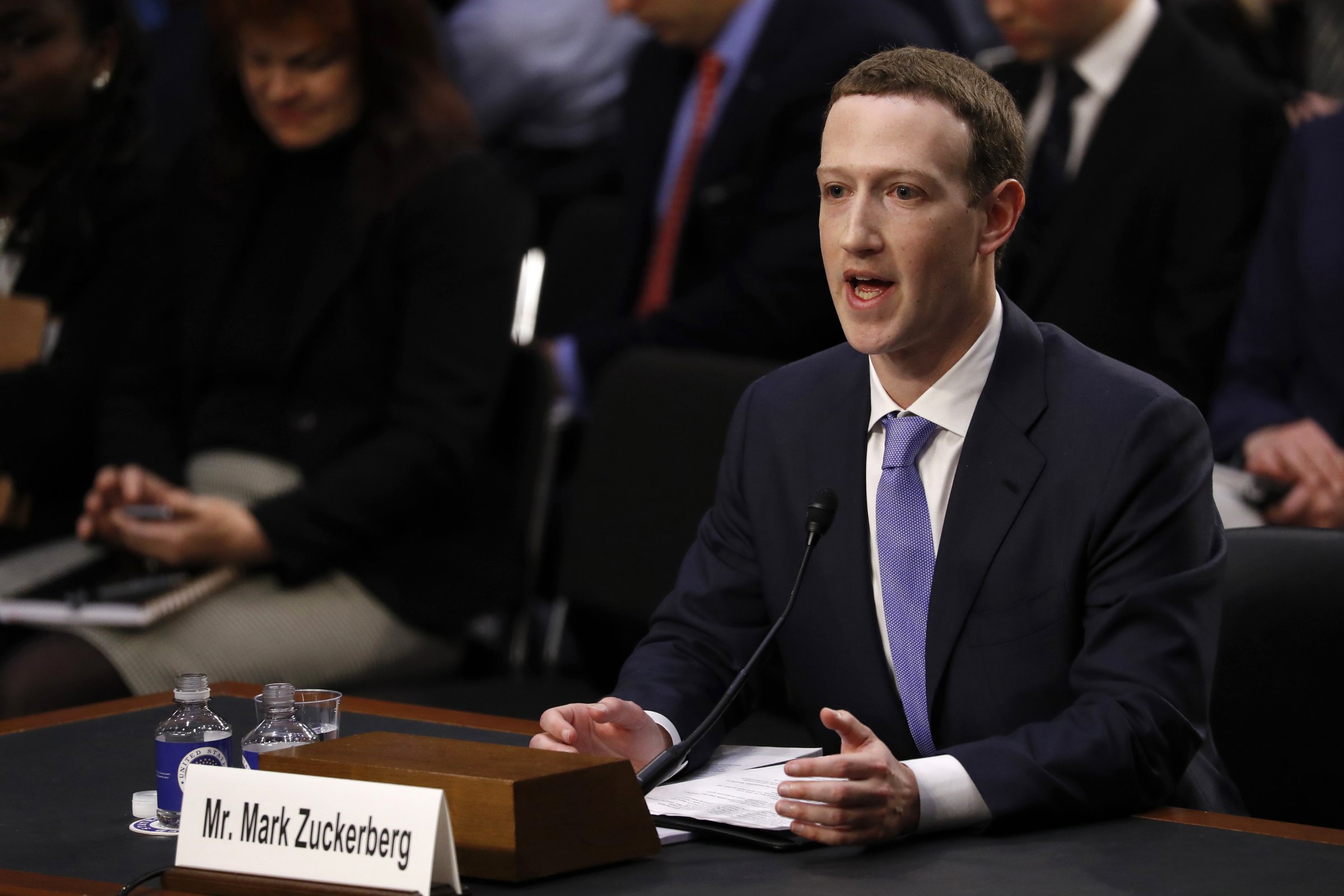
Mark ZuckerbergFacebook CEO Mark Zuckerberg is surrounded by members of the media as he arrives to testify before a Senate Judiciary and Commerce Committees joint hearing regarding the company’s use and protection of user data, on Capitol Hill in Washington, U.S.Reuters/Leah Millis

Indeed, Facebook makes it money through advertising. Facebook doesn’t provide data to advertisers — it does the work for them.

Here’s Zuckerberg explaining it to Senator Cornyn on Tuesday’s Senate hearing:

“What we allow is for advertisers to tell us who they want to reach, and then we do the placement. So, if an advertiser comes to us and says, ‘All right, I am a ski shop and I want to sell skis to women,’ then we might have some sense, because people shared skiing-related content, or said they were interested in that, they shared whether they’re a woman, and then we can show the ads to the right people without that data ever changing hands and going to the advertiser.”

In the wake of the Cambridge Analytica scandal, which revealed that at least 87 million Facebook users had their data used without consent by a political firm to influence elections (including the 2016 US Presidential election), general users, celebrities, tech executives and politicians have begun openly questioning Facebook’s handling of user data.

Facebook now admits fault for allowing third-parties to access user data inappropriately, which is what led to companies like Cambridge Analytica possessing user data in the first place. The company has since shut down loopholes in its social media service that allowed third-parties to “scrape” data from its users.

All that said, Facebook still directly relies on user data to make money — it’s just not in quite the way you may have thought.

Feature Image Credit: Facebook CEO Mark Zuckerberg testifies before a joint Senate Judiciary and Commerce Committees hearing.REUTERS/Aaron P. Bernstein

By 

Sourced from Business Insider UK


By

I spent an amazing morning today at Media Kitchen’s annual Venture Capital Conference in New York City listening to leaders in media, investing and banking talk about “new TV”:  the merging of broadcast TV, social video and everything in between.

This is the 11th year that Media Kitchen CEO Barry Lowenthal has put on the event to help drive critical thinking, inspiration and innovation for our industry.

In my remarks, I focused on what I thought would the key drivers of the advertising industry over the next five years. Here they are — and AI is not one of them:

Direct to consumer. All marketers and media companies that want to be relevant into the next decade are working hard to build direct consumer relationships.

Most incumbents here are in a bad spot. If you are Proctor & Gamble or CBS, you are basically in a B2B business. You make your sales in multiyear agreements with Walmart or Comcast, not to the Sally Browns or Joe Smiths of the world.

Not so a Warby Parker or Amazon Video. They create products and sell them directly to consumers. They know their customers’ names. They can and do talk to them directly.

This is the fast-emerging direct-brand economy  — and nobody has done a better job laying out its potential than the Interactive Advertising Bureau’s Randy Rothenberg, in a must-read for all who care about the future.

ROI. For decades, legacy brand companies have been managing their advertising as a cost center. That’s why they focus so much on outdated media measurements like gross rating points, and are maniacal about per-ad unit pricing and cost-per-thousands.

Not so if you sell direct to consumer. In the world of the Dollar Shave Clubs or Casper mattresses, advertising is a profit center. For them, sales has an ROI for each and every ad. As more companies go direct to consumer, more and more advertising will be managed as profit centers and measured by ROI.

Identity. Cookies, device IDs and IP addresses aren’t identity, even if they help ads follow you across the web. In the world of direct selling, people buy things — and it’s very important for marketers to know who those buyers are. That’s why we are seeing the rise of customer data platforms (CDPs), where companies aggregate customer data sets to make them more accessible and actionable to drive their advertising and marketing.

Critically, these systems contain ways to make data available to drive action-based systems — ad servers, email servers, TV planning systems — without leaking private data, keeping personal data within the walls of the marketers. This area is growing fast, with this week’s Facebook hearings only adding urgency.

TV advertising. What’s old is new again. Nothing sells like sight, sound and motion, and television is unrivaled in reaching more people faster, with more impact, cost-effectively. That’s why so many of the new direct brands like Dollar Shave Club, Warby Parker, Peloton, Wayfair and Ring are building their businesses with TV ads.

As we learn from research by the Video Advertising Bureau, not only does 80% of all video viewing today still occur on linear TV, but digital brands that use it see spikes in their website traffic of hundreds of percentages.

As these drivers take hold, they will have significant implications for our industry. Here are a few:

— Data management platforms and customer relationship management systems will subsumed by CDPs.

— Privacy-safe, software-based identity matching will overtake traditional “safe havens.”

— Analog media wlll become data-optimized, performance-focused and coordinated with digital.

— Platforms will take over TV media analytics/planning/activation/optimization.

— We will see true leverage created relative to the digital walled garden duopoly.

By ,

Sourced from MediaPost

By Emily Tan

Spurred by the recent outrage over the misuse of Facebook’s data by Cambridge Analytica, Adblock Plus has introduced a feature that lets users disable social media buttons.

These ‘like’ buttons allow Facebook to track users’ browsing behaviour beyond its walled garden, even if users do not touch them.

“What most people don’t realise is that buttons used to share content on social media platforms such as Facebook, Twitter, Google Plus and others are placed on almost every website that you visit,” Ben Williams, director of operations at Adblock Plus, said.

“Even if you don’t click them, these buttons send requests to the social network’s servers, which then uses the information to create a profile based on your browsing habits. This is one of the key ways that social media sites such as Facebook are able to access consumers’ private data.”

Adblock Plus promotes this feature as a way for consumers to have more control over their online data, without having to quit social media altogether.

“For consumers, this scandal highlights how easy it can be for their information to be gathered and misused without their consent. The social media giants’ policy of self-regulation is clearly not working as it should, and is making users’ data more vulnerable; it has therefore never been more important for consumers to demand their power back,” Williams added.

By Emily Tan

Sourced from campaign

By Lou Casale

Spark new interest in your brand among new and current customers.

Technology has forever changed the way we learn about new brands and interact with our favorites. With smartphones always at our fingertips, we are constantly being bombarded with information, and brands are battling it out to earn our attention. This competition puts increased pressure on marketers to cut through all the noise and keep their brands top-of-mind and relevant with customers.

If your customers are not engaging with your current marketing message and approach, consider these steps to give your brand a competitive advantage in the marketplace.

Try a reverse.

If marketers in your industry all gravitate toward a particular strategy or tactic, here’s the question you should ask yourself: Is this really the best way to reach your own customers?

In the insurance industry, for example, fear-based marketing is a common approach. Much of the insurance advertising you see focuses on fear and the need to minimize risk. At Hiscox, we believe that nothing great can happen without risk. We don’t fear risk, rather we fear not taking the risk. Our “Encourage Courage” brand platform has resonated with business owners because it celebrates the positive power of risk-taking. We communicate to our customers that insurance helps alleviate fear and risk, and it gives you the freedom to pursue your dreams. Breaking with the norm and taking an alternative approach makes people sit up and take notice.

If everyone in your industry operates from the same playbook, how can you demonstrate your unique value to your customers? In the case of Hiscox, we focused our efforts on a long-term relationship built on courage rather than a potential short-term sale driven by fear. You could take a similar approach and run a new play that challenges conventional wisdom.

Be a conversation starter.

If the industry thought leaders and influencers all talk about the same topic, there’s a good chance it’s already a trend and yesterday’s news. While it’s important to be able to weigh in on the trends that impact your industry, if you don’t the join the conversation early, you’re not going to be heard amid all the noise. It’s sort of like talking at a rock concert. The people you’re speaking to won’t be able to hear you and there’s a good chance they may not even try.

If you want to separate yourself from the pack, you need to start a new conversation. Identify the topic gaps in current discussions and offer a social-by-design topic that everyone should be talking about. You’ll move the conversation in a new direction, and you’ll be credited as a thought leader who can introduce fresh topics rather than one who regurgitates stale talking points.

Teach your team to be storytellers.

We all know how important storytelling is in marketing. Customers will remember powerful stories about your brand if they’re compelling and shareable. And while this strategy and practice sounds good on paper, it’s not so easily executed.

When I worked on the agency side, I once had a meeting with client to discuss the pitch we were sharing with the media. We had tweaked the pitch the client had originally created, and turned it into a captivating story. While the company’s original pitch may have worked well in a conference room, our practical experience gained in pitching stories to the media provided us a unique advantage in recognizing that it would not resonate with the intended audience.

Let’s face it: There are people on your team who are great storytellers. Whether it’s the way they talk about the product or the company culture, or the way they recount the employee basketball team’s epic comeback to win its first (and only) game of the season, these people know how to get and keep your attention.

Pull this group together and turn them into your “storytelling ambassador network.” Give them ownership over a particular topic or “beat,” such as customer service, product marketing, culture and innovation. This team of storytellers should meet with groups across the organization to teach other employees how to tell that story, so they can effectively bring these topics to life on their own. If everyone is working from the same script to tell these compelling stories, the messages will start to have an effect on your company’s perception over time and will impact sales in a positive way.

Your audience is out there and they’re listening. If you have the courage to say something new, you just might surprise them and welcome a new batch of customers.

Feature Image credit: Hero Images | Getty Images 

By Lou Casale

Head of Communications at Hiscox USA

Sourced from Entrepreneur Europe


By Beata Staszkow 

Personal executive branding continues to evolve. What was in vogue in 2016 is becoming outmoded in 2018. Executive branding has become a lot more personal to you and the reputation are you are trying to project. Gone are stuffy formalities.

This post explores personal branding in 2018 and provides tips to help you define your own personal executive brand.

Language

If you have defined your personal brand in 2015 the chances are the language you used was very formal. You would have used words like “motivated” and “self-starter.” In 2018 the language is more about you as a person so you have a bit more creative freedom to bring your executive brand to life. It all depends on what kind of image you want to portray.

So if you want to present formal professionalism, then it’s a good idea to stick to “motivated”, and “self-starter.” It is fine, now, however, to use less formal language to bring your brand to life. “After graduating in management accountancy I learned the ropes in the tech industry helping start-ups expand and grow.”

Voice

Today’s thinking on executive branding puts a strong emphasis on bringing your voice alive. Yes, you have lots of experience and have no doubt plenty of successes under your belt. Hiding your experience and successes behind a wall of formal speak, however, can be argued to be off-putting. Whatever way you want to spin it, somebody who has taken an interest in your career will not get to know the person behind the LinkedIn profile or the blogs if your voice is lost informality.

Using your own voice, which is really writing as you speak, you will give your output and updates character. Not everyone will necessarily take to you but there will be plenty that will. Obviously, you don’t want to write anything inflammatory.

The more memorable bloggers are known for their voice and have been for years.

Specialise

The better brands become more memorable if you write about your speciality. So if you help start-ups in some capacity you can write about it. If your experience is working with the world’s biggest corporations, or local government, the same applies. Writing through the specialist lens gives you the platform to talk about issues outsiders will not have experienced and how you overcame them. This is not only interesting reading but gives you an opportunity to position yourself as an authority in your field.

Tell your Story when Branding

Everyone has a story and telling yours is important. Your contemporaries will emphasize, recruitment managers and headhunters will be engaged, and you will probably enjoy writing in this style and feel a bit freer.

As you write you will be showcasing your achievements and your insights and this is an important part of successful personal branding.

Feature Image Credit: MagicDesk / Pixabay

By Beata Staszkow 

Sourced from Business 2 Community

By Rich Duprey

Sourced from The Motley Fool


By 

  • Aleksandr Kogan, the academic who harvested the Facebook data improperly obtained by Cambridge Analytica, also had access to some users’ private messages.
  • He collected private messages sent from and received by “a small number” of people who downloaded his app, This Is Your Digital Life.
  • Facebook hinted earlier this week that inboxes may have been compromised, and further reporting from The Guardian confirmed it. It is unclear whether Cambridge Analytica obtained the private messages.

The app that gathered private information later improperly obtained by the political consulting firm Cambridge Analytica also collected some users’ private messages, The Guardian reported on Friday.

This Is Your Digital Life, a quiz app developed by a University of Cambridge academic named Aleksandr Kogan, pulled in both incoming and outgoing messages from several thousand accounts of people who downloaded the app.

The number of people who had messages taken is a small portion of the estimated 87 million users whose data was exposed, but it represents a much more intrusive collection than the page likes, birthdays, locations, and personality traits and so forth that were taken from other profiles.

Cambridge Analytica Aleksandr Kogan Aleksandr Kogan, the academic who harvested the Facebook data obtained by Cambridge Analytica. CNN

Facebook warned users earlier this week that people who used Kogan’s app “may have” shared access to their messages. He appeared to confirm this in an interview with The New York Times.

Kogan denied handing over that information to Cambridge Analytica; it is unclear exactly what data the firm obtained and how it was used.

Facebook and Britain’s Information Commissioner’s Office are still investigating the situation. The fallout from the scandal precipitated Facebook CEO Mark Zuckerberg’s appearance before three US congressional committees this week.

By 

Sourced from Business Insider UK