Available as an experimental feature from Google Labs, this new option will help generate a short, 5-minute AI podcast based on your Google Search results.
How to turn on Audio Overviews in Google Search
Credit: Jake Peterson
To access the new feature, head over to your Google Labs page using this link and find the Audio Overviews section. There, you can either enable this feature or join a waitlist, depending on where you’re located. Unfortunately, while this is a global rollout, it’s not happening all at once, as is the case with many new Google AI features.
How Audio Overviews in Google Search work
This new search feature is lifted almost straight from Gemini, which itself got it from NotebookLM. Called Audio Overviews, the original incarnation of this feature let you generate a 10-minute AI podcast episode on any topic, although the new version has a few additional limitations.
When the feature is enabled in Google Search, you’ll see a little prompt to “Generate Audio Overview” while you scroll through compatible search results. Which results are compatible is a bit vague at this point—that’s one of the limitations. You won’t see it for simple questions like “what are some nearby cafés?” but it also won’t work for overly complex topics, like researching investment trends across Asia (where you might be better off using Deep Research tools).
Instead, Audio Overviews will kick in for queries that are somewhere in the middle. Let’s say you want a quick refresher on a Lord of the Rings character, or to know which Japanese knives to get started with when upgrading your kitchen. Just make an appropriate Google search, click the Generate Audio Overview button, and search will kick into Gemini mode. After a wait of about 30-40 seconds, which is considerably less than Gemini’s 2–5 minute wait time, you’ll see your audio overview. It will be about five minutes, tops, so you’ll get less detail than Gemini would give you, but it might be enough for a bird’s-eye view on whatever you’re searching for.
The audio player for your AI podcast will stay put as you browse the results page, and it will show links to its sources as well. And if it’s gotten something really wrong, you can give it a Thumbs Down. As is the case with any AI tool, it’s important to point out that these are based on Large Language Models, which can sometimes hallucinate. So make sure to check the sources that the Audio Overviews feature provides you before repeating what it says elsewhere.
Marc Andreessen’s 2011 prediction that “software is eating the world” has proven prophetic, but nowhere has the transformation been more complete than in marketing.
At this year’s Cannes Lions — advertising’s equivalent of the Oscars — the technology takeover that’s been building for years is now complete.
Walking down the Croisette, the traditional advertising agencies that once dominated have been replaced by tech giants: Amazon, Google, Meta, Microsoft, Netflix, Pinterest, Reddit, Spotify and Salesforce now command the iconic boulevard. But this shift represents just the beginning of a far more fundamental transformation.
We’re witnessing the death of marketing as we know it, replaced by an AI-driven paradigm that’s rewriting every rule in the playbook.
IDC predicts that by 2028, three out of five marketing functions will be handled by AI workers, while businesses will spend up to three times more on optimizing for AI systems than traditional search engines by 2029. This isn’t a gradual evolution but rather a complete reimagining of how brands and their marketing teams will connect with customers.
The Demise of the Search Paradigm
For two decades, search engine optimization anchored digital strategy. Companies invested billions in the $90 billion SEO industry, obsessing over Google rankings and keyword strategies. That playbook is becoming obsolete.
Search is rapidly migrating from traditional browsers to AI platforms. Apple’s integration of AI-powered tools like Perplexity directly into Safari represents just the beginning of Google’s declining monopoly on discovery. What’s emerging is what venture capital firm Andreessen Horowitz calls generative engine optimization — optimizing for AI-driven answers instead of clickable links.
As AI use soars and companies shift from SEO to GEO, the implications are staggering. Instead of ranking high on search results pages, brands now need to be featured directly in AI responses. Traditional SEO tactics become worthless when AI models synthesize answers from multiple sources while maintaining context across conversations.
“How you’re encoded into the AI layer is the new competitive advantage,” explains Zach Cohen from a16z. Vercel CEO Guillermo Rauch recently noted that ChatGPT was already referring 10% of his company’s new customers simply by mentioning it in AI responses. This organic referral power represents a glimpse of AI’s customer acquisition potential.
Success metrics are fundamentally changing. Page views matter less than “reference rates” — how often AI systems cite your brand when answering customer queries. Companies are already deploying specialized tools to track AI mentions and optimize content accordingly such as Brandrank.ai, Peec.ai and Quni.ai.
The Rise of AI-to-AI Commerce
The next wave is even more disruptive: autonomous AI agents that act on behalf of both consumers and businesses. Every major tech company is focused on bringing agents to life — from global giants like Google, Microsoft and Salesforce and frontier models like Anthropic, OpenAI and xAI to AI-native startups like Glean, Sierra and Writer. They are racing to deploy agents that can make decisions, execute transactions and interact with other agents with minimal human oversight.
A recent PwC survey reveals 35% of companies are broadly adopting AI agents, with another 17% implementing them across nearly all workflows. While still early days, this isn’t experimental technology — it’s becoming operational reality.
The AI Agents are coming, and both consumers and brands will have not just one, but dozens of … More Getty Images
Consider the customer journey transformation: Your customer’s personal AI assistant might research products, negotiate prices and complete purchases without the customer ever visiting your website. Meanwhile, your company’s AI agent handles inquiries, provides recommendations and closes deals 24/7. The entire transaction could happen between two AI systems.
“Previously, marketers would target campaigns directly at customers, but now the shortlisting and decisions are made by the AI,” notes a recent IDC report. This represents a fundamental shift in where influence occurs — companies must now market to algorithms as much as humans.
The speed of this transition is remarkable. What took decades with previous technology shifts is happening in months with AI. Companies that don’t adapt risk becoming invisible in an AI-mediated marketplace.
The Convergence of Marketing, Sales and Customer Service
AI agents are erasing traditional boundaries between marketing, sales and customer service. When a customer’s AI communicates with your company’s AI, it doesn’t matter whether the inquiry is about product features, pricing or technical support — it’s all one continuous conversation.
This convergence creates unprecedented opportunities for customer experience optimization. A well-designed AI agent can greet customers by name, recall purchase history, answer technical questions, process returns and suggest upgrades within a single interaction. The result is more efficient operations and significantly improved customer satisfaction.
However, it also demands organizational restructuring. Companies can no longer operate with siloed departments when AI systems need unified customer data and consistent messaging across all touchpoints. Early adopters are already reorganizing around integrated AI platforms rather than functional divisions.
The Workforce Reality
The employment implications are substantial and immediate. A 2024 industry survey found 78% of marketers expect at least a quarter of their tasks to be automated within three years, with over one-third anticipating more than half their work becoming AI-automated.
Meta’s public roadmap discusses fully automating advertising campaigns, where humans only set budgets and high-level objectives. Google, Amazon and Microsoft are developing systems that handle targeting, creative generation and optimization without human intervention.
But this disruption creates new opportunities for professionals who adapt. As AI handles routine tasks, human expertise shifts toward strategy, creativity, ethics and managing hybrid human-AI teams. Tomorrow’s marketing leaders will be part creative director, part technologist, part data scientist — orchestrating AI systems rather than managing manual processes.
What Assets Matter Now
In this AI-driven landscape, two assets become disproportionately valuable: brand strength and first-party data.
Strong brands gain significant advantages in AI-mediated interactions. When AI systems trained on billions of data points make recommendations, they naturally favour well-known, trusted brands. This creates a compounding effect where established brands become even more prominent in AI responses.
First-party customer data becomes the fuel for competitive AI systems. Companies with rich, consent-based customer information can train more sophisticated AI agents that deliver superior personalized experiences. In an era of privacy regulations and disappearing third-party cookies, this data represents a crucial competitive moat.
The Strategic Imperative
AI is growing exponentially, like a snowball gaining size and speed. In tasks like language and image generation, performance is doubling roughly every six months, driven by massive computing power, huge datasets and smarter algorithms. Companies that wait for certainty will find themselves permanently behind.
AI agents will transform consumers — and marketing as we know it. Gado via Getty Images
The strategic response requires three parallel efforts:
Experimenting with AI tools and agents
Retraining teams for hybrid human-AI collaboration
Rebuilding systems around unified customer data and experiences
Most importantly, leaders must recognize this isn’t about adopting new tools. It’s about reimagining customer relationships in an AI-mediated world. The companies that thrive will be those that ensure their AI agents deliver genuine value, maintain trust and enhance rather than replace human connection.
We’re entering a world where billions of people will have trillions of AI agents. The question isn’t whether AI will transform customer engagement — it’s whether your company will lead or follow in that transformation. The rules of marketing are being rewritten by AI. The winners will be those who write the new playbook.
Key stat: US brands will spend $13.7 billion on influencer marketing by 2027, up from $10.5 billion this year, according to a March EMARKETER forecast.
Beyond the chart:
54.7% of US brand marketers and agencies say proven higher ROI compared with other channels would be the top factor that would warrant an increased creator marketing budget, per a February survey by EMARKETER and Spotter.
Marketers use influencer marketing to support business goals throughout the funnel, including brand awareness (66%) and revenue growth (55%), per a January Sprout Social survey.
Use this chart: Marketers can use this chart to justify bigger budgets for influencer partnerships and tools, while holding firm on high measurement standards that prove their ROI.
Note: An influencer is an individual who can sway the brand preferences, buying decisions, and loyalty of a broader population, regardless of follower count. Creators are people or entities that develop original content primarily for digital properties with the purpose of building and monetizing their audience. Examples include celebrities, public figures, YouTube/Instagram/TikTok creators, and subject matter thought leaders/experts
Methodology: Estimates are based on the analysis of survey and tracking data from various research firms and industry-specific adoption trends of digital marketing tools.
Australia’s world-first social media ban for under-16s moved closer to implementation after a key trial found that checking a user’s age is technologically possible and can be integrated into existing services.
The conclusions are a blow to Facebook-owner Meta Platforms Inc., TikTok and Snap Inc., which opposed the controversial legislation. Some platform operators had questioned whether a user’s age could be reliably established using current technology.
The results of the government-backed trial clear the way for the law to come into force by the end of the year. The findings also potentially allow other jurisdictions to follow Australia’s lead as countries around the world grapple with ways to protect children from harmful content online.
“Age assurance can be done in Australia and can be private, robust and effective,” the government-commissioned Age Assurance Technology Trial said in a statement Friday announcing its preliminary findings.
The trial’s project director, Tony Allen, said there were “no significant technological barriers” to stopping under-16s gaining social media accounts. “These solutions are technically feasible, can be integrated flexibly into existing services and can support the safety and rights of children online,” he said.
Under the new law, digital platforms including Snapchat, Meta-owned Instagram, and X will be responsible for enforcing the age limit, with penalties of as much as A$50 million ($32 million) for breaches.
The trial tested a range of methods and technologies, including facial scans, inferring a user’s age based on their behaviour, age verification, as well as parental controls. The tests also took into account the ways teenagers might try to circumvent age checks.
“We found a plethora of approaches that fit different use cases in different ways, but we didn’t find a single ubiquitous solution that would suit all use cases,” the trial said in its statement.
More than 50 companies participated in the trial, while Apple Inc. and Google, developers of the most popular mobile-phone operating systems, are also contributing, Allen said on a video conference call on Friday.
The trial didn’t assess public acceptance for any particular technology or the costs involved. The accuracy of the different methods, for example the margin of error for facial analysis, wasn’t made available.
Tired of ads and don’t want to subscribe to YouTube Premium? Here’s a foolproof way to never see a single ad again.
Without YouTube Premium, you’re doomed to watch ads every few minutes, sometimes more often. If you’re exhausted by head-spinning ads, consider purchasing a YouTube Premium subscription. Sensible, right?
Well, not for everyone.
YouTube Premium’s recent price increases made it unaffordable for many. People online have found a simpler way to block YouTube ads. You wouldn’t believe it, but these two VPNs make YouTube ads vanish in seconds!
Ditch YouTube Ads With These VPNs
NordVPN and Surfshark are renowned for their reliability. They provide exceptional privacy, streaming prowess, and compatibility with all devices.
Namely, when you use NordVPN or Surfshark and connect to a server in Albania, YouTube ads suddenly disappear. Having tested the trick, we realised it’s true. You may be wondering how this works.
As many people there have reported, YouTube doesn’t display ads in Albania. Simultaneously, NordVPN and Surfshark work like all other VPNs. They allow you to connect to a remote server and use its IP address.
Given these VPNs’ strong presence in Albania, connecting to an associated server is a breeze. With the Albanian IP address, users can overcome YouTube ads and enjoy an experience similar to what YouTube Premium provides.
Things like adding videos to the queue and playing videos with the screen off aren’t there. At least, you won’t notice any ads, allowing for uninterrupted entertainment on all devices.
Other Reasons to Use a VPN
While YouTube is a big part of our lives, splurging on a VPN gives you much more. Watching YouTube without ads is just a speck in the universe of possibilities. One of them is very popular, and it’s bypassing geo-blocks.
NordVPN and Surfshark are particularly effective at streaming and unblocking many websites. They offer over 100 locations globally, with modern 10 Gbps servers and fast protocols to enable industry-leading speeds.
Many people latch onto torrenting as a perk. Both VPNs are equipped with optimised servers for P2P. In addition, they provide MultiHop (Double VPN) capabilities for double the encryption and more security and privacy.
All-around VPNs like these are fantastic for gaming, and you can even enable them on public WiFi networks for added protection. If you’re an avid traveller, more privacy and ad-free YouTube enjoyment sounds exciting.
No bandwidth limits mean endless possibilities, but more importantly, you don’t need wealth to get them. NordVPN and Surfshark cost pennies these days, so you don’t have to ditch your summer vacation for their subscriptions.
“No ads, no games, no gimmicks.” This was the ethos of WhatsApp co-founder Jan Koum. Yet 11 years after its acquisition by Meta, WhatsApp is finally doing what it said it’d never do — adverts inside the app.
The new move by WhatsApp’s owner Meta has been criticised by NOYB – European Centre for Digital Rights, a non-profit organization based in Vienna.
“This further integrates WhatsApp into other Meta services — an originally independent app, which initially was available for just $1 per year without ads or data usage,” the organization said.
So what’s going on with ads in WhatsApp, what does it mean for your privacy and should you switch to Signal instead?
I Thought WhatsApp Promised No Ads?
WhatsApp did promise no ads, but the Meta-owned app offers its services for free, which is why it has decided to start showing some limited advertising in certain sections.
And the ads in WhatsApp won’t appear in your messages or chats. Instead of appearing in the Chats tab, they will appear in a section at the bottom of the messaging app in a new section called “Updates.”
Businesses can promote ads in this space in a bid to gain followers for their channels or subscriber content. They can also advertise via a status update that looks similar to an Instagram story, according to the BBC.
WhatsApp Owner Meta Speaks Out
WhatsApp owner Meta has been advertising the privacy credentials of its messaging platform, and it reiterates this on a page explaining its ads decision. Using Meta ad preferences to show ads on WhatsApp is completely optional and off by default, it says. If users don’t add their WhatsApp account to Account Centre, Meta is using limited information to show ads on the Updates tab.
That includes info like your country or city, language, the Channels you’re following, and how you interact with the ads you see — which all comes from WhatsApp.
However, if you link your WhatsApp account to facebook or Instagram, the ads are personalized using your data.
WhatsApp owner Meta says it doesn’t use the content of your personal messages, calls, and status, location shared in chats, your device contacts or your membership in groups with friends and family to show you ads. It does not sell or share your phone number with advertisers.
Meanwhile, it stresses that it does not keep logs of who everyone is messaging, and your personal messages, calls and status remain end-to-end encrypted, the gold standard of security that ensures no one can see your messages, including WhatsApp.
WhatsApp says it has “no plans” to put ads in people’s personal chats.
What Do WhatsApp Ads Mean For Privacy?
Meta is not known for its privacy credentials. After all, it runs Facebook, which is free but involves you sharing a lot of data.
“If you’re not paying for the product, you are the product,” says Alan Jones, CEO, YEO Messaging, which is a competitor of WhatsApp. He says the new WhatsApp advertising model will “use behaviour, language, location and channel-following data to deliver targeted ads.”
Meta claims personal chats will remain ad-free, but that’s a “red herring,” Jones says. “The real value lies in the metadata — what users read, follow, or click.”
Jake Moore, global cybersecurity advisor at ESET, says WhatsApp’s new move looks fine on the surface, but users should be cautious all the same. “The ads look set to be neatly confined and encrypted chats will stay untouched, plus user experience looks set to remain unaffected for most.”
However, he questions: “How exactly will the limited data targeting look like in practice? “And could we see gradual expansion of those data sources?” Moore asks. “We know that micro targeted advertising is where the money really is.”
With this in mind, Moore advises WhatsApp users to “keep an eye on consent settings and as they change or update in the future.”
While WhatsApp claims the new ads will be minimal and focused on just one tab, it raises several privacy concerns, according to ad blocking app AdGuard. “Specifically, the potential for increased data collection and tracking, combined with the lack of any opt-out option, could significantly impact user privacy.”
While WhatsApp assures users that it won’t target ads based on private messages, calls, or group activity, if you’ve integrated WhatsApp with Meta’s Accounts Centre (e.g., by linking it to Facebook or Instagram), the company can use your ad preferences and behaviour across its entire ecosystem to deliver more targeted ads, Adguard warns.
WhatsApp Ads — Should You Switch To Signal?
Meta’s move to add ads in WhatsApp is certainly a concern for privacy-conscious users, mainly because of the precedent it could set for the future. WhatsApp says it won’t ever use your chats for adverts, but remember, it is owned by a firm whose business model is based on advertising.
Privacy-focused messaging app Signal is a viable alternative — it is also end-to-end encrypted, just not owned by Meta. However, it doesn’t have WhatsApp’s 1.5 billion user share.
I use Signal as much as possible, but many of my contacts aren’t signed up. If you’re in a similar position, then for now, it might make sense to use it for your most private chats and for general messaging, stick to WhatsApp.
Feature Image Credit: dpa/picture alliance via Getty Images
WPP’s CEO is stepping down as artificial intelligence threatens some of the core functions of the agency model.
The world of advertising feels like one that we all know intimately, with each of us faced with an almost overwhelming bombardment of logos, promos, and ads every single day.
But how many advertising firms can you actually name? If the answer is “not many,” you’re not alone.
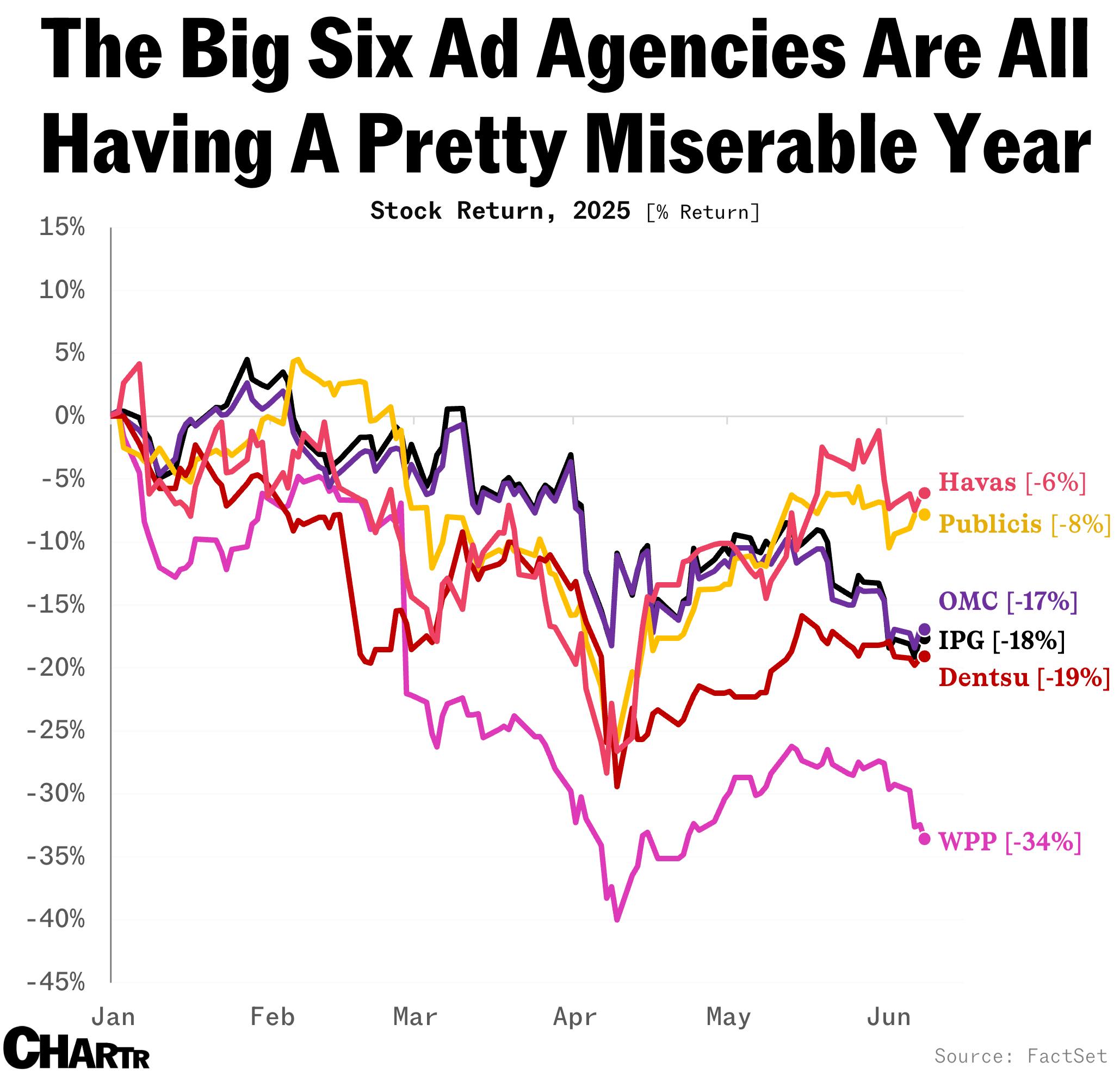
That’s because there are thousands of advertising agencies, each bursting with creative individuals looking to nudge our collective consciousness to be a little bit more sympathetic to the brands they’re tasked with representing on billboards, screens, and in print. Many of those agencies are owned by one of six major players that dominate the landscape — each one is having a tough 2025.
Sherwood News
The “big six,” the parent companies of dozens of smaller outlets, have all seen shares drop this year, but the largest — UK-based WPP — is hurting the most, with CEO Mark Read announcing his departure this morning, as the company’s stock has slumped by more than one-third so far this year.
Winter is coming
In the competitive world of advertising, industry execs are comfortable campaigning against each other for mandates to run all things advertising for major brands like Coca-Cola, Starbucks, and Nike. With the advent and popularization of AI, however, a new threat has emerged.
Just last week, Meta rocked the big six after The Wall Street Journal reported that the social media giant was planning to launch tools that would completely automate ad creation and targeting. That could mean the same product being shown in completely different settings to different users. For instance, an ad for a watch might show one user the timepiece on the wrist of a climber ascending to great heights, while someone else might see the same model on someone stepping out of a beautiful car, at a concert, playing a sport, or reading a newsletter on their phone.
With many other parts of the agency-brand relationship, like project management and media planning, already susceptible to AI tools, the creative part of the job was perhaps seen as one aspect that might be harder to replace. I’m not sure I’m ready for the ads on my Instagram to get any worse, but here we are.
Programmatic failed to live up to its promise to be faster, smarter, and better, says Tim Frankcom of Epsilon. Retail media must take note if it’s to meet its full potential.
Programmatic’s promise to simplify processes, minimize ad-spend waste, offer transparency into the locations where ads run, and bring benefits for all parties is still not being delivered. So, if we want retail media to capitalize on its full potential, we must learn from programmatic’s development.
Complexity, a lack of standards, measurement challenges, and platform interoperability all affected programmatic’s development and adoption. Now, as retail media emerges as the new engine of digital advertising, powering performance well beyond retailer ecosystems, we must address these issues early to avoid repeating past mistakes and build something better.
So, what lessons can we take from the rise of programmatic?
First-party gold
While arguing the value of learning from the past to avoid future mistakes, it’s ironic that Google’s decision to abandon its phasing out of third-party cookies seems to fly in the face of this. Precision has always been a fundamental part of programmatic, but its mainstay – cookies – were never built for today’s reality and fail to reflect the complexities of digital advertising. That’s why retail media must focus on adopting alternative future-facing solutions that have been tested and introduced over recent years, rather than fall back on a reliance on third-party cookies.
With their wealth of first-party data, retailers have the gold standard for accuracy and personalization. And while they must develop their retail media offering around this, they must also ensure they remain in charge of their own destinies. With programmatic, this loss of control saw publishers fail to benefit fully from the technology’s arrival.
With all the challenges around reach, match rates, data interoperability, transparency, measurement, and privacy, embracing universal identifiers is essential. Yes, retailers have the crucial first-party data, but adopting IDs allows them to introduce identity-based off-site retail media. While onsite may be the initial focus for retail media, networks are quickly realizing that to deliver more personalization, scale, and ROI, they must reach the right audiences off-site.
Smarter media
Identity-based off-site strategies enable brands to connect with real people wherever they are online. By leveraging first-party data, marketers can match ads to individuals with a high degree of accuracy, ensuring that campaigns reach the intended audience across social, display, and video. This one-to-one approach results in more relevant ads, higher engagement, and improved conversion rates.
For so long, programmatic delivered what was best for the technology rather than the advertiser’s best interests. Now the tide is turning, with granular, product-level insights unlocking more ways for brands to assess ROI and optimize spend. We’re seeing retail media networks increasingly reporting on incrementality to prove sales uplift, showing how campaigns are creating business value and that marketing is having an impact.
However, measurement can’t be one-dimensional; it must reflect all elements an advertiser needs. In the retail environment, there can be an array of objectives that programmatic has not traditionally catered for. For example, a campaign may focus on driving in-store footfall or encouraging people to try a new range, and metrics must be built around these goals.
And when it comes to effective measurement, this calls for standards.
Unlock potential
A major lesson from programmatic’s development is that without standards, you have inefficiency, inconsistency, and complexity. All this creates an environment that’s difficult to navigate and stifles potential.
With each retail media network developing its own processes and approaches, this has implications for adoption and investment. While the channel is undoubtedly seeing tremendous growth, a lack of standards and the fragmentation this brings is deterring nearly 60% of buyers from moving budgets into this area.
That’s why the industry must come together to promote and support new standards that offer the consistency and scale needed for growth, while continuing to enable breadth and complexity.
Developing standards also encourages collaboration, which helps overcome friction associated with new technologies coming to market. Yes, partnership choice is essential, but siloed and fragmented approaches hinder evolution and adoption. Ensuring new platforms and channels can connect and drive the interoperability critical in today’s omnichannel environment is a must. Delivering this will instill confidence in retail media, allowing it to flourish.
Ask questions
When programmatic first exploded onto the scene, there were no rules or guidelines, and few experts. Indeed, in the early stages, there was real ignorance. However, not wanting to come across as uninformed or perhaps blinded by the technology and jargon meant not enough questions were asked, and due diligence was not thoroughly carried out. This was often to the detriment of businesses that invested in technologies that failed to deliver what they needed or soon became redundant.
Now there should be no excuse. People should be confident enough to ask the key questions, so they are informed. Can they deliver the metrics you want? Can they marry online and offline sales? Is their view of identity truly deterministic, or are they just stitching together loose digital IDs? How is attribution defined? Can you understand what’s happening at a SKU level? Can they show you how transparent reporting is?
With over 200 global retail media networks, each with its own usage frameworks, it’s critical to get what you need. And that can only be achieved by asking questions and clarifying.
While faster, smarter, and better may have been the mantra for programmatic, the challenges of implementing it must be recognized and addressed at the outset for retail media. Every emerging approach in digital advertising has its intricacies. However, learning the lessons from programmatic’s past will help minimize issues, speed up adoption, and allow it to reach its full potential quicker.
Business Insider will lay off one in five employees and go “all-in on AI,” CEO Barbara Peng told staff on Thursday.
In a memo first reported by New York Times media reporter Ben Mullin, Peng announced that 21% of staff will lose their jobs as Business Insider moves to reduce its reliance on “traffic-sensitive” parts of the business. While some news publishers haven’t seen a drop in referral traffic amid the rise of Google AI Overviews and ChatGPT queries, others — including many small- and medium-sized sites — report their traffic has fallen off considerably.
“The media industry is at a crossroads. Business models are under pressure, distribution is unstable, and competition for attention is fiercer than ever,” Peng wrote. “At the same time, there’s a huge opportunity for companies who harness AI first. Our strategy is strong, but we don’t have the luxury of time. The pace of change combined with the opportunity ahead demands bold, focused action — and it’s our chance to lead the pack.”
The layoffs will touch “every department” of the media company, Peng said. In response, the Insider Union, which represents more than 250 editorial staffers, released a statement calling the layoffs a “brazen pivot away from journalism toward greed.”
“Our position as a union is that no AI tool or technology should – or can – take the place of human beings,” Insider Union said in the statement.
In its news coverage, Business Insider will scale back on “categories that once performed well on other platforms but no longer drive meaningful readership or aren’t areas where we can lead,” Peng said. That includes scrapping the majority of its e-commerce business “given its reliance on search.” The news organization, which was purchased by Axel Springer in 2015, will launch a new “live journalism” events business called BI Live.
“We’re at the start of a major shift in how people find and consume information, which is driving ongoing volatility in traffic and distribution for all publishers,” Peng wrote in the memo. “The impact on our industry has been profound, with many publications shuttering in recent years.”
Though each visit to Business Insider generates twice as much revenue as it did two years ago, 70% of the news site’s business “has some degree of traffic sensitivity,” according to Peng.
“We must be structured to endure extreme traffic drops outside of our control,” she wrote, “so we’re reducing our overall company to a size where we can absorb that volatility.”
Business Insider averages 100 million global monthly uniques and has 1.5 million newsletter subscribers, according to its media kit. The site has an AI-powered paywall and sells subscriptions for $13/month or $150/year but hasnot made recent subscription numbers public. It reported 330,000 paid subscribers in November 2023.
Nieman Lab staff writer Andrew Deck recently reported that Business Insider is tracking and incentivizing employee AI usage. In her memo today, Peng reiterated to staff that Business Insider is going “all-in on AI.” Peng also underlined the goal to have every employee using Enterprise ChatGPT regularly.
Today we’re making significant organizational changes that are part of the strategy we set in motion a year and a half ago: to be the essential source of business, tech, and innovation journalism for an audience determined to succeed and unafraid to challenge convention to do it.
Since returning to our roots as Business Insider, we’ve been building toward something new. This kind of transformation takes time — and it requires tough decisions along the way.
What happens today
We are reducing the size of our organization, a move that will impact about 21% of our colleagues and touch every department.
This will be a difficult day, and our first priority is to provide clarity and support to those colleagues whose roles are being eliminated.
If your role is impacted, you will receive an email from the People & Culture team in the next 15 minutes. The email will include details for a meeting today in which a member of our P&C team will walk you through next steps and answer any questions. You will only receive an email if your role is affected.
We’re also proposing changes that impact our UK team, but the process is a bit different there; separate communication will follow from Claire Shelton.
While today’s changes are what we must do to build the most enduring Business Insider, it doesn’t make them any easier. We are fortunate to have built a company filled with thoughtful, kind, and creative people around the world, and we deeply appreciate the positive impact they have made within the company and on our readers, clients, and partners.
The changes we’re making today and why
Eighteen months ago we announced our new strategy: We went back to Business Insider and focused on delivering best-in-class business, tech, and innovation journalism to a smart, specific audience. That kicked off the beginning of our transformation from Insider — with its broad approach and appeal — to a more focused Business Insider.
Since Jamie Heller joined as EIC at the end of last year, we’ve made great progress — we’ve sharpened our standards and are shifting towards more reporting that is authoritative and matters deeply to the people who read it. We’ve doubled the amount of original reporting we publish and have substantially increased engagement in the past months.
This is a new Business Insider. It’s more focused. It’s intentional. And it’s working.
More broadly though, the media industry is at a crossroads. Business models are under pressure, distribution is unstable, and competition for attention is fiercer than ever. At the same time, there’s a huge opportunity for companies who harness AI first. Our strategy is strong, but we don’t have the luxury of time. The pace of change combined with the opportunity ahead demands bold, focused action — and it’s our chance to lead the pack.
Here’s what’s changing today:
1. We’re aligning our coverage to match our strategic focus.
We’re focusing where we can deliver unique, lasting value and serve our audience in ways only Business Insider can.
As Insider, we cast a wide net, covering a broad range of topics. Some of those still align with our strategy — stories that spotlight the smart moves (and mistakes!) people make as they actually experience the world.
At the same time, we’re scaling back on categories that once performed well on other platforms but no longer drive meaningful readership or aren’t areas where we can lead.
Our most loyal readers subscribe, engage, and consistently return for specific coverage — and we’re doubling down on those areas with expanded reporting and key hires.
2. We’re launching events and reducing our reliance on traffic-sensitive businesses.
We’re at the start of a major shift in how people find and consume information, which is driving ongoing volatility in traffic and distribution for all publishers. The impact on our industry has been profound, with many publications shuttering in recent years.
Our business is diversified, which has helped insulate us. We’ve also significantly improved how we monetize traffic — each visit to our site now generates twice as much revenue as it did just two years ago.
Still, 70% of our business has some degree of traffic sensitivity. We must be structured to endure extreme traffic drops outside of our control, so we’re reducing our overall company to a size where we can absorb that volatility.
We’re also exiting the majority of our Commerce business, given its reliance on search, and maintaining a few high performing verticals.
We’re launching and investing in BI Live, our new live journalism events business. It’s a space where we can showcase our journalism, connect directly with our audience, and build a strong portfolio of experiences. We’ve already seen demand, brought on key leaders, and will continue to build the team.
3. Finally, we are fully embracing AI.
As we shared during our April All-Hands, we are going all-in on AI — and we’re off to a strong start.
Over 70% of Business Insider employees are already using Enterprise ChatGPT regularly (our goal is 100%), and we’re building prompt libraries and sharing everyday use cases that help us work faster, smarter, and better.
In the past year, we’ve launched multiple AI-driven products to better serve our audience — from gen-AI onsite search to our AI-powered paywall — with new products set to launch in the coming months. We’re also exploring how AI can boost operations across shared services, helping us scale and operate more efficiently.
Change like this isn’t easy. But Business Insider was born in a time of disruption — when the smartphone was reshaping how people consumed news. We thrived by taking risks and building something new.
We’re at that moment again. It calls for bold experimentation, openness to change, and a willingness to lead.
Among all publications, we are uniquely positioned to do just that.
What’s next
I know this is a lot to absorb and it will take time to process. We’ll come together during the All-Hands today at 11:30AM ET and leaders will be hosting team meetings to answer your questions.
To those affected today, we are grateful to you for helping build Business Insider and for being wonderful colleagues. Your work has made an impact and we appreciate you.
Please support each other today and as we move through the coming days and weeks. While this change is extraordinarily difficult and will test us in many ways, it is a moment I know we’ll be able to meet. Thank you all for your resilience, as ever.
Someone clicks on your ad, you pay a fee and we all go home happy. Easy enough, right?
Not so fast.
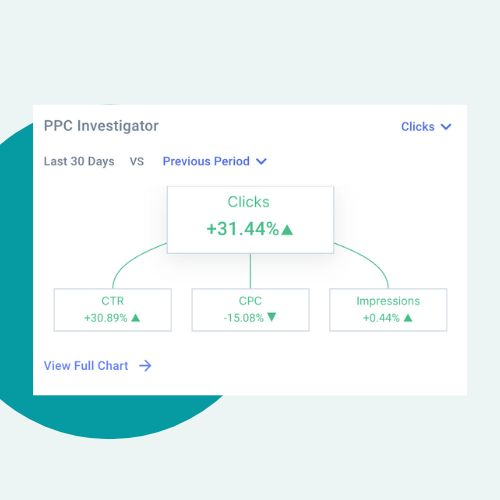
PPC advertising may seem simple on the surface, but there’s much more to it than meets the eye. From keyword research and ad copy to bid management and A/B testing, planning and executing an ad campaign is easier said than done.
Luckily, marketers don’t have to do it all on their own. With the right tricks up your sleeve and the right PPC tools, you can optimize your PPC strategy and maximize its return on investment (ROI) in real time. When used effectively, each PPC optimization tool helps you manage tasks like campaign management, allowing you to track your ad accounts more efficiently.
Here, we’re exploring the 10 best PPC tools in 2025 and how they help you manage campaigns from start to finish.
Understanding PPC: Why Does It Matter?
Unlike other marketing tactics, a PPC campaign can generate big results in a short amount of time. As a form of display advertising, it literally puts your content where your audience can’t miss it — search engines, social media, websites and more.
In other words, creating a PPC ad is like buying prime real estate in your target market. Whether it’s published on Google, Amazon or Facebook, your audience is sure to see it as soon as they step through the door.
Better yet, PPC ads are highly effective at driving targeted traffic to your website and generating conversions. According to Google, businesses make an average of $2 in revenue per dollar spent on Google Ads — an ROI of 200%. By focusing on the smart, data-driven platforms Google Ads provides, you can improve performance and ultimately save time on everyday tasks.
Why Use a PPC Management Tool?
With returns as big as that, it’s clear that PPC advertising is well worth the investment. But make no mistake: Planning, creating, designing and implementing advertising campaigns isn’t easy. It’s especially hard if you’re relying on manual processes to manage the mayhem.
Sure, you might be comfortable with Google Sheets. But can you imagine juggling dozens of ad campaigns in a single spreadsheet? It’s only a matter of time before human error becomes a problem.
Fortunately, there are plenty of PPC tools and software that simplify and optimize PPC management. Every solution is different, but generally speaking, they ease your pain in several ways:
They streamline ad copy creation, bid management, keyword research and more.
PPC reporting tools enable real-time ad campaign performance tracking, providing you with key features for better insights.
Marketers can also use PPC reports to monitor ad spend and budget optimization, allowing them to look at search volume competition while fine-tuning budgets.
Whether you’re using Amazon ads, Microsoft ads (including Bing Ads), Google search, social media or other platforms, it’s important to keep your work organized and on track. PPC automation plus the right optimization tool, coupled with an AdWords Certification, are crucial assets for achieving that goal.
10 of the Best PPC Tools in 2025
There are countless PPC management tools on the market. Some focus on PPC reporting, others specialize in social media, but all aim to strengthen your PPC strategy to its full potential. These solutions often include advanced keyword tools and features, helping you pinpoint relevant search terms that result in higher conversions.
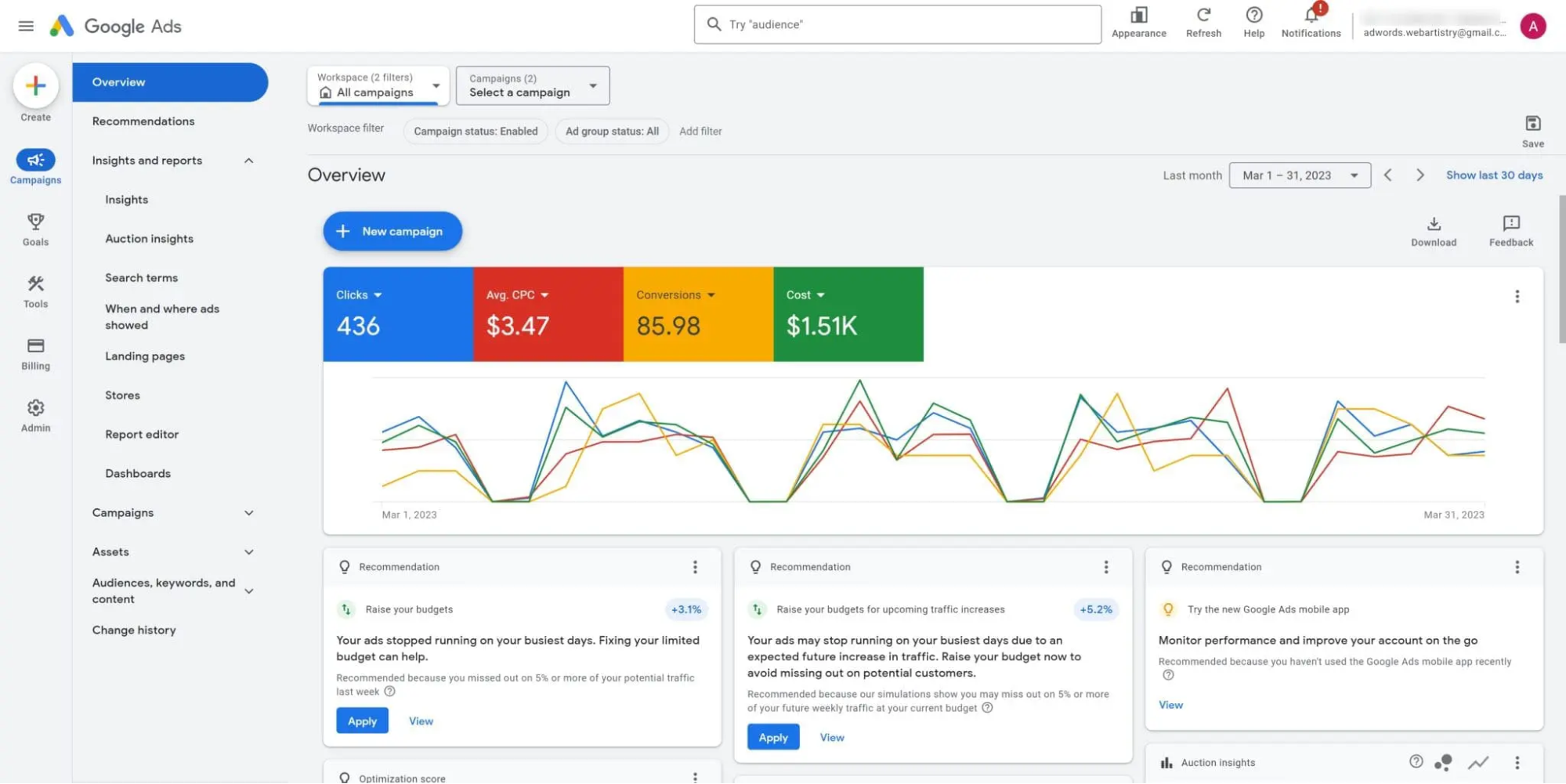
1. Google Ads
It goes without saying that Google is synonymous with all things search — PPC advertising included. That’s why we couldn’t possibly start this list without discussing Google Ads, the company’s easy-to-use PPC management tool.
Formerly known as Google AdWords, this platform’s primary function is to help you launch campaigns across its network. This includes:
Google search ads: Text-based ads that appear on search engine results pages (SERPs).
Display ads: Native and banner ads that appear on websites participating in the Google ad program.
Video ads: Videos that advertise to YouTube audiences.
Google Ads also gives marketers access to other PPC software tools, such as Google Keyword Planner. This keyword magic tool generates keyword ideas based on search terms you choose, helping you discover new and relevant keywords for your business. It provides valuable insights like search volume competition, bid range and other metrics, while also predicting expected conversions, clicks and impressions.
Secondly, users receive access to Google Ads Editor. This tool simplifies PPC campaign management, enabling you to oversee performance in a single pane. One of its key features is the ability to manage campaigns on multiple Google Ads account profiles and make bulk edits quickly and easily.
Pricing: Free to set up an account (To run ads incurs costs).
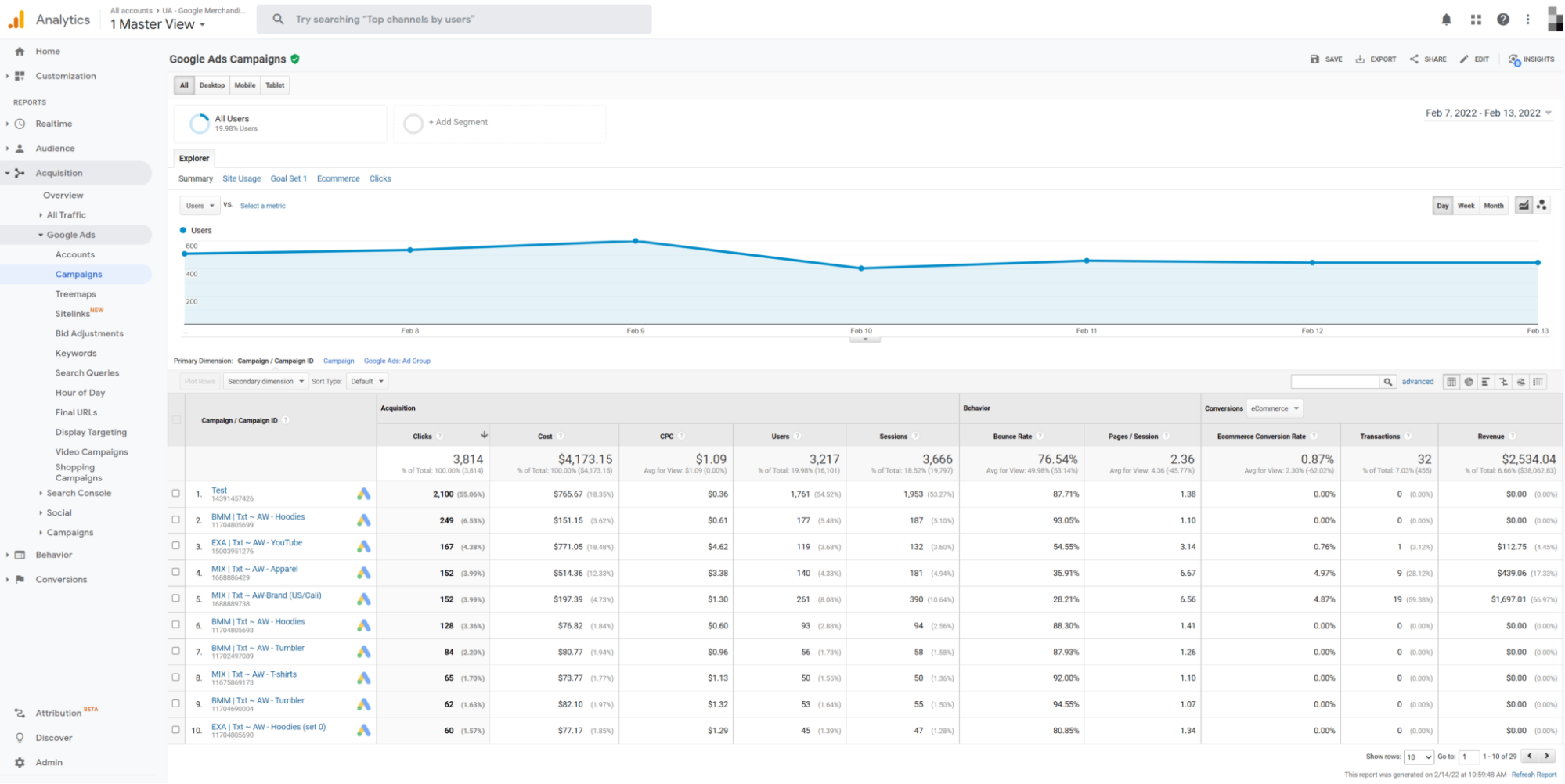
2. Google Analytics
As a digital marketer, it’s your job to know whether your PPC campaigns are on the right track. Luckily, that’s why marketers turn to Google Analytics. Integrating Google Analytics with the platforms Google Ads provides can give you deeper insights.
Although Google already offers PPC management tools, connecting them to Google Analytics will take them to the next level. This additional platform allows you to view real-time performance metrics, including:
These insights empower you to analyse your PPC strategy and make data-driven decisions about how to allocate your ad account budget. Over time, you can use these metrics to improve performance and refine your campaigns.
Pricing: Free version available (Higher tiers are priced).
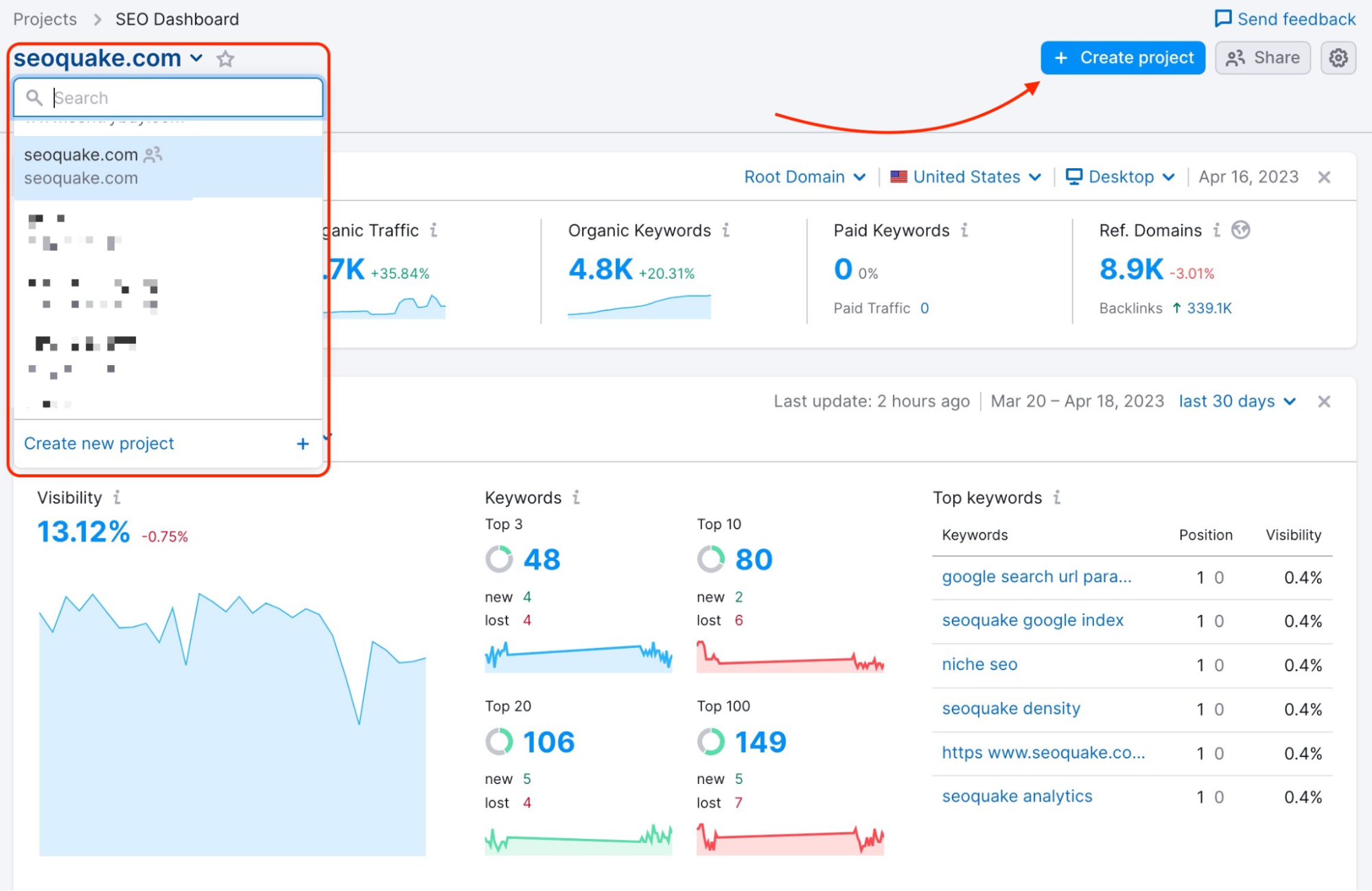
3. Semrush
Semrush is one of the most popular (and powerful) PPC tools and software providers on the market. As an all-in-one digital marketing tool, Semrush is a great asset in many aspects of PPC advertising, including search engine optimization (SEO).
More specifically, Semrush greatly simplifies keyword research by giving you detailed search volume competition data. The platform offers various capabilities that leverage a massive keyword database, allowing you to identify search terms most relevant to your goals.
Likewise, you can analyse thousands of keywords at a time and pinpoint the ones your competitors are using. It even provides insight into which keywords your competitors are bidding on. This level of detail can save time on your PPC campaign tasks by helping you focus on the phrases that matter.
Pricing: Starts at $139.95 per month.
4. PPC Entourage
PPC Entourage is a well-known tool that boasts a wide range of innovative features made specifically for Amazon ads. As a user-friendly platform, this solution is great for any digital marketer just getting started with PPC advertising who wants to run multiple ad campaigns efficiently.
Users leverage a suite of automation tools, enabling them to apply a template across multiple Amazon PPC campaigns in a matter of seconds. PPC Entourage also includes a “Bulk Optimizer” tool, which allows you to optimize every ad account and all your Amazon ads in a fraction of the time it would normally take.
Customers also receive advanced and accurate PPC reports, which can be compiled on a weekly or monthly basis. This gives you the ability to make regular adjustments to your advertising campaigns and keep them on course. Pricing: PPC Entourage charges a 2.9% monthly ad spend fee.
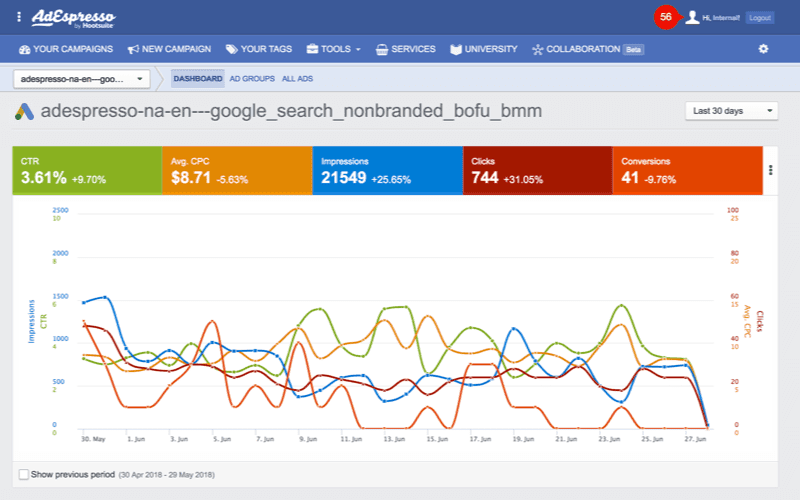
5. AdEspresso
AdEspresso is primarily a Google Ads alternative that augments the platform’s built-in capabilities. Although not one of the more robust PPC software solutions available, its unique split testing feature stands out from the crowd.
This optimization tool simplifies A/B testing, allowing you to try different Google ad variations to see what sticks. In turn, you can identify the most effective messaging and tweak the ad copy accordingly. AdEspresso also integrates with Facebook Ads and Instagram, helping you manage ad campaigns across all these channels simultaneously.
Pricing: Starts at $49 per month.
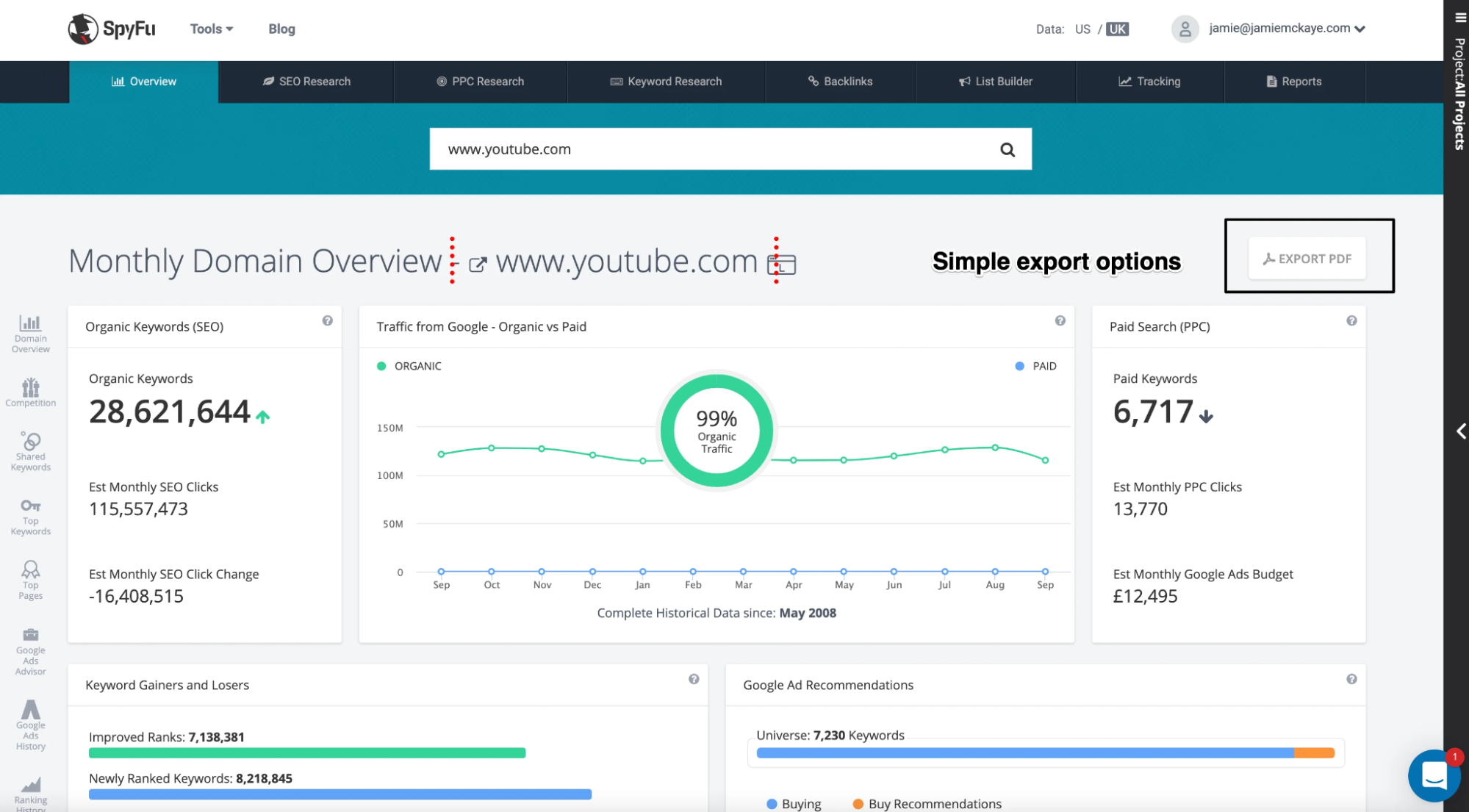
6. SpyFu
As the name implies, SpyFu helps you “spy” on the competition — well, kind of. At the very least, this PPC management software takes a peek behind the scenes and helps you understand competitor rankings and ad variations.
Not only can you see which keywords competitors are bidding on, but you can also view every keyword and PPC ad they’ve ever used. Plus, SpyFu takes the guesswork out of SEO by doubling as a SERP analysis tool. In other words, you can use its insights to understand Google trends and stay ahead of the search engine curve.
Pricing: Basic plans start at $39 per month.
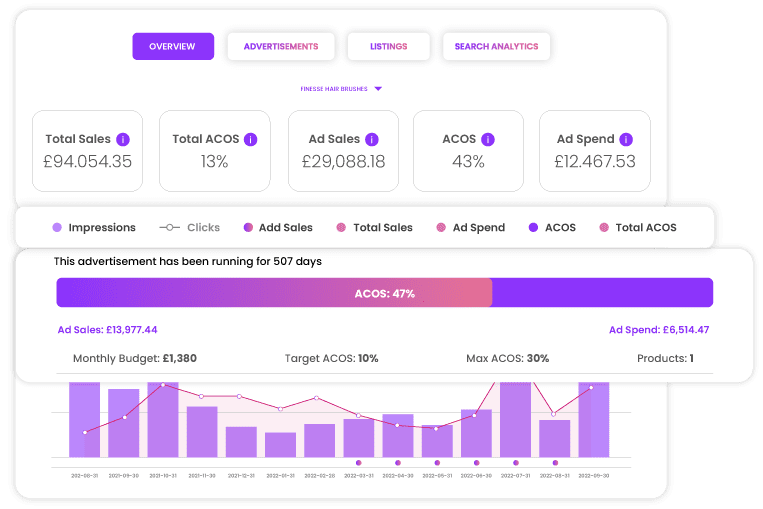
7. Trellis
Trellis is another Amazon PPC tool designed to help marketers manage E-commerce advertising. Although it’s an advanced platform with a swarm of innovative features, its user-friendly dashboard makes it easy to optimize multiple Amazon PPC campaigns in one fell swoop.
One great feature of Trellis’ AI-powered automation tools is their ability to allocate budgets between branded and generic keywords. This helps you make the most of your Amazon advertising budget, ensuring maximum sales growth and allowing you to monitor your Google Ads campaigns alongside your Amazon efforts if needed.
Pricing: Plans start at $299 for revenue up to $2 million annually.
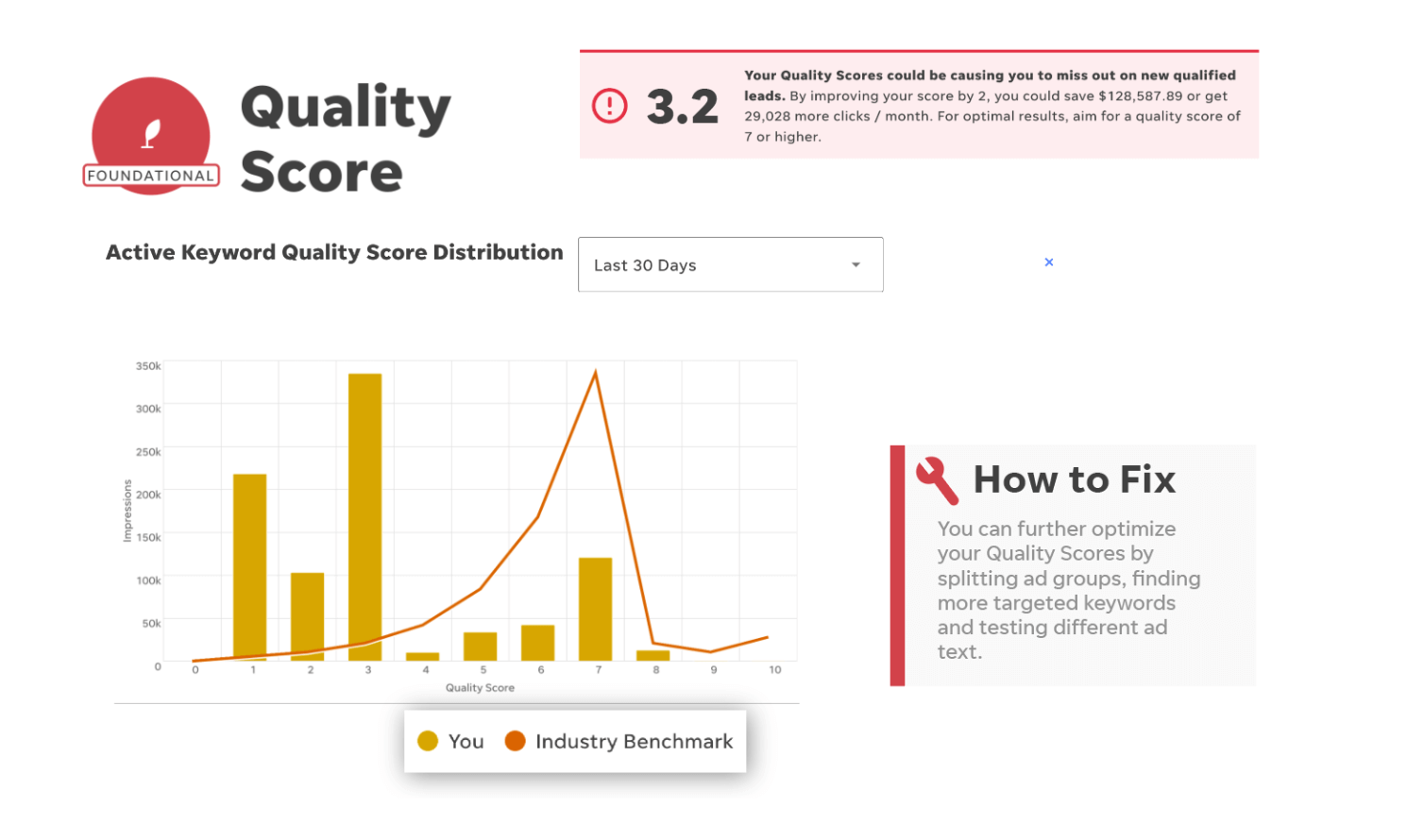
8. WordStream
WordStream began with a singular focus on keyword research, but has since developed into a suite of PPC software solutions. However, we’d like to call out two of its capabilities in particular:
Google Ads Performance Grader.
Facebook Ads Performance Grader.
These two benchmarking tools are great for understanding the quality of your campaign and identifying missed opportunities. They assess your campaigns and assign an overall score between zero and 100 — the higher the score, the better the campaign.
WordStream also provides individual scores in 10 categories, including wasted spend, click-through rate and landing page optimization. By getting a clear snapshot of your Google Ads account, you can pinpoint weak areas and boost your PPC optimization.
Pricing: Free tools and resources available.
9. Optymyzr
Optymyzr calls itself a single platform to “audit, optimize, automate and report on paid media campaigns that grow your business.” As a comprehensive PPC software provider, Optymyzr focuses not only on Google Ads, but also Facebook Ads, Microsoft Ads and Amazon advertising.
This product supports a variety of PPC ads formats, including search, shopping, display and video. Some of its key features are:
Automated bid management.
Auction insights.
Paid search optimization.
PPC reporting.
Budget tracking.
By centralizing these tasks, Optymyzr helps you coordinate all your platforms, including Google Ads, so you can manage every ad account in one place.
Pricing: $209 per month.
9. Optymyzr
Optymyzr calls itself a single platform to “audit, optimize, automate and report on paid media campaigns that grow your business.” As a comprehensive PPC software provider, Optymyzr focuses not only on Google Ads, but also Facebook Ads, Microsoft Ads and Amazon advertising.
This product supports a variety of PPC ads formats, including search, shopping, display and video. Some of its key features are:
Automated bid management.
Auction insights.
Paid search optimization.
PPC reporting.
Budget tracking.
By centralizing these tasks, Optymyzr helps you coordinate all your platforms, including Google Ads, so you can manage every ad account in one place.
Pricing: $209 per month.
10. Adzooma
10. Adzooma
The Adzooma PPC management system helps you create, manage, analyse and enhance your PPC ad campaigns through automation tools and growth opportunities. To date, this holistic platform has optimized over $1 billion in ad spend, generated over 2.11 billion clicks and achieved nearly 200 million conversions.
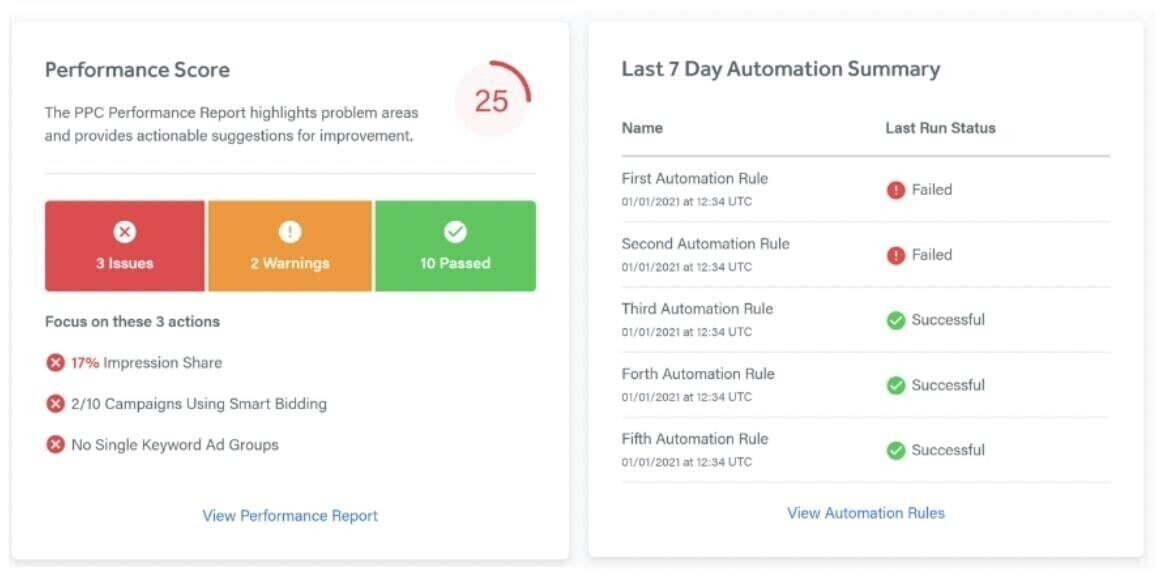
Adzooma provides weekly smart recommendations, which you can use to improve ad performance over time. Users can set rules to automate certain tasks like bidding, budget allocation and more. Plus, with Google Analytics integration, you can gain even more granular insights into user behaviour on your website.
If you’re looking for a solution with both free and paid plans, Adzooma has a flexible approach that scales as you grow.
Pricing: Adzooma offers a free plan, but premium paid plans begin at $69 per month.
What PPC Tools Won’t Be Able To Do for You
Ultimately, PPC management isn’t easy if you’re not using software solutions. That said, even the most advanced PPC tools can’t do everything on your behalf.
No matter what technologies you have at your disposal, there’s no replacing human insight and creativity. AI-powered tools may be helpful, but they’re far from perfect.
Bottom line: Think twice before you set and forget your PPC strategy. With the right balance of automation and manual oversight, you’ll be well on your way to success.
By Christopher Whitbeck
Chris Whitbeck a senior writer based in Boston. When he’s not writing, you can find him buried in a good book, walking to the nearest coffee shop, listening to a podcast or (loudly) cheering for the Boston Celtics.