By Gemma Ruse
Pop-ups are increasingly important in a digitally-saturated world. StudioXAG’s Gemma Ruse explains the most common mistakes designers make on these projects, and how to avoid them.
I think pop-ups are brilliant.
At their best, they give brands permission to bring a story to life with real impact. Their impermanence allows ideas to be expressed in bold, dramatic and sometimes theatrical ways that would never make sense in a permanent space.
They are also powerful tools for connection. A chance to surprise and delight people in a physical environment that reaches places digital simply cannot.
As a huge advocate for the potential of pop-ups, I try to give every one I walk into the benefit of the doubt. But the truth is, many do not deliver.
More often than not, I can tell within the first 30 seconds whether something is going to work.
That judgement is not about whether a space looks expensive, or whether there is a queue outside. It comes from years of watching how people move through environments. Where they hesitate. What they ignore. What quietly frustrates them.
In my experience, pop-ups rarely fail because of bad ideas. They fail because of a small number of common and entirely avoidable mistakes.
Here are five I see again and again.
1. Underestimating execution, materials and build quality
The fastest way for a pop-up to fail is through poor execution. These issues trigger an instant, subconscious reaction that something is not quite right.
Bad sight lines, sloppy finishes and poorly fitted graphics are immediate credibility killers.
Materials pretending to be something they are not are another red flag. If the budget does not stretch to marble, do not use vinyl printed to look like marble.
Lighting matters just as much. Even inconsistent colour temperatures can undermine an otherwise strong idea.
Budgets and timelines are real constraints, and value engineering is part of the job. Simplifying with intention is very different from cutting corners. Every element contributes to how a brand is judged in those first 30 seconds.
The execution is the idea. Pop-ups may be temporary, but reputational damage is not. Once something is photographed, filmed and shared, it lives on.
2. Designing for an imagined customer
One of the quickest ways to lose people is to design for someone who is not actually going to be there.
This often happens when brands chase a coveted Gen Z audience, even though their most loyal customers are much older.
The result can feel like a parody of youth culture. Loud, performative and trend driven, yet oddly hollow.
Meanwhile, the people who genuinely care about the brand feel quietly alienated.
A pop-up should entice and engage the real consumer. It is not a mood board brought to life. It is a place where people are invited in, where they feel recognised, curious and welcome.
At its best, it becomes a space for experience and community, not just a backdrop for content.
Getting this right starts with observation. Market data helps, but designers also need to spend time in stores, watching who shows up, how they move, what they touch and what makes them linger. Those insights should shape the idea from the outset.
Designing with the consumer at the centre does not limit creativity. It gives it purpose.
3. Confusing visual busyness with engagement
Another fast way to lose attention is to throw too much at people and hope something sticks.
There is an assumption that screens, games and interactive moments automatically create engagement. In reality, visual busyness often overwhelms, especially when it is not rooted in a clear idea.
Certain gimmicks resurface again and again. Novelty without meaning rarely creates connection.
Just because something can be interacted with does not mean people want to.
True engagement comes from emotion. Surprise. Delight. A sense of being let in on something.
People linger when a moment feels considered or quietly unexpected, when the atmosphere invites them to slow down rather than rush through.
If you are adding bells and whistles, ask one question. Does this deepen the story, or is it simply filling space?
4. Treating the pop-up as a standalone moment
Pop-ups fall short when they feel disconnected from the wider brand world.
The strongest ones read like a chapter in an ongoing story, not a one-off stunt. They echo what is happening online, in windows or across the brand’s broader narrative.
When a space feels unrelated, people sense the disconnect immediately, even if they cannot articulate it.
Successful pop-ups are rooted in brand DNA. They borrow cues from product, tone of voice and visual language, then amplify them. The result is continuity and surprise. Familiar enough to be instantly understood, special enough to feel worth stepping into.
A pop-up does not need to shout to stand out, but it does need to belong.
5. Forgetting the online audience
We no longer design pop-ups just for the people standing inside them. We design them for the thousands, sometimes millions, who will experience them through a screen.
A single selfie corner is not enough.
For most people, pop-ups are encountered through photos, videos and POV content. That shift fundamentally changes how spaces need to be conceived.
Boldness and clarity travel better than visual fussiness. From arrival to exit, the entire journey needs to be worth capturing, allowing people to tell a complete story as they move through the space.
Online translation cannot be an afterthought. It has to be considered from the beginning, woven into the idea, the design, and the way the space is built and finished.
Design for the camera, without losing the magic in real life. Because in a screen-first world, the risk is not being un-Instagrammable. It is being forgettable.
What’s next?
Despite many pop-ups missing their potential, they are here to stay. If anything, they are becoming more important as physical experiences carry greater emotional weight in a digitally saturated world.
The most successful pop-ups will place greater emphasis on world building. They will offer moments of escape, depth and immersion.
Above all, they need a reason to exist.
To succeed, brands must be able to answer a simple question. Why this pop-up, and why now.
The purpose does not need to be lofty, but it does need to be honest. When that is clear, those first 30 seconds start working in your favour, rather than against you.
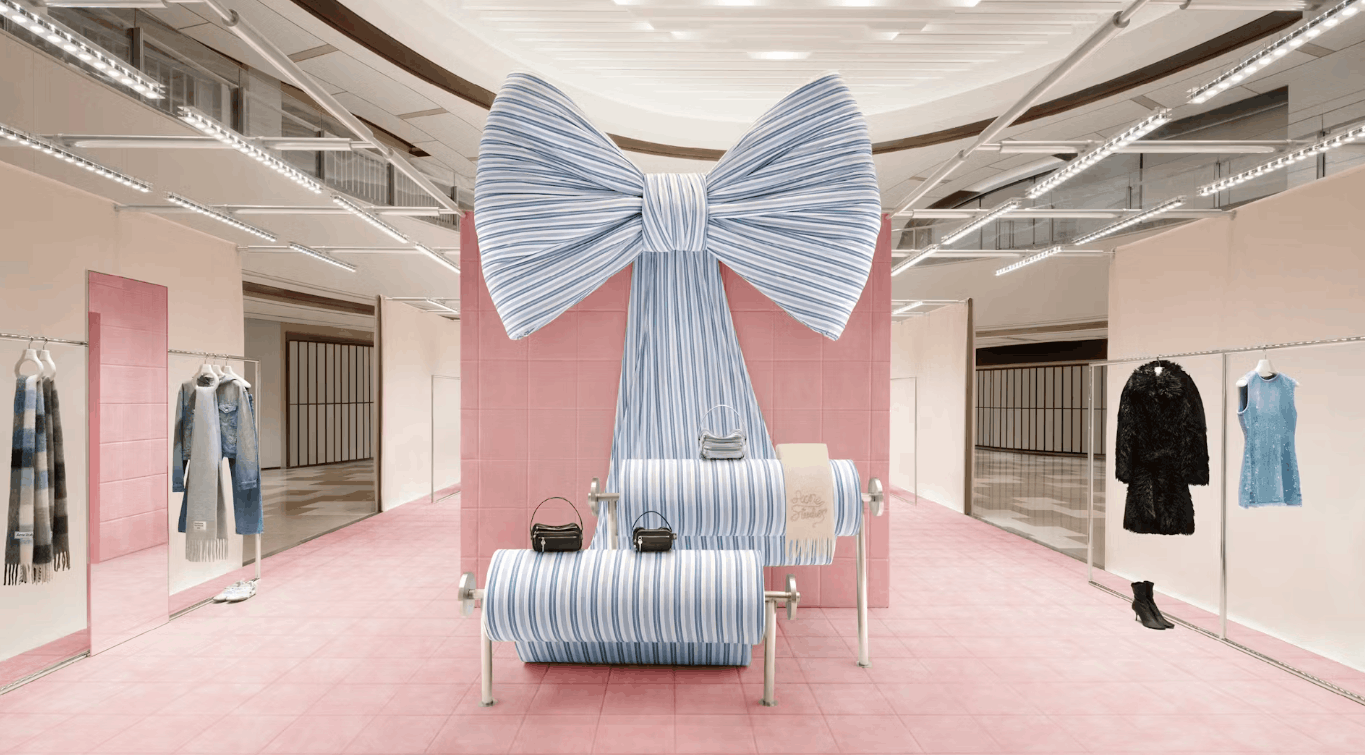
Feature image credit: Studio XAG’s Acne Studios Festive Campaign 2025, Taikoo Hui, Shanghai
By Gemma Ruse
Gemma Ruse is co-founder and creative director at StudioXAG.