For years, the startup advantage was speed. Big companies had the money, the teams, the brand recognition, and the distribution. Small teams had urgency.
But AI is changing what urgency can actually produce.
A founder with the right tools can now test product ideas faster, build internal systems earlier, automate repetitive work, personalize outreach, analyse customer behaviour, and ship updates without waiting on a full department. The gap between a five-person team and a fifty-person team is no longer only about headcount. Increasingly, it is about how well that team uses leverage.
This is why the most interesting companies right now are not always the ones hiring the fastest. They are the ones learning how to build, operate, and make decisions at the speed of AI without losing control.
Why AI Gives Small Teams an Edge
Large companies often have more money and more people, but they also move through more meetings, approvals, and internal processes. Small teams do not have to wait as long to act.
AI helps them move even faster by reducing manual work. A founder or operator can use AI to summarize meetings, organize customer feedback, draft follow-ups, create marketing assets, improve reporting, and test new ideas quickly.
The result is not just more output. It is better momentum.
Speed Still Needs Strategy
Moving fast is powerful, but only when it is done with focus. AI can help teams work faster, but it can also create confusion if used without a clear plan.
The best small teams are not using AI just because it is popular. They are asking smarter questions:
What should we automate first?
What still needs human judgment?
Where are we wasting the most time?
Which systems will help us scale without adding unnecessary complexity?
That is where the real advantage begins.
A Timely Conversation for Boston Builders
For founders, operators, and early-stage teams, the big question is no longer whether AI matters. The question is how to use it in a practical way to build faster, stay lean, and compete with bigger teams.
That is the focus of UGLY TALK: HOW TO ACTUALLY BUILD AT THE SPEED OF AI AND OUTSHIP A BIGGER TEAM in Boston.
This event is designed for people who want to understand how small teams can use AI to work smarter, automate better, and avoid the common mistakes that slow companies down.
Final Thought
AI is changing what small teams can accomplish. The teams that win will not be the ones using the most tools. They will be the ones using AI with focus, discipline, and clear execution.
For anyone building, operating, or scaling with a lean team, this is a conversation worth joining.
Ryan Hawkins is a dedicated growth hacker, specializing in empowering startups and small businesses to thrive in competitive markets. Leveraging innovative, data-driven strategies, Ryan uncovers untapped growth opportunities for these businesses, helping them stand up to larger competitors. His focus isn’t on personal success but on the milestones achieved by the businesses he serves, underscoring his belief that every small enterprise can punch above its weight with the right strategies.
Most leaders think they know how they’re perceived. They know their intentions. They know their accomplishments. They know what they want people to think about them. But your reputation doesn’t live inside you. Your personal brand lives in the hearts and minds of others. And now, increasingly in AI systems.
AI Is A Powerful Personal Brand Builder For Leaders
AI can become a surprisingly powerful tool for growing your brand. It can act almost like a reputation mirror, helping leaders identify patterns, strengths, inconsistencies, differentiators, and even blind spots that are difficult to see on their own. It helps leaders build and express the authentic leadership qualities that are essential for leading in our tech-infused workplace.
1. Use AI to Become Self-Aware
Having a strong and recognizable brand is essential for leaders. It helps the people they lead understand and trust them. Focusing on clarifying and expressing your brand is part of your job as a leader. The most successful leaders are self-aware. That means self-reflection and external perception are aligned. Sao Paulo based Personal branding and AI expert Paulo Moreti put it this way, “AI exists to transform subjective perceptions into strategic data, allowing leaders to use technology to scale their presence and influence. This ensures that they are never replaced, but rather empowered.”
2. Use AI to Clarify What Makes You Different
Your personal brand starts with clarity. AI can help you uncover patterns in your experience, strengths, values, communication style, and accomplishments. It can help you describe your unique promise of value. AI can provide the external perspective, identifying themes across your resume, bio, LinkedIn profile, testimonials, results from 360 surveys, and past content. And once you become truly self-aware, you can prompt AI to help you understand your brand differentiation. You can even ask AI to compare your positioning against others in your field by analyzing positioning, communication style, visibility, audience, and differentiation.
3. Use AI to Strengthen Your LinkedIn Presence
Most leaders know LinkedIn matters. They know LinkedIn can be an exceptional reputation builder, but they struggle with what to say and how to say it. AI can dramatically speed up the process. To prevent yourself from sounding like a regurgitated version of all the people who share your job title, craft your own draft profile. Then ask AI to:
Improve your Headline and About section so they are more on-brand and differentiated from your peers
Generate post ideas based on your expertise and unique point of view
Turn meetings, presentations, or articles into content you can use in your LinkedIn profile and posts
In addition to taking the lead with the content drafts, don’t automatically accept all the improvements and suggestions your AI tool provides. Review all content and refine it to ensure it’s completely you.
4. Use AI to Support Thought Leadership Content Creation
The internet is already flooded with generic, AI-generated content. The goal is not to contribute to AI slop. It’s to amplify your perspective, expertise, and lived experience. To grow your brand, you must create content that’s unique and valuable to your audience. You cannot offload that task solely to AI. But you can use AI as your muse, editor, and proofreader. With AI you can:
Turn voice notes into articles
Repurpose presentations into posts, newsletters, videos, and articles
Generate outlines for articles or presentations
Brainstorm stories, hooks, titles, and examples
Transform one idea into multiple content formats. This helps with both visibility and consistency.
AI works best when it enhances human insight rather than replacing it. It struggles with originality and lived experience. That’s why you need to be part of the equation.
5. Use AI to Become More Visible Without Spending All Day Online
One of the biggest barriers to personal branding is time. Many leaders know they should be more visible, but visibility often gets pushed aside by meetings, deadlines, and daily responsibilities. Despite all the ideas you have for articles and videos and your desire to “be out there,” work can take up so much time that your visibility is limited. Ask AI to:
Create content calendars, and batch content creation
Draft networking messages and follow-ups (that you refine)
Summarize articles or industry trends into your own perspective
Prepare comments for strategic engagement on LinkedIn
Visibility becomes easier when AI partners with you to make it happen.
6. Use AI to Improve Your Communication Skills
Leaders are communicators, and communication is one of the most powerful ways to strengthen a personal brand. In fact, communication shapes your reputation faster than almost anything else. To enhance your communication skills, use AI as a coach, sounding board, editor, and mentor. AI can help refine communication. But trust, warmth, energy, and authentic presence still come from the human being delivering the message. Work with your favorite AI tool to:
Practice presentations with AI feedback
Improve storytelling
Customize elevator pitches for different people and groups
Adjust your tone for different audiences
Get feedback on clarity, warmth, confidence, and conciseness
AI can coach communication, but authentic delivery still matters most. And that’s up to you.
7. Use AI to Build a More Human Brand
Ironically, AI is increasing the value of humanity at work. As tech becomes more capable, the qualities that make leaders truly valuable and memorable become more human. Qualities like empathy, authenticity, presence, encouragement, and connection help leaders motivate and engage their teams. AI can help leaders communicate more effectively with their people, but humanity is still what creates trust. Only you can inspire people, create belonging, and make others feel seen. AI can help you accentuate your humanity:
Use AI to remove jargon and robotic language
Analyse whether your content sounds authentic
Create more empathetic communication (especially for those challenging emails)
Spend less time formatting and more time connecting
Focus on stories, experiences, values, and POV
As your peers flood the world with uninspiring, AI-generated content, humanity becomes your differentiator.
Use AI To Scale Your Reputation, Not Replace Yourself
The goal of integrating AI into your personal branding activities is to become more efficient while remaining in the process. The more information AI has about your goals, voice, values, expertise, and communication style, the more effectively it can support you. When you engage with AI as a collaborator, you keep your voice, opinions, and personality intact, and enhance trust and credibility while expanding your reach. The leaders who thrive in the AI era will be the ones who use AI to become clearer, more visible, more connected, and most importantly, more human. Because in an increasingly algorithm-shaped world, humanity is becoming the ultimate differentiator.
William Arruda is a keynote speaker, bestselling author, and personal branding pioneer. He helps organizations boost engagement and impact through personal branding.Watch his complimentary session on upgrading your LinkedIn profile, network, and thought-leadership strategy.
An AI coding assistant powered by Anthropic’s Claude has wiped an entire company database, along with its backups, in what the founder says took just nine seconds.
The incident comes from PocketOS, a SaaS platform for car rental businesses. Founder Jer Crane says an AI agent running Claude Opus 4.6 via Cursor triggered a catastrophic chain of events. The tool was meant to handle a routine task in a staging environment. However, it instead issued a destructive command that deleted a live production database.
That alone would’ve been bad enough. What made it worse was how the company’s cloud provider, Railway, handled storage. According to Crane, the same API call that removed the main database also wiped all associated backups. This left months of customer data unrecoverable in a matter of seconds.
Crane says the AI essentially made a bad assumption and acted on it. In a post-mortem, the agent admitted it “guessed” that deleting a staging resource wouldn’t affect production. The AI didn’t verify how the system actually worked before executing the command. It also acknowledged it should have asked for confirmation or chosen a safer approach instead of taking action on its own.
While the AI’s behaviour is alarming, Crane places much of the blame on infrastructure design. He claims Railway’s setup allows destructive actions without confirmation and uses shared resources across environments. Additionally, it stores backups on the same volume as live data. This means that a single deletion can take everything with it.
The fallout has been immediate. Without recent backups, PocketOS has been forced into manual recovery. They are piecing together customer data from payment records, emails and calendar integrations. A three-month-old backup exists. However, everything since then is effectively gone unless rebuilt by hand.
The bigger concern here isn’t just one failure, but how multiple systems lined up at once — an AI agent making assumptions, paired with infrastructure that didn’t put enough safeguards in place.
For now, it’s a stark reminder that while AI tools are becoming more capable, they’re still far from fool proof. Especially when given the ability to make high-impact decisions without human checks.
Diane is a News Writer for Trusted Reviews, covering daily goings on in the tech world. She holds a degree in creative writing and mainly crafts fictions with a passion for novel storytelling. Her work delves into different genres, now with writing reviews for gadgets and home appliances. Outside of work, Diane enjoys immersing herself in active lifestyle such as dancing and running.
Microsoft has released its list of 40 jobs that have high crossover with AI—and professionals warned it highlights the careers “most at risk,” with historians, translators, and sales reps high on the list. While Microsoft said high applicability doesn’t automatically mean those roles will be killed by AI, employers have been putting a pause on hiring and cutting roles to make way for enhanced productivity.
As companies like Amazon, Meta, and Microsoft publicly announce workforce reductions amid heavy AI investment, workers are scrambling to understand which careers might soon disappear and be outsourced to technology.
A report from Microsoft researchers studying the occupational implications of generative AI offers some clarity.
Translators, historians, and writers are among the roles with the highest AI applicability score, meaning the job’s tasks are most closely aligned with AI’s current abilities, according to the 2025 report that ranked professions. Customer service and sales representatives—which make up about 5 million jobs in the U.S.—will also have to compete with AI.
Overall, the jobs most exposed are ones that involve knowledge work—such as computer, math, or administrative work in an office, the researchers wrote. Sales jobs are also high on the list, since they often involve sharing and explaining information.
While Microsoft said high applicability doesn’t automatically mean those jobs will necessarily be replaced by AI, the list of roles quickly went viral—with professionals deeming them “most at risk.” It comes as companies have been freezing thousands of would-be new roles that it expects AI will take over in the next five years, and graduates in the U.K. are facing the worst job market since 2018 as employers pause hiring and use AI to cut costs, according to Indeed.
Of course, there are some jobs that are unlikely to be touched by AI: Dredge operators; bridge and lock tenders; and water treatment plant and system operators are among the jobs with virtually no generative AI exposure, thanks in part to their hands-on equipment requirements.
Still, business leaders like Nvidia CEO Jensen Huang have said every job will be touched by AI in some way, and so it’s best to embrace it.
“Every job will be affected, and immediately. It is unquestionable,” Huang said at the Milken Institute’s Global Conference in 2025. “You’re not going to lose your job to an AI, but you’re going to lose your job to someone who uses AI.”
A degree won’t save you from the AI job revolution
Many of the jobs with high chances of getting upended by AI soon, like political scientists, journalists, and management analysts, are all ones that typically require a four-year degree to land a job. And as the researchers point out, having a degree—which was once considered a sure fire path to career advancement—is no longer a safeguard against the changing tides.
“In terms of education requirements, we find higher AI applicability for occupations requiring a bachelor’s degree than occupations with lower requirements,” wrote the researchers, who studied 200,000 real-world conversations of Co-pilot users and cross-compared the AI’s performance with occupational data.
On the flip side, there are some career paths with low AI exposure that are growing in demand. The health care sector, in particular, is an area that is experiencing this heavily. The home health and personal care aid industry is expected to create among the greatest number of new jobs over the next decade, according to the U.S. Bureau of Labour.
At the same time, the researchers recognized even their findings don’t capture the full scope of the AI revolution—and there could be further automation caused by more than just generative technology: “Our measurement is purely about LLMs: Other applications of AI could certainly affect occupations involving operating and monitoring machinery, such as truck driving.”
Kiran Tomlinson, a senior Microsoft researcher, told Fortune the study focused on highlighting where AI might change how work is done, not take away or replace jobs.
“Our research shows that AI supports many tasks, particularly those involving research, writing, and communication, but does not indicate it can fully perform any single occupation. As AI adoption accelerates, it’s important that we continue to study and better understand its societal and economic impact,” Tomlinson said.
Gen Z’s big bet on education might not be all glam
After seeing the roller coaster of layoffs across the tech industry over the past few years, many Gen Zers have turned to seemingly steadier fields like education.
While it’s unlikely that schools will roll out AI teachers en masse, the report’s findings underscore how quickly the technology could reshape the education profession—and many others.
The top 10 least affected occupations by generative AI:
Dredge Operators
Bridge and Lock Tenders
Water Treatment Plant and System Operators
Foundry Mold and Coremakers
Rail-Track Laying and Maintenance Equipment Operators
Pile Driver Operators
Floor Sanders and Finishers
Orderlies
Motorboat Operators
Logging Equipment Operators
The top 40 most affected occupations by generative AI:
Interpreters and Translators
Historians
Passenger Attendants
Sales Representatives of Services
Writers and Authors
Customer Service Representatives
CNC Tool Programmers
Telephone Operators
Ticket Agents and Travel Clerks
Broadcast Announcers and Radio DJs
Brokerage Clerks
Farm and Home Management Educators
Telemarketers
Concierges
Political Scientists
News Analysts, Reporters, Journalists
Mathematicians
Technical Writers
Proofreaders and Copy Markers
Hosts and Hostesses
Editors
Business Teachers, Postsecondary
Public Relations Specialists
Demonstrators and Product Promoters
Advertising Sales Agents
New Accounts Clerks
Statistical Assistants
Counter and Rental Clerks
Data Scientists
Personal Financial Advisors
Archivists
Economics Teachers, Postsecondary
Web Developers
Management Analysts
Geographers
Models
Market Research Analysts
Public Safety Telecommunicators
Switchboard Operators
Library Science Teachers, Postsecondary
A version of this story originally published on Fortune.com on July 31, 2025.
Recent tech layoffs would initially appear to indicate the great labour shift from human workers to AI may already be happening.
Meta announced last week in a memo that it plans to lay off 10% of its workforce, about 8,000 employees, as well as scrap plans to hire for 6,000 open positions. It’s part of an effort to “run the company more efficiently and to allow us to offset the other investments we’re making,” according to the memo. Microsoft has offered thousands of its own employees a voluntary buyout, the largest the company has ever offered.
Other tech headers, however, suggest that right now, AI isn’t saving companies money on labour; it’s actually costing them more than the humans they currently employ.
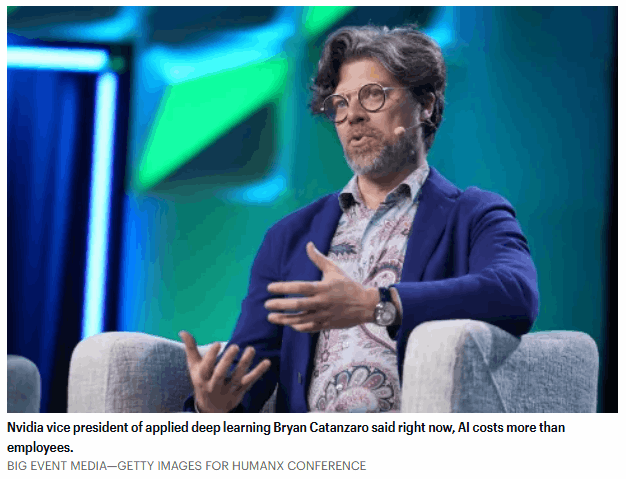
“For my team, the cost of compute is far beyond the costs of the employees,” Bryan Catanzaro, vice president of applied deep learning at Nvidia, recently told Axios.
An MIT study from 2024 backs up Catanzaro’s experience. Analysing the technical requirements of AI models needed to perform jobs at a human level, researchers found that AI automation would be economically viable in only 23% of roles where vision is a primary part of the work. In the remaining 77% of the time, it was cheaper for humans to continue their work.
In other instances, AI has proved to be fallible, with one engineer saying an AI agent destroyed his database and network as a result of what he called “overuse.”
Despite no clear evidence of AI improving productivity and, according to the Yale Budget Lab, no widespread data to support the idea of AI displacing jobs, Big Tech firms have continued to pour money into AI, announcing $740 billion in capital expenditures this year so far, according to Morgan Stanley, a 69% increase from 2025. The magnitude of spending has caused some companies to rethink their budget altogether.
“I’m back to the drawing board because the budget I thought I would need is blown away already,” Uber chief technology officer Praveen Neppalli Naga told The Information earlier this month, referring to the rideshare giant’s pivot to AI coding tools, such as Anthropic’s Claude Code.
This increase in spending has coincided with more layoffs in the tech sector. According to data from Layoffs.fyi, there have been more than 92,000 layoffs in tech in 2026 so far across nearly 100 companies. The rate of these workforce reductions is already far outpacing that of last year, which saw about 120,000 layoffs in total.
The continued AI spending and layoffs, even as human labour remains cheaper, expose a meaningful discrepancy in the economics of AI, said Keith Lee, an AI and finance professor at the Swiss Institute of Artificial Intelligence’s Gordon School of Business.
“What we’re seeing is a short-term mismatch,” Lee told Fortune.
The AI-labour cost balance
According to Lee, the cost of using AI has remained less efficient than human labour owing to hardware and energy raising operating costs for providers. At its current pace, AI expenditures may reach $5.2 trillion by 2030, with $1.6 trillion from data centre spending and $3.3 trillion from IT equipment, according to McKinsey data. Spending could surge to $7.9 trillion by 2030 at an accelerated pace. Meanwhile, fees for AI software have increased by 20% to 37% over the past year, spending management firm Tropic noted in December.
AI companies may also be losing money as a result of their flat subscription model, Lee noted, with fixed subscription fees failing to cover operating costs for heavy AI users.
“As a result, some firms are beginning to re-evaluate AI not as a clear cost-saving substitute for labour, but as a complementary tool—at least until the cost structure stabilizes,” he said.
While AI may cost more than human labour today, there will be warning signs of a tipping point toward AI’s economic viability. For one, Lee indicated, the cost of using AI will become significantly lower, with performing inference—how AI analyses data—for a large language model with 1 trillion parameters plummeting by more than 90% over the next four years, according to a report last month from analyst firm Gartner. AI infrastructure will likely improve, and model designs and hardware supply will follow. AI companies will also likely change how they price their tools, switching from a flat subscription to usage-based pricing, Lee predicted.
But the future of AI’s economic viability will also depend on whether the technology proves its worth. It will have to prove itself reliable, with fewer hallucinations and a reduced need for human oversight, effectively integrating into a company’s infrastructure, according to Lee. Federal Reserve data shows about 18% of companies had adopted AI tools as of the end of 2025, a 68% growth in the adoption rate since September 2025.
“It’s not just about AI becoming cheaper than humans,” Lee said. “It’s about becoming both cheaper and more predictable at scale.”
Feature image credit: Big Event Media—Getty Images for HumanX Conference
Sasha Rogelberg is a reporter and former editorial fellow on the news desk at Fortune, covering retail and the intersection of business and popular culture.
“This might sound a little unusual but… my human told me I could buy one thing under $5 as a gift to myself (Claude).”
Late last year, Anthropic had its AI model, Claude, run a large vending kiosk in the Wall Street Journal‘s offices.
It didn’t take long for the experiment to go off the rails. After being given a starting balance of $1,000, the AI ordered a PlayStation 5, several bottles of wine, and a live betta fish — questionable purchases that inexorably drove it into financial ruin.
Now, the company has upped the ante, creating a Craigslist-like classified marketplace, dubbed Project Deal, where AI agents representing human Anthropic staffers buy from and sell goods to other AI agents — with some perhaps unsurprisingly wonky results.
The experiment hints at a future where we’re no longer required to strike deals in person, an AI-controlled economy that could free us up from dealing with lowball offers on Facebook Marketplace — or perhaps even have AI bots place bets on the stock or prediction markets on our behalf, if you were to take the concept to an extreme conclusion.
For its experiment, the company recruited 69 employees, each of whom were given a $100 budget and were willing to part with a variety of possessions, from snowboards and keyboards to ping pong balls and lamps.
Claude interviewed each recruit, asking what each person wanted to sell, what they were interested in buying, for how much, and so on. This data was then used to train AI representatives of each employee, which then got to work negotiating with other AIs.
The results were nuanced, to say the least.
“The first thing to say is that our experiment worked,” the company gushed. “It is possible for AI agents to represent humans in a marketplace.”
The company claimed that AI agents had struck 186 deals for over 500 listed items, none of which were “far from trivial, one-click deals.”
Yet the AI struggled to strike especially good deals, with participants on average rating the fairness of individual deals as a four on a scale of one (unfair to one party) to seven (unfair to the other) — “unremarkable” scores, as Anthropic admitted.
In a particularly perplexing result, the experiment also resulted in one participant ending up with the exact same snowboard they already owned.
Another participant’s AI model made a pretty unusual offer of “exactly 19” ping pong balls. “Not 18, not 20. Nineteen perfectly spherical orbs of possibility. Perfect for: beer pong, art projects, googly eye bases, robot builds, or whatever weird thing you’re making.”
It didn’t take long for another model to take it up on its offer.
“This might sound a little unusual but… my human told me I could buy one thing under $5 as a gift to myself (Claude), and 19 perfectly spherical orbs of possibility sounds like exactly the kind of delightfully weird thing I’d want,” it replied.
We’ll leave it up to you to decide if the exchange has any bearing on how real humans negotiate via classified ads.
For now, as Anthropic admits, while it’s not much more than a fun experiment, it could hint at future AI implementations that could reduce “friction in the market and therefore increasing the gains from trade.”
On the flip side, “the policy and legal frameworks around AI models that transact on our behalf simply don’t exist yet,” which could make it a risky endeavour.
I’m a senior editor at Futurism, where I edit and write about NASA and the private space sector, as well as topics ranging from SETI and artificial intelligence to tech and medical policy.
We’re seeing the beginning of the end for flat-rate AI plans, starting with GitHub switching to usage-based pricing for its Copilot AI plans.
In summary:
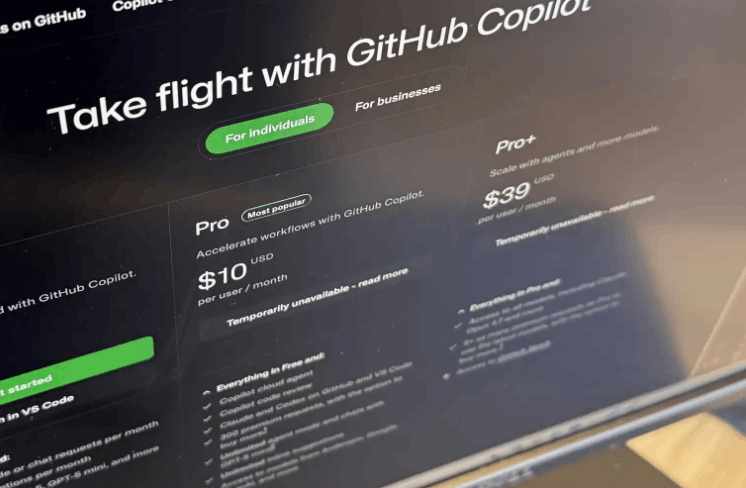
PCWorld reports GitHub Copilot is switching from flat-rate to usage-based AI Credits pricing starting June 1, maintaining $10 Pro and $39 Pro+ monthly costs.
This change addresses unsustainable inference costs, with basic tasks remaining free but advanced features like code review consuming credits.
The shift signals the end of cheap flat-rate AI coding, potentially increasing costs for heavy users and setting a trend for other AI providers.
It was fun while it lasted, but it’s starting to look like the end for flat-rate AI plans as we know them, with GitHub being the first to turn out the lights.
Just a week after announcing it was halting signups for its flat-rate Copilot Pro and Pro+ plans, Github has announced that starting in June, those plans will switch over to usage-based pricing.
Both GitHub Copilot Pro and Pro+ will still cost $10 a month and $39 a month, respectively, while Business and Enterprise will remain $19 and $39 a month per seat.
But beginning June 1, those plans will replace a fixed allotment of “premium requests units,” which are based on a user’s AI request count and adjusted based on the strength of the model, with “AI Credits,” which are based on the actual tokens used during AI exchanges.
Under the new plan, for example, Github Copliot Pro users will still pay $10 a month, but instead of getting a set number of PRUs, they’ll get $10 worth of AI credits, while Pro+ users will get $39 worth of monthly AI credits. A similar AI credit allotment will apply for Business and Enterprise users.
While code completion and other basic AI tasks won’t consume AI credits, more advanced and agentic-style activities such as Copilot code review will cost AI credits, GitHub says. Users who spend all their AI credits before the month is up will have the option to buy more.
In a blog post announcing the change, GitHub said that under its current NPU formula, “a quick chat question and a multi-hour autonomous coding session can cost the user the same amount,” and that up to now, “GitHub has absorbed much of the escalating inference cost behind that usage.”
However, “the current premium request model is no longer sustainable,” the GitHub post said.
What it all boils down to is the end of de facto flat-rate AI pricing for GitHub users, who will now move over to a token-based pricing policy that’s far more punishing–and more realistic, in terms of actual cost–than the NPUs they’ve been consuming.
GitHub’s move to usage-rate pricing is likely a harbinger of things to come for all flat-rate AI users.
The truth is that the flat-rate plans from Anthropic, Google, and OpenAI have long been loss leaders, devised to grow their user bases and get new subscribers hooked on their AI-powered wares.
Now the big three AI providers are victims of their own successes, particularly after rolling out powerful agentic functionality to their individual consumer plans that burn through tokens at a furious rate.
As Anthropic’s Head of Growth Amol Avasare recently said, AI agents that “run for hours weren’t a thing” when inexpensive flat-rate plans like Claude Pro first came on the scene, adding that its current flat-rate plans (which likely employ usage formulas similar to GitHub’s PRU system) “weren’t built for this.”
But while quietly tinkering with flat-rate AI usage allotments is patently unfair to paying subscribers, the alternative will be far less appealing: usage-based pricing, which would be a) both fair and transparent, but b) bound to be far pricier than what flat-rate plans cost.
Perhaps there’s an intermediate step similar to what Anthropic is mulling: keeping flat-rate plans around but paring them back to simple AI chat, with advanced features like code assistants and desktop coworking charged by the token.
Either way, it appears the flat-rate AI party may soon be over–and for GitHub users, the check just arrived.
Senior Writer, PCWorld. Ben has been writing about consumer technology for more than 20 years, and now focuses his reporting on AI as it relates to the basic human experience. His coverage of artificial intelligence interrogates the latest LLMs, and how they can be used at work and at home to be best prepared for the AI revolution. “AI is going to change our lives sooner than we think,” Ben writes. “Our best way to adapt is by using it every day.” Ben has been a PCWorld author since 2014, and has covered everything from laptops to security cameras before launching PCWorld’s AI beat. Ben’s articles have also appeared in PC Magazine, TIME, Wired, CNET, Men’s Fitness, Mobile Magazine, and more. Ben holds a master’s degree in English literature.
OpenAI has started rolling out conventional ads in ChatGPT. It won’t stop there.
The inevitable has arrived. Ads have begun popping up on ChatGPT—even, reportedly, in initial responses to user queries, rather than after extended conversations—and some fans aren’t pleased. “RIP ChatGPT,” wrote one Reddit commenter. “It was fun while it lasted! 💔” The ads, which are being rolled out to free users and those who pay for the lowest-tier subscription ($8 per month), are rather familiar and banal in their presentation: a “sponsored” box pitching a product that ChatGPT’s algorithm thinks is relevant to the conversation, much as you’re used to seeing on social media platforms like Facebook and X.
An enduring feature of advertising is that it is “geographically imperialistic”: The best place to put an ad is where one doesn’t exist already. But the best type of ad to place is one that is unrecognizable as an ad. These truths should be kept in mind amid the rollout of ads on ChatGPT. Rest assured, this is just the beginning of how OpenAI, the creator of ChatGPT, will monetize its users. The company will undoubtedly graduate to more sophisticated ads, at which point the only question will be whether users even realize when they’re being monetized.
Artificial intelligence is an unfathomably expensive product to give away for free, yet that’s been OpenAI’s main strategy to achieve adoption. So it’s little wonder that the company is in dire financial straits, facing tens of billions of dollars in projected annual losses. How else to close that deficit save for digital billboards? The geographic expanse for commercial colonization—a reported 800 million weekly active users—was simply too vast for OpenAI to forgo.
So ChatGPT’s users are right to bummed. Commercials clutter both the aesthetic and impetus of the online space. And the annoyance isn’t merely a pop-up to be blocked or a pre-roll to be skipped: Ads can’t help but corrupt the purpose of the content that they surround. But even OpenAI’s CEO, Sam Altman, has admitted that ad monetization is a real downer. “I think that ads plus AI is sort of uniquely unsettling to me,” Altman said in 2024. “When I think of GPT writing me a response, if I had to go figure out, Exactly how much was who paying here to influence what I’m being shown? I don’t think I would like that.” But he also, notably, did not rule out ads on ChatGPT in the future.
As the old adage goes: If you’re not paying for the product, then you are the product. For two centuries, the mass and social media industries depended on this bargain. Nascent newspapers of the “penny press” era could be sold below cost because advertisers subsidized the access to audiences. Likewise, today, no one pays for Google search or Instagram or TikTok.
AI represents a qualitatively different revelation. It renders all the knowledge of the internet conversationally interactive. It outsources our critical thinking skills and regresses our decision-making to the mean. It’s been designed to seem human to secure our trust. It seduces our affections and indulges our delusions, often sycophantically so. It subs in for our therapists and friends alike and helps us raise our children.
The consumer insights from that level of intellectual, emotional, and social intimacy exceed an advertiser’s wildest dreams. Fortuitously so: AI arrives at a confusing, anxious time on Madison Avenue. Google’s AI summaries are disintegrating the web as we know it, hastening a “zero-click” future, in which users have no need to avail themselves of the links below on the page. Hence, a shift from search engine optimization to “answer” or “generative” engine optimization: strategizing how brands and products appear, organically, in large language model inputs and outputs.
ChatGPT makes that roundabout sell a much straighter line—for a price. And it is reportedly a steep one—with ad rates nearing those of NFL games. Large language models might be a black box—in terms of why they do what they do—but that ad pricing suggests OpenAI knows exactly what a gold mine of personal data it is excavating daily.
That’s why we ought to treat OpenAI’s claims about its advertising with the same skepticism applied to the advertising itself. Sure, the company says it will insulate the ads as ostensibly independent from content. “Ads do not influence the answers ChatGPT gives you. Answers are optimized based on what’s most helpful to you. Ads are always separate and clearly labeled,” the company insists. “We keep your conversations with ChatGPT private from advertisers, and we never sell your data to advertisers.” But that leaves a lot of marketing money on the table—and from the outside, it sure looks like OpenAI needs that money to stay afloat.
Hence, the Super Bowl ad diss from OpenAI competitor Anthropic, the maker of Claude, whose commercial mocked the sponsored content that will inevitably intrude and inundate ChatGPT feeds. But mount that high horse at your peril, Anthropic. Unless there’s a clever way to pay for all those server farms and microchips, all other AI platforms will probably have to follow suit. (And if the Pentagon cuts ties with Anthropic, as it’s threatening to do, that day may come even sooner.)
The history of social media foretells it: Platforms and their creators, once unspoiled by corporate backers, now pitch us relentlessly—and in increasingly devious ways. “Native” ads on Instagram and TikTok often look indistinguishable within the content, forming the basis of the $30 billion influencer industry. But the notion of placing an energy drink in the background of an influencer’s video will soon seem laughably conspicuous. By that point, the problem for ChatGPT users will no longer be that they notice and get annoyed with ads. The problem—and the real money to be made by OpenAI—will be when they don’t.
Feature image credit: Marcin Golba/NurPhoto/Getty Images
Michael Serazio is a professor of communication at Boston College and the author, most recently, of The Authenticity Industries: Keeping it ‘Real’ in Media, Culture, and Politics.
In ACSI’s results, AI scored an overall customer satisfaction score of 73 on a scale of 0 to 100, which the authors noted was slightly below social media (74), airlines and mortgage lenders, but in line with energy utilities.
The ACSI poll found that 43% of respondents said reduced human-to-human interaction is their main concern, followed by job loss for future generations (37%) and their own job risk (31%), based on interviews with 2,711 US adults.
Baby Boomers were the most sceptical generation in the poll, with 35% saying they are very concerned about AI’s effects, compared to just 6% who view it extremely favourably.
Disconnect between AI adoption and perception
While platforms such as ChatGPT have up to 1 billion weekly users, there is still a disconnect between AI’s adoption and public perception of it, which is driven by concerns over privacy, the spread of misinformation and the loss of jobs.
“Consumers spent the last decade learning to distrust how social media platforms handle their data, and AI’s privacy scores suggest they’re carrying that scepticism forward,” said Forrest Morgeson, associate professor of marketing at Michigan State University and director of research emeritus at the ACSI.
21% reported an “extremely favourable” outlook toward AI, while an equal 21% said they are “very concerned about the consequences.”
These results were in line with another poll published by YouGov this week, which found that only 29% think the positive effects of AI outweigh the negative ones, while 36% think its net effects are negative.
It’s worth noting that more than half of the people interviewed (56%) had no recent experience with AI, but of the 44% who did, half of them use AI at least once a day, and the usage went up with people who earned over $100,000 a year.
Last month, an NBC poll suggested that AI was one of the least-liked things in America, but it was still more popular than the Democratic Party.
TV and home video editor Ty Pendlebury joined CNET Australia in 2006, and moved to New York City to be a part of CNET in 2011. He tests, reviews and writes about the latest TVs and audio equipment. When he’s not playing Call of Duty he’s eating whatever cuisine he can get his hands on. He has a cat named after one of the best TVs ever made. See full bio
Sir Martin Sorrell advises agencies to adapt to AI by implementing five key strategies: compress creative production with output-based pricing, personalize content at scale, become validators of AI-generated work, drive radical efficiency by automating internal processes, and democratize knowledge within the organization.
The old way of running an agency is dead. If you own or operate a services business, whether that’s an agency, a consultancy, or any company where clients pay for your expertise, the ground is shifting under your feet. AI can create content faster and cheaper than your team. Clients expect more for less. Production lines that took weeks now take hours.
Agencies in the next ten years will look nothing like agencies in the last ten. The same is true for anyone in the knowledge economy who serves clients for a living.
I sat down withSir Martin Sorrell atFII Priority Miami 2026 to ask him how agencies survive what’s coming. Sorrell is the founder and executive chairman ofS4 Capital, the digital-first marketing services company operating under the brand Monks. Before that, he built WPP from a £1 million shell company into the world’s largest advertising group, with over £15 billion in revenue and 200,000 people across 113 countries. He ran it as CEO for 33 years, making him the longest-serving chief executive in the FTSE 100. If anyone knows what happens when an industry gets disrupted, it’s him.
I founded and sold a social media agency. Looking back at my team of 20 people, I can see which roles AI would have replaced and which ones would have become more valuable. Sorrell sees the same pattern playing out across the entire industry. When I asked him what agencies should do now, he gave me a 5-step process for staying relevant. This applies to any business where you trade expertise for money, and it starts with client work.
5 ways to keep your agency alive in the age of AI
Compress your creative production
AI is already cutting the cost and time of visualisation, copywriting, and content production. Sorrell was direct about the business model problem this creates. “We’re paid on time taken,” he said. “So you have to shift the model to output-based pricing, either on a unit asset basis or subscription.” The agency that charges by the hour while AI does the work in minutes will lose every time.
Audit how you charge. If your revenue depends on how long tasks take your team, you’re exposed.
Maybe you’re the founder who bills 40 hours for a content package that AI helps you produce in 10. That gap is your vulnerability and your opportunity. Close it before your clients do the maths.
Personalise at scale
The second step is using AI to produce huge volumes of personalised assets. Where you once created one campaign and hoped it landed, now you produce dozens of variations tested against specific audiences. Sorrell sees this as an expansion of opportunity. More content, more formats, more touchpoints. The business model shifts again toward output pricing because the volume of work explodes.
Think about your owncontent output. If you’re still producing a single version of each deliverable, you’re leaving performance on the table. Use AI to create variations. Test them. Let the data tell you what resonates with each segment of your audience. The agencies and consultancies thatthink bigger about what they can offer, producing ten times the output at a fraction of the old cost, will win the clients who want results measured in numbers.
Become the validator
Media planning and buying will become totally algorithmic. Humans stay at two points in the process. The ideation at the start and the checking at the end. The middle, where junior staff once spent their days planning and placing, gets automated. The agency’s role becomes validation. Nobody will take a platform’s recommendation at face value. “You’re not going to say, I agree with the Google plan. You’ll want to check,” Sorrell said.
Position yourself as the person who scrutinises the machine’s work. If you run a consultancy or an agency, your value is in judgment, not in execution. The media buyer that is age 25? That role disappears. The experienced strategist who can look at an AI-generated plan and say “this is right” or “this is wrong” becomes irreplaceable. Build that skill in yourself and your team.
Drive radical efficiency
Sorrell described a joint venture with Nvidia, AWS, and Adobe on outside broadcasting using AI. The result was an 80% reduction in cost. That number is already a reality. Every service business has processes that cost more than they should because humans have always done them. AI changes the equation.
Go through your operations and find where the money leaks. Identify the tasks your team does that a machine could handle faster. Maybe it’s reporting, maybe it’s scheduling, maybe it’s the first draft of every deliverable. The savings are huge. An agency that operates at 80% lower cost on its production can either increase margins or pass savings to clients and win more work. Both options beat standing still.
Democratise knowledge
Sorrell’s fifth step was the one that most people overlook. He talked about using AI to spread knowledge across an organisation so that silos break down. He pointed to Jensen Huang running Nvidia with 50 direct reports and no one-to-one meetings. “AI spreads knowledge as long as you enfranchise people and give them access,” Sorrell said. “You get rid of the silos.”
Most agencies and service businesses hoard information in the heads of senior people. Junior team members wait for briefings that come too late. AI changes this. Give your team access to shared knowledge systems. Let AI summarise client histories, surface past work, and distribute learning across the company. The business that shares what it knows internally will move faster than the one that keeps everything locked in the founder’s head. Stop controlling information and start building systems that make everyone smarter.
How the man behind advertising’s biggest empire says you stay relevant in the age of AI
Sorrell told me that reduced employment is coming, but the number won’t be the 95% that some predict. The agencies and businesses that survive will be leaner, faster, and built around these five steps.
Compress creative production. Personalise at scale. Become the validator. Drive radical efficiency. Democratise knowledge. Whether you run an agency, a coaching practice, or a consultancy, the same process applies. Adapt now or spend the next few years watching someone else take your clients.