Tag

artificial intelligence

Browsing

By Rob Davinson 

In 2024, affiliate marketing will see brand-creator alliances rise, TikTok vs. Amazon competition, programmatic opportunities, and more, says Awin’s global head of content, Rob Davinson.

Affiliate marketing mirrors the broader digital landscape, with trends at the macro level resonating in our microcosm. In 2024, we’ll see emergent trends (artificial intelligence (AI), social commerce and retail media to name just a few) that will impact affiliate marketers.

Here we breakdown the key changes (and challenges) that affiliate marketing is likely to encounter this year, and what they mean for the industry.

1. Brand-creator affiliation will rise amidst social media slowdown

With global digital ad spend growth slowing (Dentsu predicts only 6.5% growth in 2024, after a historically low-growth year in 2023), and social media facing a similar slowdown as new user growth plateaus, brands can combat this by directly partnering with creators, as influencer marketing proves more resilient than paid social.

Major brands like The Body Shop and Walmart are two examples that launched large-scale creator affiliate programs in the last year, tying social awareness to controlled marketing outcomes. We see this trend further developing in 2024, as it not only counters platform-dependent risks, but benefits influencers seeking stable incomes,

Awin’s platform witnessed a surge of registering influencers in 2023 (over 10,000), foreshadowing continued growth in 2024.

2. TikTok vs. Amazon: Affiliate model’s value amid new competition

As major tech giants mature, Amazon transitions from a shopping marketplace to an ad space, while TikTok evolves from entertainment to a product purchasing platform. This encroachment on each other’s territory is likely to intensify competition, with TikTok employing an affiliate-type model, mirroring Amazon’s commerce flywheel.

Both platforms embracing affiliate strategies validates its efficacy. Brands may channel more ad budgets into these tech giants, necessitating a choice between entering new marketplaces or driving traffic to their e-commerce sites.

Opting for the latter requires enhancing the shopper experience, supported by affiliate tech partners, as exemplified by Nike’s livestream shopping collaboration with Contester, enhancing the Cyber period with engaging content on their site.

3. Programmatic challenges will propel affiliate ad spend growth

In 2023, the programmatic ad industry faced serious challenges, as reported in the ANA’s Programmatic Media Supply Chain Transparency Study. Among its findings was the fact that there is $22bn of wastage from the $88bn programmatic supply chain.

Advertisers often grapple with misaligned incentives, prioritizing cost over value, resulting in diminished ad quality. In contrast, affiliate marketing’s performance model, linking ad spend to tangible outcomes like sales, proves more valuable.

It says a lot that global spend in affiliate marketing last year is estimated to be around $14bn, a third less than was wasted in programmatic. As senior marketers consider their budgets this year, the data suggests affiliate marketing should garner greater consideration for its effectiveness.

4. News and media publishers will leverage affiliate commerce content

In 2024, with a record number of global elections, including the US presidential election and 40 national elections, political interest will drive traffic to news media sites.

Despite heightened ad spend forecasts, news publishers may not see increased income due to past challenges with programmatic display ads. Affiliate channels offer a solution for publishers facing declining ad monetization and brand block listing.

Additionally, major sporting events like the European Football Championships and the Olympic Games in Paris promise increased traffic, creating opportunities for affiliate efforts to offset ad revenue challenges and enhance the value of journalism amid growing demand.

5. AI revolution in search will pose a threat to affiliate longtail

When it comes to online, the significance of high Google search rankings has been paramount. As the old adage (meme caption) goes: “The best place to hide a dead body is page 2 of Google’s search results.”

Google’s search console, shaping our online information-seeking behaviour for two decades, faces challenges from Google’s monetization motives and emerging AI-powered search consoles, like ChatGPT. These AI consoles provide instant answers, diminishing the reliance on external links and altering the traditional internet ecosystem.

Google’s Search Generative Experience (SGE) introduces AI-generated responses, potentially reducing organic traffic to publisher websites. Publishers face limited options – allow crawling for SGE or risk exclusion from Google search. SEO adherence to E-E-A-T values becomes crucial for publishers navigating this transformative shift, emphasizing the affiliate industry’s need to adapt and maintain audience-centric effectiveness.

6. Travel resurgence will inspire pop culture-inspired trips and affiliate growth

While some predicted its near-extinction after the 2019 lockdown, the travel industry is booming as we begin 2024.

IATA predicts that this year will exceed 2019’s travel record, with 4.7 billion people expected to board airlines in 2024. Awin observes a surge in affiliate-driven travel bookings, a trend set to continue as consumer confidence rises, airline capacity grows, and major events drive demand.

Expedia and Amadeus foresee a significant year for experience-based tourism (think set-jetting and music festivals). Affiliates play a crucial role in the complex shopper journey, offering inspiration, comparisons, and personalized options.

Brand partnerships, where one advertiser promotes another complementary one as part of the customer’ booking experience, thrived in 2023. Travel brands are well set to capitalise on this growth with lots of potential match-ups from other brands keen to tap into consumers’ resurgent appetite for travel.

7. As cheap fashion challenges sustainability efforts, green affiliates will emerge

Despite Cop28’s pivotal agreement to shift from fossil fuels, inertia persists around climate change. In 2024, the rise of ultra-fast fashion platforms like Shein and Temu, fuelled by the TikTok trend of buying cheap dupes, contributes to growing landfill fashion.

Even impacting Amazon, Teemu users spend nearly double the time compared to Amazon, prompting the e-commerce giant to lower fees for clothes under $20. However, some affiliates continue to promote mindful consumer choices innovatively. Examples include Refoorest, planting trees for site visits, and Axon Mobile incentivizing eco-friendly commuting. And another new promising solution for 2024 is spearheaded by Birl, who are introducing the circular economy to e-commerce through their smart resale system.

By Rob Davinson 

Sourced from The Drum


Realistic-looking shampoo bottles and seltzer cans are popping up on videos from digital creators on TikTok and YouTube in a new form of old advertising.

Melissa Becraft, wearing a pink workout outfit, strikes a dance pose in a kitchen.
A screenshot of a recent TikTok from the dancer Melissa Becraft that used A.I to digitally superimpose a poster for Bubly, the sparkling water brand owned by PepsiCo, onto the wall of her apartment.Credit…via TikTok

Product placement, one of the oldest tricks in advertisers’ toolbox, is getting an A.I. makeover.

New technology has made it easier to insert digital, realistic-looking versions of soda cans and shampoo onto the tables and walls of videos on YouTube and TikTok. And a growing group of creators and advertisers is grabbing at the chance for an additional revenue stream.

A recent TikTok from the dancer Melissa Becraft featured a poster for Bubly, the sparkling-water brand owned by PepsiCo, hanging on the wall of her apartment as she shimmied to a Shakira song. A duo known as HiveMind chatted about bands while an animated can of Starry soda, another brand owned by PepsiCo, landed on a table between them. And a YouTube video of the “AsianBossGirl” podcast recently displayed a table of Garnier hair products.

Virtual product placements have been offered by start-ups and streaming services like Amazon Prime and NBC’s Peacock in recent years. But a recent wave of them on social media, in which brief, animated messages disclosing the sponsorships appear on the videos themselves, is the work of a start-up called Rembrand.

The ads provide a glimpse into one way A.I. might shape advertising in the future, especially as marketers look to reach younger viewers who are apt to skip or ignore standard ads.

Rembrand’s executives say their technology could transform product placements, which have often been used to cut production costs on bigger projects and can take weeks, months or sometimes years to negotiate.

For creators, it’s a way to make money from advertisers without physically handling products or discussing them.

“This feels like I’m making my own genuine content, but it doesn’t scream that I’m making an ad,” said Ms. Becraft, 28, who has made two TikTok videos that featured Bubly. “There’s no obligation for me to talk about it.”

Product placements in the United States are estimated to be a nearly $23 billion industry, according to PQ Media, a research firm. It has become increasingly appealing to advertisers, which have grown worried about consumers skipping commercials or the ads before YouTube videos.

The shifting viewership to social platforms and advances in technology have opened a new frontier for this work, moving it beyond getting Coca-Cola cups on the “American Idol” judges’ table or cereal brands into WB shows.

Our business reporters. Times journalists are not allowed to have any direct financial stake in companies they cover.

Rembrand, which has 42 employees and is based in Palo Alto, Calif., believes it’s on the forefront of these changes. It raised $14 million in seed funding from the likes of Greycroft and the venture arms of UTA Ventures and L’Oreal since it was created in 2022. One of its founders, Omar Tawakol, 55, spent years in programmatic advertising and is best known for founding and selling BlueKai — which helped marketers track users’ online behaviour for ad targeting — to Oracle in 2014.

Mr. Tawakol said he saw an opportunity to use A.I. to insert virtual products in influencer videos and make it a fast and easy ad buy.

Rembrand uses a form of generative A.I. that can “take an existing scene and figure out how to put a product in it,” Mr. Tawakol said. “The product has to look exactly right — Pepsi is not going to be forgiving if you screw with their logo,” he added.

The company “had to train the laws of physics into the network,” Mr. Tawakol said, so that objects would properly respond to things like light, camera distance and motion. Rembrand started placements with podcasts on YouTube because “they tended to be indoors, they tended to have fixed cameras, and they tended to have a table and a wall,” he said.

It then expanded to LinkedIn and TikTok; Instagram is next. (The company said it went with the name Rembrand — an allusion to the Dutch artist, who spelled it Rembrandt — because it wanted an artistic bent while also sounding like shorthand for “remember the brand.”)

Rembrand is still asking creators like Ms. Becraft to film indoors as they improve the technology. “The things I’m more famous for are dancing outside in the rain and dancing in Times Square,” she said. “They told me that if you do that our technology might have a heart attack.”

The placements are not as subtle as the ones in TV shows. Starry and Bubly cans wiggle before entering videos, and logos hover above them. The company shared a demo in which a digitized Tide Pen danced onto a podcast host’s shirt and wiped away a stain before vanishing, “Fantasia” style. The company experimented with “what animations were acceptable,” after realizing they could spike attention on the products, said Cory Treffiletti, 50, Rembrand’s chief marketing officer.


Madison Luscombe, chief marketing officer of the Creator Society, an agency that works with Ms. Becraft, said that while the use of A.I.-generated product placement was in its early days, the deals could be valuable for “entertainment creators” who are focused on performing, podcasting or playing games, and aren’t necessarily approached by brands as often to extol mascara or new snacks to their fans.

Advertisers use Rembrand’s marketplace to connect with more than 1,000 creators from agencies it works with. Creators upload their videos to its platform and receive them within 24 hours with the product placements. Rembrand has someone check for quality and someone else for how the brand appears. Then creators upload the clips and eventually get paid from the brands based on video views. Rembrand declined to share specific figures around payouts.

The company said it expected to turn into a “self-service platform” by the middle of this year, where any creator or brand could connect and run digital product placement campaigns without Rembrand’s involvement.

When asked why YouTube, TikTok and Instagram wouldn’t just offer this option directly to creators on their platforms, Mr. Tawakol said he would “love” if they wanted to work with him. “I designed my business to integrate it with platforms,” he said. “We want to be the world’s best at this one very specific problem.”

Sourced from The New York Times


By Webb Wright 

If you’re considering launching a new AI-centered brand or product, you may want to go beyond simply adding ‘AI’ to the end of the name.

The AI Gold Rush is in full swing and brands of all stripes are rushing to establish their particular niches in this hugely profitable and increasingly crowded industry. New AI-centered brands, departments and products are cropping up by the day, each requiring a name that is, ideally, both memorable and unique.

“Every single company, whether a candy bar manufacturer or a software company, seemingly has to show that it is doing something to leverage AI,” says Jonathan Bell, founder and CEO of Want Branding. “And that often requires some kind of adjacent brand, which, of course, then needs a name.”

Several brands, as you may have noticed, have simply taken to adding ‘AI’ (or ‘.AI’) to the ends of their names. Think Stability AI, Spot AI, Mistral AI, Shield AI, People.ai, Otter.ai, Arize AI, Crowd AI, Toggle AI and so on. And, of course, there’s OpenAI, the company that has become something of a flagship for the entire wave of AI innovation that’s currently underway following its hugely successful launch of ChatGPT in late 2022 and that has probably helped to establish the ‘AI‘ suffix as the name du jour for up-and-coming brands looking to make a name for themselves in the industry.

Adding ‘AI‘ to the end of a brand or product name “is an easy but often perhaps a cheap way of doing it without much thought,” says Bell.

A parallel can be drawn between this naming phenomenon and a similar one that followed in the wake of the dawn of the internet in the late 90s when scores of new brands with ‘.com‘ at the ends of their names began to emerge. In those early days of the world wide web, it made practical sense for companies to make unambiguously clear that they were technologically savvy enough to have an online presence. (Remember, this was back when ‘online‘ was itself a new, hip word.)

Over the slow process of many years, however, the internet became so deeply embedded into most of our day-to-day lives, into the very fabric of popular culture and commerce, that it became more or less superfluous to add ‘.com‘ to the end of a brand name. Most people these days automatically assume that any given brand – unless it‘s incompetent beyond belief or run by a group of Luddites – has a website and probably some degree of social media presence.

The ‘.com‘ naming trend, in other words, began as a worthwhile marketing tactic, but “at a certain point that was eroded and it became meaningless,” says David Placek, founder and CEO of Lexicon Branding. There are still, of course, some brands (Hotels.com, for example) that have chosen to use their domain names as their official names, but such a strategy is far less common today than it was when the internet had the shiny-new-toy factor.

AI could follow a similar trajectory of cultural adoption as that of the internet: today, it’s all anyone can talk about; tomorrow, it’s basically taken for granted. Just as people today assume that brands today have an online presence – even when they don’t have ‘.com‘ in their names – we could soon reach a point as a society in which AI is so ubiquitous, so deeply integrated into our devices and our modes of working and communicating with one another, that adding ‘AI‘ to a brand or product name becomes passé. Placek says he’s “absolutely positive” that we’ll cross that threshold sometime within the next two years, after which point “everybody will assume that there’s something AI-related” built into most brands and products.

Given that forecast, adding ‘AI‘ to the end of a name “can be a disservice for building brand strength over time, because [the market] becomes crowded,” says marketing agency Tenet Partners CEO Hampton Bridwell. “There are a lot of names with a similar sound or styling and that creates a situation where you don’t have differentiation or memorability within the name.”

Anthropomorphic names and the sad tale of Clippy

There have, of course, been other naming trends that have recently emerged around AI. For example, many AI-centered products have been given human-sounding names, apparently in an effort to make the underlying technology – which could potentially come across as a bit threatening to a culture that’s been weaned on films like 2001: A Space Odyssey and The Matrix – feel a bit less alien and intimidating.

Consider IBM’s Watson, an AI model originally designed to answer questions that gained global fame when it won Jeopardy! in 2011. There are also more recent examples, including Siri (Apple), Alexa (Amazon) and Einstein (Salesforce).

As the journalist Charles Duhigg points out in a recent article in The New Yorker, Microsoft (which became a leader in the burgeoning AI industry following its recent multi-billion-dollar investments in OpenAI) has had to learn the hard way about the risks involved with trying to anthropomorphize AI. In 1996, the company introduced Clippy, a smiling virtual assistant with big eyes and a paperclip for a body, who could answer simple user questions on Microsoft Office platforms. The character became widely loathed by users. The Smithsonian called Clippy “one of the worst software design blunders in the annals of computing,” as Duhigg quotes in his article. Microsoft killed Clippy off in 2001.

The company once again tried its hand at anthropomorphizing algorithms in 2016 with the launch of Tay, an AI-powered chatbot whose conversational style reflected that of a typical teenage girl. Tay rather quickly descended into a fit of hate speech and was deactivated less than 24 hours after its launch.

Apparently wiser after the Clippy and Tay debacles, Microsoft is now naming its AI products in a manner that suggests utility and even a touch of fallibility. Copilot, the name of the company’s recently launched suite of AI-powered productivity tools, insinuates something that can be reasonably relied upon to provide a measure of assistance, not something into which one should invest one’s whole trust.

The curious case of ChatGPT

Perhaps the biggest irony in the realm of AI names is the fact that ChatGPT, the product that, more than any other, catalyzed the burgeoning AI Revolution, has such a widely disliked name.

For one thing, says Bridwell, the word ‘chat‘ in a brand name “is pretty limiting – it really doesn’t embody what the whole thing is about in terms of [how] it delivers value. It’s a terrible name. Over time, [OpenAI] should really think about rebranding it.”

Even OpenAI CEO Sam Altman agrees that it’s not an ideal name. During a recent podcast hosted by comedian Trevor Noah, Altman said that ChatGPT is “a horrible name, but it may be too ubiquitous to ever change.”

ChatGPT’s suboptimal name could stem in part from the fact that the OpenAI team that built it did not initially have high hopes for its prospects as an uber popular app. It was referred to internally as a “low-key research preview” in the period leading up to its launch and it was intended as a means through which the public could begin to interact with OpenAI’s GPT large language model more broadly so that the company could then collect feedback and fine-tune the technology accordingly.

Many within the OpenAI team were surprised when ChatGPT attracted its first million users in just five days, becoming the fastest-growing app in history.

Advice for marketers

According to Want Branding’s Jonathan Bell, brands that are looking to promote their use of AI through an optimized name should take their time. “It needs to be well thought-out,” he says. “It shouldn’t be something that’s done casually over a quick meeting, where you just simply add ‘AI’ to [the name]. Companies need to think about: What are they specifically doing? Can they deploy AI in a way that is really effective, or is this something that’s been done that could come across as bandwagon-jumping?”

Placek, who’s prone to referencing cognitive science and linguistics when discussing the psychology of brand- and product-naming, highlights the importance of sound symbolism – that is, the associations between particular sounds and the concepts that they evoke in the mind of the hearer. “You don’t want something too soft and you don’t want something too clever,” he says. “[You want something that’s] a little bit on the more serious side that [suggests] intelligence … sound symbolism should play a role in selecting and developing your names.”

When prompted to describe the qualities of a great name for an AI brand or product in fewer than 10 words, ChatGPT wrote: “Memorable, clear, unique, relevant, easy to pronounce, globally appealing, scalable.”

Feature Image Credit: Adobe Stock

By Webb Wright 

Sourced from The Drum

By Alon Goren

At this point, most enterprises are dabbling in generative AI or planning to leverage the technology soon.

According to an October 2023 Gartner, Inc. survey, 45% of organizations are currently piloting generative AI, while 10% have deployed it in full production. Companies are eager to move from pilot to production and start seeing some real business results.

However, enterprises getting started with generative AI often run into a common stumbling block right out of the gate: They suffer analysis paralysis before they can even begin using the technology. There are tons of generative AI tools available today, both broad and highly specialized. Moreover, these tools can be leveraged for all sorts of professions and business purposes—sales, product development, finance, etc.

With so many choices and possibilities, enterprises often get stuck in the planning phase—debating where they should deploy generative AI first. Every business unit (and all of the business’s key stakeholders) wants to own a part of the company’s generative AI initiatives.

Things can get messy. To stay on track, businesses should follow these guidelines when experimenting with generative AI.

Focus On Specific Use Cases With Measurable Goals

Enterprises need to recognize that every part of the organization can benefit from generative AI—eventually. To get there, however, they need to get off the ground with a pilot project.

How do you decide where to get started? Keep it simple and identify a small, specific problem that exists today that can be improved with generative AI. Be practical. Choose an issue that’s been challenging the business for a while, has been difficult to fix in the past and will make a visibly positive impact once resolved. Next, enterprises need to agree upon metrics and goals. The problem can’t be too nebulous or vague; the impact of AI (success or failure) has to be easily measurable.

With that in mind, the pilot project should have a contained scope. The purpose is to demonstrate the real-world value of the technology, build support for it across the organization and then broaden adoption from there.

If organizations try to leverage AI in too many different ways and solve multiple problems, it’ll cause the scope to grow out of control and make it impossible to complete the pilot within a reasonable timeframe. Ambition has to be balanced with practicality. Launching a massive pilot project that requires extensive resources and long timelines is a recipe for failure.

What’s a good timeline for the pilot? It depends on the circumstances, of course. Generally speaking, however, it should only take a few weeks or a couple of months to execute, not multiple quarters or an entire year.

Start small, get something functional quickly and then iterate on it. This iterative approach allows for continuous learning and improvement, which is essential given the nascent state of generative AI technology.

Organizations must also be sure to keep humans in the loop from the very beginning of the experimentation phase. The rise of AI doesn’t render human expertise obsolete; it amplifies it. As productivity and business benefits increase with generative AI, human employees become even more valuable as supervisors and validators of AI output. This is essential for maintaining control and building trust in AI. In addition, the pool of early participants will also help champion the technology throughout the organization once the enterprise is ready to deploy it widely.

Finally, once the project has begun, organizations have to stick with it until it’s complete. Don’t waste time starting over or shifting to other use cases prematurely. Just get going and stay the course. After that’s been completed successfully, companies can expand their use of generative AI more broadly across the organization.

Choosing The Right Technology

The other major component of the experimentation phase is selecting the right vendor. With the generative AI market booming, it can seem impossible to tell the differences between one solution and another. Lots of noisy marketing only makes things more confusing.

The best way to cut through the noise is to identify the requirements that are most important to the organization (e.g., data security, governance, scalability, compatibility with existing infrastructure) and look for the vendor that best meets those needs.

It’s extremely important to understand where vendors stand on each of these things early on to avoid the headache of discovering that they don’t really check those boxes later. The only way to do that is by talking to the vendor (especially its sales engineering team) and seeing these capabilities demoed first-hand.

Get Ahead Of The Competition With A Strong Start

Within the next couple of years, I expect almost every enterprise will employ generative AI in production. Those wielding it effectively will get a leg up on their competition, while those struggling will be at risk of falling behind. Though the road may be uncharted, enterprises can succeed by focusing on contained, valuable projects, leveraging human expertise and selecting strategic technology partners.

Don’t wait. Embrace this unique opportunity to innovate and take that crucial first step now.

Feature Image Credit: GETTY

By Alon Goren

Follow me on LinkedIn. Check out my website.

CEO and Cofounder of AnswerRocket. Read Alon Goren’s full executive profile here.

Sourced from Forbes

By Nadeem Sarwar

Last year, Amazon CEO Andy Jassy said that every business division at the company was experimenting with AI. Today, Amazon has announced its most ambitious AI product yet: a chatbot named Rufus to assist with your online shopping.

Imagine ChatGPT, but one that knows every detail about all the products in Amazon’s vast catalog. Plus, it is also connected to the web, which means it can pull information from the internet to answer your questions. For example, if you plan to buy a microSD card, Rufus can tell you which speed class is the best for your photography needs.

Amazon says you can type all your questions in the search box, and Rufus will handle the rest. The generative AI chatbot is trained on “product catalogue, customer reviews, community Q&As, and information from across the web.”

In a nutshell, Amazon wants to decouple the hassle of looking up articles on the web before you make up your mind and then arrive on Amazon to put an item in your cart. Another benefit of Rufus is that instead of reading through a product page for a certain tiny detail, you can ask the question directly and get the appropriate responses.

An AI nudge to informed shopping

Amazon app’s Rufus AI.
Amazon

Amazon says Rufus is capable of answering generic queries such as “What to look for before buying a pair of running shoes” or simply telling it, “I need to deck up my workstation,” and it will automatically recommend the relevant products. In a nutshell, it’s a web-crawling recommendation machine that will also answer your questions, product-specific or otherwise.

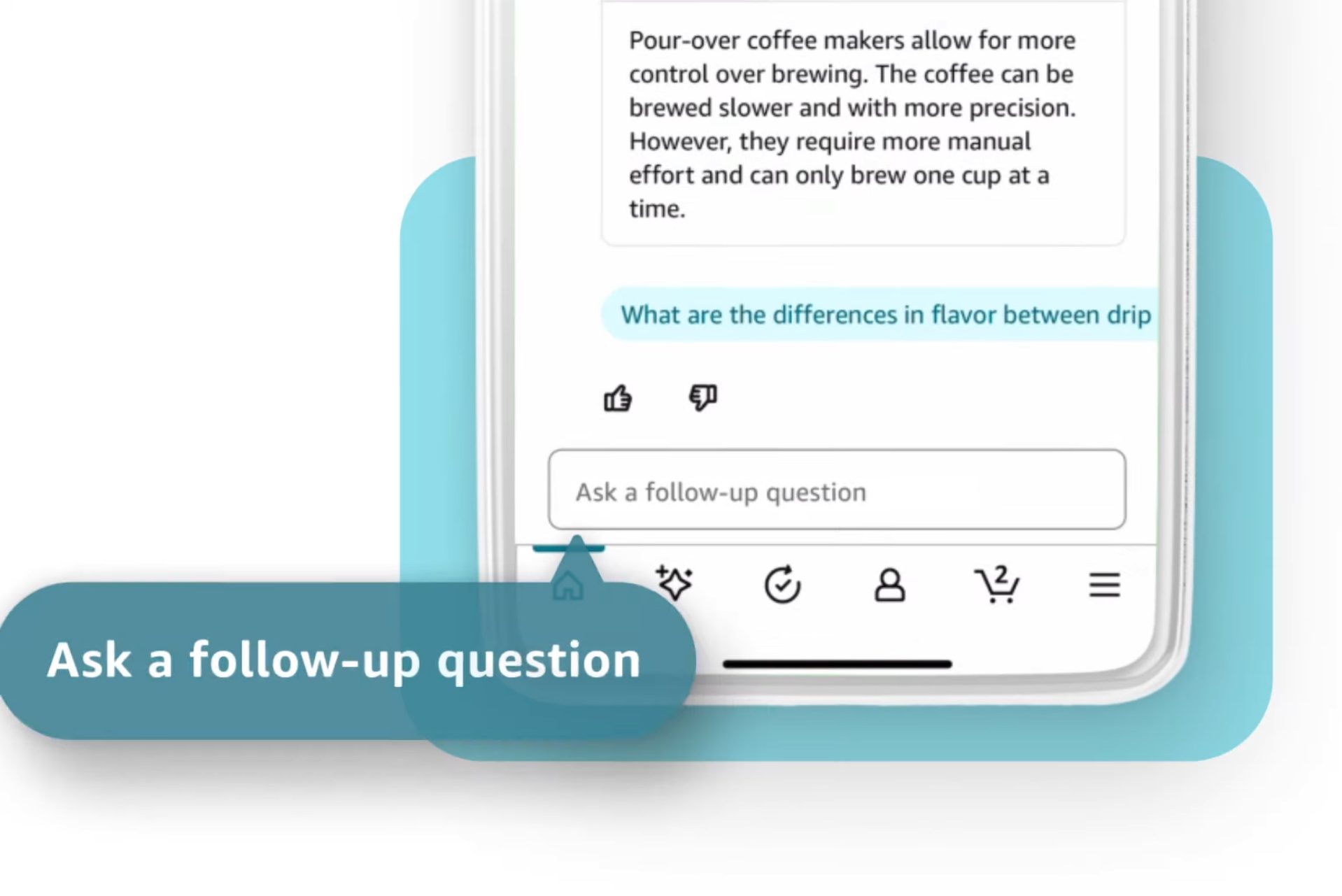
“Customers can expand the chat dialog box to see answers to their questions, tap on suggested questions, and ask follow-up questions in the chat dialog box,” says the company’s official blog post.

For queries such as “Is this phone case reliable,” the AI bot will summarize an answer based on product reviews, Q&As, and information on the product page. At the end of the day, it’s all about making informed purchasing decisions with some help from an AI chatbot.

Rufus AI answering Amazon product questions.
Amazon

Rufus is currently limited to a small selection of Amazon mobile app users in the U.S. as part of a beta test. However, this is an early version of the product, and Amazon also warns that Rufus “won’t always get it exactly right.” In the coming weeks, the AI chatbot will be made available to a broader set of users in its home market.

Rufus seems to be one of the more thoughtful and practical implementations of generative AI I’ve seen recently, and far away from the hype machinery built around the tech with hidden caveats. Plus, it seems to be free, without any Prime mandates.

Feature Image Credit: Amazon

By Nadeem Sarwar

Sourced from digitaltrends

By Sabrina Ortiz

Implementing AI is only half the battle, but a new report suggests it’s risky not to try. Just make sure you prep your employees first.

When generative artificial intelligence first burst upon the scene, the technology showed potential for making people’s everyday lives easier. Now, AI solutions have been developed to help enterprises optimize their operations, and here’s why you might want to consider using them in your business.

Pluralsight’s AI skills report surveyed 1,200 executives and IT professionals across the US and the UK to better understand how organizations deploy AI and its effects on businesses and their employees.

The report found that implementing AI in organizations had promising results, with 97% of organizations that have already deployed AI technologies benefiting. Moreover, 18% reported experiencing increased productivity and efficiency, 13% reported improved customer service and repetitive task reduction, and 11% said AI reduced business costs.

Pluralsights chart
Pluralsights 

Despite the benefits, 25% of these organizations said they don’t have plans to deploy AI, while 20% already have and 55% plan to. The hesitation stems from inadequate budget or talent required to use the new tools properly.

A majority of the professionals acknowledged that hesitation could be disastrous in the long run, with 94% of executives and 92% of IT professionals sharing that organizations investing in AI in the near future will be better able to compete, according to the report.

However, the lack of talent to properly use the new tools is an obstacle to the successful implementation of AI, and the report finds that the answer may lie in organizations helping upskill employees.

The report cites IDC research that found investments in skills and digital training of employees will be organizations’ most enduring technology investments in 2023 and 2024, even over investments in generative AI solutions.

Feature Image Credit: Getty Images/Andriy Onufriyenko

By Sabrina Ortiz

Sourced from ZDNET

Human influencers can still thrive amid their AI virtual counterparts. Employ these strategies to stay relevant on social media.

The proliferation of virtual influencers is changing the way brands approach digital marketing. They could make AI-generated personas go viral while simultaneously cutting their ad spend—buying AI tools costs less than hiring social influencers.

You might consider dropping your rates to win back clients, but it’s merely a band-aid solution. Develop more long-term plans instead. Here are simple yet effective strategies to attract brand deals and sponsorships as a human influencer despite the expanding virtual influencer market.

You might consider dropping your rates to win back clients, but it’s merely a band-aid solution. Develop more long-term plans instead. Here are simple yet effective strategies to attract brand deals and sponsorships as a human influencer despite the expanding virtual influencer market.

1. Zero In on Your Target Market

The Lifetime YouTube Studio Insights of Animetorific Channel

Your relevance as an internet personality depends on your impact on market trends and consumer behaviour. Hence, the term “influencer.” Brands will still prioritize your services over AI-generated campaigns and virtual influencers if you have healthy conversion rates.

Go beyond follower counts; study industry data and objectively list the demographics of virtual influencer subscribers. Some markets prefer AI content nowadays, so you might need to overhaul your content strategies if you’re slowly losing subscribers, fans, or engagement.

If market statistics are too generalized, narrow down your research to specific buyer personas. Ensure you understand your target market.

2. Build an Audience Across Various Platforms

TikTok, YouTube, Instagram, and Snapchat Logos on Influencer Girl

Human influencers have an edge over AI-generated personas in executing cross-platform marketing tactics. Virtual influencers perform limited functions made for specific sites. For instance, VTubers gain thousands of views on YouTube and Twitch, but only a few rank on image-based apps like Snapchat and Instagram.

Alternatively, human influencers are versatile enough to maximize various social networks. You could share random activities on Snapchat, post aesthetic shots on Instagram, and upload vlogs on YouTube.

3. Establish Yourself as an Industry Authority

Trendjacking won’t help you beat virtual influencers. Yes, capitalizing on popular topics boosts visibility, but establishing yourself as an industry authority leads to stable long-term growth. Earn the trust and respect of your audience, otherwise, people will quickly forget about you if your content revolves around recent controversies and viral topics.

Let’s say you review Apple products on YouTube. Parroting Apple’s press releases provides zero value to readers—they’ll find the same information on hundreds of other sites. Some AI platforms even scrape and summarize news reports in real-time. The best approach is to provide unique, first-hand insights. Rather than listing new features, walk your readers through them with actual screenshots and demonstrations.

4. Collaborate With Other Industry Experts

Charli and Dixie D'Amelio Talking on Unicef Interview
Image Credit: Priyanka Pruthi/Wikimedia Commons

AI-generated avatars generally publish solo content. Collaboration is almost impossible because they can’t interact as humans do, and this lack of engagement makes them look inauthentic and robotic, which viewers can dislike.

Human influencers can maximize this advantage by regularly collaborating with relevant personalities. Establish yourself as an industry authority among peers and fans alike. Your audience would also appreciate seeing you with their favourite personalities—think of it as fan service.

5. Leverage Your Personal Experiences

Blonde Influencer Wearing Pink Jacket Posing in front of Kia Stinger
Image Credit: Do The Daniel/Wikimedia Commons


As an influencer, you can leverage your daily experiences by documenting and sharing them with an interested audience. Virtual personas will never replicate your real-life stories and relatable struggles despite advancements in AI. They’re merely pre-programmed avatars with made-up backstories.

Your viewers would love to see your real side. Talk about your most notable triumphs, share how you overcame your worst challenges, and ensure you thank your loyal supporters.

6. Try to Empathize With Your Audience

AI-driven virtual influencers use natural language processing (NLP) technologies and language models to engage in conversation. While impressive, they only execute patterns. As a result, talking to AI feels inauthentic because it can’t empathize with users or show feelings.

Human influencers can set themselves apart by connecting with viewers on an emotional level. Demonstrate a deeper understanding of your audience by resonating with their struggles and sharing how you overcame them.

Set disclaimers saying that your advice and personal experiences don’t replace professional consultations.

7. Analyse Why Brands Prefer Virtual Influencers

Several Influencers at Party With a Show Host
Image Credit: Juice Krate/Wikimedia Commons

A growing number of companies are offloading their marketing needs to AI. Forbes reports that 61% of businesses use AI for email optimization, while 55% generate user-targeted ads. Going by these trends, some might start replacing their influencers too.

While AI has significantly advanced over the years, it still has shortcomings—understanding them will help you retain projects. Offer what virtual influencers can’t guarantee, like lasting partnerships and collaboration skills.

8. Frequently Engage With Your Audience

We know how nasty some people act online. They use anonymous profiles to leave hurtful comments on various platforms. Even if you understand that these insults are baseless, they could still make you feel bad. You might even stop reading comments sections to avoid haters.

Although your feelings are valid, ignoring your audience will impede your growth and reach as an influencer; people prefer personalities that interact with them. You must answer questions, consider the type of content they want, and work on constructive criticisms.

If you can’t ignore your haters, block them or delete their comments. Just make sure you engage with your audience.

9. Participate in Social Movements

Group of People Wearing Blue Picking Up Trash at the Beach

Joining social movements humanizes social media influencers. Viewers generally see you doing the same things online—participating in new activities emphasizes your individuality. Show that you’re more than your on-screen persona.

However, this isn’t to say you should just take photos of feeding programs and clean up drives. Putting up a façade for attention will only hurt your image. Support social movements that align with your principles and prioritize making a real-world impact over announcing your contributions.

You can also use these social events to expand your network and connect with like-minded individuals.

10. Explore Generative AI Tools Yourself

Influencer Feeding Prompts to ChatGPT for Content Creation

Embrace AI instead of fearing it. AI-driven platforms are here to stay regardless of your opinion—you’d do well to incorporate them into your career. Start with simple, accessible tools. For instance, you could ask ChatGPT to write a short script, generate images on Midjourney, then stitch them together using text-to-video generators.

You can’t claim ownership of your output because copyright laws don’t apply to AI art.

And even if you don’t plan on using AI tools, exploring them helps you understand how virtual influencers work. Remember: you can’t surpass something you barely comprehend. Study the functions and scope of AI before overhauling your content strategies.

Create New Strategies to Beat AI Virtual Influencers

AI platforms and virtual influencers will continue impacting the content industry as they become more accessible. And brands won’t just stop exploring AI suddenly; you must level up your overall marketing strategy as an influencer or risk losing clients to AI.

Also, closely study the most popular virtual influencers to understand how you can beat them. Try looking for issues in their marketing campaigns. You’ll keep attracting new clients if you focus on providing results that virtual influencers and AI tools don’t.

By Jose Luansing Jr.

Jose Luansing Jr. is a staff writer at MUO. He has written thousands of articles on tech, freelance tools, career advancement, business, AI, and finance since 2017

Sourced from MUO Make Use Of

By

Using AI job search tools can help optimize the hunt—and get you hired. Here’s how to make artificial intelligence work for you.

Sometimes, things seem to escalate quickly, and this was certainly the case with artificial intelligence (AI), which very swiftly transformed from a cool, futuristic idea to a tool that has infiltrated our daily lives. In fact, many of us use AI and don’t even realize it. When you use facial recognition to unlock your iPhone, Google Maps to navigate to your next destination or ask Alexa to play a song, that’s all AI. You might have mixed feelings about robots operating among us, but the future of AI is here—and there’s no going back. The latest technology can even help you level up your career with an AI job search.

Despite concerns about privacy and cybersecurity or whether ChatGPT will eliminate jobs, the benefits are real, and many job seekers are using AI tools to their advantage. Whether you’re considering changing careers or career cushioning, tap into the power of AI to help land your next big job.

How AI can offer opportunity in the job market

“Navigating the job market with AI remains a topic of considerable uncertainty, but also immense opportunity,” says Ozden Onder, chief people officer at Stability AI, a leading open generative AI company. “It’s true that we don’t fully know yet how AI will affect the types of jobs available in the future. But by learning and using the tools we have available now, you can set yourself apart from other candidates and find the right next step for your career.”

There’s no doubt that some jobs will become more automated and potentially disappear, but Ozden says to take advantage of the technology. “If history is our guide, then I believe it’s more accurate to say that in the future, it won’t be AI that replaces people. Instead, people who are enabled by AI will find more ways of doing interesting and creative work. AI is a net positive for the workplace and helping people achieve their fullest potential.” Here’s how to use AI to your advantage, according to our career experts.

Update your LinkedIn profile

Many hiring managers and recruiters look at your LinkedIn profile before they even look at your résumé, so it’s essential that your profile is in tip-top shape—that includes fixing common misspelled words on LinkedIn. “You really want to be sure to make a good first impression,” says Andrew McCaskill, LinkedIn career expert and creator of The Black Guy in Marketing newsletter. Use your profile to highlight every skill that can make you more discoverable to hiring managers, and if you hit mental roadblocks when trying to write about yourself, turn to AI to develop attractive headlines and “About Me” sections that you can then customize to your expertise. “Consider AI to provide a helping hand in helping you stand out,” McCaskill says.

Best AI tool: Get your creativity flowing during your AI job search with LinkedIn’s new AI-powered writing tools. To use the feature, simply open your “About” section and click “Get AI-Powered Suggestions” at the bottom of the text field.

Optimize your résumé for AI filters

Boris SV/Getty Images

Are résumé mistakes the reason why you’re not getting hired? Potentially. “Remember that many résumés are either machine-read or only glanced at for 10 seconds by a recruiter,” says Onder, which means learning how to optimize your résumé for AI is essential.

Bridget Lohrius, founder and CEO of career coaching company Sandwina, says that 98% of Fortune 500 companies use an applicant tracking system (ATS), which means if the key skills aren’t included in your résumé, you don’t make it through the system. “[That means] never getting the chance to dazzle a human being,” she says, adding that it’s estimated these systems reject 75% of résumés before a recruiter ever sees them.

Don’t use intricate Canva templates to build your résumé (they tend to be riddled with unique graphics, icons and fonts), and never include a photo, because ATS programs can’t read them, Lohrius says. “A clean, basic text-only design is best.”

Best AI tool: Lohrius recommends Jobscan for résumé optimization. Their proprietary AI technology analyzes your résumé and compares it with the job listing.

Find the right fit

It’s not just about finding a great job with a terrific compensation package, it’s about finding the right job that suits your skill set and your personality. “Landing a job that makes you miserable is often worse than not getting the job in the first place,” says William Vanderbloemen, founder and CEO of executive staffing company Vanderbloemen Search Group. “If you know a bit about yourself, then you can match yourself with the right job using AI.”

For example, Vanderbloemen knows he’s an Enneagram 7, so he asked an AI assistance bot, such as ChatGPT, “What are ideal jobs for an Enneagram 7?” He learned that career paths that may align well with the traits of an Enneagram 7 include photographer, event planner and sales representative. Your AI job search is only as good as your curiosity about yourself.

Best AI tool: Vanderbloemen recommends ChatGPT to help find the right fit. Simply type in your question or prompt in the message box on the ChatGPT home page. Once you receive a response, you can ask it to elaborate, regenerate a new response or more responses, or take it as it is.

Learn about company culture

There’s finding the right job, and then there’s finding a workplace culture to match your needs. Use AI job search tools to learn more about the company you’re interested in. For example, Vanderbloemen asked ChatGPT about the company culture at Google and which personality types might thrive there. He found out that Google, like many large tech companies, values a diverse workforce with a wide range of skills and personalities.

“There is no single personality type that thrives at Google, as they look for individuals who can contribute to a collaborative and innovative work environment,” Vanderbloemen says. “However, some common traits and characteristics that may be well suited for working at Google include creativity, adaptability and analytical thinking. Google is known for its data-driven approach to decision making, so individuals who are comfortable with analysing data and drawing insights from it can be successful,” he says.

Best AI tool: Vanderbloemen recommends ChatGPT to help with researching company culture.

Personalize cover letters

The job search process can be tedious and repetitive, but personalizing cover letters and creating industry-specific résumés is vital. To help your time management during the job search, tap AI to create an outline for your cover letters. “AI can save you time during that process by creating first drafts or formatting templates, so you don’t have to worry about the busywork,” says Akhila Satish, an award-winning career expert, scientist and CEO of Meseekna. Just make sure you’re personalizing and reviewing any content before submitting an application—not only will hiring managers notice AI-generated cover letters, AI can make some funny mistakes.

Lohrius points out that the cover letter is an opportunity to showcase your personality, your legitimate interest in a role or company, your understanding of their business and above all, how you—and only you—are the best fit. “AI can do the heavy lifting for you, but the most important thing to remember when using AI is that the technology generates a basic letter, so you don’t have to start from scratch, but you still need to dedicate time and energy into the content and voice to make your letter an interview-grabbing magnet,” she says.

Best AI tool: Satish recommends ChatGPT to help organize cover letter structure before you personalize it with your own voice. Lohrius likes the cover letter feature on ResumeGenius. “It takes the user through a series of questions to customize the cover letter, making the process simple and straightforward,” she says. “Once the questionnaire is completed, you add some personal information and a bit about the job you’re applying for, and the cover letter builder gets to work, creating a solid letter that you can then customize to sound like you.”

Identify the best interview questions

Guillaume/getty images

It’s important to remember that when interviewing, you have the best chance to ask questions about the job and the company, and you can use AI to identify the best inverview questions to ask. “After interviewing over 30,000 top candidates at Vanderbloemen, we are convinced that candidates who ask the best questions often gain the winning advantage in landing the job,” Vanderbloemen says.

As an experiment, he asked ChatGPT “What are the best questions to ask when interviewing for an ER nursing job?” A list popped up right away, he says, and included questions about the nurse-to-patient ratio in the ER and how it changes during peak times; how the hospital supports continuing education and professional development for ER nurses; what team dynamics and collaboration among ER staff looks like; and how the hospital manages the influx of patients during its busiest times.

Best AI tool: ChatGPT is a good choice here for your AI job search, but McCaskill also suggests LinkedIn’s Interview Prep tools that help prepare you for commonly asked interview questions with videos of tips and sample responses from real hiring managers and recruiters. “You can also get instant AI-powered feedback to your recorded interview practice session on pacing, how many times you’re using filler words and sensitive phrases to avoid,” McCaskill says.

Stay ahead of the AI curve

No matter your industry, staying ahead of emerging technology can help you stand out. Currently, that’s voice technology. “Voice technology is a rapidly growing field that focuses on natural interactions between humans and machines, requiring employees with highly specialized skills,” says Tobias Dengel, author of The Sound of the Future: The Coming Age of Voice Technology.

“As popularity increases in many industries, such as health care, customer service, e-commerce, financial services, education and automotive, employees with voice technology experience can stand out from other candidates, position themselves as valuable assets and demonstrate the ability to learn and adapt to emerging technologies and industry trends.”

Best AI tool: Ozden recommends Ben’s Bites, which is an excellent daily summary and essential reading on what’s trending in AI.

Create a website

Satish recommends supplementing your résumé and job application with a personal website to boost your AI job search success. “Your résumé is only a snapshot of you as a candidate, so showcasing examples of your best work and sharing more details on your bio can help you stand out in a pool of applications,” she says. Because building a website can take a lot of time and experience, she recommends AI website-building tools to help streamline the process. “That technology will help you navigate the nuances of website building so that you can focus on fine-tuning and polishing before sending it off to a potential job lead.”

Best AI tool: SquareSpace, Wix and web.com are all user-friendly website builders that use AI.

Show that you’ve done your research

Tailor your interview answers based on knowledge about the company. To get that information, use AI for research. “Interviewers love to see that candidates have done their homework,” Vanderbloemen says. He asked ChatGPT, “What are the traits of the best young analysts at Deloitte?” and he learned that strong analytical skills, technical proficiency and problem-solving ability are all traits that Deloitte looks for in its analysts. With this info, alter your answers accordingly.

Interviewing for a job in a new city? “AI can give you a trove of local knowledge you can drop in your interview to show your interest in the job,” says Vanderbloemen. Doing this shows your interest in relocating and that you’re already looking for ways to fit into the local culture. You might even reference local universities, sports teams or museums.

Best AI tool: ChatGPT is a great AI tool for this research. If you’re not sure it works on a local level, use the town you’re in now and see how accurate it is.

Experiment with AI tools

Unless you’re fresh out of college, most of us are just now learning to implement AI job search strategies. But Ozden recommends familiarizing yourself with the tools, even job search. “Experimentation is the best way to get comfortable with AI tools,” he says. Learning by doing is the best way to pick up any new skill, after all.

“We are just getting started with this new world of AI, and you should take time to learn every modality of AI—there is a lot more to AI than language models like ChatGPT,” Ozden says. We now have image, video, audio and so many other areas for experimentation.

Best AI tool: If you want to move beyond ChatGPT, Dengel suggests expanding your skill set to SDXL, which is AI image generation, especially if you’re in the creative fields or you ever need to present.

About the experts

Sources:

  • New York Times: “The New ChatGPT Can ‘See’ and ‘Talk.’ Here’s What It’s Like.”
  • LinkedIn: “LinkedIn’s new AI tool will help you write posts: ChatGPT Impact”
  • Jobscan: “Optimize your resume to get more interviews”
  • Resume Genius: “Make Your Professional Resume in Minutes”
  • Ben’s Bites: “What’s trending in AI”

Feature Image Credit: roberthyrons/getty images

By

Jaime Alexis Stathis writes about health, wellness, technology, nutrition, careers and everything related to being a human being on a constantly evolving planet. In addition to Reader’s Digest and The Healthy, her work has been published in Self, Wired, Parade, Bon Appétit, The Independent, Women’s Health, HuffPost and more. She is also a licensed massage therapist. Jaime is working on a novel about a heroine who saves herself and a memoir about caring for her grandmother through the dark stages of dementia.

Sourced from Reader’s Digest

By Anant Jhingran and Matt Roberts

A look at how an integration layer completes AI applications and how integrations can be done better with the help of AI.

AI is reshaping the enterprise landscape. Already, developer productivity, digital labour, email marketing, website creation, etc., seem ripe for a major transformation. It is also well understood that general AI foundation models like GPT4 and Falcon-40B need to be fine-tuned or prompt-tuned for enterprise-specific tasks, and therefore must be fed some curated data that allows for some subset of the parameters to be “adjusted,” or output changed based on new task information given in prompts.

However, training the models is one thing. Enterprise applications today live and die on access to current enterprise data. For example, an e-commerce website might return the status of the orders of a logged-in customer. Or a chat application might process the return of a product. In neither of these cases can anything useful be done without real connectivity to ( integration with) one or more enterprise applications. First, we’ll speak to how an integration layer completes AI applications.

In addition, these integrations do not magically appear. They have to be coded, and they have to be tested and maintained. Later, we’ll speak to how integrations can be done better with the help of AI.

AI Without Integration is Incomplete

How would an AI application return useful information? AI without integration is like fish without water.

In the above figure, a natural language question, “When will my package arrive?” will need to be parsed by a foundation model, and generate a GraphQL request that then accesses an enterprise data source (and in this case, third-party systems such as FedEx), and then the response needs to be used as the input to generate the output.

The above example, while simple, shows that AI foundation models must be complemented by integration and API technologies. As readers of articles from one of the authors know, we have a particular bias for GraphQL APIs. And in this case, they are especially useful since the AI application can be trained to call one universal GraphQL API, and not have to deal with the subtleties of formats and authorizations and sideways information passing if the application were to learn multiple backends.

Integration Without AI is Incomplete

However, the complement to the above is that the opposite is also true. For each of the personas and task sets in the integration space, there are benefits in the application of AI:

Integration personas in the API management domain

  • Developers are the primary focus of this effort in the industry today. Prior to the rise of AI, domains like API management and application integration have already evolved toward low code/no code tooling for creating integrations, enabling citizen developers with less skill and experience to use them. AI provides the ability to further augment and empower those developers in more advanced or historically specialist scenarios.
  • Administrators, operations folks and site reliability engineers (SREs) of integration deployments will also benefit from the application of AI. Anomaly detection on operational metrics such as API response codes, transaction rate, queue depth and on system logs are all scenarios that machine learning models are well evolved to support – and provide the administrator a sixth sense to observe and maintain the health of a system.
  • Product managers and business owners often being on the less technical end of the spectrum also benefit from the low-code and generative capabilities described above, supporting them to self-serve their needs for query and analysis of data to identify business trends and new revenue streams.

In all cases there are various aspects that require close watching as AI technology matures:

First, the models have to be trustworthy. The art and science of trust in AI is being created rapidly, but of course, the rate and pace of innovation in the core AI algorithms is moving even faster. At some point in time, the trust research will have to catch up with the model research.

Related to this is determinism and repeatability. In scenarios such as generating a mapping between two data objects, it is not desirable that a different mapping be created each time you ask the same question, and yet that is the case today for many foundation models as they balance probability between multiple competing options.

Critical to the effectiveness of AI capabilities is correctness. There are many well-known examples where content generated by AI is plausible at first glance, but flawed in practice. As such, today a skilled expert is often still needed to review, debug and rectify the AI-generated artefact, but as the technology matures, we expect to see growing confidence in the validity of the output that will reduce the need for human oversight.

Next, the cost of inferencing, which is often not talked about, will become the dominant OpEx, and enterprises will have to learn to trade off the size of the model and the size of the prompt (linear and quadratic influences respectively on the cost of inferencing) with the quality of the output (is it worth going from a 8B parameter model to 100B parameter model for a 2% lift in the quality of the output)?

Sensitivity of data ownership is also a key concern for many enterprises. Foundation models work most effectively when they can be trained using the largest corpus of available examples, but if those examples contain sensitive customer information or represent a competitive advantage to the enterprise, then care must be taken in how that data will be further used by the model owner.

Summary

There is a bright future for AI-driven integration, both in the application of integration to provide access to enterprise data for use by AI tools and also for application of AI to benefit the delivery of integration scenarios.

We will be publishing a whole series of articles on the topic of the influence of AI on APIs and integration, and as some of you might know, StepZen was acquired by IBM, so we will be bringing on some additional API and integration experts, such as Matt Roberts, the CTO for IBM’s Integration portfolio.

Feature Image Credit: Shutterstock. 

By Anant Jhingran and Matt Roberts

Sourced from THENEWSTACK


By Jennifer Liu

Artificial intelligence is the hot new skill on the job market, and even those who don’t work in tech could use it to open up a new world of job opportunities.

The U.S. is leading the way in artificial intelligence and generative AI jobs, according to data from the global job search platform Adzuna. Many roles fall squarely in tech, like software engineer, product designer, deep learning architect and data scientist.

But there are plenty of non-technical roles where having the emerging skillset can give you a leg-up, says James Neave, Adzuna’s head of data science. One fast-growing role where there’s “absolutely a shortage” of qualified applicants is tax manager. Accounting and consulting firms are looking for candidates with a mix of financial and AI skills to make their business more efficient using large language models.

It can be a lucrative move, too: The average tax manager job that’ll use AI pays $100,445 a year, according to Adzuna, and the average job using the skill in general pays $146,244.

Experts say there’s also lots of opportunity for AI to be used in customer service, writing, HR, education and health-care jobs, to name a few.

As such, Neave says it would be smart for non-technical workers to consider picking up AI skills and learning how it could apply to their work: “There are brilliant opportunities for people out there who want to get their hands on these tools and get experience,” he says. “Suddenly, your employability options go through the roof.”

Neave says generalist workers can build their AI skills, and boost their employability, in three steps:

  1. First, get to know the most popular AI tools. “Go in and get your hands on the OpenAI website, practice a few prompts and see what comes back.”
  2. Second, seek out online resources to understand how you might apply AI to your own line of work. Neave recommends finding YouTube videos and articles that introduce how ChatGPT, the generative AI tool released in late 2022, is used in different tasks. For example, you might research more about the best way to use ChatGPT to write a blog or create automated responses to customer emails, he says. You could also look into certification and training courses online, from the University of MichiganCoursera and other e-learning platforms.
  3. Finally, put your new knowledge to work in some of your routine tasks. “Once you feel confident enough using it, seek out and find any way to use it in your day-to-day work,” Neave says. It’s a good idea to check with your manager about your company’s policy on using AI in your work before doing so. And get a clear understanding of what you’re allowed to input into generative AI tools and what you’re not. For example, “there’s a general proviso that workers should not enter sensitive proprietary company data into ChatGPT to get answers, as it’s a public tool,” Neave adds.

Overall, Neave says, “if a future employer is looking at your CV, it’s going to be much more powerful if you can say you’ve gotten hands-on with ChatGPT using it for a certain purpose. That’s going to be the most compelling thing for potential employers.”

Feature Image Credit: Gorodenkoff | Istock | Getty Images

By Jennifer Liu

Sourced from CNBC make it