Tag

Brand

Browsing

Less than 1 in 3 people call Facebook a responsible company, according to a new survey.

By MediaStreet Staff Writers

Barraged by accusations of spreading divisive fake news and amid new allegations that it handed over personal information on up to 50 million users without their consent, Facebook is losing the faith of the people, according to a new survey.

Almost 4 out of 10 people surveyed said: “Facebook is not a responsible company because it puts making profits most of the time ahead of trying to do the right thing.” Less than 1 in 3 said that Facebook is a “responsible company because it tries to do the right thing most of the time even if that gets in the way of it making profits.” The rest were unsure.

By a 7-1 ratio people surveyed said that Facebook has had a negative influence on political discourse. Sixty-one percent said that “Facebook has damaged American politics and made it more negative by enabling manipulation and falsehoods that polarize people.”

The survey was conducted as new revelations surfaced that the company connected to the 2016 Trump campaign, Cambridge Analytica, inappropriately harvested personal information on millions of Facebook users.

The sharp rise in negative feelings is a significant departure from Facebook’s standing prior to the 2016 election, when the rise of so-called Fake News and polarizing content led to calls for the company to take greater responsibility for the content on the popular social media site – or face government regulation.

By a 2-1 margin, people surveyed said it’s Facebook’s responsibility to remove or warn about posts that contain false or misleading information. And 59 percent reported that the company is not doing enough to address the issues of false and inflammatory information that appear on its site.

“Facebook is at a crossroads because of its inability – nearly a year-and-a-half after the election – to get a handle on its divisive effects on society,” said Tom Galvin, Executive Director of Digital Citizens, who commissioned the survey. “From spreading fake and manipulative information to becoming a ‘Dark Web-like’ place for illicit commerce, Facebook seems to losing the trust of the American public. Regulation will not be far behind for social media companies if things don’t change.”

This declining trust reflects a growing concern about the impact Facebook and other social media sites have on young teens.  In the survey, more than two in five people surveyed said that the minimum age to have a Facebook account should be at least 18 years old.

“Digital platforms have to rise to the occasion and assure internet users that their personal information will be safe, that the content will be legal, safe and not contrived to manipulate. In short, they have to demonstrate they will be the positive influence on our society that they espouse to be,” said Galvin.


Do you supply services to the Irish Media Industry? Have you listed your company in our Media Directory? It’s free! Everyone’s favourite price! Click here to do it now.


A travel company has managed to stir up a lot of viral traffic with their hashtag. Watch and learn, people.

By MediaStreet Staff Writers

What do a dream wedding in New York, an adventure through the mountains of Sri Lanka and a family’s search for their roots in Scotland all have in common? All saw a hospitality professional going out of their way to make or save someone’s trip. And a holiday booking company use this mushy sequence of events with a hashtag to fire up social media views and get a great repsonse from them.

Booking.com call themselves the global leader in connecting travellers with the widest choice of incredible places to stay. Established in 1996 in Amsterdam, Booking.com B.V. has grown from a small Dutch start-up to one of the largest travel e-commerce companies in the world. Part of The Priceline Group (NASDAQ: BKNG), Booking.com now employs more than 17,000 employees in 198 offices in 70 countries worldwide.

So, what are they doing with their social media marketing? They are riding hastags like a showjumper would a prize horse.

They have had some great success with their recent hashtag #BookingHero. They asked people to share their travel stories using the hashtag. The best story won travel prizes and big kudos online.

Following thousands of submissions via social media, Booking.com selected the three most touching and inspiring accounts of hospitality professionals going above and beyond to create unique and unforgettable travel experiences for their guests.

The customers were then flown back to say thank you to the person who saved their trips. Here are the stories.


The point isn’t the stories though. The point is that real people’s journeys made the hashtag come alive and generate traffic for booking.com. In fact, the call out for submissions via social media has been so successsful that Booking.com is now using the hashtag to extend the social media campaign with long-form video content that extends the #BookingHero message, with TV to follow.

According to recent research conducted by Booking.com across 25 markets in 2017, a personal connection is essential for many travellers with 29% saying that an accommodation feeling like home is key and 24% sharing that a welcoming host is a make or break factor during the first 24 hours of their trip.

Said Pepijn Rijvers, Chief Marketing Officer, Booking.com. “These stories beautifully demonstrate that an amazing trip is about more than simply finding the right destination or the perfect accommodation– it’s also about the people you meet along the way which truly make for an unforgettable journey. And that’s what travel is all about.”

And for the company, it is about finding the right hashtag and getting it to go viral.


Do you supply services to the Irish Media Industry? Have you listed your company in our Media Directory? It’s free! Everyone’s favourite price! Click here to do it now.


By

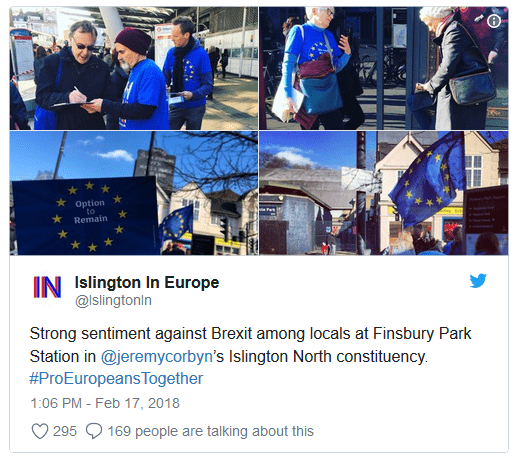
Anti-Brexit group Best for Britain (BfB) is planning to launch an advertising ‘blitz’ to keep the UK open to EU membership.

The Financial Times has reported the group aims to highlight the benefits of staying in the EU and plans to target much of its advertising at voters in the Midlands and the North of the UK.

Its chief executive officer Eloise Todd told the FT that in terms of media spend, she is planning for “some billboards”, as well as “a lot of digital spending”. The latter evokes the strategy of 2016’s Leave campaign, with Todd adding that her group was “taking a leaf directly” from the original Brexiters.

BfB claims to have raised more than £170k from more than 500 online supporters, and has further received £500,000 from George Soros’s Open Society Foundation. Overall, it has declared £1.2m in donations.

By

Sourced from THEDRUM

Gen Z use their phones a lot, but are relieved when they are taken away. So how do marketers reach this age group if they have a love/hate relationship with their smartphones?

By MediaStreet Staff Writers

Members of Generation Z are relieved when placed in a situation where they are unable to access their smartphones for several weeks. This is according to a new study conducted by Screen Education, a non-profit organisation that addresses smartphone addiction.

The study involved participants aged from 12 to 16, who spent 2-4 weeks at Camp Livingston during the summer of 2017.  Because Camp Livingston does not permit its campers to bring smartphones with them, they are an ideal group for conducting research about refraining from smartphone use.

According to Michael Mercier, President of Screen Education, “Many children said they have become overwhelmed by their smartphones. They no longer can keep up with all their notifications, and they are burdened by the ‘drama’ they encounter through social media via their smartphones. Consequently, they were relieved to be separated from their smartphones because it eliminated that stress.”

This relief was reflected in a survey conducted with the campers after they had returned home.  The campers were asked the extent to which they experienced feelings of gladness and frustration from being without their phones. “A large number − 92% − experienced gladness, while only 41% felt any frustration. We had expected the opposite,” said Mercier.

When asked what their experience would have been like if they had been allowed to bring their phones to camp, campers revealed just how severe smartphone addiction is among their age group. “They almost unanimously admitted they would have spent the entire time on their phones,” recounts Max Yamson, Executive Director of Camp Livingston. “They said they would not have formed deep relationships with the staff and fellow campers, would not have connected with their surroundings and nature on the same level, and would not have engaged as much in recreational activities.”

According to Yamson, “The study shows that the campers were glad to have left their phones behind so that they could experience a deeper level of engagement.”

“The research also revealed a stunning insight,” said Mercier. “Many campers discussed the experience of face-to-face communication as though it were a novel one. They exhibited a sense of discovery at learning that face-to-face communication is far superior to screen communication when it comes to building friendships and getting to know other people.”

Yamson added, “One camper said that in four short weeks she got to know her friends at camp better than she knows some of her friends at home – because she mostly communicates with her friends at home through screens.”

Other key findings include:

  • 92% said it was beneficial to have gone without their phones while at camp
  • 83% considered having gone without their phones for several weeks to be an important life experience
  • 35% were successful at curbing their smartphone use after leaving camp
  • 17% tried to influence a friend to spend less time on their phone after leaving camp

The researchers plan to follow this study up with additional research during the summer of 2018.


Marketers trying to catch the attention of this demographic may need to think carefully about how they approach mobile advertising for this generation of digital natives. It’s another day in the life of modern media.


Do you supply services to the Irish Media Industry? Have you listed your company in our Media Directory? It’s free! Everyone’s favourite price! Click here to do it now.


It could be sending the wrong message to your intended audience.

By MediaStreet Staff Writers

An academic study has found that women wearing heavy makeup are less likely to be perceived as leaders. Of course, it depends on what you are selling and to whom. But if you want your model to portray leadership, then stay away from the make-up kit.

The research from Abertay University found that women wearing heavy makeup were less likely to be thought of as good leaders. The study was led by Dr Christopher Watkins of Abertay’s Division of Psychology, and published today in Perception journal. It revealed that the amount of makeup a woman is wearing can have a negative impact on perceptions of her leadership ability.

Study participants were asked to view a series of images featuring the same woman without cosmetics and with makeup applied for a “social night out”.

Computer software was used to manipulate the faces and the amount of makeup was also manipulated in the face images.

Each participant completed a face perception task where they judged sixteen face-pairs, indicating how much better a leader they felt their chosen face to be compared to the other face.

It was found that both men and women evaluated women more negatively as a leader if the image suggested she was wearing a lot of makeup.

Dr Watkins said, “This research follows previous work in this area, which suggests that wearing makeup enhances how dominant a woman looks. While the previous findings suggest that we are inclined to show some deference to a woman with a good looking face, our new research suggests that makeup does not enhance a woman’s dominance by benefitting how we evaluate her in a leadership role.”

The study was carried out by Abertay graduates Esther James and Shauny Jenkins and used a measurement scale common in face perception research, which calculates the first-impressions of the participant group as a whole, working out an average verdict.

Dr Watkins has carried out previous high-profile studies including work looking at how women remember the faces potential love rivals and the role of traits related to dominance in our choice of allies, colleagues and friends.

To view the full study click here.

Do you supply services to the Irish Media Industry? Have you listed your company in our Media Directory? It’s free! Everyone’s favourite price! Click here to do it now.


Facebook is now the most popular places that advertisers are putting their video ads, even beating YouTube.

By MediaStreet Staff Writers

Top marketers know that digital video is one of the most powerful tools to increase consumer engagement and brand loyalty. In fact, according to a new study from Clinch, brand marketers are ramping up their production of digital videos with an emphasis on creating campaigns specifically for Facebook and YouTube.

The study found that 78 percent of marketers plan to increase their production of video ads in 2018, while only 43 percent of marketers plan to increase their production of static banner ads this year.

Social is Video

When it comes to digital video campaigns, Facebook reigns supreme, representing 46 percent of all video ads produced. When adding Facebook-owned Instagram into the mix, this number leaps to 74 percent. YouTube comes in a close second at 41 percent.

Says Oz Etzioni, CEO of Clinch, “It’s no secret that Facebook and YouTube dominate the digital media landscape and we don’t expect this to slow down, particularly with the Facebook algorithm change which requires brands to pay in order to be seen. In 2018 brands will increase spend and leverage the rich data that these platforms provide. However, the data and platform are just two pieces of the puzzle. Creative is the critical third piece. If brands aren’t uniquely tailoring their creative specifically for each platform and by audience, opportunities will be missed and ROI will be lowered.”

Nearly three quarters of marketers are adopting online video from their TV commercials. 44 percent indicated that they don’t shorten commercials for each platform’s suggested length. While TV ads remain a critical source of video content, the user experience of each social platform is very different than traditional TV. For example, TV ads are 15 to 30 seconds long but Facebook and YouTube recommend six-second videos.

Etzioni continued, “We were really surprised to learn that marketers were taking a one size fits all approach to video. In 2018, marketers will awaken to the fact that investment in creative will increase ROI and personalisation at scale, and will become the norm for digital video as it has become for static ads.”

Defining Social Personalisation

While 50 percent of respondents say they personalise their video campaigns, brands can be doing a lot more. Those that are personalising their creatives based on data are seeing big results. Nearly 90 percent of respondents who have customised Facebook or YouTube video ads reported seeing benefits. Furthermore, 70 percent of those who customise said that they have seen improvements in their key performance indicators (KPIs).

According to Etzioni, in the next few months, the definition of personalisation will change. “Rather than creating a handful of versions – one for men, one for women, one for the East Coast and one for the West Coast, we expect brands to be using data insights to personalise at scale. This means hundreds if not thousands of versions of videos where the message and creative is tailored to their specific needs and interests. This will create a more meaningful experience for the consumer and transform video campaigns from simply brand awareness to direct response opportunities,”

The full report, “How Leading Brand Marketers are Using Personalised Video to Drive Sales,” is available for download here.


Do you supply services to the Irish Media Industry? Have you listed your company in our Media Directory? It’s free! Everyone’s favourite price! Click here to do it now.

By

Boots No7 has launched an interactive “digital education platform” for its skincare products after finding women were baffled by the array on offer.

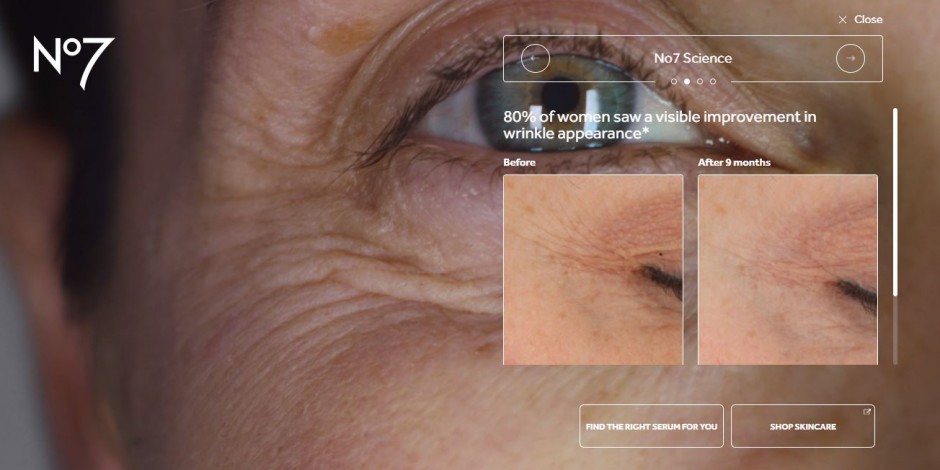
Dubbed ‘Face Study’, the online hub displays a real human face (which was filed in 4K resolution) with no make-up and no re-touching, to help women understand the signs of skin ageing. Users can zoom and scroll across the face to learn about specific problem areas and what causes ageing, as well as suggestions of products which can help.

It was created for No7 by creative agency Studio of Art & Commerce, which was simply briefed to “to help target our customer at a deeper level than a TV ad could.”

Speaking to The Drum, Kristy McCready, global director of content and engagement at Walgreens Boots Alliance, said the brand initially considered creating a website it could populate with content but quickly ditched the idea in favour of something more interactive.

“There was something inherently more fascinating about the face. [Women] want to see how products look on a face like theirs and that led us to Face Study. It really allows you to get close to the effects of aging on the skin in a way that editorial content couldn’t.”

It took over 18 months of developing the idea for the Face Study to materialise and McCready said early testing with women in the 35 to 55 age bracket (its core demographic) has been encouraging. It also led to a tweak in the platform, with No7 adding a short questionnaire on users’ skin issues to make the advice more personal.

“The feedback was universally positive. They loved the realness of it and the fact there was no retouching or airbrushing and that they could genuinely see the effects of aging on the skin. It gave a level of authenticity they responded to and [gave] us real confidence in using this digital platform to help them understand ageing,” she explained.

“It’s a hugely exciting departure [from our usual digital activity]. We have a big retail footprint, with a number of advisors who are great at educating at the point of sale. But people’s [shopping habits] are changing and we need to respond to it. This is as close to an online experience of in-store advisors as we’ve ever got.”

To get people using the platform, No7 has hired Red Consultancy to devise a PR strategy predominantly focused on engaging with bloggers and influencers, while in-store staff will also use it as part of their consultation with customers.

Boots recently explained to The Drum how women are playing a bigger role in not only the development of its skincare products, but how they are brought to market and promoted.

Last year it launched its first own-brand skincare range in over two-decades to rave reviews after three years working with a group of women – originally found to simply participate in market research – to design the entire marketing strategy.

Studio of Art & Commerce also worked on that project. Its founder, Heide Cohu, , described this latest brief as “a huge task”.

“We did this by working directly with leading skincare scientists and bringing to life the incredible science of both how the skin ages and how No7 Age Defying products work,” she said of the process.

“It is an informative and simple, yet interactive and immersive digital platform, enabling women to tailor the journey according to their needs and find a personalised solution that’s right for them.”

By 

Sourced from THEDRUM

Consumers believe a product is more effective when images of the product and its desired outcome are placed closer together in advertisements, according to a study in the Journal of Consumer Research.

By MediaStreet Staff Writers

“Merely changing the spatial proximity between the image of a product and its desired effect in an advertisement influences judgment of product effectiveness. Consumers tend to judge the product to be more effective when the two images are closer versus farther apart,” write authors Boyoun Chae (University of British Columbia), Xiuping Li (National University of Singapore), and Rui (Juliet) Zhu (University of British Columbia).

Advertising done right: The “problem” (wrinkles) and the solution (Wrinkle cream effectiveness) in very close proximity.

Many advertisements promoting the effectiveness of a product show both a product image (anti-wrinkle cream) and an image of the promised results (a face without wrinkles). Objectively, the distance between the two images should not affect how consumers judge the product’s quality.

This advertisement is done so well, the text about the product’s effectiveness is actually touching the face of the model.

In a series of studies, consumers were asked to judge the effectiveness of a variety of products promising specific results (acne cream, pain reliever, nasal allergy spray, bug spray, fabric softener). Consumers tended to assume a product was more effective when its image was placed closer to that of its promised effect. The proximity of the images was more influential when consumers were less knowledgeable about a product category or when the results were expected sooner rather than later.

Here we see there is some distance between the product (a razor that gives a perfect shave) and the outcome (Mourinho’s perfectly shaven face).

Companies should understand the subtle effect that spatial proximity between images has on consumer judgment of product effectiveness. When companies want to promote the immediate effects of their products, images of the product and its desired effect should be put closer to each other in an advertisement.

“The spatial proximity between visual representations of cause and effect in an advertisement can influence consumer judgments of product effectiveness. The closer the distance between an image of a product (an acne treatment) and that of its potential effect (a smooth face), the more effective consumers will judge the product to be,” the authors conclude.


Do you supply services to the Irish Media Industry? Have you listed your company in our Media Directory? It’s free! Everyone’s favourite price! Click here to do it now.

Make sure to keep an eye out for these five social media marketing trends that are taking over the digital marketing world in the upcoming year.

Did you know that on an average, we scroll through at least 300 feet (90 meters) of content daily? Not every brand’s campaign grabs our attention. It is a difficult and competitive game, as brands are trying harder to grab our attention, while our attention span has been reduced to a mere eight seconds. Brand strategy in the coming years will try more than ever to connect with their audiences across a variety of social platforms. It becomes imperative that your campaign works, more so taking into account the speed of feed. We have curated a list of five trends that we believe will impact your social media strategy in 2018.

Adopt Chatbots

https://giphy.com/gifs/11FyVJOvLleR5S

Gone are the days when chatbots meant unresponsive, hilarious and outright ridiculous software. Today, chatbots can do a lot more than just solve customer issues or order pizza for you. Various studies state that 20% of business content could be machine generated by next year. When we teach machines how to create authentic and engaging stories, the potential for advertising and marketing will become multifold. Chatbots interact with the users and deliver the solutions that they are looking for at the speed of light. Bots are developing to become smarter and empathetic. This engagement feels personal, from the user’s perspective. Chatbots are definitely a must-try social media marketing strategy in 2018 for your business.

Momentary content makes for good engagement:

Streaks GIF - Find & Share on GIPHY

Snapchat was the early adopter of momentary content. Instagram and Facebook followed suit, owing to the huge popularity of Stories format in a short time. These content are ephemeral and disappear in 24 hours. Brands are creating a whole new digital marketing strategy for their momentary content marketing. Having your stories appear at the very top of your follower’s feed keeps your brand at the top of their mind. Many brands do a live story session with a subject matter expert. This helps the user look out for the brand more so as to not miss an informative session. Ephemeral content marketing strategy is something that you should try in 2018!

Augmented reality boom

Augmented Reality Technology GIF by Wikitude - Find & Share on GIPHY

Augmented reality blurs the line between reality and computer-generated content by enhancing what we see, and hear. The adoption of augmented reality on mobile phones is a quick and easy way for brands to reach their target audience. Many brands are taking their products right inside the homes of users through exclusive filters. IKEA has released an app called Place which allows users to preview how the furniture would look in their homes before they buy. As more people get warmed up to augmented reality, more people will start to feel like they are missing out on things and want to become a part of it. However, you would also have to check where your strategy fits. Make sure your AR adds value for the user and don’t simply create one for the sake of it.

Influencers are here to stay

Social Media Instagram GIF by Much - Find & Share on GIPHY

Influencer marketing has grown so much over the last two years that the popularity has made it difficult to know whom to trust. Consumers expect genuine reviews from genuine influencers. Brands must seek to work with relevant influencers with industry background or knowledge. Viewers are already bored of seeing brands engage popular influencers who promote teeth whitening and a mobile phone app with the same vigor. In 2018, try and create worthwhile relationships with influencers and maintain them. Influencer marketing is going to become more authentic with brands moving to real experts instead of social influencers.

Make more videos

Film Scene GIF by Alexander IRL - Find & Share on GIPHY

We are addicted to mobile phones, and we love our videos. In 2017, 90% of the most shared content on social media was in video format. If you are not using videos yet, you will have to quickly start using them and master the art of capturing the user’s attention in the first 3 seconds. Video is the quickest and the closest way you will come face to face with your target audience. As with everything, you need to have a clear strategy before creating a video. Taking advantage of Facebook Live and Instagram Live is also a smart strategy. Ensure that the video is of the highest quality and engaging. You will also have to consider making the best design and make sure to add subtitles to attract users when they are watching with sound off.

Have you listed your company in our Media Directory? It’s free! Everyone’s favourite price! Click here to do it now.


It’s all about the reviews, so make sure yours are good.

By MediaStreet Staff Writers

More than three quarters of travellers use review sites such as Yelp and Trip Advisor to conduct research prior to booking services.

This is according to a survey conducted by The GO Group, an international ground transportation provider.

Travel GIF by Evan Hilton - Find & Share on GIPHY

The respondents were asked about site usage for accommodations, activities, events and ground transportation.

When asked about use of sites for hotels and other accommodations, 13% of respondents said they always check sites; 31% said they do so frequently, 34% said sometimes and 22% said never.

Fifteen percent said they always check sites for reviews about tours and activities; 25% and 34% said they do so frequently and sometimes, respectively. The results for checking on attractions and venues were similar were about the same.

Fewer people use review sites for ground transportation. Only 10% percent said always they did so; 23% said frequently and 40% replied sometimes.

The survey also asked how many people post on review sites. Just three percent said they always posted on the sites, nine percent do so frequently; 40% post sometimes and 26 % responded they have never posted on a review site.

“In addition to or even in lieu of obtaining information and referrals from close friends and family, more people are opting to use content generated by strangers as a guide for booking travel experiences, says John McCarthy, president, GO Group. “As reliance on online review sites continues to grow, it behooves all of us in the travel-related industries industry to regularly review and respond to posts, and monitor them for potential customer services issues.”

Angry Always Sunny GIF by It's Always Sunny in Philadelphia - Find & Share on GIPHY

The GO Group LLC is the nation’s largest airport transportation provider, offering shared rides, private vehicles, sedans, charters and tours, serving some 90 airports in North America, Mexico, the Caribbean and Europe and transporting more than 13 million passengers per year.

This study shows just how much babysitting and care you need to put into your online reviews. Like you don’t already have enough to do!

Have you listed your company in our Media Directory? It’s free! Everyone’s favourite price! Click here to do it now.