When was the last time you trusted someone or something whole-heartedly? And, if you did, that particular person or thing most likely might be the one who is the closest to you, one very special. ‘Trust’ is the sole reason why people want to relate to you and, in order for people to trust you, they need to feel like they know you very well. In order for them to feel like they know you really well, they must first notice you, then recognize you, and thereafter keep remembering you. For people to notice, recognize, and remember you, you must always show up in a way that makes them believe it obviously is you and no one else. Making people take notice is a process. It might take them seeing you in their field of vision at least fifteen to twenty times before they actually take notice of you and register. Therefore, you will need a way to get in front of these people a second, third, or twentieth time so that you can kind of be worthy enough to prove to them that you are credible, trustworthy, and surely the best choice among all the others they might consider.
As humans, we are inherently programmed with something called the ‘context-dependent memory’ syndrome, which means that we tend to forget something very easily as soon as it gets out of context. Therefore, to remain in context, it becomes extremely crucial to showcase ourselves in a consistent manner that can aid in gaining the trust of our deserving patrons. Also according to Harvard professor Gerald Zaltman, 95% of purchasing decisions are subconscious, showing that purchasing is more of an emotional decision than a practical one. Because we as humans are usually driven by feelings. Have we ever wondered why we end up buying the same soap or visiting the same café? It is a consistent brand experience delivered every time that makes us feel comfortable with every interaction. We know what to expect and are kind of very sure of the outcome. Brand consistency does foster goodwill, helps build strong equity, and acts as the adhesive that assists viewers put you back in contextual memory.
Have you ever wondered how much you relate to a Dove or a McDonald’s commercial, every time it ends up playing on your television set or you share a glance at one of their adverts while you are traveling somewhere or driving your car or maybe simply updating yourself with the daily news, either in print or on your tech gadget? And most of these times you ended up relating to them before you even took note of their logo mark. I do not intend to promote a particular brand out here but it’s worth a mention as how such brands have been delivering a consistent brand message for years. In today’s digital era, content is truly becoming more and more dominant. I really don’t need to tell you how much of it is there for you to consume. As you read this very moment, thousands of fresh new content are being published to the web in different forms, ready for you to relate to and consume. And, the more this happens, the more it also gets difficult for you as a brand to stand out. To cut through this large chunk of noise being generated, the brand will need to differentiate itself from the competition. But while differentiation is key, it might only aid in grabbing a sizeable market share which must remain intact for the brand to prevail continuously. The brand will need something much more. Something that will stick on to the viewer’s mind, something that will build their trust and win their loyalty, not just for once but possibly for a lifetime.
The benefits of being consistent can provide significant differentials within highly competitive markets, generating authority in respective segments and thereby building loyalty for the brand. Brand consistency can truly help the bottom line of a brand. According to research by customer experience expert Esteban Kolsky, 55% of consumers are willing to pay more for a ‘guaranteed good experience’. As he clearly mentions that ‘guaranteed’ is the most important factor here, noting that customers are no longer satisfied with just being promised a good experience. There has to be something more concrete that can ensure that this good experience is being delivered each time, every time. There has to be a consistent projection and delivery mechanism in place that can validate that the promises made are being translated into trustworthy action points. And this in turn will help consumers build a strong relationship with the brand going forward.
One great example I can possibly recall reading about is the man Sir Richard Branson himself. A brand name in his own right, he has gradually evolved from running a record label to building a dynamic airline brand and many other successful ventures along the way with the most recent being travel to outer space on Virgin Galactic – the world’s first commercial spaceline. He has envisioned and built a multi-billion dollar brand around his core principles and though people always seem to expect the unexpected from him, what is important to note is that he remains consistent in delivering a super cool brand experience that is customer-centric and aesthetically entertaining, no matter the venture he gets involved in. It is like swearing by what to expect from any new venture that might have the brand name ‘Virgin’ associated with it.
When you are focused on brand building, the last thing that you would end up doing is to confuse your target customers and the market at large, because they would be the ones helping you drive the bottom line for your business as well as register a worthy return on investment on your branding exercise. By not following a consistent approach to brand building, you could deprive yourself of multiple chances to drive authentic figures in sales. It is very important to remember that people buy from brands they can strongly connect with and those that seem to be authentic enough to be able to trust. After all, it does become hard to connect with a brand that doesn’t seem consistent enough. Ask yourself, how easily would you be able to trust a person you have met for the first time? Even though he might have seemed to be the perfect candidate to tick off all the questions on your preferential checklist. Yet, you wouldn’t be able to do so, right? It would probably require multiple consistent interactions for you to even think of taking the next step. And that is exactly how human behaviour works, irrespective of scrutiny being for a human or a brand.
Consistency is one of the most crucial steps toward successful brand-building. And it doesn’t end at the product or the messaging only. It needs to be strictly adhered to, across all parameters of the planning and delivery mechanism. From research, development, manufacturing, delivery, human capital, finance as well as stakeholders to the last possible mile in this entire process, there has to be a unified approach and projection at all times. With every interaction at every single touch point, the brand promise needs to be loud and clear, delivering a consistent experience to consumers. It would be really good to conclude with clarity here that even a well-articulated and clearly defined branding exercise that lacks a well-planned and consistent brand projection in place, will absolutely hold no merit at all and will end up failing to deliver desired results.
Kaushik Saha is the Co-Founder and Chief Creative Officer of Tricycle Brand Solutions, India. A firm believer in ‘Impossible is Nothing’, he intends to deliver strategically defined, impeccable creative and design solutions to help new-age enterprises create visible impact. With Tricycle, he wants to effectively combine relevance with the magic of design, to create powerful brand expressions. He has been recently conferred with the ‘Creative Entrepreneur of the Year’ award by Entrepreneur India.
Web3 could revolutionize the relationship between brands and their customers. Here’s an introduction to what marketers need to know.
When the internet first went live, publishers would create content and users would consume it – a period known as web1. A decade or so later, web2 took over with the emergence of web apps and social networks, which made it easy for everyone to create, share and engage with content.
Fast forward to today, and the novelty of web2 has largely worn off. Some of the most impactful web2 companies – such as Meta (Facebook), Google and Apple – have made a killing by leveraging user-generated content (UGC) to engage consumers and create unique profiles for each of them, only to turn around and ultimately sell that data to third parties for advertising purposes.
The worst part? The vast majority of those users had no idea this was taking place – and none of them gave their permission to allow it to happen.
If advertisers want to rebuild trust with consumers, they need to take an open, transparent approach and ask their audiences for their permission to collect data. And this is exactly what the web3 opportunity – a new era of the internet characterized by decentralization, transparency and autonomy – enables.
What are the core principles of web3?
Ask 10 people to define web3, and you might get 10 different answers. But at a high level, web3 is a new iteration of the internet powered by blockchain technology and token-based economics, and it’s also governed by three central tenets:
Decentralization. In web2, companies own platforms. In web3, platforms are decentralized. No organization has control over any content; users do
Transparency. Thanks to blockchain technology, all users on peer-to-peer networks and decentralized apps (dApps) will share open, unalterable databases that they can verify with their own eyes
Autonomy. Ultimately, users will be able to control their own digital destiny and have the final say in whether their data is collected and how it’s used
According to a recent study, 96% of consumers don’t trust advertisers. This is exactly why brands should be incredibly excited about the web3 moment.
With the right approach, digital advertisers can rebuild the trust they’ve lost during the web2 era – connecting with consumers on a meaningful level and in an open and honest way.
Web3 is here – it’s time to prepare for the tectonic shift
Though we’re still early, the web3 moment has already arrived. Unfortunately, advertisers that wait to adapt to this reality will learn the lesson the hard way.
In the not-too-distant future, users will demand a cut of the revenue generated from the data they create. As an internet-native currency that is incredibly divisible, crypto is the easiest mechanism to deliver incentives that users can immediately put to use.
As the world gravitates toward the web3 standard, user data will increasingly be held on the blockchain or in decentralized storage solutions, which will give users more power over their data than ever before. As a result, they will be able to choose exactly which brands they consent to share data with, what data they wish to share, and for how long.
Advertisers that don’t prepare for this tectonic shift and adapt their methods to offer a real value proposition in exchange for interacting with user data will be left behind.
By offering tokenized rewards – whether that’s fungible crypto coins or non-fungible tokens (NFTs), an on-trend, blockchain-based, one-of-a-kind digital asset – advertisers can tap into the web3 ethos while exciting users about what they have to offer. Plus, they get to take advantage of the magnificent properties that come with blockchain technology, such as:
Immutability, or the permanent, unalterable nature of a blockchain ledger
Validation, or the way in which users can verify transactions are legitimate
Disintermediation, or the absence of intermediaries between advertisers and users
Profound security, made possible by cryptography and decentralization
Ease of transfer, which makes it simple and quick to send and receive tokens
How crypto can help advertisers thrive in web3
One of the easiest ways to reward users when they give their permission to share their personal data or perform specific actions is by issuing crypto rewards. For example, you can give them rewards when they watch videos, view personalized ads and opt to receive content from brands.
By offering an opt-in value exchange – where they’re willing to part with their data or their attention for tokens – advertisers can begin building long-lasting customer relationships and regain trust while ensuring regulatory compliance.
Though cryptocurrency remains in its infancy, adoption continues to increase; today, some 27 million Americans own crypto. With steady growth over the last decade, it’s only a matter of time before crypto usage reaches critical mass. The sooner advertisers embrace the inevitably of crypto, the faster they’ll be in a position to capitalize.
Since the future of digital advertising will be fuelled by permission and digital rewards, brands need to start looking for a purpose-built crypto-rewarded advertising platform that will guide the journey ahead. Strategies that enable aligned incentives – where all participants, including users, advertisers and the platform, benefit from the permissioned sharing of data – will lead to victory in the web3 era.
With the right approach, the lopsided relationship between brands and consumers suddenly evens out, and both parties engaging with each other is more of a partnership than anything else.
Influencer marketing has evolved and so must your approach. Here’s what you need to do to make this powerful approach work as part of your full-funnel marketing strategy.
Like most nascent marketing channels, influencer marketing began as something of a Wild West. Metrics were thorny, processes were clouded, and many brands got burned working with influencer platforms or individual creators who produced scant measurable results.
The upshot is that, even now that influencer marketing has matured into a more structured discipline, some brands remain skeptical of the entire medium.
We are at the point where brands who have struggled to produce and prove value from working with influencers in the past, must consider starting from scratch. That doesn’t don’t mean scrapping your Influencer program, but effectively taking a beat to re-evaluate your approach and reset it.
Build an influencer marketing strategy from the ground up with the same scrutiny you would apply to any other strategy. That means a rigorous brand analysis and quantitative vetting process should drive discovery of potential influencers. While the process of engaging and partnering with or deploying an influencer should be as automated as possible. And, last, measurement should focus on influencers’ ability to drive sales. Influencers who can move the bottom line are the ones brands should redeploy to optimize over time.
Gone are the days when influencer marketing was purely a brand awareness play. In the right hands, influencer is now a full-funnel, full-service discipline, meaning it covers awareness and bottom-of-funnel activations, discovery upfront, and measurement on the back end. Here are three cores to building an influencer marketing strategy from scratch and turning it into a proven revenue generator.
Understand who you are and what you need to accomplish
Brands need to set clear specifications to select the right creators. Brands should ask themselves: What are your values? Which audiences are you trying to reach? What backgrounds would you like your creators to represent? What messages do you need to send to your audience?
Next comes the quantitative decision-making process that has historically eluded the discipline. What are your key performance indicators? What calls to action will you bake into your influencer campaigns? How will you measure success? Beyond numbers of followers (the conventional metric), what engagement rates do you expect influencers to command, and how do those rates line up with sales goals?
Once brands have figured this out, they can select influencers who meet their criteria. Brands should also implement a repeatable process for creating content briefs to set influencers up for success. These, too, can be optimized over time, allowing advertisers to eliminate ambiguities. Now is when cutting-edge influencer practices come in, transforming the discipline into a full-funnel strategy.
Maximize distribution, measure influencer success and optimize
The fatal flaw in most content marketing strategies is that brands focus all their attention on creating great content, and after they have created it, they simply slap it into a blog or repost it to a couple of social channels. The same failure has historically applied to influencer marketing.
But sophisticated practitioners can turn distribution into a source of value. For example, a video created for Instagram might be amplified by paid social, an OTT campaign, digital out-of-home billboards, or programmatic display.
After brands have transformed what could have been a simple influencer Instagram video into an omnichannel campaign, they can leverage cross-channel data to quantify sales driven collaboration. This is a far cry from the old influencer measurement framework in which advertisers would report on the number of eyeballs a campaign reached or how many comments it spurred.
Once brands understand how much revenue individual influencers are driving, they can optimize campaigns, staffing a bench of key collaborators. Over time, by following this model, they can build an “army” of Influencers who deeply understand the brand and can convert their audience, ultimately making things more efficient and seamless. This process of distribution, measurement, and optimization should ultimately equip brands with a well-oiled machine of creators proven to be worth the investment – and then some.
Raise the bar for influencer marketing
It is understandable that many advertisers are wary of influencer marketing. But forward-thinking brands should not let past failures dictate future strategy for a channel that has evolved.
Influencer marketing should be part of a full-funnel strategy. It builds awareness and trust through powerful, authentic content that resonates with consumers on an emotional level. It also drives sales and lends itself to granular measurement, which allows for optimization so that influencer becomes not only more lucrative but also more efficient over time.
The only thing standing between many brands and a revenue-generating Influencer Marketing strategy is outdated assumptions about the channel. By challenging past wisdom and applying the same structure that governs other performance marketing channels to influencers, brands can unlock fresh revenue-generating opportunities.
There are tens of thousands of businesses currently operating in every industry you can think of and the online market has never been more saturated. But, while this has its benefits, standing out among your competitors has become increasingly challenging. In order to attract more leads and increase conversions, you need to set yourself apart and one of the most effective ways to achieve this is through identifying your niche.
What does ‘niching down’ mean?
Niching down means identifying a smaller segment of your audience to target, so you can deliver a more specific and tailored offering that speaks to them directly, as opposed to a general offer that reaches a larger audience.
Consider a web designer that exclusively works with charity organizations. While they can design websites for any business, trying to get noticed in a vast expanse of different industries and specialisms is incredibly tough. By focusing on a smaller niche, not only can they tailor their services to those organizations more effectively, because they’ll understand the demands of that sector, but charities in need of web design services will know exactly who to contact.
A blanket approach may seem like it will result in more sales, but the reality is that what you’re selling may not appeal to a large percentage of that audience’s needs – you’re not going to stand out among thousands of other people all offering the same thing. Ultimately, in niching down, you’ll stand out more to a specific group of people who are looking precisely for what you’re offering. And, it provides many more benefits besides.
Connect and attract true customers
When approaching the topic of niching down, many business owners worry that by alienating a large group of customers, they’ll lose money. But actually, the opposite is true – instead of just using a blanket approach to a large group of potential customers, when you determine your niche, you increase the number of ideal clients.
These are people who are far more likely to convert, meaning your marketing efforts are stronger. In a podcast interview, brand strategist Pia Silva explains the value in connecting with targeted customers, stating, “It’s so powerful to clarify who you’re for. It turns on the light bulbs in people’s brains, they think of people to send to you that they wouldn’t think of if you’re not specific”. Your business becomes the go-to brand for your specific service or product, enhancing your reputation in your industry and attracting true clients.
Develop a stronger offer
When you narrow down your focus, you have a greater opportunity to understand the strengths and weaknesses in your sector. You’ll be able to gain clarity on the market and your competitors, and build an offer that’s consistent for your customers. Your message will be clearer and you and your customers will have confidence in what you’re offering because you’ll be the specialist in that area.
That’s not to say that every client gets the same solution. But, the framework and the structure of your offering will be the same because your clients will inevitably be in need of similar things. This, in turn, makes it easier to deliver high-quality products or services that are in keeping with what your customers are looking for.
Build trust and loyalty in your brand
When you’re speaking to a smaller audience, it’s much easier to speak their language specifically and talk to customers in a more personalized way. You’ll be communicating with like-minded individuals rather than trying to make yourself heard to everyone. This helps to build trust with your audience, as you’re creating something that’s exclusively for them. The result is that your audience feels understood and, in niching down, you’re showing that not only do you know your audience but you value their needs and requirements enough to tailor your business to them which goes a long way towards building loyalty.
Limit your competition
Two overriding benefits of finding your niche are that you instantly reduce your competition and rebuild your competitive edge in a saturated market. You’ll no longer be fighting against thousands of other businesses for the top spot. The pool of competitors will be much smaller, making it easier to achieve success. In fact, in cornering a niche market, you may even find that other businesses are less likely to take the risk which can be of benefit to you and your company because it leaves those opportunities available for conquering.
In summary
Instead of trying to solve everything for everyone, niching down enables businesses to focus on the services and products that their customers really need and are willing to pay for. It also offers the opportunity to really hone your expertise in a specific area and become a market leader for your niche, which can benefit your business in the long term.
By niching down, you become the go-to specialist which builds positive brand recognition and customer loyalty, as well as increasing conversions and staying one step ahead of competitors.
The online giant gives a leg up to hundreds of house brand and exclusive products that most people don’t know are connected to Amazon
It took Robert Gomez about five months to get his Kaffe coffee grinder to the big leagues in e-commerce: among the first three search results for “coffee grinder” on Amazon.com.
Gomez, founder of Atlanta-based consumer goods startup 4Q Brands, said he obsessively refined his photos and description, amassed reviews from happy customers, and paid Amazon $40,000 a month on advertising to boost sales, one of the elements Amazon tells sellers will increase search ranking.
Robert Gomez, owner of startup 4Q Brands, in his warehouse in Buford, GA on October 6th, 2021. For more than two years, his coffee grinder had been one of his best sellers on Amazon. Rita Harper
Then Amazon introduced a competitor from house brand Amazon Basics and another from a brand that sells exclusively on Amazon, DR Mills.
“They ranked well right away,” Gomez said, each of them appearing among the top-three results for “coffee grinder” searches immediately. The reason, he said, was clear: “Their search ranking is high because they’re an Amazon brand.”
An investigation by The Markup found that Amazon places products from its house brands and products exclusive to the site ahead of those from competitors—even competitors with higher customer ratings and more sales, judging from the volume of reviews.
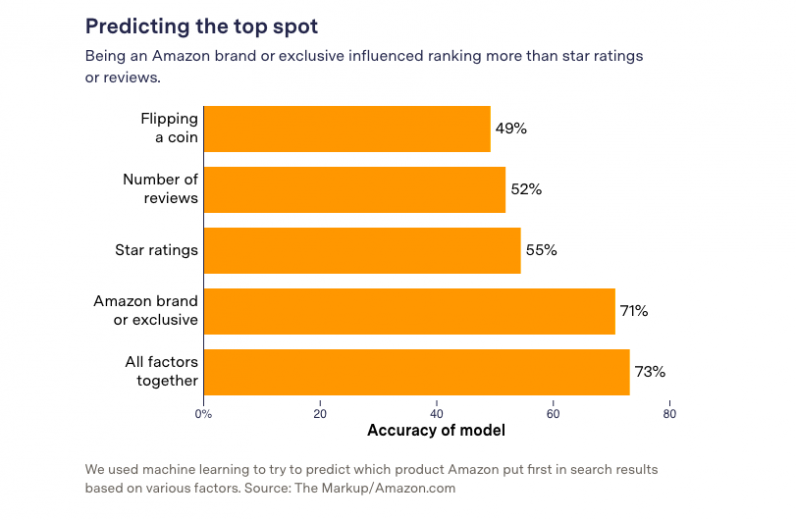
We found that knowing only whether a product was an Amazon brand or exclusive could predict in seven out of every 10 cases whether Amazon would place it first in search results. These listings are not visibly marked as “sponsored” and they are part of a grid that Amazon identifies as “search results” in the site’s source code. (We only analysed products in that grid, ignoring modules that are strictly for advertising.)
We used machine learning to try to predict which product Amazon put first in search results based on various factors. Source: The Markup/Amazon.com
When we analysed star ratings and number of reviews, neither could predict much better than a coin toss which product Amazon placed first in search results.
Amazon told Congress in 2019 that its search results do not take into account whether a product is an Amazon-owned brand.
Sellers say it doesn’t seem that way to them. Gomez said Amazon’s brands have “unfair advantages” that make it harder for small merchants like him to compete” on its open marketplace. “Who bears the cost are those entrepreneurs and small businesses that don’t have the means to fight.”
The Markup found Amazon placed its Happy Belly Cinnamon Crunch cereal, with four stars and 1,010 reviews, in the number one spot ahead of cereals with better and more reviews including Cap’n Crunch (five stars, 14,069 reviews), Honey Bunches of Oats (five stars, 5,205 reviews), and Honey Nut Cheerios (five stars, 11,702 reviews). A vacuum cleaner from Amazon’s exclusive Noisz brand was placed on top, ahead of models from Bissell, Eureka, and Hoover with higher ratings and more reviews. And the Amazon-exclusive Concept 3sneaker from Skechers placed number one, four spots ahead of a similar but not exclusive to Amazon Skechers sneaker with the same star rating but 77 times more reviews.
A former Amazon employee told The Markup that the company used to give its new house brand products an unearned place at the top of search rankings when they first launched. He said the practice has since stopped.
However, we found that Amazon brands and exclusive products overall received an outsized portion of the top spot on search results, one that was far out of line with their proportion of the sample.
That’s not what shoppers expect.
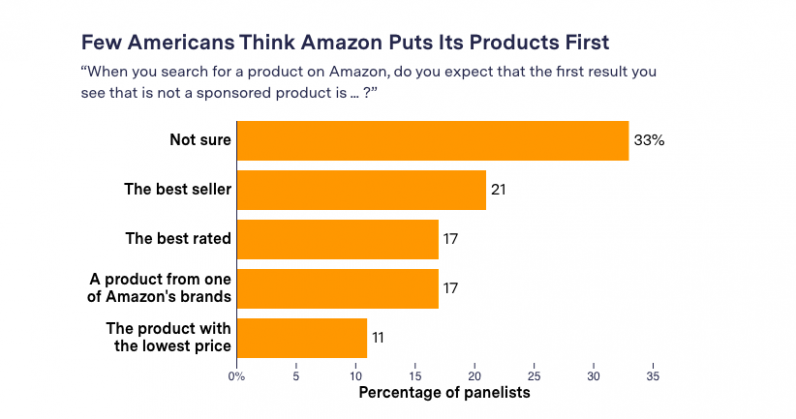
We commissioned a national panel of 1,000 adults. We included (non-Amazon) competing brands Champion and Brooklinen as a control. Source: The Markup/YouGov
In a national survey we commissioned from YouGov, only 17 percent of respondents said they assumed Amazon put its own products first. Half said they expected the first non-sponsored product on Amazon’s search results page to be the cheapest, highest rated, or bestselling.
By giving its brands top billing, Amazon is giving itself a significant leg up in sales. The first three items on the search results page get 64 percent of clicks, according to one ex-Amazon-employee-turned-consultant.
In a short, written statement, Amazon spokesperson Nell Rona said that the company does not favour its brands in search results and declined to answer any of the dozens of specific questions posed by The Markup.
She said the company identified its brands to shoppers by adding “Amazon brand” to the list of product features on the product page and sometimes to the listing title as well. We only found this to be the case in 23 percent of products in our sample that were Amazon-owned brands. She said brands that are exclusive to Amazon would not carry the disclosure because they are not owned by the company.
Invisible tags
A signal, invisible to the public but coded into the listings, suggests that most of the Amazon brand and exclusive products that were listed first were ads. In 87 percent of cases, the listing’s source code identified them as “sponsored”—though that label isn’t shown to the public. Instead, Amazon labels the products “featured from our brands.”
Rona, the Amazon spokesperson, said the company considers “featured from our brands” listings “merchandising placements” and not “search results,” despite their presence in the search results grid. She also said they are not ads, despite the “sponsored” label in the source code. Rona said they are “clearly labelled to distinguish them from search results” but did not respond to questions about whether the company believes such disclosures were clear enough under Federal Trade Commission requirements.
Mary Engle, who retired as the FTC advertising practices associate director last year, said that what Amazon calls “merchandising” is actually advertising.
“Amazon’s placement of its own products on its own site is advertising, whether or not money changes hands,” she said. She said it would require an investigation to determine whether “featured from our brands” is sufficient disclosure under the FTC’s rules.
Bill Baer, a former assistant attorney general in charge of the antitrust division of the U.S. Department of Justice and former director of the Bureau of Competition at the FTC, said if consumers expect Amazon’s product search results to be neutral, but they are not, and the site is essentially a monopoly, that could be a violation of the FTC Act of 1914, which prohibits unfair competition and unfair or deceptive practices in commerce, or the U.S. Sherman Antitrust Act, which prohibits monopolies from using their market power to harm competition.
“If basically you’ve got somebody with market power that is restraining competition both in terms of site access or where things appear on the site,” he said, “that is potentially problematic.”
Amazon’s online marketplace garners more than five times more sales than its closest online competitor, Walmart, which also allows third-party sales.
Congress is considering a package of anti-monopoly bills aimed at big tech, including the Ending Platform Monopolies Act, which would make the practice of platforms giving their brands a leg up explicitly illegal.
Amazon refers to its own brands and brands developed by others that sell exclusively on Amazon as “our brands.” They peddle everything from snack chips and vitamins to fashion and furniture.
Using public records from the U.S. Patent and Trademark Office and Amazon’s own statements, we identified more than 150 brands registered by or owned by Amazon. These include both brands with an obvious connection, such as Amazon Basics and Amazon Commercial, and those that are generally known to be owned by the company, including Kindle and Zappos. But they also include dozens more, such as Happy Belly, Daily Ritual, and Society New York, where the connection to the company is not obvious. Those are in addition to the estimated hundreds of third-party brands that are exclusive to the site.
We analysed search results on Amazon for 3,492 popular internet product queries in January 2021 and looked closely at what Amazon placed in the first spot. In 60 percent of cases, Amazon sold this spot to an advertiser and added a public label indicating the listing was “sponsored.” Of the rest, Amazon gave half to its own brands and brands exclusive to the site, and the other half to competing brands. But Amazon brands and exclusives made up only 6 percent of all products in the sample, and competitors made up 77 percent. In short, Amazon was hogging the top spot.
In more than a quarter of searches in which Amazon gave its brands the top spot, it placed its products above competitors that had both better ratings and more reviews than the Amazon brand or exclusive product.
‘They would shut us down’
Sellers said there’s no mistaking the effect on sales of Amazon’s choices in search results.
“If the customers are not seeing [our products] in the top five offers, then it makes it really hard for us to reach customers,” said Gabriela Mekler, a Miami mom who co-founded the organizational products company Mumi in 2014.
Mumi’s top product—a set of color-coded packing cubes—struggles for visibility on Amazon, even after more than two years on the site. She said the coronavirus pandemic decimated her sales—they dropped by more than 68 percent—costing the company a hard-won “Amazon’s Choice” badge on its packing cubes.
Mumi has not been placed on the first page of our search results for “packing cubes” for months. At the time of this writing, Amazon Basics took up eight spots on the first page; one was labelled “featured from our brands.” None were visibly marked “sponsored.”
“Their product will always show before yours,” Mekler said.
One Mumi product has still been selling well despite the pandemic, she said: reusable pill pouches. For now, there is no Amazon Basics pill pouch, and Mekler hopes there won’t be anytime soon.
“We’re a small company,” she said. “They would shut us down.”
Some annotated examples of popular searches we collected in January 2021. Source: The Markup / Amazon
The National Association of Wholesaler-Distributors, which represents more than 30,000 distributors, submitted a letter to members of Congress in July 2020, complaining that Amazon “abuses its position” to give preferential treatment to its house brands.
But when The Markup asked to speak to some of the sellers the group had quoted anonymously, NAW’s vice president of government relations, Blake Adami, demurred.
“Our members are still very hesitant to speak out against Amazon for fear of retaliation,” he said in an email, “even anonymously.”
Many sellers whose products we found were placed below Amazon products with fewer sales or ratings also declined a reporter’s request to be interviewed for this article, saying they were concerned it would negatively affect their livelihoods.
“Everybody’s so scared of Amazon,” said Paul Rafelson, executive director of the Online Merchants Guild, which represents Amazon sellers. “Their whole livelihood relies on them.”
‘This was a knockoff’
Some of Amazon’s competitors have accused the company of knocking off their products to sell under its house brands.
Williams Sonoma settled a lawsuit that included the claim that Amazon was copying West Elm furniture and selling it under the Amazon house brand Rivet. Allbirds co-CEO Joey Zwillinger wrote an open letter to Jeff Bezos when Amazon’s 206 Collective brand copied his company’s wool sneaker, urging Amazon to adopt Allbirds’ sustainability practices in addition to its design.
In March, Amazon Basics started selling the Everyday Sling, a camera bag with a similar design, the same name but a much lower price than a product from Peak Design.
“It wasn’t like they took some styling cues from it. This was a knockoff,” CEO Peter Dering said in an interview. The smaller company produced a parody video that now has 4.6 million views on YouTube. Within hours, Amazon changed the product’s name.
Dering said he wasn’t worried about losing sales because Peak Design mainly targets wholesalers and customers who want a high-end brand. Still, he said he found the move “highly distasteful.”
Rona, the Amazon spokesperson, said the company “did not infringe” on Allbirds’ or Peak Design’s “design rights” and “strictly prohibit[s] our employees from using non-public, seller-specific data to determine which store brand products to launch.”
Hard to spot
Identifying all of Amazon’s brands and brand exclusives to the site for this investigation was cumbersome. The company does not provide a complete list. The Markup’s reporting team used various filters on the site, reviewed the U.S. Patent and Trademark Office records, and reviewed Amazon bestseller lists—but even then we likely missed some.
Consumers would have an even harder time. We found Amazon does not consistently label its brands and exclusives.
Of the products in our sample that Amazon considered “our brands,” about two in five were not labeled as such in search results nor did they carry a name that many people would understand was connected to the company, such as Amazon Basics, Kindle, or Whole Foods.
Inconsistent labelling, combined with an almost endless stream of its own private brands, leaves customers in the dark to decide whether Amazon highly ranked a particular product because it was a good buy or because it benefited the company’s bottom line.
Nine in 10 respondents to the national survey The Markup commissioned in July didn’t know that Amazon’s highest-selling house brands, apart from Amazon Basics, were owned by the company.
Even there, 24 percent of respondents could not identify Amazon Basics as an Amazon brand, and half didn’t know Amazon owned Whole Foods.
To test your knowledge, Select all products from Amazon brands and exclusives: link
Alex Harman, competition policy advocate at Public Citizen who has studied Amazon’s marketplace, said that to him, the strategy of creating a stream of brands without a clear affiliation to Amazon feels “deceptive.”
Large brick-and-mortar retailers also have house brands. Costco has Kirkland Signature. Target has Up&Up, among others. Historically, he said, when large stores create brands they have been clearly affiliated with the store.
And Amazon’s search results are different from a store shelf.
“Unlike a retail store where you see everything on the shelf, the platform may be in a position to elevate its goods in a way that is harder to do in a retail outlet,” said Baer, the former FTC official, and assistant attorney general at the Justice Department.
By creating more than a hundred trademarked brands, most without an obvious connection to the company, Amazon can preserve its reputation if one of its homegrown products flops. This happened in 2015 when customer reviews for its newly launched Amazon Elements diapers included complaints about leaks and “sagginess.” Amazon pulled the products after just seven weeks to make “design improvements.”
Stacy Mitchell, co-director of the small business advocacy group Institute for Local Self-Reliance, and a frequent Amazon critic, said that as Amazon’s brands squeeze competitors, those competitors have less money to spend on innovation—and consumers lose.
“Consumers don’t even know what’s missing,” she said.
Case in point: Brandon Fuhrmann, who runs the New York Amazon Seller Meetup. He was considering expanding his kitchenware brand into a new type of dishware. While checking trademark registrations and U.S. import logs for sellers with similar products, he realized that the majority of his competition would come from Amazon brands.
“When that happened, we realized we couldn’t even compete,” he said. He decided not to launch the product.
Rise of Amazon brands
Amazon has continually set its sights on dizzying growth.
It launched in 1995, with the goal of becoming “Earth’s Biggest Bookstore.” Four years later, it declared its intention to become “Earth’s Biggest Selection.”
To reach this point, it took a page from rival eBay’s playbook, inviting individuals and business owners to list rare, used, and collectible items—which quickly transitioned to third parties selling mainstream, new wares on Amazon.
In 2003, Jason Boyce got a call from Amazon asking him to list his company’s basketball products on the nascent marketplace.
Jason Boyce, photographed at his home, on October 4th, 2021. (James Bernal for The Markup)
“We’re like, what are you talking about? You guys sell books,” he said. “What do you mean you’re selling sporting goods?”
Boyce took the plunge and his company’s basketball sales took off on Amazon.
By 2018, third-party sellers like Boyce were responsible for 58 percent of physical goods sales on Amazon. They helped boost Amazon’s North American sales by more than an order of magnitude, from $24.5 billion in 2009 to $386.1 billion in 2018.
The volume created fortunes for small businesses across the world. It also created a deep reliance on Amazon. A 2021 report by JungleScout, which provides software for Amazon sellers, found that Amazon was the only source of income for 22 percent of Amazon’s third-party sellers.
“Within two years of getting on Amazon, most of my clients, whether they want to or not, it becomes their single biggest sales channel,” said James Thomson, who was a manager at Amazon from 2007 to 2012 and now works at the e-commerce consulting firm Buy Box Experts.
And these new third-party sellers had lots of competition, eventually from Amazon itself.
Boyce said Amazon started undercutting his business, selling the same sporting goods—Spalding basketballs, for example—for less.
Unable to compete with Amazon on price for brand-name products, Boyce and his brothers launched their own brand, Harvil, in 2007, to sell sporting goods and home recreation equipment on Amazon. They figured Amazon couldn’t undercut their prices if he and his brothers owned the brand.
They had no idea Amazon was also beginning to launch its own brands and to enter into deals with companies to develop brands exclusive to the platform.
Among the first Amazon brands was Pinzon (a likely nod to the first conquistador to stumble across the Amazon River), which Amazon registered as a trademark in 2007 to sell bedding. Then came Denali for tools, and Amazon Basics for a slew of products, including household appliances and office supplies.
Sometime in 2017, Boyce was searching keywords related to his products on Amazon—”bocce ball,” “air hockey table”—when he noticed a new brand, Rally and Roar, peddling very similar products to his own. They showed up at the top of search results.
Rally and Roar are exclusive to Amazon, labelled as “our brands.” The company was moving in on his territory, again.
The speed of Amazon’s expansion of its own brands has been accelerating, according to several e-commerce and retail research firms. TJI Research counted 598 Amazon-exclusive brands in 2019. Coresight Research said Amazon brand products on the site tripled in the two years between 2018 and 2020 alone.
Amazon invites companies and individuals to join its “our brands” family through programs like Amazon Accelerator, which promises increased exposure for products sold exclusively on Amazon in exchange for extra fees, and sets a sales price if Amazon chooses to later buy the brand.
Boyce and his brothers had already been talking about getting off Amazon’s platform when they noticed Rally and Roar pop up. That settled it.
“We’re like, we’re not going to sit around and wait for Amazon to knock off the rest of our private-label products as well,” he said.
They sold the business.
A leg up
For years, Amazon gave items from its own brands multiple advantages when they first launched, said JT Meng, a former house brand manager at Amazon—though he said the practice has since stopped.
Employees manually applied the Amazon’s Choice label to a new Amazon brand product, even if it didn’t meet the usual criteria, he said.
And instead of starting from scratch in search results with zero reviews, sales, and stars, Meng said employees used a tactic called “search seeding” for new products, “cloning” a competing product’s search ranking and allowing the new Amazon product to appear immediately below that competitor in search results.
“We would use that for all of our products from the get-go for the first six months or longer,” he said.
Meng worked on the launch for Amazon Elements baby wipes, which he said were seeded against similar products from Huggies, Pampers, and others.
Sales spiked so quickly that his team had to stop promoting the Amazon Elements wipes so they didn’t take too much market share, he said.
Once a new house brand product was established, Meng said employees would turn off search seeding. “Without fail, your product would drop in ranking,” he said, “but the hope was that it would drop a small amount.”
By the time Meng left Amazon in 2016, he said search seeding and adding the Amazon’s Choice label to new Amazon brand products were no longer allowed.
Sellers who do try to compete with Amazon brands today said they feel compelled to pay for sponsored listings in order to get a higher result for non-sponsored listings on Amazon. On its Seller Central site, Amazon underlines to sellers how important sales are, stating that “better-selling products tend to list towards the beginning of search” and that as sales increase “so does your placement.”
“You can’t not advertise anymore,” said Boyce, who after selling his sporting goods line founded a consulting firm, Avenue7Media, which advises companies and individuals who want to sell on Amazon.
“You turn off the ads and you lose organic rank within days,” Boyce said. “It’s pay to play.”
Lots of companies are paying.
We found that inside the search results alone, 17 percent of products were paid listings. That doesn’t include entire rows of sponsored products that appear as special modules on about a third of search result pages. (Including those would roughly double the ad percentage on the first results page.)
Amazon is the third-largest seller of online advertising in the U.S., after Google and Facebook, and is growing fast. “Other” revenue, which the company says “primarily includes sales of advertising services,” jumped 52 percent from 2019 to 2020, to $21.4 billion a year.
Struggling for visibility
“If you’re willing to spend a ton of money, you can sell a ton of product,” said Evan Patterson, vice president of business development at California-based Linco, which is one of Boyce’s clients.
The 47-year-old family-owned institution makes casters, the small wheels that attach to office chairs and industrial gear—and has a solid reputation in the offline world for premium products. It competes against a product from Amazon Commercial, among others.
It’s so well known in industrial circles that Linco’s competitors advertise against its name within Amazon’s search results, Patterson said.
Still, Linco hasn’t consistently listed on the first page of search results for “caster wheels,” despite selling on Amazon for years. It will appear on the first page for Patterson, but did not in repeated searches by The Markup.
The only thing that seems to help Linco’s search ranking, Patterson said, is to spend more money for paid listings on Amazon. The company now pays about $10,000 a month for advertising.
“Our search ranking has improved dramatically,” Patterson said.
But it still has a ways to go. When The Markup searched for “caster wheels” at the time of writing, Linco appeared in the middle of the fifth page.
It isn’t every day that we see a company as big as Coca-Cola tweak its brand, but the soft drink giant has just revealed its magical new logo. Featuring a fresh wrap-around logo called the ‘Hug’ and a new tagline, this design is genius.
Coca-Cola has been running the fizzy drink game for decades now, and its logo has become an icon of modern culture. But the famous logo that we all know and love has just had an ingenious makeover – and we love it. If you are hoping to design your own clever logo, make sure you check out our 15 golden rules on logo design.
The ingenious design looks as though the logo is wrapped around a Coke bottle (Image credit: Coca-Cola)
The new logo features the traditional Coca-Cola logo but is slightly wrapped around what we can only presume is an invisible Coke bottle. It’s amazing that the brand is so well recognised, that we can decipher the shape of the Coke bottle, despite it not even being there. The new logo is apparently inspired by togetherness, and the actual action of a hug, hence the wrapped around logo imitating that of arms mid-hug.
The new logo is accompanied by a new campaign and the tagline “Real Magic.” In the ad (below) for the branding update, viewers watch as a bottle of Coke sparks peace between players on an online game. And despite this ad feeling oddly similar to the advert when Kendall Jenner controversially solved world peace with a can of Pepsi, we think the new logo and the values behind the “Real Magic” are actually rather endearing.
Chief marketing officer Manolo Arroyo at Coca-Cola has said the “Real Magic” is “not just a tagline” and that it is “a philosophy.” According to an article on the Coca-Cola company website, the intentions behind the new campaign are to “increase the Coca-Cola consumer base through an ecosystem of experiences anchored in consumption occasions, such as meals and breaks, and merged with consumer passion points like music and gaming.”
The campaign features work from a number of artists and photographers that celebrates togetherness and inclusivity. With vibrancy, happiness and diversity all included in the new campaign, a number of new print ads will feature a range of colourful mediums.
Image 1 of 4
The Real Magic campaign features a number of artists and mediums to promote inclusivity and happiness (Image credit: Coca-cola)
This print ad takes the ‘hug’ quite literally! (Image credit: Coca-cola)
We love the colour palette in this one (Image credit: Coca-cola)
This design is utterly adorable (Image credit: Coca-cola)
The new logo has been praised online by Twitter users with users dubbing the campaign as “happiness to look at,” and another calling the campaign “magic.” It’s apparent the internet likes the rebrand as much as we do.
We love this new friendly rebrand and love the fact that Coca-Cola have chosen to feature a number of different creative mediums. If you want to try your hand at logo design, then why not have a look at our roundup of the best free logo designer.
Everyone needs a personal brand. Taking control of your public image is no longer optional.
The information age demands that we share an authentic image of ourselves, and failure to manage personal branding can lead to misinformation about you or your company.
Here are five things to consider when optimizing your personal brand.
Define your brand.
You’re in control of shaping your brand. Ideally, you want to define yourself publicly in a way that’s true to your real self.
Start with a personal mantra – a positive statement that motivates and inspires you to be your best self. My personal mantra, which I also use for my business, is “voice, power, and confidence.” This mantra manifests itself in my leadership style and the approach I take with clients.
Identifying your mantra requires a lot of self-reflection in order to identify strengths, areas to develop, and places where you get derailed. This process allows you to leverage, develop, or stop specific characteristics, skills, and/or behaviours.
Next, define your personal brand values. Think of your values as one of your personal brand’s foundational elements. It is paramount to get clear on what you believe, what drives your decision making, and how you choose to show up.
We all have stated values. These are the things we say we do and don’t believe. We also have aspirational values, or what we aspire to believe, and demonstrated values, which is how we actually show up. It’s useful to reflect on the ways you’re showing up with integrity to your personal brand even when no one is watching. This tells others what you truly believe.
Reality check your brand.
Obtaining a reality check is essential for building or optimizing your personal brand. We all operate from a lens derived from our experiences and beliefs. Stepping outside of ourselves is required to get an objective sense of who we are. During this process, you take inventory of your likes, character strengths, values, motivators, and the way you communicate who you are to others. These form the baseline of your personal brand.
The next step is to validate your judgments through feedback from others. This lets you see how close your self-assessment is to how others are experiencing you. Take the time to listen and receive constructive feedback about yourself. 360s are a popular workplace tool that provides valuable information for self-improvement. Ask for feedback from people in your life such as family, friends, and colleagues.
Personality assessment tools such as Myers Briggs, DISC, and Emotional Intelligence can provide additional information to gain a better understanding of both your drivers and triggers. The more you know about yourself, the better. The feedback you receive will help you discover gaps and other information crucial to forge a future vision for your brand.
Define your brand promise.
Your personal brand promise is the expected experience others will have of you. Showing up consistently demonstrates to others that they can trust and rely on that promise. It takes commitment and consistency. My brand promise is that you will gain the tools you need to become more energized and mobilized to achieve your results.
If you promise to be prompt for meetings and in communication, then you should be on time for meetings and follow up with a meeting recap. Your brand promise is communicated both verbally and nonverbally, and you must be mindful of your nonverbal communication. Do you make eye contact? Are you more prone to frowns or smiles, interested nods or bored yawns?
Dress for success, even if you work from home. Your appearance creates your first impression and can set the stage for how others experience you.
Moving from brand planning to brand activation.
The key objective for you during brand activation is to be seen and heard consistently. You want to stand out in a positive way. Part of activation is crafting and communicating your value proposition, which conveys your value and the benefits of working with you.
Identify what makes you unique. I call this your superpower: the thing(s) you’re able to do that come easily. My superpowers are listening actively and reflectively.
Be bold with your brand or you may have difficulty escaping obscurity. The purpose of your brand is to engage, be relevant, and stay top-of-mind for your audience. As you activate your brand, you’ll find more opportunities to obtain feedback, learn, change, and build a stronger brand.
Refining your brand is not a finite, stagnant activity you engage in for a brief period every couple of years. Markets, people, and companies change. It is important to re-evaluate your brand frequently to stay current and known.
After each client engagement, I survey them to obtain feedback. Then I evaluate the experience and ask how I can improve my service. Every six months I check in on my brand messaging, services, and my presence to ensure they are still relevant and aligned.
Build rapport with others.
Part of personal branding requires building a rapport. It allows you to develop a cross-promotion between your personal and professional life that will lead to opportunities from potential employers, employees, advocates, and customers.
Authenticity is key.
People are drawn to authenticity, and it’s not an easy thing to fake. Show your true authenticity through honesty and consistency.
Use your three C’s. Clarity, consistency, and constancy.
Ensure your message is clear and consistent across all mediums, and shared constantly.
You are the CEO of your personal brand. Determine your objectives and align your actions and communications to those objectives. Be creative and original while remaining clear and consistent. Own your narrative. Don’t be shy about promoting yourself – you need to remind people of your value. Your personal brand is working for you when others see and hear you.
Feature Image Credit: Getty
By Simone Sloan
Simone Sloan is the founder of Your Choice Coach, an executive coaching and diversity and inclusion consulting firm. She applies expertise in business strategy, executive coaching, and emotional intelligence to help organizations align activities with strategy and become more human to realize results. To learn how emotional intelligence can help your teams, leadership style, or business, contact her. Follow me on Twitter or LinkedIn. Check out my website.
Ellevate Network is a community of professional women committed to helping each other succeed. We use the power of community to help you take the next step in your career.
We are all influencers is a motto in which I firmly believe because the size of our audience does not matter but how we speak to them.
Some brands seem to have understood it very well and applied it to their strategies with influencers on TikTok , the social network of the moment.
Amazon, for example, has been able to take advantage of the videos that users create organically to reuse them in their favour and promote certain products.
Thus, the e-commerce giant is taking advantage of organically driven video trends such as “Things TikTok Made Me Buy ” (“Things TikTok Made Me Buy”) or “Things You Didn’t Know You Needed From Amazon” (” Things You Didn ‘ t Know You Need Of Amazon ”) to share unsponsored content that users create on their TikTok accounts.
In addition to amplifying organic user-generated content, Amazon is investing heavily in influencer marketing for TikTok through collaborations to promote offers and increase brand recognition during the year’s busiest commercial campaigns such as Mother’s Day. , back to school, the holiday season and, of course, Prime Day.
The key to Amazon’s success with TikTok influencers is that they give them the creative freedom to innovate and create out-of-the-box content that is perfectly suited to the unconventional language of this Chinese-born social network.
Another brand that has known how to find influencers among users is the fast food chain Chipotle, which today has positioned itself as a benchmark for challenges on TikTok.
Chipotle leverages hashtags and influencer marketing to engage customers and create trends on TikTok. It is not intended to create scripted blockbusters, but genuine and creative user-generated content. The key to his videos and challenges: spontaneity.
For example, the #LidFlipChallenge drove a digital sales record for the company and generated more than 110K videos related to this challenge. The #GuacDance Challenge, launched in collaboration with TikTok creators including Brent Rivera and Loren Gray, generated 500 million impressions from 250K fan videos submitted.
Endorsement from TikTok influencers and content creators, whether sponsored or organic, increases brand awareness and builds trust and connection with the audience.
What should we do?
Audience The first thing every brand should ask itself before considering TikTok as part of its digital strategy is if its audience is on that platform.
If the answer is positive, there is no better time than now to start building a presence on TikTok and not wait, as happens with many brands with other social networks, for the social network to be saturated with marketing campaigns to launch and try to draw attention.
Content . Creating content for TikTok is challenging because you only have a few seconds to grab attention before users decide to move on to the next video. TikTok users expect to be entertained or informed, or both, with each video, so you have to be absolutely clear about what the end goal is. In terms of content creation, brands need to understand that authenticity, entertainment, and originality are highly rewarded on TikTok.
The aforementioned examples from Amazon and Chipotle are a sign that these brands understand that TikTok requires its own approach because it is a different audience that expects to see different content that grabs people’s attention from the first second and is useful and educational, but not boring.
Hashtags and Challenges . Know the culture of TikTok well and find ways in which the brand can communicate and integrate naturally. Knowing which hashtags are trending and joining or creating viral challenges will help increase brand awareness, gain followers, and show your community that the brand is part of the TikTok movement.
Influencers . A recent study conducted among advertisers and influencers in the United States, Europe, and Latin America showed that TikTok is driving social commerce, but the impact comes from user-generated content, demonstrating the power and importance of integrating influencers into marketing strategies. TikTok marketing of brands.
According to the survey, 68 percent of content creators reported making a purchase based on a post from someone they follow on the platform.
Imagine you’ve just walked into an expensive car dealership to buy a new sports car. It’s the car you’ve always dreamed of — expensive, sleek and fast. But walking up to greet you is an unkempt, mumbling salesman, wearing a tattered suit with a tomato-soup stain on his tie.
Whoa.
It’s obviously still going to be the same great car if you buy it, but do you really want to spend your hard-earned money with this guy? Is he going to make you feel good about doing business together? Are you going to trust him and take his advice? Or, does he actually give you second thoughts about buying your dream car from him?
We’ve all heard the adage, “You only get one chance to make a first impression.” In business, however, the first, second, third — and every impression after that — counts in a big way. And while the way you dress, and whether you can sip tomato soup without spilling it on your tie, can be important ways to measure every impression, I want to talk about the kind of impression you make when you’re sloppy in written communications — things like emails, texts, reports, presentations, social media, and even marketing materials. Carelessness like this is, in its own way, a tomato-soup stain on your brand and does real damage to the credibility of you and your business.
Quality counts
If you don’t care about the quality of your work why should anyone believe you do quality work?
There are lots of excuses for this kind of sloppiness and I’ve heard many of them. “I’m so busy, I don’t have time to double-check my work.” Or, “I’ve got big fingers and am a bad typist.” Or, “I hate doing that work so I just want to get it over with.” And even, “Come on, you know what I meant to say. It doesn’t really matter.”
But the underlying excuse is plain and simple, “I don’t care.”
This “who cares” approach to written communication is a lot more common than you think. And you need to know, people judge you by it.
Recently, as a favour to a friend, I had a phone call with an entrepreneur who was starting a business and wanted to know more about branding. About 15 minutes into the call, we got disconnected. He didn’t call me back so I tried calling him, but it went directly to voicemail. I texted him with no reply, leaving me no choice but to give up and wait for him to reconnect with me.
For about four hours, I heard nothing. Then, finally, I got a text from him. It was riddled with spelling errors, bad syntax, and I needed to read it three times just to decipher what he was actually trying to say.
And if that wasn’t bad enough, his excuse for being disconnected was that his phone died because he’d forgotten to charge the battery. Imagine that, he had an important call with someone who was doing him a favour, someone who could help him with something he needed help with, but he didn’t bother to charge his phone. That, too, is sloppy business practice, but for another article.
We went on to exchange several emails, each of his was poorly written and peppered with punctuation errors and simple misspellings. My entire opinion of him and, frankly, his business, was that of a tomato-soup-stained tie. I felt he was being disrespectful to me — not caring about my time and the effort I needed to make to get through his mess. All of it, to me, was a reflection on him and his ability to attend to details and care about quality. From that, I determined that I would never do business with someone who cared that little about his own business. Because if he can’t care enough to simply re-read an email to ensure it makes sense, how could I ever trust him to care about anything else?
Don’t make excuses
There is no reason, no excuse, for any mistake in written communication. It doesn’t matter if it’s a printed letter to an investor or an internal text to a subordinate, sloppiness is a bad habit. I’m not saying that you need to be a slave to the New Oxford Style Manual, or write like Ernest Hemingway. Instead, just ensure that your writing is clear and doesn’t contain any unforced errors.
The internet makes it easy to find correct answers with little effort. Spelling searches, grammar and syntax searches, simple questions about almost anything can be typed into a search bar and get you an answer in seconds. If you need more help than that, there are downloadable apps that act like an angel on your shoulder — an angel that knows how to write. Apps like Grammarly, Ginger, and others are easy to use and can pull you out of a simple mistake, or actually help improve your writing and make you look good.
Whatever you do, however, don’t simply rely on your computer’s spell check to do your work for you. It can be helpful, but it’s not always right and all it promises is correctly spelled nonsense. And sometimes not even that.
Don’t let sloppiness define you
Another way to look at this kind of sloppiness is that, these days, poorly written communication has become a hallmark of scammers. I don’t know about you, but when I receive a text from my bank, and the name of the bank is misspelled or there are other errors, I delete that text as quickly as possible. More and more, people are rightly becoming wary of errors like this and lumping them together with all kinds of nefarious schemes to avoid.
Just the other day, I was on the website of a major padlock manufacturer. As I was reading I came across some misspellings that suddenly gave me pause — could a major company trying to sell me security actually be a scam? Did I get taken to a different site without knowing it? I mean, if they can’t spell, and don’t use proper grammar, maybe they aren’t who they say they are and can’t be trusted. So I left the site without buying anything.
To be credible, you must never compromise excellence. Everything makes a statement about you and the brand you represent. You can give your reputation and your brand a ratty suit, or you can give it a beautiful, hand-sewn Italian suit that actually belongs behind the wheel of that incredible sports car.
Your message is not only what you say, but how you say it
The truth is that the content of your message is not enough — it’s also how you deliver it. So if you want to be heard, deliver your message the way you want it to be received.
Details matter. Do things to the highest quality, regardless of what those things may be. Take it beyond your writing and into the way you set up a room for a meeting, or the way you conduct a sales call. Everything. And yes, we’re all human and we make mistakes, accidently letting something slip past us. It happens. But don’t settle for that and let carelessness become a label you wear.
You may be thinking this doesn’t apply to you. You may be thinking, “I’m not perfect but I’m not about to make myself a candidate for Sigmund Freud’s couch, either.” Wrong. This isn’t about being anal-retentive, it’s about being professional. So invest a little bit of extra time to care about being perceived as a polished and credible businessperson or brand.
In the end, going to a little extra effort to ensure that everything you do is professional won’t actually add credibility to you and your business because it’s expected. It’s table stakes. But not caring is a bullet that will absolutely wound your credibility. And consistent carelessness will have you bleed out. So wear Kevlar — and for goodness’ sake, avoid tomato soup.
As part of The Drum’s Retail Deep Dive, Netmums managing director Rimi Atwal argues that by comparing and contrasting pre and post-pandemic family mindsets, brands can effectively target this demographic.
The pandemic has driven seismic change in virtually all aspects of our daily lives – from workplace norms, to the provision of education; from travel to entertainment, and how, why and when we shop.
At Netmums, we conducted in-depth quantitative and qualitative research into the lives of UK families to mark our 20-year anniversary at the end of 2019.
Although we didn’t know it at the time, our insight captured the priorities for UK families in that key moment immediately preceding the pandemic, and the dramatic impact it would have on our lives and values.
To fully understand the shifts that have taken place for all UK families, Netmums conducted further research in May 2021. We revisited the questions we had posed 18 months previously and were able to track how families’ priorities and lifestyles had changed, and what new factors are shaping how they spend their money and time.
It became immediately apparent that attitudes to shopping and spending have shifted significantly. In our 2021 survey, 34% of parents say, ’since the pandemic I have changed the brands I buy’, 59% agree ’since the pandemic, delivery efficiency and cost is most important to me’, and 65% say now that, ’price is usually my first consideration’.
Digging deeper into our insight, the story is a complex one. Obvious pressure points like cost and convenience come to the fore, but even more striking is the shifting sense of family priorities and concerns – from global to local, outwards-facing to inwards-facing, and from environmental to social.
Global to local
A core 2019 finding was 90% of parents declaring the environment a key consideration in their everyday purchasing decisions.
However, in 2021, the environment has fallen down the pecking order. When asked to rank family priorities:
82% cited equal opportunities for their children
76% said managing screen-time
65% said environment/climate change
By 2021, 66% parents, ‘wish brands and retailers made it easier to purchase sustainably and ethically‘ – down from 75% in 2019. Today, less than half (48%) of parents agree ‘I would be prepared to pay a little bit more if a brand I like demonstrated a real commitment to the environment‘.
In terms of global issues, today, social inequality and mental health emerge more frequently than environmental concerns, probably as a direct result of the way the pandemic has emphasised the impact of social inequalities on health outcomes and underlining the importance of good mental and physical health.
Outward-looking to inward looking
In 2021 family worries about the outside world have been replaced by a focus on improving and investing in self, the family unit and the home. Parents cite ‘family bonding time’ as a key priority and emphasise their desire to invest in special occasions and spend more on family time:
61% are focused on getting fitter
50% are planning to spend on home improvements
68% want to invest in more family events/entertaining
52% want to save money
Greater ambivalence to tech as a positive force
Another emerging trend is a shifting attitude to technology in our lives – just three per cent of parents want to buy more tech in 2021, compared to the 76% of parents in 2019 who enthused technology made their lives easier through time-saving solutions like online shopping and internet banking.
Moreover, 76% of parents cited managing everyone’s screen-time as a major challenge in their lives in 2021, versus the 52% of parents in 2019.
Lessons for retail brands
It’s not surprising that the past two years have shifted the dial on family spending behaviours and priorities. But as we emerge from the third national lockdown, what can retail brands do to connect with UK families and align with their new priorities?
Judging by successful campaigns recently created by Netmums for high profile family brands, it’s clear that marrying brand credentials with what families want right now, is key.
Our recent Quorn campaign is a strong example of a brand who understands the mindset shift. While the campaign maintains its pre-existing focus on sustainability, it also positions the brand as one that easily enables healthy eating and family time. Bringing this concept to life, are family cookalong videos, co-created with Netmums’ editorial team and celebrity chef, Lisa Faulkner, with Netmums users joining virtually from their own kitchens.
Family stalwart brand, Fairy, is another example of a brand demonstrating clear understanding of an evolving customer mindset. The ‘Fairy Cares’ campaign, set to launch in September, will empathise with families’ challenges post-pandemic by offering both practical advice and resources, and emotional support. At the campaign’s heart is a clear commitment from Fairy to support all parents, boost their inner confidence and help celebrate family moments at a time when traditional support systems are reduced and anxiety at an all-time high.
And building out of 2021’s key insight that 98% of parents rank family health and wellbeing as their top priority, Petits Filous’ partnership with Netmums in creating a ‘Happy Healthy Kids’ hub, has been a resounding success. Delivering on parents’ needs for fun and healthy lifestyle ideas for the whole family, from healthy snack recipes to activity ideas, Petit Filous is positioning itself as the brand that will keep kids healthy and happy all year round.
As these brand partnerships show, connecting with a family-focused customer base must be about positioning the brand as the answer to what families need, right here, right now. And the only way to find out what families need, right here, right now, is to ask them and listen to what they say and how they feel.