Tag

Digital Marketing

Browsing
By Chitra Iyer

What you need to ask if you want to better understand, influence and measure your own dark funnel in 2023.

Remember the quote of debatable origins that goes something like this (I’m paraphrasing), “I know half of my advertising works. I just don’t know which half.”

The conversation around the “dark funnel” is giving B2B marketing a similar identity crisis.

The carefully constructed and measurable B2B buying funnel is not as linear and clear-cut as marketers would like to think. There are multiple nonlinear touchpoints, that we cannot control, influence or measure, but which significantly impact the buying decision. And they make up 75% or more of the path to purchase. All such unknowable, unmeasurable, un-influenceable touchpoints are, in a nutshell, the “dark funnel.”

Naysayers say what can’t be measured can’t be managed or improved. Supporters say it’s a part of the buying process, accept it or not. So, what’s an already overwhelmed B2B marketer to do?

My money is on the “don’t ignore it” camp. If you embrace the dark funnel, then you have a shot at understanding it, and indeed, making it less unknowable, uninfluenceable and even perhaps less unmeasurable.

As Paul Slack, founder and CEO of B2B digital marketing agency Vende Digital wrote in a recent LinkedIn article, the dark funnel and dark social are simply where buyers learn to buy. He added not to be afraid of the dark funnel, but adapt instead and recommended becoming part of the learning and discovery journey by educating buyers with social posts, community, monthly Zoom meetings and podcasts.

To help understand the dark funnel, I dove into — (where else?) — the dark social. I trawled dozens of conversations, comments and resources to pick these three questions you should be asking if you want to better understand, influence and measure your own dark funnel in 2023.

1. Does Our Organization Have a Clear Understanding of the Dark Funnel?

Two areas of confusion emerged repeatedly across conversations on this topic.

Does the Dark Funnel Mean Word-of-Mouth?

The dark funnel is not just word-of-mouth (WoM). It is also ads people see but don’t click on, podcast mentions that they later Google, or event sponsorships, swag and conversations filed away in the prospect’s mind for a later time.

But WoM matters too. Perhaps more than ever in an age when it’s become hard for prospects to tell what’s an advertisement and what’s real, unbiased feedback. People trust other people over brands, but the nature of “known and trusted” has changed. Digital WoM is often “one-to-many” conversations on social or private channels, communities, Q&A forums, webinars and events, product review sites, webinar chat boxes and so on. The enabling space for this digital WoM is the dark funnel.

Is Dark Social the Same as the Dark Funnel?

Chris Walker, founder and CEO of Refine Labs, makes a clear distinction. He calls “dark social” the places where “everyone in B2B hangs out right now” — communities such as Pavilion, Peak and DGMG; internal company communication platforms like Slack and Discord channels, private channels and closed Facebook groups; third-party events and meetups, social platforms, podcasts, etc.

In dark social, the buyer is likely not yet “ready to buy” but is soaking in peer-to-peer learning. Together, via discussions, shares, DMs and content consumption, people are discovering problems, opportunities, solutions and products, evaluating their own performance, learning how others are solving similar problems and so much more. “The dark social does not show obvious intent. But if you are waiting for intent signals to start your engagement and nurturing, you are already too late,” said Walker.

So where does the dark funnel begin? After spending a long period on dark social, when learning, shortlisting and evaluation have already happened, people often transition to the dark funnel. They then come to organic search and review sites — aka the dark funnel, and finally on to your website. This shows up as “direct traffic,” “other sources” and “organic search traffic” on your Google Analytics reports.

Note that this is not a linear transition — prospects may weave in and out of both for a long time before they respond to any inbound marketing tactic if they do at all.

Expert tip: On an episode of the Demand Gen Live podcast, Chris Walker highlights a common mistake — not recognizing that much of their site traffic has already been through the dark social and the dark funnel. That means knowledgeable visitors are automatically pushed into nurture workflows when in reality, this prospect is close to a decision.

What can you do instead? Replace standard form fills and nurtures with bot-powered contextual conversations to give each visitor what they want at that moment. I came across The Bot Lab’s Helium platform, which claims to let advertisers have contextual conversations with readers right on the publisher’s page, instead of having to click out with an ad link. Ungated bottom-funnel content also helps makes it easier and friction-free for prospects to ask for a trial or demo.

2. How Can I Better Integrate Dark Funnel Traffic Into My Attribution and Analytics?

Attribution has its challenges, but it’s still one of the most powerful tools for revenue-driven marketers. You can’t give up on it — especially when revenue attribution and intelligence solutions are getting smarter by the day, several with the capability to track full-funnel customer journeys (and not just individual contacts or accounts).

At the same time, ignoring what dark social and the dark funnel have to tell us is impractical. In this LinkedIn post, Ryan Reisert of Phone Ready Leads shares how a comment left on another post received just about 22 engagements on LinkedIn. On the same day, the company’s website traffic showed a 10 times surge. A clear indicator of the impact dark social can have on web traffic, but which will show up as “direct traffic” on the analytics.

Here are some ways to get a better understanding of the dark funnel:


Correlate: if direct traffic or organic search is going up, understand what could be causing those spikes. Have you sponsored a podcast or event recently that had a lot of listens?

  • Set your conversational intelligence platforms such as Gong, Chorus or Outreach to listen for dark funnel keywords such as “podcast” or “LinkedIn,” and set your CRM to mark these as “dark funnel” sources.
  • Connect social monitoring tools such as Oktopost or Meltwater to your CRM to track brand mentions and other solution or category-related keywords to track spikes.
  • Get paid subscriptions to review sites for more insights into who reviewed your products or category. When combined with other intent data, this may provide stronger context and signals.
  • Sort out your UTM processes. Missed or messed up UTM codes often end up unleashing a big dump of “other” or “direct” traffic, especially if hundreds of campaigns leading to hundreds of landing pages are on in parallel. A solid UTM workflow narrows the dark funnel by ensuring as much traffic as possible is tagged to the right source.
  • Institutionalize a self-reported attribution process. Ask mid and late-stage prospects, converted customers, and even churned customers how they heard about you and why they chose your brand. Make it scalable with onboarding and off-boarding microsurveys.
    dark iceberg
    LinkedIn post by Strategic ABM/ Dan Mulkeen


Do these enough times, with a consistent process, and patterns will start to emerge about dark sources that are helping generate demand. Declan Mulkeen, CEO of Strategic ABM, who calls it the dark iceberg in his viral LinkedIn post, reminds us that our B2B marketing metrics need a better balance between what can and cannot be seen.

Expert tip: in this post titled “Why B2B revenue attribution is broken,” B2B marketing leader Naseef KPO shares the reasons why single-touch, first-and-last touch and multitouch attribution models are all problematic. The issue, he says, is that most of them “focus on demand capture alone and not demand creation or generation,” referring to the dark social and dark funnel. Instead, he suggests a ‘mixed attribution model’ composed of:

  • The hybrid attribution model, which focuses on a combination of self-reported attribution and software-based attribution.
  • The influencer attribution method, where you look at the contribution of multiple demand capture channels and attribute revenue proportionately.

The core principle of this approach, KPO added, is to separate demand generation and demand capture channels and attribute revenue among these channels in such a way that “you are able to come up with the right budget allocation for future marketing activities.”

Ultimately, marketing strategy should be based on where customers are, not which channels can be measured. Even Google is moving away from last-click attribution toward an intelligent data-driven system.

3. What Mindset Shifts Can Help Leverage Dark Funnel Insights Better?

Mindset is a key part of winning the dark funnel. Needless to say, dark social, dark web and almost all B2B marketing itself today should be not about selling, but about helping people buy.

You cannot track the dark social or the dark funnel 100 percent, so stop focusing on that. Instead, focus on how you can best be a part of it and influence it by providing genuine value.

Train employees to fan out across dark social and amplify — without selling — that value, with meaningful insights, comments and content about the category, problem and solution rather than the brand. When it comes to communities, do not think of prospects as “us” and “them.” Instead, be a member of the community, giving and taking value from it.

To drive leadership buy-in and help sales open more doors, track and share screen-shots of useful engagements and DMs, including those of competitors. The currency here is not conversion, but attention and engagement from the right people.

Expert tip: In this episode of Insightly’s Closing Time podcast, Shama Hyder, founder and CEO of Zen Media, makes a great case for why marketers should spend more time on dark social and the dark funnel. The problem, she says, is a marketers’ work today is more about working on known intent. They end up as an on-demand collateral factory for sales, churning out white papers and brochures for the 5% of people already showing intent and ready to buy.

Instead, marketing should focus on creating demand. They should be on dark social and dark funnel channels, interacting with the 95% of potential customers who are not yet “ready to buy,” but are in the process of learning, collaborating and evaluating with peers. That is where the real opportunity to create demand exists. But you can’t rush it. When it comes to creating value and engagement on dark social, Hyder advised, play the long game.

Like all great marketing, content, conversations, context and connections are the key to getting the most out of the dark funnel as well.

youtube screengrab
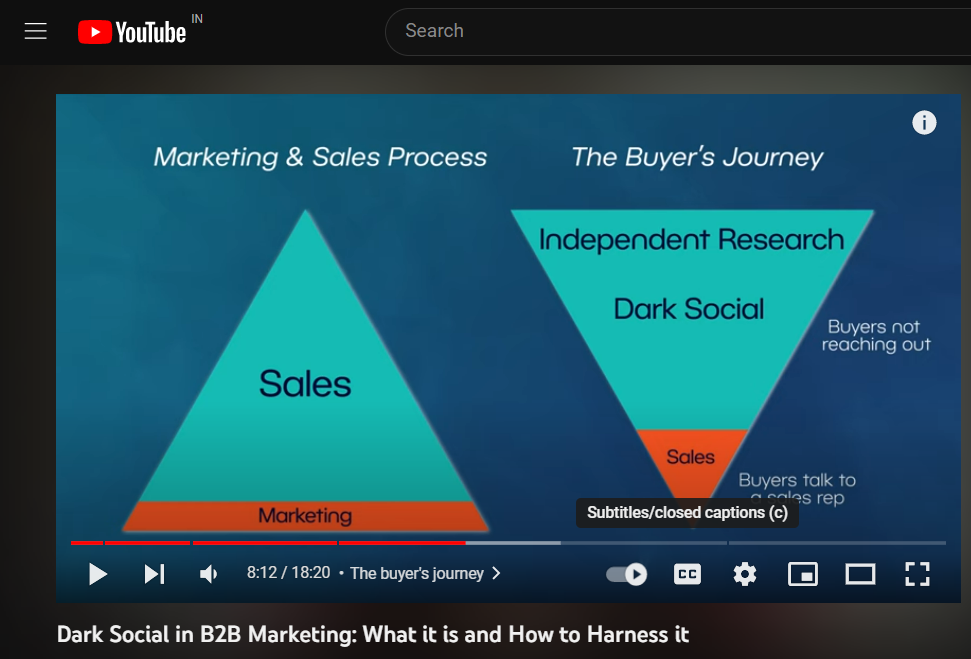
Screengrab showing how most marketing is focused on converting high-intent prospects instead of creating demand across the dark social. Closing Time Podcast episode: Dark Social in B2B Marketing: What it is and How to Harness it.


By Chitra Iyer

Chitra is a seasoned freelance B2B content writer with over 10 years of enterprise marketing experience. Having spent the first half of her career in senior corporate marketing roles for companies such as Timken Steel, Tata Sky Satellite TV, and Procter & Gamble, Chitra brings that experience to her writing. She has authored over 500 articles, white papers, eBooks, guides, and research reports on customer experience, martech, salestech, adtech, retailtech, and customer data and privacy. She holds a Masters in global media & communications from the London School of Economics and Political Science and an MBA in marketing.

Sourced from CMSWire

Sourced from Inker Street

With the rise of digital marketing, more and more small businesses are turning to digital marketing agencies for help. A digital marketing agency is a company that specializes in providing digital marketing services, like Inker Street Digital Marketing.

Digital marketing agencies are a great way to help your business grow. They can help you create a strong online presence, develop marketing plans, and manage your online marketing campaigns.

They also can provide you with the necessary tools and resources to stay ahead of the competition. If you’re looking for help growing your business, consider hiring a digital marketing agency.

They offer services that include search engine optimization (SEO), social media management, content creation, email marketing, and other online marketing services.

Digital marketing agencies can help small businesses make more money through their expertise in the field and provide valuable insights into the most effective strategies for marketing and promotion.

They can also help small businesses create an effective online presence and reach their target audience.

They can also provide valuable insights into the most effective strategies for marketing and promotion. By engaging a digital marketing agency, small businesses can benefit from their expertise in the field and get ahead of their competitors.

Digital Marketing Agencies Small BusinessThe Growth of the Internet

Marketing is not what it used to be. Not too long ago, there were very few ways a business could promote its services. Today, with the ever-growing Internet, a small business has more channels to connect with potential audiences.

The history of the internet is a story of innovation and growth. The internet first emerged in the early 1960s, but it wasn’t until the late 1970s that it really began to take off. The early internet was very primitive, consisting of a few thousand computers linked together.

In the late 1990s, the internet began to grow rapidly. This was due to the development of new technology, such as the World Wide Web, and the growth of internet usage. By the early 2000s, the internet had become a widespread phenomenon, with billions of people using it every day.

The Internet has grown to become the best medium for small businesses to level the marketing playing field. It allows small businesses to reach their customers without spending millions on advertising.

How Do Digital Marketing Agencies Help Small Businesses?

87% of shoppers begin their search for companies that provide a residential service online, this could include everything from plumbing to electrical. It’s a huge market size to not be a part of! And it’s unquestionably the most compelling incentive to invest in digital marketing.

You can’t ignore the impact of digital marketing on business growth.

Without a doubt, digital marketing plays a critical part in the growth of small businesses. Companies need to boost their sales, revenue, and overall growth, and digital marketing is an art form that allows them to turn their audience into consumers.

This allows them to earn additional cash by selling their products or services. As a result, the impact of digital marketing on startup and small business success is undeniable.

Understanding Your Target Audience and Building an Effective Marketing Campaign

Understanding your target audience is essential to creating an effective marketing campaign. Digital marketing agencies conduct audience research, that can give you valuable insights into the needs and desires of your customers.

This information can be used to create customer profiles that will help them tailor a marketing campaign to reach the right people at the right time.

With a well-crafted ad campaign, they can maximize your return on investment and ensure that you are reaching the right people with the right message.

Which Digital Marketing Techniques Should Digital Agencies Use?

Digital marketing is the use of electronic channels such as the internet, blogs, web pages, social media, and mobile apps to promote and sell products or services. It is the process of creating, optimizing, and delivering an advertisement or communication that uses digital technologies.

There are many different digital marketing strategies that a digital marketing agency can use to grow your online presence. Some common strategies include search engine optimization (SEO), online advertising, email marketing, and social media marketing.

Search engine optimization (SEO) is the process of making a website’s content and on-page elements (title tags, meta descriptions, etc.) effective at attracting search engines. Many digital marketing agencies will start with SEO as the first step to improving your online presence.

Using Social Media to Attract Customers Online

Social media platforms are a great way to reach potential customers online at a low cost. It allows businesses to engage with their target audience, build relationships and generate leads.

With the right strategies in place, digital marketing agencies can use social media platforms to reach out to their target audience, build trust and generate more leads.

Social media platforms provide businesses with an opportunity to showcase their products and services in an engaging manner. This helps them connect with potential customers, which is essential for building relationships and generating leads.

These agencies can use a variety of tactics to boost their presence on social media and reach out to potential customers. They can create content that resonates with their target audience, promote it through paid campaigns, or even build relationships with influencers who can help spread the word about their brand.

Additionally, agencies can use social media platforms for content marketing purposes such as creating blog posts or videos that will appeal to their target audience.

By leveraging the power of social media, digital marketing agencies can easily reach your potential customers online at a low cost and generate more leads than ever before.

Social media platforms are an effective way to reach potential customers quickly and cheaply. With the right strategy, businesses can use social media to engage with their target audience and generate leads.

With the right approach, businesses can tap into the power of social media platforms to reach out to more people and generate more leads. By leveraging these platforms effectively, businesses can increase their customer base and grow their business online.

Five Areas Digital Marketing Agencies Should Focus On

Digital marketing is an essential part of any small business’s success. With the right strategies, small businesses can reach a wider audience and increase their sales.  There are five areas that every agency should focus on to maximize their success.

These five areas include:
1. Social Media Management
2. Email Marketing
3. Content Creation
4. Search Engine Optimization (SEO)
5. Local Listing Optimization

By understanding how each area can help your business grow, you can ensure the agencies efforts are successful.

A Digital Marketing Strategies Every Small Business Should Know

Strategy for Digital Marketing AgenciesDigital marketing is a powerful tool for small businesses to reach their target audience. A digital marketing agency can help convert website visitors into leads and customers.

With the right strategies and tactics, these agencies can create effective marketing campaigns. These campaigns will boost your brand awareness, generate more leads, and increase sales.

Strategy: Build a Strong Brand Awareness, a strong brand awareness is the most important factor in any marketing campaign. Without one, your marketing campaign will produce limited results.

Many small business owners struggle with building a strong brand awareness because they are so focused on their product or service that they forget about the impact of messaging and communication strategy.

If you haven’t already, get clear on your brand messaging to ensure you are telling your audience who you are before telling them what you have to offer.

Once your messaging is locked down, a digital marketing agency can incorporate it into all of your marketing efforts.

In Conclusion

Whether your goal is to increase brand awareness, entice a purchase, or foster brand loyalty, there is a digital marketing agency will help you engage with your audience. Depending on your marketing strategy, a digital marketing agency can help your business:

  • Actively use social media to engage with new and existing users.
  • Create original and exciting content to position your brand as a trusted resource in its field.
  • Use website marketing tools to draw new traffic to your website.
  • Leverage the power of SEO (search engine optimization) to increase your organic search engine traffic.

Thanks to the internet, businesses of all sizes have the power to expand their reach, whether it’s attracting new consumers in a local market or developing new markets that would have previously been unattainable.

Without breaking the bank, digital marketing has levelled the playing field for smaller businesses to compete with larger enterprises.

If your business is ready to explore the world beyond traditional marketing channels, Inker Street can help develop an effective digital marketing strategy to make it happen.

Sourced from Inker Street

By

Digital marketing has become an efficient practice for growing and established businesses to promote their products and services. More and more organizations depend on digital channels to connect with customers and generate a vast customer base.

Because of its growing popularity, different digital marketing trends will reign in 2023. If businesses can pay attention to these trends and curate marketing practices to align with them, they will have better opportunities to boost their growth and generate promising leads. Hence, growing businesses must familiarize themselves with the concept of ‘what is digital marketing,’ various forms of digital communication, and stay updated on the current marketing trends to stay competitive. Here’s a look at a few trends that one must watch out for.

8 Digital Marketing Trends for 2023

1. Zero Party Data

With the rise of extensive data practices, businesses will use zero-party methods, such as form building, to gather consumer data. It will be an excellent way for enterprises to understand their customers deeper and use the information collected to tailor marketing practices and improve their work.

2. Email Marketing for Product Launches

Email marketing is an efficient practice that will see a boost this year. It is an encouraging method that generates leads and builds customer loyalty toward a brand. Most businesses can use this channel to connect with consumers about new product launches, giving customers an exclusive feeling.

3. Rise of Marketing Applications

These applications focus on advertising different products and services. Brands can register on these apps with an ad for the product they want their customers to know about and use them to reach out to new audience segments and invite them to become paying customers. It is a simple yet efficient digital marketing trend that will see a rise in 2023.

4. Use of Real-time Messaging

Real-time messaging applications are becoming an excellent way for businesses to connect with customers consistently. These applications can send out promo codes, order updates, product news, and more. It is a cost-effective way for businesses to build their audience and a trend that will become more popular  this year.

5. Influencer Marketing is Here to Stay

Influencer promotion will increase this year as more and more businesses collaborate with influencers to market their work. It is an efficient practice for organizations to grow their audience base. Hence, it will grow more into widespread practice starting this year.

6. Higher Brand Gratification

Because of online marketing and delivery channels, there has been a decline in consumer patience. People want to get their hands on products instantly when shopping. A trend in 2023 will see more gratification methods that will allow businesses to keep customers engaged while setting up a reasonable product delivery timeline.

7. Use of Machine Translators

Some businesses provide international services, and such companies will need to be able to communicate with customers in multiple languages. One of the rising trends for 2023 will be the use of machine translators on brand websites that will allow customers to access information from any location in the world, as there will be no language barrier to stand in the way.

8. Chatbots

Another rising trend in 2023 will be using chatbots on business websites. It is an excellent marketing tactic that allows customers to quickly address queries without waiting for a response. Chatbots help boost customer engagement and invoke a feeling of reliability for new consumers engaging with the business.

Endnote

Digital marketing is taking over the marketing world due to its efficiency and ability to provide quick results. Each practice has the potential to boost business opportunities and contribute to building audience trust. However, businesses must pay attention to different trends in the market to tailor their methods for maximum results. Following digital marketing trends will allow brands to work efficiently toward building customer loyalty and boosting their growth in the industry.

By

Sourced from Data Science Central

By

So, you’re after a few digital marketing examples to inspire your next campaign.

You understand the need for a digital marketing presence, as every statistic you see points towards it…

But where do you start?

Luckily, I’ve picked some of the best examples to get your creative juices flowing.

Let’s jump in!

1. Volkswagen Beetle: The Last Mile

In 2019, Volkswagen (VW) sought to give the iconic Beetle the send-off it deserved after 80 years of production.

They created the digital marketing masterpiece, “The Last Mile.”

You only need to watch the first 30 seconds to be drawn in by its relatable family story.

But why is this a powerful digital marketing example?

What Makes Volkswagen’s Digital Marketing Example So Powerful

Well, where do you begin?

You’re already captivated by its moving story, imagery, and elements of nostalgia.

You’re engaged.

But, the online video was only the beginning…

The campaign included an interactive website where you could “Build Your Own Beetle.”

Further engagement.

Also, VW prompted users to share their designs via social media, creating a sense of community and buzz around the brand.

Engagement times 100, plus increased brand awareness!

What You Can Takeaway from Volkswagen

Yet, what can you takeaway from this?

VW effectively utilized multiple online channels to engage its consumers.

They tapped into social media and leveraged the Beetle’s history and nostalgia to create an emotional connection with their target audience. It generated a sense of community unlike any other.

So, understand your target audience and create content that resonates with them.

2. ALS Ice Bucket Challenge

In 2014, The “Ice Bucket Challenge” was born.

The ALS Association produced a social media masterclass to raise awareness and funds to support research into amyotrophic lateral sclerosis (ALS).

The challenge went viral.

It was a fun and light hearted way to raise awareness about a serious illness.

Everyone from your next-door neighbour to Bill Gates participated.

But why?

What Makes ALS’s Digital Marketing Example So Powerful

For one, they kept it simple.

The challenge was easy to understand and participate in.

Simply sit (or stand) and wait anxiously for a bucket of cold icy water to be poured over you.

Easy…

It evoked many crazy reactions, each with an element of comedy and competition.

Secondly, ALS added a clever call to action (CTA) at the end of each video — nominating others, via social media, to take the challenge.

People nominated friends, family and influencers. It enabled ALS to expand their reach and quickly gain popularity.

What You Can Takeaway from ALS

Regardless of your niche, the “Ice Bucket Challenge” shows you can raise awareness and drive engagement around anything.

Ensure your content is straightforward and resonates with your target audience.

Equally, your content should have a crystal clear CTA.

3. Red Bull’s Stratos Campaign

The highly innovative Red Bull Stratos campaign captured the imagination of viewers by enlisting the help of Austrian skydiver Felix Baumgartner.

In 2012, he jumped from a helium-filled balloon 39 kilometres above the earth’s surface…

Setting a new world record and becoming the first free-falling human to break the sound barrier.

It became the world’s most-viewed live stream event.

What Makes Red Bull’s Digital Marketing Example So Powerful

Yet, why was the “mission to the edge of space” a resounding success?

The hype was real.

Red Bull took to social media to build anticipation for the event.

Not only that, content was king.

They produced a lot…

From a dedicated website full of in-depth statistics to daily updates leading to the live event — readers felt like they were part of the mission.

Moreover, they encouraged readers to share at every opportunity, using hashtags.

The result…

#LIVEJUMP and #STRATOS was trending.

What You Can Takeaway from Red Bull

Red Bull thought outside the box and created a blockbuster campaign that piqued the interest of even the most sceptical of readers.

But it’s not achievable by all.

Yet the lessons are…

Quality content is king.

So, understand your product and continually provide great content that impacts your users.

4. Dove’s Reverse Selfie

In 2021, Dove launched its Reverse Selfie campaign to combat the increasing pressure on young people to look their best online.

The YouTube video features a 13-year-old girl who drastically modifies her appearance before posting a selfie on social media.

As the title suggests, Dove cleverly reversed the editing process to give viewers a glimpse of the number of modifications.

Ending at the beginning.

What Makes Dove’s Digital Marketing Example So Powerful

Dove headed straight to the root cause…

Social media.

They repurposed snippets of the video on Instagram, posted shocking statistics, and sought the help of influencers to boost awareness.

It worked.

Viewers were emotionally charged — many shared unedited photos of themselves and encouraged others to do the same.

#TheSelfieTalk

What You Can Takeaway from Dove

Dove zoomed in and focused on one digital platform…

Social media.

Specifically, Instagram because of its focus on sharing photos.

So, you should too.

Don’t spread yourself too thin.

Pick a digital marketing platform that fits your demographic.

For example, if your brand has a strong visual element, promoting through Instagram or Pinterest may be more beneficial than LinkedIn.

5. Blendtec’s Will It Blend?

Founder of Blendtec, Tom Dickson, created the Will It Blend video series to spice up the appeal of the blender.

It consists of Tom adding unusual items to show off its ability…

Have you ever wondered if your iPhone would blend?

Or even your Amazon Echo when Alexa decides to play a completely different tune to the one you asked for?

What Makes Blendtec’s Digital Marketing Example So Powerful

But what makes Will It Blend a content marketing hit?

Well, each video packs a punch…

The YouTube videos are short and simple yet authentic and entertaining.

This creative recipe draws the viewer in and you really do wonder — @willitblend?

Also, the tag prompts viewers to interact at every opportunity by sharing suggestions.

Plus, Blendtec ensures you don’t miss it. They’ve added the tag to the Youtube channel logo, each video, and webpage.

What You Can Takeaway from Blendtec

Blendtec thought outside the box to increase brand awareness using video marketing and social sharing.

Plus, they’ve proven that you don’t need a flashy, high-cost video campaign to capture your audience’s attention.

So, grab your smartphone and start recording content that peaks your audience’s interest.

6. Smart Blogger’s Affiliate Marketing
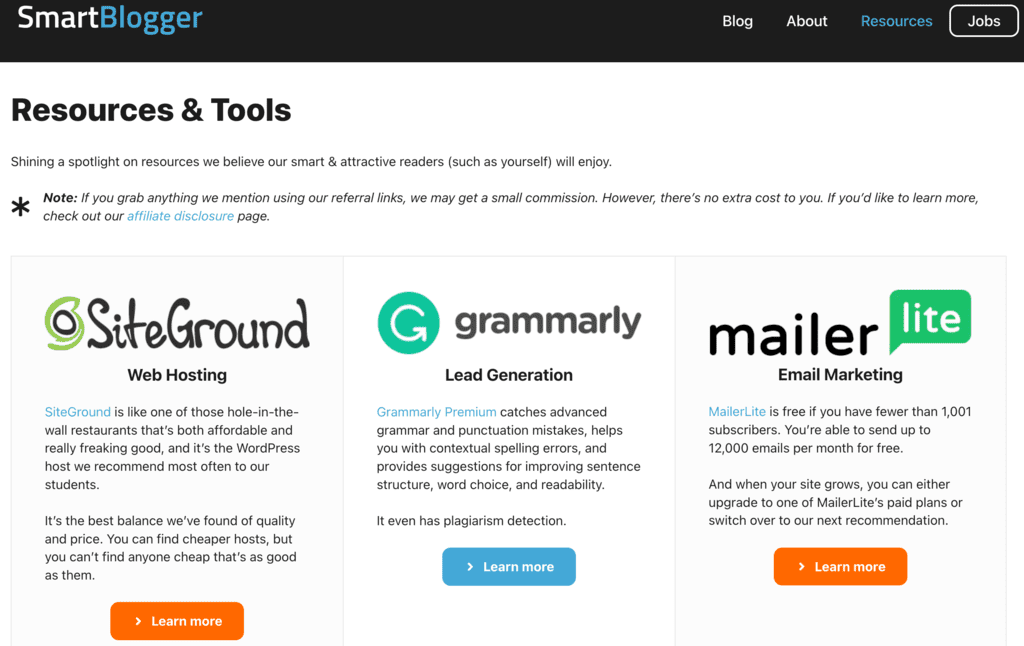
Smart Blogger’s affiliate marketing efforts are a prime example of digital marketing done correctly.

Furthermore, they highlight a key point that is worth remembering when considering affiliate marketing:

“You’re earning a commission in exchange for giving readers valuable insights on products or services they were already thinking about purchasing.”

Great!

So what can we learn from one of the world’s largest websites dedicated to writing and blogging…

What Makes Smart Blogger’s Digital Marketing Example So Powerful

Well, Smart Blogger backs up its key point by offering exactly as they state:

Giving readers valuable insights.

Whether it’s a specific review for a product or a collection of products, they ensure value is at the forefront of everything they do.

They soft sell through education.

What You Can Takeaway from Smart Blogger

Smart Blogger proves you don’t have to head straight for the hard sell with ads plastered over your page.

Instead, opt for the soft sell.

Educate.

Offer a resource and tools webpage with snippets of golden information…

Or dive in and create custom content that provides value to your audience.

7. Buffer’s Guest Blogging
Buffer is a social media toolkit for small businesses.

So, why are we talking about guest blogging?

Because they used this content marketing technique to rapidly grow their user base, and we can learn a few things…

What Makes Buffer’s Digital Marketing Example So Powerful

Buffer took a proactive approach.

They continually sought out and pitched to sites that fit their target audience. Knowing that writing for them will help establish themselves as an authority.

Not only that, consistency and personalization were vital.

Guest posting daily, building momentum, and establishing long-term relationships with others transformed Buffer into an industry leader.

What You Can Takeaway from Buffer

The key takeaway is to find out which digital marketing channel works for you and double down.

Don’t spread yourself too thin.

If you choose content marketing and find guest blogging is for you, great!

But don’t reinvent the wheel. Send out personalized messages to find opportunities and follow up with quality content.

8. Old Spice’s The Man Your Man Could Smell Like

Old Spice was predominantly associated with the scent of older men.

But that changed in 2010 when they launched the YouTube video, “The Man Your Man Could Smell Like.”

It went viral.

Old Spice’s website traffic grew by a whopping 300%, and the brand became the #1 body wash for men.

But how did this simple form of content marketing garner such a response?

What Makes Old Spice’s Digital Marketing Example So Powerful

Old Spice used a clever mix of humor and marketing know-how to appeal to its target audience.

But that’s not all.

They backed up their immediate success and kept the viral ball rolling by interacting with their audience on social media in real-time.

Users posted questions and the “Old Spice Guy” answered with personalized videos.

What more could you ask for?

What You Can Takeaway from XYZ

The key takeaway is it’s not enough to create a piece of digital content and expect a response — even if it’s positive.

Follow up, continually engage with your audience, and leave a positive, lasting impression.

Go that extra mile…

Personalize your interactions, and if you can, promptly respond in real-time.

9. Dollar Shave Club’s Our Blades Are Great

In 2012, Dollar Shave Club (DSC) shook up the male grooming industry.

They infused humour into a seemingly dull product.

And the result…

An instant hit.

Their YouTube video amassed millions of views and continues to be shared across social media.

What Makes DSC’s Digital Marketing Example So Powerful

DSC jumped on the social media bandwagon early.

They knew the marketing and advertising space was shifting to its digital counterpart and created content to suit.

Equally, they knew their target audience and products’ unique selling point.

As a result, “Our Blades are F***ing Great” was born on YouTube.

Choosing the digital platform allowed DSC to interact and engage with its audience.

Also, it allowed users to share through social channels easily.

What You Can Takeaway from DSC

Yet, what can you takeaway from this experience?

Adopting change in your niche is crucial.

Whether it’s technology-based or simply a shift in customer demand, you should pivot.

Doing so will allow you to tailor your content and give your customers what they desire.

10. Apple’s Shot On iPhone
Primarily targeting Instagram, Apple’s Shot On iPhone created a digital marketing storm.

They took the term “customer engagement” to a new level with a simple challenge to their audience…

Use your iPhone to capture a photo and submit it by sharing on social media using: #ShotOniPhone

What Makes Apple’s Digital Marketing Example So Powerful

Apple proved your digital marketing campaign can be simple when showcasing a product or service.

They planted a basic idea and allowed their audience to do the rest through participation.

This engagement was vital to building a loyal fanbase.

As a result, Apple’s reach grew, which allowed their product to be viewed by millions of users on digital channels.

What You Can Takeaway from Apple

Apple effectively used digital marketing channels to showcase its product and build brand awareness through customer engagement.

So, take a proactive approach and prompt your audience to participate in your campaign.

What challenge could you present to your audience?

What’s a Great Digital Marketing Example I Missed?

You’ve made it!

So, it’s time…

Time to take action and consider which digital marketing example will inspire your next campaign.

By

Sourced from live your message

By Denis Sinelnikov

“I’m doing everything I’m supposed to. I don’t understand why my online ads aren’t working anymore,” a client—let’s call her Mary—said to me when we sat down to look at her digital marketing strategy together. Like many entrepreneurs, Mary had been handling her own marketing when she launched her small art gallery five years ago. Now, she found herself at a plateau, unable to grow from where she was. When I told her the first step was to complete a digital marketing audit, she may have paled slightly. After all, an audit is supposed to mean something went wrong, right?

What Is A Digital Marketing Audit?

When most people hear the word “audit,” their minds immediately turn to taxes. Like a tax audit, a digital marketing audit involves a lot of digging through details—in this case, the details of a digital marketing strategy and campaign. While the scope of a digital marketing audit is big—covering SEO, analytics, audience engagement and everything in between—unlike a tax audit, it isn’t triggered by something necessarily being wrong.

The ‘Why’ Of A Digital Marketing Audit

The purpose of a digital marketing audit is to get a big-picture view of your digital marketing campaign and learn how (and if) your digital marketing strategy is meeting your business goals. Rather than a response to a problem, a digital marketing audit usually follows one of five triggers:

• Timing, such as the start of the fiscal year.

• Performance reviews, examining the overall status of a campaign or your overall strategy.

• Structural changes, such as rebranding or new business offerings.

• Strategy changes that may come in response to market changes or the above triggers.

• Relationship changes, such as Mary coming to a digital marketing expert to expand her marketing strategies.

How Do You Conduct A Digital Marketing Audit?

Conducting a digital marketing audit involves a great deal of time and patience. As with any major project, ensuring you have a solid system for assigning tasks (to yourself or partners in your audit), tracking progress and reporting to your team and client is essential.

Mary was focused on her ad performance, so she was surprised when I told her I needed access to the social media pages for her gallery. She didn’t consider herself as having a social media strategy; she just shared posts from time to time on the gallery’s Facebook and Instagram pages. When it comes to a digital marketing audit, everything the brand touches is examined, including but not limited to:

• Website.

• Online store.

• Social media platforms.

• Analytics tracking.

• SEO management.

• SEM management.

• Display advertising and other ad channels.

• Email marketing.

Mileage varies on what digital marketing aspects you’ll need to examine and what information you will find, so let’s break down these pieces:

Website

Since Mary’s primary concern was her ad performance, I wanted to know if her website had the kind of quality that search engines look for (SEO) and that keeps people from bouncing away when they find it. I examined content, format, link placement and keyword usage on the site.

Online Store

While Mary didn’t have an e-commerce platform, when working with clients who do, you’ll want to look at sales performance, searchability of the store, usability and, when possible, what products visitors start to buy and change their minds about.

Social Media

Even though Mary wasn’t (consciously) using social media as part of her marketing, I wanted to examine her social media presence to see what people responded to. I looked at her follower growth, posting frequency and posting engagement as well as the kind of content she shared.

Analytics Tracking and SEO and SEM Management

Much of what I examine for a website, store (for e-commerce clients) and social media comes from analytics and tracking tools for each platform. Use these tools to gather data about engagement, SEO rankings and ad performance over time.

Display Advertising and Other Ad Channels

Because Mary ran a small art gallery, local advertising in the newspaper and through flyers were important strategies for her starting out. While not digital, they still encompass her overall marketing strategy. Gathering hard analytics here was difficult, so we relied on correlating ads and flyers to gallery sales following.

Email Marketing

I’ve seen more and more new businesses overlook email marketing, but Mary was not one of them. She relied on email to keep local artists, gallery customers and local business partners updated on sales, showings and up-and-coming artists. I gathered email performance data from her platforms.

What We Learned From The Digital Marketing Audit

Once you have the information in hand, what do you do with it? Analyzing the data that you gather is vital to a successful audit. When I perform a digital marketing audit, I focus on gathering information to help me give a client, Mary included:

A Quantitative Analysis of the Digital Marketing Campaign or Strategy: What is and is not working? Look at what the metrics say, where the clicks are and the key performance indicators (KPI).

A Qualitative Analysis of the Campaign and Strategy: Look at industry best practices, content quality, user and customer experience, brand messaging and accessibility.

Multichannel Tactics: Examine ways to build a multichannel approach to help improve digital marketing performance. For a business like Mary’s, this includes offline channels.

A Long-Term Strategy: Digital marketing audits provide you with the information you need to build a framework for a long-term marketing strategy.

While Mary presented unique obstacles in how she engaged with social media and offline advertising, she is also a good example of how any kind of business can benefit from a thorough audit. For Mary, the audit demonstrated how we needed to build up her social media presence and how it would affect her SEO and online ads.

What will a digital marketing audit do for you or your clients?

Feature Image Credit: Getty

By Denis Sinelnikov

Denis Sinelnikov is the CEO of Media Components, an award-winning, full-service digital marketing agency. Read Denis Sinelnikov’s full executive profile here.

Sourced from Forbes

Will Mastodon provide safe harbour for marketers amid a growing Twitter exodus?

While there’s still a long way to go for Mastodon to catch up with Twitter’s 238 million daily active users, the decentralized social network’s recent announcement it reached 1 million monthly active users could create fertile ground for a Twitter takeover.

Fears spawned by an increase in posts encouraging hate speech and conspiracy following Elon Musk’s purchase of Twitter, led to a swell of users and brands making the decision to jump ship in an effort to avoid association — and left marketers asking what to do amid the Mastodon vs. Twitter debate.

Some Marketers Still All in on Twitter

Khalil Garriott, vice president for creative content and copywriting strategy with the American Bankers Association, said he currently has no plans or interest in joining Mastodon.

“As a Twitter power user since January 2011, I am still all in on the little blue birdie,” Garriott said. “I’ll admit to not knowing much about Mastodon. I understand that its feed is presented in chrono order instead of algo-based, and I gather that it is an ad-free platform. Both of those seem to be benefits, which might entice me to explore it in the future. So, it’s a wait-and-see approach for me.”

While Garriott waits it out, Mark Freeman II, a senior data scientist at Humu, jumped right on. As someone who provides his audience with content on data and technology, he said he ultimately chose Mastodon for one simple reason — his target audience is already curated.

Mastodon provides access to individual communities, called “instances” or servers, and Freeman is currently part of an “instance” consisting solely of data professionals.

“What’s more exciting is that many of the people I’m meeting on Mastodon are not on LinkedIn and thus increasing my reach to new audiences,” Freeman said. “In addition, even though my ‘home’ instance is curated for data professionals, I can still reach other communities indirectly since Mastodon is federated. Thus, my current strategy to grow on the platform is to create two types of content, data content for my ‘home; community and meta content about Mastodon with hashtags utilized by other communities.”

Is Twitter Experiencing a Mass Exodus?

So who is leaving Twitter? In analyzing more than 3.1 million accounts on Twitter, Bot Sentinel believes approximately 877,000 accounts were deactivated between Oct. 27-Nov. 1.

According to PR Week, several brands including General Motors, General Mills, Volkswagen Group, Pfizer and United Airlines have announced a “pause” on Twitter ad. Ad-purchasing goliath, Interpublic Group, recommended its clients, which include Coca Cola, Accenture, American Express, Fitbit, GoPro, Johnson & Johnson, Levi Strauss & Co, Mattel, Spotify and others, followed suit.

In a call to action, the NAACP and nearly 50 other organizations wrote an open letter to Twitter’s 20 largest US advertisers, calling on them to make a public announcement of their intention to “cease all advertising on Twitter globally” if Musk “follows through on his plans to undermine brand safety and community standards including gutting content moderation.”

NAACP CEO and President Derrick Johnson tweeted that “Until he makes this a safe space for all communities, companies cannot in good conscience put their money behind Twitter.”

Should Leaders Flock to Mastodon?

George Davidson, founder of the marketing consultancy The Lantern and adjunct instructor on Consumer Behaviour and Marketing Strategy at the University of Chicago, said it’s not clear Mastodon will take off. However, brands that like to be first in a space and show their customers they’re leaders, had better get a move on, he added.

“This in itself, may create some momentum for Mastodon and who knows what can happen when a Mastodon gets momentum?” he said.

Davidson applied for Mastodon account but said the rush in the UK has been so great, they are currently processing a backlog. He foresees two big possible impacts for marketers.

“First, Twitter has advertising and Mastodon does not, so marketers used to paying for adverts will have to create compelling creatives that are interesting enough to get shared,” Davidson said. “Secondly, we are used to a rush to claim names online through bagging website addresses and Twitter handles. Owning your own name online has been difficult in the wild, wild web in the past. On Mastodon, you have to make a case to the person running your local server, and that ought to favor marketers who feel they own their own name. You just have to persuade the server owner they agree.”

Check out Michelle Hawley’s thorough examination of what Mastodon servers actually are and other important information on Mastodon.

How Do You Actually Move on from a Social Media Platform?

Curtis Sparrer, principal and co-founder of Bospar, said he often finds the “wait and see” approach cowardly; however, he does think this might be a moment when it’s a good idea.

“While some are fleeing Twitter, this creates an opportunity for some brands to command a stronger share of voice. That said, this is a time for brands to take a serious look at what constitutes their redline when it comes to Twitter,” Sparrer said. “In other words, what are the moments that make sense for your brand to publicly disassociate yourself from the platform? And, should that redline be breached, what is your communication strategy to make your position known so leaving Twitter doesn’t seem improvised, but rather part of a thoughtful communication strategy befitting of your brand?”

For brands that elect to leave Twitter, he recommends a creating a blog, a video testimony and a social media play with other outlets to demonstrate that you have moved on past Twitter and Elon Musk.

The Musk Effect: A Twitter Takeover

After months of machinations, Musk completed his $44 billion acquisition of Twitter on Oct. 27 — and the same day addressed the advertising community in a tweet titled, Dear Twitter Advertisers, sharing his desire to make Twitter the “most respected advertising platform in the world that strengthens your brand and grows your enterprise.”

And despite previously tweeting “I hate advertising” in 2019 — he now urged advertisers to join him in building “something extraordinary together” and insisted the platform would not become “a “free-for-all-hellscape where anything can be said with no consequences.”

According to Investopedia, the majority of Twitter’s revenue (nearly 90%) is generated through selling ad space on its platform to global advertisers — bringing in $4.5 billion in 2021.

Just a few days after Musk’s takeover, Montclair State University released a study revealing a significant spike in hate speech on the platform just prior to — and immediately following — Musk’s acquisition. nd within the week, amid a mass reduction in staff, Musk admitted the company was losing more than $4 million a day, something he attributed to “activist groups pressuring advertisers.”

Should You Stay or Should You Go: Mastodon vs. Twitter

Rachel Happe, founder of Engaged Organizations, said she doesn’t think most marketers will leave Twitter for Mastodon — at least until there is more there. But she recently told her Twitter followers to follow her on Mastodon “should Twitter either go up in (flames) or become a hell hole.”

“I am not leaving Twitter yet — just hedging my bets,” she told CMSWire.

Benjamin Goh, managing partner BCG said Mastodon could be the way forward for social media apps on the open-source platform. “I used to be active in Twitter, but it’s not popular in Southeast Asian countries where most of my contacts are located, so I’ve stopped using it,” Goh said. “As for Mastodon, my initial inquiry with my network is that most of them have not even heard of it. I guess it will require some time before it gains some significant presence here.”

Bret Smith, CEO and founder of HIPB2B, quit Twitter two months ago, leaving 70,000 followers behind. “As for Mastodon, not seeing lots of upside for B2B yet so will wait and see,” Smith said.

Marketers Can ‘Safely Ignore Mastodon’

David Meerman Scott, the author 12 books including “The New Rules of Marketing and PR,” wrote about Mastodon back in 2017 in a blog “Mastodon Is Better Than Twitter But You Should Ignore It.”

Five years later, he told CMSWire his thoughts remain the same.

“I just don’t believe that people will switch in any significant numbers,” Scott said. “As I said in the post, when a new social network pops up and the defining characteristic is that it is like another social network but better, it’s doomed,” Scott said. “I think marketers can safely ignore Mastodon. I do not think that this little flurry of interest is sustainable, and I do not think that Mastodon or any other social media service will take the place of Twitter. Throughout history, social networks that pioneer a new model can thrive — Instagram, TikTok come to mind — but copycats like Google Plus fail.”

Decentralized Mastodon Could Be Appealing

While Mastodon isn’t nearly as populated at Twitter at the moment, Zacharias Joseph, chief ideations and operations officer at ZACH Multimedia, said that’s exactly where opportunity lies. The decentralized nature of Mastodon should be very attractive to the crypto community.

“A rapid scaling up can help Mastodon pull near or alongside Twitter, especially with the anger of large sections of users, including me, against the childish, capricious manner in which Elon Musk conducts the business and himself,” Joseph said. “Before marketers join the bandwagon of Mastodon with just one million users, Mastodon has to aggressively market itself globally.”

At the moment, he said, it appears Mastodon is a bit slow-moving and needs to be out there aggressively with innovative schemes to ramp up the numbers quickly, especially using the zeal of the newly converted. In addition, a top priority should be to ensure the ease of signing up.

“I tried to join and will join, but the first time I tried I found the process too irksome, so I left it halfway through,” he said. “I am not familiar with the behind-the-screen architecture of Mastodon, and how to work around it, but if Mastodon can provide a unified face for the various federated servers, then the navigation and sign-up functions for customers could be considerably eased, and that would have a force multiplier effect.”

Is Community the Key to Social Platform Success?

Evan Hamilton, director of community at HubSpot and former director of community and customer experience for Reddit, said he was part of the first wave to join Mastodon.

“Having been at Reddit during the long cleanup to get advertisers to return and seeing the challenges of driving subscription adoption, I don’t have a lot of faith Twitter is going to thrive in the coming months,” Hamilton said. “I joined Mastodon to secure my username and explore. Marketers should absolutely do this — it’s good to explore new territory — but I worry that the complexity of Mastodon and the difficulty of moving your audience will keep it from taking off.”

Hamilton said the buzz he’s hearing from people is that they’re realizing Twitter (or at least corners of it) had a culture. They’re not so much lamenting the potential loss of a tool to communicate — because there are plenty of those — but the loss of the culture.

“So, while I think Mastodon, LinkedIn and others will get some bump, I actually think what people are realizing they want is a community, not a public-commons,” Hamilton said. “I predict we’ll see more sustained growth in communities focused on specific interests and practices. … I encourage marketers to think about how they can invest in building owned communities or participating in communities run by others.”

Sourced from CMSWire

By Phil Britt

With TikTok expected to rake in $10 billion in ad revenue in 2022, a ban would likely have a serious effect on marketers and advertisers.

Federal Communications Commissioner Brendan Carr called last month for the Council on Foreign Investment in the United States (CFIUS) to take action to ban TikTok, according to an Axios report. And the FBI weighed in on TikTok security concerns this past week.

Though the FCC itself has no outright power to ban the popular social media platform, which has a reported 200 million downloads in the United States alone, the popular app has come under fire due to its Chinese ownership as well as concerns about security and the spread of misinformation. A strong stance by the FCC — Carr is one of five commissioners — could prompt Congress to take action regarding the platform.

Such a ban would have an effect on marketers and advertisers. According to a New York Times article, TikTok expects to generate $10 billion in ad revenue this year.

Below are some of the pros and cons of potentially banning the platform.

Pro: TikTok Is Poor at Handling Data

TikTok should be banned in the United States, said Lyle Solomon, Oak View Law Group principal attorney, citing TikTok’s handling of US user data and its “blatant contradictions” in how it handles the data.

TikTok’s US branch has repeatedly claimed that its data centers are in the country, Solomon explained. “However, the more extensive links of sharing US user data with the parent company, ByteDance, cannot be underplayed. Data from US users was repeatedly accessed within China’s borders by ByteDance employees. Senior TikTok employees claimed that certain ByteDance employees in China had access to all US personal data.”

Chinese law also concerns Solomon because the government can ask Chinese companies for any amount of user data. He pointed out that TikTok’s close ties with its parent company, ByteDance, the fact that Chinese authorities can legally ask for the personal data of US citizens and that TikTok has repeatedly misused US user data has put him in favour of a TikTok ban.

Con: Another TikTok-Like Platform Would Fill the Void

Suggesting that TikTok should be banned is reactionary and fails to consider the nature of such platforms, according to William Pickering, digital marketing executive at The Big Phone Store. “If TikTok were to be banned, another platform would simply fill the gap left in the market, just as TikTok was once Music.ly, and Vine acted as a precursor to both platforms in delivering short-form video content.”

Arguing that TikTok should be banned is taking a prescriptivist attitude toward technology based on one’s own personal biases and refusing to accept the inevitable evolution and proliferation of social media platforms based on current trends, Pickering added. “I think you would be hard pressed to find a member of Gen Z who holds the opinion that TikTok should be outright banned, outside of blatant contrarianism and paranoia over Chinese state surveillance.”

TikTok could make some changes to address objections about its business practices and platform, Pickering said. “But such issues are present on any major social media platform. There are problems with any system based on delivering users’ content specifically tailored to their preferences through an algorithm: such as echo chambers, the grooming of young children, reduction in attention span, etc.”

But a knee-jerk banning of TikTok in its entirety is a refusal to accept that these issues are based on the manipulation of base human psychological traits, Pickering concluded.

Pro: TikTok Is a ‘Cancerous’ Technology

Nima Olumi, Lightyear Strategies CEO, thinks not only that TikTok should be banned, but regulators should also take a hard look at Meta’s Facebook.

“TikTok and Meta are cancerous technologies that destroy human productivity and attention spans,” Olumi argues. “We need to tax social media — either the company or the user — to get daily active usage down. The average American currently spends four hours a day on social media.”

Just over one-fifth (21%) of Americans made 2022 New Year’s resolutions that included reducing time on social media, but, like many such resolutions, there’s no indication of a slowdown, with users spending 95 minutes a day on TikTok alone.

“This is clearly a cry for help,” Olumi said, adding that these platforms detract from a person’s productivity. “Apps like TikTok and Meta are designed to keep users on the platform for as much time as possible. They make their revenue through ad dollars and engagement is the only metric they care about.”

Con: TikTok Ban Would Negatively Impact US Livelihoods

Luke Lintz, HighKey Enterprises LLC founder and CEO, agreed that TikTok is no different from many other social media platforms, though it likely collects more data than others.

TikTok is expanding into a wide range of industries and partnering with major merchants to launch a marketplace to compete with Amazon, Lintz added. TikTok has already figured out the top of the marketing funnel, so the expansion will enable users to buy products and services without leaving the TikTok platform.

“Banning TikTok is not the correct solution because there are so many US content creators making their livelihoods from TikTok, and many users enjoy the platform,” Lintz added. “I believe the correct solution is setting guidelines for a USA majority stake ownership in TikTok.”

Final Thoughts on Banning TikTok

There is no questioning the popularity of the platform, nor its use as an effective marketing tool for many. Even so, members of both major political parties are wary of anything involving oversight by the Chinese government, and the privacy of personal data is a major concern, with the United States and European Union continuing to strengthen laws concerning personally identifiable information.

So the debate regarding whether or not to ban TikTok is likely to continue for the foreseeable future.

By Phil Britt

Sourced from CMSWire

By Ali Azhar

In predictive modelling, future events are predicted based on statistical analysis. Read this guide to understand how predictive modelling works and how it can benefit your business.

The rapid adoption of digital products and services has created vaster volumes of data than we’ve ever seen before. As a result, an increasing number of organizations are using big data analytics and strategies to derive value from available data.

This data is often too complex and extensive for humans to analyse manually, especially for organizations that want to derive future insights from existing data sets. Organizations are instead relying on predictive modelling tools to connect data points and identify patterns in data. With the right predictive modelling tools and strategies, companies are able to make predictions about future events, customer behaviours and market trends.

Jump to:

What is predictive modelling?

Predictive modelling, a component of predictive analysis, is a statistical process used to predict future outcomes or events using historical or real-time data. Businesses often use predictive modelling to forecast sales, understand customer behaviour and mitigate market risks. It is also used to determine what historical events are likely to occur again in the future.

Predictive modelling solutions frequently use data mining technologies to analyse large sets of data. Common steps in the predictive modelling process include gathering data, performing statistical analysis, making predictions, and validating or revising the model. These processes are repeated if additional input data becomes available.

Benefits of predictive modelling

Organizations use predictive modelling to reduce the time, effort and resources that are needed to forecast business outcomes. Here are the top benefits of using predictive modelling:

  • Minimizing risk: Predictive modelling can predict an organization’s potential for cyberattacks, fraudulent transactions and other types of risks.
  • Optimizing marketing campaigns: Using predictive modelling, organizations can uncover customer insights to tailor and recalibrate their marketing campaigns.
  • Maximizing profit margins: Predictive modelling can be used to predict sales revenue, forecast inventory and create pricing strategies.
  • Prioritizing resources: There are several ways predictive modelling can help prioritize resources for an organization. For example, sales teams can receive lists of expected leads to convert, allowing them to allocate more time and effort to these high-priority leads.

One of the challenges or limitations of predictive modelling is that the results are only as good as the data used to construct the model. To ensure predictive modelling is as effective as it can be, organizations should implement data quality tools to keep data accurate, safe and reliable. They should also prepare the data for business use by cleansing and formatting it for predictive modelling needs.

How to build a predictive model

There are various predictive modelling techniques. The two most prevalent techniques involve using neural networks and regression, respectively. In statistics, regression refers to establishing a relationship between input and output variables. The predictive model could be linear or nonlinear, depending on the variables.

In neural networks, predictive modelling tools use interconnected nodes in hierarchical levels, a model inspired by the human brain. These nodes create patterns and relationships between variables to establish future trends. Beyond these two most popular predictive modelling techniques, businesses also use clustering, outliers and classification models.

Traditionally, predictive modelling was handled manually by a data analytics team. But as the process has become more complex and data quality efforts have increased exponentially, using computer software for predictive modelling has become increasingly popular. As a result, most organizations use predictive modelling tools such as Oracle Crystal Ball, RapidMiner Studio and SAP Predictive Analytics.

Predictive model examples

Many industries rely on predictive modelling to help with key business decisions. These are some common use cases for predictive modelling:

Finance and banking

Predictive modelling is used in banking to identify fraud and illegal activities. For example, the amount and frequency of transactions are analysed to recognize patterns or trends in money laundering.

Supply chain management

In supply chain management, predictive modelling is used to forecast the impact of multiple variables on the inventory. Different risk factors can be plugged into the calculations to check their effect on the efficiency and reliability of the supply chain.

Digital marketing

In digital marketing, predictive modelling can help market research analysts improve their understanding of customer behaviour, which can reduce customer acquisition costs and improve sales conversion rates. This is done by modelling customer buying trends and online engagement based on historical data.

Feature Image Credit: doidam10/Adobe Stock

By Ali Azhar

Ali is a professional writer with diverse experience in content writing, technical writing, social media posts, SEO/SEM website optimization, and other types of projects. Ali has a background in engineering, allowing him to use his analytical skills and attention to detail for his writing projects.

Sourced from TechRepublic


By Claudia Ratterman

Tick…Tick…Tick. Is time running out on your opportunity to effectively use TikTok? Not if you make wise investments.

From recent feature rollouts to off the chart viewership numbers, TikTok has eclipsed a number of social platforms in key engagement areas, such as retention rate and active collaboration features like duets and stitches.

Best-in-class brands leverage TikTok’s native tools, editing features, ad formats and ecommerce capabilities to maximize reach and facilitate purchase. In fact, 84% of the top 50 brands ranked in Gartner’s latest Social Media Benchmarks Digital IQ had a TikTok profile as of November 2021.

However, there are still many high-performing brands that are either underinvesting in their brand TikTok pages or ignoring the platform altogether. What does this mean for digital marketing leaders?

Lost Opportunities With Target Audience

First, those that overlook TikTok will miss connecting with key audiences. TikTok commands a large, hyper-engaged user base that demands marketers’ attention. The platform is investing in increasingly sophisticated commercial features, too, such as TikTok Ads Manager and objectives driven Promote feature. TikTok gives brands the ability to invest in a number of different ad formats and influencer partnerships that drive a specific call to action among a highly targeted audience.

Given this, digital marketers should assess the scope of TikTok’s growth and audience, its business tools and the competitive landscape to kick off informed discussions about the merits of investment within the marketing organization and the rest of the C-suite.

Missing Out on Social Commerce Growth

Second, TikTok’s increased investment in social commerce means digital marketing leaders also risk losing out on a major monetization opportunity. According to TikTok, the hashtag #TikTokMadeMeBuyIt has more than 6.8 billion views and viral videos regularly translate to direct sales lift. One beauty brand saw more than a 600% increase in daily sales after their watermelon products went viral on the app, too. TikTok has capitalized on the success of viral products by introducing in-app ecommerce capabilities — for example, in-app store and link in bio — to enable a seamless buying experience for consumers.

As a result, digital marketers must track TikTok’s commerce features and gauge alignment with key marketing goals. Monitor ongoing legal concerns and remain transparent with users as personal data privacy remains a growing concern.

How to Leverage TikTok to Improve the Customer Journey Experience

Brands that effectively use TikTok — and other major social media channels for that matter — throughout the customer journey outperform competitors by lifting word of mouth, engaging more prospects and driving more valuable engagement with customers.

Digital marketing leaders have traditionally focused their social media efforts on brand posts, advertising and influencer marketing to improve brand awareness and consideration. However, they often fail to develop and invest in social strategies that lift customer satisfaction, loyalty and brand advocacy, missing out on opportunities to deepen customer relationships.

In order to drive value through social media successfully, brands should focus on the greater context of consumer needs and understanding how and why customers use social channels, not just what channels they use.

Sourced from CMSWire

By

If you are not an expert, outsourcing your marketing efforts to a digital marketing agency is a great solution. With remote work flourishing, outsourcing your digital marketing to a specialized agency with talent and resources in place is a great way to propel your business growth without having to grow your team first.

Finding the right people to help you grow your might be a challenge. That is why I recommend looking outside of your company for talent. important tasks to experts might be the push your business needs to grow quickly. One of the key tasks you can outsource to experts is marketing.

You might feel hiring a marketing agency is a risk. It’s understandable to feel hesitant at first when first engaging with a team outside your organization. But certain risks are worth it when the benefits outweigh them.

1. Not hiring a digital marketing agency could be costing you more

The number one reason companies shy away from hiring a marketing agency is they think it’s expensive. Often a marketing agency can be a cost-effective strategy when you take into consideration a full-time employee’s salary, benefits, taxes and PTO time.

Hesitating in hiring experts might delay your company’s growth unnecessarily. A marketing agency can help your business grow quicker and start generating revenue faster. It will free you up to focus on working with your clients and running your business effectively.

2. You get to decide what marketing efforts you’d like to outsource to a marketing agency

A digital marketing agency would typically have a menu of services. The advantage of contracting a marketing agency is it would have resources you would need that would take much time and effort to build up in-house.

Instead of wasting your time gaining expertise in digital marketing, you can access an agency’s experience and resources. Since marketing is its bread and butter, the agency will have people and tools in place to start executing your vision as soon as possible.

Talk to the agency representatives so you can agree on what services and resources would be best for you to leverage, given the stage of your business development. For example, you might want to outsource specialized aspects of digital marketing such as , media buying or email marketing campaigns.

Shop around for a digital marketing agency to see what each can do for you and negotiate the budget.

3. Help them help you reach your marketing goals

For a digital marketing agency team to be most helpful to you, they need to understand your vision. If they don’t get what you are about, your values, your image and your goals for marketing, their efforts won’t produce the results you are looking for.

Ensure the hired team has enough material to learn about your brand so they can design campaigns in your voice. Develop branding guidelines for them to follow, reflecting the look and feel of your brand. This way, no matter who joins their team, they all have the same understanding of your brand.

The agency will also need to understand your tech stack and the tools you use to collect and analyze your company’s performance. They will need access to your ways of reporting and your data. Establishing clear channels of access, sharing and communication will decrease friction, increasing efficiency and speed of execution of your vision on their end.

4. Collaborate and connect via project management tools

The project management tools, such as , Slack, Asana, Monday or Clickup, don’t just serve as tools of efficiency. They also provide your team and your marketing agency with a unified place to work in, creating a sense of a teamwork environment.

Trello, for example, serves my team as a central hub for communication and collaboration. My team can communicate and work together efficiently through comments and tags on specific tasks, and everyone can track progress.

A sense of cohesion among the team, aided by the digital tools, will help create a sense of common purpose. This way, each member of your team and the team you are outsourcing to will be invested in helping you achieve your goals and committed to the bigger picture, not just their assigned tasks.

It’s rewarding and gratifying to have your whole team working in unison and collaborating with an outside agency smoothly.

Level up your brand power

Growth requires more people power. Sometimes, that power can be found in outside agencies. Hiring a digital marketing agency might feel uneasy at first. Once you make the first step, however, you will find that outsourcing allows you to free up your time to work on scaling your business.

By

Sourced from Entrepreneur