The global pandemic has boosted consumer appetite for shoppable video and accelerated the move towards an on-demand economy.
At The Drum’s Digital Transformation Festival, during a fireside chat, Stuart Heffernan, head of e-commerce at Pernod Ricard, and Nicola Spooner, vice-president of strategy for Unruly, asserted that post-pandemic consumption habits were here to stay and would fuel a shoppable content boom.
On-demand e-commerce
“This past year has been revolutionary for e-commerce,” said Heffernan. “In the space of a year, on-demand retail and players have boomed globally.”
Uber’s acquisition of the drinks delivery platform Drizly, Pernod Ricard’s recent stake in on-demand grocery platform Glovo and the rise of delivery apps in mature e-commerce markets such as the UK all suggest this trend will continue.
Heffernan also remarked: “On-demand will stick around because people get hooked on convenience and are prepared to pay a premium for it. Uber Eats’ alcohol sales have increased significantly – that’s a premium price point for standard products because it is pure speed and convenience.”
Connected TV growth
The two also spoke about the rise of ‘hometainment’ and how it dovetailed with the rise in super-fast, on-demand e-commerce.
Spooner said: “Consumers are accessing more content in an on-demand capacity than ever before. We don’t predict that slowing because now that people have trialled that kind of method of indulging in content, they’re not going to want to let it go.”
She added that while she could foresee a consolidation in subscription services, there would always be a thirst for on-demand quality content. “For brands, that brings an exciting opportunity because we’re delivering a lot of creative shoppable solutions.”
According to a recent study from Unruly, 72% of UK advertisers say connected TV (CTV) is a key part of their video advertising strategy. There is also a huge amount of optimism about the medium’s future, with all media agencies and 77% of brands saying they plan to invest more in CTV during the next 12 months.
The pandemic-induced boom of branded ‘hometainment’ experiences, such as showing how to make cocktails or advice on pairing food and wine, has readied consumers for shoppable content from brands.
Heffernan argued that this would continue to be the case even after lockdowns ends.
“Even if the pandemic has completely gone away by January next year, it will still be cold and wet and I will still be sitting at home. So, if a Jameson brand ambassador reaches me through the right media targeting, then yes, I will engage because it’s something to do on a Wednesday night.”
Unruly’s Spooner said that making branded content shoppable and serviceable by the on-demand apps consumers have grown to depend on during lockdown will induce impulse purchasing.
According to Unruly and research consultancy MTM, 90% of digital advertisers plan to increase their CTV spend in 2021.
“Shoppable content really opens the doors to impulse purchasing,” said Spooner. “If you are watching content around cooking and there is the contextual placement for Jameson’s cocktails or Viejo wines, I – as a consumer – could be inspired and take action immediately.”
From awareness to conversion
Both panellists agreed that TV is no longer about brand-building but about conversion, adding that advertisers should now augment campaigns with shoppable elements.
“There are plenty of ways to add shoppable elements to campaigns,” said Spooner. “It could be a light touch brand bar over the top of an amazing TV creative or an on-screen QR code so that consumers can scan it with their phone, which is location-enabled, and have that experience in their front room in moments.”
Ultimately, shoppable video will allow marketers to build video into every stage of their marketing plan rather than simply viewing it as an awareness boosting tool.
As a b2b marketer, I use internet marketing daily to run my business, create an amazing customer experience and build brand awareness.
But, are we really using it to our best benefit?
To effectively use digital marketing, you have to understand what actually does (and doesn’t) work.
You also need to be aware of which digital channels your consumers are active on and how to create a customer journey that will turn your audience into raving fans.
Knowing what strategies to use will give your brand that extra personalization and rapidly grow your “know, like and trust” factor.
Let’s look at the digital marketing trends that you should prioritize in 2021.
Digital Marketing Trend 1: Search Engine Optimization (SEO)
Search engine optimization is how Google decides if it should show your post, site, or product on the 1st (or 100th) page of search results.
In terms of marketing effort, SEO is a long-term strategy that can bring your target audience to you if you do it right.
SEO is listed as the first trend for 2021 because most marketing experts agree that it is truly the most important aspect of your business, in terms of online presence.
Since the goal should be to always rank on page 1 of Google, you have to focus on effective SEO.
Local SEO optimization is especially important if you have a brick-and-mortar storefront in a particular location so that people find the resources they are looking for in their area..
To do this, you need to learn about keyword research, backlinks, and post layouts.
There are many different search engine optimization courses, but here are a few of my favourites:
Instagram is going to be just as popular (if not more) in 2021 as it was in 2020 as a social media channel. It’s been said that it will surpass Facebook for the number of users this year alone.
That being said, use it to build your business.
But, you have to know the algorithm to boost your engagement which will increase your audience.
Even though this social media platform began with only pictures, you can now post videos, reels, boomerangs, or even go live. To get the most traction, try to utilize all of these features.
How to use Instagram for Content Marketing
Create reels. Instagram uses reels to compete with TikTok. Therefore, this content is currently prioritized more than pictures.o compete with TikTok. Therefore, this content is currently prioritized more than pictures.
Post consistently. Whether you post daily, every couple of days, or weekly, post at the same times. Instagram favours consistent accounts.
Add content to your stories as frequently as you can. Aim for a minimum of 10 story posts per day.
Engage with other accounts in your niche. You can like, comment, save, and follow similar accounts to show up on more feeds.
Use all of the features Instagram has to offer. (This means stories, feed posts, reels, and live videos.)
TikTok is another good way to begin digital marketing.
The latest trend on video is TikTok where users can create short video clips with voice-overs and other fun and interactive content.
This app is known for its ability to allow anyone (regardless of account size) to go viral.
Although you can have a personal account, it is better to stay with a niche topic so that your audience knows the type of content they’ll be getting.
How to use TikTok for digital marketing:
Post a few times a day if you are able to. If not, try to at least post once a day.
Try to stay on the app for a minimum of an hour a day.
Digital Marketing Trend 5: Clubhouse
Clubhouse is a new app that was just released at the end of 2020.
The reason Clubhouse is a hit is because it is a completely auditory platform and is essentially built 100% off interactive content.
You can join groups to sit in on talks or even join conversations yourself. If you are a b2b company, you’ll find lots of inspiration and connections in the platform.
But, as of right now, you have to be invited to join it. This is due to the app being so new, they don’t want it to crash due to having too many users.
Once you do join, though, you get one link to send to a friend to allow them to join.
Once the owners have the app fully setup, they have said they will be opening it up to everyone without needing an invite.
How to use Clubhouse for digital marketing:
If you aren’t yet a member, you can still go ahead and secure your user name. That way, your account name is set in stone.
Once you join, optimize your bio to let your followers know what your niche is.
Digital Marketing Trend 6: Testimonials and Reviews
Get as many testimonials and/or reviews as you can for your products.
Whether you sell courses, e-books, or even physical products, make sure you get feedback.
Not only will this help you improve your products, but you’ll always have good feedback to show potential customers.
How to get testimonials to improve digital marketing:
If you haven’t launched your product yet, you can ask a few people to check it out for free in exchange for a review.
Add an incentive for your customer to leave you a testimonial or review. This can be a discount code, affiliate link, or even a free product.
Digital Marketing Trend 7: Conversational Chatbots
Conversational chatbots are created through machine learning software that creates automated responses on your social media accounts or websites to your customers.
Since we are in an ‘I want it and I want it now’ world, getting an immediate response is a win for your customers.
But, we can’t always be online, right?
That’s why chatbots are a huge hit. You can set up an automated virtual reality response to answer or ask a common question, give your office hours, or even send you an email.
Some programs even allow marketing automation that act as mini funnels taking your audience through an entire customer journey.
How to use conversational chatbots for digital marketing:
Add automated responses to your Facebook page messages and Instagram messages.
Add a conversational chatbot to your websites. This way, if a potential customer has a question, they can get an immediate answer rather than have to wait on you to respond. Oftentimes, waiting for a response can cause you to lose a sale.
Digital Marketing Trend 8: Shareable Content
One of the best ways to get higher engagement (and more traction) on social media, your websites, and your products is to make sure your content is shareable.
Now, this doesn’t mean that the content is technologically shareable. This means that the content itself needs to make the consumers want to share it with their friends, family, and followers.
How to make a shareable content marketing strategy:
Answer questions that are widely asked in your niche. That way, if one person finds it useful, they’re inclined to share it with others.
Make funny content. We all like to laugh, right? Finding ways to add humour in your niche can gain you a lot of engagement.
Use interactive content that your audience can easily participate in. Think: THIS or THAT type questions.
Digital Marketing Trend 9: Branding
Branding is one of the most important aspects of having any business in reaching our target audience.
With digital marketing being a (primarily) visual way to market, make sure you have a clear brand for your audience.
Branding includes your business layout, products, niche, and even your pictures.
How to optimize your brand for digital marketing:
Use a consistent editing style on your platforms.
Create products that fit your niche.
Style all of your social media accounts the same way. (Meaning, use the same filters and colours throughout each account.)
You want your audience to see your products, logo, or pictures and immediately know they’re yours.
Make 2021 Your Year through Digital Marketing Trends
Being a digital marketer doesn’t have to be hard. You also don’t have to follow all the trends at one time.
I recommend picking one digital trend and trying to perfect your usage of it. Then, once you think you have a great grasp of those, try to add another one.
If you utilize these trends correctly, 2021 is bound to be your year!
Digital Marketing Trend Strategies FAQ:
Related articles:
Q: Can I make money with digital marketing?
You can definitely make money with digital marketing. You can promote other people’s products or even make money off of your own products.
Q: Will these digital marketing trends ever change?
As all trends change regularly, digital marketing trends will also change. This is why it is vital to master SEO. But, all 13 of the trends previously listed are great ways to start adding digital marketing into your business.
By Sasha Lassey
Hi, I’m Sasha, an Online Blog and Business Marketing Strategy Coach for Women Entrepreneurs. I have a passion for helping women entrepreneurs achieve maximum success by showing them how to grow their side-hustles online and make more money. I’ve been running businesses and growing teams for more than ten years and I know how hard it can be to learn how to scale your business from beginner to the next level. I’d love to work with you and show you how you can make more money with time-tested online business strategies!
Most marketers had been happily paying for programmatic advertising for the last decade, very proud of themselves for being “digitally transformed.” They were also happily using vanity metrics like CPM prices, number of impressions, and click through rates because those were easy to measure and easy to report. Buying digital ads became as easy as playing a video game, with colorful dashboards that showed them what great discounts they got (“cost efficiency”), the number of impressions they bought (“reach”), and how many clicks they got (“performance”). But this triple cocktail of low price, large reach, and high performance was so addictive because every part of it was faked by fraudsters.
The low CPM prices were only possible from fraudulent or fake sites that plagiarized all their content or used no content at all. Real publishers with real human audiences had real costs of producing the content; so they could not sell ads for very low CPM prices. Further, there’s a finite number of humans that visit their sites every month; so they could not magically manifest a lot more reach. But fake sites could easily do this by buying traffic and doing audience extension. No one can force a herd of humans to all go to the same site at the same time to increase its traffic and audience; but it takes no more than one command line to instruct a vast botnet to generate a large number of pageviews on a site — exactly the amount that was paid for. And these same bots click on the ads too. Not too much or else that would be suspicious. Bots tune their click through rates to be in the 5 – 15% range, which is always higher than real human click rates. This way, marketers are tricked into thinking ads on fake sites are performing so much better than ads on real sites with real humans, so they allocate more or all of their budget to programmatic channels, which are teaming with such fake and fraudulent sites.
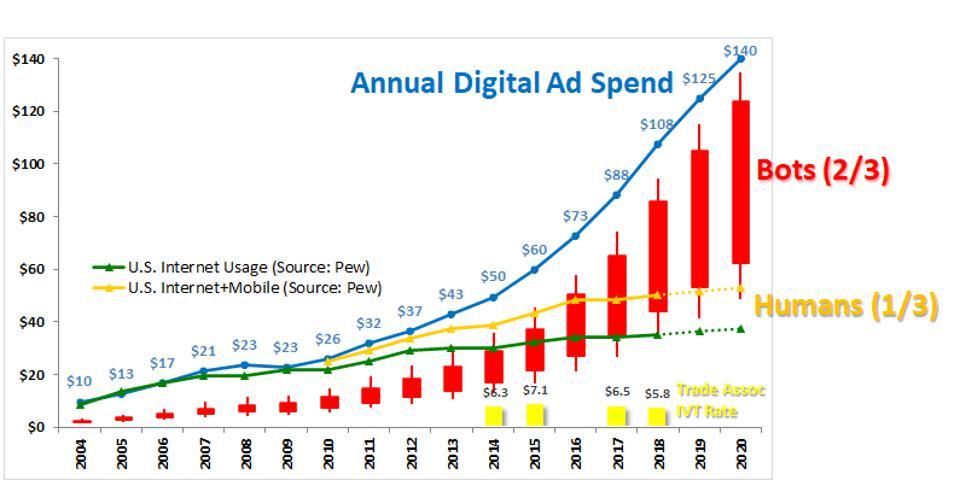
Do you see how this all worked together? Larger quantities of ad impressions, lower CPM prices, and better performance — indeed the illusions of vast reach, cost efficiency, and performance — led to what is now known as “digital marketing’s lost decade.” When “programmatic” ad buying really took off in 2012-13, the disparity from reality really took off as well. Note the green and yellow lines in the chart below — those represent humans’ usage of the Internet, social media, and mobile. Those two lines are pretty much flat across since 2012-13; indicating that real humans’ usage had all plateaued, already maxed out. But the blue line representing digital ad spending continued upward. How can this dissociation from reality be explained? Easily, with bots. Bots are simple software programs that can be remotely controlled to automate browsing (load more pages) and simulate desirable human actions, like clicks on ads. It was technically trivial to simulate all the things that marketers wanted to buy — more reach, more clicks, lower prices.
programmatic took off in 2012-13
The rise of programmatic also corresponded with marketers’ digital transformation. Marketers were shifting more and more budgets from offline channels into digital. Conveniently the vanity metrics in digital reinforced the “correctness” of those decisions to “go digital” so they were reported up the line and became the default metrics for reporting on the success of digital marketing campaigns. In the process, marketers lost sight of the real metrics that should matter — business outcomes. Clearly outcomes were not as easy to report — after all, marketers would have to figure out the complex attribution models that determined which sale was driven by which ad or action. What they forgot is that advertisers don’t actually need to know “who” bought the shampoo — which individual person; advertisers really only need to know that people who were exposed to ads bought shampoo at a higher rate than those who were not shown the ads. This was a perfect example of “too much data” from digital channels leading marketers down a rabbit hole that yielded worse insights.
Some marketers have had the courage to run “turn off” experiments with their digital media. What was interestingly consistent is that all of them found that turning off their digital ad spending didn’t change business outcomes — eBay (2015), P&G (2018), Chase (2017), Uber (2019), AirBnB (2020). So what were they spending millions of dollars on in digital, if it were not producing real, measurable business outcomes? We may never know. But what is clear is that more marketers need to check their own digital spending more closely, and do things differently than they have been doing for the last decade — or shall I say “lost decade?”
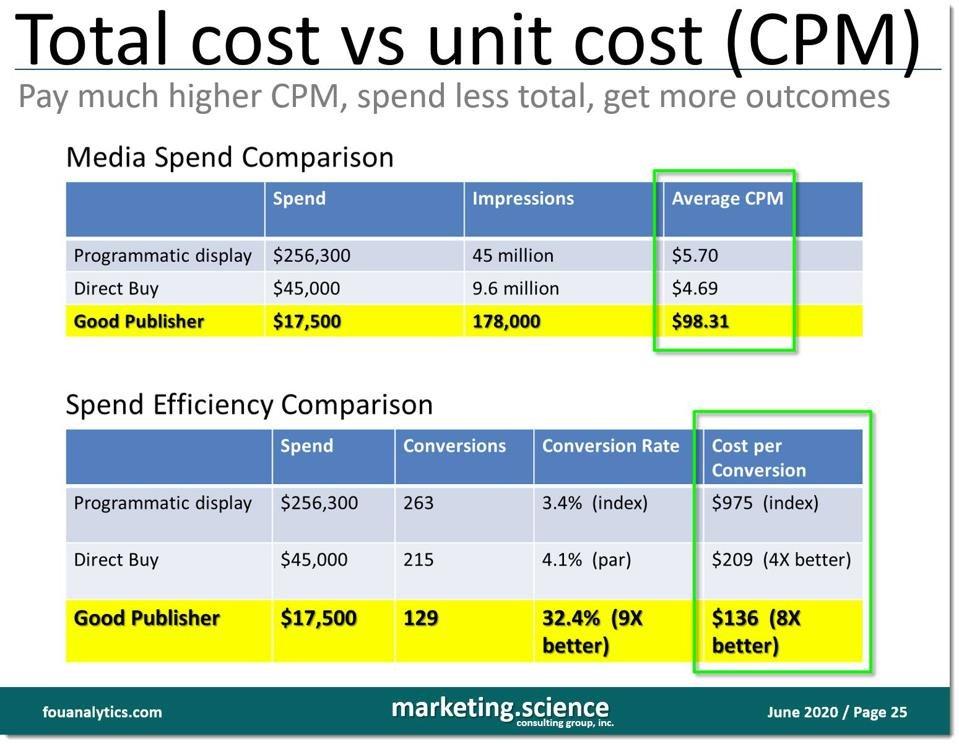
Marketers should pay higher CPMs by buying ads from real publishers with real human audiences. You know that you have to show your ad to a human before you can get any kind of business outcome right? Showing ads to bots, no matter how low the CPM prices, will drive no incremental business for you, even though it looks really good in the video game called digital advertising — you got the highest score ever this year because you bought more ads than ever before at lower CPM prices than ever before. Yay! But that was not marketing.
total cost vs unit cost
Augustine Fou
Paying higher CPM prices don’t necessarily mean greater costs either. That’s because CPMs are unit pricing (cost per thousand digital impressions). If you bought fewer ad impressions, even at higher CPMs, your total cost could actually be lower. You don’t need the vast quantities or enormous “reach.” It’s not real reach, it’s just the illusion of reach, if you’re not “reaching’ humans anyway. You don’t need to buy as many ad impressions to reach real humans. Humans tend to visit a small handful of mainstream sites repeatedly. Even though they do visit long tail sites for niche content once in a while, the “at-scale” quantities of impressions from the programmatic long tail are also an illusion, that conveniently helped fraudsters feast on marketers’ ad dollars for the last decade.
Finally, accept lower click through rates. Humans click on ads very rarely (when was the last time you deliberately clicked on any ad?). But the lack of clicks does not mean the campaign performed poorly; on the flip side, the presence of clicks faked by bots does mean the campaign performed poorly. Those clicks are not real, and the high CTRs (click through rates) don’t mean real performance. If you understand the above, you will also understand that the single most important factor in digital marketing is getting your ad in front of a human in the first place. Everything else — like targeting, viewability, click rates, etc. — is secondary. Smart marketers are ditching the ad tech targeting (costs more, works more poorly) and simply showing ads to Safari and Firefox users; savvy humans use iPhones (Safari browser) and Firefox browsers; bots prefer to pretend to be Chrome, to earn more money due to ad targeting. Advertisers showing ads to Safari and Firefox users are also getting a great deal — 50-70% lower CPMs — because other marketers are not even bidding on these browsers. Showing ads to humans in the first place always beats targeting for business outcomes, because the targeting may not be accurate and bots are pretending to be the audience segments you target.
After the last decade of digital transformation, marketers should now pull themselves out the “lost decade” of digital marketing based on vanity metrics – low prices, vast reach, high clicks. Time to think differently and do different digital marketing. Pay high CPM prices for ads on real publishers’ sites, shown to real human audiences (finite reach) and low clicks. You will see that you are doing better digital marketing, indeed marketing that actually drives real business outcomes.
I am a marketer of 25 years. I witnessed the entire arc of the evolution of digital marketing. Now I help marketers audit their digital campaigns for ad fraud and optimize campaigns based on accurate analytics. I taught digital strategy at NYU’s School of Continuing and Professional Studies and Rutgers University’s Center for Management Development. I worked on the “client side” for American Express, and on the “agency side” as Group Chief Digital Officer of Omnicom’s Healthcare Consultancy Group and SVP Digital Strategy Lead at McCann Worldgroup/MRM Worldwide. I started my career in New York City with McKinsey & Company.
If your business strategy fully relied on iOS tracking for survival, your company was probably in trouble before 14.5 came out this week, marketing experts say.
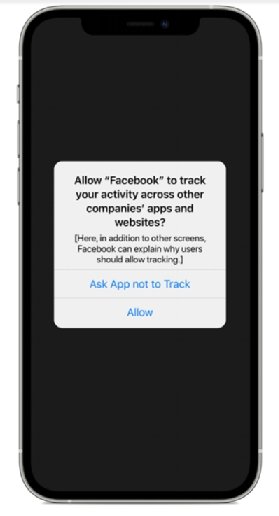
Apple’s iOS 14.5 App Tracking Transparency for mobile devices gives phone and tablet owners more control over data surveillance — apps tracking behaviour in other apps to customize ads. For marketers, that may mean one of their go-to tools has been taken out of the digital toolbox, or at least will be severely blunted.
Apple made its intentions known that it would require app developers to give users a choice to opt in to data tracking across apps late last year. Facebook immediately hit back, claiming that less-targeted Facebook ads would harm small businesses. Small businesses and agencies that cater to them reaffirmed that notion.
Experts said that while less iOS tracking will change how digital marketing is done, it probably won’t have a big effect on marketing strategy and technology for many large businesses. That’s because in the last two years, marketing teams have worked hard to comply with new consumer privacy laws that lay the groundwork for customer opt-ins on data use.
“If marketers were really being honest about why we’re freaking out about this — and why Facebook is freaking out about this — it’s because shady behaviour begets shadier action, and we’ve been doing it since the dawn of time,” said Liz Miller, an analyst at Constellation Research. “The losers in this situation are companies who look at giving customers control of their own data as a bad thing.”
Who will opt out?
Apple turned on iOS 14.5 App Tracking Transparency this week, which manifests as a pop-up window in apps. Some developers, however, turned on the features earlier in preparation of iOS 14.5. AppsFlyer, which manages mobile attribution of digital ads — keeping track of what ads drive what activity — analyzed 13 million consumer answers to data-tracking prompts among about 300-plus apps hosted by these early adopters during a three-week period before iOS 14.5 went live.
AppsFlyer found that people opted in for ad targeting approximately 41% of the time. Half the apps had at least 32% opt-in rates. But there was a difference in the kinds of apps people said “yes” to, said Shani Rosenfelder, head of content and mobile insights at AppsFlyer. The more well-known and trusted a brand was, such as in the utilities, shopping or social arenas, opt-in rates tended to be higher.
Brands that had less of a connection to their users, such as game developers, saw lower opt-in rates. Only the largest, most well-known game developers saw opt-in rates comparable with non-game apps. Brands that app users have done business with in the past, such as shopping apps, tend to be more trusted when the opt-in window pops up.
Apple
Apple mobile device users get App Tracking Transparency in the iOS update released this week.
“Things may change, but we are cautiously optimistic that opt-in rates will be higher than anticipated for marketers and for users,” Rosenfelder said. “It remains to be seen what the real opt-in rate will be.”
To persuade app users to opt in to ad tracking, AppsFlyer found that three messages Apple allows developers to put in the App Tracking Transparency pop-up may effectively drive positive results: Opting in helps the app to remain free, opting in helps show users content that is relevant to them and “we prohibit the use of your data for any purpose other than providing you with relevant experiences.”
AppsFlyer notes that Apple prohibits the use of discounts or other offers to induce users to opt into iOS data tracking across apps.
Marketing strategies will change
In anticipation of a drop-off in cross-app tracking data, agencies and consultants who work with marketers have been developing strategies to replace it. The companies that are panicking now are the ones that put off planning for App Tracking Transparency during pandemic disruptions, said Zach Baze, chief intelligence officer at Hawkeye, a digital agency that runs Epsilon adtech as well as first-party data platforms.
The hardest-hit marketers will be those that built businesses on mobile advertising or hyper-targeted ads, and they will have to adjust to survive, Baze said. For small businesses, those ads were cost-efficient. For most companies, though, the loss of cross-app data will reinvigorate the creativity that precision advertising tools made obsolete, and they probably have at least gotten started on cleaning up their first-party data on the customers they already have.
Apple’s iOS moves, in tandem with Google eliminating third-party cookies by next year, will force companies to use that first-party customer data to drive better customer experiences, instead of outsourcing tracking to Facebook and its competitors.
Apple
Tracking via iOS can still happen as it did before — but in version 14.5, Apple forces developers to explain themselves to iPad and iPhone users.
“Responsible marketers have seen this coming; it’s part of a tidal wave of a cookie-less future, and it’s probably a part of a market correction,” Baze said. “Apple is a lifestyle brand, not a data company, so it is diametrically at odds with Google or Facebook. Apple is just looking out for the experience of the consumers that they market to — which is what marketers should have been doing all along.”
Facebook, in a blog post, said small businesses will be adversely affected by the iOS tracking changes. Consultant Athan Slotkin, who works with small businesses and entrepreneurial startups on marketing and business planning, said companies that offer specialized products and sell exclusively online will be hardest hit.
Many small companies, he said, start and end their advertising plans with Facebook and Instagram. Sometimes they aren’t even aware of targeting tools those platforms run to lower costs and more precisely find customers more likely to be interested in what they’re selling.
Slotkin said he advises clients to diversify investment over different online channels, whether it’s straight SEO, TikTok, Clubhouse or other ad platforms. New and emerging social platforms typically offer more organic reach, he said, so they may represent better returns for cash-strapped small businesses. More than that, though, Slotkin advises businesses to collect and invest in their own customer data.
Get their email address, and don’t just get their consent, because that feels a little like it’s under duress. Get them enthused to share their email address because they’re interested in hearing from you and they value what you do.
Athan SlotkinSmall business consultant
“Part of my thought process — even before all this happened — is the value of owning the customer relationship and communicating with them directly,” Slotkin said. “Get their email address, and don’t just get their consent, because that feels a little like it’s under duress. Get them enthused to share their email address because they’re interested in hearing from you and they value what you do.”
CDPs move up in priority
The customer data platform (CDP) is one way to activate first-party data a company owns for marketing purposes. As Apple, Google and privacy-minded legislators put more control over data surveillance into the hands of consumers, CDPs may provide new paths for marketers to reach customers.
Many companies have mixed-vendor stacks for CRM, marketing automation, e-commerce and customer service. CDPs function as a customer data traffic manager to update marketing efforts in real time as customers buy things, browse, call customer service and fill out surveys. In turn, marketing tools can send offers to those customers or add them to campaigns as they reveal more about their preferences and needs.
For their part, CDP vendors are watching how interactions between companies and their customers will be governed by future privacy laws and those already on the books. BlueConic, a CDP vendor, strives to build flexibility into its data management features to anticipate scenarios that go much further than iOS 14.5.
“We need to be looking at the potential that every interaction with a customer will need to be consented — at the moment of interaction,” said Cory Munchbach, COO of BlueConic. “We play that out all the way — every time you come to a website or every time you come in-store, you, as a brand, have to earn the right for the customer to authenticate who they are and give you that identity. That raises the bar on customer experience.”
Optimizely, formerly Episerver, acquired the Zaius CDP last month. Peter Yeung, CIO and general counsel at Optimizely, agrees that companies that are more transparent about their customer data use will be better off in the long run.
As for App Tracking Transparency, Yeung said he feels that Apple is playing catch-up in a marketplace where consumers feel increasingly insecure about data breaches. Apple, he added, also probably wants to distance itself from Facebook and its subsidiary WhatsApp, whose data-tracking methods are under Federal Trade Commission scrutiny.
Yet iOS 14.5 gives a “romanticized vision” of choice to consumers, he said. It sounds good. But anyone who has tried to opt out of data tracking in apps then looks at their Gmail to see what is left, for example, realizes just how convenient personalized notifications and tailored emails are for things like keeping in touch with friends.
It’s great that technology companies are empowering individuals to choose to whom they give their data, Yeung said. Consent will become the product roadmap bedrock for many digital marketing vendors. But personalization is still in early stages, and the experiences will at first have much room for improvement.
“I don’t believe it’s the end of personalization,” Yeung said. “What you’ll find is that technology companies will find ways to become more and more clever in terms of how to create a personalized experience without identifying you as an individual, building a profile of an anonymous user that they kind of, sort of know what they look like or their activities are, but they can’t identify as an individual.”
Hawkeye’s Baze said that CDPs might become the tool that saves personalization, taking it to heights that cross-app tracking never could as marketers begin to use more of their features and integrate them more fully into their tech stacks. But CDP users must first get their data in order before they can effectively deploy those features. His company’s third-party data will enhance the insights that first-party data reveals, he said.
“First-party data is the best data; it’s the most actionable,” Baze said. “But a lot of CTOs have spent a lot of money on data infrastructure the last five to eight years. What they’re finding out is that the data that’s in those is incomplete, badly organized, its hygiene is not good, and it’s not that hardworking.”
The pandemic has many downsides, like the increased difficulty of beginning a new enterprise. Funding, for example, proves complicated as financial institutions become tight-fisted with their money. So, aspiring entrepreneurs find it hard to get cash.
Existing businesses have also been hit hard by the coronavirus, resulting in higher levels of unemployment all around.
Fortunately, many with jobs have saved a substantial amount of money during the pandemic using financial instruments such as tax-free ISA shares and stocks and money market mutual funds. This increase in disposable income could translate easily into golden business opportunities for the savvy entrepreneur.
A depressed economy doesn’t have to mean the end of the world. Hard times build good character and create good businesses. The best way to take advantage of this unique opportunity afforded by the pandemic is outlined in this article, starting with the benefits.
Benefits of starting a business during the pandemic
Common sense dictates that starting a new venture while the world is in chaos is not the best idea. Yet, companies founded during difficult times are better able to weather storms than their fair-weather counterparts.
Because most ventures launch during economically robust times, pandemic-era businesses enjoy the exclusive pleasure of having fewer competitors with whom to deal. During uncertain times, existing organizations do not want to spend money drumming up new ideas. Here lies a gap for an enterprising individual to contribute bold, original ideas to the marketplace.
Lurking in the turbulent economy are increased cost savings for newcomers who wish to open a business at this point. Operating expenses decrease as things like fixed cash outflow – mortgage, for example – can now be appropriated at inexpensive rates. Novice business owners can also benefit from their more influential bargaining power. They are in a position where they can come to agreeable terms with various stakeholders and develop beneficial new business relationships as a bonus.
New businesses stand to benefit from spiked levels of customer loyalty. This consumer-facing advantage contributes significantly to the permanence of a small organization. Country-specific tax incentives also aid business robustness. In the U.K., for example, small businesses receive VAT relief and have grants earmarked for them in the national budget.
Eligibility for government assistance will largely depend on the organization of the business in question.
Use market research to choose the right business type
When uncertainties arise, a sound organizational setup will stand any entrepreneur in good stead. Market research provides a wealth of information that can aid the decision-making process in the early stages of beginning a business.
Studying the business environment – particularly the activities of similar companies – can inspire prospective merchants. In the marketplace of ideas, there is often no need to reinvent the wheel. By offering minor changes to already established, successful commercial concepts, a new enterprise can easily make the best of the pandemic.
Analysing future customers is another way to get valuable information for planned business ventures. Well-organized focus groups allow participants to describe their attitudes towards products or services in their language. This information is necessary feedback for those looking to dip their toes in entrepreneurship.
There are several ways to seize the opportunities afforded by the pandemic. Some business types that are thriving right now include cleaning services, virtual exercise sessions, and mask-making.
COVID-compliant surroundings are in high demand. Both corporate bodies and private individuals increasingly require expert cleaning services in the New Normal. For this type of business, demand will very likely outlast the pandemic.
A healthy immune system is a somewhat effective weapon against the coronavirus. Keeping fit is a great way to boost the immune system. Ordinarily, going to the gym formed part of most people’s health regimes. However, the pandemic tangibly hit the exercise industry. It bounced back through the popularization of virtual exercise. In this way, the fitness market cleverly demonstrated its resilience and ability to reinvent itself.
Using masks as protective gear is common for non-essential workers. Everyone wears one now out in public. As the pandemic rolls on, consumer demand is increasing for chic and trendy masks. For example, many actors during awards season often have designer masks to match their bespoke outfits. Large corporations have contributed to the demand by having their employees wear trademarked masks.
Whatever business type a budding entrepreneur chooses, a key ingredient is the new company’s flexibility.
Adaptability
Part of staying adaptable as a new business is writing a recession-proof business plan. A detailed strategy like this will show prospective investors, vendors, and other stakeholders that the individual behind the enterprise knows what they are doing.
Separating private funds from company funds is a solid strategy that will help a novice firm remain flexible. The wise entrepreneur will open a dedicated bank account for business operations and budget prudently so the new business can endure.
It was mentioned above that cost savings are lurking in upheaval caused by the pandemic. Human Resource is an area in which a company can demonstrate flexibility and prudence. Rather than adding full-time staff members to the payroll, begin by subcontracting talented individuals as needed. If it is necessary to hire any employees, honesty about what the company can afford to offer is a good policy.
Digital Marketing
Marketing online is about more than selling goods virtually. A thriving online personality based on empathy and efficiency helps a business to stand out.
Empathy is enhanced when a business makes clever use of its social media accounts to engage its client base. Companies demonstrate efficiency when they make the most of technology to enlarge their market reach. Innovative email campaigns and user-friendly websites play a big part in crafting a company’s virtual image.
Overall, it is a good business practice to have a robust online presence. Marketing in this way increases the longevity of new organizations.
Conclusion
Contrary to received wisdom, it is possible to begin a small business amidst challenging global circumstances. Success depends on flexibility, a reliable online presence, and a sturdy business plan.
No one knows how long the pandemic will last. Plucky entrepreneurs who show foresight in their business planning will do well in current and future uncertainties.
Aren’t you tired of skimming through the internet and not being able to find a Digital Marketing Strategy that would help you scale up your business and generate steady growth? We were all looking for that magic pill, until now!
What I’m about to share with you is a thought process most elite marketers wouldn’t dare to talk about, just so that they can keep the cream to themselves. I started researching about this a year ago and the information I’ve gathered during this period is every last drop of the good stuff that I’ve shared below.
The Holy Trinity of Digital Marketing
Did you know that global B2C eCommerce sales are expected to reach $4.5 trillion by 2021? As more and more businesses are growing, Digital Marketing Experts are constantly calibrating and testing their own strategies to stand out and grow.
However, no matter how unconventional their methods may be, you don’t need to worry. All you have to do is optimize the following 3 aspects of your website and you’re bound to see substantial growth.
Traffic
One of the main focuses of a Digital Marketing Strategy is to drive traffic to your website, and not just any traffic, but relevant traffic. In order to make sure that happens, you have to incorporate keywords throughout your landing page that are relevant to what you’re selling, whether directly or indirectly.
There are 2 ways to drive traffic to your website:-
Paid Traffic
Let’s be honest. Most of the niches are highly saturated and in order to stand out, you either have to come up with something entirely new so you’ll organically thrive or advertise your services. Most successful businesses rely on both. However, advertising seems to be an effective revenue-generating tool if done right.
A good advertisement involves a headline that hooks, and a landing page with an attractive banner and sufficient information about your product.
There are 5 typical sources wherefrom you can drive paid traffic to your website:-
Display Ads – The ones that you see when you’re reading a blog. They’re around the edges, adjacent to the blog, usually in a square or rectangular box.
Search Engine Ads – The ones that pop on top of other search results. They look like the first search results but you see a little “ad” icon to signify that it’s an advertisement.
Discovery Ads – If you’re ever scrolling on Google, YouTube, or Gmail, then you have come across a Discovery ad. On YouTube, it has a panel with an image and “Learn More” is written below it. In Gmail, you’ll find it in Social and Promotion Tabs.
Sponsored Content – When you’re reading a blog and there’s a panel that looks like another blog but it’s actually a landing page, which could be anything from a blog to a product advertisement.
Influencer Marketing – Using social media influencers to promote your product. Lately, this has become just as mainstream as other forms of advertising.
Organic Traffic
When someone discovers your business on the internet when you didn’t advertise it, it means you were able to drive traffic organically on your website. Growing your business organically is a discipline in itself. The fact that people were able to discover you organically, indicates that you did a good job with SEO.
People find you either when they’re searching for you (or for similar services) on Google, or on Social Media platforms (could be Facebook, Instagram, LinkedIn, etc). According to Search Engine Journal, 70% of the links people click on are Organic. Even though ads work, it’s clear that a lot of people just skip the first 3 links on Google because we habitually understand that they’re advertisements.
How Do I Maximize Traffic On My Website?
Create a Keyword Database
In generating both organic and paid traffic, you require keywords that resonate with your target audience. What most people underestimate is the power that these keywords hold. Using tools like SEMrush, Ahrefs, etc will help you find the right keywords by offering several parameters.
Any SEO expert can tell you that you should use keywords with high search volume and low keyword difficulty, but knowing what keywords to target is a refined process, and if you’re serious about your business, then here’s what you should do:-
Make 5 columns in an excel sheet. One for the keywords, and the other 4 for “Intent”, “Relevance”, “Trending”, and “IRT Score”. Refer to the excel sheet below:-
In the above image, I have taken an example of a web development company and used 4 keywords. Each of these has been assigned a corresponding score between 1 to 4 and has been totalled in the column IRT score. Let me explain what these are and what their implications are:-
Intent – This signifies how transactional is the intent of the keyword. If the keyword is highly transactional, it has a score of 4, and if it’s not at all transactional, it has a score of 1. In the above image, the keyword “Hire Web Developer” is highly transactional, and the keyword “ReactJS vs Laravel” isn’t transactional at all and hence, they’ve been assigned scores 4 and 1 respectively.
Relevance – This will signify how relevant the keyword is for you. If the keyword has a product or service that you offer, then you may rate it between 1 to 4 in terms of relevance. In the above image, the keyword “Hire a .Net Developer” is rated as 1 because the web development company isn’t relevant to the kind of development services they’re offering.
Trending – The more the keyword is trending on Google or any other search engine, the higher will be its trending score and vice versa. In the above image, “ReactJS vs Laravel” is a keyword that has a significantly high search volume on Google and hence, has a trending score of 3.
IRT Score – IRT is simply the aggregate score of the columns “Intent”, “Relevance”, and “Trending”.
If you make a list of all the relevant keywords, you can segregate and prioritize them on the basis of these 3 parameters. The IRT score will serve as an extremely quick and reliable guide since the higher the IRT score, the more important the keyword will be for you.
Optimize Technical Performance
Did you know that the first 5 seconds of page-load time have the highest impact on the conversion rate? According to Portent, website conversion rates drop by an average of 4.42% with each additional second of load-time.
Optimizing page loading speed is only a factor and not a Digital Marketing Strategy in itself. However, improving the overall architecture of your website can help you make sure that your target audience doesn’t wander away from your landing page. Besides, the longer the page load time, the worse it is for SEO performance.
Here’s are some questions you need to ask yourself:-
Are internal pages getting enough internal link votes?
The internal pages of your website should have at least 10 internal links. The more links, the more will be the Page Authority.
Are all pages 3 (or less) clicks deep?
No pages should be more than 3-clicks deep. This is to make sure that your pages are being crawled and indexed well. For Google, more clicks mean less valuable, and vice versa.
Are all internal links using effective anchor text?
Always use exact match anchor text with your links. Here’s a catch though – If you have a huge site, you will end up using several internal links for a keyword in pursuit of site navigation, in which case you need to dial down on external links. You need to make sure that you avoid getting external links otherwise it will lead to over-optimization of the anchor text. Eg. if you have 1000 internal links for “chamomile tea”, be less aggressive on having external links with the same anchor text.
Are there any pages with existing backlinks?
Your top internal linking targets should be pages with high Page Authority. You can boost the page authority by linking pages that already have high authority.
Create Intelligent SEO Content
Having intelligent SEO content serves you in 2 ways – It will help you rank your content and will be interesting to read as well. Most writers can’t get the right mix of these 2 tangents in their content.
Ideally, 80% of your content should be keyword targeted and 20% of it should be a link bait (designed to attract backlinks). This is a long-term strategy to improve the Domain Authority of your website. This means that you’ll be able to rank on highly competitive keywords.
Here are the steps you need to follow:-
Select a qualified keyword – We already discussed this in the above header “creating a keyword database”.
Map the keyword to an existing page – If you don’t have a page targeting this qualified keyword, create a new one. Update and optimize the existing pages before creating a new page.
Only target one keyword on one page – If you have multiple pages targeting the same keyword, you either consolidate those pages, and/or delete or redirect the pages that don’t have good quality content.
Create an SEO content brief – In the SEO content brief you’ll hand over to your writer, you can mention the estimated value of this keyword (CPC x clicks), the SERP features that need to be kept in mind, the estimated organic CTR of the keyword, target word count, search intent, how many backlinks you need to rank, etc.
Conversions
Did you know that 92% of your website visitors aren’t ready to buy? We’ve talked about how you can generate traffic to your website to generate more leads, but that wouldn’t mean anything if your leads aren’t getting converted.
What you need to do is nurture these visitors until they become a qualified lead. The majority of those remaining 8% visitors are highly motivated to buy, so even if you use decent keyword targeting and copywriting, you can easily convert these. However, to get the rest 92% on board, you need to create a nurture sequence.
Here’s what you need to do:-
Create a Lead Magnet
Anything that incentivizes the visitor to sign up for your email list is called a lead magnet. It could simply be a free training webinar, a video series, or an ebook. The key is to keep these incentives really simple.
Segregate the Qualified and Unqualified Leads
Just because some visitors signed up via email, doesn’t mean they’re qualified. You can find out which leads qualify and which don’t by using 2 ways:-
New Subscriber Survey – This can include all the basic questions relevant to your target customer.
Use Trigger Links – Send a welcome email with 2 or 3 links and when the subscriber clicks on one of those, they get tagged based on what they clicked. For example, if you send an email saying “What best describes you?” and give 2 or 3 options, and based on what they click on, they get tagged accordingly, so that you can send them relevant content from that moment on. You can use Drip to accomplish this.
Created Automated Nurture Sequence
Now that you’ve qualified those leads and have segregated them into relevant categories, it’s time to nurture them. You have to accept the fact that leads convert instantly. Realistically, you have to treat them as if they don’t plan on buying for the next 6 – 12 months.
You can lay back and take your time to plan how you can add value to these people’s lives every now and then during this period. What you should do is to create an automated nurture sequence and send them value-added material, which will develop trust over time. Next thing you know, they’ll already be sold.
If the nurture sequence is solid, then these leads will be moved into a different automated sequence. This is highly dependent on your business model, but with a successful digital marketing strategy, the goal is to gradually build up and pitch them when the time is right.
Remarketing
You already understand that 92% of your website visitors aren’t interested in buying anything, so basically, they’re just bouncing away from your website without taking any action. This means that there’s so much untapped potential that you’re missing out on, unless you’re remarketing.
Remarketing is the way to reach those 92% by reaching them even when they aren’t on your website. This can be achieved through the following ways:-
Enable Tracking Pixel
A tracking pixel is an HTML code snippet that is loaded when a user visits a website or opens an email. It is useful for tracking user behaviour and conversions. At a bare minimum, you should have Google and Facebook tracking enabled on your website. Depending on the nature of your business, you could enable it on Bing, Instagram, Quora, Reddit, or even TikTok.
Create Intent-Based Campaigns
Based on what pages a visitor is viewing, you can understand their intent and should target advertisements that are designed accordingly. For example, if someone visits your website, read a blog, and just exit, then you shouldn’t advertise to them to buy your service right away.
What you can do instead is move them down your sales funnel and target with a lead magnet that’s related to the blog that they were reading. Heck, you can even split test your visitors, see what induces a favourable response for you and then use that as the main campaign.
Wrapping Up
If you were trying to understand how to reduce marketing costs, I wouldn’t blame you. All these tools can be costly and when you’re starting out, it can be an unexpectedly high expense. You can rely on free tools or consult a Digital Marketing Expert as well.
Hopefully, this Digital Marketing strategy served as an all-encompassing guide for you to understand how marketing really works, and how vast the role of relevant targeting can be. You can do your own litmus test to figure out what works for you.
Devansh is an avid content curator who loves writing about things that are mainly associated with Business and Technology. He writes about Web Development, Designing, Digital Marketing, even Machine Learning, and AI. He’s currently working with RnF Technologies. and has contributed thousands of write-ups for its clients. … View full profile ›
The messages app is starting to become the most sought-after piece of digital real estate among brands and retailers.
Marketers at e-commerce start-ups say they’re increasingly using text messages to promote new sales or product launches. That’s because they are finding it more difficult to get customers to pay attention to emails, as some customers have now signed up for email updates from dozens of brands after a decade-plus of online shopping. Additionally, the upcoming iOS14 update threatens marketers’ ability to use targeted ads on sites like Facebook. As part of the iOS14 update, iPhone users now must opt in for apps to track their browsing histories. If customers don’t, marketers will no longer be able to use their browsing history on past sites, like e-commerce sites, to serve them targeted ads.
Put together, companies are coming for people’s most intimate form of communication, amidst a slew of digital marketing changes. Because people still use it to primarily communicate with friends and family, text messaging is one of the last methods of digital communication that hasn’t been completely overrun by brands. But since it’s still not primarily used as a marketing channel, marketers are still trying to figure out just how many texts from a brand customers will tolerate. Bombard customers with too many text messages, and companies risk alienating with them altogether.
“In many ways, I think SMS is the final frontier of marketing and brand communications,” said Kinfield CEO Nichole Powell, whose start-up sells skincare essentials for the outdoors like bug repellent and moisturizer. “As a consumer, I can see why — I gave up on my personal inbox years ago, and now even social media oftentimes feels quite saturated. There are brands that I’ve followed on Instagram for years, but I couldn’t tell you the last time I saw one of their posts.”
Investor and marketing strategist Nik Sharma said that part of what is fuelling the SMS boom is brands in search of more ways to “somehow keep [customers] engaged and get them on the path to purchasing something.” According to marketing platform Omnisend, the number of SMS messages sent by the more than 50,000 companies that use Omnisend’s software increased by 378% between 2019 and 2020, while email campaigns were up 108%.
The new SMS playbook
In speaking with marketers at e-commerce start-ups, they say they try to only text customers sparingly — often only a couple times a month. But they’re still trying to figure out what kind of texts — and how many of them — someone will tolerate from a brand. In one of the most criticized brand texts from last year, Fashion Nova, sent SMS messages to customers encouraging them to spend their stimulus checks on Fashion Nova products.
One of the most common ways that marketers are using the channel is texting customers alerting them to sales, as they’re betting that people won’t mind getting a text from a brand if it’s alerting them to a good deal. Brendan Hastings, director of engineering at DTC underwear brand Thinx, previously told Modern Retail that the company used SMS to promote its August sale. He said that Thinx has found that SMS messages receive open rates close to 100%, where email open rates are 15-30%.
Powell said Kinfield hasn’t yet used SMS to promote any sales — her company has primarily used it to poll customers about what type of packaging they’d like to see for future products — but hasn’t ruled it out in the future. “We’d prefer to take the time to get to know our audience and see first-hand what kind of things they like to use SMS [for],” she said.
Eli Weiss, director of CX and Retention at direct-to-consumer brand Olipop, said that his company has found success with using text messages to alert customers to new flavours. On Instagram, Olipop will encourage customers to sign up for its SMS list in order to get first dibs when the new flavour drops.
In December, when Olipop released a limited-time blackberry vanilla flavor, the company received $15,000 worth of sales in 15 minutes from people on its SMS list. Olipop’s email list still drove slightly more sales — but the company has ten times more email subscribers than it does SMS subscribers.
Weiss said that he doesn’t see SMS entirely replacing email — that rather, Olipop will only use it to “communicate with our most engaged group of people.” Weiss said that he plans to stick to sending Olipop customers one or two texts a month. Going forward, Olipop is considering using SMS to sell company merchandise, or to send customers more personalized messages from different members of Olipop’s customer service team.
“SMS is like any fun new marketing thing where right away it can kind of get abused…some brands are now sending three messages a week,” Weiss said. “I think the future is exclusivity and intentionality.”
Jeremy McGilvrey Gives Tips for How Small Business Owners Can Grow Their Customer Base with Email Marketin
If you’re among those who think that email marketing is past its prime, then think again. Contrary to popular belief, email marketing is still one of the most successful digital marketing strategies used by companies such as Amazon and HubSpot.
Statistics have revealed email marketing is a lot more successful than SEO, paid search (PPC), social media marketing, and affiliate marketing.
Many successful small business owners use email marketing to grow their customer base. You can either choose to outsource your email marketing or select a staff member to execute it for you.
With the right techniques and the correct use of the data, you can achieve success with email marketing. Let’s dive into some tried and tested email marketing strategies.
I’ll also discuss how these methods can drive leads to your small business.
Some businesses are unable to succeed with email marketing because of their lack of segmentation. Segmentation allows businesses to put different customers and prospects into different categories and send email messages that are tailored to their subscribers. When you segment your email list you exponentially increase your odds at succeeding with email marketing.
Segmentation can provide benefits of email marketing as it allows you to create more targeted campaigns for audiences in different phases of their consumer cycle.
According to HubSpot, segmentation works wonders as email marketing KPIs work better when segmented.
Let’s look at an example to understand this better. An email with the same subject line and the same content sent to two different groups (different consumer cycle phases) will result in different outcomes. That is why it is important to segment your mailing list and then create email marketing campaigns that target each list individually to get better results.
Personalized Messages
For a consumer named Tom, an email starting with Hey customer and an email with Hey Tom is going to resonate differently. A carefully curated email will give the consumer the right impression. Make them feel that you care about them and that they aren’t receiving randomly generated emails.
Amazon uses this strategy, and the success of the company is in itself is evidence of the success of personalized messaging.
According to Experian marketing services, personalized emails have a 6X higher transaction rate, but 70% of brands fail to use them. This is where many businesses don’t properly gauge the importance of personalized email and gain a competitive advantage over their competitors.
Additional research I discovered stated personalized emails can result in a higher ROI, up to $20 for every $1 invested. As I’ve mentioned above, the most basic yet easy route to email personalization is to address the reader by their given name. You can request the first name in your opt-ins to gain this information and start doing something that 70% of the brands aren’t – using personalized emails.
Automated Email Campaigns
With a high number of subscribers to your mailing list, automation becomes a necessity. Knowing when to automate your email campaigns is going to give you an edge over others. The most basic form of automated emails are confirmation emails or welcome or thank you emails.
These are also more commonly known as trigger emails. Interestingly, research shows that trigger emails perform much better than traditional emails. These emails have higher open-rates when compared with conventional emails. Forrester reports that trigger emails-based email marketing strategies can generate 4 times more revenue and 18 times more profit.
I’ve shared some strategies that can be useful for creating effective email marketing campaigns. Now, let’s further solidify those strategies by stating the benefits of email marketing.
Email is still one of the most commonly used platforms of communication. Did you know that during the year 2020 alone, 306.4 billion emails were sent and received each day?
Add in the fact that there will be 4.3 billion email users in 2023. This staggering growth can be communicated as a growing benefit of email marketing as well.
Low Costs
One of the benefits of email marketing is its low costs. You don’t have to pay a premium to have your message appear on a billboard or in a magazine.
All you have to do is invest in software that will automate your emails and track and analyze the data gathered. However, the cost would be significantly less when compared with traditional marketing.
Effective and Easy Communication
Email marketing is your self-curated platform to communicate with your audience and engage with them.
This communication can also result in your targeted audience getting closer to your brand and becoming more loyal. It’s an easy way for your audience to keep in touch with you and stay updated with your latest updates and offers.
Targeted Messaging To the Right Audience
A good email marketing solution is a timely one. And with email marketing, not only can you reach your targeted audience with a personalized message but also target them at the right time.
Segmentation, as mentioned above, can prove to be beneficial in targeting the right audience. Add in the right timing, and your email marketing strategy is fool-proof.
Revenue Generation
The bottom-line of all marketing campaigns is to generate revenue for your company. Email marketing does that, and with lower costs. Add an excellent copywriter to your team and see your call to action resulting in significant revenue for your brand.
According to marketing week – for Virgin Airlines – email marketing was the second largest revenue driver for them after PPC.
Self-Promotion
Promotion is not an easy feat to achieve. That is why brands have to come with unique and new ways to keep promoting themselves. But self-promotion can easily be a part of an email marketing strategy.
It is undoubtedly a tried and tested method of reminding consumers of your presence. And with email marketing, you have a low-cost platform to do so.
Source : Jeremy Mcgilvrey Digital Marketing Services
Use these 5 powerful digital marketing hacks to not only bring in quality leads, but also effectively convert leads into sales
Digital marketing is the most effective way to reach your target audience, drive targeted traffic to your website, generate quality leads, and ultimately, close sales. To create a digital marketing strategy that will foster business growth, it is key to understand the following:
How much money should be spent on digital marketing?
Which tactics will provide the best return on investment (ROI)?
Which channels will help funnel in high-quality leads?
What can be done to foster the entire buyer experience?
How can success truly be measured?
No matter how small or large your business is, having a deep understanding of what happens when you implement your digital marketing strategy is critical to making better decisions that will yield positive results. As such, having the right tools, processes, and people in place will only help elevate your efforts to meet your other business objectives.
Here are 5 powerful digital marketing hacks that will help you increase sales now:
1. Create stellar content for digital marketing
The key to making content work for you in terms of gaining the awareness, leads, and sales you want is to make sure that you’re adding tremendous value. This means that the topics you write about and tips you put forth are actionable and consumed by your target audience.
One of the biggest mistakes I see companies make is that they develop content and hope that it will attract attention right away. Know that your content strategy needs to be focused on both short- and long-term goals. You’re really running a marathon, not a sprint.
There is a multitude of content types you can consider, so let’s look at a few and also understand the benefits of each:
Blogging — research topics that are actually being searched for, including hashtags that are being used by your target audience. Find a way to be a part of those conversations by writing thoughtful blog posts.
Infographics — visual content is easy to consume, so develop infographics as a way to drive engagement on your website, extend the time-on-site, and input a CTA (call-to-action) for people to inquire more about what you have to offer.
Guides and eBooks — whether you choose to gate your content or not, what’s more important is that they are being leveraged successfully as lead magnets. You can do this without gating the content because inputting CTAs throughout the content pieces will still help you understand what drives engagement and what doesn’t.
2. Run social ads
Advertising on social media networks is a no-brainer. Let’s say you’re in charge of generating leads for a B2B SaaS product and need to figure out how you can drive sales-qualified leads that will turn into opportunities — which social networks would you want to consider?
For starters, look at these three: LinkedIn, Facebook, and Twitter.
You’ll be able to narrow down specific personas, test multiple creatives and messages, and collect data to see what works best. Like any advertising strategy, make sure that you tie your social ads to their own landing pages and that the copy from the ad to the landing page matches up. Additionally, consider the following:
Leverage your content assets to funnel in leads and inquiries.
Make sure your messaging presents a clear problem and solution.
Create multiple creative assets to avoid ad fatigue.
Fine-tune and tweak as you go. In other words, focus on progress over perfection.
3. Develop robust email marketing
Once you have lead information collected from your website, the logical next step is to develop automated workflows that will nurture your leads. The key to making effective workflows is to map out the buyer journey and align your email strategy with that.
Here are some key tips to keep in mind as you develop yours:
Position the content around the lifecycle stages of your leads.
Enable lead scoring so you can keep track of what drives engagement and movement from one lifecycle stage to the next.
Segment and personalize.
Test out multiple subject lines and copy.
4. Host webinars
Get creative with your webinars by inviting guest speakers to help co-host and even do interviews with happy customers who are using your product/services. According to Xant, 73% of sales and marketing leaders say that webinars are one of the best ways to generate quality leads. In fact, a single webinar could get you over 1,000 leads.
In order to make sure that your webinars are successful, do the following:
Research and choose the right topic. Just as you would with your blog topics, do the same with your webinar topics — it’s about the searcher intent and target audience needs, i.e. the problem you solve.
Decide on a promotion strategy for your webinar. Unlike your other ads that are pushed to promote a guide or direct inquiry, webinars need at least 1-2 weeks of a promotional period.
Create a series of promotional emails as well as reminders.
Run social ads and even search engine ads.
Get out of the PowerPoint or Google Slides only presentation. Be interactive with your webinars.
Make sure the webinar is available on-demand and then have a series of follow-up emails and advertising to still drive engagement that then turns into opportunities.
5. Push a growth hacking approach
Growth hacking takes on the approach of testing nearly everything you can during the entire buyer journey so that you gain clarity around what triggers a lead to be interested and then progress into a sale. The great thing about growth hacking is that you can apply it to every single digital marketing tactic.
Here are some actionable examples you can use:
A/B testing headlines and CTAs for targeted landing pages that are tied in with ads and your homepage.
Personalize your emails per segment and even personas.
Develop multiple content clusters with your blog posts to see which one drives the best quality of leads that turn into actual sales opportunities.
Good digital marketing vs. great digital marketing
What separates good digital marketing from great digital marketing isn’t just your ability to spend a ton of money, but to use that money to show the actual problem you solve. In other words, you’re selling the solution for a clear problem and can show how you are able to do that.
More specifically, people buy from people, not companies. Therefore, being authentic with your approach and steering clear from just making a transactional sale will only help you in the long-term.
Finally, continue to integrate both your intuition and the data you collect to help excel your business forward. Don’t look at digital marketing as just a 1:1 — money in and money out — solution. Rather, use the power of digital marketing to create awareness that will expand beyond just one single piece of creative or content. Changing your perspective to this approach will help you keep the needs of your target customers top of mind, and in turn, support your growth initiatives.
Digital marketing is advancing each and every day. Every business will progress (or decline) depending on current trends and specific marketing strategies they set forth. The trends and strategies that are seen in digital marketing boil down to one crucial aspect: content creation. Content creation is crucial in digital marketing because it attracts and engages consumers, which leads to an increase in business.
Content can be as simple as making a statement. Anything from professional, financial, legal or technical advice to posting an entertaining GIF can all be considered some form of content. It is imperative to identify your target audiences because they are the ones who consume your content and essentially bring your business to life. Every business should know their target audiences, area(s) of focus and the type of content necessary to produce. Identifying these will effectively promote and improve the online presence of your business.
Identifying Your Target Audience
Convert your target audience to loyal customers by creating winning and distinctive content. The content you create will help you connect with your target customers’ needs and personas. Research and strong analytical data is required to secure all information needed to increase the traffic to your business. Gaining access to your target audience’s personal information (name, age, gender, geographic location and job title), along with answering questions and identifying their challenges, will help you improve the content you make and fine-tune your business agenda.
To adequately cater to new and current customers, research tactics such as interviewing past customers, conducting surveys and analysing the traffic you receive is vital. Use Google Analytics to view your site traffic and to analyse your audience by looking at the insights displayed. Having a very specific agenda that bookkeeps information such as key demographics, key psychographics (attitudes, aspirations and other psychological criteria of a person), challenges and preferred communication will help you create outstanding content that is unique and authentic. After identifying your target audience, the overall goal is to provide value to each consumer with the type of content you create.
Types Of Content
Content is used to entertain, educate and persuade. Businesses gain better visibility online by focusing on the content they create, increasing their exposure and attracting new leads. Every type of content produced should resonate with each consumer and provide them with a great deal of resources. High levels of engagement depend on the type of content generated.
• Blogs: Blogs are a great way to provide content and optimize search engines. Boost organic traffic by attracting potential customers who are looking for answers and other information that your business specializes in. With any blog, it is a great idea to create link pages within them so other people can share your post. Writing blogs is one way to have more interaction and develop strong customer relationships.
• Memes: Memes are videos or images that include correlating captions. Memes have become extremely popular this generation and are always going viral throughout social media. People create memes by embedding specific text into edited clips from videos, television and movies. Memes can easily create traffic because they are a fun way to engage people on social media.
• Live video/webinars: Online streaming is an effective way to increase traffic for any digital marketing strategy. Live videos and webinars allow businesses to inform their audiences, connect with them virtually and answer any questions or concerns they may have. Businesses can easily broadcast a live video or webinar to an online audience on multiple platforms.
Content Drives SEO
Content creation is to SEO as peanut butter is to jelly. Content increases traffic to your business and helps you become more visible online. Including valuable content on a business page gives owners the opportunity to reach more clientele. Content is created to be posted throughout the internet to build brand awareness and generate a larger audience. Every search engine has a variety of ways to index and provide information that determines your business exposure. These algorithms will decide the ranking of your business depending on a person’s search query.
Content creation benefits SEO because the words produced in the specified content highlights keywords that consumers search. These keywords are relevant to your business because it may create a higher ranking in the search engine result pages (SERPs). More keywords will result in a higher click-through rate (CTR) that will increase traffic and potentially bring new clients to your business. It is important for your content to be strong enough to appear in relevant search queries.
Keyword placement, backlinks and website visitors are all extremely crucial in the world of SEO. Lacking content will result in no keywords being found, no page for your future customers to view and no improvement in your SEO. Giving customers the best content possible is needed to eventually help lead your business page to one of the top search engine results.