Tag

ITV

Browsing

By Georg Szalai

The U.K. TV giant, led by CEO Carolyn McCall, reported its latest results.

U.K. TV giant ITV, led by CEO Carolyn McCall, is planning 35 million ($46 million) in “temporary,” or “one-off,” cost savings amid “softer” advertising demand in the fourth quarter. The news came Thursday as the company reported the latest revenue for its ITV Studios production arm and advertising business.

Third-quarter revenue came in unchanged from the year-ago period, better than forecast. That leaves nine-month ad revenue down 5 percent year to date. The company had previously forecast that its total ad revenue would come in “marginally down” in the third quarter, “compared to the same period in 2024, reflecting the tough comparative from the final knockout matches of the Men’s Euros in July 2024.” However, the firm had also predicted continued “strong growth in digital advertising revenues.”

But the current fourth quarter is full of uncertainty, with concern about what the late November budget by Prime Minister Keir Starmer’s Labour Party government may bring. “The economic outlook in the U.K. remains uncertain, with widespread caution being exercised across business sectors ahead of the budget in November,” ITV highlighted on Thursday. “This is impacting demand for advertising throughout the industry in the fourth quarter, with ITV total advertising revenue (TAR) expected to be down around 9 percent in the quarter.” That would leave full-year 2025 ad revenue down 6 percent.

“In response to this current reduction in advertising demand, we have identified £35 million of additional temporary savings in [our] Media & Entertainment (M&E) [segment] in the fourth quarter,” ITV said. “These savings align our M&E cost base — particularly content and discretionary spend — with the softer advertising demand we are seeing in the fourth quarter and will largely offset the expected reduction in total advertising revenue.”

The cuts will include 20 million pounds ($26 million) in content savings, “as we move some programming into 2026, which will be financed out of the existing 2026 content spending plans,” ITV said. “The total content budget for 2025 is expected to be around £1.21 billion ($1.58 billion).” In July, ITV had lowered its full-year 2025 total content spend estimate to around 1.23 billion pounds ($1.67 billion), compared to the previously indicated 1.25 billion pounds ($1.70 billion), “as we continue to optimize our content spend to best reflect viewer dynamics.”

ITV on Thursday also mentioned 15 million pounds ($20 million) of non-content savings, primarily from reduced discretionary spend reflecting the lower demand environment and reduced marketing spend aligned with the adjusted content slate, and marketing efficiencies.

Total ITV revenue grew 2 percent to 2.80 billion pounds ($3.66 billion) over the first nine months of 2025, driven by an 11 percent gain at ITV Studios. External revenue in the studios unit was up 20 percent, “reflecting strong demand from, and the timing of, programs for global streaming platforms.”

ITV Studios had recorded a revenue increase of 3 percent for the first six months of 2025. The production arm, which has been a much-rumored takeover target for various possible bidders in the industry, had back then also said that “we remain on track to deliver our target of total organic revenue growth of 5 percent on average per annum from 2021 to 2026 — ahead of the market.” But it had emphasized that 2025 results would be weighed more toward the second half of the year.

ITV’s M&E unit revenue for the first three quarters of 2025 fell 5 percent, but digital was a strong area, with digital advertising revenue up 15 percent and total digital revenue rising 13 percent. “ITVX delivered good growth in viewing, with total streaming hours up 14 percent,” ITV said.

“ITV has delivered a good performance in a tough advertising market,” McCall said Thursday. “Our strategic initiatives continue to progress well, and we remain confident in delivering good growth in ITV Studios revenue and digital revenue for the full year. This is supported by laser-focused strategic cost management and underpinned by our resilient and highly cash generative linear broadcast business.”

Thursday’s cost savings news came after ITV had in July unveiled an additional 15 million pounds($20 million) in permanent non-content cost savings, taking the total group permanent non-content savings in 2025 to 45 million pounds ($61 million). CFO Chris Kennedy in the mid-year earnings call cited technology and process efficiencies as drivers of the latest set of cost reductions. “Everyone is really focused on…rebalancing the cost base” to ensure continued business success, he said.

Feature image credit: ITV CEO Carolyn McCall Courtesy of Matt Frost/ITV

By Georg Szalai

Sourced from The Hollywood Reporter

By

UK TV broadcasters are attracting record audiences, meeting their public service remit, and keeping the lights on while working from home. In return, they are bracing for a precipitous drop in ad revenue these next few months.

First, ITV said it expected a 10% ad revenue drop in April. Just weeks later, Channel 4 announced business cuts and staff furloughs, blaming the pandemic’s “severe effect” on demand and predicting that the current situation would burn a 50% hole in the TV market in April and May. ITV also said it was “taking measures to reduce costs and manage cash flow”.

At any other time, these audiences would be cause for celebration for the TV industry (ThinkBox says Easter weekend viewing in the UK was up 29% year on year). However, there are a difficult few months ahead as broadcasters look to ensure the flow of content keeps people informed and entertained at home, which balancing the books.

Barney Farmer, sales and marketing director at Nielsen Online, says its data shows that UK ad spend dropped 27% year-on-year across all media channels in March. Money coming in from from travel, transport and business utilities halved, while retail investments fell by a fifth. Some sectors saw the reverse. Among them was government advertising was up by 38%, food was up 16%, and tech/computing rose a massive 60% from an already high base.

Farmer explains: “The initial data for TV advertising in April does not paint a pretty picture, and it is expected that the numbers will drop significantly for the overall month.”

Many TV budgets have been frozenbroadcasters are unable to rely on tentpole events to prop them up. Brands looking to activate around the now delayed Euro 2020 (which ITV was expecting a particularly strong performance from) have been forced to shelve their best-laid plans. Other businesses are turning off the tap due to diminishing stock or demand.

“Broadcasters will be looking at all avenues for revenues, whether that is through different advertising sectors or ways to ensure money stays in their businesses via different digital channels,” adds Farmer. “Out of a crisis often comes new ideas so we can potentially expect something emerging that doesn’t exist today.”

The UK’s major broadcasters are all reliant upon ad income, although to differing degrees. ITV is less vulnerable to the ad freeze than the likes of Channel 4 due to its diversification efforts in production, e-commerce and its stake in streaming service BritBox. Sky, meanwhile, has user-generated revenue to lean on — although without the draw of its sports properties it could be bleeding custom.

Which brands are still on TV?

Amid this bleak outlook, British broadcasters are forming battle plans.

Some advertisers are still spending, with many leaning on TV to communicate how they are adapting to the pandemic or driving home message for viewers to ‘Stay At Home’. Though it’s brought the economy to a grinding halt, there is an opportunity for usefulness and long-term goodwill from brands willing to embrace a higher purpose. Others TV spenders may still follow, be it retailers directing shoppers from their shuttered stores to online, or games and apps looking to grab the attention of a bored locked-down populace — also, prices for a premium ad slot have dropped significantly.

“It’s looking like the cheapest TV pricing I’ve ever seen in my in my media career,” asserts Mihir Haria-Shah, head of broadcast at Total Media. Some audiences are down 50% year on year in terms of pricing. “I wasn’t working then, but it is comparable to the 2008 recession”.

The combination of larger audiences tuning into the TV at home and a reduction in demand for the inventory is to blame, argues Haria-Shah. “TV is really deflationary at the moment, and prices have really fallen kind of through the floor.”

Haria-Shah also notes some trepidation among brands that have been absent from TV for a while, a quick return may look “opportunistic”.

“Given the current circumstances, there’s quite a fine balance between doing the right thing for your business and also maintaining your long-term brand reputation,” he continues.

He adds its important to note that not every brand’s been fully hamstrung by the pandemic: “Some brands have actually reported their best sales in years, or for younger brands, the best in their existence.” FMCGs are among those seeing a bump from some of the early panic-buying of essential items, for which toilet paper will long be a visual metaphor for.

Right now, one of the biggest barriers to entry on TV, beyond falling ad budgets, is the lack of ability to produce big-ticket, sensitive creative. With most of ad land under lockdown, amendments will have to be made to existing films. Shots of friends and family out in the world having fun, or even in close contact, now carry negative connotations. The tone has to be right. The message can’t deviate too far from stay home. And the work can’t feel cynical, else long-term damage will be done in the name of short-term gains.

Some brands have been quick to adapt though. Apple is telling us that the lockdown doesn’t mean the end of creativity. Nike has been showing the home training routines of athletes. Toyota new creative was directed over Zoom. Mobile-footage and sweeping image slideshows driven by voiceover are the flavour of the day for brands limited in what in they can produce.

Accessibility

To woo brands among all this, broadcasters are looking to remove as much as the friction from buying and production as possible. Certain fees are being waived, and the best spots are more readily available than they’ve been.

On the production side, ITV’s in-house team is now being tooled to help clients where it can. There’s a great effort to get the work over the line fashion in its keen to help and others will be doing the same.

The in-house creative teams have indeed been busy too, Channel 4 and the BBC’s PSA efforts both landed earlier this week with strikingly different tones but the same message – ‘stay at home (and watch TV)’.

Further down the chain, according to Haria-Shah, TV ad clearance house Clearcast is reportedly working at an impressive rate – its new priority is to ensure no TV ads exploit the pandemic, spread misinformation, or offer advice contrary to that government guidance: “It’s [clearance period] seems to be down from five to three working days.”

He believes demand in TV ads will rise these coming weeks.

“TVs always been seen as the best brand builder. And now consumption is through the roof, you can sit alongside record audiences on trusted news or alongside the escapism of comedy, soaps and drama. There’s a lot of longer-term positive associations, that brands that advertise correctly can build right now.”

The aforementioned broadcaster budget cuts threaten this dynamic. Many productions have been frozen, few that were on the slate can be delivered under lockdown. As replacements, broadcasters have literal warehouses of archive content they can tap into.

ITV moved fast in releasing Euro 96 footage to its on-demand Hub as was requested by fans. BBC’s current affairs panel show is going ahead with phoned-in floating heads in a virtual studio. Netflix released a series of calls between Joel McHale as a bonus Tiger King episode. A BBC weatherman stole headlines by entering a frenzied cover of the news theme after his delivering his forecasts.

Will these bold makeshift productions continue to draw high attention these next few months? Or will audiences get their heads turned by a wealth of entertainment content on many of the ad-free subscription video-on-demand services.

Disney+ has just launched, Netflix and Prime and going anywhere. And for some, Quibi may be worth a look.

Concluding, Haria-Shah says: “You always believed that soaps like Coronation Street would always be on the TV. Its pause is a real symbol of how serious an impact this is having on the TV landscape.”

By

Sourced from The Drum

Sourced from Seeking Alpha Pro.

Summary

ITVPY’s share price continues to be held back by concerns about the television advertising market.

Its dominant and growing position in this market continues to impress, however.

Similarly, its increasing push into content production and distribution should appeal to long-term investors.

The company is attractively cash-generative with what appears a sustainable strategy for continuing growth into the future.

Currently, considerably undervalued compared to its peers, today may be a good time to pick up shares in the company.

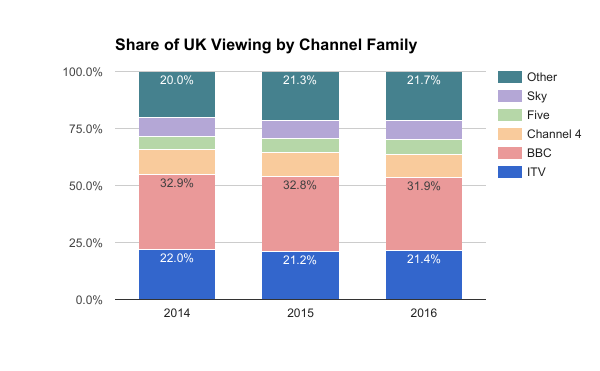
In the UK, if you’re looking at ITV (OTCPK:ITVPY) as an investment, your first thought is its wide variety of TV channels. Having emerged as the first commercial UK television channel in 1955, it has grown to be the biggest channel after the state-owned BBC family of channels from a viewership perspective (Data sources: ITV Annual Reports):

Ironically, however, I think the prominence of its channels in the UK television ecosystem has unfairly kept its share price lower than it should be. The growing viewership of other channel families in recent years is a reminder of the increasingly competitive media landscape in which the company operates.

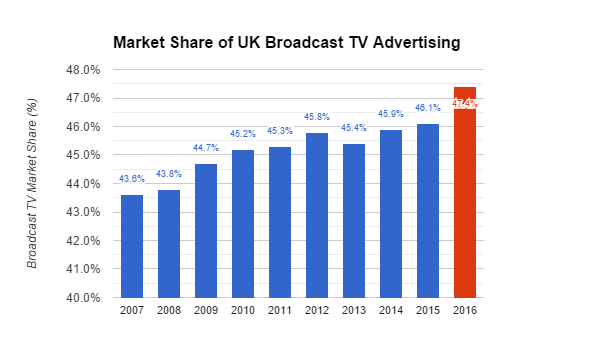
The reality is that it continues to dominate the TV advertising market in the UK (Data sources: ITV Annual Reports):

Sourced from Seeking Alpha Pro.