Tag

LinkedIn

Browsing

By Joy Okumoko

Looking for a job on LinkedIn all by yourself can quickly become a full-time job in itself. You could spend days or weeks combing through your feeds for job ads or hoping your connections will share a job opportunity.

But there’s a simpler and smarter way to improve your job search results by joining a community of fellow job seekers.

In this article, we’ll cover some of the top LinkedIn groups for job seekers with at least 200,000 members. This can exponentially increase your network and with it your chances of landing your dream job.

1. Linked:HR

LinkedIn groups LinkedHR

Linked:HR is home to more than one million job seekers and HR professionals. The popular HR group was created in September 2007 and is managed by Next Dimension Media.

It is a well-organized community with a dedicated website and specialized Community Business Forum, Job Board, HR Resume Page, and Events Calendar, among others.

Members are mostly encouraged to post in English with preference given to discussion items. A discussion item usually includes a question. Questions are more visible at the top of postings, especially ones with less than 50 words.

2. The Recruiter.com Network

LinkedIn groups The Recruiter.com Network

Over 800,000 members can’t possibly all be wrong about The Recruiter.com Network; which is one of the largest recruiter networks you can find on and off LinkedIn.

The Recruiter.com Network group was created in November 2007 as a platform where recruiters can post vacancies, and find and hire top talent across different industries.

To maintain quality and decorum, conversations and comments are moderated and must be approved by the admin before being posted. Members who contact other members in a spammy way for commercial purposes will be blocked.

3. Banking Careers

LinkedIn group Banking Careers

If you’re a job seeker, recruiter, or professional in the banking or financial industry, you’ll find over 500,000 other like-minded professionals in the Banking Careers LinkedIn Group.

This LinkedIn Group is powered by the Carfang Group and was created in March 2009. Discussions in the Banking Careers group centre solely around financial risk management and related topics.

The group features loads of career advice that can help you advance your career in the banking and finance industry. You can also make valuable connections and land job opportunities as a member.

4. HR Jobs

Linkedin group HR Jobs

Recruitment is usually the job of the HR department, but what if you’re an HR professional in need of a job, an HR job? Well, you can find HR jobs and networking opportunities by joining a group like HR Jobs.

HR Jobs currently has more than 300,000 members made up of job seekers, recruiters, and other seasoned HR professionals. You not only find job opportunities in this group, but you also get career advancement tips.

The group was created in March 2008. It is a platform where beneficial HR content is shared and connections made. Posts have to be approved by the admin before going live.

5. Digital Marketing Jobs LinkedIn Group

LinkedIn group Digital Marketing etc

This group’s name is as lengthy as the list of different professionals, recruiters, and job seekers it caters to. The full name of the group is Digital Marketing SEO SEM Mobile Apps Data Internet Media Brand CRM PR Email Affiliate Jobs.

There’s something for everyone whether you’re into digital marketing, SEO, SEM, or mobile app development.

Jobs, connections, courses, advice, and tips on digital and online marketing are also widely available in this group which has more than 300,000 LinkedIn members.

The group was created in March 2008 as a hub for all kinds of online marketing professionals, developers, and content creators, among others. Members are warned against spam and posting in all caps.

6. Life Science Network

LinkedIn group Life Science etc

If you’re a professional in the life sciences, pharma, biotech, medical, clinical, and healthcare fields, among others, you can get up-to-date news and job-related information from this group.

Instead of guessing where to find your next job opportunity, simply join this group, post, share, and explore all the immensely beneficial information available.

Here’s your chance to connect, learn, improve, and hopefully land your dream job in the life sciences and medical fields. Created in July 2009, the group has more than 300,000 members.

7. Aviation Jobs

LinkedIn group Aviation Jobs

With a LinkedIn Group like Aviation Jobs, your aviation career can take flight more quickly than you expected.

With over 200,000 aviation job seekers, recruiters, and professionals in the group, you’re certainly in good company.

The group is powered by Aviation-Job.eu and caters to flight and cabin crew, aviation maintenance, commercial and cargo airlines, airport jobs, and government operations.

8. Oil and Gas, Engineering, Construction, Mining Jobs and Artisans

LinkedIn group Oil and Gas and others

Recruiters, job seekers, and other professionals can find a lot of opportunities in the Oil and Gas, Engineering, Construction, Mining Jobs and Artisans LinkedIn Group.

The group which was created in October 2010 currently boasts of more than 200,000 members. As the name suggests, members come from the oil and gas, engineering, construction, and mining industries and also include artisans.

The group caters mostly to professionals from the Middle East, UK, Africa, and other offshore locations.

Members are not allowed to post a CV or resume, general news items, or engage in spammy activities.

Join a Job Seekers LinkedIn Group Today

The journey of job-hunting can be tiresome and time-consuming, so don’t go at it alone if you don’t have to. Join a job seekers’ LinkedIn group today and you could land your dream job by tomorrow.

Joining a LinkedIn group is one powerful strategy for getting a job via LinkedIn. You should also explore other LinkedIn features that allow you to find and land your dream job.

By Joy Okumoko

Sourced from MUO


By Hailley Griffis

I sat down with a few founders to learn more about how LinkedIn has transformed their businesses. Read on to hear their stories, see their results, and learn the strategies you can start implementing today.

People often think of LinkedIn as the place to go for personal career growth but it can also be an incredible resource for growing your company. Especially if you’re a small business owner whose personal brand is closely linked to your company mission, LinkedIn shouldn’t be ignored as part of your social media strategy.

I sat down with a few founders to learn more about how LinkedIn has transformed their businesses. Read on to hear their stories, see their results, and learn the strategies you can start implementing today.

Quick note: Before you get started with these strategies I recommend you audit your LinkedIn profile to ensure it’s accurate and compelling. It won’t take much time and it can go a long way!

Building Thought Leadership

While other social channels are typically reserved for building your company’s brand, LinkedIn provides a unique opportunity for you to grow a personal following—that can, in turn, support your brand’s recognition. This is especially true when your individual thought leadership aligns closely with the mission of your company.

When Sherrell Dorsey started the digital news and insights platform The Plug, she knew she wanted it to be seen as the leading voice in the Black innovation economy—and she wanted her voice to be in the mix as well. She turned to LinkedIn to share the work she was doing and lessons she was learning a couple of times per week.

Sherrell Dorsey, Founder and CEO of The Plug

The results were shocking: “Just a few months later, the kind of engagement I received was insane. And then just a few months after that, I was named a LinkedIn Top Voice in Technology.”

This recognition has helped give Dorsey and her company more leverage when it comes to PR outreach and speaking opportunities. “There’s a little street cred to it. I think folks come across my profile and they see that I’m a LinkedIn Top Voice, so I must be legit,” she says.

She’s continued to double down on her LinkedIn strategy—adding LinkedIn Live conversations into the mix—because she’s noticed how demonstrating her passion ultimately boosts her company’s brand, too. “It’s been a way for people to see me, see the work, see the authenticity, and then make a decision that they want to engage with this brand based off of what they’ve seen me post or share on LinkedIn,” she says.

Connecting With Industry Leaders They May Otherwise Have Never Met

Social media is great for connecting with new people, regardless of where they’re based. But many entrepreneurs share that LinkedIn has been especially valuable in this respect. In a post-COVID world where conferences and gatherings are less common, LinkedIn is a powerful platform for finding peers to serve as sounding boards, mentors to learn from, and even future customers from afar.

Sheena Russell, founder and CEO of Made With Local, loves the fact that her company operates out of the relatively remote city of Halifax in Nova Scotia, Canada. However, she shares, “In certain circumstances, it can feel isolating to not be where the action is.”

Sheena Russell, Founder and CEO of Made with Local 

Thanks to a strategy of sharing some behind-the-scenes action and reflections on her life as a CPG (consumer packaged goods) entrepreneur on LinkedIn, Russell has grown her network far beyond what would be possible locally. “With LinkedIn, I am personally connected to huge CPG founders and people who are running brands I really admire,” she says.

Beyond helping Russell and her team feel more connected and giving them the chance to learn from the best in the business, Russell expects these far-reaching connections will prove valuable as Made With Local sets its sights on expanding into the U.S. and beyond.

“It’s a really great way for us to start building a name for ourselves in the international CPG and natural food and beverage community that will serve us down the line when it’s time for us to finally start selling into those markets,” she says. “By that point, I will hopefully have shown up on the feeds of lots of other CPG founders and people from the States, so they’ll be somewhat familiar with the brand.”

Meeting Clients

Many social media platforms seem like a fun diversion—but do they actually help small businesses make money? The answer for LinkedIn—especially for companies in B2B or career-related industries—is a resounding yes. According to the Content Marketing Institute, LinkedIn is the top paid and organic channel for B2B businesses.

Latesha Byrd, CEO of talent development agency Perfeqta, has seen this firsthand. Back in 2015, before founding her company and while she was still working a full-time job, she started using LinkedIn Profinder (now called LinkedIn Services Marketplace) to advertise her career coaching services and find her early clients. “That essentially tripled the amount of revenue I was bringing in for my business, and in about six months I was able to leave corporate America,” she says.

Latesha Byrd, CEO of Perfeqta

Even today, as Perfeqta has established itself on other platforms, LinkedIn continues to be a powerful driver of clients. “One of my current retainer clients—a tech startup that we created a talent acquisition framework and did some diversity and inclusion roadmapping for—found me on LinkedIn and reached out,” Byrd notes.

Although not every new connection will lead to an immediate sale, putting yourself out there on LinkedIn can be a powerful way to build a pipeline of potential clients. “After my last LinkedIn Live, someone who works in diversity recruiting at a really great company reached out to ask for the inclusive recruitment guide I mentioned,” Byrd says. That LinkedIn Live has since been viewed almost 30,000 times.

The best part is that all of these business owners agree that LinkedIn requires less intense curation and content creation than many other social platforms. Post consistently a few times per week, engage with people in your world, and don’t hesitate to share your story authentically. With those three steps, you’re well on your way to building a strong LinkedIn strategy—and growing your business in all kinds of incredible new ways.

By Hailley Griffis

Sourced from Buffer

By Alex Kantrowitz

LinkedIn is something of an enigma as a social network. Despite its massive size — nearly 800 million members — it isn’t filled with the same type of misinformation, trolls, and engagement baiting algorithms that define its peers. The tone on LinkedIn is, actually, kind of friendly. It’s a place, as Scott Galloway recently put it, where people assume you’re engaging in good faith, not bad. “I no longer respond to people on any platform except LinkedIn,” Galloway said. “People are much more civil.”

LinkedIn’s built a friendly, productive, and scaled network by developing the right incentives and taking genuine action when things go wrong. It’s not perfect, of course. But given that the network’s peers seem to live in perpetual scandal, there’s a lot we can learn from it. Here’s a brief rundown of what LinkedIn gets right:

Real consequences for being a jerk

On most social networks, you can be a jerk with little consequence. Twitter is filled with anonymous, bile-spewing users who corrode the network’s tone. Facebook may require you to use your “real name,” but being a jerk can mostly cost you Facebook “friends,” and since you likely have more of those than friends in real life, you can spare a few. On LinkedIn, being a jerk has consequences. It threatens your ability to get your next job, strike your next partnership, or find your next customer. You use your real identity there, and what you say has ramifications. This encourages people to pick their fellow users up, not tear them down.

Long term product health > engagement 

LinkedIn’s product team makes substantial changes to address bad things on its product, even when it costs the company “engagement.”  While I was at BuzzFeed News, for instance, my colleague Ryan Mac and I wrote about a phenomenon called Broetry. At the time, LinkedIn’s feed was flooded with “broems,” or stories written line by line with spaces in between, often by cringeworthy growth hackers. LinkedIn prioritized these posts in its algorithm because it believed that when people clicked “see more” to expand posts in their feed, the posts were probably compelling. But the growth hackers figured this out, and then exploited the curiosity gap and filled the feed with garbage.

LinkedIn’s product team could’ve left the algorithm alone and kept its precious engagement. But after the story came out, they changed the algorithm and minimized the signal, and Broetry largely disappeared. When you have a product team willing to sacrifice short-term numbers for long-term product health, you’ll often end up in a good place.

A business model aligned with user interests

Most social networks make money via advertisers (their real customers), so they try to keep people (users) as engaged as possible, even if it requires some sacrifices. When you run an ad business, it’s okay if a certain percentage of the platform hates each other, as long as they keep coming back to fight.

LinkedIn’s business model is different. About one-third of its revenue comes from advertising, but many of LinkedIn’s users pay to use its premium product, so its users are its customers, and the interests are aligned. LinkedIn also sells a premium product to recruiters, who want to get people jobs, and creepy targeting won’t help with that. LinkedIn is able to sacrifice short-term engagement for long-term goals — as noted above — because its business model incentivizes it.

A functional trending column 

LinkedIn’s trending column is world-class. It’s filled with relevant news, curated by human editors, and doesn’t rally people to ridicule peers who became that day’s “main character.” Facebook struggled to figure how to build a trending column, and eventually gave up. Twitter’s trending column is so bad that the best stories about it call for its destruction. LinkedIn, however, is demonstrating how you keep people informed about relevant, popular news without wrecking society.

A reasonable share button

LinkedIn’s share button doesn’t allow you to pass along other people’s posts without accountability. Unlike Twitter’s retweets, posts on LinkedIn show up with your name and photo when you share them, adding a layer of ownership that’s missing on Twitter. There’s also little incentive to share dunks or outrage due, again, to the disincentives for being a jerk.

The slow life is the good life

LinkedIn’s feed has interesting information, but nothing feels too pressing. People using the service, therefore, tend to be thoughtful when posting. This differs from Facebook and Twitter’s rollicking, impulse-driven feeds. Slowed-down social media, as counterintuitive as it may seem, tends to be a better experience and healthier for society.

Feature Image Credit: Gabriel Varaljay on Unsplash

By Alex Kantrowitz

Sourced from Big Technology

Sourced from lightspandigital

One of the biggest debates we hear from LinkedIn fans who are determined to make the social network’s algorithm work in their favour is whether or not to place a link in the post or in the comments. In other words, does LinkedIn’s algorithm favour posts that don’t link off the platform?

The tactic of posting links in the comments instead of creating a post containing a link has become very popular with those who are trying to “work” the LinkedIn algorithm. Are they right? We decided to put it to the test.

Do LinkedIn Posts Without Links Get Better Engagement Than Posts With Links?

Socialinsider, an in-depth social media analytics provider, partnered with us to analyse their trove of data and provide insights. They analysed 86,504 LinkedIn posts from a total of 883 LinkedIn pages.

What do we mean by a LinkedIn post with a link vs. no link? Typically when we share a resource on LinkedIn, we’ll share a link with our own commentary. But what if we were to share only the commentary, perhaps with an image, and then post the link in the comments?

The hypothesis here is that posts that are not based on a link will perform better than those that share text only or images. And that leads to a preference by many to post the link in the first comment. 

If we think about it, it’s in LinkedIn’s interest to keep people on the platform as long as possible. The longer people stay, the more ads they’ll see, which is profitable to LinkedIn. Keeping people on the platform is a key strategy that’s been theorized for most social networks. It also circulates when it comes to Facebook content and might be behind Instagram’s reluctance to enable linking off the platform.

Objectives:

While our original hypothesis was related to the effect of text-based posts, Socialinsider’s volume of data gave us access to additional insight. We looked to:

  • Determine how LinkedIn posts perform when placing the link in the posts itself compared with posts without a link
  • Determine how LinkedIn posts perform when placing the link in the comments, not in the post itself.
  • Find out what type of post performs best overall on LinkedIn

LinkedIn Algorithm Study Key Insights

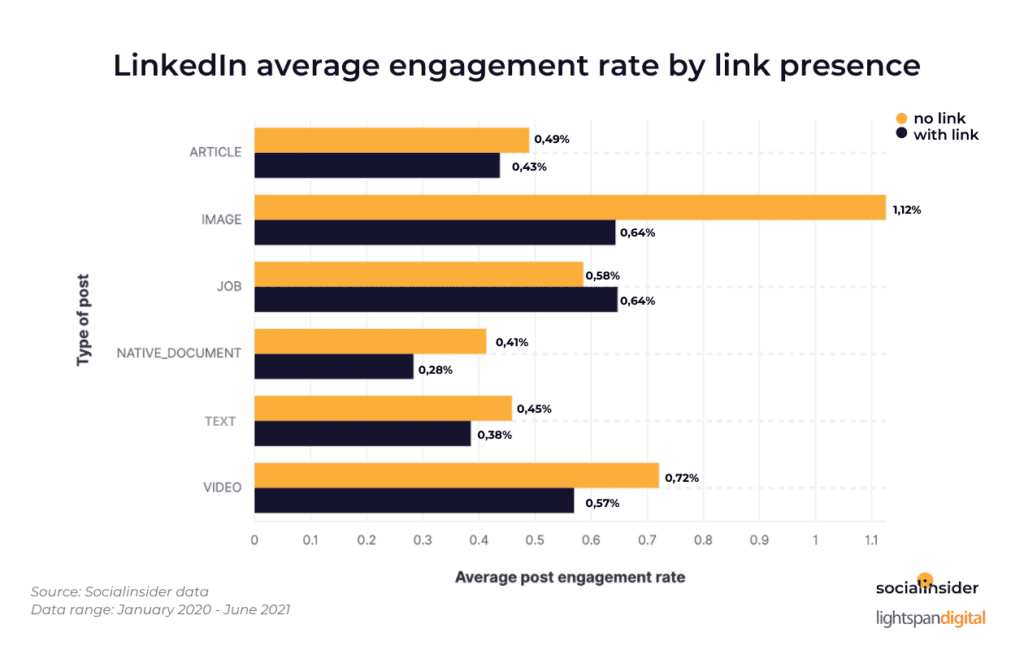
Posts with no links perform better across all types of posts on LinkedIn.

linkddin average engagement rate by link presence

For example, a single image posted on LinkedIn with no link can get an engagement rate that’s 70% higher than a post with an image and link.

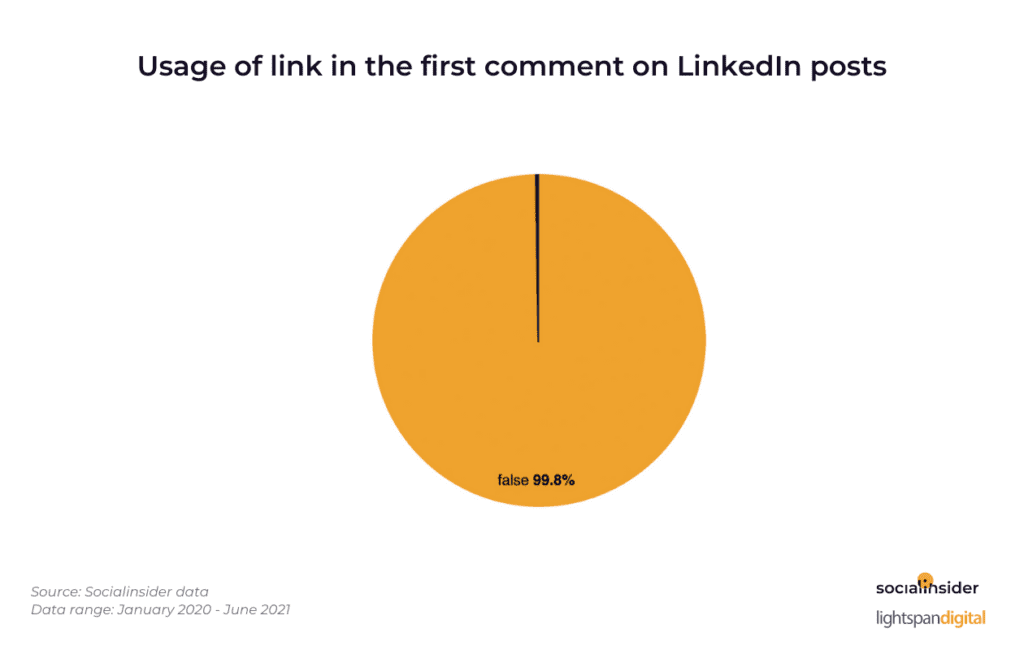
99.8% of companies that use LinkedIn for business don’t usually place links in comments.

To note, based on an analysis of 86,504 LinkedIn posts from a total of 883 LinkedIn pages, brands on LinkedIn usually don’t place links in comments. Most brands are using scheduling tools that limit their options to add links in comments.

companies don't post links in content on linkedin

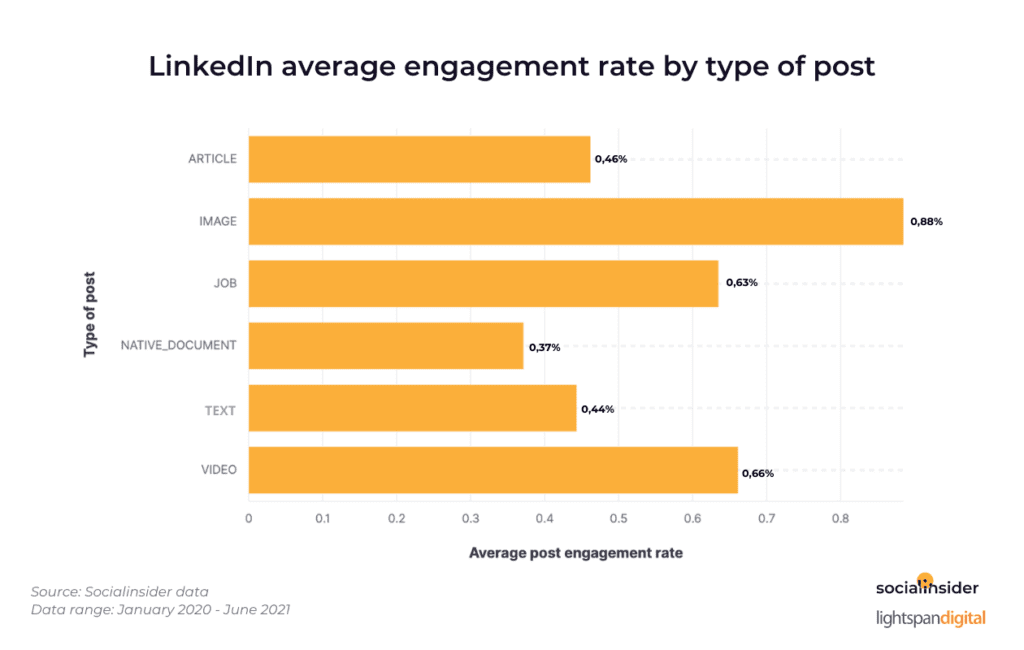
The top-performing content on LinkedIn is the image post, with a 0.45% engagement rate per post.

The most common type of business content on LinkedIn is an image with an engagement rate per post of 0.45%. Simply adding just text with no link, video, or link doesn’t increase your chances of getting higher engagement from your content on LinkedIn.

engagement rate by type of content on LinkedIn

Methodology

Socialinsider tapped into their database to evaluate more than 86,504 LinkedIn posts from a total of 883 LinkedIn pages that had an active presence on LinkedIn between January 2020 and June 2021. During that period, these pages had LinkedIn follower counts between 100 and over 100K.

For the purposes of the study, we define engagement as the measurable interaction on LinkedIn posts, including likes, comments, and shares. The engagement rate is calculated based on the total of these interactions per post, divided by the total follower count.

The LinkedIn data was also analysed based on page size, defined as the total number of followers that liked the business page.

We used Socialinsider to find out the engagement rates, the type of posts, and the link placement in the post.

Below are the categories of LinkedIn posts analysed in this case study:

  • Article – represents content that links to an article
  • Image – represents content that contains images
  • Job – represents content that contains jobs
  • Native document (PDF) – represents file types (most of the time, these are PDFs) uploaded natively. LinkedIn allows you to create posts that contain documents.
  • Text – represents content that does not contain any media
  • Video – represents content that contains videos

Conclusion

While it’s impossible to decode social network algorithms, especially since many have AI components built-in, these insights are worth exploring.

While the original hypothesis had to do with links in posts, the finding that image posts get the most engagement is beneficial and easy for you to test out on your audiences. And it may have nothing to do with the algorithm but rather with our visual human nature.

I believe that empathy is the good marketer’s superpower. Powerful content is content that gives the people what they want, how they want it, and where they want it. Algorithms are typically designed to give people what they want so they continue using that social network. If you can figure out how to give YOUR people what they want, you won’t have to worry about the algorithm. 

Sourced from lightspandigital

By Kevin Kruse,

In an age where all B2B marketing is digital yet very little of it actually works, it’s tough to know whose advice you can trust. Perhaps the first clue is when they acknowledge, up front, just how ineffective most marketing really is.

Alex Boyd, founder and CEO of RevenueZen, isn’t shy about sharing what most B2B marketers get wrong about SEO and LinkedIn. But he’s hesitant to give advice without first understanding the context and nuance of a particular situation, which is usually a sign someone has earned their chops.

I recently caught up with Boyd to hear his thoughts on SEO strategy, demand gen philosophy, LinkedIn spam, and why, at the end of the day, a simple phone call can go a long way.

This interview has been lightly edited for clarity and length.

Kevin Kruse: What have you seen change or shift in marketing and demand generation in the last several years?

Alex Boyd: Anything “mass” has decreased in effectiveness as well as anything easy to measure with a low barrier to entry. Those types of activities have less value because everyone presses the buttons that are easy to press, like sending a lot of emails and running a lot of very general ads. When you think about what marketers need to do to justify their tactics, it’s usually putting up big numbers on a dashboard to show to the CEO who doesn’t always “get it.” And so the easier something is to measure and show on that dashboard, the more marketers will do it, even if the channel is saturated and the leads aren’t converting.

Kruse: What’s a common misconception people have about demand generation?

Boyd: A lot of people think all leads are created equal, but they’re not. How you got that lead in the first place is so important. On paper, a lead is an object in a CRM with an email address. But how would a salesperson define a “lead”? It’s somebody who’s gotten more interested in your product than they were before. The person who says, “I saw your CEO in that great Forbes article and I have a few friends that use your company. I’m ready to sign,” is a lead. But, to many marketers, so is the person who entered their email address just to download a checklist and always dodges your calls when you follow up. Those two leads are not equal. Demand generation isn’t about the quantity of leads. It’s focusing on how the lead got to your company, and whether or not the environment in which they arrived warmed them up to what you sell.

Kruse: In general, what’s working in B2B marketing, assuming “working” means generating a lead that comes to you in the right way and with some interest to potentially buy?

Boyd: You already know it depends, but I’ll share what I’m seeing: first, founder-driven, brand marketing—meaning sharing the perspective of what the leadership team believes in a personal, organic way. LinkedIn is a good example, but this could also look like the CEO giving a fireside chat, or speaking at an event. People want to know what the people behind the product believe because that tells them more than a list of features. The feature list is static, but what the founders and leadership team believe is dynamic—it tells you about the future and where the company is headed. CEOs shouldn’t fool themselves into thinking that managing their social media accounts is “below them”: many prominent CxOs of tech unicorns are very active on social.

Secondly, organic search still has a lot of potential. Most SEO is still done quite badly, even by experts. The biggest thing that Software-as-a-Service companies in particular get wrong about SEO is they think they need to optimize for people searching for exactly what they do. That’s table stakes. What the SaaS companies who see massive growth through organic search do is they compete for the attention of their buyer. It’s not a game of what your product does, it’s a game of attention. And if you get in front of people and put your name, brand and insights in front of them while they’re looking for related content and they happen to encounter your product that way, you’re going to show them a new way of doing things. And that’s the core of SaaS marketing: showing someone a new way of doing things.

Kruse: Do you have a real-world example of how that kind of attention-grabbing SEO works?

Boyd: One of the best ways of doing SEO at first is to talk about the basics. Most companies will create a blog for announcements and news, but nobody is searching for your company. So why not rank for keywords they’re already searching for? A company called lightyear.ai is a great example. They’re a marketplace for IT and networking solutions—kind of like a kayak.com for IT. They don’t assume that people are searching for “IT product marketplace”, because they’re not. They rank for things that people search for to educate themselves on how to buy IT. It’s a subtle shift in thinking: when you’re a small start-up, your new idea is not the centre of your prospects’ universe.

Kruse: How should you approach SEO if you’re trying to sell something new?

Boyd: When you’re selling a brand-new product, the way you do SEO should change. Nobody is searching for your unique new product category – yet. If you sell something new, you need to rank for things that are related to what you do but aren’t your product. If you’re building an AI to help recruiters sort through resumes, you don’t want to rank for “AI resume screener”, you want to write about the Top 10 Ways to Screen Candidates, or How To Write An Amazing EEO Statement. Once your company is larger, this game changes and you then want to focus on people who are already looking for exactly what you do.

Kruse: You’ve been creating a new product for LinkedIn. Tell me about that.

Boyd: The way that people engage on LinkedIn has been broken for a long time. A lot of people see relationship-building as transactional: “I liked your posts, please take a meeting.” There’s a feeling of entitlement. That needs to change.

The right way to engage on LinkedIn involves writing good content, engaging with others, networking, and actually building community. Our product shows you which of your target accounts are talking to your competitors, customers and strong connections. And it tells you exactly which important conversations to take part in. The whole point of our product – Aware – is to give people the ability to send a LOW volume of hyper-targeted messages that have 60%+ conversion rate: unheard of.

Kruse: What’s one piece of advice you’d like to leave marketers with?

Boyd: Don’t be afraid to get your hands dirty. Tech marketers spend so much time geeking out on growth-hacking funnel jockeying, but sometimes you just need to pick up the phone and call a prospect instead of waiting around for an answer. I think we need to spend more time building relationships with people, which sometimes means just calling them up.

Feature Image Credit: Founder of RevenueZen: Alex Boyd

By Kevin Kruse

Kevin Kruse is the Founder + CEO of LEADx, a platform that scales and sustains leadership habits throughout an organization. Kevin is also a New York Times bestselling author of  Great Leaders Have No Rules, 15 Secrets Successful People Know About Time Management, and Employee Engagement 2.0. Follow me on Twitter or LinkedIn. Check out my website or some of my other work here

Sourced from Forbes

By

Over the last three years, LinkedIn‘s active user base grew by a staggering 27 percent, from 500 million in 2018 to 740 million in 2021. owners and entrepreneurs can leverage the platform to grow their brand, generate new leads, establish partnerships and make connections.

The following seven ways can help you utilize LinkedIn to grow your brand and gain a competitive edge over your competition.

1. Optimize your company profile and connect with people

If you haven’t worked on your LinkedIn profile, please take some time and perfect it. Make sure it provides all the essential details about your company’s products and services. Put more emphasis on the headline and summary to ensure that it’s compelling, engaging, interesting and professional. Furthermore, optimize it for more B2B and B2C lead generation.

Within no time, you will start seeing the “Someone has viewed your profile” notification. Don’t just view their profile back. Instead, track the individuals who viewed your business’s profile. If they are an ideal prospect, invite them to connect. An individual who views your company profile is most likely finding out more about your brand. There could be a chance they are also interested in your products or services.

2. Post valuable content on LinkedIn publisher

You can use LinkedIn Publisher to publish blog posts that users can engage with and share. With more shares of your blogs, the higher the impact it has on growing your brand. The post can also get prospects interested in your products, triggering an open door for more partnerships.

Make it a habit to publish content on LinkedIn consistently — but remember quality is key. It can build a community of loyal followers who admire your brand. Through them, you have ambassadors who can create a good reputation out there about your business. When users see the value and insights in your content, it gives them the conviction to check out more about your company. It’s one of the most straightforward and subtle ways of promoting your brand on LinkedIn without being pushy.

3. Follow other companies

Don’t forget to follow other businesses within your industry, including those you have partnered with and those who can be potential partners. This way, you have a chance to learn about them and what they offer. Still, don’t limit yourself from poking around as it might be an eye-opener to some techniques other companies use to get more leads. Also, the more you position yourself out there, the higher your chances of getting more returns.

4. Join LinkedIn groups where your target clients gather

The right groups can be a very powerful tool in growing your brand. By using advanced search, you can locate practitioners within your sector and your firm. Group conversations can give you vital insights into your industry. You can also learn about emerging industry pains and the options you can use to solve these issues.

While in the group, learn about the rules to know if content sharing is allowed. If so, create your credibility by sharing relevant content that capture potential prospects. It can include links to articles about your brand, relevant blog posts, event notices for webinars and posts that quote your business. However, make sure the materials you post are a helpful source and avoid dominating the conversation.

5. Utilize plugins

LinkedIn can be an even more powerful lead generation tool by itself when you utilize the complementary add-ons. Tap into the following plugins:

  • LinkedIn Connection Revealer: The LinkedIn Connection Revealer shows you the following that your connections have. By pinpointing the users who travel in big circles, you can engage with them to leverage their platform and promote your brand.
  • LinMailPro: It’s a Chrome extension that gives you the capability to automatically find and invite individuals who have recently viewed your profile. You can also send personalized messages to them about your brand or deliver messages.
  • Headlinr: You may have sponsored a great story, uploaded ads or put up posts, but without a great headline, your potential targets might not click on them. When you use Headlinr, a chrome paid plugin, it automatically generates multiple headline combinations with the keyword you specify depending on your industry. You will get compelling titles that lure users into clicking through your ads and stories.
  • Rapportive: If you are a user browsing in Chrome or Firefox, Rapportive can be a handy tool in getting more leads. It enables you to get LinkedIn profiles that have email addresses in your contacts. You can then send them personalized invites to their inbox to help you grow your network.

6. Create a sponsored InMail campaign

By utilizing sponsored InMail campaigns, you have an easier route to cut through the clutter and reach inboxes of individuals who matter to your business. You can send your target prospects compelling offers and rich content.

7. Ask your employees to post your business’s content

In most cases, entrepreneurs search for powerful brand advocates who can share their brand case studies and blogs. Yet, you can also do it through your employees. Research shows that about 50% of employees are already posting on social media platforms about their employers. Ask them to post blog content and other pieces relating to your brand to generate more traffic and leads. In fact, some organizations allow their marketers to pick company-approved content that their employees can share on LinkedIn.

LinkedIn can be a goldmine in attracting new clients and growing your brand, but correct execution is critical. Take your time to create your LinkedIn strategy, get clear about how you can offer prospective clients value first — then implement like crazy!

By

CEO of Bolder and Louder

Sourced from Entrepreneur Europe

By Minda Smiley

According to the company, 21 million people attended virtual events on the platform last year.

Virtual events had a moment in 2020. While their 15 minutes of fame might be coming to a close, they aren’t exactly going anywhere, since hybrid events are expected to be the next big thing. Want your lanyard and mediocre coffee in a freezing conference room? Great. Prefer to stay in sweatpants and watch from home? That works, too.

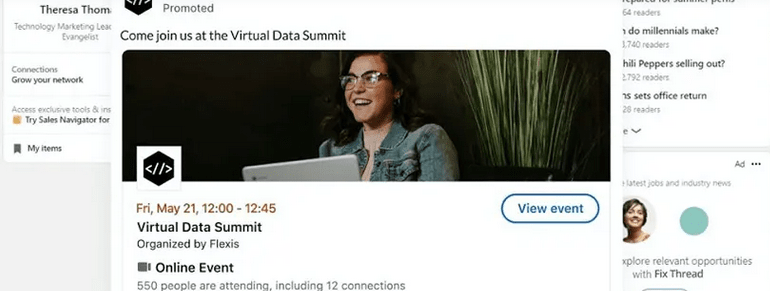
LinkedIn, for its part, is helping marketers get the word out about whatever events they’re cooking up. This week, it rolled out tools that make it easier to plug events + learn more about who’s attending:

  • Its new Event Ad format highlights details like “date, time, and how to join.” Plus, it lets users see if a mutual connection has expressed interest in attending.
  • Rishi Jobanputra, senior director, product management at LinkedIn Marketing Solutions, told Marketing Brew that these ads also provide event-specific metrics that its other ad formats do not. “Marketers can see exactly how many members clicked on or saw an ad and then registered for an event, so they know how effective their campaign spend was at driving event registrations​,” he explained.
  • Jobanputra said 60 brands created campaigns using this tool during its beta phase. During testing, he claims Event Ads reduced cost per registration by an average of 40%, compared to LinkedIn’s Single Image Ad format.

+1: LinkedIn has also released an Event Analytics tool that pulls together insights related to reach, engagement, and makeup of attendees so marketers can “more easily and effectively plan for future events.”

According to Jobanputra, 21 million LinkedIn members attended virtual events on the platform last year, while its livestreams increased more than 400% from September 2019–September 2020.

So profesh

In recent months, the Microsoft-owned company has been trying to position itself as the home for B2B advertising. A campaign it released in March told marketers that its platform, teeming with job updates and career advice, isn’t a place where cat videos and vacation pics regularly show up.

“Reaching your target audience when they’re in a ready-to-do-business mindset is particularly crucial on social media,” it said at the time.

Big picture: The latest updates come roughly a month after LinkedIn said its ad revenue was up 60% year over year, surpassing $3 billion.—MS

By Minda Smiley

Sourced from Morning Brew

Sourced from Entrepreneur Europe

LinkedIn Learning published a list of free courses that you can take on its platform to continue acquiring skills and succeed in your professional career.

An entrepreneur knows that he never graduates or finishes preparing and that training is key to achieving goals. LinkedIn Learning published a list of free courses that you can take on its platform to continue acquiring skills and succeed in your professional career.

Become a graphic designer : If you are interested in knowing the basics of graphic design to generate innovative visual concepts, this course is for you. Master the basics of building innovative design projects, and discover the skills you need to become a great visual thinker and communicator. Also, learn how to manage design teams and take your first steps managing your design company.

Master digital marketing : In this course with more than 24 hours of content, you will use your creative, analytical and tactical skills to help companies grow by generating new opportunities as a digital marketer. From creating marketing plans and content strategy to lead generation and SEO, learn digital marketing principles and best practices and tools to successfully navigate the world of digital marketing.

Learn to manage projects : Project management is one of the main activities of companies seeking to become catalysts for change. Through this course, you will learn the skills necessary to inspire your team to work with the vision and objective of having a common cause, and to manage projects from the beginning with the most effective techniques and knowledge of project management.

Become a true IT administrator : IT administration has become one of the top priorities for companies during the transition from new remote work schemes. Through this course, you will learn to design your own network and you will develop and expand your knowledge of cybersecurity, as well as the different skills that you will need to carry out a correct management of your own company’s networks on a day-to-day basis.

Learn the skills necessary to be a sales expert : If your thing is to make sales and get new business opportunities, this course is for you. Through 10 hours of content, you will learn how to convey trust, be attentive to your customers, influence their decisions and learn from their mistakes. Likewise, you will develop the necessary tools to become a sales professional, from attracting new clients to negotiation and sales techniques.

Feature Image credit: Depositphotos.com

Sourced from Entrepreneur Europe


By

When you launch an eCommerce, the first sale is as symbolic as it is necessary

When you launch an eCommerce, the first sale is as symbolic as it is necessary. It is not so much because of the income or because it is extremely complicated, but because of the optimism and tranquillity, it represents for the team. It can mean the biggest turning point in the life of the company. Obtaining that first customer will be a long and complicated battle, so in this article, we explain how to grow an eCommerce while spending the least. Keep reading!

How to grow an eCommerce with minimal expense

Without a doubt, the first sales are the most complicated and the most exasperating. Consumers won’t come to your platform by magic. Therefore, if you want to know how to grow your eCommerce investing little money, you must aggressively market your business and take advantage of the weaknesses of your competition to attract customers and traffic.

Take note of the following techniques that will help you achieve this. Keep reading!

1 # Presence in social networks

The first point on the list of how to grow an eCommerce could not be other than social networks. To start making yourself known, you must open an account. It is not about being in all of them, but about selecting the ones that will be useful to connect with your target audience, but how do you know which is the ideal one?

TWITTER

The simplicity of Twitter makes it one of the most effective ways to engage with your audience. A good way to find potential clients is to proactively find people who post questions about your field and reach out to them so they keep you in mind. The idea is not to present or mention your products but to help them answer their questions. If you do it right, users will investigate your existence and discover your business.

LINKEDIN

Second, Linkedin is the Internet office. On this platform you can find professionals and executives of all kinds, showing off their skills and connecting with others. Once you have configured your e-commerce profile, you can start doing the same.

You may not sell anything directly through Linkedin, but you will discover many opportunities with other companies, providers and related websites. There are dozens of public and private groups created for specific niches, allowing you to post questions and talk to other members.

INSTAGRAM, TIKTOK AND PINTEREST

On the other hand, social networks like Instagram, TikTok or Pinterest allow you to take a different approach if the audience is young. They are ideal platforms for original and creative content. Take photos of your products as well as videos and tell an engaging story.

FACEBOOK

And finally Facebook. This is still a very powerful social network. Take advantage of your professional profile and create a business page to interact with friends, family and acquaintances and make people talk about your brand. Get creative with status updates and engage in public groups and fan pages relevant to your niche. In addition, you can do paid campaigns.

2 # Create a blog

If you are not yet building a blog associated with your e-commerce or product, you are losing the unlimited potential of content marketing. Producing free and valuable content builds brand trust. It also offers you content to share on social networks and helps you rank in search engines.

To start, think about all those initial inquiries that the audience has about your products and your sector. Use the blog to answer those questions with individual articles. Plus, you can use it to provide lifestyle tips, tutorials, and resources around your products. If you can create regular content, you will soon start to see results thanks to social networks and search engines.

3 # Send your product to influencers

Third, the list of how to grow your eCommerce could not be without influencers. In recent years, influencers have become key pieces for marketing strategies. The Internet is full of bloggers, journalists, entrepreneurs and vloggers of all types specialized in all fields. You need to find the right ones. Many of them have a large following and a loyal following on their web pages.

Therefore, you can send a free sample of your product to those who best fit your brand. Hopefully, you will get a mention on one of their platforms, and you will also let them know that as a company you appreciate their work with a small gift.

In this sense, you can also conduct interviews with them. It is a good way to create original and different content. Interviews work because they are win-win situations. The interviewee gets more visibility and the interviewer has good content to post on the blog, for example. Take the opportunity to ask questions about their lives and careers, but also about the industry in general.

On the other hand, to collaborate with them, you can also run contests or raffles. We all love free stuff and if you’re looking to build trust, running a contest or giveaway could help you get there. This can be done with the collaboration of influencers or on your social networks.

4 # Public relations and communication strategy

If you want to know how to grow your eCommerce, make a public relations strategy. They have the same effect as when a video goes viral and can propel your brand to success. A sure fire public relations trick is to do something unusual, outrageous, funny, or important enough to merit media attention.

If it goes well, your eCommerce will benefit from many high-profile news source links, which is great for both short-term traffic and long-term SEO.

In terms of communication, many electronic businesses publish press releases to attract the attention of the media, although most of them fail. It is a less useful strategy than it used to be but still sire. The secret is to make sure your story is newsworthy, concise, and professional, without being too monotonous.

5 # Create a Mailing list

Email is one of the best channels for attracting leads, and it can even be free. You can create a mailing list of previous and potential customers and send them information, products and content. Include an email subscription form on your website. This is an effective way to convince visitors to sign up for your database.

Instead of just saying “sign up for our newsletter,” offer an incentive or some kind of added value for subscribing.

Another use that you can give is conducting surveys to your consumers, so you receive comments to improve. Customers often have no qualms about saying what their experience with the store has been like and whether something was done wrong.

6 # Experiment with Google Ads

To know how to grow an eCommerce you have to know what Google Ads is. In case you don’t know yet, Google Ads is Google’s pay-per-click advertising platform. It enables online merchants to place ads on almost all Google results pages, YouTube videos, and partner websites.

The biggest advantage of Google Ads is its speed and massive reach. In a few minutes, you can set up and launch an advertising campaign that makes your text, image or video ads appear. You can also set the option for them to be activated and displayed next to Google results when users search for predefined or similar keywords.

7 # Pay attention to web analytics

The behaviour of each user when he visits a web page from when he enters to when he leaves helps you understand why you are or are not selling. Your page statistics will show you what your customers are doing on your website, including the websites they enter, the time they spend on each one, and the route they choose to exit.

Some tools also display additional information. For example, how often a customer visits your website. In this sense, Google Analytics is a totally free tool that helps you measure traffic in many ways.

8 # Sponsor an event

To get good results sponsoring an event you have to give it the right approach. First, you will have to make sure that you select the right event and that the target audience is the same as yours. Will your potential clients be among the attendees? Would your product interest them? How many attendees will it have?

Once the data in hand, classify them according to the type of audience and sponsorship price. Once you attend, avoid typical marketing strategies like handing out flyers. You will have to be creative to establish and build relationships.

Show off some of your most interesting products to tell their story, get people talking about it, and offer immediate promotions like free coupons in exchange for email list subscriptions or social media follow-ups.

9 # Make use of affiliate marketing

Affiliate marketing is those actions by which you allow other people to market your products and send traffic to your website. In return, for each sale, you pay a percentage. You can track it by giving it a custom link or a unique coupon code.

The great thing about this sales strategy is that you only pay if sales are made, which makes affiliates do their best.

10 # Outperform the Competition on Price Comparison Platforms

Most consumers like to shop around before making a purchase, this includes browsing Google and sites like Amazon for the best options. The most popular platforms are Google Shopping, Yahoo Shopping, Kelkoo, idealo, etc.

To achieve notoriety, you have to follow the rules of each platform, stay competitive on pricing, and wait while you experiment to find out which platform is the best fit for you and offers the best ROI.

What did you think of this article on how to grow eCommerce? Leave your comments and share!

And if you want to set up your own e-commerce and you don’t know how to launch your project, take the Master in e-Commerce & Digital Marketing. You will learn everything related to managing electronic commerce with a comprehensive vision with the best business models and strategies. We will wait for you!

By

Author Selena is a blogger and a guest contributor for a well-known brand that includes MESHEBLE, Saveucoupon & INTHEMARKET. In her leisure time, she plays tennis.

Sourced from INFLUENCIVE

By Chris J “Mohawk

LinkedIn likes to create new features, but I’ve noticed that most are a waste of time and a mere distraction. Focus on the basics, and you can become a LinkedIn rock star. To do that, you also should know what not to focus on, which typically includes the features that are declining in use. Here are eight things that you shouldn’t worry about on LinkedIn:

1. LinkedIn Live

LinkedIn Live was only given to non-LinkedIn marketing people, which I believe was a mistake, as LinkedIn advocates like me would have used it better. Then it became ubiquitous and its quality and delivery waned. People were getting bored, and the number of watchers declined. Then the pandemic and Zoom came along, and suddenly people were on webinars all day and night and the last thing they wanted was yet another one. So, don’t waste time on it.

2. LinkedIn Groups

Groups began dying years ago. LinkedIn has tried several times to revamp them, and each time they get less and less engagement.

3. Company Pages

Posts on LinkedIn company pages are typically only liked by people who work there or want to work there, and you probably won’t see comments unless the post features the CEO/founder. This often pales in significance when compared with the amount of engagement a CEO/founder will get by posting directly from his/her profile, even if they have fewer followers. People buy people on LinkedIn, not companies.

4. LinkedIn Polls

It took me a day after polls were released on LinkedIn to see the first poll that said “Are you sick of polls?” And sure enough, you don’t see them now, or if you do, they have a minimal amount of votes and lack quality.

5. LinkedIn Stories

No sooner was Stories released and it was killed by lack of user interest. This is not Instagram. It didn’t work, so it’s time to move on. Why would you want to spend time and effort creating content that disappears? The best content on LinkedIn gets liked and commented on even weeks later, which enhances your personal brand.

6. Long Articles

Although studies vary, people spend roughly 20 minutes a month on LinkedIn, and I’ve noticed that they don’t have time to read long articles. They go to Forbes for that! LinkedIn used to promote articles but then stopped and removed them from the profile, too, which made them totally invisible. People on LinkedIn like to view photos of you, videos of you and short posts of 200 words that they can read easily. They don’t want to click through to an article or a website to read the rest. Work on improving your feed.

7. Skills And Endorsements

Unlike recommendations, which are personally written and usually by people who have worked with you, there is no context to endorsements and skills on LinkedIn. Skills can be endorsed by anyone with no background, so I believe this makes them pretty meaningless. Instead, make recommendations a priority.

8. LinkedIn Advertising

The number of potential clients that came to me after trying and wasting tens of thousands of dollars on LinkedIn is incredible. In my opinion, LinkedIn advertising is for people, companies and CMOs who typically don’t know how LinkedIn works. Organic content by your CEO will always beat anything you do on Linkedin Advertising. Additionally, since people care more about your CEO/founder’s content and not your company page, why spend money advertising on a page that no one cares about? Create more content for your CEO/founder’s page, and skip the LinkedIn adverts that don’t work well.

Focus on the live elements of LinkedIn that work and create long-term engagement that enhances your personal brand and will win you clients, not the features that won’t.

Feature Image Credit: getty

By Chris J “Mohawk

LinkedIn & Personal Branding Expert – CEO & Founder of Black Marketing – 1,000+ LinkedIn Recommendations, 4 Best Selling Books. Read Chris J “Mohawk” Reed’s full executive profile here.

Sourced from Forbes