Having successfully in-housed its own media buying and planning, Lastminute.com has launched a consultancy arm – Playbook – to help other brands do the same.
In an industry where businesses are increasingly bulking up their internal arsenal, Playbook will guide brands through the complex process of internalising core marketing capabilities, including media planning, tech, data and content creation.
Although it’s being pitched as a consultancy, it’s not run by consultants, instead, it will be led by the same team behind Travel People; Lastminute.com’s own in-house media and trading arm.
Playbook and Travel People will both be led out of a new media business within Lastminute.com called Forward. Alessandra Di Lorenzo, Lastminute’s chief commercial officer, will head up this new company as chief executive.
Playbook is already working with several unnamed travel and FMCG clients.
Lastminute.com has been bulking up the services it offers to brands since it launched Travel People 2016, scaling up its programmatic capabilities and finding new sources of revenue by letting other advertisers plug into its adtech stack.
Steered by Di Lorenzo, as a way to protect the travel platform’s revenues against the threat of the digital giants like Google and Facebook, Travel People has helped Lastminute.com up its annual media revenues by 40% in three years.
As a brand, Lastminute.com started in-housing its own media in 2016, after pausing its relationship with former planning and buying agency Manning Gottlieb OMD. Although Publicis still handles its above-the-line work, it runs its own media desk.
Di Lorenzo explained how having gone through this process itself, Lastminute.com has “experienced the challenges, solved the problems, spotted the opportunities and honed the process,” of setting up shop in-house.
“We realised that we are perfectly placed to de-risk the process for other businesses, and to help move other brands forward by making their marketing activity more efficient, intelligent and relevant,” she added.
“2019 and beyond looks set to be a tough year for marketers. In-housing proven and repeatable marketing activities is a no-brainer for companies wanting to empower their teams to drive powerful and tangible achievements, faster. But – understandably – many don’t know where to start. That’s where Playbook comes in.”
Playbook will work closely with businesses to help them identify opportunities and successfully build the necessary confidence to in-house core marketing capabilities.
This includes deciding what technology providers to work with and how, building an in-house content function, monetising and making better use of data or upskilling internal teams.
The launch from Lastminute.com follows on from a recent ID Comms report that revealed finding talent to bolster in-house media capabilities was cited as one of the top concerns among marketers in 2018.
A report from Kantar has shown that consumers are suffering from ad fatigue, with bombardment and oversaturation putting the UK ad industry at risk.
The research firm’s Dimensions report, found that almost three quarters (73%) of UK consumers had seen the same ads ‘over and over again’. As a result, just 11% said they ‘enjoyed’ advertising.
Kantar commissioned the report to examine the risks facing the advertising industry as a result of over-targeting. It is based on the findings of 5,000 consumers in five markets with a combined total ad spend of $352bn.
The study found that Brits’ perception of advertising has been tainted by repetitive and obtrusive ads, with more than half (55%) saying they felt ‘apathetic’ towards advertising, an increase of 2% on 2018’s figure. On the flip side, 61% of people conceded they were open to receiving ads relevant to them.
The report also looked into ad-blocking technology, and found use remains steady. Despite this, the study detailed how better content was continuing to pull consumers towards subscription offers with paid-for TV and video services on the rise.
As one of the 58 brands who contributed to the report, Eve Mattresses’ chief marketing officer Cheryl Calverley said: “What you can’t see from data is the damage you might be doing by re-targeting people endlessly with your products.”
On the matter of rebuilding consumer trust, Kantar’s UK chief executive, Mark Inskip said there needed to be: “More responsible use of data across the industry.”
He added: “By adopting an integrated approach, balancing niche targeting capabilities with mass marketing tactics, brands can provide consumers with a helpful, additive experience.”
The findings of the report echo concerns raised by top brand marketers about oversaturation. Back in 2017, P&G’s Marc Prichard warned of the content “crap trap,” and advised brands and agencies to dig themselves out of exposure overload by creating fewer, but better, ads.
For Credos, bombardment of advertising messages was found to be the biggest issue of all the public concerns about advertising and accounts for half of the ‘negatives’ in the search.
In the first chapter of our “Complete Guide to SaaS Marketing”, we discussed how to validate a SaaS idea as a marketer and why marketing is so vital in the validation stage of every startup.
I shared my 7-step validation framework with you – a framework that could help even the most desperate of wantrepreneurs.
If you’ve applied this framework, you should’ve validated your idea and even have some pre-orders in your bank account.
You’re probably not rich enough to run off to the Bahamas, yet, but you have enough fuel to push yourself to the next milestone of your startup journey: building and launching the real product.
But before that, there’s one more step: the pre-launch.
In this article I’m going to show you:
How to create a Go To Marketing Roadmap.
How to build a successful pre-launch landing page.
How to start a conversation with your pre-launch audience.
How to get traffic to your pre-launch landing page.
And how to grow your pre-launch email list.
On top of that, I asked 8 startups that have built a pre-launch subscriber base to share their best pre-launch marketing tip with us.
I’ve accompanied each pre-launch marketing tactic in this guide with a real-life mini-case study.
But it doesn’t all end there.
I’ve also packed this guide with a few goodies for you. Download them all below:
Unlock The Pre-launch Pack
Pre-launch landing page template – Photoshop and HTML files included. Kickstart your pre-launch marketing with a conversion rate optimized landing page.
Go To Marketing Roadmap – Google spreadsheet swap file. Prepare and execute a solid pre-launch plan with this roadmap.
List of all ProductHunt upcoming products with 500+ subscribers – Examine the best performing upcoming products and learn from them.
+ All other marketing resources from Encharge
So let’s get rocking!
Contents
Why Pre-launching and Pre-launch Marketing
Today I was catching up with an old friend of mine.
He’s a developer.
I was talking about my pre-launch marketing efforts at Encharge when he interrupted me:
“Isn’t it a bit too early to market? I mean, you don’t have a product, yet.”
I don’t blame him.
He’s a developer.
I blame the hundreds of startup teams that slave away for months developing a product before they push the Go button on their marketing.
The highest achievers spent more time crafting what they did and said before making a request. They set about their mission as skilled gardeners who know that even the finest seeds will not take root in stony soil or bear fullest fruit in poorly prepared ground.
– Cialdini, Robert B.. Pre-Suasion
You might’ve seen this video of the co-founder of Dropbox showing a “fake” prototype of Dropbox.
This video skyrocketed Dropbox’s beta list from 5,000 subscribers to 75,000 literary overnight.
Or you might have heard about the Robinhood story.
A plain pre-launch landing page with a concise value proposition helped the 2 founders get over 1 million pre-launch subscribers.
Now:
I don’t care if you want to be a big unicorn success like Robinhood or a tiny bootstrapped operation.
Your SaaS must be pretreated and readied for growth.
You must have a pre-launch marketing plan. And you must engineer that plan the moment you decide to pursue your SaaS idea.
Before we get into some actionable tactics:
Why the hell you need to bother with pre-launch marketing? Why not slouch around for a few months until your tech co-founder or developers build the product?
5 Reasons to Do Pre-launch Marketing for Your SaaS
1. You will have an audience to launch to.
Say no more, Sherlock.
This one is obvious, but a lot of startups still get it wrong.
They’re way too confident. They believe because it was hard and took a lot of time, it must be important.
The truth is simple – if you don’t have an audience, you can’t sell shit.
“If a tree falls in a forest and no one is around to hear it, does it make a sound?”
If you have the best software in the world, but no people to try it, do you have a product?
For Simvoly (one of the SaaS companies that I’ve consulted) it took 3+ years to get to a few hundred in MRR.
When they were doing that much in monthly recurring revenue they had a product that was up to par with behemoths like Wix (yes, a solid product!) Yet, they struggled with customer acquisition. Now, a few years after the first line of code, they’re doing pretty well for a bootstrapped SaaS.
Question is:
Do you have that much time on your hands?
I guess not.
Which leads us to the next reason to pre-launch…
2. You will enter your market faster.
You can’t allow lazy marketing to slow you.
It’s our job as marketers to help the market find our product sooner than later.
Pre-launch marketing can be the difference between $0 and $10,000 MRR in your first 2 weeks.
Sathish from LimeVPN – another great SaaS marketer and founder that I’ve worked with – did a great job with his pre-launch marketing strategy. They had a bunch of customers lined up long before they launched the actual product:
Pre-launch marketing works!
3. You will build relationships with your (future) customers.
Let’s face a universal truth:
Except for Al Pacino’s speech in The Devil’s Advocate – conversations are more interesting than monologues.
Pre-launching gives you the time to be human and start a conversation.
Ask questions, answer questions, talk to people.
Do the opposite of screaming “Buy my STUFF!!1”
Opening a dialogue with your potential clients is an example of what I call “the shot across the bow,” and it’s a great way to start your prelaunch campaign.
– Walker, Jeff. Launch (p. 24). Simon & Schuster UK. Kindle Edition.
4. Your customers will become more receptive of your product message.
The best persuaders become the best through pre-suasion—the process of arranging for recipients to be receptive to a message before they encounter it.
– Cialdini, Robert B.. Pre-Suasion (p. 3). Random House. Kindle Edition.
After the pre-order campaign for Encharge, I did a little exercise. I opened our Autopilot and sifted through the activity log of all people that have made an order.
I noticed a simple pattern:
All the pre-order buyers have opened at least 3 of my emails.
If a person opens my email broadcasts 3 or more times there’s a high chance he will become a customer.
By providing value in your email sequences, you’re building anticipation and increasing the receptiveness of your audience.
It’s simple: the healthier your email list metrics are, the better your SaaS launch will be.
5. You will get feedback on a larger scale
While you exposed your MVP to a handful of people (from a couple dozens to a few hundred), the pre-launch idea is to go all out and create buzz for your product on a much larger scale.
The goal of your pre-launch should be to reach thousands of people.
This is an excellent opportunity to confirm your hypothesis from the MVP and collect some quantitative product feedback.
MVP vs Pre-launch marketing
The Go To Marketing Roadmap
Below is the Go To Marketing Roadmap (GTMR) we use to launch SaaS products.
The Go To Marketing Roadmap which includes the Pre-launch marketing stage
The GTMR could be used for launching brand new SaaS products but also for launching new features and releases.
The purpose of the GTMR is to:
Provide an actionable plan that shows how your product and marketing are likely to evolve.
Align your product people and marketing people.
Help with prioritizing your marketing activities and provides a general continuity of purpose.
At Intercom teams now hold themselves to a new rule: If we’re launching a product and want to spend more than a week on it, the product manager and product marketing manager must align on the story we want to tell come launch.”
– Matt Hodges, Senior Director of Marketing at Intercom
Unlock The Pre-launch Pack
Pre-launch landing page template – Photoshop and HTML files included. Kickstart your pre-launch marketing with a conversion rate optimized landing page.
Go To Marketing Roadmap – Google spreadsheet swap file. Prepare and execute a solid pre-launch plan with this roadmap.
List of all ProductHunt upcoming products with 500+ subscribers – Examine the best performing upcoming products and learn from them.
+ All other marketing resources from Encharge
This is the exact Go To Marketing Roadmap we’re currently following at Encharge:
The Go To Marketing Roadmap of Encharge
Stage
I’ve divided the roadmap into 3 main stages:
Validation – the stage in which you validate your product or feature. We already covered what you should as a marketer in that stage.
Pre-launch – the stage in which you’re building your new product or feature. Later in this article, we’ll explore different tactics for pre-launch marketing.
Launch – The most exciting and scary stage of your product or feature’s life. The day you’ve been building up to. The moment you click Launch.
Post-launch – not included in my template but it’s a good idea to add a post-launch stage. That stage is dedicated to evaluation and following-up with the leads that didn’t convert in your Launch stage.
Release
These are your product releases – as in the releases you’ve set for the development in Jira or wherever.
It’s entirely up to you decide on the number of releases and their names.
At Encharge we’ve broken down our pre-launch into 4 releases:
Alpha – this is for internal use. We’re already using the barebones of Encharge to send one-off broadcasts
Beta – a release for close friends and people that will not get angry by a buggy product.
Gamma – this is the first time we’re going expose our pre-order customers to the product. Fingers crossed and prayers to the gods of startup.
Gamma – a larger release. We’re going to send an email to a small segment of our email list
Public release – the big bang. We’re going to launch Encharge.
Pre-launch – for our pre-launch we decided to focus on evergreen, long-term marketing tactics: email list building and link building to ramp up our organic traffic. As well as regular email broadcasts to drum up some interest in our audience.
Launch – our marketing activities in the Launch phase will be related to warming up our audience with “Open cart” email sequences and webinars.
Output Goals
This is a quantifiable goal that you’re in control of. What are you going to produce as a marketer in each stage? While it’s difficult to be in control of the outcome, outputs give you the opportunity to be disciplined and achieve your goals.
Validation – for Encharge we set to have 50 customer development conversations. Design a landing page. Plus write regular broadcasts to warm up our email list audience for the pre-order.
Pre-launch – for our pre-launch (the stage that we’re currently at) I’ve set myself some stretch targets for the marketing deliverables. I’m tracking these on a weekly or monthly basis:
My marketing tasks in Todoist
Here you can also include your pre-launch landing page
Launch – for the Launch stage we aim to launch using the Product Launch Formula (more on this in our next article). Create 1-2 product launch webinars and provide some extra service packages to sell with the software.
Outcome Goals
These are your marketing goals. What do you actually aim to achieve at each stage?
Validation – for Encharge we aimed to have 50 conversations with potential customers, collect 1,000 emails and have 100 credit cards (i.e., trials).
Pre-launch – now, for the Pre-launch our target is to collect 3,000 emails and grow to a stable 150 daily visits.
Launch – for the Launch we aim to get 300 people to trial Encharge – 10% conversion rate on our email list. Convert 30 of those to paying customers. Add $1,000 in initial MRR and also make another $6,000 in collateral revenue from personalized service packages.
Outcome Achieved
The last column in this table is what you’ve actually achieved. A.k.a delusion check.
Do not mourn if there’s a big discrepancy between your goals and your results. As you become a seasoned launch expert, your results will match and outperform the goals you set.
Your Landing Page
Ok, let’s clear something out of the way.
I don’t care how good of a marketer you’re and what smart marketing tactics you have in your bag, you must have a pre-launch landing page with a clear call to action.
Even if you don’t have a full-fledged idea, create a landing page.
It becomes real when you create a landing page.
That’s when you can start getting feedback.
You can put a big, bad mission statement. But what I really want you to do is collect email addresses.
This is important because as you grow your email list, they (your subscribers) can help you launch and do other things.And frankly, if you can’t collect email addresses and people don’t resonate with your idea it’s a time to change either your messaging or maybe your idea doesn’t have legs.
The purpose of your pre-launch landing page is to:
Build an audience or pre-sell your product
Test your product messaging with a broader audience
Start a conversation with potential customers
Should I collect emails or try to pre-sell my product on my pre-launch landing page?
It depends.
It depends on how far are you with your product development, on whether you have any screens to show, and whether you’ve validated your idea or not.
Ideally, by the time you launch your SaaS, you’d have both a raving email list and people that have passed the walled test.
Yet, you should only have a single call-to-action (CTA) on your landing page. Do not try to collect emails and make pre-orders at the same time. That’s a terrible idea.
Whichever goal you set for your landing page, it’s important to have it written in your Go To Marketing Roadmap.
Next thing – putting the landing page together.
Before you get muddled into what software to use for your brand new landing page, let me show you a different approach.
Copy First, Design later
Every letter matters.
– “Getting Real” by 37 Signals
As a designer, I could tell you that letters matter more than pixels.
How you communicate the story and the Why behind your product is going to have a way bigger impact on your pre-launch success than the look of your page.
Think of how Amazon does launches. You might’ve heard about their “internal PR release method.”
Instead of building the product first, product managers at Amazon start by writing an internal press release announcing the finished product.
You can treat your landing page as an internal PR release and apply the same practices Amazon’s PMs use.
Start from the epicenter of the page and write outwards.
Focus on the essence of the page and ignore the peripheries: logo, navigation bar, footer, and so on.
I use visual elements to separate sections and outline buttons/CTAs, but my goal is to keep my writing distraction-free as possible and focus on the messaging, not the style.
I always start writing the copy of a landing page first
Designing and Building the Landing Page
I don’t want you to spend weeks designing and coding your landing page, so I’m going to do you a favor here.
I had a bold idea to share the design and code of the Encharge landing page for free. It will save you some time and headaches. That’s how nice I am!
Feel free to use it for your SaaS product or any other commercial projects.
Leave your email below, and you’re going to get our landing page design – Photoshop and HTML files included + the rest of the bonuses.
Unlock The Pre-launch Pack
Pre-launch landing page template – Photoshop and HTML files included. Kickstart your pre-launch marketing with a conversion rate optimized landing page.
Go To Marketing Roadmap – Google spreadsheet swap file. Prepare and execute a solid pre-launch plan with this roadmap.
List of all ProductHunt upcoming products with 500+ subscribers – Examine the best performing upcoming products and learn from them.
+ All other marketing resources from Encharge
Encharge landing page
Between 14 November 2018 and 17 January 2019 (around 60 days)
1,698 people visited this landing page.
42 people made 50 orders on this landing page.
That’s 2.94% conversion rate on a visitor to buyer. I’d say it’s a satisfactory result for a non-existing product.
Note: We’re currently not accepting pre-orders. If you land on the recent homepage of Encharge, you’re going to see an email collection form instead.
Let’s break down and analyze the elements of this landing page and why it works.
Headline and Sub-headline
A clear and concise headline and sub-headline that describe what’s the product (“marketing automation software”) and “what is in it for me” (“make your marketing apps speak to each other).
The target customer can easily understand what the product is all about.
Personalization and Identification
The landing page speaks to a single customer persona – SaaS companies.
Narrowing the message by using contextual keywords like “marketing” and “SaaS”, the target buyers can identify and relate with this offer.
Clear CTA
Clear call-to-action immediately visible above the fold.
No “blocking” words such as “Signup” used in CTA.
Product Visualization
Customers can see what they’re going to get.
The deliverable is illustrated with a solid product image that depicts the most exciting part of the product – our visual workflow builder.
Video Sales Letter
Hello there, it’s your boy Kalo!
A brief (2-3 minutes) video that summarizes the landing page messaging.
These are the stats from our Wistia video.
28% of the landing page visitors watched the video
On average people watch 43% of the video
Most surprising for me was that 21.8% of the viewers click on the call to action at the end of the video.
Yes, with Wistia you can have CTAs in your videos.
My tip is:
If you’re going to have a CTA in your video, make sure to apply the same best-practices you use for the rest of your page CTAs.
CTA at the end of the video
Personal Letter from the Founder
Personal elements on the landing page
A sincere personal letter from the founder (me) that speaks to the customer.
The message depicts the customer current’s situation and problems:
It demonstrates my understanding of the problem and entices trust in the reader:
It describes a better future for the customer:
Lastly, we made it look like a real human message by having my snapshot at the end. It’s almost as I’m chatting with the reader through the landing page:
Value-oriented Headlines
Here, we could’ve done better by quantifying the value (i.e., highlighting numbers.)
Skimable Sections
Sections are separated visually with clear headlines, section backgrounds, and other visual clues such as icons and screens.
List of Benefits
Instead of using bullet points, our Use Cases section explains our software. We focused on the benefits, rather than features.
Use cases with benefits
Live Chat
Let’s not forget this. People are going to ask you questions about your upcoming product. Be accessible – include your email, a live chat button, and any other contact information.
Start a Conversation With Your Pre-launch Audience
Opening a dialogue with your potential clients is an example of what I call “the shot across the bow,” and it’s a great way to start your prelaunch campaign.
We started writing on Medium a mix of “how to” guides that were specific to pain points and learnings I had and thought leadership articles.
Elevar’s Medium blog
Now, we’re targeting Shopify eCommerce business owners but when we started eCommerce managers were our primary target.
For the topics, we did a little bit of keyword research on competition of target queries. Otherwise, I tended to write about what I was actively doing and learning about at the time.
We also amplified our articles through Facebook ads:
I created audiences on Facebook that matched interests (e.g., Shopify, Google Analytics and eCommerce) and posted/boosted articles from our Facebook page to these audiences.
We tried collecting emails, but it was dismal to succeed with this on Medium.
It was nice to have a built-in audience looking for analytics content to help get started, but the lack of retargeting, pixeling and prompting for emails was the big turning point for us to switch to a native blog.
Later we changed over to WordPress on our main site and canonicalized the Medium pages.
It also turned out to be very good for organic search as well.
Before and after the transition to our primary domain (note organic channel only):
My pre-launch marketing strategy was pretty simple since cold emailing or calling was not working for me.
Ecomply.io is a GDPR software, and I wanted to earn a reputation in the market as a specialist even though I was not a lawyer.
I wanted quick traction, but I didn’t have customers – Ecomply was still in Beta.
I put together 3 webinars on different topics. I promoted the webinars on relevant Facebook groups and invited people to join.
Webinars work for pre-launching
As a result, people started trusting me.
In total, it was 40 hours of work, including promotion and organization.
I got 5 sure customers who paid me €100/month each.
If you ever want to pre-launch your app, either do a webinar or create a user base through blogging.
Don’t Forget the Basics: Sort Your On-page Optimization and Track Conversions
Waleeg C, Bodo Results: 2,300 subscribers in 12 months
To get to over 2,300 subscribers in a year, I had to focus on the low hanging fruits.
SEO
Probably the most obvious advice, yet, often ignored or the hardest to see any result from in the short term.
You should cover the basics:
A good page structure and keywords optimization.
Register your website on the Google Webmasters Tool (now Google Console) and observe for keyword opportunities.
Google search is my number one traffic source, and I am far from ranking first on my keywords. Patience is key.
Track Conversions
About 25% of all Bodo visitors sign up to receive product launch announcements.
The option to sign up for the email list has been there since the very first version of the site.
I later improved that conversion rate to 50% by tweaking the design and copy of the page and focusing on user’s pains rather than features.
To increase your conversion rates, you must have a design that inspires trust – forget the quick, unpolished landing pages.
Conversion optimization is just like SEO, it might only increase your sign-ups by a few people a day; but over a long period, this could translate to hundreds if not thousands of new subscribers.
Kalo’s note:
If you’re looking for a lead generation/form builder with advanced conversion tracking look no further than ThriveLeads.
In my personal experience trying more than 5 different pop-up/form builder tools, I’ve found that ThriveLeads has the most robust conversion rate reports:
Turn Your Subscribers Into Ambassadors
I always try to please my users above and beyond.
I involve them when building new features, and make sure to understand their pain points.
I, also, don’t shy away from big discounts for the most engaged users. I found out that they would usually recruit more people around them.
Don’t waste time/$$ on ads, or commenting to the void on social media, trying to find an initial customer or build a community from scratch.
Try attending an event, or hosting one, and find those initial customers in real life.
Start by browsing Facebook events near you, searching Eventbrite.com and meetup.com, and check out the calendar at your local co-working space(s).
Use Facebook to find relevant meet-ups and events
Look for groups where you can find some people who have the same problems, then share your solution and see what resonates, and what doesn’t.
Can’t find a group? No worries, make an event on Eventbrite or Meetup about your thing, and meet a few people one afternoon at a cafe to talk about it.
Build up your mailing list and start your community from here.
Digital is awesome! It would be ideal for most of us to make an ad, which gets customers signed up online, and they start paying us… but your job (especially in the beginning) is to talk to people and understand them… know their needs and wants and to build a product you (and they) will love.
Once you know who your people are, then you can target some ads for more people like them and use online to drive sales and engagement for you.
Doing this might get you both a customer and help you start a community too.
Signing up to the Product Hunt Ship feature had a significant impact – once I enabled promotion and people could discover the page, I found many subscribers naturally through Product Hunt.
However, I think the biggest impact came from carefully choosing my upcoming page’s title to match the keywords prospective users would search.
In my case, this was:
SEO Split Testing Tool: Optimize your Organic CTR with A/B Rankings
Product Hunt is a highly trusted site, so without really needing to do any further promotion, my upcoming page would rank in Google for some queries related to the product.
Keyword optimizing my title helped me reach far more people before the launch than I would have through PH’s listings alone.
At first, it was just me having ten to fifteen-minute conversations with people. We made it a little bit more efficient by having a survey on our website where I could send people to. We did that to get 700 people. After that, we just wanted to automate it because our end goal was to get 10,000 subscribers.
That’s when Drew turned up to UpViral to run a viral giveaway.
GrooveVest’s UpViral campaign
Groove are using a custom-designed landing page and share page:
They promoted their giveaway across their website in areas such as the header, slider, across product features.
They also used catchy videos to share the giveaway on Instagram.
This campaign resulted in over 2,800 email subscribers and 1,856 social interactions.
Although, not a software product, the same giveaway tactic could be applied to your SaaS to gain some early traction and build a pre-launch audience.
My marketing superpower is long-form content (as you might have noticed from this post).
My strategy with pre-launching is:
Write a long (5,000-15,000 words) eBook that is relevant to my target audience.
Promote the hell out of it.
“From an Idea to Exit” helped us collect over 600 emails of marketers and entrepreneurs. We did that by distributing and syndicating content to other social networks – Facebook, Reddit, and IndieHackers. You can read the whole case study here.
We decided to promote our Upcoming listing in a more integrated manner versus using the widget provided by Ship which is more invasive and feels like live chat.
Layr’s website
I attribute a lot of our subscriber growth to people who landed on our website through some other means and were enticed by the idea of getting a behind the scenes look into something new we were building.
We used our marketing automation software to send targeted emails announcing the same opportunity to gain a behind the scenes look into something new we were building to 3 different segments:
Current Customers
Because this is our most loyal segment, we also asked them to amplify our Ship campaign by re-sharing our social media posts announcing the effort.
Prospective Customers
We used the Ship campaign as a way to re-engage with our prospects.
Because they aren’t customers, perhaps there was something about our current product they didn’t like?
What better way than to try and win them over than by offering a behind the scenes look into the new product we’re building?
Prospective Investors
Like most startups, we have a segment of investors who have asked to be kept up-to-date with our progress.
Again, we used the Ship campaign as an “excuse” to engage with them.
Further, investors often have unusually high follower counts on PH so as they followed our Upcoming listing; their networks were organically exposed as well.
An engaging first communication with new subscribers that set expectations is vital. You want your subscribers to amplify our Upcoming listing across their network so getting them excited about what you’re building is key.
We made sure that our first message isn’t just a short “Thanks for subscribing, we’ll keep you updated.” Instead, we provide concise bulleted examples of what we’re building along with tentative dates of when we’ll be engaging with the Ship subscribers. In a way, we almost want subscribers to look forward to receiving their next Ship update from us.
Bonus Case Study: How Crowded Got 1,407 Subscribers for a Side-Project
Several channels are driving pre-launch signups for Consently right now:
1. Product Hunt Upcoming
We signed up for Product Hunt Ship, through which we can list Consently on their upcoming page.
It’s great because it has a viral component built-in. If someone subscribes, followers on the platform will be informed.
We capitalized on this effect by using Ship’s sign up form option as an email capture on our website.
Consently’s website
When someone learns about Consently through another channel and signs up via the website, they are signing up through Product Hunt.
The cool thing is, if someone is a PH user, it will also show up on their Product Hunt profile/feed. This works really well!
2. A Viral Effect in the Product
While we are still building Consently (it’s a side-project at our startup Crowded) we do already help people with our product.
There are no interfaces yet, so we help people set up Consently manually.
When people subscribe, they get an invite for our private beta. People then can get our consent pop-up on their website.
Our product is used on other websites, and this is a marketing channel for us:
In the popup itself, we show a little link saying “We’re powered by Consently.” This referral link amounts for 15% of our visitors now.
Consently’s viral widget
The conversion rate of people that end up subscribing to Consently is 4.4%. We’re pretty excited by this specific metric once we start rolling out Consently and have our pop-up on more website
3. SEO Optimized Blog
One of the biggest names in our industry is Cookiebot.
Inherent to having a huge customer base, there’s also a group of people looking to move away from Cookiebot.
To rank high in search for people searching for “Cookiebot Alternative”, we wrote a post “Cookiebot alternative for tracking consent tool.”
“Cookiebot alternative” has 590 monthly views
We didn’t actively push signups in this post using pop-ups and lead capture; we just link to our main website from the post.
The conversion rate from this post is an astounding 27%. The post got 700 page views from Google. Of those, around 200 went to our website, and 50+ people signed up.
4. Friendly Features in Newsletters
Now and then a bunch of new visitors come to our website because we got picked up in a newsletter.
For example, Kai Brach featured us in “DenseDiscovery”. That feature brought 750 visitors and 90 signups!
We’re keeping an eye on our analytics to see who is writing about us.
Hope you enjoyed reading this and already have some tactical tips for your pre-launch marketing campaign!
In the next chapter of the Complete Guide to SaaS Marketing we’re going to discuss launching a SaaS product, so make sure to follow.
Don’t forget to grab the pre-launch goodies below:
Unlock The Pre-launch Pack
Pre-launch landing page template – Photoshop and HTML files included. Kickstart your pre-launch marketing with a conversion rate optimized landing page.
Go To Marketing Roadmap – Google spreadsheet swap file. Prepare and execute a solid pre-launch plan with this roadmap.
List of all ProductHunt upcoming products with 500+ subscribers – Examine the best performing upcoming products and learn from them.
Co-founder and marketer at Encharge. Former co-founder of HeadReach, a SaaS that I bootstrapped and scaled to 7000+ users. Now, I’m working on my next big thing — Encharge, marketing automation platform for SaaS companies.
Building a social media following is difficult – it requires patience, consistency and a commitment to learning what your audience wants and needs from your brand on social platforms.
But all of that can be undone in an instant if you share the wrong things. Send out a misguided update and you can quickly turn people off, reversing your work to establish a connection. Yet, it still happens, brands still tweet out updates that are tone-deaf, or they simply fail to adhere to basic social media best practices.
Want to know the mistakes that could be ruining your social media marketing strategy?
The team from Inklyo share their social media fails to avoid in this infographic.
Influencer marketing is a relationship built between a brand and an influencer, where the influencer promotes that brand throughout social media outlets. Influencer marketing allows businesses to advertise directly to their target audience through an influencer that consumers follow and already trust. Influencer marketing has become a very popular social media strategy in the past
Influencer marketing is a relationship built between a brand and an influencer, where the influencer promotes that brand throughout social media outlets.
Influencer marketing allows businesses to advertise directly to their target audience through an influencer that consumers follow and already trust.
Influencer marketing has become a very popular social media strategy in the past few years. With the rise and advancement of technology, it’s important for businesses to learn and master this tactic to drive traffic and increase sales.
Here are the four steps an entrepreneur can take to successfully execute the influencer marketing strategy.
Define main goals and target audience
The first step to achieve success with any tactic in marketing is to define and set goals throughout the campaign. This preliminary step makes it easier to measure success and generate returns on any investments made.
Identify and make your product appeal to your target audience. Take time to research your target audience and identify what your ideal influencer would look like. Then, you will be able to target your product towards that specific audience.
“For a small business there’s one simple goal for influencer marketing: sales,” said Dhar Mann, an experienced entrepreneur and founder and CEO of LiveGlam, a cosmetics company that he took from $600 in starting capital to 8-figures in annual revenue in less than two years.
According to Mann, it is important to consider your company’s current stage when choosing where to focus your time and effort. In the beginning stage of your business, always place the focus on sales. After some cash is put away, you can focus on building up the brand.
Develop performance-based affiliate program that pays commission for sales
A business starting with a small budget can get the most return on their investments working with influencers by creating a performance-based affiliate program. Using this approach can help a business generate sales without spending any money.
“My company, LiveGlam, a beauty subscription box, will generate $20 million in sales in our third year of business and we will spend a whopping $0 on advertising. All of our sales come through commission-based influencers that love our products and make a great living selling them,” Mann added.
However, you must create personal relationships with key influencers in order for the performance-based affiliate program to be put into effect.
Create personal relationships with key influencers
Building trust and a personal relationship with an influencer is key to holding a mutually-beneficial relationship. People feel more of a connection with a person than they do to a brand.
“My advice is to take time to build personal relationships and don’t blow your whole marketing budget on a few pay-to-post activations.
“First, make sure the influencer loves your product and consistently uses it so their audiences know the love is real. Once that history is developed and the influencer’s audience is warmed up to your brand, then paid activations can start to work,” Mann said.
It’s also important to focus on developing a really good relationship with a smaller number of influencers then it is to depend on thousands of micro-influencers to drive sales.
“We constantly send them thoughtful gifts, fly them to our studio in Los Angeles, interact with them on all their social channels, take them on trips and do whatever it takes to build personal relationships.
“We pay attention to the small details and it’s paid off in a big way,” Dhar Mann added.
Also, creating a strong relationship can lead to many different, exciting opportunities to promote your product including giveaways, exclusive product bundles, and collaborations. These opportunities will also help expand your company’s social media followings.
Use the right platform
Using the right platform for influencer marketing makes a huge impact, depending on your brand. It’s also more efficient to become an expert one platform at a time.
“I suggest start with one platform, master that, and naturally it will start spilling over onto others especially since most Influencers are multi-platform. If they love your product and your brand, they’ll start talking about you everywhere,” Mann advises.
Facebook Live is a great platform to use for the start of your influencer marketing strategy.
According to a study held by Statista, Facebook is the most widely used social network.
“Not only do influencers on Facebook Live have the deepest engagement with their audiences, they’re also not being flooded with offers by big brands because live content is so new. So, you can get a lot of bang for your buck.
“Established YouTubers and Instagrammers have so many deals coming at them that you’ll have a tough time getting on their radar and will have to pay an expensive price to get in the door,” added Mann.
Review and Repeat
Keep your social media influencer relationships strong and continually monitor the success of your business. Reviewing your influencer strategy helps you to adjust any problems and replicate success. It also helps you find out what works best for your business.
“When LiveGlam first started we looked at everything like this: if we spend $X then we expect a $Y return. And we defined a successful activation as one that generated a positive return on our investment.
“As our business grew we started to look at the brand lift potential from an influencer activation. How many followers did we gain? How many impressions did we generate? How many people now know about our brand that had never heard of us, including other influencers?” said Mann.
Monitor your sales, leads, traffic, followers and engagement consistently. Make changes according to your business growth and keep your influencers happy for future demands. Influencer marketing is one of the most effective ways to improve your brand’s awareness. Using these strategies can help take your business to the next level.
Christina Nicholson, (Media Maven) is a former TV reporter and anchor who has worked in markets from New York City to Miami. She is still telling stories, but instead of doing it for a newscast, she’s doing it to help businesses grow. With her business, Media Maven, her podcast, Become a Media Maven, and in her TEDx talk, she helps entrepreneurs reach thousands, even millions, of their ideal customers or clients in minutes instead of months through the power of media without spending big bucks on advertising.
You can still see her in front of the camera as a host on Lifetime TV, in national commercials, and read her work online in Huff Post, Inc. Magazine, and Fast Company. Christina also has a local lifestyle and family blog, Christina All Day. She lives in South Florida with her husband and two young children.
On April Fools’ day no one is safe from brand PR stunts. Where Microsoft has just initiated a blanket ban on 1 April humour, other companies have decided to uphold the tradition of capitalising on the event with some fake news of their own.
In a memo to staff last week, Microsoft noted how April Fools’ pranks had a “limited positive impact”, pointing out that ill-judged jokes can even result in “unwanted news cycles”. But while big tech might be cynical about filling journalists’ inboxes with fake news for a day, consumers aren’t as uptight.
In the UK at least, research indicates 86% of people think humour is one of the best ways a company can connect with them. 68% even say they think April Fools’ campaigns were funny.
Though some admittedly miss the funny bone, this year’s lot of brand executions is a mixed bag of inspired ideas, millennial product parodies and a few clumsy rebrands.
Among the efforts is a ‘height verification tool’ from Tinder which has already proven to be divisive despite its aim of bringing “truthfulness back into the world of online dating”. British retailer Boden, meanwhile, has riffed off the current Brexit chaos with a tongue-in-cheek Breton top ban.
Scroll down to see the rest of this year’s tongue-in-cheek stunts, campaigns and product launches from around the world, from Singapore to Scotland.
Tinder: Height verification badge
Recognising that height is a valuable currency in the world of online dating, Tinder has trolled users by announcing plans to introduce a ‘height verification badge’. “Simply input your true, accurate height with a screenshot of you standing next to any commercial building. We’ll do some state-of-the-art verifying and you’ll receive your badge directly on your profile,” it teases.
Durex: Fish skin and mala hot pot flavoured condoms
Durex is inviting couples to unleash the heat with a special new flavour:”Spice things up and experience the taste of the fish skin condom with mala hot pot flavour. Packed with handpicked ingredients for your tasteful experience. Let ’em pleasure your mouth…” it insists on its Facebook page.
Jameson: A glittering deterrent
Jameson has launched a clever (and sparkly) way to deter would-be whisky thieves from stealing a dram of the good stuff. Jameson Catchmates comes complete with ‘glittershot’ technology. One twist of the cap sees any sip-stealing roommate or relative met with a wave of green glitter, turning their sticky fingers into shimmering ones.
Boden: Brexit Breton top ban
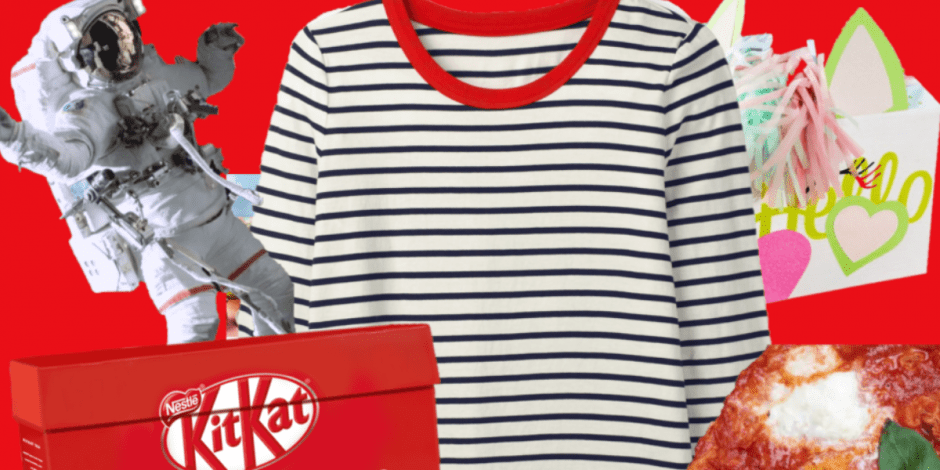
Breton shirts are the latest casualty of EU upheavals according to Boden. The retailer claims consent has been withdrawn for it to continue producing the French-inspired sartorial staple in the UK, and that anyone owning a Breton top will now need to apply for a special EU shirt license to wear one or face a €1000 fine. As such, it’s offering a thoughtful solution to customers: a Breton stripe removal service. The complimentary postal service erases illegal stripes by screen-printing, a technique the company calls ‘the Bret-off’. Boden’s founder has been giving interviews to the media this morning.
Travellodge: Bedshare service
In its bid to compete with sharing economy rivals, Travel lodge is taking sharing to the next level with a fresh ‘bedshare’ service that makes travelling a little less lonely and cheaper. Guests will get a 50% discount if they are willing to share half their room with another guest, and the company will clearly mark everything down the middle to make sure each person gets their fair share.
SodaStream: A wind-powered innovation
American astronaut Scott Kelly, best known for having spent the most time in space on a single mission, is the face of SodaStream’s newest innovation; SodaStream.ME, which turns people’s excess CO2 into sparkling water on the go. One small burp for man, one sparkling leap for mankind.
Discussing the campaign with The Drum, Scott Kelly said: “I have a SodaStream and really like the product. As a lover of our planet, I appreciate partnering up with a brand whose environmental values fall in line with my own personal beliefs.”
He clarified that: “You can’t burp in space. On earth – or in a gravity field – the gas in your stomach is lighter than air, so it rises opposite to the force of gravity. In space – in microgravity – there is no weight and hence the gas isn’t “lighter” than air, so it doesn’t rise. It stays mixed in with the food in your body, so it’s eventually expelled another way.”
Maryland: Avocado cookies
Forget smashed avo’ on toast, Maryland has taken the millennials’ favourite food craze one step further with the launch of its brand-new Avocado Cookie. Promising an “Instagrammable snack” like no other, the snack maker claims to have used “refined avocado powder” in lieu of flower, creating a super-food alternative to original cookies.
Hello Fresh: A bold unicorn box
What do brands think millennials love more than avocados? Luridly-coloured foods and Unicorn-themed products apparently. That’s why Hello Fresh is adding the ‘The Unicorn Box’ to its meal subscription box options. The first-of-its-kind experience contains three colourful recipe kits that will let diners eat “like a mythical creature with a box full of farm-fresh rainbows, smiles, and joy right at your doorstep”.
Honda: The polite horn
Sometimes drivers need to get the attention of others. But do they have to be so rude about it? In its mission to make roads everywhere more civilised, Honda Canada has launched a solution: the polite horn.
Origin: Sun power
Solar panel business Origin has announced it’s literally going the extra mile for customers and heading to the sun to power the entire planet, in a world first mission to capture solar power in its purest form. It says the traditional method of waiting for sunlight means we lose around 98% of its power before it hits earth. So, in order to capture the energy in its purest form, Origin has engaged some of the world’s greatest engineers to head into space to carve off a bowling ball size of the sun – which alone will be enough to power the world for the next 60,000 years.
Caring Skin: Astronaut facial
Space is a recurrent theme this year, with Singapore facial spa caring skin revealing it will be sending customers into outer space to clear blemishes and treat sensitive and inflamed skin. The 150-minute suborbital ‘pop-up’ treatment, dubbed ‘The Astronaut Facial’, is endorsed by influencers Camira Asrori and Cassandra Tan.
Google: Snakes on a map
Google prefers to celebrate April Fools’ day instead of tricking people. Last year, you might’ve seen Waldo peeking out of your Google Maps to invite you to find him on a scavenger hunt: This year, it’s revived another nostalgic game that takes people back to a much simpler, pre-Fortnite time: Snake. Confusingly, the ‘snake’ is now a train. Regardless, the twist on the 90s Nokia classic lets players ‘travel’ to different locations across the world—including Cairo, London, San Francisco, São Paulo, Sydney and Tokyo – straight from Google Maps.
Jägermeister: Introducing the Jägerbong
Just ahead of the 4/20 celebrations, Jägermeister has announced that it’s joining the cannabis market with the launch of the Jägerbong. Coming in at a clever $42, customer can light up the party with a kit which includes a 1L bottle of the aperitif they can recycle and turn into a bong, a bong carb, a hacky sack, eye drops, a lighter and grinder.
Aaron & Partners: Animals need lawyers too
UK law firm Aaron & Partners has launched an employment law service for pet influencers. Dogs, cats, fish and tortoises are just some of the species the firm hopes to work with. Standard employment contracts will be drawn up to suit the needs of each animal, including key clauses such as fixed nap times, allocated time for belly tickles or petting, and remuneration in snuggles and favourite treats.
BMW: Lunar paint
BMW has unveiled an innovative new feature that helps to “push the limits of electric driving”. From 1 April, BMW drivers will be able to add Lunar Paint as an optional extra to their i series vehicle. The product uses “revolutionary photovoltaic technology to harness the power of the moon and passively recharge your battery in the hours of darkness.” It’s what Neil Armstrong would have wanted.
Deliveroo: Crustless wonder
Delivery giant Deliveroo has revealed its plan to remove all crust options from the app, due to overwhelming anti-crust feedback from customers placing pizza orders across all of its 14 markets.
Like Tikes: Big Tikes
Kids toy maker Little Tikes will now be known as Big Tikes. The announcement reflects the brand’s “new found maturity” and is a nod to its fresh and grown-up approach. The new logo will appear across all brand channels and on social media.
KitKat: Tea time
After four years of intense research, Nestlé has crafted the optimal blend of tea leaves for the perfect brew to accompany its famous KitKat break. This tea has been developed in the brand’s very own Teaology labs and comes in tea bags inspired by the signature KitKat range: two-finger, four-finger and KitKat Chunky to fit every break occasion.
Amazon: Audible for fish
Amazon is giving Aussies the chance to get their fish hooked on literature with Audible for Fish – a three-second audiobook designed to keep underwater friends company while their owners aren’t around. It says research has shown that marine life is stimulated by short bursts of audio, sounds a little fishy to us.
London Dungeon & HSBC: Rugby torture chamber
Organisers of the HSBC London Sevens rugby tournament have announced a collaboration with macabre tourist attraction London Dungeon. The London Dungeon has installed a replica of its infamous torture chamber within a dungeon-style sin bin at Twickenham Stadium, where players will be sent on receipt of a yellow card throughout the duration of the nail-biting two-day event.
Zava: The Meata-blocker
Following a record-breaking Veganuary, it’s the dietary trend on everyone’s lips, and from today Brits can simply pop a pill to help them lead a plant-based lifestyle. Online doctor Zava’s Meata-blockers have meat-suppressing properties, diverting blood flow so that hormones involved in creating meat cravings can’t circulate around the body as efficiently. The pills also cause a decreased sense of smell and therefore less temptation when a tasty bacon sandwich is nearby.
Foodpanda: Jetski deliveries
A new mode of food delivery via jet blades has been revealed by Foodpanda Singapore. The innovation will “shave delivery times by half”, reducing it to 15 minutes or less. Not to disappoint Singaporeans, Foodpanda will be rewarding one lucky customer with a personal jet blade session (valued at S$198) with Ola Beach Club on Sentosa, with those who include ‘fpjetblad’ into the voucher code box until 5 April in with a chance of winning.
Wilkinson Sword: Casting Ken
Wilkinson Sword has appointed Ken Carson as the face of its Hydro 5 Sense product range.
Otherwise known as Ken Doll, clean-shaven Ken now can grow a beard… in seconds.
Le Chameau: Muddy boots
Building from the insight that people want an authentic outdoor experience, Le Chameau has launched an exclusive Pre Muddé service.
Pre Muddé offers boot lovers the desirable, well-worn country look, without even stepping outside. The boots arrive in soil curated by the brand’s expert pedologists (soil specialists).
Shutterstock: AI-serviced library
Shutterstock has announced plans to build the world’s largest brick-and-mortar library. The library is to house over 250 million volumes of imagery, a full-floor of 14 million reels of film and a listening bay where visitors can enjoy over 20,000 music tracks.
AI-powered robots call Cyanotypes are to replace traditional librarians, to ensure the building is open seven days a week, 24 hours a day.
Construction of the building is to commence in 2020 and will be designed by the world-renowned Belgian architect, Alexandria VonPixel.
Sainsbury’s: Pink avocados
Sainsbury’s is to stock a limited edition run of ripe and ready pink avocados – a naturally grown hybrid of different avocado varieties.
The supermarket has worked closely with a supplier in Peru to grow the exclusive Rosa-vo, which will go on sale as an initial trial to gauge popularity among UK customers and Instagram hungry millennials.
Nakd: Takeaway flavours
Nakd has expanded its range of bars with a series of savoury snacks inspired by Indian Takeaways.
The Indian ‘Flakeaway’ comes in four flavours: Vindalover, Poppadom Paradise, Korm-azeballs and Pilau Nice.
Cineworld: 4DX movies
Cineworld has done the impossible and brought snowfall in London, in Spring.
To celebrate the countdown to the arrival of its 4DX screens, visitors exiting North Greenwich station were met with an unexpected snowfall.
Snow is one of the effects 4DX can stimulate in the screening room, as well as wind, lightning, bubbles, water and scent work.
Hotels.com: Pet passports
With Brexit still up in the air, 75% of pet owners do know that their EU pet passports are in jeopardy.
To ensure pets don’t miss out on the beauty of the continent, Hotels.com has launched its first European Pup fakeation. It is a themed pet stay where dogs can enjoy European destinations without leaving the UK.
Royal Caribbean: Air space
Who says cruises can only be enjoyed on water? Not the Royal Caribbean, who has launched its first ‘cloud-class’ plane called ‘Master of the Skies.
Set to take off in 2020, the plane offers guests the chance to enjoy all the hallmarks of its cruises at 35,00 feet in the air.
When the seatbelt sign turns off, the plane turns into a dedicated entertainment zone that hosts an air-hockey table, a library of video games, as well as a whirlpool and dining area.
Subway: Listening in
As paranoia mounts around smartphone listening and ad targeting, Subway is the first brand to openly admit it makes use of covert research techniques.
In dramatic new footage released today, a Subway Sandwich Artist has been caught on camera, capturing overheard conversations in an unknown part of Great Britain. He can be seen hiding in bushes, behind a newspaper and dressed in state of the art military-standard disguises.
Benson for Beds: A royal visit
Prince Harry and Meghan Markle shocked shoppers at a central London store after they were spotted testing out mattresses.
With their ‘newly born’ baby in tow, the couple were seen browsing the Benson for Babies cot mattress section.
Spam: A vegan treat
Spam has jumped on the plant-based wagon, by launching a new variation of its iconic tinned food.
With a quarter of 25-34-year-olds identifying as vegetarian or vegan, Spam is re-positioning itself towards those decreasing their meat consumption, with ‘Vegan Spam.’
Duolingo: A passive aggressive owl
Learning a language takes a lot of work, perseverance and motivation. With this in mind, Duolingo has launched ‘Duolingo Push.’
Duolingo’s Duo is an online passive aggressive owl that sends you reminders when you need to practice your language skills, but this year, Duo will remind people to practice their language skills – in person.
Duo will turn up at your work, when you are on a date when you are at the gym to make sure you practice your French, Spanish, Korean, Klingon, High Valyrian or Chinese.
Muuna: Cheesy cannabis
Muuna has introduced a new flavour to its cottage cheese range. Muuna cannabis cottage cheese is a limited-edition variety, using milk from grass-fed cows.
Muuna’s limited edition Cannabis variety features cottage cheese as a base with a sprinkle of food-grade cannabis on the bottom.
Designed to create an element of carefree relaxation, while delivering an earthy taste, its latest offering will leave customers relaxed while keeping the munchies at bay.
Isobel: Brexit stamps
As the UK still looks set to exit the EU, a series of six stamps commissioned has been leaked ahead of their official release.
Created by isobel, the six first and second class stamps capture six Brexit ‘icons’ who are presented as famous historical figures complete with a relevant line of copy.
Theresa May is presented as the lady with the lamp – the UK’s first woman of nursing Florence Nightingale, while Boris Johnson has adopted a rotund Churchillian guise.
John Berkow, leader of the house is seen donned a suit of armour as Henry V with the line “Once more unto the lobbies!”
Virgin Atlantic: A sing-a-long
Virgin Atlantic is going back to their musical roots and trialling sing-alongs on key routes.
As part of an extension to the airline’s ‘depart the everyday’ campaign, passengers will be encouraged to join the crew for in-flight karaoke from shortly after take-off.
Highlights of the schedule include a Saturday Night Cabin Fever disco on weekend flights, mile-high hip-hop during flights to LA and non-stop Sinatra on flights to New York. Start spreading the news…
LinkedIn has added lookalike audiences to its ad offerings after beta testing the tool over the last year.
Lookalike audiences are nothing new, as Facebook has shown. LinkedIn’s director of product, Abhishek Shrivastava, said it “took us some time” to build the tool.
Marketers could already go to a platform like Facebook to discover new audiences using existing customer data. LinkedIn is now offering that for B2B marketers by making it easier to find company names or job titles.
Audience templates, another new offering, streamline the process of finding audiences. According to Shrivastava, it’s a one-step process that separates audiences job titles and functions into 20-plus templates.
LinkedIn has over 610m users and, according to Shrivastava, it has seen over 30% growth in the number of sessions per user over the last year.
“Because of all this activity happening on the platform by our members on an increasing basis…it allowed us to tap into a lot of the signals that have allowed us to create the lookalike product, which requires a lot of signals to do the modeling of who are users,” said Shrivastava.
LinkedIn also announced it will integrate Bing data for the first time into its ad products. Marketers can now leverage Bing data with LinkedIn’s interest-based targeting tool it launched in January.
“If someone searched for an article on digital marketing trends, that would map them to a category of being interested in marketing,” explained Shrivastava. “That list of categories is what we are exposing within our campaign manager on LinkedIn, to allow our customers to create campaigns to reach people who are interested in that particular topic.”
Shrivastava said connecting Bing and LinkedIn data “gives marketers the best of both worlds”.
Do you think online referral campaigns have any role in digital brand marketing? Yes, Of Course. According to the marketers, referral campaigns serve high in enlarging number of buyers and various marketing strategies can also done digitally(through Online) in order to promote brand as well as product. Conducting Online campaign is not a difficult task, just click to Webmarketing123.com refer the guidelines to get a basic idea of how to do digital brand marketing for online campaign referrals. Online Campaigns are carried out to create a center of attention on viewers mind about the existence of products, its brand image, how it is digitally promoted etc. To achieve this, most of the marketer selects referral programs as an important tool. Why is it so?
Because they believe in Buyers words and they know the power of it. The Words/feedbacks from the new buyer/ loyal buyers play a vital role in expanding the business. Once, the customers get satisfied with the particular product then they will act as brand ambassador in selling the products to the others. They will share information related to prices, after sales services, online payments etc, to others and Convert them to first time user then to repeat buyer then to prospect and finally to loyal customers. Try hard to get Good WOM (Word of Mouth) feedbacks in Online.
Importance of Digital Brand Marketing
Digital Brand Marketing is the marketing strategy of searching, investigating, encouraging, advertising, selling, and distributing a company’s brand. It encloses set of creating responsiveness on the subject of the brand, advertising, exposure, endorsement, pricing. As far as now, the people and Internet, both are in each other’s pocket. So, it is not a difficult task to advertise everything. The populaces have a fondness of goods or messages which ought to be pleasing to eyes and mind.
Referral Campaigns
Referral Marketing is one of the best marketing strategies to promote the products and increases the level of purchase among the customers. Almost, every sale will result in profit making, because it is done with buyers word of mouth. Referral Marketing is one of the best digital marketing strategies which help in saving time, cost, energy of the marketer. At present, online referrals and services are considered to be the most useful and effective marketing strategies where the new start ups as well as well established business people can make use of it.
Framework for Online campaign Referrals
Based on the ideas of https://www.webmarketing123.com, there are few frameworks for digital brand marketing to be carried out for online campaign referrals (Word of Mouth). The word of mouth is always requiring less investment of money. It is one of the low-cost methods to market your product and helps to bring large number of customers. It is done effectively through Online Referral programs, campaigns etc. The objectives for accomplishing the campaigns repeatedly develop the brand image and draw many buyers.
They are
Identify the target and try to aim on it with proper referral campaigns. Automatically helps in increasing sales, profit, goodwill
Use simple language to describe about your product and brand. It should be appealing and convenience to the buyers. Encourage the existence buyers to give positive word of mouth to the others. This will be done very easily by providing discounts, gift coupons, credit points, if they give referrals to others. Frame attractive SEOs where the customers get attracted towards it at the first look. Make use of Google Analytics to have track on success rate. Make the product available for full time in all social media. In everywhere the viewer has to see the product/brand details say in messages, blogs, email etc. Just have hope on Social Media. Make Staffs as lawyers for your brand. Instruct staff members to have a friendly communication with their known members about the brands.
Through Online referral campaigns, proficient web portals, the entrepreneurs can publicize their brands to the customers in an effective way. The Digital Brand Marketing is emerging at a higher level due to emergence of Internet. It applies so many electronic means and platforms to market a company’s business. Every folks use online for diverse reasons say for starting and promoting the business.
Social media marketing is a baffling area. It looks like anyone can do it: Post something (anything!) on social media, look for new content, talk with people, keep filling the Instagram page of your company with your most photogenic team. It sounds like a task for today’s social media age kids.
If you want your ROI to grow, though, that’s not the way to go.
It may look simple, but without economic resources, talented people and the right tools for the job, it is almost impossible to make social media marketing effective. This article will focus on marketing tools for social media. These SMM tools actually stand out because they are user-friendly and continue to improve in response to social media changes and trends.
According to the most important SMM tasks requiring automation, we’ve divided them into three groups: Social media management, social media monitoring, and social media advertising.
These social media social media management tools help you manage the workflow required by social media. So they really make it easier, more organized, less stressful and thus more efficient. Some of our favorites are here.
IFTTT is the freeway to get all your apps and devices talking to each other. Not everything on the internet plays nice, so we’re on a mission to build a more connected world.
IFTTT is a website as well as a mobile app. The free service was launched in 2010 with the motto: “Put the Internet to work for you”. However, in recent years it has changed a lot. You can currently connect all your “services” with IFTTT to complete tasks automatically.
There are numerous ways you can connect all your services – and the resulting combinations are called “Applets”.
Applets essentially automate your daily workflow, whether smart home devices or apps and websites are managed. For example, if you own the intelligent lighting system, Philips Hue, you can use IFTTT to automatically turn on a light each time you are tagged on a Facebook photo.
Buffer makes it easy for businesses and marketing teams to schedule posts, analyze performance, and manage all their accounts in one place.
BufferApp lets users manage a range of social media accounts, lining up updates to be shared in the future across a range of social networks.
Every time you find a post you want to share, a tweet you want to retweet, or whenever you write some content that you want to share out over time, you can add it to your Buffer. This places it in a queue and the posts are sent out in order, at times you have pre-selected.
This means that you don’t need to choose a date and time for every single post you want to schedule. You just add it to your queue, and Buffer does the work for you.
Buffer has a smooth, clean interface that is really enhanced by installing its browser extensions – a lot of its best functionality comes from these add-ons.
Quuu is the number one source for content and the only place where each and every piece has been hand-reviewed in house.
Quuu’s main goal is to increase your follow-up and commitment to social media by helping you post hand-curated content in your niche. Quuu sends relevant, high-quality content from its niche to its users every day, which they can easily program and post on their social media profiles via Quuu scheduler or any other tool such as Buffer or HubSpot.
These suggestions include a link to the content (article, blog post, video, podcast episode…) and a text containing relevant hashtags and social handles (making it easier to tag the author or source).
MeetEdgar is another programming tool that stands out for one reason: You can recycle old posts. This is more important than it seems: Content is forgotten and left behind even good and popular content. It is low-hanging fruit and too often a missed opportunity to recycle this old content so that it can get views again.
With MeetEdgar, you organize posts by category, schedule content by category, and then, every time the tool has gone through your scheduled posts, it will automatically post old content from each category so it can get attention again.
Price: $49/mo
Social Media Monitoring Tools
Social media marketing is divided into two processes. One is about the content you and your brand have. You create content, aggregate and share content with your audience and promotional content. The SMM tools discussed above to automate and optimize this part of social media marketing.
The audience is the second aspect of social media marketing. It’s your brand’s online mentions, reviews, questions, compliments, and complaints.
Although posting may be more important to raise brand awareness, it is also important to keep an eye on what people say about you and to respond appropriately. It’s almost impossible to manually find all brand mentions on social media, as people don’t always tag the brand even on social media platforms.
That’s why there are social media monitoring tools: To ensure comprehensive communication with an online audience. Here are some of the highlights:
Are you looking to bring your social media presence under one roof and get usable, real-time insights? Awario lets you join in conversations about your business after crawling the web and finding the people having those conversations.
When the web and social media are saying something about you, the Awario monitoring tool is able to pick up mentions instantly using non-stop monitoring in any language. This lets you respond quickly to what is being said, good or bad. You can then amplify the positive and clarify any negative comments or untruths regarding your brand before they get out of control.
Having a website and social media are now almost requirements for small businesses in today’s digital ecosystem. And once you create your channels, managing the different platforms and interacting with users takes a lot of effort. Being able to do it in one place, makes the task that much easier.
Mention offers real-time social media monitoring, and you can set up alerts for your brand, your competitors, and your industry. With this tool, you can view and respond to each like, tag, or mention (ah, see what they did there?) right in the app. You can also sort mentions by importance or significance, and even set up filters, including by source or by language.
If your budget is much wider, Brandwatch can be your tool. The analytical data of Brandwatch is highly visual: If you are an agency, it is perfect to illustrate the significance of social media marketing for customers.
Talkwalker is another tool at the company level that is without a doubt one of the most powerful on the market. It offers a wide range of filters, subfilters and coverage platforms. It covers not only social media, news sites, blogs, and forums, but also broadcasting, television and printing. The available data is nearly endless.
When you first created your Facebook profile, assigned your Myspace top 8, sent your first tweet, or uploaded your Instagram square, you probably had a sense that social media would change the way you spent your time, communicated with others, and received breaking news stories.
But as you signed up for your very first accounts or connected with friends online for the first time, you may not have predicted that a shift in the way we communicate online would also change the way we form opinions about where to shop, what to buy, and whose recommendations to trust.
And although the rise of influencer marketing happened virtually overnight, it feels natural, like we’ve never known a world without it. To go a step further, you may not even realize you’ve been a target of influencer marketing, and that may very well be the most successful part of this type of marketing.
In this article, we’ll explore what influencer marketing is, how effective it can be, and what you can do to reap the benefits for your own brand.
What is influencer marketing?
Rather than focusing on the marketing channel, such as email, social media, paid search, or print advertising, or the target audience, influencer marketing focuses on the people who could potentially influence their following to become new customers of a particular product or brand.
So while, yes, it’s Kim Kardashian posting a SnapChat about her favorite athletic wear line or Kylie Jenner talking about her new lip kits on Instagram, influencer marketing goes beyond just those who are keeping up with the Kardashians. Influencer marketing has consistently grown in almost every industry and across all marketing channels, and, truth be told, we’re pretty positive it’s here to stay.
DIFF charitable eyewear is a company known for using Instagram influencers to its benefit. From recent stars from The Bachelor to pageant contestants and fashion bloggers, DIFF’s social media presence is largely filled with photos curated from the feeds of influencers-turned-customers who review their product in exchange for some type of reward. Many times, the benefit can be free products, VIP privileges, or monetary payment.
DIFF’s social media feed reflects their influencer strategy, featuring real people wearing their product.
How to identify an influencer
So, isn’t “influencer” just another name for a celebrity? Yes and no. Because our online lives have opened us up to connecting with more people who share our interests than ever before, we can also follow along with others’ lives in a new way.
Gone are the days of limiting the term “celebrity” to only popular musicians, actors, or writers. Now, as smaller niche audiences gather across all media channels and turn to people they idolize in their own field or industry, the term influencer has broadened.
A survey from Nielsen showed only 33% of consumers trust advertisements, while 90% put their faith in peer recommendations, which is why influencer marketing is definitely something worth paying attention to.
Number of followers
There is no definitive scale to determine an influencer’s status, but their number of followers is the first place to look. Think about it: Never before have we had such accurate numbers for one’s followers or reach. Before social media, we could measure a person’s influence by box office numbers or albums sold, but none of those statistics would come close to the precise measurement we now have in a social media following.
And because social media appears to be a way to gain inside access to the behind-the-scenes of stars’ work and personal lives, it instantly feels more authentic than other mediums. We can see beyond the stage or screen.
This image from Sprout Social shows the types of people you may consider to be an influencer:
Finding an influencer in your industry
Influencers of all levels can be found in almost any industry. Let’s say you run a business that focuses on email marketing (Can you imagine?!). When brainstorming, you may come up with the following ideas for who you could consider influencers:
Entrepreneurs who send lots of emails to their customers
Podcast hosts who talk about marketing
Famous bloggers who send their content via newsletter
Experts in other areas of marketing, such as social media
There’s no magic formula for finding an influencer for your niche, but you want to find someone whose followers listen to them and take their opinions seriously.
Micro and macro influencers
As the number of influencers continued to increase, we needed a way to measure one’s influence, especially when compared to others. While we all know the potential for this to change at any moment, the categories micro and macro influencers have been created as an unofficial way to differentiate various people with moderate to large followings.
Social Media Today identifies micro influencers as those with less than 10,000 followers and macro followers as those with more than that.
While there’s still plenty of gray area when it comes to differentiating between major and minor influencers, the emergence of these terms shows that the number of influencers will continue to expand and you can expect the effectiveness of influencer marketing to grow with it.
As content creators get better and better, consumers will have more choices for who to follow and how to spend time online. It only makes sense that more niches will be created and therefore, brands and consumers alike will have more influencers to look to.
Why influencer marketing works
Since everyone’s following grows over time, some people believe that influencer marketing may be on the decline. But influencer marketing is more than just the people doing it—the authentic connections followers make with influencers is something that, in one capacity or another, will continue to increase.
A trusted friend
Have you ever texted a friend for a recommendation for the next book you should read or asked where she got the jacket she’s wearing? Our personal connections can be our biggest motivators, and we’re much more likely to choose one brand over another if a friend or family member has given us input on a decision.
At its core, influencer marketing is the same thing. With or without a real-life personal connection, we’ve specifically chosen who to follow on social media and have grown accustomed to seeing glimpses into their personal life. We trust them, which is why we’re much more likely to buy something from their already-vetted recommendation versus a paid ad for a product we’ve never seen before.
Here’s an Instagram post by former Bachelor contestant JoJo Fletcher on her favorite hair tools. She currently has 2.2 million followers, making her a macro influencer.
Authenticity: The secret sauce
So, why exactly is influencer marketing so effective?
Because it feels more natural and trustworthy that traditional advertising.
As email marketers, we couldn’t stress the importance of personalization enough, and we’re always trying to write messages for people, not inboxes. But influencer marketing has also raised the bar on authenticity and custom messaging.
No longer will we blindly order something we receive a printed ad for in the mail. We’ll probably look up its Amazon reviews, ask friends how they feel about the product, or look to other online experts we trust.
A study by Mediakix revealed that the influencer market is currently worth over 1 billion dollars, and this number is projected to soon double. But does this mean these type of promotions will remain the same? Yes and no. We predict that authenticity and trustworthiness, two tactics that have far outlasted the rise of influencers, will remain the best way to approach marketing, but as always, the mediums, channels, and people involved will continue to evolve.
More and more influencers are making their full income from their blog and social media, so as their experience rises, the more likely they are to have working partnerships with brands. However, this is an area where you should work hard to preserve authenticity, rather than become just another sponsor of their website or podcast. Keep it real!
One of the longest-running examples of influencer marketing is Michael Jordan for Nike. Here’s influencer marketing at work in an email marketing campaign for Air Jordans, named after the basketball player himself:
Is influencer marketing a good choice for my brand?
As a whole, the influencer marketing concept is worth trying for most brands, but how you do it is completely up to you. Unlike most paid advertising strategies, the formulas to success are not clear-cut, and the input and output can vary greatly for each brand.
For example, you’re not always working with a set amount of money: Now, influence and product have become their own forms of currency. Create a strategy that casts a wide net of potential influencers and hones in on the people who you’d most like to represent your brand to new customers. Be sure that the influencers you work with share the same values as your brand. Of course, people are more unreliable than paid ads you write yourself, but that’s the risk you take in the name of unfiltered authenticity.
Wrap up
As you can see, influencer marketing isn’t just for large brands who have connections with big-name celebrities. Even if you’re an entrepreneur for a small business or feel like your industry doesn’t have famous thought leaders, it’s definitely worth the extra research and effort to explore.
And regardless of your partnership status with influencers, trustworthiness and authenticity should be the focus of your marketing strategy, regardless of brand, industry, or platform.
If you’re a brand looking to share customer testimonials or influencer content with your audience via email, reach out to us for a demo today.