Tag

Online Businesses

Browsing

By Sherin Shibu|Edited by Frances Dodds

Key Takeaways

  • Nuseir Yassin is the founder and CEO of Nas.com, an AI-powered platform that helps solo entrepreneurs launch online businesses from a single product photo.
  • Yassin left his software engineering job to travel and create Nas Daily, a one‑minute video series he produced daily for 1,000 days.
  • With Nas.com, he is productizing his storytelling and growth experience into tools that automate storefront creation, marketing content and ads for small business owners.

He grew his social media accounts to over 70 million followers across a decade. Now, content creator Nuseir Yassin is crafting a platform to address a common desire he encountered while interacting with thousands of individuals for his social channels — the desire to be their own boss and start their own business.

Yassin is the founder and CEO of Nas.com, an AI-powered startup designed to help solo entrepreneurs start and grow their online businesses with a single product photo. Yassin studied economics and computer science at Harvard University, graduating in 2014. He started his career as a software engineer at Venmo.

In 2016, Yassin left his job to travel the world and document his experiences, launching Nas Daily, a one-minute video series that he sustained for 1,000 consecutive days and grew to a global media brand.

That venture into content creation, spanning 19 languages and multiple social networks, gave Yassin deep insight into storytelling, audience growth and digital marketing. With Nas.com, he is turning those lessons into software. The platform, which he founded in 2022, automatically builds storefronts, generates high‑performing marketing content and runs ads for creators and small business owners, lowering the technical and marketing barriers to solo entrepreneurship.

The platform has already minted four millionaires and earned funding from the likes of Vinod Khosla, a venture capitalist who made early investments in OpenAIStripe and DoorDash.

The following interview has been edited for clarity and concision.
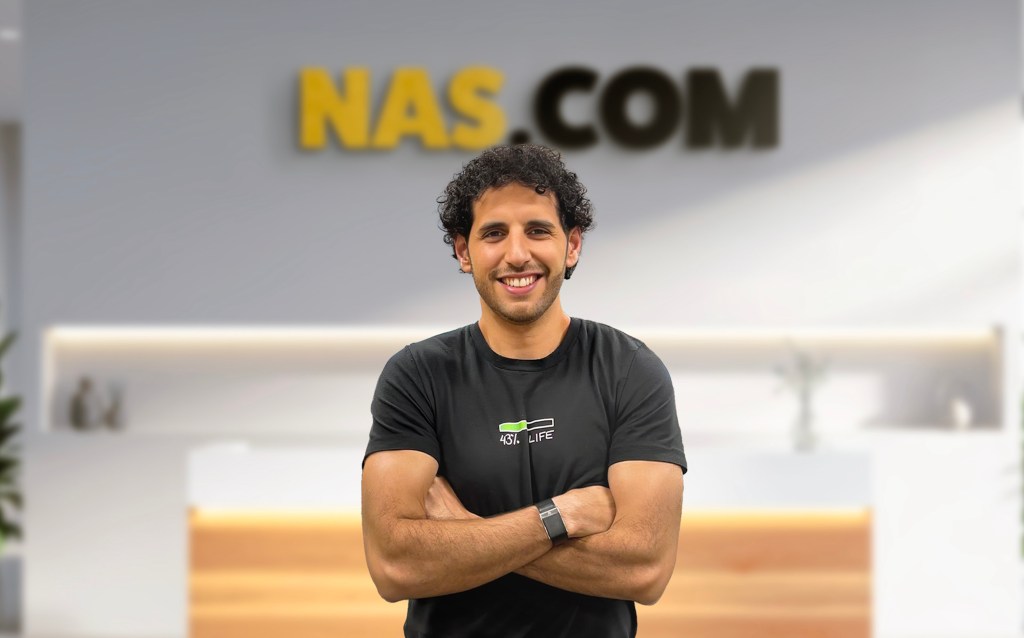
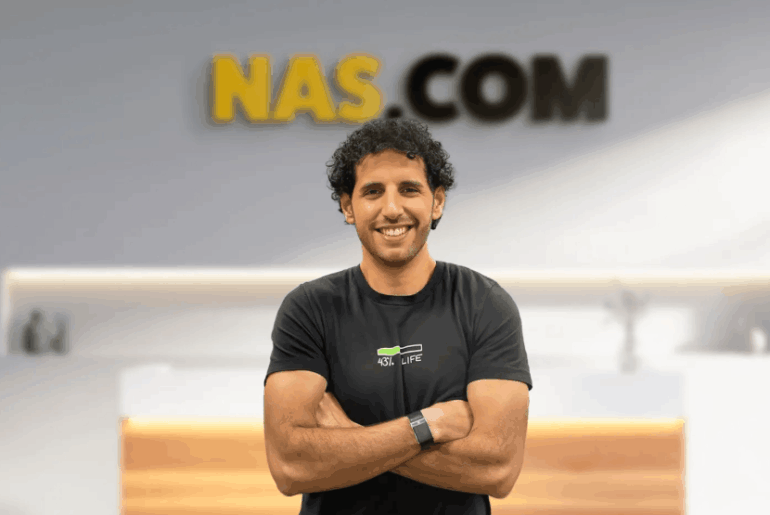
Nuseir Yassin. Credit: Nas.com

Pitching Nas.com

For someone who’s never heard of Nas.com, what’s the most concrete way you explain what it does for a solo seller in their first week?

In the first seven minutes, you take a picture of whatever you want to sell, and we handle everything else to help you find a customer to buy that thing. With that one picture, AI creates your store, makes your marketing, and helps you find the customer.

It really comes down to three main things: you can sell any product you want, market the product, and get paid. You upload a single picture of whatever you want to sell—yourself, your products, your candles—and AI automatically creates your product page, sets pricing and options, writes the content, and can even generate a video. With one click, you can market that product on Instagram and Facebook directly through Nas.com. We’ve simplified what used to be three difficult skills—coding a website, creating content and doing performance marketing—into one simple interface to create more entrepreneurs in the world.

His content background

You have a decade of experience creating content. How successful were you?

Across the internet, Nas Daily reached about 70 million followers and more than 20 billion views. We have around 5 million followers on TikTok and 55 million on Instagram on the Nas Daily channel. I built Nas Daily across virtually every social media channel and many languages: Nas Daily Arabic, Nas Daily Indonesia, Nas Daily Spanish, and more — 19 languages and six platforms in total, with about 70 million followers overall. It became a great lifestyle business, but I realized the bigger opportunity is being the platform for others rather than being the influencer.

What did it take to get that many followers?

It felt like eating glass. I made 1,000 videos in 1,000 days straight, which is where the name Nas Daily comes from. Each video took about 15 hours to make, and I produced them from 64 countries. The first 270 videos failed, and it was video 271 that finally broke through. To get attention and build a social media following, you need an irrational work ethic and passion. I don’t recommend it for everyone; at a certain level, it becomes a security concern and isn’t necessarily a healthy way to live. What I do think is for everyone is building a business and working for yourself.

What kind of content did you put out in those 1,000 videos?

I travelled around the world focusing on whatever was interesting about people and places. I looked for the most interesting people—founders of companies, people doing crazy or inspiring things—and made videos about them, plus personal stories. For example, I did a video in Bhutan about it being one of the most romantic countries, showing a nation that’s one of the least visited in the world. Another video covered the woman founder of Miami—Miami is the only major U.S. city founded by a woman—and others included a video about my friend’s death and my experience with Wikipedia. “Nas” means “people” in Arabic, and the channel was really about everyday people.

Origin story of Nas.com

How did you get the idea for Nas.com?

While building Nas Daily, I met roughly 100,000 people in person. I saw in many of their eyes that they hated their jobs and lives and had a constant desire to do something different, work for themselves, and control their own schedules. I’d already experienced the difference that working for myself made in my life; at Venmo, I was overpaid and underworked—I worked about four hours a day and made over $100,000—yet felt no meaning or passion. When you work for yourself, your life changes, and I wanted others to experience that. Helping them build their own businesses felt like the starting point.

What did it take to leap from content into an AI‑driven business with generated ads and storefronts?

We’re careful not to send the message that this is “easy money.” If you think one click of AI will create everything and you’ll just sit there printing money, that’s not our positioning. Our message is: life is better when you work for yourself, and now technology can help you do that through this business platform. It still takes work to build a business; it’s still hard, but it doesn’t have to be as hard as it used to be. In the past, it could take two months to start selling online; now it can take as little as five minutes. You can take a picture, start a free trial, and accept payments within about ten minutes.

Nas.com has created millionaires

How many new entrepreneurs has Nas.com created so far?

We’ve had hundreds of thousands of people express interest in building a business. We have tens of thousands of paying users running active businesses on the platform. The big success is that we’ve created four millionaires on the platform.

Could you tell me a success story?

One big success story is a woman in Singapore who teaches financial advice under the brand “Singapore Budget Babe.” She monetized her financial knowledge on the platform and made over a million dollars. Another story is a 60‑year‑old farmer in Mexico who wanted to build a business teaching farming; he now makes about $1,000 to $2,000 a month on Nas.com. I consider that an incredible success because technology used to gate people like him out, and we’ve made it simple enough for him to participate.

Those four millionaires you mentioned — what industries are they in?

They’re in very different industries: one in events, one in education, and one in fitness, among others. The beauty of Nas.com is that you can sell almost anything. We support all types of products: physical goods like candles and cookies, events (for example, meet‑ups after you’ve sold 1,000 candles), memberships (such as 20 dollars a month to join a network), and coaching (like teaching others how to make candles). Our users all share one thing: they want to work for themselves as solo entrepreneurs, but they monetize in many different ways.

Finding customers and marketing

How do you help sellers find customers?

It’s all about integrations. We help you create the content and then we help you run ads. For example, for a “Dubai Entrepreneur Networking Night” event, a user spent about $200 on ads we ran on Instagram and Facebook. That resulted in 32,000 views, 971 page visits, and 130 ticket buyers. We aim to be your marketing arm across channels like Meta, TikTok, Google, and eventually Amazon listings, which would otherwise be too complicated for most people to manage on their own.

How do you determine what goes into an ad?

We have 10 years of experience creating content and understand what makes a good or bad piece of content. We’ve turned that experience into programmatic “styles” that tend to perform well. For example, if you’re selling a candle, we might create a UGC‑style or unboxing‑style video. We know the script should begin with something paradoxical or superlative—“the best candle,” “the worst candle,” “the healthiest candle,” “the coolest candle”—and we generate that script using AI, guided by our internal rules about what makes a strong ad. This kind of automation would have been impossible five years ago, but AI now allows us to generate effective ads quickly.

So you create the ads using AI?

Yes, the ads are all AI‑generated. As of two weeks ago, AI has gotten good enough that the average person often cannot tell the difference between an AI‑generated ad and a human‑made one. I expect that by the end of the year, about 90% of AI ads will be unrecognizable as AI to 90% of humans.

Pricing and competition

How much does it cost to use the platform?

Pricing ranges from as low as $10 a month to up to $99 a month, with an average of about $30 a month. For roughly $1 a day, you get your own website, payment processing in every country, AI-generated marketing content, the ability to list unlimited products and ownership of your customers.

How does the company make money?

We make money through subscriptions, a small cut on marketing spend and a small cut on some transactions. If you advertise $100 through our platform, we take about $5. We also take about 1% on some transactions, but we charge 0% on physical products because we want to be competitive as an alternative to Shopify, at least for now.

Is Shopify your main competitor?

Essentially, yes. Shopify is an amazing $150 billion company, but it doesn’t work well for new entrepreneurs. It’s too complicated and doesn’t help you with marketing. The entrepreneur’s priorities are: first, product; second, content; third, marketing — using that content somewhere. Shopify focuses mostly on creating the product store, whereas we focus on helping you create content and then market it. Many Shopify users have a store but don’t know how to get traffic to it, and that’s what we aim to solve.

Growth, traction and fundraising

How many people are on the Nas.com team, and where are they based?

We’re about 40 people. Engineering is based in Singapore, and marketing is based in the United States, and I’m the founder and CEO.

How much did it cost to start the company?

A lot. We’ve raised a total of $40 million, including $27 million in the round we’re now announcing. Building technology is very expensive if you want really good engineers, but I believe the opportunity is in generating billions of dollars’ worth of value in the form of new businesses on the internet.

How much in sales did the company do last year, and what is it projected to do this year?

Last year, we started at about $1 million in annual recurring revenue (ARR) and ended at around $8 million in ARR.

How Nas.com grows

What tactics do you use to grow Nas.com?

We grow Nas.com using Nas.com. We market Nas.com with Nas.com because we’re also a business on our own platform.

Can you give an example of that?

In Mexico, we run an operation called ECO Mexico by Nas.com. We built that business on Nas.com and sell a product called “Build your own e‑commerce in 2 hours.” Around 4,000 people signed up for it and came to events where we introduced them to Nas.com. We found those people by marketing ECO Mexico through Nas.com itself, and we host workshops and events for potential new customers to try the platform and build their businesses on top of it.

How do you market these products and campaigns?

We create different events for different campaigns in different markets. Inside my own Nas.com account, I have hundreds of businesses I’ve started — Miami Social for Miami entrepreneurs, an education business, internal company businesses, and even a clothing business where I sell my t‑shirts. In the clothing business, I have about 200 members and made around $3,000 selling t‑shirts as a test, with the revenue going to my bank account every two weeks.

Nas.com’s value proposition to investors

What about the company was attractive enough to draw investment from someone like Vinod Khosla?

Vinod is one of the biggest champions of entrepreneurs I’ve ever met; he truly cares about the “small guy” and “small girl” who just want to work for themselves. He understands our mission and sees that existing solutions are too complicated and B2B‑oriented. Shopify, for example, is built for companies like Apple or Tesla, not for a mom in Wisconsin who wants to sell her creations. Vinod believes AI will make everything accessible to the “little guy,” and Nas.com is explicitly designed for that user.

Advice for founders and entrepreneurs

What hard, concrete advice do you have for founders?

I hope you enjoy eating glass. I hope you enjoy doing hard things. Starting a media company or a channel is difficult, and starting a technology company is difficult. More generally, building something out of nothing is hard — whether it’s a human giving birth to a baby or a founder giving birth to a company. My advice is to “choose your hard,” because whatever you do will be hard.

What makes the road to entrepreneurship easier?

AI will make it easier, and I believe that 100%. If you couldn’t speak English before, now AI can help you communicate in perfect English; if you couldn’t make content, now you can. If you couldn’t do marketing before, AI can help you market. But it still won’t be a walk in the park.

When it comes to this specific business, what have you found particularly surprising?

I’m most surprised by how fast technology has advanced in the last three years. What used to take me 15 hours per video felt like an irreplaceable skill set, and I thought no one else would have access to those capabilities. Now AI can replicate much of that in seconds. Technology has evolved so quickly that if a company “sleeps” for a month, it can find itself out of business.

Feature image credit: Nuseir Yassin. Credit: Nas.com

By Sherin Shibu

Sherin Shibu is a business news reporter at Entrepreneur.com. She previously worked for PCMag, Business Insider, The Messenger, and ZDNET as a reporter and copyeditor. Her areas of coverage encompass tech, business, strategy, finance, and even space. She is a Columbia University graduate.

Edited by Frances Dodds

Sourced from Entrepreneur

By John Hall

If you run a small, local business, chances are you’ve got some sort of a website. You may even be set up to sell a few products online, here and there. But you may not have tapped the massive potential of building out a real e-commerce arm for your business. And you might not realize just how easy — or how lucrative — it’s become for small, local businesses to move online.

If you’re still mostly bound to brick-and-mortar, it’s time to consider a change. Here are some low-risk, high-reward ways to successfully scale into the digital world.

1. Do a Digital Reboot

As noted, you may already have a great website or even a decent online store. But it’s likely you could be doing much more to make it competitive with other e-commerce sites in your niche.

If it isn’t already, your site should be hosted on—or at least integrated with—a platform that’s designed for e-commerce, like Shopify, Squarespace or BigCommerce. Make sure it’s easy to use, intuitive to navigate and has a clean, simple design. It might be worth having a specialist conduct a user experience audit.

Perhaps most importantly, ensure your site is optimized for mobile users. Remember that 91% of Americans ages 18 to 49—likely the bulk of your target customers—shop on their smartphones. Most web design platforms let you convert your desktop designs to mobile layouts almost automatically. But you still need to make sure the mobile version is attractive and usable.

2. Leverage the Power of Online Testimonials

Getting good product reviews on your site and on other platforms can do wonders for your business. Consumers don’t trust brands, but they trust other people’s experience of a brand or product. Positive reviews can be just as effective as hearing directly from people they know in real life.

Smallbiz Technology recommends that businesses feature reviews and testimonials directly on their website and social media channels, natch. But they also note that positive reviews on third-party sites like Google, Yelp, and Trustpilot can generate tons of traffic.

To encourage customers to write reviews, they suggest offering customers free products or discounts as incentives. But note that if you sell products through a marketplace like Amazon, exchanging gifts for reviews could violate their policies. Alternatively, you can reach out and simply ask customers who like your product to take a moment to do a short write-up.

3. Offer Convenient Payment and Shipping Options

Your customer won’t buy from you online if you don’t make it as easy for them as shopping on Amazon. It’s imperative to offer fast, free or cheap shipping and eliminate any trace of friction from the shopping experience. The smallest details can send a customer packing even when they were already pretty serious about making a purchase.

Whatever you do, don’t force your customers to create an account before checkout. That’s one of the fastest ways to turn a ready-to-buy customer into one who’s just closed your site’s browser tab. It’s also vital to offer a number of convenient payment options, including PayPal, Apple Pay and Google Pay in addition to the standard credit cards.

Packing and shipping your own orders in-house may save you money when you’re just starting out. But as a small business, you don’t have the infrastructure to keep doing that at scale. Eventually, you’ll need to contract with a third-party fulfilment service. Shopify offers its own in-house option and maintains a list of other recommended fulfilment services you can try.

4. Be Smart About Email Marketing and Social Media

One advantage you have as a small local business owner is that you already have a devoted following. You’ve got people in your corner who support your business and want to see it flourish. If you create content that speaks to your biggest champions, they’ll be excited to share it with others.

Email marketing remains one of the best ways to drive engagement and sales for your brand. After all, it’s one of the few forms of brand communication that customers actually enjoy receiving. Still, carefully consider your content—you don’t want to irritate your loyal fans with ads for the same old products. Use email to make announcements, share informative blog posts or offer valuable discounts. That’s the kind of content your devotees will be happy to pass along to their friends.

Social media is likewise a powerful tool for bonding with current customers and reaching new ones. This is especially true if you actively engage with users, such as responding to Instagram comments or stitching videos on TikTok. Partnering with influencers through a platform like Grin or Afluencer could also help drive engagement.

Don’t Reinvent the Wheel

As recently as five or 10 years ago, small businesses had to transition to e-commerce on their own. They needed their own systems for everything from packing and shipping to handling customer service to accepting credit card payments.

All that has changed. Now, there’s an easy, affordable third-party solution for just about any e-commerce problem you can think of. You’ve already got a small, likely overworked staff. Don’t make them—or yourself—create systems from scratch when there’s probably a ready-made solution a short Google search away.

Feature Image Credit: getty

By John Hall

John Hall is a top motivational speaker and the co-founder of Calendar, a scheduling and time management app. He’s also an adviser for the growth marketing agency Relevance, a company that helps brands differentiate themselves and lead their industry online. You can book him as a keynote speaker here.

Sourced from Forbes

By

  • Many Americans are looking for easy and entrepreneurial ways to make money.
  • Some are creating online businesses, which often have lower startup costs than brick-and-mortars.
  • Here are five of the easiest types to start, including content creation, coaching, and marketing.


Suss out the need for your potential online business

Businesswoman Working with Document
Conduct market and consumer research to determine what’s needed.
Morsa Images/Getty Images

It’s important for aspiring founders to ensure that the product or service is needed in the marketplace, said Cynthia Franklin, an entrepreneurship professor at New York University.

When deciding what type of business to start, “looking at where societal forces are heading and seeing if you can get ahead of the trend” is a good start, she said.

“Start with scratching your own itch,” Franklin suggests for aspiring online business owners. “Whatever you do, find something you care about because you’re going to need to put a lot of time and energy into making it succeed.”

Here are 5 of the easiest online businesses to start in 2023.

1. Content creation and social-media management

Lauren Mabra and Lauren Ferry
Lauren Mabra and Lauren Ferry founded the social-media content agency Lauren Labeled. courtesy of Lauren Labeled 

Content creation and social-media management can be simple and lucrative businesses to start. With many free or cheap platforms and editing tools, the field has low financial barriers to entry and is popular given social media’s prevalence. But popularity also means the competition can be stiff.

Lauren Mabra and Lauren Ferry are the Gen Z founders of the social-media advertising agency Lauren Labeled, which launched in 2021.

Their business helps other brands write, film, and produce social-media advertisements and campaigns. They specialize in marketing meant to reproduce the look and feel of user-generated content, or the kind of material an everyday social-media user might post from their iPhone, Mabra said.

“We saw that it was a broken system,” Mabra said. “Businesses either had to do it in-house — and a lot of teams are already short-staffed and overflowing with tasks — or they are going to influencers and paying $2,000 for one single video. How sustainable is that when you need new videos every single week?”

Before Lauren Labeled’s website launched, it already had a waiting list of customers, Mabra said. Now, the business regularly books five figures in revenue a month, documents verified by Insider show.

2. Coaching

Jessica Hawks (left) and Amy Lee (right)
Jessica Hawks and Amy Lee are virtual coaches. Jackie Sterna, P. Mastro


Online coaching has grown in recent years, whether entrepreneurs are offering virtual workout classes, leadership advice, or guidance on starting a business.

Amy Lee, for instance, is a life coach. She booked nearly $60,000 in revenue in her first 10 months in business, documents verified by Insider show.

There are no required credentials for life coaches, Lee said. While this can make some coaching communities seem like the Wild West, it also creates a low barrier to entry for professionals looking to enter the space.

Other types of coaches, like Jessica Hawks, seek to help their clients build startups.

Business coaching is an option for those who want to share their expertise in a certain field. Hawks started her online career as a virtual assistant, and when she realized her community was looking for advice on starting their own VA agencies, she launched her coaching program, the Digital Creatives Academy.

Hawks books seven figures in sales a year, documents verified by Insider show.

3. Blogging

Lisa Andrea, founder of The Financial Cookbook
Lisa Andrea, the founder of The Financial Cookbook. courtesy of Andrea

Blogging is another popular business avenue, especially for those who can share knowledge about a particular subject.

For instance, Lisa Andrea, the creator of The Financial Cookbook, started her blog as a side hustle in 2021. She shares tips on how to become financially independent and on investing, along with other money guidance. “The Financial Cookbook is a guide for everything they should have taught us in school,” she previously told Insider.

Her income streams include affiliate marketing and brand partnerships. She recommends other bloggers and digital founders take advantage of company affiliate programs by applying to be part of them online, as she did.

But it’s also important to stay authentic and work only with companies that align with your brand messaging, she added. That way, your community will stay engaged and be more interested in the links you’re promoting, which can help you earn more money.

Andrea regularly books $8,000 in monthly revenue, documents verified by Insider show.

4. Virtual assisting

Vivian Purcell
Vivian Purcell is a full-time virtual assistant. courtesy of Purcell


Vivian Purcell is a virtual assistant who lives in Canada. She started her online career as a freelance writer in 2016, seeking flexibility to travel and live wherever she wanted, she said.

“I did the switch into virtual assistant because I wanted to bring in more of my corporate experience and educational training into freelancing to offer something of higher value,” she said.

Purcell earned more than $132,000 in 2022 sales from her virtual-assistant work, documents verified by Insider show.

Virtual assistants can work with both small-business clients as well as major firms looking to hire contract or one-time employees, said Arun Sundararajan, a professor of entrepreneurship and technology, operations, and statistics at New York University’s Stern School of Business.

“It’s getting increasingly hard to hire full-time employees for anything,” said Sundararajan, who is also the author of “The Sharing Economy.” “So more and more businesses that didn’t consider gig work are now considering gig or freelance workers as an option.”

5. Marketing

Cody May
Cody May is a founder and a digital nomad. courtesy of May. 

Cody May is a digital-nomad founder who built his business entirely online. He runs SheridanSt., a marketing firm for real-estate agents.

SheridanSt. helps agents with tasks like lead generation along with call and email marketing. In 2017, he left his corporate role and applied his marketing experience to start StudioPTBO, the precursor to SheridanSt. Then, in 2021, he connected with his current business partner, who worked in real estate, to relaunch the company within the real-estate niche, he said.

He’s recruited most of his staff by offering a fully remote, travel-friendly workplace, he added. What’s more, online real estate is a hot sector: The National Association of Realtors’ 2022 Profile of Home Buyers and Sellers report found that 51% of this year’s buyers found the home they purchased online.

Feature Image Credit: lemono/Getty Images

By

Sourced from INSIDER

By

Entrepreneur Patrick Sargis, a full-stack digital marketer, is also an apt example. Everything that an entrepreneur has achieved today is the result of his passion and commitment.

It is the dream of billions of people in the world to make it big in life. Many take risks, work hard day and night, and know-how to thrive their business and attract money. We have many examples in every part of the world. But the common thing about every successful person is – they have put a lot of effort to achieve their goals.

Entrepreneur Patrick Sargis, a full-stack digital marketer, is also an apt example. Everything that an entrepreneur has achieved today is the result of his passion and commitment.

Patrick Sargis is the Founder and CEO of Marketers Edge and several other online businesses. Sargis started generating online income at a very young age, thanks to his phenomenal skills and in-depth knowledge as a digital marketer. He is a college dropout, but that was never an issue as he was always focused on his goals.

By the age of 24, he generated multiple millions online. The year 2018 was a major turning point for him. He launched his first Ad offer on the Cold track. He scaled his first Ad to $100,000+ in sales in just 40 days. It continued this way for months, and gradually, he started getting more clients and more money.

Furthermore, about his venture, Marketers Edge founder Patrick Sargis shares, “I help 7, 8, and 9-figure businesses scale with better marketing. I’m one of the best ‘conversion multipliers’ in the world. Some of the services that I offer to my clients consist of strategy, copywriting, optimization, and sales funnel creation services.” In addition, Sargis offers courses and assessments to his clients who want to grow their business on a larger scale in a small amount of time.

If you visit Sargis’ website https://marketersedge.com/, you will see what his venture offers to people in the best way. The text that immediately catches your attention on his site reads, “We Help Businesses Scale With High-Converting Sales Funnels & Elite Copywriting”.

If someone can make their site appear so captivating, it is obvious that to ensure client satisfaction, Sargis and his team do their best and come up with out-of-the-box ideas all the time.

Today, Entrepreneur Patrick Sargis is an inspiration to thousands of young aspirants who wish to thrive in the field of digital marketing. While some are close to achieving their goals, many are unsure how to go about it.

Today’s youth often worry about the result as not every time; it is what they desire to be.  For such people, Sargis has some motivating words. He says, “Become the best in the world at your skill-sets. Find the best in your industry and pay to learn from them.” For those who have set their foundation in the field and are new, the entrepreneur has an interesting tip.

He says, “A simple tweak to your copy or sales funnel can immediately 2X, 3X, 5X, or even 10X of your sales.”

In every work we do, having an expert’s suggestion or feedback is important. Sometimes, we get such advice directly or by reading about their work or interviews. So Patrick Sargis, one of the most proficient digital marketing experts, was also asked for a suggestion that he would give to his clients who want to improve their business.

The entrepreneur says, “Your offer is by far the most important aspect of your business. You can sell a great offer with a common copy, but you can’t sell a common offer with a great copy. If your offer isn’t a ‘hell yes’ to your target market, you’re not going to be able to scale long-term.”

If you wish to connect with Patrick Sargis, here’s his LinkedIn profile link – https://www.linkedin.com/in/patricksargis/.

Feature Image: Patrick Sargis

By

Sourced from INFLUENCIVE

Aside from the fact that starting an online business is something you do when you have a great solution to offer people and also is something, you’re passionate about, you also start an online business because you want to have the ability to work on your own schedule and not be limited in how much you can earn.

However, not all online businesses will offer you that freedom and flexibility that you desire, so if that’s what you’re looking for, then in this post we’re going to share with you some of the online businesses that offer the most flexibility.

Freelancing:

Freelancing is probably one of the easiest ways to start an online business – especially if you want to start making money as quickly as possible. The great thing about freelancing is that you can start with very little to no money and build a successful business very quickly. Whether you’re working as a freelance copywriter, graphic designer, or even as a freelance tax consultant, as long as you’re able to provide a service and solution that solves a real problem people have, then you’re going to find freelancing to be a very rewarding business where you have lots of flexibility around the schedule you work, the money you make, and the clients you work with.

Coaching:

If you’re a people person, then a career as a coach is something that’s very flexible and rewarding, but it’s definitely something that you have to be passionate about. The great thing about coaching is that you can do it with very little technical setup and money and because you can work with clients online then you can work on a completely flexible schedule. If you decide to go down the coaching route, then you can choose to work as a business coach, a health coach, a fitness coach, or even a parenting coach.

Blogging:

If you’re someone who loves to write and would like to turn this into a business by writing about things, you’re passionate about, then blogging is a great way to make this happen. As well as being totally flexible and enjoyable, you can make great money as a blogger as long as you’re putting out consistent and good content. It doesn’t matter if you’re writing about software development companies like Praxent or if you’re writing about fashion, the content needs to be of value to people.

Affiliate Marketing:

Affiliate marketing is definitely an extremely flexible business that you can start because it’s very hands off. Although it definitely takes some work to build up in order to start making money from affiliate marketing, it’s worthwhile, so if you’re looking for something that you can work around your other commitments, then affiliate marketing is a good option. One of the best things about affiliate marketing is that you’re going to be making money by recommending other people’s products and services, so there’s really no content that you have to create, and since many of these products and services are subscription based, you can make money on repeat from something you’ve recommended previously.

By Ryan Kh

Sourced from Catalyst for Business