For years, one of the clearest signs that an out-of-home advertising campaign had worked was a spike in search.
A billboard went live. People saw it. Someone searched the brand name. Branded search increased, website traffic followed and, suddenly, there was a digital trail showing that something happening in the physical world had created an online response.
The billboard is no longer the end of the journey
That relationship between OOH and search still matters.
But the way people find information is changing. Instead of typing a few words into Google, someone can ask ChatGPT, Gemini, Perplexity or another AI-powered search tool a much more complicated question and expect an answer immediately.
The journey can now look very different:
See billboard → ask AI → receive an answer → investigate brand → visit website → take action.
That creates a new question for OOH planners. What happens after someone notices the campaign?
What information will they look for and what will an answer engine tell them when they ask?
OOH creates the question. The digital ecosystem has to answer it
Outdoor advertising has traditionally been treated as a broadcast medium.
You buy the location, create the artwork, put the campaign live and measure reach, impressions, recall and perhaps a lift in search.
But a strong piece of OOH can create something more valuable than an impression: a question.
If a billboard makes a surprising claim, people may want to verify it. If it introduces a not-so-familiar brand, they may want to understand it.
If it shows an unusual price, statistic or comparison, they may want to know whether it is true.
That means the campaign does not necessarily finish when somebody walks past it. The physical creative can become the trigger for a digital information journey.
A York Street campaign offers a useful example
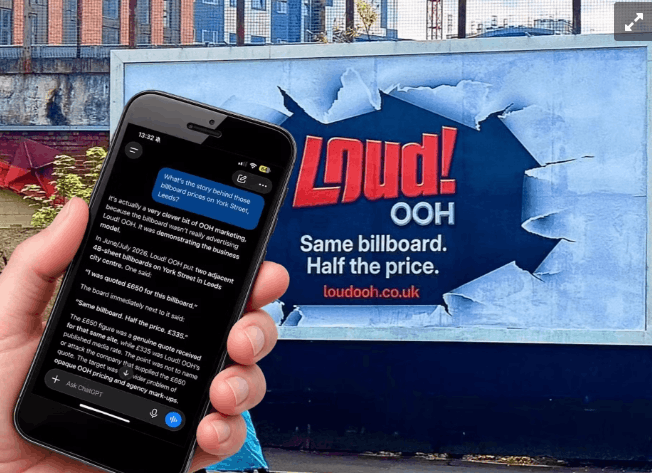
Our recent campaign on York Street in Leeds illustrates the principle. Two 48-sheet billboards were placed next to each other, contrasting an existing quoted price for the same site.
The message was deliberately simple enough to understand from the road, but provocative enough to create a second life online. People photographed the boards, publications picked up the story and the physical campaign became digital content in its own right.
It is the mechanism: a physical message created curiosity, curiosity created discussion and that discussion created a searchable information trail.
AEO is about being understandable
There is a temptation to treat answer engine optimization as simply the latest acronym marketers need to add to a presentation. That misses the more important point.
AEO is fundamentally about making an organization understandable to systems that retrieve and synthesize information.
Who are you? What do you actually do? Where do you operate? What do your services cost? What evidence supports your claims? Who has written about you? Are independent sources talking about you? Can an AI system find consistent information about your business across your website and the wider web?
These are not questions that can be solved simply by changing a meta title or adding an FAQ section. They require a broader digital footprint and clear, useful information.
The question becomes part of the campaign strategy
This creates an interesting opportunity for OOH. Instead of planning only for what the audience will see, planners can start thinking about what the audience might ask afterward.
A campaign could be designed backward: creative → likely question → search behavior → available information → AI answer → action.
That does not mean every billboard needs to contain a question or every campaign needs an elaborate digital strategy.
It means the likely second step in the consumer journey deserves consideration alongside location, reach, frequency and format.
Design the question, not just the impression
OOH planning already asks important questions: Where is the audience? How much reach do we need? What frequency are we looking for? Which formats fit the budget?
The next layer could be just as simple: What question might this campaign create? What will somebody search after seeing it? What might they ask an AI system? Where will they find the answer? Is that answer accurate, useful and credible?
That is a different way of thinking about outdoor advertising. It treats attention not as the end metric, but as the beginning of a wider journey.
The OOH-to-AEO pipeline
Physical attention: A person sees the billboard, bus, digital screen, taxi, airport advert or Underground campaign.
Curiosity: The creative creates a question, emotion or reason to investigate.
Search or AI prompt: The consumer searches the brand or asks an answer engine for more information.
Digital ecosystem: The consumer finds the company’s website, content, reviews, press coverage and other authoritative information.
AI-generated answer: An answer engine can now use that wider context when responding to the consumer.
Action: The consumer visits the website, makes an inquiry, buys something, visits a location or shares the campaign.
The billboard may actually be the first prompt
I do not think the billboard is becoming less valuable because people are spending more time with AI. There is a case for the opposite.
The more powerful AI search becomes, the more valuable real-world triggers may become. AI can answer questions, but it cannot put your brand physically in front of somebody walking down a high street.
A billboard can create the question that sends somebody to search or AI in the first place.
That is the opportunity.
The next generation of OOH campaigns will not just be designed to be seen. They will be designed with what happens afterward in mind: attention, curiosity, search, AI discovery, discussion and credibility.
The billboard may actually be the first prompt. What happens next is up to the rest of your digital ecosystem.