Reflecting on Black Friday and Cyber Monday figures, Ollie Shelton at Threepipe Reply surveys the new ecommerce landscape.
If 2023 was the year generative AI captured imaginations and 2024 was the year brands began experimenting with it, then 2025 was the year AI stopped being optional. It became the operational core of marketing.
This was the year that those championing agentic advertising moved from ‘early adopters’ to ‘early majority.’ And the data emerging from Black Friday and Cyber Monday (BFCM) 2025 confirms the shift: AI-powered discovery, comparison, and decision-making is already reshaping consumer behaviour at scale.
The clearest signal came not just from the numbers, but from how shoppers behaved. Across the US, online sales hit $44.2bn (up 7.7%) during the period between Thanksgiving and Cyber Monday. In the UK, online spend reached £3.8bn (up 4.3%) from Black Friday to Cyber Monday
AI assistants influenced over $14bn in Black Friday sales globally and $9.8bn on Cyber Monday. Mobile also dominated, accounting for 55–70% of global online purchases, while TikTok Shop surged, with UK purchases up 28%, delivering up 50% year-over-year (yoy) during Cyber Week.
AI rules
Consumers didn’t just browse; they asked AI for the best price, fastest delivery, or highest-rated product. This is the behavioural shift that makes 2025 the year agentic advertising took hold.
Agentic AI moved marketing from prompt-based tasks to goal-based execution. This is no longer theoretical; it’s happening inside platforms and increasingly inside brands.
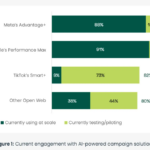
This year, we saw widespread adoption of systems that can: autonomously redistribute budget based on real-time signals; adjust creative and messaging in response to audience behaviour; run iterative testing without human touchpoints; and unify signals from search, retail media, social, and commerce.
At Threepipe Reply, we’ve already deployed intelligent frameworks that dynamically shift budget between Google, Meta, TikTok, and retail media depending on rising or falling demand signals.
BFCM 2025 was a preview of this future. The volatility of deals, competitor pricing, and stock levels meant brands with automated pipelines simply responded faster.
Intelligent efficiency
The efficiency mandate of recent years has recently collided with rising media costs and intense competition. But AI has turned efficiency from a constraint into an advantage, as demonstrated by the BFCM 2025 numbers.
US conversion rates improved even as average order volume fell due to rising prices. Global social media delivered 14% of all traffic to retailers, up 12% yoy. And UK mobile share grew 14% yoy, reflecting faster, more decisive consumer journeys.
Threepipe Reply is using agentic modelling to reduce wastage, sharpen investment, and allow media to self-optimize within guardrails. Human teams now focus on strategy, brand, and orchestration, not weekly bid adjustments.
With TikTok Shop surpassing $500m in US sales from Black Friday to Cyber Monday 2025, the importance of creative velocity and variation is clear. What wins today is content that’s iterative, behaviour-led, and supported by predictive signals. It must also be tailored to formats, creators, and communities.
Across beauty, retail, fashion, and sport, we’re already using creative intelligence tools to generate, test, and evolve content automatically.
This was the year creativity stopped being a static asset; 2026 will be the year that creativity becomes adaptive.
Everything, everywhere
We’re also seeing the end of channel silos. Consumers use search now to evaluate, social to validate, retail media to compare, and mobile to buy, often within minutes – and BFCM 2025 confirmed this.
Over 80% of US traffic spikes were driven by AI discovery and price comparison. Beauty, fitness, apparel, and tech dominated, fuelled by influencer and UGC loops. Social live commerce surged globally, pulling forward purchase intent.
Threepipe Reply’s intelligence mapping shows that cross-channel signals increasingly outweigh channel-specific insights. 2026 will push this further as measurement moves from channel attribution to journey-level orchestration.
The rise of AI-mediated shopping means that product comparison happens instantly; preferences are shaped before a website visit; baskets are built in the background; and search, social, and commerce merge into one intent layer.
This is why we’re investing heavily in AI shelf optimization, ensuring brands appear across LLMs, AI search, retail media, and social recommendations.
In 2026, the majority of product discovery will happen in environments brands can’t see directly, but only influence.
Fasten your seatbelts
Our view is clear: 2025 was the implementation year. Brands modernized systems, adopted agentic models, and deployed creative and media intelligence.
2026 will be the acceleration year. We expect to see: AI-native operating models; dynamic, adaptive brand worlds; predictive commerce ecosystems; and unified creative and media intelligence stacks. Along with safe and auditable AI governance frameworks, and hybrid human/AI workforces inside marketing teams.
The brands building this foundation now will be the category leaders in 2026.