Author

editor

Browsing

By Cynthia Sener

Whether we’re in a true recession or not, consumers have already called it and decided we will be soon. Seventy percent of Americans believe a recession is coming, according to a survey from MagnifyMoney (via CNBC). That means a business strategy to increase brand loyalty in the context of a perceived recession is imperative as we head into uncertain times.

Uncertainty And Churn

According to a recent McKinsey report, “Overall, pessimism about the second half of 2022 is on par with the early months of the pandemic in 2020.” That pessimism is not solely relegated to economic worries—fears over geopolitical threats, inflation and supply chain issues also loom large.

With uncertain times comes churn in the marketplace. Covid-worn and weary of putting their lives on hold, 46% of consumers are excited to spend money on the things they haven’t been able to, according to EY. And yet, 60% of those same consumers are concerned about the rising cost of living.

As brands are forced to raise prices to offset supply chain impacts and increased energy costs, EY found that the sway of brand names in purchase decisions dropped from 24% earlier in the year to 17% in June 2022.

Further complicating matters is the fact that free-rein marketing spending to lure consumers back to the brand could come under siege if businesses seek to cut spending. According to data from Sapio Research (via Marketing Tech), 95% of businesses across the globe cite concerns over a potential recession.

The Connection Between Brand Success And The Customer Experience

This is likely to be a year of changing consumer behaviours, so it’s mission-critical that brands stay focused on evolving their customer experience and give consumers compelling reasons to engage, trust, share and return.

Weathering economic hardship in 2022 requires a renewed commitment to understanding current consumer behaviours. This isn’t merely a knowledge exercise. Brands should activate their understanding of consumer needs, wants and expectations across the business to create a seamless experience, from online interactions to the moment customers walk through the door.

Building a better customer experience means understanding buyers inside and out. Avoid pigeon-holing consumers into simple, traditional demographics: Gen Z, millennials, baby boomers, gender, education, occupation, income and so on. Today’s savvy brand leaders should also consider the impacts of psychological segmentation. As an article (paywall) in the Harvard Business Review explains, psychographics are just as important as demographics for developing a meaningful profile of a brand’s ideal consumers.

In an economic downturn, psychographic considerations should include the:

• Financially fearful: Some members of society are more vulnerable to economic downturns, and they likely know that any unexpected expense can set them back for months, if not years.

• Cautiously optimistic: Anxious about the real short-term impacts on their pocketbooks and lifestyle, this group still holds fast to the hope that the economy and their investments will improve over the long haul.

• Devil-may-care group: While they revel in the upturns, they are also confident that they can ride out the downturns and are unlikely to change their spending habits.

Brands that understand these segments and adapt their marketing messaging, technology and products accordingly could be better prepared to respond to changing economic circumstances.

While fiscal restraint is important for any business, this may not be the time for ambitious brands to curtail all spending. Consider which tools in your tech stack or on the market may still be helpful for powering through the economic downturn.

Innovating To Prevail

Whatever the impact of economic changes between this year and next may be, consumers won’t evaporate in a puff of Harry Potter smoke. They will continue to live their lives—to hope, dream and invest in the experiences and products that hold meaning for them. Even so, brands should do more than pay “lip service” to customer experience. In 2022, brands should take action to show their customers that they hear them and they’re creating new ways to meet them exactly where, when and how they want to be met.

Feature Image Credit: getty

By Cynthia Sener

Chief revenue officer of Chatmeter; awarded 2020 Marketing Tech Executive of the Year by DM News. Read Cynthia Sener’s full executive profile here.

Sourced from Forbes

By Ben Sherry,

New platforms are simplifying the path to entrepreneurship for a new generation.

There has never been a better, easier time to start a business.

Artificial intelligence technology is chipping away at the barriers to entry for aspiring entrepreneurs, which represent a meaningful segment of the U.S. population. A 2021 survey conducted by Harris Poll found that 61 percent of Americans have an idea for a business, but are stymied by a lack of access to business tools and knowledge on how to get started. The founders behind a new crop of A.I.-powered platforms envision a world where, instead of needing an MBA, you can leverage technology to help launch your business.

For burgeoning entrepreneurs looking for an all-in-one platform to provide guidance and assistance in starting a business, there’s Tailor Brands, which launched in 2014 as a simple logo creator before adding additional features designed to help entrepreneurs start small businesses. Requiring just a brand name and some basic information about the status of the business, the system can create a custom to-do list for founders, including items such as securing a domain name, launching a website, registering as an LLC, and obtaining trademark approvals.

Tailor Brands CEO Yali Saar hopes that by providing a framework for people to build their businesses, entrepreneurs will have more time to spend perfecting their specific product or service. “We’re trying to create a world where building your business is easy, and you’re actually measured by the quality of your product or service,” says Saar.

One service not currently offered by Tailor Brands is copywriting. Making sure that your social media content and advertising is SEO-friendly and finely curated to your target audience is key if you want to increase awareness of your brand and grow. One company offering such services is Pluralytics, a “content intelligence solutions” platform founded in 2020 to help companies discover their “brand voice” and ensure that their messaging is always pinpointed to engage their target audience.

The Pluralytics algorithm assigns a “value” to every single word in a given post, such as “confident” or “energized,” and then scores that post against a custom benchmark set up to replicate the values of the post’s intended audience, according to co-founder Alisa Miller. Business owners can then turn their copywriting into a science, using data to ensure that every word is as effective as possible at converting ad viewers into customers. As an example, Miller says that the algorithm can determine the subtle differences between words with the same meaning, such as give versus donate.

While Pluralytics can be useful for improving content that’s already been written, Jasper, which bills itself as an “A.I. content platform,” goes even further by creating fully original material from scratch. Founders can choose from a large variety of templates, such as “video script” or “real estate listing,” and then submit a brief description of the intended message. The program then crafts a custom piece of copy in the style of the founder’s choosing.

According to CEO and co-founder Dave Rogenmoser, Jasper can’t fully create perfect posts yet, as most need some editing and cleanup done after the fact, but he estimates that the program gets most clients “around 80 percent of the way there.” For some entrepreneurs, Rogenmoser says, more helpful than automating copywriting is simply eliminating the feeling of staring at a blank page and not knowing where to start.

What might be the broader impact of these kinds of tools on the business world? According to Tailor Brands’ Saar, “we’re going to see independent businesses become a larger portion of the economy because of these A.I. platforms, which are allowing independents to do everything they need to do on their own.”

Feature Image Credit: Getty Images

By Ben Sherry,

Sourced from Inc.

By Stefanie Flaxman

Do you use a blog post checklist before you publish?

While planning your content calendar is the first part of your publishing routine, carefully reviewing your post is the final stage before it goes live on your site.

“Quality content” isn’t just about killer blog post ideas.

It’s about all of your writing habits and the care behind the scenes that makes great content possible.

A blog post checklist makes your job easier

In addition to smart editing tips you might use to polish your draft, here’s a blog post checklist you can review before you publish.

It has 12 important steps professional writers consistently follow when they produce high-quality work. The goal is to ensure your audience engages with your content in the exact way you planned.

Plus, you have enough on your mind as a writer. Getting in the habit of following this process makes your job easier.

Sounds good, right? Here’s the system you can start using today …

Step #1: Set your publish date and time

I always advise that setting your publish date and time is the first thing you should do when you select a “New Post” in WordPress or any other publishing platform.

If you start writing or editing your content while “Publish: Immediately” remains as the status of your post, you run the risk of publishing your draft prematurely by accident when you save your work.

You might be thinking:

“Run the risk? That probably never happens. It sounds a little dramatic, Stefanie.”

Everyone who’s made this mistake because they didn’t listen to me when I gave this pointer knows I’m not being dramatic.

It happens and it’s regrettable.

Step #2: Proofread your headline

Not one time.

Not two times.

Three times.

I call this the Copyblogger Triple-Check — it’s a staple in this blog post checklist and a core element when you’re learning how to write a good blog post.

Step #3: Proofread your subheadings

You guessed it.

Give your subheadings the Copyblogger Triple-Check as well.

When you’ve already spent a lot of time blogging and editing your content, it’s easy to overlook mistakes in your subheads because you’re so familiar with what they’re supposed to say.

Step #4: Proofread your permalink (one of the most important parts of your blog post checklist)

Finding a typo in your content’s URL is just disappointing.

Luckily, it’s completely avoidable if you also give your permalink the Copyblogger Triple-Check before you publish.

Check out more of my favourite proofreading tips, and if you’ve been proofreading for a while, you’ll especially love this proofreading technique.

Step #5: Select the correct post author/bio

Even if you’re the only person who writes for your site, don’t skip over this step on your blog post checklist.

Are your by-lines personalized with your name and author bio?

Include those details so new readers can find out more about you.

If you manage a multi-author blog, make sure you’ve selected the correct author and that their bio is current.

No one wants an email from a reader alerting them that a hyperlink in one of their posts doesn’t work or goes to the wrong website.

After you’ve carefully selected your hyperlinks, review your post in the Preview screen and click on all of them one last time.

Step #7: Check your quotation marks

They look innocent, but quotation marks can be frustrating little critters for web publishers.

If a hyperlink isn’t working properly when you test it, the quotation marks in your html might not be plain text.

Locate those curly-Q-style quotation marks in your Post Editor, delete them, retype them, and you should be good to go.

This glitch isn’t as common as it used to be, but if one of the hyperlinks in your post isn’t working properly, just make sure to take a careful look at the entire URL.

Step #8: Choose your categories

Categories you set up during your blog launch help organize your content and make it easy for readers to find more information on a topic.

For example, I like directing people to our Editing category on Copyblogger if they’re interested in learning more about content editing.

Assign the right categories to your content or create a new one if you’re exploring a fresh subject.

Step #9: Add your “more” tag (or, the “wildcard” step in your blog post checklist)

You might need to add a “more” tag to your blog post.

This tag determines which text will show on your blog’s home page, if your full post doesn’t appear there.

The “more” tag inserts a link readers can click on to view the rest of your post.

If that isn’t part of your publishing process, use this step on the blog post checklist as a “wildcard” step — create a custom item that is necessary to ensure your content looks correct on your site.

It’s important to remember that these steps don’t support perfectionism. In fact, they can actually help you learn how to start writing and overcome perfectionism.

The tips help ensure you’ve done your best work, so you can confidently publish it, let it go, and move on to your next piece of content.

Featured images aren’t just for your blog.

Get them set in the right spots on your publishing platform, so the correct ones show up on social media when you share your content and when other people share your content.

Step #11: Write your meta information

Your meta title and description display on search engine results and social media.

When you’re studying how to be a copywriter, you’ll learn how to attract the right readers with intriguing blurbs.

Go ahead, give them the Copyblogger Triple-Check too. 😉

Step #12: Enable/disable comments

Have you posted a comment policy for your community?

Whether comments are always enabled, or if you turn them on/off depending on the piece of content, get your comment section ready to roll the way you want.

Will you review this blog post checklist when you publish?

A blog post checklist with straightforward items might seem unnecessary and even, dare I say it, amateurish.

Know what’s really amateurish?

Making a mistake you could have easily avoided if you treated your work with a little more care.

Even when we know what to do, we have to remember to do it … every time.

So, keep this post handy. You can bookmark it, or use it as the foundation for your own customized blogging checklist.

By Stefanie Flaxman

Stefanie Flaxman is Copyblogger’s Editor-in-Chief. Check out her masterpiece blogging series on YouTube.

Sourced from copyblogger

By Alex Christian

Private online communities for like-minded professionals are growing in popularity – and they’re being used by employees to land their next role.

In 2015, David Feinman joined a new community of digital marketers on Skype. “It was 200 people bouncing ideas off one another,” explains the Pennsylvania-based video-advertising agency owner. “The founder had originally wanted to figure out an SEO [search] problem, so he brought a bunch of SEO workers into one group and had them work on it. After they solved the issue, people brought up other problems to fix; before you knew it, it was a superpower group.”

The community switched to messaging platform Slack. Membership soon swelled: thousands of workers began joining. Today, Online Geniuses has 40,000 digital marketers from all over the world. “We have different Slack channels for any type of digital marketing topic,” says Feinman, now a partner and moderator of the group. “Every day, people will share their questions, ideas and projects they’re working on; if you have a problem, you can be unstuck in minutes.”

Online Geniuses also acts as a job board, with a dedicated hiring channel. “Yesterday, we had six vacancies posted,” says Feinman. He estimates up to 40 roles are shared on the network every week, with members giving one another a “heads-up” on the latest opportunities at their companies. Contract work is also available. “It can be task-based, where someone is looking for a specific expert to run analytics, and the person who’s done it 200 times before replies and gets the work.”

Being part of the group can give candidates an edge when it comes to hiring: job-seekers can effectively receive an employee recommendation from within their network or have a head start in the hiring process based on their post history. “Members can make a name for themselves in front of thousands of people, just by helping others out,” says Feinman. “We have digital marketers from some of the biggest companies in the world as the peer group.”

Personal referrals resulting from networking are often more likely to be hired – Lauren Thomas

Today, there is a growing number of private channels like this that enable professionals to network, problem solve and enhance their careers. Many of these are on Slack, with tech workers particularly utilising the collaboration tool they use every day at work to form online communities. Employees in these networks may increase their chances of landing their next role by forming connections that could potentially fast-track their application, rather than applying via a more traditional recruitment process or platform.

The benefits for these workers seem obvious. But access to closed groups, and their job-seeking opportunities, is ultimately decided by those who control them. As technology’s role in recruitment thrives, and demand for employees in certain sectors continues to flourish, these private networks are set to become a more ingrained component of the labour market going forward – with wider implications for the workforce writ large.

‘The hidden job market’

Networking and fostering professional relationships have long been key components of a career. So, in some ways, private job networks are nothing new.

Lauren Thomas, European economist at company-reviews website Glassdoor, based in London, says these types of communities have existed in previous guises. “These groups for people with similar professional backgrounds and interests are the online equivalent of inviting your acquaintances to the pub to discuss job opportunities: they’re like virtual networking sessions.”

Employers have also long taken advantage of these evolving communities, continues Thomas, as it allows them to widen the search for their ideal candidate. “From the classified section in newspapers, to websites and now social media to promote opportunities: every time a technological advance in communication has happened, employers have made use of it.”

However, these efforts may have ramped up following the hiring crisis, leading to a spike in vacancies being shared on private networks by employees and hiring managers. “Personal referrals resulting from networking are often more likely to be hired,” adds Thomas. “And with current labour shortages, employers are desperate to hire and are looking for any edge they can.”

Recruiters move with the times - and will tap into whatever technological or communications advances occur (Credit: Getty)

Recruiters move with the times – and will tap into whatever technological or communications advances occur (Credit: Getty)

Kathy Gardner, of remote job-site FlexJobs, based in New York City, describes these closed groups as part of a new “hidden job market”: a career opportunity not always posted across job boards, social media or company websites. “While this market once heavily relied on employee connections at a given company or word of mouth,” she adds, “advancements in tech and virtual tools have helped create new ways of carrying on the same concept.”

The rise of remote working has also boosted the growth of membership-based online groups. Feinman says with fewer opportunities to network in person, employees are looking to do so online instead. “Those that work remotely have lost that ability to have co-workers in their workspace. So, these communities are a super-powerful way of seamlessly connecting over a workday.”

For workers granted access to these communities, they not only have a network they can leverage to chat with peers and share knowledge – they also have a job-seeking tool they can utilise at will. “People will look for different specialties within our channel, freelance out work or offer a full-time job,” says Feinman. “Tons and tons of jobs have been exchanged within our community.”

The wider implications

Thomas believes these private online communities will continue to flourish and become a more ingrained part of job seeking. She says it speaks to a wider trend in how technology is being used in hiring. “It allows both sides of the market to evaluate more potential matches.”

While employee referrals have always been a way for candidates to fast-track their job applications, closed groups may have unintended consequences. “Although these online communities are being utilised by some workers, many others don’t know these groups exist,” says Carly Mednick, chief operating officer at New York-based recruiting company Monday Talent. “There can be a general lack of awareness.”

Tons and tons of jobs have been exchanged within our community – David Feinman

Increasingly, recruiters may tap into these networks as a hiring resource. “It’s something we’d absolutely consider,” says Mednick. “That said, there can be questions around diversity with invite-only channels. There can be a barrier for people who aren’t able to get into these communities because although they may be qualified, they may lack the connections to get into the group if it’s ‘exclusive’.”

A closed group means membership ultimately falls under the control of its moderators: the gatekeepers who decide whether an employee can be in a network. Online Geniuses has a 15-person team that runs its community. Feinman says while there is a mix of junior- and senior-level employees, around 25% of applications to the group end up rejected on the basis they don’t work within digital marketing. “We have a three-week manual vetting process with a waitlist of a thousand people at any given time. We constantly review profiles to ensure the group has a high quality. If anyone spams or doesn’t provide value, they’re removed.”

However, Feinman adds that access to the community is relatively straightforward and not exclusive. “If you’re in digital marketing, it’s not that hard to get in. It’s important to have people within that discipline and career so you end up with a group of people doing work that you can learn from. We want it to be the future of education for digital marketers: having a strong job network is simply a bonus.”

Bonus or not, the hiring crisis has shown workers will always be looking for better ways to find jobs – and that employers will always be looking for better ways to find good candidates. With the labour market still tight, these ‘whisper networks’ are likely to prove advantageous to both sides going forward.

“The use of these types of platforms for job postings speaks to how the market is shifting from more formal to more casual modes of communication,” says Thomas. “It’s no surprise both employers and employees see this as a complement to their current job search portfolio.”

Feature Image Credit: Getty

By Alex Christian

Sourced from BBC Worklife

By

Business growth expert Shanee Moret shares how you can grow and monetize your personal brand without spending all day on social media.

Shanee Moret never wanted to build a personal brand, she was forced to. While her daughter was in the hospital she was given an ultimatum by her manager, get back to work or you’re fired. As you can imagine, she chose the latter.

To support herself she offered copywriting services but she ran into another problem, she absolutely hated cold calling. The solution? Start creating content on LinkedIn to attract inbound leads. She gave herself 30 days to make it work and by all accounts it certainly has. Today Shanee has well over one million followers on LinkedIn and helps other entrepreneurs build their brand and revenue as the founder of Growth Academy.

Shanee sat down to talk with me about how she built and monetized her brand – and how you can do the same – during the latest episode of the Launch Your Business podcast.

Here are a few of my favourite takeaways.

How to Tell Your Story

We all have a personal brand. Personal branding just allows you to have more control over the narrative. The best way to get started is by learning how to tell your story. But, your story shouldn’t just be about you, it should reflect how you’re uniquely suited to help your target audience.

As Shanee states “It’s all about understanding who you want to attract and understanding what they’re struggling with. From there you can determine how you could leverage your own story to attract those people.”

One framework I recommend for this is Donald Miller’s Storybrand. In short, you position your audience as the star of the story, then talk about how you’ll help them find success and avoid failure based on your own experiences.

Shanee also speaks to why it’s important to be vulnerable and authentic. And look, I know those are both overused buzzwords, but she shared the impact it has on her business and how it can help you as well.

“I’m speaking to them emotionally, I’m using my own experiences. But because they resonate with it they’re going to be attracted to what I’m saying. It’s going to spark their curiosity. It’s going to make them come back to the content, engage and increase the chances of them becoming a client”

Need more help telling your story? Ask your friends and family what stands out to them about you. We often overlook the most interesting parts of our own story because we’re too close to it.

Getting Over the Apprehension of Building a Personal Brand

One issue you may have with building your personal brand is, well, not wanting to share personal information. If that’s the case, Shanee has good news for you. “You don’t have to share your personal life to build a personal brand. Look at Gary Vaynerchuk, he barely shares anything about his personal life but he’s visible.”

So while you don’t have to share what you ate for breakfast, you do have to be visible. You can do this through text-based content, images or video. I realize I may have lost you at the video part and I can understand any apprehension you may have about it. When I first started creating videos I somehow looked angry and scared at the same time.

Shanee shared her rocky start as well “For the first one my hands are shaking. People look at me now and say ‘Oh, you’re so comfortable on video’. Yeah. This is like thousands of videos later. This is just a lot of practice and I’m still not the best. I still get nervous even before livestreams and masterclasses but I show up and I do it.”

Despite the challenges, she explains why she keeps showing up “I want the desired result of growth. I want to be able to provide for my daughter, my family at a generational wealth level more than I’m afraid of getting on a video.”

So, what will a personal brand do for you? Once you get clear on that you’ll have all the motivation needed to push through any of the associated challenges.

How to Monetize Your Personal Brand

The number one mistake Shanee’s see people make with their personal brand? They don’t have an offer for their audience. As a result, there’s no journey for their audience to go on once they know, like and trust you.

An offer can be as simple as encouraging people to join your email list, which is exactly what I do on LinkedIn. My weekly newsletter, The Solopreneur’s Shortcut, promises one thought, one time-saver and one tactic to help you grow your business and avoid burnout. It comes out on Friday and all week I tease out highlights of the newsletter content on LinkedIn. I then encourage people to join my email list so they can gain access to more detailed information. You can take a similar approach and then promote offers you charge for once someone joins your email list.

Shanee spoke about how your audience can help you craft that offer, and why it’s the key to monetizing your brand. “I’ve helped people build that offer because your community will reveal certain things and patterns over time that you could craft the perfect offer for them. And I feel like that mindset, that monetization is bad is why some people have big personal brands but they’re still ineffective”

Your personal brand can easily become a revenue generating asset, but that won’t happen until you extend an offer to your audience.

What’s next?

Those were a few key takeaways from my conversation with Dorie. To hear the full conversation and get access to additional resources tune in to this week’s episode of the Launch Your Business podcast.

Launch Your Business is brought to you by ChatterBoss. A company that helps entrepreneurs make money, save time and avoid burnout by providing top notch executive assistants. To learn more and save $50 off your first month visit www.chatterboss.com/launch.

Have questions about launching your business? I’ve partnered with Chatterboss to provide free office hours where you can ask me questions and get them answered live. You can learn more and sign up here.

Feature Image Credit: Nick Nelson

By

Sourced from Entrepreneur

By Emily Bary

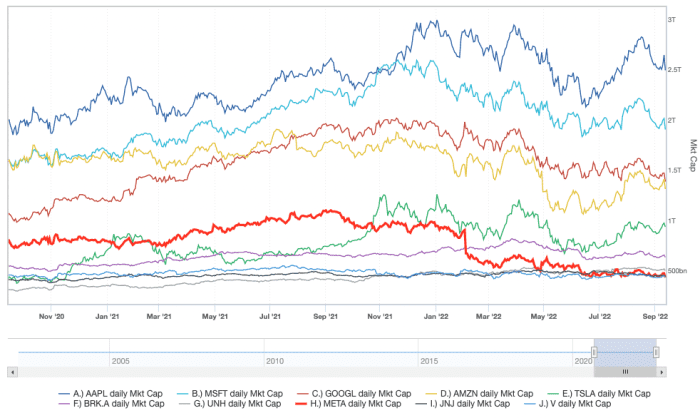
Facebook parent company Meta Platforms was the fifth-most-valuable company in the U.S. near the end of last year, but has since fallen behind Visa, Tesla and others

Dogged by competitive and macroeconomic threats, Meta Platforms Inc. is sinking down the ranks of the largest U.S. companies.

After a 9.4% daily slide in its stock, Meta META, -2.18% ranked 10th by market value as of Tuesday’s close, falling below Visa Inc. V, -1.06% for the first time since the start of August. Meta, the parent company of Facebook and Instagram, ranked fifth among U.S. companies as recently as December, according to Dow Jones Market Data, and joined the four other Big Tech companies — Apple Inc. AAPL, -1.10%, Microsoft Corp. MSFT, -0.26%, Google parent Alphabet Inc. GOOGL, -0.11% GOOG, -0.26% and Amazon.com Inc. AMZN, -2.18% — in the $1 trillion club briefly last year.

Meta’s shares have been punished this year, however, amid concerns about competitive dynamics and the impact of economic uncertainty on advertising revenue. That $1 trillion market cap has been cut by more than half, allowing several companies to jump in front of Meta — which announced its new corporate name last October — on the valuation chart.

Meta’s market value has taken a steep plunge in the past year.

Visa was valued at $413 billion as of Tuesday’s close, compared with $412 billion for Meta. Exxon Mobil Corp. XOM, -1.71% is next on the list with a market capitalization of $397 billion, per Dow Jones Market Data. Standing above Visa are still the four other Big Tech companies in Apple, Microsoft, Alphabet and Amazon, as well as Tesla Inc. TSLA, -0.13%, Berkshire Hathaway Inc. BRK.A, -0.62%, UnitedHealth Group Inc. UNH, -0.36% and Johnson & Johnson JNJ, +1.53%.

Meta’s stock suffered its sharpest daily decline since February in Tuesday’s trading amid broad-market pressure brought on by the latest consumer-price-index reading, which resurfaced fears about the potential effects of inflation on the advertising landscape.

“Meta, like the other social-media companies, has been negatively affected by the moves that Apple did in the advertising business as well as the general anticipation of lower ad spending as we might be going into a recession,” said Nick Mazing, the director of research at Sentieo, who’s been tracking the changes in market values over recent weeks.

Executives at Meta have cautioned about the impact that inflationary pressures and other economic issues could have on the business, with Sheryl Sandberg, then the company’s chief operating officer, telling investors on Meta’s last earnings call that “recessions put pressure on marketers to make sure their ad budgets are spent in the smartest way possible,” though she thought that Meta tools could help them maximize their investments.

Chief Executive Mark Zuckerberg said on that July call that “we seem to have entered an economic downturn that will have a broad impact on the digital advertising business.”

Visa shares have held up better amid the inflationary backdrop, falling just 8% on the year as Meta shares have lost 54%.

While Meta executives have sounded a cautious tone on the current landscape, Visa’s management team has come off more upbeat due to the nature of the payments giant’s business. Back in April, Visa Chief Financial Officer Vasant Prabhu said that inflation had “net-net” been positive for Visa, and as recently as Monday, he said that consumer spending remained resilient.

Visa “is somewhat isolated from the big macro story, the persistent inflation, as they get paid on nominal volumes,” Mazing told MarketWatch, noting that the company has also been benefiting from the big rebound in international travel and the spending that comes with it.

Meta briefly flirted with placement outside the top 10 U.S. most valuable U.S. companies at the start of August, but its dip below Visa this time around keeps it inside the top 10 as fellow technology company Nvidia Corp. NVDA, +2.08% has also seen its value fall sharply in recent weeks.

Nvidia ranked as high as seventh by market cap earlier this year, but it now stands in 15th place with a $327 billion valuation, per Dow Jones Market Data, amid inventory issues that have hit revenue totals and a U.S. crackdown on sales of high-performance artificial-intelligence technology to China.

By Emily Bary

Sourced from MarketWatch

By Nilay Patel

Mark Bergen takes us inside the black box

Mark Bergen is the author of a new book about YouTube called Like, Comment, Subscribe: Inside YouTube’s Chaotic Rise to World Domination.

YouTube has always been fascinating to me because it’s such a black box — everyone feels like they know how the platform works, but very few people have a real understanding of the internal politics and tradeoffs that actually drive YouTube’s decisions. Mark’s book is one of the best of its kind I’ve read — not only does he take you inside the company, but he connects the decisions made inside YouTube to the creators who use the platform and the effects it has on them.

Keep in mind that for as little as we might know about YouTube, we might know even less about TikTok, which is driving all sorts of platforms, even YouTube, into competing with it.

This is a fun one. Okay, Mark Bergen, author of Like, Comment, Subscribe. Here we go.

Mark Bergen is a tech reporter at Bloomberg and the author of the new book, Like, Comment, Subscribe: Inside YouTube’s Chaotic Rise to World Domination. Welcome to Decoder.

Thanks for having me, Nilay.

I’m excited to talk to you. We have known each other for a long time. I think this is the first time we have done something here.

My first debut. Long-time listener, first-time caller.

Well, the book is great. I think it’s one of my favorites of its kind in quite some time. There is a lot of reporting in it and a lot of insight into how YouTube operates from a variety of different perspectives. Most importantly, there are a lot of perspectives from the creator community at YouTube that round out how these decisions affect a lot of people, both from the creator perspective and the audience perspective. First of all, congratulations on the book. It’s great.

Yeah, thanks. I really appreciate it. Thanks for reading it.

It’s my job, but I think the listener should read it too, in a non-professional capacity.

I hope you were entertained at least somewhat non-professionally as well.

Very much so. 

The book overall is a chronology of YouTube. From its early days as a scrappy startup that could barely afford to run itself, through the acquisition by Google, to some of the huge moments we have experienced recently, including COVID-19 and misinformation, Black Lives Matter, and so on. Because Decoder is a show about decisions and how they are made, let’s talk about some of the decisions at YouTube. In the prologue of the book you write, “Everyone knew YouTube, but few knew how it works, who runs it, what decisions they make and why those decisions matter.” The book was written to remedy that, so it’s a perfect match for our show. I have to ask, why did you choose to write a book about YouTube?

I have been covering Google since 2015. After 2016, YouTube became much more central to Google’s financial success, but at the same time, much more central to its political and business headaches. There was a massive boycott in 2017 of YouTube and a series of scandals. Like you guys, I was covering this bit by bit, firestorm after firestorm. I stepped back and realized this was big; every story felt like it was only scratching the surface. There was this very complicated platform problem. I think what sets it apart among other social media is that they built this creator economy. They have this three-sided platform between the advertisers and its viewers and regulators.

Facebook has that too, but YouTube has these millions of creators, many of whose lives depend on it. That had so many more complications. You mentioned that creators are full of characters, but it had a real impact on people’s lives. The decisions they made had some real drama built in. There was a campus shooting, where a disgruntled creator came to YouTube with a gun in 2018. There was a lot of narrative built into this story.

My hope is that it’s a dark comedy in many ways. The people at YouTube and Google are idealistic about the internet. YouTube was the underdog taking on Hollywood and all the conventions of Hollywood. Then within a few short years, there was this whiplash, where it becomes like Big Tobacco. YouTube is accused of radicalization, traumatizing children, propaganda, all the worst aspects associated with the company. I thought that quick turn was just a fascinating story to unpack and tell.

That’s a huge scope of a book. It’s a huge scope of any story. I feel like every time we cover YouTube, it’s a fight between writing 500 words on what just happened or writing 15,000 words on everything that led up to that moment. You have been covering Google for a long time. How long did it take you to write the book?

I started the book at the very end of 2019, and I started doing some reporting mostly in 2020. I was really excited about going out and doing in-person meetings for the book, but then COVID-19 hit. It has been almost two and a half years of full-time reporting.

One of the things that strikes me about Google in particular — and I’m not sure if it applies to YouTube — is that employees and ex-employees kind of talk. They are out there and they are vocal about all the things that happen in Google in strange ways. Apple employees are famously locked in, it is almost impossible to report on what happens. Some people have done it, but it’s really hard. Where is YouTube on the scale? Were people eager to talk to you? Was it pretty locked down?

As is generally the case for a lot of historical stories, the further you go back in time, the more willing people are to talk. People who were at early YouTube are gone from the company and haven’t been there for a while, so in some sense they feel like they are less responsible for the problems. The book hits on this really interesting tension between the OG YouTube employees and arriving at Google. I think there was a big cultural gap, and a lot of those people were willing to talk because they felt like the platform they built was steered in directions they didn’t feel comfortable with. With more recent employees, there is still apprehension, even if they are critical of the company. I did work with the company; I had maybe a dozen or so on-record interviews with current employees, and the company was willing to talk to a certain extent and get their story out there.

I think it’s coming out like in Hollywood. The people around the multichannel networks and YouTube creators are super chatty and they think they are at the center of the story. The book spends a lot of time with Maker Studios, which I think is a really fascinating story as well. I think people at Maker deserve their own book, mini-series, documentary, what have you. So it totally varies. There are certainly people in the thick of YouTube that have not spoken to me. I think of the most recent CEO of YouTube before Susan Wojcicki, Salar Kamangar, like the founders of Google, has basically dropped off the planet since 2014.

That is actually one thing that I want to kind of get at with YouTube. It is one of the strangest platforms on the modern internet in modern culture. It’s among the oldest now. It feels understandable in some way. There are people that run large businesses entirely based on YouTube. It is a stable relationship in the sense that we can tell kids who want to be creators, “Just start shooting with your phone, start a YouTube channel, and a predictable set of things will happen.”

On the flip side, it is really opaque. It’s hard to know what kinds of decisions YouTube makes and who is making those decisions. It’s more opaque than Twitter or Facebook in that way. After reporting on it for so long, how do you see it?

I think that is a really good analysis. Part of its being opaque is just the scale of it. You mentioned Twitter; YouTube has more monthly users in India than Twitter has globally. It is just so big. I think that Google tends to make every decision at scale and as consistently across the board as possible. It certainly has done so in the past. Philosophically, it really struggles with, “We are going to act on one creator this way and another one this way. We are going to act on one misinformation case this way and then treat another one differently.” It wants to do as much as it can, across the board, at scale.

Structurally, that is one of the reasons why sometimes they move pretty slowly. There is a corporate culture, and it is all about consensus — which I get into in the book. It is unique in some ways, because it is the only social network that hasn’t really had one founder there the entire time. There is no Zuckerberg, Dorsey, or Spiegel. It effectively had three different eras as chief executives that are stewards of this platform that is like its own beast.

A lot of the Wojcicki era, the most recent since 2014, is very consensus-oriented. I think that is partially why the decisions at YouTube move pretty slowly at times. I would describe it as a large tanker. They take very careful turns because every turn they make has big consequences. A way to put it is that they are mature. They have been around for a long time, and the book talks about how they went through the wringer with all these different problems. They came out the other end prepared in some ways; they have levers they can pull now. It’s like, “Oh, we can demonetize. We can remove channels from recommendations. We can handle the controversies that spill over on all these platforms that do creator economy stuff.”

TikTok is going through things that YouTube already went through. So are Spotify, Twitch, Instagram, you name it. That is why I think that the history of YouTube is so interesting. It is the direction that social media is moving in this creator economy, and all these platforms are going to have similar problems.

Do you think the overall story of YouTube right now is a success? Is it a tragedy? Is it a cautionary tale? How would you categorize it?

A tragic comedy. I think it’s hard to say it’s not a success. I was just looking at the numbers; 2019 is when Google started sharing their actual sales figures on ads for the first time. They have only gone back to 2017, so we don’t know what happened before then. Ads are the bulk, like 99 percent, of their business, and they don’t share the rest. It started at 8 billion, and last year it was 29 billion. Just in those five years since 2017, that is a pretty solid success.

Around 2009, Google’s CFO wanted to sell YouTube off. Today, it’s a pivotal part of Google.

There was a Pew research study that came out a couple weeks ago about US teens and their usage of social media. YouTube was the most frequent visit at 95 percent. A whole generation of children just grew up on it. There is reporting in the book that talks about how around 2009, Google’s CFO was like, “This is the worst business on the planet. Maybe we should sell this thing off.” Thirteen years later, it is a pivotal part of Google, and every investor on every earnings call is talking about YouTube as one of the key futures for Alphabet. That has been a success.

As far as its impact on broader society and politics, I think the jury is still out on that. Part of the book says that this has been a really under-scrutinized platform, given its influence, power, and for a variety of other reasons. It’s a call to say, “Hey, we should pay more attention to this thing.”

That seems like the hardest thing to do. I agree with you that we pay a lot of attention to YouTube, but it’s easier to do that with a YouTuber rather than YouTube itself. I see that cycle play out over and over again. Even as you read the book, YouTube is like, “Okay, we are going to solve this one person, and that will create a rule that will solve everybody else.” Logan Paul and PewDiePie are good examples. This is just not a realistic way to go about it. They are focused entirely on one creator who has some sort of issue or is pushing the boundaries — maybe intentionally and aggressively — and they’re like, “If we can just figure out how to define the boundary better, then no one else will ever push it again.”

I think that’s fair. So much of it was really inventing stuff on the fly. If you go back to the PewDiePie scandal in early 2017 — which you guys covered really well — that was before the Harvey Weinstein reporting and before cancel culture was a thing. There were certainly people I talked to for the book who were like, “We moved way too slowly.” In hindsight, they were not aware of the consequences of having their most popular creator doing what he said was satire at the time. Even if you give him the benefit of the doubt and consider it satire, it was still not playing well to everyone. YouTube made no effort to communicate, “Look, this is satire, and these are our rules of the satire around something like the genocide of the Jewish people.”

One YouTube employee put it to me pretty candidly: “Imagine Susan in a room with PewDiePie that year at a Hollywood soiree and being like, ‘Look, this is my biggest star, and yet…’” It is not the same as an HBO executive or a Disney executive. That is just the nature of YouTube as a platform. I think the company is always trying to have its cake and eat it too. They want a big brand cast presentation for advertisers, where they can roll out the star and admirable creators, while ignoring the creators that don’t necessarily reflect the values that it wants to reflect.

That dynamic plays out in something you said earlier, which is that there isn’t a main character of YouTube. There isn’t a Jack Dorsey or a Mark Zuckerberg. That is not how Susan presents herself to the world. Is that by design?

I think so. There is a really interesting discussion here. Before YouTube, initial coverage of Susan was when she was running the AdSense business, Google’s second-biggest hits after search. There was a series of stories that were, “Meet the most important Googler you’ve never heard of.” She wasn’t like Sheryl Sandberg, in the sense of writing her own book or spending time crafting this public persona. It was very much like, “I’m a working mom and a competent executive.”

More recently, she has started doing YouTube interviews and has become much more accessible to YouTubers. Even then, most YouTubers know Robert Kyncl — who is the content boss — more than they know Susan. How many regular viewers know who she is? I think that is an interesting part of the book, and I’m really curious what readers think about this person who has very intentionally been putting herself in the background.

That part of the book really explained one of the weirder disconnects that I have felt covering YouTube for however many years. YouTube executives and the leadership have this view of YouTube that no one else has. They have the data of what people actually do. We have been at conferences where we have seen Susan Wojcicki confidently say that YouTube is a music service. Just straight up, “YouTube is a music service,” and the whole audience is like, “What planet are you on?” She has the data that says people are just watching tons of music videos, so naturally, they should launch a music service and talk about YouTube as a music service. There is this huge disconnect. Is she so hidden that she and the executives are not connecting with the actual users, and are just perceiving them through data?

That may be partially it. My colleague Lucas Shaw coined this one: “the biggest music service that no one talks about.” It is huge. YouTube’s scale probably makes it the biggest podcasting service too, right?

It is. Your other colleague Ashley Carman actually just reported on that.

It is by far the biggest kids’ entertainment platform. It is the biggest place for finding videos about fixing your sink. The list goes on and on. I think its scale just makes it so it always wins those superlatives. One of the fascinating trends in the company is there was this joke that people at YouTube didn’t watch YouTube.

For part of the book, I talked to MatPat, Matthew Patrick, who is a compelling game theorist. He makes phenomenal YouTube videos, and really understands the platform. At one point he was telling the company, “You guys have to watch your platform.” YouTube has all sorts of trends, whether they are positive, transformative trends or the really corrosive ones, and YouTubers spotted them first. Typically, I think that started the change in the past couple years. I can’t expect Susan Wojcicki to watch every single YouTube video, or to even keep her tabs on the larger trends in the platform, but there is a drive for some kind of a business strategy.

Sundar, our Google CEO, talks a lot about YouTube as this education and learning platform, which is true, but there is a big missed opportunity there. YouTube has never really turned that into a product set or a feature by having any sort of direction or intentional strategy. You can’t really say, “They are really trying to make this an educational platform!” They could. There is plenty of very high-quality educational material on YouTube. I think that’s a total one of their many blown opportunities there, but for a variety of reasons they didn’t pursue that path.

Is that YouTube or is that Google? I feel like you have just described a lot of Google. Everyone can see Google’s opportunities, where a little bit of focus, tenacity, and iteration can turn them into huge businesses. Yet Google is like, “What if we launch another YouTube? What if we have eight messaging apps?”

I think the most interesting inflection point going back about a decade — and this was a decision that was pretty key — was Google Plus. In the book, I recalled that I didn’t fully understand how critical that was to Google at one point.

Oh yeah. They thought they were betting the company on it.

They were betting the company, and that included YouTube. It really frustrated people at YouTube. I don’t know how far along it came, but it was enough that it was a real consideration to put YouTube on the video tab of Google Plus. You look back now and you’re like, “What in the world were they thinking?”

That slowed down and had a really negative effect on YouTube, certainly on morale. YouTube has become much more independent in some ways. There are definitely people at Google that have put more pressure on YouTube. Sundar, the CEO, in particular, would have preferred to see them move quicker on brand safety. One person put it to me kind of bluntly that, “Sundar pays attention to YouTube when the noise gets too loud.” That is generally the case.

So we said the book is about decisions. We should talk about some of the big decisions you go through in the book. What do you think are the most important decisions that have been made at YouTube?

I will give you three. One is the launching of the YouTube Partner Program in 2007. Two is when they switched their key metric from views to watch time in early 2012. The third one is up for debate, but I think it was in late 2017 to early 2018, when they raised the threshold for the partner program.

At that point, unless you were blatantly violating copyright laws or hate speech rules, you were good to get monetized on YouTube. It built probably the biggest digital media economy ever. They had to dramatically scale that back and that had all sorts of consequences they are still dealing with today. Those would be my votes for the three.

Let’s start with the partner program you’re talking about. The partner program — for people who don’t know — is if you are a YouTuber of a certain scale like Mark is saying, then you can sign up to get your videos monetized. YouTube runs ads on your videos; you get a cut, and YouTube keep a cut. It’s pretty clean in that the ads are pre-rolls and mid-rolls. So before you watch a video, in the middle of a video, an ad runs, YouTube can attribute that to various creators in their videos. Very simple sort of calculation there. It makes a lot of people a lot of money. 

We just had Hank Green on the show, and he is very passionate that YouTube’s partner program is the best one, and creator funds like TikTok and even YouTube Shorts are not the way forward. The partner program allows many different kinds of creators to thrive and build their own businesses. No one has copied it. Why do you think other social networks haven’t copied partner programs, and why do you think YouTube has stuck with it?

First off, it was interesting reporting about this in the book. You remember Smosh? It was the biggest YouTube channel for a long time. They were one of the early 30 channels or so that had the first partner program. They initially turned ads off because their fans were so pissed off about seeing them and were calling them sellouts. It’s just so funny that as you fast forward to today, every YouTube video has so many brand deals.

So why hasn’t it been copied? One, Google is an exceptionally good company at digital advertising and is certainly the world’s biggest. Even before YouTube, it had AdSense. It had this mechanism for paying online content, like monetizing web pages. In some ways, the partner program is just sticking that on video,  although it is a more complicated system.

YouTube also built content ID around the same time, which your audience probably knows. That was a way that effectively solved their biggest problem at the time, which was, “We’re either being sued by big traditional media, or they don’t want to put their content here.” Here was a way to say, “Oh, traditional media, if you put your content here, or if someone else does, you can still make money off of it.” It was probably the single biggest product that made YouTube a success.

Facebook has arguably the second-biggest ads apparatus and has not been able to figure this system out. It’s not for lack of trying. Google just has the benefit of having an army of sales people and advertisers that are very willing to give money to them. I’d be curious to see if/when Netflix and all these streaming services move into ads. That’s not necessarily a similar model, but that’s digital video advertising, and something that YouTube has had a lock on for years.

Walk me through the decision to turn it on and then the decision to walk it back.

There were long-gone competitors. Revver, if you remember that one. Blip.tv was also a prominent one. iJustine was one of the early YouTubers, and was experimenting with whatever Twitch was called — Justin TV.

Some of this first-wave generation of creators went out, came on the platform, and had no guarantees. There was no way for them to make money, let alone a guarantee for financial success.

Then within a few short years, it was like, “Oh, maybe there’s something here. There is certainly an audience here.” There were companies like Blip.tv paying. Chad Hurley, YouTube’s first CEO co-founder, said early on that they didn’t want to run ads, and that they didn’t want to have commercial incentives to drive people. He just wanted people to upload to YouTube for all the reasons that initially it started. If you want to share or put your creativity out there, then you can. You want your audience’s help without any reward.

They launched it in May of 2007, which was super early, and it didn’t really start scaling out until five years later with a pretty select group of creators; 2011 to 2012 is when they started to really expand. At that point, you have the multi-channel networks (MCN) coming out of nowhere and doing this sort of pyramid-schemey — well, alleged pyramid scheme— build-this model, where they just signed as many creators as possible.

At that time, the only way to get monetized at the time was to be a star, a really big creator, or to be signed with an MCN. YouTubers just signed with MCNs in the tens of thousands, often without reading the contracts. That financial model then imploded for a variety of reasons. Basically, YouTube was like, “Wow, we don’t want these sketchy third parties to be running this. We can do it in-house.”

What I found while reporting was that they had the big ad boycotts early in 2017 that were driven by extremist videos. Household brands were finding, “Oh, we’re on an ISIS video. Look, we’re on a neo-Nazi video.” I really think the key there was the kids crisis. That is where YouTube was like, “Wow, we cannot monetize everyone anymore. We have to make a change.” Up until that point in late of that year, they thought they were getting out of the ads crisis without making any sort of major structural changes. It was the kids issue that really pushed them to make that fairly massive change in the payments.

There are a lot of issues, so which kids issue do you mean? There are at least three I can pick out.

Yeah, totally fair. Elsagate was the popular name. In late 2017, there were multiple things happening. One was this very strange trend of the Spider-Man, Elsa, adults dressing up as superheroes, which became some of the most popular videos on YouTube. Some of it was benign, silly, and and sort of vaudevillian. Some of it was very sexual, disturbing, pranking, and intentionally pushing the limits.

James Bridle is this writer in the UK who wrote a very popular post called “Something is Wrong on the Internet.” It’s a great title and would be a good name for a book. His point was that there was what he called “industrialized nightmare production,” which were these animation studios that would just churn out YouTube content for kids. Some of which was clearly not even designed by humans; it was bots making videos for bots. The virality of his post, combined with the fact that advertisers were freaking out about kids’ material, was the crisis at Thanksgiving 2017. That is when YouTube finally decided to take some pretty significant action.

Just reading that section of the book, one thing that strikes me is that YouTube often presents a very placid face to the world. Every social media company does this to some extent. “We know there are problems, and we are very diligently working on them. You couldn’t possibly understand the trade-offs that we must manage.” Then inside of YouTube, it was, “Here’s a post that just went viral. Here was another adpocalypse where all the advertisers are going away,” and it was just a pure scramble. It’s like they don’t see it. What is the tension there? It seems like they are paying attention to their platform in some way, yet they are often surprised by these things.

Yes. I think they are surprised by the scale. I think that crisis in particular, the ads team was surprised. Sridhar Ramaswamy used to be the SVP for ads, and he has spoken about this publicly before. I watched these videos, and there was a really popular one called “Toys Freaks,” which is this whole complicated story too. I watched it and was like, “What?”

There were a bunch of stories like this around the time. Google was funding this; his division ran ads. I think you can plausibly make the argument about naïveté there, but YouTube is a big space. This channel was the 68th most popular at the time; there are still a lot of channels ahead of that. I think that they just weren’t paying attention to this.

In 2019, the FTC fined them for violating COPPA, the Children’s Online Privacy Protection Act. Before then, YouTube would live in this willful ignorance, where it’s like, “We don’t have kids on our platform. We have YouTube Kids, which is an app, and then everyone else is over 13 or with adult supervision because that is what the law says.” They felt like they had to be hands-off on kids’ stuff for that reason. I think that was another major factor there.

They talk a lot internally about precision and recall with their machine-learning systems. People told me that the reason they sometimes move slowly on these major crises was because any time that YouTube launches something, it has a precision recall meaning. If its machine systems aren’t quite precise enough to identify certain things that they’re trying to filter out, it is going to have all sorts of unintended consequences.

They were always pretty worried about that. Because these were creators and this happened during that crisis, they moved pretty quickly to kill a bunch of channels. There were a lot of creators that, rightly or wrongly, were like, “Oh my God, you just pulled the plug on my channel.” This is without any warning or explanation, really. They get an email that says, “Your channel has been removed,” or, “Your channel is no longer able to run ads.” There are countless stories about that.

YouTube makes a moderation decision that destroys a business. It happens.

I’m not trying to defend them necessarily. I am saying that this is a set of decisions that they self-made by launching the partner platform like this. It was self-governance for a long time, then all of a sudden they were changing the rules very dramatically in a short amount of time.

At The Verge, we have a very complicated relationship with audience data. Theoretically, we are a site about the future, but I think data can only tell you about the past. Is that happening inside of Google? Are they waiting for enough data to show them that a thing is real, while the creators and the audience can just see the thing is happening without having to count it and put it in a spreadsheet?

That’s an interesting way to put it. Maybe.

I actually don’t have an answer for you about the Spider-Man, Elsa trend, because we are talking about kids. There were videos in 2016 from pretty popular creators, pinpointing this trend. This is sort of a silly example, but a few years ago in 2011, they were doing the first funded originals program. They were like, “Okay, this is another big, dramatic decision. A lesser decision, but an important one. We are going to start funding channels and giving them money.” Although, it is also a misconception that it was all upfront. They weren’t just giving them money, they were funding channels by giving them an advance on their ad credits.

They were like, “We are going to look through the list of popular categories to identify the ones we would want to fund.” One of the huge ones was military. “Okay, is there actually a lot of military footage on YouTube?” It turns out the machine system was categorizing Call of Duty as military, so every Call of Duty video was a military title.

I do think some of this is just the clunky world of machine intelligence. That was a decade ago, so I am certain that they have gotten more precise and granular, but there may be a way they missed these things because it is not apparent in the data, or they are just willfully being blind to it.

So YouTube turns on the partner program for almost everybody, a flood of creators show up, then they raise the floor because they’re like, “Hey, a bunch of these creators are actually going to destroy our business. Big advertisers see that their videos are getting some weird stuff. This is not a manageable situation. We need to make sure that people have enough audience or enough subscribers to make it worth it.” So they raise the floor. This is the other big decision. How did they raise the floor? What were the consequences of that?

They said at minimum you have to have a certain number of subscribers and watch hours. Neal Mohan, who you have had on here before, is effectively the number two at YouTube. I can’t remember his exact phrase, but my understanding was that they looked at the number that would be around where people made a living wage. It’s basically, “Here is the amount where people start to become financially dependent on YouTube,” which is really fascinating.

What if YouTube had gone a different direction?

When they switched to watch time, they were like, “Maybe another metric we could have is we could start to prioritize videos where creators make six figures a year.” The book is interesting, in that there are all these alternative histories. “What if YouTube had gone this direction?”

Back to your point, they raised the threshold. There were immediate and tragic consequences. Just to be very clear, I will not draw a line of fault. I don’t think that YouTube was responsible for this at all, but there was a creator who was upset about these series of changes and came to open fire on the campus. People at YouTube were like, “Oh my God, these decisions we make have real life consequences that are visceral.”

The other unintended consequence was this rise in merch. YouTube is now moving in that direction and trying to do what they call “alternative monetization.” I don’t think they would have done that aggressively without this change, because a lot of creators moved that way on their own. It also got them into some legal trouble, certainly with kids’ creators, when kids and creators start to dabble in more commercial products. It is now more regulated, in the same sense that any other part of YouTube is regulated. That has been a bigger consequence.

They have started to bring the number up. I think they said they now have 3 million creators who are in the partner program, and that is working its way up slowly. They have certainly put in a lot more guardrails. Demonetizing channels or videos wasn’t really a thing before. Now there is a system in place to do that, and I think YouTube does it often. Let’s be honest here about transparency — sometimes the creators will know, but the viewers will not. You and I don’t know how often we are watching a video that’s like, “Oh, this video has been demonetized for this reason.” We don’t know that at all.

That is actually one of the longest-running jokes on the show. Every YouTube creator reaches a point in their YouTube career where they make a video about how mad they are at YouTube.

Which was great material for the book, by the way. It’s a fascinating platform, in the sense that its biggest users have spent a considerable amount of air time bitching about the platform.

Is the platform responsive to them? That is something that I keep trying to suss out. Most platforms are not responsive to their creator communities. Kim Kardashian can complain about Instagram turning into TikTok, and Adam Mosseri will make a video where he basically says, “Sorry, I’m not sorry, go eat your vegetables. This is where we are going, but we hear you.” That is basically the response from Facebook. “We are on our path and you can be along for the ride. We will miss you if you’re not.” YouTube seems like it responds a little bit more openly, but still not as much as anybody would want.

I think there were certainly points in the past when it did not. In early 2016, before Trump’s election, there were several female YouTube creators talking about doxxing and harassment. I think it took three more years until YouTube really changed its policies there. Not across the board for sure. There has been well-documented reporting about how they tend to listen to bigger creators more, which makes sense. It’s almost as if YouTube is more willing to be like, “Of course we are going to listen to our bigger creators.”

Hank Green is a perfect example. He’s not huge compared to others subscriber-wise, but Hank Green is trusted by creators. He is ad-safe and a voice of moral authority on the platform. I know he has the ear of the executives there. How influential that ear is though, I don’t know. I think you could certainly argue that they are much more responsive to creators now because of TikTok. New competition forces them to be more attentive and responsive to creators more than anything else.

That plays into recommendations and watch time. If you want to be big on TikTok, you can do the trends, you can play the games, and you can dance, but it is the algorithm that is ultimately going to find you and decide whether you blow you up or not. There is a lot of playing into the algorithm that people just nakedly do in 2022. I think it is a new phenomenon to not hide the game you are playing, to openly and aggressively go for virality on TikTok since the whole platform is the algorithm. That is what is expressed to you as the user, so it’s right out in the open. 

YouTube was not that thing. It started out with a curated homepage and human reviewers. You have a lot of material from the people who used to curate the homepage as human reviewers of YouTube. It slowly got more algorithmically curated. The shift they made in the recommendation algorithm to reward watch time — the total minutes watched will now be the biggest signal of the recommendation algorithm — feels like a massive decision that almost no one has really unpacked except for you. Walk us through that one.

I thought it was really interesting. I think readers will too, in part because it is this really fascinating example of unintended consequences. Talking to people who were involved at the time, YouTube measured by views, which felt like the wrong metric. I think they were right in the sense that there is a big problem with clickbait.

The Reply Girls phenomenon is a good early example. I don’t know if anyone in the audience remembers this, but this was in 2011. I think it was when YouTube had passed over more of their feed to algorithmic curation, and these were largely women that had sorted out a way to game the system in a hacking genius way. They were called hackers. I believe there has been reporting that they were doxxed and threatened, which is a whole separate thread about YouTube’s problem in dealing with women.

They figured out the reply videos; they would put up a video that would use the same tags and titles of a really popular video and have a low-cut shirt on. Then it would just get a lot of clicks. YouTube would see this in the data, that people were clicking on it and jumping off. They could see that someone hadn’t watched for a few seconds, or people were doing all sorts of games to get clicks.

There was a really long debate. I think this was around the time when YouTube was starting to plateau in some worrying sense, mobile traffic hadn’t really taken off. They were like, “We are getting five minutes a day from viewers.” One thing that I want to get across to readers is that YouTube had a pivotal moment. They saw their competition as television, and television had four or five hours of time from Americans a day at that time. “TV advertisers are spending so much money on TV, relative to the time and audience fervour and what we have online. We need to convince advertisers to come over.”

The book gets into this if you want to unpack this metric they got stuck on. I think it’s really interesting. They read this Olympian’s book called Will It Make the Boat Go Faster? It became a business bestseller. The idea is that you want to have one thing that will inspire your team and you want to have one central focus. With anything you do in the training regimen, you ask, “Does it make the boat go faster?” Like, “Should we eat this thing for breakfast? Does it make the boat go faster?”

That was the epiphany for the YouTube folks that were planning this. The leadership was like, “We need something that will make our boat go faster. Watch time will be it.” We talked about this a little bit with YouTube, Google. Watch time is very antithetical to Google’s business.

That’s when Yelp came.

I can hear the Yelp alarm clocks going. Google was like, “We want to get you off somewhere into the web, preferably a place that paid us for advertising.” YouTube was like, “No, we want people to linger around.” The classic example they threw around a lot was the bow tie video. Is it better to have a 30-second clip of, “how to tie a bow tie quickly,” or a 10-minute video, where someone is actually going to watch the entire video to understand how to tie a bow tie? Clearly we want people watching for 10 minutes.

It had an immediate impact. One of the biggest YouTube channels at the time was the eHow videos, a series of how to do everything. This may be debatable, but the quality of those videos wasn’t great. I think watch time did surface higher quality. It also created gaming, beauty vlogging, alt-right podcasts… all these verticals that we now associate with YouTube came because they are low production cost and it is easy to get as many minutes onto the platform as possible.

I spent some time with some early YouTubers who were basically just making TikTok videos. They spent a lot of time making these short videos. MysteryGuitarMan was this big YouTube hit before the watch time era. He would make these minute-long mini films, but the algorithm switches and he is no longer a star in some ways. I don’t think it’s because Joe Penna became less creative as a person or that his videos were less enticing to viewers, I think it’s because of the big change YouTube made behind the scenes.

It’s funny now that they have YouTube Shorts. In many ways they are right back to where they started.

Yes. They said the first YouTube video was a short. It was like, “Guys, the first four years of YouTube was a short.” Yes, one of the many delightful ironies of the company.

Stepping back from YouTube and into Google generally, it strikes me that Google’s effect on monetization is that it becomes harder to get some information, because Google demands padding as a sign of quality. If you search for a recipe, in order to get ranked, they need long stories before the recipes. Google’s monetization engine has demanded some amount of interference between you and the thing that you are trying to get to. If you are looking for how to tie a bow tie, YouTube’s monetization engine has demanded that video be 10 minutes long with a mid-roll ad in it, versus just how to tie a bow tie. When you back out even farther, it’s like, “Oh, all of this is a game.” YouTube makes a game that spits out money, and they are just constantly rewriting the rules of this game. The rules get broken and they have to scramble to write new rules. Do you think YouTube, as an entity, understands that it is doing this? It is fundamentally unpredictable what billions of content creators will do. Are they just kind of squeezing the balloon on what bad things will happen today?

Was it last year that they made that really distasteful tweet making fun of creators for posting 10-minute videos? Do you remember this one? I think they deleted it.

YouTube crisis number 5,007.

Whoever made the decision, I’m sure someone could report that out.

To go back to the watch time transition, I think the important thing to remember back then was that there really wasn’t a creator economy. There were a few partner managers here and there, but YouTube didn’t even think the creators were commercially viable.

Disaster struck for YouTube in the Trump era.

That was part of a structural problem. There really wasn’t an advocate for creators like we think of today, or people touching base with them in a really meaningful way. To add on to that, Hank Green started VidCon. That was a whole community. YouTube was sort of there, but it wasn’t present for a long time in these conversations. Once they started becoming present, all the disaster struck in the Trump era. I think their priority has been trying to put in guardrails since then.

Algorithmically, it’s like, “We want to get people the right things. We want to deliver the best videos to people. We don’t want them to click on clickbait.” Then it was like, “Oh, God, we don’t want all the downstream, unintended consequences of watch time. We don’t want to be accused of spreading hate speech and conspiracy theories.”

A lot of it is trying to control this very uncontrollable thing. One really interesting example in the book is there have been multiple times where LGBTQ creators get demonetized for discussing words like “sex,” “lesbian,” and “gay.” Even more awful were the anti-gay therapy ads that were running on their channels. People inside YouTube were like, “We do not want this. We did not intend to do this. We are trying to fix it as quickly as possible.”

Genuinely, that is why I think the book has these moments of dark comedy. There are people inside YouTube who are like, “No, this is not what we wanted at all,” but it’s complicated to snuff these things out so quickly. That first crisis where LGBTQ creators were being demonetized, YouTube employees were like, “We don’t want this. They work really hard.” They then figured out the problem and launched it. As they were doing that, there was a massive ads boycott about a totally different issue. So the YouTube employees working on this issue were like, “Oh, great. We are working on this little fire, and there is a gigantic firestorm happening behind us.”

That machine learning has come up several times in this conversation. There are no YouTube employees watching every video. There are computers that are scanning videos and trying to match patterns and make complicated decisions at scale. To YouTube’s credit, that has largely worked in the sense that YouTube exists and mostly careens from crisis to crisis with periods of relative quiet in between. No one has figured this out. YouTube is as close to figuring it out as it can. 

On the flip side, I often joke that most people understand the copyright system on YouTube better than how their local government works, because they are just constantly exposed to it. You see it, you might not even know the speed limit two streets over from you, but some content creator has complained about content ID. It’s this thing that enables YouTube to exist. It’s a moat for YouTube in a massive way. What is your perception of that understanding of YouTube? At some level, are computers just doing whatever they want and people are going to scramble back in to try to guide the ship back on course?

That’s fair. I think they felt that most acutely during that big Elsagate moment. That was a really powerful example of a trend taking off on the platform and employees watching these videos like, “We don’t want this trend to take off on the platform, and yet.” They have had a much more hands-on approach recently, but back then there was a sentiment of, “Who are we to impose our viewing judgment on viewers?”

Guillaume Chaslot, a former YouTube engineer, has been one of their biggest critics on algorithmic transparency. When he initially brought his findings in 2016, he said, “Hey, the recommendation engine is recommending Alex Jones and all these sort of conspiratorial videos.” A former colleague of his was like, “People are clicking on it. What are we going to do?”

You have heard this argument from other companies too. I do think that YouTube, like Facebook, is aware that they are living in a relative bubble. I think that the Trump election and even the most recent election reinforced this idea that, “Oh wow, there are 70 million people that don’t necessarily think like us. They’re our users. We need to be more thoughtful, careful, and cautious about what decisions we are imposing there.”

After their big controversy, they went out and contracted thousands of moderators. In an ideal world — and they talk about this a lot — 98 percent of inappropriate or violative videos are flagged by machine systems and a human never has to see them again. Part of this is to avoid the Casey Newton stories about the real traumatic toll of content moderations. That is a job we want to shift to robots basically.

Content ID is shifted to robots and I think that works out pretty well. Aside from a few complaints a year, they are very happy with that tradeoff, with YouTubers complaining about copyright or content ID versus the extreme financial success and lack of lawsuits that content ID brings. It is still a Google company, and Google’s DNA is like, “Whenever we can do machine learning at scale, we are going to do it.”

Whenever the robots can do it, for Google. For me, it really comes down to Google being a company with pretty strongly expressed internal values. I think about this with all the social media platform companies. Inside the company, the employees are expected to live by the company’s values, which often include some amount of inclusion, diversity, tolerance. Like every company, they want to celebrate the wide variety of people that use the platform. They want to spotlight gay and lesbian creators, they want to spotlight people of color, they want to spotlight trans people, and then YouTube itself, the product, does not do that thing, in very real, tangible ways. That disconnect is real on every platform, but it seems very pronounced on YouTube.

YouTube’s premise is, “We don’t have the gatekeepers of Hollywood.” Some of the earliest creators that really broke through were people of colour doing really inventive and creative stuff. They said, “Hey, I don’t have a clear path to me in Hollywood or on TV, but I do on YouTube.” YouTube has that power and has profoundly changed the media landscape but they don’t trumpet that a lot, which makes me think that perhaps it’s not quite there in the data.

YouTube burnout has been a problem for a long time. Creators don’t have a long lifespan on this platform for a variety of reasons. I have no idea if this is true, but there are a lot of prominent women that have left YouTube. That is something that YouTube hasn’t really addressed that well.

I think there were times during the Trump era, when they were trying to – and forgive the term — lean in on this a bit, where YouTube was like, “Well, we are the only social network run by a woman. That’s a great opportunity for us.” I talk about the reasons why they were really timid making these steps around the issues of gender equality and racial justice. After George Floyd, they started a fund and made a big push for that like all companies did. These efforts are sort of short-lived because they are responsive to what they see as a news cycle issue, rather than larger OKRs at the company.

I want to end with a little bit of lightning round.

Please.

We live in a moment of increasing antitrust scrutiny of all these companies. Do you think YouTube would be better off if it got split up from Google?

I don’t think it’s going to happen so it’s all theoretical. That is a really interesting question though, because I think I can say yes and no. I would be curious to see what they do with more constraints, fewer resources like bandwidth and servers, and without Google’s advertising system. I’m a little bit willing to buy the argument, but if you want YouTube to do moderation at scale now, you need the resources of a company like Google.

We both know Kara Swisher. Her theory is that they would immediately launch a search engine.

I mean, they have. It’s the second biggest search engine in the world.

Right. That’s what I mean. They would just extend it to text and call it a day. YouTube has other products. They have YouTube TV, which is rapidly becoming one of the biggest cable providers on the internet. You mentioned several times now, YouTube was pointed at TV as the thing they wanted to kill. Now it is a huge provider of television and it’s competing with TikTok. So where is the lane now with YouTube? What are they going after, or are they just trying to eat it all?

They have had a problem with mission drift. The Originals program was a big focus for them. They were like, “Oh, we need to wait. We need to jump in and compete with Netflix and Amazon.” Then that died out. This year, they eventually killed it and are going in on Shorts. I think TikTok is actually posing a more significant threat to them. I do think that Shorts will be a long-term investment.

They talk a lot about commerce, but there is an uncanny valley there about how much you want to push that before it becomes unpleasant to viewers. They have Shorts, TV, and commerce. But they are also pushing podcasting and whatever they are going to do on YouTube Music. They see themselves as an underdog there also.

Last lightning round question. One of the themes in your book is that YouTube is a social network, but Google refuses to see it as one and act like it, which would lead to a variety of different decisions. There is a theory out there that even Zuckerberg has floated. Every generation grabs a social sharing dynamic and that’s it. The winner there is the winner. He bought Instagram because, “Photo sharing is going to capture a new demographic and we have to have it.” Obviously with Gen Z, that is TikTok. All the companies are trying to compete with TikTok. Is TikTok as much of a threat to YouTube as everyone seems to think it is? Is it the new social sharing dynamic that will take over, or is YouTube more durable than that?

If you look at the Tubefilter as a reliable source for most popular YouTube videos of the week, every single week, it is Cocomelon and kids’ shows. It is dominated by shows for toddlers or children, so I think the question is a bit different. Does that generation watch religiously, or are they going to jump to TikTok when they turn 12? Or when they are preteens?

Or something else.

Or something else, for sure. I feel like YouTube is sort of always there in the background. Not to discount the fact that TikTok is a real threat, but I feel like as far as business threats go right now, Apple and ad targeting has had more of a kneecapping effect for YouTube and Facebook than TikTok.

Actually, I don’t think we have talked about this at all. Do you think the Apple ad changes have really affected YouTube on mobile?

I think they have hit YouTube in a meaningful way. The FTC regulating YouTube on kids’ stuff has had a really pretty profound consequence. It made the kids’ environment on YouTube demonstrably better in quality.

I won’t let my kid use real YouTube, only YouTube Kids. There will be stuff that is not on YouTube Kids and she wants to use the regular YouTube app, and I’m like, “You’re not getting closer to that!”

Once she hits eight or nine is when it gets really weird. YouTube hasn’t solved tweens yet.

Mark, you have given us so much time. The book is great. Like I said, it’s my favorite of this genre in recent years. I encourage everyone to go buy it. It’s on sale when this podcast is coming out. Where can people get it?

People can get it anywhere they buy books.

Are you going to do a reading on YouTube?

Only if you’ll have me. I don’t think I would start a channel just to do that unless I’m desperate. That would be a good performance art piece though.

That’s pretty good. All right, Mark. Thank you so much for being on Decoder.

Thanks for having me.

Feature Image Credit: Will Joel / The Verge

Sourced from The Verge

Are you using video effectively to engage new customers, enhance your SEO, and drive profits for your business? No? Then keep reading!

In this article I’m going to show you ways to optimize your videos for massive growth.

Video is more engaging, more wanted, more liked and more useful to consumers – and most importantly – it is what the majority of consumers want to see as part of their buying cycle (see the graph below).

Just ask yourself, if you could choose between reading a blog post or watching a video about the same topic, which would you pick? Video most likely!

Based on statistics (Wyzowl 2019) 68% of consumers want a short video from a brand to find out more about a product or service.

How do you most prefer to learn

The power of video

Let’s dive a bit under the surface to understand why video is so darn important.

Video is like a super-magnet for the eyes and mind. Video also builds communication and connection. These are vital ingredients to building the key item we need most to convert leads into customers – TRUST.

How does video do that you ask? I am getting there. Stick with me.

Your customers  want to watch a video to learn about your products or services. And most importantly, they make decisions to buy from you based on watching one or more videos.

There are some astonishing facts about how the human brain is wired for video – we humans process visual information 60,000 times faster than text!

Let’s consider your website for a minute. Statistics from a Stanford University study found that people form an opinion about your brand in 50 milliseconds. That’s .05 of a second!

If you don’t want to lose them, you need to have something “sticky” on your website to capture attention. Video is sticky! Humans love video.

How to use your videos to increase traffic and conversions

We have no choice today but to be our best spokesperson for our brand. No matter if you are a dentist, an attorney, a coffee shop owner, car repair shop, watch maker, salon owner, restaurant owner or veterinarian, it is time to start getting good at video to tell your story and sell your solutions.

Consumers need to see you, hear your voice, and learn about your business from the source, aka you! That’s how you will win their trust. By utilising video, you will make them feel like they know you before they’ve ever met you in person.

Now that you know why you need to use video, let’s get into the strategy. Putting your videos in the right places will help you gain a profitable return on your investment.

9 places to use your marketing videos

  • YouTube
  • Website
  • Email Blast
  • Email Signature line
  • Introductory Emails to Possible Customers or Clients
  • LinkedIn
  • Facebook (Natively Posted)
  • Sales presentation
  • Trade show or convention booth

I’ll break down details of the how and why for each of these below.

1) Upload your video to your company YouTube account

If you haven’t got a YouTube account, make one.

YouTube is the second largest search engine in the world and billions are on it every day to find information, buy products and be entertained. Every business needs a YouTube channel.

If you don’t have a Youtube Channel set up yet, the first step is creating a Google account. You probably already have a personal Google account where you may have set up a gmail account for email.

From there go to YouTube and create a Branded YouTube channel. Google owns YouTube, so setting up your YouTube channel is done through your Google account.

Once you have your account set up, you can optimize it with keywords and tags and a well written “about” page. Add links to your social profiles like Facebook and Instagram. You will also want to put up a well branded YouTube header image. Once your video is hosted on YouTube it becomes easy to share and build attention for your brand.

Take for example this client, Walker Mobile Homes. She didn’t think anything much about the value of a YouTube channel to support her work.

I convinced her to set up the channel and share her story of renovating and selling mobile homes. Heck, the world loves HGTV and so this may just work, I told her.

She’s had her channel for a bit over a year. She’s posted 30 videos so far. With almost no promotion she has 502 subscribers and almost 50,000 video views. She regularly gets calls from potential customers who saw her on YouTube. She ranks as the #1 leader in her niche for her geographic region on YouTube.

Walker mobile homes

2) Embed your video onto the landing page of your website

On average, people spend 1.4x more time on pages with video than without . If you want people to watch and read the information on your website, place the video on your home page.

Put it right below the top title information. Google algorithms check if people are spending more time on your site. Video helps to keep them there longer.

And if you have a testimonial video, place it lower down on your home page, and/or on the “Testimonials” page of your website. Testimonials are fantastic sales tools on your website, in emails and for use in social media.

3) Place your video in email blasts to new and existing customers

You probably have email lists of people you’ve done business with, the people you’ve met, or the people you want to sell your products and services to.

Hopefully these lists are in email software such as Mailchimp or Constant Contact. If not get something like this set up so you can send out good looking bulk emails.

Put your video into an email to your list. Incorporate it smartly to help sell your brand and get people watching it, sharing it, commenting on it, and reacting to it.

4) Add a link to your web video in your email signature

By adding “Watch our video here” to your email signature, you’ll be able to reach the clients that don’t have a social media presence or haven’t already been directly targeted.

It means you’ll be able to subtly reach out to existing clients and anyone you email, without coming across as pushy. Check out the example below. You can copy this design for your own email signature if you like! (Make sure and change the photo and links to your own)

Cebron-Walker

5) Introduction emails

The first contact with a customer must pique their interest to stand any chance of response, especially if you aren’t already connected. An initial email with a video receives an increase click-through rate of 96%. A video can quickly and effectively deliver your message and connect with that new potential client. Use the video link in your introduction emails.

If you need a new unique video as an introduction, I often use tools like Wistia’s “Soapbox” to record a video for a client or new prospect and then embed that unique video directly into an email.

6) LinkedIn

Visual posts on a LinkedIn feed catch the eye more than a text-based post, and with auto-play, videos hook people in pretty quickly. Post your video from YouTube to your LinkedIn feed for the company and any personal LinkedIn account.

Again, I just did this with a video I produced to support shopping at local businesses.

7) Upload your video to Facebook

Sure, you could share your link from YouTube in a Facebook post, but Facebook is designed to give preferential treatment to videos posted to your company Facebook page.

You may have heard this called “native” video. What native means in this case is that the video is uploaded to and posted directly on that network. No clicking. No linking.

8) Embedded in a proposal

If you do sales presentations, a client could be suitably impressed that you’ve gone to the effort of producing a video to help them understand your offer. Consider this: if you were to get a text-based offer or video with the offer, would you want to watch a video rather than simply read text?

Most people are more likely to choose to watch a video. When your video has done the talking, use your written content to fill the gaps and nail down the finer details.

9) Trade show/Conference

If you’ve got a stand at a trade show, you’ll be packed in with competitors and trying to reach as many potential customers as possible.

By playing your corporate video on a screen you can grab people’s attention, keep them at the stand for longer and get an on-brand message to your audience, regardless of who you’re busy talking to.

And a final point that I feel must be mentioned is that your friends and family can be great ambassadors for you! Tell them about the video – share it with them and get their help in spreading the word about how awesome you are.

Getting started with video

I want you to get started with video. I don’t want you to feel like you must have a professional video crew to start.

Getting going can be done with a mobile phone. Then you can add a lapel mic that plugs into your phone and a sunlit window for “lighting”. You can do it “selfie-style”. Then upgrade further to a tripod to hold your phone.

Video-Doesnt-Have-To-Cost

I’ve coached multiple clients on how to start with their office manager or their wife or husband being their “cameraman.” In fact, one veterinarian had her 11-year-old son be her cameraman as she did educational videos about how to care for puppies. He edited her videos on iMovie!

Check out this blog for a list of simple equipment you can purchase at low cost: Doing Video on a Budget.

When you are ready, you can hire someone. Have a trusted agency produce a set of premium videos, testimonials and educational content for your website, your YouTube channel and your social profiles.

In summary

Jumping into the video world can be fun, refreshing, and exciting for you and your business. And let’s not forget profitable, because the more profitable you are, the more freedom you have to create more of the things you love.

Use the information above to create videos and get them used in the right places to generate massive exposure for your brand and engagement with your target audience.

Best of luck to you in building an extraordinary online presence with video.

Guest Author: Cebron Walker is a Marketing and Public Relations specialist with 30 years’ experience. He is the founder and CEO of Walker Kreative, a digital marketing agency with offices in St. Petersburg, Florida and Sacramento, California. Walker Kreative serves small business owners and healthcare practice owners across North America. The Walker Kreative team uses the latest tactics in video marketing, SEO, social advertising and content creation to grow new customer numbers and help businesses achieve leadership positions in their regions.

Sourced from Jeff Bullas


By Jessica Entner

Looking for engagement? Make it meme-able!

There is a very long list of songs and audio clips that have helped create trends, new content, new followers and often help break songs or artists. Sometimes a trend happens using an “oldie but goodie” and introduces a younger audience to an artist from the past, as was the case for the resurgence of Fleetwood Mac’s “Dreams.”

I’m positive Fleetwood Mac, Mick Fleetwood and Ocean Spray all appreciated the opportunity (Mick even responded with his own video). In turn, that viral content also helped launched the career of Doggface (aka Nathan Apodoca) who is now taking on acting roles. The publicity behind this viral phenomenon was a win-win for everyone.

And then there are the missed opportunities. I’m sure you’ve seen the cutest audio bite—”I want to be a marshmallow”—being used in a variety of ways on socials. Who can resist that little voice saying “wobble ’round?” IMHO, this was a missed opportunity for a few key brands. Jet Puffed, Kraft and Nabisco, where you at? It was teed up so perfectly…

There’s also this year’s audio trend which is super relatable, unexpected, and is also my favourite morning mantra.

So what IS going on?

Sound trends are widely popular in the creator culture, but why? What makes a sound go viral? And why do people use it over and over again? The answer, for the most part, is fairly obvious.

Memes = Memorable

The majority of sounds used on TikTok and various social media platforms are comedic in nature and allow most creators to either jump on the bandwagon of a meme, or create their own version of a new meme in order to perpetuate the popularity of a chosen soundtrack. Sound clips, songs, or catchphrases are often dubbed over new content for weeks on end until the next audio trend is discovered.

Why is this important to brands and marketers? If you want an organic post to go viral, then MAKE IT MEME-ABLE!

When you are looking to boost engagement and brand loyalty while appealing to the creator community, you need a solid audio component to propel your post into a viral phenomenon.

Let’s evaluate how certain qualities of audio boost your chances for viral content.

Intentional Sound

Sound has power. Whether it’s a song or a soundbite, using audio as a memorable component to a social post should sound intentional. Brands that created original audio with their posts saw a 52 percent increase in 6-second view rates, compared to content that featured a registered track. With original audio, other creators can also repurpose it in a “meme-able” way, which can create clickback and substantial traction to the brand’s original post.

Sticky Sound

If you want content to stick with the masses, you should consider following these guidelines when creating your audio components:

  • Comedic in nature: Humour is one of the most memorable and emotionally impactful tools anyone can leverage. When using a funny song or sound, not only are you providing enjoyment to the listener, but a comedic sound has a much higher chance of “getting stuck” in someone’s head than any other type of content. People love to replay, and/or share, anything that can make them laugh.
  • Catchphrases or relevant lyrics: Lyrics or phrases in your audio that evoke a sense of familiarity have a higher chance of being repurposed by creators since they have already exhibited popularity and relevance.

Comedy and familiarity are two great qualities to make your audio “stick” and get picked for the next iteration of content consumption and sharing.

Well Placed/Paced Sound

Music that has a great tempo for editing or good pacing has a higher chance of resonating with consumers. If your lyrics are timed to imagery and the sound and visual compliment each other just right, the better the chance your viewers will share, and creators will repurpose.

Recently, I saw that one of my favourite artists, Woodkid’s “Run Boy Run,” was trending on IG with this new challenge of how well your friends know your passions. This is a great example of “well placed” sound and pacing.

Trending Sound

Jumping on mainstream bandwagons is a good way to boost your content. Whether there’s a new dance challenge, photo collage, or creator trend, getting your audio in conjunction with trending content, through aligned hashtags, is a great way to get recycled by social media algorithms.

A good example of a song that created a photo trend was “As it Was,” by Harry Styles. Creators’ interpretations of the lyrics incited a trend of posting photos of themselves over the years, documenting their personal change. The audio had great tempo for editing to the visuals, and the lyrics complimented the imagery well.

Although a lot of trends use mainstream songs, the thread between all of them is that they have been used as memes organically. Pay attention to trends on social media, and listen close to how the audio propels them.

Celebrity Sound

Any celebrity driven content, whether there’s use of a known song or an original, will always get attention. If a celebrity starts the trend, then the chance of it going viral and being recreated is even higher.

A good example of this is Lizzo’s song “About Damn Time.” Not only was her song already catchy and a popular hit, but it ignited a dance challenge that caught fire fast. The lyrics worked perfectly with the imagery, and the dance videos had the comedic and expressive elements we discussed earlier, especially since Lizzo herself got involved. Tacking on celebrity driven trends like these challenges, are a great way for your videos to get exposure, and for you to be a part of the chatter.

Nostalgic Sound

Many songs that have been trending well on TikTok, for instance, have displayed audio components that evoke nostalgia. Nostalgia is such a powerful emotion to tap into for brands, and a great way to ignite and connect different audience demographics. “Running Up That Hill” by Kate Bush, is a great example of this. Not only is the 1985 hit trending again because of its recent resurgence in Stranger Things, but younger creators are now reposting videos of themselves in different contexts, some relating to the show, and some not at all.

The song’s combo of nostalgia, great tempo for editing, and imagery, made it a perfect recipe for viral content, especially since it was in conjunction with a hit show.

“The chances of going viral can be improved by choosing classic chart-toppers that may find a revival among younger audiences. When a beloved artist is found by Gen-Z audiences, it leads to gatekeeping by longtime fans, as well as counter-gatekeeping by fans who are thrilled to see a younger audience connecting with one of their favourite artists’ music.” (The Conversation).

Conclusion

When creating your content, remember to be intentional with your sound. How is it going to resonate, and why will it? What’s the tangible longevity of this campaign, and is it meme-able?

“Songs with short catchy hooks that are attached to eye-grabbing visual sequences in clips that are sixty, or better yet thirty, seconds maximum are more likely to be picked up on and shared on TikTok.” (The Conversation).

In January 2021, The MIT Technology Review published an article entitled “The future of social networks might be audio.” With the upsurge of audio related content being made, it proves one point over and over again, we all just really want to be HEARD. People, brands, stories, theories, you name it, music helps us be heard.

As we continue to become more globally connected via social media the one thing that always stands true: the language of sound and music is universal.

By Jessica Entner

Jessica Entner is the founder and executive creative producer of JEM Music+Strategy

Sourced from Muse by Clio

Sourced from Forbes

Companies can use a variety of platforms to distribute their content including social media, email and blogs. However, there are times where a certain method is seen as the best way to put out content and keep the consumers happy. Making content accessible the way consumers want it is a way to retain those consumers and adopt a loyal fanbase.

Companies are always looking for new and better ways to do so. Here, 11 Forbes Communications Council members share what they deem as the best way to distribute content and why.

1. Think Of The Consumer’s Preference

The best way to distribute content is to start with the consumer’s preference—not the content. As AI improves, companies and media outlets are using data and communication provided by consumers to choose the best channel for communication. Pushing content pushes consumers away. – Rob Wyse, Robert Wyse

2. Cater To The Audience

To have a successful distribution, we need to research the audience, create multiple audience segments, develop a content strategy for each audience and choose the right platform where they are active most. My favourite channel is video marketing via YouTube or social media to distribute content. Based on the data, video content has the highest impact on achieving business goals. – Yasaman Javadi

3. Team Up With Media Outlets

As a former journalist, earned content through respectable media outlets does much of the heavy lifting to reach target customers. Done right, customers are not bothered to vet the credibility of brand claims. Once the editorial channel is populated, the licensing and distribution is fair game for other channels. This approach is low cost, high impact but requires time and a solid hook. – Cheryl Goodman, Technology

4. Make Content Across All Platforms

Making content available across many formats and platforms is key to a distribution strategy. Consumers can begin their journey with short form content to build awareness, while long form content drives deeper engagement over time. Overall, all formats have a mutually beneficial role to play by providing content viewers with various options depending on their preferred consumption choices. – Victor Potrel, TheSoul Publishing

5. Find Out Where Consumers Get Content

Everything starts with your audience and figuring out where they consume content. Then, when you know the content platforms they are engaging with, you can design your content effectively by using those platform strengths while still effectively communicating the content you want your target consumers to consume. – Mark Sutherland, Missouri Partnership

6. Use An Opt-In Newsletter

Nothing beats an excellent opt-in newsletter for content distribution. It allows people to get fresh content that they can read, listen to or watch on their own time. It allows the brand to add commentary, outside sources, recommended articles, humor and insights in a snackable size that’s easy to consume and share. – Leslie Poston, Austin Data Labs

7. Make A Podcast

Starting with a podcast is a great way to reach customers because a long form audio or video conversation is easy to repurpose into blogs, video micro clips, social media graphics, email content and more. Plus, podcast guests offer co-promotional opportunities that reach consumers outside your network as well. Podcasts may take longer to build up and establish than other content, but it’s worth it. – Robert Neely, Lima One Capital

8. Use Multiple Channels

Different distribution channels and different content styles will appeal to different consumer target groups. Smart brands are creating highly personalized, visual and relevant content across multiple channels to engage with consumers at the right time, wherever they appreciate being contacted. Depending on the target group this may be direct mail, social media, WhatsApp or others. – Rafael Schwarz, TERRITORY Influence (a Bertelsmann group company)

9. Utilize Your Email

Of all of the tools in your marketing toolbox, email is one of the most useful. Not only can you create curated, segmented lists, but you can also glean valuable intel through analytics on the back end with open rates and click through rates, helping you define the messages that best resonate with your target customers. – Melea McRae, Crux KC

10. Layer The Content You’re Making

You spent a lot of time developing great content, so don’t limit it to just one channel. Layer your content so consumers can access it their way and on their time. Put it out on social media, include it in an email campaign and host it on your blog. Whenever possible, include a strong visual element like an infographic to increase both readership and retention. – Esther Bonardi, Yardi Systems

11. Be Original

The best way to distribute content to consumers is to do it in an organic way. Think of ways you can get your marketing content seen without shoving it down clients’ throats. Usually collaborating with influencers or utilizing social media ads are great ways to do this. Also concentrate on building your own social media presence. – Christian Anderson, Lost Boy Entertainment Company

Sourced from Forbes