Author

editor

Browsing

Is your email deliverability rate making you want to bang your head against a wall? Frustrating isn’t it?

After all, you likely spent a decent chunk of time crafting the perfect email to send to your subscribers, only to find out a large percentage didn’t even receive it!

To ensure that your emails get read, it’s important to understand the best email deliverability practices.

Several elements and practices define good email marketing campaigns, and your email deliverability rate is one of them.

Today, I’ll take you through the different aspects of email deliverability, such as:

  • Is there an average email deliverability rate?
  • What is a good deliverability rate?
  • How to evaluate test email for deliverability?

Understanding the concept of email deliverability

Ever find all your emails land in the receiver’s spam?

Amazon-Workmail

This makes it challenging for your business to reach the right audience and generate leads.

Therefore, it’s important to analyse and run tests and concentrate on email deliverability before you send an email to your audience.

Email deliverability evaluates the frequency of an email reaching the subscriber’s inbox. This process is occasionally termed inbox placement.

The ultimate goal of any company is to gain metrics on whether the email has landed successfully in the inbox and how frequently it is opened.

Several factors influence your mail’s landing in the inbox or the spam folder, and they are:

  • IP address reputation
  • Sender reputation
  • DNS records
  • SPF records

Your email-marketing process has a big effect on whether the email will land in the inbox or the spam folder.

Email deliverability is an actual rate that highlights whether the email made it to the subscriber’s inbox or not. You are bound to experience a poor email deliverability rate when your emails consistently land in the spam folder or when your email address is blocked.

Common email deliverability mistakes to avoid

In addition to the factors mentioned above, there are a few other factors that impact email deliverability, and they are:

  • Bad list quality
  • Low engagement
  • Missing email authentication

If you aim to improve your email deliverability rate, determine what’s wrong or missing. You could have missed a single or a combination of elements shared above.

Search for authentication methods such as DKIM, SPF, and others to improve your email deliverability rate. You can implement a DMARC record setup to enable email authentication measures and protect your domain.

Simultaneously, it is important to prioritize user engagement through the content of your emails. Remember, an email engagement rate is a mix of click and open rates that indicate positive engagement signals.

One of the primary causes of poor deliverability problems is bad email list quality. For instance, a couple of inbox providers facilitate the additional services of domain blocklist lookup, where they spam your emails if you fall under the email blocklist.

Other metrics such as the sender score can have an effect on your deliverability. Sender score considers your IP reputation and domain reputation.

The difference between email delivery and email deliverability

Before sending an email campaign it is important to ask the following questions:

  • Is your message acceptable?
  • Is the message getting delivered to the inbox?

Understanding email delivery

Email delivery revolves around the probability that a receiver will accept your email before the spam folder or inbox. If your email does not end up in the inbox, the delivery is less likely to be successful.

For instance, you have booked a flight ticket, reached the airport, boarded the right flight, and got to your destination.

Similarly, when you deliver the email correctly, it will land in the receiver’s inbox; they’ll learn about you and hopefully buy one of your products.

Understanding email deliverability

Is the message getting delivered to the inbox?

Your concentration is on the inbox placement; this means you have to be mindful of where your email gets delivered. Email deliverability in the spam folder, inbox, and other folders has different impacts.

Good deliverability comprises three essential elements:

Identification:  This describes the primary protocols that confirm you are a reliable authority and all you quote in the email. Some protocols are shared via SPF, DKIM, DMARC, and others.

These protocols act as a security checkpoint for your organization that helps clear your email deliverability.

Reputation:  Your sender’s reputation represents your email’s trustworthiness. Each ISP and firm have different scores for you, and curating positive behaviour can help you craft a good reputation.

Content: Do you share relevant messages with your target audience? Poor copy with unorganized formatting can repel readers.

Using abrupt and unclear formatting can harm your email’s deliverability. Instead, consider what your audience is searching for and quote email messages accordingly.

The identification and reputation efforts lead the email to either inbox or the spam folder. On the contrary, if you have delivery issues, you need changes in the infrastructure. It’s time to review and work on the email addresses on the list.

However, if you notice deliverability issues, your subscribers are not interested in your content, or your practices are outdated.

Regardless of where you stand today, there is a scope to improve email deliverability.

Email deliverability best practices for 2022

Email Deliverability Best Practices For 2022

This image will give you an idea about blacklist emails. If your email is on the blacklist then it will show in this list. Email service providers used to check the email blacklist to check whether your email will go into an Inbox or spam.

Personalize your emails

Subscribers and marketers have different descriptions of spam emails. For example, subscribers prioritize relevance over algorithms or spam filters.

Are you sharing content that your audience is interested in?

Analyse your content relevance and errors before you hit the send button on your email.

Of all the marketing tactics, email is the most personal channel, and hence your content must resonate with your audience. So, naturally, this directly impacts your deliverability and reader engagement.

Informative and engaging emails can lead to long-lasting relationships with your audience.

Clear opt-in process

The way you accumulate email addresses plays a vital role in your deliverability rates. An optimized opt-in procedure is more effective and affirms that the list comprises handpicked engaging users.

When you tap the wrong audience, they are likely to mark you as spam, and the ISPs consider that you are spamming others on your list.

To avoid such circumstances, I recommend the use of a double opt-in strategy that involves dual verification for the user. This verification process ensures that you have an engaged email list and target them only. Make sure to clean the list regularly to avoid spamming boxes unknowingly.

Analyse subscriber’s expectations

It is essential to consider reader expectations to improve email deliverability. The best way to do this is to inform your readers what they are getting into through transparent communication.

This way, you can align with them and obtain better outcomes.

A few businesses and marketers prefer easy ways to expand email databases, but they seldom drive results and may hamper your sender’s reputation.

One of the key reasons for this could be that they were not ready for regular messages and end up ignoring them, marking them as spam, or unsubscribing.

ISPs can track this poor engagement and degrade your sender reputation, which gradually affects your deliverability rate.

Instead, ask readers for their consent before shooting them a series of emails and playing with your engagement.

Track your metrics

Whether the result is good or bad, it is important to keep tabs on your reader’s activity and not flood their inbox with unwanted emails.

How do you understand whether your subscribers are engaged and enjoy associating with you?

Open and click-through rates coupled with spam complaints and unsubscribes can notify you of the effect of your audiences’ preferences.

Besides, high bounce rates, negative engagement, and compliant rates are bad indicators of email campaigns. You can use email deliverability tools and hire digital experts to strategize an effective campaign for your brand.

This combination can assist you in improving your sender score and eventually reaching the desired benchmark.

Key takeaways

Hosting good email lists, updating your content regularly, and sending effective marketing emails are crucial to email deliverability. This will help increase the likelihood of having your emails delivered to your recipient’s inbox.

Managing email deliverability helps to a solid foundation for your company’s future success.

Bharat Patel heads the digital marketing team at Brainvire Infotech. He is armed with over 12
years of experience in the fields of online marketing and project management. He is extremely
proactive in implementing the latest technological innovations in his projects. Bharat’s core

expertise lies in search engine optimization (SEO), social media marketing, and conversion rate
optimization, among other things. His immense flare of writing encourages him to consistently
pen down words revolving around current trends and innovations that relate to his fields of
interest.

Sourced from Jeff Bullas


By

Every day, new internet users buy products online. From America to Europe to Asia, eCommerce is here to stay.

Therefore, it’s no surprise that global eCommerce sales are expected to hit $5.5 trillion in 2022, according to Statista. But while you have more potential customers, more competitors are also trying to take their share of the eCommerce pie.

So, don’t expect internet users to land on your website and launch a buying spree without your effort. That’s why marketing is vital to any successful eCommerce business’s operations.

Now, there’s no single strategy that works for every eCommerce business. So how do you know the best for your business?

This guide will show you the most effective marketing strategies and how to identify the best for your needs.

How do you know what strategy is best for your eCommerce business?

As I mentioned earlier, every eCommerce business’s marketing strategy is unique according to various factors. Nevertheless, here are three critical considerations to help you discover the best marketing strategy for your eCommerce business.

Your ideal buyer

While billions of users are online, only a few profiles of people qualify as your ideal customer. Therefore, defining your ideal buyers will determine most of your marketing and even business decisions.

You can define your ideal buyer by creating a buyer persona, which will include details such as:

  • Name
  • Gender
  • Age
  • Income
  • Favorite marketing channels
  • Location
  • Pain points
  • Ambitions
  • Hobbies

These pieces of information will determine elements of your marketing campaigns, such as marketing channels, brand voice, targeting criteria, and more. Here’s an eCommerce buyer persona example from Drip:

Your marketing goals

Although your overall goal is to acquire more customers and revenue, there are many stages of that journey. Your marketing campaigns at various buyer journey stages will have different goals.

Common marketing goals for eCommerce businesses include:

  • Brand awareness
  • Lead acquisition
  • Customer acquisition
  • Customer retention

Once you have a goal for your marketing campaign, it will inform your marketing messages, channels, and tasks. You must also define the metrics to measure your goal during the goal-setting process.

Without setting a goal for your marketing campaigns, you can easily fall into a scattergun approach. As a result, there’ll be no way to measure the success or failure of your campaigns.

Your marketing budget

First, your overall budget will determine the channels you’ll focus on. With a big budget, you can have more space to experiment. However, a small budget will restrict you to only a tried-and-tested strategy.

Whatever your budget, it’s vital to optimize it to obtain the best result possible.

Considering these factors, you can create a unique eCommerce marketing strategy to meet your business needs.

The best eCommerce marketing strategies

Below, we’ll consider six proven strategies to help you reach more customers. Of course, you can combine some of these strategies to achieve your marketing goals.

Let’s go into the details.

Ecommerce SEO

Before a customer is ready to buy your product, they’ve done a lot of research. So to give your business the best chance of converting prospects, you must connect with them during the research stage.

ECommerce SEO is the process of optimizing your web pages to rank high for essential business keywords. Here are tasks to execute to improve your eCommerce SEO:

  • Content Marketing: no page can rank on search engines without some content on it. Hence, valuable content is one of the most vital criteria for ranking high for a keyword. Today, SEO has gone beyond just stuffing a page with keywords. Search engines consider search intent and ensure your content provides the information a searcher is looking for. Therefore, creating pieces of content that solve your visitors’ problems is vital.
  • Technical SEO: includes tasks you execute in your website’s backend to ensure search engines can quickly discover your website. For example, you can submit your sitemap to index your pages and make them crawlable. Another aim of technical SEO is to improve the website experience for visitors. For instance, you can increase the speed of your website for a boost in rankings and usability. Another similar focus is making your website mobile-friendly to complement both of the points mentioned above.
  • On-Page SEO: these are SEO tasks you do on your web page. They include tasks such as adding your target keyword to the page URL, title, subheadings, and other aspects of your page. Header tags are essential, they help break down content to help search engines better understand your content.
  • Off-Page SEO: while you can improve SEO for your eCommerce website through many actions on your website, you can also take steps outside your website. One of the most prominent off-page SEO tactics is link building. When other websites relevant to your niche link to your page, they help build the authority of that page. Another critical factor is that the website linking to you already has a lot of high-quality backlinks to your pages will boost your chances of higher ranks.

By engaging in eCommerce SEO campaigns, you can acquire more leads and customers through search engines.

Pay Per Click Advertising

Improving organic search and social media performance can take a lot of time that you don’t have. However, with pay-per-click (PPC) advertising, you can reach your audience now.

For PPC advertising on Google, you must take the necessary steps to improve your chances of success. They include:

  • Conduct keyword research: what keywords are your potential buyers putting in the search box? You can find the best keywords to reach your prospects through keyword research on Google Keyword planner and other research tools.
  • Adjust bidding according to your goals: Are your ads showing up for your preferred keywords? Is the competition too high? Is a click worth much higher than you’re currently bidding? You can also achieve better success with your bidding if you increase your ad quality score through high-relevant ads and better click-through rates.
  • Build relevant landing pages: your ad copy must align with your landing page copy to improve your chances of conversions. Some landing page builders allow you to take it further through dynamic text replacement. This will feature searchers’ keywords on your landing page.
  • Use Google shopping ads: These ads are usually created for transactional keywords. These ads will display your products and their prices on the search results page. You can also add shipping information and ratings.
  • Use retargeting ads: if someone has visited some pages on your website, you can send them ads related to those pages. For instance, you can target a shopper who has visited a product page with ads for that product. This will make them more receptive to your ads.

After executing these tactics, you can improve performance through A/B testing. Frankly, there’s no single ad that works for every business. So, you have to test various ad campaign elements to improve performance.

Email Marketing

According to statistics from Litmus, email marketing can deliver an ROI of $45 for every dollar spent by eCommerce businesses. So, unsurprisingly, this is one of the best marketing channels to improve performance.

That is because email marketing for eCommerce has many advantages compared to other marketing channels. First, your marketing messages will land in your subscribers’ inboxes. This is more exposure than other channels.

Second, sending different messages according to the subscriber’s interests is easy. In other words, personalization can make a lot of difference in your marketing campaigns.

Naturally, the best email marketing software you can use today will allow you to personalize your emails based on many criteria such as:

  • Name
  • Birthdays
  • Gender
  • Location
  • Purchase history
  • Emails opened
  • Website pages visited

As a result of sending relevant emails to subscribers, you’ll increase your open and click-through rates. And since you’re directing them to a relevant web page, there’s a higher chance of converting such visitors.

Beyond personalization, email marketing automation is another effective strategy. Email marketing automation involves sending a series of messages to your subscribers based on a schedule or when some conditions are met.

Some examples of automated email sequences are:

  • Welcome emails
  • Lead nurturing emails
  • Promotional emails
  • Abandoned cart emails
  • Up-sell and cross-sell emails
  • Onboarding emails
  • Re-engagement emails

To create these emails, you’ll find the necessary tools in your email marketing software. Better still, some software packages will provide automation templates you can use to create your campaigns. Here’s an example of a sequence built with

While creating your sequences, you can add triggers or conditions to add or remove subscribers from your email automation. For your eCommerce business, email marketing is a must rather than an afterthought.

Social Media

While social media is a platform to connect with friends, users also follow businesses and check out information and product offers. Here, eCommerce brands can provide value to their audience through content that can solve their problems.

Of course, your business needs to focus on social media platforms where you can reach your ideal customers. Some ways eCommerce businesses can use social media include:

  • Posting product tips
  • Displaying product use cases
  • Providing industry information
  • Making product announcements
  • Featuring user-generated content (UGC)
  • Featuring influencer content
  • Selling products
  • Customer care

In many industries, you’ll find experts and celebrities who have gained a big following due to years of excellent performance in their industries. As a result, these influencers have audiences who trust their product recommendations.

Naturally, eCommerce businesses have taken advantage of this phenomenon to promote their products. However, while launching an influencer marketing campaign, you need to find the right influencers.

The right social media management tool can help you find the right influencers. Then, it can help you track the effectiveness of your influencer campaigns.

Fortunately, you’ll find many examples of brands using influencer marketing on Instagram.

Over the years, social selling has become a popular strategy for eCommerce businesses. For instance, Statista found that about half of American social media users aged 14 to 34 made purchases through this channel in 2021.

In fact, some social media platforms now allow you to sell your products on their platforms. For example, Instagram allows you to add shopping tags to products on your Instagram posts.

A user can click on this tag to buy this product or shop more products without leaving the Instagram app. This allows you to eliminate the barrier of taking users out of Instagram.

Pinterest also allows influencers and brands to create shoppable pins. This will let users shop products on Pinterest or click a link to visit the eCommerce website.

On social media, there are many opportunities to promote and sell your products.

Affiliate marketing

Since you can’t reach all your prospects through your efforts alone, you can partner with publishers who will promote your products on blog posts, emails, social media, and videos. In return, publishers will take a share of the sales they refer.

This will help you increase your reach faster. After all, according to Backlinko, “40% of U.S. merchants cited affiliate programs as their top customer acquisition channel”.

First, you have to find a suitable affiliate marketing platform. This will help you organize details such as your affiliates, commissions, and other pieces of information. Moreover, your publishers can see the number of clicks, affiliates, paid affiliates, commissions, and more.

Some affiliate marketing platforms such as PartnerStack, Everflow, and Impact.com provide tools to run your affiliate marketing campaigns. On the other hand, you can use affiliate marketplaces such as ShareASale and Commission Junction.

Beyond this, you need to create an affiliate marketing page on your website. On this page, you’ll explain your affiliate terms to publishers. Publishers should also have a link to register.

After a publisher has registered as an affiliate, you should send emails to them providing tips on how they can promote your products more effectively.

Optimizing Website UI/UX

Your website is the first impression a shopper will have about your business. If your website design is poor, shoppers will see your business as sloppy. And sloppy businesses don’t make great products, right?

So, a shopper can leave before they get to see your wonderful products if your website UI/UX is poor. However, there are a few steps to ensure this never happens.

First, you need a simple site structure. This means shoppers should be able to get to any page in no more than 4 clicks. More so, you can install a search bar to help visitors find products easily.

You can also use a chatbot and live chat to answer any vital questions prospects may have during shopping. Another way to optimize your eCommerce website UI/UX is to make your website scannable and use obvious CTAs.

Today, a large percentage of your buyers will be on mobile devices. Having a mobile responsive website ensures all the essential elements on your page will be visible to mobile users.

Adding the geolocation feature helps provide shipping information and addresses of your nearest physical stores. Implementing these tactics will help provide a seamless experience to shoppers during the buyer’s journey.

Conclusion

As more people shop online, your eCommerce business should prepare for more challenging competition. Effective marketing is one of the best ways to give your business the right exposure.

Even if you have an excellent product, nobody will buy it if they’ve never heard of it. But with the right marketing strategies, you’ll attract more shoppers to your online store and sell more products to them.

Employ the strategies explained in this guide to boost your marketing results.

The post The Best Marketing Strategies for eCommerce Businesses appeared first on Due.

Feature Image Credit: Due – Due

By

Sourced from Entrepreneur

These free online image editors use AI to give Photoshop effects without any limitations or restrictions.

Plenty of free image editors online do wondrous things like remove backgrounds from photos or upscale picture sizes. But usually, these have some restrictions. You’ll find limitations like only editing five images in the free account or exporting images at a really low resolution.

So we set out to find free online image editors with no restrictions or limitations that don’t affect a normal user. With these tools, you’ll be able to remove backgrounds or watermarks, clear out one object from a photo, upscale images to a higher resolution with no loss, and even batch-edit multiple photos.

1. Adobe Express Background Remover (Web): Remove Backgrounds Using Photoshop Tech

Adobe Photoshop started the trend of removing backgrounds from images with its incredible one-click tool years ago. It worked like magic, and now you can access that technology for free, without Photoshop or buying an Adobe Creative Cloud license.

In the free online Adobe Express suite, Adobe has included a background removal tool that anyone can access. You don’t even need to be an Adobe user; you can log in via other IDs like Google or Apple. Once you’re in, upload an image from your hard drive (you can’t link to URLs). Adobe Express Background Remover accepts a maximum size of 6000×6000 pixels, the largest we’ve seen so far.

Unlike many other websites to remove image backgrounds, Adobe Express has pay-to-download tiers or a limited number of tries based on “credits. Plus, you can use Adobe Creative Cloud’s suite to edit the image further online if you want.

2. Watermark Remover (Web): Remove Watermarks From Any Image

Watermark Remover is made by the folks behind Erase.bg, one of the most mind-boggling AI photo editors online. And if that app impressed you, you’ll be amazed by what Watermark Remover can do.

We really put the web app through the grind, throwing images from stock photo sites with their watermarks, our own watermarked creations, and even screenshots of watermarked PDFs. Watermark Remover was able to handle each case with aplomb. It’s truly shocking what the AI can do while requiring zero input from you.

The app supports JPEG, PNG, and WebP formats, with image resolutions up to 2400×2400 pixels. However, don’t let that resolution stop you from using it because the same suite of apps also offers an upscaler, as you’ll see in the next section.

3. Upscale.Media (Web, Android, iOS): Use AI to Make Images Upto 4x Bigger

Often we have small-size images, especially from the past, that we want to blow up for our bigger, high-resolution screens today. But if you increase the size, you’ll see pixelated and unclear photos. Upscale.Media uses AI to blow up images without losing quality.

Upload a picture or share a URL link to an image with a maximum resolution of 1500×1500 pixels. Upscale.Media will then work on it for a bit and let you upscale it to twice or four times the size of the original image. The results will also show a comparison of normal upscaling versus AI-assisted upscaling.

Upscale.Media also offers image enhancement. This tool will remove artefacts in the image, balance sharpness and softness, and preserve the natural aspect — all valuable edits when you have blown up a picture. Nonetheless, you can choose whether to toggle image enhancement on or off in case you want to retain the original image.

Download: Upscale.Media for Android | iOS (Free)

4. Shrink.Media (Web): Compress Images and Reduce File Size Without Losing Quality

A sister app to Upscale.Media, Shrink.Media does exactly the opposite. You can take any high-resolution image (up to 5000×5000 pixels) and compress it into a much smaller and lighter image without losing quality.

Shrink.Media gives you two bars to play with: photo quality and dimensions. You will see a live preview of the final output image as you adjust these parameters and a calculation of how much you have shrunk the image.

Download: Shrink.Media for Android | iOS (Free)

5. ZMO Remover (Web): Remove Any Object From Photos Without Photoshop SKills

When it first launched, Cleanup.Pictures took the internet by storm with its ability to remove any object in a photo without requiring any Photoshop skills. Unfortunately, the app only exports 720p images. Well, you don’t have to put up with that anymore, thanks to ZMO Remover.

This free app (which requires no sign-up) is as simple as it gets. First, upload an image from your hard drive (you can’t add URLs directly) and let ZMO Remover process it. Then, draw on the image using the brush tool to indicate which object you want to remove. The AI will then analyse the image and your desired removal, and in a few seconds, you’ll get the final image.

ZMO Remover lets you compare the original and final image, and download it when you’re happy with the result. It recommends doing multiple repeated erases for better performance, as the AI learns with each try. You can use it to remove unwanted objects or people, bad reflections, and touch up your shots.

6. ImgTools (Web): Batch Edit Images to Compress, Resize, Crop, and More

ImgTools offers a suite of free online image editing tools with the option of applying those effects on multiple images at once. This batch editing is usually a paid service, but here, you can upload up to 100 images at a time and edit them together.

ImgTools supports PNG, JPG, GIF, SVG, WebP, TIFF, and PSD file formats. You can upload from your hard drive, or also through Google Drive or Dropbox. Currently, ImgTools offers 12 types of image editing options: compress, convert, extract faces, hide faces, crop, resize, rounded corners, rename, blur or pixelate, rotate, password-protect, and extract frames from animated GIFs.

All services are free and without any restrictions. Once the batch edit is finished, you’ll get to download the new images as a zipped file.

Replace Photoshop With These Alternatives

These AI-powered free image editors make it easy for anyone to edit images in a way that looks professional without needing Photoshop skills. Using them in conjunction is almost like getting a free Photoshop replacement.

For example, you can remove the background in one app, take the result in another to remove an object, and then export the final to an image upscaler to increase the size. And with several such images, you can add batch edits in seconds. Brilliant, isn’t it?

By Mihir Patkar

Mihir Patkar has been writing on technology and productivity for over 14 years at some of the top media publications across the world. He has an academic background in journalism. More From Mihir Patkar

Sourced from MUO

By

A Blueprint is a detailed design plan of something to be built.

I have written several articles about Data Products and the role that they are playing in helping organizations monetize their customer, product, service, and operational analytic insights (individualized predicted behavioural and performance propensities).

In my first blog, “Data Apps and the Natural Maturation of AI”, I stated that Data Products were the natural maturation of AI – from a technology capability to a business discipline for delivering more accurate, more predictive, more relevant, more timely business outcomes.

Data Products are a category of domain-infused, AI-powered products designed to help non-technical users manage data-intensive operations to achieve specific business outcomes.

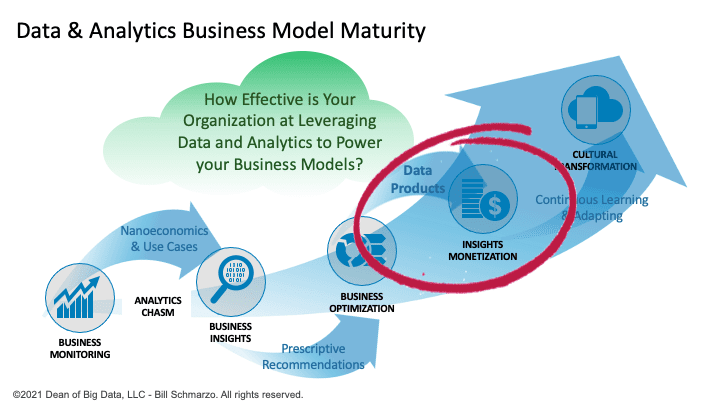
In my next blog “The Economics of Data Products”, I discussed Data Products as the vehicle for helping organizations drive “Insights Monetization” through the packaging of customer, product, and operational insights to optimize customers’ and partners’ operational decisions (Figure 1).

Slide1-1

Figure 1:  Insights Monetization through Data Products

And in my latest Data Products blog, I introduced the “Data Product Development Canvas” as a design tool to guide organizations in the creation of these Data Products.

This blog pulls together several key design templates to create a Data Product Blueprint to help organizations build their data products business; a business that can yield net new revenue streams while accentuating the value of the organization’s base products and services.

Note:  I will use the Order-to-Cash (OTC) cycle to explain the Data Product Blueprint concepts.

Blueprint Design Canvas #1:  Customer Journey Map

The Customer Journey Map ensures that we understand where and how customers and key constituents create or realize value by walking in their shoes as they try to achieve or accomplish a specific outcome (buy a car, select a college, fix a broken manufacturing press).

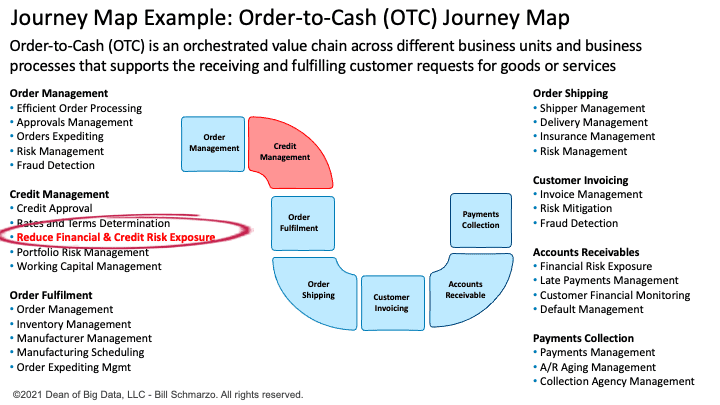
For example, the OTC cycle is an enterprise-wide business process (journey) for receiving and fulfilling customers’ requests that result in the delivery of specific goods or services outcomes. The OTC journey crosses multiple business operations including Order Management, Credit Management, Order Fulfilment, Order Shipping, Customer Invoicing, Accounts Receivable, and Payments Collections (Figure 2).

Slide2-1

Figure 2: Order-to-Cash (OTC) Journey Map

We can use the OTC journey map to identify the use cases for each business domain.  For example, the Credit Management business domain would have the following use cases:

  • Credit Approval
  • Rates and Terms Determination
  • Reduce Financial and Credit Risk Exposure
  • Portfolio Risk Management
  • Working Capital Management

For this exercise, we are going to drill down into the “Reduce Financial and Credit Risk Exposure” use case.

Note: Business Model Canvas developed by Strategyzer is a popular design canvas for helping organizations describe and design their business model.  I have assumed for this exercise that organizations have already established their desired business model and now are looking to become more effective at leveraging data and analytics to power that business model.

Blueprint Design Canvas #2:  Use Case Canvas

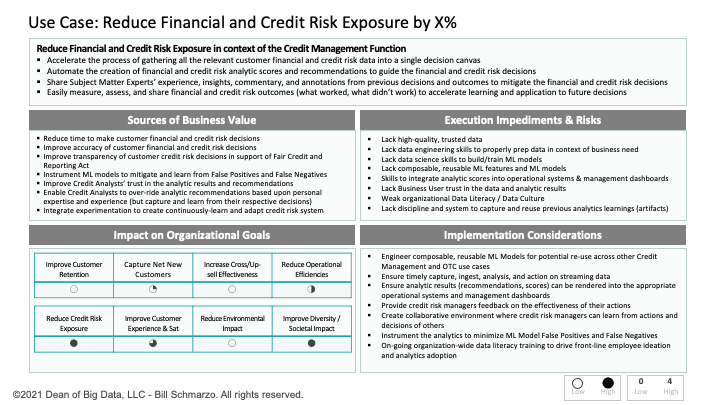
Next, we want to capture important details for each of the identified use cases. We want to collaborate with key subject matter experts to flesh out for each use case the important execution details including Objectives and Ideal Outcomes, Sources of Business Value, Execution Impediments & Risks, Implementation Considerations, and Impact on the Organization’s Financial and Operational Goals (Figure 3).

Slide3-1

Figure 3:  Reduce Credit Risk Exposure Use Case Canvas

Notice the bottom of the Use Case Canvas renders an assessment of the Overall Financial Impact and Ease of Implementation on a scale of 0 to 4.  These assessments are used to jump-start the Prioritization Matrix process that drives organizational alignment and consensus on the prioritized use case roadmap.

Blueprint Design Canvas #3:  Hypothesis Development Canvas

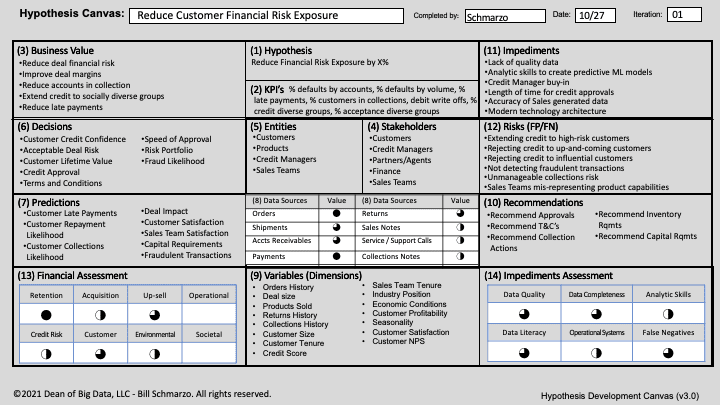
The Hypothesis Development Canvas facilitates the business stakeholder-data science collaboration to ensure that we thoroughly understand the business problem we are trying to address, the KPIs against which we will measure success, the key decisions that the need to be optimized, and the potential impediments and potential risks (including the costs of False Positives and False Negatives) associated with addressing the business problem (Figure 4).

Slide4-1

Figure 4: Reduce Risk Exposure Hypothesis Development Canvas

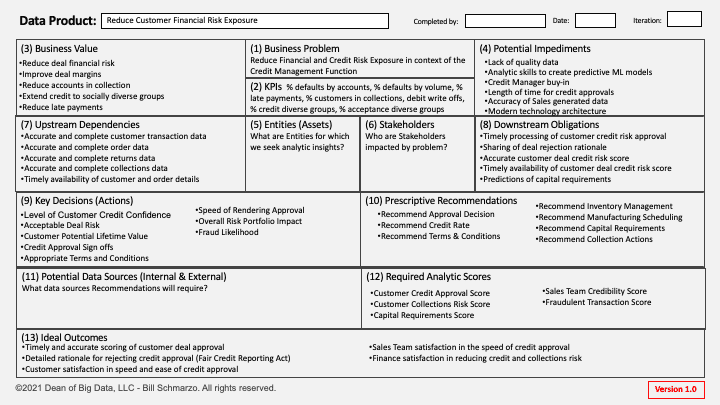
The Hypothesis Development Canvas is an output of the “Thinking Like a Data Scientist” methodology that brings together business subject matter experts with data team members to define the use case’s data and analytic requirements including use case desired outcomes, key stakeholders, analytic entities around which we will build analytic scores, the decisions, predictions, and recommendations to address the use case, the data and analytic requirements (feature engineering), and the potential people (cultural), process, and technology impediments.

Blueprint Design Canvas #4:  Data Product Development Canvas

The final step in the Data Product Blueprint process is the creation of a Data Product Development Canvas to guide the development, operationalization, and ongoing management of the Data Product.

The Data Product Development Canvas is an easy-to-comprehend tool for facilitating business and data team collaboration in triaging the targeted business problem and identifying the data and analytic components and requirements for the development of a Minimum Viable Data Product (MVDP) to achieve or deliver a specific business or operational outcome.

Slide5-1

Figure 5: Data Product Development Canvas

Some of the key operational requirements captured in the Data Product Development Canvas include upstream dependencies (that is, what data and/or analytics need to be captured and provided by upstream processes or use cases to support our use case) and downstream obligations (that is, what data and/or analytics does our use case need to capture and provide to downstream processes or use cases).

Notice that many of the success criteria and potential impediments are repeated across the Use Case, Hypothesis Development, and Data Product Development canvases.  That is to ensure that we don’t let the scope of the Data Product slip as we move through the Blueprint process.

Summary: Data Products Business Blueprint Summary

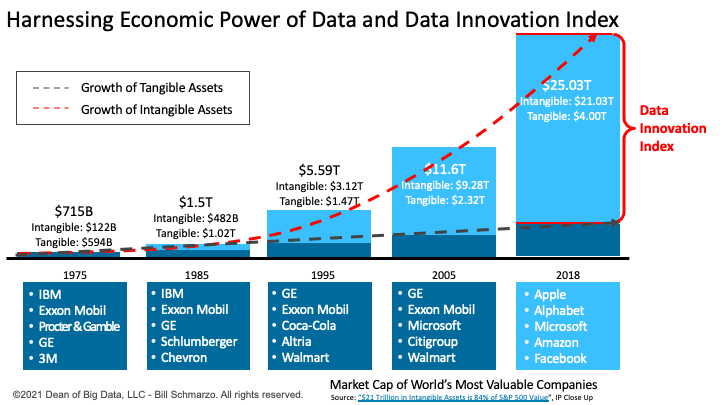
The opportunities for Data Products are almost endless – opportunities to expand an organization’s “Data Innovation Index” to create net new revenue streams while accentuating the value of the organization’s base products and services (e.g., automobiles, CT scanners, compressors, motors, wind turbines, televisions, refrigerators, washing machines). See Figure 6.

Slide6-1

Figure 6: Data Innovation Index

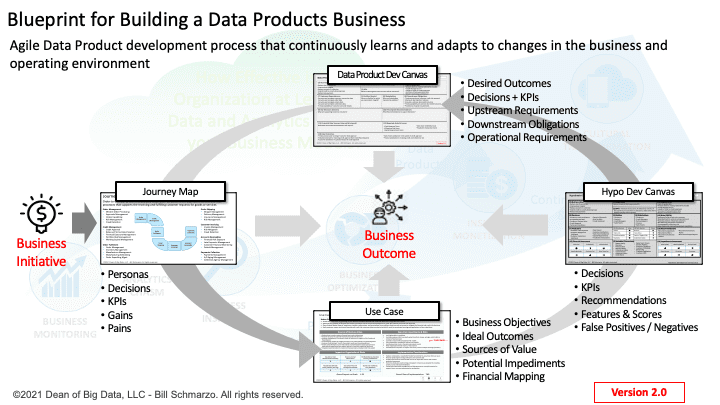
All organizations need is a blueprint – a detailed design plan of something to be built – to help them master the Data Innovation Index through data products.  Hopefully, this blog is the start of that mastery (Figure 7).

Updated-Agile-Blueprint-Process

Figure 7: Data Products Business Model Blueprint

Note: I got feedback that my Data Product Blueprint process in Figure 7 was waterfall, not agile. Totally agree and that’s my bad. I’ve updated the image and will release a future blog to address the questions that I got about that process. Thanks for your feedback!

By

Sourced from Data Science Central

By

When it comes to personal branding, the right colours have the power to attract clients and opportunities, while the wrong colours can do the exact opposite.

When it comes to personal branding, the right colours have the power to attract clients and opportunities, while the wrong colours can do the exact opposite. So, what’s the secret to choosing brand colours that lead you to the C-suite and closing bigger deals?

The first step in figuring this out is understanding the psychology of colour. Colour has the power to influence human behaviour. It can be utilized to induce a desired mood or emotion in someone and elicit a desired response (Masterclass Staff, 2022).

Colours are broken into several categories, the most common being primary and secondary colours. The primary colours are defined as colours from which all other colours can be created by mixing. The primary colours are:

  • Red
  • Blue
  • Yellow

Secondary colours are created by mixing two primary colours, with the most common being:

  • Green
  • Orange
  • Purple

The psychology of colour

Each colour can vary in intensity, also known as chroma (think, electric blue vs. navy blue) and its value (lightness or darkness). Here is a quick reference guide:

Red is passionate and energetic. Brands that use red in their branding are trying to communicate excitement, vibrancy and action.

Blue is calming and trustworthy. This is why many financial and healthcare services use blue in their branding.

Yellow is cheerful and optimistic — perfect for brands that want to communicate happiness and positivity.

Green is refreshing and natural, making it an excellent choice for eco-friendly and health-focused brands.

Orange is energetic and playful, often used by brands targeting younger audiences.

Purple is associated with royalty, luxury and mystery. If you want to convey a sense of sophistication and elegance in your branding, purple is the way to go.

Black, white and brown are considered neutral colours, but they also evoke emotions:

  • Black is powerful and mysterious.
  • White is pure, sophisticated and simple.
  • Brown is a mixture of all the primary colours and is natural, earthy and strong.

When it comes to personal branding, you want your brand colours to represent who you are, and authenticity is everything. Choosing your brand’s colour isn’t a game of “hope for the best.” It’s a scientific approach that starts with clarifying what you want to achieve and how you want to be perceived by your ideal audience.

For example, let’s say that you are a take-charge nurse who wants to leverage a personal brand’s power to move into an administrative role. In this case, you may lean towards choosing colours that convey compassion, excellence and leadership.

Let’s use Kaiser Permanente, a non-profit healthcare organization, as an example. The brand’s logo uses a calming blue to represent “loyalty and trust,” while the white brings balance and peace to the logo. When you look at the Kaiser logo, how do you feel? Do you see how this large organization used colour to make the brand feel “human”?

Get clear on how you want to be perceived by others

Now that you have an overview of colour psychology, it’s time to understand how you want others to see and experience you. What are three words you want people to use when they describe you? What colours come to mind when you hear the words fiery, bold and ambitious?

Ask yourself how your industry and/or niche are viewed. Would you expect to see a doctor in private practice using pink and purple in their branding? Another point to consider when thinking about industry standards is: Do you want to disrupt the industry or offer a slightly different approach?

Your primary brand colour is the colour you’ll use most often. It should demand attention. Visually, it is the star of your show and is used in your logo, website, social media and marketing materials. Your secondary brand colours are the colours you’ll use less often in your branding. They can accentuate some aspects of your website or add visual interest.

Related: Understanding the Power of Design and Branding

Consistency is key

Now that you know the psychology behind choosing the right colours for your brand, it’s essential to use your colours consistently. You’ll use your brand colours on your website and marketing materials.

Another area where your brand colours should be consistent is in your attire. So many leaders and entrepreneurs miss the mark by displaying brand presence in the way they dress. If you’re planning on doing any public speaking, attending events or networking, wear your brand colours! By showing up “on brand,” you will stand out in a crowd and make yourself unforgettable.

If advancing in your career is your goal, consider using your brand colours in your email signature, across social media and any other place you show up. To remain consistent, you also need to know the hex codes of your brand’s colour.

What is a hex code?

A hex code is a six-digit combination of numbers and letters to specify a colour. Hex codes start with a pound sign (#) and are followed by six characters, three numbers and three letters. For example, the hex code for electric blue is #00FFFF.

Hex codes are essential for personal branding, because they ensure that your brand colours are consistent across all platforms. When you use hex codes, you can be confident that the blue in your logo will match the blue on your website, and the green in your social media posts will match the green in your email signature.

A best practice is to create a guide that outlines your brand standards, including your colour palette, words that describe your brand, etc. This document is known as a brand guide, and it can also include logos, fonts and even the filters you use on social media. As your brand grows, everyone on your team will know the standards, and they can easily maintain the same level of consistency.

Colour is an essential tool that should not be overlooked for personal branding. By understanding the psychology of colour and choosing colours that align with your goals and values, you can create a strong and recognizable personal brand.

By

Sourced from Entrepreneur

By Danielle Wiley

In the ever-expanding world of influencer marketing, the sheer number of potential partners and topic niches can seem overwhelming. With one recent report estimating that there are over 200 million creators of various kinds, the main question brands may be wrestling with is who to partner with instead of where.

While finding the right influencer is obviously a critical element of the influencer marketing process, today’s platform technologies offer targeting capabilities that many brands simply aren’t taking advantage of.

Geotargeting allows brands to be even more successful with their influencer campaigns by making branded content more relevant and personalized to its target audience. Brand outreach that’s been tailored to audience locality and behavior has a better chance of reaching the right people at the right time with the right message.

What Is Geotargeted Influencer Marketing?

In a nutshell, geotargeting is a way for businesses to tailor their advertising to potential customers based on specific geographic locations. Geotargeted influencer marketing incorporates the influencer’s location (and their associated influence within that location) into the campaign as a whole.

For example, let’s say a national fast-casual restaurant chain is opening a new location in a specific town. Geotargeting would allow brands to activate area influencers who can raise awareness and drive sales for the new restaurant, connecting with the brand’s intended audience with localized messaging that resonates.

The same campaign could include regional influencers, adding to local-level outreach with bigger-picture messaging that’s still targeted to specific locales as well as national influencers.

Better Results With A Local Approach

Local influencers are ideal partners for local businesses since it’s likely that many of their followers are also in the same area. Partnering with local creators allows local businesses to connect with target audiences that are close in proximity, sharing brand benefits and differentiators through a local’s lens.

This strategy can also be leveraged to support larger brands: Local influencers can help establish and promote regional or national brands with a local presence. Creators with local ties offer brands a built-in community connection, and they often have the local credibility and influence that can help shape a brand’s message.

A few examples of partnering with local creators:

• National clothing brand partnering with a local Pacific Northwest weather reporter to promote their new line of rainwear.

• Rising college basketball player promoting a local restaurant with a new menu item named after her.

• National beauty store partnering with a local makeup influencer to promote a new retail location in the area.

• Southern restaurant chain partnering with local influencers to promote nearby locations that offer regional favourite foods.

• Member of a local dance team promoting a new sparkling water flavour from a national beverage brand.

• Local nutritionist sharing her excitement over the new opening of a specialty grocery store.

People are more likely to try out a new restaurant or product in their area if someone in their social circle recommends it. Additionally, influencers are often able to share brand messaging in a way that doesn’t feel like a traditional ad or sales gimmick.

Increased Authenticity & Brand Impact

Influencer marketing is a way to tap into the genuine consumer needs and interests of the moment, which offers an effective strategy for dealing with ongoing consumer uncertainty.

By partnering with creators who authentically represent their target audience, brands don’t have to rely on spray-and-pray advertising. Instead, they can share incredibly personalized messaging that’s been shaped by influential local personalities.

Geotargeted influencer marketing can contribute to the larger brand story by including relevant local perspectives. Consider the branding upsides of partnering with genuine people who genuinely care about their locality, are known for their local/regional expertise and/or are strongly associated with the area.

The right kinds of geotargeted campaigns can spark authentic reviews and recommendations that drive specific kinds of consumer action. And they can also add to a brand’s overall presence by encouraging genuine consumer connections and points of engagement.

Geotargeted Brand Spend Boosts ROI

Every influencer marketing campaign will inevitably reach some people who aren’t interested in the promoted brand. However, without careful campaign targeting, brands may be wasting their budget reaching out to consumers who don’t even live where they can buy a brand’s products or services.

With geotargeting, brands can deliver content to potential consumers within a specific location, with messaging that’s shaped by locals and relevant to the area. Whether it’s for a local business or a local franchise from a large national brand, geotargeted influencer marketing can work alone or supplement national outreach efforts.

Not only does the spectrum of influencer marketing include the affordable (and surprisingly effective)nano-influencer, but also influencer campaigns can be stopped, started and adjusted on the fly. This offers an enormous benefit to brands adjusting to Covid-19’s “new normal.” Shifting consumer behaviours can be quickly addressed within the campaign. (For instance, if a new store is opening in an area with rising infection rates, campaign messaging can be quickly changed to promote online shopping instead of in-person.)

The Local Mindset

Brands know how important personalization has become for reaching today’s consumers. Local market strategies are increasingly necessary to drive traffic and sales, as well as to strengthen the overall brand.

Location is an important aspect when it comes to marketing personalization, and technological targeting advancements have changed the game for both creators and audiences. Today’s platform tools offer deep-dive demographic insights that simply weren’t available even a few years ago.

Research shows that consumers’ attitudes and behaviors remain highly localized, even in a global context. Adopting a local mindset through geotargeted influencer marketing can help brands foster the kinds of meaningful audience connections that drive real results.

Feature Image Credit: getty

By Danielle Wiley

Founder and CEO of Sway Group, an agency that specializes in influencer marketing, branded content and digital advertising. Read Danielle Wiley’s full executive profile here.

Sourced from Forbes

By Jeff Beer

Global chief marketing officer Manuel Arroyo outlines the OpenX partnership with advertising holding company WPP, and how it will drive new brand growth.

Just today alone, 1.9 billion Coca-Cola products will be sold around the world. Now, chief marketing officer Manuel “Manolo” Arroyo is aiming to double its number of consumers very quickly.

“We’re in the process of deploying QR codes in every package available for all of our brands in the next three years,” Arroyo tells Fast Company. “QR codes are arguably the most unexploited and under-leveraged media vehicle that exists out there. Even if you only get a 3% redemption, imagine the return on 1.9 billion per day, what we can do in terms of first-, second-, and third-party data moving forward. One [strategy] at a global scale, and it’s going to take us to very different places.”

The key phrase there is one strategy. Coca-Cola operates in more than 200 countries around the world, and has traditionally—like many global corporations—operated with a complex network of marketing and advertising partners throughout its worldwide business. But last November, Arroyo partnered with advertising-holding company WPP to create a unique partnership that includes a bespoke internal team dedicated to Coca-Cola globally called OpenX. The CMO sees this as a key tool in achieving his overall goals for the flagship Coke brand, and the company in general.

“First, it’s to make that brand an incredible icon and brand, young and relevant again,” says Arroyo. “But also tap into a tremendous growth potential. We should be able to double this brand [consumer base] very soon if we do things right, and if we do it very differently than how we’ve done it in the past 20 years. I think we have a very clear idea of what it takes to get there.”

A significant part of that idea is for OpenX to help his company be more consistent and efficient in its marketing and advertising, on a global scale. Coke spent more than $4 billion on global advertising in 2019. It saw its spending drop by 35% in 2020 but has since gone back to pre-pandemic levels.

“Even though we have reshaped our portfolio into something more focused, we still have more than 200 brands across the world, and we come from an incredibly fragmented way of marketing,” says Arroyo. “Instead of having one-off campaigns that change every quarter, [we want to have] ongoing, continuous platforms. We know we’re doing Christmas for the next five years, so we don’t need five different briefs for Christmas. We just need one platform, and then update it and shape it based on the [consumer] data.”

In February, the company launched its “Coca-Cola Creations” campaign for Coke, which included a “space-flavoured” cola, that’s all part of an overall global marketing platform the company calls “Real Magic.” And in May, it rolled out a new global campaign for Sprite (the first created wholly by OpenX) called “Heat Happens.”

The idea of a bespoke ad-holding company team for a massive client isn’t new. Omnicom Group created the We Are Unlimited team in 2016, at the time to service McDonald’s (folded in 2019), as well as Team X last year for Mercedes-Benz. WPP itself has tried these models before, in 2006 with Team One for Ford, and Team Energy for BP.

The basic idea is that a global advertising-holding company, with its many agencies and specialties, combines its capabilities into a single, custom-made entity for a major client. It’s an idea that hit trend status a few years ago, only to have some brands swing back to a more traditional multiple-agency model. (In the U.S., for example, both Ford and McDonald’s have picked indie agency Wieden + Kennedy for major ad work.) Prior to OpenX, Coca-Cola worked with about 4,000 different agency partners around the world. Arroyo and Laurent Ezekiel, OpenX CEO and WPP chief marketing and growth officer, insist things will be different this time.

The key is a single contact point, as well as a single P&L, giving Coke a simple partnership format, and preventing WPP’s various stakeholders from competing internally for parts of the business—two things that have often muddled these types of partnerships in the past.

Last year, Domino’s chief marketing officer Art D’Elia lauded the simplicity of an independent agency partner over the complexity of a holding company, telling AdAge, “I really feel that the independent agency model gives us more flexibility and less distractions.”

Another significant development in the OpenX model is that it not only allows, but insists, that if an outside competing agency can help, Open X is obligated to collaborate. It’s all in the name of finding the best possible work for Coke, and removing as many barriers for finding it.

“In a partnership like this with WPP, they’re putting skin in the game on our metric—growing our consumer base—and that will define success for The Coca-Cola Company in terms of marketing,” says Arroyo. “And they’re ready to be compensated or penalized, based on mutual achievement there. So Laurent’s achievement will be the same as what I report to my CEO.”

Ezekiel says this partnership has the potential to influence work beyond a single brand and agency. “I tell my team that we’re in the position to architect the future here,” says Ezekiel. “Genuinely writing a new page in marketing history.”

By Jeff Beer

Jeff Beer is a staff editor at Fast Company, covering advertising, marketing, and brand creativity. More

Sourced from Fast Company

In the subscription economy, brands need to react quickly to keep customer churn to a minimum.

It’s no secret that the subscription economy has been one of the fastest-growing sectors in recent years. According to the Zuora Subscribed Institute, 78% of adults paid for subscription services last year in the US.

Yet, in April, we saw one of the world’s biggest players in the subscription economy — Netflix — announce a net loss of 200,000 subscribers globally. In addition, the company expects to haemorrhage a further two million subscribers over the next few months.

Naturally, this raises the question of whether the subscription economy boom is starting to wane, and if so, what brands can be doing to react, keep customer churn to a minimum, and even keep pace with growth projections.

In my view, a key component to this is the service function, and more specifically service agents themselves. Let’s look at why.

Is the Subscription Boom Waning?

Yes, there are caveats to the Netflix case, chiefly that it suspended its services in Russia. Further, it’s seen increased competition from new players in the space, especially Disney+. However, given that the company is projecting to lose even more of its subscribers, it ought to serve as a warning to the rest of the subscription economy.

If we look more generally at this sector, the immediate driver of any stalling in growth and loss of customers is inflation and a rise in the cost of living. For many consumers, getting notified that another subscription charge has been taken from your bank account will only prompt them to probe whether they have extracted value from that service or not.

This doesn’t mean there is going to be a mass exodus from subscription services — there are subscriptions for just about everything these days, whether that’s streaming services, beauty products or food boxes. They aren’t going to just disappear.

However, it is probably going to be the case that we’ll see consumers going through a process of justifying expenditure and asking: is this thing I pay for monthly really of value to me?

We also need to view these changes in the context of more macro trends in consumer behavior. Firstly, the vast increase in online shopping and boom in services that offer convenience as their unique selling proposition has only heightened consumer expectations of brands. In some places, you can now get a full week’s shop on your doorstep in 20 minutes, ordered on your smartphone. These buying scenarios have been accelerated by the COVID-19 pandemic.

Secondly, this has also been coupled with a dramatic drop in the cost of switching to another brand. It is now no longer a huge undertaking for consumers to cancel direct debits and move to a competitor — it’s just one click away. This is probably why, when we spoke to 3,000 consumers across the US and UK last year, we found that just one poor experience is enough for 95% of consumers to consider never returning to the brand.

Overall, then, convenience is at an all-time high, but brand loyalty and the cost and effort of switching is at an all-time low. Add in the new dynamic of the rising cost of living, it’s easy to see this contributing to the loss in subscriber numbers associated with Netflix, and potentially the subscription economy more broadly.

Retention and Customer Service

And when I say the loss in subscriber numbers, what I am referring to is customer churn. This is why it is critical to focus on customer retention. For subscription services, growth and increasing the number of subscribers has been the key objective. But now, with consumer behaviours changing and costs rising, reducing the churn rate and increasing retention and loyalty now ought to be the key objective.

Yes, there are tactical ways subscription brands can reduce churn and increase retention, such as offering customers the option to suspend subscriptions. But, in my view, the customer service function has a key role to play in reducing churn by increasing loyalty in the sector.

In most digital brands today, reaching out to customer service is the only contact a customer has with a brand, and service agents are the ones managing and nurturing these relationships. They are on the front line and are key to shaping the experience of the customer, and as we know, just one poor experience can mean a once-loyal customer churns.

The challenge is that many brands are getting the service function wrong. In the same survey we conducted, the large majority (66%) of consumers we spoke to said companies are still not getting customer service right; hence why they are willing to switch loyalties more quickly. Crucially, we found that some of the key drivers of this disloyalty are everything from having repeating information across different channels, receiving a robotic service and, in general, high effort engagements with agents.

For brands in the subscription economy, reducing churn through driving retention and loyalty will become the new oil. But if your service agents can’t deliver the experience customers want and demand, helping them see the value in your product, then you’ve already lost. So, how can they get on the winning side in a climate where the brand-consumer relationship is more unstable than ever?

Agents as Drivers of Retention

Last year, we also spoke to around 300 customer support staff that work across retail and ecommerce in the US and UK, with 88% reporting that they are currently losing customers due to poor customer support: 46% say it takes them longer than it should to find simple information such as a customer’s order status, while over one in three (34%) of staff still Google customer problems to find the answer.

In my view, this provides a key part of the answer. Convenience is at an all-time high, but brand loyalty and cost of switching are at an all-time low. Where consumers will be reassessing the value of the services they pay for, giving your service agents what they need to protect, build and strengthen this relationship is vital.

The bedrock of this is ensuring they have the right information at the right time. What is this customer inquiring about? How much have they bought from us in the last three months? Are they part of our loyalty scheme? In having the answers to these questions at their fingertips, agents will have all they need to protect, build and grow the relationship, reducing churn rates and increasing retention in the process.

Overall, the successful subscription businesses will be those that focus on becoming even more customer-centric. Not only does this mean giving customers control over managing the subscription relationship, but also having a focus on providing ongoing customer value through the service function across all contact channels. Prioritizing the latter will mean reducing customer churn and driving high levels of loyalty, which will be vital in a period of consumer-brand instability.

By Tue Sottrup

With over 20 years of experience in customer service, Tue is driven by his passion for the industry. Customer experience and engagement is an integral part of any business, and Tue truly believes that software can empower brands to build stronger and longer lasting relationships, as well as dramatically improve the agent experience.

Sourced from CMS Wire

By Lane Ellis

How can B2B marketers make their content stand out and highlight the talented subject matter experts, creators, and influencers they partner with?

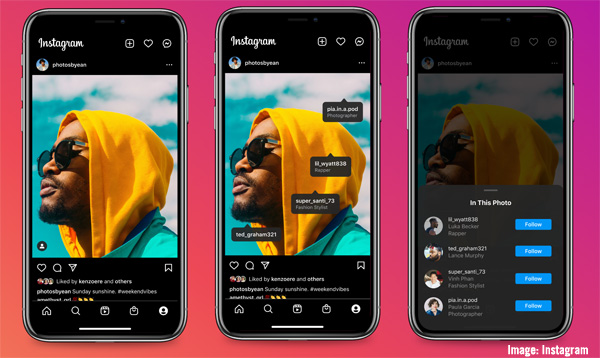
Earlier this year Instagram rolled out new enhanced tagging features that allow digital marketers to do a much better job of indicating and crediting the various influencers and creators involved in the creation of content shared on the platform.

Instagram’s addition of enhanced tagging — which is also available for use in video Reels — offers significant new exposure opportunities for B2B content that has been created by multiple professionals, often precisely the type of content that is either made or co-created by industry influencers.

Let’s take a look at some of the advantages provided by Instagram’s enhanced creator tags, and how B2B marketers can best put them to use.

1 — Straightforward Setup Process

The process of using the enhanced tagging features is fairly straightforward, however there are a few caveats to be aware of as you move to incorporate them into your B2B marketing workflow on Instagram, in order to get the full effect of Instagram’s latest tagging elements.

Instagram Image

While Instagram has moved to make more of its features available to desktop users, the enhanced tagging features were initially only available from the mobile app.

Simply having content creators or co-creators tagged goes a long way, and shows a clickable link to learn more about or follow the people involved in the digital assets you find helpful on Instagram. The updated tagging feature can do more, however.

2 — Switch On A Business Or Creator Account

One aspect of the enhanced tagging system takes on even more value, and that’s when the people tagged have gone through the simple process of setting up their Instagram profile as either a creator or business account.

Tagging people with a creator or business account adds a second line of helpful information below the person’s username, containing a category they’ve selected, such as a few B2B-related examples listed here:

  • Video creator
  • Digital creator
  • Writer
  • Author
  • Advertising Agency
  • Marketing Agency
  • Market Research Consultant
  • Advertising/Marketing
  • Internet Marketing Service

To ensure that anytime your brand or the influencers you work with are mentioned using an enhanced tag that also shows category information, it’s easy to switch your Instagram account from personal to professional — there is no waiting period or fee involved — simply access your account settings and select the option to switch to a professional account.

From there you can choose between a creator or business account, described by Instagram as:

  • Creator accounts are best for public figures, content producers, artists and influencers
  • Business accounts are best for retailers, local businesses, brands, organizations and service providers

After choosing your account type, you’re given the option to select a category that best fits how you use Instagram, and this will be the category that shows below your username when others include you using enhanced tagging — however keep in mind that  you must also tick the “show category on profile box” option.

Instagram uses a search box for finding the most relevant category for creator and business accounts, such as those we listed above, and it can be worthwhile to experiment with the available categories, as new ones may be added over time that better describe your own B2B marketing niche.

3 — Ripe For Implementation By B2B Brands

In the B2B arena, the new Instagram enhanced tagging is ripe for implementation by brands and marketers looking to distinguish their content from the competition, and to highlight the subject matter experts and influencers they partner with.

It’s still early days for implementation of the enhanced tagging, and those brands and B2B marketers willing to put them to use will be among the first to stand out as multiple contributors are highlighted in co-created content.

“The new Instagram enhanced tagging is ripe for implementation by B2B brands and marketers looking to distinguish their content from the competition, and to highlight the influencers they partner with.” — Lane R. Ellis @lanerellis Click To Tweet

4 — From One Influencer To Many Others

When Instagram’s enhanced tagging becomes more regularly utilized, it will represent a powerful way not only for influencers to have the digital work they’ve helped create gain greater exposure, but it will also be a helpful way to find new industry experts who are tagged alongside an influencer you may already be aware of.

These days top performing digital content can involve a slew of talented creative professionals, from marketers and writers to video, audio, and social media specialists, and Instagram’s new enhanced tags make it easy to shine a light on everyone who had a hand in building a successful digital asset.

5 — Tagging Gives Voice To Underrepresented Talent

While not unique to Instagram, the new enhanced tagging features can play a helpful role in giving a greater voice to traditionally underrepresented talent.

Instagram’s augmented tagging features were brought to life through the help of three women in technology, who were each profiled in the Snobette interview, “Meet The Women In Tech Behind The Instagram-Enhanced Tagging Feature.”

“In a world where online visibility directly leads to brand sponsorships and other types of monetary opportunities, crediting is more important than ever,” Alexandra Zaoui, music data analyst at Instagram-parent firm Meta, observed.

“In a world where online visibility directly leads to brand sponsorships and other types of monetary opportunities, crediting is more important than ever.” — Alexandra Zaoui @ZaouiAlexandra Click To Tweet

“One of the biggest challenges about being a woman and particularly a Black woman in tech is not seeing nor working with others like you,” Cameryn Boyd, software engineer at Meta, noted. “I’m passionate about bringing other Black women and underrepresented people into tech because that is how and when some of the best and most equitable innovation happens,” Boyd added.

Just as in the B2C marketing world, B2B influencer marketing can help amplify underrepresented voices, and features such as Instagram’s new enhanced tagging help expand such efforts.

Our CEO Lee Odden featured efforts that give voice to talent as one of the top methods for elevating B2B marketing in 2022, in “Three of the Biggest Opportunities to Elevate B2B Marketing in 2022.”

“B2B marketers are in a unique position to make choices about how they represent their customers in content, who they partner with in content collaborations and the influencers they engage.” — Lee Odden @LeeOdden Click To Tweet

Instagram Enhanced Tagging For B2B Marketing Success

By fully embracing Instagram’s new enhanced tagging capabilities, savvy B2B marketers can lead the way and set a good example for the influencers, digital creators, and industry experts they work with, in a process that’s beneficial for both brands and influencers alike — not to mention both existing and potential customers.

Instagram is just one of the digital menagerie of social media platforms that top B2B brands use to engage audiences, however as an increasing number of B2B firms find success on platforms including TikTok and others, having a solid cross-platform tagging strategy in place will give you an edge over those who don’t.

Creating award-winning B2B marketing that elevates, gives voice to talent, and humanizes with authenticity takes considerable time and effort, which is why an increasing number of firms are choosing to work with a top digital marketing agency such as TopRank Marketing. Contact us to learn how we can help, as we’ve done for over 20 years for businesses ranging from LinkedIn, Dell and 3M to Adobe, Oracle, monday.com and others.

By Lane Ellis

Lane R. Ellis (@lanerellis), TopRank Marketing Social Media and Content Marketing Manager, has over 38 years’ experience working with and writing about the Internet. Lane spent more than a decade as Lead Editor for prestigious conference firm Pubcon. When he’s not writing, Lane enjoys distance running (11 marathons including two ultras so far), genealogical research, cross-country skate skiing, vegetarian cooking, and spending time with his wonderful wife Julie Ahasay and their cat Kukla in beautiful Duluth, Minnesota.

Sourced from TopRank Marketing

By Stas Pamintuan

Not enough companies dedicate time and effort to blogging, which is a great way of promoting services and connecting with users – new and old. Stas Pamintuan, junior SEO executive at Digital Ethos, shares some fool proof techniques for blogging in style to ensure that posts engage readers.

As Google becomes increasingly sophisticated at determining user search intent, it’s evident that content writing answering your customers’ questions is one of the key ways to develop a powerful SEO blog strategy. Creating topics that address the queries and concerns of your customers allows you to take advantage of Google’s algorithm and searchers’ trends toward longer search strings.

Here’s a little secret – the information you need is readily available for free. All it takes is a few searches, as well as knowing where to look. And if you can figure out what your target audience is searching for, the process of finding blog topic ideas comes quite easily. Not only that, but there are also various tools and resources to help you generate ideas and streamline this process.

Use medium- and long-tail keywords for SEO

When you focus on writing blogs that answer specific questions, you’ll attract buyers who are after what you offer. This is where medium- and long-tail keywords come in as they improve click-through rates and conversions because they answer questions from customers who are in specific stages of the buyer’s journey.

In essence, you’re pre-qualifying your audience. Even if you end up receiving fewer site visits, those that do click through to your site will be more likely to convert into buyers because of this. It’s better to target users who are searching for your products or services and convert, rather than getting more visitors who immediately bounce off of the site.

Check Google Analytics

Reviewing your analytics can help you discover what pain points customers are looking to solve. Are more people clicking on a specific product or service page? Is there a specific blog people are looking at on your site? How many times are they downloading your resources?

Understanding these behaviours can help you find what’s working. You can also find gaps in the content you release, so you can generate more copy to help you resolve your audience’s pain points.

Practice social listening

With so many conversations happening on social media, it can definitely be a challenging space to maneuver if you’re not sure what you’re after. But if you’re able to identify their presence on socials, social listening becomes a tool you can leverage to find interesting blog topics to write about.

Follow hashtags, like pages or join groups that are related to your products and services. This way, you’ll be able to find out about the conversations your audience is having and even their pain points; but regardless, there is an abundance of blog topic ideas as people will always be having conversations, old and new.

Rather than connecting with one person, when you optimize your content correctly you have the ability to connect with everyone in a group.

Keyword tools to help you generate blog topic ideas

To help you get started, here are some keyword research tools you can use to generate blog topic ideas that people are searching for online.

Ahrefs: Ahrefs is a free keyword generator tool that helps you to find relevant keywords from their database of over 8bn queries. You can enter up to 10 words or phrases and even choose from one of six keyword ideas reports. What’s even more useful is that search query relevance can be divided between Google, Bing and Amazon and queries from seven other search engines.

Semrush: Semrush is one more tool that helps you to find keywords based on search queries and questions.

AnswerThePublic: AnswerThePublic is a tool that generates a visualization of questions people are asking about a topic. The good thing here is that there are so many topic clusters you’re definitely bound to find popular blog topics to suit you.

Google Keyword Planner: If you have an existing AdWords account, Google Keyword Planner allows you to find keywords along with their stats and their popularity in your choice of region.

Quora: When you enter a word or phrase on Quora, it generates a list of questions that its users are asking about a particular subject. You can even dig deeper by filtering By Type and selecting Questions or Topics. When you filter by Topics, you’ll see how many times questions about that topic have been asked.

We’re always ahead of the game

As a specialist in content marketing, the team at Digital Ethos can make your business worth discovering. We can work with you to deliver truly consumable content that magnifies your brand and everything it’s about.

By Stas Pamintuan

Sourced from The Drum