Author

editor

Browsing

By

According to a 2017 Glassdoor survey, 57% of job seekers say that benefits and perks “are among their top considerations” when accepting a job. In the midst of the Great Resignation that continues into 2022, benefits are still front of mind for job seekers — and even important for retaining employees who are thinking about jumping ship. Here are offerings all companies should have in 2022 if they’re looking to reengage and retain their employees.

1. Flexibility.

Newer generations have promoted the incorporation of flexible work options. It is clear that no two employees are able to work in the exact same fashion. When flexible positions are offered, a company can have a variety of employees that showcase unique skills. Companies that create a diverse workplace will notice the overwhelming benefits over time.

Many employers miss the opportunity to hire exceptional employees because of the lack of flexible positions. Just because an individual thrives better in a different scenario doesn’t mean they aren’t an asset to your company.

Managers and HR professionals should consider creating opportunities for a range of employee types. In order to develop flexible positions, brainstorm realistic options. For example, many thrive in remote positions because they can produce better work when in the comfort of their own home. Some people prefer going to work some days, and completing their tasks at home during other days.

It’s not just management’s view of flexibility that counts. They need to be proactive in asking their employees what they want.

“Once I considered the perspective of employees, I’ve become better at my job,” revealed Daniel Neal, HR manager at Assignment Service and RatedWriting.

2. Employee wellness benefits.

Neglecting the well-being of employees is not only unethical, but it is also a dangerous disadvantage. When employees are viewed as workers rather than humans, it creates an unhealthy workplace dynamic. In order to prevent this notion, it’s of your best interest to show authentic dedication prioritize employee wellbeing. By ensuring that employees have healthy well-being, not only will they perform better, but they will enjoy their jobs more.

There are several ways that employee wellness can be worked into a company. Recognition, health benefits, a genuine relationship among all workers, and less pressure are factors that lead to positive wellbeing.

3. New technology.

Old methods often produce outdated results. Due to new generations and changes in our world, outdated work methods don’t always suffice. New strategies are a solution to gaining company success in the modern world.

Let’s say your company fails to incorporate technology use. Our world now revolves heavily around technology in order to operate. When companies don’t utilize technology, they will struggle performance-wise. It’s no surprise that modern workers already have ample technology expertise. Allowing workers to use technology, especially for certain jobs, is a clever decision. Technology can be used to lessen work difficulty, efficiently advertise and build quick relationships with customers and clients.

4. Analytics and feedback.

Rather than assuming how employees can improve, management should provide real solutions based on the analytics of the company. Company analytics can be measured by the overall performance of each employee combined in all areas.

After data is collected, management can identify the problem areas. For example, maybe a majority of employees struggle to fill in information in a certain format. If so, the company can adapt the format in a way that all employees are able to easily complete that task.

With analytics comes employee appraisal. In order to both fairly, but also accurately appraise employees, managers need to give back quality constructive criticism. Some employers and HR professionals mistake harsh feedback as constructive criticism. The issue is the feedback is often blunt and doesn’t promote employee improvement. Modern employees prefer constant feedback rather than annual appraisals. In order to learn and improve, they need to know about how they can become better workers — in a constructive way.

Companies that aren’t aware of these trends risk not only falling behind in the job market but also losing valuable current employees. By offering flexibility, employee wellness benefits, new technology and regular feedback, they can reengage employees and stay competitive with other companies — all while making for a happier workforce.

This article first appeared on Fairygodboss, the largest career community for women dedicated to helping them achieve their career goals.

By

Sourced from Hive

By

Looking back on the past six years, the headlines may have pivoted to cloud, AI, and the continuing saga of open source. But peer under the covers, and this shift in spotlight has not been away from data, but because of it.

t’s been a wild ride over the past six years as ZDNet gave us the opportunity to chronicle how, in the data world, bleeding edge has become the norm. In 2016, Big Data was still considered the thing of early adopters. Machine learning was confined to a relative handful of Global 2000 organizations, because they were the only ones who could afford to recruit teams from the limited pool of data scientists. The notion that combing through hundreds of terabytes or more of structured and variably structured data would become routine was a pipedream. When we began our part of Big on Data, Snowflake, which cracked open the door to the elastic cloud data warehouse that could also handle JSON, was barely a couple years post stealth.

In a short piece, it’s going to be impossible to compress all the highlights of the last few years, but we’ll make a valiant try.

The Industry Landscape: A Tale of Two Cities

When we began our stint at ZDNet, we’d already been tracking the data landscape for over 20 years. So at that point, it was all too fitting that our very first ZDNet post on July 6, 2016, looked at the journey of what became one of the decade’s biggest success stories. We posed the question, “What should MongoDB be when it grows up?” Yes, we spoke of the trials and tribulations of MongoDB, pursuing what cofounder and then-CTO Elliot Horowitz prophesized, that the document form of data was not only a more natural form of representing data, but would become the default go-to for enterprise systems.

MongoDB got past early performance hurdles with an extensible 2.0 storage engine that overcame a lot of the platform’s show-stoppers. Mongo also began grudging coexistence with features like the BI Connector that allowed it to work with the Tableaus of the world. Yet today, even with relational database veteran Mark Porter taking the tech lead helm, they are still drinking the same Kool Aid that document is becoming the ultimate end state for core enterprise databases.

We might not agree with Porter, but Mongo’s journey revealed a couple core themes that drove the most successful growth companies. First, don’t be afraid to ditch the 1.0 technology before your installed base gets entrenched, but try keeping API compatibility to ease the transition. Secondly, build a great cloud experience. Today, MongoDB is a public company that is on track to exceed $1 billion in revenues (not valuation), with more than half of its business coming from the cloud.

We’ve also seen other hot start-ups not handle the 2.0 transition as smoothly. InfluxDB, a time series database, was a developer favourite, just like Mongo. But Influx Data, the company, frittered away early momentum because it got to a point where its engineers couldn’t say “No.” Like Mongo, they also embraced a second generation architecture. Actually, they embraced several of them. Are you starting to see a disconnect here? Unlike MongoDB, InfluxDB’s NextGen storage engine and development environments were not compatible with the 1.0 installed base, and surprise, surprise, a lot of customers didn’t bother with the transition. While MongoDB is now a billion dollar public company, Influx Data has barely drawn $120 million in funding to date, and for a company of its modest size, is saddled with a product portfolio that grew far too complex.

It’s no longer Big Data

It shouldn’t be surprising that the early days of this column were driven by Big Data, a term that we used to capitalize because it required unique skills and platforms that weren’t terribly easy to set up and use. The emphasis has shifted to “data” thanks, not only to the equivalent of Moore’s Law for networking and storage, but more importantly, because of the operational simplicity and elasticity of the cloud. Start with volume: You can analyse pretty large multi-terabyte data sets on Snowflake. And in the cloud, there are now many paths to analysing the rest of The Three V’s of big data; Hadoop is no longer the sole path and is now considered a legacy platform. Today, Spark, data lakehouses, federated query, and ad hoc query to data lakes (a.k.a., cloud storage) can readily handle all the V’s. But as we stated last year, Hadoop’s legacy is not that of historical footnote, but instead a spark (pun intended) that accelerated a virtuous wave of innovation that got enterprises over their fear of data, and lots of it.

Over the past few years, the headlines have pivoted to cloud, AI, and of course, the continuing saga of open source. But peer under the covers, and this shift in spotlight was not away from data, but because of it. Cloud provided economical storage in many forms; AI requires good data and lots of it, and a large chunk of open source activity has been in databases, integration, and processing frameworks. It’s still there, but we can hardly take it for granted.

Hybrid cloud is the next frontier for enterprise data

The operational simplicity and the scale of the cloud control plane rendered the idea of marshalling your own clusters and taming the zoo animals obsolete. Five years ago, we forecast that the majority of new big data workloads would be in the cloud by 2019; in retrospect, our prediction proved too conservative. A couple years ago, we forecast the emergence of what we termed The Hybrid Default, pointing to legacy enterprise applications as the last frontier for cloud deployment, and that the vast majority of it would stay on-premises.

That’s prompted a wave of hybrid cloud platform introductions, and newer options from AWS, Oracle and others to accommodate the needs of legacy workloads that otherwise don’t translate easily to the cloud. For many of those hybrid platforms, data was often the very first service to get bundled in. And we’re also now seeing cloud database as a service (DBaaS) providers introduce new custom options to capture many of those same legacy workloads where customers require more access and control over operating system, database configurations, and update cycles compared to existing vanilla DBaaS options. Those legacy applications, with all their customization and data gravity, are the last frontier for cloud adoption, and most of it will be hybrid.

The cloud has to become easier

The data cloud may be a victim of its own success if we don’t make using it any easier. It was a core point in our parting shot in this year’s outlook. Organizations that are adopting cloud database services are likely also consuming related analytic and AI services, and in many cases, may be utilizing multiple cloud database platforms. In a managed DBaaS or SaaS service, the cloud provider may handle the housekeeping, but for the most part, the burden is on the customer’s shoulders to integrate use of the different services. More than a debate between specialized vs. multimodel or converged databases, it’s also the need to either bundle related data, integration, analytics, and ML tools end-to-end, or to at least make these services more plug and play. In our Data 2022 outlook, we called on cloud providers to start “making the cloud easier” by relieving the customer of some of this integration work.

One place to start? Unify operational analytics and streaming. We’re starting to see it Azure Synapse bundling in data pipelines and Spark processing; SAP Data Warehouse Cloud incorporating data visualization; while AWS, Google, and Teradata bring in machine learning (ML) inference workloads inside the database. But folks, this is all just a start.

And what about AI?

While our prime focus in this space has been on data, it is virtually impossible to separate the consumption and management of data from AI, and more specifically, machine learning (ML). It’s several things: using ML to help run databases; using data as the oxygen for training and running ML models; and increasingly, being able to process those models inside the database.

And in many ways, the growing accessibility of ML, especially through AutoML tools that automate or simplify putting the pieces of a model together or the embedding of ML into analytics is reminiscent of the disruption that Tableau brought to the analytics space, making self-service visualization table stakes. But ML will only be as strong as its weakest data link, a point that was emphasized to us when we in-depth surveyed a baker’s dozen of chief data and analytics officers a few years back. No matter how much self-service technology you have, it turns out that in many organizations, data engineers will remain a more precious resource than data scientists.

Open source remains the lifeblood of databases

Just as AI/ML has been a key tentpole in the data landscape, open source has enabled this Cambrian explosion of data platforms that, depending on your perspective, is blessing or curse. We’ve seen a lot of cool modest open source projects that could, from Kafka to Flink, Arrow, Grafana, and GraphQL take off from practically nowhere.

We’ve also seen petty family squabbles. When we began this column, the Hadoop open source community saw lots of competing overlapping projects. The Presto folks didn’t learn Hadoop’s lesson. The folks at Facebook who threw hissy fits when the lead developers of Presto, which originated there, left to form their own company. The result was stupid branding wars that resulted in Pyric victory: the Facebook folks who had little to do with Presto kept the trademark, but not the key contributors. The result fractured the community, knee-capping their own spinoff. Meanwhile, the top five contributors joined Starburst, the company that was exiled from the community, whose valuation has grown to 3.35 billion.

One of our earliest columns back in 2016 posed the question on whether open source software has become the default enterprise software business model. Those were innocent days; in the next few years, shots started firing over licensing. The trigger was concern that cloud providers were, as MariaDB CEO Michael Howard put it, strip mining open source (Howard was referring to AWS). We subsequently ventured the question of whether open core could be the salve for open source’s growing pains. In spite of all the catcalls, open core is very much alive in what players like Redis and Apollo GraphQL are doing.

MongoDB fired the first shot with SSPL, followed by Confluent, CockroachDB, Elastic, MariaDB, Redis and others. Our take is that these players had valid points, but we grew concerned about the sheer variation of quasi open source licenses du jour that kept popping up.

Open source to this day remains a topic that gets many folks, on both sides of the argument, very defensive. The piece that drew the most flame tweets was our  2018 post on DataStax attempting to reconcile with the Apache Cassandra community, and it’s notable today that the company is bending over backwards not to throw its weight around in the community.

So it’s not surprising that over the past six years, one of our most popular posts posed the question, Are Open Source Databases Dead? Our conclusion from the whole experience is that open source has been an incredible incubator of innovation – just ask anybody in the PostgreSQL community. It’s also one where no single open source strategy will ever be able to satisfy all of the people all of the time. But maybe this is all academic. Regardless of whether the database provider has a permissive or restrictive open source license, in this era where DBaaS is becoming the preferred mode for new database deployments, it’s the cloud experience that counts. And that experience is not something you can license.

Don’t forget data management

As we’ve noted, looking ahead is the great reckoning on how to deal with all of the data that is landing in our data lakes, or being generated by all sorts of polyglot sources, inside and outside the firewall. The connectivity promised by 5G promises to bring the edge closer than ever. It’s in large part fueled the emerging debate over data meshes, data lakehouses, and data fabrics. It’s a discussion that will consume much of the oxygen this year.

It’s been a great run at ZDNet but it’s time to move on. Big on Data is moving. Big on Data bro Andrew Brust and myself are moving our coverage under a new banner, The Data Pipeline, and we hope you’ll join us for the next chapter of the journey.

By

Sourced from ZD Net

Website migration is more than just an update. It’s a process of substantial change in your website’s structure or tech stack. Migrating your site can be time-consuming, expensive, and risky. But sometimes, it’s either the best or the only option.

Migrations usually take place when:

  • You change your company’s name, so you have to move to a new domain
  • You begin implementing the HTTPS protocol, making your site more secure
  • You move to a new content management system (CMS), such as WordPress
  • You do a major website redesign
  • You change your site’s structure, to optimize for conversions or navigability

Nevertheless, if it’s not done properly, a website migration can have negative effects on your SEO. As a result, your ranking, traffic, and authority could drastically decrease.

What can you do to prevent SEO pitfalls? In this post, we’ll share 14 website migration best practices that will help you restructure or move your site without undermining your SEO efforts.

Let’s dive in.

Before you get started

To ensure a smooth transition, thorough planning and testing are key. This is why, before taking a look at SEO, we’d like to share some premises to get your website migration right.

Let Your Audience Know

Notify your users that your website will be moving. Migration is a challenging process. Therefore, there are chances of having some setbacks from time to time. Transparency is key and every large company does this. Tell your audience beforehand, so they can know what to expect, and plan accordingly.

Don’t Do It All at Once

A step-by-step approach makes changes easier to manage. Migrating the entire site in one morning might not be the best approach. Start by creating a staging site, and build your new website there. Once everything works smoothly, you can proceed to push the changes to your domain. This is especially useful if you are running multiple types of migration (e.g: URL, HTTPS, and CMS).

Do It When Traffic Is Low


Understanding your audience goes a long way. And, when it comes to migration, knowing when your traffic is low can be helpful. If you make major changes when just a handful of users are online, any hiccups will have a relatively small impact. Moreover, thanks to the lighter server load, your new site will be crawled and indexed more quickly.

Be Ready For Setbacks

Although website migration comes with great benefits, as aforementioned, it is quite challenging. Plan, test, and make the most out of your staging site. Don’t get discouraged if something turns out wrong, it’s part of the process.

Next, we’ll share a couple of tips that will help you minimize the chance of things going south.

SEO migration and why it matters

Search engines find your site, crawl it, and rank it over time. Google decides how to crawl and rank your site depending on certain data sources you provide. For example, your sitemaps or your site’s interlinking. When you modify your website, you modify that information as well. Consequently, applying an SEO migration strategy is crucial to not lose the visibility that took you so long to build.

Additionally, a poorly handled migration can turn your most linked-to pages into 404s. These changes would have an impact both on both SEO and UX.

With an SEO-focused strategy, you make sure you’re not losing visibility in the process of migrating your website.

How Long Does It Take?

On average, SEO migration takes approximately 3 months. However, the amount of time required for SEO migration will depend on how big your website is.

If your site has over 100 pages, it’s going to take way less than if your site has 3,000 pages. The duration of your SEO migration will depend on the amount of content you’re moving, along with any audits that may be necessary. Be patient and have all your resources ready.

Website migration checklist

The most effective way to migrate your website and protect your SEO efforts is to plan ahead.  There are a couple of the steps you should follow to get it right:

  1. Audit your existing site
  2. Create a backup
  3. Set up a staging site
  4. Run a health check on your new domain
  5. Crawl your site
  6. Create a map of 301 redirects
  7. Update all your links
  8. Set up a custom 404 page
  9. Set up an XML sitemap
  10. Test on mobile
  11. Set up your schemas
  12. Update your robots.txt
  13. Keep control of your old domain
  14. Do a post-launch performance check

1. Audit your Existing Site

Before starting your migration, it’s important to conduct an SEO audit on your existing site. That way, you’ll understand which problems your current site has, and you will be able to fix them during your migration. Make sure you review:

  • Duplicate content
  • Content relevance
  • Broken links
  • Page structures
  • Mobile performance
  • Missing or duplicate meta tags

2. Have a Backup

It’s a good idea to back up your site before you start working on it. With a proper backup, you’ll be able to revert any site-breaking mistakes you may make.

3. Work with a Staging Site

A staging site is a private website that serves as a testing ground for new updates. We recommend you always work with a staging website. It’s extremely useful to test any new changes without affecting your live site. And, with the right SEO tools, you can even do SEO testing on staging.

4. Do a  Health Check on your New Domain

If you’re moving to a new domain, you should check its organic health first. In other words, you should screen for past or current problems in the domain, so you can have a clear idea of what you might face in the future. These problems could be:

  • Past penalizations for spammy content or backlinks
  • Irrelevant or spammy current backlinks pointing to your website

By checking the metrics and the history of the new domain you can know what it used to contain (e.g: games, adult content, literature, etcetera), what Google relates it to, and see if it’s beneficial for your business or not.

5. Crawl Your Site

Crawl your site and create a URL and content inventory. With it, you’ll be able to:

  • Get a general look at your URLs
  • Detect problems and correct them on your staging website
  • Set 301 redirects and map old URLs to new URLs
  • Detect outdated internal links and update them to reflect the new URL structure
  • Set optimization priorities

Tools like ScreamingFrog and Moz are great for this task.

6. Set Permanent Redirects

Once you have listed all your URLs, you’ll notice which ones are working as intended and which ones aren’t. It’s time to fix that.

Every URL in your new website must take users somewhere. But it can be hard to ensure that after you’ve changed your URL structure.

That’s what 301 Redirect maps are helpful for. By using a 301 Redirect map you can redirect all your problematic URLs to new and better pages.

How you’ll set 301 redirects will depend on your CMS and your preferences. But, in most cases, it’s as simple as opening your .htaccess file (which you’ll find at the root of your domain), and adding this line:

Redirect 301 /old-page.html  http://newsite.com/new-page/

Remember to replace “/old-page.html” and “http://newsite.com/new-page/” with your old and new URLs respectively. Do this for every new redirect.

For each of your missing pages, you need to find a destination on your new site. We urge you to be attentive and careful when setting up redirects. We recommend that you use Google Search Console to handle both redirects and the indexing of your new pages. You can manually submit your URLs into Search Console and ask Google to crawl them.

7. Protect your Links

Once you’ve updated your new URLs and know how they’ll be, it’s time to update internal links. Thus, you can prevent broken links or internal redirects. ScreamingFrog is useful for this.

The same applies to backlinks in other websites directing to your website. You can get a look at your backlinks with a tool such as Majestic, MozLink Explorer, or Ahrefs. If the URLs those sites are linking have been redirected, you shouldn’t need to contact them. But, if the content in question has been removed and you don’t want to set up a redirect, you can:

  • Create a new piece of content under that URL
  • Leave it as is (which makes you vulnerable to broken link building strategies)
  • Contact the editors of the sites that link to yours, and ask them to replace the link

8. Have a custom 404 page

Despite all your efforts, there might still be some broken links left on your site, after you launch. This is why it’s essential to have a custom 404 page to redirect users to navigate through your site. Otherwise, they will encounter a blank page and will likely leave.

Make sure your 404 is optimized to take users back to your website’s home. You can also lead them to pages that may be relevant for them. For instance, you can list your most visited pages on your 404.

9. XML Sitemap

Create a new XML sitemap and upload it to your Google Search Console. Thus, it will be easier for search engine bots to understand your website’s structure.

Most sites have two types of sitemaps:

  • An XML sitemap, made for bots
  • An HTML sitemap, made for humans

The HTML sitemap is usually found on the site’s footer. The XML sitemap, on the other hand, is accessible by adding /sitemap.xml to a website’s root domain. For instance, https://jeffbullas.com/sitemap.xml

Make sure both of these sitemaps reflect the new changes on your site. Depending on your CMS, you may be able to automatically create and update your sitemaps with a plugin.

10. Responsivity Matters

Before indexing your site, Google will evaluate your mobile experience. Consequently, building your new website with mobile UI in mind is vital.

Google has also shown a preference for sites that use Accelerated Mobile Pages (AMP). So, consider the possibility of delivering your content to mobile users in this format.

11. Mind About Schema

Schema is a set of data vocabulary that helps search engines understand your content. While implementing it doesn’t directly translate into better rankings, it can help you get rich snippets and lead to more clicks.

If you don’t use it yet, give it a go. And if you already do, don’t forget to consider it for your migration.

12. Update Robots.txt

You can use robots.txt files to offer suggestions to search engine robots about how they should crawl your site. Your robots.txt should always include:

  • Files and directories that search engine robots aren’t allowed to crawl
  • Your sitemap’s URL

Create a robots.txt for your new website, and update it on Google Search Console. That way, you can prevent Google from crawling sensitive directories. For instance, if you’re migrating to WordPress, you may want to disallow robots on the /wp-admin/ directory. In that case, you’d include the following in your robots.txt file:

User-agent: *

Disallow: /wp-admin/

13. Don’t Let Your Old Domain Expire

If you let your old domain expire, someone else may buy it and take advantage of your backlinks. On the other hand, by staying in control of your domain, you can:

  • Maintain control of your online reputation
  • Make sure all backlinks are properly redirected

14. Post- Launch: Check Performance

Once your new website is live, you’ll have to check if it meets your performance standards.

Chances are that, after a change (however large), your position in the SERPs won’t be instantly affected. A couple of weeks after your new website has gone live, conduct an audit and check:

  • Engagement metrics
  • Speed across different devices and browsers
  • Average SERP positioning
  • Organic traffic
  • Backlinks

SEO isn’t a one-off project. It’s a consistent effort. And, the longer you invest in SEO, the better the result you’ll get. After migrating your site, use technical SEO tools regularly. That way, you can stay on top of any new changes that may impact your position in the SERPs.

Key takeaways

Migrating your website is a big challenge that should be taken only if it is worth the effort. You can protect your SEO wins by working with the right tools and implementing best practices.

If you don’t have the expertise to face these challenges in-house, don’t hesitate to reach out to a professional. It’ll be worth it.

Clay Kramer is the Head of Product at SEORadar, an SEO disaster prevention tool used by thousands of people worldwide.

Sourced from JeffBullas.com


By Michael Della Penna

The unconventional virality that comes from the social platform creates real-world opportunities for brands

With one billion global active users and more expected in the coming year, TikTok is driving significant growth for brands of all sizes and industries.

From transforming side hustles to successful businesses to immortalizing a pug named Noodle, TikTok’s unconventional virality is creating tangible, real-world opportunities for brands. The social platform even inspired millions of people to recreate an ASMR salmon bowl video (which, according to Instacart, spiked ingredient orders by 97% during the trend’s peak).

Unlike legacy platforms like Facebook and Twitter that have become “cheugy”—a word coined on the platform itself and is associated with things that are out of touch and outdated—TikTok rewards originality over volume of spend, enabling any brand to reach a targeted and engaged audience.

In short, TikTok creates moments—moments that become experiences enjoyed and shared around the globe. More than a marketing channel, TikTok is a key to the future for brands. Here’s how your brand can lead TikTok in 2022.

Champion the next generations

The future prosperity of brands relies on reaching new generations.

With over half of Gen Z consumers using the platform daily, there are long-term implications to winning on the platform and they shed a light on the future of marketing—the importance of creating a moment or experience for users that form a connection and loyalty over time.

Especially as it rises in engagement and legacy platforms lose share to their younger counterparts, TikTok is the key to reaching younger demographics that are gaining significant market power.

They’re culturally driven and outspoken, and as a result, they’re turning to their trusted brands and peers on TikTok for recommendations on everything from cleaning products to travel hacks, and even how to invest in the stock market.

Denny’s, for example, is featuring student athletes to celebrate the accomplishments of underrepresented groups and connect with younger diners. Brands have an extraordinary opportunity to champion these young customers as key influencers and make a powerful impact that goes beyond a product launch.

Bring your brand personality to life

Understanding that audiences on TikTok respond better to authenticity instead of hard selling, successful brands on TikTok harness the power of entertaining content to create experience and drive engagement.

For social media marketers, this marks a new approach to content creation. When in doubt, unhinged and comedic content is the answer.

Violating all previous norms of social media marketing, Duolingo’s TikTok is the perfect example of the impact this strategy can have on a modern brand. Racking up over 58.6 million likes since February 2021, Duo the Owl pines for Dua Lipa’s love, mocks the brand’s legal team and trolls users and celebrities.

Just like the other social media platforms, TikTok is saturated with branded content, making it critical for marketers to change up their typical approach. Going beyond the scope of what the product is, marketers create exponential opportunities for content that are geared towards entertaining and engaging users and thus driving brand awareness.

Success on TikTok is driven by consistent engagement, and sometimes you have to be a little unhinged to achieve it.

Create a moment, not an ad

TikTok’s interest-based algorithm allows brands to create a moment by reaching targeted audiences in a more impactful way.

Dunkin’s partnership with TikTok superstar Charli D’Amelio is a prime example. Dunkin’ tapped into the Gen Z zeitgeist at peak popularity, leading to hundreds of thousands of drinks sold across the nation.

But you don’t have to be Dunkin’ to hit big ROI through influencer partnerships. TikTok provides a unique opportunity: A creator doesn’t need millions of followers to go viral.

Engagement is the holy grail of TikTok and should be your brand’s main focus. An influencer partnership, innovative product or unhinged video should merely be the tipping point in a larger strategy.

Ask yourself questions like: How can users duet this video to continue the conversation? How can this tag capture the attention and engagement of our target market? Is there also an opportunity to raise visibility or support for a cause that ties into the brand’s mission?

Click HERE to read the remainder of the article.

Feature Image Credit: Dunkin’s partnership with TikTok superstar Charli D’Amelio reached targeted audiences in an impactful way, as seen in sales.Dunkin’

By Michael Della Penna

Sourced from ADWEEK

By

The pandemic resulted in a disproportionate number of lost jobs for women, which is why their need to self-brand effectively is uniquely critical.

You keep saying that you want to show up differently, gain authority in your industry, get booked on national TV, grow your , speak on a big stage or confidently apply for that six-figure job. But as you’re reading this, does your reflect that?

If you’ve ever tried to grow your from the ground up, you know that it can be intimidating, but right now and more than ever before, it is vital for women.

American working women took some major hits during the pandemic. Before 2020, they made up more than of the workforce, a percentage not expected to return until 2024. It was a rough year, to say the least, and we had to make some tough decisions. Many women saw their lives briskly transformed by stay-at-home orders, school closures and the onset of . When child care centers closed, hundreds of thousands of working mothers lost their jobs, requiring an overwhelmingly larger number of women versus men to stay home and prioritize family needs.

Now that it’s time to return to the workforce, women must establish a personal brand. Whether you are looking to find a , get a promotion or create a competitive advantage, it’s imperative that you now represent the best version of who you are online — showcase what you do, what you stand for and what you do believe in.

What is personal branding anyway?

Put simply, this term refers to how you present your unique combination of skillsets, experience and personality, as well as your perspectives. famously quipped that personal branding is “…what people say about you when you’re not in the room.” That can be a paralyzing thought; what are the lasting feelings that people around you feel when you’re no longer in their presence?

We tend to associate the concept of a well-crafted brand with major corporations, but that can’t be further from the truth. In this , where we are the product, it has become a critical ingredient to success — on both the personal and professional fronts.

The truth is, you have all of the power to design how the world sees you, and by extension your professional brand. You have everything you need, both visual and written, to usher new energy into whatever space you occupy (or want to occupy). Whether you’re an intrapreneur aiming for a six-figure promotion, the founder of a non-profit or a self-employed designer wanting to share genius with the world, crafting a strong and authentic personal brand is the differentiator — the key to securing more interviews, being considered for more opportunities and giving people around you a memorable sense of who you are. A personal brand puts you in control of your next career move and helps you attract the employer you want, not just the one who will have you back.

Why it’s crucial for female entrepreneurs

Before the pandemic hit, perhaps your career path was a little blurry or non-traditional. These times have changed everyone, including giving us time to reflect on values and passions. Struggles highlighted our strengths and what set us apart from others. For many, the pandemic provided clarity concerning which goals they wanted to continue to pursue, which ones to let go of and where a broader purpose might lie. All of the above make up who you are. This introspection will help you truly thrive, and is the key to crafting a personal brand story. When you weave it into branding, you alert others to what you desire and expect in your next career move, as well as what they can expect from you.

What is the story you want people to tell when you walk out of the room? That message you leave behind — that is your brand. Eventually, if done correctly, it becomes more than a career or a business; it becomes your legacy. Whether you’ve decided to return to the same field, start your own business or perhaps run for political office, creating a strong brand will help elevate all goals.

Building a personal brand post-pandemic

As lockdowns and other restrictions unfolded, the world became a little more savvy and dependent on technology. We all got a crash course in video chats, remote work or and certainly increased online activity overall, including possibly Googling a few new people who crossed our social feeds. That same level of online curiosity will continue as people emerge from being homebound, seek out new relationships and try to reconnect with old ones.

According the 31% of U.S. adults report being online almost constantly now. So clearly, an online presence impacts our day-to-day lives, whether we are looking at the screen or producing content for others to find. What we each put out into the digital world makes an impact. By building a personal brand online, you attract the type of people, employers and relationships you desire, while also telling the world what you won’t stand for. It sets clear boundaries and expectations and lets the world know what your presence, ideologies and work ethic bring to the table.

Such a digital footprint is, in fact, the first impression most employers, future relationships and potential clients will see, so how you make it is more important than ever before.

People buy from people first, and that will never change, and they don’t connect with stories that don’t resonate. If they can’t connect with you, they will likely not care to purchase from you, either. Your personal brand is that connection.

So, does your online brand reflect your inner brand? Have you created an online presence that you can be proud of? The better you present that unique you online, the more straightforward your path forward will be. When done right, it encompasses story, vision and purpose and keeps an audience loyal and committed, no matter where life takes you.

By

Sourced from Entrepreneur

By Ernie Smith

With more employees working remotely, now is the time to invest in home livestreaming setups, from high-end DSLR cameras and ring lights to lavalier microphones.

Whether your goal is to build a stronger audience on social media or to put on effective virtual events, livestreaming is a great opportunity to reach your audience through the power of live video.

It was already a growing trend before the pandemic, with platforms such as Amazon’s Twitch and Google’s YouTube hosting a number of livestreams, but the professional contexts for live video and hosted virtual events are also on the rise.

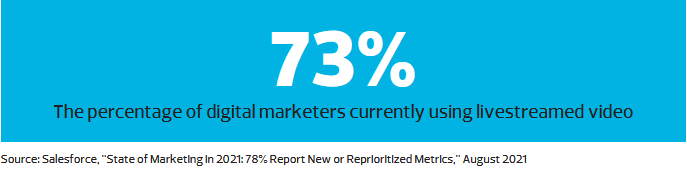
Salesforce’s State of Marketing study found that 73 percent of digital marketers are using livestreamed video, compared with 81 percent using pre-produced video. In the wake of the pandemic, livestreaming became an increasingly popular strategy for retailers looking to increase online commerce. It also helped non-profits boost their fundraising during a time when more traditional in-person options were harder to come by.

Now, with more employees than ever working remotely, the need for livestreaming equipment at home is growing — including for CEOs and other executives, who might take part in virtual events or TV interviews from home.

What Are the Basics of a Streaming Setup?

At its core, a streaming setup needs four things:

  • A modern computer capable of delivering live video
  • A camera
  • A microphone
  • A fast internet connection that prioritizes both uploads and downloads

Of course, it’s not necessarily limited to those four things, and the context may differ based on your goals. For example, if you’re producing a podcast, sound dampening becomes an important consideration.

You may need mounting equipment for cameras and microphones, to ensure your equipment is properly positioned when recording. Your setup may also require capture equipment that can feed in video from another source over industry-standard video technologies such as HDMI and DisplayPort. For example, the content from a video game console might be an important element of esports streaming.

Streaming Setup: Back-End Considerations

In building a strong livestreaming platform, it’s important to consider the quality of the connection and the underlying technology that’s used to manage the livestream.

During the early months of the pandemic, for example, Zoom became a popular choice for livestreaming. And tools you already use can be integrated into livestreams. For example, with plug-ins that use the Network Device Interface standard, Adobe’s Premiere Pro video editing tool can be integrated with Zoom to allow professional live video editing in real time.

If your goal is to use a hosted infrastructure to distribute video, resources on Amazon Web Services, Microsoft Azure and other cloud services can be important to making that work. An outside eye, such as that offered by CDW AmplifiedTM services, can help you figure out what makes the most sense for your needs.

DSLR vs. Webcam for Streaming Video

The camera you use can greatly affect the quality of your stream, so it’s a good area to invest if you have the budget. While your laptop’s built-in webcam may be able to do the job, it probably won’t have the fidelity of an external webcam, a high-end digital camera or even a smartphone.

A high-end streamer may prefer a high-end digital camera, such as a digital single-lens reflex camera (DSLR) or a mirrorless digital camera. Their quality is often significantly better than a webcam can produce, due to the generally wider options for use of camera lenses and increased capabilities of the camera’s shutter. Even smartphones, which often have better cameras than many webcams, can pale in comparison to a moderately priced DSLR (though artificial intelligence has helped close the gap). When professionalism is the goal, a high-end camera, such as those made by Canon, might be the best option.

However, DSLRs often require proprietary software to use in streaming contexts, some of which may not work on every platform. This is an area where webcams shine. More traditional webcams have grown increasingly capable in recent years; for example, Logitech’s Brio camera can provide 4K images. While higher-end cameras can capture more, they may not be the right option for a more complex streaming setup in a studio setting.

Finding the Best Lighting for Your Video Streaming Setup

Another area livestreamers may want to invest in is lighting, which can bring a more professional look to the stream.

While fixed lighting for a livestream isn’t nearly as extreme as shooting a Hollywood film, it does require some setup. Three-point lighting, for example, uses a key light in front of the subject and a fill light to the side with a backlight illuminating the subject from behind. In a more traditional studio setup, this could be a good option.

An alternative to multipoint lighting that has grown popular among livestreamers in recent years is ring lighting. Videos are shot through a large circle of LED or fluorescent lights, which simplifies the lighting setup for those shooting at a desk or via a smartphone.

What Microphone Is Best for Audio Streaming?

You may have seen people using Bluetooth earbuds when doing interviews on television. That approach certainly works in a pinch, but it may not be the best if you’re regularly livestreaming, as quality can often be lost with Bluetooth headphones. (Again, wired is preferred for a high-quality audio connection.)

If audio quality is vital to your setup, it’s important to invest. Consider the following for a livestreaming setup:

  • Dynamic microphone. This type of microphone, as noted by the website Producer Hive, is often used in recording studios to pick up certain instruments. It captures loud sounds effectively while avoiding unwanted noises. While durable, they are best for microphone setups where the goal is to minimize external noise.
  • Condenser microphone. While these tend to pick up more outside noise, condenser mics also capture broader frequencies overall, allowing a fuller sound. Because of their structural design, they can be more sensitive than dynamic microphones. They also require an external power source to function properly — a phenomenon called “phantom power.” If fidelity is paramount, however, condensers are a good choice.
  • Lavalier microphone. For streaming setups that need a more minimal microphone, a lavalier mic, which can attach to a shirt collar, is often desirable. Generally these are wired, but wireless options that rely on higher-bandwidth 2.4-gigahertz wireless connections are available.

Ports are another consideration for microphones. Many basic streaming microphones use USB connections, but others rely on traditional XLR plugs for audio input. While USB microphones are fairly simple to plug in, you could gain more flexibility with an XLR, although your setup will probably also require a mixer. A number of popular brands, such as Logitech’s podcaster-focused Blue Yeti line of microphones, are built with USB in mind.

Feature Image Credit: Getty Images/ Tirachard

By Ernie Smith

Ernie Smith is a contributor to BizTech, an old-school blogger who specializes in side projects, and a tech history nut who researches vintage operating systems for fun.

Sourced from BizTech

By Arol Wright

Instagram is a powerful tool for both established and up-and-coming businesses. Here are a few tips on how you can use it better.

For any company or business, it is of utmost importance to maintain a presence on social media, and do so in the most efficient way possible. Nailing down your internet strategy is as important as ever, and if you’re a business, it can score you a lot of points to get things right.

One of the biggest social networks around right now is Instagram. It can be a daunting platform to get into, but if you use it properly, it can be a powerful tool for your business. Here are a handful of tips on how you can boost your presence on Instagram.

1. Get the Basics Right

Phone Showing Instagram Insights

When first creating an Instagram account for your business, there are a few things that you need to do before kicking it off other than just putting a name, a profile picture, and a bio. These will be essential for your journey later on.

The first one is to switch your profile to an Instagram business account. This will allow you to access juicy metrics later on, and use some of the tools we’ve detailed later on in this post—and it will also make prospective customers take you more seriously. To do so, go to Settings, tap on Account, then tap on Switch to Professional Account and follow the steps—select the category that best suits your business, and click OK to confirm.

The second one is to put action buttons on your profile. You can add info to your profile, like a phone number or an email, and make it easily accessible via call-to-action buttons on your profile, so people can quickly reach out to you. Create a Linktree link and put it in your profile, too, as this will allow you to both add extra buttons not supported by Instagram and also link to your other social media accounts.

Also, while we’re on it—even if you do all of this, keep an eye on your DMs, because you’ll almost certainly still have people message you there, and you don’t want to lose out on them.

2. Use Facebook Creator Studio

Facebook Creator Studio

To manage both your Facebook account and your Instagram account, this is one of the best options around. It’s an official tool developed by Meta itself, first launched in 2018. A mobile app was also launched in 2020.

Facebook Creator Studio tool allows you to schedule posts on both social networks, and lets you monitor statistics on your profile to know how well your posts are performing. Being a tool developed by the parent company of both Facebook and Instagram, it stays constantly updated and relevant with the latest additions to the platform. And for Instagram, in particular, it’s a very powerful tool, allowing you to do mostly everything short of posting stories. You can post pictures/videos, schedule content, and look at stats on everything from followers to post metrics.

It can do many things, but don’t go overboard, either. If you’re just getting into this tool, in order to make it much more bearable to use, make organizing content your priority and take into account the fact that you don’t need to check out all the metrics or use all tools at your disposal. Stick strictly to what you need.

If you’re an entrepreneur looking to grow their social footprint, you should adapt to what you really need inside Creator Studio. You don’t need absolutely everything—the key is to make things easy, and for that, it is best to use only what is really necessary.

3. Feed Design is Key

photo of a phone showing an instagram feed

Keeping your post feed nice and tidy is something many businesses overlook. And quite frankly, these days, it might very well be one of the most important.

The very moment users click on your profile, they’re going to form their very first impression of your project. And it goes much further than just reading the bio, or looking at your profile pic. They’re also going to take a look at your feed without necessarily looking at each post in deep detail, so make it looks appealing and consistent.

Use websites like Unsplash to get high-quality, free-to-use resources for your content, and use tools like Figma Editor, Canva, or even Adobe Photoshop to create killer images. And while making them, remember to keep a common design language, in order for your feed to have a nice dose of visual harmony.

4. Don’t Be Afraid of Branded Content

Tablet with Social Links

Once you start getting a large social media following, and you’re looking into actually pouring money into your promotion efforts, you can look at branded content.

Instagram’s branded content is pretty much just partnering with influencers and other users for them to promote your product. It’s actually surprisingly effective—things can and often do go viral on TikTok and Instagram, resulting in sales multiplying exponentially. People see their favourite creators using things, and then want to buy those things.

To make branded content, you’ll actually need to reach out to creators. But once you’ve agreed on terms with them, Instagram makes disclosing a partnership to the public quite easy.

Darkposting on social media is another way to serve branded content seamlessly into users’ feeds.

5. Be Customer-Friendly

instagram app

Finally, no matter at which stage of the process you’re in—whether you’re still a growing brand, or if you already have a large following—it’s very important to always be customer-friendly.

Keeping attention to detail, being responsive, and listening to your users are all key parts of not only holding up your social media presence, but also your integrity as a business. If you’re a small or big store selling things, make your price tags visible and be responsive to users looking to buy from you. Keep your catalogue of products visible and easily accessible. Ideally, you only want people messaging you to either buy something or know more about a specific product—always be kind and proactive with them.

Growing on Instagram Takes Time and Effort

The tips we’ve detailed here are not a sure-fire way to grow into a world-renowned brand in a matter of days. That will actually need more dedication and effort. But they’re a good place to start from scratch, or boost things if you’re already established.

Organizing your content better and being proactive will set you apart from a big crowd.

By Arol Wright

Arol is a tech journalist and Staff Writer at MakeUseOf. He has also worked as a news/feature writer at XDA-Developers and Pixel Spot. Currently a Pharmacy student at the Central University of Venezuela, Arol has had a soft spot for everything tech-related since he was a child. When not writing, you’ll either find him nose-deep into his textbooks or playing video games.

More From Arol Wright

Sourced from MUO


By Peter Weinberg & Jon Lombardo

Brand marketing creates more financial value than short-term performance marketing – the sooner B2B marketers flip their perspective and start allocating budgets accordingly, the better it will be for everyone in B2B.

Should you be optimistic about the future of B2B marketing?

We are optimists, believe it or not. We believe B2B marketing is on the cusp of a Golden Age, a glorious revolution that shall be ushered in by a momentous event.

And we call this event…the Flippening.

To understand the Flippening, first you must understand the three numbers that explain everything that’s wrong with the B2B marketing industry.

80%, 95% and 8%.

First, 80%. If you talk to a financial analyst, they’ll tell you something like 80% of your share price is based on cash flows that are 10n years out into the future. Contrary to conventional wisdom, Wall Street is not short term. The market values businesses on their future cash flows.

Second, 95%. According to our research with the Ehrenberg-Bass Institute, something like 95% of buyers are not ‘in-market’ to buy your products right now. That means effective marketing works primarily by reaching the 95% of customers who are not yet in-market, increasing the odds your brand gets remembered when those customers do enter the market in some future period.

Contrary to conventional wisdom, delivering short-term sales isn’t the most important job for B2B marketers, because only 5% of customers are ready to buy today. The most important job is influencing the 95% of future buyers who generate future cash flows.

And finally, 8%. According to LinkedIn data, B2B marketers spend around 8% of their budgets on brand awareness objectives. Something like 92% of B2B budgets are dedicated to short term, bottom funnel objectives like lead generation.

This so-called performance marketing may capture sales from in-market buyers, but it has little to no effect on future buyers. Brand marketing is much better at building the lasting memory structures that determine future sales.

85%. 95%. 8%.

One of these numbers makes 0% sense. If 80% of your stock price is based on future cash flows and 95% of your buyers are future buyers, why would you spend only 8% of your budget on brand marketing, which increases future sales from future buyers? Why would you spend 92% of your money chasing after 5% of your customers? Isn’t that a massive misallocation of capital?

Yup!

But don’t worry, the correction is coming.

Brace yourself for the Flippening.

The Flippening: When 8% brand becomes 51% brand

So what the flip is the Flippening?

The Flippening is that magical moment when B2B businesses realise that brand marketing creates more financial value than short term performance marketing, and B2B CMOs begin to allocate at least 51% of their budgets to brand marketing.

The Flippening will spark a positive chain reaction, which will be good for everyone in B2B.

The shift to brand will benefit businesses, since brand 1) increases long- and short-term sales, 2) improves pricing power, 3) reduces talent acquisition and retention costs, 4) unlocks growth in new categories, and much more.

Sales does not share power. The bottom of the funnel is the land of Mordor, where sales torments marketing for all eternity.

By creating more commercial value, marketing will enhance its status within B2B organisations. Instead of sitting in the basement, colouring in our whitepapers and sales collateral, marketing will get back to the boardroom with the decision makers.

Moving up the funnel will also make the job of B2B marketing a million times more enjoyable. The problem with the bottom of the funnel is that marketing has to ‘share’ its success with sales. And as Gandalf once said to us: “There is only one Lord of the Rings, and he does not share power.”

There is only one department that will ever get credit for delivering short-term sales, and it’s the sales department. Sales does not share power. The bottom of the funnel is the land of Mordor, where sales torments marketing for all eternity. The top of the funnel is the Shire, where marketers can frolic like happy little hobbits. Marketing has a monopoly at the top of the funnel. Only we can influence future buyers at scale through brand advertising.

The Flippening will even benefit performance marketers, both by lowering their precious cost-per-leads and by increasing their budgets. That’s right – we don’t believe brands’ growth will come at the expense of lead generation. It’s incremental. Businesses need to both influence ‘out-market’ buyers and capture in-market buyers. The Flippening will grow the overall marketing budget. Performance marketing will receive a smaller slice of a much bigger pie.

Yum!

Feature Image Credit: Shutterstock

By Peter Weinberg & Jon Lombardo

Sourced from MarketingWeek


By

Online customer experience is changing like never before. So, brands need to decide: adapt or die, writes BOSCO™’s Morgan Mitchell.

The new customer experience economy is set to be the making or the breaking of not just newer brands but established ones too. Since 2020, the customer experience (CX) online has evolved dramatically. The need for a winning online CX is essential for success and is proving to be one of the most important and fundamental elements of marketing in today’s digital landscape.

With 81% of retailers increasing their investment in CX over the past two years, what does that mean for brands, consumers and the long-term relationship between the two?

The BOSCO™ index measures the online footprint of brands and benchmarks how effective they are with their paid and organic media channels. Using third-party data, BOSCO™ generates a score between 0-1,000 to determine how successful brands are in the digital space.

What is online CX and what does it include?

Online CX refers to the digital customer experience of your brand. It includes every stage of the consumer buying journey, including pre-purchase, purchase and post-purchase.

Online CX is a huge part of brand perception as it encompasses every interaction a customer has with you digitally. That could be from first finding your Instagram page to using your online chat function to troubleshoot an order problem. While that may sound overwhelming, online CX is really just about providing a persona to your brand and carrying this through every customer-facing element of the business. And as we’re sure you know, consistency is key.

Why is online CX changing?

Unsurprisingly by now, the online and digital space is changing. Major steps have been brought forward by the Covid-19 pandemic as the world moved solely online as a result of international lockdowns. The need for online customer support skyrocketed and brands that previously didn’t have a digital-first approach scrambled to catch up.

Plus, it’s getting even more difficult for brands to retain consumers. 94% of sales and marketing professionals say that their business is effective at nurturing newer relationships during the ‘interaction’ and ‘awareness’ stage of the buyer journey. But that all changes at the advocacy stage, where professionals feel they are only 77% effective. What that tells us is that it’s harder to sustain long-term consumer relationships. This is where online CX comes into play.

So, how are brands adapting and strategizing to fit this new customer experience economy? What can we learn from these insights and consumer behaviour patterns?

Instant messaging & online chat functions

As the pandemic hit in 2020, consumers moved their lives entirely online in a way that hadn’t been seen before. We couldn’t pop into a shop to see a product, make a return, or just speak to an employee. Phone lines became jammed, so consumers turned instead to online messaging.

Since then, brands and retailers alike have amped-up their online messaging capabilities. Whether that be a live chat function on their site or through their social media, messaging became the go-to way to interact with brands online. In fact, between 2019 and 2020, social messaging rose in popularity by 110% – that’s huge.

Implement an omnichannel CX approach

Businesses fail to form meaningful, positive relationships with consumers when processes become tricky to navigate. For example, support tickets are passed from department to department without proper follow-up.

Let’s put that into context. A consumer messages you on social media with a complaint. The social team pass this on to customer service where the consumer has to explain the issue again. This then gets passed on to a complaints department and once again, the consumer must explain the problem. This could go on and on, meanwhile, the consumer is becoming more and more annoyed at the lack of communication within your business.

Instead, an integrated omnichannel CX system is seamless. Agents can easily transfer customer messages between apps and departments without the need to start from the beginning every time. This creates an easy, problem-free interaction that solves problems quickly, efficiently and, most importantly, leaves the consumer with a positive experience.

It’s not just about problem-solving either. Great online CX is more about being proactive rather than reactive. A great example of omnichannel CX is Zara’s (BOSCO™ score: 731) use of ‘Store Mode’ in its app. This allows users to only see products available in their local Zara store which they can then buy online and pick up in that store on the same day. This real-time shopping perfectly blends both online and offline channels using GPS and QR technology to its advantage.

Be open and responsive to feedback

When it comes to consumer feedback, there tends to be only two options: incredibly positive or incredibly negative. No one bothers to leave feedback or a review for an average experience, but they have plenty to say when everything has either gone right or wrong.

Being open to and receiving feedback is a huge part of uncovering valuable insights into your consumer base. While you may think your online CX is bulletproof, your consumers are the people who can really put that to the test. What they have to say is a massive part of the digital evolution of your brand. Plus, that open-ended communication helps you to build that relationship further and patch up damaged ones. Often, your next clever CX move will be the result of real-time feedback directly from the consumers themselves.

Uber (BOSCO™ score: 738) is a leading example of using customer insights to improve its online CX. The business makes around 22,000 tweaks to its app every month to customize it in every city it operates in. It does this using incident and reliability reports to tailor how the app operates based on where its user is. This eliminates data problems early and lets users know it is listening and adapting.

The key to digital transformation

Standing out in the digital space isn’t easy, and with the rapidly changing online CX expectations of consumers, brands need to fast decide their strategy.

The first step is to stay up to date with changes and developments as they happen. Take note of other brands that are adapting their online CX well and look at how you can implement something similar. With 58% of consumers expecting more from services than they did pre-pandemic, the need for integrated, omnichannel CX with room for personalization is key to digital transformation.

BOSCO™ is an AI learning platform that integrates your cross-channel digital marketing data into one personalized dashboard. The data allows marketers to make better digital marketing spend decisions with the help of data-driven insights, forecasting and mapping tools. Unlock your BOSCO™ score, today.

By

Sourced from The Drum

Space and Tesla CEO Elon Musk has had many loves — think electric vehicles, large rockets, Claire “Grimes” Boucher, and internet memes.

But he may have no greater and more longstanding infatuation than the microblogging service Twitter, which he joined in 2009 and has consistently used as a megaphone to grow his personal brand, issue proclamations and predictions about the future, and occasionally nurse feuds with a staggeringly broad selection of other famous people and institutions.

Now it appears that Musk has turned his sights on a new foe: Twitter itself. In a series of messages on the platform — yes, he’s using Twitter to complain about Twitter — the mercurial CEO griped over the past day that the site’s algorithm isn’t fair, and that there should be more transparency around how it works.

“The algorithm needs to be open source,” he wrote.

Poll Position

That wasn’t all. Soon afterward, Musk expressed amusement at a meme making fun of coders’ use of the word “algorithm.” Then, perhaps in a fit of self-doubt, he reframed his initial anti-Twitter tweet as a poll, asking his followers to weigh in on whether the site’s algorithm should be open source (at press time, 82.7 percent had agreed.)

Perhaps most striking is his single-minded focus on Twitter. It’s difficult to argue with the critique that social media companies’ opaque algorithms have a worrisome amount of control over public discourse in this extremely online era, but compared to a heavily algorithm-mediated service like Facebook, Twitter’s algorithm is relatively unobtrusive. And, while Twitter makes the setting fairly difficult to activate, it does still offer a purely reverse chronological feed.

Perhaps most intriguing is why Musk is irate at Twitter’s algorithm at this precise moment. If it’s burying anybody’s posts, Musk isn’t a very prominent victim — not only is he one of the site’s most popular users, but his poll complaining about its algorithm received more than a million votes.

By Jon Christian

Sourced from THE BYTE