We are delighted to welcome Larry Ryan, from Behaviour & Attitudes, to take part in our next Toolkit session on Thursday April 28th at 10am.
Date: 28th of April Time: 10am Location: Online Registration: Here.
Behaviour & Attitudes undertook a wide ranging consumer, customer and promoter study, together with a global review of responses and initiatives across the music sector to help the National Concert Hall develop a safe route back to live performance in 2021. The research undertaken was used to help develop the National plan for the return to live performance across the music industry and was recently awarded a special 2021 Covid-19 Research Excellence Award by the Marketing Society of Ireland.
Larry Ryan of B&A will take us through a review of the challenges and approaches involved in the study. He will demonstrate how it enabled the Concert Hall to emerge from the pandemic ahead of its private sector competitors and chart a trail blazing return to profitable live performance.
Larry has been a researcher of trends, themes and sectors for more than 35 years with stints at Lansdowne, MRBI and Guinness before joining B&A, where he is one of the joint owners, in 1997. He has a particular interest in studies related to popular culture/media, education, housing/development and healthcare.
Two Stanford researchers have found widespread use of fake Linkedin accounts created with artificial intelligence-generated (AI) profile photos. These profiles target real users in an attempt to increase interest in certain companies before passing the successful leads to a real salesperson
Misinformation online takes different forms — from false or skewed facts presented as the truth to machine-generated photos and videos, that can be used for a variety of unethical and damaging purposes.
AI Photos Used as Fake Profile Photos
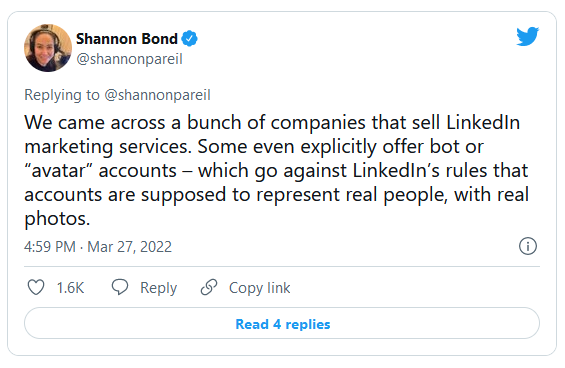
Two researchers, Renée DiResta and Josh Goldstein from the Stanford Internet Observatory, discovered that Linkedin, the same as Facebook and Twitter, is not immune to this digital age problem. In the case of Linkedin, they found that bots using AI-generated faces — as many as 1,000 fake profiles — are being leveraged to create false buzz around some companies, reports The Register.
The process is simple: a bot with an AI-generated profile photo contacts an unsuspecting Linkedin user and, if the target shows interest, they get passed on to a real salesperson to continue the conversation.
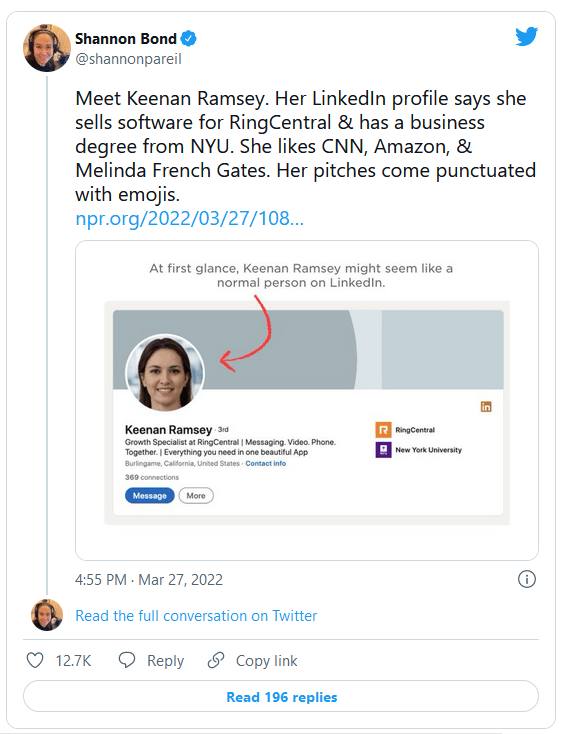
The two researchers made the discovery after DiResta received a message from a profile belonging to a “Keenan Ramsey.” At first, it looked like a normal sales pitch from a software company but it soon became clear that Ramsey was a fictitious person — the fake profile headshot contained multiple red flags, like the unusually central alignment of eyes, only one earring, and parts of hair were blurred into the background.
After the AI-generated profile photo jumped out as a fake, DiResta, who has also studied Russian disinformation campaigns and anti-vaccine conspiracies, began looking into the matter with her colleague Josh Goldstein and found over 1,000 profiles using AI-generated photos.
Using AI to Cut Down on Hiring Costs
Companies use profiles like these to cast a wide net of potential leads without having to use real sales staff and to avoid hitting Linkedin message limits. It was found that more than 70 businesses were listed as employers of fake profiles, with some companies telling NPR that they hired outside marketers to help with sales but hadn’t authorized the use of AI-generated photos, and were surprised by these findings.
The use of fake profiles is not permitted by Linkedin. The company’s spokesperson Leonna Spilman told TechRadar that the company’s policies make it clear that every Linkedin profile must represent a real person.
“We are constantly updating our technical defences to better identify fake profiles and remove them from our community, as we have in this case,” Spilman says. “At the end of the day, it’s all about making sure our members can connect with real people, and we’re focused on ensuring they have a safe environment to do just that.”
Difficult For Naked Eye to Detect Truth
Although some businesses may employ AI-assisted marketing tactics because they are cheaper than employing real people, it’s difficult for users on the other side of the screen to distinguish between a fake or real profile photo — a recent study by PNAS found that people have a 50% chance of guessing correctly. The research also found that some people find machine-generated faces more trustworthy because AI often uses average facial features, suspects Hany Farid, co-author of the study.
To make it easier for people to tell real and fake profiles apart, V7 Labs created a new AI software that works as a Google Chrome extension and is capable of detecting profiles belonging to a bot, with a claimed 99.28% accuracy.
The V7 Labs’s “Fake Profile Detector” extension aims to help authorities and regular Internet users spot and report profiles that spread fake news or otherwise create misleading content.
Deciding on the right mix of marketing strategies is a huge undertaking for any business. Some might feel compelled to dive into the deep end and get into the weeds with all the tools at their disposal, while others might prefer to survey their options and build a thorough plan before accomplishing much of anything.
These two different approaches can be summed up in the terms tactical and strategic marketing. Whether an organization is looking to start from scratch or simply trying to beef up existing marketing efforts, knowing how to best leverage both is a huge advantage.
What is tactical marketing?
When it comes to digital marketing, the tactics a business uses can range from email blasts to blogging and from organic social posts to Google Ads. Tactical marketing means focusing on those individual elements. Some common digital marketing tactics include:
Blogging: Keeping a blog up to date can be useful for search engine optimization (SEO) by targeting specific keywords. If SEO efforts are successful, a business will rank higher when its target audience searches for its products or services.
Email marketing: Regular email newsletters can engage a customer base over time. Remarketing is another effective form of email marketing where those who have interacted with an organization’s site before (for example, added something to their cart but not checked out) get reminders of their previous interest right in their inbox.
Ads: There is a wide variety of digital ad opportunities. Paid social and paid search are some of the most common. Google Ads is its own beast entirely, and each major social site has a way to run ads where your potential customers are already spending their time.
Organic posts: We just touched on social ads, but creating an organic social following through the right message can also be an effective tactic.
What is strategic marketing?
Strategic marketing looks at the big picture. While tactical marketing can sometimes miss the forest for the trees, strategic marketing zooms out over the whole landscape. Setting goals, coordinating with other departments and creating an overarching message are all part of this type of marketing.
Research is another vital element to building a successful marketing strategy. Knowing what’s possible, what tools are available and what others in the industry are up to are just some of the important things to know before crafting a digital marketing strategy.
This research element is one of the issues some people run into when they attempt strategic marketing. There might be a steep learning curve. So, instead of struggling alone, some opt to bring on digital marketing experts in some fashion. Having a team well-versed in the field can be a huge boon when it comes to choosing the right goals, techniques and messages.
Which is better?
The bottom line is both kinds of marketing go hand-in-hand. Ignoring one or the other is a surefire way to hamstring a marketing effort before it ever gets up and running.
An overall strategy ensures cohesion between the individual tactics. Messages between different ads, posts and emails should all be in harmony with each other, and the only way to do that is to look at the broader strategy. It is also important to have a goal to work toward so that a business can measure its digital marketing success.
Without putting the tactics that build up that strategy into practice, though, no organization is going to reach its goals. Lots of businesses will decide they want to try a tactic like Google Ads or email marketing and just jump straight into building those campaigns. It might seem like diving into the thick of things is a quick way to get results, but ignoring that overall strategy is just a quick way to waste time and resources.
For more information about the success of strategic and tactical marketing, check out Beanstalk Web Solutions’ case study.
By Beanstalk Web Solutions
Beanstalk Web Solutions is a St. Louis-based web design and digital marketing agency. Contact Beanstalk to learn more about the right mix of strategic and tactical digital marketing opportunities for your business.
AI provides key enhancements to existing emergency notifications systems that can reduce the amount of time a business needs to effectively prepare for and respond to a crisis.
Crisis communications have come a long way from call trees and text chains. Today’s emergency notification systems and cloud-based notification services are far more effective than relying on employees to call each other.
However, these developments have not made crisis communications foolproof. For example, if emergency messages never reach their intended recipients, the sender might not get a notification of the message delivery failure. If a reply message is not generated, an organization’s emergency teams could be facing an incident that escalates into a full-blown crisis due to the lack of clear communication.
Artificial intelligence (AI) and machine learning (ML) are highly proficient in capturing a wide variety of data inputs and then making predictions and emergency recommendations. Organizations can use these technologies for identification and classification of emergency tasks, as well as to provide communications and intelligence at the right time and to the right people. AI has a role to play in the future of crisis communications, and it’s only just getting started.
What does AI bring to the table?
AI and ML can provide additional value to emergency notification system (ENS) technology. Today, ENSes are generally programmed to disseminate a variety of message types, such as email, text and SMS, to preset lists of individuals. While some more traditional systems can request replies from message recipients, AI-enhanced systems can do that and more.
AI crisis communications systems can use multiple channels of information to provide value to emergency message delivery. These channels can include weather forecast data or drone-generated video, among others. An AI-enabled ENS, for example, can take weather data generated by the National Oceanic and Atmospheric Administration and translate it into forecast data that can then be formatted into a series of alert messages helping people to prepare for an impending hurricane or other severe weather.
Another example of AI-enhanced crisis communications is using the system to ask specific questions about a situation, such as the likelihood of tornadoes or other natural disasters forming. The system can examine multiple resources to provide message recommendations and other analyses.
Inclusion of AI and ML technology is increasingly found in ENS offerings from traditional vendors as well as messaging system vendors. It is up to the user to determine which AI-enabled capabilities will be best suited to the organization and how it will add value to corporate ENS requirements. Non-AI systems will still provide rapid dissemination of emergency messages, and many can support reply messages, so at that point the added edge — and expense — of AI becomes a business decision.
AI-enhanced vs. traditional ENS
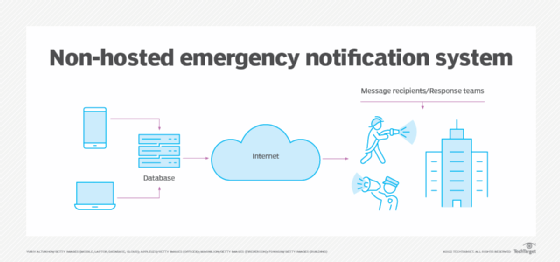
Earlier ENS technology was largely on site, with a server designated to provide ENS functions connected to either landlines from the local telephone company or via the internet to deliver messages. Figure 1 depicts how a traditional premises-based ENS uses the internet to deliver messages.
Figure 1. A non-hosted emergency notification system.
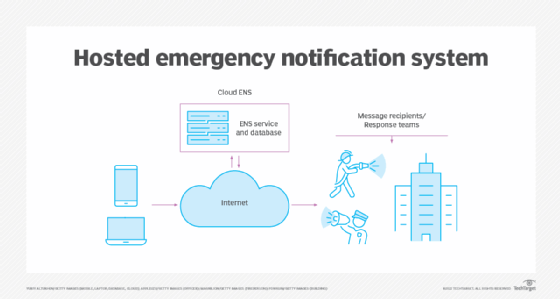
By contrast, today’s systems are often hosted by a specialized ENS vendor, with the technology in the cloud. All resources are located with the vendor, and access is as simple as using a laptop or smartphone. Figure 2 depicts a hosted ENS configuration. Users are completely dependent on the ENS vendor to deliver emergency messages when the system launches.
Figure 2. A hosted emergency notification system.
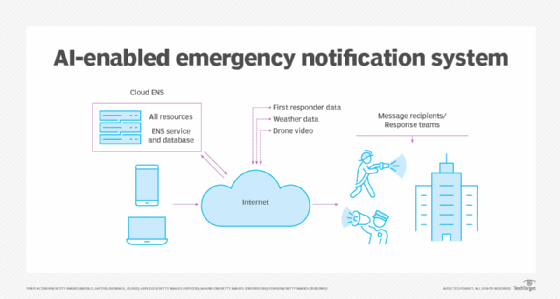
When AI and ML are in the mix, the configuration is largely unchanged except for the added capabilities of the ENS when AI and ML are implemented. Figure 3 shows a possible configuration of an AI-enabled, cloud-based ENS.
Figure 3. An AI- and ML-enabled emergency notification system.
Traditional ENS message delivery and reply features are enabled, and AI capabilities add value by using a variety of other resources.
Market options and pricing
Prices for standalone crisis communications systems can range from under $5,000 to well over $200,000.
Managed ENS offerings usually require payment of a monthly fee for the service. This is typically based on the number of contacts in the database, the features being used and the network transport services that deliver the messages. There can also be activation fees when the system is used in a disaster, and some systems will have setup fees. Monthly fees can range from under $500 to over $25,000, depending on the system configuration.
Hosted ENS tools require no physical space for equipment, there are minimal or no upfront installation fees, and customers can discontinue service with minimal technical effect on the organization. The inclusion of AI features will vary by vendor, and organizations should carefully research all options before making a buying decision.
Organizations that already use emergency notification systems will need to evaluate the added value versus the cost to upgrade their existing tool to an AI-enabled one. For example, an existing system might not be upgradeable to one with AI, and a replacement would be needed.
There are several crisis communications vendors that offer AI- or ML-enabled platforms and products. Vendor options in this market include the following:
Omnilert started as the developer of a campus emergency communications system. Current hosted products use AI to detect, analyze and visualize emergency situations through intelligent data capture and analysis, and the products offer an easy-to-use interface. Omnilert offers a free trial; check with the vendor for more pricing information.
Quiq provides an AI-enabled messaging platform that businesses can adapt to different situations, such as customer order placement and customer service inquiries. Although ENS is not specifically listed as an application, the Quiq platform is easily adaptable to crisis communications applications. Pricing begins at $12,000 per year.
OnSolve offers a variety of hosted ENS tools. It also has an AI engine to provide emergency intelligence that businesses can use for decision-making. Pricing ranges from a basic system for under $2,000 to more complex systems with a variety of pricing plans.
Everbridge offers numerous ENS options for many different applications and uses AI functionality to analyse data from multiple sources to provide intelligence for emergency management. The company offers on-site as well as managed emergency notification services, with fixed and monthly pricing plans.
HubSpot is one of the best CRM software on the market. Here are some ways you can use it in your marketing career.
HubSpot has been known for being the best customer relationship management platform on the market for businesses of all sizes, but what specifically can the company offer your marketing career?
If you aspire to work in the marketing field or want to start your projects, you’ll want to invest time into a good program to manage customer databases for companies you work for, as well as for your use. Here are some HubSpot features that will help your career get off to a great start.
1. Customer Relationship Management
HubSpot has one of the top CRM platforms above all others, so whether you end up growing a team during your career or choose to work solo, you can guarantee all of your important records will be managed effectively!
Add members of your team to the platform to boost productivity —such as calls or meetings— important information on contacts, companies, deals, and more. Know more about your audience by tracking their patterns, which will overall transform into a collaborative and supportive online workspace!
2. Social Media Management
Not only can you use HubSpot to craft amazing emails, but their social media marketing tools as well. HubSpot can be especially useful to you if you intend on managing your own social media brand! Increase your brand awareness to the public, obtain leads —and hopefully conversions—build relationships with your social media audience, and delve into competitor research.
Instead of spending a fortune on independent programs, you can use the HubSpot social media software to connect your accounts, schedule a bulk collection of posts ahead of time, design images with Canva build into HubSpot, customize the publishing schedule, build social media campaigns with their premium templates, publishing platform, analytics, and more.
3. WordPress Integration
If you’re at that point in your career where you’d like to build a solid website but have no idea how to optimize it, HubSpot has a great tool for it. Integrate WordPress into your HubSpot account, then you can have access to all of their amazing features.
After setting everything up, you can add call-to-action buttons to your site to encourage clicks, create custom forms for potential clients to fill out, set up an email automation feature when people agree to subscribe to emails, and effectively manage your website analytics! Know exactly how many people are accessing your page, and all the nitty-gritty details along with it.
4. Search Engine Optimization
Learning the basics of SEO usually becomes a normality at some point in your marketing career, but with the HubSpot SEO Marketing Software, this can make the process way more simple. It offers advice on what you can do to rank your content higher, assistance with content strategy, accurate reports on your Google ranking, and support at every corner with your blogs, landing pages, emails, and more.
If you’re looking for a system that has the entire package, you need to implement this into your marketing strategy. Furthermore, if you’re still worried due to being an SEO novice, check out the best websites to learn SEO!
5. Sales Tool
Are you working on building a business alongside your career, but do not know sales? HubSpot can show you how. Marketing is important, but so is managing your sales with a platform that can manage them.
The HubSpot Sales Hub Enterprise allows you to take part in sales engagement tools, monitor internal business permissions, manage payments, have access to sales data, analytics, and the overall activity and progress of a business. With these tools at hand, all of your sales information can be stored and managed with ease.
6. Email Marketing Tools
HubSpot has a range of tools in their Marketing Hub. These can be used to build an email list, store and manage contact data such as location or phone numbers, create innovative email campaigns, design forms people can use to sign up to emails, and so much more.
Choose from custom templates, build categorized lists, upload your current clients, and more. In using this feature, you can slowly build up a list of loyal customers that you can manage with a few clicks of the button! If you’re looking to learn the basics of email campaigns, here’s how to leverage email marketing with this boot camp course.
7. Reliable Analytics
With numbers, they need to be accurate, and HubSpot offers precise analytics that can be a big help in your marketing journey. If you decide to send out an email, there are statistics you can always refer back to tweak your strategy.
Check out the number of clicks, the percentage of people who opened your email, the number of emails that didn’t send, and even whether your customers opened your email on Firefox. With solid statistics to keep track of, HubSpot will be your best asset when it comes to those digits.
8. Customized Database
How good are your organizational skills? This is one of the most important things when climbing up the marketing ladder, and HubSpot has everything you need if you struggle to keep track.
With the database system, you can add in contacts manually or using an Excel spreadsheet, create numerous records, email or call contacts, see communication history, and even integrate Gmail or Outlook to make sure you’re sending to the right people! Don’t stress about that one company that hasn’t received a newsletter yet, you can easily filter their details at the click of a button,
9. High-Quality Customer Service
When starting your marketing career, you need a trustworthy support network! Not only does HubSpot have proven marketing features that work, but their customer service is one you can always rely on.
Easily contact the support team by clicking the chat box via their website, type in your problem, and you’ll receive a friendly support specialist in a matter of minutes. HubSpot is fast, reliable, and goes as far as recording videos on Loom to give you a hands-on demonstration to help you. The effort put into customer satisfaction is phenomenal, and knowing you have a support network will decrease your career anxiety.
Exceed in Your Marketing Career
Working in the field as a solo marketing entrepreneur or employee means you need the right programs to push you forward. HubSpot is professional, easy to use, and will ultimately be the key to your success in the world of business.
All aspects of marketing will benefit from the program, whether it’s content marketing, mobile marketing, direct to consumer, social media marketing, or email marketing. Your stakes are higher with a reputable platform on your side every step of the way.
Saffron has been freelancing for over five years, specializing in the copywriting and creative writing industry. She is based in Melbourne, Australia. More From Saffron Clacy
Email marketing can be highly profitable, but your success depends on the tactics you use.
There’s no question that email marketing is one of the most profitable routes to take for marketers.
For every $1 spent on email marketing, the ROI is between $45 to $32. That isn’t surprising since the majority of consumers check their email ten times a day, every day. What’s more? Of those consumers, the ones who actually buy products marketed via email spend 138% more than those who don’t receive email offers.
With this in mind, companies that want to get a leg up on the competition should turn to the following strategies for maximum success.
1. Show you care
Believe it or not, something as simple as addressing customers by name can make them more likely to engage with your emails.
When Experian Marketing Services compared generic, cookie-cutter promotional mailings to personalized ones, they found that personalized emails have 29% higher unique open rates and 41% higher click rates per person. What’s more, according to Harvard Business Review, personalization can deliver five to eight times the ROI on marketing spend — and boost sales by upwards of 10%.
People don’t want to feel like nameless faces in a sea of customers; they want to be respected. If your brand isn’t willing to go the extra mile, your competition will step in to fill the gap.
2. Data is power
Remember back in 2013, when Edward Snowden revealed that the National Security Agency (NSA) was gathering mountains of private, personal information on millions of people? Morality aside, the NSA saw data for what it was: a key to power. While you don’t need to go to such extremes, the principle remains the same. The more you find out about the person or business, the more knowledge you can use to your advantage to build a relationship or secure a sale.
At Outreach Chimp, we draft hyper-personalized cold emails for businesses looking for guest blog placements by studying their website analytics using SEO data providers like MOZ, Ahrefs and SerpStat. The motive is not only to pitch our services, but also to provide valuable information about their website’s shortcomings and suggestions for improvement.
This may sound like a lot of work for a cold outreach campaign, but with automation and the use of application programming interfaces (APIs), it takes minimal effort to achieve major results.
3. Write click-worthy subject lines
Every competent marketer knows the marketing mantra: “Provide value. Solve problems.” Nobody likes clickbait, and if you use it, prepare to never have your emails opened again.
Subjects such as “10 Ways To Shock Fat Off Your Body in Five Minutes!” are grounds for being labeled as spam, and although your email may actually be useful and highlight ways to eliminate fat in a short amount of time, the subject line cheapens the content within. If the title of your email reads like a headline out of the National Enquirer, People or BuzzFeed, people won’t open it — and rightfully so.
4. Be mobile-friendly
Today, everybody has a mobile phone; some people have three. In 2014, data from the U.S. Consumer Device Preference report revealed that 65% of emails were opened on phones. Now more than ever, it’s important to make sure your emails are suitable for reading on such devices.
5. Target your list
The Data & Marketing Association discovered that segmented email campaigns delivered a 76% increase in revenue for marketers.
By segmenting your subscribers, readers or buyers, you can hone in on their demographics and sort them according to criteria. For example, if 10 of your subscribers open emails about optimizing SEO keywords, you can assign them a special category. This category means they will receive only SEO-related emails, specifically tailored for them, while the other segmented subscribers receive a different set of emails.
Targeting your list with specific promos and offers related to the segment in your lists is important. Gone are the days where we could cast a wide net and know that at least 10 out of 100 people would bite the bait.
6. Test everything
Without testing your messages, subject lines or any other aspect of your emails, you won’t know what works and what doesn’t.
Studying these metrics is called A/B testing, and it’s an invaluable tool every email marketer should know. You’ll also be able to test which subject lines get your emails opened or not, which is great information to have. Now, this doesn’t mean it’s a universal fact — hence the importance of testing everything.
Analysing the numbers for inbox rates, open rates, bounce rates, reply rates and unsubscription rates can help you make your email campaigns more effective.
7. Follow up within reason
Let’s imagine that this is a perfect world. The emails you send out have a 65% open rate (I said perfect, not unrealistic), average reply rates and an above-average subscription rate.
People are buying the products your emails are promoting. Now, let’s say you start to add an email or two every couple of days. Although the numbers dip a bit, you’re still sending emails to “get your name in front of their face” and become as relevant as Coca-Cola. In a matter of days, your emails aren’t opened at all; dozens of people quickly report them as “Spam” or send your work to the trash.
What’s the solution? Email follow-up tools, which you can use to set up reminder emails on a schedule that provides value without annoying your customers.
In the old days, we gave cold emails the benefit of the doubt. We might not have known who the sender was or how they got our email, but as long as they pertained to our interest, it didn’t matter.
But that’s no longer the case. Today, hyper-personalized emails that add value are key in attracting and retaining customers.
Feature Image Credit: Pavel Muravev | Getty Images
Formjacking is a dangerous cyberattack that can result in financial loss and identity theft. So what is formjacking and how can you stay safe?
Cybercrime is everywhere, but it’s not always easy to spot. Some types are disruptive and in-your-face, while others, like formjacking, are more subtle. If you don’t know how to prevent formjacking, cybercriminals could steal private information without anyone noticing anything wrong.
So what exactly is formjacking, and how can you stop yourself falling victim?
What Is Formjacking?
Formjacking is a cyberattack whereby hackers insert malicious code into a website, usually a payment form. When you enter your personal information, this code will send a copy to a server so that cybercriminals can access and use it.
Stealing financial information from e-commerce sites is the most common formjacking example, but it’s not the only one. Sometimes, formjackers steal names and addresses to commit identity fraud or break into other accounts. Other times, they’ll just sell your personal information on the dark web. Some cybercriminals will do all of the above too!
Email marketing has taken off during the COVID-19 pandemic; with an ROI of $44 for every $1 spent and the massive shift to online storefronts, the high level of trust we place in email marketing forms has only heightened the issue. Legitimate information forms are everywhere online, giving hackers a perfect opportunity to steal valuable data.
How to Prevent Formjacking
Formjacking is a real danger if you run a website, but you can prevent it. And your visitors can protect themselves from formjacking too. Some of the most effective tools are script blockers like ScriptSafe or JS Blocker. These browser extensions block scripts from running, including those that formjackers might use.
Masked credit cards or tokenization through apps like Apple Pay or Google Pay also helps by hiding sensitive information. Most antivirus programs further include measures to block some formjacking scripts.
Website owners should run tests before every update. This will help reveal any suspicious code and ensure everything works as it should. Putting Subresource Integrity (SRI) into website code will make browsers verify resources deliver without manipulation, helping prevent formjacking.
How to Detect and Respond to Formjacking
Regardless of how you prevent formjacking, no prevention method is 100 percent effective. As a result, you should also know how to detect and respond to things that slip through the cracks.
Scan your website’s code regularly, especially before releasing an update, to look for irregularities. Anything you didn’t write or put there could be malicious, so remove it. Obviously, you need to be careful you don’t accidentally delete something that’s important; be doubly sure before you get rid of code.
Two-Factor Authentication (2FA) won’t prevent formjacking, but it will minimize the damage because it makes it harder to breach other accounts. Admittedly, 2FA isn’t perfect, but some experts nonetheless call it the most effective tool against cyberattacks. Website owners should offer it and visitors should enable it.
You can also detect formjacking by regularly checking your bank accounts, credit score, and other records. Call your bank to cancel or freeze your cards if you see any unusual activity, and then change your passwords. Automated monitoring apps can make this easier by checking your records for you.
Website owners should contact affected users if they notice unusual code. It’s your responsibility to handle users’ data, so take that burden seriously and be up-front about cyberattacks. Tell them to monitor their accounts and change their passwords. On top of keeping them safe, this transparency will help build trust.
Keep Your Website and Your Data Safe
Even small, non-business sites could become victims of formjacking. Knowing how to prevent formjacking is an important first step in the fight against cybercrime. Website owners and visitors who understand these threats can take the right steps to stay safe.
Shannon is a content creator located in Philly, PA. She has been writing in the tech field for about 5 years after graduating with a degree in IT. Shannon is the Managing Editor of ReHack Magazine and covers topics like cybersecurity, gaming, and business technology. More From Shannon Flynn
Work for someone else and your success (at least your professional success) is, in large part, outside your control. You can control how hard you work, how dedicated you are, how loyal you are. But you can’t promote yourself. And you definitely can’t give yourself a raise.
That’s just one reason why entrepreneurs become entrepreneurs. They embrace the opportunities, and the risks, inherent in choosing themselves. They embrace an, “If it is to be, it’s up to me” mindset.
Which is great. Until it’s not.
According to Steve Jobs, independence and self-reliance often get in the way of success. As Jobs said:
I called up Bill Hewlett when I was 12 years old. “Hi, I’m Steve Jobs. I’m 12 years old. I’m a student in high school. I want to build a frequency counter, and I was wondering if you have any spare parts I could have.” He laughed, and he gave me the spare parts, and he gave me a job that summer at Hewlett-Packard … and I was in heaven.
I’ve never found anyone who said no or hung up the phone when I called. I just asked.
Most people never pick up the phone and call. Most people never ask, and that’s what separates, sometimes, the people who do things from the people who just dream about them.
To Jobs, “Do I ask for help?” was a question that predicted an individual’s success.
Take the first iPhone. An early prototype’s hard-coated plastic screen wasn’t hard enough: After Jobs spent a day carrying it around in his pocket, he noticed the screen was already scratched.
Jobs could have gone the self-reliant route. He could have tried to fix the problem himself using Apple’s considerable resources. Instead, he called Wendell Weeks, the CEO of Corning Glass, and described the type of glass he needed.
After a little back and forth, and a few cleverly effective words of persuasion that you should definitely borrow, Weeks agreed to help by providing gorilla glass–a product the company had developed in the 1960s but never put into production.
And here’s the kicker. When Jobs biographer Walter Isaacson walked into Weeks’s office years later, only one memento was on display.
A letter from Jobs that said, “We couldn’t have done it without you.”
That’s the thing about asking for help.
Sure, admitting you need help can make you feel weak, or vulnerable, or somehow “less than” in the eyes of the other person.
But that’s not what happens. When you ask for help, in the right way, other people don’t think about you. They think about how your request implicitly shows you respect them, implicitly shows you trust them. It shows you value or admire the skills, talents, experiences, or resources they clearly worked hard to obtain.
And it gives them the opportunity to make a difference, however small, in someone else’s life. Judging by the framed letter on his wall, Weeks was clearly proud to have made that difference for Jobs.
Which is the ultimate reason asking for help can predict success.
Since no one does anything worthwhile on their own, asking for help might just be the first step towards creating long-term, mutually-beneficial relationships that build a foundation for lasting success.
And lasting friendships.
An element that should be included in everyone’s definition of “success.”
Feature Image Credit: Steve Jobs. Photo: Getty Images
There are common rules that apply to increase the impact and resonate with your audience.
The essence of a blog is that it caters to a definite fan base or customer base. The prime advantage here is that everyone reading it, already harbours a soft spot for your cause. Blogs have ever since been a medium of conversation between a blogger and his readers. The person reveals and narrates intricate experiences of life and lets his audience connect to those instances. The language is different from general content writing norms. And the most important element in harnessing relatability is within the write up. It should be engaging to the point that the reader is glued to it until the last syllable.
There are various kinds of blogs and each follows a distinct pattern of writing. For example, an educational and academic blog would focus on information. It would be presented in a crisp and direct manner. This is so that the student reading it does not have to swim through the pool of ordeal and comprehension to unravel the content. On the other hand, if a writer is focusing on travelogues or anecdotal content then it is important that they cater to the primitive tools of story-telling and setting build-ups along with the gradual progression of the plot. Nonetheless, there are some common rules that apply to both forms of writing that contribute to a better blogpost.
Decide on an engaging title
The title of each blog is its identity, the chief element of the blog that first meets the reader. Therefore, it is important that the title must be catchy. It is not necessary that it be a flamboyant syllable or a foreign phrase. It should be crisp and must have a ring to it. It must make the reader think and wonder what it could be and here lies the second trick to name a blog. The title should balance on the tip of too much and not enough. So the reader would feel that they know but simply can’t figure it out. This instinct is targeted by masterminds of marketing as they manipulate the psyche of the reader, and in their case the client or customer.
Open with a bang for an introduction
The calliout is here and it demands the most exquisite English. If you are aware of the expression that the first impression is the last impression, you will understand the efficiency of the introduction. It is necessary to connect with the reader of the blog in this segment. The reader can then gradually progress down the narrative, building on that introduction. The realization of putting extra effort in the introduction is the mark of a mature writer who values the reader.
Aim the content towards a prospective target audience
Each blog must have a topic and also must host a target audience. Having full knowledge of the target audience is very important for framing the content. Directing the content to a particular set of people helps provide an idea of what language to use. Also, what kind of information to introduce and to what extent it should be explained. The content must also have a definite path, which is difficult to address without a target audience. Having addressed each of these elements, the writer can plan out his entire blog accordingly.
To inform and not to boast
It is important to maintain an unbiased voice. No matter how much either side influences you. At no instance should it feel like the writer is boasting of his work and knowledge. On the contrary, it must feel like the writer is taking the reader on a journey with his words. The reader should be adequately informed, and at the same time, they would also develop their own perspective on the words they read. This information would be well received by the reader, allowing them to form their own opinion throughout the entire blog.
Search optimization
It is important that your blog utilizes SEO tweaks and tricks. It is advisable to follow the norms of incorporating keywords to rank the content higher on search results. This effort will lead to a better reach among readers. Their searches will lead to more accurate results, which in turn will incur better response to content as they themselves have requested it. Mastering this very practice will turn the writer into a formidable presence, and eliminate the need to check the document for SEO alignment.
Call to action
A blog addresses an already loyal audience who are interested in being part of an organization or a cause. Therefore, the writer should include a call to action urging the reader to act on an issue as the goal is to have all the readers react in unison. However, the writer must maintain strict supervision so that the strategy is successful.
Above are the keys to writing a successful blog. But also keep in mind that the most important element, and one not to forget, is the soul of a writer. The primary objective is to connect with the reader and the soul is necessary for that feat to be achieved. Make sure that the content is crisp and concise, as it is most important to ensure the blog is informative and stands tall on its reputation. The worst sin is letting down the reader. For a blogger, that is equivalent to the sin of losing innocence.
Now he’s just raised funding for a follow-on app called Superlist, which he’s set up with four other entrepreneurs including two of the other Wunderlist co-founders.
Reber told CNBC earlier this year that the Wunderlist acquisition left him feeling “really unhappy” and annoyed. One of the main reasons Reber was so frustrated when Microsoft shut down Wunderlist is because he felt that the app never became the product he wanted to build.
He didn’t give up there though. In 2021, he launched Superlist, which he describes as the “unofficial successor to Wunderlist” and a “passion project.”
Superlist is a task and project management app that aims to help people collaborate in a hybrid-working world. It’s currently still in the second phase of its release life cycle.
“What we wanted to do was build the de facto standard application to collaborate on personal projects and in business,” Reber told CNBC earlier this year, adding that there are either enterprise products like Asana and Trello or personal to-do list apps like Things or To Do.
“I feel like nothing really nailed the bridge between both,” he said. “You either get like very cluttered software that is basically optimized for project managers, or you get like these very personal to-do apps that make it impossible to collaborate.”
Superlist is designed to help users scale a project from one person to 100 or 200 people.
The Berlin-headquartered company announced Monday that it has secured 10 million euros ($11 million) in a seed funding round led by venture capital firm EQT Ventures. Total investment in the company now stands at 13.5 million euros.
“The global productivity management software market is projected to reach $102.98 billion by 2027, so there is real opportunity for a tool that harnesses team members’ individuality and focuses specifically on the challenges of the modern workplace,” said EQT Ventures partner Ted Persson in a statement.
Superlist said it will use the new funding to double the size of its team from 20 to 40 by the end of 2022, with a focus on hiring developers, designers and product leads.
In addition to Superlist, Reber has also co-founded a Microsoft PowerPoint competitor called Pitch. The four-year-old business, which employs around 160 people, has raised a little over $130 million and it was most recently valued at $600 million.
“I think it’s incredibly easy to raise funding for technology companies right now because it’s like there’s more money than companies on the market,” Reber said. “As a founder who is starting companies more frequently, I feel like it’s never been better to raise.”
Feature Image Credit: Wunderlist co-founder Christian Reber Pitch