Author

editor

Browsing

By Kailynn Bowling

Content marketing is a must if you want to boost your brand on a budget. But only 33% of brands have a content marketing strategy — and the brands that have a plan still struggle to come up with innovative blog topics.

The good news is that content marketing is accessible to just about anyone: All you need is the time and expertise. Done right, blogs put your brand in front of more engaged shoppers thanks to the power of search engine optimization (SEO).

But what happens when you’ve run out of things to say? Or if your brand’s blog is feeling a little flat?

Whether you’ve just started blogging or you’ve been doing it for a while, you know how hard it is to think of something new to say to your audience. Nobody wants to read a short, rehashed piece that doesn’t teach them something new. With so much noise out there, your brand needs to say something with substance. Unique, intriguing topics are the best way to connect with more customers.

If you’re in a blogging rut, try these five tips to generate effective, interesting content that won’t put your readers to sleep.

1. Research what people are looking for.

What do your readers want to know? What information do they crave? Instead of guessing what your customers want to see, do a little research to find which topics are most important to them. This way, you only spend your energy on blogs that readers will actually engage with.

And no, you don’t need to spend a lot of money on fancy research tools to know what your customers want to see, either. You can find inspiration in so many places! When you’re in a rut, check out:


• Google Trends daily searches

• Google Analytics to see what people search for on your website

• Upvoted Quora posts

• Google autocomplete

• Social media posts by your customers

• Your customers’ emails to sales or customer service

• Twitter Trends

If these sources don’t yield anything interesting, you might have to dig deeper with your customers. Try conducting paid video call interviews with a handful of your more engaged customers. Treat this interview as a source of blog ideas and as information that can improve your business as a whole.

2. Choose topics for each customer persona.

You’ve created customer personas for your business, right? Put them to use! Instead of writing generic content that applies to all of your customers, create blog topics based on each persona’s pain points.

For example, one persona might be more worried about the cost of your products (and would want to see topics like DIYing) while another persona might want to know different applications for your product. Those are two very different needs, so make sure your topics cover the needs of every persona.

3. Do an expert roundup.

Does your brain need a break? Roundup-style posts are great for your readers, give other experts in your industry a little love and free up your time to focus on other areas of your business.

Sign up for a free Help A Reporter Out (HARO) account and ask experts to submit their opinions on a particular topic. Once you have at least 10 experts, put their quotes in a roundup post with a backlink to their site. More often than not, the quoted experts are happy to share your post with their network, putting your blog in front of more readers for little effort.

4. Attend a conference.

Conferences are the best place to hear about the latest news in your industry. If you’re lacking inspiration, sign up for a virtual or in-person conference.

Sometimes you’ll get a great idea for a unique blog when you’re listening to conference speakers. But this isn’t about transforming other people’s speeches into a blog. This is about forming your own take on upcoming trends or changes in the industry. The more unique your blog is, the better!

5. Tag-team with other businesses.

Nobody says you have to blog alone. If you have existing relationships with complementary businesses, ask them if they’d like to co-author a few blogs together. Two heads are better than one, after all.

The Bottom Line

Your goal is to create content that’s so good, it helps your readers sleep better at night. Successful content marketing requires consistency, but it gets harder and harder to generate good topics over time. It just won’t work if you rehash and recycle what everyone else is saying, so when in doubt, try these five tips to create better content for your blog.

Feature Image Credit: Getty

By Kailynn Bowling

Co-founder of ChicExecs PR & Retail Strategy Firm.

Sourced from Forbes

By Scott Clark

Social listening enables brands to understand what their customers truly think about the brand’s products and services. By “listening” for mentions of the brand’s name, products, and services on social media, brands can remove pain points in the customer journey, resolve customer complaints, learn what customers like and what they don’t, and even learn what customers think about the brand’s competitors. That said, there are several things that brands should avoid doing when using social listening. This article will discuss the pitfalls of social listening and how to avoid them.

What Is Social Listening?

Social listening is a marketing practice in which brands “listen” for keywords, typically the brand name, the brand’s products and services, and its competitor’s brand names, products and services, on social media outlets. By actively listening for those terms, brands are able to rapidly respond to customer complaints, determine where the pain points are in the customer journey, understand what they are doing right, and where they are going wrong. Additionally, brands can learn the things that customers like or dislike about the brand’s competitor’s products and services.

Research by SmartInsights revealed that as of October 2021, 57.6% of the world’s population (4.55 billion people) use social media. The leading social media outlets are, in order, Facebook (2.8 billion users), YouTube (2.2 billion users), WhatsApp (2 billion users), Instagram (1.3 billion users), and farther down the list, TikTok (732 million users), Pinterest (478 million users), and Twitter (397 million users).

A report from GlobalWebIndex showed that up to 50% of social media users use social networks to do research on products and services. Additionally, a report from Statista indicated that 33% of those polled from the United States said that they have used social media to complain about a brand or its customer service. Given these statistics, brands have a huge opportunity to learn more about their customers through social listening.

Don’t Fail to Listen to How People Feel

Dean Browell, PhD, Professor of Digital Ethnography and Social Listening at the VCU School of Business, shared his thoughts on the true benefit of social listening: gaining a much clearer picture of the personalities, behaviours, and feelings of customers. “Social listening provides deep behavioural insights into the decision making of the online public while also providing the landscape through which peers find when they are information gathering,” explained professor Browell. “It helps to illustrate the personalities and behaviours of audiences and can be used to follow trends and patterns in both the audiences and their feelings toward brands, services, products, facilities, and more. Social listening seeks to provide the voice of the consumer and understand the volume and timber of that voice and how it influences others.”

Brands often get caught up on metrics, rather than paying attention to the feelings that their customers are expressing on social media. These customers are representative of all the other customers that feel the same way but haven’t taken the time to post on social media. “Listen to them — they’re telling you what products they want, how they want to be treated, and who they trust. And if you think those are just the loudest voices, then understand the power of those loud voices for all the lurkers looking for answers. Social listening can help you understand the customer experience and their perception of it — and how it influences others. That’s very different than simply how they navigate your website or find products in store (although they might talk about that too),” said professor Browell.

Don’t Focus on the Brand’s Official Social Channels

When brands focus on social media, they often turn to their own official channels, focusing on what customers post there, or how they respond to what the brand has posted. Often, however, the most revealing aspects of social listening will show up on customer’s own profile pages, or within other groups or communities.

“It’s understandable that brands would be focused on the channels they own first, but there’s a real issue with thinking that by mostly paying attention to who shows up at your official channels represents how people actually feel about you,” said professor Browell. “Yes, there’s things to be revealed in those interactions, but the context of those interactions is incredibly important — and showing how people speak to peers when you’re not around is crucial to understanding why some segment shows up at all on your digital doorstep. It’s too small of a focus group.”

According to Davitha Ghiassi, executive vice president of Social and Integration at Red Havas, a merged media public relations and communication agency, going beyond the comments that come to brands is vital to gain a fuller understanding of their customers. “Whilst much of your customer feedback may come to you directly via branded channels — research shows that 96% of the people that discuss brands online do not follow those brands’ owned profiles,” said Ghiassi. “Therefore, looking beyond the comments that come to you is crucial in order to see the complete picture; and social listening enables you to do just that by tracking conversations including relevant keywords, brand mentions and even visual mentions of your brand (i.e. logo, product through visual intelligence tools like Talkwalker).”

Don’t Just Listen, Participate

The 2020 Sprout Social Index report revealed that 79% of customers expect a response within the first 24 hours after they have reached out to a brand through social media, and 40% expect brands to respond within an hour. Although social listening is about just that — listening — it also provides opportunities for brands to interact and respond to customers.

When customers create a post extolling the virtues of a brand’s products, that brand should step in and reply, thanking them for their feedback. When customers leave negative comments about a product or service, it’s the perfect time for the brand to resolve a problem and gain a loyal customer. Social listening is not just about listening to what customers are saying — it’s about participating, and having conversations with customers, showing them that the brand cares about them, and is grateful to be able to learn how they feel about the brand.

Brands must avoid being confrontational or defensive when they reply to what may appear to be negative comments left by customers on social media. They should leave a well thought out reply explaining that they are sorry that the customer had an issue, along with a way for the customer to contact them directly to resolve the issue. If the issue cannot be resolved, they should offer to immediately reimburse the customer for the entirety of what they paid. Once the offer has been resolved, there is always the opportunity to provide the customer with a special discount, buy one get one free, or something extra that shows that the brand cares about the customer’s feelings.

“Social listening not only offers a powerful means of identifying and directly addressing comments, questions or concerns surrounding your brand or product — it also allows you to look to them for insights that can help improve the overall customer service strategy,” explained Ghiassi. “For example, by creating pro-active content that can live across channels and addresses frequently asked questions sourced via social.”

Don’t Fail to Set Goals for Social Listening Initiatives

Many brands begin social listening initiatives without setting any specific goals or KPIs. Not only do specific goals require different practices, but without goals or KPIs it becomes impossible to gauge the effectiveness of social listening initiatives.

Depending on the goals that have been set for social listening initiatives, brands can gain a much deeper understanding of their customers’ needs and desires, how they feel about the brand in general, or how they feel about specific products and services, than they can through other channels. “Goals of social listening can be incredibly varied,” said professor Browell. “Social listening could help inform a brand of their actual brand health, it could provide insight into how their target audiences (B2C or B2B) make decisions and therefore inform decision paths, it can help validate and enhance personas, it can help with recruitment and retention, it can illuminate crucial geographic differences, it can enrich other research including making big data more valuable with rich insights, it can help in product development and adoption…honestly, the applications are as endless as a market research tool, the only difference is social listening also informs you on what the public will find when they look for peer input — something that a survey or focus group can’t fundamentally confirm.”

Final Thoughts

Social listening can be a very effective tool that enables brands to get to know their customers on a more personal, emotional level — when it is done correctly. Brands must set goals for their social listening initiatives in order to reap the most benefits, listen to how their customers feel, and learn to empathize with what they are hearing. They must not make the mistake of only listening to what is posted on the brand’s own official social media channels, and they must participate, rather than just listen, responding to customers when appropriate. Finally, brands must take action based on the insights that social listening has revealed, and ultimately, improve the customer journey.

Feature Image Credit: Adobe

By Scott Clark

Sourced from CMS Wire


By Elvira Barucija

In today’s times, inexpensive online marketing for small businesses has become the best way to market your services and products. The traditional way of marketing is still important; however, online marketing ideas for small businesses supersedes most of the traditional forms of marketing and advertising. Except for TV and radio advertising, other forms of traditional advertising are not as noticeable to the average consumer.

Inexpensive Marketing Ideas for Small Business

Yet even with the different types of online marketing, it’s still important to use it wisely. One reason is because it’s important to reach your appropriate audience. This can be done, for instance, when advertising is sent to consumers who have searched for similar products and services like yours. There are inexpensive marketing ideas for small business, like social media, email marketing, and popups. They normally display advertisements when consumers have searched for similar products/services online. Otherwise, it will be a waste of time and money advertising to consumers who are not interested in your product or services.

Secondly, with all the competitors online, it’s important that your website, content marketing, blog, etc, display words that will promote better search engine optimization. If not, your business can run the risk of having lesser visitors due to your business being displayed several pages down on the Google search.

Marketing on a Budget

When working out your marketing budget, you should keep different things in mind. First of all, maintaining great SEO and SMO is always extremely important. In doing this, you will have a much higher probability of visitors to your website, which means having a higher probability to have more customers.

Another thing to keep in mind is to use mobile marketing and email marketing to consumers who have shown similar interests in your products/services. Mailing lists are normally a great way for finding these consumers.

Also, utilizing analytics for social media, the website, and Google will help you get appropriate feedback, and adjust accordingly. And finally, banner advertising could also be a great way to hire someone else to strategically advertise across different social media outlets, while you’ll have more time to focus on other aspects of your business.

Digital marketing Works for You

Digital Marketing at Your Fingertips

Marketing Tips Online   

There is no doubt that online marketing is crucial when it comes to the success of your business no matter the industry. Online marketing is the best practice if you want to reach and connect to a larger crowd.

Here are some tips for marketing online that will help you reach your customers.

Offer Valuable Content 

As consumers, we are aware of how much we are bombarded with content that we don’t even need. However, if the content is valuable, informative, and entertaining we will keep reading. Valuable and interesting content that relates to your industry will encourage subscriptions, comments, and sharing on social media which will all contribute to your ROI.

Keep in mind that your valuable content should be related to your product, and it should be original.

Do you have Your Social Media Accounts set up? 

All businesses have moved to the digital world, and you must be there too. You need to have your online presence there and your social media up and running. There are so many social media platforms that you can utilize, but you need to focus on platforms where your targeting audience is spending most of their time.

Focus your Energy on 20% that will Bring you the Results 

There are so many things you can do online, and you will get lost trying to do everything. In the beginning, you must focus your energy on 20% of things that work instead of trying to do everything. Let’s say you have a yoga studio. You should have your website, do SEO optimization, have your Facebook, Instagram account, Twitter account, and YouTube account. Maybe you should focus at the beginning on YouTube and build from there. Or if you have an ice-cream shop, maybe the best way to present yourself to the world would be through nice pics on Instagram.

Social Media for Business 

If your small business doesn’t have its own social media accounts, then you might be missing out a lot. You are losing insight into your brand, engagement from the customers and more information on your competitors. On top of this social media can be cost-effective in reaching customers in more personalized ways.

Facebook Marketing

Facebook is probably still the most popular with an audience of over 2.7 billion users. Every business should have a Facebook page. You can use Facebook to share photos, important updates and you have access to powerful advertising tools and analytics of your customer base.

Instagram Marketing

On the other side, Instagram is gaining a lot of customers with the current number being 1 billion active users. There is no shortage of business tools on Instagram that can help you promote your services. Instagram is a visual platform so it’s the best platform for those who have strong visual content.

On Instagram, you can use the services of influencers who are ready to promote your products. Here, we are not talking about Kardashians but influencers who are in the same niche as your business. For example, there are so many moms on Instagram with 50 000 or more followers that would be ready to promote your baby products for a fee. The fee can be arranged on the percentage of sales they make. Here, you only need to be mindful to work with influencers who have less than 100 000 followers since those who have hundreds of thousands of followers will probably not work for a fee but for the payment in advance (which doesn’t guarantee any results).

Twitter Marketing

Twitter is the third most popular platform and it’s great for sharing short updates, videos, and blog posts. Twitter is super easy for interaction with your followers by simply mentioning users in your posts, liking and retweeting tweets. However, if your brand is visual you might want to skip this network at least at the beginning.

Online marketing can be overwhelming when you are starting and it’s important to know where your energy should go first meaning what will bring you the results that you want to see.

By Elvira Barucija

Elvira has a Master Degree in Psychology. She is passionate about writing, is always on trend, and thoroughly researches her topics to offer readers high quality content. She also enjoys working with children and practicing yoga.

Sourced from GILDSHIRE Magazine

More on Gildshire Our World Magazine

By Stephanie Vozza

Expert advice about email for today’s hybrid work world.

Most of us have a love/hate relationship with our inboxes, but they’re not going away anytime soon. Get a grip on email in 2022 by knowing its strengths and weaknesses:

What to do:

Note time zones
If your working hours aren’t the same as a coworker’s, schedule your messages to be sent later, says Lynne Oldham, chief people officer at Zoom. You’ll demonstrate respect for your teammate’s work-life balance.

[Illustration: Nico 189]

What to avoid:

Don’t inadvertently create silos
Unless you’re sharing sensitive information, skip the email and put conversations in public threads that are searchable, says Job van der Voort, cofounder and CEO of HR software provider Remote.com. This is essential for companies with remote workers.

Don’t expect an immediate response
Use email for nonurgent announcements only. Collaboration should be done on shared platforms like Slack or by picking up the phone, says A World Without Email author Cal Newport.

By Stephanie Vozza

Sourced from Fast Company

By Peter Roesler

Local search is changing. Here’s what marketers need to know

Google is constantly changing, evolving, adapting, and updating. This is a fact I have seen first-hand after several decades in the marketing realm.

Unfortunately, all these changes and updates have caught many businesses unaware, leaving them facing the consequences of being uninformed.

One of the biggest changes that have occurred in the last few years is local search and SEO in Google. Keep reading to learn about some of the biggest changes and updates that have occurred so you will know what to do to ensure your website is still being found.

Improving Local Review Quality

Today, reviews are grouped together by topic. This update was mentioned on a timeline, and you can see there is a badge in place for the reviews.

Google is also starting to reorganize the way third-party reviews are presented.

Third-party reviews are still as important as the ones displayed in the knowledge panel. They are showing up in organic searches, which means you need to figure out where you stand.

Google is also starting to reorganize the way third-party reviews are presented.

Third-party reviews are still as important as the ones displayed in the knowledge panel. They are showing up in organic searches, which means you need to figure out where you stand.

It’s estimated that 45% of the updates were related to local SERPs. The changes show how important it is to have recent reviews, third-party reviews, and reviews featuring relevant comments.

The reviews’ relevancy, recency, sources, and topics all play a role in how the local SEO algorithm ranks them. As a marketer, you must understand where your clients stand for each of these factors and ensure quality reviews are created.

Edit Knowledge Panels Using Off- and On-Site Sources

Google has been working on revamping the local knowledge panel in big ways. It is starting to develop into a unique entity, including third-party data. This means that it shows more of the client’s information and may be filled with information sources you can’t access.

Even if these things seem uncontrollable, you may be able to influence what Google uses. Some areas to check in your panel to ensure no incorrect content is included are:

Google Business profile completion

  • Schema
  • Robot directives
  • Site content
  • Industry sites
  • Google reviews
  • Third-party reviews


Be sure to correct your data sources and test your knowledge panel appearances when you can. Even if the corrections you are making seem insignificant, Google will find the new info and change things based on them.

Improving Local SEO Efforts

You can only make sure that your website is adhering to the new local search requirements by knowing how things are changing. The information here provides you with a general overview of what to expect. Be sure to keep this in mind, and if needed, work with the professionals to help ensure you have someone ensuring that the local SEO efforts are meeting the latest upgrades and requirements that are in place. Being informed will help you with these marketing efforts.

Feature Image Credit: Getty Images

By Peter Roesler

Sourced from Inc.

By Shan Abdul

Looking for the best productivity tools for blogging? Here are the tools you need.

In the world of blogging, being productive all the time is essential. Things can get hectic when you manage everything manually, from assigning topics to your writers to monitoring your SEO. If you are struggling to keep up with your responsibilities, many online tools can help.

We have compiled an extensive list of tools to help you manage your team’s work hours, set financial goals for your business, better manage your passwords, stay on top of news relevant to your niche, and more.

1. Toggl Track

If you’re a full-time blogger, you may have a team of SEO experts, writers, graphic designers, and web designers. When a team grows, it becomes harder to hold everyone accountable by asking what each one of them did during the day, week, or month. Toggl Track is an excellent tool for tracking the time of your team.

Your team members can keep a note of all the activities they completed during their workday, along with the time each activity took. They can quickly convert that report into an invoice and send it to you at the end of the week or before their next payday.

Then you can look at how they have spent their time in the office. If you look at each activity with its allocated time, you can quickly determine how productive each one is. By doing so, you can distinguish between workaholics and slothful. With it, you can easily assign specific types of work to team members who take less time to complete them.

It also helps your team stay organized and keep track of how efficiently they are doing their work. The fear of being held accountable will surely make your team more productive. Give Toggl Track a try if you don’t use any time tracking tool.

2. LastPass

For a blogger, one of the most challenging tasks is to remember the login information for all the various tools they use every day, including keyword research tools, hosting accounts, analytics tools, social platforms, backlinking panels, and so on.

That’s where LastPass comes in. One of the best password managers, it saves all your passwords and protects your login credentials from hacker infiltration. Using the Dark web monitoring feature, you’ll be alerted in advance when your personal information is at risk.

You only need to save the password once; LastPass will store it for centuries. Additionally, you can use its strong password generator while signing up for a new blogging service. Also, it makes it easy for you to share data securely and effortlessly with your newly hired manager when you need to share the login credentials.

The free plan of LastPass can only save data on one device, but you can access it across multiple devices when you subscribe to its premium plan at $3 per month.

3. Asana

Asana is a web-based management system that helps teams across the globe stay organized and improve their workflow. It allows bloggers to keep an eye on how their team is performing and to manage their entire workflow in the same place.

It allows you to set up a simple board interface where your writers can suggest topics for your blog that your editors can quickly approve. Then, you can track how long it took them to finish that topic and when it went live.

Through a simple board interface, you can track how efficiently your SEO team creates new topics, how quickly your editors are approving and editing pitches, and which of your writers are becoming lazy or taking longer than expected to complete tasks.

With Asana, you’ll be amazed at how smooth your workflow can be with so little effort.

4. Lifetick

A new blogging project starts with some goals and plans. You might set a target for uploading a certain number of articles, earning a certain number of backlinks, or hitting a particular financial goal on your blog. A tool like Lifetick can help you keep everything in check.

Using Lifetick’s intuitive interface, you can define a specific goal and stay organized. As you accomplish subtasks while achieving your main goal, you can document your journey, track which areas need improvement, and at the end of the given period, get a detailed report that shows how well you and your team did.

In addition to allowing you to set your own goals, the software makes it possible to share goals with your entire team. It is possible to make the whole plan in advance and assign different roles to the team members.

In Asana, you can do the same, but Lifetick makes it so much easier to set and achieve goals. Check it out!

5. Google Alerts

Google Alerts Results For Messi

Google alerts can be a helpful tool for filtering new content ideas for your audience. This is a simple tool from Google that lets you set up an alert for something. The alert can be about a new gadget coming to the market, a new version of any operating system, or a well-known footballer who is always making headlines.

Simply enter a keyword and add an email address where you want to be notified when news is released concerning that topic. It’s a convenient filter for bloggers who run news-based websites where every second counts.

6. Slack

There are many internal communication tools, and everyone has their preferences, but Slack is one of the best workplace messaging options for small businesses.

You can use it to create channels for each website’s categories, and let your editors make separate chat groups for your writers to share feedback. Your colleagues are all within a single Slack search. Also, just one joining request can help your new hires get settled.

Slack’s new integrations with tools like Asana, Outlook, Twitter, etc., make it easier than ever to manage everything without leaving Slack’s workplace. It eliminates the need to switch from one app to another to stay productive.

Boost Your Blogging Productivity With These Tools

With the tools on the list, you should be able to keep your blog in check and improve your communication with your team. The more efficient your workflow, the faster you can expand your business, which is why the tools listed above can assist you.

Have you ever had a hard time coming up with content ideas? Check out the following article that can streamline your topic research.

Feature Image Credit: Pexels

By Shan Abdul

Sourced from MUO


By Gordon Kelly

Microsoft’s billions of Windows users have been placed on high alert after the company confirmed two serious new problems with its operating systems and fixes are not yet available.

All Windows Versions – Broken Installer

First, Microsoft has confirmed that a recent update released across all supported Windows versions (Windows 7, Windows 8.1, Windows 10, Windows 11 and Windows Server 2008-2022) breaks the company’s ubiquitous Microsoft Installer (MSI).

“After installing KB5007215 or later updates, Microsoft Installer (MSI) might have issues repairing or updating apps,” Microsoft explained. “Affected apps might fail to open after an update or repair has been attempted.”

This is a big deal and Microsoft states it is working on a resolution and “will provide an update in an upcoming release.” In the meantime, watch out for KB5007215. It can be removed using the following steps:

  • In Windows Desktop Search type ‘update history’ then click ‘View your Update history’
  • Select ‘Uninstall Updates’
  • On the Installed Updates dialog window, find and select KB5007215, click the Uninstall button
  • Restart

11/22 Update: Microsoft has confirmed that it has released a new version of Windows 11 to combat the installer problem. This was an urgent fix and Microsoft has acted quickly. Windows 11 Build 22000.348 has been sent to beta and release preview channels. The company added the patch as an “additional fix” late into the new build. 

“We fixed a known issue that might prevent apps, such as Kaspersky apps, from opening after you attempt to repair or update the apps using the Microsoft Installer (MSI),” states the Windows Insider Program Team. 

Microsoft has also released a full list of the improvements in Windows 11 22000.348. There is currently no timeline on the fix being rolled out to the stable channel but, given the acceleration of the bug fix here, I would expect a relatively short wait. MSI installers are widely used on Windows and some of the affected apps include security programs (such as Kaspersky), so it will be a priority for Microsoft. As for Windows Insider program members, if you check for updates you should see the new build now.

Windows 11 – Intel SST Causing Blue Screen Of Death

Publishing the data on its Windows 11 Known Issues blog (via Windows Latest), Microsoft also explains that major incompatibility issues with Intel’s ubiquitous Smart Sound Technology (SST) are causing full blown Blue Screen of Death (BSOD) errors for Windows 11 users.

“We recommend that you do not attempt to manually upgrade using the Update now button or the Media Creation Tool until this issue has been resolved,” Microsoft explained.

Breaking the issue down, Microsoft said that the flaw is particularly problematic with recent Intel SST drivers 10.29.0.5152 and 10.30.0.5152. To find if you are using the affected driver, open Device Manager > System Devices > ‘Intel® Smart Sound Technology (Intel® SST) Audio Controller’ and open the ‘Driver’ tab.

Intel SST is used by virtually all modern Intel-based PCs, so the problem has the potential to affect millions of computers around the world. Microsoft is working with Intel on a new driver to resolve the BSOD crashes but warned: “[if] an updated driver is not yet available, you will need to contact your device manufacturer (OEM) for more information.”

To Microsoft’s credit, Windows 11 has had a relatively smooth release and the company recently confirmed it plans to increase the rollout pace to Windows 10 computers. But you might just want to hold fire for now

Feature Image Credit: SOPA IMAGES/LIGHTROCKET VIA GETTY IMAGES

By Gordon Kelly

Sourced from Forbes

By Urian B

Instagram is willing to pay from around $600 all the way up to $35,000 for creators to make content on Reels. Reels is Instagram’s app designed to compete with the trendy social media platform TikTok.

Instagram Reels vs. TikTok

TechCrunch and Business Insider reported that Instagram is putting aside a massive amount of money to give to creators to post videos on its own TikTok competitor Reels.

Instagram has just announced its own bonus program for Reels in July. This was the time when Mark Zuckerberg. The CEO of Meta noted that the company would be paying a whopping $1 billion to creators throughout 2022.

Reels Pays Up to $35,000 to Creators

The reports reportedly shed new light on just how much individual creators are now being offered for their own Reels. The report also details how many views are needed to get the maximum bonus pay out.

TechCrunch also points out one Reddit post where a person was offered all the way up to $35,000 if their own Reels reaches 58.31 million views in just a month. This is reportedly in line with what Business Insider reports regarding Sam and Cori Werrell offering to make Reels content for their already significant 283,000 Instagram followers.

Creators Offered Smaller Sums

On the other hand, smaller creators have been offered smaller sums. A creator with about 52,000 Instagram followers, Maddy Corbin, was offered up to $1,000. She noted that she knew people that were offered about $600 to $800.

According to the story by The Verge, TechCrunch now reports that the bonuses look to be increasing over time. Another creator with 24,000 Instagram followers was just offered a higher $8,500 to get 9.28 million views.

Payments are Still Testing

It was also noted that a Verge staff member that had 15,000 followers was also offered the same pay out. It was noted that there doesn’t seem to be any particularly firm rules regarding how payment amounts would correspond to follower counts.

Instagram reportedly told TechCrunch that the whole program was still in its early age and still experimenting with the given format. The company noted that they continue to test out payments towards more creators. The company expects them to fluctuate while they are still getting started reportedly.

Snapchat, YouTube, Reels vs. TikTok

Both Snapchat and YouTube were also offering their very own creator incentives. In August, YouTube actually announced that they would pay up to $10,000 a month for certain popular videos. In September, Snapchat also announced its very own Spotlight Challenges.

Snapchat reportedly offers a prize pool that would range from $1,000 to $25,000. There are now two different possible interpretations of these particular platforms’ bonus schemes. The Meta-owned Instagram currently wants to give more to creators to incentivize them to post more content.

Feature Image Credit: Image from Alexander Shatov on Unsplash Website

By Urian B

Sourced from Tech Times

By Lane Ellis

Here’s What B2B Content Marketers Will be Investing in Next Year
69 percent of B2B content marketers have said that videos will be their top area of content marketing investment in 2022, with 61 percent saying that events will lead their investment areas next year, while 57 said that owned-media assets will top their content marketing spending in 2022 — two of several statistics of interest to digital marketing contained in recently-released survey data. MarketingCharts

New LinkedIn data shows how gen Z is recalibrating the norms of work
Gen Z comprises the fastest growing audience demographic on the LinkedIn (client) platform, with 63 percent visiting the Microsoft-owner professional network at least once a week, and 74 percent saying they use LinkedIn to learn new skills, according to newly-released report data. . The Drum

YouTube gives dislikes the thumbs-down, hides public counts
Google’s YouTube video platform has done away with the default display of thumbs-down count data, moving instead to make that information available only as private feedback to video content publishers, in an effort to foster more respectful interactions between creators and video viewers, YouTube recently announced. The Verge

B2B Buyers Say They’re Engaging Salespeople Late in the Process, But Are Open to Doing So Earlier
The solution identification stage is the most frequent point of first engagement B2B buyers use with sellers, followed by the identification and clarification stage, with the evaluation of solutions phase rounding out the top three first engagement points, according to newly-released survey data of interest to online marketers. MarketingCharts

2021 November 19 Statistics Image

Making the Business Case for Your Marketing Budget
Building a collaborative relationship with corporate suite peers is a leading way to make the case for marketing budgets, and the Harvard Business Review looks at how CMOs can show the effectiveness of marketing in driving business, using data, trust, and more. Harvard Business Review

Massive CTR Study Reveals Actionable Insights
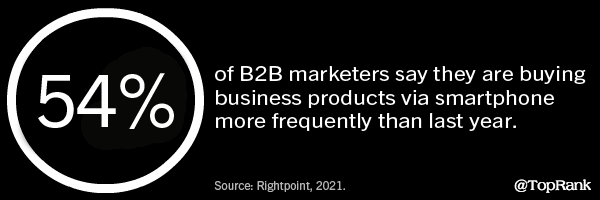
Differences in Google search desktop and mobile click-through-rate (CTR) insights garnered from 750 billion impressions are featured in newly-released third-party study data, which reveal that in the business and industrial sectors more searches for business-related content are conducted on mobile devices than on traditional desktops. Search Engine Journal

LinkedIn Quietly Experiments With Product Pages To Boost Conversations
Microsoft-owned LinkedIn has undergone testing of specialized business product pages on the platform, as part of ongoing efforts to increase engagement between members, brands, and brand product development teams, the social network recently announced. MediaPost

25% of marketers cite sustainability as ‘general goal’ rather than employ specific metrics
Gauging the success of sustainability efforts is a top challenge among marketers, with some 42 percent having said that they need to make new technology investments in the area, according to recently-released survey data of interest to digital marketers. The Drum

ON24 teams up with HubSpot in app marketplace
B2B users will be able to better integrate the features of the HubSpot platform and cloud-based hybrid engagement service ON24, with new event data-sharing options available in a forthcoming upgrade to the platforms, ON24 recently announced. MarTech

Budgets Show Spending Across All Social Networks: Trends For 2022
Facebook, Instagram, and LinkedIn are the three top social media platforms when it comes to effectively reaching business goals, according to Hootsuite’s newly-released annual social trends report, which has also shown that younger people are increasingly using social networks to research brands instead of traditional search engines. MediaPost

ON THE LIGHTER SIDE:

2021 November 19 Marketoonist Comic Image

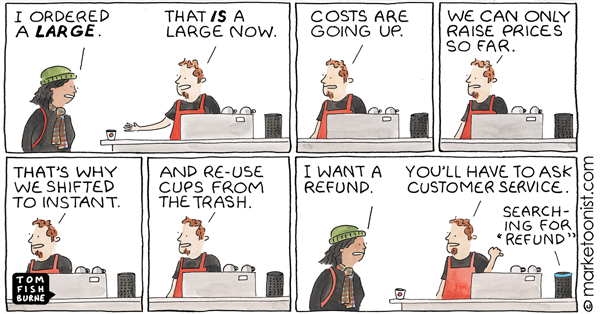
A light-hearted look at the “inflation, shrinkflation, and skimpflation” by Marketoonist Tom Fishburne — Marketoonist

Instagram is Paying Up to $35,000 to Lure Creators Away From TikTok — PetaPixel

Atari Unveils New Logo, Games, And More For 50th Anniversary — Forbes

TOPRANK MARKETING & CLIENTS IN THE NEWS:

  • Lee Odden — 5 Questions 4 With Lee Odden — Demandbase
  • Lane R. Ellis — What’s Trending: Embrace Your Inner Tinker — LinkedIn
  • Lee Odden — Membership Update Fall 2021 [Digital Marketing Institute] — Digital Marketing Institute

Have you found your own top B2B marketing news from the past week? Please drop us a line in the comments below.

Thanks for taking the time to join us for the week’s TopRank Marketing B2B marketing news, and we hope you’ll return next Friday for more of the week’s most relevant B2B and digital marketing industry news. In the meantime, you can follow us on our LinkedIn page, or at @toprank on Twitter for even more timely daily news.

By Lane Ellis

Sourced from TopRank Marketing

By

The latest update promises to block invasive data collection across your whole phone.

At the end of April, Apple’s introduction of App Tracking Transparency tools shook the advertising industry to its core. iPhone and iPad owners could now stop apps from tracking their behavior and using their data for personalized advertising. Since the new privacy controls launched, almost $10 billion has been wiped from the revenues of Snap, Meta Platform’s Facebook, Twitter, and YouTube.

Now, a similar tool is coming to Google’s Android operating system—although not from Google itself. Privacy-focused tech company DuckDuckGo, which started life as a private search engine, is adding the ability to block hidden trackers to its Android app. The feature, dubbed “App Tracking Protection for Android,” is rolling out in beta from today and aims to mimic Apple’s iOS controls. “The idea is we block this data collection from happening from the apps the trackers don’t own,” says Peter Dolanjski, a director of product at DuckDuckGo. “You should see far fewer creepy ads following you around online.”

The vast majority of apps have third-party trackers tucked away in their code. These trackers monitor your behaviour across different apps and help create profiles about you that can include what you buy, demographic data, and other information that can be used to serve you personalized ads. DuckDuckGo says its analysis of popular free Android apps shows more than 96 percent of them contain trackers. Blocking these trackers means Facebook and Google, whose trackers are some of the most prominent, can’t send data back to the mothership—neither will the dozens of advertising networks you’ve never heard of.

From a user perspective, blocking trackers with DuckDuckGo’s tool is straightforward. App Tracking Protection appears as an option in the settings menu of its Android app. For now, you’ll see the option to get on a waitlist to access it. But once turned on, the feature shows the total number of trackers blocked in the last week and gives a breakdown of what’s been blocked in each app recently. Open up the app of the Daily Mail, one of the world’s largest news websites, and DuckDuckGo will instantly register that it is blocking trackers from Google, Amazon, WarnerMedia, Adobe, and advertising company Taboola. An example from DuckDuckGo showed more than 60 apps had tracked a test phone thousands of times in the last seven days.

My own experience bore that out. Using a box-fresh Google Pixel 6 Pro, I installed 36 popular free apps—some estimates claim people install around 40 apps on their phones—and logged into around half of them. These included the McDonald’s app, LinkedIn, Facebook, Amazon, and BBC Sounds. Then, with a preview of DuckDuckGo’s Android tracker blocking turned on, I left the phone alone for four days and didn’t use it at all. In 96 hours, 23 of these apps had made more than 630 tracking attempts in the background.

Using your phone on a daily basis—opening and interacting with apps—sees a lot more attempted tracking. When I opened the McDonald’s app, trackers from Adobe, cloud software firm New Relic, Google, emotion-tracking firm Apptentive, and mobile analytics company Kochava tried to collect data about me. Opening the eBay and Uber apps—but not logging into them—was enough to trigger Google trackers.

At the moment, the tracker blocker doesn’t show what data each tracker is trying to send, but Dolanjski says a future version will show what broad categories of information each commonly tries to access. He adds that in testing the company has found some trackers collecting exact GPS coordinates and email addresses.

The beta of App Tracking Protection for Android is limited. It doesn’t block trackers in all apps, and browsers aren’t included, as they may consider the websites people visit to be trackers themselves. In addition, DuckDuckGo says it has found some apps require tracking to be turned on to function; for this reason, it gives mobile games a pass. While the tool blocks Facebook trackers across other apps, it doesn’t support tracker-blocking in the Facebook app itself. In DuckDuckGo’s settings, you can whitelist any other apps that don’t function properly with App Tracking Protection turned on.

The introduction of App Tracking Protection for Android comes at a time when ATT has pushed advertisers to Android, while also benefiting Apple. “ATT meaningfully changed how advertisers are able to target ads on some platforms,” says Andy Taylor, vice president of research at performance marketing company Tinuiti. The company’s own ads data shows Facebook advertising on Android grew 86 percent in September, while iOS growth lagged behind at 12 percent. At the same time, Apple’s ad business has tripled its market share, according to an analysis from the Financial Times. Around 54 percent of people have chosen not to be tracked using ATT, data from mobile marketing analytics firm AppsFlyer shows.

DuckDuckGo’s system is unlikely to have an impact anywhere near that scale and is more of a blunt tool. Unlike Apple, the company doesn’t own the infrastructure—the phones people use or the underlying operating systems—to enforce wholesale changes. Each time an app wants to track you, iOS presents you with a question: Do you want this app to track you? When you opt out, your device transmits the IDFA sent to advertisers as a series of zeros—essentially preventing them from tracking you. DuckDuckGo doesn’t have this luxury; its privacy browser app is installed on your phone like any other from the Google Play Store.

To make App Tracking Protection work, DuckDuckGo runs the same set of device permissions as a virtual private network (VPN). Dolanjski says that while Android phones will show the DuckDuckGo app as a VPN, it doesn’t work in this way: no data is transferred off your phone, and the network runs locally. In essence, the system blocks apps from making connections to the servers used for tracking. (When some trackers can’t communicate with their servers they will make repeated attempts to do so, Dolanjski says, which can cause certain tracker counts to swell within the app. He adds the company has seen no impact on battery life).

At the time of writing, Google had not responded to a request for comment on apps using VPN configurations to block trackers across Android. Other apps on the Google Play Store—including Jumbo Privacy, a VPN app by Samsung, and Blokada—already use similar methods to block trackers, although they also offer wider privacy-focused tools and don’t act as browsers.

Google itself has gradually added more privacy controls in Android, including some that apply to apps. The company allows users to reset their ad IDs and to opt out of personalized ads. Following the launch of iOS 14.5, Google said that Android owners who opt out of personalized advertising will see their unique identifiers stripped to a series of zeroes—as is the case for iPhone owners who turn off tracking. The change is already rolling out on phones using Android 12 and will be made more widely available on other Android devices early next year.

But for many people, the planned Android changes may not be enough. They don’t go as far as Apple’s alterations. DuckDuckGo’s Dolanjski argues that there’s very little transparency around the trackers currently employed in the apps people use every single day and that most people would be shocked at the amount they are tracked. For him, blocking trackers on Android is the next step in giving people more control over how companies handle their data. “It is going to dramatically reduce how much information these third-party companies get about you,” he says.

This story originally appeared on wired.com.

Feature Image Credit: Gabriel Weinberg, creator of DuckDuckGo.

By

Sourced from ars Technica