Author

editor

Browsing

By

How to build a culture that encourages growth and trust within your team.

Some businesses ride or die on strategy alone: If culture stands in the way of strategy, then strategy goes out the window. Really, though, the two are interdependent functions of the same mechanism. Strategy sets the direction, but implementing projects efficiently depends on a solid, healthy company culture.

Culture should be integrated into every aspect of business strategy, and at the heart of culture lies employees. The frontline between a company and its customers should be people who love their jobs, care about customer satisfaction and promote overall company success. Employees are a brand’s first customers and best advocates, and company culture is the key to keeping them engaged.

Here are three ways to make dramatic improvements.

1. Build high levels of trust

Brands need to generate and sustain a culture of believers and advocates, which comes from building trust. Leadership behaviours can start this process, but it is the mission of strong culture to establish trust among all levels. Employees want their company’s mission to align with their personal values. If they believe in your goals, they will support your success. People work and behave better as a team when they trust that everyone is on the same page.

Building trust is the key to greater employee engagement, which has a direct impact on customer satisfaction. A Harvard study of data collected by Sears in 1998 found a definitive link between employee attitude and customer-satisfaction scores. The resulting employee-customer-profit chain system was heavily dependent on adequate training and establishing trust.

Research has demonstrated a scientific link between trust and economic performance. People in high-trust companies report 74% less stress, 50% higher productivity, 13% fewer sick days, 76% more engagement, 29% more satisfaction with their lives and 40% less burnout. A 2015 study found significant causality between employee satisfaction and a company’s financial performance, and another review found that positive employee perceptions resulted in higher operation margin, revenue per employee and return on company assets.

2. Develop an emotional commitment

Engaged employees need to feel confident that they belong and are important to the company, so go the extra mile and show them that you care. Take the time to know each individual employee on a more personal level and take a genuine interest in his or her success. One study found that positive interactions between employees and their leaders encourage them to make greater contributions to the team.

Nurture an emotional commitment with your employees with rewards and recognition beyond pay increases and promotions. Employees want to feel a sense of ownership and that their input can make a genuine impact, so reaffirm their areas of strength and encourage their innovation. When they trust that they have a home to grow within a company, they go the extra mile to excel for themselves, their co-workers and the business as a whole.

Inspiring employee engagement generates both commitment and connection, intellectually and emotionally. Highly engaged employees are motivated to succeed, but they also want to help others and inspire them to do their best. When employees take pride in the organization and are committed to its success, they become highly persuasive advocates for the brand who help meet company goals faster.

3. Address disengaged employees

Just as high employee engagement can help a company, disengaged employees can hurt it, so have a plan ready to address employee disengagement. Employees don’t quit jobs, they quit managers, so start by coaching and training great management. Be sure to first provide them with all the resources, tools and data necessary to implement best practices, and then make engagement a key performance indicator to hold managers accountable.

Engagement is a two-way street, and getting employees engaged requires engaging them.  A 2017 study found that most employees assume leadership is responsible for keeping them engaged. Encourage feedback through one-on-one meetings, surveys, exit interviews and performance reviews, including their evaluation of the management. While discarding disengaged employees results in negative feelings towards a brand, making institutional improvements that lead to employee satisfaction has been linked to better stock performance.

Disengaged employees can cost companies up to $550 billion per year and hurt your positive company culture. Insecure or unhappy employees may already be slacking in their responsibilities, reading job postings or, worse, venting their “I hate working here” attitude to their co-workers. By proactively instituting feedback mechanisms that keep employees engaged, however, you can be more involved in making sure that they never get to such a point.

The research is clear: When you position a healthy team culture as the strategic foundation for a business, it drives performance outcomes. I always say, “If culture eats strategy for breakfast, what the hell is for lunch?” Strategy alone can leave you starving, but with culture as a constant and integral part of your overall company diet, you end up with an abundance at every meal.

By

Entrepreneur Leadership Network Contributor

Donna Peeples is an accomplished senior executive with verifiable results, leading customer-focused change initiatives in a variety of industries known for developing markets, growing startups and inspiring global change.

Sourced from Entrepreneur Europe

Sourced from wpbeginner

Do you want to set up WordPress email tracking on your site?

WordPress email tracking will help you see whether your users receive, open, and click your emails.

In this article, we’ll show you how you can easily set up WordPress email tracking to gain new insights.

Note: This article is specifically for emails sent from your WordPress site such as order receipts, password reset emails, contact form follow-ups, and more. These are not marketing emails that you send with your email marketing service because those already have open and click tracking built-in.

Why Set Up Email Tracking in WordPress?

By tracking your WordPress site emails, you’ll be able to see who opens and clicks your emails. Plus, get detailed reports about email deliverability.

This helps to make sure that all of your website emails are reaching your users. You can even resend emails that didn’t get delivered to improve the overall user experience.

There are all kinds of reasons to track your WordPress emails:

  • See which links in your emails are clicked
  • Make sure important membership site and online course emails are sent
  • Check if emails being sent by a certain plugin are delivered
  • Ensure online store order and confirmation emails get to your users

Whether you’re running a WordPress blog or small business website, WordPress will send all kinds of automatic email notifications to your users.

This can be new user registration information, password reset emails, comments, WordPress updates, and much more.

You need to make sure all of the emails sent from your website go to your user’s email inbox and not to the spam folder.

The best way to do this is by using an SMTP service provider to improve email deliverability. For more details, see our guide on how to fix WordPress not sending email issue.

With that said, let’s take a look at how to set up WordPress email tracking, step by step.

Setting up Email Tracking in WordPress

For this tutorial, we’ll be using the WP Mail SMTP plugin. It’s the best WordPress SMTP plugin in the market used by over 2 million websites.

It lets you easily send all of your WordPress emails using an SMTP server and improve email deliverability for your WordPress website.

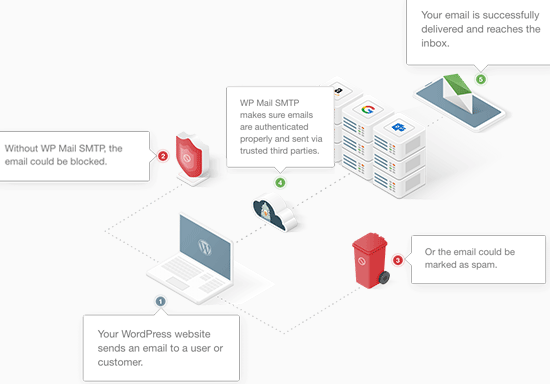
How WP Mail SMTP works

Step 1. Install and Setup WP Mail SMTP

First thing you need to do is install and activate the WP Mail SMTP plugin. For more details, see our beginner’s guide on how to install a WordPress plugin.

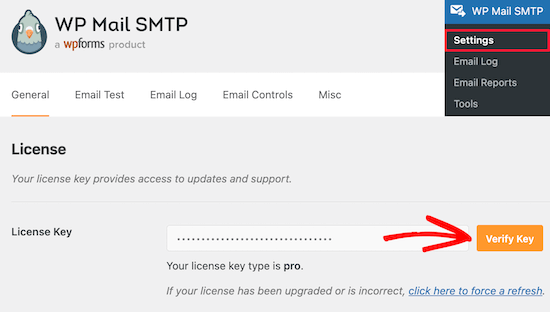
Upon activation, you need to go to WP Mail SMTP » Settings to configure your plugin settings.

Then, you need to enter your license key and click the ‘Verify Key’ button.

Enter WP Mail SMTP license key

You can find this information under your account on the WP Mail SMTP website.

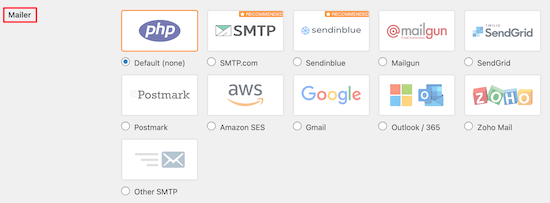
Once you’ve done that, you need to scroll down the page to the ‘Mailer’ section. Here you will choose how you want to send your WordPress emails.

The WP Mail SMTP plugin works with any SMTP service. There are easy setup options for the most popular providers, including Gmail, Outlook, SendInBlue, SendGrid, Amazon SES, and more.

Select SMTP mailer

Simply click on the mailer you want to use, and there will be detailed instructions on how you can set it up properly.

The default option is using the PHP mailer. However, we don’t recommend this method since it’s not reliable.

Most WordPress hosting servers aren’t configured to send emails. So, your WordPress emails may never even reach your users or end up in their spam folder.

For more details on setting up your SMTP server, see our guide on how to use a free SMTP server to send WordPress emails.

Step 2. Enable WordPress Email Tracking

Now that you’ve set up the plugin, it’s time to turn on the email logging and email tracking features.

Once activated, the plugin will automatically add a tracking pixel to every email that you send from WordPress.

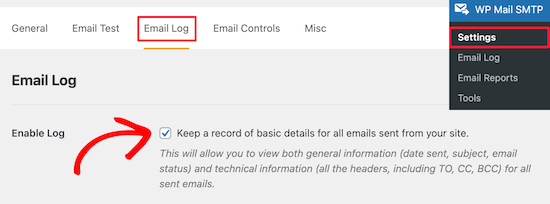
To do this go to WP Mail SMTP » Settings and then click the ‘Email Log’ menu option.

After that, you’ll want to make sure that the ‘Enable Log’ box is checked for email records.

If it isn’t, then check the box now. This will keep a record of basic details about your emails and store them in your WordPress database.

Enable email log tracking

You’ll also need this enabled if you want to resend emails in WordPress.

Next, you’ll see a few more checkboxes that let you turn on additional email tracking options. We recommend checking every box so you have more email tracking data available.

First, you can choose to save a copy of the email body. This lets you search the content of emails and also resend the entire email if it doesn’t send.

Simply check the ‘Log Email Content’ box to enable this.

Check log email content box

Next, you can save a copy of the attachments that are sent from your site. This can be helpful if an email doesn’t send and you need to resend the attachment.

To enable this, you need to check the ‘Save Attachments’ box.

Check save email attachments box

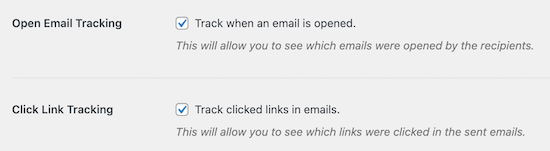
After that, you can track when an email is opened and which links get clicked by checking the ‘Open Email Tracking’ and ‘Click Link Tracking’ boxes.

Enable email opens and click tracking

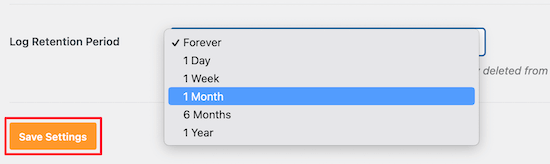
Then, you can set the time period for how long you’ll save your email logs. If you’re concerned about disk space, then you can change the setting here.

Simply select the time period from the ‘Log Retention Period’ drop down.

Choose log retention period

Make sure to click the ‘Save Settings’ button before you leave the page.

Step 3. Check Email Tracking Analytics Data in WordPress

Once you’ve set up the plugin and sent out WordPress emails, you can view your email tracking and analytics data.

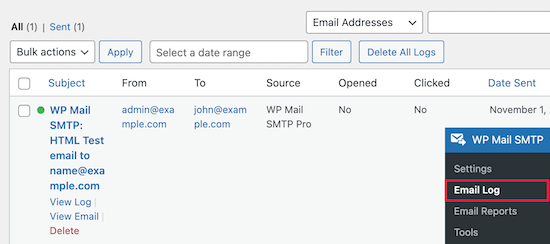
To do this head over to WP Mail SMTP » Email Log in your WordPress admin panel.

View email log opens and clicks

This screen will show you basic email data like opens and clicks, so you get a quick overview of your audience engagement.

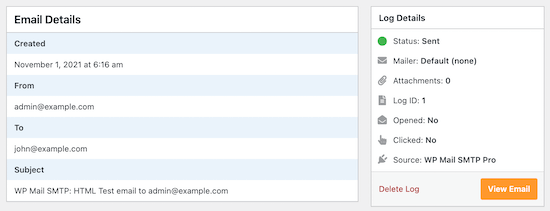
Next, you can open up individual email logs to see in depth email information.

Simply hover over an email and click the ‘View Log’ link, and the email details will open in a new screen.

View individual email log

This shows you when the email was sent, the subject, if it was opened, and more.

Resend New User Emails in WordPress

Another great feature of WP Mail SMTP is the ability to resend emails.

To do this, go to back to WP Mail SMTP » Email Log to bring up your email logs.

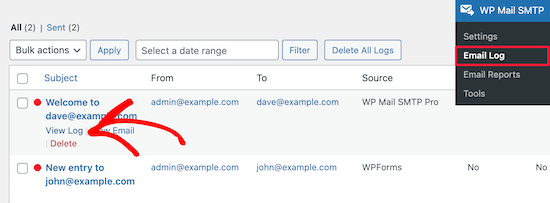
This page shows you every email you’ve sent and whether or not it was delivered. The red dot means not sent and the green dot means delivered.

To resend an email, simply click the ‘View Log’ link on the email that didn’t send.

View email logs for resend

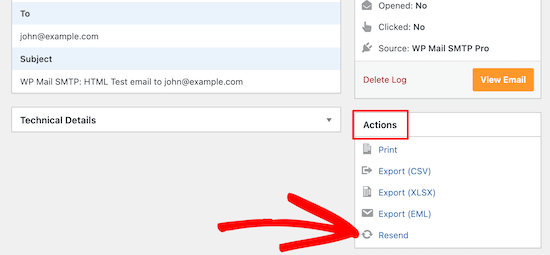
This brings you to the email log screen for that individual email.

Then, click the ‘Resend’ button in the ‘Actions’ tab.

Click resend button

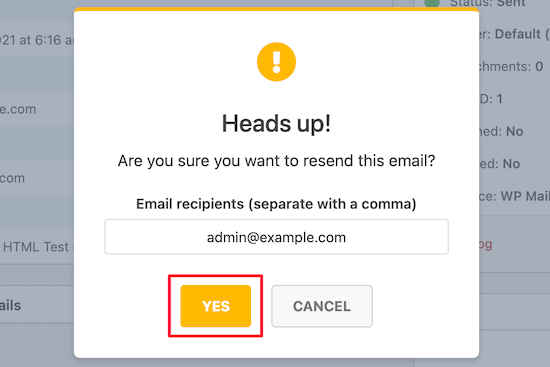
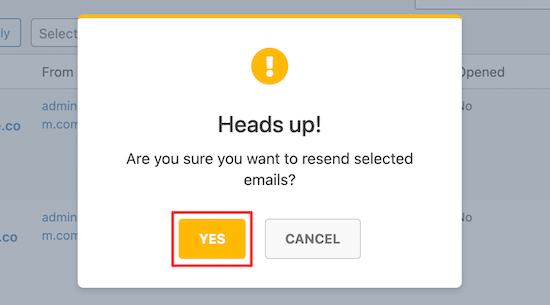
This brings up a popup that will confirm the email address.

Simply click the ‘Yes’ button to resend the email.

Click yes to resend email

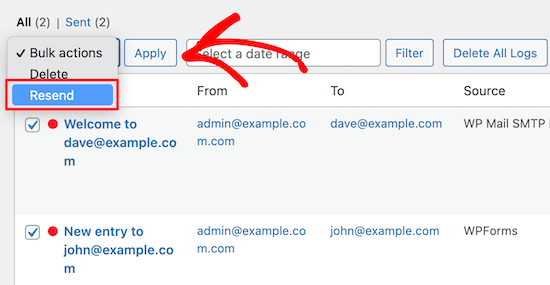
If there are multiple failed emails, then you can use the bulk resend feature from the email log screen.

Simply check the box next to the emails that didn’t send, then select ‘Resend’ from the drop down list, and click the ‘Apply’ button.

Resend multiple emails

This brings up a similar popup as above.

Simply click the ‘Yes’ button to resend the email to multiple users.

Click yes to resend multiple emails

View WordPress Email Engagement Statistics

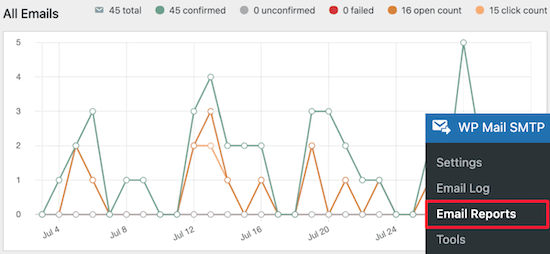
You can also view your full email tracking and reporting data by going to WP Mail SMTP » Email Reports.

This brings you to a screen with detailed statistics about your open rates and email deliverability.

View WordPress email reports

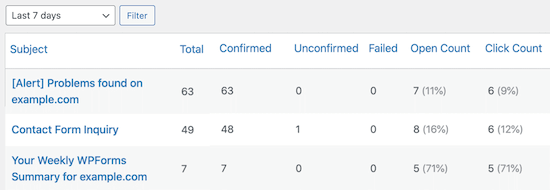
Under the main graph you’ll find a breakdown of how your individual emails are performing.

You’ll see open rates, click through rates, deliverability breakdown, and more.

View WordPress email stats

We hope this article helped you learn how to set up WordPress email tracking. You may also want to see our guide on how to create an email newsletter and our picks of the best business phone services for small business.

If you liked this article, then please subscribe to our YouTube Channel for WordPress video tutorials. You can also find us on Twitter and Facebook.

Sourced from wpbeginner

By Shama Hyder

No matter which industry they are in, business leaders need to meet challenges head-on and create methods to make ends meet.

Many businesses were forced to close their doors due to the pandemic. More than 200,000 companies were forced to close in 2020 alone. Many of these businesses were in industries deemed “non-essential” — such as restaurants and bars. Their closures and the resulting economic downturn forced many people to re-evaluate their industry of choice. No one had a playbook for how 2020 would unfold, and the term “unprecedented” became (ironically) commonplace.

Surprisingly, other industries saw an increase in revenue last year. Those who found success during hardship utilized unique business and marketing strategies to make things work. No matter which industry they were in, business leaders needed to meet challenges head-on and create methods to make ends meet.

What can marketers learn from how industries are changing nationwide? Here are some tips that can help.

Use Social Media to Connect

When the world was in lockdown, many companies scrambled to improve their digital footprint. Online interaction swiftly became the only means many had to connect with customers. One study from 2019 reported that despite social media’s accessibility, roughly 38 percent of small businesses still do not use it to connect with their audience. But its importance should not be neglected.

Amanda Gunawan of OWIU Design uses her social-media platforms to express the unique vision and purpose behind her company. With a combined total of roughly 150k followers between her personal and professional Instagram accounts, she is able to brand herself and her company. This social-media presence became imperative in 2020, as networking had to be done online and Instagram accounts or websites often served as company portfolios.

Manage Stress and Avoid Burnout

Leading a company during an economic downturn is undoubtedly stressful. Many companies may be tempted to take the easy route in order to alleviate stress instead of thinking about their long-term strategy. Learning to balance the pressure of highly competitive industries with a need for well-thought-out marketing strategies is a difficult but vital task.

Nancy Almodovar, CEO of Nan & Company Properties, runs the largest local real estate brokerage in Houston. Almodovar credits managing stress as the key to her success. “Stamina has been a challenge. You have to perform at a higher level to win the daily battles. Sleep, diet, exercise, and meditation are essential to prepare, reset, or rest enough to be ready to take on the next challenge without any lack of energy,” she says.

Know When to Pivot Your Strategy

Many interpersonal services were suspended for a significant portion of 2020. Some companies completely pivoted and changed their offerings to make ends meet. For some businesses, this meant emphasizing previously underperforming services and products, or totally shifting business models.

Powerhome Solar, a residential and commercial solar power company, changed the way it advertised its services during the pandemic and saw a 95 percent year-over-year increase in revenue. They understood that most people were spending all of their time at home, and loss of power would be disastrous. Updating the way they marketed their offerings based on the new needs of their customers due to the struggles brought about by the pandemic was crucial.

Before the pandemic, the value proposition around their offerings focused on cost and the environment. The new messaging, developed alongside the Sussman Agency, emphasized how they could help ensure homes would never be left in the dark during power outages. This subtle change in messaging brought them much success and is a great example of the importance of knowing your customers and recognizing that as their needs change, your strategy needs to as well.

Create a Strong Internal Culture and Company Personas 

Creating a strong digital brand won’t happen if you and your employees don’t understand your company’s mission and values. WebEnertia, a digital brand and Web design company, understands how imperative culture and brand are to its success, no matter what is happening economically. With over 20 years of creating compelling design experiences for clients, they know that personas are key to an effective marketing strategy. Once a company understands its own brand, it can share that brand with the world.

Become a Student of Consumer Behaviour

If they were not already doing so, marketers must marry their strategies to consumers’ purchasing and behavioural patterns. The Sussman Agency works with clients to make sure they’re adhering to consumer behaviour and knows they won’t find success without it. In a world that changed rapidly due to the pandemic, it became even more important to understand that your ideas may be brilliant, but if they don’t reflect raw numbers, they aren’t going to take you anywhere.

Feature Image Credit: Getty Images

By Shama Hyder

Sourced from Inc.

Sourced from techradar.pro

The best things in life are free

Do you want to increase online sales, build brand awareness and promote your products? From leading brands that boost TV campaigns with Facebook engagement, to growing businesses that host creative online offers to keep fans excited, any business – big or small – can use Facebook as a marketing tool.

Social media platforms such as Facebook bridge the gap between businesses and consumers, improving communication between them and leaving brands with a better understanding of their audience. Whether you’re a freelance illustrator, successful independent restaurant or a globally- recognized brand, Facebook should be at the top of your marketing strategy.

Facebook groups and pages each have their own strengths. Groups are ideal for intimate communication in communities – to discuss a topic, and to share ideas and opinions – while pages are designed to help businesses, organizations and professionals create an authentic presence online to represent their values. Therefore, creating a Facebook page for your brand or business is the first step towards getting yourself noticed on the social network.

How to promote yourself

A megaphone in front of a smart phone surrounded by heart symbols

(Image credit: shutterstock/SPF)

Suggesting your page to friends, putting up signs in your bricks-and-mortar store, adding a Like button to your website, and including links to your page wherever possible will all contribute to page growth. However, the most noticeable change in Likes will be as a result of the content you post on your page. Let’s look at ways to optimize your Facebook marketing effort by identifying your audience, creating compelling content, and analysing your strategy.

Having a clear understanding of your audience will help you tailor your Facebook posts to suit its interests. Most brands have customer profiles outlined through authorized data collection, but as a growing business or freelancer, taking time to identify your ideal customer will help you to find more of them.

Create a description of your ideal customer. Decide on age, gender, personality, occupation, hobbies, spending habits, likes and dislikes.

Locate your online audience. Which websites interest them? What are they reading? What are they likely to search for online?

Determine their end goals. What is it about your product or service that they like?

Write a more detailed outline of each identifiable customer. Give them each a name and backstory. Write a short day-in-the-life-of paragraph about each one that you can refer to. These are just a few questions to get you started. There are hundreds of customer profiling templates online that can help you build a more comprehensive portrait. Piecing together a clear picture of who you’re ‘talking’ to online will help determine the tone for each post and what customers are likely to respond to.

Create a content strategy

An illustration of a person using a giant magnet to attract social media likes

(Image credit: Shutterstock/Lepusinensis)

A Facebook content strategy is a daily outline of page updates scheduled for the week or month ahead which include things you want to promote or share. For example, you know next week you’ll publish a blog post about an offer available on your website’s shop, which will start on Saturday and end on the following Monday.

For your Facebook strategy you could schedule the following: an announcement of the upcoming offer the Thursday before, share a link to the blog post on Saturday, and post a product image on Sunday evening as a reminder to those who haven’t already taken advantage. Map out your Facebook strategy by determining your weekly or monthly goals and devising daily content around it.

Remember to look at your customer profile to find ways of working in content that would interest them. Your goals may be to drive traffic to your online store, to increase your reach and Page Likes, or to build brand awareness. They may be all of these things, so a strategy is central to creating posts that get attention and get results.

According to Posting Best Practices, rich photography and captivating videos, asking questions, and Facebook Offers (a paid-for service) – or offers of your own – receive the best response. If you think about your personal use of Facebook, are these the same things that catch your eye? Arizona-based State Bicycle Co. has been featured on Facebook’s Success Stories page.

Each week it shares a stunning image of a bike with an inspiring quote dropped over the top. This generates a  lot of shares and plenty more comments and likes. The company calls it Motivational Monday. Not only is it the perfect day for inspirational posts that banish Monday blues, but the content is also visually striking. Most importantly, it’s shareable, which extends the reach of the page and potentially leads to new fans.

With your page in place and content being published regularly, you can measure your success using Facebook  Insights. Facebook’s easy-to-use analytics service helps you evaluate different aspects of your page. Tools such as Engagement, Page Likes, and Post Reach help with tracking your best-performing content by discovering who’s engaging with you, and at what time.

Use these tools to find out what’s working well, write your own best practice, then replicate it. These steps are simple, but it takes an active page to make discoveries that lead to growth.

Case Study: Tatty Devine

The Tatty Devine Facebook page showing a happy woman holding a lollypop

(Image credit: Facebook/ Tatty Devine)

Tatty Devine is an independent British jeweller whose studios are located in London and Kent. It specializes in expressive, standout jewellery with hints of retro fashion. The brand used Facebook to bring the products from its British studios to a global audience. Its aim: to turn Facebook Likes into online purchases, shop visits and brand awareness.

A quick scan over the brand’s Facebook page makes it clear that Tatty Devine knows its audience. Its page is kept fresh by varying post types from anything between new collections, sneak peeks and discounted item announcements, all of which are accompanied by gorgeous images and enthusiastic copy. In spring/summer 2013, Tatty Devine launched the successful Wishing Tree campaign. It encouraged fans to leave comments on its Facebook page with their springtime wishes. These comments would be written out and pinned to an in-store wishing tree, photos of which were uploaded soon after.

This simple idea worked to bring a community of fans together by getting them to engage around a theme that wasn’t about a new offer or competition, but which resulted in increased online sales and improved store footfall. Tatty Devine’s sample sales have fans in screeches of sheer excitement. To promote the event, it created a public Facebook event and invited fans to visit its London store.

It soon had more than 400 guests attending. Other posts about the event included an announcement that newsletter subscribers would receive early access to buy ‘Lucky Dip’ boxes online, and an invitation to fans to submit song requests for the Sunday sample sale through comments.

Many happy customers shared images of their Lucky Dips, and those wishing they’d got something else were given the means to swap items with other Tatty Devine shoppers through a one-month-only Swap Shop event. Through both the Wishing Tree and Sample Sale campaigns, Tatty Devine created great excitement around its products using Facebook as the medium between it and its audience. It uses Facebook as the channel for driving online sales through good posting strategies and learning what its audience responds best to.

Six top tips

A woman checking her social media notifications

(Image credit: Shutterstock/Kaspars Grinvalds)

DO:

Create sharable content:
Shareable content is a post that directly benefits your audience. When a fan shares your post, it appears on their timeline and their friends’ news feeds, so creating shareable content is important for page exposure and acquiring new Likes. People respond to a business or brand with a ‘human side’, so don’t be afraid to add your own flair. Combine your (clean) humour with content that helps your fans express their own identity. Now more than ever it’s important to put yourself in their shoes.

Measure and adjust:
Once 30 people have liked your page, you’ll be able to see your Page Insights, which tell you all about how your audience is responding to your content. Page Likes, Post Reach and Engagement tools are just some of the things you can use to track your best-performing posts.

Be available:
People love an authentic presence online, so be conversational and share what you’re genuinely interested in – it’s about quality, not quantity. Respond to both good and bad feedback. Experiment with post types and times. You can schedule posts on Facebook, which is a godsend for businesses with little digital resource.

DON’T:

Forget formality:
Say goodbye to formalities and loosen up already! People on Facebook are there primarily to catch up with friends, so if you want their attention, you have to talk with them as though you’re just another pal to encourage interaction, rather than sounding like a marketer. This is not to say that you shouldn’t be professional, but have a little fun with your status – what have you been up to?

Reference:
Do not take credit for any content that does not belong to you! This is not to say that you can’t share an image you think your audience would love to see on your page, even if you didn’t take it yourself. It simply means that you should, at all times, give credit where credit is due. Adding a link to the original source builds credibility and trust with your audience.

Don’t irritate:
Facebook likes an active page but people are quick to hit the Unlike button. The aim is to be consistent and to post regularly to counter this, but don’t overdo it. Ask yourself, “Would my audience share this?”, “Would they find it interesting?”, “Would they like to see this in their news feed?” – if the answer is yes (honestly), then go ahead.

Sourced from techradar.pro


By Nate Nead

Ask any two software developers what the best approach to development is, and you’ll probably get two different answers. Development is both a logical and creative pursuit, so there’s a lot of room for personal opinion.

That said, most methodologies can be broadly categorized into two competing approaches: waterfall and agile. Agile software development is arguably more popular, used by a greater percentage of individual developers and businesses. It’s also commonly touted as the “superior” approach – but is it? And are there situations or projects where the waterfall methodology is better?

What Is Waterfall Development?

Let’s start by analyzing the waterfall development methodology.

Think of a waterfall in nature. The water flows in one direction, from its source, through the fall, and down to the pooling water below. In a similar way, waterfall development is unidirectional. You’ll start with a specific, detailed plan on what you’re going to develop and how you’re going to develop it. Across a series of phases, including research and planning, you’ll flesh out the details, then start building the architecture.

Your goal is to create the product from the ground up, as completely as possible, with minimal changes along the way.

There are several advantages to this approach:

  •         Clear central planning. With the waterfall methodology, you’ll invest a lot of time and effort at the beginning of your project. You’ll analyze the competition, make thorough documentation about the type of product you want to build, brainstorm the possibilities, and make critical decisions that will impact the project for weeks or months to come. This front-loaded process leaves you with more information and a clear direction to follow for the entirety of the project.
  •         A clean, phased approach. Waterfall development also has a very clean, phased approach. There’s no ambiguity as to when a phase is over and you’re not bogged down by competing priorities. In many environments, this leads to painless, straightforward development.
  •         Easy coordination and workflow. Many developers also find that waterfall makes it easy to collaborate, especially with people working in other roles (like project management). It’s very obvious when the project should change hands, and there’s no question about when the project is ready for launch.
  •         Less back and forth. As we’ll see, conversation and the “back and forth” process of collaboration can be valuable for software development. However, it can also be time-consuming, confusing, and complicated. In waterfall development, there are fewer micro conversations that need to occur and fewer meetings that need to take place. Developers can spend less time talking and more time coding.

What Is Agile Development?

By contrast, agile development is all about flexibility and adaptation. You’ll still spend time researching and planning – but nowhere near as much as you’ll need to spend if you’re following the Waterfall methodology. Here, the goal is to start working as soon as possible, building a loose sketch of a product, then filling in the details later.

During this process, you’ll be reviewing your work, talking to clients, collaborating with others, and fine-tuning your approach. You’ll be developing continuously, even after your product launches, polishing old features and adding new ones.

These are some of the best advantages:

  •         Faster startup. The intensive planning in the initial phases of waterfall development can be beneficial, but they can also delay your startup. If you’re interested in developing a minimum viable product as quickly as possible, or if you need to get rolling immediately, agile development will work out better for you.
  •         Easy modifications. There are many reasons why you might want to change the nature of your product, or its core features, in the middle of development. There might be new technologies, new competitors, or new market dynamics to think about. You might second guess a key feature or come up with a new idea on the fly. You might even find that your original idea isn’t working out the way you want. In any case, agile methodologies allow you to adapt – rather than being stuck with your original plan.
  •         Continuous testing. Thanks to AI and other powerful testing tools, agile software developers have the advantage of continuous testing on their side. They can discover flaws and bugs as they’re developing, so they can stamp them out long before they ever impact a user.
  •         Active client involvement. Agile development is also popular because of its ability to support active client engagement. Project managers and clients alike can get into conversations with developers, analyze the product, provide new direction, and guide the product to the finish line together.
  •         Constant communication and refinement. The agile methodology also provides opportunities for constant communication and refinement. You can consistently polish your product until it’s as perfect as you originally imagined it.

Why Agile Has Become Dominant

Agile software development has slowly grown to become the dominant methodology in the development field. It certainly has plenty of advantages, but why has it become this popular?

There are a few influential factors:

  •         Evolving scope. Scope creep is a problem for all kinds of projects. Clients change their minds. Stakeholders come up with new requirements. People get new ideas. With agile, scope creep isn’t nearly as big of a problem; you can adapt to the new requirements responsively and keep making progress toward the finish line.
  •         Changing landscapes. The landscape for your software is always changing. You’ll experience the introduction of new competitors, new technologies, and new ideas. Waterfall can lock you into a position you don’t want, while agile gives you an opportunity to escape.
  •         Faster progress. Tech businesses have a desperate need to generate revenue as quickly as possible. Only agile development allows you to hit the ground running.
  •         Customer service. In many ways, agile development also provides opportunities for better customer service. Your customers are more involved and more invested in the development process; accordingly, you’re likely to see better results if you’re creating products for others.

When Is Waterfall Better?

Is waterfall ever better?

The short answer is yes. Waterfall is more efficient, more streamlined, and faster when it comes to specific types of projects like these:

  •         Small, quick projects. Generally speaking, the smaller the project, the better suited it is to waterfall development. If you’re only working with a few hundred lines of code or if the scope of the project is limited, there’s no reason to take the continuous phased approach.
  •         Low priority projects. Low priority projects – those with minimal impact – don’t need much outside attention or group coordination. They can easily be planned and knocked out with a waterfall methodology.
  •         Internal projects. One of the best advantages of agile development is that your clients get to be an active part of the development process. But if you don’t have any clients, that advantage disappears. If you’re working internally, there are fewer voices and opinions to worry about – which means waterfall might be a better fit.
  •         Projects with few stakeholders. Similarly, if the project has few stakeholders, waterfall can work better than agile. If you’re working with a council of managers or an entire team of decision makers, agile is almost a prerequisite. But if it’s just you and one other guy, waterfall may be ideal.
  •         Fixed projects not subject to change. It’s sometimes hard to tell which projects will be “fixed” and which ones will be subject to change in the future. But if you feel confident your project isn’t going to change or evolve in the future, you should consider waterfall development.

The agile development approach is so popular and so well-received that it’s even influencing organizational culture beyond the realm software development. But despite its appeal and lasting popularity, it’s not a perfect system – and there are some projects that perform better with the help of waterfall development. Analyze your project and your goals completely before deciding which methodology to follow.

By Nate Nead

Nate Nead is the CEO & Managing Member of Nead, LLC, a consulting company that provides strategic advisory services across multiple disciplines including finance, marketing and software development. For over a decade Nate had provided strategic guidance on M&A, capital procurement, technology and marketing solutions for some of the most well-known online brands. He and his team advise Fortune 500 and SMB clients alike. The team is based in Seattle, Washington; El Paso, Texas and West Palm Beach, Florida.

Sourced from readwrite

By Andrew Faridani

When launching a new campaign, product or new line of service, many businesses – both large and small – choose to forgo an important step: market research. While many companies cite cost as the reason to skip this crucial step, others think it’s too time consuming or simply not necessary.

This couldn’t be farther from the truth. Market research is the most critical piece of a marketing launch because it helps businesses understand the audience segment and, by extension, the actual need of a product or service.

Some companies think it should be the first thing cut when discussing an upcoming launch. Because it’s a long-term payoff and doesn’t immediately turn into revenue, it’s quickly ignored or discarded for something more immediate.

If you’re not doing market research, what needs to be remembered is it’s very likely your competitors are. And the business with the better understanding of what a consumer needs and wants is going to come out on top.

Take Target. It’s hard to believe from such a large company, but when they launched their brand in Canada, they skipped market research and banked on name recognition to drive customer traffic. After buying the leases for a defunct discount chain in Canada in 2013, Target quickly turned the empty stores into new Target stores.

The big store conglomerate spent millions on marketing on social media, radio, TV and billboards but never took the time to deep dive into the specific Canadian consumer segment. Customers in Canada knew the brand, but when they went into stores, they saw different products than what they’d seen in U.S. stores and prices were higher. It took less than two years for Target to close its Canadian stores and call the launch a failure.

The main lesson learned is: Do your market research! The time and cost of doing proper research is worth the investment, every time. And here’s a secret: it doesn’t have to cost hundreds of thousands of dollars. Sure, if you’re Pepsi and launching a new beverage or Nike testing out a new shoe, market research will cost upwards of millions. But if you’re a small business trying to determine whether you should launch a new line of business, or if a product is a good fit for a specific locale, there are cost effective ways to do your market research. Some are even free!

Here are a few of the best tried-and-true best practices in market research:

Free Please!

Before you dip your toe into paid research, use the free online tools at your disposal. The best tool? Google. Search the phrase you’ll use to describe your product and review its popularity. If the popularity is high, ie. millions of searches, it’s in high demand. If there are only a couple hundred results, you may be barking up the wrong tree.

Another important tool is the keyword search query within Google Adwords. Their keyword research tool tells you how frequently certain words and phrases are searched and how they changed over time. This tool gives insight not only into what is being searched, but how. It will help refine the best words and phrases to use when promoting your product or business. And it will also give insight into the popularity and search volume of those terms.

Go Digital

For many, the image that comes to mind when you say “market research” is a person standing in the grocery store offering free samples of a new product. And while that can be effective, the digital realm is a much easier and faster option. You don’t get quite as many opinions standing in line in the grocery store as you might running an online poll. Think 20 people versus 5,000: That’s a significant difference.

LinkedIn and Twitter both host online polling and provide solid results. It’s important to slice and dice the audience until you’re polling the right segment. Make sure your geographical location is accurate – it’s not uncommon for those polling to accidentally use a much bigger geo target setting than necessary, which can skew results.

You can hire a third party vendor to do your polling and/or surveying or find a self-serve platform, like Survey Monkey. The best way to determine which solution is by budget and campaign size. If your budget is $10,000 or less, use a plug-and-play, self-serve option. Anything over $10,000 should be handled by the pros.

And don’t forget simple ad campaigns on Facebook, Instagram, LinkedIn or Twitter. Running an A/B test using different images, slogans, and copy can tell you what is resonating with your target audience – and what isn’t.

Email For The Win

Another smart tactic to use for market research is an email marketing campaign. Whether you use an internal email list or purchase one from companies that specialize in list creation, targeting a segment audience via email works phenomenally well.

There are many digital ad agencies that specialize in surveys. They help you buy legitimate lists to purchase within a specific vertical which is a great way to target specifically. For example, if you’re a dental manufacturing company, there are very specific lists you can buy to help you find and target dentists. You can break down the list by location, speciality, size of practice, etc. Email marketing is an effective way to do market research without breaking the bank.

Market research can make or break your business. Be smart and put in the time and effort to make sure your product or line of business is truly going to resonate with your target audience.

Feature Image Credit: getty

By Andrew Faridani

President and CEO at BreezeMaxWeb. Read Andrew Faridani’s full executive profile here.

Sourced from Forbes

By Rosie Spinks

Feature Image Credit: Simple Superpower of a Follow-Up Email

By Rosie Spinks

Sourced from Forge

By Cal Jeffrey

ATT effect on individual advertisers is unclear as they shift ad budgets to more effective platforms

In context: Last year, Apple announced new policies requiring app developers to publish “privacy nutrition labels” in their App Store listings detailing their data collections practices. More importantly, the company revealed that it added a feature to iOS that would allow users to opt out of ad tracking for individual apps.

Facebook warned that Apple’s App Tracking Transparency (ATT) policies that give users control over how their data is collected would spell catastrophe for its developers and advertisers. It “conservatively” estimated a 50-percent drop in revenue from its Audience Network platform.

The Financial Times reports that Facebook, Snapchat, Twitter, and YouTube lost a combined $9.85 billion in the two quarters following the full implementation of Apple’s ATT plans in April. While nearly $10 billion is a significant decline, it is nowhere near the 50-percent adpocalypse Facebook was shouting about in full-page newspaper ads.

According to adtech company Lotame, by nature of its size, Facebook owns the vast majority of the ad revenue share, so it took the biggest monetary hit. However, it was only a dip of 13.2 percent. Snapchat also suffered a 13.2-percent blow and is a much smaller company, so it probably felt the effects even worse. YouTube and Twitter saw smaller ad revenue declines of 7.7 and 7.4 percent, respectively.

Of course, the median 12-percent drop for these social media platforms does not necessarily translate to an equivalent loss for the smaller companies who advertise with them. Lotame’s COO Mike Woosley points out that, depending on the company, individual advertisers can lose close to 50 percent of their advertising power. He illustrates this with an example of a men’s underwear line buying a $5 ad targeted at 1,000 men.

“Well, now to get 1,000 men, you have to show it to 2,000 people because all of a sudden you don’t know who is a man and who is a woman,” Woosley explained. “And you still only have $5 for those 2,000 impressions. So your acquisition costs doubled, and the lost yield is 50 percent.”

It’s worth noting that there is a difference between bang for your buck and lost revenue. Even still, Lotame’s estimates might lean to the conservative side. Adtech consultant Eric Seufert claims that Facebook alone could have lost $8.3 billion since April. He also says that losses are likely to continue as advertising groups adjust to a new “privacy-centric paradigm.”

“Some of the platforms that were most impacted—but especially Facebook—have to rebuild their machinery from scratch as a result of ATT,” Seufert said. “My belief is that it takes at least one year to build new infrastructure. New tools and frameworks need to be developed from scratch and tested extensively before being deployed to a high number of users.”

In the meantime, many companies are finding that Facebook is no longer a viable advertising platform because of its continually increasing costs and the now diminished ad power. Wayflyer CEO Aidan Corbett said that many advertisers have been moving to TikTok because the cost per 1,000 impressions is much lower.

This shift in advertising budgets is the reason these big platforms are seeing declines. It’s not that companies have cut their ad spending. They have simply moved it from poorly performing venues to more effective ones. So it’s hard to determine how much individual advertisers have been affected overall.

Twitter and Google said the effects of Apple’s ATT policies were minimal. Twitter claims its ad sales climbed about 41 percent last quarter. The company says its ad platform relies less on tracking users’ mobile habits and more on “context and branding.” Alphabet says that it has enough first-party data that it does not need to track users across third-party apps. The exception would be YouTube, but Google claims even the effects of ATT on YouTube were “modest.”

Unsurprisingly, Apple has faired well since implementing its transparency policies. Last month, the App Store’s Search Ads platform tripled its growth over last year. Where it once held only 17 percent of the iPhone’s advertising market share, it now stands at 58 percent. Of course, a significant part of that growth reflects the market’s atrophy as advertisers shift more funds to other platforms.

By Cal Jeffrey

Sourced from TECHSPOT

It’s Monday, and your co-workers are digging into a long, gruelling database project. If you’re nice, you’ll bring them coffee and bagels. But if you’re feeling less charitable, there’s always an animated Clippy sticker to help get their week started off on the wrong foot.

Microsoft recently confirmed that, yes, you can pull a number of animated Clippy images from within Microsoft Teams. In case you’re too young to remember Clippy, the animated paperclip was introduced to Microsoft Word in 1996 as an “office assistant,” and is unfondly remembered as a precursor to virtual assistants like Siri and the Google Assistant. Now, Clippy is back as an animated retro sticker pack within Microsoft Teams.

We’re on record as standing against animated emoji, specifically the ones Microsoft said would arrive in Windows 11. Fortunately, Microsoft took our advice, and the distracting, animated emoji have yet to make an appearance. Animated stickers, however, have appeared within Teams for some time. And now Clippy has entered that arena.

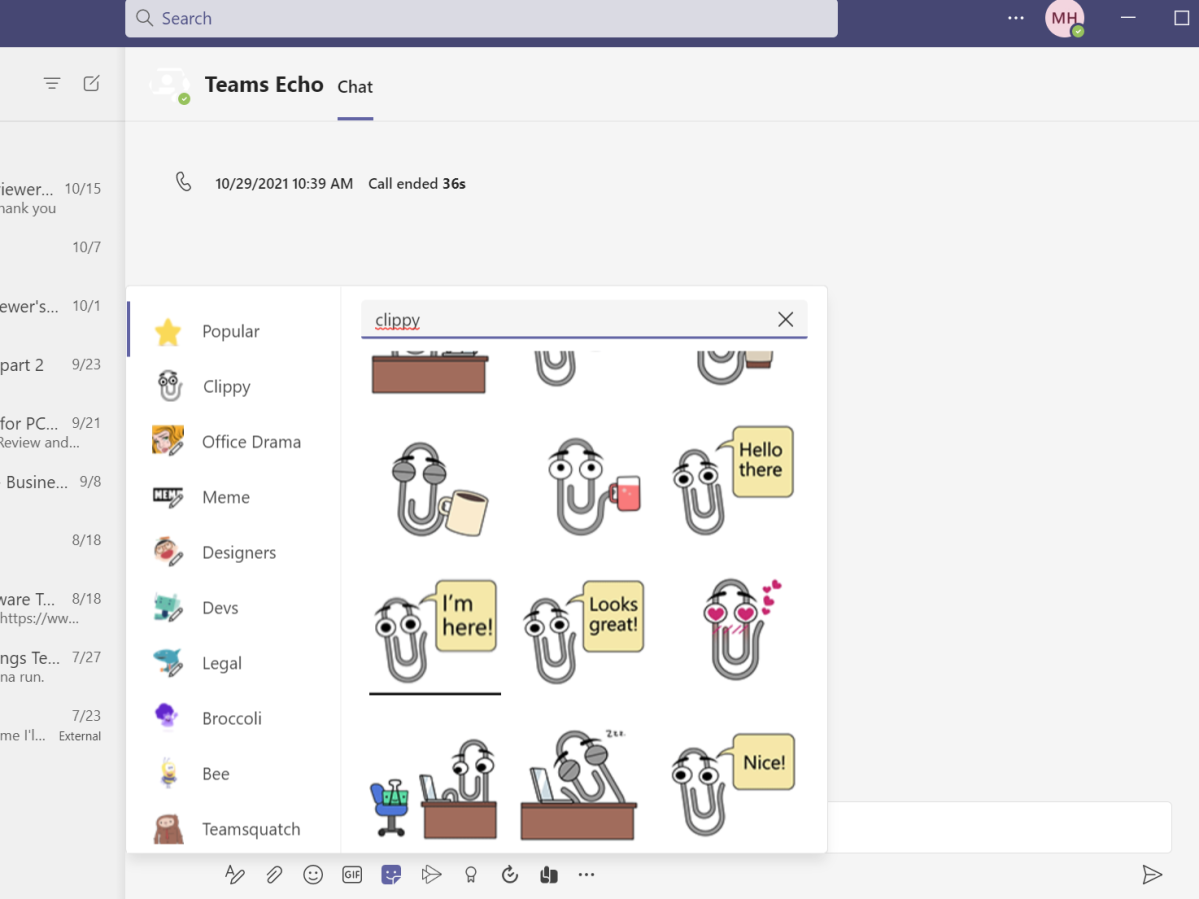
To select from among the dozens of animated and non-animated Clippy stickers, you’ll want to launch the main Teams app and scroll down to the small icons underneath the chat window. There, you’ll find a list of “Clippy” stickers accessible from the left-hand rail nav, or you can simply type in “Clippy” inside the search box. Either way, now you’ll have a number of Clippy icons from which to choose.

Microsoft Teams Clippy sticker pack
Here’s how to find the Microsoft Clippy pack within Microsoft Teams.

Mark Hachman / IDG

Microsoft stopped using Clippy as a formal part of Microsoft Office years ago, but the animated paperclip has snuck back into the tech zeitgeist via everything from Greenpeace protests to a Microsoft Office game (yes, seriously) called Ribbon Hero. Clippy was supposed to eventually replace the “paperclip” emoji within Windows 11, but so far that hasn’t happened.

By Mark Hackman

Sourced from PCWord 

Sourced from Inc.

How the nation’s highest performing CEOs run circles around everyone else? They have an edge, of course.

very leader has a cheat sheet for success: the things they’ve learned overtime that have helped them cultivate strong teams, manage under fire and just generally inspire a thriving organization–even when the odds are stacked against them.

Below, some of the most effective leaders among this year’s 250 Best-Led Companies share their top-secret tips for business success.

My Secret to Finding Focus: A Post-it Note on my monitor

“When I was 13, I had this great soccer coach, Andy. He had this saying: ‘Focus, focus, focus.’ I still hear it ringing in my head: ‘Focus, focus, focus, Zach, focus, focus, focus.’ I write it on Post-it Notes and put them on my monitor and I talk about it frequently around the company. Doing one thing well as opposed to many things slightly well–that continues to be so important.”

–Zach Perret, co-founder and CEO of financial services company Plaid

My Secret to Breaking Down Silos: Sharing goals

“One of my first initiatives when I joined Exabeam was to realign objectives to force us to share goals that were more collaborative across the company. We had to break down organizational silos and even have certain roles report to two different organizations.”

–Michael DeCesare, CEO of cybersecurity firm Exabeam

My Secret to Business Longevity: Shared ownership

“One-third of our company is owned by employees. We wanted to create a business that people would join and where they would be happy to stay.”

–Jim Henderson, co-founder and CEO of insurer AssuredPartners

My Secret to Effective Meetings: Built-in prep time

“Carve out time during the first 10 to 15 minutes of your meetings for everyone to read memos. It really helps create more structure around a discussion, and allows people to have all the information before jumping into one. Everyone gets all the data, so people can make comments and see those of others–creating a much richer meeting environment.”

–Dev Ittycheria, CEO of database platform MongoDB

My Secret to Successful Partnerships: Letting people in

“I was able to get co-founders I look up to by being unselfish. It’s about letting your ego go a little bit and letting people share in the decision-making and take ownership in the business. A lot of company leaders guard that equity for themselves. Making sure the people around the table are incentivized is important.”

–Kurt Workman, co-founder and CEO of Owlet Baby Care

My Secret to Winning: Hiring people who hate to lose

“We all enjoy the feeling of winning, but that feeling lasts for only a few hours. Our hatred of what it feels like to lose can last for days, even weeks. People who hate to lose use that feeling as motivation to rise to the top and achieve things that others never thought were possible.”

–George Kurtz, co-founder and CEO of cybersecurity firm CrowdStrike

My Secret to a Productive Workplace: Making employees feel safe

“People are happiest and most productive when they have a sense of psychological safety. To create that kind of environment, the leadership team needs to celebrate both success and failure, visibly, in front of the whole company. I love opportunities to go in front of the company and say, ‘Look, this is an area where I got it really wrong.’ ”

–Stuart Landesberg, co-founder and CEO of natural home products maker Grove Collaborative

My Secret to Leading Remotely: Connect, personally

“Don’t just jump into the transactional work at the beginning of a call. Take the space–two minutes–to check in with what’s going on in their world. Maybe it’s an interesting book in their background or you hear a dog barking or a kid. Those moments of rapport-building start to unlock the things you have in common, and it snowballs in a positive way. But you have to make the choice to build the relationship.”

–Hayden Brown, CEO of freelance work platform Upwork

My Secret to Building Great Teams: Being intentional

“Define your culture as carefully as your business strategy. Build your guiding principles–mission, values, and vision–into your hiring and leadership.”

–Tim Brown, co-founder and co-CEO of eco-conscious sneaker brand Allbirds

My Secret to Shaping Employees: Mentorship

“Make sure that you and your employees are getting to know people up and down the organization. We have formal mentor programs. We hire people right out of school, and we pair them with our chief architects, because we know they have the potential to learn very quickly. A true meritocracy [comes when] people can grow as fast as they’re ready to.”

–Karl Sun, co-founder and CEO of Lucid, a visual collaboration software company

My Secret to Taking Criticism: Learn to Love It

“If you don’t, the person who suffers the most is going to be yourself. It hurts less and less over time. We’re all unfinished products. If you look at feedback like data and you learn to love it, then the better off for your team and your business.”

–Zachariah Reitano, co-founder and CEO of Ro, a telehealth and online pharmacy startup

My Secret to Staying Cool: Don’t Dilute Your Brand

“We are very careful with our brand and what we do with it. We try to have depth in the communities we operate in, but we try not to be everything to everyone.”

–Matt Reintjes, CEO of YETI, maker of insulated tumblers and outdoor gear

My Secret to Leading the Competition: Stay Nimble

“I remind my team frequently that we are literally creating a new industry, and it’s still so early. When we see an opportunity, we go after it. That mindset not only rallies people to embrace change, but also empowers them to lead through change.”

–Jason Robins, co-founder and CEO of DraftKings, the sports-betting operator

My Secret to Being Relatable: Demonstrate Vulnerability

“We have a speakers series named after our former CEO, Dave Goldberg, who passed away. So far, we’ve brought in more than 60 leaders, ranging from athletes, politicians, and business executives, to speak to us. It’s an opportunity for employees to not only learn from them, but also to see me be vulnerable and ask questions to people I admire.”

–Zander Lurie, CEO of business solutions platform Momentive (known for SurveyMonkey)

My Secret to Course Correcting: Dig Into Feedback

“I decided a number of years ago that I would read and respond to every Glassdoor review. We actually shine a light on those; it often leads to nuggets of insight about what we could be doing better, or it shows me a blind spot that I didn’t realize.”

–Dan Burton, CEO of health-data storage and software company Health Catalyst

My Secret to Grooming Leaders: Making Them Want It

“High performers want to be challenged and stretched. We want our team members engaged and pushing for their next role at the company.”

–Deanie Elsner, CEO of Charlotte’s Web Hemp, maker of cannabinoid wellness products

My Secret to Building Trust: Empathy

“Understand your team members’ priorities, their concerns, what they need to achieve personal and emotional health, and how social issues impact them. Then, remain open to feedback and demonstrate your commitment to constant growth and development as a leader.”

–Scott Cutler, CEO of luxury footwear and apparel marketplace StockX

My Secret to Leveling Up: Start With Your People

“Focus on the four P’s: people, plan, process, and performance. If you get the people piece right, you can develop a robust plan. Having the right people also enables you to have the right processes in place because they know what is needed. You do all of those things and you drive the performance of the organization consistently.”

–Nick Vlahos, CEO of The Honest Company, the personal care company founded by Jessica Alba

My Secret to Resilience: Confidence

“You are going to be told no so many times. You are going to have so many challenges that you didn’t anticipate. There are so many reasons to quit. And if you don’t have this attitude of ‘I’m gonna fix this; I’ve got this; and we’ll figure it out,’ then you won’t make it.”

–Julie Wainwright, founder and CEO of online luxury consignment shop The RealReal

My Secret to Leading With Agility: Get Cozy With Change

“You have to have a long-term vision of what to do, but you have to be able to use agility within that framework–and everybody has to feel like they are a part of it. Everyone has to understand that change is a daily occurrence.”

–Mindy Grossman, CEO of WW (formerly Weight Watchers)

My Secret to Radical Transparency: Put It All on Slack

“Our number one form of communication is Slack, and all channels are open, whether it’s our diversity numbers, or how we did on user growth, or a boardroom debrief. Transparency is about having the information searchable and at your fingertips, so you don’t even have to ask someone for it. I trust my team with all the information, good or bad.”

–Wes Schroll, CEO and founder of savings app Fetch Rewards

Sourced from Inc.