To the average outsider, link building seems intimidatingly complex. You’ll be in charge of placing links to your site with a delicate balance of brand visibility and subtlety, working with high-profile publishers, and dodging Google penalties at the same time. It’s a service that costs thousands of dollars per month to manage if you’re working with an external agency, so clearly it’s not something you can do yourself, right?
Start Link Building if You’ve Never Tried Before
The truth is, while link building is complicated, it’s also approachable, even if you’ve never tried the strategy before.
What Is Link Building?
Let’s start with a primer on what link building is. As the name suggests, it’s a way to construct links in a digital environment. With the right approach, you can place links with external publishers and other websites, pointing back to various pages on your website.
Builds SEO and DA
The most obvious benefit is that the link serves a functional purpose, creating more roadways that people can use to find your site. But it’s also important for search engine optimization (SEO). Earning more links and being connected to more authoritative sources will increase your domain authority (DA), eventually helping you rank higher in search results – and earning you more traffic.
Link Building helps new business
Links are especially powerful for new and emerging businesses since they don’t have much authority or much of a web presence to work with initially. It’s also valuable here because it’s inexpensive and accessible, meaning you can use it even if you’re working with a limited budget.
There are many possible ways to approach link building. Some people attempt to earn as many links as possible as naturally as possible, creating compelling onsite content and hoping that people link to it. But it’s much more reliable to manually build links yourself – as long as you’re building them in an appropriate and Google-friendly way. More on that later.
The Benefits of Link Building
There’s no question that link building is valuable, at least when done right. But where does that value come from? What makes this strategy so effective?
Traffic. First, there’s the potential for traffic generation. Getting a link to your site placed in the right article, with the right publisher, could conceivably send thousands of visitors to your site every month – or even more. And because the link is functionally permanent, it could keep sending recurring traffic to your site for months, or even years to come.
Search rankings. Most people discover link building as a tactic when researching SEO. Link building isn’t the only element necessary for an SEO strategy, but it’s one of the most important. Together with onsite content optimization, coding optimization, and technical improvements, it can help your site rank higher in SERPs and, ultimately, get more organic traffic.
Visibility and authority building. Link building can also be valuable for visibility and building the subjective authority and reputation of your brand – especially at the higher levels. Merely mentioning your brand in an article, or getting connected to the right publishers and authors, can be a boon for your entire company.
Black Hat Link Building and Potential Penalties
Link building isn’t always straightforward. Google goes out of its way to penalize websites that infringe on the experiences of its users. If it thinks you’re spamming backlinks, overtly promoting yourself, or trying to manipulate its ranking algorithm — you’re going to face a penalty.
Link building tactics that are meant only to manipulate search rankings, and that have little to no value to average users, are known as “black hat” tactics. They’re also considered unethical.
But don’t worry. There are plenty of ways to build links properly – and as long as you’re improving user experiences, you’ll be in good shape. The most straightforward tactic is to write high-quality content for an external publisher, while linking to your own onsite content as a reputable source.
Prerequisites for Link Building
Before you start link building, there are some things you’ll need in place first.
For example:
An established website. You can’t build links to a place that doesn’t exist. If you want to get the most value from your links, your website needs to be functional, safe, mobile-friendly, and easy for users to navigate.
Good onsite content. Additionally, you’ll want an archive of high-quality written content on your website. This is going to help establish your site’s domain authority, and will also serve as valuable fodder you can use as the destinations for your links. The better your onsite content is, the stronger your links will be.
Social media profiles. Social media is the best place to promote your onsite and offsite content. It’s also a great way to connect with other authors and reach out to new publishers.
Author profiles. Your business may have an awesome brand built for it, but it’s not always ideal to write as the business. Instead, you may want to write content as individual authors, complete with author profiles you can build up over time.
What Makes a Link Effective?
What is it that makes a link effective?
In terms of SEO, you’ll need to consider, at a minimum:
Domain authority. The higher the DA of the publisher, the more valuable the link is going to be.
Value to the reader. If the link is valuable to the reader in some way, like giving them additional background information, that’s helpful.
Context and placement. The link needs to be relevant to the piece – and should be one of several links to a variety of sources. It shouldn’t stand out unnaturally.
Appropriate anchor text. The anchor text can be optimized for your target keywords and phrases, but not to the extent that it makes the link seem unnatural. The text needs to blend with the rest of your content.
Long-term, you’ll also need to consider:
Publisher diversity. Repeated links on the same publisher have diminishing returns. It’s helpful to work with as many publishers as possible.
Link diversity. It’s not good to link to the same pages over and over; try to point to a range of different pages on your site.
Frequency and volume. If you build too many links too quickly, it could invite a penalty.
Starting With Your First Links
You can’t climb to the top of the SERPs overnight. In fact, some businesses spend months to years developing their brands enough to start ranking higher. SEO is a long-term strategy that demands commitment and patience.
Still, the journey begins with a single step. Try to work with a low-stakes, accessible publisher to build your first link(s). Look for local publishers and small publishers in your niche – and reach out to the editors with content ideas their audience is going to love.
If they like your pitch and you get a chance to write for the publisher, take the opportunity seriously. Write the best article you can, place your link carefully (and in a way that’s beneficial to users), and comply with any requested edits you receive.
Building Your Influence
Next, you’ll need to start networking and building your influence. As you start getting featured in more publishers, you’ll get more writing opportunities naturally and your circle of readers will grow. It will get easier and easier for you to get featured with new publishers and build your presence.
While you’re at it, keep up with your old publisher relationships as well – new publishing opportunities can always be helpful.
Working With an Agency
Though link building is approachable and understandable even for amateurs, it can also be prohibitive in terms of time and monetary costs. Getting started with link building takes a lot of work, especially if you don’t already have a team of writers and established publisher relationships. That’s why it may be in your best interest to work with a link-building agency — a team of professionals who already know what they’re doing and can help you get the best results.
Conclusion
No matter what, link building has the power to transform your business. If you’re not already using it to support your SEO strategy or attract more referral traffic to your website, now’s the time to get started.
Timothy Carter is the Chief Revenue Officer of the Seattle digital marketing agency SEO.co, DEV.co & PPC.co. He has spent more than 20 years in the world of SEO and digital marketing leading, building and scaling sales operations, helping companies increase revenue efficiency and drive growth from websites and sales teams. When he’s not working, Tim enjoys playing a few rounds of disc golf, running, and spending time with his wife and family on the beach — preferably in Hawaii with a cup of Kona coffee. Follow him on Twitter @TimothyCarter
If you want to write content that makes an impact, start with these steps.
When it comes to content, you may think that you already know it all. While there are countless tutorials and how-to tips out there, I’m here to tell you that there’s always more to learn.
Marketers depend on content. However, not all content is successful. Part of the reason this happens is because of your content creation methods. That said, here are some tips on creating quality content that will meet your needs and the needs of your audience.
1. Determine Your Goal First
You should never produce content just to have new content. You need to create content that’s helping you achieve a set goal. You may be trying to achieve some goals such as establishing thought leadership, producing more sales, more leads, more traffic, or something else.
When you have your goal, you can determine important creative elements–such as the depth and details of the article, your tone and overall writing style, and if you educate or provide solutions to your reader.
Knowing the goal of the content is going to help you achieve the goals you have set.
2. Select a Topic
A quality topic will help you meet your goal. It should be something that your audience is interested in learning about.
There are a few ways to find topics, which include:
Common customer questions.
Trending topics.
Keyword research.
Once you determine what you want to write about, it’s time to research the topic and refine your idea. You need to ensure that you can support the claims you make.
3. Build the Framework of Your Content
After you know the type of content you want to write, your topic, and the information you will include, you should create an outline to organize your ideas.
You don’t have to create a formal outline, and there is no right way to organize the content. The idea here is to give a bit of structure to the ideas you have. This is going to help you logically present the information.
4. Start Writing
This is the easy part. You have done the hard work of planning all of your content, and it is now time to flesh out the ideas you have. You don’t have to start at the top. The goal is to write based on the outline you created. You can jump from one section to the conclusion as you write, if you want.
5. Creating Content That Generates Results
Creating content is easy. Creating content that helps generate the results you want is more challenging. While that’s true, the tips above will help you with this difficult task. Be sure to keep this in mind, which will minimize issues and ensure you get the results desired with your content creation efforts.
Cold calling is not for everyone — and that’s where automated outreach comes in. But what is the impact on your brand?
As an introvert, I’ve spent the majority of my entrepreneurial life mastering the techniques of inbound marketing.
But avoiding outreach forever isn’t sustainable — especially in the early days where SEO is practically non-existent and your social-media followers primarily represent your “friends and family” circle.
Research led by ValueSelling Associates, Inc reports that 48% of sales professionals are afraid of cold calling. The art of making a great first impression in the first 20 to 30 seconds and taking the lead further down the funnel requires practice and resilience, which led to the further development of automated tools, text bots and outreach systems plugging into exported lists of LinkedIn contacts.
But every entrepreneur feels for the efforts of a sales representative — or any outreach person (be it in marketing or recruitment). What really draws the line, however, is an inappropriate message that throws the conversation off — and can negatively impact the brand’s perception in the long run.
While receiving 8:40 a.m. cold calls every other Monday isn’t among the best ways to start the week, here is how to get flagged right away (and why you should avoid these common traps).
1. Sell competitive services
I founded my development agency 11 years ago, and I’ve probably received over 10,000 pitches for development services since. Even if I can relate with outsourcing firms leasing talent, any cold outreach attempting to sell a solution we offer straight on our homepage is outright automated and shows zero personalization in researching the prospect.
While working with a product founder in the SEO space, I saw a LinkedIn pitch from a direct competitor offering a white-label license to the other product. Considering that virtually every review website lists down both solutions among the list of top alternatives, it’s one of the best ways to make your business viral on Twitter or across Facebook groups by trying out too hard.
2. Insist on a meeting right away
Unless you found a cure to a rare disease or had an unlimited supply of masks on the day of the first lockdown in 2020, there is no practical reason an executive (or a senior manager) would welcome a random phone call the day after. Many executives have their week planned ahead of time — some only booking meetings in 15 to 25 business days.
There are different variations of this outreach approach:
Suggesting an urgent meeting within 24 hours.
Sending two available time slots that fit you best (without considering the other party).
Proposing meeting hours late at night or very early in the morning.
Warming up a lead takes time, especially when it comes to cold outreach. Some sales reps try to ease the process by sending Calend.ly links or looping in an automated scheduling bot, but facilitating personalization immediately gets in the way.
Give your leads some breathing room; suggest providing some context or send some brochures over before insisting on urgent calls.
3. Provide zero context
Being secretive isn’t helping out in landing a demo meeting.
A surprising percentage of the automated follow-up LinkedIn messages I receive include something along the lines of: “I work in IT, let’s book some time next week and explore the best way to help you out.”
And last month, a LinkedIn connection request came in from a medical professional.
“I’m a doctor, we need to jump on a call.”
After inquiring about additional details, she insisted on disclosing more over a call.
Needless to say, I archived this message and moved on. Time is valuable, and having to hop on dozens of cold calls monthly would hardly allow any business professional to complete anything else.
Be mindful of the prospect and provide succinct yet sufficient information before moving to a meeting request.
4. Butcher someone’s name
Our CTO conducted an experiment and added a random emoji to his LinkedIn name. After assessing the results a month later, he reported that 30% of all outreach messages included the emoji in the initial pitch.
Any seasoned practitioner with access to the internet would immediately realize they have fallen prey to an automated bot. We may be used to receiving robocalls from governmental institutions or a cell provider, but hey, at least they are relevant and personalized.
Some of the corresponding examples include a nickname or an alias used in a forum system instead of the person’s real name. We have all seen this in the context of mass emails among newsletters, but trying to mimic a human message or a LinkedIn outreach deserves a personal touch.
5. Ignore the application requirements
Not every outreach is cold — sometimes there is a legitimate reason to touch base, and that’s great.
But missing out on essential details in an RFP or a social-media post really defeats the purpose of trying to connect with a prospect.
Our hiring posts always disclose location (and the fact that we look for individuals starting full-time employment). At least half of the respondents are business developers or recruitment firms leasing people abroad, completely omitting the details in the post.
This practice is recognized broadly and using freelance networks or job boards often leads to a simple “test” for applicants. An example here is asking applicants to include a random word in the subject line — or pick their favourite colour. Application-tracking systems never capture these, and business professionals save time sifting through these ignorant submissions.
6. Offer something irrational
While entire Reddit communities exist solely to mock hilarious spam messages, it’s not uncommon for business professionals to receive an irrelevant outreach proposal that simply does not make any sense.
At least twice a month, I receive a premium InMail offering a low-level job that isn’t fit for my skills (and certainly does not make sense as a serial founder). This includes anything from seasonal jobs for students to entry-level positions in legal or pharmacy.
I have been pitched on trucks in South America, unlimited supplies of integrated chips from Chinese manufacturers, enterprise-grade solutions aimed for Fortune 500 corporations and everything in between.
Don’t buy an email list and blast every single email right away. While sales outreach is a numbers game, you don’t want to completely demolish the brand value by being intrusive in the wrong circles.
There are different ways to embarrass yourself and harm the reputation of the business during outreach. Trying to contact someone who hasn’t been an employee for years, asking for a random person in the organization you simply found online or mass emailing a series of group emails in a thread (hoping for a single stakeholder) won’t get you anywhere either.
But the bottom line is simple. While the shotgun approach would not disappear overnight, add at least some personalization in your outreach process.
Be mindful of your prospects and spend a few extra minutes confirming that they fit the buyer persona. Check your grammar and construct a simple yet clear message stating the purpose of the outreach. Stay clear of relationships you want to avoid — and make the most out of the remaining list.
Following this simple set of practices will lead to scheduled meetings and slowly grow your pipeline. Just make sure you don’t get busted while taking shortcuts early on.
Entrepreneur Leadership Network Contributor. CEO of DevriX and Growth Shuttle, Mario Peshev helps SMEs scale digitally to 500,000,000 monthly views. He advises executives and senior managers on operations, martech, management, recruitment and business strategy.
While search marketers can get bogged down worrying about high quality content, successful link building strategies, and technically sound sites, when it comes to SEO, we need to take a step back and look at the what and why in order to get results.
To that end, Moz’s own Ola King walks you through the three main pillars, or as he calls them, “bosses”, of SEO work. All of your SEO strategies feed into their demands, but they all need different things.
Click on the whiteboard image above to open a larger version in a new tab!
Video Transcription
Hi, Moz fans. I’m Ola King. I work at Moz, and I’m excited to join you today for this edition of Whiteboard Friday. I will be talking to you about the three bosses of SEO.
Creating high quality content, making sure that you have a solid link building strategy, making sure your site is technically sound, these are great things to do when it comes to SEO. However, none of them would be as effective if you’re not taking a look at things from a strategic, wider lens. Basically, it means you have to take a step back and look at what you’re doing and why you’re doing them in order for you to get the results that you need.
So for SEO, there are three main pillars really to consider. I call them the three bosses of SEO. So that’s really your business, your searchers, and your search engines. Each of these bosses have their own individual needs.
Boss #1: Your business
So let’s start with the business. So these are the needs of the business. This is by no means a comprehensive list. I’m sure there are things that I’m missing. So if there are things that you think should be here, please leave a comment and we can have a discussion on that so we can all learn from each other. But the whole idea of this is to get you thinking about things from a broader lens before you dive into tactics.
Key metrics and goals
So the first one is the key metrics and goals. Any activity that is done without a goal is essentially a hobby, which is fine. However, if you want to do serious SEO work, you need to have a goal. In order to know what your goals are, I guess you have to look at your business goals.
Then that determines your marketing goals, which then determines your SEO goals. So understand what your KPIs are, understand what your priorities are, and that will then let you know what your next steps are. So, for example, if your goal is to get more traffic, you need to focus more on the top of funnel types of content, so like an ultimate guide for example.
If your goal is to get more leads, you might start looking at maybe your product comparison pages. Then if your goal is to have more sales, then it might be time to start optimizing your product pages for example. So always look at your key metrics and goals and then work from there.
Competitors
So the competitors is also something you should really consider. A lot of people are very familiar with who their direct competitors are in terms of product or services.
But when it comes to SEO, there is also the informational competitors, so people that might not be doing the same thing as you, but they provide information to your ideal audience. So always keep an eye on those competitors as well.
Resources
The resources. So look at the resources that you have in terms of time, budget, and personnel. If you don’t have the time for SEO, you might be able to consider outsourcing it. Or if you don’t have the right talent for link building, maybe you might want to partner up with an agency that does that. So always take stock of your resources before you start thinking of what you should do.
Brand identity + recognition
The brand identity and recognition also determines the types of content that you go after. It doesn’t matter if the content has a lot of volume and it’s trendy. If it doesn’t align with your brand in the long run, it’s not really a very good use of your time.
Area of expertise
The area of expertise as well is very much related to this. So what are you an expert at? Try to lean on your expertise. If you don’t have the expertise but you want to provide that information to your audience, maybe you might want to collaborate with other people that are better suited to that so that you can still complete your goal for your business and audience.
Strengths
Strengths is very related to expertise, but this is in terms of what talents, what skills do you have. Are you better at doing research and creating long-form content, or are you better at creating things that go viral and are more like listicles? Lean into your strengths and collaborate as needed with people that can help you with your weakness.
Time in business
The time in business also the time is the approach you take for SEO. A brand-new website, what you would need would be completely different from a business that has been around for a long time, that has a great website, but they’re just trying to do a refresh, which is also different from a business that has been around for a very long time but doesn’t have a very good online presence.
All of this would affect the way you approach content, link building, and trying to rank for those tough content. So that’s your business. As I mentioned, I’m sure there are things I’m missing. So I’m very curious to know the other things that you might come up with as well.
Boss #2: Searchers
So next up let’s look at the searchers. So these are the people that you are serving as a business. The first thing, when it comes to the searchers, is look at your persona. So what are the types of people that you’re trying to attract into your website? There is no point in creating any piece of content if you don’t even know who you are trying to attract with that content. So start with the persona.
Search intent and relevance
Once you’ve identified the persona, you can then start looking at the search intent and relevance.
So what are they looking for? The good news is the answer is already right on your search engine results pages. Do a quick search for your ideal keyword and you’ll be able to see the results that the search engines have deemed as the most appropriate for what your audience is looking for, which matches the search intent. Once you’ve done that, then you’re going to want to create the right content to satisfy the searcher’s intent.
Topics, not keywords
When you’re creating content, focus on topics and not keywords. So gone are the days where you just want to create your page and stuff it with as many keywords as you can and you start ranking and print out dollars. Not so effective anymore. You basically want to look at each page on your site covering a topic that you have a focus.
While you’re doing that, then you want to make sure that you have the most comprehensive page that answers that searcher’s intent. Cyrus Shepard actually has a great
Hotel booking service Trivago has unveiled a brand new visual identity, complete with a new wordmark, a cute illustrated mascot and a bold new illustrative style. Also at the centre of the refresh is what Trivago calls a “first of its kind” AI-driven ad campaign.
The new look is delightfully friendly, right down to the smiley door hanger mascot and the new wordmark’s clever incorporation of a checkmark (“representing how easy it is to find a hotel that suits your needs”). The graphic design work here is top notch, so it’s a little bizarre that Trivago has chosen to dedicate so much precious press release space to the aforementioned AI ads – arguably the least visually striking aspect of the campaign.
Designed by DesignStudio, the new visual identity is centred around the new tagline, “Search savvy. Feel super.” According to the studio, “the witty and characterful nature of the brand is brought to life through playful hand-drawn illustrations, created in partnership with Niceshit. The illustrative scenes are inspired by the trivago persona, Hank – a simple yet lovable door-hanger character.”
“Our goal was to create a simple design system that heroes our warm & witty tone of voice,” shares Diane Dear, senior designer at DesignStudio. “Hank can play a key role in this by welcoming and guiding users through the customer journey.”
Meet Hank (Image credit: Trivago)
In an age of flat, monochromatic, sans-serif wordmarks, it’s refreshing to see such a fun and playful visual identity. But this is also the age of AI, which explains why the brand has also decided to make a song and dance of its new “first-of-its-kind” ads. Anyone worried about AI taking jobs, look away now: the ads use AI to translate a single actor’s dialogue into various languages, removing the need for various actors. “The spot is an evolution of the Mr. Trivago or Mr. and Mrs. Trivago spots that in the past had 20 spokespeople and 35 productions,” Trivago CEO Johannes Thomas told Skift. “The beauty now in leveraging AI is to have one actor in one production, and being able to cut production times in half.” You can view two different versions of the ad below.
But AI-powered translations aren’t anything particular new, and the ads themselves are missing most of the fun of the new visual identity itself. Instead of this slightly dead-behind-the-eyes actor (perhaps showing little emotion to make the AI translation job easier) couldn’t we have had lovely old Hank? Instead we have a somewhat generic-looking ad that, unless the viewer chooses to watch in its various translations, does little to belie the supposedly revolutionary artificial intelligence at play.
Still, that doesn’t detract from DesignStudio’s brilliant rebrand. Like Burger King’s sizzling new look in 2021, this is a personality-filled delight. With mascot logos seemingly on the decline, we’ll be hang(er)ing our hopes on Hank for a comeback.
Daniel John is Senior News Editor at Creative Bloq. He reports on the worlds of art, design, branding and lifestyle tech (which often translates to tech made by Apple). He joined in 2020 after working in copywriting and digital marketing with brands including ITV, NBC, Channel 4 and more.
By Christian J. Ward The future is AI-driven, trust-centric dialogue between brands and consumers The generative AI race is well underway, and we’re already seeing applications in…
By Ali Donaldson Companies pivoted away from weird names in 2023, but some made questionable decisions to walk away from established branding built up…
on this, where he talked about you want to be the first click, the long click, and the last click. So be the most comprehensive page that satisfies the searcher’s intent based on topic, not keywords.
Psychological and socioeconomic factors
So when you’re creating your content or you’re trying to devise your content strategy, always look at the emotion, psychology, social, and economic factors that are affecting your audience. It’s easy to look at data on your site’s traffic and obsess about what could have gone wrong in terms of your competitors or other factors. But you might also want to take a step back and look at what’s happening in the lives of your audience, like what are they struggling with right now.
So in the past 18 months also, every one of us have been experiencing the pandemic. So that has changed the way people search for things. Searches for keywords like remote, things like delivery, those searches have gone up over the past few months, and that’s based on the social factors that are affecting people. It means they can no longer do things that they were able to do before, so now they’re having to adjust in different ways. So always look at what’s happening to your audience and then react accordingly.
Brand affinity and trust
The brand affinity and trust also affects the way people interact with your site. If people are familiar with a brand, they are more likely to trust them and interact with them more.
So if you’re a newer website or a brand, it might be a good idea to let the content speak for itself and not try to make your brand the front and centre of attention. Whereas for a bigger brand, it might be a good idea to do the opposite. So a site like Amazon would do good to have their brand name in the title tag for example because people know their brand and they can trust them and click on the site, whereas a brand-new website it might be a good idea to not necessarily make that the focus of attention.
Trends and seasonality
So other things to look at are trends and seasonality. As you’re looking at your SEO data, if you notice a dip, you might not be doing anything wrong. It could just mean that it’s the nature of the time of the year. So I’m sure certain keywords would trend upward around the holiday season, for example, for things like electronics, video games, etc.
Then towards like February or March, maybe those searches might reduce. It doesn’t mean you’re doing anything wrong. It’s just the seasonality.
Search behaviour
So the search behaviour as well. People’s behaviour changes over time. Humans are not robots. They are very dynamic.
Things change, things that they search for. As I mentioned before, when their emotional, psychological, social, and political factors are affected, it also changes how they search for things as well. So always try to react to that or pay attention to what people are doing. Try to understand what’s changing in their search behavior and react to that accordingly.
Customer journey
The customer journey is very important. Always understand the touch points that your customers have with your business. Even outside of your business, look at their journey before they get to your business. This allows you to know the types of content you need to create to fill in the gap in their journey. This allows you to know who you might need to collaborate with, so other information sources that your audience has, where they hang out. You are able to understand those things and be able to create the perfect content for them and also promote it in the right places as well.
Struggles
The struggles. What are the things keeping your audience up at night? What are they struggling with? Understanding this allows you to create content that no other person would be able to create. It would almost be to them like you have like some magic wand where you’re able to predict what’s going on with them.
Try to understand what are their struggles. You can find out the struggles by looking at questions that your audience asks your help team, for example. That’s a good place to start and use SEO tools to do your keyword research to know what some of those questions that they’re asking, that indicate struggles. Go on forums like Quora and Reddit. Those types of places allow you to find those struggles.
Location and language
Location and language affects how people search for things. Different locations have their own slangs, have their own culture, behaviours, and ways of doing things. Try to understand the location that you’re targeting. Try to understand what the culture is like, what the language is, and try to create your content with that in mind. If you don’t have that expertise or knowledge, it’s a good idea to partner up with someone in those locations as well.
Also make sure that your site is internationalized as well if you’re targeting multiple countries. There are lots of resources that teach you how to do this. You can find that in the Moz [SEO Learning Center] as well.
Accessibility
Accessibility, different people search for things in different ways. People have different needs. So make sure that your site is universally accessible to everyone. So make sure it’s mobile friendly. Make sure you don’t have like annoying pop-ups everywhere. Make sure that you provide an alt tag for your images to make your content more accessible to all.
So these are the factors that are affecting the searchers. There’s a lot that I probably missed, so I would love to know what you think and also other ones that I forgot.
Boss #3: Search engines
So the last but not the least is the search engines. In order to win for SEO, you really need to understand that the search engines are businesses as well.
Business model
So in order for them to rank your site, you have to be a site that is in line with their business. For Google, if you want to understand what their business model is, there is a video on YouTube that you should watch.
It’s called “A Trillion Searches, No Easy Answers.” It’s a very interesting video that shows you the behind the scenes of how they think about things, what challenges they have, and the future of where they’re heading. This would then allow you to be able to know where they might go next so that you can react accordingly.
For Google, once again, I mean ultimately they are just trying to provide content to their searchers that is valuable, that is from sites that are indexable, that provides a good experience, and of course it has to be relevant content.
Natural language processing
They put a huge emphasis on relevant content. That leads us to the next one — NLP. So every additional change that Google has been making over the past few years is geared towards that goal of helping people get answers to things that they search for in a natural way, so making search basically more human.
That allows them to be able to help people find the relevant content to them by using more advancements in machine learning. So in order for you to do well for SEO, you need to understand what are they doing with these updates. Read the release notes. Try to understand what each update means and then try to cater your content to match that goal as well.
E-A-T
E-A-T, it means expertise, authoritativeness, and trust. Google is very strict on this when it comes to sites that are in the money or your life categories. So that’s health, finance, and fitness, things like that. So make sure that your site is displaying the signals that they need for this authority.
There are a lot of resources out there. I wish I could spend more time to explain this, but we have limited time. But make sure you look into this so you can follow the right guidelines for the E-A-T.
Links
The links, I don’t need to explain this too much. Everyone that works in SEO is pretty much familiar with this. But links are basically the digital word of mouth. A lot of people are familiar with getting backlinks.
But just as important to getting backlinks, you also want to make sure that you’re spreading internal links as well. So make sure that the pages on your site that are getting high traffic, you are also linking to pages on your site that might not be getting as much traffic, but they are just as important to you.
Core web vitals
This is a recent update, the Core Web Vitals. So it’s meant to basically build better websites in the world. A lot of people debate the effectiveness of this at this very moment. I would say you should do your best. Use tools like the Moz Performance Metrics Beta and try to improve your site as best as you can to at least be prepared when these changes do start affecting your ranking power.
Indexability
Indexability, of course make sure your site is indexable to the search engines. So the things like your robots.txt file is well set up. Make sure that there are no HTML or JavaScript errors. Make sure that you are reducing pages on your site that have no value so that you’re not taking away from that crawl budget for the most important pages. Look at your site’s architecture. Make sure things are set up correctly so it makes your site very indexable.
Schema markup
Take advantage of schemas. These help the search engines understand your website very clearly. Having schemas doesn’t mean you would always win the SERP features, but at least it gives you a fighting chance. So take advantage of them as well.
Query deserves freshness
QDF is “query deserves freshness”. So for certain queries, the search engines determine that more up-to-date information is more relevant than other types of content, so they refresh them more frequently. So if you notice that some of your content did not perform quite as well, it might just be because that they are outdated.
So a little quick refresh can help you take advantage of the opportunity to rank better.
Ongoing updates
Last but not least, ongoing updates. SEO is not stagnant. It’s continuously dynamic. It’s moving, and things are changing. All the search engines are pushing dozens of updates on a daily basis.
So keep an eye on, like I said, their business model, try to understand where they are headed, and try to be able to predict where they’re going. Keep on top of the updates and then adjust as you go. But yeah, so these are the three bosses of SEO, and these are all what they need.
As I mentioned, I probably missed a lot of things. But the whole idea is not for this to cover everything. The idea is just getting to think of SEO from a very holistic perspective. You might be wondering this is a lot. Where do I even start from? Well, the most important thing is your business. Try to make sure that you’re doing the right thing for your business.
Then make sure you do the right thing for your searchers and then start satisfying the search engines to get results. But yeah, so that’s all I have for you today. Leave your comments below. I would love to have a discussion with you and see what we can learn from each other as well. All right. See you next time.
You can use hidden search modifiers to find better results a lot faster.
You likely use Google multiple times a day, from searching for restaurants nearby, to looking up answers to everyday questions. And usually, Google is pretty good at giving you what you want, even if you didn’t type in the right phrase. But when it comes to using Google for research purposes, especially for work, there’s probably some room for improvement…and that’s where a few hidden tricks can help you out.
Use Quotation marks when you can
Looking for something specific, like an author’s name, a long phrase, lyrics, or an idiom? Sometimes Google will show you results that match with a couple of words, but not the entire phrase. Use quotation marks around the phrase to force Google to only show results matching that phrase.
For example: iPad Air “4th generation”
Use dashes to exclude misleading words
Sometimes a particular word messes up your search results. If you don’t want results for a particular word, you can literally subtract it out by using a dash.
For example: canyon -grand
Use Google’s tabs for the best search tool
It’s easy to forget, but Google is a lot more than just text search. There’s Google Images, Maps, and Google Books. Use the tabs at the top to switch between these modes.
Use a tilde to include common synonyms
Looking to expand your search results? Use a tilde symbol before a word to find results related to the term.
For example: coding ~class (That way, you’ll also see results for coding colleges, classes, courses, and so on.)
Search for the particular file type you’re looking for
This is especially useful when you’re looking for documents online: Type in the search phrase, and then just add “filetype:pdf” at the end to look for PDFs. You can also find PowerPoint presentations, Word documents, and Excel sheets using this format.
For example: climate change report filetype:ppt
Find citations that link to a certain page
This is an obscure tip, but it can help you find pages that link to a specific page. If you’re looking for citations for a college essay, for example, just use the “link:(insert link here) format to find the links.
For example: link:lifehacker.com
Use an asterisk for words you can’t remember
Sometimes you’re looking for lyrics to a song and you can’t remember a couple of words. This is where an asterisk comes in. Google treats this as a wildcard or a blank, and it’ll give you search results considering the gaps in your knowledge.
For example: strawberry * forever
Find related websites to what you’re searching for
This is a search trick everyone should know about: Let’s say you found a website you liked and want to find more websites like it—you can just ask Google to do the hard work for you using the “related:(site address)” search term.
For example: related:boardgamegeek.com
Do site-specific searches directly from Google
Usually, the search feature in websites isn’t great. But because Google indexes web content anyway, you can use Google to search through websites reliably. Use the “site:(website link)” term the next time you want to search a site.
For example: site:lifehacker.com
Find results from two specific places
Looking to find results from two terms? For example, maybe you’re looking for TV shows from Netflix or Amazon Prime. You can do that using the pipe symbol (that vertical bar), with basically tells Google to choose between this “or” that.
For example: Netflix | Prime
Search within a number range
When you’re using Google for online research, narrowing down results in a particular timeframe can help. You can use two dots to search between a range of two numbers.
fter what feels like an eternity, Google is bringing dark mode to Google Search for the desktop. The update is now rolling out globally, and like most server-side changes, you don’t have to do anything to receive it — you should automatically see the toggle to enable dark mode in the Search settings.
So if you’ve been waiting for a while to switch to dark mode in Google Search for desktop, here’s how you can do so right now.
How to enable dark mode in Google Search for desktop
Navigate to the Settings icon (the gear icon on the right).
You should see a toggle at the bottom of the settings to enable dark mode. Toggle Dark theme to enable dark mode in Google Search for desktop.
That’s all there is to it. If you want granular control or want Google Search to update its colour scheme based on your system theme, you can do so. Go to the Settings icon, select Search settings, and go to the Appearance tab that’s located on the left. In this section, you’ll see three options:
Device default: Matches the colour scheme of your device
Dark: Light text on a dark background
Light: Dark text on a light background
Select one of the options and hit Save to save these settings for your Google account. Doing so will save the preferences across devices.
With dark mode enabled, Google Search switches to a dark background with white text and blue accents for the links and buttons. There’s significantly less strain on your eyes, and it makes a huge difference in day-to-day use.
I’ve been using the Dark Reader extension in Chrome for a few years to get dark mode in Google Search for the desktop. Google rolled out dark mode a long time ago on the best Android phones, and while it took its time bringing the feature to desktop users, it is great to see that it is finally here.
Google says the feature will roll out over the coming weeks, so if you don’t see the option just yet, hang tight; it shouldn’t be too long before you can start using dark mode on Google Search for the desktop. With Google Search now getting the feature, it shouldn’t be too long before we see dark mode make its way to Drive, Maps, and other Google services on the desktop.
Feature Image Credit: Harish Jonnalagadda / Android Central
In a crowded online ecosystem, your business needs to stand out to see success.
The online ecosystem is becoming increasingly crowded. The majority of adult consumers are shopping online now, some exclusively, and new brands are launching daily. Competition for consumer attention online has never been higher.
Brands need to use every competitive advantage they can to stand out and position themselves as the more favourable and appealing choice. One of the ways to accomplish this is by leveraging social proof.
The average consumer will trust the opinion and review from a stranger the same way they would if it was coming from a close friend or family member. Consumers also view brands that align themselves with popular personalities and are seen in trusted media outlets in a better light.
It snowballs from there, as the more people who purchase from a brand, the more likely others will follow, right behind them. Social proof helps your brand build trust, which provides you with incredibly powerful marketing leverage. Let’s look at a few ways to use social proof to grow your business online.
1. Publish case studies that showcase your product or service
Every product or service solves a problem, which allows you to showcase just how great of a solution your product is by creating a case study, trial or demo. This is great content that you can use not only on your website to convert more sales, but also share on social media and with your email list.
It doesn’t matter if you are selling a product or service; case studies are a highly effective way to show potential customers that what you are offering delivers as promised. Demonstration videos can be very powerful in terms of converting sales.
A call-to-action that makes a claim is great, but one that also includes a video that allows the consumer to witness it will convert at a much higher rate. Video and graphics — anything visual — will outperform a traditional whitepaper written case study.
2. Display customer reviews in proximity to your CTAs
You are more than likely already focused heavily on collective customer reviews, whether it’s on your Google My Business profile, Facebook page, Yelp profile, Better Business Bureau listing or ecommerce website.
Reviews are powerful, and you can even take all of the reviews you are already receiving and funnel them all to one dedicated “Reviews” page on your website. There are plugins and apps that can help you do this.
Incorporate some of your best reviews into your website design, placing them in proximity to your calls-to-action. An authentic review detailing how amazing your product is located right next to the “Add to Cart” button can help push consumers to the point of conversion.
3. Showcase trust badges on your website to increase credibility
Take advantage of any opportunity you have to instil more confidence in your website visitors. The more confident they are in your business, the more likely they are to purchase from you or request additional information.
Trust and credibility create a more confident consumer. When the barrier of uncertainty is removed from the equation, there is far less friction between potential customers and your product or service.
Displaying trust badges on your website is a way to make your visitors feel confident immediately. Different industries will have different badges, depending on what professional organizations they belong to and what their conversion goals are.
For example, a D2C ecommerce website would want to highlight website security, fast processing times and customer service. They might include SSL badges and badges from their online-payment processor to instill consumer confidence as well as something along the lines of “Orders Processed and Shipped within 24-Hours” to highlight their speed and efficiency.
A local contractor or electrician could use the BBB seal if they are active members or their Yelp review badge to highlight their customer satisfaction. A local Chamber of Commerce badge or other industry-specific organization memberships are also good examples.
4. Publish testimonials in video format
Testimonials from your customer are very powerful, and in video format, they perform better than standard written testimonials. Why? Because it’s coming from an actual person, and when it’s genuine, the potential customer senses it.
Anyone can post up a written testimonial, and consumers aren’t stupid — they know some businesses write fake testimonials. If the video is recording in your office or place of business, even better, as it adds to the authenticity factor. Anyone viewing it will undoubtedly know it’s an honest and genuine review.
It is a time of challenge for every marketer. However, we all have common goals, but some of us are finding top talent or some deal with such problems in finding the best and suitable technology for their needs.
Whatever we looking for, now there is one area which we can improve to convert our online marketing agency to a revenue generator. But Many Social media experts state that the marketing industry is fast-paced and we can’t able easily identify the areas which we need to develop to get stronger and hefty growth today.
To find out the real criteria which need improvement, it is really important to pause for a moment and try to find out the real marketing challenges we are going to face current year.
In this article, we are going to discuss top Marketing Challenges Faced Globally by Digital Marketing agencies and expert tips to tackle these challenges.
Let’s get started.
Generating Leads and Traffic
As per the state of Marketing report of Hubspot, Generating traffic and leads is the topmost priority of marketers this year.
Also, the Head of Evangelism at Microsoft Advertising states that generating organic traffic and leads will be a big threat for marketers in 2021.
Due to the tremendous growth in search and content marketing in 2021, it is not the only problem of the current era but it likely won’t be tomorrow.
Furthermore, marketers find it difficult to produce demand for their content. Due to numerous platforms, it becomes nearly impossible to find the best areas to focus their efforts.
Expert tips:
To produce such content which plays a vital role to generate enough traffic and leads, every marketer should keep two things in their mind:
To produce perfect high-quality content gives value for money to people.
Try to provide such content that people really want.
For example, in 2021, majorities of people like to watch short videos to learn about any new product or service. It just cut out almost 70% of text-based articles, e-books, and infographic articles.
It simply means that if you are focusing on eBooks for any product-related content marketing you lost more consumers than you think because people prefer to watch videos rather than eBooks.
Securing Enough Budget
Would you be able to do a proper and winning marketing campaign without a proper budget?
There is a big NO!
Even if you have such an amazing revenue-generating idea, you must need the approval of your budget by a higher authority.
Especially in this global pandemic situation, most companies don’t prefer to add extra bucks to their marketing budget.
And it is hard for marketers to continue the path of success without minimal financial supports.
Therefore, it is hard as a rock to secure more budget for marketing. It becomes worsen for smaller or medium organizations that don’t prefer to working with flexible or flexible marketing spend.
Expert tips:
You must prove the Return of Investment by your marketing efforts if you want to get the big deal. The more you satisfy by ROI the higher chances to receive a higher budget.
As we all know that inbound marketing is a long game and if you want higher budgets you must be successful in inbound marketing.
Managing A Website
When it comes to website up-gradation, more than 60% of companies prefer to invest in it. It makes it harder and challenging for marketers to managing it. Many Search Engine Optimization services believe it is less threatening, but managing a website is a major challenge as others.
It is a time when the performance and speed of your website play a pivotal role in the website’s SEO ranking. It is the best option for marketers to draw visitors and complete their goals.
There are many difficult factors you need to focus like optimizing the content, writing, designing, and many others.
Expert Tips:
You can take the help of Hubspot’s free website grader that helps you to find out the different metrics like mobile-friendliness, security, performance, SEO for the website. It also suggests you some improvement tricks.
Targeting Content For Audience Across The World
In this competitive era, more than 65% of marketers prefer to market internationally. This means one-third of marketers plan their strategy to cover the international audience.
It creates hard competition to be effective at targeting. It just not only limited to figure out the marketing way for an international audience but also need to optimize and organize site differently for each country.
However, the major goal of any marketer is to identify the real buyer personas to determine the niche of marketing.
Expert Tips:
You need to change the way of produce offerings when you do marketing at any different or new region.
You also need to understand the customer requirement like different languages accordingly to the countries.
By being aware of seasonal references, monetary references, translators’ tools, etc, you can able to make content appealing to a global audience.
Train Your Team
Training becomes one of the major challenges for marketers as companies grow. There are so many changes that occur in scale and technologies.
It becomes more difficult to train them on different concepts and tools they will be using. It is also another level problem to train them to achieve their full potential
Expert Tips:
You need to be sure about each team member’s marketing strengths, levels of expertise, commitment towards works, and weakness to your company.
Once you identify all of these criteria you need to rate the priority of their expertise. You can also use simple assessment tools like Lean Labs to identify your team’s real potential.
You also suggest them some online marketing certification. Like Hubspot Academy, it just not only offers the certificates but also provides documentation, training programs that directly help you to understand the basics of marketing.
Wrap Up:
Regular analysis of your marketing strategy and performance is the only keys to identify the real marketing opportunity. It also suggests you some improving areas you need to focus on and make it more effective.
You may already be familiar with STAT Search Analytics and its rank tracking abilities, but did you know it can also help you discover SEO opportunities on a massive scale? In today’s Whiteboard Friday, Cyrus shows you how to dig into STAT to do just that.
Click on the whiteboard image above to open a larger version in a new tab!
Video Transcription
Hi, everybody. Welcome. My name is Cyrus. Today the thing I want to talk about is how to use STAT to find SEO opportunities at scale, and I mean massive scale.
Now a lot of you have probably heard of STAT. You may know that it has an excellent reputation. But it’s possible you haven’t actually used it or have a very good understanding of what it actually does.
So that’s what I’m going to try to cover today and explain how powerful it is at discovering SEO opportunities in ways that can inform content strategy, competitive analysis, and a lot more.
What is STAT?
So STAT, the full name of STAT is actually STAT Search Analytics. On the surface, what a lot of people understand is that it is a rank tracker, tracking thousands of keywords at a time anywhere across the globe. But underneath the hood, it’s actually a lot more than a rank tracker. It’s a rank tracker. It’s a competitive landscape tool. It’s SERP analysis and intent. It allows you to do some pretty incredible things once you dig into the data.
Keyword attribution
So let me dig into a little bit about how it actually works. So like a lot of keyword rank trackers, you start with keywords. But one of the differences is all the different attributes that you can assign to each of your keywords.
So first is very familiar, the market or the search engine. So you want Canadian English results or Canadian French results. Any market in the world that’s available it’s pretty much available for you to use in STAT.
The second is location, which is a slightly different concept. So you can define ZIP Codes, cities, be as specific as you want. This is very important for multiple location businesses or if you’re running an advertising campaign in a certain part of the country and you want to track very specific results. But you can define location very specifically for each of your keywords.
Third is device, mobile or desktop, especially important with mobile-first indexing and increasing mobile results. But also tags, smart tags, and this is where the true power of STAT comes in, the ways that you can use smart tagging.
Smart tagging
So you can tag your keywords in multiple ways, assigning multiple tags to slice them and dice them any way you want.
So different ways that you can tag keywords in STAT is anything that’s important to your business. For example, you can create keyword groups based on what’s important to you. On Moz, we tag keywords with “SEO” in it or anything that’s important to your business that you want to create a keyword cohort out of. Or location, like we were talking about, if you’re running an advertising campaign in Indiana and you want to tag certain keywords that you’re targeting there, something like that. Or all your Kansas city keywords or your London or Berlin keywords.
Product categories. So if you sell multiple categories, you sell TVs, books, dresses, anything you want, you might want to tag all of those into a particular keyword category. Or attributes, such as a 55-inch television versus a 48-inch television, when you want to get very, very specific across your product line.
Also your brand. At Moz, we track everything with the word “Moz” in it, or Nike or Apple or whatever your brand is or if you have multiple brands. Basically, anything that’s important to your business, any KPI that you measure, anything that’s relevant to your marketing department or finance or anything else like that, you can tag, and that’s where the true power comes in, because once you tag, you’ve created a keyword cohort or a group.
Share of voice
Then you can see your share of voice across that entire market using just that group. So if you want to track yourself against a very specific set of keywords, you can see your share of voice, share of voice meaning how much visibility you have in Google search results, and STAT will show you your exact competitors and how you rank among those.
Generally, you want to see yourself going up and to the right. But if you’re not, you can see exactly who’s beating you and where their movement is, and how you’re doing for that specific keyword group, which is incredibly valuable when you’re working on a particular set of keywords or a campaign.
SERP features + intent
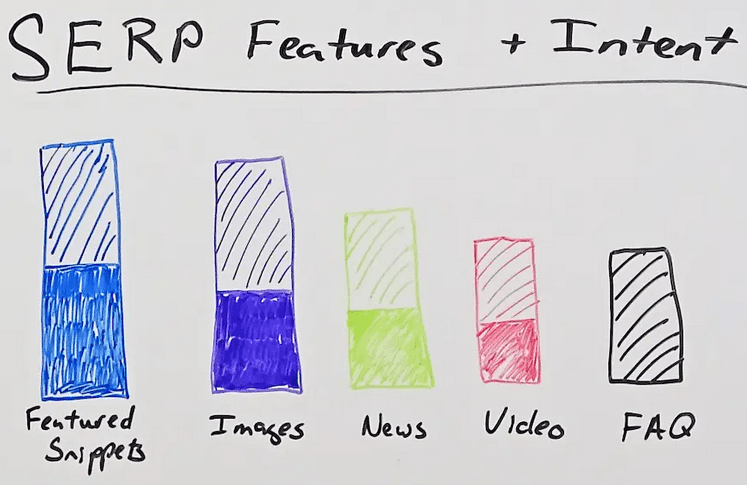
But my favorite part — and this is where the true power comes in, because it can inform your content strategy and this is where the SEO opportunities are actually at — is the analysis of SERP features and intent. Because what STAT will do is, out of the thousands of keywords that you put into it, it will analyze the entire SERP of each of those and it will collect all the SERP features that it finds and tell you exactly what you own and don’t own and where your opportunities are.
So let’s give an example that’s a little more concrete. So let’s say you track a bunch of keywords within a particular cohort and you see that most of the results have a featured snippet. STAT will show you exactly what you own and what you don’t own. Now what’s cool about this is you can click into what you don’t own and you can see the exact featured snippets that your competitors own that you can actually create some content strategy around and try and go steal those.
A different way is images or news. So let’s say that you notice that you’re selling TVs or something like that and almost all the SERPs have images and you don’t own any of them. So something like that can inform your content strategy, where you go to your team and you say, “Hey, folks, we need to create more images, or we need better structured data to get Google to show the images because this is the intent for this type of keyword, and we’re simply not owning it in this way.”
Same thing with news. If you notice a lot of news results and you’re not a news organization but you’re competing for these keywords, that can inform your content strategy and maybe you need to go after those news keywords or try something else. Video is another one. More and more SERPs have video results with video carousel and things like that. You can see exactly what you own and what you don’t own.
A lot of times you’re going to find that certain domains are beating you on those videos and that may inform, especially for the high volume keywords that you want to go after, you may want to be creating more video content for that. But it all depends on the SERP, and you’re going to find different feature sets and different combinations for every keyword cohort that you do.
So what’s important to you and what’s important to track it’s going to show up differently every time, but it’s going to show you exactly where the opportunities are. FAQs are another thing, rich snippets sort of results. You may find that your competitors are all using FAQ markup. You’re not using any. That could inform your SEO strategy, and you might start incorporating more FAQs because Google is obviously rewarding those in the SERPs and your competitors are gaining those and not you.
Other things, virtually any SERP feature that’s trackable. You can find local results. Twitter boxes. You may find that for certain queries Google is surfacing Twitter results and maybe that means you need to be on Twitter more than you actually are right now and see who’s ranking for those results instead of something that you’re doing on-site.
Maybe it’s you need to do more YouTube. It’s not all necessarily on your site. But this will tell you where you need to invest those opportunities. Review stars, podcasts, and more. All of this will tell you what’s important and where the opportunities are and where you’re winning and losing and the exact keywords that you can go after if you want to win and the exact feature sets where your competitors are getting traffic and you aren’t.
So I use STAT, I love it, every week. It’s a great tool. If you want to try it out, I encourage you to do so. That’s it for me. Thanks, everybody.
Cyrus Shepard is the founder of Zyppy SEO, an SEO consulting and software company. He writes/tweets about Google ranking signals, SEO best practices, experiments, tactics, and industry updates.
Balmain, Gucci and Louis Vuitton are experimenting with low-key marketing strategies to engage with key opinion customers. Unexpected ad platforms are also coming into favour.
Louis Vuitton and Gucci quietly hosted pop-ups in lower-profile locations of Somerset and Brooklyn respectively, in the past 10 months. While traditionally, a new launch is followed with media interviews and influencer previews, both of these pop-ups were left to be discovered by their local communities. In turn, this prompted user-generated social media responses, says Todd Sachse, founder of Sachse Construction, who built the stores for both brands. For Gucci, it was part of its continual “test and learn” approach to engage with its community. Louis Vuitton declined to comment.
Similarly, Balmain halted print campaigns in fashion magazines including Vogue this year, in favour of spending some of its marketing budget on full-look styling. Clothes are presented on a model as directed by the brand for a fee instead of being chosen by the magazine’s stylist, sources close to the company told Vogue Business. It’s not the only luxury brand to have invested in full-look styling in recent years, industry professionals say.
As consumers seek out newness and authenticity and designers look to stand out from crowded advertising channels, luxury brands are using more subtle marketing tactics to get their message across. Low-key marketing strategies that are less interruptive and, ideally, more organic are being tested. No longer should a brand’s main focus be the key opinion leaders (KOLs) or influencers, instead it should be on connecting with the key opinion customer (KOCs) – highly engaged, everyday customers of a brand – experts say. For luxury companies it marks a continual shift away from a top-down approach of selling the luxury ideal, towards so-called “stealth marketing” where consumers are made aware of a brand without realising it.
Fashion week attendees holding magazines. Some brands have pulled ads in publications and are paying for styled editorial looks instead. Edward Berthelot/Getty Images
“We’re all getting a bit jaded and tired of the hard sell. Marketing that is in our faces is just not clever, so customers end up blocking it out,” says Nicole Armstrong, executive strategy director at R/GA, the ad agency for luxury brands including Givenchy, Nike and Moncler. “[Stealth marketing] is basically a relationship-building tactic that can also be shared and talked about. You do that by creating moments.”
Stealth marketing is making more of an impact because people are overloaded with paid media, adds Armstrong. Screen fatigue is also growing: 75 per cent of respondents surveyed in January 2021 by the OAAA and The Harris Poll said they were paying less attention to online ads. R/GA’s brands are prioritising building long-term relationships with their customers to incentivise them to shop over longer periods of time, as opposed to a specific moment.
Retention vs recruitment
Unlike flashy billboards and sponsored social media posts, the primary objective of stealth marketing isn’t recruitment but retention, a challenge for brands of all sizes as customer loyalty becomes a priority. Nike has gradually shied away from big-budget print and television ads over the past decade and is instead investing in smaller neighbourhood stores and events, and value-added services that lets it engage with more localised audiences. “There is a new desire from brands to get closer to local communities, and to make it feel like an authentic connection,” Armstrong says.
True loyalty is the end goal; the feeling is emotional and leads to customers believing they’re part of an exclusive group, Armstrong says. It’s why the key opinion consumers are becoming increasingly important in luxury, she explains. Not only do they appear more trustworthy and relatable than KOLs, they require less spending from brands.
KOCs, whose potential was first recognised in China and are in their infancy in terms of awareness among Western marketers, are long overdue in fashion, Institut Français de la Mode professor Benjamin Simmenauer believes. Many fashion influencers found fame because of their glamorous lifestyle or inspirational style, rather than through any “recognisable expertise,” he argues. This is unlike other industries such as photography, gaming or cars, where key opinion leaders tend to be experts in the subject. KOCs fill this gap, he says.
Unexpected platforms
Some brands are diversifying their media buy and are experimenting with advertising on unexpected platforms such as WeTransfer. Kering, parent company to Gucci, Saint Laurent and Balenciaga, as well as Stella McCartney have recently hosted ads on the file transfer service’s site. The spike in the platform’s revenue from luxury fashion clients began in 2018, when “brands were looking for alternative platforms [to advertise] in the digital space,” says WeTransfer’s chief advertising officer Natascha Chamuleau.
Over 70 per cent of WeTransfer’s users work in the creative industries, according to the company, which means being able to offer partners a gateway into a premium creative community, explains Chamuleau. Brand safety is another perk. “We offer full screen exclusivity where you’re not advertised alongside other content that could potentially damage your reputation,” she says. An ad space for a few days on Wetransfer ranges between five and six figures, according to the company. Kering and Stella McCartney declined to comment.
Stealth marketing is simply another tactic in a brand’s toolbox to engage and grow their communities, but how much a brand wants to invest in a quieter marketing approach depends on how much control they are willing to relinquish, explains R/GA’s Armstrong: “If you’re not in the ether and being talked about, you will naturally be forgotten, so there is a need to have some form of messaging shared. But as a brand, how much do you want to own that message?”
Not looking to be trying too hard is another key benefit of stealth marketing. “When an advertisement is too obvious, it’s not credible anymore and can be harmful to a brand’s image,” says Simmenauer. This isn’t to say lifestyle influencers and product placements are over, but shifting consumer preferences mean that brands will need more subtle strategies in the mix, he says. Luxury is no longer about exclusivity, but identity and belonging, and people take pleasure in the intimacy of consuming and interacting with a like-minded community, he adds.
Some brands may struggle, because the approach only engages with specific individuals who have like-minded interests, rather than multiple segments of a brand’s customer base. The key is to find the right balance between retention and recruitment marketing.
“The biggest benefit of stealth marketing is that there is often a high level of involvement, so consumers will walk away with an innate understanding of what a brand is about and what their universe entails.” She references a Confucious proverb: “Tell me and I’ll forget, show me and I might remember, but involve me and I will understand.” In that sense, stealth marketing can be incredibly powerful, she says.
Feature Image Credit: Edward Berthelot/Getty Images