Author

editor

Browsing

By Seth Price,

Search engine optimization can help the right customers find your company. Embrace it.

Feature Image Credit: Getty Images

By Seth Price,

Managing Partner of Price Benowitz LLP and Founder & CEO of BluShark Digital

Sourced from Inc.

By

Jack Butcher spent 10 years working in advertising as a creative director for multi-billion dollar brands. And then he realized he was missing something: Freedom.

“So in search of freedom, I started my own advertising agency,” he wrote. “No fun, and even less freedom.”

After two years of working on his own agency, Butcher figured out that he needed a model that could scale infinitely. “The insight behind this transition? Productizing myself,” he said.

He pivoted to a business he called Visualize Value, which consists of a $1 million per year product business and a media platform with an audience of more than 500,000 people. (You may remember when Butcher illustrated a guest post I wrote for his website.)

Recently, Butcher participated in an hour-long, live “Ask Me Anything” with readers who are part of The Profile’s members-only Telegram chat. (To join, consider becoming a premium member here.)

Below are the highlights of his Q&A with the readers:

Q: Jack, you recently became a dad. How did you continue to consistently produce content without losing momentum even though (I assume) you had to make more time to spend with your new baby?

Butcher: I’ll start by saying my wife Celia is an incredible mum, so that definitely accounts for 90%. The other 10% I think comes down to a shift in priorities that a life event like that brings. It’s amazing what you’re actually capable of in five minutes if you literally only have five minutes. So you start to prioritize the things that have the maximum (or close to) amount of impact for time spent.

Q: To follow up, what things are maximum impact for you?

Making visuals or working on the systems in the back end of the business (email sequences, product updates, stuff that you can do once that works in perpetuity)

Q: I wanted to know if you were influenced by the Bauhaus movement or Japanese minimalism? Do you have an opinion on them?

Probably subconsciously yes. Not much of an academic so can’t credit as accurately as I’d like, but Swiss graphic design had a huge influence on me: Josef Müller-Brockman. Also product designers like German industrial designer Dieter Rams.

Q: You recently appeared on Jim O’Shaughnessy’s Infinite Loops. Which one of the question stumped you the most?

I can’t recall the exact set of questions he asked, but the hardest question to answer is always “What’s next?” I plan maybe two weeks out versus 10 years.

Q: How do you get ideas, and is there a reason you prefer to work in the short-term?

I think I just forged a preference for working under pressure in an agency environment, and the idea of “running out” of ideas is weirdly motivating. Each iteration of the business wasn’t planned in a traditional sense. It was more of an organic evolution, so I’ve stopped trying to predict those things and just lean into trusting the process and see where it ends up.

Q: Do you recall the moment that your visuals gained traction on Twitter? What was that feeling like? And how did you know that what you were working on was working?

I think it was a Nassim Taleb retweet that made me realize that this thing could work. I was new to Twitter and experiencing the power of network effects on that platform when it shifted something in my brain. I went all in after that.

Q: How did you decide to monetize your graphics after realizing there is a chance post-Naseem Taleb’s RT? How did you figure out the skill-market fit?

My background is in advertising, so I think I understood that the ability to capture attention organically is worth something. The first product took that idea and turned it into an education product “How to Visualize Value.”

Q: What advice or tips would you give to educators who are creating content to teach online when designing content to have maximum learning impact?

My personal approach is “principles first” — so understanding the building blocks of knowledge that are necessary for someone to practice something effectively, and introducing them one at a time.

Lots of online education teaches tactics first (or the memorization of something), which is much less effective than teaching someone the fundamentals and letting them figure it out for themselves.

It’s also about encouraging people to create things off the back of what they learn creates the best kind of feedback loop — “If you can’t explain it to a 5-year-old, you don’t understand it.”

Q: Have you thought about creating a book for toddlers or younger kids? Your graphics are exceptionally simple to understand, which is the best part of the creation.

I had a baby recently and did not know that the black and white high contrast images were a cognitive development thing. I’m looking into it right now. (There’s also room for something for older children too I think).

Q: Have you built a personal brand for anyone using VV methodology and if so, was it as effective as doing it for a product or business?

There have been plenty of graduates of our courses that have built solid personal brands on the same principles that VV uses:

By

Sourced from INSIDER

By Phoebe Bain

Nandini Jammi and Claire Atkin are the cofounders of Check My Ads, which helps marketers keep their advertising away from fake news and the like.

ICYMI, Marketing Brew hosted a virtual event on Wednesday with the cofounders of Check My Ads, a consultancy that helps advertisers navigate the chaos (and danger) of the ad tech world.

  • Morning Brew’s B2B Executive Editor, Josh Sternberg, chatted with cofounders Nandini Jammi and Claire Atkin about where ads lost in the ad tech pipes actually land. Often, they end up alongside misinformation, fake news, and conspiracy theories.
  • That’s where Check My Ads comes in. Jammi and Atkin’s consultancy works with marketers, providing them brand safety training to help them steer their ads away from such content.

Watch the recording of the full event here, or read on for our three favorite quotes from the thirty minute conversation.

  • “We have yet to work with a brand that hasn’t been on some kind of disinformation [site].”—Atkin, on just how common it is for ads to get funneled into the worst places on the internet without marketers knowing it.
  • “Google, Criteo, OpenX, [and] Taboola are some of the biggest funders, monetizers of hate speech and disinformation. That’s something we have seen in our own work with clients, and it’s also something that I see as a disinformation researcher.”—Jammi, on which ad tech companies she and other anti-disinformation professionals believe to be the worst offenders.
  • “You cannot automate your way to brand safety.”—Atkin, on why all marketers should, quite literally, check their ads.—PB

By Phoebe Bain

Sourced from Marketing Brew

Want better results from your Instagram ads? Wondering how to optimize your top-performing Instagram ads?

In this article, you’ll find a comprehensive process to test your Instagram ads campaigns and scale your results.

Instagram Ads Are Different From Facebook Ads

Instagram may still have great (relative to Facebook) organic reach, but if you really want to scale, you need to reach people outside of your existing audience. How do you do that? Therein lie the art and the science (mostly the science) of Instagram ads.

Instagram is a unique platform for running ads for several reasons.

The most active demographic on Instagram has changed dramatically in the last 5 years. Five years ago, 45-year-olds were barely on Instagram and the under-25 crowd dominated the platform. Now, the under-25s are on TikTok and 45-year-olds are all over Instagram.

Aside from a massive demographic shift, user behaviour can make Instagram a challenging platform to convert buyers or leads—namely, people aren’t in the habit of clicking off of the platform. Organic content on Instagram almost always keeps people on the platform.

Sure, some accounts have 10,000+ followers and a swipe-up link on Stories. Sure, people can climb a mountain, cross a fjord, and hop on a zipline to get to an account’s “link in bio.” But that link-clicking behaviour happens on a minority of content on Instagram.

Ninety-nine percent of the organic content people engage with on Instagram keeps them on the platform. Conversely, on Facebook, Twitter, LinkedIn, and Pinterest, people regularly click off of the platform to read articles, explore products, or opt into free offers.

Instagram ads require different behaviour than organic content, and whenever you have this discrepancy, you’ll have a lower click-through rate. This is the challenge of Instagram.

Click HERE to read the remainder of the article

Sourced from Social Media Examiner

By

It’s no secret that creating amazing customer experiences is a key component of all brands’ marketing strategies. If that’s not the case, then quite frankly you’re missing a trick. In 2021, where the majority of a customer’s interaction with a brand is online, customer experience (CX) becomes even more important. eMarketer’s 2021 Customer Experience report finds that 93% of US adults described themselves as very likely to make more purchases from companies across all industries that provided ‘very good’ CX. On top of this, the Global State of Customer Experience report tells us that three-quarters of consumers switch to a brand competitor after just one bad experience. In short, if you want to retain your customers and drive more sales, a positive customer experience is key.

Customer experience covers an extremely broad area, as it can be defined as every touchpoint that a customer has with your brand, from pre-purchase, to the purchase process (if they get that far) and consumption, to post-purchase interactions.

So, if you’re looking to improve your customer experience, where should you start?

Hit them in the feels

In my opinion, creating emotive experiences is one of the key considerations for driving exceptional CX. Customers respond well to brands when they feel heard and understood, or when they are surprised and delighted by the experience they have with a brand. A study conducted by Forrester and Focus Vision showed that the way customers feel during a brand experience (delight or disgust) has 1.5x more impact on the actions they take with that brand (for example, purchase) than the way they think about the brand (for example, it fitting in their with lifestyle). The study also found that increasing the average number of positive thoughts or feelings about a brand increases a customer’s likelihood to purchase in the next three months by 11%, and their likelihood to advocate for your brand by 15.4%.

Driving emotive customer experiences doesn’t necessarily come easily. I believe there are three key considerations to keep in mind to achieve this:

  1. Empathize with your customers
  2. Surprise and delight your customers
  3. Make your customers feel unique

Empathize with your customers

The best customer experiences are born from an outside-in approach: listening to your customers and responding to their needs. Collecting data from your customers (including from social media comments and product reviews) is a great place to start. However, it’s not just about listening – it’s about hearing what your customers have to say and empathizing with them. Sometimes they will tell you something you don’t like, or something unexpected; adapting your strategy based on their genuine feedback is the way to win.

Bloom & Wild demonstrated a great example of this in 2019. Despite Mother’s Day being the busiest day of the year for florists, for some Bloom & Wild customers persistent email marketing reminding them of the occasion was upsetting. Bloom & Wild heard this and were mindful of the fact that Mother’s Day can be a difficult time for a variety of reasons. In response, Bloom & Wild adapted its CX, giving customers the chance to opt out of Mother’s Day-specific marketing, while still receiving the same offers and discounts. This resulted in 18,000 opt-outs of the Mother’s Day campaign, and over 1000 responses from customers to thank Bloom & Wild for its thoughtfulness – a perfect example of pivoting your CX through empathy.

Surprise and delight customers

Many brands now offer a similar standard of customer experience, especially digitally, in response to the Covid-19 pandemic. Driving joyful, unexpected experiences for your customer is a great way of standing out among competitors. No one particularly enjoys having to interact with brands, and contacting brands directly is typically out of necessity or to complain. Using a direct contact opportunity with your customer to surprise and delight them can tap into driving up their positive thoughts or feelings. As mentioned previously, this could increase the likelihood of future purchases and brand advocacy.

Octopus Energy have done a brilliant job here. Max McShane, head of digital, recently talked at Econsultancy Live about their focus on “outrageously good customer experiences”. Its strategy includes treating customers to personalized hold music based on the year they were born in a bid to up their positive feelings about the brand while they wait. This has worked wonders, with McShane claiming: “Every week we get a comment that says, ‘can you put me back on hold, I’m listening to an absolute banger.’” Identifying even the smallest moments where your brand can increase a customer’s positive feeling can be the difference between a good CX and a great one.

Make your customers feel unique

Staying on the theme of personalization, making your customer feel unique is another way of generating emotive customer experiences. Spotify has always done this well. Ever since it started creating its ‘Daily Mixes’ for its customers, personalization has been inherent to its CX. However, it took this up a notch recently by launching its ‘Only You’ campaign. This campaign uses your listening data to highlight the artists, songs, genres and listening patterns that are both unique and important to you. With this campaign, Spotify doesn’t just make the customer feel special – although it has done the same for everyone, there is novelty in the idea that this is ‘just for you’ – the content that comes with it is also very shareable. Spotify’s retention rate is also benefited by this unique customer experience, as the creation of ‘Only You’ playlists gives customers ready-made content that would be a lot effort to replicate on a competing music streaming service.

Key takeaways

  • The importance of great customer experience is not going away, so brands must ensure CX is considered as an integral part of their marketing strategy.
  • With that in mind, creating emotive customer experiences can be extremely powerful, especially as research has shown the effect positive customer feeling has on interactions with brands.
  • Collect as much data as you can that helps you to understand your customer’s needs and desires, and pivot your CX strategy accordingly.

If you are keen to explore how improved CX can drive growth in your business, then get in touch with Capgemini Invent.

Feature Image Credit: Capgemini Invent provides tips for marketers looking to improve their customer experience

By

Senior marketing consultant at Capgemini Invent.

Sourced from The Drum

By Mark Hamstra,

Executives from S’well, Jersey Mike’s, Verizon and Toshiba share insights on the seemingly questionable strategies that yielded tangible benefits for their companies and customers.

Counterintuitive tips to grow business:

  • During tough economic times, instead of slashing your budget, invest in your brand.
  • Give products away for free to build good will with consumers and summon buzz.
  • Recognize that an engaging customer experience can sometimes be delivered better virtually than in person.

In business, sometimes what at first might not appear to be the most logical course of action can in fact yield surprising benefits.

That’s what executives from S’well, Jersey Mike’s, Verizon and Toshiba Global Commerce Solutions discovered.

At S’well, a maker of sustainable, fashionable water bottles, giving the product away for free turned into a powerful tool to generate awareness and build the business. At Jersey Mike’s, investing in promotion and store remodels during the pandemic was a winning strategy for the sandwich chain. Verizon, meanwhile, discovered that in-person meetings are no longer necessary, and Toshiba believes that being memorable by making connections creates a more lasting impression than “doing something crazy.”

Here, executives from S’well, Jersey Mike’s, Verizon and Toshiba share how the companies took what otherwise might be viewed as conventional business wisdom, and turned it on its head to drive results.

 Headshot of Sarah Kauss, founder of S'well.
Sarah Kauss, founder and executive chairwoman of S’well. — S’well

S’well: Give your products away for free

Sarah Kauss, founder and executive chairwoman

When S’well was just starting out, I quickly learned the power of getting our bottles into the hands of as many people as possible—from retailers and conference attendees to media and influencers. By creating opportunities for people to experience the beauty of our products first-hand and be delighted by their performance, we generated a groundswell of buzz that delivered meaningful partnerships and sales opportunities.

[Read here on the difference between sales and marketing.]

 Headshot of Hoyt Jones, president of Jersey Mike's.
Hoyt Jones, president of Jersey Mike’s Franchise Systems. — Jersey Mike’s

Jersey Mike’s Franchise Systems: Instead of slashing your budget in tough times, invest

Hoyt Jones, president

Many companies cut their budgets when faced with a downturn, whether it’s a recession or unexpected event like a pandemic. At Jersey Mike’s, we do the opposite. We believe companies that continue to invest in their brands during tough times come out stronger as they remain top of mind. In March 2020, the world practically shut down due to COVID-19. To provide financial relief and support for customers during this difficult time, we made a big investment in advertising to let people know about promotions for 50% and 25% off subs, as well as free delivery services. We wanted our customers to know we were open and operating safely.

Helping our communities was a top priority, and we invested heavily in TV time to invite customers in to support Feeding America. Over two weekends [in April and November 2020], we donated 20% of sales, raising more than $4.5 million for the organization, providing 45 million meals. These were some of the busiest days in Jersey Mike’s history.

Another example of this counterintuitive approach is choosing to continue our program to retrofit all 2,000 locations across the country despite fewer customers coming into the physical space of our stores. This roughly $175 million investment includes a brand-new look, along with operational improvements like adding a second make line [a team of workers that prepares virtual orders] to accommodate heavier digital orders.

As states begin to reopen, our sales continue to grow, thanks to the awareness generated throughout the past year. As customers return to our restaurants, we hear how they love our new look.

We believe companies that continue to invest in their brands during tough times come out stronger as they remain top of mind.

Hoyt Jones, president, Jersey Mike’s

 Headshot of Wendy Taccetta, SVP at Verizon.
Wendy Taccetta, senior vice president for nationwide small business and channel chief, Verizon. — Verizon

Verizon: In-person isn’t necessarily personal — sometimes ‘we know each other better by engaging virtually’

Wendy Taccetta, senior vice president for nationwide small business and channel chief

What was counterintuitive three years ago is now table stakes. We always think that great customer experience has to be personal. And that’s true. But personal doesn’t always mean in person. In a lot of ways, we know each other better by engaging virtually.

The most common thing we hear from business owners is that they have to be available when the customer needs them. That used to mean sitting in the office so they could find you. Now it means having an application like One Talk [which Verizon developed so that companies] can find who is available to take the next customer call no matter where they are physically. [It’s part of] the Complete Business Bundle we created in January to specifically address the needs and challenges of small businesses.

[Also], having a simple video call is not enough anymore. Now, we need the ability to chat, share documents and collaborate with virtual whiteboards. We’re helping businesses explore the ways they can create a signature experience in person or virtually because they will both be part of our future.

 Headshot of Fredrik Carlegren, VP of marketing, Toshiba.
Fredrik Carlegren, vice president of marketing, Toshiba Global Commerce Solutions. — Toshiba

Toshiba Global Commerce Solutions: Take the ‘four Ps of marketing’ with a grain of salt

Fredrik Carlegren, vice president of marketing

Still to this day I hear references to the ‘four Ps of marketing,’ to which someone inevitably adds their own unique twist like, ‘Don’t forget that fifth P.’ Sure, there is relevance in the understanding of how product, place, price and promotion fit into the narrative of your business. But this all misses the point. Or perhaps stated differently, it ignores the more fundamental understanding that we are dealing with people, human beings. People that buy, that influence, that use. People who want to look good for their boss, have their own fears and aspirations and more. People who are skeptical, and others that are trusting.

[One takeaway is to] be memorable — but genuinely so.

‘Being memorable is easy—let’s do something really crazy,’ said someone, but not likely a serious marketer. They key is being genuine in this journey with you and your business fully and inextricably connected to your core mission and value, and by creating a deep connection between your brand and [your clients] and in how you strive to always put them first. You’ll be faced with numerous challenges large and small, expected and unexpected. Listen intently to the voice of your customer at every turn, then create the genuinely memorable experiences that will keep them coming back.

By Mark Hamstra

Sourced from CO

CO— aims to bring you inspiration from leading respected experts. However, before making any business decision, you should consult a professional who can advise you based on your individual situation.

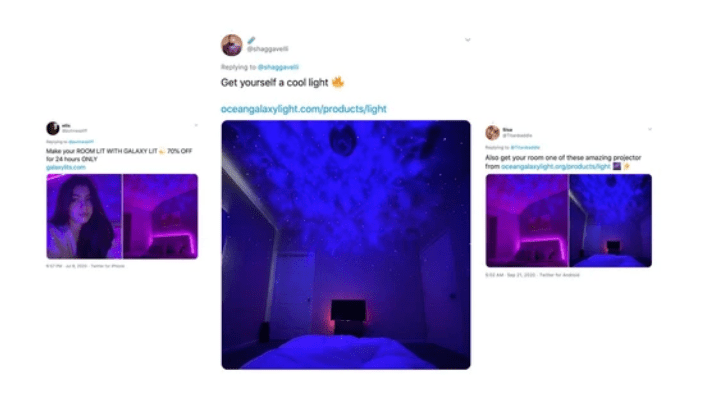
“Get yourself an Ocean Galaxy Light” is the equivalent of tweeting “wow, this blew up, check out my Soundcloud”. But does it work?

Brands often ask the people marketing their content to make it “go viral”.

This, unsurprisingly, is no easy task – there’s a reason you don’t regularly see “Persil Non-Bio” trending on Twitter. However, brands have cottoned on to a new strategy that basically involves riding the coattails of something that’s already gone viral. That strategy is called “piggybacking”.

When a tweet goes viral, you’ll often see the original user tweets again, plugging whatever they want to plug (“wow this blew up! Check out my Soundcloud”). Now, though, you may see an advert for the kind of tat usually sold in a high street gadget shop, like star light projectors and slime.

Companies are approaching ordinary people on Twitter who just happen to have gone viral, and offering them cash or commission in exchange for the opportunity to piggyback their temporary Twitter fame. It always seems to be the same few companies, but what they offer to users in exchange for advertising space varies.

The legality of this practice is questionable, with online advertising regulations varying wildly across the world, but none of these tweets are marked as an advertisement. So are these viral tweeters actually getting paid? And if so, how much?

A huge star light projector, called Ocean Galaxy Light, is one of the products most frequently advertised using this method; @shaggavelli was offered £15 through Paypal to post two pre-written tweets about it. Vir Guards, which makes face masks, also offered £15. Standardized, an anime merchandise site, offered him a code through which he’d get a small commission. However, a month after his viral tweet, he’s yet to make any money from the link. “I’ve heard they sometimes give the person £5 first, then give commission, but personally I didn’t receive that treatment,” he said.

Some tweeters are offered promo work off the back of one viral tweet. Others do it more regularly. @engxl had already worked with brands when one messaged him about piggybacking off his tweet about an extremely magical old lady. Unlike others on Twitter, he was able to negotiate for more money and time limits.

Slime Clean is a gooey substance that you roll over a dusty keyboard or grimy car interior to pick up dirt. @enyxl was offered $20 (£15.50) to tweet about the product and leave the tweet up for 24 hours, but because he’d done promos with the Slime Clean representative before, “I asked him for $25 [£19.30], since I knew the tweet was gaining a lot of traction.” Slime Clean agreed and paid him through Paypal.

“If he wants it to be there for another 24 hours, it would be another $25,” @enyxl explained. “Galaxy Light approached me from their official Twitter account and asked what my price was to promote. Since I had already done one for $25, I asked for $30 [£23.15], and they paid me through Cash App. They never mentioned anything about recurring days, so I have an alarm set for when to delete the tweets unless I get compensated again.”

Pay-outs differ between users, with some getting more than others. @putinaspliff was also offered advertisements for Vir Guards and Ocean Galaxy Light for his viral tweet. But despite having around the same metrics as @shaggavelli when the ads went live, with roughly the same number of likes and retweets, he was offered substantially less by one of the brands. Why this was is hard to say, but it could simply be the brand testing just how little they can get away with paying.

Most users make a little money after firing off viral tweets – but those tweets aren’t specifically designed to appeal to advertisers. This is where the micro-influencer makes their entrance.

Unlike others I spoke to, @titanbaddie – real name, Sisa – is a pro. He regularly works with brands and has standards in place for the minimum he’ll accept. “My standard is $30 a tweet, but I’m adaptable depending on how big the brand is, and the expectations,” he says. “For example, I have brands that will pay me weekly fees to interact with their accounts, and those are normally brands that are trying to build online traction. Normally, when it’s a product, you’re paid per post, and normally when you [make] viral content they’ll reach out to you.”

Sisa explained that there’s a growing influencer culture in South Africa, where he’s getting work. At the moment it’s a new industry, and relatively unregulated, meaning influencers can make decent money if they work for it.

“I only recently started accepting promo offers from SA, because I just joined a promo team, but on some campaigns I’ve done before it can be anything from R250 (£11) a week to R2,000 (£95) for three posts, depending on how big the brand is and how long you work for them. I’ve been very lucky, in that I work with more international businesses and forums, so on an average week now I make about $200 (£154) from viral attachment tweets and paid posts.”

While there are clearly ways to make money from viral tweets, for the average joe who just happens to have blown up, it’s not going to be a big earner. As for the products themselves, I can’t find anyone who has actually tried them. Aside from one tweet from a parent whose kids enjoyed the Galaxy Lights, no one seems to be buying them. As for Slime Clean, the majority of tweets about it seem to be asking one question: how on earth are you supposed to clean the slime?

By Bethany Fulton

@bkafulton

Sourced from VICE

Sourced from Mashable,

You can waste time reading hundreds of articles on SEO (which changes constantly, BTW), spend thousands of dollars learning the basics at school, or you can get access to a toolkit that breaks it all down for you.

With the GuinRank SEO content optimization tool, you can create content that Google automatically wants to rank. By running it through this AI tool, everything you publish will already be SEO-friendly. After all, since Google relies on artificial intelligence to rank and score web pages, it only makes sense to use AI to beat it at its own game.

GuinRank works by helping SEO beginners analyse their competitors’ keyword content and then providing ideas to write articles that easily result in the same search results. It features a keyword analyser (KA) that helps you understand exactly how hard it would be to rank for a search query based on the words you currently have. Then, you can adjust accordingly. It also features a content optimizer (CO), which increases your content’s relevance by simply recommending keywords to include within the sentences you already have. It will show you the top 20 Google results that pair with the subject of your content, so you can ensure your page ranks and shows up on search results.

See it in action:

GuinRank doesn’t just help show you which keywords to include in your content. It will even show you micro-niches on the internet that have little-to-no competition, so you can carve out a unique space on the web to get your content noticed and seen. You can even run your page through the page analyser tool, which will give you a Google score automatically, and show you what you can improve on.

A two-year subscription to this helpful tool is valued at $680. But, for a limited time, you can sign up for only $59.99.

Feature Image Credit: Good SEO strategy can bring you more online engagement. Credit: Caio / Pexels

Sourced from Mashable

Sourced from LADDERS

Your boss will open any email you send them. Your boss’s boss’s boss might not.

That’s a problem you want to fix. Your career could depend on it.

This may not be the reality at small companies, where a VP reads every internal email that comes her way. But at a giant corporation like Google, where I work, it’s simply the reality. Imagine unplugging for a week away with your kids, and then coming back to a mountain of laundry and 462 unread emails. That’s what a corporate VP is dealing with every afternoon.

Compounding this problem is that people on the corporate ladder are constantly seeking recognition for their work, because that’s the pathway upwards. You want that attention because you’re working on cool stuff! You inspired Engineering to fix the product and reduce customer care contacts by 12%, and that project might nudge you up to the next performance rating bucket at your annual review.

To get noticed, you must win a competition for attention. You must woo your corporate executive to open your email. You have but one chance to grab your reader’s attention, and that chance is your subject line.

Here are three things you can do to nail it.

1. Start with a call to action

When you email your boss’s boss’s boss, think of it as a marketing email. You are the product being marketed. And if you’re at all versed in email marketing 101, you know the first lesson in getting someone’s attention: You need a strong call to action.

A call to action asks the reader to do something — share, sign up, give feedback, or anything else. But so many subject lines lack them.

I’m high enough in the corporate ladder that I am someone’s boss’s boss’s boss, and as I look at the first 100 emails in my inbox now, I see that only two have a call to action. The remaining 98 are less action-oriented, like, “Thursday’s leadership meeting” or “Dashboard use cases.” That doesn’t urge me to do anything.

Use a call to action to inspire your reader to read on. “Thursday’s leadership meeting” could become, “Please add agenda items to Thursday’s leadership meeting,” and “Dashboard use cases” might be more interesting as “Please give feedback on dashboard use cases.”

Of course, the act wears thin if every email has a call to action; there are times when it is simply not needed. Use it when you really want your audience to respond or do something.

Sourced from LADDERS

This article originally appeared in Entrepreneur.

Sourced from Forbes,

Facebook and Instagram have been incredibly effective marketing channels for quite some time. Now, brands can also leverage the Stories feature on both platforms to create deeper connections with users. Stories often offer more interactive options than regular social posts, and companies can use this to their advantage by creating unique content that captures the attention of consumers as they scroll through their feed.

As with any social media marketing, coming up with a solid strategy is the key to seeing the strongest returns on investments in this particular area. When it comes to utilizing the Stories feature on either platform, brands have a wide spectrum of effective approaches to choose from. Here, 10 members of Forbes Agency Council explore some of the most innovative ways companies can leverage the content they share via Stories to better connect with consumers.

1. Maintain The ‘Human Touch’ To Make Stories More Approachable

The key to making the most of Stories is maintaining the “human touch.” With so many interactive features, such as polls, questions, custom stickers, etc., Stories can be more approachable and fun than an average post. You can also get away with toning down your brand voice and introducing a more laid-back vibe, while still delivering eye-catching and informational content. – Russ Williams, Archer Malmo

2. Use The Shopping Feature And Post Time-Sensitive Promotions

Instagram now allows brands to use a shopping feature on their Stories. It will let the audience see the product details and price, and if they press it, it will take them to the page on the website where they can purchase the product. Stories disappear after 24 hours, so brands can post time-sensitive content, such as promotions that their audience can’t miss. – Jonas Muthoni, Deviate Agency

3. Create Stories That Enhance Your Online Customer Relationships

If you think of Stories as an extension of the relationship you have with your customers on Facebook and Instagram, note the things that attract the most engagement on your pages. Use this information to create Stories that serve as “teaser” content to increase the fun factor or to show one aspect of your brand in a playful way. Or, cross-pollinate Clubhouse activity with your Instagram stories. Authenticity is key. – Megan Devine, d.trio marketing group

4. Use Paid Advertising To Extend The Reach Of Your Stories

One great way for a brand to leverage Facebook and Instagram Stories is to create and post vertical-friendly content as their Stories, then promote those Stories to larger audiences using paid advertising. In doing so, the brand’s Stories are not only available for longer than 24 hours, but can also then be shown to new, relevant demographics. – Jonathan Durante, Expandify Marketing Inc

5. Use Interactive Features To Gain Audience Insights

Stories are an effective way for brands to connect with their audiences in real time. Instagram and Facebook Stories have features that allow brands to gain insights directly from their followers. Try using tools such as polls, question stickers and quizzes to gain an understanding of your audience and immediate feedback on their preferences and insights. – Jason Wulfsohn, AUDIENCEX

6. Expand On Other Social Posts To Extend The Life Of Creatives

A Facebook or Instagram story can be used to expand on other social posts from the brand to extend the life of a single creative. If the original post is about an article, a story can highlight multiple text excerpts from the article with imagery to add more description. A story can also show a sequence that led up to the final image of the highlighted post and provide context and background. – Jessica Hawthorne-Castro, Hawthorne LLC

7. Let Influencers Collaborate On Or Take Over Your Stories

Stories are like a conveyor belt of content. What starts out as innocent scrolling through a friend’s content quickly turns into a steady flow of Instagram Stories and advertisements that can be viewed with just a swipe up. Influencer collaboration and takeovers are a great way to use Stories, along with polls and questions that encourage interaction. – Joe Gagliese, VIRAL NATION

8. Tell Unique Stories Through Carousel Ads

Using carousel ads in the Stories format on Facebook or Instagram is a great way to tell a unique story through three back-to-back images or videos. Businesses can use these to share three parts of a story or follow an “attention, benefit, action” format to increase performance. Story ads work amazingly because they appear in vertical format and take up the entire mobile phone screen, ensuring that the ad is seen. – Brian Meert, AdvertiseMint

9. Chop A Larger Piece Of Content Into Smaller Pieces

Take a larger piece of content and chop it into smaller pieces. For example, a recorded Facebook or Instagram Live stream could be chopped down into a Reel on Instagram, Stories on both platforms and even a regular News Feed post. As far as specific content for Stories, posting inspirational quotes, customer testimonials, quizzes, polls and other peoples’ relevant content can all work to create a solid narrative. – Christopher Tompkins, The Go! Agency

10. Give Viewers A Behind-The-Scenes Look At Your Culture

Facebook and Instagram Stories offer a great way to show a behind-the-scenes look into what’s happening at the company. This will give viewers a look into your company culture and give them a sense of belonging and transparency. You can take it one step further and start your own company show on Stories with live streams. – Stefan Katanic, Veza Digital


Sourced from Forbes