The idea of making money completely independent of any employer is a dream for many. But what skills do you really need to start living with that kind of freedom?
When you’re working for a company, you’re often a single part of a larger machine. You only have to focus on being the best gear or crankshaft that you can be to keep collecting that paycheck.
For many, this is a perfectly fine way of surviving. They occupy their desk, they collect their cash, and they “live” during the hours they can be home.
What does it take to live free?
There are some, though, who want more freedom. They aren’t satisfied being a piece of a machine. They want the flexibility and sense of pride that comes from steering their own life from the ground up.
When you’re running your own operation, you are the machine. That means all of your individual parts (skill sets) have to be up to snuff if you want to be profitable. So what skills do you need to be a business online?
Core skills for the entrepreneur:
Marketing
SEO
Copywriting
Business management
Data management and visualization
That list isn’t so daunting, is it?
Unfortunately, it’s just the tip of the iceberg. Each of these bullet points represents a body of knowledge that entire degrees are dedicated to.
Do you really need 5 degrees to be a successful online business?
No! Thankfully not!
In the past, when information was less available, higher education or apprenticeship were the only ways to access this knowledge. Nowadays, you don’t have to waste your time with humanities classes you’re not interested in or fill out a tedious list of requirements all while accruing a debilitating amount of debt.
All the specific skills you need are readily available through online courses.
With online courses, you strategically invest in yourself. Individually they can be pretty pricey, but if you hunt around, you can find relevant bundles that fit all of your needs.
Bought individually, these courses would run you over $1,800. However, for the next few days you can snag lifetime access to all these resources for $39.
Sound too good to be true? It’s not! Course creators often bundle new courses with previously successful ones to boost enrollment in the new course. Their marketing ploy is your opportunity get the gold without breaking the bank.
If you’re interested in freeing yourself from the grind and striking out on your own, consider investing $39 in yourself. Get the full breakdown by clicking the button below!
Its forecasting panel was revamped, and Boolean logic can now be used in queries
LinkedIn added several tools to help marketers on its platform bolster the effectiveness of their targeting.
Director of product management Abhishek Shirvastava said in a blog post detailing the new tools, “You’ve shared that one of your biggest priorities is to reach more of the right audiences at scale. We’ve recently invested a lot in bringing that to life with the introduction of new tools to expand your reach, including lookalike audiences, interest targeting with Bing search insights and audience templates. Today, we’re taking that up a notch by bringing more sophisticated audience targeting and campaign reporting features to Campaign Manager. These tools are designed to help marketers who are looking for more powerful reach and insights for their LinkedIn campaigns.”
The professional network said it improved the campaign forecasting panel in Campaign Manager, enabling marketers to see the makeup of their target audience directly via the dashboard.
The panel can now be customized to bring up specific professional characteristics, such as top industries, years of experience or company sizes.
Shirvastava wrote, “When combined with contacts you’ve uploaded to matched audiences, you can be sure that you’re not only serving ads to the specific prospects you’re trying to reach, but that you’ll have the demographic insights to deliver the content and creative mix that will resonate with them.”
LinkedIn also added targeting using Boolean logic, or using “and/or” in queries, at the top of the list, so that marketers can combine profile facets including job function, seniority and titles in a single campaign.
Shirvastava explained, “For example, let’s say you wanted to target people using director seniority and the finance job function. Previously, within a campaign, you could only do so by targeting directors in finance roles. Now, with Boolean targeting, you can use a single campaign to reach people who are directors at any job function, as well as people in finance roles of any seniority. This gives you greater flexibility to determine the kinds of professionals who see your ads.”
A how-to video on Boolean targeting is available here.
Finally, LinkedIn is adding the ability to track measurement insights at the audience level, including leads, Sponsored InMail openings and video ad views.
Shirvastava wrote, “With this data, you can demonstrate to your leadership or partners in the sales org exactly what kinds of professionals are becoming quality leads for your business, or what kinds of audiences are spending time with your video content or reading your Sponsored InMails.”
The updates to audience forecasting and addition of Boolean targeting are available worldwide starting Tuesday, while the new demographic reporting features will be rolled out over the next two weeks.
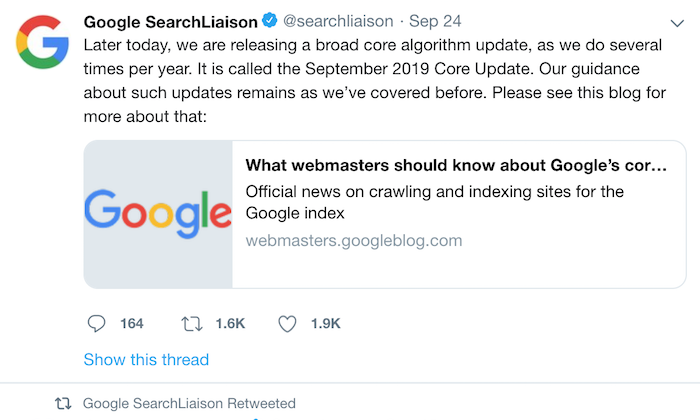
Google released a major update. They typically don’t announce their updates, but you know when they do, it is going to be big.
And that’s what happened with the most recent update that they announced.
A lot of people saw their traffic drop. And of course, at the same time, people saw their traffic increase because when one site goes down in rankings another site moves up to take its spot.
Can you guess what happened to my traffic?
Well, based on the title of the post you are probably going to guess that it went up.
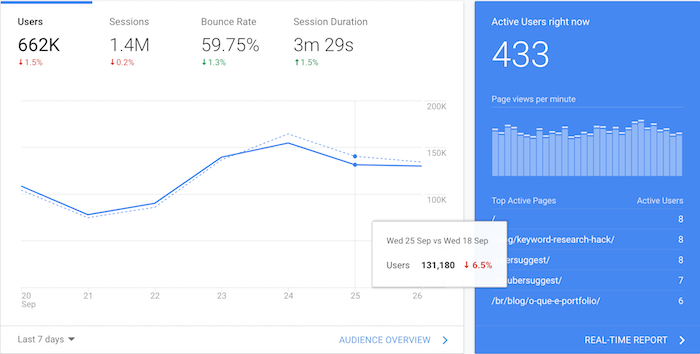
Now, let’s see what happened to my search traffic.
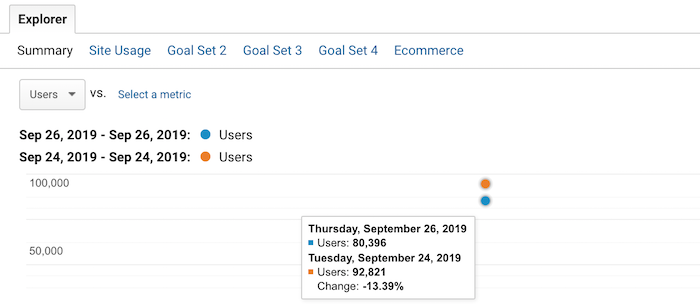
My overall traffic has already dipped by roughly 6%. When you look at my organic traffic, you can see that it has dropped by 13.39%.
I know what you are thinking… how did you beat Google’s core update when your traffic went down?
What if I told you that I saw this coming and I came up with a solution and contingency strategy in case my organic search traffic would ever drop?
But before I go into that, let me first break down how it all started and then I will get into how I beat Google’s core update.
A new trend
I’ve been doing SEO for a long time… roughly 18 years now.
When I first started, Google algorithm updates still sucked but they were much more simple. For example, you could get hit hard if you built spammy links or if your content was super thin and provided no value.
Over the years, their algorithm has gotten much more complex. Nowadays, it isn’t about if you are breaking the rules or not. Today, it is about optimizing for user experience and doing what’s best for your visitors.
But that in and of itself is never very clear. How do you know that what you are doing is better for a visitor than your competition?
Honestly, you can never be 100% sure. The only one who actually knows is Google. And it is based on whoever it is they decide to work on coding or adjusting their algorithm.
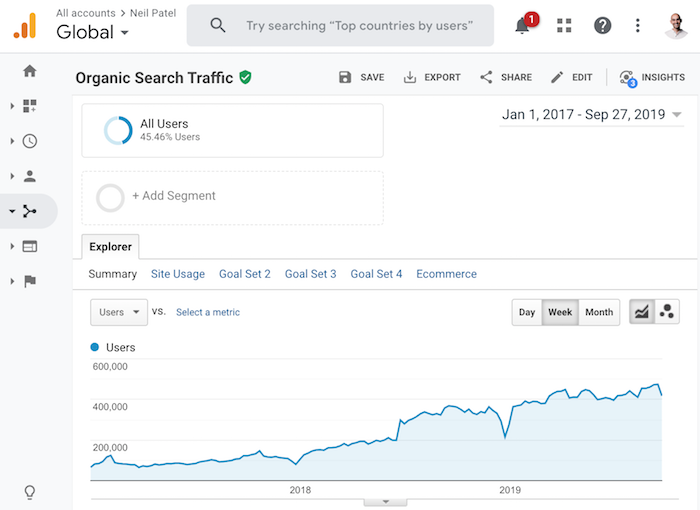
Years ago, I started to notice a new trend with my search traffic.
Look at the graph above, do you see the trend?
And no, my traffic doesn’t just climb up and to the right. There are a lot of dips in there. But, of course, my rankings eventually started to continually climb because I figured out how to adapt to algorithm updates.
On a side note, if you aren’t sure how to adapt to the latest algorithm update, read this. It will teach you how to recover your traffic… assuming you saw a dip. Or if you need extra help, check out my ad agency.
In many cases after an algorithm update, Google continues to fine-tune and tweak the algorithm. And if you saw a dip when you shouldn’t have, you’ll eventually start recovering.
But even then, there was one big issue. Compared to all of the previous years, I started to feel like I didn’t have control as an SEO anymore back in 2017. I could no longer guarantee my success, even if I did everything correctly.
Now, I am not trying to blame Google… they didn’t do anything wrong. Overall, their algorithm is great and relevant. If it wasn’t, I wouldn’t be using them.
And just like you and me, Google isn’t perfect. They continually adjust and aim to improve. That’s why they do over 3,200 algorithm updates in a year.
But still, even though I love Google, I didn’t like the feeling of being helpless. Because I knew if my traffic took a drastic dip, I would lose a ton of money.
I need that traffic, not only to drive new revenue but, more importantly, to pay my team members. The concept of not being able to pay my team on any given month is scary, especially when your business is bootstrapped.
So what did I do?
I took matters into my own hands
Although I love SEO, and I think I’m pretty decent at it based on my traffic and my track record, I knew I had to come up with another solution that could provide me with sustainable traffic that could still generate leads for my business.
In addition to that, I wanted to find something that wasn’t “paid,” as I was bootstrapping. Just like how SEO was starting to have more ups and downs compared to what I’ve seen in my 18-year career, I knew the cost at paid ads would continually rise.
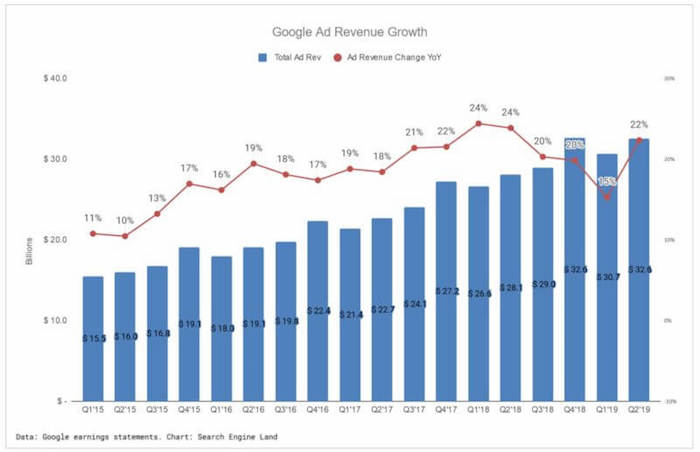
Just look at Google’s ad revenue. They have some ups and downs every quarter but the overall trend is up and to the right.
In other words, advertising will continually get more expensive over time.
I didn’t want to rely on a channel that would cost me more next year and the year after because it could get so expensive that I may not be able to profitably leverage it in the future.
So, what did I do?
I went on a hunt to figure out a way to get direct, referral, and organic traffic that didn’t rely on any algorithm updates. (I will explain what I mean by organic traffic in a bit.)
I went on my mission
With the help of my buddy, Andrew Dumont, I went searching for websites that continually received good traffic even after algorithm updates.
Here were the criteria that we were looking for:
Sites that weren’t reliant on Google traffic
Sites that didn’t need to continually produce more content to get more traffic
Sites that weren’t popular due to social media traffic (we both saw social traffic dying)
Sites that didn’t leverage paid ads in the past or present
Sites that didn’t leverage marketing
In essence, we were looking for sites that were popular because people naturally liked them. Our intentions at first weren’t to necessarily buy any of these sites. Instead, we were trying to figure out how to naturally become popular so we could replicate it.
Do you know what we figured out?
I’ll give you a hint.
Think of it this way: Google doesn’t get the majority of their traffic from SEO. And Facebook doesn’t get their traffic because they rank everywhere on Google or that people share Facebook.com on the social web.
Do you know how they are naturally popular?
It comes down to building a good product.
That was my aha! moment. Why continually crank out thousands of pieces of content, which isn’t scalable and is a pain as you eventually have to update your old content, when I could just build a product?
That’s when Andrew and I stumbled upon Ubersuggest.
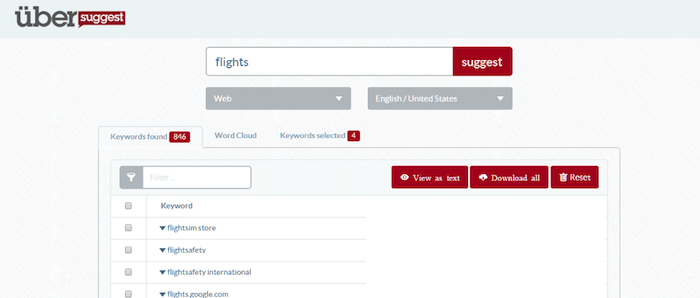
It used to be a simple tool that just showed you Google Suggest results based on any query.
Before I took it over, it was generating 117,425 unique visitors per month and had 38,700 backlinks from 8,490 referring domains.
All of this was natural. The original founder didn’t do any marketing. He just built a product and it naturally spread.
The tool did, however, have roughly 43% of its traffic coming from organic search. Now, can you guess what keyword it was?
The term was “Ubersuggest”.
In other words, its organic traffic mainly came from its own brand, which isn’t really reliant on SEO or affected by Google algorithm updates. That’s also what I meant when I talked about organic traffic that wasn’t reliant on Google.
Now since then I’ve gone a bit crazy with Ubersuggest and released loads of new features… from daily rank tracking to a domain analysis and site audit report to a content ideas report and backlinks report.
In other words, I’ve been making it a robust SEO tool that has everything you need and is easy to use.
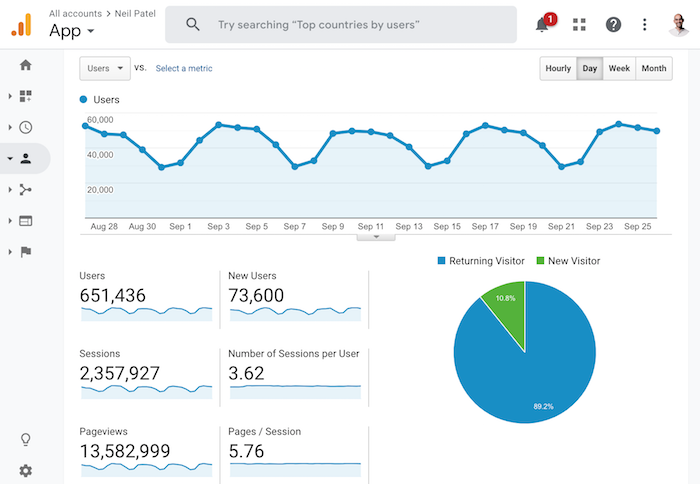
It’s been so effective that the traffic on Ubersuggest went from 117,425 unique visitors to a whopping 651,436 unique visitors that generates 2,357,927 visits and 13,582,999 pageviews per month.
Best of all, the users are sticky, meaning the average Ubersuggest user spends over 26 minutes on the application each month. This means that they are engaged and will likely to convert into customers.
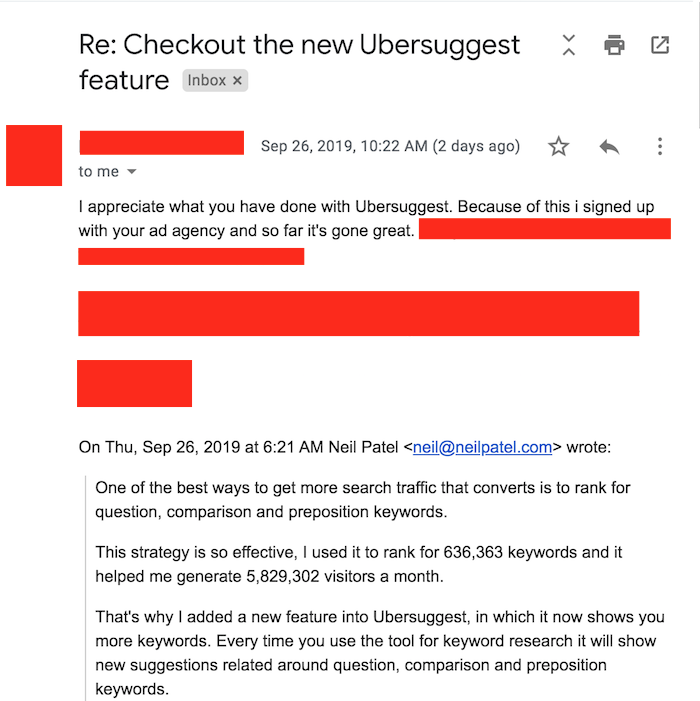
As I get more aggressive with my Ubersuggest funnel and start collecting leads from it, I expect to receive many more emails like that.
And over the years, I expect the traffic to continually grow.
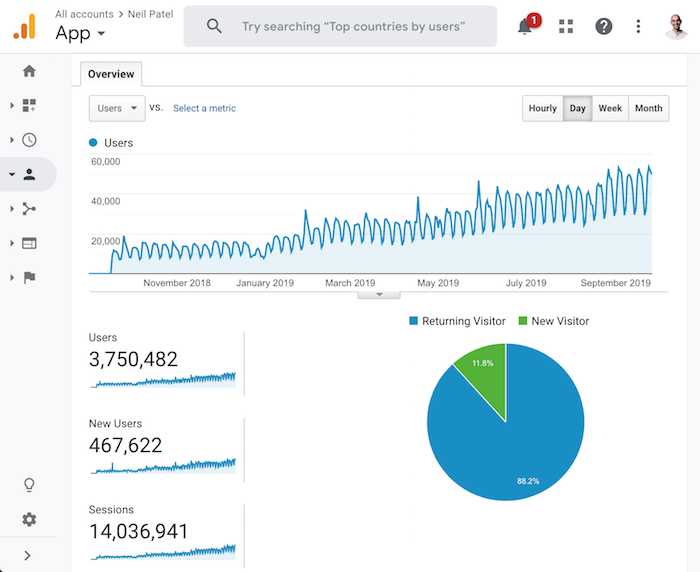
Best of all, do you know what happens to the traffic on Ubersuggest when my site gets hit by a Google algorithm update or when my content stops going viral on Facebook?
It continually goes up and to the right.
Now, unless you dump a ton of money and time into replicating what I am doing with Ubersuggest, but for your industry, you won’t generate the results I am generating.
As my mom says, I’m kind of crazy…
But that doesn’t mean you can’t do well on a budget.
Back in 2013, I did a test where I released a tool on my old blog Quick Sprout. It was an SEO tool that wasn’t too great and honestly, I probably spent too much money on it.
Here were the stats for the first 4 days of releasing the tool:
Day #1: 8,462 people ran 10,766 URLs
Day #2: 5,685 people ran 7,241 URLs
Day #3: 1,758 people ran 2,264 URLs
Day #4: 1,842 people ran 2,291 URLs
Even after the launch traffic died down, still 1,000+ people per day used the tool. And, over time, it actually went up to over 2,000.
It was at that point in my career, I realized that people love tools.
I know what you are thinking though… how do you do this on a budget, right?
How to build tools without hiring developers or spending lots of money
What’s silly is, and I wish I knew this before I built my first tool on Quick Sprout back in the day, there are tools that already exist for every industry.
You don’t have to create something new or hire some expensive developers. You can just use an existing tool on the market.
And if you want to go crazy like me, you can start adding multiple tools to your site… just like how I have an A/B testing calculator.
So how do you add tools without breaking the bank?
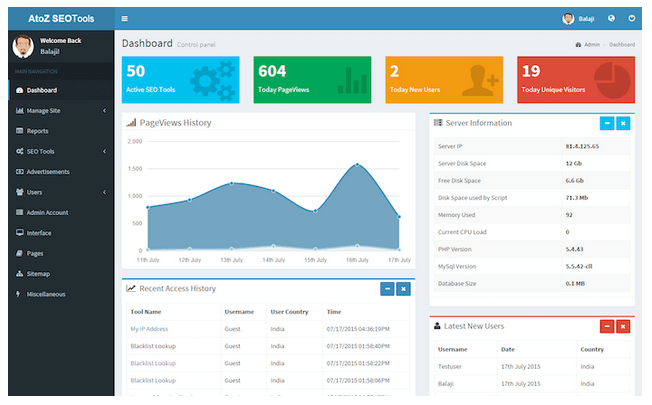
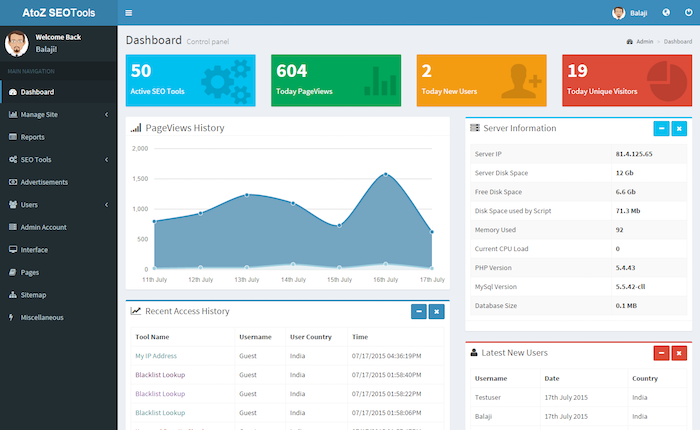
You buy them from sites like Code Canyon. From $2 to $50, you can find tools on just about anything. For example, if I wanted an SEO tool, Code Canyon has a ton to choose from. Just look at this one.
Not a bad looking tool that you can have on your website for just $40. You don’t have to pay monthly fees and you don’t need a developer… it’s easy to install and it doesn’t cost much in the grand scheme of things.
And here is the crazy thing: The $40 SEO tool has more features than the Quick Sprout one I built, has a better overall design, and it is .1% the cost.
Only if I knew that before I built it years ago. :/
Look, there are tools out there for every industry. From mortgage calculators to calorie counters to a parking spot finder and even video games that you can add to your site and make your own.
In other words, you don’t have to build something from scratch. There are tools for every industry that already exists and you can buy them for pennies on the dollar.
Conclusion
I love SEO and always will. Heck, even though many SEOs hate how Google does algorithm updates, that doesn’t bother me either… I love Google and they have built a great product.
But if you want to continually do well, you can’t rely on one marketing channel. You need to take an omnichannel approach and leverage as many as possible.
That way, when one goes down, you are still generating traffic.
Now if you want to do really well, think about most of the large companies out there. You don’t build a billion-dollar business from SEO, paid ads, or any other form of marketing. You first need to build an amazing product or service.
So, consider adding tools to your site, the data shows it is more effective than content marketing and it is more scalable.
Sure you probably won’t achieve the results I achieved with Ubersuggest, but you can achieve the results I had with Quick Sprout. And you can achieve better results than what you are currently getting from content marketing.
He is the co-founder of Neil Patel Digital. The Wall Street Journal calls him a top influencer on the web, Forbes says he is one of the top 10 marketers, and Entrepreneur Magazine says he created one of the 100 most brilliant companies. Neil is a New York Times bestselling author and was recognized as a top 100 entrepreneur under the age of 30 by President Obama and a top 100 entrepreneur under the age of 35 by the United Nations.
Social media has become a hub of influence on many consumers’ shopping. Boomers, though, have been wary of this, whether via ads, postings by fellow consumers or the cajolery of “influencers.”
According to February 2019 polling by Oracle, social media ads inspire little credence from boomers. Fewer than one in 10 internet users ages 55 to 75 said they trust social ads for recommendations when shopping.
“It’s not just an aversion to straight-out advertising. Influencers are conspicuously uninfluential, too,” said Mark Dolliver, principal analyst at eMarketer and author of our latest report, “US Boomers 2019: ‘Aging in Place’ in Multiple Aspects of Life.”
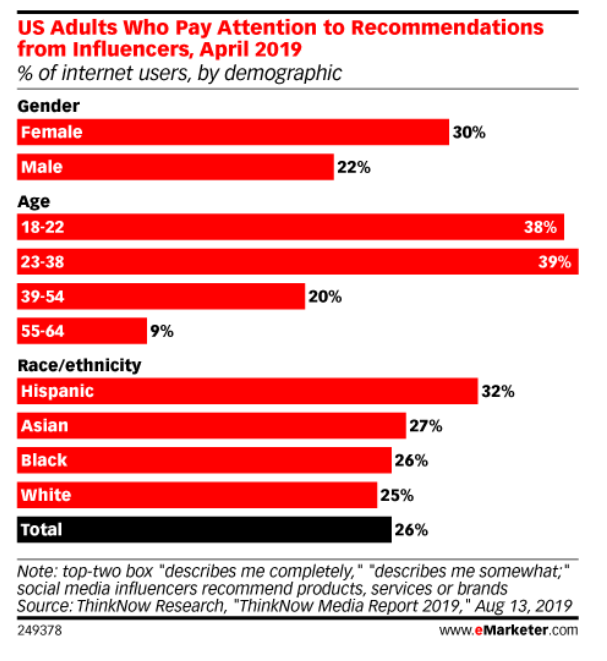
In Oracle’s polling, 96% of boomers (along with 90% of Xers and 79% of millennials) agreed that they “distrust influencers and bloggers.” Meanwhile, ThinkNow Research’s April 2019 survey found a mere 9% of 55- to 64-year-olds (vs. about four in 10 millennials) saying they heed what social media influencers recommend.
Boomers are also less likely than younger consumers to report being influenced by other peoples’ opinions online. In Oracle’s survey, 14% of boomers—vs. 22% of Xers and 28% of millennials—said they trust the recommendations of “fellow consumers online.” Similarly, a Charles Schwab survey in February 2019 found boomers about one-third as likely as millennials (16% vs. 49%) to say they are “likely to spend on experiences because of something they saw on social media.”
According to Joe Beier, executive vice president of GfK, there’s an important distinction between boomer attitudes toward “expert reviews”—those given by authoritative sources with credentials in a subject area—and reviews by everyday users. Boomers are less likely than younger people to find value in the latter. “What does Bill next door know that’s really going to enlighten me?” as Beier put it. But they do pay attention to the expert reviews. “Boomers have much more of an old-school view, ‘Ok, the experts are the ones that know what’s going on. And therefore they’re the ones I’m going to trust and look to help inform my decision.’ … If it’s just more of an anonymous pool of user reviews, there’s a certain skepticism about that,” he said.
While marketers view social media as a venue where they can bond with consumers, many boomers regard it as a place where companies invade their privacy. In March-April 2019 polling by CivicScience for the Internet Innovation Alliance, 79% of respondents 55 and older disagreed (62% “strongly”) with the statement, “I’m OK with online tech/social media companies that collect and use my personal data because it makes my online searches, advertisements and content more relevant to me.”
Few boomers are eager about social commerce. In the eMarketer/Bizrate Insights polling, about half of 55- to 65-year-olds said either that they haven’t made purchases via social and are uninterested in doing so (49%) or don’t know what that is (3%). Just 7% reported using it regularly.
If you are reading this it is highly likely that a portion of your emails are landing in SPAM.
You must be pondering – “why are my emails going to spam?“, “What did I do wrong in the last few weeks that caused my emails to land in SPAM?”, “Am I being too aggressive with my email marketing campaigns?” Or “Is it the new Email Marketing Provider which we moved to recently?”, “how to make emails not go to spam?“, “why do some emails go to spam?“.
Before I get deep into the topic, here is a quick preview of what we will be covering in this guide:
So, back to the question: “why are my emails going to spam?”
The tragedy is:
You don’t have to be a spammer for your emails to land in SPAM.
It is very likely that you were part of the collateral damage in a war being waged against email SPAM.
With this guide we will teach you exactly how to prevent your email from going to SPAM.
For some reason (probably unintentional) your emails mimicked the behavior of a Spammer and they were sent straight to the email graveyard (read: spam folder).
Your emails will get shot down your if your email behaviour is similar to spammers
The goal of this guide is to teach the rules of this war to You (a non-Spammy innocent civilian) so that you can stay off those dangerous territories.
Before we jump into rules, a quick line on how email delivery infrastructure works.
In order to deal with the email SPAM problem, Internet Service Providers (ISPs) and Email Inbox providers (like Gmail, Yahoo Mail, AOL etc.) rely on SPAM filters, Firewalls and Blacklist directories to keep your inbox free of “Unsolicited” SPAM emails.
There is 3 broad class of reasons because of which your email might land in SPAM.
So, this will answer your questions “how to make emails not go to spam“?
A). Your email looks (design, copy, header) like a SPAM email
B). You Domain has a poor reputation
C). The IPs (read: email servers) over which you are sending emails have a poor reputation.
A lot of factors (70+) contribute to the above and here, with this guide, we deconstruct each one of them. Also, if your email is landing in SPAM it is highly likely that you are violating more than 1 law across the 3 classes.
Few Abbreviations & Definitions which I will be using in the article:
ESP – Email Service Provider. By ESP I specifically mean email marketing softwares (like SendX) that help you send emails at scale.
Inbox Providers – Companies that provide an Inbox for your emails (Gmail, Yahoo Mail. Outlooks, Hotmail, AOL, Apple Mail etc.).
Spam Filters – Decides whether the email should be present in the inbox, promotions tab, spam folder or whether it should be blocked all together.
IP Address – Internet Protocol Address. In this article’s context it refers to the unique public address of the server over which your emails go. This is typically maintained by the ESP.
Now, let’s get started with deconstructing all the LAWS of the SPAM WORLD and answer the question which every email marketer encounters at some point in their career – “why are my emails going to spam?”
Download a checklist for Email SPAM?
A). Your Email Looks (design, copy, header) Like a SPAM Email
The spam filters and firewalls take a look at the anatomy of your email, match it with commonly occurring themes (of a SPAM email) and decide if your email is SPAM or not.
Here are all the various factors that a spam filter takes a look at:
General
1). Keywords in your email body
These are also known as SPAM trigger words. It is highly likely for an email to be SPAM if these keywords are frequently present in your email. With highly sophisticated AI and Machine Language being used inside SPAM filters, this subject is more complicated than just simple words being present and their frequency. Always take an objective look at your email and see if you’re being too pushy or salesy.
Here are the words that you should either avoid entirely or at least avoid overusing:
lottery
cancel at any time
check or money order
click here
congratulations
dear friend
for only ($)
free or toll-free
great offer
guarantee
increase sales
order now
promise you
risk free
special promotion
this is not spam
prize
free
bonus
buy
purchase
order
amazing
money back guarantee
2). Keywords in your email subject line
Pretty similar to the above point. Avoid using pushy words in your subject line and stay away from words like (lottery, prize, fortune etc…).
3). Image / Text ratio
A common trick used by spammers is to hide all SPAM trigger words in an image and use the email body for neutral words only. Since most SPAM filters do not process the image it gets past them. So, an email with a really skewed ratio of Image/Text can start getting flagged by SPAM filters.
4). Alt Text not present in images
Some users don’t allow display of images in their in inbox. The images in your email won’t show to them, making your email look spammy. This can further lead to them marking the email as SPAM. SPAM filters will take this feedback and over a period of time will start considering most of the emails with a similar signature as SPAM.
A simple way to handle this is to use Alt text with your images. Alt text is a text that shows when ever the image is not displayed.
Example of Email with Alt Text
5). Similar email being marked as SPAM by users
This is how SPAM filters learn new email SPAM patterns. If your emails are landing in SPAM and Gmail is giving a message like the following it is time to change the copy and HTML templates of your email.
If the links inside your emails point to a suspicious domain or a URL which has been flagged as fraudulent then it is very likely your email will land in SPAM.
Beware – This can also happen if you are using an email marketing software and the domain they use to re-write links (to track link clicks) is spammy.
This might come as a surprise. But, the reason for this is simple – A lot of Spammers use URL shortening services like bit.ly to hide their spammy URL. Never use URL shorteners in your emails.
You can find the most abused URL shorteners over here
These laws lay down guidelines and not following them will not only attract heavy penalty (according to the FTC, if you violate the law, you could be fined $11,000 for each offence—that’s $11,000 for each email address on your list). Here are a few things to keep in mind:
8). Not having Unsubscribe link in the email footer
All marketing emails need to have a clear way for users to opt-out of them. If you are sending emails to opted-in list(s) ensure every email going to them has a way to opt out of using an unsubscribe link.
Unsubscribe link in Email Footer
9). Not having a Physical Address in the email footer
All opt-in emails need to have the physical address of the company (in the email footer).
Address in Email Footer
10). Not having an Unsubscribe Link in the header
This is not mandated by law (considering you have an unsubscribe link in the email footer) but email providers like Gmail consider this an important signal of reputation. This is how the unsubscribe link in the header looks like:
This can happen if you forget to add this while creating your email campaign and the email marketing software you use does not stop you from sending the campaign. Most of your emails will land in SPAM folder and also your domain and IP reputation will take a hit.
12). Missing ‘Subject Line’
This can again happen in case you missed adding a subject line while creating your email campaign and the email marketing software does not stop you from sending the campaign. Again, almost all your emails will land in SPAM folder and giving a beating to your domain and IP reputation.
13). Missing ‘Email Body’
Same as above. If you missed adding the email body itself while creating your email campaign and the email marketing software does not stop you from sending the campaign.
Missing Email Body
14). Missing Plain Text version of your email
This is applicable in case you are sending HTML emails.
Every HTML email should have a plain text version.
There are three reasons for this:
a). Spam filters prefer a plain text version.
b). Some email users prefer text emails.
c). Email provider serves this email version for users on a slow internet network.
Unless you are sending a simple plain-text email, multi-part MIME should be part of every email.
Multi-part MIME (Multipurpose Internet Mail Extensions) bundle together a plain text version of your email along with the HTML version.
A multipart MIME message is like a package with multiple boxes within it. In your standard HTML + text message, both types of content are sent in the email. Your email client, assuming it understands MIME format, will decide which of the boxes to open and display to you.”
We at SendX, automatically generate a plain text version when ever HTML email, so if you are using SendX for your email marketing, you can consider this steps as done.
15). Different versions of HTML and plain text email
This adds on to the above point. Ensure you are not having two different messages in your HTML & plain text versions. You don’t need to be too clinical about it, just ensure that your email does not signal anything suspicious to spam filters.
Again, SendX takes care of this for you as well by auto-generating the plain text version of the HTML email.
16). Broken HTML
Broken HTML will appear sloppy and unreadable on certain (or all) email clients. Not only will users mark your email as SPAM, but it will also alert SPAM filters (they will think you could be a lazy spammer using unsophisticated tools).
An important note here – I have seen way too often, marketers copy content directly from Microsoft Word, Excel, Powerpoint, etc. Beware, these applications add additional unwanted characters to your message source. Always copy your content to a plain text editor that strips off all such characters.
Now, the debate is out if email size impacts your SPAM score. Email Acid team did a test on this and this is what they had to say:
We created text-only, HTML emails in various sizes, from 15-650KB.
We found that sending a file size between 15KB-100KB is A-OK. These emails successfully passed through all our spam filters with flying colors!
Deliverability issues began to occur once the email file size was over 100KB. Every email from 110KB to 650KB wound up failing multiple spam filters. Interestingly enough, once the email file size was over 100KB, the number of spam filters that failed each email stayed the same. For example, an email that was 110KB got caught in the same 7 spam filters as an email with a file size of 650KB.
Multiple studies point that there is a correlation between email size and deliverability. We would recommend keeping emails between 15KB-100KB to ensure healthy deliverability.
18). Unsafe OR binary attachment
This is an obvious one. Scammers use this technique to steal your data. You would see a warning in Gmail like this:
Unsafe Email Warning
19). Image only email
Here are the reasons we think sending image only emails could be bad for you:
a). Typically email clients don’t parse the text and hence this technique has been used by spammer. Your emails will get shot down by spam filters and firewalls that place a high weight on this.
b). Image only emails will likely have an empty text field (refer point #14).
c). Some email users don’t allow display of images by default. For them, your email will come as empty (with only Alt text if you have followed point #4). Your email will look spammy to them. They can even mark your email as spam.
It is better to be safe than sorry in such grey areas. Avoid sending emails with a single image in them.
20). Non-responsive email design
This in itself will not directly cause your emails to land in SPAM.
We understand the importance of responsive template in email marketing. All email templates inside SendX are responsive by default. Not only that, we have created one of the biggest responsive email templates resources on the web (till date). We have crafted some of the most beautiful email templates and offer them for free for our fellow #email #geeks 🙂
Example of Non-responsive Email Design
21). Using unsupported HTML tags and CSS attributes
Like the point above, this in itself will not directly cause your emails to land in SPAM. But, an Email that does not render properly will start getting marked as SPAM.
Here is the thing: Email HTML is NOT equal to Web HTML.
There are a lot obvious HTML tags and CSS attributes that are not supported by major email clients (major culprit being – Microsoft Outlook). The safest way to design an email is to use HTML tables. PERIOD.
22). Using JavaScript in your email HTML
The problem with doing anything smart with email (i.e using scripting languages like JavaScript) is then that email is no longer safe.
Spam filters and more importantly firewalls always take a “better to be safe than sorry” approach. So, all your well-intentioned emails with any type of script will go straight to the SPAM folder.
23). Using iframe tag
An iframe is an HTML element that embeds content from one website into another. Iframes more often than not contain scripts and will simply get blocked.
Instead of using iframe use a link to your content you want to embed.
24). Using flash
Most email clients simply don’t support flash content as it is considered unsafe for something as sensitive as email. Email clients block emails containing flash.
You can use GIFs as an alternative to make your emails more appealing.
25). Using HTML forms
Avoid embedding forms in your email. The submit button of the form will require you to use JavaScript (which is a problem).
26). Using rich media content
All major email clients don’t allow the ability to view rich media content as they don’t support HTML5.
Remember: Email HTML is NOT equal to Web HTML.
The email with this type of content will look spammy to most of your users and will ultimately lead to emails getting marked as SPAM (if they make it to the inbox).
27). Spelling and Grammar Errors
Poorly Written Email Copy
Sounds obvious? Not really. If you are a psychology junkie, the reason for this might blow your mind.
This is the secret reason why most scam emails are poorly written – It is not because the scammer has poor English or he is lazy. It is because a poorly written email self selects the most gullible victim. Read the last sentence again. Now. Done?
What would you do if you really get scammed – Report it to the police.
This is a bad outcome for a scammer. They would rather want you to ignore the email Or mark it as SPAM, which is what a poorly worded email does!
It self selects people who are at the bottom of the pyramid because of
a). They would fall for it easily (blind spot due to lack of knowledge + greed)
b). They might not have the resources to come after you (once they are scammed).
And…I didn’t come up with this theory. Check out this paper from Microsoft Research that talks in depth about this topic.
Okay, enough of a detour. So, why did I tell you this?
a). Any of these obvious and stand out slips in spelling abd grammar will alert SPAM filters.
b). Obvious, but, worth repeating – the user will mark the email as SPAM hence indirectly affecting your reputation.
So, here are things you should avoid:
28). Big Fonts and Flashy Color
29). A lot of Exclamations!!!!! and $$$$$$
Others
30). Using phishing phrases
This will typically happen only if you are sending emails in an unauthenticated manner or using brand names in the emails which are most regular victims of Phishing attacks.
31). Malformed From Email address
Avoid frequent changes to the From email address field and avoid obscure From email fields like [email protected], [email protected]. We strongly recommend our users to use trustworthy email addresses like “feedback@”, “newsletter@”, “support@”, “hello@”, <your_name@> etc.
We can’t tell for sure if this goes as a direct signal to SPAM filters but we have seen emails with trustworthy addresses getting much better open rates. Also, weird obscure email addresses can make some users mark them as SPAM (affecting your domain and IP reputation).
Download a checklist for Email SPAM?
B). Domain Reputation:
Your domain (which you use to send emails) reputation plays a vital role in your email deliverability. To borrow an analogy from the finance world, it is a lot like a credit score for your email domain. If it is high, you will get good deliverability. We have seen it is equally hard to reverse a bad domain reputation and impersonation techniques (like using a new domain/sub-domain to send emails) rarely work. With SPAM filters getting really sophisticated it is getting impossible to be a bad citizen in the world of email without permanently damaging your domain reputation.
That said, let’s deconstruct what are the factors that contribute to it.
32). Purchased email list
If your email list is purchased then a portion of your email receipts will mark yoir emails as SPAM and you will have a high bounce rate.
33). People marking emails as SPAM
This should not come as a surprise. If people mark your emails as SPAM, your domain reputation will get effected.
When your subscribers click on Mark as SPAM, a SPAM complaint is logged by mailbox providers like Gmail, Yahoo, AOL, Outlook etc. notifying ESP’s about the same.
Since SPAM complaints are an explicit user signal about unsolicited emails (even a 0.5% SPAM rate is considered really high).
SendX automatically removes all email addresses from your list as soon as we detect they have marked your email as SPAM for the first time. This ensures that you do not send any further emails to those users. We do this to protect the domain reputation of legitimate users.
34). Email Bounces
There are 2 type of Email Bounces:
a). Hard Bounce – Hard Bounce is an email message which bounces back OR returns to the sender because the recipient’s email address is simply wrong (invalid).
b). Soft Bounce – Soft Bounce are temporary failures because recipient’s email mailbox is full, down or out of office.
Hard Bounce Vs Soft Bounce
Hard bounces affect your domain reputation much more than soft bounces since it is a clear sign that something is wrong with your email list.
You should get alerted if your email campaign has > 5% bounce rate.
SendX automatically removes all hard bounce email address from your list as soon as we detect it for the first time. This ensures that your domain reputation does not get spoiled by repeated email bounces.
35). Gmail users blocking your emails
This feature was introduced by Gmail in 2015. If someone blocks your email, you will never be allowed in there inbox again (until they unblock you). Needless to say if this happens a lot with the emails from your domain then your domain reputation will take a toll.
35). An unusually high number of abandoned emails in your list
For SPAM filters this smells more like a purchased list. List sellers bloat up their list size (to sell at a higher price) with abandoned emails.
Secret agents of the email overlord (aka spam filters)
They are fake email addresses which are published in a hidden location of the web. The only way these email addresses can be a part of an email list is when some has crawled the web and collected email addresses.
37). Using free email address as your From Email address
If you are using an ESP (like SendX) then you will need your own domain to send emails. The reason you can not use free email address inside a 3rd party system is that they have strict DMARC policies.
If you have your own domain you can set DMARC policies that will tell receiving servers how to handle emails that have failed the DMARC check.
38). Not having a valid website
This is a typical behavior of a spammer. They keep buying new domains to send emails (and do not really create a website on that domain). In case you are buying domains to only send emails, ensure you either redirect that domain to parent business website or host a simple page like this.
39). Inconsistent Email Volume
This again is typical behavior of a Spammer. Also, can you think for legitimate business who will suddenly increase their email volume by 100x?
Sudden changes in email volume is always considered suspicious in the email world.
Email Authentication
Email authentication is an important topic if you are using a 3rd party ESP (like SendX). If you are using a mailbox provider like – Gmail, Yahoo Mail, AOL, Apple Mail etc then your emails will be authenticated by default (if everything is setup correctly).
Quite simply, email authentication means – that you (owner of the domain) are giving required permissions to a 3rd party ESP, to send emails on your domain’s behalf.
In case you are wondering if it is even possible to send emails from a domain without providing permission (from the domain owner), the answer is YES. You would have seen emails having via <some_domain_name> in the email header like following.
If not, go check your inbox and you are sure to find several emails like this. This simply means Johnny Appleseed’s domain is sending this email over the authentication of sendx.io domain. To read in-depth about email authentication I would recommend reading the Email Authentication section of our Email Deliverability guide.
Needless to say, this is not the best way to send emails. And SPAM filters look at such an email with suspicion. A lot of spammers also rely on this technique since they are able to leverage the good domain reputation of the ESP.
Always ask for your ESP to provide email authentication. At SendX, we provide email authentication for free in every plan and strongly encourage our users (during on-boarding) to get their domain authenticated with SendX.
Here are common mistakes we see people make (when it comes to email authentication):
35). Not adding SPF Records
It stands for Sender Policy Framework. It is an email authentication method to detect forged sender addresses in emails. It is a TXT DNS record entry which allows an IP or a set of IPs or email servers to send emails for you. All emails not originating from these servers will be considered as unauthenticated. Email inbox providers check this to either reject the mail entirely or send them to Spam of the receiver’s email ID (so that no one else exploits you as a sender). It is a best practice not to allow more than 10 servers to send emails on your behalf.
To test this, you can open any email that you received and check the headers and/or the original mail. The “mailed by” domain tells you whether or not the SPF is applied properly. It should match the domain of the from email address.
In inbox providers like GSuite, there is a simplified description of the header in the original email stating whether the SPF passed.
It is the abbreviation for Domain Keys Identified Mail. It provides a mechanism to verify that the email message has come from the domain it is claiming to and the message hasn’t been tampered with along the way. This is done using a two-way (private key and public key combination) authentication. The public key is usually supplied by the ESPs (again, in the form of a TXT DNS entry which can be queried globally) and the private key is used by themselves to encrypt the entire or a part of the email, which can be decrypted on the receiving end by using the public key. If the decryption fails, the receiver knows that either the domain hasn’t allowed this email to be sent or somebody in between has tampered the email (man-in-the-middle attack).
To check whether your DKIM is valid, you can check the email headers and look for “signed by”.
In inbox providers like GSuite, there is a simplified description of the header in the original email stating whether the DKIM passed
DMARC is a declaration from the sending domain that their owner knows about email authentication and receivers should receive fully authenticated emails (including both SPF and DKIM) originating from them. It also declares what actions should be done to emails not having the proper authentication. They may include: letting them be or not affecting them, sending them to the spam folder or blocking such emails entirely. When DMARC is added for any domain, it can be configured so that inbox providers like Gmail, Outlook, Yahoo etc can send regular email reports as to how many emails were encountered with/without proper email authentication and what actions have been taken.
This can be added directly by domain owners following the steps in https://dmarc.org/overview/. Although the absence of DMARC doesn’t cause emails to land in Spam folders currently, most email inbox providers are fighting towards mandating this since the domain owners are much more in charge and help fight email spam globally.
DMARC entry can be checked in the original email data and inboxes like Gmail also provide simplified headers for it.
38). Using via Domain
If ESP doesn’t provide you with authentication/whitelisting details(SPF/DKIM), then they are using their own domains to send your emails. These temporary domains are authenticated by the ESPs themselves. This means that not only would your emails go over their servers, but also, your email deliverability would depend on the reputation of these via domains which might be used for their multiple clients with variable email sending habits. This could impact the deliverability and open rates of your campaigns heavily.
You can check the “mailed by” and “via” domains to validate your settings.
39). Domain Present in Email Blacklists
Domain blacklists are quite simply a directory of domains that have been involved in suspicious behavior.
A lot of publicly available blacklists (300+) have been created. SPAM filters refer to one or more of these blacklists.
We proactively help our users with getting them delisted from these blacklists. Do reach out to us for more help in this regard.
40). Domain Age
This one might sound obvious, but in the email world this is even more important.
It is much easier to spoil your reputation forever when your domain is young. This is because – buying new domains and sending SPAM over that is a typical signature of an email spammer. So, spam filters are extra cautious about you in your early days.
If you have maintained a good email behavior for years it is hard to damage your reputation until something really tragic (like a phishing attack) happens using your domain.
41). Sending a lot of emails in a very short period of time on a new domain
This is a typical signature of a Spammer. Also, a new domain (read: business) cannot build a big email list organically overnight. So, if you try sending, say, a million emails over a brand new domain, most of them will go right into SPAM + the domain reputation will take a hit.
42). Frequent changes in the email sending domain
This behavior again mimics the signature of a Spammer. If your older domains have a poor reputation they have high reason to believe that you will continue that behavior with the name domain as well.
Email Engagement
Email providers don’t talk about it openly but we have seen email engagement to be really important in getting good email opens. Also, this entire topic is contextual in nature. For example – your emails might start landing in SPAM for a user who has not interacted with your last 10 emails but for a user who has opened 3 out of last 10, the emails will still reach the inbox. But, if a majority of your users don’t open your email, email providers have a strong reason to believe that the emails from this domain are no longer adding value.
Here are the behaviors that result in a bad email engagement:
There is no point sending emails to a user who does not open your email. You are not only wasting your money but also adding to a poor domain reputation. I can’t recommend this enough. Whenever we onboard a new customers experiencing low opens, we recommend them to prune their email list.
From a domain reputation standpoint:
50% email opens for 5,000 subscribers (2,500) > 20% email open for 50,000 subscribers (2,500)
44). Non opt-in email list
This one should be pretty obvious by now. Apart from getting a lot of SPAM complaints and email bounce, people won’t engage with your email(they don’t know you… why will they?)
45). Not having a double opt-in list
What is better than a Single Opt-In(SOI) list? A double opt-in list (DOI). That said, I must point out that there are valid arguments on eitherside.
My point of view on this is driven by this simple logic – You don’t make money from the size of your list (unless you sell email lists, which I sincerely hope is not the case), you make money when people engage with your emails. DOI leads to better engagement and hence better domain reputation.
Email list size is a vanity metric for most businesses.
Be sure about the value you want to deliver with your email marketing and test out both the SOI and DOI for that. Whichever moves the needle, go for it.
I leave it up to you to take a call on this.
46). Your subscribers delete your email (without reading them)
This is worse than an unread email. This tells that users are confident that they will not get any value from your email(s). Of course, there is little you can do to directly change this except to write better email copies and even better email subject lines.
47). Not asking users to add/mark your email address in address book/safe sender list
This should be obvious.
SendX strongly recommends this to its users. And this step is a part of our deliverability checklist which we go through with for all customers.
Gmail subscribers should be encouraged to create a filter to ensure none of your emails ever go to SPAM. This is a really neat trick that you must follow.
Here is how you do it for all popular email clients.
This might change based on your business. If you cater to users with multiple interests it is best to segment them based on that and so that you only send relevant emails.
Segments are a combination of (and) and (or) conditions on top of your email lists.
Using segments you can hyper-target your audience.
The most optimum solution for an email marketer would be to send an email right when the users is most likely to open their inbox. The email will be right at the top! Of course, this would require telepathic powers and sadly the world has not reached there yet!
Send Emails by Timezone
But, we have a solution for you until then. SendX has two really cool features that can probably help you come as close to it as possible.
a). Smart campaigns – With smart campaigns we send your emails at a time they are most likely to open it.
How? With time, we learn your users email open behaviour. When you send a “Smart Campaign” we use that data and send emails based on that.
b). Geo optimized delivery – This is important if you have subscribers from across the globe. Suppose you want to send a campaign at 9 AM, Geo Optimized Delivery ensures that everyone gets the email at 9 AM their local time. That’s right, no more sending marketing emails to your subscribers at 2:32 AM!
50). Secondary level email engagement metric:
Link Clicks
Replies
Forwards
Multiple Email Opens
The point is simple – The more a user engages with your emails the more a SPAM filter will get confident about your domain.
Email engagement = Email providing value to recipients
Otherwise, why would they spend time engaging with it?
MailBox Usage:
We have seen Gmail being especially stringent about it. Here are few cases to be aware off:
51). No real inbox for your domain
You need to have an email inbox for your domain (which you want to use to send marketing emails). It will give you legitimacy in the email world.
Email providers and Spam filters will get to know this since your domain:
a). Might not have MX record (Mail Exchanger record) – This is a publicly available record.
b). Reply emails will bounce.
52). No inbox for a from email OR reply-to email address field
If you are sending emails using a from email address which does not have a real inbox you might be successful initially but, pretty soon you will start facing issues. Email providers and SPAM filters will know this is an invalid email once your receipts try to reply (email replies will bounce).
This is the same reason it better to never use a <no-reply>@ email address in your “from” OR “reply-to” email address.
a). This is typical behavior of a sophisticated spammer.
b). This is never a behavior of a real business. Ever heard of a business that sends a lot of marketing emails but doesn’t use emails regularly to run their business?
Other Factors
55). Inconsistent domains for from email & reply-to address
Email header has an option for you to explicitly set an email address that will get auto-filled when the recipients click on the reply (email) button. This helps in cases where you want all the replies of your email campaign to be diverted to a specific address (like – support@ or marketing@). Just be sure that your From Email domain and reply-to email domain are same.
At SendX, we have seen emails that were landing in SPAM started going to the Inbox after changing this very thing.
56). Very frequently changing IPs
IP/Infrastructure Reputation refers to the backend infrastructure which is used to send emails. This is taken care by the ESP you are using to send an email. Very Frequently Changing IPs for your email is typical behavior of a Spammer (as they keep trying new IPs for better delivery).
57). The domain used for phishing attacks
This can happen if your domain got compromised by hackers. The domain used to do the attack will get blacklisted pretty quickly.
C). IP/Infrastructure Reputation:
IP/Infrastructure Reputation refers to the backend infrastructure which is used to send emails. As a marketer or an email user you never interact with it directly.
Taking our finance world analogy of credit score to the next level: if domain reputation was the credit score for your email domain then IP reputation is the credit score for the IP (email server). Again, a lot like domain, it takes time to build an IP’s reputation.
In order to know the reputation of an IP you should check it’s Sender Score. Anything above 90 is a healthy score. Sender Score is a comprehensive reputation measurement covering email senders worldwide.
You need to decide on what IP infrastructure should be sending emails – shared or dedicated based on your business requirements.
Shared IP Vs Dedicated IP
Here are the pros & cons of both the choices:
a). Dedicated IP
This is best when you are sending a consistently high volume of emails. Dedicated IP will be used exclusively to send your campaigns only.
It helps you built a reputation over a period of time. It allows you to be in total control over your email deliverability.
On the flip side, inconsistent sending pattern or dips & spikes in email sends may lead you being classified as a spammer.
If you are sending more than 200k emails on a consistent basis then opting for dedicated IP will be the better choice.
This works well when you are just getting started with building an email list.
On a shared IP pool, you will have many businesses sending from the same IP.
Why do SPAM filters and Firewalls consider the reputation of the IP at all? This is required to ensure anyone who provides email infrastructure has skin in the game in keeping the email traffic clean.
An IPs reputation takes a hit whenever unsolicited emails of any kind are sent over it. So, email infrastructure providers have to ensure they do not allow Spammers over their infrastructure.
Since an IP’s reputation is so much dependent on the kind of emails that get sent over it so, a lot of reasons that affect the domain’s reputation also affect its IP.
Here are some factors that affect IP Reputation.
58). IP not warmed up properly
IP warm-up is a process to establish a reputation for a new IP. Or an IP that has not been used for some time. This also makes it difficult to send a lot of emails over a new infrastructure. A lot of ESPs do not warm-up their IPs correctly which leads to poor deliverability for their users. If you are facing such issues there is little you can do about it apart from requesting your ESP to move you to a different IP or switch to a new ESP.
59). IP Server not configured properly
If the backend of the ESP is not configured with proper email header, authentication parameters, and encryption then the emails will get rejected by Email providers (like Gmail, Yahoo Mail, AOL etc.)
60). IP Present in Blacklists
Just like domain blacklists, there are IP blacklists as well. If an IP gets blacklisted all emails going over that IP will take a hit.
We proactively help our users and help them get delisted from these blacklists. Do reach out to us for more help in this regard.
61). Not having TLS Authentication
Email runs over the top of a protocol called SMTP (Simple Mail Transfer Protocol) which is unencrypted by its very nature. TLS or transport level security provides a mechanism to encrypt email messages which prevent the content being read from entities other than the intended recipients.
You can check this using the email headers when you receive them. If your ESP is not using TLS authentication for their IPs, it will affect their reputation.
62). Inconsistent Email Volume over the IP
If your IP is sending 10,000 emails one day and 500k emails on the second day then there is something wrong. The IP you are using should be sending consistent email volume to maintain its reputation.
Sudden changes in email volume are always looked at suspiciously by the SPAM filters.
If the IP has been used for phishing attack it’s reputation will drop overnight and you can know that by seeing the drop in it’s Sender Score. You should move to another IP in such a case.
Here are other reasons which lead to poor IP reputation. These are same as what effects the domain as well, so I won’t get into details:
65). Purchased email list
A purchased list will take a hit on your IP reputation due to reasons already discussed in the Domain Reputation section. It could be either you or other senders who are sending emails over the IP you are using.
66). Users marking emails going over the IP as SPAM
This is the most common reason for the IP losing its reputation. If you are on shared IP, then someone else spamming can make a part of your emails go to SPAM as well.
67). Email sent over the IP getting bounced
Just like a domain, an IP will lose its reputation if consistently a high percentage (> 5%) of emails sent over it is bouncing.
68). SPAM trap emails present in the emails going over the IP(s).
As I have already covered, SPAM trap emails are like the secret agents of SPAM filters. Just like in case of domain reputation, your IP reputation will take a beating if a lot of SPAM trap emails are present in the emails going over the IP. This is an indication for Spam filters that the ISP is allowing bad email traffic over its infrastructure.
69). Emails sent to a non opt-in email list(s)
Non opt-in email list means that the email user present in the list did not give consent to receive (marketing and sales) email from the respective business. This is the definition of a SPAM email. Hence a non opt-in list is looked down upon by SPAM filters. How do they know it is a non opt-in list? The email recipients will mark the email as SPAM and it is highly likely that the list will have higher than usual bounce and SPAM trap emails.
70). Sending a lot of emails in a very short period of time on a new domain
This has a direct impact on the domain reputation but also expect your IP reputation to take a hit too since it is regularly allowing this behavior. As mentioned before, the email gatekeeper penalizes the email infrastructure for even allowing such spammy behavior over there IPs.
71). Not having an inbox for domains which are sending an email over the IP
All sending domains over an IP need to have an email inbox for their domain.
Spam filters will get to know this since the domain:
a). Might not have MX record (Mail Exchanger record). This is a publicly available record.
b). Reply emails will bounce.
You will start seeing a hit to your IP reputation if this happening regularly.
72). Not having an inbox for a “from email” OR “reply-to” email address that is used while sending the email over the IP
Now, there could be a scenario when the domain has inbox BUT the “from email” being used while sending the email does not. A common example of this is <no-reply>@ email addresses.
SPAM filters will know this is an invalid email once your receipts try to reply (because the reply emails will bounce).
You will start seeing a hit to your IP reputation if this happening regularly.
Download a checklist for Email SPAM?
If a portion of your email traffic is landing in SPAM then you are leaving money on the table.
A portion of your prospects and users are not getting important messages from you like: pricing changes, deal emails, new features, and product updates, upgrade opportunities and a host of other things.
Your revenue is leaking because your emails are landing in SPAM.
But, understanding why your emails are landing in SPAM could be really complicated.
With this guide, we have attempted to lay down all that LAWS that govern the SPAM world.
So, that you are no longer part of the collateral damage in a war being waged against email SPAM.
SendX complies with all the above laws.
In case your emails are landing in SPAM and you are struggling to figure it out all by your self, reach out to us for help.
Don’t leave money on the table, fix your revenue leakage now.
By Mayank Agarwal
Mayank is an email marketing expert & co-founder of SendX. SendX is an intuitive & affordable email marketing software. Read more posts by this author.
By Rubicon Project country manager ANZ Rohan Creasey
We’ve all been there…you’re in the middle of shopping online for a present for a loved one’s birthday, and suddenly, you realise ads for the products you’ve been considering are following you around the web. If you made the mistake of searching on a home computer shared by said loved one, the surprise will be well and truly spoiled.
Welcome to the world of retargeting. Although it might be deemed annoying by some, this technique plays into one of the oldest concepts of marketing – the Rule of Seven which states that your prospects need to come across your offer at least seven times before they really notice and start to take action. At its heyday, retargeting was driving up to ten times higher click through rate (CTR) in comparison to standard display ads, so it’s easy to see why so many marketers, advertisers and publishers are fond of retargeting.
But retargeting has a significant Achilles heel: cookies. Retargeting requires cookies, yet cookies weren’t designed for retargeting. Like much of adtech, we used a hack to repurpose a technology meant for something else, and cookies aren’t wholly reliable pieces of data. And now we are paying the price. Users can manually delete cookies whenever they want, and many spam filters delete them automatically. Additionally, when a user moves to another device, say from their desktop to their phone, the cookie is unable to follow their journey. Considering the majority of web traffic is now mobile, even this simple deficiency is a major stumbling block for cookie-based targeting.
Traditionally, the majority of cookies had a shelf life of about 30 days, meaning marketers were challenged to effectively map a customer journey beyond a month. Likewise, most mobile devices do not accept cookies and more recently browsers including Safari, Firefox and Chrome started to block certain cookies by default – making retargeting significantly more challenging.
The message is clear: advertisers and publishers alike need to start planning for a cookie-less world. The display world should draw inspiration from formats including digital out-of-home, audio, and app that generally operate successfully without cookies.
One of the obvious ways to adapt to the cookie-less future is contextual advertising. This relatively old school technique remains an efficient way to capture customers who are interested in your product or service, simply through targeting the pages that those customers are more likely to visit. If you sell car parts, you might choose to advertise on a web page detailing how to fix a car. It’s a simple technique, but it’s (still) incredibly effective.
It’s just that as an industry we were totally sucked into the bubble of focusing on super-fine targeting at the expense of the broader contextual considerations. Perhaps this is because our industry has so many tech parties vying for business or because agencies have been so captivated by algorithms and shifted their attention away from the simpler contextual approach.
Another benefit of contextual advertising, and methods like it, are that they comply with data privacy rules laid out in legislation, including the GDPR. As more countries begin to implement similar legislation, cookies will only face increasing scrutiny.
Google and Facebook have a lot to gain from a world without retargeting. The tech giants have a wealth of first-party data at their fingertips, making them perfectly positioned for a new wave of people-based targeting. Instead of tracking the user through individual site visits and sessions, each user is assigned an ID, which is then tracked wherever that user is signed in.
This is an increasingly popular alternative to retargeting, because the technique overcomes many of the issues, including not being able to follow a user across devices. However, as users become more aware and concerned with data privacy, advertisers need to proceed with caution. If customers are wary of retargeting, people-based marketing takes those concerns to a whole new level.
In order to survive in a world without retargeting, publishers must start to realise the power of their own platforms, their own content and their own audiences (and don’t forget that relying on a third-party log-in – like walled gardens- gives those third-parties a window into your audience).
Contextual advertising and forms of advertising that don’t rely on user data have always been valuable and viable, and maybe now especially so in our data-conscious world. And while retargeting will live on for quite a while, in the end we have to stop putting all our cookies in one jar.
(Reuters) – Martin Sorrell’s S4 Capital has bought Silicon Valley’s biggest independent agency, Firewood, for $150 million in its latest deal to form a purely digital global advertising firm.
The world’s best-known advertising boss is building up the new venture following his departure from ad giant WPP, sealing deals for digital content that runs on platforms like Facebook and Google, and the automated placing of ads online.
Sorrell said digital growth was “on fire” and his focus on it meant he was currently involved in five large pitches.
S4 will gain access to Firewood’s client base in the United States, including Facebook, Google, LinkedIn, Salesforce and VMware.
S4 raised 100 million pounds ($123 million) through a placing to part fund the Firewood deal and to build up a war chest for future acquisitions.
Rather than replicate WPP, the world’s biggest advertising company he created with a holding company model, Sorrell is buying smaller agencies and merging them into one arm producing content and one arm handling the programmatic placing of ads.
“I don’t want to end up with a fragmented model,” he said.
Sorrell told Reuters he is still looking to acquire companies that own first-party data on consumer habits, but said he had two small deals looming for data analytics companies, with one in London and one in Korea.
“They will slot in to the programmatic offer,” he said.
S4 has already won work from the likes of Procter & Gamble, Nestle, Coca-Cola and Sprint and had said it was being asked to bid for other major clients.
Industry data released on Monday showed the U.S. advertising market remained solid, helped by small- and medium-sized companies spending on digital platforms to reach customers.
Feature Image Credit: FILE PHOTO: Sir Martin Sorrell attends a conference at the Cannes Lions International Festival of Creativity, in Cannes, France, June 22, 2018. REUTERS/Eric Gaillard/File Photo
On Tuesday, Twitter announced that it “unintentionally” used phone numbers and email addresses for advertising purposes even though the information was provided by users for two-factor authentication.
According to Twitter, no personal data was shared with the company’s third-party partners, and the “issue that allowed this to occur” has been addressed. As of September 17th, phone numbers and email addresses are now only collected for security purposes, Twitter said.
“We cannot say with certainty how many people were impacted by this,” Twitter said in a blog post disclosing the security mishap. “We’re very sorry this happened and are taking steps to make sure we don’t make a mistake like this again.”
Over the past year, Facebook has taken the brunt of criticism over its privacy malpractices, but Twitter has been embroiled in its own controversies over how it handles the privacy of its users. Just last month, Twitter CEO Jack Dorsey’s account was compromised after hackers were able to tweet racial slurs via text message.
In May 2018, Twitter advised its users, all 330 million of them, to change their passwords after a bug was discovered that exposed them in plain text. Twitter said at the time that no information was breached or misused.
Feature Image Credit: Illustration by Alex Castro / The Verge
Books on tape were the lifeblood of self-help. But e-learning startups like Khan Academy and Coursera demanded our eyes, not just our ears. Then came podcasts that make knowledge accessible, yet rarely focus on you retaining and applying what they teach.
Today, a new startup called Knowable is launching to provide gaze-free audio education at $100 per eight-hour course on topics like how to launch a startup or how to sleep better. The idea is that by layering chapter summaries and eventually interactive activities atop premium, long-form, ad-free lessons, it can become the trusted name in learning anywhere. With always-in Bluetooth earbuds and smart speakers becoming ubiquitous, we can imbibe content in smaller chunks in new environments. Knowable wants to fill that time with self-improvement.
The big question is whether Knowable can differentiate its content from free alternatives and build a moat against copycats through savvy voice-responsive learning exercises so you don’t forget everything.
To evolve beyond the podcast, Knowable has raised a $3.75 million seed round led by Andreessen Horowitz’s partner Connie Chan, and joined by Upfront, First Round and Initialized. “The market is ready for a company like Knowable. Their timing is right and their team possesses the rare combination of product expertise and creative media experience necessary to win. That’s why I’m not just hosting Knowable’s first course, Launch a Startup, we’re also one of the earliest investors in the company,” says Initialized’s Alexis Ohanian.
There’s certainly a market opportunity, as 32% of Americans listen to podcasts monthly, up from 26% in 2018, with 74% of those citing the desire to learn. Half of Americans have listened to an audio book. The e-learning market is $190 billion today, but projected to grow to $300 billion as bloated and expensive higher education succumbs to cheaper and more focused options.
But to score consistent revenue, Knowable must build up its library and execute on plans to offer a subscription service with access to updates on prior lessons. A major challenge will be bundling classes on the right topics that don’t exhaust users so they keep listening and paying.
Building a school from sound
“My first-generation immigrant parents came here without college degrees. Great teachers let me move up the socioeconomic ladder pretty quickly,” says Knowable co-founder Warren Shaeffer. “The genesis of the idea came from our shared interest in education and the value of great teachers.”
Shaeffer and his co-founder Alex Benzer have already been through the struggles of startup life together. After meeting at MuckerLab in LA and splitting from their respective co-founders, in 2007 they created SocialEngine, a community website builder that sold to Room 214. Next they built up a video platform for independent creators called Vidme that raised $9 million but never became sustainable before selling to Giphy in 2018.
The pair had glimpsed how great content could rope in an audience, but felt like the true potential of the podcast hadn’t been explored. Why did they have to be produced on the cheap, distributed on generic platforms and supported by ads? Knowable emerged as a way to create luxury audio, delivered through a purpose-built app and paid for with direct sales or subscriptions. Instead of recording unscripted discussions as episodes, they mapped out course curriculum and filled them with structured advice from experts.
I’m a few hours into the Ohanian-hosted Launch a Startup. It’s certainly a lot more efficient than trying to learn the basics just through storytelling from podcasts like Reid Hoffman’s Masters of Scale or NPR’s How I Built This. One chapter breaks down the top ways startups die and the traits you’ll need to persevere. From optimism and resilience operating in unstructured environments to a refusal to make excuses why you can’t succeed, Ohanian cooly recaps the learnings at the end of the chapter. Open the app and you’ll get a written summary plus suggested blog posts and books for diving deeper. An accompanying 95-page PDF workbook collects all the key learnings for rapid review later.
The topic is huge, though, and Knowable is at its best when it’s distilling knowledge into neatly packaged lists and frameworks. The course’s weakest moments are when it feels most like a podcast, with somewhat meandering conversations with random founders discussing how they dealt with problems. Meanwhile, it currently lacks some basic tools like in-app notetaking and sharing, or as wide a range of playback speeds and rewind options as you’ll get on Audible. “We don’t think of ourselves as a podcast company,” Shaeffer says, but that’s still who he’s competing against.
What’s also missing is any true interactivity. The downside of audio learning is that if you’re not paying full attention, it’s easy to zone out. Knowable needs to develop voice and touch-controlled exercises to help users apply and retain the lessons. There are plans to launch learning communities where students can confer about the classes, akin to Y Combinator’s “Bookface” forum.
However, Shaeffer says that “we’re on a mission to make education more accessible and quizzes might be an impediment to that,” which leaves questions about what the learning activities will look like, even though they’re crucial to users coughing up $100 per class. It’s easy to imagine Spotify/Anchor, Gimlet Media or other major podcast players developing their own interactive features and classes if Knowable doesn’t get there first.
Snackable audio education
The startup’s bid for virality is the ability to give a friend a code to take the class with you. Knowable is also hoping big-name experts and quality driven by a team cobbled together from NPR, The Washington Post, William Morris Endeavor, Masterclass and Vice will set it apart. They’ve got a lot of work ahead to grow beyond the six courses currently available on topics like climate change activism and real estate, especially because there’s a 100% money-back guarantee if classes fall short.
For the moment, Knowable feels a bit late with its homework. It has the potential and demand to reinvent audio learning but currently sounds too similar to what’s already everywhere. I was hoping for a Bandersnatch for education that made a broadcast experience feel more like a game.
But the opportunity will only continue to grow as we spend more of our lives in earshot of AirPods and Echoes. With a broad enough library and clever editing, one day you might tell Knowable “teach me something about venture capital in eight minutes” as you walk to the coffee shop. That’s going to have a much better impact on your life than just scrolling through another feed.
While you can’t plan for uncertainty, you can prepare for it. The Advertising Association is encouraging the industry to plan for Brexit as the risks of the UK leaving the EU without a deal on 31 October 2019 are high.
In its remit of representing the interests of the UK advertising industry, the Advertising Association has brought together key pieces of information to ensure businesses have contingencies in place to continue receiving personal data lawfully in the event of a no-deal Brexit. This is intended to provide guidance, and does not replace legal advice.
The UK’s data protection regime is currently governed by the EU’s General Data Protection Regulations (GDPR) and the UK’s Data Protection Act 2018 (DPA 2018). If your organisation receives personal data from the EEA you will still need to abide by both GDPR and the DPA 2018 even after Brexit.
Assessing data adequacy
As the UK is currently a member of the EU, there are no restrictions on the flow of personal data and other EEA Member States. Article 45 of the GDPR states that the European Commission needs to assess the relevant country’s laws to determine whether they are essentially equivalent or “adequate” to that of EU ones.
The UK has announced that it will allow the flow of personal data to the EEA regardless of a deal being in place and will recognise existing European Commission data adequacy decisions. However, the EU has not yet made a similar commitment towards the UK. This is because on leaving the EU, the UK will become a ‘third country’. And while the UK remains an EU member, the European Commission will not conduct this assessment. Unfortunately, this means if we leave the EU without a deal we will not have a data adequacy decision in place to facilitate the free flow of personal data from the EEA.
Standard Contractual Clauses
In the absence of an adequacy decision, GDPR states that personal data can be transferred to a third country or an international organisation if there are appropriate safeguards. There are a number of recognized safeguards, but most appropriate to businesses are the implementation of Standard Contractual Clauses (SCCs).
SCCs are a standard set of contractual terms and conditions for the transfer of personal data which both the data exporter and the data importer enter into. They include contractual obligations that help to protect personal data when it leaves the EEA and ensure compliance with GDPR. SCCs only relate to the transfer of personal data, so they can be incorporated into a wider contract that covers other business terms. One of the key benefits of using these SCCs is that they are approved by the European Commission.
Binding corporate rules
If you are a multinational operating in the UK and in one or more EEA country, then Binding Corporate Rules are required to transfer personal data between the different parts of the Group located in the UK and the EEA.
US Privacy Shield
If you send data to a US Privacy Shield organisation, the Privacy Shield participant will need to update their public commitment to specifically reference the UK, in addition to the EU. There is further information on the US government’s Privacy Shield website. In addition, the ICO has published guidance for organisations about international data transfers.
Data Protection Lead Authority
If the ICO is your lead Data Protection Authority, you may need to review your operations to assess whether you can still have a lead authority and benefit from the one-stop-shop following Brexit.
Appointing a data representative.
If you are a data controller or processor that is subject to GDPR but not established in the EEA – as will be the case when the UK leaves the EU – you have an obligation to designate a data representative based in the EEA. This representative will be the go-to person to deal with individuals and DPAs in the EEA. The UK plans to oblige non-UK controllers who are subject to the UK data protection framework to appoint representatives in the UK if they are processing UK data on a large scale.
It’s important to regularly check the GOV.UK website for updates. The ICO has a page dedicated to Brexit that covers the implications for data protection and data transfers in more detail and its SCC tool provides template contracts. If you need more information about your obligations and what you need to do to comply, we recommend seeking legal advice.