Ripple Marketing is a Digital Marketing solutions agency based in South Dublin.
Digital Marketing, Design, Sponsorship, Events and satisfied clients are at the core of our business.
Were looking for a Digital & Creative Marketing Executive to join us here in Ripple Marketing!
To support our growing team and varied client base, we need a highly organized Digital & Creative Marketing Executive to join our team. This role covers Social media, Google AdWords, evtns and sponsorship projects with a strong focus on improving and providing innovative digital solutions for current and future clients.
Our business is growing and varied, and we are looking for a Digital & Creative Marketing Executive who is keen to join a hardworking, fun loving team. At Ripple we pride ourselves in providing our clients with key solutions and unrivalled service while ensuring we enjoy ourselves along the way!
Key responsibilities include:
The selected candidate will be involved in the planning and execution of a range of campaigns on behalf of clients from the events, property, sports, tourism and sponsorship sectors.
This is an opportunity for a passionate team player with a keen eye for innovation and creativity as well as an extensive knowledge of current online trends to assist Ripple across many areas including digital marketing, tourism, property and sponsorship.
If the below sounds like you, please get in touch!
2 years experience in the online marketing space specific to social media
Strong ability to generate content ideas in fast-paced environment
Awareness and understanding of current social media marketing trends
Experience in social media advertising and budget management
Relevant experience in strategic planning, content creation, management and reporting across multiple social media accounts and channels
A proven track record of generating sales/leads via social media channels
Excellent writing ability
Flawless attention to detail
Proficiency in creative skills ie. photoshop, videography/photography
A can-do attitude with superb work ethic
Ability to integrate into a hardworking, fun loving team (Ripple is full of foodies, so if you know your food youre bound to hit the ground running!)
Candidate must have a full clean Irish driving licence
As a reward for your commitment to the role you will receive an excellent salary and the chance to work with some of the biggest brands and events in Ireland. You will join a young dynamic team with the opportunity to influence major digital marketing campaigns and contribute to driving further business growth.
BuzzFeed, Group Nine Media and Insider form alliance to co-sell video ads
Three prominent digital publishers are pooling their video ad space in an effort to better compete against Alphabet Inc. -owned YouTube, other digital platforms and TV networks.
BuzzFeed Inc., Group Nine Media Inc. and Insider Inc. are creating an ad sales alliance to sell video advertising across all three companies’ websites, apps and YouTube channels, the companies said.
The group is also in conversations with Discovery Inc., a major investor in Group Nine, as well as other media companies about joining the group, according to executives at BuzzFeed and Group Nine Media. A Discovery representative confirmed the talks.
The alliance, which doesn’t have a name yet, will sell ads as an independent body, the companies said. Participating publishers will share ad revenue based on the amount of ads they deliver.
YouTube is the dominant seller of digital video advertising. Alphabet Inc. does not break out YouTube’s financials, but analysts have estimated that the video giant brings in more than $15 billion in annual ad revenue.
Other tech giants including Facebook Inc.,Amazon.com Inc. and Snap Inc. are also becoming bigger players in the business.
But marketers have repeatedly bumped up against offensive, highly charged or otherwise unwanted content on YouTube. Early this year, for example, marketers including Nestlé SA and McDonald’s Corp.suspended advertising on YouTube after a report highlighted inappropriate user comments appearing under videos featuring underage girls.
“We continue to hear from clients that they’re looking for a more brand-safe environment, but still needed the scale they get on the platforms,” said Christa Carone, president of Group Nine Media, whose brands include NowThis, Thrillist and the Dodo.
The companies said they expect the alliance to help them land larger ad deals. “For all of us to get together in a room like this, we’re not going to do a deal that we could have normally gotten on our own,” said Ken Blom, senior vice president of ad strategy and partnerships for BuzzFeed.
Publisher ad alliances aren’t new, though the strength of Google, Facebook and, increasingly, Amazon in online ad sales is making the case more compelling for some.
In the U.K., the Guardian, the Telegraph and News U.K. banded together last year to form the Ozone Project, which sells ad space across their sites. News U.K. and The Wall Street Journal share a common owner.
“That’s why media companies are merging,” said Catherine Sullivan, chief investment officer at Omnicom Media Group North America. “Everyone is trying to compete with platforms; this helps, even though they are not going to be as big as the platforms.”
BuzzFeed, Group Nine and Insider say they have nearly 100 million subscribers across their YouTube networks and are generating more than 1 billion video views across their own sites and apps every month.
Advertising executives said they don’t expect this alliance to pull marketers’ ad budgets away from YouTube, but they like the idea of simplifying buying across publishers.
Some advertisers also said the publishers will need to offer something beyond mass reach and brand-safe environments. “There has to be something more proprietary of them coming together—what else are they offering that’s unique?” said Christine Peterson, managing director and digital investment lead at Mindshare USA, part of WPP PLC.
The brand safety pitch is compelling, but there are caveats there, too. “There are trusted news sources some brands don’t want to be aligned with because of politics,” Ms. Peterson said.
The publisher alliance also comes as digital media companies are more vocally exploring the notion of merging to better position themselves against tech competitors. BuzzFeed Chief Executive Jonah Peretti publicly floated the idea in a New York Times interview last year, tossing out names of potential partners including Vice Media LLC, Vox Media Inc., Refinery29 Inc. and Group Nine.
Vice has had talks to buy Refinery29, people familiar with the matter said in July.
The video ad-sales alliance is not a precursor to a merger, said Ms. Carone. “There is no discussion right now on a merger or an acquisition.”
Feature Image Credit: A scene from “Little But Fierce,” a video series from Group Nine Media’s the Dodo. Photo: Group Nine Media
Diving into the details of a problem to get to the root issue and create solutions that work for everyone?
Help guide projects from idea to launch?
Working with a diverse team of designers, writers, developers and marketers?
Leading through strategic thinking and committed execution?
We do more than just build websites.
Chances are, if you join our team, the next project you help us create will help our customers make more money, gain freedom, and live a better life. And we think that is pretty cool.
If you think that’s cool too, you might be in the right place.
So, here’s the deal:
Our company, Ireland Website Design, is currently hiring for a super important, dynamic, awesome, exciting and influential role.
Stop reading now if you are NOT:
AMAZ-ING at what you do.
FULL of innovating smarts and know-how to figure out problems as they come in.
EXCITED about blazing a new trail in the digital agency space.
The right person for this role will have:
Extensive knowledge and experience driving sales with marketing strategy and implementation in eCommerce
Organisational skills that would put Marie Kondo to shame
Serious attention to detail
Experience managing and forecasting budgets
Excellent communication skills for collaborating with staff & customers
Strong analysing skills to solve complex challenges and problems
A passion for conversion optimisation strategies
Flexibility on working on their own initiative and as part of a team
A drive to achieve results with strong numeric ability to drive data-led decisions
This is optional, (but super beneficial):
Experience with Teamwork suite of project management tools
As head of digital marketing, you’ll spend your days:
Collaborating with 8+ other team members
Working with relevant analytics and data tools to drive progress towards agreed KPIs
Maintaining positive relationships with customers, suppliers and partners
Driving strategies including search engine optimisation (SEO), search engine marketing (SEM) and managing PPC and AdWords campaigns
Developing and executing strategic digital marketing plans against a defined budget to maximise returns for clients
Analysing and reporting weekly digital performance metrics
You will have access to:
A team of A-Player designers, marketers, writers and sales experts
You’ll be in charge of making local, national and international companies’ online performances even better.
Ryanair Holdings plc, Europe’s largest airline group, is the parent company of Ryanair DAC, Lauda, Buzz and Malta Air. Carrying over 152m guests p.a. on more than 2,400 daily flights from 86 bases, the group connects over 200 destinations in 39 states on a fleet of over 475 aircraft, with a further 210 Boeing 737’s on order, which will enable Ryanair Holdings to lower fares and grow traffic to 200m p.a. by FY24. Ryanair Holdings has a team of more than 19,000 highly skilled aviation professionals delivering Europe’s No.1 on-time performance, and extending an industry leading 34-year safety record.
The Role
Ryanair are looking to add a key role to our central Sales & Marketing team in our Dublin head office. This role be a Maternity cover contract and will report directly into the Head of Sales & Marketing and will be working hand in hand with all S&M Managers across Europe.
Key responsibilities:
Plan, manage & coordinate the implementation of bespoke cooperative marketing plans on owned & paid media, between the Ryanair Sales & Marketing team and their tourism board partners across all markets / Europe
Analyse campaign performance and generate insights on how to improve product portfolio and campaign proposals
Coordinate and deliver post campaign reports
Coordinate weekly update meetings with key internal stakeholders
Ensure that all campaigns are delivered on-time, within scope and within budget
Proactively address issues in the implementation process
Requirements
In-depth understanding of both offline and online media / Digital Savvy
Background in account/relationship management
Excellent communication and negotiation skills
Proven working experience on projects
Fluent verbal and written English is essential. Other languages would constitute a plus
Solid organizational skills including close attention to detail, multi-tasking skills and ability to work to tight deadlines.
Strong working knowledge of Microsoft Office, particularly Excel and PowerPoint
Confident and upbeat personality.
Other responsibilities:
Support the central Sales & Marketing team on additional tasks whenever capacities require
Run internal or cross-departmental projects if required
Any other task which is being designated by the Head of S&M
What exactly are customer segmentation and targeting?
Marketers throw around terms like customer segmentation and targeting a lot, but what exactly do they mean? And more importantly, how can they help your business?
What is customer segmentation?
First things first, let’s talk about customer segmentation. It may sound intimidating, but customer segmentation is a way to separate your audience into groups according to categories like gender, age, and similar interests. By dividing your customers into groups, you’re able to send each group an email with products, promotions, or coupons that they might find interesting and are more likely to buy.
Within Square Marketing, you can access filter options including Last Visited, Hasn’t Visited, Card on File, etc.,which allow you to create groups of customers you’d like to target. You can also filter based by location if you have multiple stores and only want to target customers who have purchased from a particular location.
It’s worth noting, there are also smart groups that are automatically updated for your regular customers and those customers that were regular but have become lapsed. You can view and update the definitions of these smart groups by going into your Customer Directory within your Square Dashboard, clicking on All Customers, selecting Regulars or Lapsed, and going to Edit.
Creating buyer personas, which are profiles of your ideal customer, may help you decide how you want to divide up your audience base to send them the most relevant email. When creating buyer personas you may want to consider the following:
The demographics of your customers: Age, gender and income bracket can impact what products your customers may be interested in. For instance, Millennials and baby boomers are unlikely to have similar interests. (You can find more information on customer demographics using third-party or industry data).
Your customers’ hobbies: Maybe some of your customers are bakers and maybe some are gardeners. No matter their hobby, it’s useful to know how to segment your audience.
What is customer targeting?
Once you’ve identified your customer segments, you can clearly target your ideal customers with the products they’re most likely to buy. Customer targeting can help focus your messaging so your email is most appealing to the specific customer segmentation you want to reach.
Think of customer segmentation as putting your customers into like-minded buying groups and customer targeting as the messaging you use specific to each of those groups. By “targeting” your customers with messages that most resonate with them, you’re more likely to get them to take that next step and click-through to buy your product.
Using customer segmentation and targeting in your business
By identifying and segmenting your customers into groups according to the marketing categories you have identified with buyer personas, your email marketing can go further.
Segmentation allows you to focus on groups of customers and target them specifically, rather than trying to target all of your customers in one group. Your email marketing is much more likely to be successful if you’re targeting individual groups who you know are more likely to engage with a certain product as opposed to blindly sending it to your entire list.
Also, if you’re still on the fence about segmentation, consider that “marketers have found a 760 percent increase in email revenue from segmented campaigns,” according to Campaign Monitor.
Sometimes it’s easier to use a specific example than marketing terms. So, let’s say that you own a chocolate shop. You know through your Square Dashboard that you have a group of customers who buy lots of your dark chocolate sea salt caramel (but of course they would –– who doesn’t love dark chocolate with sea salt?).
You could target this audience segment with an email letting them know about a sale you’re having on dark chocolate sea salt caramels. By sending them a sale on a product you know they love, they are more likely to buy the product (did we mention we would buy your dark chocolate sea salt caramels? Because we will). It’s really that simple—and a method you can start using today in Square Marketing.
With the growing and busy times, productivity is something everyone looks forward to. It doesn’t matter if you are working or in school or just trying to develop a hobby, you can find a way to be productive in multiple ways.
To enhance one’s productivity and skills certain tools have been developed digitally that can not only help plan your day ahead but also keep track of your progress.
If the planning, and organization part of the work can be taken over by these productivity tools, one can truly focus on doing their work and excel in the same.
Slack is a team collaboration tool which facilitates chat and message features. This can help in avoiding the repetition of the same information to different team members over and over again. All the relevant conversations can be found in the same place to save time.It is also compatible with applications that facilitate sharing documents and files which can be really handy for sharing data quickly. Check out our guide on how to use Slack if you want to go in-depth on the tool.
Troop Messenger is a messenger tool that can aid team communication with features that help share files and keep the team informed and updated about the latest occurrences in a project. This application has a wide range of chat supporting features such as Screen Sharing, Video call, Burnout, Workout, Recall, delete etc., to enhance team communication and collaboration.
Troop Messenger’s user interface is quite intuitive and impressive that all its features are self-explanatory for any novice user. Any business user can start the application’s free trial using their email.
Fleep is a messenger application that combines with the email feature to be able to facilitate team communication. It integrates emails, messages, and file sharing at one place for easy access. The communication platform is truly flexible in every way. It is like an open network where users of different teams can communicate. It keeps everything in one place.
Quip is a tool for effective communication across different platforms. It helps to ensure maximum productivity with efficient features to keep you updated with your team at all times. Its key feature is getting everyone on the same page. One can view the document and another can simultaneously edit it, thus, saving time and facilitating efficiency.
GoToMeeting is a video conferencing tool. You can easily organize meetings and share screens in real time. This helps to share and display both the individual and team’s progress. This is perfect to keep everyone updated during scheduled meetings. It is an integration of an online meeting and video conferencing software in one package.
Calendar is an AI-powered time management app that improves how you leverage a digital calendar to schedule, track, and share your time each day, week, month and year. Highly integrative with other digital calendars like Google Calendar, Outlook, and iCal, the Calendar app for desktop and mobile use (Android and iOS) brings all those calendars into one view, offering new ways to see how you can use your time more effectively. Decide who can see what and let the app contact meeting participants to schedule events for you. The Calendar app offers free and paid versions for individuals and teams.
10to8 appointment scheduling software is a booking tool, that makes it easier for businesses to schedule both internal meetings and appointments with clients seamlessly and skip date ping-pong.
The tool is quick and easy to set up, it syncs with iCal, Google and other popular calendars, and integrates with thousands of apps via Zapier.
Time Doctor is a team time tracking application. It helps to keep track of how each individual person is keeping track of their time and hence makes them accountable for their working hours. You can even use alerting and other features to avoid distraction for extra productivity. It includes a desktop software, mobile version and even a chrome app. It even offers a free 14-day trial without the need of a credit card.
Hubstaff can be used to track time for several hundred teams working in distant locations. It has features like randomized screenshots and tracking the mouse movements so that a check can be kept on the workers. You can use the work-time tracker with additional screenshots and time sheets. This can help to analyze where every minute was spent and hence create a sense of accountability. Our Hubstaff review shows all of these features in detail. Go check it out.
Toggl helps to track time along with other added features. With a history of working hours, it can deduce the chargeable hours and track the availability of different employees all at once. This can further be used for invoice generation with the pre-recorded chargeable hours. It is free and can be used to create detailed reports of time spent on various activities.
Check out our Toggl review to have a better look at the tool.
Paymo helps in tracking time along with planning and project management tasks. It also automatically generates invoices according to the number of working hours and assist in carrying out the payments. Additional features include resource planning, charts, reports, and invoices. The combination of these features makes it an excellent overall productivity tool.
Harvest is a business-oriented time tracking software that can work on multiple devices. It helps in creating time specific reports for the employees. This can also be used for generating and sending their due invoices online. It has an efficient mechanism of starting and stopping time as you work. We also have a comprehensive Harvest review so you can see more of its features.
actiTIME is a work management and time tracking solution for teams of any size. It offers a hassle-free way to keep record of work and leave time, allows to track project progress, and provides managers and employees with valuable insights on work results and productivity.
Its cost & billing module helps calculate billable amounts and process payroll, analyze profitability of specific projects, and create professional invoices. The robust reporting module helps analyze the collected data and get actionable results.
actiTIME also offers native mobile apps that simplify time tracking on the go and allow to implement the tool for remote and field service teams.
Celoxis is an award-winning, affordable, all-in-one project management & collaboration solution. Manage projects, tasks, resources, timesheets, expenses, issues, risks & more from one place saving your team license fees & the hassle of jumping through multiple tools. The reporting and dashboards are fantastic. It also has a built-in workflow engine that enables you to automate things you never thought possible.
Monday helps to manage and organize work in a spreadsheet format. It distributes the workload, tracks progress, and conducts project management for the team as a whole. It simplifies and organizes the work for easier and more efficient management. Additional features include the tracking of projects and communication tools.
This is an extremely flexible project management tool. The Kanban Method it uses helps to keep track of the project progress at different stages. It is also an efficient way of organization. Trello is great for businesses as well as educational projects and task management.
Asana is helpful in organizing, tracking and managing projects. It aids the process of communication and collaboration among team members. It also helps to formulate deadlines and create an efficient working environment. Asana provides a free version for use that can accommodate up to 15 people. Other paid versions can be accessed for the addition of more members.
Hive is used to manage the economics, business and collaboration aspects of different projects. It can be helpful in dividing the project into current target lines and serves as a platform for the entire team to be updated with the progress. It provides an SQL type of interface for storage of data in different databases.
Workzone is a project management and collaboration software for teams. It can help to create reminders and prioritized task lists for added productivity. It allows one to access the employee portal from the convenience of any location. The workplace documents can be viewed and updated by any member of the team according to the requirements.
ProofHub is an online project management software that lets you stay in control of your projects, project communications, and project delivery. The software provides scalable features such as Chats, Discussions, Notes, Gantt Charts, Kanban Boards, Timesheets, Reports, etc to match the requirements of any business size from small startups to large enterprise. It also integrates well with popular productivity tools such as Google Drive, OneDrive, Box and Dropbox, thereby enhancing your overall project management experience.
Another key feature that grabs everyone’s attention is ProofHub’s compatibility with various devices and popular operating systems, including iOS, Android, and Windows. Plus, it offers a free trial and exceptional support services before you go for a paid version.
Canva is a designing software apt for creating resumes and other documents in an extremely creative fashion. It offers several templates and options to customize your creations. You can set a tone for how formal or informal you want your document to be. You can get a list of predefined fields for ease in creating your document. These fields can also be edited and customized according to one’s needs.
PicMonkey is a photo editing and designing software. It can be used to edit and format pictures with a series of options available. You can also create a collage and design it in any style. It is, essentially, a platform that encourages visual and creative communication.
Crello is a graphics and animation software. It can be used to edit images as well as create animation designs. There are several templates available for you to choose from, hence making it highly customizable. You can create posts, covers, graphics and other documents.
Design Bold is an online photo editing and design studio. It helps you create resumes, collections, posters, etc. You can choose from the thousands of templates available in order to be able to give your creation a professional look.
Adobe Spark is a graphic designing application which incorporates the creation of videos and graphics. It is a platform which can be used to effectively create and share content including graphics, animated videos, posts for social media and other web stories.
Evernote is an efficient note-taking application which can help you to organize and share notes effectively. The notes can be synced across various devices for ease of access. It also allows the attachment of audio recordings and reference links. It even has a feature that allows you to read digital media like physical documents.
Microsoft OneNote is a note-taking app which allows writing and drawing freely. The app allows audio and video recording with facial recognition features. It also allows you to take side notes along with PDFs or other documents just like you would in real life. Plus, you can use it free with just your email address.
Google Keep is a note taking app for lists, reminders, and checklists. It is compatible with Google Docs. You can sync your notes and even add audio and color codes to them. It is absolutely free of cost. You can attach reminders even in the form of voice notes for future reference. It helps to capture notes together and organize them efficiently.
Apple Notes is the note-taking app for iOS and macOS devices. It allows adding text, photos, videos and other forms of notes and finally synchronizes them with multiple devices. The Notes app is compatible with the Apple Pencil. You can draw a line of varying thickness by pressing the pencil lighter or harder. These variations provide a life-like feel.
Brain.fm is a focus and productivity application based on music. It uses music to stimulate the brain and helps to boost focus. It aims at unlocking the potential of music to assist our cognitive states. You can choose a mental state to get music from that genre. Focus, relaxation, meditation, and sleep are some of the modes that you can enhance. It is designed in a way that noticeable results can be observed in 15 minutes.
Hocus Focus is a focus application for Mac and iOS device which helps reduce the distraction and create an aura of concentration. This can be very efficient in ensuring productivity as people tend to waste a considerable amount of time on their devices without even actively doing something. The tools provide several creative features to encourage the user to concentrate and keep the desktop clutter-free.
It is a focus-based app integrated with a daily planner which helps to enhance productivity and efficiency. It acts as a planner with a focus timer based on the timeboxing technique. This includes boxing several hours of the day to a certain activity. It is basically a way of visualizing the hours of the day.
RescueTime is a time management tool which gives you an analysis of how you are spending your day. It helps minimize wasted time and formulate a strategy for productivity. Its motto is to find an ideal work-life balance. It continuously tracks the time you spend on websites and in other apps to give you an accurate picture of your workday.
This is a focus tool that helps set the light of your computer to match the exact time of the day. When it is night time, your computer screen will look like indoor lights. But, when it’s day time, it will look like sunlight. These light changes will actually help you sleep better at night.
PomoDone App is a productivity and time management ecosystem for all your devices, integrated and synchronized (Windows/Linux/macOS/web, iOS and Android).
Boost, hack and track your workflow using the Pomodoro technique, on top of your current task management system (Asana, Trello, JIRA, Basecamp, Evernote, Slack, etc).
Sharpen your focus by using an interruption shield: block certain websites while you are working, notify your distributed team via Slack and switch it to silent mode by managing its Do Not Disturb. Use your work history log to analyze, report and invoice.
Free version for everyone, paid plans for advanced and team users.
Google Docs is a Google-based word processor. It also makes available other variants like spreadsheets and presentation. You can edit and update the documents in real time. This avoids the trouble of loss of content due to unsaved data. One can access the document from various platforms with the use of the shareable link.
It is a documentation tool that is integrated with an iterative interface which proves to be helpful in creating and sharing professional documents. Real-time uploading and updating can help team members and co-workers to access information as and when it is made available.
Zoho Docs is an online documentation software which enables one to centrally access documents, spreadsheets, presentations, images, etc. You can also share these by a mere link, thus avoiding the hassle of a lot of system space being consumed.
Confluence is a collaboration software which assists in organizing your work and creating professional documents. Its features include being able to update documents online without having to save it separately.
It is a document creation and editing software to design creative work. You can efficiently edit, format and design professional looking documents with absolute ease. It also has features for tasks and to-do lists. It is collaborative and team friendly. You can create, review, revise, manage and organize all project documents. You can even work in offline mode when required. One can read, comment and edit without any Internet connection.
MyFitnessPal is a trusted calorie counting app which helps to lose weight and encourages healthy eating. There are features which can also help to provide tips and ideas on health benefits and fitness techniques. The calorie counting in daily activities can be an interesting way of keeping score and being motivated to lose more weight.
StrongLifts 5×5 is a strength and muscle building application which focuses on primarily five exercises, namely squat, bench press, deadlift, overhead press, and barbell row. The app encourages a three-time workout weekly while focusing on weightlifting techniques. It emphasizes proper sleeping and eating schedules to maintain health along with fitness.
It is a fitness app based on Yoga by Rodney Yee. It provides HD video classes from experts. Videos for different purposes including treatment of posture oriented diseases and other bodily problems are available. You can focus your yoga routine on the results you want to obtain.
It is a gym workout application for training and keeping track of your progress. It helps to focus on different gym sessions for building fitness. You can focus on arm strength, legs or lower body according to your preference. The tool helps you to keep track of previous progress in gym routines to effectively improve performance.
Strava.com is a health application for athletes with features to track and organize their activities. It mainly focuses on a range of athletic activities to enhance the physical features of the body. An organized routine of activities for stipulated periods of time can help to develop the body into an athletic form.
AWeber is an email marketing and auto responding tool to send commercial messages to people via emails. This can be greatly beneficial in attaining a perfect email pitch that markets and advertises your brand positively. AWeber lets you build audience of diverse verticals with its result-oriented email marketing strategies. This can be considered as a perfect tool for small businesses to communicate more effectively and profitably.
SendinBlue is a relationship and marketing tool which helps in a transaction and automated email generation. It provides a wide range of templates to choose for a response or advertising mail. This tool ensures custom marketing workflows to inform, guide and convert customers into loyal clients. The transactional messaging of SendinBlue includes sending emails and SMS to customers.
GetResponse is an email marketing software with features suitable for auto-responding and appealing to business clients. You can give specific instructions to generate emails according to the message you want to convey. This tool lets you build an impressionable and profitable customer base. It has got the highest reachability rate, to make sure that each email gets delivered to the destined inboxes.
MailChimp is a marketing and automation tool which processes advertisements and emails for the purpose of marketing. You can easily attain a professional vibe that is desirable for your brand. MailChimp allows you to create unique campaigns by sending out emails and SMS.
This is an automation and email marketing tool used by professionals and bloggers to generate responses and carry out advertising via email. It has features that bloggers need like newsletter promotions and other professional communication. The drag and drop email builder feature of this tool helps the user to create professional newsletters, instead of using the regular HTML email format.
EmailAnalytics is a unique tool that integrates with Gmail or G Suite and visualizes your employees’ email activity such as emails sent, emails received, top senders, average email response time, and much more. It enables managers to identify imbalances in employee workloads, and identify top performers, while also identifying employees who don’t have enough work to do.
Google Drive is a cloud-based real-time file creation and sharing tool. It makes different types of file styles like documents, spreadsheets, and presentations available. One can directly share the link to the file for easy access without the consumption of any extra space for the storage of the shared file.
Wimi helps to manage and formulate documents and share them on a platform for easy access of all team members. It helps in project management and collaboration as well.
Dropbox is a file hosting and sharing service used to share files by syncing them online directly. Dropbox also offers cloud storage and file synchronization which can be essential in being efficient and productive.
OneDrive is a cloud-based file hosting and synchronization service which helps to share files and documents online. It helps to save the system space and effectively update documents immediately. Team members can access the updated documents from different locations at their ease.
SugarSync is a cloud service platform for the synchronization of files. It provides features for the access, backup, synchronization, and sharing of files and documents across various operating systems. Contrary to other popular file sharing tools, it enables you to generate a backup for the shared documents which can be helpful and beneficial for future references. It is, therefore, an efficient file management and productivity tool.
Evidently, there are a number of different types of tools which can help you achieve your maximum potential, whether it is by and for yourself or for your team at work. However, the onus eventually lies on you to take the initiative and work towards it with the help of these incredible apps, tools, and software programs.
By Md Mohsin Ansari
Md Mohsin Ansari is the Marketing Manager of Troop Messenger – a business messenger that comes with all the requisite features. It is a viable team communication tool that is spreading its wings across all industries by bringing all the internal communication at one place. Connect with me on Linkedin.
Earlier this month, Amazon announced plans to hire blockchain experts for its advertising division. But how can the use of blockchain technology possibly resolve the pain points in the advertising industry?
For the digital advertising industry, with its revenues reaching over $28.4 billion in the first quarter of 2019 in the United States alone, you’d think standard business tools like a shared database would be required — but you’d be wrong. In reality, the advertising industry uses very outdated, manual, time-consuming processes when it comes to selling, payment, verification and other critical functions.
New tools for digital advertisers
It is time to introduce a better framework for digital advertisers, a platform without bias and with a common set of rules. Fortunately, blockchain technology is ideally suited to address issues of transparency, trust, verification, efficiency and complexity, all of which currently plague the digital advertising industry.
Smart contracts, in their simplest form, are vending machines — two parties agreeing to a set of terms and each party paid with either goods or services. Buying and selling digital advertising is more complicated but isn’t any different.
Marketers today use a paper or digital insertion order for contracted terms of their ad buys, but they aren’t trackable or enforceable. Blockchain-based smart contracts can resolve these issues with a programmatic approach. These smart contracts enforce what an advertiser is buying and allows the verification to take place during the reconciliation process at the end of the campaign. These efficiencies alone are monumental in allowing advertisers to actually get what they pay for on top of payouts to the supplier within the agreed upon time.
An ideal system provides the opportunity to tokenize the framework to treat digital advertising as a true asset class, standardizing the valuation of ads. This, in tandem with the structure of blockchain, keeps decentralization as a top priority.
This provides incentives for running a full node and validating transactions within an ecosystem instead of trusting an inherently biased third party (e.g., Facebook and Google). These third parties have a huge influence on market pricing due to their pervasiveness and can cause immediate shockwaves throughout the entire industry.
In 2018, both tech behemoths took a strong stance against the crypto sphere when Google announced a ban on all cryptocurrency-related advertising while Facebook made a similar move months prior before later renouncing it.
Citing user protection, censoring advertisers with the intention of protecting against scammers following the initial coin offering craze, these companies could greatly benefit from integrating blockchain solutions to safeguard their advertising spend.
Blockchain for advertisement
While it appears Amazon recognizes the value of blockchain at the foundation level of its advertising model — for billing and reconciliation — it is only a matter of time before it is enlightened of the numerous other ways it can be used to increase efficiency and protect ad spend through tokenization.
At this early stage of blockchain, it’s unlikely that major brands — along with their large budgets — will want to pay in some unconventional way like a token. Integrations within the platform are needed to ensure adoption and to facilitate the movement of traditional currencies through these smart contract insertion orders.
The digital advertising ecosystem is ripe for a revolution, and blockchain holds the most promising keys.
What makes Amazon different from other tech behemoths?
Amazon needs to do something to differentiate itself from Facebook and Google, which currently dwarf its advertising platform. If Amazon were able to provide efficiencies around Facebook’s and Google’s shortcomings, it would be able to siphon off some of the market share from the other ad platform giants.
Smart contracts with logical insertion orders can contain any logic that the blockchain would support. Targetability within that logic can be a game changer in regard to what’s actually being delivered. This cures a lot of questionable tactics many advertising networks use to secure the delivery of a campaign. With 100% transparency on the smart contract insertion order and terms placed within it, there is no tampering or delivering something the client didn’t order. Verification of purchase is needed within this industry, and blockchain (along with layered logic through smart contracts) solves these issues.
In addition to pairing smart contracts and payment reconciliation efforts, integrations within a blockchain can be endless, and provide additional insight and value. Adding a measurement provider into a smart contract allows additional transparency to all parties. In this measurement provider example, a demand-side client wants to only be billed for a very specific downstream event, like signups. If everyone is on the same page in terms of what is being delivered, it rules out discrepancies, allows for a more successful campaign to be delivered and payment to be expedited.
Fraud can’t totally be solved by implementing blockchain alone, but it can track publisher identity along with governance. Identity at scale is something that this industry won’t see until this new technology is implemented.
The digital advertising vertical has grown very quickly and essentially created an overlap in regard to bidding or, to some extent, competing with yourself by purchasing media on multiple platforms. Governance within a blockchain is something that can improve what we’re dealing with today.
As an industry, we can all agree on certain aspects or actions that would be considered fraud. A click from an Android user that installs an application only meant for an iOS device shouldn’t ever be billed or valid. In this example, that logic — along with others — could be built into a smart contract to enforce only true iOS installs vs. mismatched installs. Also, by tracking identity, blockchain networks could include or exclude publishers or users that create issues or are fraudulent within the ecosystem.
Amazon is trying to make its mark in the digital advertising ecosystem, and to get there, it needs to innovate and outpace the major platforms of today — i.e., Facebook and Google. It seems clear that Amazon has refined its internal chain supply, but how it implements it in the advertising ecosystem will be the key to its success.
Matthew Hrushka is product marketing manager at Xchng. Matt has been involved in the cryptocurrency space since 2015 and has a deep knowledge about distributed ledger technologies including blockchain. Additionally, Matt’s professional experience in the digital advertising space makes him uniquely qualified to understand the application of blockchain to this particular industry. Matt previously served as the mobile marketing manager at Rosetta Stone and before that, was the ad operations manager at Verve Mobile. Matt is the primary contact for the OnXchng Partner Program and is passionate about bringing new partners into the Xchng project.
Google’s grip on the search market is near complete. However, from far outfield there’s surprising competition emerging.
Ecosia is a search alternative running mostly on Microsoft’s Bing. But it’s not competing by offering better search.
Ecosia is taking on Google not by offering better search, but by offering enhanced privacy and social investing.
Recent circumstances have brought these benefits to a much wider audience and growth of Ecosia has taken off as a result.
While Goole’s (GOOG) (NASDAQ:GOOGL) search engine has a seemingly iron grip on the search market and ad income from search constitutes more than 86% of Google’s revenue, competition is emerging from a surprising corner of the market.
Google search business could suffer from the rising popularity of an alternative search engine called Ecosia, a browser mostly powered by Microsoft’s (MSFT) bing engine. The popularity of Ecosia has gotten a very big boost recently, and we’ll discuss why.
Ad dominance
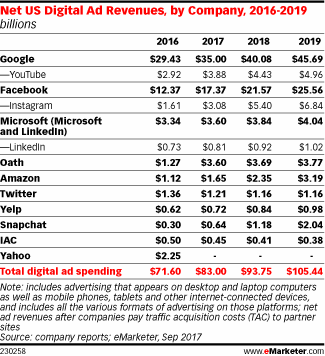
Googleand to a lesser extent Facebook (FB) are dominating the digital ad market, and this is easy to show in one graph, from Investopedia:
The dominance of Google and Facebook in the digital ad market is waning just a little bit lately, as companies like Amazon (AMZN) Twitter (TWTR), Snap (SNAP) and Pinterest (PINS) are growing fast. There shouldn’t be any doubt about Google’s continued dominance. It will take a long time for these relative newcomers to catch up.
Search dominance
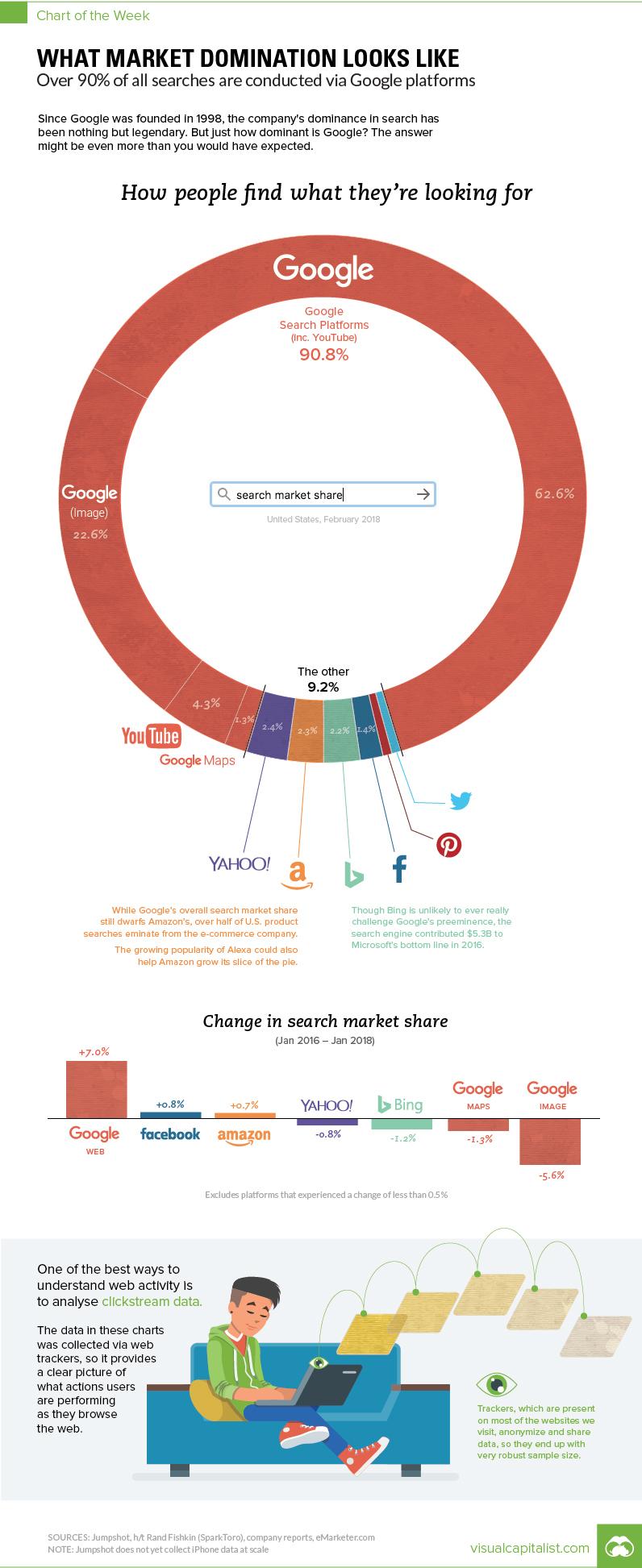
Google’s dominance in search is even bigger compared to digital ads. Once again from Visualcapitalist:
It’s so dominant that to google has become a verb and synonymous with search. One would never imagine Google being unseated in the search market, as big competitors like Microsoft (MSFT), Yahoo and others weren’t able to make a dent.
What’s more, search runs on algorithms, which need big data, which creates a situation that the largest companies are at an advantage.
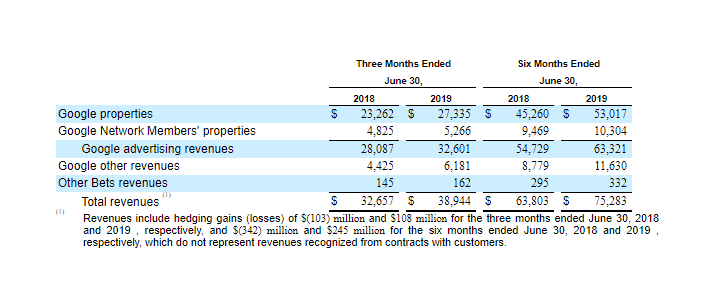
Google derives most of its revenue from search (in the order of 86%). Any inroads here will have very serious implications for its finances. From the Q2 10-Q:
Ecosia
Ecosia is a Berlin, Germany,-based company that launched 10 years ago, founded by Christian Kroll. It’s taking on Google, but not because it’s a better search engine, instead it provides two unique angles in the competitive battle:
Searches are encrypted, not stored permanently, and data is not sold to third-party advertisers. The company states in their privacy policy that they do not create personal profiles based on search history, nor do they use external tracking tools like Google Analytics.
Management recently clashed with Google, accusing it of anti-competitive behavior (EU-startups):
Ecosia today confirms that it has declined to take part in Google’s recently-announced auction for the right to be a “default” search engine on Android. Ecosia calls upon Google to abandon this unethical practice and allow users to freely choose which search engine they use, rather than auctioning off access to the highest bidder. Ecosia is the first search engine decided to reject Google’s “invitation” to this anti-competitive auction and calls other search engines to join.
On the second, the company spends 80% of its search ad profits to planting trees. Here are some data on that:
Every search request removes 1kg of CO2 from the atmosphere.
It takes roughly 45 searches to plant one tree as Ecosia earns about 0.5 eurocents per search and it cost 22 eurocents to plant a tree.
The search engine is actually powered by Microsoft’s bing (enhanced with their own algorithms running on servers powered by alternative energy). It earns money on search ads. It also earns money on some merchandise and the profits on these also go mostly to planting trees. So if it sells a t-shirt, that’s 20 trees planted (according to their FAQs).
The social aspect has important competitive benefits, from Browsermedia (our emphasis):
Nielsen carried out an online study and asked 30,000 digital consumers what they thought about the products they buy, and what they’re prepared to pay for a sustainable product. Sixty-six percent of people asked said they were prepared to pay more for a product sold by a company who is environmentally aware and committed to sustainability.
In fact, by using Ecosia, you don’t even have pay more (search is free). Quite the contrary, you get much better privacy protection in the process so you don’t “pay” by surrendering private data either.
Growth
One might infer that the use of the browser is likely to get a boost from the recent fires in the Amazon as it’s an easy way for people who are concerned and feel helpless to do something.
One can add to this recent insight that tree planting is by far the most viable and cheapest way to combat climate change. Does this expectation pan out?
In 2017, it was still tiny (Browsermedia):
Ecosia boasts over 5.5 million active users, and receives on average 56 queries per second. Google, in contrast, has over 1.17 billion users, and receives over 40,000 queries every second.
As it turns out, there’s indeed a recent big boost, from Bigthink (our emphasis):
But last week did yield some good news for the Brazilian Amazon: Ecosia, a search engine that donates some of its profits to tree-planting projects, saw a 1150% increase in downloads on Thursday as more people become aware of the fires, becoming the top-ranked iOS app in Brazil.
CEO Christian Kroll told Business Insider that the non-profit usually sees 20,000 daily downloads on average, but that shot up 1150% to 250,000 on 22 August, as media coverage around the Amazon fires intensified.
A quarter of a million downloads in a single day, that adds up. Not to put a pun on it, but this could spread like wildfire (Bigthink, our emphasis):
Users voicing their concern on social media is partly responsible for the uptick in Ecosia’s downloads. Business Insider found Instagram users encouraging their friends to download the app in response to the rainforest fires, and the app is prominently mentioned by users on Twitter alongside the #PrayforAmazonia hashtag.
So this is clearly spreading socially with the passion generated by the fires and what many see as an inadequate reaction spurring people to downloading Ecosia.
Wider implications
We also think there’s a competitive lesson that has potentially much wider implications. There’s a substantial market for products and services that, as long as they are “good enough” on their basic function (like Bing in search) might be able to take on much more capitalized competitors by embracing social goals.
In fact, they could even charge premium prices for doing so, as we showed research above that suggested that a substantial part of consumers are willing to pay higher prices for companies to embrace social goals.
It won’t work in every market, but this search example shows that not even the most dominant, entrenched companies are entirely immune from these forces.
In fact, as search is free so any competitor competing on social goals like Ecosia doesn’t have to charge premium prices, Google might be one of the more vulnerable companies to this competitive threat.
Conclusion
Google’s dominance in search seems near absolute, but Ecosia using an innovative business model that addresses important privacy claims and devotes 80% of its search ad profits to planting trees might be well positioned to make serious inroads.
It’s dangerous for Google simply because of the unique cocktail of low switching costs, high passions (produced by the Amazon fires and the Brazilian President’s reaction) and the impotence of alternative meaningful actions for those worried about the Amazon.
Add to that recent reports that identified tree planting as by far the cheapest way to combat climate change, and you could very well have a winning formula with Ecosia.
Since Ecosia is largely running on Microsoft’s bing, the latter too will get a significant boost from Ecosia’s growth, which might be something for investors to consider, although search is only a very small part of Microsoft’s revenue.
Disclosure: I/we have no positions in any stocks mentioned, and no plans to initiate any positions within the next 72 hours. I wrote this article myself, and it expresses my own opinions. I am not receiving compensation for it (other than from Seeking Alpha). I have no business relationship with any company whose stock is mentioned in this article.
For those who wished they could Google anything and figure out what direction to take for their business, this company provides a solution.
IT Prof. Alex Pentland and Director of the MIT Media Lab Entrepreneurship Program, named by Forbes as “one of the world’s 7 most powerful data scientists,” developed a new paradigm for Machine Learning based on AI.
Instead of building a data model for each predictive question, it uses a new social theory of human behavior that predicts future choices through behavioral commonalities. With the interplay of social and the kind of cause of effect interaction associated with physics, naturally enough, he called it Social Physics.
What his research demonstrated was that people behave in mathematically predictable ways. Just like physics determines the state of the natural universe, Social Physics governs the human universe.
But this was not just academic knowledge for Pentland.
Pentland was well-versed in real-life business dealings. He served as a founding member of the Scientific Advisory Boards at Google, AT&T, Nissan, and the UN Secretary General for cutting edge technology. On that basis of combining knowledge, skills, experience, and innovation, he created an automated engine that can answer any natural-language question.
That is the cornerstone of the business Pentland cofounded in 2014: Endor. Endor extended Social Physics using proprietary technology into a powerful engine that is able to explain and predict human behavior.
More AI-enabled prediction to arrive at a Google-like capability
Endor enables the automation and democratization of Al and data science, allowing a company to advance from paying a lot for getting the answers to just a limited number of predictive questions each year to affordable and easy access to unlimited answers.
It addresses the problem that has hampered businesses that do not have the deep pockets to fund the data science teams that had been necessary to become truly data-driven and capitalize on the power of predictive analytics. That meant that the power of predicting the future was only within reach of tech-giants who could afford to invest millions of dollars in building their data science resources.
Smaller companies that wanted to be able to direct their business strategy on the basis of predictions had to work off slow, complex, and expensive machine learning solutions. But now the are able the automated AI predictions provided by Endor, which MIT dubbed the “Google for predictive analytics.”
The same MIT article quotes the other Endor co-founder and its CEO, Dr. Yaniv Altshuler, reinforcing the Google comparison:
“It’s just like Google. You don’t have to spend time thinking, ‘Am I going to spend time asking Google this question?’ You just Google it.”
Altshuler declared, “It’s as simple as that.”
Altshuler has his own list of impressive credentials. He is a recognized expert on Machine Learning, Swarm Intelligence and Data Analysis who has authored over 60 scientific papers and filed 15 patents.
He expressed the great potential in Endor as follows:
“Imagine if you can ask any predictive business question such as ‘Who will complete a transaction tomorrow?’ or ‘Who will upgrade to Premium services in the next week?’ — this is a gamechanger for businesses and enterprises who want to act on their data in a speedy and accurate manner.”
Althshuler is featured in the video below in a conversation with Charles Hoskinson, Senior member of Endor’s Advisory Board about the future of Predictive Analytics:
What it can do for businesses
Endor delivers faster response times, as no data scientist input, including modeling, coding or data gathering, is called for. It embeds actionable insights into an organization’s workflow by allowing it BI, sales, marketing and all business teams to self-find predictions ‘do-it-yourself’ style
Now Endor makes accurate predictions scalable and accessible to businesses of all sizes (Enterprise to SMB) through proprietary Social Physics technology developed through years of research at MIT (Not through NLP). It enables business users to ask predictive questions, and get automated accurate predictions without having to hire data scientists.
It is particularly convenient for those without data scientist resources to prepare the data. Endor is agnostic about its use of big data. Even if has not been prepared through cleaning it can be analyzed.
Plus Endor has the industry-first capability to compute on encrypted data without decrypting it. That means that it meets the standards set for global privacy and data security regulations, which should be a major relief for businesses that have to deal with European entities and prove themselves to be GDPR compliant.
Since its founding in 2014, Endor has successfully grown an impressive clientele, including national banks, large Financial Services, and Fortune 500 companies, such as Coca Cola and MasterCard.
Endor is a pioneer in the merging of legacy infrastructure with innovative Blockchain services, thus supporting the transition of its large, Fortune 500 customers, enterprise customers to the Endorprotocol. The convergence of platforms will ensure a larger pool of aggregate data (new data sources), to the Endor Protocol, which in turn, will work to further increase the accuracy of its predictions.
Above is the HubCulture interview with both Pentland and Altshuler,
Beyond commercial applications
While it is primarily marketed to businesses, including wholesalers, retailers, and financial institutions, Endor’s technology can also be applied to other goals, including that of national security. MIT reported that it used its analytics for analyzing terrorist threats on the basis of Twitter data:
“Endor was given 15 million data points containing examples of 50 Twitter accounts of identified ISIS activists, based on identifiers in the metadata. From that, they asked the startup to detect 74 with identifiers extremely well hidden in the metadata.”
It only took an Endor employee 24 minutes to identify 80 “lookalike” ISIS accounts, more than half of which were in the pool of 74 well-hidden accounts named by the agency. The efficiency of the system is not just manifested in the relatively short time it took to do the analysis but also in the very low false-positive rate.
As the video above clarifies, the company’s name comes from Star Wars. Fans may recall Endor as the home of the cute and furry, pint-sized beings who help the rebels against the Empire forces that went there to build the second Death Star in Return of the Jedi.
Here’s a clip to remind you of the scene at Endor.
The thing is that the name Endor was not actually born out of George Lucas’ imagination. It actually first appears in the Bible in the 28th chapter of the Book of Samuel. That is the account of the witch of Endor whom the king calls on for divination.
In the Bible’s account, King Saul requests that she summon the now-dead prophet Samuel to instruct him on what to do. So really the name Endor is more appropriate for predictive technology because of its original context than for the more geeky-cool Star Wars connection.











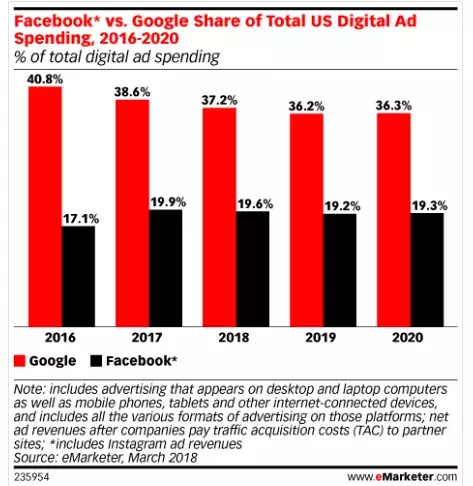 Here are US figures, from