Oath has studied the viewing habits of World Cup fans to deliver ad insight to its clients, and in doing so, it learned about brand recognition levels in the UK – and a staggeringly low purchase intent.
In February, 7,294 respondents from UK, France, Brazil, Denmark, Germany, Sweden, Italy and Spain gave their views on sponsors. For Coca-Cola retention levels were at 45%, at McDonalds it was 41%, Adidas (33%), Visa (31%) and Budweiser (27%).
Brazilians were found to be the most passionate fans, but they were also the most brand-friendly. 35% said they would be much more interested in using a brand that sponsors the World Cup tournament, in the UK, this figure slips to just 1%
Furthermore, one in four (26%) people in the UK said they would not support any other team in the football tournament should their team leave the contest. Stepping aside from the data, Scots have a habit of supporting any team playing England. It was the subject of a Paddy Power ad at Euro 2016.
The study also uncapped consumption habits. Three in four (75%) viewers will be watching at home on TV, as opposed to just 1% on mobile, However, nearly one in four (23%) will leverage smartphones as part of a multi-screen experience.
On the features fans expect, 33% wanted on-demand replays, 18% were keen on 360° virtual reality stadium tours, and 15% wanted to see tabletop AR football.
Stuart Flint, vice president EMEA at Oath, said: “Brands only have a small window where they can grab consumers’ attention while games are on, so they need to look beyond matches and engage fans seeking out supplementary information including stats, replays and interactive experiences.
“While some British fans will switch off from TV once their team is out of the running, they’re still likely to be keeping tabs on contextually relevant content throughout the competition.”
37% in the UK claimed they won’t be engaged in World Cup tournament until the first game kicks off.
Consumer outcry surrounding the global overuse of plastics has caused multitudes of FMCG, retail and food companies to rapidly readdresses their packaging strategies. But is the drastic jettisoning of PET plastic really the best route for brands to take?
If David Attenborough is the prophet of the anti-plastic generation, Chris Griffin is the pragmatist. As multinationals from Evian to Adidas scramble to reduce the amount of plastic in their supply chains in response to consumer outcry, the chief executive of the Museum of Brands, Packaging and Advertising is quietly cynical with regards to brands’ efforts.
“From the consumer’s point of view, the plastic debate is so complex that I don’t think they can engage in anything other than the top line soundbite,” he says. “The consumer is going to be fed many lines – like ‘we’re going to make all our new bottles out of sugar cane’ or something. That’s probably not going to happen worldwide on the scale of a global brand.”
The reason, Griffin believes, is because product lifecycles are complicated. Designers spend years understanding the end-to-end process of packaging – from conception to burial in either landfill or recycling plant – and therefore the choice of whether or not to use plastic should not be one made by a PR department.
“Brands have to be very careful not to respond too quickly to media pressure,” he says. “If they say … ‘We’re going to go for all sugar cane-based packaging’, that’s going to be dangerous for them because they won’t be able to deliver it.
“What might work as a comment this year, could get them in trouble next year.”
Yet there’s no doubt the pressure on brands to do something about the amount of plastic they produce is enormous. Last month saw a brigade of passionate, if not militant, protestors launch a ‘plastic attack’ on a Tesco store in Bath (they ripped off wrapping and left it dumped at the tills), ‘reduce plastic waste’ brings up 38m+ results on Google and online vitriol spun towards Whole Foods over selling orange segments in plastic boxes caused the retailer to pull the product almost instantly.
Since David Attenborough urged humanity to halt plastic use in order to save ocean ecosystems in Blue Planet II, the list of brands promising to reduce or jettison plastic from their packaging has extended exponentially. Commercial pressure has given plastic a bad name – but that’s not entirely a good thing, argues Griffin. Plastics, after all, evolved with and as part of the notion of the 20th century brand.
“Plastics do some incredible things: preserving by using the absolute minimal amount of material,” he explains. “The moldability, the formability … you can get shape and character, you can get brand attributes into your packs.”
The Museum of Brands’ Pack The Future
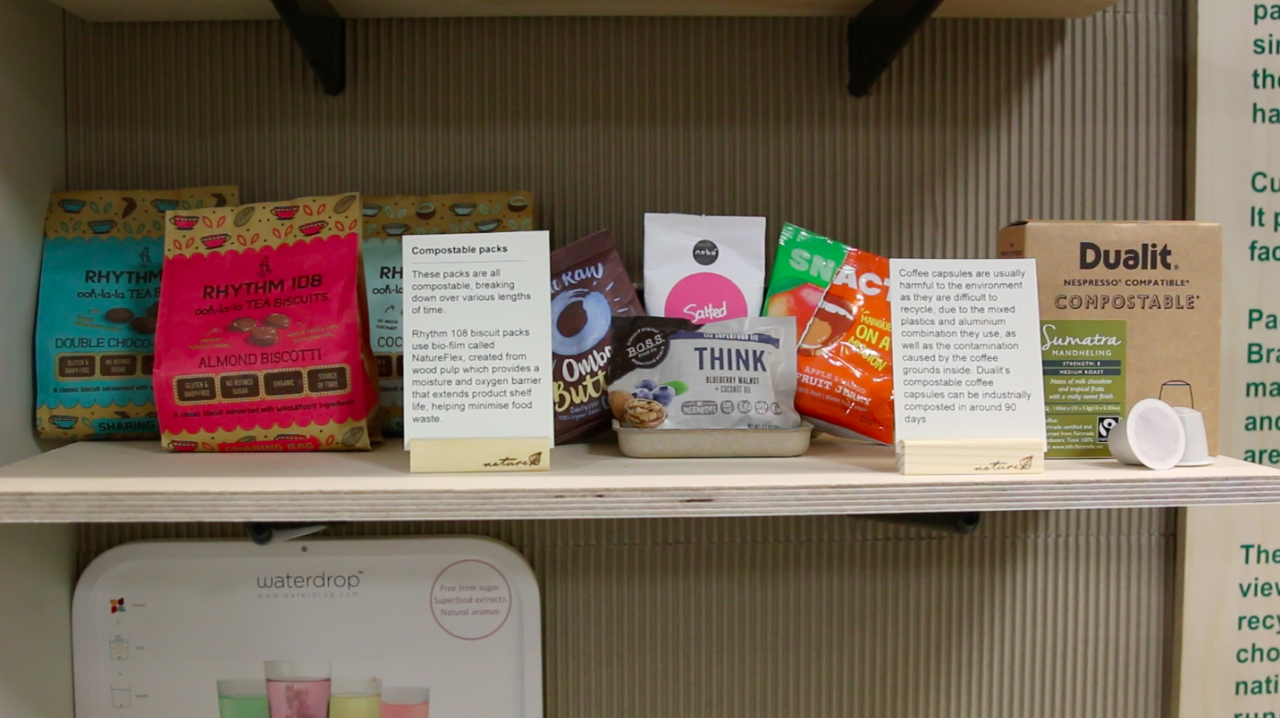
Griffin’s appreciation for the material is slightly ironic considering his museum has launched an exhibition dedicated to sustainable and, largely, plastic-free packaging. Yet his favourite exhibit is of two cucumbers, one wrapped in plastic and one naked: while the green skin of the cucumber is cited by many anti-packaging activists as natural packaging, it’s the unwrapped fruit that goes mouldy first.
“The energy that goes into food production is phenomenal,” Griffin says. “And if we don’t get it from the field to the plate because it’s wasted [because of a lack of packaging], that’s a huge waste of energy.”
A similar argument was made by The Genuine Coconut Company when it was lambasted for wrapping its coconuts in film; its retort was the packaging helps the milk stay fresh for longer, and plastic is fully recyclable. Additionally, disability campaigners have defended the accessibility of pre-chopped and wrapped vegetables, which have also been much maligned since the Blue Planet II episode aired.
A food industry without plastic may then be unobtainable – or even undesirable, at least for the time being. But as countries such as the UK continue to wait for a comprehensive national recycling system, it’s brands that are leading the charge in researching sustainable solutions. Unilever announced last week (4 April), for example, that it’s collaborating with Dutch startup Ioniqa, which has developed a technology to break down PET plastic to a molecular level.
“That means we can take any type of PET waste, then break it down to remove colour and impurities,” said Sanjeev Das, the conglomerate’s global packaging director, in a statement. “We can then turn it back into pure, clean, transparent PET plastic that’s food-grade ready.”
Coca-Cola has promised to help collect and recycle a bottle or can for every container that it sells by 2030, alongside aiming to manufacture plastic containers with 50% recycled content by the same date. On a smaller scale, rival P&G is working with the recycling company Terracycle to manufacture Head & Shoulders bottles made partially of plastic washed up on beaches and waterways.
Interestingly, Terracycle has found gaining support from big multinationals, such as P&G, to have been easier than garnering it from the NGOs it relies on to collect the beach plastic.
“P&G wanted to do something sustainable, something to make a difference,” explains Stephen Clarke, head of communications at Terracycle Europe. “And although there’s quite a lot of work to get buy in from various departments from within a company, our biggest problem was actually getting the NGOs to buy into it. It’s getting them to do something different.”
While the FMCG multinationals (which have budget and scale on their side) lead on recycling innovation, Griffin sees potential in the luxury sector when it comes to the development of sustainable plastic alternatives.
“As a designer, some sustainable materials are just fabulous to work with,” he says. “Corrugated cardboard looks beautiful, materials come from crustaceans have fabulous textures and some [materials] that come from various plant materials are wonderful to work with and wonderful to design with. But they’re not on the scale that will be economical for volume. So I think luxury’s a whole new area where sustainable thinking is necessary.”
The potential for luxury, sustainable packaging to double as a proof point for the wider industry is a sentiment shared by a number of design houses.
“As with any aspirational market, the luxury packaging sector is a platform for materials and innovations to be revealed and translated into other areas,” says Toby Wilson, chief operating officer at MW Luxury Packaging. “Naturally, the more a new technology, technique or material is used, the more accessible it becomes.”
However Wilson is cognisant that the luxury sector has, thus far, been immune to the pressures of sustainable packaging due to the assumed long lifespan of its products. A consumer is more likely to keep and reuse a beautiful Fortnum & Mason chocolate box, for instance, than a Milk Tray.
“But this is changing,” he says. “Quality and brand aspiration is critical and therefore innovation in high quality and high-performance materials is essential. Materials that perform and present need to be developed to maintain the luxury credibility that a brand demands.
“This will come through innovation and material development.”
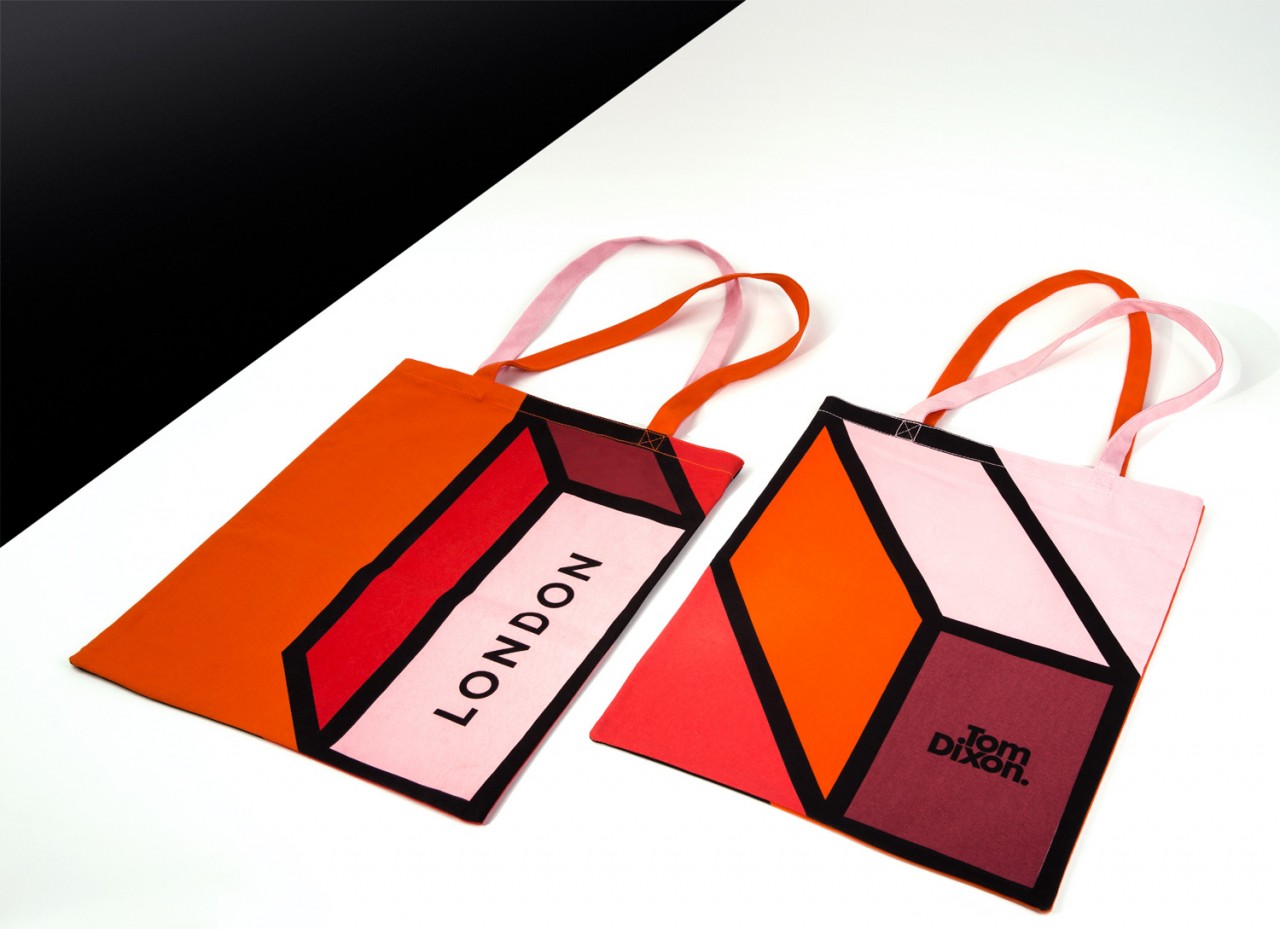
Progress Packaging’s totes for Tom Dixon featured natural canvas wrapped in a clear biodegradable bag
The current trend for minimalism (little to no branding on packaging) in the luxury sector has also meant for easier experimentation with avant-garde, sustainable materials, says Victoria Walmsley, media developer at Progress Packaging. The agency has been working with recycled cottons, canvas and hessian, as well as corrugated board and recycled boards.
“There is definitely a strong wave of encouragement [for more sustainable materials] that comes from designers, manufacturers, and the consumers, too,” she says. “We do see more enquiries asking us how they can make things pretty but also reusable. I think reusability once a product has been opened is the key requirement. The market doesn’t just want to provide bags and boxes that will get used once and then thrown away anymore.”
Yet environmental charities, quite understandably, aren’t ready to rest the future of the world’s oceans on the luxury sector’s ability to innovate alternatives to plastic. For Julian Kirby, lead plastic-free campaigner at Friends of the Earth, the onus is on a number of actors to make change.
“Currently the companies that make and market packaging only contribute about 10% of the costs of collecting and processing it, meaning the remaining 90% is borne by tax payers through cash-strapped local authorities,” he says. “A mix of sectors working together could rapidly provide answers we need to the plastic pollution crisis, with big companies having the power to make alternatives to plastic the mainstream choice.
“However, for this change to come about on a mass corporate scale we need central government action.”
Asos has singled out the performance of Instagram Stories in its marketing mix, saying the number of people viewing its content on the platform has almost doubled in just six months.
The online retailer today (11 April) reported stellar sales for the six months to 28 February, noting a 10% rise in half-year profits to £29.9m as sales jumped 27% to £1.13bn compared with the same period in the previous year.
On a call with analysts, chief executive Nick Beighton praised the Instagram-effect, saying the Facebook-owned platform was now more popular among its core 20-something customer base than Facebook and as such the business had maintained its investment in its “relevant, emerging content formats” including Stories.
The brand’s content on the site was viewed over 30m times while videos were viewed more than 52m times, up from 40m in the previous half of the year.
“When we recognise technology that can help our business, we fold in pretty quick,” Beighton said.
Now that its convinced on the value of Stories, the current tool under the spotlight is Instagram’s shopping-enabled adverts, which launched widely at the beginning of this year.
“On one level [Instagram Shopping] could turbo charge the experience for 20-somethings but on another level it could be a real threat,” admitted Beighton.
“We do know Instagram is one of the biggest channels for our customers, it’s much bigger than Facebook, so I’d go with the positive and think about how we can make it more intuitive and friction free for our customers.”
Its experiments on the digital channel come amid a wider review of its marketing costs. It didn’t give an exact figure but as a percentage of sales it stood at 5% versus 5.3% in the previous period. The savings were made as a result of “digital marketing efficiencies and a higher return on advertising spend,” said Beighton.
Though admitting the brand is on “every conceivable marketing channel”, Beighton said it is venturing offline, especially in other European markets. In the UK it ran its first out of home campaign to launch its Face and Body and Activewear lines while in France it took to TV and cinema for the first time with promising results.
“The combination of TV and cinema aren’t immediately relevant to the 20-something market in the UK but they are in the French market. But it’s an experiment,” he said.
In the US meanwhile, its PPC ad spend is under scrutiny with Beighton saying the rates “are up pretty dramatically” on various terms, though he didn’t go into detail on how it would mitigate that cost.
Overall, he said continued investments are enabling strong engagement levels across its customer base. Site visits increased by 25% year-on-year; average order frequency improved by 8%; average basket value increased by 2% alongside a 10 base point improvement in conversion.
Active customers are now at 16.5 million, representing a 17% increase since last year.
Coca-Cola’s latest experiment in opening short design briefs to the entire world illustrates its plans to no longer be seen as “a traditional advertiser” by appointing consumers – not agencies – as its co-creators.
The drinks giant’s head of digital, David Godsman, admitted at the Adobe Summit opening keynote that the digitally connected world is “somewhat unknown” to the brand. Nevertheless, 12 months ago it embarked on a five-year digital transformation programme, underscored by four key areas: operations, business, culture and experiences.
Surprisingly, Coca-Cola has filed its marketing and advertising operations into the latter category. Not only is Godsman asking his “traditional brand marketers to become experience makers”, but he’s earmarked the fans of Coca-Cola as vital to its content creation strategy.
David Godsman, chief digital officer, Coca-Cola
“Digital allows us to create unifying experiences which – regardless of language or place in the world – helps to bring them together,” he said. “Digital enables them to participate actively with us and co-create the experiences we bring to market
“We don’t see a world where we will continue as a traditional advertiser in that sense.”
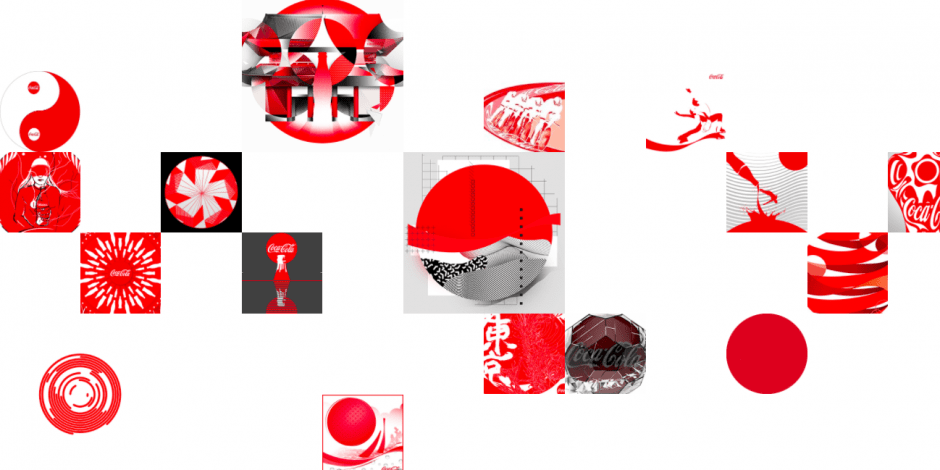
James Sommerville, Coca-Cola’s vice president of global design, introduced one of the first forays into this strategy of consumers-as-creators. Coke x Adobe x You, which quietly launched last October on social media, comprised a succinct brief open to the entire internet, which read: ‘Create a work of art celebrating Coca-Cola, sport, movement, strength, and unity using Adobe Creative Cloud tools’.
“We thought: ‘What would happen if you just gave the world’s designers three or four simple tools and a short brief – so short that you could tweet it?’,” explained Sommerville.
The brief for Coke x Adobe x You
So far, the project has thrown up around 1,500 submissions, from trippy, fun animations to meticulous hand-drawn illustrations. All the designers were commissioned to feature the red Coca-Cola circle, while Adobe and Coca-Cola kept the Tokyo Olympics 2020 under wraps.
“If you scan these pages you’ll see the enthusiasm to work on our products and our brand,” said Sommerville, adding that the project “really is the start of our journey”.
The brand is arguably in need of a revived creative strategy. Diet Coke’s latest offerings have failed to capture the mass imagination that 1995’s ‘Diet Coke Break’ managed to, for instance, while ‘Because I Can’ was pretty much panned creatively.
It’s unlikely that Coca-Cola will eschew working with creative agencies for consumer creations altogether. Sommerville stressed that “we love our agencies partners, we need our agency partners”, but he also loves to “discover the hidden gems”. By that he means freelance artists such as Noma Bar, the graphic designers going viral, or “some guy working in Starbucks right now on a laptop”.
Noma Bar for Coca-Cola
But when conglomerate does come looking for agencies in the future, it may start knocking on other doors. Sommerville’s design lab is currently experimenting with prototypes such as a fountain that dispenses mobile data in lieu of soft drinks – the kind of project that will certainly require the expertise of creative technologists, but perhaps not those of traditional creatives.
“I really want to invite the creative community to reimagine the whole experience,” said the Atlanta-based, Huddersfield-born designer. “Everyone in this room, everyone on this planet, has the right to work with Coca-Cola.”
How does he plan on keeping those divergent, global ideas tied to a common brand idea? By looking back on the vast history of Coca-Cola.
“We have a little phrase called Kiss the Past Hello,” he explained. “A lot of people talk about failing fast – for us this is the Coca-Cola way of saying a very similar thing. Our past is so important to us. It educates us. The good, the bad, what worked, what didn’t.
“Those stories are the same, but the context has changed. We are about technology, we are about transformation and we are about talent. But ultimately for us the experience starts at the product – it’s the texture, it’s the touch of the glass, it’s the temperature.”
After disrupting many traditional sectors through its online presence, Amazon is now stepping into physical spaces, with tangible results. The Drum looks at how the brand is rewriting the rule book, most notably with retailer Whole Foods and its own Amazon Go store concept.
When Amazon launched in 1994 it declared itself to be ‘Earth’s Biggest Bookstore’. Almost 25 years later, the strapline feels laughably out of step with the money-making juggernaut it has become.
However Amazon has, throughout its lifecycle, remained true to its roots as a purveyor of paperbacks, going on to disrupt the category with the Kindle e-reader and self-publishing services.
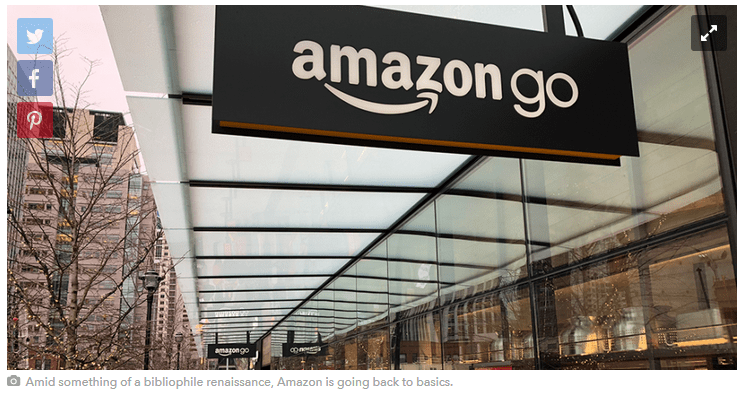
And amid something of a bibliophile renaissance, Amazon is going back to basics.
Last year it announced plans to open a bricks-and-mortar bookstore in Manhattan. Meanwhile, its own physical imprint has in the past few months launched a division dedicated to short fiction reads.
Amazon is also taking a back to the future approach to retail. Its now-famed checkout-free Amazon Go opened recently to shoppers in Seattle, and the company has a network of Whole Foods stores throughout Canada, the US and UK.
Omnichannel experiences
“Amazon is coming at these industries from a position of no baggage,” muses Teaque Lenahan, regional director of business design and strategy at Fjord Seattle.
“Digitally native companies such as Amazon already know how to interact with consumers in that context, so in many ways it is an easier play for them to shape this digitally enabled, physical experience, than it is for traditional bricks-and-mortar players.”
Publishers in particular are likely to find themselves caught between the draw of a mutually beneficial relationship with Amazon and the memory of the disastrous impact that bringing sales online had on stores like the now defunct Borders.
Cory Cruser, experience innovation partner at creative consultancy Lippincott, argues that Amazon is not so much moving into the industries it helped kill, but rather shaping future behavior.
“With behavior changes come new ways to create value for customers, and reinterpreting traditional models is one way to do that, improving them in line with the behavior shift.”
Too much influence?
Aydin Moghaddam, head of PPC at digital agency Roast, laments the lack of competition Amazon asserting its dominance in these areas would bring about.
“Amazon has too much influence, and there cannot be perfect competition when one company has that,” he says.
Fjord’s Lenahan, meanwhile, is more pragmatic. “At the moment, Amazon’s foray into the physical market is either primarily for customer learning, or not yet scalable,” he says.
What’s next?
For Simon Law, chief strategy officer at WPP agency Possible, there is no irony in its forays into physical retail.
“It’s brilliant. The company has more than $22bn in cash and is using it to explore what the future looks like and how to keep retail innovating. It is investing in the new, the different and the explorative. It is doing what all business that are in decline failed to do.”
As for what’s next, Moghaddam predicts Amazon will acquire a fashion retailer, while Lenahan notes that as Amazon could trade on transparency to make money in the media arena.
For Cruser, it’s finance. “The industry ripe for massive disruption is banking, simply because the systems in this industry have not kept pace with the changing nature of our relationship with money,” he says.
Whatever happens, the company that started out as the world’s biggest bookseller is rewriting the rule book when it comes to disruption.
Quick! What’s the difference between a positioning statement and set of brand values?
Or a value proposition and a brand’s DNA?
What about a brand promise and a brand essence?
If you answered ‘er’ to any of the above, then you are not alone.
Week long workshops have been spent parsing out the distinctions between ‘DNA’ and ‘purpose’. Cut through the froth, however, and we are talking about positioning.
But whatever we call it, positioning is central to what marketers do. Yet, here’s a scary New Year’s thought: is it time to reposition positioning?
Positioning was a strategic exercise, informing everything from distribution, to product innovation, and marketing communications. By analyzing competition, consumer, and company in question, brands could clearly define themselves against rivals with a strong positioning. Ultimately it was about ‘where’ and ‘how’ a brand should ‘play’ against competition.
As a result, the primary goal of the advertising agency morphed from (tactical) creativity, for its own sake, into the (strategic) management of brands.
Yet, as the synonymic inflation around the word ‘positioning’ suggests, this has become an increasingly complex exercise, cast adrift from the original intent.
We now spend a great deal of time ruminating over the finer points of brand personalities, or carefully delving into semantic nuances. We build pyramids, diamonds, and peel back layers of brand onions (weeping, often, in the process), while flicking through thesauruses for synonyms of ‘inspirational’.
More worryingly, positioning is increasingly detached from its original strategic intent. It has become too concerned with marketing communications, and is often treated as a story which should be told (directly) to the consumer. This is a long way from what it should be. Moore and Helstein in a 2007 article on positioning tersely noted ‘a positioning statement is not an advertising strategy, a slogan, or a tagline. It is an internal document, and is often very dull and straightforward.’
The lack of strategic thought is also evident when it comes to understanding of the competition. Competitor analysis is all too often overlooked, and palmed off on someone more junior, with the results filed away and never used. This leads to the weird sense of déjà vu between a lot of brand executions, born, one suspects, from positionings that didn’t pay attention to, or distinguish themselves from, the competition.
All this distracts from an exercise that was originally intended to focus strategy. Positionings have become a pick-and-mix of Big Words that agencies often struggle to execute against.
And positioning faces an even bigger challenge. Jenni Romaniuk of the Ehrenberg-Bass Institute has pointed out that the way we think about positioning is back to front.
Unlike marketers, the brand is the last thing consumers think about.
For consumers, brands are not the fixed platonic ideals that brand onions suggest they are. Instead they are a mess of mental cues, recalled to solve certain problems throughout the day.
Romaniuk refers to these situations that induce brand recall as ‘category entry points’ (CEPs).
For example, you might feel hungry at lunchtime (CEP) and several brands will pop into your head to solve this problem.
You might need a mid-afternoon pick me up (CEP) and Starbucks, Coca-Cola, or the godawful stuff in the canteen might mentally appear.
CEPs can be linked to things like hunger, the time of day, a sporting event, or a type of weather. This makes sense because brand considerations are context specific, and different contexts – or CEPs – evoke different brand options. (If you are considering lunch you might not be considering Burger King. But, if it’s 3am, or the morning after the night before, it might be at the top of your mind.)
This is a big challenge to traditional positioning and the 3Cs that inform it.
After all the consumer (or at least consumer mindset) varies depending on the situation. The competition varies too. If you’re Coca-Cola you might be competing with a coffee mid-afternoon, and a beer at 6pm.
And the brand itself is perceived differently in each situation. It’s not, in other words a ‘fixed’ idea. (That’s why it makes little sense to ask consumers what situations come to mind for specific brands – the answer is it depends on the situation. We should instead be asking what brands come to mind for certain situations.)
In short, different CEPs should logically produce different positionings.
So how do we adapt?
For a start, it should prompt marketers to consider what CEPs they are currently linked to, and if they should expand this number. The most successful brands are linked to wide a range of different situations, and smart brands actively seek to expand them. A simple example of how this works is from McDonalds, which went from simply answering a ‘fast food’ situation, to also answering a quick and easy way to get breakfast and a decent coffee.
We should therefore not be afraid of embracing positioning(s) plural. This does not mean that every brand should document a bewildering array of every potential CEP, and position against each. Some CEPs are more common (and profitable) than others. CEPs also seem to have practical limits. Fizzy drinks or fast food chains might have quite a few, but realistically how many does toilet roll really have?
All this suggests that positioning should cease to be the distant, lofty, and totemic PowerPoint it often feels like today. It was, after all, originally intended as a battle plan, rather than a religious text. Positioning should once again act as a practical and powerful tool to help focus thinking, and compete with the competition across (a range of) different consumer cues.
That positioning often feels more like an exercise in semantic acrobatics or character creation suggests it’s long-overdue a repositioning.
At SXSW, YouTube chief executive Susan Wojcicki revealed that the site will begin using Wikipedia to try and curb the spread of conspiracy theory videos.
Conspiracy theory videos on the site will now include text from Wikipedia pages that users can click on to learn more about the topic in question. For instance, someone watching a video about chemtrails would see a “companion unit” featuring Wikipedia’s “Chemtrail conspiracy theory” page.
According to Wojcicki, the feature is set to roll out in the coming weeks. While she did not explicitly say how exactly YouTube plans to determine what is considered a conspiracy theory video, she did say that the site will be “using a list of well-known conspiracies from Wikipedia” to help it decide which videos should receive the additional information.
“When there are videos that are focused around something that’s a conspiracy, we will show as a companion unit next to the video information from Wikipedia,” said Wojcicki. “People can still watch the videos, but they actually have access to additional information.”
The move comes weeks after YouTube was criticized for letting a conspiracy theory video about last month’s mass shooting in Parkland, Florida take the top spot in its “Trending” section. The video accused David Hogg, a survivor of the shooting who has since spoken out for gun control, of being a “crisis actor.” YouTube eventually pulled the video for violating its policies.
Over the past year, YouTube has struggled to keep its platform free of extremist and offensive content. About a year ago, brands including Verizon and PepsiCo pulled advertising from the platform due to concerns that their ads were appearing next to videos that promote terrorist groups.
In December, the Google-owned video site rolled out a four-step action plan in hopes of curbing the brand safety concerns that have plagued it in recent months.
Feature Image: Conspiracy theory videos on the site will now include text from Wikipedia pages that users can click on to learn more.
Online reputation management is very necessary all of a sudden.
By MediaStreet Staff Writers
Businesses say they plan to allocate more resources to their online reputations in response to the growing popularity of social media and online reviews.
According to a new survey from Clutch, 40% of businesses will increase their investment in online reputation management (ORM) this year.
All this is due to the growing power of social media and third-party reviews sites, which impact businesses’ control over their online reputation.
Clutch surveyed 224 digital marketers and found that more than half of businesses (54%) consider ORM “very necessary” for success. As a result, 34% said they allocated more resources to ORM in 2018, and an additional 43% said they plan to hire a professional public relations or ORM agency in 2018.
Businesses already invest a significant amount of time observing their online reputation, Clutch found. More than 40% of digital marketers (42%) monitor their companies’ brand online daily, while 21% monitor their online reputation hourly.
According to public relations experts, businesses frequently monitor how their brand is portrayed online because they know even one negative media mention can quickly damage the public’s perception of their company.
“When people search for brands online, they tend to search for stamps of credibility,” explained Simon Wadsworth, managing partner at Igniyte, an online reputation management agency in the UK. “If potential customers find anything negative, that could end up being a significant amount of leads the business won’t get from people who are put off from using the service.”
Social media also has shifted the ORM landscape because it gives consumers free-reign to share their opinions and experiences quickly and frequently: 46% of businesses look to social media most often to monitor their online reputation.
By using professional agencies that have expertise in online reputation management, businesses can minimise losing new customers who may be dissuaded from purchasing their product or service.
Do you supply services to the Irish Media Industry? Have you listed your company in our Media Directory? It’s free! Everyone’s favourite price! Click here to do it now.
The concepts behind intelligent content are an important glimpse into the future of content marketing.
As you can tell from the number of chatbots that are popping up across the web, brands of all types have begun investing in artificial intelligence, mainly for their customer service departments.
But ask these same forward-thinking brands whether they’re using intelligent content, and their answer will probably be either “No,” or “What’s intelligent content?”
Here’s a quick explanation of this content development, and how to determine whether it’s right for your brand.
What is intelligent content?
Intelligent content is content that can be adapted, changed, and/or released on different channels, to different audiences, without needing a human to touch it. Intelligent content is to content what adaptive design is to design – it adapts to the device, context, and situation in which it’s being consumed.
(Intelligent content is a complex topic, so for a full, in-depth explanation, you may want to pick up Ann Rockley’s book Managing Enterprise Content: a Unified Content Strategy. Rockley is a top expert on intelligent content, having pioneered the idea more than 10 years ago.)
In order for this to be possible, your content needs to be structured in such a way that it can be mixed and matched, as it were. It has to be broken into fragments, easily customizable, and – perhaps most importantly – properly tagged, so that both your marketing team and your customers can find the pieces they need easily.
In other words, intelligent content is content that takes a lot of the guesswork, rewriting, and repetition out of content creation. It replaces it with content that can be easily automated, recombined, personalized, and distributed.
How can I tell if it’s right for my brand?
Intelligent content isn’t something every brand needs.
For example, if you’re a small business that sells one product to one audience, there’s really no need for you to put in the effort to take your content from standard to intelligent. You likely have a bank of content that already works for you, and that needs little adaptation.
However, if you’re a business that sells lots of products, to lots of different audiences, then intelligent content can allow you to drastically cut down on the amount of time you spend creating new content and adapting what you already have.
Consider this example. Your company creates 5 different software packages, each of which is used in 3 different industries. Within each of those industries, you’ve got 7 different buyer personas for whom you’re creating content.
While you’re likely reusing and adapting content already, to some degree, the process of creating new content for every persona, in each industry, for every product, is extremely time-intensive.
Switching to an intelligent content approach could work extremely well for this company. That would mean that instead of spending time writing new content from scratch, the marketing team would begin breaking down their existing content into fragments, and tagging it with metadata to make it easily findable.
For example, they would have one sentence about the company itself – they could tag that “about company.” They might have an intro paragraph that they use consistently – that would be removed and tagged “intro.”
Then they could begin getting into their more detailed, individual content needs. For each software package, three features could be selected and summarized, with each feature tagged “feature 1,” “feature 2,” etc. One testimonial per industry, per software package could be chosen and tagged.
This process would continue until they had the building blocks to create the content they needed quickly and efficiently.
That’s just the beginning, though. Depending on your resources, you can invest in artificial intelligence programs that can automate your content and even, in some cases, produce some for you.
One program, Wordsmith, can create written reports from reading your Google Analytics and AdWords data. Wordsmith pulls your data and then analyzes it for insights, creating a robust report that reads as though it were written by a human. Programs like this can save your team huge amounts of time, and even, in some cases, produce better data analysis.
Women-owned businesses are most likely to use social media. Men! What y’all doing?
By MediaStreet Staff Writers
A woman-owned small business is more likely to use social media, according to a new survey from Clutch, a leading B2B research and reviews firm.
Among women-owned businesses, 74% use social media, compared to 66% of men-owned businesses.
The findings came as no surprise to experts, who said women overall are more likely to use social media. Given that trend, female small business owners more easily can bring their business onto social media.
“Women are generally better conversationalists than men,” said Jeff Gibbard, chief social strategist at digital agency I’m From the Future. “They tend to be more expressive and more emotive. It’s no surprise to me why more women business owners use social media.”
Women often communicate better than men, which translates to the online world where they are more likely to use social media effectively.
Millennial-Owned Small Businesses Lead Social Media Use
There is also a generational divide among small businesses’ social media use. The survey finds that 79% of millennial-owned small businesses use social media compared to 65% of small businesses owned by older generations.
Millennials, like women in general, frequently use social media for their personal lives. Their social media skills easily carry over into their businesses – unlike older generations, experts say.
“The older people didn’t grow up with social media, so many don’t understand how to use it for their business,” said Shawn Alain, president of social media agency Viral in Nature. “They went through a significant part of their life without even the internet, and they remember what it was like not to have a smartphone or email.”
Millennials are also more likely to use Instagram and Snapchat than older generations, but Generation Xers and Baby Boomers are more likely to use LinkedIn.
Most Small Businesses Use Facebook
Facebook remains the most popular social media channel for small businesses, no matter the gender or generation of the owner – 86% say they use it, which is nearly twice the number of small businesses that use the second-place channel, Instagram (48%).
Among small business users of social media, 12% say they use Facebook exclusively for their social media efforts.
Overall, 71% of small businesses use social media, and more than half (52%) share content at least once per day. Images and infographics (54%) are the most popular content types that businesses post to social media.
Do you supply services to the Irish Media Industry? Have you listed your company in our Media Directory? It’s free! Everyone’s favourite price! Click here to do it now.