Tag

Twitter

Browsing

By

Twitter has come a long way over the last 14 years.

From the early days of random egg-shaped avatars screaming into the void over 140 characters about why one celebrity’s dress was better than the other to modern election cycles. The cynic might view Twitter as nothing more than megaphone-assisted political diatribes without an edit button.

While this certainly exists to some extent, Twitter has grown to over 50 million accounts and as a top-five social media destination in the United States, maturity brings out additional use cases that brands should not ignore.

One big step in this maturation process has been the emergence of Twitter-specific influencers. Due to their relatively inexpensive acquisition cost comparative to professional networks like LinkedIn combined with a Swiss Army knife-like malleability similar to Google My Business influencers, there’s significantly more to the process than meets the eye.

Let’s explore seven different ways a business can employ Twitter influencers to solve a variety of use cases.

Build your next Twitter influencer campaign with Intellifluence now.

twitter-influencers-add-new-campaign-select-goals

Use #1: Social shares

Why: Amplify existing content such as previously written blog posts and hosted videos that exist outside Twitter in order to drive more exposure.

Details: This is one of the easier of the use cases for most brands to grasp. Twitter’s share functionality in the form of Retweets, Quote Tweets (and now likes injected into activity feeds) feel more disposable in nature than the intimate sharing with friends that exists over Facebook. The lower barrier to activity results in higher campaign acceptance rates for brands reaching out to influencers looking for these shares.

Since the amplification use case is designed more to maximize eyeballs than specific audiences, the targeting aspects are more relaxed.

A rough equation used at Intellifluence and other influencer networks would be to suggest Exposure-per-dollar wherein Twitter audience size is divided by the amount the influencer is looking to charge for a simple click.

This use case works best with content targeted towards a broad audience to ensure later KPIs for activity take place.

Use #2: Social engagement

Why: Driving deeper engagement on a conversation can not only increase exposure towards a desired audience as the comments show in the target activity feed, but conversation amongst authorities and industry peers provides an air of legitimacy, acting as social proof.

Details: Much like acquiring social shares, a brand in this case is looking for activity surrounding an existing asset; the primary difference is the asset in this example already exists on Twitter.

Further, pricing can be a little higher as the influencer is being asked to apply some critical thinking and needs to be judicious in word selection when commenting for engagement’s sake (though not as much as a review, which we’ll get to).

Targeting for engagement is also a bit more focused than simple social sharing, as the engagement that matters most will be from individuals the intended audience will respect. One easy method to locate these individuals is via Twitter’s own search functionality for specific keywords, both hashtags, and plain text.

An additional tip is to draw in specific influencers to a conversation occurring on Twitter.

This requires more nuance to not appear spammy.

By comment mentioning @NameOfInfluencer in reference to something s/he posted or commented elsewhere, the probability of ego baiting said influencer into the conversation increases dramatically. Don’t overuse this technique as it will become obvious what you’re doing and never do it if you have already pitched monetary compensation to the individual and were turned down.

Use #3: Social review

Why: When the KPI you are chasing requires eliciting a specific action such as sale, newsletter signup, or other lead generation activity, it is necessary to provide a more detailed endorsement than a Retweet or comment can provide.

Details: The individuals needed for a product or service review on Twitter should be hyper-focused on what you are selling.

Celebrity aspirational influencers only make sense in the context of the product having broad geographic and socioeconomic appeal.

Start with the best of the best: the industry experts you might have wanted to target your social engagement campaign. Get these industry experts to act as proxy authorities on your offering as well as social peers to your intended buying audience.

Expect the prices charged by influencers to be higher as the work they are required to put in is more of a time investment in order to accurately describe their endorsement via Tweet.

In previous years, social reviews over Twitter were similar to a Quote Tweet with a few sentences acting as an endorsement with a link out.

While this is still part of the strategy, the effectiveness of the method has evolved somewhat to where the initial Tweet can be thought of as the primary call-to-action language complete with the necessary URL, backed up with a Tweetstorm explanation of why the endorsement is taking place, such as a list of reasons.

The Tweetstorm threaded formatting enlists deeper readership by the influencer’s audience and a stronger probability of comment-driven engagement to extend efficacy of the campaign itself.

Use #4: Video reviews

Why: It is extremely difficult to convey a complex matter over 140 characters; 280 isn’t much better. When dealing with complex explanations, a good video can go a long way.

Details: Before starting, pour a drink out for Vine. Now pour another out for Periscope.

Vine was a wonderful short-form video service purchased by Twitter that was subsequently shut down. The demand for the humor-driven short format service has since shifted to rapidly growing TikTok.

At the beginning of writing this article, the video review solution for using influencers on Twitter resided then on the hope of Periscope. Unfortunately, that will now be sunset in March of 2021.

So how can brands get video reviews on Twitter?

Twitter Live.

The main concepts of Periscope have been adopted into the core Live product. Live reviews are objectively the same as regular social reviews in terms of influencer compensation and needs, with one caveat: timing.

As Live implies a time constraint, the timing of your influencers’ content needs to be managed to coincide with the time when a brand’s prospective audience is most likely to be on Twitter.

For specific use, Live content is ideal for both explaining complex matters and providing time-sensitive offers to spur the desired action.

Use #5: Contest/Giveaway for account growth

Why: Sometimes the best way to get attention is by giving away attention. When the KPI is to increase Twitter accounts following legitimately, contests and giveaways are the best way.

Details: The concept is relatively straightforward. If a brand is looking for a more authoritative account, the last thing you want is to purchase low-quality bot traffic and fake followers.

Instead, allow for self-selection of followers by periodically running contests and giveaways that somehow tie to the core product or service.

In the case of Intellifluence, the desire was to increase the number of influencers paying attention to the CEO’s account and the main brand account. To satisfy that, a simple giveaway was created to offer cash in exchange for a minor hoop-jumping activity.

The result was the positive lead generation of new influencers and a lot of additional attention.

For brands that are looking for specific paying users of their site, the giveaway could be a free subscription.

For brands selling a physical product, the giveaway could be the physical product.

The Retweets and comments in the example above were all from influencers recruiting more influencers, a virtuous cycle of activity.

If the contest is remotely successful, interview the winner like we did and re-run the contest again with a larger audience baked in to share your message.

Use #6: Press relations

Why: In short, influencer marketing is having someone tell your story for you.

Details: The PR world has been on a collision course with most mediums in the digital world since the advent of the Internet.

Influencer marketing is simply the latest collision.

For a brand’s purposes, the Twitter press relations game can be thought of as a multi-step process.

Keep in mind that the real power of press releases from an influencer perspective is to get the attention of those journalist contacts for the purposes of generating media interviews and garnering follow-up attention.

How to do this?

Step 1. Hire an authoritative influencer in your niche to write a positive story about whatever milestone you are looking to promote. This influencer doesn’t necessarily need to be Twitter-specific, but it helps if they have a strong Twitter following.

Step 2. Employ Twitter-specific influencers to Quote Tweet this content, utilizing mentions to the specific journalists you want to get in front of.

Step 3. Have your active listening customer service team (more on that below) comment positively in the thread that mentions the journalist and casually mentions being open to discussing what you’re building or doing.

It. Really. Works.

Use #7: Sneaky sales and customer service

Why: A happy customer might tell one person. An unhappy customer might tell ten people. An anti-vaxxer will probably tell ten thousand.

Details: All jokes aside, the premise is outreach with speed. When a prospective customer, current customer, or former customer is venting on Twitter, it is a prime opportunity for you as a brand to interject into the conversation and redirect.

The faster the response, the more appreciated and effective the outcome.

Anyone on Twitter has seen how angry frequent travellers can get at their airlines for poor customer service and take to put them on blast.

What’s the outcome? In most cases, if the Twitter user is prominent enough, a representative will jump into the conversation and try to make the problem right.

If you pay closer attention, the airline wasn’t always mentioned in the complaint, so they’re employing active listening. It is not enough to pay attention to brand mentions, but also the relevant hashtags and keywords used to know when a customer service nightmare needs to diffused before it explodes.

The same comes into play with sales.

A frustrated prospect might complain into the void about the need to solve problem XYZ, which just happens to be what you do! By having a small group of engaged influencers working on your behalf via active listening, compensated by a mix of hourly wage and per acquisition, they can redirect the prospect’s pain into your solution.

It’s sneaky because not only are you growing your sales, but you might be directly doing so at the expense of your competition.

Are there more use cases for Twitter influencers? Absolutely.

As with any advanced medium, there are far more use cases for Twitter influencers than the seven listed above. The limitations are constrained only by a brand’s imagination.

Build your next Twitter influencer campaign with Intellifluence now.

By

Joe Sinkwitz is the Co-Founder and CEO of Intellifluence. Joe has close to 20 years of experience in SEO, leading several successful marketing companies, and providing expert consultation. Joe recently published The Ultimate Guide to Using Influencer Marketing, available in print or ebook.
Sourced from Jeff Bullas

Sourced from News18 India

Twitter is launching tweets that disappear in 24 hours called Fleets globally, echoing social media sites like Snapchat, Facebook and Instagram that already have disappearing posts.

The company says the ephemeral tweets, which it calls fleets because of their fleeting nature, are designed to allay the concerns of new users who might be turned off by the public and permanent nature of normal tweets.

Fleets cant be retweeted and they wont have likes. People can respond to them, but the replies show up as direct messages to the original tweeter, not as a public response, turning any back-and-forth into a private conversation instead of a public discussion.

Twitter tested the feature in Brazil, Italy, India, and South Korea, before rolling it out globally.

Fleets are a lower pressure way to communicate fleeting thoughts as opposed to permanent tweets, Twitter executives Joshua Harris, design director, and Sam Haveson, product manager, said in a blog post.

The news comes the same day Twitter CEO Jack Dorsey and Facebook CEO Mark Zuckerberg faced questions from a Senate Judiciary Committee about how they handled disinformation surrounding the presidential election. Both sites have stepped up action taken against disinformation. Zuckerberg and Dorsey promised lawmakers last month that they would aggressively guard their platforms from being manipulated by foreign governments or used to incite violence around the election results and they followed through with high-profile steps that angered Trump and his supporters.

The new Fleets feature is reminiscent of Instagram and Facebook stories and Snapchats snaps, which let users post short-lived photos and messages. Such features are increasingly popular with social media users looking for smaller groups and and more private chats.

Disclaimer: This post has been auto-published from an agency feed without any modifications to the text and has not been reviewed by an editor

Sourced from News18 India

By Eric J. Savitz

Social-media stocks are getting a boost from Deutsche Bank analyst Lloyd Walmsley, who raised his rating on Twitter and lifted his price targets on Facebook, Alphabet, Snap, and Pinterest.

For Twitter (ticker: TWTR), he went to Buy from Hold, with a price target of $56, up from $36. The call is part of a broader bullish report on the social-media stocks, which he thinks are positioned to benefit from a coming rebound in online advertising demand.

The analyst lifted his price targets on Facebook (FB), to $325 from $305; Alphabet, Google’s parent (GOOGL), to $2,020 from $1,975; Pinterest (PINS), to $55 from $43; and Snap (SNAP), to $32 from $28. He repeated Buy ratings on all of them.

“We are bullish on the ad names into Q3 results given a continued ad recovery through Q3 and a strong outlook for Q4 based on our industry conversations,” he said. “We are bullish on the space into 2021, where a continued cyclical recovery and easy comps will drive accelerating growth and margin recovery, with potential for more share gains across online advertising.”

He cited the large-cap companies in the group—Google and Facebook—as having a better balance of risks and potential rewards, given that investors are less enthusiastic about their prospects than they are for the midcap firms in the group: Snap and Pinterest. Walmsley said he is positive about Snap and Pinterest’s fundamentals, but noted “positive sentiment” about those stocks.

Twitter, he said, can continue to rally, driven by improving growth in the second half. and “a compelling bull case for 2021.”

“In our view, Twitter is well positioned to benefit from a big event landscape in 2021, expansion into more performance advertising on the back of its ad server rebuild and new MAP [mobile app promotion] product, and an eventual high-margin subscription product,” he wrote.

“We have been excited about the medium-term prospects for Twitter but unable to get more bullish given weak advertising channel feedback. We are now starting to hear more positive feedback in the ad channel and would take advantage of the opportunity to build a position now before a stronger ad recovery takes hold and we get into the period of 2021 excitement.”

Monday morning, Twitter was up 4.5% to $47.99, Facebook rose 3.1% to $272.67, and Alphabet gained 2.7%, to $1,550.94. Snap rose 0.7% to $27.18, while Pinterest rallied 2.9% to $44.65.

By Eric J. Savitz

Write to Eric J. Savitz at [email protected]

Sourced from BARRON’S

By

Twitter for iOS now has a handy new feature that lets you easily see comments that were added to retweets of your posts.

A short video (below) posted by Twitter on Tuesday, May 12, shows the new feature in action. It means that with the latest version of the app, you can see all of the retweets with comments in one place, with a single tap.

To try it out, simply tap on “retweets” under your tweet. You’ll then see a “with comments” section with a number at the top showing how many people retweeted your tweet with a comment. You can then scroll down to read all of the comments, and also see any images, videos, or GIFs that were attached to those retweets. It’s a simple solution for people keen to find out more about how people are responding to their Twitter musings, and is likely to prove popular among those who see a lot of engagement with their tweets.

There’s no word on whether the feature is coming to Android, though we expect it will in time. We’ve reached out to Twitter to find out and will update this article when we hear back.

In other Twitter developments, we recently learned the microblogging platform is testing a feature that lets you reword a potentially offensive reply before you post it. It is part of efforts by Twitter to create a more congenial atmosphere in the Twitter community by giving folks a second chance to review their post if it contains the kind of language that the recipient may find offensive. It is also testing something called “fleets,” which are tweets that disappear after 24 hours.

Sadly there’s still no sign of the edit button that so many people would like to see. Twitter CEO Jack Dorsey has said in the past that his team is looking into the idea, but the continued absence of such a feature has left many wondering if it will ever happen.

By

Sourced from Digital Trends

By

Back in May 2018, Twitter announced that they were collaborating with Google Cloud to migrate their services to the cloud. Today, after two years, they have successfully migrated and have also started reaping the benefits of this move.

For the past 14 years, Twitter has been developing its data transformation pipelines to handle the load of its massive user base. The first deployments for those pipelines were initially running in Twitter’s data centers. For example, Twitter’s Hadoop file systems hosted more than 300PB of data across tens of thousands of servers.

This system had some limitations despite having consistently sustained massive scale. With increasing user base, it became challenging to configure and extend new features to some parts of the system, which led to failures.

In the next section, we take a look at how Twitter’s engineering team, in collaboration with Google Cloud, have successfully migrated their platform.

How The Migration Took Place

For the first step, Twitter’s team left a few pipelines such as the data aggregation legacy Scalding pipelines, unchanged. These pipelines were made to run at their own data centers. But the batch layer’s output was switched to two separate storage locations in Google Cloud.

The output aggregations from the Scalding pipelines were first transcoded from Hadoop sequence files to Avro on-prem, staged in four-hour batches to Cloud Storage, and then loaded into BigQuery, which is Google’s serverless and highly scalable data warehouse, to support ad-hoc and batch queries.

This data from BigQuery is then read by a simple pipeline deployed on Dataflow, and some light transformations are applied. Finally, results from the Dataflow pipeline are written into Bigtable. This is a Cloud Bigtable for low-latency, fully managed NoSQL database that serves as a backend for online dashboards and consumer APIs.

With the successful installation of the first iteration, the team began to redesign the rest of the data analytics pipeline using Google Cloud technologies.

After evaluating all possible options, the team chose Apache Beam because of its deep integration with other Google Cloud products, such as Bigtable, BigQuery, and Pub/Sub, Google Cloud’s fully managed, real-time messaging service.

A BigQuery slot can be defined as a unit of computational capacity required to execute SQL queries.

The Twitter team re-implemented the batch layer as follows:

  • Data is first staged from on-prem HDFS to Cloud Storage
  • A batch Dataflow job then regularly loads the data from Cloud Storage and processes the aggregations, and
  • The results are then written to BigQuery for ad-hoc analysis and Bigtable for the serving system.

For instance, the results showed that processing 800+ queries(~1 TB of data each) took a median execution time of 30 seconds.

Migration final picture via GCP

The above picture illustrates the final architecture after the second step of migration.

For job orchestration, the Twitter team built a custom command line tool that processes the configuration files to call the Dataflow API and submit jobs.

What Do The Numbers Say

via Twitter 

The migration for modernization of advertising data platforms started back in 2017, and today, Twitter’s strategies have come to fruition, as can be seen in their annual earnings report.

The revenue for Twitter can be divided mainly into two categories:

  • Ads
  • Data licensing and other services.

According to the quarterly earnings report for the year 2019, Twitter has declared decent profits with steady progress.

“We reached a new milestone in Q4 with quarterly revenue in excess of $1 billion, reflecting steady progress on revenue product and solid performance across most major geographies, with particular strength in US advertising,” said Ned Segal, Twitter’s CFO.

The 2019 revenue was $3.46 billion, which is an increase of 14% year-over-year.

  • Advertising revenue totalled $885 million, an increase of 12% year-over-year
  • Total ad engagements increased by 29% year-over-year

The motivation behind Twitter’s migration to GCP also involves other factors like the democratization of data analysis. For Twitter’s engineering team, visualization, and machine learning in a secure way is a top priority, and this is where Google’s tools such as BigQuery and Data Studio came in handy.

Although Google’s tools were used for simple pipelines, Twitter, however, had to build their infrastructure called Airflow. In the area of data governance, BigQuery services for authentication, authorization, and auditing did well but, for metadata management and privacy compliance, in house systems had to be designed.

By

Sourced from AIM

By Thomas Griffin,

When trying to get the word out about your business, you might feel discouraged by all the competition out there. Thanks to the rise of social media over the last decade, Twitter and platforms like it are no longer just for user entertainment; rather, businesses can benefit from using them to promote their brands and further their reach. With more than 330 million monthly active users, there are endless opportunities to meet your objectives.

Twitter is a valuable resource you can use to reach your desired business goals, but if it isn’t used correctly, you’ll fail to see positive results and return on investment (ROI). It’s a great asset to have to promote your business because its users are constantly looking for new, fresh content to devour from brands they love, and that brand could very well be your own.

Let’s look at the different ways you can leverage your Twitter profile to promote your business and drive results.

Lay out your goals.

No matter where your business is at in terms of success, it’s essential when you create your business account that you know what you want to accomplish with it. Without a clear idea of the results you want to see, it’s difficult to form a marketing strategy that helps you reach your objectives.

What do you hope to achieve through your Twitter account? A few common goals businesses have with their profiles are:

  • Providing customer service
  • Furthering reach
  • Increasing sales
  • Building brand awareness
  • Keeping up with industry trends
  • Improving engagement rates

Once you know exactly what you’re trying to accomplish, it’ll be that much easier to create content that brings you closer to reaching your goals.

Optimize your profile.

Promoting your brand doesn’t just have to do with creating a content marketing strategy and posting as frequently as possible. If you don’t have a solid foundation to go off of first and foremost, very few people in your target audience will be able to find you in the first place. That’s why you need to optimize your Twitter profile.

There are several components to pay attention to within your Twitter profile, including the:

  • Bio
  • Header image
  • Profile picture
  • Location
  • Website

It’s important to note that while filling out all the information you can is important, offering value straight off the bat is the most important thing you can do for your profile. Instead of simply stating what your business does or what niche it’s in, go a little further and tell users how it benefits them.

Turn on Twitter analytics.

How beneficial would it be if you could see exactly how your followers interact with your social media content? Thanks to Twitter analytics, you can monitor user engagement, explore your audience’s demographics and measure individual tweet activity. With this information readily available, you’re able to decipher what they’re most interested in and what they don’t care much about, which helps you create a refined content marketing strategy that boosts your following.

It’s essential to track your social analytics and monitor them regularly because, just like your brand grows, so will your audience’s interests and needs. Without staying on top of the content they’re most engaged with, you won’t be able to optimize your content marketing strategy accordingly.

Add video.

If you want to increase engagement on your posts, incorporate more video content. Twitter reports that tweets with video are six times more likely to be retweeted than tweets with photo and three times more likely to be retweeted than GIFs. Your videos should be relevant to the post you’re creating and spark interest in your audience enough to boost engagement.

Coca-Cola used video in its ads and, as a result, received a 53 percent viewing rate from its target market. Video, and visual content in general, outperforms other types of media because it’s good at catching people’s attention and keeping it there. Make sure your video content isn’t too long, preferably no longer than a minute, so users don’t lose interest and are encouraged to check out your brand further.

When done correctly, businesses can use Twitter as a valuable avenue to increase engagement, improve ROI and build brand awareness. It’s essential to optimize your profile, monitor analytics and incorporate video into your content marketing strategy if you want to have the best possible chance of reaching your target market and achieving your goals.

Feature Image Credit: Getty Images

By Thomas Griffin

Thomas Griffin is co-founder and president of OptinMonster. He is an expert software architect with a deep knowledge of building products for the mass market.

Sourced from Inc.


By Amanda Pressner Kreuser

Customers are dramatically more likely to engage with ads on Instagram than Twitter or Facebook. If you choose to place your bets–and your budget–on IG stories, here’s how to ensure a bigger payoff.

In case you hadn’t heard, consumers love Instagram Stories. And because of that, brands do too.

There are over 500 million daily active Stories users worldwide. Younger users are particularly active on the platform: 59 percent of millennials and 70 percent of Gen Z watch stories, and many engage with brands by swiping up on content and clicking through to shop.

For those new to the platform, Instagram Stories are images and videos located at the top of the Instagram app that last for 24-hours then disappear. When users finish a story, the next one starts playing immediately.

The nature of IG stories–one image or clip appearing on your screen right after the other, makes the medium ideal for advertising. Since the ads flow along with the organic content, some users don’t even realize they are watching them at all. Others actually welcome the interaction from brands that they like. A recent study reveals that a quarter of millennials and Gen Z check out IG Stories for the products and services they may want to buy.

That level of brand integration and user engagement can be huge for brands–particularly those that make the most of their advertising opportunities while the platform is still fresh and consumers are open to messaging.

As you plan your IG Stories strategy and budget for 2020, here are three recommendations to keep in mind.

Engage Your Target Audience

Here’s an eye-opening stat for marketers and brands: consumers are 58 times more likely to interact with branded content on Instagram than on Facebook.

But consumers don’t stop to engage with just any type of advertisement. To grab users’ attention, you need a combination of powerful images, clear content, and a persuasive call-to-action (CTA). If your CTA effectively communicates where the user should go next, they will be more likely to swipe up on your advertisement and head to your linked content (this could be a landing page, product page, blog, etc.).

There are seven objectives that companies can select from for their Instagram story ads: brand awareness, reach, video views, conversions, app installs, lead generation, and traffic.

Be sure to choose the objective that best falls in line with your business goals, and build your content around that.

Make Your Ads Memorable

With a quick swipe of the finger, users can disregard your advertisement and move into the next story. For this reason, your advertising needs to command their attention right away.

One way to create memorable ads is by using storytelling that plays to consumers’ emotions. You can make your advertisement funny, interesting, nostalgic, or educational. Making users feel something builds a connection between them and your brand.

Use high-quality, eye-catching videos and images. Make sure you include your brand name and use clear wording so that users understand what your business does and how you can solve their problems in a matter of seconds.

Be aware: captivating videos and photos can come at a cost so you should set aside some real marketing dollars for creative (an intern with an iPhone probably isn’t going to get the job done).

Go for Videos

Advertising with videos instead of images on Instagram Stories is more effective for a simple reason: you have more time to capture users’ attention. With videos, you get one whole minute to sell to consumers whereas images only are featured for five seconds.

Your videos must communicate what your company does and focus on how your products can fix users’ pain points. They should be short, sweet, and most importantly, entertaining. Remember, users can click out of your ad at any time. Think about what you can do to make them want to watch your video until the very last moment.

Feature Image Credit: Getty Images

By Amanda Pressner Kreuser

Sourced from Inc.

Summary
  • Twitter posted accelerating user growth in Q3 2019.
  • Some advertising headwinds caused the company to miss on revenue this quarter and lower guidance for Q4 2019.
  • I remain neutral on Twitter, but am following closely.

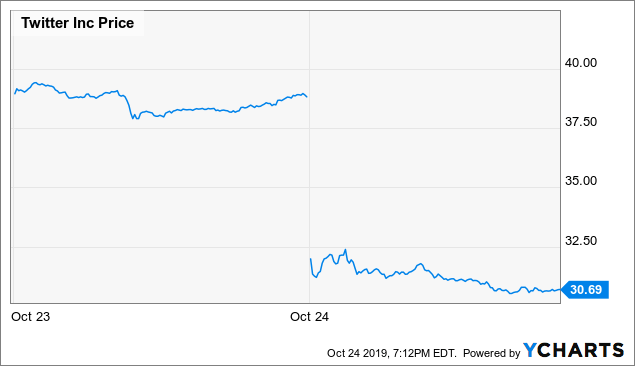
Twitter (TWTR) reported a significant miss on Thursday for Q3 2019 that sent shares tumbling 20% in one day. While the user metrics were strong with accelerating monetizable Daily Active users, the company missed on revenue that flowed through to a big miss on the bottom line. The company’s management lowered guidance as well for the rest of the year, after some product issues that weighed on advertising revenue.

Chart Data by YCharts

Q3 2019 Earnings

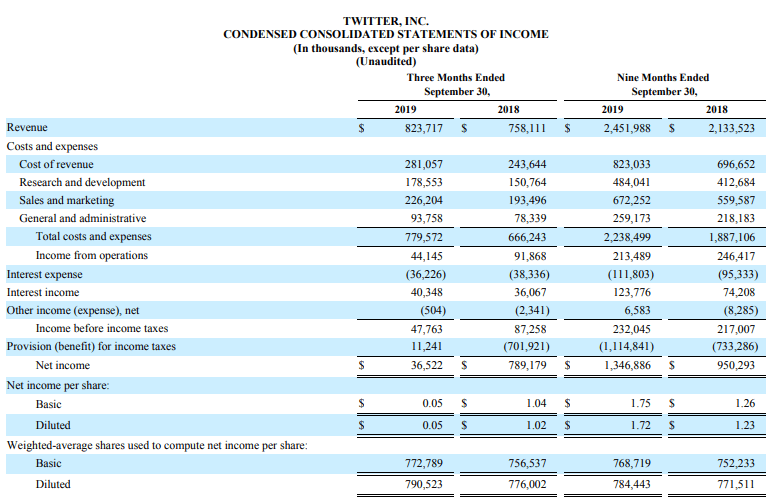
Twitter had been having a solid 2019, posting numbers in the first half of the year that encouraged investors to buy the stock all the way up to $45 per share in early September. In my last article on the company, I wrote about how the company was performing well, but I wanted to see greater revenue growth combined with improving margins before starting a position. Q2 2019 saw Twitter post a 9% operating margin, down from 11% in Q2 2018 on revenue growth of 18%. Now in Q3 the company posted an operating margin of 5%, down from 12% in Q3 2018 on revenue growth of just 9% year over year.

13 essential Twitter stats to guide your strategy

Source: Sproutsocial Blog

Simply put, with revenue growth this small, it will take a long time before the company gets anywhere close to margins like Facebook (FB), which reports Q3 2019 numbers next week. That, combined with Facebook’s consistent 25% or greater revenue growth and lower valuation, caused me to state in my previous article on Twitter that Facebook was a better stock to own for growth investors, an opinion I continue to hold today.

Twitter’s revenue this quarter was impacted by some bugs that affected the company’s ability to target ads and share data, as well as greater than expected ad seasonality in July and August. September was strong, however. Management seemed to remain positive on the Q3 conference call but stated that these problems with advertising products would continue to impact revenue going into Q4 2019. Specifically, the problems were related to Twitter continuing to use data from users that had declined to give Twitter permission. The company lowered Q4 guidance, as a result, to revenue between $940M and $1.01B (compared to $1.06B consensus), with operating margin expected to come in between $130M and $170M.

Source: Form 8-K

Conclusion

While I’m bullish on Twitter’s business model, the company evidently still has some problems to work through. The low margins relative to peers leave little room for error, as seen this quarter. The stock remains risky going into Q4, but it also leaves room for a surprise to the upside. Q4 is seasonally the strongest quarter for Twitter and online advertising companies.

Chart Data by YCharts

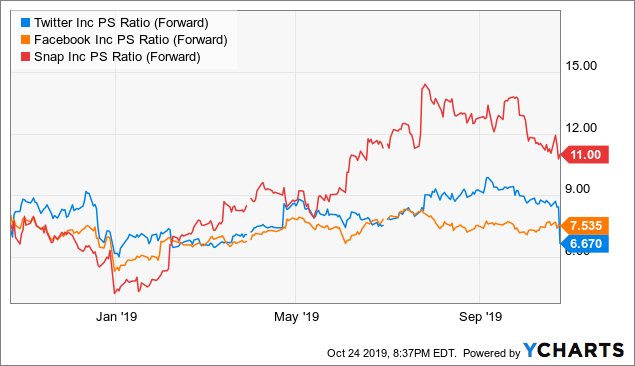
Twitter is now cheaper on a price to forward sales basis after the 20% drop compared to Facebook and Snap (SNAP), but also continues to see the lowest revenue growth. The company did, however, post higher user growth than Snap in Q3 2019.

Twitter remains a stock I’m watching closely going into 2020. This is possibly a better time to buy it than a few months ago, but it still isn’t turning the user growth into revenue growth that I need to see to justify buying this stock. In time, I’m expecting revenue growth to increase solid double-digit percentages if it can keep posting user growth like this, but the company isn’t there yet.

With companies like Facebook and even Pinterest (PINS) growing revenue much faster, I continue to prefer those stocks over Twitter. Ultimately, I remain neutral on Twitter and will be watching revenue growth rates, operating margins, and user growth through Q4 and into 2020.

By 

Sourced from Seeking Alpha

By

Twitter execs have outlined how they plan to bolster its ad business after missing Q3 revenue targets. It blamed the weak growth on bugs affecting its mobile product, which further hindered ad sales already weakened by the “seasonality” of a slow summer.

Revenues for Q3 were up 9% year-on-year to $824m. The US reported a rise of 10% to $465m, while international growth was slower at 7%, totalling $358m.

Sales fell short of the expected $874m. Growth slowed substantially since Q3 2018, when sales grew 32% year-on-year.

The results, which sent shared in the tech firm tumbling 20%, were explained by advertising “headwinds” driven predominantly by bugs in the company’s targeting system. In a letter to shareholders, Twitter explained the issue had affected its ability to target ads and share data with its measurement and ad partners.

The bugs reduced year-over-year revenue growth by at least 3% in Q3, Twitter wrote in a letter to shareholders.

Ned Segal, Twitter’s chief financial officer, explained the glitches in the legacy mobile application promotion (MAP) product meant information regarding users’ device settings was shared with Twitter for targeting purposes, even if they had asked it not to be.

“When we discovered that … we turned off the setting,” he said on an earnings call this morning (24 October). “That has a negative impact on revenue because it’s one less input you’ve got when you’re figuring out what ads to show people.”

Additionally, a bug meant Twitter was passing on data to measurement companies from users who explicitly asked not to be monitored in such a fashion.

“We stopped doing that, and although we are working on remediation, there isn’t remediation yet in place,” said Segal. “So, the effects of that will continue into Q4.”

Twitter recently faced criticism after it reported some users’ private email addresses and phone numbers had been exposed to its advertisers in a breach of its targeting system.

Aside from the technical issues, organic advertiser interest in Twitter dropped in the quarter, too. “Greater-than-expected” seasonality issues began in July and continued into August, due to what the company dubbed a “relatively lighter slate of big events” taking place when compared to the same period in 2018.

The sales slowdown occurred as Twitter continued to push its offer to advertisers on its global ‘#StartWithThem’ roadshow. The platform has a goal to double its ad business by 2020 and become advertisers’ most recommended partner.

Today, Segal outlined the company’s immediate and long term plans to bring more advertiser dollars into the business and appease Wall Street qualms.

He first stated the company will continue to actively market its platform to big advertisers. By way of example, he observed that while 38 of this year’s Super Bowl advertisers were on the social network at the same time as the game, there were eight “to whom we still need to make the case”.

“[We’re also] continuing to improve relevance, to continue to come out with better ad formats and improve versions of our existing ad formats,” he said.

He added Twitter could do a better job in monetizing smaller advertisers – an area it has not “prioritized” in the past.

“We’ve got to do the engineering work and make the case to them better than we are today, and right now we’re chosen to prioritize other things first,” he said.

Finally, he noted the Twitter ads experience could also be improved through better educating clients and working more closely with advertisers on their paid-for content.

“There’s also opportunity without selling one more ad to put better copy in the ads that exist today,” he said. “And we still have half of our video ads being served at longer than 15 seconds. As you can imagine on a service like Twitter, the completion rates for video ads that are six seconds are much better.

“That, along with continuing to improve relevance, better formats and moving down the funnel in terms of the types of advertising that’s available … are all things that ought to help us.”

Feature Image Credit: Twitter launched a consumer campaign in recent months / Jonathan Hokklo

By

Sourced from The Drum

By E.J. Samson.

A new study shows just how much consumers want brands and culture to mix

Commerce and culture have always intersected—even though it can be a fine line for brands to walk. But what surprised the research team behind MAGNA and Twitter’s new study, “The Impact of Culture,” was just how much consumers—particularly younger people on Twitter—expect and even want brands to be culturally relevant: aligning well with cultural events, promoting trends that define today’s culture and supporting social issues that benefit everyone.

Insight-rich results

Brand involvement in culture is especially important among consumers between the ages of 18 and 35, and those on Twitter versus the general population are more passionate, informed and feel more strongly about brands aligning with culture.

The study found that brands can become more relevant by embracing culture by staying current, demonstrating knowledge of consumers and giving back. When people are deciding which products and services to buy, they’re not only thinking of basics like price and quality—or even more amorphous concepts like reputation. They are also assessing just how much a brand reflects their interests and supports the issues they hold close to their hearts.

Incredibly, a brand’s cultural involvement makes up a full 25 percent of a consumer’s purchase decision. That means being involved in culture is a significant consideration when people are weighing whether or not to buy something, alongside other factors like positive brand perception, price and quality. It’s a finding that should make marketers rethink their focus and strategies, since cultural relevance can be established with one campaign, whereas other factors are relatively more intractable.

twitter1

While jumping on trends and cultural happenings in realms like sports and music are table stakes for brands, the study reveals that people want to go even deeper: Americans might love their reality TV, but survey respondents say they are more informed on issues like gender equality and fair trade than pop culture events.

What does this mean for marketers?

Go where the most leaned-in and influential people are already gathered: A key revelation of the study is that while culturally passionate consumers tend to be younger, what really sets them apart are their media habits. Social media usage is a 25 percent stronger indicator of cultural passion than age. According to our study, culture-focused ads work harder on Twitter than on other premium sites, where audiences of true tastemakers are most engaged and most receptive.

Live out the values of your customers: While there are many ways for a brand to be involved in culture, according to survey respondents, the top ways include giving back to the community, putting customers first, being inclusive of a wide audience and supporting social issues that benefit everyone.

Have a strong POV in your ads: Culture-focused ads succeed in positioning brands as relevant. They also position them as socially responsible and innovative. And they create a more memorable experience for consumers.

This new research makes a strong case for brands to acknowledge, and even actively improve, the culture that permeates all of our lives so fully. And expressing their engagement with culture on platforms like Twitter is the best way for brands to join the liveliest conversations of the day.

By E.J. Samson.

E.J. Samson is the lead content strategy manager for Twitter’s Global Business Marketing team. Follow him on Twitter @ejsamson.

Sourced from AdAge