Hindsight can be a wonderful thing, especially within a fast-growing business – if only we could see the mistakes we were making before we made them! If your business is growing at pace, here are the common challenges we’ve seen scaling-up businesses face, and our 5 key insights to help you avoid the pitfalls
The evolving proposition
Laying out your customer proposition is not a one-off project. As your business grows you get pickier about the audience you’re focusing on, and as you get closer to your customers you better learn the language that resonates with them. You also become more sophisticated in understanding where your margin comes from as you start to make money on the bottom line as well as the top. All these learnings help you to evolve your proposition which shifts your brand tone, your marketing campaigns, and often your services entirely.
Top Tip: From the start set your expectation that the proposition will evolve over time, and plan in time to review what’s working and what’s not. See any time that you invest into evolving your proposition as progress rather than thinking you got it wrong the first time – it’s all part of the journey to success!
Speed over sanity
Lots of businesses have very high expectations on the speed of growth they want, and sometimes these high expectations encourage them to fall into the trap of ‘throwing money’ at marketing.
By investing heavily in marketing there can be the belief that the more that is invested the faster the business will grow, and whilst effective marketing can obviously fuel growth it can also be where vital money gets burnt. We see this particularly with digital marketing. Don’t get us wrong, well thought out digital marketing can be spectacular in fuelling fast growth, however it’s also a precise art. Spending too much on digital marketing before truly understanding your customers or your proposition can make money magically disappear, and unlike other marketing efforts once it’s gone, it’s gone.
Top Tip: Make sure you’re happy with the ROI and conversion rates by running smaller ‘test and learn’ digital pilots before scaling up.
The customer is ALWAYS right
The brand can look and sound great, with everyone in the business on the same path, but one pitfall we often see is that an important group of people aren’t onboard with the vision – the customer. We’ve regularly observed brands not bringing the customers on the journey with them, and not validating the business proposition with customers is a real hazard to success. Scale-ups are often disrupters, ahead of the curve in their thinking, and sometimes the challenge is that the customer just isn’t ready.
Top Tip: If you’re innovating and treading new paths, remember to factor in how you will bring the customers on the journey with you before they will buy your product or service.
Brand before business or business before brand
The adage about the chicken or the egg is apt here! Businesses often fail when they invest all their energy into building a great brand but trip up over not putting the same effort into making the business model stack up – they simply run out of cash before the whole thing monetises.
We’ve also seen businesses miss out on their full potential because they focus all their efforts into running a great business, and not enough on investing in their brand (which has sometimes meant letting a friend design a logo and buying a cheap off-the-shelf website).
Top Tip: The reality is investing in both your brand and your business is where the true value lies, neither deserves a shortcut.
Vanity over sanity
It’s easy to get over excited about your success, after all you’ve seen the numbers in your forecast and this thing is going to make you the next Richard Branson…. but keep those feet on the ground! Getting your head in the clouds by hiring a highly paid CMO and a top London agency is where things can start to unravel.
Top Tip: Look for the best expertise at affordable rates. Instead of committing to huge marketing salaries consider tapping into part-time networks like The Marketing Centre. When choosing your agency shop about, reach out for referrals, and find a team that wants to come on the whole journey with you as you grow.
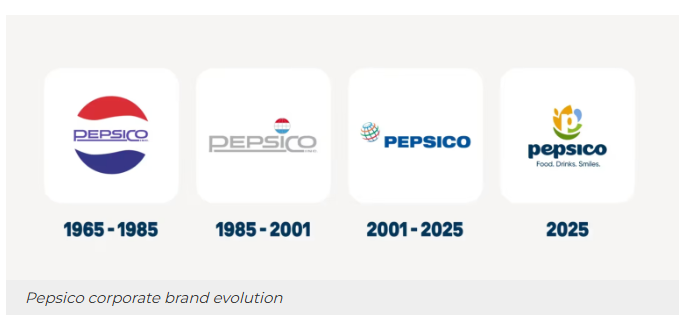
Pepsico, the global giant, already derives more of its revenue from food than drinks. Last year it launched a corporate rebrand that is designed to carefully move away from cola-centricity.
The company’s global corporate affairs boss sat down with Mumbrella this week to explain the relaunch, which will see the new logo subtly appearing on billions of packages worldwide.
For Stephen Kehoe, Pepsico executive vice president and chief corporate affairs officer, the key constraint of his company’s corporate branding is also its biggest strength: “Pepsi”.
Solving that particularly devilish problem — maintaining the brand power but moving beyond the fizzy drink — has been the focus of the food giant’s first corporate rebrand in more than two decades.
”Obviously 25 years ago, we were a company steeped in beverages,” he told Mumbrella.
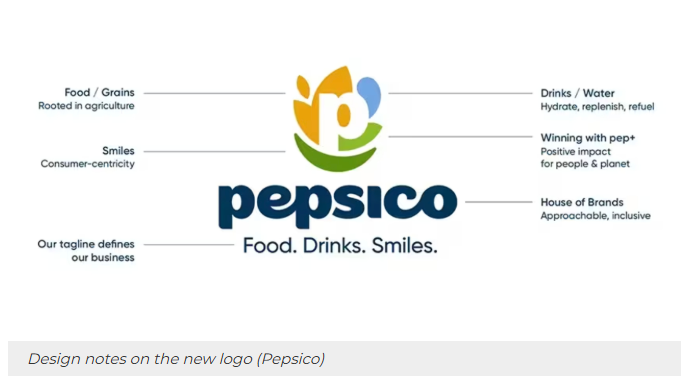
“Today we’re primarily a foods company. Second largest food company on the planet, largest food company in North America. We are steeped in agriculture, 60 crops, 30 countries around the world, localized production, involved in farmers …the old Pepsico way of looking at the logo didn’t really speak to all of that in a way that came across.
“All of that” is a lot.
Pepsico’s global revenues were US$94 billion last year, from sales of more than 500 food and drink brands. That places it behind only Nestlé (around US$115b revenue) in terms of the packaged food and drink market.
As Kehoe points out, the majority — 58% — of Pepsico’s revenue now derives from food, including products from big global brands such as Lay’s, Doritos, Quaker and Cheetos.
Local Pepsico food brands include Australian favourites such as Smith’s and Twisties.
Kehoe mentions how the new logo, which is styled all lowercase, seems to take the emphasis off the “Pepsi” brand recognition. On closer examination it seems clear the omission of Pepsi’s defining red, white and blue in the colour scheme is also significant.
“[The old logo] was very much dominated by one particular brand in our beverage portfolio, Pepsi, and whilst we’re extremely proud of that heritage and will never want to let it go, it doesn’t speak to the overall company who we are today.”
The logo redesign work was done in-house, with brand senior design director Marco Escalante credited as the lead creative.
A question of strategic positioning
Kehoe declined to comment on his company’s long-time rivalry with Coca-Cola. The latter company remains squarely focussed on beverages, and is around half the size (US$48b global revenue).
“Our brand proposition only being linked to the fortunes of the beverages industry is a self-limiting proposition,” he said.
Kehoe seems focussed on building that brand proposition with regulators and the company’s 320,000 employees first. Pepsico as a house of brands for consumers would be a much more gradual build.
“For those of us that spend more time than others talking to policymakers, governments, regulators and all of this, I think this is a powerful new way of representing the company,” he said.
”It’s been a very quiet, understated launch to start to get the brand out there. And we hope through putting the logo on all of our packs around the world, consumers will begin to associate the name with the brands that they love and that will over time increase the overall halo and reputation for Pepsico itself.”
The spectre of advertising regulation
Kehoe was measured in discussing regulatory interventions targeting junk food advertising — for example, South Australia’s ad ban on government properties.
“Banning ways in which we can communicate to consumers is probably not the long-term solution in all of this,” he said.
“ It’s much more around the provision of transparent information about what’s in the portfolio, allowing us as a company to continue to innovate and reformulate, as we have over the years reduced the amount of salt within the portfolio, a switch to healthier oils reducing the amount of sugar.”
In a slightly different context — the question of his long-term outlook — he made a case for choice.
”I believe in the average human being’s ability to make rational, intelligent decisions for themselves and their families,” he said.
Macro economic conditions
Given the signs in Australia of a retail downturn, Mumbrella asked Kehoe his opinion of the general economic environment.
”It’s certainly a challenging moment,” he said.
“It’s an economy of two halves. You’ve got the affluent who continue to do very well, and then you’ve got at the other end of the spectrum, people who are finding it very difficult to make ends meet.
“You can see that actually reflected within the Pepsico portfolio itself … certain aspects of the portfolio continue to grow very well, which tend to be the more premium products like Red Rock Deli here in Australia … people are willing to pay for products that they perceive are healthier for them.”
So how will he know the relaunch has been a success? What are the core KPIs?
“Number one is people’s awareness that we are a food company as well as a beverage company,” he said.
“And then secondly … if people are able to name three, four brands which are part of the Pepsico portfolio and not just one or two.”
“We’re doing something which really is about making sure that people understand that Pepsico, the mother company, is one that has a real, deep voice to play in some of the biggest existential problems and challenges that we face in the world today.”
Note on house style: Mumbrella follows standard capitalisation in company names (for example, “Pepsico” rather than “PepsiCo”) except where non-standard capitalisation is required for legibility.
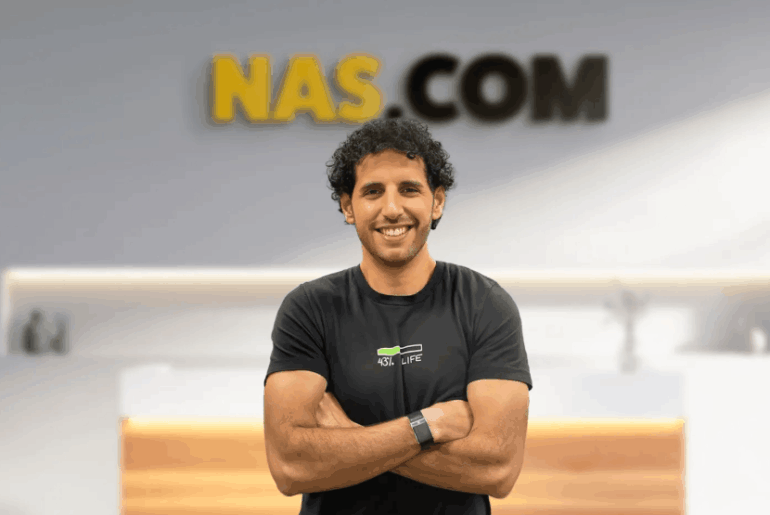
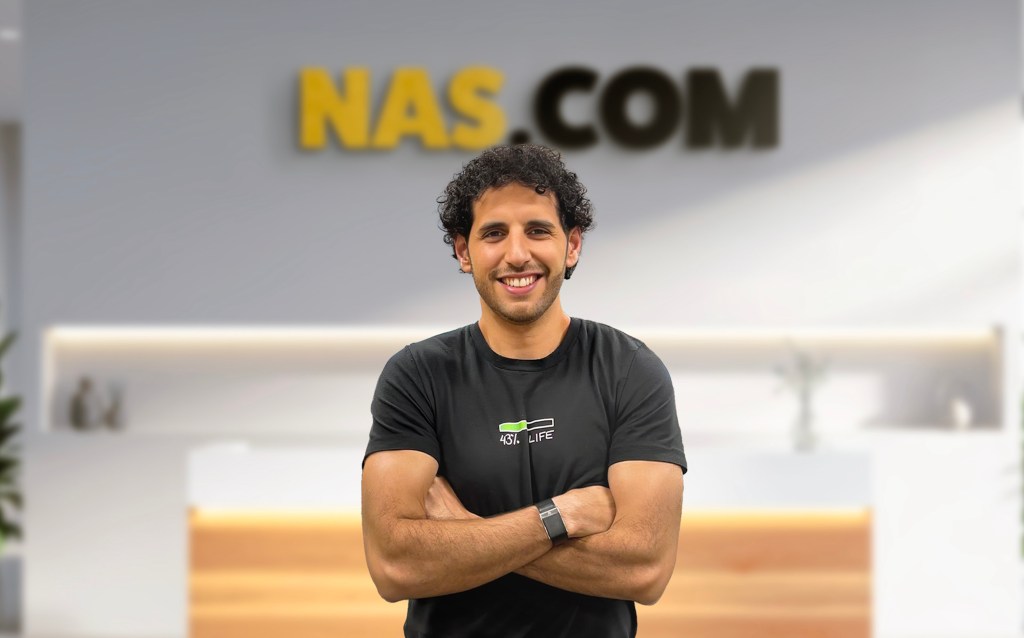
Nuseir Yassin is the founder and CEO of Nas.com, an AI-powered platform that helps solo entrepreneurs launch online businesses from a single product photo.
Yassin left his software engineering job to travel and create Nas Daily, a one‑minute video series he produced daily for 1,000 days.
With Nas.com, he is productizing his storytelling and growth experience into tools that automate storefront creation, marketing content and ads for small business owners.
Yassin is the founder and CEO of Nas.com, an AI-powered startup designed to help solo entrepreneurs start and grow their online businesses with a single product photo. Yassin studied economics and computer science at Harvard University, graduating in 2014. He started his career as a software engineer at Venmo.
In 2016, Yassin left his job to travel the world and document his experiences, launching Nas Daily, a one-minute video series that he sustained for 1,000 consecutive days and grew to a global media brand.
That venture into content creation, spanning 19 languages and multiple social networks, gave Yassin deep insight into storytelling, audience growth and digital marketing. With Nas.com, he is turning those lessons into software. The platform, which he founded in 2022, automatically builds storefronts, generates high‑performing marketing content and runs ads for creators and small business owners, lowering the technical and marketing barriers to solo entrepreneurship.
The following interview has been edited for clarity and concision.
Nuseir Yassin. Credit: Nas.com
Pitching Nas.com
For someone who’s never heard of Nas.com, what’s the most concrete way you explain what it does for a solo seller in their first week?
In the first seven minutes, you take a picture of whatever you want to sell, and we handle everything else to help you find a customer to buy that thing. With that one picture, AI creates your store, makes your marketing, and helps you find the customer.
It really comes down to three main things: you can sell any product you want, market the product, and get paid. You upload a single picture of whatever you want to sell—yourself, your products, your candles—and AI automatically creates your product page, sets pricing and options, writes the content, and can even generate a video. With one click, you can market that product on Instagram and Facebook directly through Nas.com. We’ve simplified what used to be three difficult skills—coding a website, creating content and doing performance marketing—into one simple interface to create more entrepreneurs in the world.
His content background
You have a decade of experience creating content. How successful were you?
Across the internet, Nas Daily reached about 70 million followers and more than 20 billion views. We have around 5 million followers on TikTok and 55 million on Instagram on the Nas Daily channel. I built Nas Daily across virtually every social media channel and many languages: Nas Daily Arabic, Nas Daily Indonesia, Nas Daily Spanish, and more — 19 languages and six platforms in total, with about 70 million followers overall. It became a great lifestyle business, but I realized the bigger opportunity is being the platform for others rather than being the influencer.
What did it take to get that many followers?
It felt like eating glass. I made 1,000 videos in 1,000 days straight, which is where the name Nas Daily comes from. Each video took about 15 hours to make, and I produced them from 64 countries. The first 270 videos failed, and it was video 271 that finally broke through. To get attention and build a social media following, you need an irrational work ethic and passion. I don’t recommend it for everyone; at a certain level, it becomes a security concern and isn’t necessarily a healthy way to live. What I do think is for everyone is building a business and working for yourself.
What kind of content did you put out in those 1,000 videos?
I travelled around the world focusing on whatever was interesting about people and places. I looked for the most interesting people—founders of companies, people doing crazy or inspiring things—and made videos about them, plus personal stories. For example, I did a video in Bhutan about it being one of the most romantic countries, showing a nation that’s one of the least visited in the world. Another video covered the woman founder of Miami—Miami is the only major U.S. city founded by a woman—and others included a video about my friend’s death and my experience with Wikipedia. “Nas” means “people” in Arabic, and the channel was really about everyday people.
Origin story of Nas.com
How did you get the idea for Nas.com?
While building Nas Daily, I met roughly 100,000 people in person. I saw in many of their eyes that they hated their jobs and lives and had a constant desire to do something different, work for themselves, and control their own schedules. I’d already experienced the difference that working for myself made in my life; at Venmo, I was overpaid and underworked—I worked about four hours a day and made over $100,000—yet felt no meaning or passion. When you work for yourself, your life changes, and I wanted others to experience that. Helping them build their own businesses felt like the starting point.
What did it take to leap from content into an AI‑driven business with generated ads and storefronts?
We’re careful not to send the message that this is “easy money.” If you think one click of AI will create everything and you’ll just sit there printing money, that’s not our positioning. Our message is: life is better when you work for yourself, and now technology can help you do that through this business platform. It still takes work to build a business; it’s still hard, but it doesn’t have to be as hard as it used to be. In the past, it could take two months to start selling online; now it can take as little as five minutes. You can take a picture, start a free trial, and accept payments within about ten minutes.
Nas.com has created millionaires
How many new entrepreneurs has Nas.com created so far?
We’ve had hundreds of thousands of people express interest in building a business. We have tens of thousands of paying users running active businesses on the platform. The big success is that we’ve created four millionaires on the platform.
Could you tell me a success story?
One big success story is a woman in Singapore who teaches financial advice under the brand “Singapore Budget Babe.” She monetized her financial knowledge on the platform and made over a million dollars. Another story is a 60‑year‑old farmer in Mexico who wanted to build a business teaching farming; he now makes about $1,000 to $2,000 a month on Nas.com. I consider that an incredible success because technology used to gate people like him out, and we’ve made it simple enough for him to participate.
Those four millionaires you mentioned — what industries are they in?
They’re in very different industries: one in events, one in education, and one in fitness, among others. The beauty of Nas.com is that you can sell almost anything. We support all types of products: physical goods like candles and cookies, events (for example, meet‑ups after you’ve sold 1,000 candles), memberships (such as 20 dollars a month to join a network), and coaching (like teaching others how to make candles). Our users all share one thing: they want to work for themselves as solo entrepreneurs, but they monetize in many different ways.
Finding customers and marketing
How do you help sellers find customers?
It’s all about integrations. We help you create the content and then we help you run ads. For example, for a “Dubai Entrepreneur Networking Night” event, a user spent about $200 on ads we ran on Instagram and Facebook. That resulted in 32,000 views, 971 page visits, and 130 ticket buyers. We aim to be your marketing arm across channels like Meta, TikTok, Google, and eventually Amazon listings, which would otherwise be too complicated for most people to manage on their own.
How do you determine what goes into an ad?
We have 10 years of experience creating content and understand what makes a good or bad piece of content. We’ve turned that experience into programmatic “styles” that tend to perform well. For example, if you’re selling a candle, we might create a UGC‑style or unboxing‑style video. We know the script should begin with something paradoxical or superlative—“the best candle,” “the worst candle,” “the healthiest candle,” “the coolest candle”—and we generate that script using AI, guided by our internal rules about what makes a strong ad. This kind of automation would have been impossible five years ago, but AI now allows us to generate effective ads quickly.
So you create the ads using AI?
Yes, the ads are all AI‑generated. As of two weeks ago, AI has gotten good enough that the average person often cannot tell the difference between an AI‑generated ad and a human‑made one. I expect that by the end of the year, about 90% of AI ads will be unrecognizable as AI to 90% of humans.
Pricing and competition
How much does it cost to use the platform?
Pricing ranges from as low as $10 a month to up to $99 a month, with an average of about $30 a month. For roughly $1 a day, you get your own website, payment processing in every country, AI-generated marketing content, the ability to list unlimited products and ownership of your customers.
How does the company make money?
We make money through subscriptions, a small cut on marketing spend and a small cut on some transactions. If you advertise $100 through our platform, we take about $5. We also take about 1% on some transactions, but we charge 0% on physical products because we want to be competitive as an alternative to Shopify, at least for now.
Is Shopify your main competitor?
Essentially, yes. Shopify is an amazing $150 billion company, but it doesn’t work well for new entrepreneurs. It’s too complicated and doesn’t help you with marketing. The entrepreneur’s priorities are: first, product; second, content; third, marketing — using that content somewhere. Shopify focuses mostly on creating the product store, whereas we focus on helping you create content and then market it. Many Shopify users have a store but don’t know how to get traffic to it, and that’s what we aim to solve.
Growth, traction and fundraising
How many people are on the Nas.com team, and where are they based?
We’re about 40 people. Engineering is based in Singapore, and marketing is based in the United States, and I’m the founder and CEO.
How much did it cost to start the company?
A lot. We’ve raised a total of $40 million, including $27 million in the round we’re now announcing. Building technology is very expensive if you want really good engineers, but I believe the opportunity is in generating billions of dollars’ worth of value in the form of new businesses on the internet.
How much in sales did the company do last year, and what is it projected to do this year?
Last year, we started at about $1 million in annual recurring revenue (ARR) and ended at around $8 million in ARR.
How Nas.com grows
What tactics do you use to grow Nas.com?
We grow Nas.com using Nas.com. We market Nas.com with Nas.com because we’re also a business on our own platform.
Can you give an example of that?
In Mexico, we run an operation called ECO Mexico by Nas.com. We built that business on Nas.com and sell a product called “Build your own e‑commerce in 2 hours.” Around 4,000 people signed up for it and came to events where we introduced them to Nas.com. We found those people by marketing ECO Mexico through Nas.com itself, and we host workshops and events for potential new customers to try the platform and build their businesses on top of it.
How do you market these products and campaigns?
We create different events for different campaigns in different markets. Inside my own Nas.com account, I have hundreds of businesses I’ve started — Miami Social for Miami entrepreneurs, an education business, internal company businesses, and even a clothing business where I sell my t‑shirts. In the clothing business, I have about 200 members and made around $3,000 selling t‑shirts as a test, with the revenue going to my bank account every two weeks.
Nas.com’s value proposition to investors
What about the company was attractive enough to draw investment from someone like Vinod Khosla?
Vinod is one of the biggest champions of entrepreneurs I’ve ever met; he truly cares about the “small guy” and “small girl” who just want to work for themselves. He understands our mission and sees that existing solutions are too complicated and B2B‑oriented. Shopify, for example, is built for companies like Apple or Tesla, not for a mom in Wisconsin who wants to sell her creations. Vinod believes AI will make everything accessible to the “little guy,” and Nas.com is explicitly designed for that user.
Advice for founders and entrepreneurs
What hard, concrete advice do you have for founders?
I hope you enjoy eating glass. I hope you enjoy doing hard things. Starting a media company or a channel is difficult, and starting a technology company is difficult. More generally, building something out of nothing is hard — whether it’s a human giving birth to a baby or a founder giving birth to a company. My advice is to “choose your hard,” because whatever you do will be hard.
What makes the road to entrepreneurship easier?
AI will make it easier, and I believe that 100%. If you couldn’t speak English before, now AI can help you communicate in perfect English; if you couldn’t make content, now you can. If you couldn’t do marketing before, AI can help you market. But it still won’t be a walk in the park.
When it comes to this specific business, what have you found particularly surprising?
I’m most surprised by how fast technology has advanced in the last three years. What used to take me 15 hours per video felt like an irreplaceable skill set, and I thought no one else would have access to those capabilities. Now AI can replicate much of that in seconds. Technology has evolved so quickly that if a company “sleeps” for a month, it can find itself out of business.
Sherin Shibu is a business news reporter at Entrepreneur.com. She previously worked for PCMag, Business Insider, The Messenger, and ZDNET as a reporter and copyeditor. Her areas of coverage encompass tech, business, strategy, finance, and even space. She is a Columbia University graduate.
Canva’s State of Marketing and AI Report 2026 finds that 97% of marketing leaders use AI daily and 99% plan to increase spending, but 78% of consumers still prefer human-made adverts and 87% say the best advertising requires a human touch. Mentions of “AI slop” have risen ninefold, and consumers want disclosure (52%), data protection (53%), and the ability to opt out (37%). The report was published alongside Canva’s expanded partnership with Anthropic, integrating its design engine into Claude for Small Business.
Nearly every marketer in the world is now using AI to make creative work. Nearly every consumer would still rather that a person had made it. That tension, between the industry’s enthusiasm and the public’s unease, is the central finding of Canva’s State of Marketing and AI report for 2026, and it suggests that the harder problem in AI-assisted marketing is not production. It is permission.
The numbers are stark on both sides. Ninety-seven per cent of marketing leaders surveyed say they use AI in their daily creative work. Ninety-nine per cent plan to increase their AI investment this year. But 78% of consumers say they would rather see adverts made by people, even if AI could produce better ones, and 87% believe the best advertising still requires a human touch. The report, based on surveys of 1,415 marketing leaders at organisations with 500 or more employees and 3,547 consumers across seven countries, captures an industry that has adopted a technology faster than its audience has learned to trust it.
The disclosure question
The trust gap is not abstract. Consumers are increasingly specific about what would close it. When asked what would make them more comfortable with AI in advertising, 53% cited data protection, 52% cited disclosure of AI use, 39% wanted assurances that AI is not replacing jobs, and 37% said they would like the ability to opt out of AI-generated adverts entirely. The demand for transparency is sharpened by a growing awareness that the line between human-made and machine-made content is dissolving: 70% of consumers believe it will eventually be impossible to tell whether an advert was AI-generated without disclosure, and 56% expect that threshold to arrive within two to five years.
The finding reframes a conversation that has, until now, been dominated by capability. Marketing teams have spent the past 18 months asking what AI can do. The report suggests their audiences are asking a different question: whether they were told.
The slop problem
The quality concern has also acquired a name. Mentions of “AI slop,” the colloquial term for low-effort, visibly machine-generated content, have increased nine fold in media monitoring data, according to the report. Forty-one per cent of marketing leaders say it is already a considerable challenge. Seven in ten consumers say AI-generated adverts feel like they are missing something, a response that may reflect not a rejection of AI itself but an instinctive detection of the gap between content that was made and content that was generated.
The paradox is that the same technology driving the slop problem is also the only plausible route to solving it at scale. AI makes it trivially cheap to produce mediocre creative. It also makes it possible to personalise, test, and iterate at speeds that no human team could match. The distinction between the two outcomes is not the technology but the standards applied to it, which is to say, it is a management problem dressed in engineering clothes.
What marketers are actually doing
The report finds that 68% of marketing leaders say AI has led to an increase in marketing-influenced business decisions, suggesting the technology is not merely accelerating production but reshaping how teams allocate resources and measure impact. The investment trajectory is almost vertical: from 94% of marketers investing in AI in the 2025 edition of the same survey to 97% actively using it daily this year, with near-universal plans to spend more.
The timing of the report’s release is not incidental. Canva published it on the same day it announced an expanded partnership with Anthropic, integrating its design engine into Claude for Small Business, a product that allows small business owners to generate on-brand marketing campaigns directly through Claude’s AI assistant. The integration connects to each user’s Canva Brand Kit, so that generated assets automatically use the correct fonts, colours, and visual identity. It is, in effect, the infrastructure for exactly the kind of AI-assisted creative work the report describes, targeted at the millions of small businesses that lack dedicated marketing teams.
The Canva-Anthropic partnership had already seen usage grow fourfold in March 2026 following a January expansion that made Claude the first AI assistant capable of generating on-brand designs through a simple prompt. The new integration extends that capability into a broader suite of business tools including QuickBooks, PayPal, HubSpot, DocuSign, and Google Workspace.
The trust economy
What the Canva report captures, perhaps inadvertently, is the emergence of trust as a competitive variable in marketing, not between brands and consumers (which is old), but between AI-assisted brands and consumers who know the assistance exists (which is new). The 78% of consumers who say they prefer human-made adverts are not necessarily saying AI is bad. They are saying they value the knowledge that a person chose to make something, that creative decisions reflect intention rather than optimisation. Whether that preference survives a generation raised on AI-generated content is an open question. But for now, it represents a constraint that the industry’s adoption curve has outrun.
The marketers who navigate this well will likely be those who treat AI disclosure not as a compliance burden but as a brand signal, a way of saying: we used the tools, and we used them deliberately. The ones who do not will contribute to the nine fold increase in slop, and their audiences will notice, even if they cannot always articulate why.
Your domain says a lot about your brand, long before you meet with a potential client or customer. It’s an asset that can quietly appreciate over time. Here’s what it tells the world about your brand and why it matters.
Your domain name is one of those brand assets that quietly does a lot of heavy lifting and often gets ignored. Long before anyone reads your messaging, watches your demo or clicks through your site, they’re already sizing you up based on that URL alone. Whether you’re reaching out to investors, running paid ads or cold emailing a prospect, the domain tied to your brand is doing much of the heavy lifting. Sometimes it’s helping you. Other times, it’s costing you trust, clicks and credibility.
Here’s what your domain is quietly telling the world before you ever get the chance to explain who you are.
Your domain extension is a trust signal
People gravitate toward .com without giving it much thought. It’s what they know, and it feels dependable, recognizable and easy to recall. Punch in a brand name, and .com is usually the first stop. That reflex has been wired in for years, and it’s not going away. When a business locks down the .com version of its name, it instantly feels more established, especially to audiences outside the tech bubble. And, the right domain has the potential to add millions in brand value to your business over time.
That said, extensions like .io, .ai, and .co definitely have their moment, especially in tech circles where they’ve become a kind of digital badge for startups. But step outside that bubble, and the questions start to creep in. Like, why does the brand not own a .com? Was it already reserved by another entity, or did they just want to pay less for a generic domain? Why doesn’t the brand own the .com? Was it already taken, or did they just not want to pay for it?
These might seem like small concerns, but they can quietly impact everything from response rates to press coverage and user trust.
Short domains speak loudly and leave no doubt
There’s a reason the strongest domains keep it short. They’re easy to remember, quick to type and instantly feel sharp. A single word or a tight brand match doesn’t just look polished; it shows intent. It tells the world this brand knew what it wanted and didn’t wait around to claim it.
Long or hyphen-filled domains hit differently. They can come across as patched together or short-term fixes. It might not be a fair judgment, but people read into it, and perception has weight. If someone has to pause to figure out your email address or double-check your URL, you’ve already made them work too hard.
Some founders shrug off domain quality, saying, “We’ll upgrade down the line.” But that line keeps moving. All the while, content is being added, links are being built, and, more importantly, trust is being assigned to a domain that doesn’t have long-term value.
The connection between domains and brand identity
Beyond trust and professionalism, your domain can signal scale, ambition and industry position. Let’s take a few examples.
A company using “getbrandname.com” or “trybrandname.com” may be signalling that they couldn’t acquire the exact match. That can work in early-stage situations, but once the business matures, the lack of a core domain can be a red flag to partners, investors or media.
Adding a location to your domain like “brandnameNYC.com” or “brandnameUK.co”—can work in certain cases, but it also sends a message: this brand’s focus is local. If the goal is to scale beyond your starting point, your domain needs to match that mindset. Investors notice this, and a regional-sounding URL can make a global vision feel much smaller than it should.
Domains impact perception
Imagine two startups viewed side by side online from their domain perspective. One is using a simple name like hedge.com, and the other might be using a domain like hedgly.app. Which one is more impactful? Often, you know before you even click.
Now put yourself in the shoes of a reporter, an investor or a potential partner. If you’re deciding who to respond to, who to feature, or who to trust with your money, these tiny differences in perception start to matter. You may not consciously know why one feels more legitimate than the other but the domain plays a big role.
I’ve seen deals delayed due to email confusion caused by lookalike domains. I’ve also seen ad performance drop due to weak domain names that didn’t inspire confidence. And I’ve seen businesses pay ten times more for their domain after scaling because they waited too long to secure it.
You don’t need a perfect domain, but you do need a strategic one
Not every business needs to own a single-word .com. But every business should think strategically about the message its domain sends. Is it memorable? Is it easy to say aloud? Does it match where you’re going, not just where you started?
If the answer is no, it may be time to rethink what your domain is doing for, or against, your brand. Whether you’re pitching investors, running ads or growing an audience, your domain name shows up everywhere your brand does. Make sure it’s pulling its weight.
Michael Gargiulo, the CEO and founder of VPN.com, helps brands and businesses secure the best domain possible for their vision. Having spent nearly $1 million to acquire VPN.com, he understands the value of owning the category-defining domain name for your industry. Find out more at vpn.com/domains
WASHINGTON — Meta and Google enlisted trusted children’s brands such as Sesame Street, Girl Scouts and Highlights magazine to teach kids to use technology in moderation — even as the companies designed apps that made it difficult for those same young users to unplug, public statements and internal documents show.
Backed by tens of millions of dollars from the tech giants, these organizations delivered lessons about personal responsibility to hundreds of thousands of children and parents, using colourful magazines, popular characters and catchy songs, according to public statements.
The tech giants designed apps that made it difficult for those same young users to unplug, public statements and internal documents show.Syda Productions – stock.adobe.com
The partnerships also weaken trust in decades-old institutions families have relied on for advice on raising kids, parent advocates said, at a time when the tech giants are facing down multiple lawsuits accusing them of designing addictive products that harmed youth mental health.
The first case to reach trial ended with a $6 million judgment against the two companies.
“It’s like Sesame Street teaming up with Philip Morris to teach kids how to smoke cigarettes safely,” said Rose Bronstein, whose 15-year-old son died by suicide after he was bullied online. “How is it any different?”
Meta and Google’s properties generate billions of dollars in advertising revenue from businesses marketing to minors. That economic incentive, critics say, makes it difficult for the companies to offer unbiased guidance on screen use.
“Their very business model relies on maximum time on device,” said Emily Boddy, co-lead of US Smartphone Free Childhood, a parent group that advocates against phones in schools. “Their guidance or advice can’t be neutral, and we see that it’s not.”
Corporations, ranging from soda companies to the tobacco industry, have long made donations to “trusted institutions” to improve their reputations, said Nora Kenworthy, a public health researcher at the University of Washington Bothell.
“It’s very much a reputation management strategy,” Kenworthy said.
Sponsorships extend across several brands
Reuters reviewed thousands of pages of company documents made public through lawsuits, along with company-sponsored educational videos and lessons.
The documents reveal that Meta’s strategy to partner with outside groups to promote positive messages about technology began several years ago as criticism of the apps started to proliferate.
In a 2018 draft document, internal user experience researchers deliberated how to respond to accusations that social media companies were “designing addictive products that can harm well‑being.”
Researchers proposed asking external experts to identify Facebook features that could have a negative effect on users over time.
In a 2018 draft document, internal user experience researchers deliberated how to respond to accusations that social media companies were “designing addictive products that can harm well‑being.”Davide Angelini – stock.adobe.com
Among their list of ideas, they wrote: “Form an alliance where the third party can vouch for the thoroughness and relevance of our approach for targeting the ‘addiction’ claims.” In a statement to Reuters, Meta said it did not act on that idea.
The companies did establish relationships with numerous brands. Google sponsored Sesame Street, Highlights and Girl Scouts. Meta also sponsored Girl Scouts.
Some of the materials promoted by Meta and Google do include digital safety instructions, children’s media researchers said, including reminders to set strong passwords and avoid scams.
The companies declined to say what they paid these organizations. But in a 2024 statement, Google pledged to spend at least $20 million supporting groups that promote “digital well-being,” including Highlights Magazine and Sesame Workshop.
“We prioritize the well-being of our youngest users by building industry-leading safeguards and putting families in charge of their digital experiences — any suggestion otherwise is simply wrong,” a Google spokesperson told Reuters.
Sesame Workshop said Google had no control over its digital well-being educational materials, adding in a statement that Google executives gave advice “prior to the start of content development.” Child development researchers, parents and caregivers weighed in on the materials themselves, Sesame said.
Meta said in a statement it had a limited role in designing the Girl Scout materials, but said it was proud of its work with experts in online safety. The company often works with academics to study negative use of the platform, a spokesperson said.
Highlights Magazine declined to answer specific questions about its Google partnership. Spokesperson Melanie Bay said the magazine designs products to help kids “make thoughtful choices.”
Merit badges for using tech
The Girl Scouts’ digital safety curriculum, sponsored by Meta’s Instagram, requires that girls complete age-specific lessons to earn a “digital leadership” badge.
One part of the curriculum aimed at middle-school-aged scouts instructs girls to track their screen time. Girls are then challenged to “create digital content to support a topic” they care about.
The Girl Scouts’ digital safety curriculum, sponsored by Meta’s Instagram, requires that girls complete age-specific lessons to earn a “digital leadership” badge.
Last year, Google began sponsoring its own Girl Scouts patch, called the “Be Internet Awesome Fun Patch,” tied to the company’s digital literacy curriculum. Girls learn about being kind online, using strong passwords, and keeping personal information private.
The patch, available on the Girl Scouts website, features its logo, as well as Google’s.
“It’s almost priming them to desire to get on social media once they reach the minimum age,” said Brendesha Tynes, a children’s media researcher at the University of Southern California.
Girl Scouts did not respond to multiple requests for comment.
Smartphone sleeping bags
Google also paid Highlights magazine at least $5 million. A 2024 special edition sponsored by Google includes instructions on how to make a “sleeping bag” to store devices overnight.
“Before you shut down for the night, put your device to bed,” the magazine says.
The activity makes it appear normal for Highlights readers — who range in age from six to 12 — to have smartphones at that age, seven parents who advocate for tech restrictions told Reuters after reviewing the magazine.
Google paid Highlights magazine at least $5 million.Christopher Sadowski
Google provided an extra 250,000 copies of the special Highlights edition to organizations such as Save the Children and Reading is Fundamental.
In a statement, a Google spokesperson said the company’s internet safety curriculum is “accredited and reputable,” adding that Google worked with safety organizations to design it.
One of those organizations is the Family Online Safety Institute, a non-profit that receives the majority of its revenue from tech companies, including Google. Meta is not a member.
The institute said in a statement that they reviewed the curriculum before launch.
Some consequences addressed
The lessons sponsored by Google and Meta addressed some of the apps’ effects on kids, four children’s media researchers and paediatricians told Reuters.
Meta’s sponsored Girl Scouts curriculum for middle schoolers addresses how companies take user data to sell products or “influence you online.”
A Scholastic worksheet sponsored by Google asks kids to practice what to do if they get a pop-up message that says, “You’ve won a free smartphone! Click here to get it!”
I’ve used this strategy to add an additional $30,000 in closed sales to my business in less than a week, and it can work for you, too.
One of the hills I’ll die on as a business owner and person who’s helped more than 1,500 people grow their business on LinkedIn is that polls are the most underrated sales tool on LinkedIn.
I hate cold outbound DMs and I’ve built most of my business on inbound conversations because of it. Polls are a happy medium because prospects volunteer information, so I can customize my outreach to them.
Polls slide under the radar—they aren’t even an official category of post on the activity section of LinkedIn’s profile feeds—but if you use them correctly, they can be a massive sales booster.
Here’s the system I use to predictably turn a one-click vote into revenue.
When to use a LinkedIn poll
I run polls roughly quarterly in one of three scenarios:
When I’m scoping a new digital product or service offering and I need to do audience research or fill a beta round.
When inbound inquiries are quieter and I need to fill up my pipeline with qualified people easily.
When I sense the market has shifted and I want confirmation of my hunch if no public polling data or reporting exists
The best type of poll question to ask
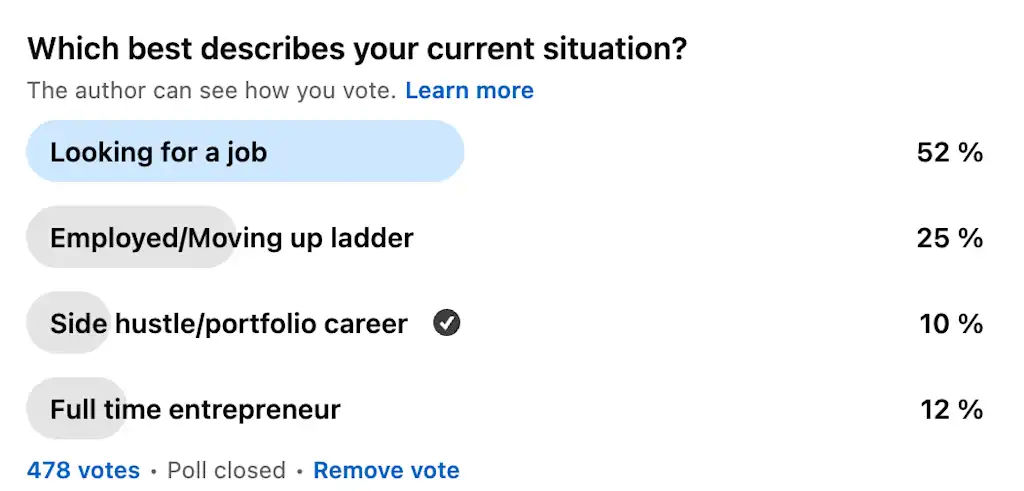
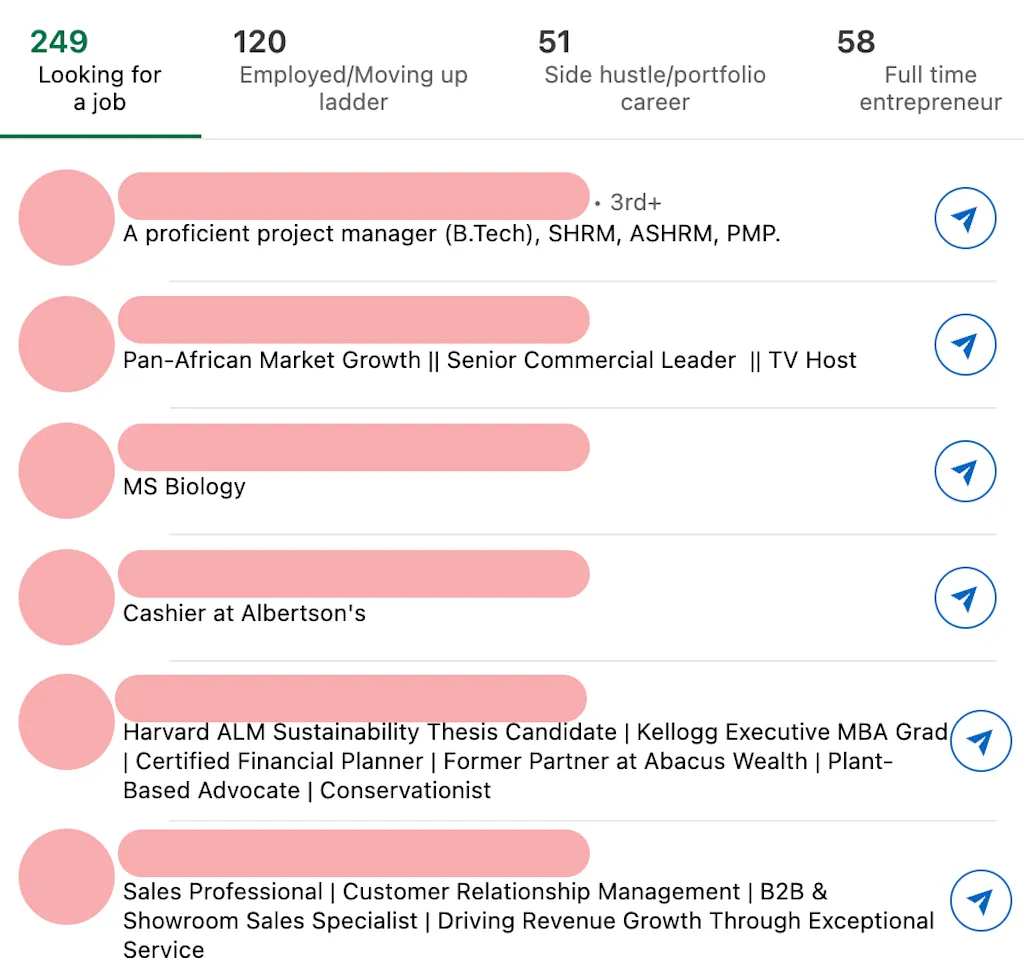
The best type of poll to run is a segmentation poll that groups your audience into different buckets. That way, you can start a conversation with your audience about pain points they’ve already told you they have and you can design content and offers specifically around those pain points or states.
An example of a 72 hour poll I recently ran on LinkedIn.
DM qualified prospects in your audience
You only have so many hours in the day, so you want to start with people who are likely to pay you more money. Although it’s a much smaller segment of my audience, the majority of my five-figure one-to-one clients come from the “employed/moving up” bracket or the “side hustle/portfolio career” bracket.
These people are more financially stable and they stand to make far more than I charge in working together, so it’s an easy investment for them. If you can be online and messaging people within a few minutes of them voting, I highly recommend it.
LinkedIn lets you DM all of your poll respondents.
I don’t message every voter. I scan the list and pick only the people who fit my ideal customer profile. Talking to everyone is how you waste your week and tank your reply rate. Talking to the right 100 voters out of nearly 500 is how you make money.
Logistically, you also don’t want to send too many messages in a day (I max out at 40) to avoid LinkedIn thinking you’re automating your activity.
If someone’s not a connection, I send them a connection request first with this message: “Thank you for voting in my poll. I have a free resource I’d love to send you to help you with [outcome].”
Once I start chatting with my highest value people, I then work on the people who will purchase my one-off services, courses and digital products. I have options between $27 and $1497 so I can meet people where they’re at financially.
How I structure my follow up message
My follow-up message does three things.
I thank the person for voting and being part of my community
I ask a follow-up question tied to the option they picked
I send my best free resource with a link to a landing page related to their problem
Almost everyone responds to me because I give them three-value based ways to engage with me and keep the conversation going. Most people also opt-in, which means I get their email, more market research, and a lead all in one exchange.
I then go back and forth with the chattiest people via DM and if I see an opportunity to get on a call with them, I do. If I think the person needs a call or I’m not sure they’ll be a fit, I start with a paid $250 Career Power Hour where I’ll help them with a specific career outcome, and if they’re interested in more help, I roll that initial investment as a credit into their package.
How to write the post that accompanies your poll
People answer polls when they’re curious about the answer or they feel like there’s a net positive to answering, not when a poll feels extractive.
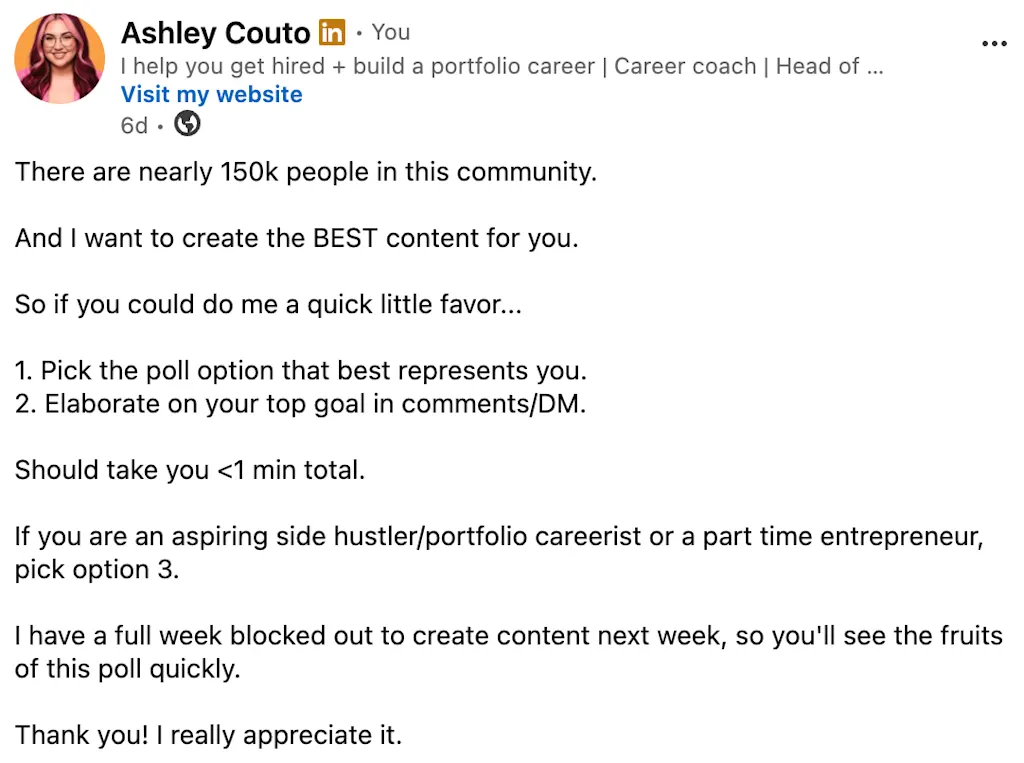
I tell my audience I want to make better content for them and need less than a minute of their time. Both of those things are true. I have no interest in posting about promotions for half the week if the majority of my audience is unemployed.
I also always leave a CTA to comment or DM. Most voters won’t comment, but the ones who do leave me something genuine are high intent, same with the people who DM me to chat about their answer.
Remember: A poll without a CTA and sales process behind it is a dead end and hollow engagement. A poll with a CTA and sales process behind it is a funnel.
Here’s an example of a recent poll post
The post that accompanied my poll.
There’s always money in polls if you treat them as sales infrastructure rather than engagement filler. Most founders are still treating them like a fun way to ask a question. That’s the gap, and it’s wide open.
Most business-to-business (B2B) emails don’t fail because of bad timing or weak data. The hard truth is they fail because no one wants to read them. Open your inbox, and you’ll see the problem: Long intros. Generic, often incorrect, personalization. Paragraphs that say nothing but still take up space. It’s not that readers aren’t interested. They’ve just been conditioned to ignore anything that looks like it takes extra effort.
It’s no surprise that attention spans are actually shrinking. And now, with AI making it easier to generate more mass outreach than ever, the volume of emails people delete without thinking is only getting worse.
If your message isn’t clear, direct and actionable in seconds, it’s gone. You don’t get a second shot.
Short Is Not A Style Choice
There’s a difference between being short and being useful. A lot of B2B marketers confuse the two.
Short doesn’t mean cutting your message down until it’s vague and void of personality. It means removing everything that doesn’t help the reader make a decision. No rambling backstory. No inflated claims. No buzzword-heavy paragraphs that exist just to sound impressive.
A strong email gets to the point fast: why you’re reaching out, why it matters to the recipient and what they can do next. That’s it. Anything beyond that starts working against you. The longer the email, the more likely it is to be skimmed, misunderstood or ignored altogether.
Actionable Means Clear Next Steps
A lot of emails are technically “short” but still don’t convert. The reason is simple. They don’t tell the reader what to do. “Let me know your thoughts.” “Would love to connect.” “Happy to share more.” These aren’t calls to action. They’re exits.
But there’s a bigger mistake most senders make. They ask for action before they’ve earned any interest. That’s how you get deleted before the reader even considers the ask. “Are you available for 15 minutes next week?” “Should I send over more information?”
Those questions assume familiarity that most likely isn’t there yet. If the reader hasn’t decided they care, they’re not taking the next step.
Actionable emails remove ambiguity, but they also respect context. They give the recipient a clear next step without pressure. That could be:
• “If this is relevant, I can share a quick example. If not, I’ll step back.”
• “Worth a quick look, or not a priority right now?”
You’re not forcing a response. You’re making it easy to give one.
Personalization Has Been Diluted
Most “personalized” emails today aren’t personal at all. They’re templated messages with a name, a company and maybe a vague reference to something the recipient did. Audiences see right through it.
Real personalization doesn’t come from swapping in tokens. It comes from relevance. It shows that you understand what the recipient is dealing with and why your message is worth their time.
That doesn’t require a long email. In fact, the more tailored the message is, the shorter it should be. If you’ve done the work upfront, you don’t need to overexplain.
At Stirista, we see this play out across campaigns. The emails that perform best aren’t the most polished or the most detailed. They’re the ones that respect the reader’s time and get to the point quickly.
Most Emails Are Written For The Sender
This is the real issue. B2B emails are often written to check a box, hit a quota and say everything the sender wants to say. That’s how you end up with long pitches that try to cover every angle and end up landing none. The reader doesn’t care about your full story. Not yet. Their attention hasn’t been earned. They care about whether your message is relevant to them right now. If it is, they’ll engage. If it’s not, no amount of extra detail or fluff will change that.
Writing shorter, more actionable emails forces discipline. It makes you prioritize what actually matters instead of dumping everything into one message and hoping something sticks.
The Bar Is Higher Than It Looks
It’s easy to say “Keep it short.” It’s harder to do it well.
Clear, concise communication takes more effort than writing a long email. You have to think about what matters, what doesn’t and how to make your point without wasting words. The extra effort is what separates emails that get ignored from ones that get responses.
If your outreach isn’t working the way you want, the answer usually isn’t to say more; it’s to say less, with more intention. Because at the end of the day, the rule still holds: Don’t send garbage.
Ajay Gupta founded Stirista in 2009. As CEO, he oversees the data-driven performance marketing solutions provider’s global growth. Read Ajay Gupta’s full executive profile here.
Research reveals that newsletters are a vital daily ritual for 75% of readers, providing a prime platform for advertisers
A new research study titled “The Scoop on Newsletter Advertising,” conducted by MAGNA Media Trials and Sherwood Media, delves into the effectiveness of newsletter advertising for reaching key audiences. In today’s fast-paced world attention spans are short. Standing out is crucial for brands, and this study presents a solution through newsletter advertising.
According to the study by MAGNA, the media investment and intelligence unit of IPG Mediabrands, and Sherwood Media, most decision-makers incorporate newsletters into their morning routines. The research showed that 76% of decision-makers felt ready to take on the day after reading their favorite newsletter, 78% felt empowered, and 71% consider newsletters to be the best source for top news.
Advertisers can make the most of these factors to effectively connect with their key audience through newsletters.
“Audience attention is scarce, and the value homepages used to provide to consumers and brands has been diminished by SEO games and AI,” stated James Denis, Global Head of Revenue, Sherwood Media. “We believe the inbox is the new homepage, operating in a curated, opt-in environment where an action-oriented, open-minded audience seeks to improve themselves on a daily basis.”
Highlights from the new research study include:
Newsletters are a top news source for readers and are considered a vital daily ritual by 75% of readers.
91% of readers feel informed after reading their favorite newsletters and experience feelings of being more grounded, motivated, inspired, and empowered.
Newsletters are a valuable media format for advertisers who want to reach business decision-makers through brand-sponsored content, because readers trust that type of content more when it appears in newsletters versus elsewhere.
Newsletters have a unique advantage in reaching not just any readers but also those who are focused, curious, and highly receptive to information. In fact, 88% of readers feel receptive to information, and 65% are open to brand-sponsored content, making newsletters a prime platform for advertising.
Advertisers can effectively reach their audience by making the most of newsletters. The study provides a clear plan and tools for digging into the untapped potential of newsletter advertising.
“This study emphasizes the longstanding popularity and integral role of newsletters in people’s daily routines,” shared Kara Manatt, EVP of Intelligence Solutions at MAGNA. “Because readers rely on newsletters to prepare them for the day, they are uniquely focused when reading and, most importantly, open to messages from brands.”
Denis added, “The relationship is built over time, founded on trust and consistency, with education as a core element in the value exchange that newsletters offer to subscribers. This unique environment creates an extremely valuable platform for brands to reach consumers who are not only looking to learn but also to take action.”
To learn more and read the full report, visit the MAGNA Media Trials website linked here.
About MAGNA
MAGNA is the leading global media investment and intelligence company. Our trusted insights, proprietary trials offerings, industry-leading negotiation and unparalleled consultative solutions deliver an actionable marketplace advantage for our clients and subscribers. We are a team of experts driven by results, integrity, and inquisitiveness. We operate across five key competencies, supporting clients and cross-functional teams through partnership, education, accountability, connectivity, and enablement. For more information, please visit our website: www.magnaglobal.com and follow us on LinkedIn.
About Sherwood Media
Sherwood has a simple mission: to deliver actionable, illuminating news and information on the culture of money — in a way that’s authoritative, engaging, and speaks in the language of this moment. Our job is to find the stories others don’t see, tell those stories in a manner that honors the intelligence of our audience, and to push journalistic storytelling forward in ways that truly matter. We strive to be the definitive news source for a generation reshaping money and power in the world; an engaged, intelligent, evolving audience hungry for information delivered on their terms.
IPG Mediabrands is the media and marketing solutions division of Interpublic Group (NYSE: IPG). IPG Mediabrands manages over $47 billion in marketing investment globally on behalf of its clients across its full-service agency networks UM, Initiative and Mediahub and through its award-winning specialty business units Healix, KINESSO, MAGNA, Mediabrands Content Studio, Orion Holdings, Rapport, and the IPG Media Lab. IPG Mediabrands clients include many of the world’s most recognizable and iconic brands from a broad portfolio of industry sectors including automotive, personal finance, consumer product goods (CPG), pharma, health and wellness, entertainment, financial services, energy, toys and gaming, direct to consumer and e-commerce, retail, hospitality, food and beverage, fashion and beauty. The company employs more than 18,000 diverse marketing communication professionals in more than 130 countries.
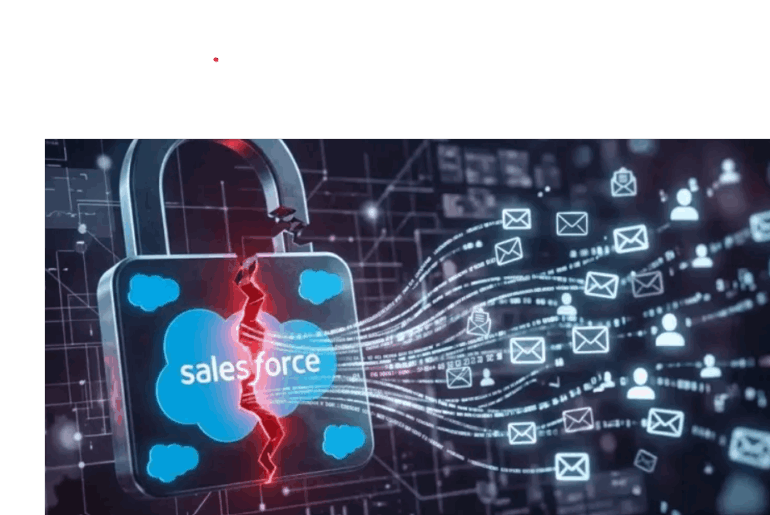
A recently disclosed set of vulnerabilities in Salesforce Marketing Cloud, widely known as SFMC, has drawn attention to the security risks tied to centralized marketing infrastructure.
The flaws, which affected components tied to AMPScript, CloudPages, and email-rendering workflows, could have enabled attackers to access subscriber information, enumerate marketing emails, and potentially affect organizations across multiple tenants.
Security researchers found that weaknesses in SFMC’s templating engine and cryptographic implementation introduced opportunities for unauthorized data access across customer environments.
AMPScript and SFMC Template Injection Risks
Modern enterprises rely heavily on Salesforce Marketing Cloud to manage large-scale marketing campaigns, personalized customer journeys, and trackable email communications. The platform, formerly known as ExactTarget, supports dynamic content generation through technologies such as AMPScript, Server-Side JavaScript (SSJS), and internal data views connected to large subscriber databases.
While these features provide flexibility for marketers, researchers noted that they also increase the impact of any underlying vulnerability. One of the major concerns cantered on SFMC’s server-side templating framework.
AMPScript and SSJS allow organizations to dynamically insert subscriber attributes such as names, email addresses, and engagement metrics directly into marketing content. However, functions like TreatAsContent introduced a dangerous behaviour because they effectively evaluate user-controlled input as executable template code.
Researchers explained that if attacker-controlled data was passed into these functions, it could trigger template injection inside Salesforce Marketing Cloud environments.
The issue became more severe because SFMC historically supported AMPScript execution within email subject lines. According to the findings, legacy behavior caused subject templates to be evaluated twice by default.
That design opened the door for payload execution during the second rendering stage. Researchers demonstrated the risk using the following payload inside a name field:
If processed during the second evaluation phase, the payload could execute successfully and create a reliable injection point inside the marketing workflow.
Once template execution was achieved, attackers could potentially use built-in SFMC functions such as LookupRows to query internal Data Views, including:
_Subscribers
_Sent
_Job
_SMSMessageTracking
_Click
Access to these views could expose subscriber lists, email delivery records, engagement metrics, and message history associated with affected Salesforce Marketing Cloud tenants.
CloudPages and “View Email in Browser” Vulnerability
Researchers identified an even more serious vulnerability tied to SFMC’s “view email in browser” functionality and CloudPages infrastructure.
Many Salesforce customers configure branded domains such as view.example.com or pages.example.com that route back to shared SFMC infrastructure. These links typically rely on an encrypted qs parameter containing tenant and message-specific information.
According to researchers from Searchlight Cyber, the older “classic” qs implementation used unauthenticated CBC encryption. The researchers found that the implementation behaved as a padding oracle, which made it possible to decrypt and re-encrypt query string parameters under certain conditions.
Initially, the researchers abused the weakness using the Padre tool before later improving the process through the AMPScript MicrositeURL function.
This allowed them to forge valid QS values and access workflows such as “Forward to a Friend,” which could resolve subscriber identifiers into actual email addresses.
One of the most concerning aspects of the vulnerability was SFMC’s use of a single static encryption key shared across tenants. Researchers stated that once the cryptographic structure became understood, attackers could theoretically enumerate subscribers and access email content across multiple organizations using the same mechanism.
Legacy Encryption Weaknesses Expanded the Attack Surface
The researchers also uncovered an older URL format that relied on per-parameter “encryption.” However, the mechanism reportedly consisted of a repeating static XOR key combined with a checksum.
Although the scheme was considered legacy functionality, researchers found that it still worked on modern SFMC tenants.
Because the implementation lacked strong cryptographic protections, attackers could decrypt and enumerate parameters such as JobID and ListSubscriber at high speed without relying on the slower padding-oracle technique.
The findings highlighted how legacy systems inside large cloud platforms can continue to create security exposure long after newer protections are introduced.
Impact of the Salesforce Marketing Cloud Vulnerability
Researchers concluded that the combined vulnerabilities could have enabled attackers to:
Abuse argument-injection flaws tied to the MicrositeURL function
Manipulate CloudPages and other SFMC web workflows
To address the issues, Salesforce assigned multiple CVEs covering several root causes, including insecure cryptographic implementations, hard-coded keys, and argument injection vulnerabilities affecting MicrositeURL and CloudPages components.
According to Salesforce, the vulnerabilities were reported on 16 January 2026. Mitigations were deployed between 21 January and 24 January 2026. The company stated that it had identified no confirmed malicious exploitation at the time of disclosure.
As part of the remediation process, Salesforce migrated Marketing Cloud Engagement encryption to AES-GCM, rotated encryption keys, and disabled the double evaluation behaviour tied to AMPScript subject-line rendering.
The company also invalidated all legacy tracking and CloudPages links created before 21 January 2026 at 23:00 UTC. Those links expired globally on 23 January 2026 at 21:00 UTC.