Avon is honing in on its ability to transform women’s lives, with a global campaign asking people to reconsider the 135-year-old beauty business. Its chief brand and beauty officer explain why now is the right time to “blow the dust off.”
When you think of Avon, you most likely conjure up images a of handbag-sized catalogue filled with scented pages and pictures of Senses bubble bath and Skin So Soft spritz. And possibly a neighbour armed with a bag full of miniature lipsticks and nail polishes who would regularly ding the doorbell.
However, over the past 12 months the brand has been looking to carve out its own place in the global $532bn beauty and personal care market, heavily investing in digital tools for its army of direct sellers. It now allows its five million representatives in 50 markets to run a business from their phone, create and share marketing content and personalise recommendations for regular customers.
Since the pandemic kicked off, the beauty brand has seen a 200% uptick to digital transactions. In the first half of this year, the number of Avon reps has also grown twofold as social selling becomes more relevant to people looking to embrace a more remote and flexible way of working.
Avon sells three lipsticks every second, seven bottles of fragrance every second (which it claims is more than any other brand) and two bottles of its Anew skincare products every second.
In a world of Glossiers, Beauty Pies and Drunk Elephants, however, Avon has an image problem. It’s failing to keep up with these ‘cool-girl’ brands and engage a younger generation of women. Even its chief brand and beauty officer, James Thompson, concedes that over the past few years Avon has been “underestimated” from a brand perspective.
As a result, its launching ’Watch Me Now’ a significant global campaign that will run in more than 70 markets globally calling on people to reconsider their views of the company.
The premise behind the push is that Avon has been transforming women’s lives by “doing beauty differently” for 135 years. The ads – which will run across OOH, digital and press – nod at Avon’s heritage as a purpose-driven business that gave women the power to make an independent income in the US before they even had the right to vote.
‘Watch Me Now’ underscores the power of beauty to create opportunities for people to earn on their own terms, and highlight’s Avon’s own support for causes including domestic abuse and breast cancer – with the business fundraising £20m for charities relating to the latter cause and teaming up with Coppafeel to encourage women to check their breasts regularly.
The hero ad celebrates the success of the underdog and highlights the unexpected and underestimated aspects of the Avon brand, its people, activism, and products – for which Avon has been granted more than 750 patents and 300 awards.
For Thompson, it’s less a campaign and more a “fundamental repositioning”.
“There’s a parallel with how Avon as a brand has been underestimated over the past few years,” he says pointing to the fact that the brand has 98% awareness but a “much lower” consideration among customers.
“We need to blow the dust off and reinvent ourselves for another generation.”
‘Watch Me Now’ was created in collaboration with Wunderman Thompson but restrictions from the pandemic mean the work itself was produced in-house. The ads are also being supported by an extensive identity refresh.
Avon’s network of reps will also be central to spreading the message. Influencers in their own right, Thompson says the brand’s sellers are its “first media channel”.
“We’ve equipped them with much better technology,” he explains, pointing to the Avon On app which allows them to do everything from invoice customers to built assets for Facebook or Instagram from their phone.
“In the first months of this campaign we’ll be sending them content on a regular basis that they’ll be encouraged to share with customers. Over time, we’ll be giving them tools and education on how to make their own content too within the framework of this campaign. It’s effectively the world’s most democratic marketing programme ever.”
All that said, the brand isn’t planning to ‘do an Argos’ any time soon and ditch its hallmark physical brochure.
“It’s still a really important part of our business. It’ll be updated to reflect our new positioning and we’ll be improving the quality but we’re an omni-channel business – we have stores in some countries, we’re online elsewhere. We need to be where our customers can find us.”
When you think food advertising can’t get any better than it is now, someone finds a way to one-up the competition. It does raise the question of whether there is a point in advertising a thing we can’t live without, but I digress.
McDonald’s has come out with an advert—a street billboard—in the streets of Paris that has been drawing people’s attention lately with its unconventional public ad design.
Have you ever gotten so hungry that you’ve had the idea to take a bite out of a billboard?
So, McDonald’s—you know, that ginormous fast-food chain whose food people can’t help but crave every once in a while and effectively don’t need to be persuaded to want to eat it—has come out with an ingenious billboard design that has people captivated.
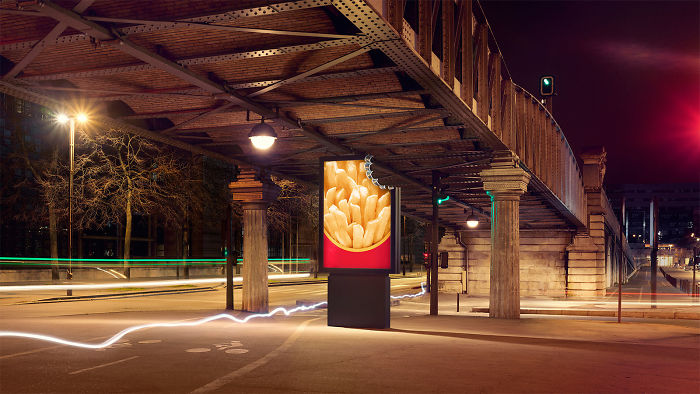
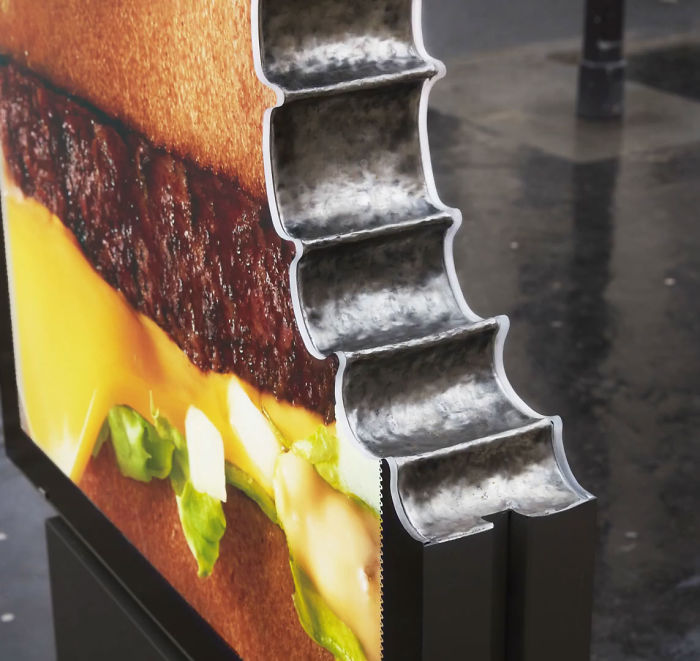
McDonald’s has placed 3 lit street billboards around the city of Paris, France with pictures of two kinds of their signature hamburgers and a carton of french fries. Except they aren’t regular rectangular billboards that many of us are used to, but rather rectangles that someone has taken a literal bite out of.
An ad agency recently took that concept and made it into a McDonnald’s billboard that is literally bitten off
The entire design does have a silly vibe to it because the bite mark is just comically out there—who would try to take an over-sized bite out of a billboard picturing food? But, at the same time, it’s very on-point and the strangeness of it all manages to draw the eyes of passersby—exactly what an ad should be doing.
People with a keen eye will also notice that the billboards lack any branding. Besides the carton of french fries being packaged in the obvious red and yellow packaging that McDonald’s offers, there is no mention of it being McDonald’s. For all intents and purposes, this could be an ad for any other fast-food restaurant.
3 “bitten-off” billboards were placed in Paris, France that feature McD’s juicy pics of burgers and fries
But a supplementary video showcasing these same billboards clarifies that it is indeed McDonald’s—the classic golden arches appear right after the cartoony frames of the two burgers and french fry logos at the end of the video.
The people behind the billboards are TBWAParis, an advertising agency headquartered in New York City but with a presence all around the world, including Paris. It aims to bring a culture of innovation and to put companies’ brands at the heart of pop culture.
TBWA Paris is the team behind the billboards and they’ve been working with McDonald’s since 1985
The agency has been working together with McDonald’s in Paris for a while now—since 1985, actually. Their projects with McD’s include ad campaigns for the Sharing Box, “Being A Good Father,” and “American Summer,” among many others.
Now, this isn’t the first time someone has taken a bite out of a tasty food ad as Ben and Jerry’s also realized the same concept for an ad some time ago. The ad for B&J’s Pint Slices has been seen bitten off in Auckland, New Zealand. The Phantom Labs team are the people behind this one.
Interestingly enough, none of these ads feature any of McDonald’s branding, save for its colors with the fries
Social-media stocks are getting a boost from Deutsche Bank analyst Lloyd Walmsley, who raised his rating on Twitterand lifted his price targets on Facebook,Alphabet, Snap,and Pinterest.
For Twitter (ticker: TWTR), he went to Buy from Hold, with a price target of $56, up from $36. The call is part of a broader bullish report on the social-media stocks, which he thinks are positioned to benefit from a coming rebound in online advertising demand.
The analyst lifted his price targets on Facebook (FB), to $325 from $305; Alphabet,Google’s parent (GOOGL), to $2,020 from $1,975; Pinterest (PINS), to $55 from $43; and Snap (SNAP), to $32 from $28. He repeated Buy ratings on all of them.
“We are bullish on the ad names into Q3 results given a continued ad recovery through Q3 and a strong outlook for Q4 based on our industry conversations,” he said. “We are bullish on the space into 2021, where a continued cyclical recovery and easy comps will drive accelerating growth and margin recovery, with potential for more share gains across online advertising.”
He cited the large-cap companies in the group—Google and Facebook—as having a better balance of risks and potential rewards, given that investors are less enthusiastic about their prospects than they are for the midcap firms in the group: Snap and Pinterest. Walmsley said he is positive about Snap and Pinterest’s fundamentals, but noted “positive sentiment” about those stocks.
Twitter, he said, can continue to rally, driven by improving growth in the second half. and “a compelling bull case for 2021.”
“In our view, Twitter is well positioned to benefit from a big event landscape in 2021, expansion into more performance advertising on the back of its ad server rebuild and new MAP [mobile app promotion] product, and an eventual high-margin subscription product,” he wrote.
“We have been excited about the medium-term prospects for Twitter but unable to get more bullish given weak advertising channel feedback. We are now starting to hear more positive feedback in the ad channel and would take advantage of the opportunity to build a position now before a stronger ad recovery takes hold and we get into the period of 2021 excitement.”
Monday morning, Twitter was up 4.5% to $47.99, Facebook rose 3.1% to $272.67, and Alphabet gained 2.7%, to $1,550.94. Snap rose 0.7% to $27.18, while Pinterest rallied 2.9% to $44.65.
Check out these tips to help drive your Instagram marketing strategy toward better engagement and higher ROI.
If you’re looking for a way to grow your business, you may want to consider Instagram marketing. Instagram is an essential part of many business owners’ social media marketing strategies. This guide covers the benefits of using Instagram for business and top Instagram marketing tips to follow.
Business benefits of using Instagram
Instagram is a smart marketing tool if your business has products and services that can be presented visually and your audience is active on the channel. If your business checks those boxes and you carefully plan and execute your Instagram social media marketing strategy, this social media channel can have these big benefits:
Increased brand awareness
Followers’ trust
Brand loyalty
A boost in website traffic
New leads
New customers
Repeat business
Instagram marketing tips and best practices
Instagram marketing strategies vary from business to business. Although the following Instagram marketing tips have been effective for select brands, you should cater each tip to your unique audience and sales offerings.
Know your audience.
If you don’t know your audience, you are essentially creating content blindly. Many small businesses think their audience is everyone, which is almost never the case.
To help pinpoint your target audience, HubSpot suggests creating buyer personas. A buyer persona is a fictional representation of your ideal customer. You can have more than one buyer persona, but limit them to five to ensure they are manageable. Include important details about your target audience, such as their demographics and how they think and act. For example, consider the following characteristics:
Age range (keep it within 10 years)
Specific location (city and state)
Job title
Gender
What motivates them at their job
What motivates them at home
Three main problems they have
Where they go for information (e.g., business.com, Facebook or a local radio station)
Any additional information you can identify (e.g., if they have pets and/or children, their salary range, their hobbies)
When developing buyer personas, make them as clear and as detailed as possible. The more specific your buyer personas are, the better you’ll succeed in creating content that appeals to your audience. If you’re unsure where to get this information, start by surveying your current customers. Email them a survey, letting them know how long it will take to fill out. Keep your questions brief, and offer multiple-choice and open-ended options.
To further entice your current customer base to take your survey, you could offer a promo code to be applied to their next purchase, and you might even get some extra business from it. If your business is brand-new and you really don’t have any idea where to begin with surveying your customers, reach out to your personal social media networks for assistance. There has to be an audience you had in mind when you started your company. Find those people, even if you have to go through your personal Facebook friends list and phone contacts.
Another option is to use a paid digital tool to survey a group of people. If you choose this route, start with an audience of 100 or fewer people, and increase it as needed. Sometimes, a small sample is helpful and saves you money.
Optimize your bio.
Your bio is an important part of your Instagram page, and it needs to be optimized. Include the following elements:
A clear and engaging Instagram profile picture that’s sized appropriately
A bio that tells a story of what your brand or Instagram influencer page is about
A link that visitors can access for more information
Hashtags (when applicable)
Your bio is an important part of your Instagram page, and it needs to be optimized. Include the following elements:
A clear and engaging Instagram profile picture that’s sized appropriately
A bio that tells a story of what your brand or Instagram influencer page is about
A link that visitors can access for more information
Hashtags (when applicable)
Example: Just for fun – micro-influencer Instagram bio Zoey the Maltichon
Source: Image courtesy of Zoey the Maltichon
Incorporate relevant hashtags.
Hashtags, including those that are trending, can help people find your page on Instagram and Twitter and are essential to grow your audience and sales. Josh Stutt, founder of ABCD E-Commerce, said to make sure to research hashtags before you start using them. If you’re not a widely known brand or celebrity, using generic hashtags won’t get you anywhere. For example, if you’re a new vintage T-shirt brand, don’t waste your time with broad hashtags such as #fashion or #tshirt.
“You need to find hashtags that are typically on point [and] have a good following but aren’t being used by everyone else in your space,” Stutt said. “By using the Instagram search function, you can see the popularity of any given tag (#tshirt has 38.5M posts, but #vintagetees only has 388K). Dig around and find 50 or so tags that are applicable to you.”
Once you’ve done this, use about 15 hashtags in various combinations on your posts, and keep track of where you use each one, Stutt suggested. After that, he said, review the results, looking at which posts resonated, which hashtags brought people in and what people talked about in your posts.
“As you learn which ones work for you, use them continuously while slowly adding in other ones and trying to scale up as you gain popularity,” Stutt said. “Once you start connecting on certain tags, that’s when you can hit the Discover section, and that’s how you get Instagram working for you instead of the other way around.”
Interact with other users in your target audience.
Building relationships is an age-old sales tactic that is effective in social media as well. It is also the best organic way to increase your audience and get new business. The key to building relationships is to be genuine. Here are a few ways to build relationships on Instagram:
Follow people in your target audience who interest you.
Like and comment on their posts.
Sometimes, share their posts to your stories.
It can take time to build these relationships, but doing so can generate some of the hottest leads.
Team up with other brands to host giveaways.
Jenna Labiak, owner of The Silk Labs, said hosting giveaways with other small businesses that have the same values, location and target audience has been beneficial to her business on Instagram.
“This way, we can have a mutually beneficial relationship within this giveaway and share both of our audiences with one another,” she said. “On average, I would say for each giveaway with another small business, The Silk Labs gains 200 new customers.”
Source: Image courtesy of The Silk Labs
Use a link tool to drive traffic to your website and other important links.
There are quite a few link tools available, but one of the most effective and widely used is Linktree. When you set up and add Linktree to your Instagram profile, users who click the link are directed to the Linktree page that shows all of the links you have added. You can customize the Linktree page with a profile image, such as your company logo, and edit the links at any time. The Linktree tool has a “forever free” plan that is ideal for small businesses. Additional plans start at $6 per month.
Capitalize on affordable influencer marketing.
You may know that partnering with Instagram influencers, or people with large followings for a particular interest or category, can be an effective marketing strategy. However, it often comes with a hefty price tag.
As a more affordable alternative, “Strike a win-win deal with other companies that have affiliations with influencers, and do a collaboration,” said Amy McWaters, CEO of The Hamper Emporium.
As an example, McWaters’ Australia-based company collaborated with Ponting Wines, which is promoted by Ricky Ponting, a cricket legend. As part of the collaboration, her team created stories featuring him and, in return, he promoted his wines in The Hamper Emporium’s e-commerce store.
McWaters said her company received a lot of direct messages asking about the products, and the campaign resulted in an overall sales increase of 43% that quarter.
Humanize your brand.
This is a strategy that works well across all social media channels. Think about the content that resonates with you on the pages you follow. Most likely, it’s the stuff that you can connect with personally, not corporate business posts. That’s why it’s so important to show your human side.
For example, payment processing company Priority Payments Local created a “Meet the Team” series and, during the COVID-19 pandemic, got its team together to convey the message “We’re all in this together.” The photo of the company’s business development manager, Vincent Napoli, shows him in a different light than his clients are used to seeing him in: with his son.
Source: Image courtesy of Priority Payments Local
Leverage Instagram analytics (also called Instagram Insights).
Instagram Insights, Instagram’s analytics tool, is available to use for free on the Instagram app and is available on business accounts and contributor accounts (sometimes called influencer accounts). The tool provides the following metrics:
The number of accounts reached (with increase or decrease percentages)
Content interactions (with increase or decrease percentages)
Total followers (with increase or decrease percentages)
Content your page shared
Instagram story content
IGTV video content
Promoted post data
This information is available for the previous seven-day period. Unfortunately, unlike Facebook’s analytics tool, it does not show the best times to post different types of content. If you have a Facebook business page, experiment with the best posting times (as determined by when your audience is online).
Post awesome content.
You and your audience may not have the same idea of what constitutes impressive content. Research what types of content get the most engagement on your competitors’ pages.
Fill your followers’ Instagram feeds with engaging content. Note the type of content that gets the most engagement, so you can keep giving your audience what it wants. For example, some brands do better with Instagram Live posts than they do with Instagram Stories. Ultimately, you can define “awesome content” by how well it performs. Your posts should be carefully planned, crafted and distributed.
Grow your page and your business with Instagram advertising.
Instagram advertising can be beneficial for expanding your brand’s reach across the social media platform, thereby growing your following and increasing sales. Depending on your industry, for Instagram to be effective, you may need to run your ads through a sales funnel, like Credit Repair Kings did. The company’s strategy was to target consumers within a specific age group in the local area who had an interest in the credit services and financial categories. When someone clicked on the ad, Credit Repair Kings used ClickFunnels to capture the lead to schedule a call with them using Calendly.
Source: Image courtesy of CreditRepairKings.com
Source: Image courtesy of CreditRepairKings.com
Source: Image courtesy of CreditRepairKings.com
Test and try again.
The social media landscape is always changing, so it’s important to test new tactics. Don’t be afraid to create Instagram content that gets zero or little engagement. Learn something from every post, and keep trying. With time and practice, you could find yourself with a flood of new sales straight from Instagram.
Find out what’s in store for design in the next 12 months.
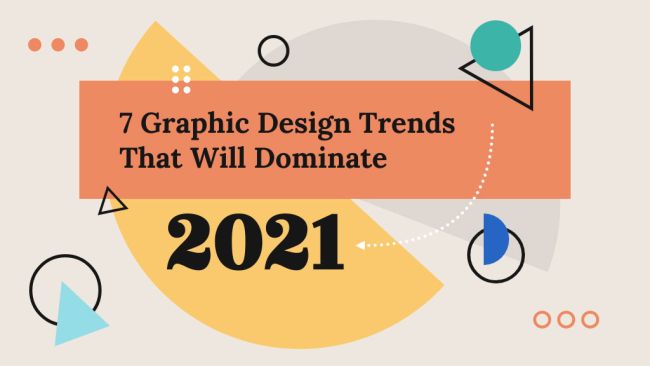
After experiencing all the year has thrown at us so far, we can’t be the only ones looking forward to 2021 (it hasn’t been cancelled yet, has it?). Perfect for creatives who want to get a jumpstart on life beyond Christmas, this infographic sets out seven key graphic design trends expected to blow up next year.
Full of useful information, this infographic from Ryan McCready might be one of the best we’ve seen (check our list of best infographics for more). It intelligently explains why certain trends are on the way – relating them to current consumer needs in relation to the rollercoaster that has been 2020 (muted colour palettes instead of bold, brash colours, for example – because they feel safe and secure). Click the picture below to see it in its full glory.
(Image credit: Ryan McCready on venngage.com)
According to the graphic, the general design arc will be to favour simplicity and practicality. This means that flat icons and illustrations are making a comeback, classic serif fonts will take centre-stage and text-heavy videos are here to stay as a necessity (because of the limitations the pandemic has put on shooting production-heavy footage).
You can also look forward to seeing (and creating) simple data visualisations, an abundance of geometric shapes and social media slide decks to communicate longer messages (things are probably going to remain pretty complicated, after all).
When people think of rewards programs, they often think of points, such as frequent-flyer miles, or punching in a phone number at a pharmacy or grocery chain. Those experiences can feel a bit empty because there is no instant gratification; it’s as if there were value there but you’re not sure exactly when it will pay off.
With that said, those rewards programs work. They motivate consumers to achieve a benefit from spending their money with a brand. There’s a psychological pull that most consumers do not — and sometimes cannot — resist.
From leading a cash back rewards company, I’ve seen first-hand the impact such incentives can have on customer loyalty. We just surveyed 19,000 of our users about their shopping behaviour, and 82% said they prioritize special promotions, discounts or cash back when choosing where they’ll shop. That’s a powerful loyalty stat.
Rewards Reactions
People react to rewards in various ways. According to global consultancy McKinsey’s research, these reactions entail context, habit, friendly influence, incentives, emotions, congruence, salience and other factors. It’s a sure-fire way to engage someone’s emotions, and in turn, gain or lose their loyalty.
When it comes to spending, neural studies have shown that consumers have unpleasant emotions when contemplating the monetary cost of making purchases. As a matter of impulse, people simply do not want to part ways with the cash they’ve worked hard to earn.
Making customers feel positive about their purchase is crucial to not only the customer experience but also brand loyalty. It’s why 79% of consumers look for deals in loyalty rewards programs before buying an item.
Reshaping ‘Value’
More generally, the psychology of rewards and this pandemic should have companies rethinking “value” and how it pertains to their marketing budgets. In previous years, “value” meant consumers attaining something meaningful for what they give to a business. In the current public health crisis, consumer needs have shifted dramatically, and “value” should now play out with brands and financial institutions helping customers achieve their budgetary goals.
Even when things return to normal, brands and financial institutions will need to think much differently about how they provide value to customers. Marketers should consider factors like easing consumer stress, communicating availability, offering more options for convenience and putting money back into consumers’ wallets when they need it most. Appealing to consumer sensibility during Covid-19 has never been so impactful, and, more than any other reward, it’s cash back that ensures a strong finish to the customer experience. For financial institutions, it’s identifying ways to add value that don’t demand their customers to jump through hoops for the benefit.
The New Reward King: Cash
With consumer budget worries in mind, rewards are on the rise as more brands turn to “surprise and delight” experiences with cold hard cash at the forefront. Financial institutions, neobanks and digital payment platforms are flocking to embed engaging cash back rewards into their user experiences. Whether it be attached to a specific card product or generally available to their customers, cash now speaks volumes when it comes to creating value and remaining top of wallet.
For example, financial membership platform MoneyLion knew these things to be true as early as two years ago when it started giving customers $1 cash back each day for opening the financial membership brand’s mobile app. And in February, Level, a challenger bank app, began giving customers 1% cash back on debit card purchases, which its customers have surely been appreciating since then due to pandemic-driven economic anxiety. Such brands understand that their customers not only have always been hard-wired toward cash back and rewards, but they are especially now during these hard economic times.
Rewards such as cash back also drive sales. For instance, more brands see increased revenue via rewards (36%) compared to discounts (28%). More specifically, my company Dosh — in a research partnership with The Centre for Generational Kinetics — found that brands that offer millennial and Gen Z consumers at least 5% instant cash back will see even greater sales impact now and in the months ahead.
Cash back’s momentum is clear. And with miles racking up and nowhere to go, consumers are questioning their miles cards. Credit card companies are starting to recognize this reality with 80% of card members redeeming cash back rewards during the pandemic.
What Fintechs Need To Know
The best way for fintechs, neobanks and other financial services companies to implement cash back into their offering is to make the customer experience as frictionless as possible. Don’t make the CX more than one step. When customers sign up for your loyalty/rewards program, the savings that follow should be automatic: Cash back should be built-in, not opt-in. Once customers experience the ease and delight of automatic cash back notifications, yours will be their payment method of choice.
Every financial services company wants to be top-of-wallet and have their customers highly engaged. Providing a vast array of merchants that provide 5% to 10% cash back automatically to a customer is already proving that customers will use that payment instrument more times than others. The fintech winners will be those that provide the right offer, to the right person at the right time, and find the right way to celebrate savings with their cardholders.
What’s Next For Rewards
Even before this pandemic, my company’s survey found that 82% of Americans will shop more frequently with retailers that send cash back notifications. And McKinsey has revealed in a study that immediate gratification, like cash back, results in positive customer experience and creates brand loyalty. Once again, rewards are all about psychology, and cash back entails the greatest positivity in shopping and the best outcome for both consumers, brands and financial services companies alike.
The psychology of rewards is powerful. Brands have the opportunity to make such rewards even more memorable for customers, when the rewards look more like something they need and can use immediately, like cash back.
To hit your conversion targets, you need content that motivates your audience to act. A strategic point of view will help you accomplish that.
In the B2B space, you or others in your company may have concerns about your POV. Should you avoid a conversational tone? Is it better to be formal or personal? Be deliberate in selecting a POV that can attract and engage prospects through the long term.
In case you have better things to do than geek out over grammar, here’s a quick refresher on the three POVs:
First person uses “I,” “my,” and “we.”
Second person refers to the audience as “you.”
Third person calls the audience “they” or “them” and frequently uses the company’s name.
Let’s explore each point of view and when to use each to better engage your audience and boost conversions.
Third person creates barriers between you and your audience
You may prefer to use a formal tone when speaking with your audience. After all, you’re selling to executives and other sophisticated B2B buyers.
You might think that the third person sounds more professional than the other voices. Since journalists write in the third person, this voice can also seem objective.
However, using the third person in your content holds your audience at a distance. When people read your copy, they’re less likely to see themselves. They’ll think of someone else.
If audience members don’t think you’re speaking directly to them, they may question whether you can solve their challenges.
A recent study confirmed that using the third person creates barriers. In the study, participants who experienced anxiety talked about themselves in the third person. Using this voice created distance between participants and their negative emotions, helping them calm their anxiety.
According to the study, “(T)hird-person self-talk leads people to think about the self, similar to how they think about others, which provides them with the psychological distance needed to facilitate self-control.”
While this technique may help with anxiety, it does the opposite of what you want to happen when your audience consumes your content. You need readers to feel their pain points so they realize they need your help.
Using the third person can also make your content sound stuffy. If you mention your company or product a lot, you may come across as self-focused instead of audience focused. No one wants to be around someone who talks about themselves all the time.
You can check how well your content focuses on your audience with the free Customer Focus Calculator. Enter a link to any page on your site and the tool calculates the percentage of space devoted to talking about your company vs. your audience. Your results may be eye opening.
Of course, there are exceptions. Here are some formats where the use of third person makes sense:
Case studies or other content where you talk about a customer and position them as the hero
White papers or research reports where you want to convey a formal, objective tone (If you want your white paper to nurture leads, consider using the second person to draw readers in and get them to take the next step.)
Follow the POV Golden Rule: Start with second person
Addressing your readers as “you” is a best practice in content marketing.
It also motivates audiences to take action. A study by the University of Illinois confirmed this. It examined whether using first or second person would motivate students to exercise. Students in the second person group, e.g., “You can do it,” exercised more in two weeks and generally had a better attitude than the first person group. (A more recent study echoed this finding.)
Want to make your content better? Write (or rewrite) it in second person.
Use first person in these 2 places
Popular bloggers such as Neil Patel use first person POV. This voice can make articles more personal and help readers connect with your stories.
First person POV is effective in blog posts or other content where you want to:
Share your personal experiences and lessons learned.
Discuss your challenges and how you overcame them.
Talk about tests you conducted and the results you achieved.
Voice a strong opinion.
Another great place to use the first person is on call-to-action buttons. Studies have shown that adding the words “I,” “me,” or “my” to them boosts conversions.
For example, Unbounce saw a 90% increase in conversions when it changed the pronoun on the button from “your” to “my” – “Start your free 30 day trial” to “Start my free 30 day trial.” All other elements on the page remained the same.
Although Unbounce conducted this test several years ago, it still uses first person today:
Will this work for you? Change the copy on one of your CTA buttons to first person. Then, see if your conversion rate improves.
However, you should limit the use of “I” and “we” in your other content. Overusing these words puts the focus on your company – not on your audience.
Next steps
Point of view is an often-overlooked aspect of B2B content. But when you think strategically about your POV, you can improve the quality of your content so that you can engage more B2B audience members and turn them into customers.
Try for yourself. Find an underperforming blog article, newsletter subject line, social media post, infographic, landing page, or call-to-action button. Change your POV to see if you can boost your conversion rates.
Have you experimented with the POV in your content? If so, what have you learned from your results? Share your insights in the comments section.
Rachel Foster is a B2B copywriter and the CEO of Fresh Perspective Copywriting. Since 2009, she has helped B2B tech marketers improve their response rates, clearly communicate complex messages and generate high-quality leads. She has also presented at Content Marketing World and taught B2B copywriting for MarketingProfs. Connect with Rachel on LinkedIn or check out her B2B marketing resources at www.freshperspectivewriting.com.
It’s succession planning time again, and your organization is likely faced with identifying and planning the development of employees who will “one day” replace existing leaders. For many leaders, brainstorming potential successors is easy, similar to adding items to your Amazon cart.
However, you eventually have to determine the time frame of each successor’s readiness to lead and defend your point of view in a succession planning meeting. How do you really know if Carol is ready now to become the head of the product team? What science did you use to determine that Bryan will be ready to lead sales in three to five years? How objective is your readiness time frame estimate? Did you consider how long Bryan has been at the same readiness time frame? Often, successors appear on a succession plan year after year with the same readiness time frame as in prior years. Or worse, successors appear and disappear from a specific succession plan based on recency bias.
More organizations are focused on the diversity of their leadership pipeline; however, developing succession plans that support diversity can be even more challenging if organizations are not proactively preparing successors to lead within the desired time frame.
More than anything, organizations want new leaders to succeed in bigger, more challenging roles as soon as possible, but the risk of failure is real. If organizations promote successors before they have the skill, will and leadership capabilities to take on a new role, it is highly likely that the successor will crash and burn, which may directly impact business results. When organizations are risk-averse, the fear of failure will often result in hiring experienced external talent even though a well-defined succession plan is in place.
When organizations are unsure of a successor’s readiness, they should test instead of guess.
By testing the readiness of future leaders, you simultaneously develop them by gradually presenting challenges that mimic their future role(s). Below are few considerations when designing a readiness test approach?
• Apply an internal ‘gig’ strategy. Match your key successors to challenging strategic projects that specifically address their development gaps or areas where risk of failure is the highest. For example, when I interviewed general managers (GMs) to inquire what it takes to be a GM, most of them indicated that commercial acumen, emotional intelligence and experience leading cross-functional teams was key. Therefore, a successor to a GM who lacked direct sales experience could be assigned a project to gather customer insights and build the business case and plan to launch a new line of business.
• Leverage internal and external experts. Borrowing internal and external leaders/experts who can aggressively teach up-and-coming leaders the ropes is an effective way to improve successor readiness. For example, many organizations are focusing on digital marketing; however, if your organization’s current marketing team is long-tenured and does not have digital marketing capabilities, consider hiring a digital marketing expert on short-term contract to cocreate a new digital marketing strategy and upskill the team on effective digital marketing best practices.
• Use technology and talent analytics to track progress. With the emergence of AI-powered internal talent marketplace technology, organizations can easily define and match employees to short-term development gigs or opportunities. By leveraging technology to define, match and track project completion, you will speed the logistics of managing internal gigs. Also, it is critical to leverage talent analytics to truly understand the state of your succession pool. Your succession dashboards should provide actionable insights about the diversity of your succession pool, changes in readiness (e.g., how long has this successor been at said readiness?) and the success rate of succession targets (e.g., what percent of key successors are actually promoted to the desired role, and what percent are successful once promoted?).
Ensuring your leadership pipeline is ready for the future is both an art and a science that is critical to a successful enterprise. By testing your future leaders, you can be sure they will be ready for what lies ahead.
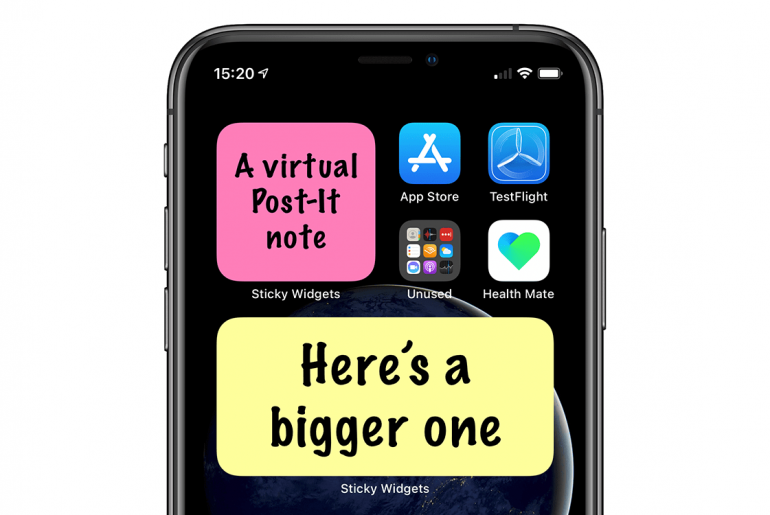
When iOS 14 launched, it was somewhat lacking in the widget department. Since then, we’ve seen a wide range of third-party apps offering useful widgets, and Sticky Widgets is the latest …
The app is a simple one. Install it and then add it as a widget to your home screen. Just tap the note to edit the text on it.
You can have multiple notes on your screen. For each, you can choose between three colors (yellow, pink, and blue) and three typefaces (MarkerFelt, Noteworthy, and System). You can, of course, also choose between the three different widget sizes supported by iOS 14.
If you’re looking for more widget inspiration, check out our growing guide in areas covering finance, health and fitness, photo and video, music, and more. If you’re not yet up to speed on how to use them, we have how-to guides for both iPhone and iPad.
Trade shows offer an unmatched opportunity for connecting with potential customers; this strategy can help you make the most of them.
Traditional trade conventions are an outstanding way to show off your products or services and connect with potential customers and partners. But just like on the Internet, there’s a lot of noise you need to overcome to stand out and make people want to walk over to your booth instead of someone else’s. I have a simple strategy I’ve used with enormous success for this very purpose.
The survey-raffle combo
In my previous company, Sunbelt Software, we focused on selling products to system administrators. So, in terms of events, we hit up Microsoft tech conferences and similar trade shows. Those events usually brought in anywhere from 4,000-8,000 people, so we knew they would be a fantastic opportunity to rub elbows in a huge way — if we could just figure out how to draw people to us.
We had to think — what could we do that would appeal universally to this particular demographic and that would outshine the other vendors even if we couldn’t anticipate what they’d offer?
And then we had our “Aha!” moment. With a raffle, we could generate positive interest with a little friendly suspense, taking advantage of everybody’s natural inclination to want to beat the odds, which at a trade show are much better than the lottery.
Of course, there was the little problem of the raffle item. We had to make sure it was something people would really go nuts for, or nobody would drop by the booth to get scanned and grab a ticket. The solution? A quick survey of our fellow techies to find out what they thought would be the ultimate, super-cool giveaway for a trade show.
After doing the survey, we went to TechEd 2006 in Boston. Our booth was nothing special, just a 10-by-10 space. But based on the survey results, we’d brought in — picture this — a spectacular custom-painted Harley Davidson chopper.
The buzz was overwhelming. We could tell that everybody was itching for a shot, imagining themselves getting away from technical code, security and so on and winning the freedom the bike boldly offered. To get a ticket, though, they had to register with us. And did they ever.
By the time the show ended at 4 p.m., it was pretty obvious our strategy had paid off. Crowds of people were gathered around our booth to see who would win. We had someone get up on a ladder with a megaphone and pull a number from the raffle barrel. There was a terrific moment of tension, and then everybody gave a mix of oh-wells and congratulations as a very happy attendee came up to claim the bike. Everybody had a great time, and for our effort, we walked out of the show with practically every attendee there in our database.
Making the technique your own for the long-term
Because this trick was so successful, it was a no brainer for us to keep doing it — so we’ve been using raffles at shows for a number of years now. It’s something that you can use at virtually any conference, and the sequence of survey-raffle-get leads isn’t going to change much regardless of which industry your event might be for.
But there are two caveats.
First, make sure that you introduce your raffle at the right time at events that have a sufficient audience. We tried this strategy in the early days of KnowBe4, but there just weren’t enough people at the show to make it worth it.
Secondly, be flexible in what you raffle off based on your survey results. If we were to do this today, people might tell us that their ultimate giveaway item isn’t a Harley chopper anymore. It could be a Tesla Model 3 or any other number of things you normally wouldn’t associate with your own business. You always need to listen to your audience and decide from there, and you should give people at least a little bit of an idea about what they might see to drive interest.
As you keep these points in mind, remember that there are a lot of convenient ways to survey your audience, such as with an online form. You can use whatever makes sense given your timeframe, resources and your audience’s known preferences. And you’ll have two ways to get the items you’re going to raffle. The first is to approach the company that makes or sells what people want and ask them if they’ll donate the item for the exposure they’ll get at the show, which can be a great way to make new connections and build lasting partnerships. But you can also purchase the raffle item yourself if you have the budget to do so — you just need to have some evidence that the value of the leads you’ll get will outpace the cost of the raffle item.
Visibility and fun in one package
Raffles at trade shows work largely because, on top of offering fantastic visibility, they’re super fun. Most people don’t have one going on, so attendees naturally will turn their attention to what’s different. And people like the idea that they’ll leave with more than they put in — that they’ll come out ahead compared to everybody else.
So yes, there’s definitely a serious side to business and getting yourself out there. But you should be able to enjoy yourself along with your customers, too! With a convention raffle, you can do both with enormous success.