An essential part of an effective content marketing program, blogging is a great way to accomplish several of your marketing goals at once.
Need fresh content for your website? Post a blog. Want to establish yourself as a subject matter expert? Write a blog that demonstrates your mastery. Need high-quality content for social media that drives traffic to your website? What about writing you can repurpose for email marketing? Yep. Blogs.
Aren’t there already a ton of blogs out there? Well, yes. But that doesn’t mean you’re too late to start leveraging this very effective tool. Here are some helpful guidelines, so the time you spend on your blog will return the highest return on your investment!
Our top 3 tips for business blogging
1. Provide value
Give prospective customers a real reason to make the jump to your content on the website. Write about topics that are relevant to your audience, whether they are timely or evergreen. A good place to start is with questions you are frequently asked about your services or products. These are questions people will be using on search engines, using keywords that relate directly to your business, making it even more likely you will be found online!
2. Keep it interesting
Make the text easily scannable by breaking up large blocks of text with attractive white space, and adding pictures, videos, and links. Need quality sources for free or low cost images? Create your own using graphic design tools or try free photo sites that provide a natural range of people in current and realistic settings.
3. Connect your blog to your website
Hopefully, by sharing links to your blog through social media and email marketing, and by being found during online search, you will be driving traffic directly to your blog. HubSpot recommends making sure your blog is directly connected to your business website, either as a subdomain (blog.yourdomain.com) or as a page (yourdomain.com/blog) so visitors can easily access additional information about your company.
Reviving a blogging program or starting a new one?
Beginning a blogging program (or restarting a dormant one) can be intimidating and overwhelming. Listen to your customers and clients to learn what topics they are interested in, and follow these best practices to make the time you spend blogging more rewarding and effective.
Approach it the right way, and your blog can be a revenue centre.
Blogging offers an amazing opportunity to build authority and earn income. You can create a blog about anything you know or in which you have experience. The key is to choose a niche–serving a specific audience is better than writing about a jumble of topics.
Whether you want to focus on a business topic like growth marketing or a personal passion like a sport, choose a vertical and dive in. With effort and time, your blog can generate income and position you as an authority in your space. It may even help you make a profit.
You can use your blog to position yourself as an expert in any field. Take Facebook marketing, for example. Facebook Messenger marketing and Messenger chatbots are on the rise, and the marketing possibilities are endless.
If you’re a digital marketing or social media consultant, leverage the buzz surrounding Facebook chatbots, and create a blog that’s all about using Facebook Messenger chatbots for businesses. Potential topics could include things like why chatbots are great for business, how to set up a chatbot, how to use it to capture leads, the lower cost for click-to-messenger ads, etc.
Over time, you can use your blog to build authority as a Facebook chatbot expert. With a blog as your base, you can successfully add a chatbot consultancy to your business.
There is no denying the power of Google. The search engine has become so popular that the term “Googling” has become synonymous with the very idea of looking something up. The only problem is that while people look to Google for answers, they do not look very hard.
Most people never look past the first page of results. This means that falling to the second page is almost as bad as being on the tenth page. Given that the vast majority of people begin online by using a search engine, this is not something any successful website can afford.
Search Engine Optimisation (or SEO) is the key to landing a prime position on the front page. However, competing with big businesses who have monopolised all the most popular words and phrases can be more than a little intimidating. That is not even mentioning all the other businesses and blogs out there who are fighting for the same position.
Not to worry though! There are several relatively simple tips and tricks that can give anyone the edge they need. The reason why everyone is not taking advantage of these techniques is that they are not the most intuitive since it involves working with the inherent disadvantages rather than trying to get rid of them.
The Disadvantages
In order to turn these so-called weaknesses into strengths, the first step is to understand what they are. To begin with, no-one is going to be able to compete with big industry names when it comes to popular phrases from the start.
Websites have a domain authority score rated out of 100. This score is heavily influenced by how many external links there are to that particular site. The big-name popular sites will have tens of thousands of links meaning that their domain score is often 70+.
So competing directly is very hard. Achieving that kind of domain score would require years of work and a huge monetary investment. Fortunately, there are other ways to make it on to Google’s front page. All that is required is a little creative thinking.
Long-Tail Keywords
Since no-one can fight the big names for popular phrases, the next best thing will have to be used instead. Long-tail keywords are longer and more precise phrases used to search for items.
Take this guide for example. The popular “head” keyword would be “ First Page of Google “. A long-tail search might look something like “ How do I get my Website on the First Page of Google Search “. The thing is, that the majority of Internet users search with phrases that are long-tail keywords. People want answers to their specific problems. So, if these searches can be predicted then there is no need to fight over head keywords. It is like casting ten smaller but more accurate nets instead of one larger one.
The great thing about this strategy is that when a relevant website appears when someone has searched for a long-tail keyword, people are more likely to stick around. This is because they asked for something specific and got a result so they believe the thing they are looking for must be somewhere within the site.
While it is true that head keywords are searched more often than any long-tailed keyword the difference does not matter that much. Long-tailed keywords have a much higher conversion rate which is the truly desirable result. It is better to have 20,000 users with an 80% conversion rate than it is to have 60,000 users with 20% conversions.
Write More Posts
The problem with utilising a strategy focused on long-tail keywords is that it requires a lot of content to back it up. A good blog post will feature a couple of keywords at the most. To capitalise on all the different keywords that will bring a website to the front page require a lot of different posts to catch a lot of different search terms.
So how many posts is enough? The industry standard is to write at least 16 posts per month, probably a little more. This means that the competition is averaging a new post slightly more often than every second day.
These are not low-quality, short-form posts either. Most posts that turn up on Google’s front page are over 2,000 words in length. Write guides with lots of useful details to help people fix their specific problems. Again, being specific is better since it allows for more long-tail keywords to be spread out across multiple posts. It is also harder to run out of things to talk about if the topic is not exhausted quickly.
Still, a brand new 2,000-word article every 2 days in 3 is a lot of content. At that point, it may be worth finding a dedicated content creator. Fortunately, content marketing is the cheapest form marketing available right now and it generates the most leads.
As well as being informative, the content needs to generate the highest CTR possible. This means optimising both the headline and the meta description. Then, as CTR increases the search engine ranking also increases.
One common trick is to figure out a headline that is the opposite of common wisdom. For example, if someone is searching “How to do X” and they see a headline saying “Learning How to do X is a Bad Idea!” they are going to stop and read a little more. Subverting expectations is a great way to stand out from the competition.
Become Featured Elsewhere
Generating all that content is a lot of work so it’s time to supplement it with something that requires far less effort. As mentioned before, all of the competition, including the big names, rely on content generation. This can be turned into an advantage.
A lot of these sites write content round-ups and features about other sites and blogs. All that is required is to be featured in their work. It is like advertising, except without the fees attached. Both sides win since one needs content to feature and the other needs to be featured. The result is essentially free advertising.
The thing about sites dedicated to ranking other sites and services is that people trust them. Customers believe that their work has been done for them and so they are free to choose the site from the ranking that suits them the best. For anyone who makes it on to these lists, it means competing with 4 to 9 other websites instead of hundreds.
This method requires very little time or effort. All that is needed is to reach out to the site ranking hosts with a pitch. It does not cost anything at all and there are huge returns for every successful attempt.
The key factors to ranking in Google are;
Quality and depth of your content
You need to cover your subject in an in-depth way and provide users with quality content and answers to their search queries.
Quality and number of inbound links
You need to get other quality website to link to your website, which can be done by content distribution to other high-quality website from within your niche. Always focus on quality and not quantity.
Fast Loading
Make sure your website load quickly for users, as nobody likes to wait for slow loading websites. You can test your website speed with Google. Click here
Mobile friendly
With the majority of users now using mobile devices it is imperative that your website is optimised for mobile use, and they can find the content they require quickly.
Domain Authority
You need to build the authority of your website using both content you publish on your website and by having external links to your website from high authority and related websites.
Security
You should ensure your website is free from any viruses or malware, and make sure it is hosted on a secure server and is accessible from https and make use of a SSL certificate.
Paid Advertisements
Paying for AdWords is probably not the first thing that comes to mind for anyone thinking about trying to reach Google’s front page. There is a strategy here and as always, it is about building an advantage from an unusual angle.
Results from AdWords are typically irrelevant to most searches. This is because the people who pay for it are not interested in being part of the organic search. Conversely, most people who want to be part of the organic search are not thinking about the ads that everyone has to scroll past to reach their search results.
Take a search for “best car insurance” for example. Someone entering this term is likely looking for a list comparing different insurance providers so that they can make an informed decision. There is no way any insurance provider is going to appear in these search results. Still, the insurance providers want a chance to capture some customers who are searching for this term and so they pay for AdWords.
A well-positioned advert that is actually relevant to the searcher’s intent is going to generate traffic. Also, because the adverts appear before the organic search results it is a little like skipping the line to be top of the list. So long as the advert is built to look like one of the results the user is actually looking for it is going to work. The more focused your ads is and the landing page you send them to the better results you will get. For example if you users was searching for “bmw 5 series car insurance, and your ads says “Best price BMW 5 Series car insurance” the users is much more likely to click on the ad and if the landing page is about BMW 5 series car insurance the user is much more likely to convert into a customer or enquiry.
Summary
No-one is going to make it on to Google’s first page of results immediately. A lot of the best keywords have long since been eaten up by the biggest names. These companies have long reputations that make competing directly extremely difficult.
There are ways to get around the limitations and still make it with enough time and hard work. First, use long-tail keywords. Finding the right ones takes some research but it is well worth the effort since they boast a much higher conversion rate than shorter phrases anyway.
Next is content. Content provides the platform for the keywords to come into play. Make sure to produce constantly and make sure that the posts are detailed with a narrow focus. Once enough has been produced it can be submitted to review sites. Making it onto a top 5 or a top 10 list is always going to generate a lot of attention.
Finally, it is always possible to utilise ads. AdWords results that look enough like organic search results will generate extra traffic. It is simply a matter of being creative and doing the proper research beforehand to make sure the advert has the correct look and feel.
These tips are not conclusive but they are a good place to start. The thing they have all have in common is creative thinking and with enough imagination, it is possible to go much further. Any site can sit right beside the biggest names with the right approach.
Has worked for many Internet marketing companies over the years, and has contributed to many online publications. If there is a story, he will find it.
PPC is the advertising hack that makes sure your ads are in the right place at the right time. Learn how it works, and how to implement it, with our dedicated guide
PPC (Pay Per Click) is a type of online advertising that requires advertisers to pay each time a user clicks on one of their online ads.
The most common type of PPC advertising is the paid search ad. These ads appear when people use a search engine like Google to perform commercial searches, meaning that they’re specifically looking for something to buy.
The following goes into more detail about what PPC actually is, how it works, and the steps you can take to get your own PPC campaign up and running today.
PPC (Pay Per Click) advertising means that each time a customer clicks on the PPC advert, the advertiser pays a fee to the search engine displaying it.
A good advert will generate a lot of interest, encouraging customers to click-through and hopefully make a purchase. The business running the advert will then be charged for this ‘click through’ process.
Sometimes referred to as Cost Per Click (CPC), PPC comes in a variety of forms – the most common of which is the paid search ad. Paid search advertising presents customers with adverts that the search engine operator deems most relevant to their search.
For example, someone searching for ‘beachwear’ will see adverts for bikinis and flip flops – rather than bobble hats and ski goggles – because the search engine has already filtered out the content that’s irrelevant to their search.
Building a website for your business idea is easier than you might think. Our online tool ranks the top website builders that offer free trials.
But it’s not just a case of “throw money at it, and the ad will appear” – oh no. Search engines are nifty, and will place adverts into what’s known as the ‘Ad Auction’.
This rather exciting-sounding process is used by Google and other search engine operators to determine the relevance of ads, and automatically assesses an advert’s applicability in relation to the customer’s original search.
If, after the Ad Auction, an advert is deemed ‘relevant’ by the search engine, then it will appear in the SERP (Search Engine Results Page).
How does the Ad Auction work?
You may or may not be surprised to hear that there is some bidding involved. Not in the ‘flog-it’ sense complete with block, gavel and auctioneer, but digitally.
Advertisers will bid on keywords that they want to prompt the display of their advert. Keywords shouldn’t be confused with search queries: the keyword links to the advertised product, whereas the search query is what the customer puts into Google.
For example, if a customer types the search query ‘pizza near me’ into Google, the keyword here is pizza. Therefore, Google will show ads for local pizza shops (as the query was ‘near me’, showing local intent).
The auction is automated and runs off a set of predetermined metrics, taking into account your budget, target market, and the keywords you’ve decided to bid on. Those keywords should be relevant to your product, and be search-engine friendly – if you’re looking for some helpful tools to carry out your keyword research, take a look at this list.
The bidder’s position, known as the Ad Rank, is determined by combining the PPC bid and the quality score of the advert itself. Low quality ads are not looked at favourably, so the winner isn’t necessarily the highest bidder.
Now, if your advert has won the bid – and is judged to be a suitable fit with the search intent of the customer – your PPC advert will appear at the top of the search page. If the customer clicks on your ad, you will then pay a fee determined by how much you bid on that keyword.
What is Google AdWords PPC?
The most popular form of PPC advertising, Google Ads (formerly known as Google AdWords) is a platform that allows businesses to create ads which appear and rank on Google.
Google Ads operates on a Pay-Per-Click model. Every time a search term is entered into Google, Google then dips into its bank of ads relevant to that search, and selects some to appear in the ad space on its search results page.
This selection process is based on:
The relevance of the advertiser’s chosen keywords
The quality of the ad itself
The size of the keyword bid
These factors combine to form what’s known as the advert’s Ad Rank (calculated by multiplying the PPC bid and the ad’s quality score).
The Ad Rank is designed to keep advertisers within their budget, as the system itself operates on a Pay Per Click basis. This allows the winning ad to reach the right customer at a cost that fits their budget.
But, how much will it cost?
That’s entirely dependent on how much you want to spend. In Google’s own words, “you’ll never pay more than the monthly cap you set”.
Google allows you to set a monthly budget cap, and there’s no minimum spend! Google will give you advice based on how much other businesses similar to yours spend on their PPC ads, and what the estimated results from that figure might be.
It takes around a month to start seeing results from a Google Ad, so there’s no need to panic. If you do feel that you’re really not getting the desired ROI, then you can readjust your budget at any time, with no strings attached.
What you choose to spend will depend on the value of the keywords themselves, as well as your own budget. But we can offer you the wise words of James Munro, PPC advertising expert at digital marketing agency, MVF: “A bid should always be what a click is worth to you.”
How to do PPC
PPC can be implemented in lots of ways, but the simplest, most popular method is to use Google Ads. It’s free to use, and relatively simple to get yourself started.
The steps it’ll take you through are detailed below, so you know what you’re getting yourself into before you get stuck in.
Step 1 Google Ads will ask you to set your goal
You can set your Google Ad account to have a certain focus, and Google will then help you achieve your targets. Your goal will have one of three focuses:
Calls – get customers on the phone to book appointments or close a deal.
Store visits – if you business relies on foot traffic.
Website action – if you want people to use your online shop, join your mailing list, or fill out a form.
Step 2 Decide where to advertise
Global or local. You decide where you’d like to show your ads, and Google will put them in front of the right people at the right time.
Step 3 Your ad’s reach
Finding the right audience is key to your ad’s performance. With Google Ads, you can choose the location of your ad’s appearance, from encompassing a certain radius of your shop to covering entire counties or countries.
Other variable metrics include:
Demographic (based on gender, age etc) Device (mobile, tablet, PC) Time (am/pm – working hours or weekends) Location (local or global) Audience (based on interest)
Step 4 Create your message
Use some compelling copy to get customers excited about your business, or create exciting banner ads by adding images. Pop to our helpful guide on display advertising for more banner ad information.
Step 5 Set your budget cap
With no minimum spend and no commitment, the Google Ads budget cap allows you to spend within your means on advertising. You’ll never pay more than the monthly cap you set, while Google will also show you the estimated results for your budget, helping you make an informed decision.
Step 6 Go live
Google will display your ads when your product or service is relevant to a search. Your ads can appear on Google Search, Google Maps, and a network of partner sites. You’ll pay for results when people click on your ad, call your business via Google, go to your landing page via the ad, or get directions to your shop.
Step 7 Keep track of your progress
Google Ads will help you audit your performance by providing reports, insights, and ongoing tips on how to make your ads even more successful.
Choosing your keywords
Keywords allow you to target your advertising based on what people are searching for. You can judge the intent of the customer based on their search query – for example, someone searching ‘where is my nearest coffee shop’ probably wants a cup of coffee immediately.
If you’re keen to do some of your own keyword research, then here are some helpful sites and plugins that’ll make optimising your keywords a breeze:
Google Ads also has an inbuilt keyword planner to help you figure out the value of each word you want to bid on. This helps inform your bid budget, and shows the value of each individual keyword.
In a nutshell
PPC is a process that sees users bid on keywords and pay for each click on their advertisements. Favoured over traditional advertising methods due to its measurability, accountability and flexibility, PPC is perfect for a small business looking to create a targeted ad campaign on a budget.
Giving you the freedom to choose how much you’re willing to spend at any one time, PPC is adjustable to any budget or requirements, providing useful metrics for you to constantly streamline your approach.
If PPC sounds like something your business could benefit from, but you don’t have the manpower to run such a campaign, there are marketing specialists who can help. To be put in touch with a marketing specialist who’s just right for your business, pop to the top of the page, fill in the online form, and we’ll help you find the answers to all your PPC needs.
As summer looms so too does a deluge of ‘summer ready’ and ‘beach body’ ads targeted at women. But Boots’ latest ad from Ogilvy has turned the trope on its head.
Part of a wider commitment from the retailer to focus on body confidence in its marketing, Boots has launched an integrated summer campaign it hopes will “give women the confidence to be whoever they want to be.”
Based on its own insight that 76% of women in the UK have avoided summer activities – like going to the beach or attending music festival – because they feel self-conscious, the TV spot at the heart of ‘Summer Ready’ follows the story of two women embarking on a summer trip.
As they head into shop in Boots, they see a Protein World-esque ad which asks, ‘Are you summer ready?’. The pair are shown laughing it off, before heading to their destination. Boots products feature in the ad as the duo get ready to head to the beach.
The spot is set to a custom version of the Diana Ross classic, ‘I’m Coming Out’.
Helen Normoyle, marketing director for Boots UK and Ireland, said that amid a shift in the conversation around confidence the brand “had a role to play” in ensuring the discussion wasn’t about shape or size but about women having the confidence to be whoever they want to be.
“The statistic [we uncovered] is really shocking and as the brand that stands for championing everyone’s right to feel good, we wanted to take action.”
She added: “That’s why we’re celebrating women who aren’t driven by a need to be someone else’s definition of ‘summer ready’. In doing so, we hope to inspire the rest of the nation to stop worrying about what others think and just start feeling great about themselves.”
The TV ad marks the beginning of a summer-long campaign with activations set to take place throughout the season which will run across ATL TV, print, PR & influencer marketing, loyalty and more.
The play from Boots builds on other commitments it has made to championing body confidence, including its sponsorship of all the national women’s football teams in the UK.
“This is not just about summer. Our partnership with women’s football has given us the opportunity to talk to our customers in new ways, supporting a much bigger social conversation to help improve the confidence and wellbeing of others,” explained. Normoyle.
Boots Health & Beauty print magazine has been leading the charge on this too, having banned image re-touching from its their cover seven years ago.
Boots has been heavily focusing on beauty in its marketing. Its 2018 Christmas ad from Ogilvy married its brand purpose with its beauty proposition, telling the story of a mother and daughter to showcase how giving the gift of beauty can make someone feel.
Earlier this year, it announced it was upping investment in its beauty proposition, overhauling its bricks-and-mortar stores and bringing fresh brands into the fold as it looks to keep is grip on the burgeoning market.
Whether you’re trying to drive traffic or conversions, your campaigns need to start with strategic keyword research. Which tools should you rely on to give you the best keywords?
We asked ourselves the same question—and after researching dozens of tools, we settled on 17 keyword research tools that can give you good insight, regardless of your budget.
Why We Consider These the Best Keyword Research Tools
The best keyword research tools give you enough data to make good decisions—things like search volume, keyword difficulty, and click rate. They should also suggest keywords to help you find good variants and related keywords.
Beyond that, the keyword research tool that’s best is the one that’s best for you. It’s within your budget, has related tools that help you with all your SEO needs, or supports the type of projects you do most.
To help you find your best tool, we’ve taken all our favorites and ranked them according to price and features.
Here they are: the 17 best keyword research tools every SEO needs.
Ahrefs Keyword Explorer
Paid | $$$
Ahref’s Keyword Explorer is one of the best keyword research tools on the market. Their database contains more than 33 billion keywords, updated with fresh data every month, so you get up-to-date search volume numbers, as well as the advanced metrics you need to make smart decisions: keyword difficulty, return rate, clicks per search, % of clicks, and more.
Finding the right keywords for your project is easy with this tool. You can generate keyword ideas in one of 4 ways:
Phrase match
Having same terms
Also rank for
Search suggestions
Rank Tracker from SEO PowerSuite
Paid | $$$
Rank Tracker is part of SEO PowerSuite’s collection of tools. It gives you accurate ranking data to track your SEO campaigns, and 18 keyword-suggestion tools to help you find the best keyword variants.
With this tool, you get all the keyword data you need:
KEI (keyword efficiency index)
Competition
Search volume
And more
As part of this tool, you’ll also get ranking reports, scheduled tasks, and search safety features such as proxy rotation, human emulation, and user agents.
Moz Keyword Explorer
Free to Paid | $$$
You can get 10 free queries per month with Moz’s Keyword Explorer. But to find your best keywords, you’ll want to upgrade to their paid version.
This tool is easy to use and gives you the data you need:
Search volume
Keyword difficulty
Organic click-through rate
Priority
It also gives you a score, telling you how valuable this keyword would be for your campaign.
SEMrush
Paid | $$
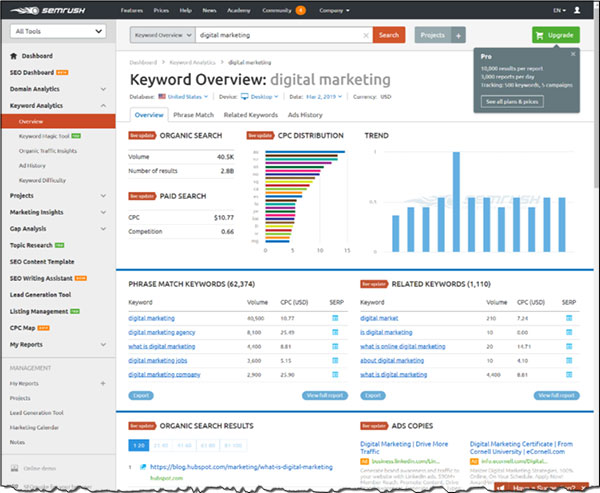
SEMrush gives you all the information you need on the keywords you’re researching. The overview gives you data on organic vs. paid search, CPC distribution, and search trends.
Their Keyword Magic Tool was recently named the Best Digital Tool in PubCon’s 2019 Interactive Marketing Awards. It gives you the keywords you need to build your most profitable campaign.
LongTailPro
Paid | $
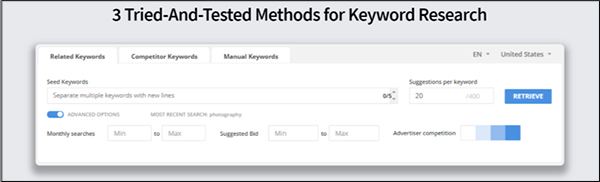
With LongTailPro, you enter the seed keyword and get hundreds of long-tail suggestions—less competitive keywords that you have a real chance of ranking for. You can also run keyword and competitor analysis, identify the keyword difficulty of your keywords, and track your rankings.
KWFinder by Mangools
Paid | $
KWFinder gives you many of the same features you get with the top-of-the-line keyword research tools, but at a price that fits into any budget. You’ll get:
Keyword difficulty
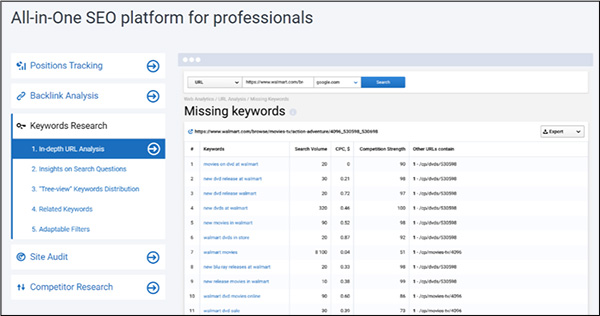
The keywords your competitors are missing
Search volume for variant keywords
Local keywords
You also get the full SEO suite of tools, including SERP analysis, rank tracking, backlink analysis, and website analysis.
(NOTE: Need a helping hand with your digital marketing efforts? Or maybe you just want proven, actionable marketing tools, tactics, and templates to implement in your business? Check out the latest deal from DigitalMarketer, and you will be on your way to helping your business grow.)
SpyFu
Paid | $
For competitor research, SpyFu is your go-to tool. With this one, you get every resource you need to spy on your competitor’s Adwords and SEO campaigns:
Adwords competitor keywords
Competitor Adwords campaign and ad test history
And SpyFu’s Adwords advisor
In case you’re uncomfortable with spying on your competitors, be aware, it’s a useful (and common) approach to SEO strategy. If you know what your competitors are doing, you can learn what’s working for them, which means you can boost traffic and generate leads with less guesswork. The key, of course, is to use your powers for good, not evil.
Jaaxy
Paid | $
Developed by affiliate marketers for affiliate marketers, Jaaxy helps you manage all aspects of keyword, website, competition, and market research. Data is pulled from Google, Bing, and Yahoo, giving you 99.7% search engine coverage.
We’re not sure you need to be an affiliate marketer to get value from this tool. Keyword research is keyword research, after all.
Market Samurai
Paid | $
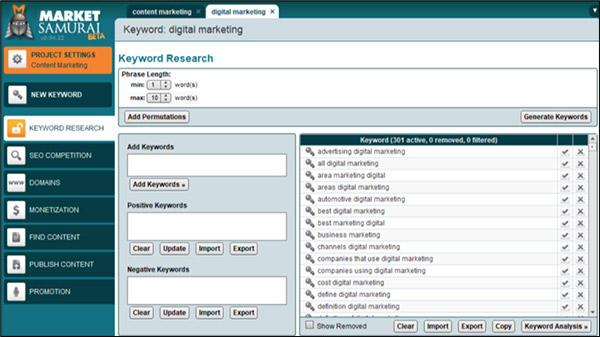
Market Samurai is a simple, intuitive keyword research tool that fits into any budget. Simply type in your seed keyword and click “Generate.” You’ll get a list of keywords that have high traffic, high profit potential, and suitable phrase match competition.
We like this tool because once you have your keywords chosen, it will help you do competitive research, publish high-quality content that drives traffic, and monetize your traffic. An all-in-one package at a reasonable price.
Keyword Snatcher
Paid | $
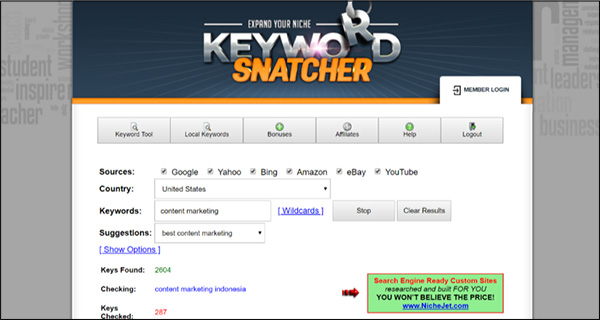
Keyword Snatcher generates thousands of keywords for your campaigns by pulling data from Google, Yahoo, Bing, Amazon, eBay, and YouTube. Users love how easy it is, and they appreciate having such a comprehensive list of keywords to target in their content.
With this tool, you’re just getting keyword suggestions. There’s no data about search volume or keyword difficulty. But for a comprehensive list of keywords you could be targeting in your content, this is the tool of choice.
SERPStat
Paid | $
With SERPstat, you can find long-tail keywords and keyword variations while exploring trends and keyword suggestions. You’ll also get performance indicators, such as search volume, cost-per-click, and competition level. All plans give you access to 230 Google and 9 Yandex databases.
Ubersuggest
Free
Getting started with Ubersuggest is easy. Just type in a domain or seed keyword to get started. You’ll get a domain overview, top SEO pages, keyword suggestions, content ideas, and backlink data—similar to a paid tool, but completely free. This one is definitely worth checking out.
(NOTE: Need a helping hand with your digital marketing efforts? Or maybe you just want proven, actionable marketing tools, tactics, and templates to implement in your business? Check out the latest deal from DigitalMarketer, and you will be on your way to helping your business grow.)
Answer the Public
Free
As part of your keyword research, you need to figure out what people are asking when searching for your keyword. Answer the Public doesn’t just list the questions people are typing into search engines, it organizes them by the type of question.
The results will give you a good understanding of the search intent related to your keyword, and the information you need to include on your pages to rank well for that intent.
FAQfox
Free
Like Answer the Public, FAQfox helps you get a better handle on user intent, so it’s easier to find your best keywords. This tool does that by identifying your customers’ core wants and needs, so you can choose the keywords that are most likely to resonate with them.
Google Keyword Planner
Free
Google’s Keyword Planner is the original keyword research tool. It helps you discover new keywords, figure out how often keywords are searched, and how those searches have changed over time. That helps you identify the keywords that are most likely to give you the best traffic and conversions.
Seed Keywords
Free
Seed Keywords helps you find keyword ideas when you’re just starting a campaign, trying to figure out which search terms to optimize for. It lets you create a scenario, such as “When looking for the best pizza in your town, what do you search for?” Seed Keywords then gives you a link you can send to your friends, so you can get their input.
The concept is simple: to discover what real people are searching for, ask real people.
Soovle
Free
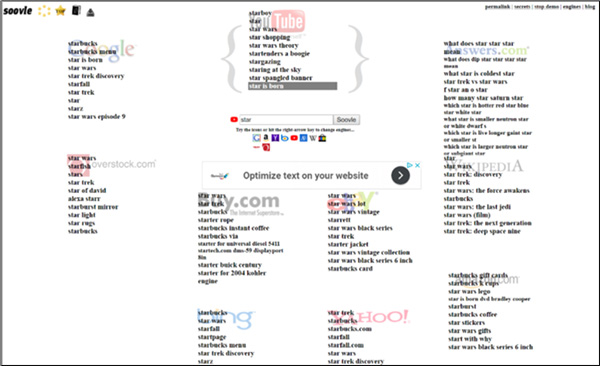
Soovle pulls data from a wide range of search engines to tell you what people are searching for related to your keyword. Just type it into the search bar, and “Soovle it.” The results aren’t pretty, but for free research, it’s a good option.
Back to You
Effective SEO depends on strategic keyword research. The best tools are often the most expensive, but as you can see, there are plenty of keyword research tools available for every budget and need.
Whether you’re trying to understand what your market is searching for, find the keywords that are the easiest to rank for, or identify your most profitable keywords, there’s a tool that’s right for you.
(NOTE: Need a helping hand with your digital marketing efforts? Or maybe you just want proven, actionable marketing tools, tactics, and templates to implement in your business? Check out the latest deal from DigitalMarketer, and you will be on your way to helping your business grow.)
(Reuters) – British companies spent more on marketing in the opening quarter of 2019 despite uncertainty around Brexit, but their budgets for the rest of the year could be the most subdued since after the financial crisis, a survey showed.
The IPA Bellwether survey, conducted by IHS Markit, showed on Wednesday that 21.6 percent of marketing executives raised their budgets during the quarter, while just under 12.8 percent of executives who took part in the survey cut their marketing budgets.
“This sharp increase following Q4 2018’s flatlining signals that UK marketing budgets have received a much-needed kiss of life in an economy gripped by Brexit uncertainty,” IPA Director General Paul Bainsfair said.
Bainsfair, however, added that the forecast for the year ahead was uncertain given the seemingly endless negotiations around Britain’s exit from the European Union.
The report showed that cautious undertones were still apparent in budget plans for the current financial year, with panelists providing only modest growth expectations in available marketing spend.
Brexit was postponed by a late-night agreement in Brussels last week that gave Prime Minister Theresa May until Oct. 31 to persuade parliament to approve the terms of the country’s departure.
“A return to growth in marketing budgets during the opening quarter of 2019 may come as a surprise given that the uncertainty that shrouds the UK political and economic climate has only built further,” said Joe Hayes, economist at IHS Markit.
A six-year run of marketing spending growth at British companies ended in the final quarter of 2018 as uncertainty over Brexit led companies to clamp down on costs.
While Brexit uncertainty continued to prompt belt tightening and a delay in decision-making, some companies pushed resources into their brands in the first quarter, the report showed.
The survey found that the best performing category was internet with its net balance seen at a growth of 17.2 percent in the quarter.
The rise in marketing spend was supported by demand for big ticket advertising campaigns such as those on TV and radio. The survey also flagged that marketing executives expect further growth in traditional media advertising through the year.
Around 300 UK marketing professionals, primarily from Britain’s top 1,000 companies and across all key business sectors, were interviewed for the survey.
When starting a business, rule number one is to know who your customer is. Knowing your customer is the foundation for any successful venture because it will influence your content, marketing, product development—basically every aspect of the company. Yet, deciding on a niche isn’t always easy. The initial temptation is to go broad so that you’re not excluding potential customers. Unfortunately, that approach leads to what used to be dubbed “spray and pray” marketing—a term describing how irrelevant messages get sent to generic audiences in the hope that something will stick. The result when you try to sell to everyone is that you sell to no one. A more solid approach is niche marketing which refers to a strategy that focuses on a unique target audience.
Here are five steps that any business owner or entrepreneur can use to find that perfect niche.
1. Do some soul-searching
If you don’t really care about the work you’ll be doing you definitely won’t be successful. Being an entrepreneur has a lot of ups and downs and the only way to get through those periods is to have a passion for the work itself. Your niche should arise naturally from your goals, interests, and values. The best ideas for a niche market will come from your own experience.
Ask yourself questions like:
What special skills have I developed?
What would I love to do even if I wasn’t getting paid for it?
What do I enjoy doing so much that I lose all track of time when I’m doing it?
Is there a pain point I’ve been encountering that I’d like to solve for myself and others?
If I had all the time and money in the world and I knew I couldn’t fail, what would I be doing?
Once you have a preliminary idea for a niche, survey that target market to uncover their pain points. Take a look at sites like Facebook, Twitter, Redditt and Quora to see what dialogue people are having. What questions are they asking and what problems are they experiencing? Facebook is especially useful because you can join groups where your target market is present and be a part of their conversations. Offer to help people with their issues and start testing your product or service that way. Create a Meetup group so you can get ideas by personally interacting with your target audience. Surveys are another option to better understand your niche. Tools like SurveyMonkey or Survey Gizmo make it easy to create custom surveys without all the complexity.
3. Research the competition
No matter what niche market you are pursuing, you should definitely investigate your potential competitors. Is there even a market for your niche? Start entering keywords into Google that your target audience would use and see what appears. Is there an opportunity for you to stand out in the crowd? How will you plan to differentiate yourself? If you find a keyword that has substantial traffic but little competition and paid advertising, that might be an excellent chance for you to insert yourself into that market. Also, take a look at your competitor’s content and see how valuable it is. You might be able to uncover an opportunity to deliver a superior product.
4. Assess potential profitability
Now it’s time to determine whether you can profit from your niche market! After doing a Google keyword search, the next step is to explore Google AdWords Keyword Planner. Search for those same keywords and see if any terms result in at least 10,000 searches per month. If you find keywords with substantial search volume, that’s usually a good indicator of a potentially profitable niche. Google Trends is also a useful tool to dig into trending topics. Another idea is to search for those same terms on Amazon and see what pops up. Finally, Clickbank is a helpful resource. This online retailer boasts a library of over 6 million unique products created by passionate entrepreneurs. Doing research there will give you some indication of whether there is a potentially profitable niche market. Ideally, you have narrowed your selection down to a niche that has both a need and a market where people will pay for your product or service.
5. Test your idea
The last step is to validate your idea. Initially, you can reach out to your network of friends and acquaintances to see if they would be interested in your new product or service. You can contact them via email and Facebook asking if they’d like to make a purchase and point them to your PayPal account for payment (even before you have a product to sell). If you end up with a bunch of sales, that’s a great validation of your niche market. Setting up a crowdfunding campaign on sites like Indigogo or Kickstarter is another way to validate your product and also collect money upfront to fund the business. If you’d like to go a step further, you don’t necessarily need to create a full website. Tools like Leadpages make it easy to set up a simple landing page promoting your idea and you can use paid advertising to drive traffic to that page. Even if you don’t seem to gain traction, it could still be a viable niche. You might need to refine your messaging or find a better offer. You can also set up some A/B tests to determine if using a different landing page template delivers better results.
Once you’ve followed the previous steps, just go for it! You can do all the research in the world but until you finally get out there, you’re not going to know how your niche is going to respond to your offering. Remember to remain flexible and continue to make adjustments along the way. Stick with it, and eventually, you will crack the code that will open the door to that ideal niche market.
I’m a business and life coach who helps people escape their 9-5 jobs, so they can find fulfillment working for themselves. As the founder of Corporate Escape Artist, I made the leap to entrepreneurship after a successful 25-year corporate marketing career and have never looked back. Prior to Corporate Escape Artist, I held executive leadership roles in small tech firms as well as Fortune 500 companies like AMD, Dell, and Sony. I have an MBA from the Thunderbird School of Global Management and am a Certified Professional Coach (CPC) and Energy Leadership Index Master Practitioner (ELI-MP). In addition to Forbes.com, I also contribute to Thrive Global and enjoy inspiring others through my weekly Facebook Live show and my blog on CorporateEscapeArtist.com.
Diversifying attention is the only way to build a real long term business.
So many people only focus on the platform that’s getting the most reach and ignore the rest.
People make this mistake all the time. How many artists and bands on MySpace ignored Facebook, and then disappeared when MySpace became irrelevant? How many Vine stars dominated that platform, but “fell off” when attention shifted? How many influencers with a lot of Instagram followers will become irrelevant when attention shifts away from Instagram?
Because I promise it’s going to happen one day.
That’s why I talk so much about tasting and exploring other platforms. It’s why I’m on virtually every platform – Snapchat, YouTube, Twitter, Facebook, Instagram, LinkedIn, Podcasts, written word (on my blog), and more.
That’s why I’ve won and built big followings everywhere in a world where so many influencers rise and fall.
In this article, I’m going to articulate a concept I call the “79 / 21 rule” to build a long term business by not putting all your eggs in one basket.
If You’re Not Diversifying Your Social Media Strategy, You’re Vulnerable
First of all, even getting to a point where you’ve built an engaged following is super difficult – so I’m pumped if you’re there already.
But I’m also scared for you.
I’m honestly more worried about those who are starting to win on platforms like LinkedIn or Instagram because that’s when they start to get complacent. They start to put “what’s working” on a pedestal and start romanticizing it — just like bigger businesses put channels like billboards or television commercials on a pedestal even though they don’t work nearly as well anymore.
It’s happening right now with people who are winning with AdWords and landing page optimization (as the world becomes more mobile and brand-focused). It happened with MySpace stars. And it’ll happen with Instagram influencers.
It’s human nature.
Most people who are on social spend 100% of their time on the hottest platform, and only put in about 70% effort into it.
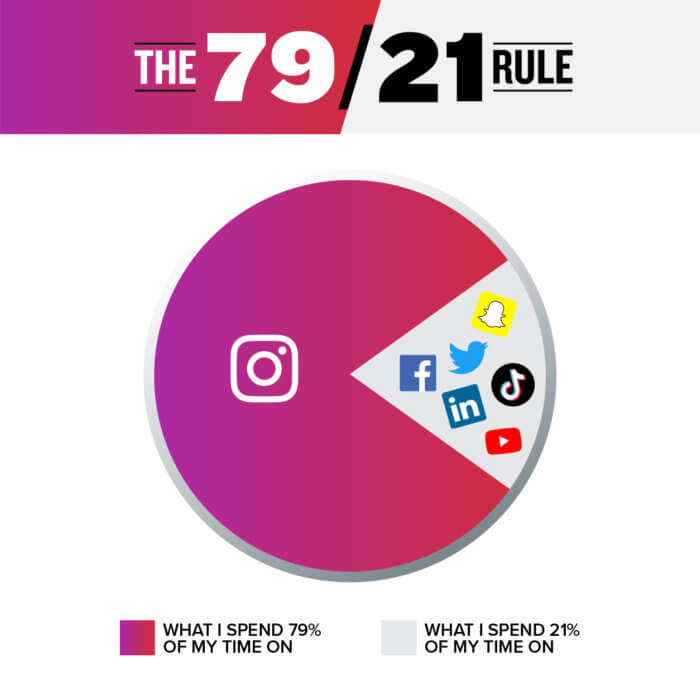
I spend about 80% of my time on the hottest platform, go as hard as I possibly can on it, and spend 20% of my time getting a feel for everything else.
I call it the 79 / 21 rule, just to be a little different
Here’s the best articulation of how I think about it:
Right now, my 79-80% is spent on Instagram because it’s the most popular. I’m going the hardest on it.
And I spend 20-21% of my time on platforms like LinkedIn, Snapchat, Tik Tok, YouTube, and other stuff. Within that 20%, there are some platforms that get higher priority – LinkedIn is something I’m very, very bullish on right now so I’m spending a lot of time on it. Tik Tok is something I’m really excited about too.
The “79 / 21” rule is about diversifying attention. It’s not just about social media.
Before Facebook and AdWords existed, my “80%” was spent on email marketing. My “20%” was print, radio, direct mail, and AdWords.
Once AdWords really took off, that became my 80% and email went in my 20% along with platforms like YouTube that were up-and-coming.
When YouTube popped, that became my 80%, and up-and-coming platforms like Twitter went in my 20%.
When Twitter blew up, that went in my 80%.
See where I’m going here?
“If Instagram or LinkedIn become irrelevant, something else is going to take its place. Can’t I just focus on the new platform after that happens?”
You don’t have to be the first mover to win on a platform, but it really, really helps.
I got a million followers on Twitter early because I was one of the most active people on there up front — so I got featured on the “suggested users” list and many people who signed up for Twitter followed me.
As attention shifts away from the main platform, it’ll go to the platforms in your “20%.” And those who are active on the secondary platforms will siphon most of the attention first.
“But I have a t-shirt company that targets kids. Do I really need to be active on LinkedIn?”
I would reverse engineer the audience.
LinkedIn’s organic reach is so incredible right now that it’s my top priority within my “20%.” It’ll go away in a year. Before that happens, it would be really smart for you to take advantage of it.
If you’re making t-shirts, what kind of premium product can you make for business people? How could you take your product and create content around it contextual to a business-world?
For example, if I’m selling sneakers, the post I’m putting up on LinkedIn might be something like “hey, want to look fresh in the office?” On Instagram, it’d have a totally different context.
“Instagram is basically copying Snapchat, and it has more reach. Why do I need to be on both?”
Because you have to be very careful when you say something is “dead” or “irrelevant.”
People said Twitter’s dead, then it started getting more important.
Several years ago, people never thought you could create content on LinkedIn, then things started changing in the last year or so.
When DJ Khaled posted those snaps from his jet ski, that started the process of Snapchat getting more and more traction. There could literally be another moment like that tomorrow, or a new feature that Snapchat releases that puts Snapchat back on the map ahead Instagram in my “80%.”
Startups that have a great marketing plan and product are leaps and bounds ahead of many starting a business. One of the first questions that’s posed is whether the company is going to take on the marketing themselves or outsource their marketing to an agency. The fact is that both of these options have their merit as well as disadvantages. Taking on your marketing as a start-up founder allows you to control each aspect of the marketing campaign, but this can be risky since many start-up founders might not be too well-versed in marketing.
Outsourcing your startup marketing can be risky as well as not all marketing companies are created equal. With a small budget, one marketing company that doesn’t deliver then cash flow can be limited without any return.
Self-Education
Self-education in the marketing realm is challenging but very possible. There are training programs for nearly every part of online marketing like PPC, Google Adwords, and affiliate marketing. If you want to learn Adwords or PPC, then you should review which classes/certifications garner the best results. After you have self-educated, it is important to remember that your training was not industry specific. For this reason, it is essential to try a few different approaches to things like content marketing, SEO and, PPC.
Finding the tactics with the most substantial ROI might take a few months to find the optimal process. The education can also be offered to your staff as this will help them understand the marketing strategy in a more profound way. Many of these classes can be written off come tax time so do not look at this education as money spent, but rather an investment in the company as well as its people.
Become an Industry Thought Leader
The founder of a start-up generally gets quite a few responses when outreaching to industry publications. For this reason, you should spearhead becoming a thought leader in your industry. This doesn’t mean that you always have to write articles, but it can mean being a part of a podcast or agreeing to be interviewed. The companies of thought leaders in an industry tend to get leads just because of the highly revered name of the founder. As the founder, you should take it as a personal mission to become widely known throughout an industry.
Other opportunities to establish yourself in an industry is that of conferences. At specific conventions, there are openings to speak about something specific which can do a multitude of good for the speaker. This presentation can be shared as well as a substantial increase in sales can be achieved after the presentation. As we all know conferences are a hotbed of deals being made so giving a great presentation could seal a massive deal for your startup.
Build Your Team
Building a great team can be difficult, but it has numerous advantages. This team will have no learning curve when it comes to the brand that you want to build as this can be instilled in them with training and reminders. An in-house team will also be directly accountable, while a contractor can push responsibility onto their employees. This team in-house is an investment; but with the conversions the marketing team can bring in can be an excellent basis for the beginning of a start-up.
How to build the perfect team:
• Find a great content strategist who can keep your content calendar exciting and informative.
• A social media coordinator isn’t always needed, but someone who writes excellent social media copy is. This can be a contract or piece-by-piece position. A copywriter you have on board can do a month’s worth of tweets using Hootsuite within a few hours. Automating all of the posts should be done carefully as this post points out what could go wrong.
• Talented writers are a must in an online marketing campaign, so find a few contractors while having a writer or two in-house for rush assignments.
• A person who specializes in other types of content like video or infographics can be quite valuable. Content shouldn’t just be in written form so diversify your team with a person who specializes in these content mediums.
Take Advantage of Free Marketing
Social media can market every business regardless of size or industry. The fact social media is also free makes it necessary to create social media accounts for your start-up. This can be a great place to engage with those who might be potential customers. Creating a buzz via social media for a start-up can be invaluable. Name recognition is something all start-ups strive for during their infancy. Social media profiles are often some of the first Google results for a company. Engaging with others in your industry can be an excellent way for the company to network as well as possibly drum up some new business.
Other free marketing opportunities are things like directories as well as forums. These are not as effective as social media, but without cost, there is no real risk. Subreddits are a great place to get real feedback about products or ideas. Even though this isn’t marketing it can be used as a test group as many people on Reddit are there to help and educate.
Taking on marketing, in-house and personally, as a founder of a start-up can be quite a responsibility. Build the best team possible to market as well as establish yourself individually in the industry and watch the leads/sales stream in. Marketing in-house isn’t always an option, but it should at least be considered.